O R I G I N A L A R T I C L E
Deliberative Performance of Television
News in Three Types of Democracy: Insights
from the United States, Germany, and Russia
Hartmut Wessler & Eike Mark RinkeUniversity of Mannheim, Institute for Media and Communication Studies, D-68159 Mannheim, Germany
We show that television news is considerably more deliberative in established (United States, Germany) than in defective democracies (Russia) and slightly more deliberative in a power-sharing political system (Germany) than in a power-concentrating system (United States). We further demonstrate that public-service channels, nonpartisan programs, and in-depth news shows make stronger overall contributions toward deliberativeness than their respective counterparts. While national news cultures produce distinct national styles of mediated deliberation, individual channels in the United States (Fox, CNN) and Russia (REN) cut across these national patterns. The significance of deliberative media content for citizens and political elites is discussed.
Keywords:Deliberation, Television, News, Journalism, International & Comparative, Quantitative Content Analysis.
doi:10.1111/jcom.12115
The democratic performance of the news media has been a central concern for com-munication scholars from Walter Lippmann (1922) to Denis McQuail (1992) and C. Edwin Baker (2002), and the discussion continues to this day. Most would agree that democracy cannot function well if important social groups are excluded from public debate in the news media, if that debate amounts to nothing but an empty shout-ing match, or if political news ignores the substance of actual political decisions. But coming from such common sense perceptions, how can we capture the contribution of news media to democratic life in a systematic and meaningful way? Any attempt in this direction faces at least three main challenges: (a) choosing theoretically meaning-ful performance criteria, (b) choosing empirically relevant media types and outlets, and (c) selecting the right kind of countries to capture the full range of democratic performance.
Deliberative News Performance H. Wessler and E. M. Rinke
Concerning the normative criteria we heed the call by Althaus (2012) for a “sys-tematic normative assessment” that taps existing normative theories of democracy to derive performance standards, instead of ad hoc judgments. In this study we delib-erately draw on the most demanding variant, the theory of deliberative democracy. Deliberative theory favors civil, argumentative exchange and thus exceeds the sparser demands of its liberal, republican, and agonistic counterparts (Baker, 2002; Ferree, Gamson, Gerhards, & Rucht, 2002; Strömbäck, 2005; for a particularly undemanding version see Zaller, 2003). The explicit development of normative performance criteria for the news media is also more advanced in the deliberative than in other traditions (see Gastil, 2008; Wessler, 2008).
With respect to media types we focus on television news in commercial, public-service, and state-controlled channels. It is striking that deliberative qualities have been studied in print media (e.g., Dekavalla, 2012; Ferree et al., 2002), talk radio, and television talk shows (e.g., Jacobs & Townsley, 2011; Mutz, 2007) as well as online discussion forums and blogs (e.g., Xenos, 2008), but that television news has been largely neglected. After all, television news is the most important source of political information for most people in most countries (see Papathanassopoulos et al., 2013; Trilling & Schoenbach, 2012) and television exposes viewers to alternative viewpoints more often than newspapers and thus should support deliberative qualities in citizens more strongly (Goldman & Mutz, 2011).
Finally, most studies of the news media’s democratic performance focus on a nar-row group of established democracies in the West (e.g., Esser, 2008; Hallin & Mancini, 2004).The third challenge therefore lies in covering the range of democratic systems to also include unstable and defective varieties (Merkel, 2004). The defective democ-racy we look at in this study, Russia, qualifies as both “illiberal” with deficiencies in the rule of law and weak judicial oversight of the executive and legislative branches, and “delegative,” in the sense that power is delegated to a strong president who then rules as he pleases (Voltmer, 2012). Investigating news discourse in Russia helps put into perspective the differences found among the more widely studied Western democracies.
We will start with an overview of the limited existing research on cross-national differences in deliberative media performance, present a multidimensional construct of deliberativeness in television news, and develop hypotheses and a research question about the impact of system, organizational, and news format variables on the deliber-ative features of television news. We then present findings from a large-scale analysis of television news content in the United States, Germany, and Russia and spell out the factors conducive (and detrimental) to deliberative performance. Finally, we map the characteristics of mediated deliberation as realized in television news shows in a single two-dimensional space and analyze cross-national similarities and differences.
Mediated deliberation in television news and across systems
According to a systematic search on theCommunication and Mass Media Complete journal database andGoogle Scholarabout 70 publications in the last two decades
explicitly employ a deliberative framework in analyzing media content.1Twenty-two
publications focus exclusively or partly on television content. These studies follow different methodological approaches and typically use a small number of diverse mea-sures of deliberativeness ranging from actor and idea inclusiveness to justification of and dialogue between different positions. A comprehensive instrument that system-atically gauges the input, throughput, and output aspects of deliberation in television news is lacking, however.
In addition, the existing studies do not systematically reflect on how particular levels and forms of deliberation in television news relate to different empirical models of democracy and different types of media organizations (for an exception, see Benson, 2013). Ferree et al. (2002) study one issue, the debate about abor-tion legislaabor-tion, in United States and German newspapers and show that the U.S. debate is more inclusive—featuring more people affected by the problem and more “ordinary citizens”—than the German debate, but that levels of dialogue and civil-ity are quite similar in the two countries. Benson (2013) compares United States and French newspapers and television news and finds that due to differences in press–politics interactions and news formats French media generally provide more diverse perspectives on social issues, more in-depth information and critical debate (p. 206). Finally, Wessler (2008) argues that print media in countries conforming to Hallin and Mancini’s (2004) media system types—liberal, democratic-corporatist, polarized-pluralist—should differ systematically in the kind of mediated deliber-ation they offer. He proposes a research strategy for investigating deliberativeness comparatively so as to detect the structural and cultural prerequisites of mediated deliberation. Our study builds on and extends the comparative argument made by all three studies and uses discourse criteria developed by Ferree et al. (2002) and Wessler (2008).
Criteria of deliberativeness: The dependent variables
Deliberative News Performance H. Wessler and E. M. Rinke
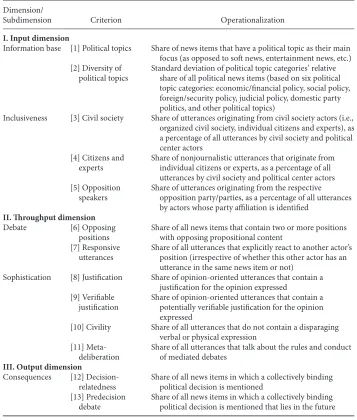
Table 1 Criteria of Deliberativeness Used in this Study
Dimension/
Subdimension Criterion Operationalization
I. Input dimension
Information base [1] Political topics Share of news items that have a political topic as their main focus (as opposed to soft news, entertainment news, etc.) [2] Diversity of
political topics
Standard deviation of political topic categories’ relative share of all political news items (based on six political topic categories: economic/financial policy, social policy, foreign/security policy, judicial policy, domestic party politics, and other political topics)
Inclusiveness [3] Civil society Share of utterances originating from civil society actors (i.e., organized civil society, individual citizens and experts), as a percentage of all utterances by civil society and political center actors
[4] Citizens and experts
Share of nonjournalistic utterances that originate from individual citizens or experts, as a percentage of all utterances by civil society and political center actors [5] Opposition
speakers
Share of utterances originating from the respective opposition party/parties, as a percentage of all utterances by actors whose party affiliation is identified
II. Throughput dimension Debate [6] Opposing
positions
Share of all news items that contain two or more positions with opposing propositional content
[7] Responsive utterances
Share of all utterances that explicitly react to another actor’s position (irrespective of whether this other actor has an utterance in the same news item or not)
Sophistication [8] Justification Share of opinion-oriented utterances that contain a justification for the opinion expressed
[9] Verifiable justification
Share of opinion-oriented utterances that contain a potentially verifiable justification for the opinion expressed
[10] Civility Share of all utterances that do not contain a disparaging verbal or physical expression
[11] Meta-deliberation
Share of all utterances that talk about the rules and conduct of mediated debates
III. Output dimension
Consequences [12] Decision-relatedness
Share of all news items in which a collectively binding political decision is mentioned
[13] Predecision debate
Share of all news items in which a collectively binding political decision is mentioned that lies in the future
First, on theinputside of television news discourse deliberative democratic theory is particularly concerned with the openness of debate. No contentious issue should be permanently suppressed and the range of voices should not be structurally cur-tailed (see Ferree et al., 2002, pp. 232–236; Gastil, 2008, p. 52). By opening up public debate both in a topical and in a social sense the news media should redress some of the inequalities in media access that exist because actors command different lev-els of resources to express their views. The most basic value in public deliberation consists in “creat[ing] a solid information base” (Gastil, 2008, p. 52) for television
users to draw on. From a deliberative point of view theshare of political content [1] should be high compared to other content, particularly soft and entertainment news. In addition, television news should not focus on a few issues all of the time. Conse-quently, thediversity of political topics[2] is a second important standard that has not been investigated in prior research. Concerning the range of different voices heard in the news it is particularly important for Habermas (1996, pp. 359–387) that pow-erful actors from the center of the political and economic systems are supplemented by actors from the periphery such as civil society organizations, experts, and ordi-nary citizens (see thecivil society[3] criterion in Table 1). Attached to this criterion is the expectation that the top-down, routine mode of political decision-making be reversed every now and then and societal concerns channeled “upward” into the polit-ical power centers. In addition, a particular premium is placed on actors such as intellectuals, experts, and individual citizens, who primarily contribute ideas to public discourse rather than articulating their own interests (Peters, 2008). These actors are seen as least detached from the authentic concerns and communicative rationality of the life-world. For this reason we include a second, narrower criterion of inclu-siveness in our analysis (citizens and experts[4]).2 Finally, inclusiveness should also
be understood in political-institutional terms. For open democratic debate to thrive, opposition parties must be given a public voice and government speakers must not remain uncontested in public discourse. Thus we include the share ofopposition speak-ers[5] as our final criterion of inclusiveness.
Deliberative News Performance H. Wessler and E. M. Rinke
consequences of exposure to political disagreement (e.g., Mansbridge, 1983; Mutz, 2006)—a recognition that has been shown to apply to mediated deliberation as well (e.g., Mutz, 2007).3A final yardstick for the sophistication of public deliberation is the
degree to which it carries a potential for self-reflexivity in the form of metadelibera-tion[11]. Underlying this criterion is the realization that any democratic polity needs practices that facilitate continuous democratic innovation (Fung, 2012). Discussing the terms and conditions of public debate thus becomes a society-wide democratic endeavor and indeed a fundamental question of social justice (e.g., Gamson, 1999).
Third, on the outputside of mediated deliberation it is important to recognize that “[d]iscourses do not govern. They generate a communicative power that cannot take the place of administration but can only influence it.” Habermas (1992, p. 452) thus succinctly points to the limitations of mediated deliberation on the output side, but also to its necessary connection to political decisions. In assessing the delibera-tiveness of television news across issues, organizations, and countries it is impossible to directly measure the clout of that communicative power in influencing political decisions. The deliberative function of television news rather lies in enabling citizens to generate informed opinions and engage in meaningful political activity in order to influence decisions themselves. Therefore, television news should point out how political debates are connected to political decisions (decision-relatedness[12]) and, even more importantly, to do so before the respective decision is taken (predecision debate[13], see Higgins, 2006). Note that deliberative theory does not have to assume that mediated deliberation leads to or should lead to substantive consensus in public discourse itself, as some have argued it does (e.g., Ferree et al., 2002; Gerhards, 1997). By casting the output dimension of mediated deliberation in terms of its topical and temporal relation to political decision-making we circumvent the conceptual prob-lems that arise when the consensus-orientation of communicative action (Habermas, 1987) is transposed too literally as the desired outcome of public debates (for a similar argument see Rinke, Wessler, Löb, & Weinmann, 2013).
It should be noted that, conceptually, each of the 13 criteria is normatively relevant independent of the others. For example, it constitutes a deliberative gain if speakers justify their positions, even if these speakers were only members of the elites (and inclusiveness would therefore be very low). Conversely, it is normatively desirable to have a diverse actor set including civil society actors in TV news programs, even if none of these actors justifies their positions. Theoretically, therefore, the 13 criteria are independently valuable and thus carry the same level of normative importance.
Structural prerequisites of deliberative television news
With the 13 criteria mentioned we have a comprehensive theoretical basis for the relative assessment of deliberativeness in different television news shows. But what are the conditions conducive to deliberative performance? The scarce literature on the topic does not offer a fixed set of likely explanatory factors. Rather, these have to be carved out of various separate strands of research in communication and political science. On the macrolevel of the political system, the distinction between established
and defective democracies is important. Defective democracy is an umbrella term for various structural deficiencies including limitations on press freedom, strong state dominance in the media system, and a weak civil society (Vartanova, 2012). It stands to reason that all of this will limit the inclusion of nonstate actors in mediated delib-eration (input) as well as effective debate between well justified opposing positions (throughput). Television news in established democracies will be more deliberative than in defective democracies (H1).
It is less clear, however, whether the deliberativeness of television news will differ between our two cases of established democracies, Germany and the United States. Several authors have pointed to the impact of political system variables on the shape of mediated deliberation (Ferree et al., 2002; Kriesi, 2004; Hallin & Mancini, 2004; see also Nir, 2012a, 2012b). The distinction between majoritarian and consensus democracies (Lijphart, 2012), especially the degree of institutionalized power-sharing between executives, parties, and other political interest groups on what Lijphart calls the executives-parties dimension, plays a prominent role here (Kriesi, 2004). The United States is a moderate majoritarian system on this dimension, with power concentrated in the hands of the majority party and elected president, and Germany a moderate consensus system, in which power is shared between several parties in coalition governments (Lijphart, 2012, p. 244).4Kriesi (2004) argues that consensus
systems tend to produce less mediated public contestation. Political actors in coun-tries with highly fragmented political power structures are expected to rely less on strategies of public contestation to galvanize voters or negotiate political positions, but more on behind-the-scenes negotiations (Pfetsch, 2003). Nir (2012a, 2012b) on the other hand argues that power-sharing systems produce more public delibera-tion because the higher number of political parties creates incentives to stake out ideological differences more clearly for voters. If the influence of the political system on the quantity of mediated deliberation is unresolved, its effect on deliberative quality is even more unclear. Instead of formulating a hypothesis we therefore revert to the following research question: Will television news be more deliberative in a majoritarian or in a consensus democracy?
Deliberative News Performance H. Wessler and E. M. Rinke
in public-service than in commercial channels and deliberativeness in both of these types will be higher than in state-controlled channels (H2).
State-controlled channels can be either owned by state agencies exerting direct command or privately owned and more indirectly controlled through intimidation. The latter type, which we call semiautonomous, should exhibit somewhat stronger deliberativeness than the state-owned type. In a defective democracy, television news in semiautonomous channels will be more deliberative than in state-owned channels (H3).
Commercial channels, on the other hand, can either follow the historically dom-inant “catchall formula” by attracting viewers from all sides of the political spectrum or they may advance the partisan politics of their owners or supporters. Partisanship can be expected to curtail the inclusiveness of mediated debate by privileging speakers from one camp. In established democracies, television news in nonpartisan channels will be more deliberative than in partisan channels (H4).
Finally, on the microlevel of editorial decisions about individual shows televi-sion news has been subject to a diversification of formats. To keep things simple and applicable across different national contexts we distinguish two main formats: fact-centered newscasts that mainly feature items read out by anchors and relatively short preproduced video reports on one hand; and focused, in-depth news shows that concentrate on a limited number of topics and offer interviews and longer background pieces on the other. Evidently, in-depth news shows offer more possibilities for jour-nalists to feature different voices presumably making them more inclusive, responsive, and argumentative than fact-centered newscasts. Focused in-depth news shows will be more deliberative than fact-centered newscasts (H5).
Method
The data to test the above hypotheses and answer the research question were gener-ated in a large-scale quantitative content analysis of the main evening television news programs from ten national television stations in the United States, Germany, and the Russian Federation (see Table 2).5 The choice of channels was based on
considera-tions of their prototypicality for the respective combination of attributes in each cell and their market share in the respective segment.6
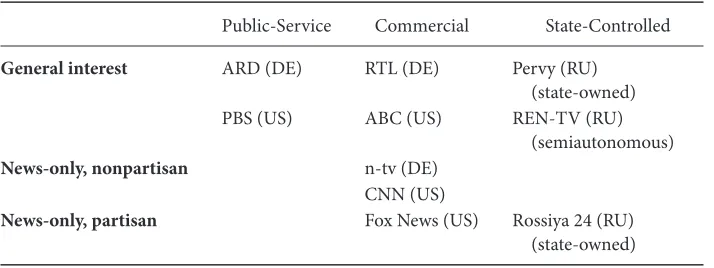
On the one hand we look at general-interest television stations of the public-service, the commercial, and the state-controlled variant. The two Russian general-interest channels differ in the degree to which they are subject to direct government influence: REN-TV manages to insulate itself somewhat from direct government interference, which is why we label it semiautonomous, while Pervy is directly subjected to state control. We also study news-only television channels, which are either nonpartisan (n-tv, CNN) or partisan (Fox News, R24).7Among the
newscasts aired by these different types of television stations four are focused in-depth news shows (CNN’sAnderson Cooper 360∘
, ARD-Tagesthemen, PBS’sNews Hour, and Fox News Channel’sFox Report); all others are more fact-centered newscasts.
Table 2 Typology of Television Channels Studied
Public-Service Commercial State-Controlled
General interest ARD (DE) RTL (DE) Pervy (RU)
(state-owned)
PBS (US) ABC (US) REN-TV (RU)
(semiautonomous)
News-only, nonpartisan n-tv (DE)
CNN (US)
News-only, partisan Fox News (US) Rossiya 24 (RU)
(state-owned)
For each of the channels in our sample, we analyzed data from two constructed weeks random-sampled from the 6-month periods between 1 October 2009 and 31 March 2010 and from 1 April 2010 to 30 September 2010. All sampled newscasts were recorded and the audiovisual material was coded directly without using tran-scripts. Variables were measured for two units of analysis: news items (“stories”) and, nested within them, utterances made by or attributed to actors. An overview of our operationalizations is given in Table 1; the complete unitizing and coding protocol is available in the Online Appendix (located at http://mkw.uni-mannheim.de/hwessler). Coding was done by eight student coders who underwent intensive, multiwave coder training (approximately 50 h per coder). The analysis included a total of 2.340 news items, and 10.308 direct and quoted utterances. Several measures were taken to ensure high data quality. All coders received the exact same training and instructions and were fluent in German and at least one of the two other source languages (English and Russian). Coders were rotated over the material so as to code news content from Germany and at least one other country (Russia or the United States) to ensure an even spread of possible remaining idiosyncratic coding error across at least two countries and prevent undue bias in the data for any single country. In addition, the entire corpus of television material was coded twice by pairs of independent coders. As an initial step upon completion of the double-coding process, percent agreement, Brennan and Prediger’s kappa (1981), and Krippendorff ’s alpha (2004) were calculated for every variable as measures of intercoder reliability. [Correction made after online publication September 10, 2014: “Krippendorff ’s kappa” has been changed to “Krippendorff ’s alpha”] Brennan and Prediger’s kappa corrects for chance agreement between coders by subtracting from raw agreement a chance agreement term based on the number of available categories. Krippendorff ’s alpha employs covariance-based correction for chance. Overall, the double-coding process showed acceptable levels of intercoder reliability (kappa or alpha>.7) for all but three
variables: topic, decision-relatedness, and justification (Table 3).
Deliberative
Table 3 Preadjudication Reliabilities for Deliberativeness Measures
Germany Russia United States Overall
Measure N PA κ
n α N PA κn α N PA κn α N PA κn α
News item level
Topic 415 74.7 .73 .71 320 71.9 .70 .66 473 68.3 .66 .62 1208 71.4 .69 .66 Decision-relatedness 96 67.7 .52 .51 52 57.7 .37 .37 97 62.9 .44 .45 245 63.7 .46 .46 Opposing positions 415 94.2 .88 .45 323 96.0 .92 .22 467 94.0 .88 .66 1205 94.6 .89 .55
Utterance level
Type of speaker 2338 91.2 .91 .83 1428 84.7 .84 .74 3732 84.1 .83 .72 7498 86.4 .86 .76 Party of speaker 514 97.9 .98 .96 428 95.8 .96 .87 958 89.2 .89 .72 1900 93.1 .93 .84 Metadeliberation 2340 95.1 .90 .12 1432 97.6 .95 −.01 3727 92.5 .85 .09 7499 94.3 .89 .09
Justification 175 74.9 .62 .23 69 68.1 .52 .18 820 48.2 .22 −.05 1064 53.9 .31 .00
Incivility 2342 100.0 1.00 .67 1433 99.9 1.00 .00 3758 99.4 .99 .20 7533 99.7 .99 .24 Responsiveness 2342 98.8 .98 .26 1433 98.7 .97 .34 3758 96.5 .93 .26 7533 97.7 .95 .27
Note: Cell entries are percent agreement (PA), Brennan and Prediger’s kappa (κ
n), and Krippendorff’s alpha (α) values indicating agreement between coders before census decision-making, based on double-coding of the complete sample.Nis the number of double-coded units (news items or utterances).
Correction made after online publication September 10, 2014: column headers in Table 3 have been updated.
Coder consensus can be used to reduce error in the data and is common practice in research involving rating tasks, for example in meta-analytic research (see Orwin & Vevea, 2009, p. 184). We accounted for two known pitfalls of coder consensus: Sys-tematic error due to between-pair bias was avoided by again rotating the adjudicating coder pairs over the material; systematic error due to within-pair bias (e.g., due to deferral to the more senior coder) was avoided by pairing student coders that were equally familiar and involved with the project. This concluding step ensured that final coder agreement is much higher than the preconsensus-decision reliability coeffi-cients in Table 3 indicate. In light of the measures taken, we are confident that no major systematic bias occurred in the cross-national measurement of our variables. The quality of data used in this study can be considered very high.
Results
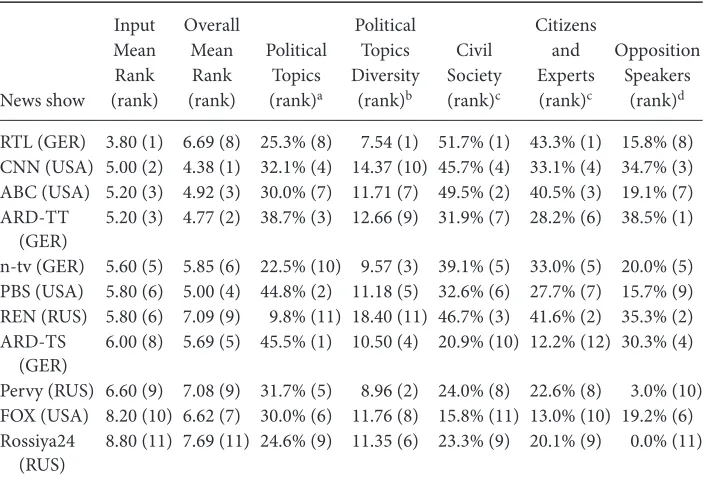
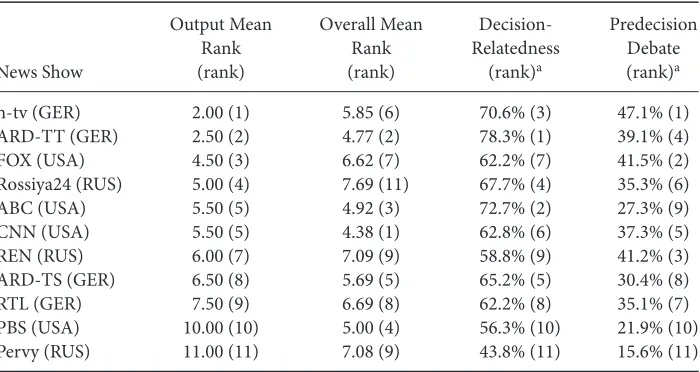
Tables 4–6 show the exact values for all news programs and all criteria on the input, throughput, and output dimensions of deliberativeness and rank them accordingly.8
If we compute the mean rank for each newscast across all 13 criteria, we have a rough measure of its overall deliberative performance.9 It turns out that CNN’sAnderson
Cooper 360∘
has the highest mean rank (4.46), followed by ARD-Tagesthemen, ABC’s World News, and PBS’sNews Hour. On the low end of overall deliberative performance we find the three Russian channels R24, REN, and Pervy as well as German com-mercial broadcaster RTL. However, a closer look at Tables 4–6 reveals some striking divergences from this overall mean.
On theinputside (Table 4) German commercial broadcaster RTL (overall rank 8) surprisingly leads the field due to its high topical diversity and great openness to civil society actors as well as ordinary citizens and experts. At the same time the par-tisan news-only channel Fox News (overall rank 7) drops to rank 10 on the input dimension mainly because it features very few civil society actors. Thethroughput dimension (Table 5) exhibits relatively little differences to the overall mean, but here RTL and the German commercial news-only channel n-tv fall into the lowest seg-ment. Both channels offer very little responsive debate and justifications. Theoutput dimension (Table 6), in turn, is characterized by a very different pattern. Here both partisan news-only channels, Fox News (USA) and Rossiya 24 (RUS), as well as n-tv (GER) enter the top group. It seems that their targeting of more elite audiences leads them to focus on how news relates to political decisions. N-tv and Fox even provide predecision debate to a considerable degree. On the other end of the scale PBS and ARD-Tagesschau(overall ranks 4 and 5) fall into the lowest segment on the output dimension; PBS in particular offers more free-wheeling news that is less related to political decisions than most other channels.
Deliberative News Performance H. Wessler and E. M. Rinke
Table 4 Deliberativeness Ranking of News Shows: Input Dimension
News show
aShare of all news items.bStandard deviation of political topic categories’ share of all political
news items (in %, based on six political topic categories).cShare of all utterances by civil society
and political center actors (based on all news items).dShare of all utterances by actors whose
party affiliation is identified (based on all news items).
this respect but particularly strong in including the opposition parties into public debate, in eliciting verifiable justifications from speakers, and in connecting debates to imminent political decisions.
Explaining differential levels of deliberativeness
Concerning thetype of democracy, we predicted that deliberativeness will be higher in established than in defective democracies (H1). And indeed, the television newscasts from Russia, our case of a defective democracy, are much less deliberative than those from the United States and Germany. When we compute country-wise mean ranks across all criteria, Russia’s mean rank is 2.85, while the U.S. news shows display a mean rank of 1.62 and those from Germany a mean rank of 1.54. The answer to our research question (Will television news be more deliberative in a majoritarian or in a consensus democracy?) points to a slight advantage for consensus systems, albeit by a relatively slim margin. Both the United States and Germany are moderate cases of their respec-tive system types so that we should expect to see clearer differences in more pure cases. But there is no plausible reason to believe that the study of such cases would revert the pattern we found. Ferree et al. (2002), the only other study that directly compares deliberativeness of media content (in this case, newspapers) between the United States
W
Table 5 Deliberativeness Ranking of News Shows: Throughput Dimension
News Show
aShare of all news items.bShare of all utterances (based on all news items).cShare of all utterances containing a statement of opinion (based on all
Deliberative News Performance H. Wessler and E. M. Rinke
Table 6 Deliberativeness Ranking of News Shows: Output Dimension
News Show
aShare of all political news items.
and Germany, finds no interpretable difference in the overall level of deliberativeness but strengths and weaknesses on different criteria and thus two different variants of deliberativeness in established democracies. We cannot completely rule out this inter-pretation, but our data tilt the scale more in favor of power-sharing systems.
In H2 we expected that public-service channels display higher levels than com-mercial channels and both fare better than state-controlled channels. This hypothesis is confirmed. When we merge all newscasts by organizational types and compute mean ranks across all criteria for each type, the public-service stations (ARD and PBS) come in first with a mean rank of 1.38, followed by the commercial stations (RTL, ABC, n-tv, CNN, and Fox News) with a mean rank of 1.77 and the state-controlled channels (Pervy, REN, and R24; mean rank 2.85). The statutory and legal require-ments as well as professional commitrequire-ments of public-service channels do seem to boost deliberativeness in comparison to their commercial and, even more strongly, their state-controlled counterparts.
H3 and H4 pertained to within-country comparisons in Russia and the United States. We hypothesized in H3 that in Russia deliberativeness is higher in the semiau-tonomous channel REN than in the state-owned channels Pervy and R24. This was not confirmed when we look at mean ranks across all criteria, where REN has the same mean rank as Pervy (7.15) with R24 tailing at 7.62. What distinguishes the semiau-tonomous REN from the two state-owned channels is its openness for a wide range of civil society actors and speakers from the political opposition as well as its focus on predecision debate. In this respect REN, although only on rank 9 overall, marks a clear alternative to the state-centered channels in Russia. H4 hypothesized that in an established democracy, deliberativeness will be higher in nonpartisan than in partisan
channels. This hypothesis was confirmed since CNN’sAnderson Cooper 360∘
turned out much better than theFox Report(mean rank of 4.46 vs. 6.69).
Finally, H5 in which we hypothesized that focused in-depth news shows perform better than more fact-centered newscasts was clearly confirmed since three of the four top ranks are occupied by focused in-depth news shows: CNN’sAnderson Cooper 360∘
(rank 1), ARD-Tagesthemen(rank 2), and PBS’sNews Hour(rank 4), while the fourth in-depth news show,Fox Report, reached rank 7. By comparison, fact-centered news-casts fare much worse on average and thus offer less deliberative news to their viewers.
Mapping deliberativeness in television news across cases and key criteria
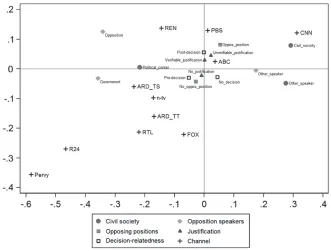
As a final step of analysis key criteria of deliberativeness were used to map the “de-liberative space” of television news using a multiple correspondence analysis (MCA; see Figure 1).10Among the 13 criteria we selected those that reflect the essence of
deliberativeness most clearly on each of the three dimensions: On the input dimen-sion deliberativeness is most closely related to both social and political inclusiveness, in terms of the throughput the core of deliberativeness lies in an exchange of well justified opposing positions and on the output dimension deliberativeness is about relating this exchange to (imminent) political decision. This conceptual core of delib-erativeness is best captured by Civil society [3] and Opposition speakers [5], Opposing positions [6] and Justification [8] as well as Decision-relatedness [12]. In practical terms, a two-dimensional representation such as an MCA biplot limits the number of criteria that can be usefully displayed and five proved to be the maximum number yielding an interpretable graph. Therefore no additional criteria were included.
Deliberative News Performance H. Wessler and E. M. Rinke
Figure 1 Mapping deliberation in television news (MCA).
Note:Biplot for multiple correspondence analysis using the Burt approach with post hoc scale adjustment (Greenacre, 2006). Row and column coordinates were obtained through principal normalization (i.e., coordinates are scaled by principal inertias). Analysis was performed using Stata, version 11 (StataCorp, 2009).
The second (vertical) dimension only adds another 4.3% of explained inertia. It represents more subtle differences mostly connected to the throughput and output criteria Opposing positions [6], Justification [8], and Decision-relatedness [12]. To interpret the dense cloud close to the origin in Figure 1 it is important to see which cat-egories cluster together on which side of the horizontal line. Above this line television news tends to engage more in the presentation of opposing positions when reporting on authoritative political decisionsafterthey have been made, and this presentation of opposing positions also generally tends to lead to a greater exchange of justifica-tions by speakers. Also, opposition and civil society speakers tend to appear more in such situations. Below the horizontal axis pre- or no-decision reporting is associated with the absence of opposing positions and justifications. The vertical dimension may thus be read as distinguishing between a more declaratory, justification-poor prede-cision reporting in which government officials take center stage on one hand and a more argumentative, justification-rich postdecision reporting in which the display of opposing positions, mostly from the parliamentary opposition and civil society speakers, combine on the other hand.
From a comparative point of view it is decisive where the individual news shows come down in the overall space. Three clusters of news shows emerge: The two
Russian state channels are located in the lower left corner indicating that they are both characterized by a strong dominance of state actors as well as a lack of opposing positions and justifications. The German news shows as well asFox Report(USA) fall below and left of the origin of the axes. This means that they tend to privilege state speakers and favor coverage that is nonargumentative (i.e., not showing contrasting positions and justifications) as well as focused on predecision debate, albeit to a much lesser degree than the Russian state channels. The third group of news shows clusters in the upper part of the deliberative space with the U.S. channels PBS, ABC, and the Russian semiautonomous REN relatively close to the center and CNN’sAnderson Cooper 360∘
in the upper right corner. These news shows combine opposing posi-tions, justificaposi-tions, and a postdecision focus with an orientation toward civil society speakers (CNN) or the political opposition (REN).
Figure 1 thus demonstrates how distinct national news cultures entail distinct deliberative performances of television news. But it also shows that cross-national variation clearly is not the only explanation for patterns of deliberativeness. Several channels deviate from the national pattern, most notably REN and Fox. The semiau-tonomous REN provides a more deliberative alternative to the state-owned channels in Russia by balancing government with opposition voices (y-axis) and giving more voice to civil society (x-axis). REN is also much closer to the cluster of throughput and output deliberativeness in the upper right quadrant than its state-owned coun-terparts. Fox News on the other hand deviates from the mainstream of U.S. television news culture, especially regarding the weaker deliberativeness of its throughput (y-axis) but also with respect to its somewhat greater focus on official politics as opposed to civil society on the input dimension (x-axis). Among the countries studied here Germany has the most homogeneous deliberativeness profile with all four news shows forming a close national cluster.
Discussion
Deliberative News Performance H. Wessler and E. M. Rinke
(2004) and Pfetsch (2003) suggest. Our study also confirms the democratic advan-tages of public-service broadcasting vis-à-vis commercial channels (see Aalberg, van Aelst, & Curran, 2010; Esser et al., 2012; Iyengar et al., 2010). While previous studies offer evidence on the subdimension that we call “Information base,” with our comprehensive catalogue of quality criteria we are able to show, in addition, that the merits of public-service news provision extend across all three dimensions and are particularly pronounced with respect to the throughput criteria (opposing positions, responsive utterances, justification, civility). This is due to the specific statutory and legal responsibilities and professional cultures of public-service channels.
We thus have evidence that institutional settings with strong public-service chan-nels (such as those found in many European countries) do contribute to the provision of deliberative news content to citizens more than settings in which public-service broadcasting is weak or endangered. In addition, nonpartisan channels generate bet-ter deliberative performance than partisan ones, a finding that supports Sunstein’s (2007) widely acknowledged argument for the value of what he calls “general inter-est intermediaries.” Our analysis clearly reveals that Fox News provides not only less inclusive but also less interactive debate than CNN. This lends credence to the idea that fragmented news environments, be they fragmented by the sheer number of channels available or along ideological lines, tend to diminish democratic benefits both in the news and in citizens (see Nir, 2012a, 2012b).
At the top end of the spectrum and across all 13 criteria CNN’sAnderson Cooper 360∘
comes out as the best performer, followed by the in-depth news show of German public broadcaster ARD (Tagesthemen) and ABC’sWorld News.11 These programs
seem to define different deliberative optimums in television news programming, illustrating that deliberative television news can be realized in divergent, but possibly complementary ways. While Anderson Cooper is particularly strong on inclusive and responsive debate and shows above-average performance on a number of other accounts, ARD-Tagesthemenexcels in including opposition speakers, eliciting veri-fiable justifications from speakers through its interviews and reports and in linking debates on a diverse set of political issues to political decision-making. ABC’sWorld News is a more fact-centered news format and, in combining the balance norm long established in American journalism (e.g., Gamson & Modigliani, 1989) with the characteristic “news you can use” approach of commercial news media (Esser, 2008), performs well in featuring opposing positions in news items that often include nonofficial voices as well as links to political decisions.
Our study has a number of limitations that are worth acknowledging. First, our country sample is small and thus limited in diversity. The differences found between majoritarian and consensus systems could be further corroborated (or qualified) (a) by including more pure consensus systems such as Switzerland or the Netherlands in addition to the moderate case we have studied, and (b) by including polarized-pluralist variants of majoritarianism such as those found in Southern Europe to complement the United States (Hallin & Mancini, 2004; Kriesi, 2004; Lijphart, 2012). Also, less authoritarian cases of post-Soviet transformation such as
Poland should be studied to fill the gap between Russia and the established Western democracies.
Second, our set of indicators could be refined in some cases and expanded in others. We have already mentioned possibilities for a more fine-grained typology of actors that would separate, for example, experts from pundits and public intellectuals as well as strong from weak civil society organizations. The only condition here is that such distinctions must be borne out by normative reasoning that specifies why the inclusion of a particular actor category is relevant for the functioning of democracy. Additional quality criteria are also conceivable. While we have defined both a con-ceptual core and a full set of criteria of deliberativeness other authors use additional standards that can support deliberative success. Benson (2013), for example, looks at criticism of the government, a possible indicator for how wide the space of non-coercive bottom-up deliberation actually is. The width of the ideological spectrum represented in media debate can serve as a standard of inclusiveness beyond actor representation. And our own measure of responsiveness could be extended into an analysis of who responds to whom in news discourse in order to reconstructrelations of accountability and justification between actors.
Third, in this paper we have not looked at whether some of our criteria of deliber-ativeness are empirically interrelated, particularly across the three dimensions: Does an inclusive actor set go along with more opposing positions and more responsive utterances? If included, is the citizen public indeed shown passive, without opportu-nity to make and justify their points or address issues that are up for decision (Lewis, Wahl-Jorgensen, & Inthorn, 2004)? Does the inclusion of the political opposition enhance decision-relatedness and diminish civility? And do such possible interrela-tions hold across contexts and formats, or not? The internal contingencies of mediated deliberation have never been systematically studied before so that this route of inquiry seems to be the most obvious next step.
Deliberative News Performance H. Wessler and E. M. Rinke
Acknowledgments
The authors would like to thank Patricia Moy, Scott Althaus, and Florian Töpfl as well as the three anonymous reviewers and two editors of theJournal of Communica-tionfor their most helpful comments and suggestions. Sevda Arslan, Mihaela David-kova, Julia Lück, and Bianca Willhauck provided valuable research assistance. Olesya Butenko, Philip Egermann, Marianna Gershkovich, Katharina Hölck, Mona Hörner, Christine Melcher, and Ekaterina Shirovatova contributed coding work. Earlier ver-sions of this paper were presented at the conferences of the European Communication Research and Education Association (2010), the International Communication Asso-ciation (2013), and at the University of Washington’s Department of Communication research colloquium (2011).
Notes
1 The search comprised five steps. First, a search ofCommunication and Mass Media CompleteandGoogle Scholarwas performed using the following query: (media) AND (deliberation OR deliberative OR deliberativeness). Second, we used the bibliographies of all relevant items retrieved in step one for a backward search of further items. Third, we usedGoogle Scholar’s “cited by” functionality for a forward search on the basis of all relevant items found until step 2. Steps two and three were reiterated for newly found items until no more relevant items could be identified. Finally, we added relevant publications not found via this procedure but known to us. For the most part, these were older non-English language publications. The effective search date was 15 October 2012. 2 This is a relatively rough indicator for idea-giving actors that could be further
differentiated in future studies. Our category of “experts” does not distinguish academic experts and public intellectuals, and it comprises pundits who, in a more fine-grained analysis, could be grouped with the actors from the political center due to their usually strong connections to established powers. In the “civil society” category we do not distinguish between strong and weak organization, i.e. between collective actors with a strong membership or power base (such as trade unions and industrial associations) and smaller, informal organizations of engaged citizens.
3 Deliberative theorists disagree on whether all public communication should be civil or whether in the agenda-building phase uncivil forms of protest and disruption are acceptable or even desirable to put certain issues or grievances on the media agenda (Wessler, 2008, p. 5; Rinke et al., 2013, p. 487).
4 Kriesi (2004) describes Germany as “the typical intermediary case” (p. 205) in this regard. In fact, according to Lijphart’s data (2012, pp. 305–306), both Germany and the U.S. are only moderate cases of consensus and majoritarian systems. If anything, differences between pure majoritarian and consensus systems should be more pronounced than between the two cases we study (see Results section).
5 The following news programs were analyzed in this study. German programs:Tagesschau
(ARD),Tagesthemen(ARD),RTL aktuell(RTL),Nachrichten(n-tv); U.S. programs:PBS NewsHour(PBS),World News(ABC),Anderson Cooper 360∘(CNN),
Fox Report(Fox News Channel); Russian programs:Novosti(Pervy),Novosti 24(REN-TV),Vesti.
Seitschas(Rossija 24). For the German public service station ARD, both main evening
newscasts (TagesschauandTagesthemen) were analyzed because ARD presents two major news programs during prime time (TS at 8.00–8.15 p.m. and TT at 10.15–10.45 p.m.). 6 For details on ownership and market shares for all channels studied, see the online
appendix (also Rinke, 2013).
7 Rossiya 24 is a state-owned news-only channel that effectively serves as an official voice of the Russian government; it must therefore be considered partisan in the Russian context. Fox News has been shown to be partisan in its news choices, even in the hard-news sections of its program (Groeling, 2008, p. 652). Comprehensive content analyses show that CNN does not exhibit a partisan bias toward either side of the political spectrum (Holtzman et al., 2011; see also Groseclose & Milyo, 2005).
8 In testing the hypotheses formulated in this study, we depart from the often-observed practice of employing statistical significance testing to identify differences in media content across countries and media types. This study shares with most cross-nationally comparative social research the two fundamental inferential problems of a country sample that is nonprobabilistic (see Ebbinghaus, 2005; Western & Jackman, 1994) and too small to allow inferences on the country level in the logic of classical inference (see Stegmueller, 2013). Standard errors andp-values would therefore be uninformative. Instead we report more meaningful and instructive uni- and multivariate descriptive analyses such as comparisons of mean ranks and multiple correspondence analysis (on the value of descriptive analyses see, e.g., Levine, Weber, Park, & Hullett, 2008). 9 Ranks reflect the relation between one particular case and the entire set of cases at the
expense of information about the exact distance between cases. Ranks also provide a unified scale that allows comparisons of relative performance across variables with divergent scales. The raw data underlying the ranks are displayed in Tables 4–6. In addition, we complement mean ranks with the more holistic and information-rich approach of multiple correspondence analysis (see below).
10 MCA is a descriptive multivariate statistical method used to identify and plot systematic associations found in a multiway contingency table of categorical variables (Le Roux & Rouanet, 2010), and can be thought of as a generalization of principal component analysis (PCA) to categorical data analysis. Similar to PCA, it essentially identifies the
low-dimensional subspace that is maximally close to the set of data points in the true space defined by the full set of variables.
11 This does not contradict the general pattern that, on average, public-service stations offer more deliberative news, because commercial channels are found among the strongest as well as the weak performers.
References
Aalberg, T., van Aelst, P., & Curran, J. (2010). Media systems and the political information environment: A cross-national comparison.International Journal of Press/Politics,15(3), 255–271. doi:10.1177/1940161210367422.
Althaus, S. L. (2012). What’s good and bad in political communication research? Normative standards for evaluating media and citizen performance. In H. A. Semetko & M. Scammell (Eds.),Sage handbook of political communication(pp. 97–112). London, England: Sage.
Deliberative News Performance H. Wessler and E. M. Rinke Bennett, W. L., Pickard, V. W., Iozzi, D. P., Schroeder, C. L., Lagos, T., & Caswell, C. E. (2004).
Managing the public sphere: Journalistic construction of the great globalization debate.
Journal of Communication,54(3), 437–455. doi:10.1111/j.1460-2466.2004.tb02638.x. Benson, R. (2013).Shaping immigration news: A French-American comparison. New York,
NY: Cambridge University Press.
Benson, R., & Powers, M. (2011).Public media and political independence: Lessons for the future of journalism from around the world. Washington, DC: Free Press.
Brennan, R. L., & Prediger, D. J. (1981). Coefficient kappa: Some uses, misuses, and alternatives.Educational and Psychological Measurement,41(3), 687–699. doi:10.1177/001316448104100307.
Chambers, S. (2010). Theories of political justification.Philosophy Compass,5(11), 893–903. doi:10.1111/j.1747-9991.2010.00344.x.
Cushion, S. (2012).The democratic value of news: Why public service media matter. Basingstoke, England: Palgrave Macmillan.
Dekavalla, M. (2012). Evaluating newspaper performance in the public sphere: Press accounts of Westminster elections in Scotland and in England in the early post-devolution period.
Journalism,13(3), 320–339. doi:10.1177/1464884911398335.
Ebbinghaus, B. (2005). When less is more: Selection problems in large-Nand small-N
cross-national comparisons.International Sociology,20(2), 133–152. doi:10.1177/02685 80905052366.
Esser, F. (2008). Dimensions of political news cultures: Sound bite and image bite news in France, Germany, Great Britain, and the United States.International Journal of Press/Politics,13(4), 401–428. doi:10.1177/1940161208323691.
Esser, F., de Vreese, C. H., Strömbäck, J., van Aelst, P., Aalberg, T., Stanyer, J., ... Reinemann, C. (2012). Political information opportunities in Europe: A longitudinal and comparative study of thirteen television systems.International Journal of Press/Politics,17(3),
247–274. doi:10.1177/1940161212442956.
Ettema, J. S. (2007). Journalism as reason-giving: Deliberative democracy, institutional accountability, and the news media’s mission.Political Communication,24(2), 143–160. doi:10.1080/10584600701312860.
Ferree, M. M., Gamson, W. A., Gerhards, J., & Rucht, D. (2002).Shaping abortion discourse: Democracy and the public sphere in Germany and the United States. Cambridge, England: Cambridge University Press.
Fung, A. (2012). Continuous institutional innovation and the pragmatic conception of democracy.Polity,44(4), 609–624. doi:10.1057/pol.2012.17.
Gamson, W. A. (1999). Policy discourse and the language of the life-world. In J. Gerhards & R. Hitzler (Eds.),Eigenwilligkeit und Rationalität sozialer Prozesse: Festschrift zum 65. Geburtstag von Friedhelm Neidhardt(pp. 127–144). Opladen, Germany: Westdeutscher Verlag.
Gamson, W. A., & Modigliani, A. (1989). Media discourse and public opinion on nuclear power: A constructionist approach.American Journal of Sociology,95(1), 1–37. Gastil, J. (2008).Political communication and deliberation. Thousand Oaks, CA: Sage. Gerhards, J. (1997). Diskursive versus liberale Öffentlichkeit: Eine empirische
Auseinandersetzung mit Jürgen Habermas.Kölner Zeitschrift für Soziologie und Sozialpsychologie,49(1), 1–34.
Goldman, S. K., & Mutz, D. C. (2011). The friendly media phenomenon: A cross-national analysis of cross-cutting exposure.Political Communication,28(1), 42–66.
doi:10.1080/10584609.2010.544280.
Greenacre, M. (2006). From simple to multiple correspondence analysis. In M. Greenacre & J. Blasius (Eds.),Multiple correspondence analysis and related methods(pp. 41–76). Boca Raton, FL: Chapman & Hall.
Groeling, T. (2008). Who’s the fairest of them all? An empirical test for partisan bias on ABC, CBS, NBC, and Fox News.Presidential Studies Quarterly,38(4), 631–657.
doi:10.1111/j.1741-5705.2008.02668.x.
Groseclose, T., & Milyo, J. (2005). A measure of media bias.Quarterly Journal of Economics,
120(4), 1191–1237. doi:10.1162/003355305775097542.
Habermas, J. (1987).The theory of communicative action: Lifeworld and reason: A critique of functionalist reason. Boston, MA: Beacon Press.
Habermas, J. (1992). Further reflections on the public sphere. In C. Calhoun (Ed.),Habermas and the public sphere(pp. 421–461). Cambridge, MA: MIT Press.
Habermas, J. (1996).Between facts and norms: Contributions to a discourse theory of law and democracy. Cambridge, MA: MIT Press.
Hallin, D. C., & Mancini, P. (2004).Comparing media systems: Three models of media and politics. Cambridge, England: Cambridge University Press.
Higgins, M. (2006). Substantiating a political public sphere in the Scottish press: A comparative analysis.Journalism,7(1), 25–44. doi:10.1177/1464884906059426. Holtzman, N. S., Schott, J. P., Jones, M. N., Balota, D. A., & Yarkoni, T. (2011). Exploring
media bias with semantic analysis tools: Validation of the Contrast Analysis of Semantic Similarity (CASS).Behavior Research Methods,43(1), 193–200. doi:10.3758/s13428-010-0026-z.
Iyengar, S., Curran, J., Lund, A. B., Salovaara-Moring, I., Hahn, K. S., & Coen, S. (2010). Cross-national versus individual-level differences in political information: A media systems perspective.Journal of Elections, Public Opinion and Parties,20(3), 291–309. doi:10.1080/17457289.2010.490707.
Jacobs, R. N., & Townsley, E. (2011).The space of opinion: Media intellectuals and the public sphere. Oxford, England: Oxford University Press.
Kriesi, H. (2004). Strategic political communication: Mobilizing public opinion in “audience democracies.” In F. Esser & B. Pfetsch (Eds.),Comparing political communication: Theories, cases, and challenges(pp. 184–212). Cambridge, England: Cambridge University Press.
Krippendorff, K. (2004).Content analysis: An introduction to its methodology(2nd ed.). Thousand Oaks, CA: Sage.
Le Roux, B., & Rouanet, H. (2010).Multiple correspondence analysis. Thousand Oaks, CA: Sage.
Levine, T. R., Weber, R., Park, H. S., & Hullett, C. R. (2008). A communication researchers’ guide to null hypothesis significance testing and alternatives.Human Communication Research,34(2), 188–209. doi:10.1111/j.1468-2958.2008.00318.x.
Lewis, J., Wahl-Jorgensen, K., & Inthorn, S. (2004). Images of citizenship on television news: Constructing a passive public.Journalism Studies,5(2), 153–164.
Lijphart, A. (2012).Patterns of democracy: Government forms and performance in thirty-six countries(2nd ed.). New Haven, CT: Yale University Press.
Deliberative News Performance H. Wessler and E. M. Rinke Merkel, W. (2004). Embedded and defective democracies.Democratization,11(5), 38–58.
doi:10.1080/13510340412331304598.
Mutz, D. C. (2006).Hearing the other side: Deliberative versus participatory democracy. Cambridge, England: Cambridge University Press.
Mutz, D. C. (2007). Effects of "in-your-face" television discourse on perceptions of a legitimate opposition.American Political Science Review,101(4), 621–635. doi:10.1017/S000305540707044X.
Nir, L. (2012a). Cross-national differences in political discussion: Can political systems narrow deliberation gaps?Journal of Communication,62(3), 553–570.
doi:10.1111/j.1460-2466.2012.01648.x.
Nir, L. (2012b). Public space: How shared news landscapes close gaps in political engagement.Journal of Broadcasting and Electronic Media,56(4), 578–596. doi:10.1080/08838151.2012.732145.
Orwin, R. G., & Vevea, J. L. (2009). Evaluating coding decisions. In H. Cooper, L. V. Hedges, & J. C. Valentine (Eds.),The handbook of research synthesis and meta-analysis(2nd ed., pp. 177–203). New York, NY: Russell Sage Foundation.
Papathanassopoulos, S., Coen, S., Curran, J., Aalberg, T., Rowe, D., Jones, P., ... Tiffen, R. (2013). Online threat, but television is still dominant: A comparative study of 11 nations’ news consumption.Journalism Practice,7(6), 690–704. doi:10.1080/17512786.2012. 761324.
Peters, B. (2008). On public deliberation and public culture. In H. Wessler (Ed.),Public deliberation and public culture: The writings of Bernhard Peters, 1993-2005(pp. 68–118). Basingstoke, England: Palgrave Macmillan.
Pfetsch, B. (2003).Politische Kommunikationskultur: Politische Sprecher und Journalisten in der Bundesrepublik und den USA im Vergleich. Opladen, Germany: Westdeutscher Verlag. Rinke, E. M. (2013).Justificatory news:Investigating the contextual antecedents of justification
in the news(Unpublished doctoral dissertation). University of Mannheim, Mannheim, Germany.
Rinke, E. M., Wessler, H., Löb, C., & Weinmann, C. (2013). Deliberative qualities of generic news frames: Assessing the democratic value of strategic game and contestation framing in election campaign coverage.Political Communication,30(3), 474–494.
doi:10.1080/10584609.2012.737432.
Rohlinger, D. A. (2007). American media and deliberative democratic processes.Sociological Theory,25(2), 122–148. doi:10.1111/j.1467-9558.2007.00301.x.
StataCorp (2009).Stata Statistical Software: Release 11. College Station, TX: StataCorp LP. Stegmueller, D. (2013). How many countries for multilevel modeling? A comparison of
frequentist and Bayesian approaches.American Journal of Political Science,57(3), 748–761. doi:10.1111/ajps.12001.
Strömbäck, J. (2005). In search of a standard: Four models of democracy and their normative implications for journalism.Journalism Studies,6(3), 331–345.
doi:10.1080/14616700500131950.
Sunstein, C. (2007).Republic.com 2.0. Princeton, NJ: Princeton University Press.
Trilling, D., & Schoenbach, K. (2012). Skipping current affairs: The non-users of online and offline news.European Journal of Communication,28(1), 35–51.
doi:10.1177/0267323112453671.
Vartanova, E. (2012). The Russian media model in the context of post-Soviet dynamics. In D. C. Hallin & P. Mancini (Eds.),Comparing media systems beyond the Western world
(pp. 119–142). Cambridge, England: Cambridge University Press.
Voltmer, K. (2012). How far can media systems travel? Applying Hallin and Mancini’s comparative framework outside the Western world. In D. C. Hallin & P. Mancini (Eds.),
Comparing media systems beyond the Western world(pp. 224–245). Cambridge, England: Cambridge University Press.
Wessler, H. (2008). Investigating deliberativeness comparatively.Political Communication,
25(1), 1–22. doi:10.1080/10584600701807752.
Western, B., & Jackman, S. (1994). Bayesian inference for comparative research.American Political Science Review,88(2), 412–423. doi:10.2307/2944713.
Xenos, M. (2008). New mediated deliberation: Blog and press coverage of the Alito nomination.Journal of Computer-Mediated Communication,13(2), 485–503. doi:10.1111/j.1083-6101.2008.00406.x.
Zaller, J. (2003). A new standard of news quality: Burglar alarms for the monitorial citizen.