Tourism Management for Multi-Cultural Based Tourism Destination
in China
Chuanchen BIaSekson Yongvanit*aWarangkana Thawornwiriyatrakulb a, Faculty of Humanities and Social Sciences, Khon Kaen University, Thailand b, Faculty of Business Administration, Khon Kaen University–Nong Khai Campus, Thailand
Corresponding e-mail:[email protected]
Abstract: China is the country with variety ethnic groups and cultures, besides the major Han group and its‘Han culture’, 55 ethnic groups have their unique and charming culture and traditions as well. With the development of tourism industry, especially after the moving into the mass tourism era in 2015, how to develop the tourism industry facing the multiculturalism demands become serious to be focused. Xishuangbanna region as the habitat where more than 14 different cultural located becomes the popular tourism destinations since 1953. Due to the multi-ethnic groups with different traditional festivals and traditional way of life, the tourism industry achieved its commercial summit in 2002-2004. The cultural based tourism is the selling points and most attractive point in Xishuangbanna region, this research focus on the management of certain tourism management and trying to explore the management model for multi-cultural based tourism in Xishuangbanna region. In order to achieve the objectives of this study, field survey with participatory observation and in-depth interview, and systematic review are applied. The findings of this paper indicated for developing the multi-cultural based tourism and moving towards the commercial success, the authenticity with multi-stakeholders participatory should be kept in the priority to be focused. The‘tourism company + local community’is discovered for the multi-cultural based tourism management in Xishuangbanna region, as it could not only improve the living standard for the local residents, also provide the opportunity for multi-stakeholders participate in the tourism management and development.
Keywords: Multi-cultural tourism management, authenticity, ‘tourism company+ local community’management, stakeholder, Xishuangbanna region
1. Introduction
China is the country with over 5,000 years history, after the foundation of the People Republic of China, the central government organize the activity to classify the ethnic groups in China. After been working for over 5 years, the Chinese government announced within China has over 55 ethnic minorities groups and 1 major‘Han’group. The 5,000 years of history create the diversity of the colorful culture in China, beside the ‘Han’ culture, each ethnic minority groups also have their unique culture, such as the‘Bai ye culture’ for Dai ethnic group, ‘Benzu culture’ for Bai ethnic group, ‘Dong ba culture’ for Naxi ethnic group, etc. How to
develop the multi-culture has been focused in China for long time, the researches mainly focus on the education for the multi-cultural region (Jieyuan, 2011; Ya, 2012; yi et al., 2012).
The Dai ethnic group and its‘Bai ye culture’, Jinuo and Hani ethnic ‘fire culture’, etc. are the most attractive points for the tourists, and also made a great contribution towards the local GDP.
How the local ethnic people manage the tourism industry within XSBN area? Is there any outside supporter to help them deal with the tourism promoting and marketing? How to keep the authenticity in the multi-cultural based tourism industry in XSBN? For having a better understanding of the situated research questions, this paper divided into three themes. The first theme of this paper discovered the general background in XSBN tourism industry which including the tourism development history and tourism flows in XSBN area. The second theme explore the tourism management approach for multi-cultural based tourism industry, and clear the role of outsider in managing the tourism industry in XSBN area. The last theme offer the case study and interview data as the evidence to explore the core factors of tourism management for multi-cultural based tourism in XSBN area.
This paper is the initial study of strategic plan for sustainable tourism development in Xishuangbanna, China, the researcher’s PhD thesis.
1. Research Method
In order to achieve the research objectives mentioned above, t the systematic review, participatory observation and in-depth interview are applied in this research. The secondary data mainly covers the tourism yearly reports, government yearly reports, policy manuals, procedure statements, previous tourism planning and the tourism reports from tourism association from both local and provincial level. The information collects from different sources will be analyzed by documentary analysis methods for the better understanding of tourism in XSBN.
The in-depth interview mainly focus on the local residents who participate in the tourism management, tourism company which join the tourism development and management in the culture based tourism.
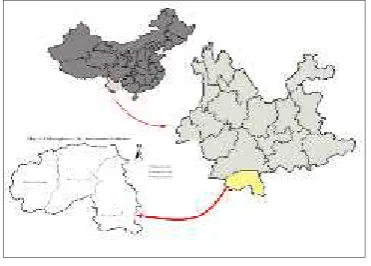
2. Tourism in Xishuangbanna area XSBN is located in the south-west part of Yunnan province, mainland China. XSBN is also known as the gate facing Southeast Asia. Due to the perfect location of XSBN (with
the boundary line with Lao PRD and Myanmar), the boundary tourism focus on the overseas tourists are suitable for XSBN to operate. Furthermore, XSBN is not only the gate towards ASEAN community, also the channel towards South Asia. With the development of ‘Kunming-Bangkok highway’, which will stimulate the XSBN to play the important role in this special location. Moreover, with the development of AEC + China, tourism cooperation with GMS countries, XSBN plays an important role in the regional cooperation and development (Lixia HUANG, 2013; JIE, 2009; Ma, 2004).
XSBN is rich of both cultural resources and natural resources, based on this situation, XSBN province set tourism as their strategic pillar industry to be focused. In 2014, Tourism industry contribute 74% towards local GDP (XSBN Tourism Administration). Based on this steady growth, local government has been largely characterized and recognized its development policies and heavy promotional campaigns and strategies to promote domestic and international tourism as a major source of foreign exchange earnings, employment, opportunities, and protect both natural resources and unique cultural resources; this industry is particularly benefit for the lower income groups, and rural community. Tourism sector is the attractive characteristic in XSBN, also the ‘name card’ of it. Whether its success of not, will directly affect the general development in XSBN.
Fig. 1 Xishuangbanna Dai Autonomous Prefecture, PR. China, Created by author
2.1 Tourism Flow
nature environment, countryside, farm land, rural life and ethnic cultural scenic. XSBN as the first group of tourism destinations in mainland China, with the unpolluted air quality, richness of aboriginal cultural, beautiful rainforest and border life, and variety of culture resources attracted 17.01 million tourists, with the domestic earnings around 22.80 billion(2014).
With the development of tourism, XSBN becomes one of the most popular tourism destinations national-wide, also attract the tourists from neighboring countries and places, such as Thailand, Malaysia, Japan, Korea, Hong Kong SAR. The increasing of the tourists and earnings will contribute towards the local GDP, increasing the local infrastructure, improve the quality of life, etc. Based on the ‘XSBN Tourism Twelve Five Year Plan’ report, domestic tourists are the major travelers, most of the tourists are from Yunnan province and East part provinces, like Anhui province, Shanghai, Zhejiang province, Jiangsu province.
For the international tourists, most of them are from Great Mekong Sub-region (GMS). Yunnan province is involved in the GMS, XSBN located as the core of the gate facing GMS, take very important role in the cooperation with GMS countries. In the year of 2013, around 416,660 of international tourists come and visit XSBN, among them, tourists from Thailand contribute around 50%.
2.2 Ethnic Group and Culture Resource For the ethnic groups, there are 13 ethnic groups located in XSBN area, namely Dai ethnic group, Ha ni ethnic group, La hu ethnic group, Bu lang ethnic group, Wa ethnic group, Yi ethnic group, Ji nuo ethnic group, Yao ethnic group, Zhuang ethnic group, Hui ethnic group, Miao ethnic group, Jing po ethnic group, and Han group.
Dai ethnic group is the majority ethnic group in XSBN, the population is around 316,151 (2010). Dai ethnic minority group is the special ethnic group in XSBN, since Dai group is the largest aboriginal group. Their way of life, traditional cultural, traditional food, house style, etc. are the attractive things for the outside tourists.
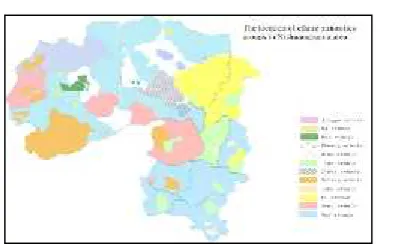
Besides Dai ethnic group, 11 ethnic minority groups also located in XSBN area. The following figure indicates the location of each ethnic minority groups in XSBN area.
Fig. 2 The location of ethnic minorities groups in XSBN area. Created by author
As indicated above, XSBN is famous for the Dai ethnic cultural, Theravada Buddhism, tea cultural, tea plantation, etc. With such a unique tourism resources in XSBN, over 15 high-level tourism spots located in this area (fig. 4). Moreover, along with the tourists’ interests in China mainly focus on the unpolluted nature environment, countryside, farmland, rural life and ethnic cultural scenic. Tourists who come to visit XSBN mainly focus on the different ethnic groups’ traditional way of life, historical towns, high mountain discovery, tea plantation, nature rainforest, cross border tourism, Theravada Buddhism tourism, etc(Sun et al., 2014). For the ethnic culture resources, mainly located in the place where ethnic people located. As the traditional way of life, and traditional festivals are never seen in the other places in China, that encourage the tourist come and visit.
2.2.1 Festival
members. Dai people believe the water represent the lucky, the one who splashed by the water will receive the good luck in the following years.
Fig. 3 Dai people celebrating the Songkran Festival
For Hani group, ‘Ga tangpa festival’ is the most important and joyful day for them,‘Ga tangpa’ means ‘commemorate for Hani ancestor Tangpa’.‘Ga tangpa festival’is held every January 2nd -4th , during the festival, some traditional culture show and folk dance are performed, Hani people calls friends and family members to get together and to celebrate this new year festival. This festival is also interested by the tourist who want to share the different way for ‘New Year’ in China.
Fig. 4 Hani people celebrating‘Ga Tangpa festival’
‘Te Maoke festival ’ is the important and meaningful festival for the local Jinuo people. ‘Te Maoke’ means ‘forge iron’, in the beginning the date of this festival is different in each Jinuo community. For better celebrating this important festival, Central Government Ethnic Bureau discussed with the local spiritual leader and announced one suitable date for all Jinuo group to celebrate this festival. In the February of 6 to 8, the Jinuo people held the ‘Te Moke’ festival, people get together and dance for the peaceful world. Normally these activities
will be last for three days. Different with the other festival in XSBN, this ‘Te Maoke festival’is unique due to the location. In the beginning, as Jinuo people mainly located in the mountain area, and the road access to the Jinuo community is not that comfortable, so their festival is not yet discovered by the tourists. Nowadays, with the development of tourism industry and social media, more and more tourists realize this famous traditional festival, the local leaders decide to move this festival to the foot of mountain to welcome the tourist come and join.
Fig. 5 Jinuo people enjoy the‘Te Maoke festival’
2.2.2 Religion
Religion is another unique culture resources in XSBN. as most of the Dai and Bulang people believe in the Theravada Buddhist, the temple and its building structure becomes the unique and impressed tourism resources. Buddhist temple, as the center of Dai and Bulang community, played an important role in Dai people’s traditional way of life. Some temple has thousands of history. Until now, the temple also plays an important role in local religion ceremony. In the XSBN area, there are over 1,600 temples located, among which, one famous temple named Ban Chun Man which has over 1,400 history becomes the ‘must visit’ resource inXSBN.
Fig. 7 Dai people pray for the Buddhism lent day in Man Chun Man temple
2.2.3 Traditional Building and Food
Furthermore, the ethnic people’s building and traditional way of life are also the attractive themes. Compared with the modern buildings in the city, ethnic groups’ traditional buildings attract tourists come and visit. This is also been recognized as the most eco traditional building in China. Furthermore, the home-stay services offer the opportunities to know the real traditional way of life. With the development of tourism industry, some local people offer home-stay services, which could contribute their own income and share the way of life to the tourists.
Fig. 8 Local ethnic housing and home-stay
Moreover, the local Dai food is different
from the eight famous Chinese cuisines. The sour, spicy, and palatable are the characteristic for Dai food, while, the local Dai barbecue could represent those mentioned characteristic of Dai food.
Different with the barbecue in the outside cities, the special barbecue in XSBN is the materials. Bamboo worms is the worms lived in the bamboo tree, as XSBN has the rainforest, and the eco system is well conserved, the bamboo worms could be found easily. Bamboo worm has more protein, which is good for health, is popular in the barbecue restaurants. The other special and best sold food is the barbecue chicken with lemon grass, barbecue fish with lemon grass, and barbecue honeybee pupae.
The special barbecue material makes the barbecue famous and popular, some of the outside tourists from Kunming, make the special-purpose trip to XSBN to taste the famous barbecue.
Fig. 9 Barbecue bamboo worms and honeybee pupae
3. Tourism management for multi-cultural based tourism
development in XSBN, researcher found the timeline of tourism development started in the 1953 which could be classified into four periods.(Luo, 2006; Tingbin, 2007; Wang, 2006)
1. 1953-1980 is the period of establishing the destination image. One famous documentary film shows the aboriginal people lived in the rainforest attract the scholars, institutes want to do the research in there;
2. 1980-1990 is the establish the tourism industry, in this period, XSBN Dai Autonomous Prefecture mainly receive the foreign delegations, for the domestic tourists, most of them are scholars from university and institutes. In 1985, local government set the tourism enterprise to manage the scenic. The characteristic of this period are foreign delegation reception and tourism enterprises manage.
3. 1991-2005 is the rapidly growth period, especially after the ‘golden week’ in 1999 and the Kunming Expo, XSBN enter into the mass tourism period. The tourism infrastructures built, domestic airport upgraded for international flights, local government realize the importance of tourism industry for XSBN, tourism transformed from ‘foreign reception’ into ‘economic industry’. Tourism industry announced by the local government as the largest strategic sector in XSBN region, however, in the year of 2002, and 2004, tourists decreased. Due to this situation, Prof. Bao Jigang, famous tourism expert in China, announce XSBN is now in the stagnation stage based on the life cycle of Butler1.
4. 2005-now is the new period for XSBN. Based on Butler’s life cycle theory, either decline or rejuvenation might happen after stagnation stage appear. These serious problems also draw the attention by provincial government. In the year of 2005, Yunnan provincial government announces the ‘Second-wave entrepreneurship’ which trying to bring the other spring for XSBN tourism industry.
Overview all the cultural based tourism attractions in XSBN area, the management approach could be classified into 2
1 http://www.xsbnly.com/xsbnly/hyxh/989.jhtml
categories; local government guiding approach, and ‘tourism company + local community’. Observation, secondary data and in-depth interview with stakeholders are applied in this part.
4.1 Local government guiding approach Government control is the major tourism managing approach applied in XSBN and the whole mainland China (Wu et al., 2012), especially for the ethnic culture based tourism attractions(Wu & Li, 2012).
For this approach, the local government realized the unique tourism resources, calling the local villager to involve into tourism activities. All this tourism management relies on the trustable local leaders, so that an autonomous system is requested to be established.
The benefit from this government control approach is that local government as the local official representative could request for some special support from upper level government. The tourism attraction reconstruction, upgrade the tourism facilities, applying some special budget are easier(Ai, 2007). Moreover, with the government involved it is easier to expand the social impact. ‘Ban Jingfa Dai’ village is the beneficiary for this managing approach. Before the government involved into this tourism attraction, few people realize the valuable of this Dai community. The local government brings the special policy to support the local facility, expand the social impact, and attract the performing arts companies to operate the local folk dance and performance. During the weekend and student’s holiday season (February, and July-August) hundreds of tourists come to enjoy the local Dai culture, food, and local folk performance.
‘Ithink this is good for maintain the core of our traditions, the government leaders are voted by ourselves, so we trust them very well. And I think with this approach, we increase the income and also let the tourists know more about our traditions and history.’ Local residents, who involved into tourism and offer home-stay
compare with the other community, they have the outsiders joining, they can earn more benefit from this.’
Local residents, selling tourism products in the community
Moreover, as one of the souls of Dai community, the local government also encouraged the local people to maintain the traditional Dai building. For them, Dai building is the perfect place to operate the Dai home-stay, and daily activities with tourists. Over 50,000 tourists (2014) come to enjoy the local Dai home-stay in Ban Jingfa Dai village, which increase 5,384 Yuan per household.
‘for me, I think the most important is the keep the traditions, and maintain the authenticity. That is the core element for the cultural based tourism in my village’
Local leader in Ban jingfa village
Conserve the local ethnic culture is another major objective for the local government, as they understand that authenticity is the core component of the local community and the important direction towards the sustainable tourism development.
Local government control could guarantee the local villagers as the single stakeholder to share the benefit from the tourism activities. Moreover, local villagers could involve into the decision making process, to decide the development direction.
However, this ‘Government control’ approach also has the weakness, which is lack of finical support.
‘now I am worry about the money. The tourism is the not the major income for us, after build the new village gate, we do not have extra money left. We operate the tourism by ourselves, and also we need the money to support the tourism to go further.’
Local leader in Ban feilong village
‘I used to visit the other village where they have one tourism company involved. I think maybe this is the good way to go. Yes, we conserve the traditions and maintain the traditional way of life, but if we cannot give more benefit to the local residents, maybe they will quit the tourism position, that will make us more difficult to go.’
Local leader in Ban Chunman village
Due to the condition of socialist government, tourism budget is unfixable set, which might prevent the development of tourism attractions. When compared with the other tourism attractions, local people’s mobility will be decreased.
4.2‘Tourism Company + Local Community’Approach
Besides the government guiding approache, there is another tourism management approach in XSBN could be identified as the second approach for the cultural based tourism management. Moreover, under the mass tourism era, this management is regarded as the ‘best way to balance the stakeholders’in China.
‘Company + Villager’ management approach has been operated in XSBN area for over 15 years, which bring the tourism attraction, especially the ethnic tourism attractions into another commercial success (Jiana et al., 2011; Jun et al., 2012; Ping et al., 2006; Qinglei et al., 2010; Wen et al., 2011). ‘Company + Villager management’ tourism management approach mainly applied in the ethnic culture based tourism attractions, such as Dai Park, Muang Jinglai Dai community, Hani ethnic museum, etc. Company, specifically for the company that focus on the tourism development, tourism promoting, and tourism attractions management. Under China current situation, Tourism Company has two categories,‘State owned Enterprise’ and ‘Private Tourism Company’. Offering the financial support to operate the tourism activities and maintain the tourism construction, upgrade the community public facility, and hire the local villager be a part of their tourism activities, etc. are the major operating method the tourism company.
State Owned Enterprise (will use SOE instead), due to the government background, has more advantages in dealing with the tourism attractions. In XSBN area, SOE Tourism Company controlled most of the ethnic culture based tourism attractions and natural based tourism attractions. Moreover, the advantage for this SOE tourism company is the policy support(Jizhen, 2013), such as free tax. the tourism attraction reconstruction, updates the tourism facilities, applying some special budget are easier(Ai, 2007; Dianting et al., 2003).
Company, it will benefit the development of tourism attraction under government supervision. With the support from government, the tourism attraction could expand the market awareness, to attract more tourists (Ruhui et al., 2009; Wenwen, 2006). For the second category of ‘Tourism Company’, Private Tourism Company (will use PTC instead) also play an important role in tourism management at XSBN area. As XSBN is one of the first tourism destinations in China, tourism been operated for over 50 years, for better stimulate the tourism development in XSBN, local government set some policy to encourage and guarantee private tourism company involved into tourism management(Shaohua, 2003). Compare with the SOE, PTC is more fixable for applying and using the financial budget(Shaohua, 2003).
Villagers, specifically for the one who stay inside the ethnic community of XSBN area. The villagers offer the landscapes, their traditional buildings as the tangible museum, the nature environment, traditional way of life, historical Theravada Buddhism religion, and colorful ethnic culture as the background for Tourism Company to operate the related tourism activities.
The scholars’ research and tourism earning evidences all proved and indicated this ‘Tourism Company + Local Community Management’ approach as the most successful operating experiences in ethnic cultural Tourism and rural tourism in China (Ai, 2007; Liang Huang et al., 2006; Wu & Li, 2012; ZHANG et al., 2006), also contribute to the local tourism industry.
4. Case study
Dai Park is the most famous and must visit tourism attraction in XSBN, where tourism company involved in 1999. Before the tourism company involvement, Dai Park has already been famous among the scholars, anthropologists and sociologists. However, ‘famous’ does not mean the commercial success. Until 1999, after the SOE tourism company involved, Dai Park began to reach the commercial success from tourism. The Dai garden managing history could be identified into 4 periods2,
2 Data collected during Sept.2015 to Apr 2016 3
http://www.mypcera.com/xin/1/shengxiao/21/4286.html
1998-1999, it was the initial period. As the selected well-conserved Dai community, Dai Garden draw lots of attention from the world. Local community receive the loan as the financial budget from the government. However, local villagers are lack of operating experiences, villagers partly involved into tourism activities.
1999-2001, Tourism Company Involved. Provincial Agronomic Group established one company help the local villagers to deal with the tourism activities.
2001-2011, Rapidly Developed. In 2001, National Tourism Bureau certified the Dai Garden as 4 A level tourism attraction. After that, millions of tourists come and visit this well-conserved Dai community.
2011-now, Tourism Company Changed. In 2011, Yunnan Provincial City Investment Company (YPCIC) replaced Provincial Agronomic Group, to be the new manager. YPCIC is the SOE under provincial control.
The tourism company as the main manager, for better conserve the Dai culture, they offer 20,000 Yuan for each household for supporting them maintain their traditional Dai building3, provide the stimulate policy for the local people to operate the Small-Medium-Enterprise, such as Dai Home-stay, Dai restaurant, etc. For those people whose farmland been requisitioned, tourism company will offer the living allowance and hire the victim who lost their farmland to be their employee. Moreover, the company share the 15% of the benefit from entrance ticket(Wu & Li, 2012)4. In 2010, the average income of Dai home-stay is 200,000 Yuan per year, which is 20 times compared with none-tourism company involved. In general, with the tourism company involved, stimulate this ethnic culture based tourism attraction into another summit5.
4
Fig. 10 Dai Home-stay and restaurant
‘the tourism company set one regulation, the local residents cannot build the modern style house. We are the Dai village, we have to keep the traditions and maintain the core of the Dai culture.’
Local leader in Dai Park
‘you can see the difference with and without tourism company involved. I stay in this village since I was born. Before the tourism company involved, we do it by ourselves, and the income is not that high. In 2002, the tourism company involved, they invite the government as agent to balance the relationship, and support the local residents to keep traditions and invite the local people join the tourism industry. This is good.’
75 years, local residents in Dai Park
As the traditional culture is the core and soul of Dai ethnic group, for better conserved of these historical intangible heritage, tourism company support these intangible heritage to apply the national level heritage certification. They also support local youth to study those intangible cultural heritage.
Fig. 11 Dai historical intangible cultural heritage (National Heritage)
With the government background of the company, improving the local social welfare also important for this tourism company. Hiring the local villagers into tourism activities could help the villagers to improve their living standard, and have a better life.
Departme nt
No. of total positio ns
N o. of local villag ers
Percent age
Office 34 16 47.05%
Managem ent
99 57 57.57%
Environm ent conservat ion
98 70 71.42%
Tour guide
12 0
87 72.5%
Folk performa nce
25 8
19 8
76.74%
Total 60
9
42 8
Table 1 Number and percentage of local villagers involved into tourism activities6
‘I think the tourism help us a lot, especially for improving the living standard. Previous our life rely on the rice plantation and rubber tree plantation, now we could have another choice. Moreover, the SOE share the entrance fee with us, they hire some of the local villagers into management and folk dance that is also good for us’
Local villager, 75 years
‘the tourism company help the local villager involved into tourism activities, it is a good phenomenon. I think it should expand to whole China.’
Tourists from Beijing, female
‘The tourism company involved, to develop and manage the colorful culture resources, it was not that commercialized than I expected. I think it not only conserve the traditional culture, also help to improve the living standard for local people.’
Tourists from Shanghai, male
‘the aim for this approach is we offer financial support, local villagers offer their living space. Then we cooperate with each other, to achieve win-win success.’
Manager of Dai Park
Dai Park has been managing for over 17 years, the entrance fee changed from 10 Yuen/person in the beginning to 100 Yuan/ person (2015). The receiving tourists increased from 250,000/ year in the beginning to 600,000 /year. The villagers’ income increased from 1,708 Yuan/year to 7,678Yuan/year (2015), which is the ‘take-off’increasing7. Those statistic indicated the ‘Tourism Company + Local Community’ approach involved into this tourism attraction, bring the tourism attraction into both commercial success and traditional culture conserved 8(Chen, 2010; Likun, 2015; Yang et al., 2008; Zuo, 2012).
5. Conclusion
‘Tourism Company+ Local Community’
6 Data from author’s field research in Spet,2015-Apr.2016 7 The neighbor district’s average income is 7,012. The yearly income in Dai Garden is higher than the neighbor district.
approach becomes popular since 1990s, the company offer the financial support, to maintain the tourism facilities and offer the employment opportunity for the local community; local villagers offer the living space, cultural heritage and traditional festival, etc. for attracting the tourists. Based on the special tourism condition under nowadays China, this approach is unique and only practiced in China tourism industry, over 10 years of operating experience indicated the success of this approach in culture based tourism management, ‘Tourism Company+ Local Community’ approach achieved a great success in both commercial success and living standard. Moreover, this approach also set a great example for conserve the tangible and intangible heritage.
For the negative impact, when managing the tourism under mass tourism ear, NGOs such as tourism association should involve as the supervisor to guide the tourism management. Tourism Association and some other NGOs should play as the agent between the tourism company and local villagers, speak for the local villagers to negotiate with the tourism company, also promote the company’s regulation to the local villagers.
To date, the positive impact already obvious and outstanding. For managing the mass tourism, especially for the cultural based tourism and rural tourism, this ‘‘Tourism Company+ Local Community’’ approach should be promoted to apply.
Reference
Ai, Juhong. (2007). The development and culture conservation based on community participarory, case study of three Dai communit. Ethnic national study, 4, 47-58.
Chen, Likun. (2010). Dai Village 'Cultural Authenticity' Impact of Ethnic Tourism: Comparative Study of Three Dai Villages inXishuangbanna, Yunnan Province. (M.A), Zhongshan University.
Dianting, WU, Quansheng, GE, et al. (2003). A Discussion about the Strategy Models of Tourism Development in the Western Region of China.
8
TOURISM TRIBUNE, 1(9), 13.
Huang, Liang, Lu, Lin, et al. (2006). Ethnic community tourism development model research, case study of Dai Park. TOURISM TRIBUNE, 21(5), 53-56.
HUANG, Lixia. (2013). SWOT analysis for the cross-border tourism in Yunnan.
shangqing(20), 4,43.
Jiana, CHEN, & Wei, LI. (2011). Research about the Pattern of the Traveling
Community Participation in
Characteristic Village Tourist Scenic Zone——Taking Xishuangbanna Dai National Minority Garden Scenic Area as the Example. Journal of Xichang College, 25(4), 66-68. doi:
10.3969/j.issn.1673-1891.2011.04.023
Ma, Wenyin. (2004). THE STUDY OF SWOT ANALYSIS AND COUNTERMEASURES
ON DEVELOPING TOURISM
RESOURCES IN YUNNAN PROVINCE.
YUNNAN GEOGRAPHIC
ENVIRONMENT RESEARCH, 16(2), 35-38.
Ping, LUO, & Shaoying, HE. (2006). On the Protection and Inheritance of the Ethnic Cultures in the Development of Tourism: A Case Study of the Dai Garden at Xishuangbanna.JOURNAL
OF YUNNAN NATIONALITIES
UNIVERSITY(SOCIAL SCIENCES EDITION), 23(1), 70-76. doi:
10.3969/j.issn.1672-867X.2006.01.013
Qinglei, LI, Ying, FENG, et al. (2010). Exploration on Practice Mode of Circular Economy in Integrated Tourist Attraction——A Case from Xishuangbanna Dai Park. JOURNAL OF XIHUA UNIVERSITY(PHILOSOPHY & SOCIAL SCIENCES), 29(3), 102-106.
doi:
10.3969/j.issn.1672-8505.2010.03.019
Ruhui, WANG, & LING, XIN. (2009). The Changes of Development Models of Minority Village Tourism in the Perspective of Neo-Institutional Economics:A Case Study of Taoping Qiang Village. JOURNAL OF YUNAN NORMAL UNIVERSITY(HUMANTITIES AND SOCIAL SCIENCES EDITION),
41(3), 128-133. doi:
10.3969/j.issn.1000-5110.2009.03.021
Shaohua, YI. (2003). An Analysis of Private-Owned Enterprises Developing
Scenic Areas and Its
Countermeasures. TOURISM
TRIBUNE, 18(4), 47-51.
Sun, Kun, & Wang, Shumin. (2014). Tourism market reconstruction under GMS eccomonic cooperation, case study of Xishuangbanna. Journal of Chaohu College(5), 40-45. doi:
10.3969/j.issn.1672-2868.2014.05.010
Tingbin, BAI. (2007). The Market Strategy Adjust for Yunnan Travel Industry of "Two Times Start A Business"
Development. INQUIRY INTO
ECONOMIC ISSUES(11), 103-106. Wang, Jing. (2006). The background and
salution for the tourism second wave entrepreneurship in Yunnan.
INQUIRY INTO ECONOMIC
ISSUES(10), 114-117,122.
Wen, GUO, & Zhenfang, HUANG. (2011). Study on the Development of Community Power and Functions under the Background of the Development of Rural Tourism—— Based on the Investigation of Two Typical Cases in Daizu Garden and Yubeng Community,Yunnan Province.
Tourism Tribune, 26(12), 83-92. doi: