ENGLISH SENIOR HIGH SCHOOL TEXTBOOK ANALYSIS: ADDRESSING GENDER BIAS ISSUES
Nashriyah & Dini Khairul
Nasriyah is The Lecturer of Department of English Language Education, Faculty Of Tarbiyah And Teacher Training and Dini Khairul is The Student of Department of English Language Education,
Faculty Of Tarbiyah And Teacher Training, UIN Ar-Raniry Banda Aceh
Abstract
Due to the imbalance gender presentation in English Senior High School textbook detected during teaching practice program, the researcher was interested in doing a research about the issue. Students might take much time to learn from textbooks to develop their gender roles at school, therefore, the proper textbooks which attain the objectives of gender equality are needed. The aim of this study is to investigate whether or not female and male are presented equally in the English Senior High School textbook. The object of this study is the English textbooks widely used by teachers in Banda Aceh Senior High School. First and second textbook entitled Bahasa Inggris X Semester 1 and Bahasa Inggris X Semester 2 were written by Utami Widyati, Zuliati Rohmah, and Furaidah in 2014. Third and fourth textbook entitled Bahasa Inggris XI Semester 1 and Bahasa Inggris XI Semester 2 were written by Mahrukh Bashir in 2014. The last textbook is Bahasa Inggris XII was written by Utami Widyati, Zuliati Rohmah, and Furaidah in 2015. All textbooks were published by Indonesian Ministry of Education and Culture. The focus of this study is the gender representation through five aspects which were also used by Amini and Parviz in their study in 2012. The five aspects are visibility, firstness, masculine generic construction, activity, and occupation. The result showed that four aspects were led by male in the term of quantity: visibility, firstness, masculine generic construction, and occupation while females were more visible in activity aspect. Even so, the difference of number was not too big in every aspect, except the visibility. However, in the term of quality, visibility and activity aspects showed that female and male are presented fair enough in English textbook at high school level by involving females in every aspect which may indicates that females are considered as important and useful as males nowadays.
Keyword : Textbook Analysis & Addressing Gender
A. Introduction
There are many textbook definitions made by the experts in education field, one of them is explained by Fakir (2007: 16). He said that textbook is a book that contains knowledge, derived from the basic competencies setting out in the curriculum, and compiled by KEMENDIKBUD (Indonesian Ministry of Education and Culture). It consists of the materials which have to be taught by the teachers in one year based on the syllabus. Teachers know what to teach and what to do in the class by using a textbook. Some textbooks are usually equipped with additional resources, such as CDs for listening, videos, and also workbooks. They can assist teachers in improving the quality of student learning. Therefore, textbooks have an important role in teaching and learning activity.
For students, a textbook is one of the resources that provides linguistic input. Richard (2001: 255) explains that a textbook provides an effective language model and input. In addition, it helps students to prepare what to learn next and to review what they have learned.
For teachers, Baleghizadeh and Amir (2011) said that a textbook helps and supports them to achieve their goals in teaching process. They can modify and adapt the materials in
order to get the student’s need. It assists teachers to design the activity in the classroom as
well.
In addition, teachers spend most of the time in class referring to textbooks. It is supported by Baiqiang (2008) that due to deficiency in EFL resources and traditional exam-oriented classroom practice in some EFL countries, it is estimated that 95 per cent of EFL classroom time is related to textbooks which have hence been used and repeatedly studied as canonical EFL materials. Therefore, choosing the most appropiate textbook is needed.
However, according to Salamah’s experience (2014) during PPKT (Praktik Profesi Keguruan Terpadu), she reveals that teachers usually use a textbook without analyzing the materials. They also depend on the textbook provided by school. They stated that they have less knowledge to do the textbook analysis and said it takes time. They just consider the instructional materials. Besides, it is important to analyze the contents of textbook like kinds of vocabulary developed, kinds of illustration, kinds of exercises, and social or cultural aspect like the concept of gender. This is why it is important to analyze the whole textbook.
Textbook materials planned are closely related to wider educational and social context (Yang, 2011). Indonesian social context, with different cultures, consists of different views about gender, and from the cultures students can learn how female and male play
their social role. As Taylor et al (2006) states, “The ways that gender is potrayed or represented in the culture – in mass media, schools, public discussion – provides us with
person can refer to both women and men and it is grammatically correct. Another example is men often depicted with activities outside the home, such as fishing and traveling. Whereas, women's scope of activities is more often potrayed being at home, such as cooking in the kitchen, take care of the children, and so on. When the issue exists in a society, school becomes an agent that socializes it through textbooks. If a textbook contains such gender issue without further understanding, students may get confused. Female students might think that their position or status is not as high as male’s. Hence, a textbook is one of the agents to socialize culture including the concept of gender.
Therefore, as an agent of socialization, textbooks have to describe the real world.
O’Neill as cited in Mukundan and Nimechisalem (2008: 155) states that, “That does not
seem to me a convincing argumet for suggesting that we should pretend in our textbook that women have more equality than they already have. I do not believe that it will benefit anyone. If we create an illusion in our textbook that the battle has already won, I feel that our textbook will be better if we try to potray the world as it is and not as we would like to
be. In doing so we do not perpetuate inequality and injustice”.
Consequently, gender bias that may be contained in the textbook could influence
student’s thought about women and men. Although students have little awareness about
gender bias, the concept of gender bias presented in the textbook unconsiously internalizes into their mind. For example, the textbook potrayed women as look after the children and do the chores at home. It could lead the students to think that those activities are only for women and men should not be in the kitchen. Whereas, women do not only relate to such activities now, they also work outside as men commonly do.
Likewise, Richard (2001:260) states that one of the reasons why a textbook is
considered good and suitable to use is because of the compatibility between learner’s
gender, social class, and culture background. However, during researcher’s experience when doing teaching practice in SMK 5 Banda Aceh, it was found that the textbook has some problems. First, the textbook does not display religious values. Second, it also does not have an audio material for imitation process. Next, images shown in the textbook are rarely gives praise when students have been put through what they are told to. Last, the
textbook used by the teacher at school does not present female and male equally. Male’s
Therefore, the researcher wanted to investigate further on the issue of gender bias in English Senior High School textbook. After doing a preliminary review, the researcher found that the most widely used textbook in Senior High Schools in Banda Aceh is 2013 curriculum English textbook. 2013 curriculum English textbook is separated per semester for each year, except for grade XII. Therefore, the researcher needed to examine five textbooks.
In conducting the study, the researcher used the same aspects used by Amini and Parviz in their study in Islamic Azad University, Tehran, Iran in 2012. The title of the study is Gender Bias in the Iranian High School EFL Textbooks which investigated sexism through five categories; visibility, firstness, generic masculine constructions, sex-linked occupations, and activities.
Finally, the researcher hopes this study could help teachers to avoid social issue that may contain in the textbook such as gender bias and teachers are expected to choose the most suitable and appropriate textbook to be used in the teaching and learning process. As a result, the researcher conducted a study entitled English Senior High School Textbook Analysis: Addressing Gender Bias Issue.
B. Discussion
The researcher analyzed this study through five aspects, that are visibility, firstness, masculine generic construction, activity, and occupation. The entire chapter was analyzed and described as follows:
1. Visibility
The followings are the findings of visibility aspect:
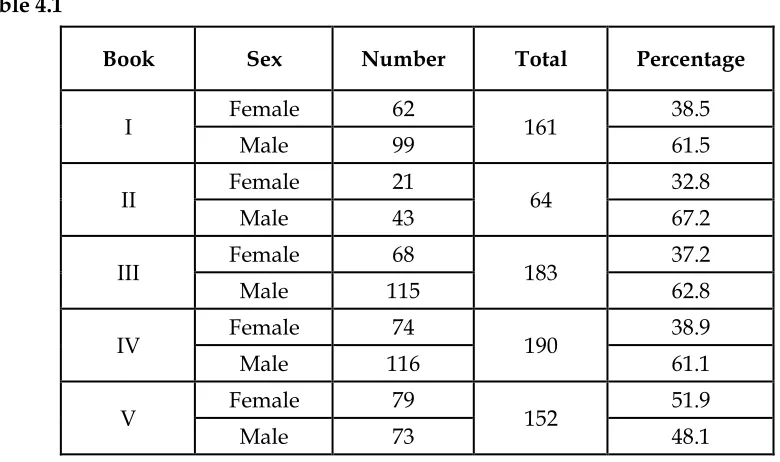
Table 4.1
Book Sex Number Total Percentage
I Female 62 161 38.5
Male 99 61.5
II Female 21 64 32.8
Male 43 67.2
III Female 68 183 37.2
Male 115 62.8
IV Female 74 190 38.9
Male 116 61.1
V Female 79 152 51.9
It can be seen in the table, the finding of visibility aspect shows that all textbooks presents more pictures of male than female, except textbook V. Each textbook, I to IV, shows a big
difference of number in images presentation. The number of male’s pictures are superior to female’s. Female’s pictures are even below 50% in the four textbooks. However,
unexpectedly, textbook V shows more picture of female than female, but the difference is
not too big. The textbook presents female’s images about 51.9% while male’s 48.1%. This is the evidence that all textbooks might not consider female has an important role as male in the appearance aspect.
Although some images of female and male presented in the textbooks showed gender bias, some activities and occupations varied for female. Females are not potrayed doing the chores when male are relaxing. For example, if male student are potrayed playing volley in the picture, female students are playing volley as well (Textbook I, p. 27). Another example, when a chapter dicusses a male as the president, the next chapter discusses a female as a national hero (Textbook II, p. 35). The pictures are in the following:
Picture 4.1: Female and male students Picture 4.2: Female student as active are playing volley together. as male student in class
Those pictures show that women are not always related to do the chores, such as: cooking in the kitchen, taking care of the children, and doing the laundry. Female students are potrayed as active as male in the class (Textbook I, p. 82) like was displayed in the picture above. Although in the term of quantity female are surpassed by male in most textbooks, but in the term of quality the textbook are fair enough in displaying both female and male.In addition, unlike men who are stereotyped with muscular body and women with slim body, all textbooks show female and male with the same posture.
Picture 4.4: Same body posture Picture 4.5: Same body posture
with male. with female.
2. Firstness
The second is firstness which investigates pattern of mentioning female/ male’s name (e.g.
Ghina and Anto), noun (e.g. sister and brother), and surname with title (e.g. Ms. Tia and Mr. Beni) within a single phrase. Textbook I and IV do not mention any female’s firstness nor male’s. Meanwhile, textbook II shows female and male firstness equally. Sadly, textbook II shows six male first patterns while female first pattern is only one and textbook V also show male first with one difference to female. Although firstness aspect has been circumvented by the use he/she, the result turns out this aspect has not been free from gender bias issue. Overall, like visibility, this aspect also shows male majority in the term of quantity which may indicates females are male’s follower.
Table 4.2
Textbook Female first Male first
I - -
II 1 1
III 1 6
IV - -
3. Masculine Generic Construction
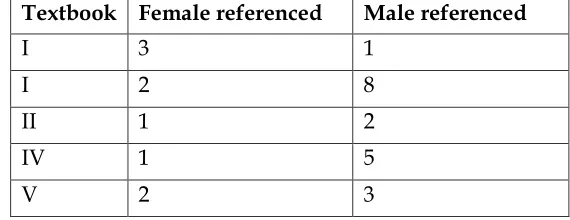
The third aspect is to see whether or not masculine generic construction is truly generic, including both female and male, or exclusively male referenced. In the term of quantity, as it can be seen in the table 4.3, only one textbook shows more female referenced with only 2 difference than male, and the rest of the textbooks show more male referenced. Thus, three aspects are led by male in the quantity term so far. In addition, in the term of quality, most of the jobs that are considered difficult are referred to men such as newspaper journalist, expert, and doctor. Meanwhile, teacher, writer, and counter attendant are the occupations referred to female. Unfortunately, when there is the example of the thief, it is referenced to male. As if all the bad traits are always associated to them. This may make male students think that it is common if they do bad thing. Moreover, animals are also male referenced such as kancil (mouse deer), fish, and crocodile while three friend words are referenced to female. Therefore, although it is not truly equally, this aspect shows that male is not exclusively generic anymore.
Table 4.3
Textbook Female referenced Male referenced
I 3 1
I 2 8
II 1 2
IV 1 5
V 2 3
3. Activity
The next aspect is activity which shows an unexpected result. Unlike the three aspects before, three textbooks led by female in the term of quantity while only two textbooks led by male. In addition, the activities done by female also show more options. Females are not always potrayed doing the chores at home anymore. Men are also presented by the work usually associated with women such as cooking the dishes, shopping in the market, and cleaning the room. Meanwhile, women also do what men do such as doing sports (playing tennis, volley, and basketball) and applying for job vacancy. The textbooks also show that women have much time to enjoy such as reading magazines and novels, visiting some places for holiday, and watching movie. Moreover, they also have the opportunity like men do such as registering for OSIS chief and joining English speech competition.
However, the textbooks are not completely free from gender bias. There are still some gender-stereotype traits that addressed to women. For example: Like many other girls, she is
addition, the text provided in chapter two (Textbook III, p. 28) discuss bullying action happens in the school. Unfortunately, most of the bullying victims in the example of the text are female student. It indicates that women are weak like are always stereotyped. Although some other activities still show gender bias such as mom is serving meals and father is working to afford money for family, overall the textbooks are fair enough in presenting female and male activity with evidence that has been given in the previous paragraph or see the table below.
Textbook I-Table 4.4
Activity
Female Male
Studying using computer Cooking the dishes Playing tennis and basketball Preparing coffee Visiting Batu (tourism spot) for
holiday
Eating in the buffet
Cooking some soup Fishing
Playing volley Painting a picture Baking cookies Playing volley
Playing football Travelling in the forest
Textbook II-Table 4.5
Activity
Female Male
Had lunch in the food court Studying Writing experience in the diary Writing a diary
Telling story Selling ice cream
Cooking in the kitchen Reading story book
Sing a song Enjoying ice cream
Gossiping Cycling to go to school
Textbook III-Table 4.6 Activity
Female Male
Reading “The Hunger Games” Fishing on boat Watching romantic movie Cleaning his room Serving meals for family Watching a movie Scrubbing floor Shopping in the market Taking in laundry Giving speech
Playing kite Meeting with President and ministry
Preparing food Dancing
Shopping Working to afford money for family Visiting Senggigi beach for holiday
Textbook IV-Table 4.7
Activity
Female Male
Reading Playing
Playing kite Cooking pizza
Baking some cookies Sewing shirt
Playing violin Studying
Playing ballet Playing puppet
Studying
Textbook V-Table 4.8
Activity
Female Male
Visiting exhibition Visiting exhibition
Making cake Cycling
Studying Travelling
Teaching in front of class Studying
Reading magazine Cleaning room every day Applying for job vacancy Travelling in the jungle Registering for OSIS chief Smoking
Visiting grandparent’s ranch
Planting rice
Visiting Ceramic village
4. Occupation
The last aspect is occupation. Although all textbooks do not describe women only as a
mother, the result indicates that men’s scope of occupations is wider than women’s. This is evidenced by the big difference of occupation’s amount presented for female and male. Actually, the compiler of those textbooks must consider this aspect seriously because the textbook can guide them to be what they want to be after graduating high school.
Table 4.9
Book Female Male
I Teacher, basketball player, teacher, servant, chef
(4)
Singer, barista, tourism resort worker, furnitur company worker, fisherman, Student, Football player, Manager, Hero, Pilot
(10) II Singer, national hero
(2)
Soccer player, bussinessman, singer, vendor, student, president, national hero, research assitant, advisor, chief officer, minister, retainer, village head, merchant, plane inventor
(15) III Counter attendant,
concierge, store attendant (3)
C. Summary
After gaining the findings, what we have to do next is to examine the research questions which is why this study is done. We can examine the research questions based on the data
analysis. The first research question is “to what extent does gender bias exist in English Senior High School textbook?” and the second is “what type of gender bias are found in English Senior High School textbook?”. To answer these questions, as already explained in the chapter III, the researcher counted the frequencies of female and male mentioned in each aspect in the form of content analysis by using checklist method. Both questions can be answered by using the same technique because they have the same purpose.
Based on the data analysis, there are some important findings to discuss. First, although most of Senior High School textbooks show male majority in images, but those textbooks are considered fair enough in presenting the activity and occupation of male and female in the picture. Nowadays, we can find many women as a mother and a worker as well at the same time. This might be the reason of the author of the textbooks to omit gender bias containing in the picture.
This results in line with the opinion of Smith as cited in Gupta and Lee (1990) who
states that textbook has to describe the real world. “One would hope that the producers
(dictionary and textbook) would be constrained by the criteria of objectivity and realism, at least at the level of constructing image that reflect the relative number of men and women
in society, and the variety of roles that they perform”.
In addition, the textbooks also portray female and male with the same body posture. Although Wood (2001: 151) explains that the cultural view tells women and men’s attractiveness lies on the appearance, the textbooks try to show that it is not a big deal. Having a slim body for women and muscular body for men is not a must. When the textbooks potray female with slim body and male with muscular body, it may influence
student’s thought and can trigger gender bias. However, in this aspect, the textbooks are considered fair enough in potraying female and male’s body posture.
Second, in firstness aspect, the result shows that two textbooks mention more
male’s firstness, one textbook shows female and male firstness equally, and two other textbooks do not show any firstness. This result is similar to Yang’s study in 2011 that male
tend to be mentioned first within a single phrase. This could be embedded in student’s mind that women should not be mentioned first and only as men's follower because none of the textbooks show female first mention. Therefore, teachers need to use the other pattern of mentioning of female/male within a single phrase in order to avoid gender bias.
exclusively male referenced, the author of the English textbook at High School level has already considered female in the generic construction of the word as well. In contrast, Amini and Parviz found that masculine generic construction in Iranian High School EFL textbook was truly all male-referenced. Textbook I show one case of male referenced and textbook II shows four cases. However, teachers are expected to give more instances of feminine generic construction because the textbooks only show a little number of female.
Fourth aspect, activity, shows an unexpected result. Unlike Salamah’s result (2014) in her study who found women are attributed with houseworks such as cooking, doing laundry, and preparing meals, this study shows that some activities do not reflect gender bias for both female and male anymore. Although the textbooks are not completely free
from gender bias, they are considered safe for students. In order to avoid student’s
confusedness on the activities that still contain gender bias, it is better for the teachers to give the other examples of free-gender-bias activity.
The last aspect is occupation. The result shows that males are outnumber females in all textbooks. It is similar to a study conducted by Amini and Parviz where the result is female are surpassed by male. Of the 19 occupations in the Book II, 17 were referred to male and only 2 referred to female. In Book III, the ratio of female to male occupation
appearance is 3 to 13. This must be a concern of the textbook’s author because Senior High
School is the first level to choose the vocational. Therefore, teachers should provide more occupation examples of female other in the textbook. It can avoid female students from the thought that their scope of occupation is smaller than male. They also can be what they want to be just like male students.
Finally, both of research questions have already been answered. In brief, in the term of quantity, male was more visible in the visibility, activity, and occupation aspect in textbook I while female was only more visible in masculine generic construction. Unfortunately, in textbook II, all aspects were taken by male except for firstness aspect which showed the same number for female and male. In textbook III and IV, female was more visible only in activity aspect and the rest was male majority. However, textbook IV did not show any female nor male first. Interestingly, textbook V showed female more in visibility and activity aspects while firstness, masculine generic construction, and occupation aspects were led by male.
Overall, based on the result of the study, some aspects in English Senior High School textbook have already presented female and male fair enough in the term of quality
but the other aspects still need the attention of the textbook’s author toward gender bias
important as well to be included in those aspects. Therefore, teachers need to discuss the gender stereotype as well as bias in the textbook in order to make the students aware of it. Besides, they also need to provide the other material that is free from gender bias.
References
Amini, M., & Birjandi, P. (2012). Gender Bias in the Iranian High School EFL Textbooks. English Language Teaching, 5(2). doi:10.5539/elt.v5n2p134.
Arikunto, Suharsimi. (1996). Prosedur Penelitian. Jakarta: Rineka Citra
Ary, Donald, Lucy C. Jacobs, and Christine K. Sorensen. (2010). Introduction to Research in Education:8th edition. Wadsworth: Cengange Learning,
Baiqiang, Tao. (July 15, 2008). Identifying and Combating Sexism in EFL Textbooks.
Baleghizadeh, Sasan and Amir H. R. (2011). Evaluation of an ESP Textbook for the Students of Sociology. Journal of Language Teaching and Research, 2(5)
Baron, Robert A., Nyla R.B., and Donn Byme, (2008). Social Psychology: twelfth edition.
Boston: Pearson Education
Chen, P. (2008). English Teacher should Notice Gender Bias in Textbook. The Science Education Article Collects, 28. 128-130
Coles, G. (1977). Dick and Jane Grow up: Ideology in Adult Basic Education Readers.
Urban Education,12(1), 37-53. http://dx.doi.org/10.1177/0042085977121003 Crawford, Mary and Rhoda Unger. (2004). Women and Gender: A Feminist Psychology.
New York: McGraw-Hill
Eckert, P., & McConnell-Ginet, S. (2003). Language and Gender. Cambridge: Cambridge University Press
Evans, L., & Davies, K. (2000). No sissy boys here: A Content Analysis of the Representation of Masculinity in Elementary School Reading Textbooks. Sex Roles, 42(3), 255-270. http://dx.doi.org/10.1023/A:1007043323906
Fakir, Muhammad Razia. (2007). Effective Use of Textbooks: A Neglected Aspect of Education in Indonesia. Journal of Education for Indonesia Development 3(1)
Gharbavi, A., & Mousavi, S. (n.d.). A Content Analysis of Textbook: Investigating Gender Bias as a Social Prominence in Iranian High School English Textbooks.
English Linguistic Research, 1(1). doi:dx.doi.org/10.5430/elr.v1m1p42
Harmer, Jeremy. (1991). The Practice of English Language teaching: new edition. New York: Longman
Hutchinson, T. and Torres, E. (1994), “The textbook as agent of change”, ELT Journal 48(4): 315-28
Ifegbesan, A. (n.d.). Gender-Styereotypes Belief and Practises in the Classroom: The Nigerian Post-Primary School Teachers'. Global Journal of Human Social Science.
10(4).
Lips, Hilarly M. (2003). A new Psychology of Women: Gender, Culture, and Ethnicity: second edition. New York: McGraw Hill.
Mardalis. (1995). Metode Penelitian. Jakarta: Bumi Aksara
Mineshima, M. (2008). Gender Representation in an EFL Textbook. [Online]Available:http://www.niit.ac.jp/lib/contents/kiyo/genko/13/14_MI
NESHIMA.pdf
Mukundan, Jayakaran, and Vahid, Nimechisalem. (2008). Gender Representation in Malaysian Secondary School Englsih Language Textbook. Indonesian Journals of English Language Teaching. 4(2)
Muthali’in, Ahmad. (2001). Bias Gender dalam Pendidikan. Surakarta: Muhammadiyah University Press
Nunan, David. (1991). Language Teaching Methodology: A Textbook for Teacher. London: Prentice Hall
Porreca, K. L. 1984. Sexism in Current ESL Textbooks. TESOL Quarterly, 18(4), 704-724.
Reed, Arthea J.S., Verna E.R., Mary W.o. (1998). In the Classroom; An Introduction to Education: third edition. New York: McGraw Hill
Richards, Jack C. (2001). Curriculum Development in Language Teaching. Cambridge: Cambgrige University Press
Shaw, Susan M and Janet Lee (esd.). (2007). Women’s Voices, Feminist Visions: Classic and Contemporary Reading. New York: McGraw Hill
Skierso, Alexandra. (2001). Teaching English as Second or Foreign Language: Textbook Election and Evaluation in Marianne Celce-Murcia: Second edition. Boston: Heinle & Heinle Publisher
Sugiyono. (2011). Quantitative Research, Qualitative and R & D Methods. Bandung: Cv. Alfabeta
Sukmadinata, Nana Saodih. (2007). Educational Research Methods. Bandung: PT. Remaja Rosdakarya
Taylor, F. (2003). Content Analysis and Gender Stereotypes in Children’s Book.
Teaching Sociology. 31(3), 300-301. http://dx.doi.org/10.2307/3211327
Taylor, Verta, Nancy Whittier, Leila J. Rupp. (2006). Feminist Frontier: seventh edition.
New York: McGraw Hill Textbook in the ESL/EFL classroom. English Language Teaching. 4(2)