*
PROCEEDING
The 6
th
International Symposium for
the Development of Integrated Pest
Management (IPM) in Asia and Africa
Published by the Plant Breeding Laboratory of Niigata University
Proceeding
The 6
thInternational Symposium for the Development of Integrated Pest
Management (IPM) in Asia and Africa Held at Niigata University 2-3 March, 2016
THE ORGANIZING COMMITTEE International Standing Committee of IPM
Dr. CHO Myoung-Rae, National Academy of Agricultural Science, RDA, Korea Dr. Ngo Dinh BINH, Vietnam Academy of Science & Technology, Vietnam Dr. Soraya RUAMRUNGSRI, University of Chiang Mai, Thailand
Dr. Bahadur MD. MEAH, Bangladesh Agricultural University, Bangladesh Dr. Delwar M HOSSAIN, Bangladesh Agricultural University, Bangladesh Dr. Jamalam LUMBANRAJA, University of Lampung, Indonesia
Dr. Mohamad Roff Mohd. Noor, Horticulture Research Centre, MARDI, Malaysia Dr. Kazuro OHNO, University of Miyazaki, Miyazaki, Niigata, Japan
Dr. Keiichi Okazaki Niigata University, Niigata, Japan Dr. Naoki Harada Niigata University, Niigata, Japan
Local Committee
Keiichi Okazaki (Chairman), Professor, Niigata University Kuni Sueyoshi, Professor, Niigata University
Naoki Harada, Associate Professor, Niigata University Yoshitaka Sano, Associate Professor, Niigata University Masaru Nakano, Associate Professor, Niigata University Eigo Fukai, Assistant Professor, Niigata University
Editor
Dr. Keiichi Okazaki
Publisher
Plant breeding laboratory of Niigata University
Phone: +81-25-262-6615 Fax: +81-25-262-6854
Sponsor Acknowledgements
The organizing committee would like to acknowledge the financial support given by Sasaki Environmentally Friendly Technique Promotion Foundation and the Alumni Association of Faculty of Agriculture, Niigata University.
PREFACE
To date, the international standing committee had arranged five international symposiums to extend IPM research successfully. In the 6th IPM symposium, we have four sessions for oral presentation and one session for poster presentation. The IPM technology contains various topics of different field so there is scarce opportunity to mutually exchange the knowledges about IPM technology in the symposiums divided into ordinary agricultural sciences. Therefore, the aim of this symposium is to exchange our knowledge of IPM, to develop the expertise for crop production, and to solve the agricultural problems using IPM.
I also sincerely appreciate all of the participants who come from the different countries far from Niigata, such as Turkey, Vietnam and Indonesia, and also appreciate the participants from Japan. Prof. Fuji comes from Akita prefectural university.
We wish to share the opportunity to recognize the current situations surrounding IPM and develop collaboration among the universities and institutes in Asia and Africa.
Dr. Keiichi Okazaki,
Contents
The Speech for All Participants from Dean of Academic Assembly,
Institute of Science and Technology, Niigata University
1
Program of the 6th IPM meeting in Niigata
3
Selected Papers
1. Organic Farming and Its Importance in Turkey
14
2. Present Scenario of IPM in Bangladesh
19
3. Phosphorus Adsorption Behavior as Affected by Compost, Iron ion, and
Iron Concretion in a Highly Wheathered Soil
29
4. Problem with Spread of the Rice Seed Disinfection Methods not using
Chemical Fungicides and its Countermeasures
36
5. Isolation, Expression and Characterization of Housefly Larvicidal Cry2Aa
Protein from a New Strain
Bacillus thuringiensis
serovar
kurstaki
MSS8.4
42
6. Pathogenicity of Entomopathogenic Fungi to Soybean Aphids
Aphis
glycines
(Hemiptera: Aphididae)
56
7. Exploitation of the Gadgets Immobilizing
Lacto bacillus
sp. and
Bacillus
sp to Control the Proliferation of Bacteria Generating Bad Smell by
Digestion of Urea in Toilet
67
8. Regulation of Chitinase System by Small RNA in
Serratia marcescens
77
9. Screening of Chitinolytic Bacteria by Measuring Chitinase Activity and
Biofilm Formation
83
10. Fermentation Medium Compositions Optimization for Chitinase
Production from
Bacillus thuringiensis
serovar
kurstaki
strain MSS1.1
Using Response Surface Methods
88
11. Paddy Rice Cultivation method under high temperature conditions
involving application of whole base manure containing organic matter
Proceeding of the 6th International Symposium for the Development of Integrated Pest Management (IPM) in Asia and Africa 2016
The Speech for All Participants from Dean of Academic Assembly, Institute of Science and Technology, Niigata University
It’s my great pleasure to welcome you all on behalf of Niigata University, Japan to the 6th International Symposium for the Development of Integrated Pest Management (IPM) for sustainable agriculture in Asia and Africa 2016.
IPM has become very popular during the last two decades particularly in South and South-east Asian countries because it calls for the reduction of indiscriminate use of chemical pesticides. IPM is an environment friendly approach for pest management. It is also an important component for Good Agricultural Practices (GAP).
The conferences have sought out three main concepts i.e., i) to develop the crops resistance to various pests and diseases with the combination of conventional methods and gene technology, ii) to progress sustainable and environment friendly management of the soil fertility iii) to develop environment sound bio-pesticides and agricultural technologies for controlling various pests and diseases.
I would like to acknowledge that, previously the IPM organizing committee had arranged five international conferences to extend IPM research successfully. The 1st conference was held on in Chiang Mai University in Thailand at 2007, the 2nd in Hanoi, organized by VAST at 2008, the 3rd in Lampung University in Indonesia at 2009, the 4th in Bangladesh, organized by Bangladesh Agricultural University, Mymensingh at 2010, and the 5th in Malaysia, organized by Malaysian Agricultural Research and Development Institute (MARDI), Sabah at 2012. The IPM Standing Committee organized the past conferences with a view of the development of the sustainable agriculture in Asia and Africa. I think that, the achievements of those conferences were outstanding.
Agriculture in Asia and Africa largely depends on the use of chemical pesticides and chemical fertilizers; but the negative aspects of these have been recognized. For the establishment of the sustainable agriculture, we need to decrease the use of those chemicals as much as possible by replacing it with bio-pesticides, organic fertilizers and pest tolerant cultivars. However, still these shifts have not been succeeded yet as the many materials used in various scenes in the fields. This international conference has obligation to develop those materials based on the three projects that we have placed.
Finally, I would like to appreciate the contributions of the organizing committee lead by Niigata University for organizing such wonderful conference. I wish the success of the symposium.
Takuji Ohyama
Proceeding of the 6th International Symposium for the Development of Integrated Pest Management (IPM) in Asia and Africa 2016
29
Phosphorus Adsorption Behavior as Affected by Compost, Iron ion,
and Iron Concretion in a Highly Wheathered Soil
Jamalam Lumbanraja
1, Hery Novpriansyah
1, Ainin Niswati
1, and Tri Purnama
Sari
11
Department of Soil Science, Faculty of Agriculture, University of Lampung, Jl. Prof. Sumantri Brojonegoro No 1 Bandar Lampung 35145, Indonesia. Corresponding author email:
[email protected], phn:+628127924131.
Abstract
It is to be concerned that because of the high content of free iron (Fe) and (Fe) concretion, phosphorus (P) is generally tighly bound as Fe-P compounds in soil system found in the humid tropical region and, therefore, the available P for plant growth is very low. Beside as a source of complete essential nutrients for plant, source of energy and nutrients for soil organism, and for soil structure improvements, the use of organic compost would be able to inactivate the free iron and iron concretion in the soil so that the applied P from fertilizers would be available for plant. The objective of this study is to determine the effect of free Fe, iron concretion and compost materials on the P sorption behavior in a highly wheathered (Ultisols) soil. The study consists of five reatments: S (soil), SF(soil+FeCl3), SC (soil+concretion), SFO (soil+FeCl3+compost), and SCO (soil+concretion+compost). The organic compost has been developed from the mixed of fresh cow dung, coconut fine fiber waste, air dried solid waste powder of the monosodium glutamat (MSG) processing (about 9.5% of P2O5), husk, and chicken manure being composted for 30 days. The air dried sub-soil sample, iron concretion and compost had been grinded and passed through 0.5 mm sieve. The P sorption behavior of the treatments were constructed using Langmuir Plots. The results showed that the free Fe drastically increased the maximum adsorption-P and relative P-binding energy in to the soil colloid and reduce the amount of available P followed by iron concretion treatment. While the organic compost reduced the maximum adsorption-P and relative P-binding energy and the increased the available P. The highest maximum adsorption-P and relative binding energy were found in the SF (soil+FeCl3 treatment), whereas the lowest value of maximum P adsorption and binding energy were in the SCO (soil+iron concretion+compost) treatment.
Keywords: P-sorption, binding energy, free iron, concretion, Langmuir plot,
metal-organic complex.
Introduction
The intensive wheathering, leaching and decomposition processes make soils in the humid tropical region having very low organic matter content (<1%), pH (<5), base saturation (35%), and cation exchange capacity (CEC <15 cmolckg
-1
Proceeding of the 6th International Symposium for the Development of Integrated Pest Management (IPM) in Asia and Africa 2016
The reduction–oxidation reaction of iron can form a tick layer of iron concretion with in the soil profiles, especially, in the B horizon that can be very close in the soil surface. The formation of iron concretion as the result of reduction and oxidation reactions due to the rising up and down alternately of the ground water level and create the red-yellow color of the various form of Fe concretions; the formation of Fe concretion and the high free iron in this type of soils can be toxic and limit the plant root growth (Darmawijaya, 1997).
It has been reported that the high amount of P sorption occurring in soil colloids associated with the content of extractablel Fe and Al, oxide or oxide hydrate content of Fe and Al, and clay content dealing with the type of soil colloids and clay minerals (Sanchez, 1976). The higher levels of these compounds and the higher the clay content in this type soil, the higher the phosphorus sorption capacity and, the greater the power of the P fixation (Sukmawati, 2011). The high content of free Fe and iron concretion can affect the phosphorus (P) being generally tighly bound as Fe-P compounds and, therefore, the available P for plant growth is very low in the soils. On the acid soils such as Ultisols, high content of free Fe will fix the P from soils having been fertilizered making it unavailable to the plant (Widjaja-Adhi and Sudjadi, 1987).
One way to limit the P fixed by Fe constituents in the soil system is using organic matter before P fertilizer. Beside as a source of complete essential nutrients for plant, source of energy and nutrients for soil organism, and for soil structure improvements, the use of organic compost would be able to inactivate the free iron and iron concretion in the soil so that the applied P from fertilizers would be available for plant. Organic matter has been known to suppress the solubility of Al and Fe and can decrease the amount of P adsorbed due to organic acids produced during decomposition of organic anion form that has a capacity to bind free Fe and Al in the soil solution (Schwertmann, et al, 1986; Stevenson and Fitch, 1986; Hakim and Sediyarsa, 1986).
The objective of this study is to determine the effect of free Fe, iron concretions, and organic material on the maximum adsorption P, the P binding energy and available P on an Ultisol soil in Lampung Indonesia.
Materials and Methods
Sub-soil sample used for the study was taken from the University Experiment Station of the University of Lampung, Natar. Compost had been composted of mixing of various agriculture wastes (including cow dung and chicken fresh manure, cocodust, rice husk, mud MSG waste that had been dried- powdered), FeCl3 as free iron, and iron concretions taken from the Central Lampung. Soil, compost and iron concretion were grinded and sieved through 0.5 mm, Characterization of the chemical properties of soil weres pH, total-N, available-P, exchangable K, total-C , Cation Exchange Capacity (CEC), and potential-P (25% HCl).
Proceeding of the 6th International Symposium for the Development of Integrated Pest Management (IPM) in Asia and Africa 2016
31
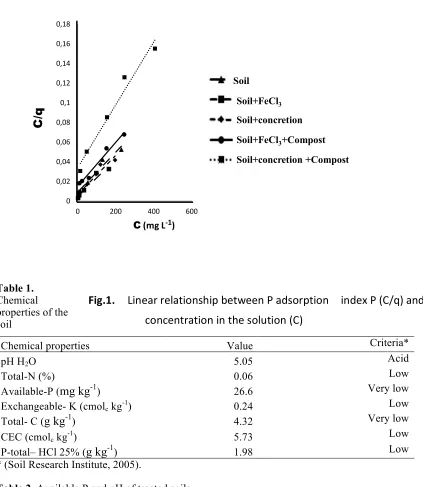
Phosphorus sorption behaviour of each treatment was constructed using Langmuir Isotherm (Fox and Kamprath, 1970; Rubinger, et al., 2006) by the following equation:
C / q = (1/ kb) + 1 / bC---(1)
where: C/q = sorption index (kg L-1), k = relative P binding energy, b = maximum adsorption-P (mg kg-1), and C= equilibrium P concentration in the equilibrium solution (mg L-1).
The construction of the Langmuir Isotherm between C/q in the Y-axis and C in the X-axis to
The chemical properties of the soil samples used in this study are presented in Table 1. The soil has acidic properties with a pH of 5.05. The condition of soil acidity indicates that the availability of nutrients in the soil such as phosphorus available are very low (26.6 mg kg-1). Similarly, total-N and exchangeable K are low ( 0.06% and 0.24 cmolc kg
-1
, respectively), and total-C content is very low (0.43%). Overall the chemical properties of the soil at this particular research are low to very low. Cation exchange capacity (CEC) is also low (5.73 cmolc kg
-1 leaching. The low availability of plant nutrients, especially P, in this Ultisol Soil thought to be as affected by the high P being tightly bound to free iron and iron concretion in the soil.
Phosphorus and pH in the soil treated samples
Available P and pH of the soil as affect by treatments are presenting in Table 2. The lowest-available P content of 2.6 mg kg-1 is on the treatment of soil + FeCl3 and the highest available P is the treatment of Soil + concretion+ compost (844.9 mg kg-1). This is due to the role of organic matter as a source of nutrients including P in the compost. Organic matters from compost can form organo-metal compound between organic acids with metal ions such as Fe and Al (Schwertmann, et al, 1986; Stevenson and Fitch, 1986) and therefore, P from fertilizers will be more available. The highest pH (6.72) was in the treatment of Soil+ concretion +compost. However, surprisingly pH of the treatment Soil + FeCl3 + compost is very low (strongly acid of pH 2.97) . This is due to hydrolysis of the free iron can not be neutralized by the organic material so that the pH value is very acid. Organic materials used in this study are classified alkalis pH 8.45 with available-P as much as 9.576 g kg-1 and total-P 3.14% which are classified as very high (Table 3).
Maximum adsorption P and relative binding energy
Proceeding of the 6th International Symposium for the Development of Integrated Pest Management (IPM) in Asia and Africa 2016
increasing adsorption-P in the soil. The values of maximum adsorption P in the Soil + FeCl3 and Soil+concretions are 5291 and 5051 mg kg-1, respectively and its relative P binding energy are 0.0413 and 0.0300, respectively.
The results also indicate that soil treated compost can reduce the maximum adsorption-P (b) and relative P-bond energy (k). The maximum adsorption P the treatments of Soil+ FeCl3 + compost and Soil + concretion + compost are 4464 and 3135 mg kg-1, respectively and the relative P binding energy are 0.0151 and 0.0094, respectively. The decreasing of P-sorption behaviour can be as a result of organic materials being able to chelate Fe (Schwertmann, et al, 1986; Stevenson and Fitch, 1986).
The highest maximum adsorption-P value (b) and the relative P binding energy (k) are found in the treatments of Soil + FeCl3, (b = 5291 mg kg adsorption-P and the relative P binding energy in the compost treatments can be as a results of organic acids (negative charge) can bind Fe (positive charge) in the soil solution before the addition of P.
Significance maximum adsorption-P (b) and the relative binding energy (k)
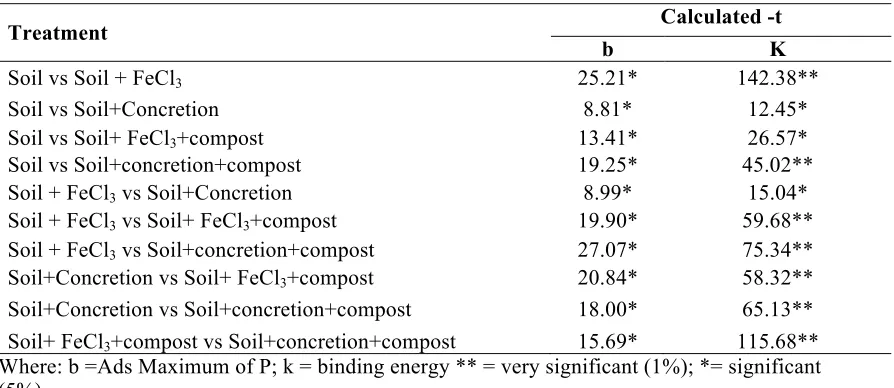
To determine the significance of the maximum adsorption-P (b) and the relative P binding energy, student t-test has been executed for pairs of treatments and the results are shown in
Table 5. The results indicate that there are significantly higher, both maximum adsorption-P
and the relative P binding energy when it is introduced free iron and concretion into the soils significant in increasing relative P-binding energy (k); iron concretion in soil was significantly increasing relative P-binding energy (k) of adsobed-P, while the presence of organic compost was highly significant in decreasing the relative P-binding energy (k), exept the precense of free iron and compost was only significantly decreasing relative P-binding energy (k).
References
Soil Research Institute (2005), Characteristics of Chemical Data Analysis for Soil, Plant, Water, and Fertilizer.Soil Research Institute. Bogor. 136 p.
Darmawijaya, I. (1997), Soil Classification. Gajah Mada University. Yogyakarta. 245 p.
Proceeding of the 6th International Symposium for the Development of Integrated Pest Management (IPM) in Asia and Africa 2016
33
Frank K., Beegle D., Denning, J (1998), Phosphorus. In J.R. Brown (ed.) Recommended Chemical Soil Test Procedures for the North Central Region. North Central Reg. Res. Publ. No. 221: 21-30.
Hairiah K., Utami S.R., Lusiana B., van Noordwijk M. (2006). Nutrients and Carbon Balance in Agro forestry Systems 14: 29−34. .
Hakim L., Sediyarsa M. (1986), Field experiment of several sources of natural phosphate fertilizer in Lampung Utara. Soil and Fertilizer Research.18:179−194.
McKeague,J.A., Cheshire M.V., Andreux, F., Berthelin J. (1986), Organo-mineral complexes in relation to pedogenesis. In P.M. Huang and M. Schnitzer (Ed.) Interactions of soil minerals with natural organics and microbs. SSSA Spc. Pub. Number 17 :549-592
Rachim D. A., Suwardi (1999), Soil morphoology and classification. Department of Soil Science, Faculty of Agriculture, Bogor Agricultural University. 187 p.
Rubinger C.P.L, Moreira R.L, Cury L.A., Fontes G.N., Neves B.R.A., Meneguzzi A., Ferreira C.A. (2006), Langmuir-Bloggett and Langmuir-Schaefer films of poly (5-amino-1-naphthol) conjugated polymer. Applied Surface Science 253:543-548
Sanchez P.A. 1976. Properties and Management of Soil in the Tropics. John wiley and Sons, Canada. 225 pp.
Stevenson F.J., Fitch A. (1986). Chemistry of metal ions with soil solution organics. In P.M. Huang and M. Schnitzer (Ed.) Interactions of soil minerals with natural organics and microbs. SSSA Spc. Pub. Number 17 :29-58
Sukmawati. 2011. P- sorption in Andisol Emerging From Tuff Vulkan in some volcanoes in Central Java treated with Humic Acid and Amino Silicate.Media Litbang Sulteng IV (1) : 30 – 36.
Widjaja-adhi IPG. and M. Sudjadi. 1987. Soil phosphate status and behavioral in Indonesia.
Proceedings of the National Workshop on Use of Phosphate Fertilizer. Soil Research Center.Bogor. p: 223-243.
Proceeding of the 6th International Symposium for the Development of Integrated Pest Management (IPM) in
Table 2. Available P and pH of treated soils
Treatment Available P (mg kg-1) pH
Proceeding of the 6th International Symposium for the Development of Integrated Pest Management (IPM) in Asia and Africa 2016
35
Table 3. Available P and pH compost and concretion
Sample Available P
(mg kg-1) Total-P (%) pH (criteria)*
Compost 9576 (very high) 3.14 (very high) 8.45 (alkalis) Concretion 4.02 (very low) 0.004 (very low) 4.43 (very acid * (Soil Research Institute, 2005).
Table 4. Langmuir linear equation of the P sorption
Perlakuan Langmuir linear equation
b
(
mg kg
-1) k r2
Soil C/q = 0,00901 + 0,000203 C 4926 0,0225 0,963
Soil + FeCl3 C/q = 0,00458 + 0,000189 C 5291 0,0413 0,942
Soil+Concretion C/q = 0,00660 + 0,000198 C 5051 0,0300 0,937 Soil+ FeCl3+compost C/q = 0,01483 + 0,000244 C 4464 0,0151 0,975 Soil+concretion+compost C/q = 0,03412 + 0,000319 C 3135 0,0094 0,971 Where: b = maximum adsorption of P ; k = binding energy ; r2 = koefisien, C= solution P and q=
adsorbed P
Table 5. Student-t test significances of maximu adsorbed P (b) and binding energy (k)
Treatment Calculated -t
b K
Soil vs Soil + FeCl3 25.21* 142.38**
Soil vs Soil+Concretion 8.81* 12.45*
Soil vs Soil+ FeCl3+compost 13.41* 26.57*
Soil vs Soil+concretion+compost 19.25* 45.02**
Soil + FeCl3 vs Soil+Concretion 8.99* 15.04*
Soil + FeCl3 vs Soil+ FeCl3+compost 19.90* 59.68**
Soil + FeCl3 vs Soil+concretion+compost 27.07* 75.34**
Soil+Concretion vs Soil+ FeCl3+compost 20.84* 58.32**
Soil+Concretion vs Soil+concretion+compost 18.00* 65.13**