• Tidak ada hasil yang ditemukan

Designing Sustainable Program Innovation in Lampung Province

N/A
N/A
Protected

Academic year: 2019

Membagikan "Designing Sustainable Program Innovation in Lampung Province"

Copied!
12
0
0

Teks penuh

(1)

Designing Sustainable Program Innovation in Lampung Province

Simon Sumanjoyo Hutagalung¹, Dedy Hermawan² Departement Of Public Administration, Universitas Lampung

Bandar Lampung, Lampung, Indonesia

[email protected]¹, [email protected]²

Abstract

This study seeks to describe the efforts of new autonomous regional governments in building the capacity of public services in new autonomous regions, identifying the dynamics of sustainable public service capacity building in new autonomous regions and designing a model of sustainable public service capacity building in order to strengthen autonomy area. This model tries to reach the intergenerational development aspect of development, which is not short-term. The research method used in this study is a qualitative approach that combines secondary data and primary data. Data were collected from several local governments with best practice in public service capacity management. Data analysis was done by using interactive model. From the research conducted known that the strengthening of innovative programs in the public service sector need to adopt the role model of public sector innovation initiative. The model emphasizes the importance of identification of the role of innovation that is designed in a program to the real problems faced, so that later will be achieved public trust about the urgency of the innovation.

Keywords: Program Innovation, Sustainability, Role Strengthening

I. Introduction

Increasing the capacity of public services through a territorial range approach is an argument that has succeeded in realizing a new autonomous region in Indonesia. This is evidenced by the drastic increase in the number of new autonomous regions. However, the correlative argument between the formation of new regions and the improvement of public services is also experiencing the opposite condition.

(2)

The autonomous region as a result of regional autonomy policy in principle has the same function to the community (Haris, S. 2005). The autonomous regional government in this context still has an obligation to carry out excellent public service activities for the community in its territory, although it is known that the new autonomous regions generally do not have the capacity of infrastructure and resources capable of providing optimal contribution to the delivery of public services (Hutagalung, SS, & Hadna, A. H, 2010). Administrative issues such as office building, employee procurement, boundary issues, allocation and provision of financial resources and other administrative aspects are still a major challenge for local governments in autonomous regions (Wismono, FH, & Ramdhani, L. E, 2015) .

Paying attention to the development of areas that are specifically implemented in new areas is important because this area needs to be managed in a planned manner early in order to avoid mismanagement of management which will lead to stagnant quality of society in the area. The context of sustainable regional development becomes relevant. The issue of public service capacity becomes the focus that must be prepared in order to implement the regional economy (Hutagalung, S. S, 2012). Given the capacity of a good public service will produce a long-term positive impact, even reaching across generations.

Based on the background of the problem, then generated research questions as follows; (1). How do local government efforts to build the capacity of public services to local governments are realized through excellent public service programs ?, (2). What is the model of sustainable public service capacity building in the context of strengthening regional autonomy in local government ?. Two questions are then to be discussed in the discussion section.

II. Research Method

This study uses a qualitative approach that describes and explains symptoms and trends in the emerging phenomenon. This approach is used to examine the object under natural conditions, where the researcher is a key instrument with data collection techniques conducted in triangulation, inductive data analysis and research results that emphasize the meaning of generalization (Sugiyono, 2006). Field data collection for this research will be done with the techniques developed in qualitative approach that is: (1). Interviews with key informants using interview guides, (2). Direct observation into the study site, and (3). Documentation review. The data obtained will be analyzed qualitatively by using interactive model of analysis Miles and Huberman (1992). Data were analyzed by qualitative descriptive method. This stage through several phases namely: (1) data reduction. (2) data presentation, and (3) drawing conclusions. In this phase the researchers do inference based on the interpretation of the findings of the field.

III. Results and Discussion

A. Analysis of Public Service Innovation Program at Local Government in Lampung

(3)

achievement of free health service program objectives P2KM) in Bandarlampung city that has been achieved and monitoring and supervision related to free health services (P2KM) in Bandarlampung City that has been done by the organizers.

This program is valid since January 1, 2015 guaranteed by the Government of Bandarlampung City in Mayor Regulation No.24 of 2014 and shown to the entire community of Bandarlampung City for the community to be comfortable, so there is no excuse if sick there is no cost, because it is borne by the City Government Bandarlampung. Bandarlampung City Government, City Health Office Bandarlampung and UPT related health centers have run the program objectives by providing free medical services to the community of Bandarlampung City. This is evidenced by the number of people who do not have other health insurance treatment by using KK and ID card Bandarlampung city. Disease health services are also not only general ailments, but for illnesses that must be treated by the hospital as well, in addition to inpatients also have been borne by the City Government Bandarlampung. In addition, the cooperation between Bandarlampung City health service with the Department of Population and Civil Registry and Hospital, very petrified in prosudur free health service is to provide convenience to service providers and service recipients.

As for the factors supporting the free health care program (P2KM) in Bandarlampung City, among others the City Mayor Regulation Bandarlampung No.24 of 2014 about free medical treatment, as well as cooperation relationships between government agencies. While the inhibiting factors of this health care program is the lack of awareness of the community to bring the requirements or incompatibility of data between the KK and KTP and residents who have not taken care of citizenship city Bandarlampung. This makes the service hampered due to incompatibility of the data, or the citizens themselves who do not carry the original card and ID card requirements and photocopies. Should the citizens who want to seek treatment has prepared the requirements for smooth service of patients.

(4)

According to the researcher, the location of free wifi installation in North Lampung Regency is not effective due to the location which is not strategic, as in the location of Ramayana fruit market which is placed at the location point of Military Police Complaint Service Office using the wifi access is only the office user only, then at Simpang location Saprodi, South Abung, is placed at the point of photocopy location where the facilities and infrastructure are not provided, then at the location of Kotabumi Koramil Square, placed at the point of location at the Koramil Office, Kotabumi. This program is very helpful to the people of North Lampung Regency, the community is very helpful and feel satisfied with this program. But this program is less the effort of the Office of Communications and Informatics North Lampung in improving the quality of Human Resources community of North Lampung, the relevant offices do not conduct trainings on ICT so that there are still many people of North Lampung who still stuttering technology or less able to access the internet, the internet is not used in a positive way.

Based on the research, it is concluded that the goal of free internet program in North Lampung Regency in supporting public literacy has not been achieved well. This can be seen only one that is achieved from both goals, in the first point that is Helping the general public in terms of facilitate access to information quickly and accurately the desired information, has been achieved seen through the satisfaction felt by the people of North Lampung Regency, the community helped by the while the second goal of improving the quality of human resources in North Lampung Regency is not achieved because most of the users of internet access in North Lampung use it to play online games, and there are still people who do not master how to use the internet.

Pesawaran District has a Home Care Program as its flagship program. Home Care Program is a home to door health program by doing nursing care individually, family, or group to improve the life pattern of clean and healthy society continuously and comprehensively where the hopes of self-reliant and conscious society. Making it easier for people who can not afford to get health services just waiting at home and waiting for Home Care officers to check their health regularly and thoroughly. Home Care programs and family physicians almost have the same duties and roles of doing home health services, only difference if Home Care has function as preventive health service and notification (promotive) while for family doctor have both and added with treatment . For Home Care officers themselves can actually also to treat patients who are served but should consult in advance with the doctors in the health center where on duty because they are only allowed to treat just P3K only and their drugs are also standard drugs instead doctor's prescription. And for family doctors they can give treatment directly and only conspire with the family of the patient without any outside interference.

(5)

date as it should be despite the monthly reporting system as well as the supervision of various parties. (3). Stakeholders (stakeholders) served. The community as a party served felt cared for health and maintained his health and felt facilitated in receiving health services by just waiting to be visited by his house or by joining activities such as posyandu and posbindu. (4). Sources used. Sources such as the budget are inadequate in the conduct of health activities because they still have to take and ask for funds from the Health Operational Assistance (BOK) and the National Health Insurance (JKN), the number of officers is not enough so that the officers overwhelmed in serving, and the last facility they get vehicles, medical equipment, and medicines. (5). Implementation of the program compared to the expected in the plan. Many improper implementations such as the ideal number of one village officer will be but in reality two or more villages, the community is not yet fully aware of the importance of the Clean and Healthy Lifestyle (PHBS), and neither the community nor the officers know their roles well.

The results of the implementation has not been running well because there are still many that have not achieved in the main goal of Home Care is to encourage the community to live healthy and also not all people get the services of Home Care. Society is a factor inhibiting because they are still not yet changed the idea that if there is a risk factor disease should report to Home Care officers to know if in their village there are cases of risk factors disease that can be prevented and directed to get other health services.

B. Analysis of Implementation Capacity and Sustainability of Innovation Program

The results of the analysis of each innovative program of the area are then compared by using the strategic triangle approach. The strategic triangle approach delivered by Moore (1995) can be borrowed to test the feasibility of innovation ideas. There are three elements that must work simultaneously so that a strategic and big innovation idea can be implemented to realize a strategic change in the organization, ie clear mission and objectives, support and legitimacy, and organization and operations. Furthermore, there are three tests that need to be done to assess an idea of innovation or change can proceed, ie the idea is substantively valuable, the potential for sustainability both legitimately and politically sustainable, and technically operational and administrative feasible (operationally and administratively feasible) (Moore, 1995: 71).

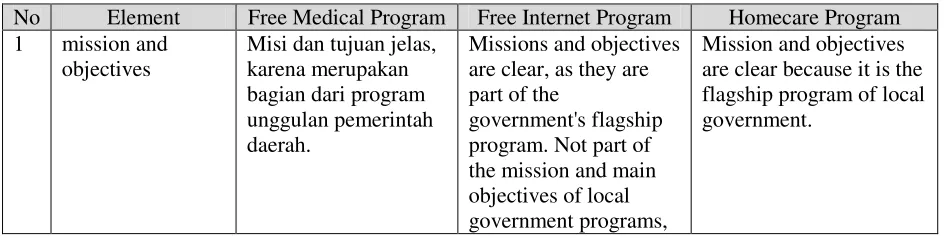
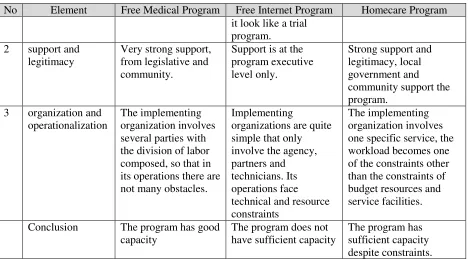
The capacity of the program implementation appears to occur differently in each program, it appears that some aspects are formed under optimal conditions and in other programs there is an unoptimal condition. The results of the identification can be seen from table 1 below:

Table 1. Program Implementation Capacity Analysis

No Element Free Medical Program Free Internet Program Homecare Program 1 mission and

objectives

Misi dan tujuan jelas, karena merupakan bagian dari program unggulan pemerintah daerah.

Missions and objectives are clear, as they are part of the

government's flagship program. Not part of the mission and main objectives of local government programs,

(6)

No Element Free Medical Program Free Internet Program Homecare Program

Conclusion The program has good capacity program that already has good implementation capacity, while the Home Care Program becomes a good program but needs revamping and free Internet Program in North Lampung Regency to be a program that does not have adequate capacity where there are still many weaknesses. Further analysis of the sustainability power of the three programs are analyzed and can be observed in table 2 as follows:

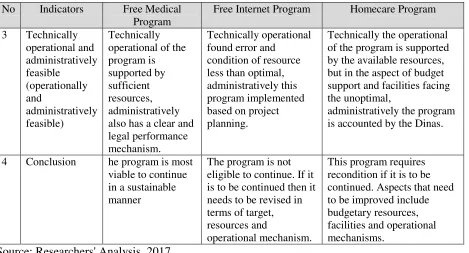
Table 2. Analysis of Sustanability Aspect of Innovation Program No Indicators Free Medical

Program

Free Internet Program Homecare Program

1 Has substantive in the case of political support is also not a major concern.

The program is mandated, meaning that it is

implemented at the official / OPD level while its

(7)

No Indicators Free Medical Program

Free Internet Program Homecare Program

3 Technically of the program is supported by the available resources, but in the aspect of budget support and facilities facing the unoptimal,

administratively the program is accounted by the Dinas.

4 Conclusion he program is most viable to continue in a sustainable manner

The program is not eligible to continue. If it is to be continued then it needs to be revised in terms of target, resources and

operational mechanism.

This program requires recondition if it is to be continued. Aspects that need continuously, while the Home Care Program in Pesawaran District has the power to proceed but by improving on several aspects. The free internet program becomes the least powerless program to become an ongoing program. This program should be redesigned with a more capacity-ready design.

From both tables can be observed if the capacity of the program is designed optimally it will produce good program sustainability capabilities as well, otherwise if the capacity of the program experienced many obstacles and obstacles it will result in poor sustainability capability. This is at the same time the basis that a model needs to be designed in advance in the design of innovative programs that become local government policy, and not just replicative other regions or imitate the central government program.

C. Capacity Building Model of Local Government Innovation Program

(8)

Figure 1. Capacity Building Model of Sustainable Public Service Through Local Innovation Program

The model begins with the existence of a grand design of local innovation programs that prioritize the improvement of the quality of public services. The existence of a grand design is a strategic foundation for the organization of regional apparatus to translate it into various internal activities of agencies or activities involving the network of agencies. This section forms the basis for the vision and purpose of the program's existence. In the next stage, identify the direction and importance of the innovation program. Different directions and interests will require different forms and program mechanisms as well. Therefore, not all problems in an area can be solved with the same program. The next stage is testing the form of the program into the program ecosystem, in this case related to the target group and the beneficiaries of the program later. Different ecosystems will require different forms of the program as well. In this case the program ecosystem includes the legitimacy of policies, socio-economic conditions of society and political conditions. The next stage is to prepare a series of local government capacity to implement the program, capacity conditions will determine the success rate of the innovation program later. A well designed innovation program will potentially fail if it is not supported by a sufficient set of local government capacity. Therefore, it should be prior to the implementation of the good program compared with the feasibility of capacity and if it is considered not able to support the program it is necessary to strengthen the capacity first.

The next stage is the implementation and control of the program. Control becomes an inherent part in the implementation activities intended to create consistency in achieving the goals and objectives of the program. Often found a good innovation program but failed to reach the optimal level due to lack of commitment implementers reflected in the consistency of program implementation. The final stage is the evaluation and improvement of regional innovation programs. This stage is a stage that assesses the success or failure of the program. If found obstacles that cause the failure of the program can be improved program design and then become

Formulation of Regional Innovation Program

(Grand Design)

Ecosystem Testing Local Innovation Program:

• Policy,

• Socio-Economic,

• Politics.

Identification of Program Roles:

 Problem Solver,

 Enabler,

 Motivator,  Convener,  Integrator

Preparation and Strengthening of Program

Implementation Capacity

Program Implementation and

Control

Evaluation and Improvement of Regional

(9)

material for the preparation of the next innovation program with reference to the grand design of innovation program area. So it can be concluded will happen the cycle of innovation program area.

IV. Conclusion

The P2KM program in Bandar Lampung City becomes a program that already has good implementation capacity, while the Home Care Program is a good program but needs revamping and free Internet Program in North Lampung Regency to be a program that does not have adequate capacity where there are still many weaknesses. The P2KM program in Kota Bandar Lampung has the power to continue continuously, while the Home Care Program in Pesawaran District has the power to continue but by improving on several aspects. The free internet program becomes the least powerless program to become an ongoing program. This program should be redesigned with a more capacity-ready design. Finally, if the capacity of the program is designed optimally it will produce good program sustainability capabilities as well, otherwise if the capacity of the program encounters many obstacles and obstacles it will produce poor sustainability capability.

The capacity building model of local government innovation programs can be built by adopting five program innovation roles, ie Problem Solver, Enabler, Motivator, Convener, and Integrator. Some roles are often important to make innovation a success, and each role involves the adoption of a specific set of strategies and approaches. Taking an ecosystem-based approach to innovation can have a dramatic impact on addressing community challenges. If every actor in the ecosystem understands its proper role and engages in the right strategy to fulfill this role, the entire ecosystem can function more effectively.

V. References

Bappenas. & UNDP., 2007. Studi Evaluasi Pemekaran Daerah. Building and Reinventing Decentralized Governance Project Badan Perencanaan Pembangunan Nasional Bekerjasama dengan United Nation Development Program. July, 4 Version. Jakarta. Available at :

http://bappenas.go.id/files/6013/8785/4695/Studi_Evaluasi_Pemekaran_Wilayah-2007.PDF

Brata, A. G. (2007). Konsolidasi daerah dan pelayanan publik. Pustaka Lembaga Persemaian Cinta Kemanusiaan (Percik).Yogyakarta.

Haris, S. (2005). Desentralisasi dan otonomi daerah: desentralisasi, demokratisasi & akuntabilitas pemerintahan daerah. Yayasan Obor Indonesia. Yogyakarta.

Huberman, M., & Miles, M. B. (1992). Analisis data kualitatif. Jakarta. Penerbit Universitas Indonesia.

Hutagalung, S. S., & Hadna, A. H. (2010). Kapasitas pelayanan publik pada daerah otonomi baru:: Studi terhadap kapasitas penyampaian pelayanan kesehatan pada kecamatan di wilayah pesawaran Lampung tahun 2005-2009 (Doctoral dissertation, Universitas Gadjah Mada).

Hutagalung, S. S. (2012). Penyampaian Pelayanan Publik (Public Service Delivery) Pada Daerah Otonom Baru. Publica, 2(1).

Kementrian Negara Perencanaan Pembangunan Nasional. (2007). Evaluasi pemekaran daerah. Bappenas: UNDP. Jakarta.

(10)

Wirawan, (2012). Evaluasi Kinerja Sumber Daya Manusia, Teori, Aplikasi, dan Penelitian, Jakarta: Salemba Empat.

Wismono, F. H., & Ramdhani, L. E. (2015). Penataan Kelembagaan pada Daerah Otonom Baru (Dob)(Studi Kasus di Provinsi Kalimantan Utara)(Institutional Arrangement In New Autonomous Region (Case Study In The North Kalimantan Province)). Jurnal Borneo Administrator, 11(3), 362-381.

(11)

L E M B A G A A D M I N I S T R A S I N E G A R A

ICoGPAS

SEKOLAH TINGGI ILMU ADMINISTRASI

Jl. Administrasi II, Pejompongan Jakarta Pusat 10260 – Telp. 5347085, 5328496, 5326396 Fax. 53651793, 5329996

No: 016 / ICoGPASS / VI / 2018 Jakarta, 7 June 2018

Subject: Letter of Acceptance (LoA) Attachment: -

Dear Simon Sumanjoyo

On behalf of the International Conference Committee, I am delighted to inform you that on the

strength of the abstract submitted your paper “Designing Sustainable Program Innovation in Lampung Province” to International Conference on Governance, Public administration and Social Sciences (ICoGPASS) on July 19, 2018, at Inna Garuda Hotel, Yogyakarta, Indonesia has been accepted for presentation at the conference. The paper will be included in the conference proceedings (ISBN).

Please submit your full paper by the June 18, 2018 and pay the registration fees by the June 19, 2018 at the latest to be included in the Conference Programme.

If you wish to have your paper included in the Conference Proceedings, please let us know by return mail and we will do the necessary to have it refereed.

Sincerely yours,

ICoGPASS

(12)

Gambar

Table 1. Program Implementation Capacity Analysis
Table 2. Analysis of Sustanability Aspect of Innovation Program
Table 2 indicates if the P2KM Program in Kota Bandar Lampung has the power to continue continuously, while the Home Care Program in Pesawaran District has the power to proceed but by improving on several aspects
Figure 1. Capacity Building Model of Sustainable Public Service Through Local

Referensi

Dokumen terkait

Program P2KM di Kota Bandar Lampung menjadi program yang sudah memiliki kapasitas pelaksanaan yang baik, sedangkan Program Perawatan Rumah adalah program yang baik tetapi

IV-6 GOVERMENT IN LAMPUNG PROVINCE A Malik1* and B Noning Verawati1** 1Social and Political Science of Bandar Lampung University *Corresponding email: [email protected]

The role of MSMEs as national economic development with various problems faced by MSME business actors, the Mayor of Bandar Lampung in supporting MSMEs The Bandar Lampung City

LEMBAR PENGESAHAN LAPORAN AKHIR PROGRAM KAMPUS MENGAJAR ANGKATAN 1 PELAKSANAAN PROGRAM KAMPUS MENGAJAR ANGKATAN 1 DI SD N 5 BANDAR AGUNG KECAMATAN BANDAR SRIBHAWONO LAMPUNG TIMUR

PEMBAHASAN Berdasarkan hasil penelitian yang dilakukan oleh peneliti, maka diperoleh hasil bahwa persepsi masyarakat Kelurahan Kedaton Kota Bandar Lampung tentang Program Acara Warta

Based on the estimation results, three variables have a significant effect on household spending on the recipients of social assistance in Bandar Lampung City, namely income X1 with a

Setelah paparan Program Keluarga Harapan, Indeks Kemiskinan di kota Bandar Lampung serta Kesejahteraan di Kota Bandar lampung sebagian dapat mengurangi jumlah penduduk miskin di Kota

Program kerja ekstrakurikuler Paskibra SMPN 14 Bandar Lampung tahun pelajaran 2023/2024 telah selesai