A NEW RECORD OF
Cephalopholis igarashiensis
KATAYAMA, 1957
(PERCIFORMES, SERRANIDAE) FROM INDONESIA
T. Peristiwady
1, M.F. Rahardjo
2, and C.P.H. Simanjuntak
21
Technical Implementation Unit for Marine Biota Conservation Indonesian Institute of Science
2
Department of Living Aquatic Resources Management, Faculty of Fisheries and Marine Science, Bogor Agricultural University
Jl. Tandurusa, Kelurahan Tandurusa, Kotamadya Bitung 95227, Indonesia e-mail: [email protected]
Received: 5 December 2008, Accepted: 12 May 2009
ABSTRACT
Four specimens were collected at Winenet Fish Market, Bitung, North Sulawesi, Indonesia on March 5th, 2008 and
October 11th, 2009. Other one specimen was collected at Batuputih Fish Market on October 17th, 2009. The fish was caught by hook and line at a depth about 50 m in Dua Island, North Sulawesi. Distribution of Cephalopholis igarashiensis atPacific Ocean is found in southern Japan, Taiwan, Guam, Philippines, South China Sea, Samoa, and Tahiti in French Polynesia. Its morphological features and diagnostic characters are discussed and illustrated.
Key words: Cephalopholis igarashiensis, Garish hind, New record, Serranidae.
INTRODUCTION
The serranid is one of the largest
important families on corals reefs and living in
all seas except in the cold regions. It may be
found in marine and brackish water but is
primarily found in marine environment.
Ecologically serranid plays an important role in
the ecosystem as top predators.
Many members of this family are popular
as ornamental fish especially the small size. Sea
basses and groupers are found worldwide in
tropical and subtropical waters, and several
species are of commercial importance. Serranids
are all carnivorous, with food ranging from
zooplankton (Anthias) right through to large fish
and crustaceans (cod and groupers).
The family Serranidae belongs to the
Class Actinopterygii (ray-finned fishes) and the
Order Perciformes. Nelson (1984) divided this
family approximately to 35 genera and about 370
species with the dominant genus are Aiphestes,
Anthias, Caesioperca, Centropristis,
Cephalopholis, Dermatolepis, Diplectrum,
Epinephelus, Gemoplectrus, Hemanthias,
Hypoplectrus, Lioproma, Mycteroperca,
Ocyanthias, Paralabrax, Paranthias, Pibea,
Plectranthias, Promicrops, Pteranthias,
Schultzea and Serranus. Randall and Heemstra
(1991) revised this family in to 62 genera and
there are approximately 500 species with the
varied size range on size and weight. This family
is further divided into a number of sub families
which include Anthias (Antiinae), Grouper
(Epinephelinae) and Soapfishes (Grammistinae).
This family is divided into three
subfamilies, the Serraninae (sea basses), the
Anthiinae (fairy basslets and perchlets), and the
Epinephelinae, with the latter arranged into five
tribes. These are the Niphonini (Japanese ara or
grouper), Epinephelini (groupers and coral
trouts), Liopropomini (Swissguard basslets), and
the Diploprionini and Grammistini (both
soapfishes). The serranid fishes commonly
known as groupers are classified in the subfamily
Epinephelinae by having the following
characters: bodies are robust, oblong, oval to
elongate; wide bodied or only slightly laterally
compressed; scales smooth to rough, or a mixture
of the two; large mouth with lower jaw
26
on opercle; edge of pre-opercle usually serrated;
pelvic fins below or close to the base of the
pectoral fins; well defined caudal peduncle.
Ichthyological research in the Indonesian
waters began with the visits of European
explorers in the early 19th century following by
Dutch researchers. The Indonesian sea fishes
specimen mostly deposited at the United States
National Museum of Natural History (USNM) in
Washington, D.C., the Bishop Museum (BPBM)
in Honolulu (Allen & Adrim, 2003). Studies on
fish in Indonesia are still insufficient. There are
numerous technical or research reports, published
earlier, which contain information on fishes of
the Indonesian waters such as Allen and Adrim
(2003) who has documented a very good data of
Indonesian fish. However, most of these reports
concentrate on community structure of some
coastal ecosystems and realized by sensus visual
method. Information on the fishes in Indonesia is
scarce: Weber and Beaufort (1911-1962) covered
2.778 marine and freshwater fishes of Indonesia
and Froese et al. (1996) prepared a list of 2.151
marine and brackish water fishes of Indonesia.
MATERIALS AND METHODS
Five specimens were collected at Winenet
Fish Market, Bitung, North Sulawesi, Indonesia
(Fig. 1) on March 5th, 2008, October 11 th, 2009
and Batuputih Fish Market on October 17th,
2009. The fish was mixed with other grouper and
collected from the coral reefs ecosystem in Dua
Island, Lembeh Island, North Sulawesi. The
specimens deposited in the Technical
Implementation Unit for Marine Biota
Conservation, Indonesian Institute of Science
(LBRCF, LIPI Bitung Reference Collection).
Cyanin blue was used to examine and
count scales. Counts and measurements follow
Randall and Heemstra (1991). Standard length is
expressed as SL. All measurements were made
with caliper to nearest 0.05 mm. The counts of
last 2 soft rays of the dorsal and anal fins are
counted as single rays, as each pair are associated
with a single pterygiophore. Pectoral-fin ray
counts begin with the short slender uppermost
ray. Standard length (SL) is taken from the front
of the upper lip to the base of the caudal fin (end
of hypural plate). Body depth is the maximum
depth, adjusting for any obvious malformations
of preservation. Body width is measured just
behind the gill opening (anterior to the base of
the pectoral fins). Head length is measured from
the front of the upper lip to the end of the
opercular membrane. Orbit diameter is the
greatest diameter to the fleshy edges of the orbit.
Interorbital width is the the length of the upper
jaw is measured from the front of the upper lip to
the posterior fleshy edge of the jaw. The depth of
the caudal peduncle is the least depth, and the
length of the caudal peduncle is taken
horizontally from the rear base of the anal fin to
the base of the caudal fin. Lengths of the dorsal
and anal spines and rays are measured from the
point they depart from the contour of the body.
Pectoral-and pelvic-fin lengths are the lengths of
the longest ray.
RESULTS AND DISCUSSION
Genus Cephalopholis (Randall & Heemstra,
1999 in Carpenter & Niem, 1999)
Dorsal-fin spines IX to XI; lower edge of
preopercle smooth (except for a few species of
Epinephelus with 1 to 4 enlarged serrae). Caudal
fin rounded, truncate, or concave; dorsal-fin
spines IX to XI. Palatines with teeth; body
compressed in some species, but its width only
1.8 to 3 times in head length. Dorsal profile of
head straight, convex or slightly concave;
27 or oblong. Pectoral fins symmetric or nearly so,
the middle rays longest; dorsal fin with IX to XI
spines and 12 to 21 soft rays; caudal fin rounded
truncate,or emarginated. Caudal fin rounded
(truncate in Cephalopholis polleni); head length
2.2 to 3.1 times in standard length; adults with a
knob at lower rear corner of maxilla (hidden by
upper lip); dorsal-fin membranes between rays
distinctly incised.
Fig.1. Location of Winenet Fish Market, Bitung, North Sulawesi, Indonesia where the specimen was collected
Cephalopholis igarashiensis Katayama, 1957
(Fig. 2)
English Name: Garish hind
Local Common Name: Kerapu
Synonym:
Cephalopholis swanius Tsai, 1960 (Froese &
Pauly (eds.). 2006)
Material examined:
CRDOA 6370; 1 specimen; Winenet Fish
Market; June 1, 2008; hook and line; coll. by a
local fisherman; -- LBRCF 239; 1 specimen
Winenet Fish Market; June 1, 2008; hook and
line; coll. by a local fisherman; -- LBRCF 241; 1
specimen Winenet Fish Market; June 1, 2008;
hook and line; coll. by a local fisherman; --
LBRCF 1282; 1 specimen Batuputih Fish
market; October 17, 2009; hook and line; coll. by
a local fisherman; -- LBRCF 1269; 1 specimen
Winenet Fish Market; October 11, 2009; hook
28
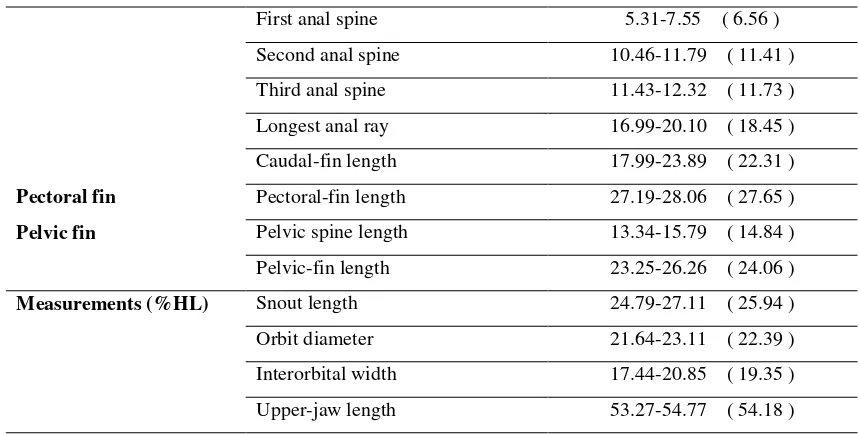
Table 1. Meristic and morphometric of Cephalopholis igarashiensis Katayama, 1957
Counts and Measurements n = 5
Total length (mm) (158.83)
Standard length (mm) (128.90)
Counts Dorsal-fin rays IX, 14
Anal-fin rays III, 9
Pectoral-fin rays 18
Pelvic-fin rays I, 5
Caudal-fin rays (17-18)
Scales on lateral line (63-66)
Scales above lateral line (28-30)
Scales below lateral line (57-58)
Gill rakers on upper limb (8-9)
Gill rakers on lower limb (16-17)
Total gill rakers (8-9) - (16-17)
Measurements (%SL) Head length 41.83-43.00 ( 42.35 )
Body depth 44.77-49.06 ( 46.57 )
Body width 18.48-20.94 ( 19.60 )
Predorsal length 41.19-42.33 ( 41.86 )
Prepelvic length 40.35-43.16 ( 41.52 )
Preanal length 68.30-71.90 ( 70.69 )
Caudal-peduncle depth 13.98-15.58 ( 14.80 )
Caudal-peduncle length 17.62-22.40 ( 19.19 )
Dorsal-fin base 54.82- 8.67 ( 56.68 )
1th dorsal spine 6.41-7.85 ( 6.95 )
2nd dorsal spine 11.58-13.89 ( 12.72 )
3th dorsal spine 14.28-16.78 ( 15.43 )
4th dorsal spine 13.69-15.72 ( 14.64 )
5th dorsal spine 13.32-15.72 ( 14.46 )
6th dorsal spine 13.32-14.73 ( 14.01 )
7th dorsal spine 13.32-14.55 ( 13.84 )
8th dorsal spine 12.66-13.20 ( 12.98 )
9th dorsal spine 11.83-13.05 ( 12.52 )
Longest dorsal ray length 16.12-20.41 ( 18.21 )
29
Dorsal fin with IX spines and 14 soft rays,
the membranes distinctly indented between the
spines; anal fin with III spines and 9 soft rays;
caudal fin rounded; pectoral-fin rays 18, the fin
length 27.19-28.06 (27.65) in SL; pelvic fins
reach to or beyond anus, 13.34-15.79 (14.84) SL.
Body scales rough, without auxiliaries;
lateral-line scales 63 to 66. Scales above lateral lateral-line
(28-30), scales below lateral line;(57-58), gill rakers
on upper limb (8-9), gill rakers on lower limb
(16-17), total gill rakers (8-9) - (16-17).
Body depth greater than head length
vex; lateral line noticeably arched over pectoral
fin. Interorbital area flat; preopercle rounded,
finely serrate, the ventral serrae slightly enlarged,
the lower edge irregular but hidden by skin;
subopercle and interopercle finely serrate; upper
edge of operculum distinctly convex; maxilla
reaching vertical at rear edge of eye.
Color:
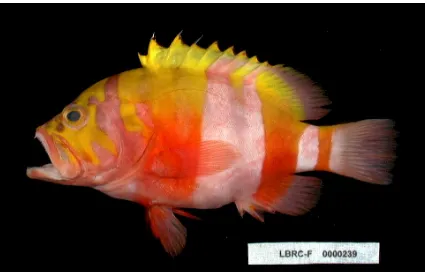
Color of fresh specimens: head, body, and
fins reddish orange; 7 lemon yellow bars on
dorsal part of body, extending onto dorsal fin; 3
broad yellow bands radiating from eye; fins red,
except for extension of yellow bars from body
in large juveniles or small adults.
Size:
Maximum total length about 43 cm.
demersal; non-migratory; marine; depth range
80-250 m
Remark:
A rare, deep-water grouper; a specimen
30
(Heemstra & Randall, 1993). This species seems
too rare to be of commercial importance.
Caught with hook-and-line and in traps;
marketed fresh.
Fig. 2. Cephalopholis igarashiensisKatayama, 1957; LBRCF-239, 158.50 mm SL from Bitung, North Sulawesi, Indonesia.
31 Distribution:
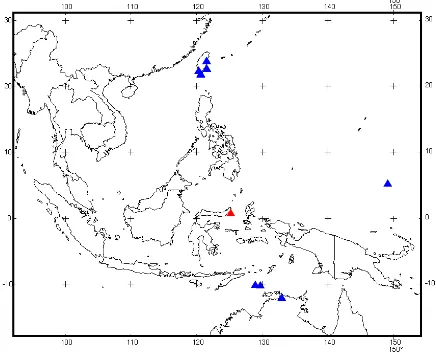
Tropical western Pacific: southern
Japan, Taiwan Province of China, Guam,
Philippines, South China Sea, Samoa, and
Tahiti (Fig. 3). Froese and Pauly (2006) noted
the countries where Christmas I. (Allen &
Steene, 1988), Cook Is. (Mc Cormack, 2000 in
Froese & Pauly, 2006). Guam & Japan (Heemstra
& Randall, 1993), Malaysia (Cabanban, 1999),
Micronesia (Myers, 1999), N Marianas (Myers,
1999), Ogasawara Is. (Randall et al., 1997), Palau
(Myers, 1999), Philippines (Conlu, 1986), Samoa
(Wass, 1984), Tahiti (Heemstra & Randall, 1993),
Taiwan (Randall & Heemstra, 1991) as Fig. 4.
Fig. 4. Geographic distribution of Cephalopholis igarashiensisKatayama, 1957 in the world represented by blue triangle (position were downloaded from Froese & Pauly (eds.), 2006.) and specimen collected from Bitung, Indonesia represented by red triangle
ACKNOWLEGEMENT
I am very grateful to the reviewers for all
suggestions and corrections. I also express my
sincere gratitude to Dr. S. Kimura, Fisheries
Research Laboratory of Mie University, Mie,
Japan for the visit of author in his laboratory.
And also to JSPS by Dr. K. Matsuura, Collection
Director at National Museum of Nature and
Science, Tokyo-Japan to support author visiting
32
REFERENCES
Allen, G.R. & Adrim, M. 2003. Coral reef fishes of Indonesia. Zoological Studies 42(1): 1-72.
Allen, G.R. & Steene, R.C. 1988. Fishes of Christmas Island Indian Ocean. Christmas Island Natural History Association, Christmas Island, Indian Ocean, 6798, Australia. 197 p.
Bleeker, P. & Weber, M. 1911. The fishes of the Indo-Australian Archipelago. Volume I, Index of the Ichthyological papers. E.J. Brill Ltd., Leiden, 410 pp.
Cabanban, A.S. 1999 Coral reef fish resources of Darvel Bay: an analysis of coral reef fish data from 1981-1990 and report of diversity from a market study in Lahad Datu. p. 85-95. In M.W.R.N. De silva, R.A. Rahman, S. Mustafa & A.S. Cabanban (eds.) Ekspedisi Galaxea '98.
Carpenter, K.E. & Niem, V.H. (eds.). 1999. FAO species identification guide for fishery purposes. The living marine resources of the Western Central Pacific. Volume 4. Bony fishes part 2 (Mugilidae to Carangidae). Rome, FAO. 1999. pp. 2069-2790.
Conlu, P.V. 1986. Guide to Philippine flora and fauna. Volume IX, fishes, natural resources management center, Ministry of Natural Resources and University of the Philippine, 495 pp.
Froese, R. & Pauly, D. (eds.). 2006. FishBase. World Wide Web electronic publication. www.fishbase.org, version (06/2006).
Froese, R.; Luna S.M. & Capuli, E.C. 1996. Checklist of marine fishes of Indonesia, compiled from published literature. In D. Pauly & P. Martosubroto (eds.). Baseline studies of biodiversity: the fish resources of Western Indonesia. pp. 217-275.
ICLARM Stud Rev., 23: 1-312Heemstra & Randall, 1993)
Heemstra, P.C. & Randall, J.E. 1993. FAO species catalogue. Vol. 16. Groupers of the world (family Serranidae, subfamily Epinephelinae). An annotated and illustrated catalogue of the grouper, rockcod, hind, coral grouper and lyretail
expanded edition. Coral Graphics, Barrigada, Guam. 330 p. 297
Nelson, J.S. 1994. Fishes of the world. John Wiley & Sons, Inc., 600 pp.
Randall, J.E. & Heemstra, P.C. 1991. Revision of Indo-Pacific groupers (Perciformes: Serranidae: Epinephelinae), with descriptions of five new species. Indo-Pacific Fishes (20): 332 p.48; pl.IIIC; fig. 16-18
Randall, J.E.; Allen, G.R. & Steene, R.C. 1997.
The complete diver’s & fisherman’s. guide to fishes of the Great Barrier Reef and coral sea. Revised and Expanded Edition. Crawford House Publishing, Bathurst, 557pp. of the Indo-Australian Archipelago.
Volume II. Malacopterygii,
Myctophoidea, Ostariophysi: I.
Siluroidea. E.J. Brill Ltd., Leiden, 404 p.
Weber, M. & de Beaufort, L.F. 1916. The fishes of the Indo-Australian Archipelago. Volume III. Ostariophysi: II Cyprinoidea Apodes, Synbranchi. E.J. Brill Ltd., Leiden, 455 p.
Weber, M. & de Beaufort, L.F. 1922. The fishes of the Indo-Australian Archipelago. Volume IV. Heteromi, Solenichthyes, Synentognathi, Percesoces, Labyrinthici, Microcyprini. E.J. Brill Ltd., Leiden, 410 p.
Weber, M. & de Beaufort, L.F., 1929. The Fishes of the Indo-Australian Archipelago. Volume V, Anacanthini, Allotriognathi,
Heterostomata, Berycomorphi,
Percomorphi: Kuhliidae, Apogonidae,
Plesiopidae, Pseudoplesiopidae,
Priacanthidae, Centropomidae. E.J. Brill Ltd., Leiden. 458 p.
Weber, M. & de Beaufort, L.F. 1931. The fishes of the Indo-Australian Archipelago. Volume VI. Perciformes: Serranidae,
Theraponidae, Sillaginidae,
Emmelichthyidae, Bathyclupeidae,
Coryphaenidae, Carangidae,
Rachycentridae, Pomatomidae,
Lactariidae, Menidae, Leiognathidae, Mullidae. E.J. Brill Ltd., Leiden, 448 p.
33
Perciformes (continued). E.J. Brill Ltd., Leiden, 607 pp.
Weber , M. & de Beaufort, L.F. 1940. The fishes of the Indo-Australian Archipelago. VIII. Percomorphi (continued). Cirrhitoidea, Labriformes, Pomacentriformes. E. J. Brill Ltd., Leiden. 508 pp.
Weber M. & de Beaufort, L.F. 1951. The fishes of the Indo-Australian Archipelago. IX. Percomorphi (concluded), Blennoidea.
E.J. Brill Ltd., Leiden, 484 pp.
Weber, M. & de Beaufort, L.F. 1953. The fishes of the Indo-Australian Archipelago. Vol. X. Gobioidea. E.J. Brill Ltd., Leiden, 423 p.