Vo lume 8 Issue 6 Artic le 2
A The o ry o f Ta ilo ra ble Te c hno lo g y De sig n *
Ma tt G e rmo npre z
Unive rsity o f Wisc o nsin – Ea u C la ire g e rmo nr@ uwe c .e d u
Dirk Ho vo rka
Unive rsity o f C o lo ra d o – Bo uld e r d irk.ho vo rka @ c o lo ra d o .e d u
Fre d C o llo py
C a se We ste rn Re se rve Unive rsity c o llo p y@ c a se .e d u
Ta ilo ra b le te c hno lo g ie s a re a c la ss o f info rma tio n syste ms d e sig ne d with the inte ntio n tha t use rs mo d ify a nd re d e sig n the te c hno lo g y in the c o nte xt o f use . Ta ilo ra b le te c hno lo g ie s sup p o rt use r g o a ls, inte ntio ns, me ta p ho r, a nd use p a tte rns in the se le c tio n a nd inte g ra tio n o f te c hno lo g y func tio ns in the c re a tio n o f ne w a nd uniq ue info rma tio n syste ms. We p ro p o se a the o ry o f ta ilo ra b le te c hno lo g y d e sig n a nd id e ntify p rinc ip le s ne c e ssa ry fo r the initia l d e sig n. Fo llo wing a Ka ntia n style o f inq uiry, we id e ntifie d fo ur d e finitio na l c ha ra c te ristic s o f ta ilo ra b le te c hno lo g y: a d ua l d e sig n p e rsp e c tive , use r e ng a g e m e nt, re c o g niza b le e nviro nme nts, a nd c o mp o ne nt a rc hite c ture s. Fro m the se c ha ra c te ristic s, we p ro p o se nine d e sig n p rinc ip le s tha t will sup p o rt the p he no me no n o f ta ilo ring . Thro ug h a ye a r-lo ng c a se stud y, we re fine d a nd e vid e nc e d the p rinc ip le s, find ing fo und tha t d e sig ne rs o f ta ilo ra b le te c hno lo g ie s b uild e nviro nme nts in whic h use rs c a n b o th inte ra c t a nd e ng a g e with the te c hno lo g y, sup p o rting the p ro p o se d d e sig n p rinc ip le s. The find ing s hig hlig ht a d istinc tio n b e twe e n a re fle c tive e nviro nme nt, whe re use rs re c o g nize a nd ima g ine use s fo r the te c hno lo g y, a nd a n a c tive e nviro nme nt in whic h use rs ta ilo r the te c hno lo g y in a c c o rd a nc e with the ima g ine d use s. This re se a rc h c o ntrib ute s to the c la rific a tio n o f the ro le o f the o ry in d e sig n sc ie nc e , e xp a nd s the c o nc e p t o f "p o ssib ilitie s fo r a c tio n" to IS d e sig n, a nd p ro p o se s a d e sig n the o ry o f a c la ss o f info rma tio n syste ms fo r te sting a nd re fine m e nt.
Ke ywo rds: Te c hno lo g y Ta ilo ring , De sig n The o ry, Ka ntia n Inq uiry, Info rma tio n Syste ms, Info rma tio n Te c hno lo g y
* The o rig ina l ide a o f this p a p e r wa s p re se nte d a t the JAIS The o ry De ve lo p me nt Wo rksho p 2005. Ro b e rt Ka uffma n wa s the a c c e p ting Se nio r Edito r. This p a p e r we nt thro ug h 3 re visio ns.
Vo lume 8, Issue 6, Artic le 2, p p . 351-367, June 2007
A Theory of Tailorable Technology Design *
352 Volume 8 Issue 6 Article 2
1. Introduction
Tailorable technologies enable end users to select and integrate technology features in the ongoing creation and re-creation of unique information systems (IS) that match their concerns and activities. Familiar classes of such technologies include ERP systems, desktop operating systems, and word processing software. These technologies are tailorable by the end user within the confines of the functionality and components provided, and allow for user expressiveness in computing approach, function preferences, and aesthetic layout. The design of tailorable technologies requires a shift in perspective from a computational metaphor that provides ready-made applications to technologies that are capable of open-ended use patterns that are created by the end users' own interpretation and needs. In this paper we propose a theory of tailorable technology design.
Despite calls for greater theoretical focus on technology (Benbasat and Zmud, 2003; Orlikowski and Iacono, 2001), theories about the design of IS artifacts remain underdeveloped. With that, our audience for this paper is two-fold. The first is IS researchers pursuing theory development and, in particular, design theory (Hevner et al., 2004; Gregor and Jones, 2007). Members of this audience are concerned with the conduct of research into the theories underlying information system design and evaluation. The second audience is system designers who are concerned with existing practices in the design and evaluation of the class of tailorable technology. While tailorable technologies provide end users with varied ways to modify the technology, as designers and researchers we have little understanding of how tailorable technologies are initiallydesigned to support that end-user modification.
This research does not address the software engineering literature or theory or programming theory. Rather, we focus attention on the principles underlying a user-view of tailorable technologies that would be instantiated via software engineering processes. From a software engineering perspective, parameterizing everything and allowing the user to change any part of the system can achieve tailorability. But this is neither theoretical nor practical. The purpose of the paper is to clearly identify and articulate the phenomenon of tailoring and to develop a theory modeling the design principles used to create artifacts that encourage users to engage with and tailor a technology. From a program coding perspective, the principles we propose are not directly applicable; but coding is not the same as design.1 This is a theoretical paper that seeks to support the achievement of goals, not to prescribe how to build a technology or evaluate the outcome of the goals. Although this perspective differentiates this paper from some of the widely held criteria for design science, we believe that our emphasis on the development of design theory is a valuable aspect of the design mode of IS research.
Tailorable technologies are information systems where the users are not necessarily concerned with traditional IS research performance goals (e.g., performance, satisfaction, efficiency). Instead, users of tailorable technologies break them apart and reassemble them to achieve desired processes, novel functions, and perceived value. Tailoring occurs when a user encounters a breakdown or mismatch between the information system and his or her intentions. Tailorable technologies represent a shift in the design of information systems from a fixed external physical object to "a space of potential for human concern and action" (Winograd and Flores, 1986, p. 37). To address this, we propose a theory of tailorable technology design that encourages user-initiated process goals such as improving task-oriented communication or encouraging a metaphorical or an aesthetically pleasing interface. Development of a theory of tailorable technology design will strengthen our understanding of design theory, in general, and provide practical guidance for the design of such technologies.
A theory of tailorable technology design needs to describe the principles that allow an information system to be modified by a user in the context of use. The theory itself does not specify the contexts in which tailoring occurs. In this regard, the theory is distinct from other theories of adaptation such as structuration theory (Orlikowski, 1992) and adaptive structuration theory (DeSanctis and Poole, 1994). The theory of tailorable technology design specifies the designer and user environments and the design principles that support the phenomenon of tailoring and treats users of the technology as designers of action (Romme, 2003). Whereas adaptive structuration theory describes the interplay and restructuring of organizational and technology structures, our theory describes how to design tailorable technologies themselves. Technologies that contain the design environments and principles allowing tailoring or restructuring are assumed by adaptive structuration theory. For that
Issue 6
Volume 8 Article 2
353
reason, designers of tailorable technologies need to consider the broader social contexts in which technologies may be used as users enact principles underlying designs.
Our approach incorporates aspects of the specification of IS design theories of Gregor and Jones (2007) and Walls et al. (1992), who state that "the purpose of design theory is to support the achievement of goals" (Walls et al., 1992, p. 40). These specifications, which are intended to deal with both the process of design and the artifact include: 1) the class of goals to which the theory applies; 2) identification of the class of artifacts that meets the goals; 3) the kernel theories from the social and natural sciences; 4) a mutable artifact; 5) propositions that test whether the design process leads to artifacts that fulfill the goals of the class; 6) the procedures for constructing the artifacts; and 7) an example of the artifact. We first examine how theorizing about design is distinct from other types of theorizing. We then present the artifact of concern and compare and contrast the defining characteristics and design principles of tailoring identified by Gordon Pask (cybernetics), Christopher Alexander (architecture), Greg Gargarian (music), and Kim Madsen (information systems). These researchers represent four approaches to how tailorable technologies are built in four distinct disciplines. The selection of these authors is not intended to be exclusive of other domains, but it is intended to be representative of the tailoring concept. The principles provide support for propositions about tailorable technology design in order for their design to become more coherent and tractable. We conclude by discussing the implications for IS research of tailorable technology design and expectations for the in-use process of tailoring.
2. Design Theorizing
Research in IS often focuses on identifying and explaining the underlying regularities of phenomena or on interpreting human experiences and discourse. These two approaches have been described as science and humanities (Romme, 2003). However, the functional, goal-oriented, and pragmatic nature of design requires a third approach often described as a
design science mode of research (Hevner et al., 2004; Purao, 2001; Romme, 2003).
Design science research fulfills a purpose different from studies whose goal is discovery or justification of knowledge. Rather than producing general theoretical knowledge, the design science paradigm seeks to produce novel artifacts that can improve individual, organizational, and societal capabilities and evaluate the performance of the artifact (Hevner et al., 2004; March and Smith, 1995). Design science artifacts are technology-oriented, not universally given, and they are judged against criteria of value and utility (Purao, 2001). Rather than retrospective examination and explanation of events in the past, design science traditionally designs, tests, pilots, and evaluates new artifacts to show improved performance. We contend that this focus on performance tends to miss the “multi-generational and emergent aspects of technological artifacts that arise as designers, developers, users and other stakeholders engage with evolving artifacts over time and across a variety of contexts” (Orlikowski and Iacono, 2001, p. 132). Therefore, from our perspective, design science theory must account for a reality that has not yet occurred.
Two extensive reviews of design science literature (Gregor, 2006; Venable, 2006) illustrate that theory and theorizing have a role in the IS discipline that is distinct from pragmatic design efforts. Theory adds new knowledge to a community and addresses ill-defined problem spaces that do not yet have established design practices. Design theory must bring novel values and goals because an ill-defined problem space "does not contain sufficient information to enable the designer the means of meeting those requirements simply by transforming, reducing, optimizing or superimposing the given information alone" (Archer 1984, p. 384). The role of theory in design science is to propose principles by which an artifact could be built to support a particular phenomenon, in our case, tailorability. Whether the phenomenon is of value is a judgment that may be rejected.
We emphasize that design theory is a dimension rather than a category and can range from approximations, to mid-range theory, to strong theory (Weick, 1989, 1995; Gregor and Jones, 2007). Design theory may be demonstrated to be incorrect, and theory choice is based upon the ability of the claims to be effective (Gregor, 2006) and the characteristics of "accuracy, consistency, scope, simplicity and fruitfulness - all standard criteria for evaluating the adequacy of a theory" (Kuhn, 1977, p. 103). Therefore, design theory can be considered a starting point from which testing and refinement may flow. Good theories contribute to knowledge "in the service of action" (Romme, 2003, p. 562) and are “interesting rather than obvious…a source of unexpected connections...high in narrative rationality…and aesthetically pleasing” (Weick, 1989, p. 517). The construction of design theory does not guarantee its verification or validity, and testing of design theory requires pragmatic, action-oriented experimentation and observation of the propositions presented by the theory.
354 Volume 8 Issue 6 Article 2
action" (p. 565). Goldkuhl (2004) proposes grounding design theories in multiple other theory types. Hevner et al. (2004) propose interactive Develop/Build and Justify/Evaluate theories based on “knowledge of behavioral theories and empirical work" (p. 88).
In this paper we apply a Kantian inquiring system (Churchman, 1971; Mason and Mitroff, 1973) in which theory precipitates out of the convergence of multiple perspectives and the synthesis of concepts from multiple sources and disciplines. A Kantian style of inquiry builds support for the theory by comparing many explicit views of the phenomenon of tailoring. By synthesizing concepts, definitions, and principles shown to lead to tailorability in different domains, we are able to produce a theory of tailorable technology that represents the abstracted principles of design supporting the phenomenon of tailoring. The different views explicitly incorporated in building our theory can each be considered as data for the creation of a Lockean "fact net," and the confluence of principles among these competing views, in combination with the case study used to refine the principles, is the guarantor of the evidence for our new theory (Mason and Mitroff, 1973).
We used a Kantian inquiring system to define the desired class of information system and to induce theory from existing literature and case study data (Eisenhardt, 1989; Langley, 1999). We identified and mapped design principles from the literature to the Romme (2003) design model, and the principles provide the kernels for a theory of tailorable technology design. The Romme model provides a way to package the set of principles into a design theory and suggests that design requires framing and restriction without which we can not create artifacts. We then applied research questions based on these design principles to a case-based study of the development of a tailorable technology. We used the data from the case to refine the design principles, and then finally used these to develop testable propositions for a theory of tailorable technology design.
3. Tailorable Technology
Tailorable technology is technology that is intentionally modified in the context of use. There is a large body of literature in human computer interaction (HCI), IS, architecture, music, and design that describes the relationship between human cognition and technology. In a broad set of domains, studies suggest that users play an integral role in the modification of the technologies in the context of their use. Tailorable technologies represent one form of the mutable nature of IS artifacts discussed by Gregor and Jones (2007). Although the evolving nature (Simon, 1996) of artifacts may emerge from versioning or designer customization, tailoring is specifically a user-initiated process more aligned with "the idea of the arising of something from out of itself, or emergent properties, and behavior" (Gregor and Jones, 2007, p 326). A number of terms have been used to describe this class of information systems including tailorable, interactive, customizable, and modifiable. We use the term tailorable technology because of its long-standing and consistent use in the reference disciplines used in this research. In addition, we examined varied disciplines to identify design principles for the design of such tailorable technologies because tailoring is not unique to the IS field. A review of work in only the domains of HCI and IS may have fallen short in identifying principles that allow theorizing about tailorable technology design
Designers of information systems are frequently presented with limited information about the system to be designed and may recognize that the system will be used to address problems and goals unique to each user. The uniqueness comes from every task domain being embedded in a larger context, and it is not possible to anticipate every user’s concerns and goals in every context. To account for this, designers must rely on assumptions to identify the task domain and the possible actions users may take to achieve goals, and they can achieve flexibility by specifying the goals and operators rather than a single course of action (Winograd and Flores, 1986). The designer then produces an artifact in response to the anticipated problem based on its ability to execute multiple courses of action as determined by the user. The process repeats itself as the newly created artifact and its possible interactions act as a model for future designers. Winograd and Flores (1986, p. 177) interpret this iterative process as “the world determines what we can do, and what we do determines the world." Through this process of participation and interaction, the artifact is shaped to take on various forms across various environments (Romme, 2003).
Issue 6
Volume 8 Article 2
355
Therefore, tailorable technologies are not solely defined by meeting technological criteria but instead must be capable of being tailored to meet user-defined goals, metaphors, and use patterns.
Users must be provided with a rich design environment (Pask, 1971) or design space (Alexander, 1979; Gargarian, 1993) in which technology can be tailored based on user-constructed parameters. Alexander (1979) describes how users apply functional parts in the production of a larger whole and through the application of these parts, technology takes on the desired states for end users. A review of the literature reveals the following set of definitional characteristics of tailorable technologies. The nine principles presented later in the paper are propositions for what Walls et al. (1992) call "meta-requirements" for the design of a tailorable technology. We propose that inclusion of these principles in the design process will produce the four definitional characteristics of tailorable technologies listed here.
1. A dual design perspective that includes the initial design and user-defined tailoring (Hummes and Merialdo, 2000; Turban and Aronson, 2002)
2. User engagement that supports user tailoring through functional components (Alexander, 1979) within the tailoring environment (Gargarian, 1993; Pask, 1971)
3. Recognizable environment that supports user tailoring within the tailoring environment (Alexander, 1979; Gargarian, 1993; Pask, 1971; Madsen, 1989)
4. Component architectures that support functional and applied characteristics necessary in tailoring technology (Baldwin and Clark, 2000)
These characteristics are used to define tailorable technology and do not represent the theoretical principles used in their
design. We treated the definitional characteristics as necessary for a technology to be considered tailorable and used them as an entry point into the literature to discover design principles. We first discuss the definitional characteristics in more detail below, and then identify the theoretical principles.
3.1. Dual Design Perspective
A definitional characteristic of tailorable technology design is a requirement for two distinct design phases. A dual-phased design approach divides the design process into two phases enacted by the designer and the user. In the first phases, the designer creates the default state that provides functional components and an environment in which the user may tailor the technology. The second phase is the ongoing act of tailoring or the user-defined design of the technology during its use. In his discussion of the creation of systems from available materials, Lévi-Strauss (1966, p. 17) states:
“the [user] is adept at performing a large number of diverse tasks; but, unlike the [designer], he does not subordinate each of them to the availability of raw materials and tools conceived and procured for the purpose of the project. His universe of instruments is closed and the rules of his game are always to make do with whatever is at hand, that is to say with a set of tools and materials which is always finite and is also heterogeneous” (Lévi-Strauss, 1966, p. 17).
This dual design view is echoed in discussions of system design-time versus run-time modifications (Hummes and Merialdo, 2000) and of the user toolbox metaphor in decision support systems (Turban and Aronson, 2002).
Gargarian’s theory of design (Gargarian, 1993), with its emphasis on balancing two kinds of design -- that of the design environment and that of the technology itself—seems particularly relevant to the design of tailorable technologies. Gargarian argued that in any design process, designers must ultimately attend to two aspects of design: the development of the design environment and the production of the technology itself. In doing so the designer must balance two tasks: managing design complexity and ensuring the expressive utility of the resulting technology. It is not enough to make it technically possible for users to tailor a technology; the default state must manage the users' design complexity as well.
356 Volume 8 Issue 6 Article 2
3.2. User Engagement
In tailoring, user engagement occurs when a user can modify the coupling between the technology and the structure of the task domain for which the technology was designed. The inability of designers to create a simple set of information system goals and operators for a task means that the system will often be used in ways that were not anticipated (Winograd and Flores, 1986). Designs that are well aligned with the structure of the task domain and allow for modification of the system in use will succeed in engaging user tailoring. Failure to align with a task domain does not engender user engagement toward tailoring but, instead, engagement associated with workarounds and improvisation (McGann, 2004).
Alexander (1979) proposed a design theory that suggests technologies will only be engaging and useful if they are properly defined during their default state. Designing any technology starts with a collection of parts that are partially autonomous and can adapt to the local conditions (Alexander, 1979, p. 163). Tailorable technologies must maintain an inward representation of functional characteristics as well as an outward representation of the context in which they are being used, whether individual, group, or organizational (Simon, 1981). In this view “design is a process of synthesis, a process of putting together things, a process of combination” (Alexander, 1979, p. 368).
Pask focuses attention on users' engagement with the environment, and he states, “Man is prone to seek novelty in his environment and, having found a novel situation, to learn how to control it” (Pask, 1971, p. 76). In the symbolic domain, control comes through problem solving, explaining, and relating the context to an existing body of knowledge. Pask argues that people enjoy this process, particularly when the technologies they are using have been designed to support it. The technologies are characterized by having sufficient variety to provide new ways of performing tasks, forms that can be interpreted, queues to guide learning, and enough responsiveness to engage users. The characteristics of Pask’s environment provide a set of principles for designing technologies that support his notion that people are always aiming to achieve or discover some goal through technology (Pask, 1971). In this sense, tailorable technologies are used for the explanation and engagement of novelty. It is the responsibility of the initial designers to create an environment through which the technology can be used to seek goals and achieve those goals. Tailorable technologies and the environments embedded in them support user engagement via two common characteristics: 1) they provide sufficient variety and flexibility, so that novelty can be sought, and 2) they are responsive, engaging a person in actively describing, modifying, and using the technology. A third characteristic, a recognizable environment, is also an important aspect of user engagement. As a user recognizes characteristics of the technology to provide support for variable tasks, communication, or aesthetics, engagement is supported. In the next section, we examine the recognizable environment as its own characteristic because it serves as a critical transition between an abstract user environment and a concrete technology.
3.3. Recognizable Environments
Madsen (1989) argues that we create and tailor workspaces through recognizable environments. Specifically, Madsen states that metaphor may be used to perceive a situation in a new way and to provoke invention of future artifacts (Madsen, 1989). We use familiar metaphors and analogues from our experience to search and explain new environments. Through the use of metaphor we create our concept of 'information system' by seeing it as something (Alvesson and Skoldberg, 2000). This seeing as informs our understanding of the technology, its functions, appearance, limits, and use. Common metaphors for information system include electronic mail, electronic commerce shopping carts or baskets, and electronic
libraries. The metaphors of mail, shopping cart, and library engage us by relating the functions and use of an unfamiliar technology to our experience with other environments. Metaphor makes the technology understandable and shapes how users develop solutions to problems to which the technology is applied. At the same time, it limits how we think about and use the technology. Users modify technologies to fit within the metaphors for functions with which they are familiar to create new and unanticipated uses, to reflect on their uses of technology, and to restructure their own perceptions of how a particular technology is used. A critical aspect of tailorable technologies is to provide a default state that will engage different metaphors for the user to allow for the creation of innovative systems. From a technology perspective, metaphorical systems are capable of supporting multiple and conflicting interpretations and open-ended use patterns.
To support a recognizable environment for tailoring technologies, designers must present a suite of recognizable components that can be joined for deciding how to accomplish a task not just for problem solving. The objects should be analogous to existing technologies in order to promote their use. Components should illustrate the conventions of rules they contain as well as any larger technology of which they are a part. Any component should be functionally complete such that its use provides unique means-end solutions. Each component is then a functional characteristic that differentiates its own space. It creates distinctions where there were none before. Tailorable technologies then become a sequence of these component characteristics (Alexander, 1979).
Issue 6
Volume 8 Article 2
357
tailoring process. Through recognizable components, users should understand the conventions and rules that define the functional relationships of the technology. In language, words are the objects, and rules simultaneously allow and restrict the patterns between them in the creation of unique sentences. Similarly, users tailor technologies through the ad hoc, opportunistic, and unpredictable application of the relationships among functional components. For the designer, components are viewed as complex objects with conventions and rules that define their interaction.
The environment for supporting tailorable technology is defined by how the components and conventions are applied to fulfill the metaphorical understanding of the technology’s purpose or functions. The process through which metaphor provokes innovation involves a breakdown in understanding how an existing technology works in the current context (Madsen, 1989). Winograd and Flores (1986) indicate that these breakdowns occur when "the course of activity is interrupted by some kind of 'unreadiness'" (p. 147). If user understanding of a technology breaks down, the user will recreate the technology to fit within his new metaphorical understanding. Thus, a breakdown moves available but unusable technology into usable technology, and moves unreflective, mechanical use into reflective use. It involves the user in the creation of new domains in the use of technology (Madsen, 1989; Winograd and Flores, 1986). Different metaphors result in different combinations of functions and components.
3.4. Component Architectures
Component architectures are complex technologies that are built from stand-alone components. The components must be partially autonomous so that they can adapt to the local conditions of their use (Alexander, 1979, p. 163). Design is ultimately a sequence of increasing complexity where components are added and the whole emerges. Tailorable technologies are, in part, based on the principles of component architecture, where users are able to select from a set of functions during use (Morch and Mehandjiev, 2000; Hummes and Merialdo, 2000). Component architecture supports user discovery of functions distributed across nodes within a larger technology system, whether word processing applications or enterprise resource systems. Users can integrate specific, reusable components at each node to create unique technologies (Berners-Lee et al., 2003; Baldwin and Clark, 2000). The functional characteristics are necessary but not sufficient for designing tailorable technologies, as much of tailoring is based on the reflection and imagination of a user.
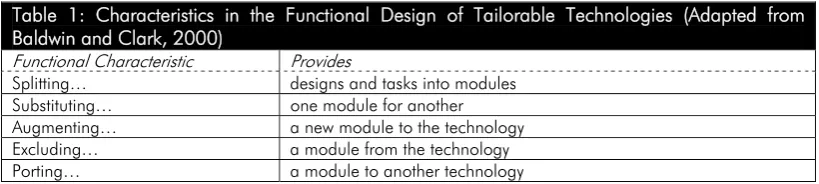
Users are constantly managing smaller, independent components in complex, integrated technologies to handle varied levels of innovation and growth, adapt technology to new contexts, and seek new uses of the technology. Component-based technologies rely on five functional characteristics that support continual modification and are not subject to designer-centric diminishing returns. The five characteristics (Table 1) represent the functional support needed for a technology to be modified in the context of its use (Baldwin and Clark, 2000).
Table 1: Characteristics in the Functional Design of Tailorable Technologies (Adapted from Baldwin and Clark, 2000)
Functional Characteristic Provides
Splitting… designs and tasks into modules Substituting… one module for another Augmenting… a new module to the technology Excluding… a module from the technology Porting… a module to another technology
Splitting is used to reduce a single module to smaller components. The components may share common features that are aggregated under a hierarchical set of global design rules. For example, a web site can be split into multiple components based on the data sources represented. Global design rules include consistent format and position. Substitution allows for the replacement of components or their respective smaller parts based on a value improvement (Baldwin and Clark, 2000). If a web site contains a weather data component and a better component is available, it can be substituted for the first. With tailorable technologies, users are capable of surveying a suite of similar and dissimilar components and substituting components on an as-needed basis.
358 Volume 8 Issue 6 Article 2
Using the porting activity, two different technologies can employ the same component. A component is not bound to a single technology but can be replicated across technologies. Through a series of experiments, Malone et al. (1995) used the tailorable technology, OVAL, to demonstrate how dependencies between components could be ported in the creation of multiple systems that mirror the functionality of the cooperative work systems: gIBIS, Coordinator, Lotus Notes, and Information Lens. In this example, a single information system was tailored multiple times to simulate existing systems by providing the respective functionality across various computing environments. Mansfield’s (1997) work on the collaborative system, Orbit, also focused on porting “to offer a deep level of tailoring for groupware [so that] the users have the ability to alter bindings between parts of the system” (p. 4).
As users perform new tasks, form new groups, or develop new processes, the technology must support these changes (Wang and Haake, 2000). As these uses are fundamentally flexible, the implementation of a technology must embody a range of possible courses for action and not strictly represent a set of anticipated user actions. Flexibility relies on a component model and the evolution of component relationships during the ongoing use of a technology (Domingos and Martins, 2000; Wang and Haake, 2000).
Tailoring will not occur based on the functional characteristics of a technology alone. For tailoring to occur, both the technology and the internal environment must support and promote modifications in the context of its use. Technologies, whether a building or software, can be architected to encourage modification, thereby producing unforeseen states derived from the original building or software. The ideas of Alexander, Pask, Gargarian, Madsen, and others support the design of tailorable technologies through the promotion of design environments that support end user modification.
We have presented tailorable technologies as a unique class of information system and the four characteristics that define them. We concentrate the remainder of this paper on a design theory of tailorable technology. We first explore design theory, in general, and then present a theory of tailorable technology and principles associated with them as proposed by Alexander, Pask, Gargarian, and Madsen. We subsequently reduce the principles to a core set of design principles that we used to achieve the aforementioned definitional characteristics. We then describe a research setting and methods by which these propositions can be tested, thus strengthening a theory of tailorable technology.
4. Design Principles for Tailorable Technology
In this paper, we look only at the initial design phase of the dual-phase design process and propose a set of principles that are required in the initial design of tailorable technology. Three research questions motivate our theorizing on the subject of designing tailorable technologies (Table 2).
Table 2: Theorizing Questions in the Design of Tailorable Technology
Theorizing Questions Research Outcomes Addressed in this Study? What principles are evident in designing tailorable technologies? Theory
Development YES
Can the principles be refined beyond their original conceptualization?
Proposition
Development YES
What patterns of interaction are evident between the principles? Proposition
Development NO
We answer the first two questions in this paper. The last question is reserved for the application of the principles in the field in the context of dynamic redesign of the tailorable technology.
4.1. Design Principles
Using the framework of a Kantian Inquiring system (Churchman, 1971; Mason and Mitroff, 1973) we examined the design approaches of Alexander, Pask, Gargarian, and Madsen. We identified nine principles that contribute to the central outcome of designing tailorable technologies, represent a concept that is generalizable and operational, and are unique and mutually exclusive. The principles were identified through a content analysis of the four streams of research discussed above (Krippendorf, 1980). Weanalyzed the texts based on the codes of dual design approach, user engagement, recognizable environments, and component architectures.
Issue 6
Volume 8 Article 2
359
literature included theory development (Whetton, 1989) regarding customization, tailoring, or modification. This enabled us to focus on recurring theoretical principles across a set of papers smaller than the entire suite of papers that use these terms. The literature identification represents a starting point for a theory of tailorable technology design, and we further evidence and refine the principles through a case study presented later in the paper.
This approach provided grounding for the nine principles, while retaining overall theoretical flexibility (Eisenhardt, 1989). For example, a recurring principle across all approaches was to include recognizable components from current and in-use systems when designing new technology. Each of the selected principles is present in at least two of the four approaches Romme’s (2003) design model provided a basis for explaining how the principles relate at a high level for designing tailorable technologies. The Romme model served as a way to package the set of principles for describing the design of tailorable technologies. The principles represent propositions about designing tailorable technologies and are used to control the complexity of the design process in order to create usable technology. Specifically, the principles operationalize two design environments for designers: the reflective and the active environments.
The reflective environment describes how knowledge and content are used in the service of action. This is similar to Heidegger’s (1927) ready at hand, where technology serves as an extension of the user’s actions. A web browser is an example of a technology in the service of action. When a user seeks information, the browser simply acts as a portal to a desired search space. Consideration is placed on the goal and not on the technology. The reflective environment supports tailoring through encouraging environments and recognizable design spaces.
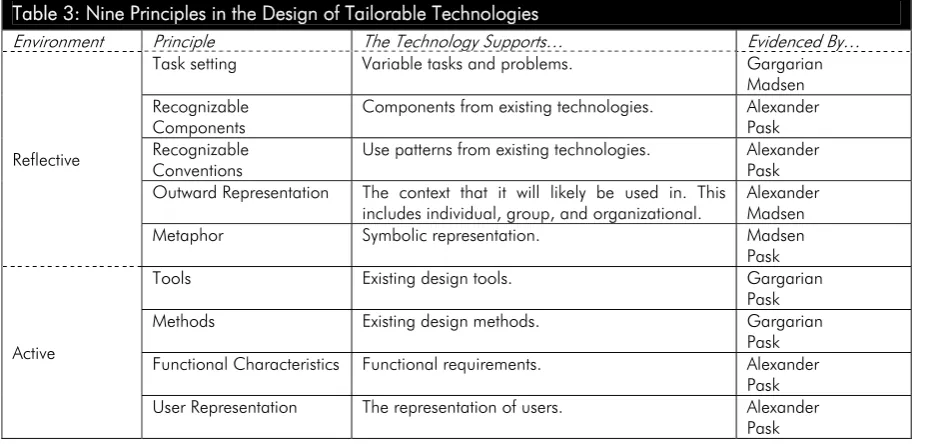
The active environment employs knowledge and content in the form of action. The form of action supports tailoring through practical and functional design principles (Romme, 2003). This is similar to Heidegger’s (1927) present at hand, where technology is evident as a tool for user actions. A web browser is used in the form of action when a user is unable to connect to a search space. Consideration is no longer focused on the goal of searching but, instead, on resolving the technology problem. In either case, the design of tailorable technology relies on the support of two environments that are designed into the technology. The first is an environment that supports a natural use of the technology to extend functionality such as user searching, communicating, and computing. The second is an environment that allows the user to realize the tailorable technology as a tool that can be manipulated to serve changing contexts. Table 3 defines the nine principles and their relationship to both the reflective and active environments, and illustrates at least two authors who evidenced the principle (Churchman, 1971; Mason and Mitroff, 1973).
Table 3: Nine Principles in the Design of Tailorable Technologies
Environment Principle The Technology Supports… Evidenced By…
Reflective
Task setting Variable tasks and problems. Gargarian Madsen
Use patterns from existing technologies. Alexander Pask Outward Representation The context that it will likely be used in. This
includes individual, group, and organizational.
Methods Existing design methods. Gargarian
Pask Functional Characteristics Functional requirements. Alexander
Pask User Representation The representation of users. Alexander
Pask
360 Volume 8 Issue 6 Article 2
The reflective and active environments are embedded in the technology in the initial design of tailorable technology. For example, a tailorable technology contains the reflective environment through recognizable components and conventions. It also contains the active environment through tools that enable the user to tailor the technology (e.g. selection and placement of desktop icons, selection of portlets or information feeds). The environments do not evaporate once the technology enters a use state. We assert that the reflective and active environments remain critical for the actual action of tailoring, as the user becomes, in essence, a designer of the secondary states of the tailorable technology.
In our theory, both the reflective and active environments contribute in the design and development of tailorable technologies. We propose high-level associations between the principles that can be altered and made actionable for future testing and validation (Romme, 2003). We took the nine, literature-derived principles to the field to understand and clarify their definitions and to discover their boundaries on the principles (Eisenhardt, 1989). In particular, the principles accommodate prior literature and allow us to gain familiarity with the data, and we sharpen them through the field study.
4.2. Refinement of Principles
To address the refinement of the principles, we followed the design of a web portal for one year. The selection of the web portal as a tailorable technology was driven by practical considerations including availability and access to a design team. The web portal represented a fully developed tailorable technology based on the aforementioned definitional characteristics, and because our research focused on a theory of design, we were highly involved with the design team.
The identification of principles from prior literature allowed us to select a case and begin data collection in the field. Data collection resulted in a year-long qualitative database that included interviews, documentation, and observation. In addition, we used the portal for one year and designed two services for the portal to better understand and verify its functionality. In all, we conducted 14 semi-structured interviews, studied 350 pages of documentation, and observed the design of the portal both online and via interactions with the design team. We selected interviewees based on their willingness to participate in the research project as well as their position within the university (student, staff, or administration). Of the 14 interviewees, five were on-site project designers and nine were tailorable technology test community members, representing students, staff, and administration. An epilogue to the case is also provided at the end of the paper.
While a multi-project approach was used by Eisenhardt and Bourgeois (1988) and Gersick (1988) in the production of process models, we believe that refinement of our proposed principles and continued theorizing was viable through a single project (e.g., Mintzberg and McHugh, 1985). To offset any negative impact stemming from the use of only a single case, we revisited each principle multiple times over the course of the data collection and analysis to provide better principle definitions, validity, and measurability. In all, this process improved validity to the proposed principles and high level model. Table 4 provides a summary of how theorizing was accomplished with respect to Eisenhardt (1989).
Table 4: Project Issues Applied from Eisenhardt (1989)
Theorizing Issues Accomplished Through Getting started,
selecting a case, and using prior literature
Definition of constructs in sections 2 and 3 and the selection of a case in designing tailorable technologies.
Data collection resulted in a year-long qualitative database that included interviews, documentation, and observation. In addition, the first author used the portal for one year and designed two services for the portal to better understand and verify its functionality.
14 semi-structured interviews were conducted, 350 pages of documentation were studied, and design of the portal was observed both online and via interactions with the design team. Interviewees were selected based on their willingness to participate in the research project as well as their position within the university (student, staff, or administration). Of the 14 interviewees, 5 were on-site project designers and 9 were tailorable technology test community members, representing students, staff, and administration.
Each principle was revisited multiple times over the course of the data collection and analysis to provide better principle definitions, validity, and measurability. In all, this process provided improved internal validity to the proposed model.
Issue 6
Volume 8 Article 2
361
purpose is to improve the overall grounding of the principles through prior literature and to ground our theorizing through the triangulation of evidence.
4.3. Research Setting and Preliminary Findings
The setting for the case was a private, Midwestern United States university. We provided access to approximately 2,500 undergraduate and 7,500 graduate students to the studied technology following its design. The university is comprised of colleges or schools, each representing a particular discipline (i.e., Management, Medicine, Engineering). The university computing facilities are ad hoc, where certain colleges manage their own systems and others rely on central computing services to manage their systems. The studied technology was released by central computing services and was available to all colleges.
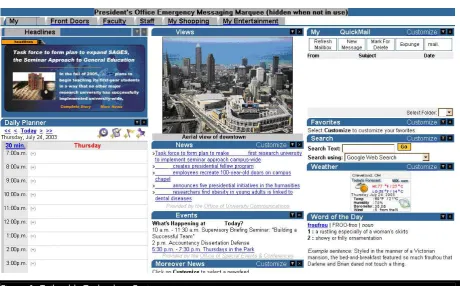
Historically, as organizations expand computational capabilities, islands of computing form. Integrating computational islands is a motivator in the development of a web portal. At our case site, the portal was highly integrated with numerous other computing services including email, scheduling, and legacy ERP. A web portal provided an interface through which users accessed data in an integrative and personal way. A web portal can be tailored to provide information such as the local weather, calendaring functions, email access, and search functions that can be turned on/off, rearranged, and configured by end-users. Figure 1 does not represent the act of tailoring but an environment in which tailoring could occur.
Figure 1. Tailorable Technology Environment
The central computing administration gave the design team the charter to design the portal technology. In particular, the design team was to develop the technology using specific vendor software that was not originally intended to support web portal capabilities. The design team consisted of three administrators, three design team managers, and 20 programmers. The test community was defined by the project designers and totaled roughly 220 individuals. The test community was identified independent of the research project, based on their association with prior university computing projects, membership in various associations, and employment within university computer support facilities. The test community included undergraduate and graduate students, university staff, and university administration.
362 Volume 8 Issue 6 Article 2
to turn the tables around [from a traditional web site], then to become user centered. That means letting people design their own space.” Similar sentiments were echoed by all designers as well as within the project design documentation. It was explicitly stated by designers that users could decide which components were used, how these components interacted, and how the presentation of the components was laid out through the portal interface.
4.3.1. Reflective Environment Principles
The design team used Task setting to specify how a technology could be used and what tasks could be performed. The portal technology supported a design separation where functionality was designed into the technology, yet each user’s portal could be unique. The designers rarely prescribed when or how to use the technology; instead, they provided flexibility. The design focus was on 1) supporting unknown user tasks through functional characteristics and 2) providing outward representations of the technology for users to tailor the technology. In this case, the design supported a suite of university-related tasks (emailing, calendaring, and payroll) but not a predefined manner in which the tasks were used for predefined user groups.
The team supported the concept of outward representation specifying how the technology represented the individual, group or organizational context within which it is used. Designers recognized that the portal technology must be inherently flexible in order to support the change of existing practices into ideal desired ones, even when these ideals were imprecise. The tailorable technology was intended to support changing work practices, the evolution of departmental communicative structure, and cost savings for a department. The tailorable technology was seen as a significant agent for social change, mirroring an existing environment or context, and possibly surpassing it.
The portal supported recognizable components that are components from existing technologies and environments. The design team selected each component of the tailorable technology so as to be approachable and usable. Recognizable components included communication tools, scheduling, access to legacy applications, and contact management services. The portal followed aesthetic conventions of web forms and pages with respect to windows and navigation.
The portal supported recognizable conventions or use patterns from existing technologies. Like recognizable components, this principle was evidenced through a retrospective look by designers at the use patterns the technology supports. The design team employed generic conventions based on patterns of conventional web usability (e.g., point and click, hyperlinking). The design team also provided conventions by designing the technology to support the addition, removal, and rearrangement of portlets similar to other web portal technologies. Other conventions included single login and repetitive use patterns throughout the technology.
Metaphor was also supported in the portal, present in how the tailorable technology was described, acting as a conversation tool in representing the technology. From a design perspective, the technology was symbolized as desktop-like, an intelligent agent, a marketplace, and a communication device. From an outward or contextual perspective, metaphor included the paperless office, a tool to reduce organizational silos, and a mechanism for porting information from one application to another.
4.3.2. Active Environment Principles
With respect to the active environment, tools, method, and functional characteristics were all supported. The only principle that was not designed into the portal was user representation. To begin, the tailorable technology supported tools that were built into the portal: menus for selecting pieces of information (portlets), guides for moving the portlets around the page, and mechanisms for changing the aesthetics. The tools supported the active or present-at-hand environment for when users of the portal required an addition or change to the technology.
Two methods were supported in the portal. First, since users’ knowledge of how and when to use aspects of the portal was expected to vary, a design-by-learning method was supported. How tools were used and how tailoring styles were shared was informally determined in the design of the portal. Users were expected to work differently, so setting common practices or guides for accomplishing work was impractical. An informal approach to sharing common practices was intended to require users to select tools, tailor their personal environment, and reevaluate new tools within their own environment. Second, in order for the portal to support the informal method where value is modified through the addition and removal of portlets, designers established a systematic method to accomplish these tasks, similar to a waterfall model of design - implement - verify. This method included guidelines on how to add and remove portlets.
Issue 6
Volume 8 Article 2
363
The technology provided an integration of legacy systems, mandates on certain functions (e.g., a presidential banner), and data sharing.
We suggested, as one of the nine literature-derived principles, user representations should be provided in the design of the technology, those users should be provided training, and they should be allowed to provide feedback on the technology. However, communication between designers and users was limited, and users played a marginal role in the actual design of the portal technology, leading to a lack of support for user representation. Two explanations suggest that (1) this principle is represented through outward representation and user representation, as its own unique principle was not necessary or (2) the team was not focused on user-centered design but instead on activity-centered design.
Collectively, designing tailorable technologies consists of managing two environments: a reflective environment and an active environment. Designers must build environments in which users can both identify with and interact with the technology. In the design of the web portal, the designers provided attention to the functional requirements of the system while maintaining the flexibility that was the raison d’etre for the technology’s design.
5. Discussion
This paper provides three important contributions. First, we identify and define tailorable technologies as a class of information system composed of a technological assemblage that adheres to the principles outlined in Table 3 and that is intended to be modified by individual, group, or organizational users in the context of use. Tailorable technologies entail a dual design perspective that necessitates an initial design-prior-to-use and a secondary design-in-use. This perspective requires that users be viewed as autonomous designers (Siponen and Iivari, 2006) capable of tailoring a technology in the context of use. We have accepted that technology tailoring occurs and is potentially desirable, and we have provided a theory of design of such systems. We focus on a design theory of tailorable technology rather than a theory that hypothesizes the use of tailorable technologies and evaluates the impact on performance measures. Our approach was to produce a unique design theory for tailorable technology that applied aspects of normative and descriptive theories (Gregor and Jones, 2007; Walls et al., 1992).2
As a second contribution, a design theory of tailorable technology addresses the intentionality of human-computer interaction. People approach different kinds of information technology with different knowledge, metaphors, and expectations. Sometimes users expect a technology to be non-tailorable; (e.g., ATMs, Point-of-Sale Credit Card Machines) and to have the same appearance and functionality independent of ownership or location. On the other hand, people want to customize personal technologies such as cell phones or web portals. This observation leads to interesting research questions regarding degrees of tailoring, contexts in which tailoring occurs, and tailoring of systems that were intended not to be tailored. Because the active and reflective environments are built into the tailorable technology in the initial design for use in the ongoing tailoring of the system, designers recognize the distinction between an environment where users recognize and imagine uses for the technology and an environment containing the tools and methods to redesign the technology in accordance with user-constructed parameters. Designers’ awareness of the principles in the active environment (tools, method, functional characteristics, and user representation) will allow them to effectively apply the principles and constraints of task setting, components, conventions, representation, and metaphor. This aligns with the emerging area of activity centered design (Norman, 2005) where people adapt to technology no matter how difficult it is (i.e.. the violin, programming languages) in order to achieve the desired ends (music, functional information system). In activity centered design, it is not the goal of the designer to design human-centered technology that is singularly focused on a user. Instead, designers must understand that users are capable of collecting and aggregating appropriate technology tools to accomplish interrelated tasks at hand, no matter how hard the learning process might be. Activity-centered design suggests that, contrary to popular design opinion, spending an inordinate amount of time on the future users of the system may prove detrimental. Instead, the focus should be on the suite of activities and functions that the designers of a technology anticipate, regardless of who the users are. We are critical of Norman’s approach, however, because a design theory of tailorable technology suggests that users are critical participants in the design of tailorable technology, as they envision possibilities for action. The ability of users to modify the technology requires that the designer decouple the system structure from a predetermined function set and allow users to determine what "classes of functions go together and fill a niche in the user’s goals" (Hovorka, 2005, p. 4). Being mindful of activities may affect degrees to which some tailorable technology design principles are evident and others are hidden from users.
2
364 Volume 8 Issue 6 Article 2
As a third contribution, a theory of tailorable technology design provides guidance to developers and outlines an agenda for future research. By delineating the active and reflective environments and providing principles for developers, we narrow the development process into a manageable set of parameters. As a design theory, it provides a generalized set of principles to solve design issues for a class of information systems rather than a specific problem solution with a unique set of system features. This theory also articulates a set of principles in distinct design environments that are subject to empirical and pragmatic validation and refinement. Walls et al. (1992) and Gregor and Jones (2007) argued for a set of structural components for design theories. Markus et al. (2002) later used this thinking in the production of a design theory for emergent knowledge systems by specifying kernel theory, developing hypotheses, implementing in-use systems, and integrating findings back into the development of new theory (Germonprez and Mathiassen, 2004). Where Gregor and Jones (2007) focused on the structural components of design theory, we sought to expand the epistemology of design by introducing a Kantian style of inquiry for theory development and to incorporate the concept of "possibilities for action" into a theory that also identifies the definitional characteristics, design principles, and design environments for the class of tailorable technologies.
5.1. Conclusions: From Design to Performance
We do not view tailorable technologies and people as separate entities that are combined to create socio-technical systems. We propose the design of tailorable technologies as the creation of a nexus of human action rather than a computational artifact. Tailorable technologies can be designed a priori and tailoring does not always need to be explained post hoc. In this perspective, users play a critical role in an ongoing design process to accommodate the designers' inability to predict all contexts and tasks for which the system will be used.
We have drawn a line regarding the development of design theory such that we do not include the performance evaluation of artifacts designed based on the theory. We have suggested the principles lead to a greater potential for tailoring—not whether the tailored technology will be more effective in practice. Further research is needed to extend the current design theory to include the contexts and reasons why users tailor technology. The dual design perspective also requires that we measure tailorability as an outcome. Measuring tailorability places research squarely on the process of tailoring, not on the performance outcomes of use of a technology. Partner theory could be developed to evaluate tailorable technologies in use. Such theory could determine levels of tailorability based on our work and determine the role of task, context, environmental factors, or design-evaluation interaction on tailoring in action.
5.2. Epilogue
Archival log data shows that the portal is being tailored at the university, although we are unable to see a level of granularity in the data that would indicate a particular type of tailoring or motivation as to why tailoring is occurring as per the aforementioned discussion (Table 5).
Table 5. Two Year Overview of User Tailoring
Since Portal went Online (2005-2007) One Year Period
30 Day Period
7 Day Period Number of Users Who Have Tailored
their Portal Page: 6511 5633 599 229
Two years have elapsed since the portal case research project was started, and the project has continued through several versions at the Midwestern university. During that time, additions have been scheduled into the portal system including tabbing where the user can define tabbed environments for home, work, or play and including Web Services for Remote Portlets (WSRP), where users will be able to include content from other providers. The portal is also slated to be incorporated into the main university web page—previously, the main university page and the portal page were two different sites. The incorporation will allow visitors to view the university site as ‘logged in’ or ‘not logged in,’ where being logged into the system will provide the portal services. Development continues on the portal, and users continue to tailor the technology. In light of Table 5, future research pushes us to refine the design principles for tailoring from the users' perspective, explore the relationships between the principles, and determine the contexts and reasons for tailoring through our widening understanding of tailoring in action.
Acknowledgements
Issue 6
Volume 8 Article 2
365
References
Alexander, C. (1979). The Timeless Way of Building. New York, New York: Oxford University Press. Alvesson, M. and Skoldberg, K. (2000). Reflexive Methodology, Thousand Oaks, CA:Sage Publications.
Archer, L.B. (1984). “Systematic Method for Designers,” in Developments in Design Methodology, Cross, N. (Eds.). John Wiley & Sons: Chichester.
Baldwin, C.Y. and Clark, K.B. (2000). Design Rules: The Power of Modularity, Cambridge, MA: MIT Press.
Benbasat, I., and Zmud, R.W. (2003). The Identity Crisis Within the IS Discipline: Defining and Communicating the Discipline's Core Properties. Information Systems Research, 27(2): 183-194.
Berners-Lee, T., Hendler, J., and Lassila, O. (2001). The Semantic Web. Scientific American, April: 34-43. Churchman, C.W. (1971). The Design of Inquiring Systems. New York: Basic Books, Inc.
Cortes, M. (2000). A coordination language for building collaborative applications. Computer Supported Cooperative Work, 9: 5-31.
DeSanctis, G. and Poole, M.S. (1994). Capturing the complexity in advanced technology use: Adaptive Structuration Theory. Organization Science, 5(2): 121-147.
Domingos, H. and Martins, J. (1997). Coordination and tailorability issues in the design of a generic large scale groupware platform. Proceedings of Group ’97, Phoenix, AZ.
Dumas, J. and Parsons, P. (1995). Discovering the way programmers think about new programming environments.
Communications of the ACM, 38: 45-56.
Eisenhardt, K.M. (1989). Building theories from case study research. Academy of Management Review, 14(4): 532-550. Eisenhardt, K.M. and Bourgeois, L.J. (1988). Politics of strategic decision making in high velocity environments: Toward a
mid-range theory. Academy of Management Journal, 31: 737-770.
Gargarian, G. (1993). The Art of Design: Expressive Intelligence in Music. Unpublished Doctoral Dissertation, Massachusetts Institute of Technology.
Germonprez, M. and Mathiassen, L. (2004). “The Role of Conventional Research Methods in Information Systems Action Research,” In Information Systems Research: Relevant Theory and Informed Practice, Kaplan, B., Truex, D., Wastell, D., Wood-Harper, T., and DeGross, J. (Eds.). Boston, MA: Kluwer Academic Publishers.
Gersick, C. (1988). Time and translation in work teams: Toward a new model of group development. Academy of Management Journal, 31: 9-41.
Goldkuhl, G. (2004). Design Theories in Information Systems - a Need for Multi-Grounding. Journal of Information Theory and Application 6(2): 59-72.
Gregor, S. (2006). The Nature of Theory in Information Systems. MIS Quarterly, 30(3): 611-642.
Gregor, S. and Jones. (2007). The anatomy of a design theory. Journal of the Association for Information Systems, 8(5): 312-335.
Heidegger, M. (1927). Being and Time, Albany, New York: State University of New York Press.
Hevner, A.R., Ram, S., March, S.T., and Park, J. (2004). Design Science in IS Research. MIS Quarterly, 28(1): 75-106. Hovorka, D.S. (2005). Functional Explanation in Information Systems. Proceedings of the 11th Americas Conference on
Information Systems Omaha, NE.
Hummes, J. and Merialdo, B. (2000). Design and extensible component-based groupware. Computer Supported Cooperative Work, 9: 53-74.
Krippendorf, K. (1980). Content Analysis: An Introduction to its Methodology. New York: Sage. NY. Kuhn, T. (1977). The Essential Tension. Chicago: University of Chicago.
Labianca, G., Gray, B., Brass, D.J. (2000). A grounded model of organizational schema change during empowerment.
Organization Science, 11(2): 235-257.
Langley, A. (1999). Strategies for theorizing from process data. Academy of Management Review, 24(4): 691-710. Levi-Strauss, C. (1966). The Savage Mind. Oxford, England: Oxford University Press.
MacLean, A., Carter, K., Lovstrand, L., and Moran, T. (1990). User tailorable systems: Pressing the issues with buttons.
Proceedings of CHI ’90, New Orleans, LA.
Madsen, K.H. (1989). Breakthrough by breakdown: Metaphors and structured domains, In Systems Development for Human Progress, H. Klein and K. Kumar (Eds.).North Holland: Elsevier Science Publishers.
Malone, T., Lai, K., and Fry, C. (1995). Experiments with OVAL: A radically tailorable tool for cooperative work. ACM Transactions on Information Systems, 13(2): 177-205.
Mansfield, T. (1997). User-tailorability in a locale-based collaboration system. Proceedings of Group ’97, Phoenix, AZ. March, S.T., and Smith, G.S. (1995). Design and Natural Science Research on Information Technology. Decision Support
Systems, 15: 251-266.
Markus, M.L., Majchrzak, A., and Gasser, L. (2002). A Design Theory for Systems that Support Emergent Knowledge Processes. MIS Quarterly, 26(3): 179-212.
Mason, R.O., and Mitroff, I.I. (1973). A Program for Research on Management Information Systems. Management Science
366 Volume 8 Issue 6 Article 2
McGann, S.T. (2004). Coping with the Unplanned: The Dynamics of Improvisation in Information Systems Evolution Within and Across Organizational Boundaries. Unpublished Doctoral Dissertation. Case Western Reserve University. Mintzberg, H. and McHugh, A. (1985). Strategy Formation in an Adhocracy. Administrative Science Quarterly, 30:
160-197.
Morch, A. and Mehandjiev, N. (2000). Tailoring as collaboration: The mediating role of multiple representation of application units. Computer Supported Cooperative Work, 9: 75-100.
Norman, D. (2005). Human Centered Design Considered Harmful. Interactions, July/August: 14-19.
Nambisan, S. (2002). Designing virtual customer environments for new product development: Toward a theory. Academy of Management Review, 27(3): 392-413.
North, C. and Shneiderman, B. (2000). Snap-together visualization: can users construct and operate coordinated visualizations? International Journal of Human-Computer Studies, 53: 715-739.
Orlikowski, W. J. (1992). The duality of technology: rethinking the concept of technology in organizations. Organization Science, 3(3): 398-427.
Orlikowski, W. and Iacono, S. (2001). Research Commentary: Desperately Seeking the "IT" in IT Research - a Call for Theorizing the IT Artifact. Information Systems Research, 12(2): 121-134
Page, S., Johnsgard, T., Albert, U., and Allen, D. (1996). User customization of a word processor. Proceedings of CHI ’96, Vancouver, Canada.
Pask, G. (1971). A Comment, a Case History, and a Plan, in Cybernetics, Art and Ideas, Jasia Reichardt (Eds.). London, England: Studio Vista.
Purao, S. (2001). Design Research in the Technology of Information Systems: Truth or Dare. Unpublished Working Paper. http://purao.ist.psu.edu/working-papers/dare-purao.pdf.
Romme, A.G.L. (2003). Making a difference: Organization as design. Organization Science, 14(5): 558-573. Simon, H. (1981). The Sciences of the Artificial, Cambridge, MA: MIT Press.
Turban, E. and Aronson, J. (2002). Decision Support Systems and Intelligent Systems 6th Edition, Upper Saddle River, NJ: Prentice Hall.
Venable, J. (2006). The Role of Theorizing in Design Science Research. DESRIST, Claremont, CA.
Walls, J.G., Widmeyer, G.R., and El Sawy, O.A. (1992). Building an Information System Design Theory for Vigilant EIS.
Information Systems Research, 3(1): 36-59.
Wang, W. and Haake, J. (2000). Tailoring groupware: The cooperative hypermedia approach. Computer Supported Cooperative Work, 9: 123-146.
Weick, K.E. (1989). Theory Construction as Disciplined Imagination. Academy of Management Review, 14(4): 516-531. Weick, K. (1995). What theory is not, theorizing is. Administrative Science Quarterly, 40: 385-390.
Whetten, D. A. (1989). What Constitutes a Theoretical Contribution? Academy of Management Review, 14(4): 490-495. Winograd, T. and Flores, F. (1986). Understanding Computers and Cognition: A New Foundation for Design, Norwood,
NJ: Ablex Publishing Corporation.
Issue 6
Volume 8 Article 2
367
About the Authors
Matt Germonprez is an Assistant Professor of Information Systems at the University of Wisconsin – Eau Claire. He worked previously at Case Western Reserve University in Cleveland, Ohio. He received his Ph.D. at the University of Colorado in Boulder in 2002. His research interests are in the domain of human-computer interaction with a secondary interest in Information Systems theory. He is a member of IFIP 8.2, ACM, and AIS and currently serves on the executive council for the AIS special interest group for human-computer interaction. He has published work in Communication of the AIS, Organization Studies, International Journal of IT Standards and Standardization Research, Designing Ubiquitous Information Environments: Socio-technical Issues and Challenges, and Information Systems Research: Relevant Theory and Informed Practice.
Dirk S. Hovorka is currently a Scholar in Residence at the Leeds School of Business, University of Colorado at Boulder. He attended Williams College, MA for his BA, holds as MS in Geology and an MS in Interdisciplinary Telecommunications, and received his PhD in Information Systems from the University of Colorado. His research includes development of design theory, the philosophical foundations of IS research, the evolving role of information systems in science and, the influences of social networks on knowledge exchange.
Fred Collopy is Professor and Chair of Information Systems and Professor of Cognitive Science at Case Western Reserve University. He received his PhD in decisions sciences from the Wharton School of the University of Pennsylvania. He has done extensive research in time series forecasting, information systems and strategy, and design. He is an editor of the International Journal of Forecasting and is on the editorial board of Information and Organizations. His research has been published in leading academic and practitioner journals including Management Science, Information Systems Research, the Journal of Marketing Research, the Journal of Forecasting, the International Journal of Forecasting, Interfaces, and Chief Executive.