Safety of
Annona muricata
Extract Supplementation for
Colorectal Cancer Patients
Lili Indrawati*, Purwantyastuti**, Murdani Abdullah***, Ingrid S Surono****,
Ibrahim Basir*****
*Departmentof Pharmacotherapy, Faculty of Medicine, Universitas Kristen Indonesia, Jakarta **Departmentof Pharmacology, Faculty of Medicine
Universitas Indonesia/Dr. Cipto Mangunkusumo General National Hospital, Jakarta ***Division of Gastroenterology, Departmentof Internal Medicine, Faculty of Medicine
Universitas Indonesia/Dr. Cipto Mangunkusumo General National Hospital, Jakarta ****Food Technology Department,Faculty of Engineering, Bina Nusantara University, Jakarta
******Departmentof Surgery, Faculty of Medicine, Universitas Indonesia/ Dr. Cipto Mangunkusumo General National Hospital, Jakarta
Corresponding author:
Lili Indrawati. Faculty of Medicine, Universitas Kristen Indonesia. Jl. Mayjen Sutoyo No. 2 Jakarta Indonesia. Phone: +62-21-29362033; Facsimile: +62-21-29362038. E-mail: [email protected]
ABSTRACT
Background: People have used Annona muricata (A. muricata) leaves traditionally as tea drinks. Traditional use of A. muricata leaves is as an infusion which is closed to water extract. The potential health benefit of A. muricata tea leaves that is traditionally used for maintaining health which lately is being used by cancer patients. Therefore it is urgent to verify the safety of A. muricata leaves extract.
Method: A randomized double blind placebo controlled trial was conducted on 30 colorectal cancer out patients who had undergone primary tumor resection. Twenty eight subjects completed the study, divided into two groups, namely ethanol-soluble fraction of A. muricata leaves water extract (ESFAM) (n = 14), and placebo (n = 14) for 8 weeks. Peripheral blood samples were withdrawn from subjects by venipuncture at baseline and at the end of the study period.
Results: The effect on bone marrow can be considered to be safe. The measure in indices of organs function, i.e liver and kidney also showed similar results and within normal range after supplementation. The dose given to the subjects is safe and highly tolerable, as shown by very few (6.7%) of patients complained intolerable adverse effects.
Conclusion: This study indicates the safety of ESFAM supplementation.
Keywords:colorectal cancer, Annona muricata leaves, adverse effect, vital organs
ABSTRAK
Latar Belakang: Daun Annona muricata (A. muricata/sirsak) telah digunakan secara tradisional sebagai minuman teh. Penggunaan rebusan daun A. muricata merupakan sediaan yang mirip dengan ekstrak air. Potensi manfaat kesehatan teh daun A. muricata yang secara tradisional digunakan untuk menjaga kesehatan akhir-akhir ini juga dimanfaatkan oleh pasien kanker. Oleh karena itu sangat mendesak untuk memverifikasi keamanan ekstrak daun A. muricata.
menjadi dua kelompok, yaitu kelompok ethanol-soluble fraction of A. muricata leaves water extract (ESFAM) (n = 14), dan plasebo (n = 14). Sampel darah perifer diperiksa pada awal dan pada akhir masa studi.
Hasil: Efek pada sumsum tulang dapat dianggap aman. Fungsi hati dan ginjal juga menunjukkan hasil yang sama dan dalam rentang normal setelah suplementasi. Dosis yang diberikan kepada subjek aman dan sangat ditoleransi, hanya sedikit (6,7%) dari pasien mengeluh efek samping.
Simpulan: Penelitian ini menunjukkan keamanan suplementasi ESFAM.
Kata kunci: kanker kolorektal, daun Annona muricata, efek samping, organ vital
INTRODUCTION
Some of Annonaceous acetogenins, biologically active compounds found in members of family Annonaceae, showed a powerful anti-tumor activities.1
Nowadays, 34 acetogenins have been recognized in the leaves of Annona muricata (A. muricata).2 The
primary site of action of the acetogenins is complex I of the electron transport chain in mitochondria which is more selective against tumorous than normal cells.3, 4
In several areas in the world, tea leaves or decoction of A. muricata Linn helps cure several diseases.5-7
People have used A. muricata leaves traditionally as tea drinks.8 Traditional use of A. muricata leaves is as an
infusion which is closed to water extract. The potential health benefit of A. muricata tea leaves is traditionally used for maintaining health and lately is being used by cancer patients. Therefore it is urgent to verify the safety of A. muricata leaves extract.
This study is part of clinical study on A. muricata
leaves extract for colorectal cancer. The findings are not only of academic interest but also to provide public with evident-based-research information on the safety of this traditional medicine that sometimes constitutes the only affordable source of health care. This study is the first study supplementing colorectal cancer patients with ethanol-soluble fraction of A. muricata leaves water extract (ESFAM) and monitoring its safety.
METHOD
The subjects were colorectal cancer (CRC) patients at Cipto Mangunkusumo Hospital, Faculty of Medicine, Universitas Indonesia, Jakarta, Indonesia, after having experienced surgery for complete primary tumor resection. The protocol of this study was accepted by Medical Ethics Committee, Faculty of Medicine, Universitas Indonesia (No. 406/H2.F1/ ETIK/2013). Participation in the study was voluntary, and written informed consent was asked prior to the study. The clinical trial was cataloged on ClinicalTrials. gov under the identifierNCT02439580.
Male and female CRC patients older than 30 years who were willing to consume one capsule per day of A. muricata extract or a placebo as an additional treatment throughout the study period were recruited to the study. The patients should also have satisfactory hematological and biochemical function and a Karnofsky performance status of ≥ 60%.
The exclusion criterias were as follow: uncontrolled hypertension (untreated systolic blood pressure >160 mm Hg, or diastolic blood pressure > 95 mm Hg); serious heart problems; upper limit of alanine aminotransferase (ALT), aspartate aminotransferase (AST), and creatinine are 111 U/L, 123 U/L, 3.6 mg/ dL respectively; a disability rendering them unable to communicate verbally; or a history of cancers other than colorectal (such as non-melanoma skin cancer, basal cell carcinoma, and squamous cell carcinoma) in the past five years. Pregnant or lactating women, and those using inadequate contraception, were also excluded. In addition, patients taking other investigational drugs, patients with hereditary non-polyposis colorectal cancer (HNPCC), and patients consuming probiotic supplementation during the study period were also excluded to avoid potentially conflicting conditions and treatments.
The A. muricata extract investigated in this study was a standardized vacuum dried extract (Zirzak Orac) made by Javaplant, Central Java, Indonesia, containing 0.018% acetogenin (w/w). Zirzak further fractionated using ethanol to produce ethanol-soluble fraction of water extract (ESFAM). ESFAM contains 0.36% acetogenin (w/w) or 3.6 mg/g, and a 10 g water extract is equivalent to a 2 g ethanolic fraction. In this study, the CRC patients took either 300 mg of ESFAM or maltose as a placebo in the form of a capsule after breakfast.
were taken from subjects by venipuncture at baseline and at the end of the study period.
The results were analysed using SPSS for windows software version 22 (SPSS Inc., USA). Descriptive statistical analyses were conducted to present patients’ characteristics. Differences in means for normally distributed continuous variables were examined using independent t-tests. Differences in means within group for normally distributed continuous variables were examined paired sample t-test. Non-normally distributed data was examined by non-parametric tests. The Saphiro Wilk test was used to test the normality of the data.
RESULTS
Of 253 subjects on the list from the two centers, 30 subjects met the inclusion and exclusion criterias and consented to take part in the trial and were allocated randomly into two groups (n = 15), namely supplementation and control group. A total of 30 subjects participated in this study, and 28 subjects aged 30-80 years (x = 50.2 years) completed the study in placebo (n = 14) and A. muricata leaves extracts (n = 14). The baseline characteristics of subjects are shown in Table 1. which were comparable between the groups.
The evaluation of the organ function was determined using metabolic profile and blood count test. Tests performed as part of the blood countpanel include the
following: hemoglobin (Hb), hematocrite, red blood cell, platelet, leukocytes count. Tests performed as part of the metabolic profile panel included the following: albumin, AST, ALT, creatinine, blood urea nitrogen (BUN).
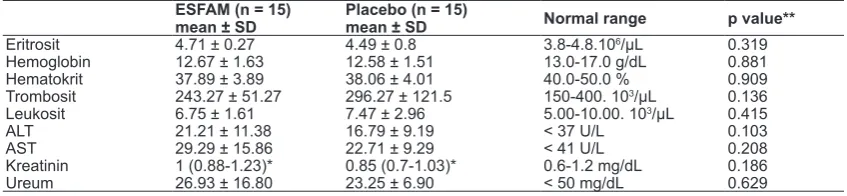
The outcome variables, i.e. blood count, metabolic profile, and albumin were comparable in the two groups at baseline, and all those variables were normally distributed (p > 0.05; Shapiro Wilk test). The between-group comparability analysis found that randomization ensured equal distribution of all variables (Table 2).
The mean number of days of taking the supplements was 56 days, and the percentage of subjects completing the trial (meet the compliance criteria of more than 85% supplement tablet taken) was 93.33%, in each group of both study groups. The results of the present study showed a high adherence rate, 93.33% of the subjects were reported taking at least 85% of tablets, and categorized as complete participation.
Two subjects were withdrawn and discontinued intervention for the following reasons: suffered from anal pain (n = 1) and the condition was getting worse (n = 1) caused by the chemotherapy and radiotherapy, also her housing area was flooded. Hence only few subjects (6.7%) in each group experienced probable intolerant side effects, thus the intervention was found to be highly acceptable to the subjects.
In general, the overall biochemical parameters (Table 3) before and after supplementation were considered within the normal range of the values, means that ESFAM did not decrease erythrocyte, platelet, and leucocyte count. The effect on bone marrow can be considered to be safe.
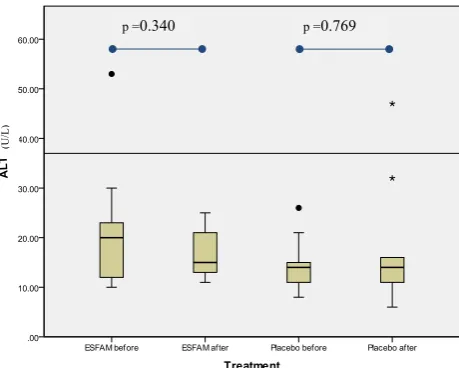
The measure in indices of organs function, i.e liver and kidney also showed similar results. The change of ALT and AST were not significantly different between groups, and within normal range after supplementation (Figure 1 and 2).
Table 2. Biochemical parameters of the subjects at baseline ESFAM (n = 15)
mean ± SD
Placebo (n = 15)
mean ± SD Normal range p value**
Eritrosit 4.71 ± 0.27 4.49 ± 0.8 3.8-4.8.106/μL 0.319
Hemoglobin 12.67 ± 1.63 12.58 ± 1.51 13.0-17.0 g/dL 0.881
Hematokrit 37.89 ± 3.89 38.06 ± 4.01 40.0-50.0 % 0.909
Trombosit 243.27 ± 51.27 296.27 ± 121.5 150-400. 103/μL 0.136
Leukosit 6.75 ± 1.61 7.47 ± 2.96 5.00-10.00. 103/μL 0.415
ALT 21.21 ± 11.38 16.79 ± 9.19 < 37 U/L 0.103
AST 29.29 ± 15.86 22.71 ± 9.29 < 41 U/L 0.208
Kreatinin 1 (0.88-1.23)* 0.85 (0.7-1.03)* 0.6-1.2 mg/dL 0.186
Ureum 26.93 ± 16.80 23.25 ± 6.90 < 50 mg/dL 0.629
*median (25th, 75th percentiles) for non-normally distributed data; ** Independent sample t-test was performed for normally distributed data, Mann-Whitney U test for non-normally distributed data; ESFAM: ethanol-soluble fraction of A. Muricata; ALT: alanine aminotransferase; AST:aspartate aminotransferase
Table 1. Medical history of the subjects in each group Groups Between
phytochemicals is one of the purposes of this study. This study might be catagorized as a proof-of-concept (PoC) study, defined as a clinical trial to determine if a treatment (drug) is biologically active or inactive. In general, they are phase I/II studies - which, investigate the safety profile, dose level and response to new drugs. PoC studies usually use surrogate markers as endpoints.9
This study was motivated by empirically usage of A. muricata leaves as traditional tea drink that is currently being studied on the developing effort of treating some types of cancers. In vitro and animalstudies have been conducted using the extract of these leaves.10,11 One
of cancers that are becoming a serious public health problem in Asia especially Indonesia isCRC 12-14
From the beginning of the supplementation phase, there were no appreciable differences between the study groups on socio-economic status, medical history, biochemical parameters, and nutritional status. The biochemical parameters were in the normal range. The patients recruited were in the range from capable in caring for most of their need to normal, no complaints, no evidence of disease. This condition is probably the most important factor to allow subjects in completing the eight weeks supplementation. Hence, only 6.7% patients were withdrawn, but their characteristics did not differ from the subjects who completed the trial. Study in Scotland on 55–64 year old CRC patients, reported that the screening of subjects showed socioeconomic deprivation as a strong predictor of participation.15
In this study, most subjects (70%) have advanced tumor staging (stage III-IV) but it is comparable between the two groups. Likewise, the socioeconomic status and race/ethnicity category are also comparable. Hence these factors did not influence the study outcome.
Subjects participate in this study are mainly male (66.7%), only 33.3% are female. The avarages of age are 50.9 and 52.2 years in ethanol-soluble fraction
Figure 1. Changes of SGPT in each group of CRC patients
Figure2. Changes of SGOT in each group of CRC patients
)
Figure 1. Changes of ALT in each group of CRC patients
Figure 2. Changes of AST in each group of CRC patients
Figure 1. Changes of SGPT in each group of CRC patients
Figure2. Changes of SGOT in each group of CRC patients
p =0.168 p =0.583
(U/L
)
ALT
AST
Table 3. Laboratory analysis between groups ESFAM (n = 15)
mean ± SD Within-group difference
Erythrocyte counts 4.71 ± 0.28 4.72 ± 0.392 0.944 4.45 ± 0.82 4.44 ± 0.86 0.964 0.941 Haemoglobin
concentration
12.69 ±1.69 12.79 ± 2.07 0.582 12.42 ± 1.43 12.57 ± 1.69 0.539 0.867
Hematocrite 38.01 ± 4.01 38.42 ± 4.86 0.475 37.74 ± 3.96 38.24±4.67 0.487 0.912 Platelet count 244.93 ± 52.79 240.57 ± 76.93 0.735 308 ± 116.93 267.07 ± 124.83 0.226 0.613
Leucocyte count 6.725 ± 1.67 7.20 ± 2.18 0.416 7.63 ± 3 8.15 ± 5.81 0.604 0.679
ALT 21,21 ± 11,38 17,5 ± 5,06 0.340 16.79 ± 9.19 17.14 ± 10.87 0.769 0.645 AST 29.29 ± 15.86 26.93 ± 12.97 0.168 22.71 ± 9.29 26.21 ± 14.13 0.583 0.175 Creatinin 1.0 (0.88-1.23)* 1.0 (0.70-1.03)* 0.088 0.85 (0.7-1.03) 0.9 (0.68-1.03) 0.432 0.755 Ureum 26.93 ±16,80 27.07 ± 19,01 0 .371 23,25 ±6,90 22,74 ± 5,87 0.929 0.370
*Median (25th, 75th percentiles) for non- normally distributed data; **Independent sample t-test was performed for normally distributed data, Mann-Whitney U
test for non-normally distributed data; ALT: alanine aminotransferase; AST: aspartate aminotransferase
DISCUSSION
This study is part of study that identified the effect of A. muricata leaves extract in CRC patients, designed to correlate between in vivo human study and in vitro
of water extract (ESFAM) and placebo group, respectively. This is in line with epidemiological studies in Asia that CRC patients are predominated by male and the risk are increased with age.16 Another
study reported that a more than fivefold increase of CRC incidence between ages 55–59 and 80+ years was observed for women. While in men, a more than fourfold increase from the youngest to the oldest (55-80) age group was observed.17
The majority of the subjects received chemotherapy because chemotherapy is one of currently main options for cancer treatment. The number of subjects received chemotherapy is comparable between the two groups. There are six and five subjects in ESFAM and placebo group, respectively receiving chemotherapy as well as blood withdrawn at the same time points. Hence chemotherapy has no influence on study outcome.
The dosage of 300 mg of ESFAM in this study was based on safety data, efficacy and feasibility. Safety consideration is based on acute toxicity experiment in animal as part of this study and history of traditional use, whilst the efficacy is based on antitumor activity in mouse and in vitro test as part of this study. The defined dose was also based on the highest concentration of actogenin at affordable cost.5,8
The eight week supplementation study are based on several studies especially on the effect of vitamins or fruits on inflammatory markers. Duration of the studies vary between one month to three years. Study on the influence of antioxidant supplementation on plasma C-reactive protein (CRP) concentrations among active and passive smokers was conducted for an average of 58 days. Result of that study showed a significant change on CRP level with 24% reduction after supplementation. Other study among Type II diabetic patients also showed significant reduction of 48% after tocopherol supplementation for one month.18
Orange and blackcurrent juice supplementation among patients with perpheral arterial diseases for four weeks also significantly decreased CRP level.19
The organ function, liver as well as kidney, are not affected during supplementation in the present study. Hematological parameter measured in this study consist of platelet, erythrocyte, leukocytes count, and hemoglobin. Supplementation did not give any significant adverse effects on all parameters of hematology, the mean of all parameters relatively remain in a normal range, means that supplementation did not reduce the bone marrow function, unlike conventional chemotherapy. The dose given to the subjects is safe and highly tolerable, as shown by very
few (6.7%) of patients complained intolerable adverse effects. This fact indicates the feasibility of adding ESFAM as adjuvant therapy.
Since these dietary compounds are not classified as drugs, A. muricata extracts do not require official
approval to be available for consumption. Therefore, a thorough evaluation on their toxicity and drug interactions are necessary to ensure the safety.
CONCLUSION
This study indicates the safety of ESFAM supplementation.
ACKNOWLEDGEMENT
This study was supported by a grant from the Centre for Ageing Studies, University of Indonesia (contract number 036/H2.R12.5/PPM.01.04/2012).
AUTHOR DISCLOSURES
The authors have no financial or commercial conflicts of interest in this work.
REFERENCES
1. Yu DQ. Recent works on anti-tumor constituent from Annonaceae plants in China. Pure Appl Chem 1999;71:1119-22.
2. Champy P, Melot A, Guérineau Eng V, Gleye C, Fall D, Höglinger GU, et al. Quantification of acetogenins in Annona muricata linked to atypical parkinsonism in guadeloupe. Mov Disord 2005;20:1629-33.
3. Garc, iacute, a-Aguirre KK, Zepeda-Vallejo LG, Ram, oacute, et al. Genotoxic and cytotoxic effects produced by acetogenins obtained from Annona cherimolia. Biol Pharm Bull 2008;31:2346-9.
4. Gupta A, Pandey S, Shah D, Yadav J, Seth N. Annonaceous acetogenins: the unrevealed area for cytotoxic and pesticidal activities. Syst Rev Pharm 2011;2:104-9.
5. Taylor L. Technical data report for graviola Annona muricata. Herbal Secrets of the Rainforest. 2nd ed. Texas: Sage Press,
Inc 2002.p.1-43.
6. Badrie N, Schauss AG. In: Watson, R R and V R Preedy, eds. Soursop (Annona muricata L.) Composition, nutritional values, medicinal uses, and toxicology. In Bioactive foods in promoting health: fruits and vegetables. Academic Press 2009. 7. Okunomo K, Egho E. Economic importance of some
underexploited tree species in Nigeria: urgent need for separate research centers. Continental Journal of Biological Sciences 2010;3:16-32.
8. Zuhud E. Kanker Lenyap Berkat Sirsak. Jakarta: PT Agro Media Pustaka 2011.
research methodology 2010;10:1.
10. Indrawati L, Purwantyastuti, Bela B, Abdullah M, Surono IS. The effect of a Annona muricata leaf extract on nutrition status and cytotoxicity in colorectal cancer: a randomized controlled trial. Asia Pac J Clin Nutr 2013;0:2016-24.
11. Indrawati L, Ascobat P, Bela B, Abdullah M, Surono IS, Pramono S. Antiproliferative activity and caspase enhancement properties of Annona muricata leaves extract against colorectal cancer cells. Med J Indones 2016;25:136-42. 12. Yee YK, Tan VPY, Chan P, Hung IFN, Pang R, Wong BCY.
Epidemiology of colorectal cancer in Asia. J Gastroenterol Hepatol 2009;24:1810-6.
13. Pourhoseingholi MA. Increased burden of colorectal cancer in Asia. World J Gastrointest Oncol 2012;4:68-70.
14. Soeripto I. Gastro-intestinal cancer in Indonesia. Asian Pac J Cancer Prev 2003;4:289-96.
15. McCaffery K, Wardle J, Nadel M, Atkin W. Socioeconomic variation in participation in colorectal cancer screening. J Med Screen 2002;9:104-8.
16. Yee YK, Tan VPY, Chan P, Hung IFN, Pang R, Wong BCY. Epidemiology of colorectal cancer in Asia. J Gastroenterol Hepatol 2009;24:1810-6.
17. Brenner H, Hoffmeister M, Stegmaier C, Brenner G, Altenhofen L, Haug U. Risk of progression of advanced adenomas to colorectal cancer by age and sex: estimates based on 840 149 screening colonoscopies. Gut 2007;56:1585-9. 18. Block G, Jensen C, Dietrich M, Norkus EP, Hudes M, Packer
L. Plasma C-reactive protein concentrations in active and passive smokers: influence of antioxidant supplementation. J Am Coll Nutr 2004;23:141-7.