Praise for
Lean Customer Development
“Cindy has done us a great service. Lean Customer Development shines the light on the discipline of developing a clear understanding of the customer. By understanding who the customer is, what their real needs are and developing clear hypotheses; product, design, and engineering can design, build, and test what customers really want. This frees teams to focus on the business of bringing the best experiences to life instead of a product nobody wants. Whether you are a startup or a large enterprise you need to develop this discipline and this way of thinking about the customer. I recommend this book.”
Bill Scott—Senior Director UIE, PayPal
“Cindy drives home the case for maintaining a continuous dialog with our customers. This book is chock full of actionable steps to make the most out of every conversation, user test, and feedback session. She opens up the research process encouraging teams to build a shared understanding of their users’ needs and the validity of their hypotheses. Make sure you add this terrific step-by-step guide to your arsenal of product development tools.”
Jeff Gothelf—Author, Lean UX
“Companies are learning that the only competitive advantage is the ability to make continuous learning and iteration part of their culture. For many large organizations, including Microsoft, this means re-learning how to engage with customers as partners. Lean Customer Development offers a view of how companies of any size can practice deep customer learning in parallel with product development.”
Adam Pisoni—Corporate Vice President, Microsoft
“This is a daunting book. It’s so packed with concrete steps, hard facts, and proven techniques that it removes any excuses you might have around building the right product for the right market. When I finished it, the first thing I wanted to do was go read it again. The second thing was to get out of the building and test five startup ideas. It’s that good.”
“Understanding what your customers need and will buy is easier said than done when your customers are Fortune 100 companies. Lean Customer Development is full of practical, hands-on guidance that allows our entrepreneurs to immediately ‘get out of the building’ and validate (or invalidate) their market and assumptions.”
Lean Customer
Development
Building Products Your
Customers Will Buy
Cindy Alvarez
Lean Customer Development
by Cindy Alvarez
Copyright © 2014 Cindy Alvarez. All rights reserved. Printed in the United States of America.
Published by O’Reilly Media, Inc., 1005 Gravenstein Highway North, Sebastopol, CA 95472.
O’Reilly books may be purchased for educational, business, or sales promotional use. Online editions are also available for most titles (safari.oreilly.com). For more information, contact our corporate/institutional sales department: (800) 998-9938 or
Editor: Mary Treseler
Production Editor: Kara Ebrahim
Copyeditor: Jasmine Kwityn
Proofreader: Becca Freed
Indexer: Bob Pfahler
Cover Designer: Mark Paglietti
Interior Designers: Ron Bilodeau and Monica Kamsvaag
Illustrator: Kara Ebrahim
Compositor: Kara Ebrahim
June 2014: First Edition.
Revision History for the First Edition:
2014-05-08 First release
See http://www.oreilly.com/catalog/errata.csp?isbn=0636920028253 for release details.
Nutshell Handbook, the Nutshell Handbook logo, and the O’Reilly logo are registered trademarks of O’Reilly Media, Inc. Lean Customer Development and related trade dress are trademarks of O’Reilly Media, Inc.
Many of the designations used by manufacturers and sellers to distinguish their products are claimed as trademarks. Where those designations appear in this book, and O’Reilly Media, Inc., was aware of a trademark claim, the designations have been printed in caps or initial caps.
Although the publisher and author have used reasonable care in preparing this book, the information it contains is distributed “as is” and without warranties of any kind. This book is not intended as legal or financial advice, and not all of the recommen-dations may be suitable for your situation. Professional legal and financial advisors should be consulted, as needed. Neither the publisher nor the author shall be liable for any costs, expenses, or damages resulting from use of or reliance on the information contained in this book.
Foreword . . . . vii Preface . . . . xi
Chapter 1
Why You Need Customer Development . . . . 1
Chapter 2
Where Should I Start? . . . . 17
Chapter 3
Who Should I Be Talking To? . . . . 29
Chapter 4
What Should I Be Learning? . . . . 59
Chapter 5
Get Out of the Building . . . . 81
Chapter 6
What Does a Validated Hypothesis Look Like? . . . . 107
Chapter 7
What Kind of Minimum Viable Product Should I Build? . . 131
Chapter 8
How Does Customer Development Work When You
Already Have Customers? . . . . 149
Chapter 9
Ongoing Customer Development . . . . 181
Appendix
Foreword
Steve Blank’s ideas are so well known today that some may not realize that when he first self-published The Four Steps to the Epiphany, he was very much a voice in the wilderness. Steve, with whom I’ve been fortunate to work as an investor, mentor, and friend, was courageous enough to call for bringing the rigorous approach of product development to the business and marketing functions of startups—long before mainstream entrepreneurs and VCs caught on; in so doing, he inspired many of us to rethink our beliefs about startups. He called that theory Customer Development.
Now that these ideas have taken hold well beyond the San Francisco Bay Area and become an integral part of the Lean Startup movement, it’s high time to revisit them and share some of the success stories, tips, and tricks from the trenches. It’s fitting that Cindy Alvarez, an early Lean Startup evangelist, has drawn upon her experience at early-stage startups and Fortune 500s alike—most recently, for Microsoft as Director of User Experience at Yammer—to write a nuts-and-bolts guide for a new generation of entrepreneurs.
Companies both large and small have been drawn to a more nimble, iterative approach to innovation and growth, but as they soon discover, doing so requires a different way of interacting with current and prospective customers. The goal of any startup is to figure out the right thing to build as quickly as possible, and the Lean Startup is a set of practices for helping entrepreneurs increase their odds of success. How do we know if we’re building the right thing? How should a cross-functional team work together? How do we hold people accountable? These are the questions the Lean Startup methodology was designed to answer.
Customer Development is different from traditional marketing research methods. While those techniques can help us understand customer needs and preferences, and take us inside the user experience to show us how customers use a product or service, this goes a step beyond—using scientific experimentation to put what we’ve learned to the test. Our goal is to not simply understand customer behavior, but to learn how to change customer behavior and build a sustainable business.
The process involves running many tests at microscale in order to get the engine of growth turning, so that a startup can achieve hypergrowth. This is one of the reasons the methodology is so challenging: it requires people to work in a truly cross-functional way to synthesize what they’ve learned. It means working hand-in-hand with colleagues from marketing, engineering, operations, and customer service—in other words, everyone. Engineers and scientists without traditional marketing or sales backgrounds now find themselves hearing straight from the customer’s mouth what he thinks about the product. People on sales teams who’ve been used to presenting final products recognize that the feedback they receive in sales calls can be of tremendous value to the innovation process. People in customer support positions are empowered to better meet customer requests rather than simply trying to put out fires.
But even after they’ve prepared themselves to speak to customers or potential customers, many who are new to the Lean Startup methodology have plenty of questions: “How can I convince people to spend their time talking to me about a product we haven’t even finished building?”“How do we get information from our best customers without potentially alienating them?”“If a customer cannot place an order, how can we assess whether we’re on the right track?”
or learning something new has a cost,”she explains. “You need to figure out the difference between want and will, and uncovering that difference requires discipline in how you talk to your target customers.”
Often, this means thinking creatively about how to turn an exploratory customer interview into an experiment. While working with a large bank that insisted on asking customers, “Are you concerned with the security of your financial information?” all 10 customers Cindy spoke to answered “Yes.” This wasn’t giving her the insights she needed so she switched gears, telling one customer he would only be entitled to the $50 gratuity if he shared his mother’s maiden name and Social Security number. “Without hesitation, the man grabbed a ballpoint pen and reached for my sheet of paper,”Cindy writes. “I stopped him before he could write anything, but my point was made. Very concerned about security…until $50 was on the line.”
A word of caution to anyone embarking on the Lean Startup journey:If you think you know what’s important to your customers, you’re in for a big surprise. Whether you work at a large corporation or a scrappy startup, whether your enterprise is hoping to build the next big thing or your startup is learning how to deal with hypergrowth, whether you build consumer-facing apps or large industrial engines, this difficulty unites every one of us.
The Lean Startup process won’t give you all of the answers, and neither will Lean Customer Development. Instead, we hope these techniques will help you challenge your assumptions as quickly as possible so that you can build a lasting company that serves customers well.
Preface
We have guesses about what’s good for the user, but we’re mostly wrong. No matter how good you are, you’re mostly wrong.
—Adam Pisoni, CTO of Yammer
In a startup no facts exist inside the building, only opinions.
—Steve Blank
In 2008, at the startup I was working for, my manager dropped Steve Blank’s The Four Steps to the Epiphany on my desk. “You have to read this book,” he said. “It’s brilliant and we need to learn from it.”
Blank wrote about the failures (and successes) he’d experienced in two de-cades and eight technology companies. Through his experiences, he rec-ognized a process that was missing from startups, which he called “cus-tomer development.” In reading his book, I recognized both mistakes that I’d made and mistakes I’d observed in companies around me. We were not verifying that we were building something customers would buy. Too often we substituted our internal industry and product knowledge for customer input.
of necessity as a user experience professional working in companies with a lot of uncertainty, no budget, and no dedicated team.
It was with The Four Steps in my head that I walked into my first meeting with one of our early customers. It was an easy meeting; they liked us and nodded in approval as my manager talked about our upcoming product release. As the hour drew to a close, people around the table made the uni-versal gestures of a meeting wrapping up: snapping laptops shut, gathering papers, fishing business cards out of their wallets.
I asked a question: “I know we’ve shown you what’s coming in the next release—but I’m curious… If we could add anything to the product, how could we make it more useful and valuable for you?”
I wasn’t really expecting an answer.
The project manager on the customer team paused. “Well…” she said, “your recommendations widget gets us more engagement, which makes us more money, which is great. But not all of the pages on our site are mon-etized equally. Some pages are 10 or 20 times more valuable to us, and we have specific page-view commitments for them. If you could specifically help us promote those pages, you would help us make a lot more money.”
As we walked out the door, my boss said, “I can’t believe we’ve been work-ing with them for almost a year and we never asked that question.”
Over the next couple of weeks, I talked to more customers. I listened as they described how they worked with business partners, what helped them make money, and who made purchasing decisions. What I learned from those conversations spurred us to change our product and triple our price.*
This short conversation is a great example of what I call lean customer development. Just one question posed to a customer. Just one shift in per-spective—away from building a better product and toward building a more successful customer. It led us in a new direction, saved us time, and brought in a lot more money.
It’s a simple formula. Learn what your customers need, and use that knowl-edge to build exactly what they’re willing to pay for.
Who Is This Book For?
If you are a startup founder in the San Francisco Bay Area, this book is not for you.
Why? Because you’ve probably not only read Eric Ries’s The Lean Startup and Steve Blank’s The Four Steps to the Epiphany (or at least tried to get through it), but also many of the other books in the O’Reilly Lean Series. More importantly, the Bay Area is full of speakers, bloggers, and peers who embrace change and experimentation. Even your prospective custom-ers have an above-average tolerance for the new.
This book is for the entrepreneurial product person who isn’t in such a sup-portive environment.
Maybe you’ve read The Lean Startup. You’re thinking, “This sounds great—but how do I actually do it?”
You may work in a startup or in a large organization where you think you can’t get away with using tactics that work for startups.
I built my career in the Bay Area, but I’ve spent most of my time working with people like you. I’ve worked in startups where our customers were in conservative or change-averse industries like finance, publishing, health-care, legal, or construction. In 2012, the company I work for, Yammer, was acquired by Microsoft. Since then I’ve been evangelizing lean and training Microsoft employees on how to adapt to a faster, more hypothesis-driven culture.
In other words, I feel your pain and I can show you how to apply these tactics, whether you’re working at a startup or in an established company.
This book is for product-centric people in technology or offline businesses, service businesses, big companies, conservative industries, and even heavily regulated industries. This book is for:
• Product managers, designers, and engineers who want to increase their next product’s chances for success
• Product-centric people in large organizations who are struggling to help their organizations move faster and work smarter
• Entrepreneurs seeking to validate a market and product idea before they invest time and money building a product that no one will buy
soft-Because the simple approach to customer development that I present can help you no matter what your product focus or the size of your organiza-tion, I’ll ask you to read all the examples, not just those that fit your indus-try. The principles you’ll learn will be worth your time.
Who Can Practice Customer Development?
What do you need in terms of background and skills to practice customer development? All you need are three qualities:
Ruthless pursuit of learning
It’s uncomfortable to ask questions that might prove you (or your boss) wrong. It’s also essential to success.
Comfort with uncertainty
Customer development isn’t predictable; you don’t know what you’re going to learn until you start. You’ll need the ability to think on your feet and adapt as you uncover new information.
Commitment to accepting—and escalating—a reality check
Some of your team’s assumptions will be proven wrong. You’ll need to convince people to change their minds and their plans based on what you learn.
If you’ve got these three qualities, this book will give you the background to start practicing customer development immediately. You’ll also gain an understanding of the social psychology behind the tactics I show you (i.e., why they work). Because every company is different, you’ll want to adapt the techniques from this book to make them work for your situation. Knowing why they work will empower you to do just that.
You might also wonder how many people you need to do customer develop-ment. In fact, even one person can drive this change.
If you’re the founder of a new startup, you may be that person.
In my experience, even in organizations with multiple people practicing customer development, one person coordinates and consolidates what ev-eryone is learning. That’s why throughout this book I’ll be talking straight to you.
How Does This Book Fit into O’Reilly’s Lean Series?
ideas in Ries’s book and provides a deeper guide to putting those ideas into practice.
You don’t need to have read The Lean Startup or any of the other books in this series to read this book.
What Is Lean, Anyway?
The term “lean” originally comes from manufacturing, specifically from Toyota. it stresses eliminating waste from processes and mak-ing sure the end product is somethmak-ing that the customer wants.
Customer development can be considered part of lean, because it helps you streamline your product development process and en-sures that you create something that the customer wants.
Because customer development is a core element of the lean startup, you will find mentions of it in other books in the series. However, lean custom-er development is unique in that it focuses entirely on how to get out there and start practicing customer development today. It’s also unique in that it is explicitly directed at both startups and mature, existing companies, in recognition of the fact that lean tactics are now being used in companies of all sizes and types. You don’t have to work in a startup to use this book—in fact, enterprise companies may well need it more!
Why I Wrote This Book
Customer development is critical to success, but grossly underutilized. Here are the top four reasons I believe this is so:
• We’re biased toward our own great ideas.
• We feel that our industry knowledge entitles us to skip validating those ideas and jump to creating products.*
• We don’t know how to find customers before we have a product. • Most of the information to date on this topic is long on telling you why
you need customer development, but short on telling you how to do it. As a result, most people don’t know where to start.
I don’t want to see more companies make the same mistakes I and so many others have made!
This book tells you exactly what to do, how to do it, and why you should do it, so that you reduce your risk and accelerate your progress from idea to profitability.
What You’ll Learn
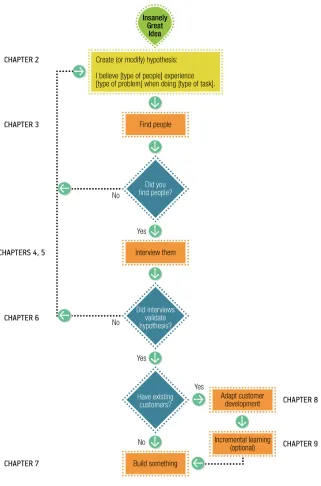
This book offers a practical education in customer development. Figure P-1 illustrates an overview of the process and serves as a guide to where each step is covered in this book.
In Chapter 1, “Why You Need Customer Development,” we’ll arm you with the facts you need to overcome initial resistance from your organiza-tion about doing customer development.
In Chapter 2, “Where Should I Start?”, we’ll get you started with identify-ing assumptions, writidentify-ing a problem hypothesis, and mappidentify-ing your target customer profile.
In Chapter 3, “Who Should I Be Talking To?”, we’ll describe how to find your target customers and get them to talk with you.
Chapter 4, “What Should I Be Learning?”, details the types of questions that effectively identify customers’ existing behaviors, pain points, and constraints—and explains why these questions work.
Chapter 5, “Get Out of the Building,” gives you a play-by-play for success-ful customer interviews. You’ll learn how to introduce yourself, get people talking, and get beyond shallow answers to detailed, thoughtful facts about customer behavior and needs.
Chapter 6, “What Does a Validated Hypothesis Look Like?”, shows you how to synthesize the valuable insights you’ve gained and use them to drive product and business decisions.
Chapter 7, “What Kind of Minimum Viable Product Should I Build?”, de-scribes the different kinds of MVPs and what situations each one works well in.
Chapter 9, “Ongoing Customer Development,” gives you strategies for fit-ting customer development into your everyday routines and piggybacking on existing customer interactions to continuously gain insights. By the end of this chapter you’ll have new ideas for creating more opportunities to talk with your customers.
The appendix, “Questions That Work,” offers tried-and-true questions to ask and describes when to use each question, as well as what you can ex-pect to learn from asking it.
A Word of Thanks
First of all, thanks to the people who trusted me to try out all of the tactics and questions in this book on our customers over the years: Hiten Shah, Peter Hazlehurst, Tim Sheehan, Jim Patterson, and Pavan Tapadia.
Justin Lin deserves a lot of credit for figuring out exactly how much to nag me to keep writing. Serena Lin was less subtle: “When you going to be done writing, Mommy?”
Thanks to Maureen Be, Vanessa Pfafflin, Grace O’Malley, Jamie Crabb, and Priya Nayak—my amazing research team at Yammer—who have been refining these ideas and using them to make our product teams and our product better.
C H A P T E R 1
Why You Need
Customer Development
It is humbling to see how bad experts are at estimating the value of features (us included). Despite our best efforts and pruning of ideas, most fail to show value when evaluated in controlled experiments. The literature is filled with reports that success rates of ideas in the software industry are below 50%. Our experience at Microsoft is no different: only about a third of ideas improve the metrics they were designed to improve.
—Ronny Kohavi, Partner Architect at Microsoft
Nature hath given man one tongue but two ears, that we may hear from others twice as much as we speak.
—Epictetus
Customers are what make a product successful.
Without customers willing to buy, it doesn’t matter how good or innovative or beautiful or reasonably priced a product is: it will fail.
Customer development is an approach for doing just that.
It’s a way to reduce your business risks by challenging your assumptions about who your customers are, what they need, and why and how they buy.
By applying the scientific method to learning about your customers, you can help confirm that you’re on track to a business model that works and a product that people want to buy.
Sounds great in theory, right?
But theory is useless if you can’t put it into practice. That’s why I’ve writ-ten this book—because I’ve worked with, mentored, and spoken to hun-dreds of companies who love the lean ideas and principles but struggle to make them work.
The First Challenge Is Inside the Building
Customer development is a big change for most organizations.
To many people, customer development sounds like saying, “Hey! You know that expertise that we’ve amassed over decades of experience, doz-ens of products, and millions of customers? Let’s shelve it and start from scratch.”
Of course that’s not what we’re saying. But as a pragmatist, I recognize that it’s difficult to correct a mistaken first impression. If your team doesn’t un-derstand what customer development is and how it enhances (rather than replaces) your competencies, it’ll be far more difficult to get started.
Customer development is admittedly the new kid on the block. Everyone knows about the role of product development, marketing, customer sup-port, and even user research in an organization. But customer develop-ment? You’re likely to encounter some skepticism.
Unless your team has been exposed to lean startup conferences or Steve Blank’s work, you may find yourself having to sell customer development to your organization before you can really get started.
This chapter takes a step back, explaining what customer development is (and isn’t), why you need it, and who can do it. It also offers responses to some common objections.
What Is Customer Development?
So let’s back up a minute and talk about definitions. What is customer de-velopment? What does it replace? What does it not replace?
has a customer development methodology. And the truth is, if you don’t learn what customers really want, you’re at a very high risk of building something that no one wants to buy.
Customer development is a hypothesis-driven approach to understanding:*
• Who your customers are
• What problems and needs they have • How they are currently behaving
• Which solutions customers will give you money for (even if the product is not built or completed yet)
• How to provide solutions in a way that works with how your customers decide, procure, buy, and use
You probably have ideas or intuitions about all of these. Let’s identify what those really are: guesses. Let’s make it sound a bit better and call them hypotheses. Those hypotheses may be around forming a new company, building a new product, or even adding new features or capabilities to an existing product.
Everything you do in customer development is centered around testing hypotheses.
What Is Lean Customer Development?
You may have heard of customer development. So what’s the difference between “customer development” and “lean customer development”?
I call my approach to customer development “lean customer development.” I’m using “lean” as a synonym for pragmatic, approachable, and fast.
Lean customer development takes the heart of Steve Blank’s ideas and renders them into a simple process that works for both startups and established companies. It’s what I write about on my blog, speak about at tech events, and teach when I mentor companies.
* if you’ve read Steve Blank’s The Four Steps to the Epiphany, you’ll recognize that this is not his original definition of customer development. Blank defined the four steps as customer discovery, customer validation, customer creation, and company building.
But The Four Steps was written explicitly for startups, and Blank is very clear that “a startup is not a small version of a big company.” having worked for over a decade in startups and now being a part of Microsoft, i completely agree. They are very different beasts!
Lean customer development can be done by anyone who speaks with cus-tomers or prospects. It works whether you’re a startup founder with no product and no customers, or at an established company with numerous products and customers. Now that I’ve explained my perspective on lean customer development, from here on out, I’m going to talk simply about customer development.
In my experience across multiple companies and in mentoring startups, every hour spent on customer development has saved 5, 10, or even more hours of writing, coding, and design (Figure 1-1). That doesn’t even include the harder-to-measure costs such as opportunity cost, snowballing code complexity, and eroding team morale from working hard on features that no one ends up using.
Figure 1-1. Talking to customers saves time and money
Customer development starts with a shift in mind-set. Instead of assuming that your ideas and intuitions are correct and embarking on product devel-opment, you will be actively trying to poke holes in your ideas, to prove yourself wrong, and to invalidate your hypotheses.
Every hypothesis you invalidate through conversations with prospective customers prevents you from wasting time building a product no one will buy.
Lean customer development is done in five steps:
• Forming a hypothesis
• Finding potential customers to talk to • Asking the right questions
• Making sense of the answers
• Figuring out what to build to keep learning
corrections will lead to validating an idea that you know customers want and are willing to pay for.
What Customer Development Is Not
There are as many misunderstandings about what customer development isn’t as about what it is. Let’s clear those decks right now.
Customer Development Is Not Just for Startups
When The Lean Startup was published in 2009, many companies were slow to embrace the ideas it introduced. “We’re not a startup,” they replied.
Although Eric Ries uses the word “startup” in the title of his book and Steve Blank wrote specifically about customer development as it pertains to startups, startups are not the only companies that benefit from customer development. Startups certainly have a higher degree of uncertainty than mature companies; they are still searching for a business model, a distribu-tion strategy, a customer base.
But larger, more mature companies also can’t assume that their models will remain static. Markets and technology change. In addition, larger com-panies often find it difficult to shift attention and resources away from profitable lines of business in order to explore new markets and areas of innovation—leaving them ripe for disruption. (Kodak, which I write about in Chapter 8, enjoyed over 100 years of success before missing the boat on digital imaging and declaring bankruptcy in 2012.)
Customer development, with its focus on small-batch learning and valida-tion, can promote internal innovation. Intuit, for example, has launched multiple products using customer development—including SnapTax and Fasal. General Electric is using lean principles. So is Toyota, the New York Department of Education, and the White House’s Presidential Innovation Fellows program.
Customer Development Is Not Product Development
Product development answers the question “When (and what) can they buy?”
Customer development answers the question “Will they buy it?”
Product development is the process of building a new product or service and (one hopes) bringing it to market. Start with a concept, define the re-quirements, build the rere-quirements, test the near-finished product, refine it, and launch it.
How you develop a product varies tremendously based on the methodol-ogy your organization follows (e.g., Waterfall, Agile, Scrum, etc.). What all product development methodologies have in common is the desired out-come: a completed product for customers to buy.
But what if the product you build is not a product that customers will buy? Is “product” the biggest risk your team faces? What about market risk? As Marc Andressen said, “Market matters most. And neither a stellar team nor a fantastic product will redeem a bad market.”*
With customer development, you are building your customer base while you’re building a product or service that solves their specific problems. Cus-tomer development doesn’t replace product development; it’s a second pro-cess that you do in parallel with product development.
If you’ve done customer development alongside product development, you don’t need to wait until your product is launched to know whether custom-ers will buy. You’ll know, because you will already have beta customcustom-ers, evangelists, and paying customers.
Customer development and product development are two independent ac-tivities, and both are necessary to maximize your company’s chances for success.
Customer Development Does Not Replace Product
Management
Some folks object, “Well, what’s left for product managers to do?”
Customer development does not replace product vision. Talking to your customers does not mean asking them what they want and writing it all down. Product management requires a disciplined approach to gathering
information from a variety of sources, deciding which pieces to act upon, and figuring out how to prioritize them.
Customer development simply adds two components: a commitment to stating and challenging your hypotheses and a commitment to learning deeply about your customers’ problems and needs.
Customer development does not provide all the answers. Although it can replace many of your assumptions with actual information, it still requires a disciplined product manager to decide which pieces of information to act upon, how to prioritize them, and how to take what you’ve learned and turn it into a feature, product, or company.
Customer Development Is Not User Research
Your company may be conducting user research already. That doesn’t mean you’re practicing customer development.
Customer development does borrow from many of the techniques that have served user researchers well for decades. But the context, the practitioners, and the timing are very different.
User researchers often describe their work as “advocating for the user.” It is, unfortunately, still viewed in many companies as optional, something you should do because it delights customers.
Customer development is “advocating for the business.” It’s not something that you should do because it makes customers happy. It’s something you must do to build a sustainable business where people open their wallets and pay for your product or service.
Why You Need Customer Development
Most new products (and companies) fail. The odds are against you. Around 75% of venture-backed startups fail.* Anywhere from 40% to 90% of new products fail to gain significant market adoption.†
* You’ll hear varying numbers. The National Venture Capital Association, for instance, estimates that only 25% to 30% of venture-backed startups fail completely. But the discrepancy may be due to different definitions of failure. harvard Business School senior lecturer Shikhar Ghosh estimates that 30% to 40% of high-potential startups end up liquidating all assets—a failure by any definition. But if a startup failure is defined as not delivering the projected return on investment, then 95% of VC companies are failures, Ghosh said ( http://www.inc.com/john-mcdermott/report-3-out-of-4-venture-backed-start-ups-fail.html).
But surely, we think, we will be the exception. We like to think of build-ing products as an art—somethbuild-ing guided by our creativity, intuition, and intellect. We all know that there are good product managers (and designers and engineers and strategists) and mediocre ones. Maybe that’s what makes the difference between a failed product and a success?
Unfortunately not.
Universally, we’re just not very good at building products and companies solely based on creativity, intuition, and intellect. It’s not just a startup problem, either: in 1937, the companies that made up the S&P 500 had an average life expectancy of 75 years; recently that number has dropped to just 15 years.*
On a smaller scale, we’re not as good as we think we are, either. Most of our ideas don’t increase value for customers or companies—Microsoft es-timates that only around one-third of their ideas improve the metrics they are intended to improve. Amazon tests every feature and fewer than 50% work; Yammer’s numbers are roughly the same. Netflix and Intuit don’t claim any higher proportion of successes.†
The truth is that it doesn’t matter how much companies research, how well they plan, how much money they spend, or how smart their employees are: the odds that they’ll avoid big mistakes are worse than a flip of a coin.
* “What went wrong? [startup guru John hagel iii] argued that American companies and their leaders were essentially not prepared for a move away from a corporate model of ‘knowledge stocks’—developing a proprietary product breakthrough and then defending that innovative advantage against rival companies for as long as possible—and toward a more open and collaborative business model that he called ‘knowledge flows.’ The problem, he said, is that because of the increasingly global nature of business competition, the value of a major proprietary breakthrough or invention erodes in value much more quickly than in the mid-20th century” (http://knowledge.wharton.upenn.edu/article.cfm?articleid=2523).
Not Just Software
i may be citing a lot of software companies, but the benefits of risk reduction and course correction are even greater for other businesses. Lines of code are far cheaper and faster to change than manufacturing setups, supplier contracts, and compliance approvals.
There’s limited opportunity to regain trust in a service that dis-appointed your customer, and no opportunity to alter a physical product once it’s in a customer’s hands.
For the makers of KRAVE jerky, it was critical to understand how customers defined a premium snack food (no nitrates, no artificial ingredients) before committing to a recipe and starting mass production.
For Romotive, a company that makes smartphone robots for learn-ing, it was critical to understand the environments that their ro-bots would be moving in. “The robot has to have good mobility and traction on carpets, hardware floors, or over grates. Also, kids drop things! A lot of what we’ve learned about how these robots will live has influenced our hardware decisions,” says marketer Charles Liu.
How Do We Improve Our Odds?
In part, we improve our odds by embracing the idea that building products is a systematic, repeatable process. There are tools that you can use, regard-less of your company’s size, maturity, or industry, to help increase your chances of success. Customer development is one of those tools.
By practicing customer development as a parallel process in conjunction with product development, you can greatly maximize your learning and reduce your risks.
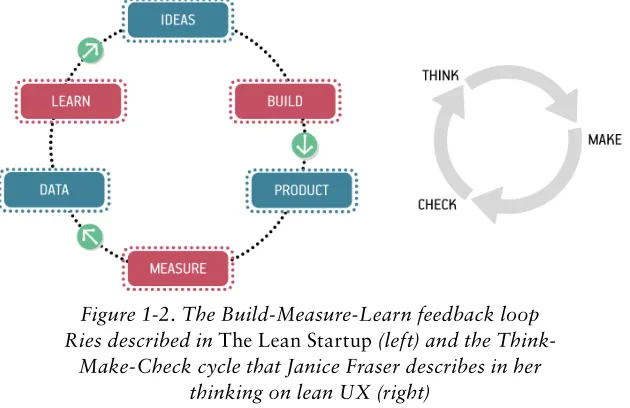
Figure 1-2. The Build-Measure-Learn feedback loop Ries described in The Lean Startup (left) and the
Think-Make-Check cycle that Janice Fraser describes in her thinking on lean UX (right)
What’s the difference? Just the starting point. You don’t need to start with the Build phase—in fact, doing so is often an expensive way to experiment.
Customer development is an important part of the Think phase. It allows you to explore and iterate during the cheapest phase of development— before any code is written or mockups are created. Customer development gives you the necessary information to build the best possible first guess, which you will then validate.
I’ve talked about learning more and reducing risk—those are valuable gains, but they don’t feel very tangible. What else will you gain from prac-ticing customer development?
• You’ll get a richer picture of your customer and your competition (not just companies and products but established habits and routines)
• You’ll uncover new opportunities for differentiation • You’ll reduce the amount of product you need to build
Everything You Know Is Wrong
Well, not quite. But as humans, we are subject to a lot of cognitive biases: our brains take shortcuts that prevent us from seeing the world the way it truly is.
We tend to operate as though we are usually right, and we in-terpret neutral or ambiguous evidence as supporting our beliefs rather than challenging them. This is called confirmation bias, and it’s responsible for a huge percentage of product failures.
Confirmation bias is our innate tendency to pay more attention to information that confirms our beliefs.* We’re more likely to ignore or downplay facts that contradict our beliefs, or interpret subjec-tive information in a way that favors what we want to believe.
We don’t do this because we’re bad or egotistical people; it’s what our brains naturally want to do. Unfortunately, it leads us to subtly sabotage ourselves: to ignore the person whose feedback con-tradicts one of our main assumptions or to dismiss a person as a dumb user because he doesn’t understand or value our product.
Overcoming cognitive biases is difficult. What helps is simply writ-ing thwrit-ings down. By objectively documentwrit-ing our assumptions, as well as the input we get from customers, it is easier to spot the discrepancies and notice when the evidence is proving us wrong.
* http://en.wikipedia.org/wiki/Confirmation_bias
In 2009, I was lucky enough to join a startup called KISSmetrics, which had Eric Ries as an advisor. KISSmetrics had previously built two unsuc-cessful versions of a web analytics product. For both versions, the company had spent many months in development, only to launch and realize that their product wasn’t solving a problem that customers needed to solve.
I spent the first month of that job on the phone, on IM, and drinking coffee with people. I was shocked to find that:
• So many people were willing to talk to a total stranger who didn’t even have a product
• The features that most people requested were far more ambitious than their current behaviors and tool usage
• We’d be able to cut our product scope in half for our initial beta
The third version of KISSmetrics was built in a month.* It was missing tons of features and included a lot of code that made our CTO cringe. But it was enough to provide value to customers and enough for us to glean valuable insights that shaped the future direction of the product.
Answering Common Objections
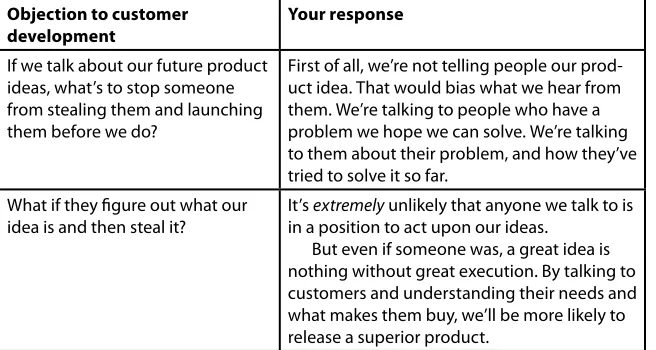
I’ll assume that you’re convinced of the value of customer development hav-ing read this far. But how can you respond to people who are not so con-vinced? Table 1-1 offers tactics for responding to common objections.
Table 1-1. Responding to common objections
Objection to customer development
Your response
if we talk about our future product ideas, what’s to stop someone from stealing them and launching them before we do?
First of all, we’re not telling people our prod-uct idea. That would bias what we hear from them. We’re talking to people who have a problem we hope we can solve. We’re talking to them about their problem, and how they’ve tried to solve it so far.
What if they figure out what our idea is and then steal it?
it’s extremely unlikely that anyone we talk to is in a position to act upon our ideas.
But even if someone was, a great idea is nothing without great execution. By talking to customers and understanding their needs and what makes them buy, we’ll be more likely to release a superior product.
Objection to customer development
Your response
What if we get bad press coverage because of this?
For startups:
We’re not at a place yet where anyone wants to give us press coverage of any kind.
For enterprise:
We’re talking to an extremely small sample size, and we will set expectations appropriate-ly. if it makes you feel more comfortable, we can ask prospective customers to sign non-disclosure agreements (NDAs). But this hasn’t been a problem for GE, intuit, or Microsoft… so it’s unlikely to be a problem for us.
how will we find people to talk to? We don’t have a product or cus-tomers yet.
We’ll have to figure this out once we have a product, won’t we? Come on, we know we’re solving a specific problem for a specific kind of person—we just need to figure out where those people are online or in the real world. (See Chapter 3.)
What if this damages our relation-ships with existing customers?
Customer development is actually an op-portunity to build stronger relationships with some of our customers. We’ll choose those most likely to be receptive, and we’ll set ex-pectations appropriately. (See Chapter 8.)
if we do customer development, what’s left for the product man-ager to do?
Customer development doesn’t mean ask-ing customers what they want and buildask-ing exactly that!
it’s a process for gathering information, and it will require a skilled product manager to prioritize that information and figure out what and how we respond to it. Customer development is just another tool to help our product managers do their jobs more effectively.
We already do market research and usability testing. how is this different?
Customer development gives us information on how individual customers behave and buy. We don’t get that from market research—it’s more high-level, covering aggregate popula-tions. We don’t get that from usability test-ing—that just tells us whether someone can use our product, not whether they would buy it. Market research and usability testing may still be valuable, but they serve different pur-poses from customer development.
Objection to customer development
Your response
how can we justify taking time away from building our product?
if a few hours of customer development helps us discover that even one of our assumptions is flawed, that’s likely to save us weeks of cod-ing and design time.
Plus, doing customer development doesn’t mean we can’t make progress on the product. We can—and should—do both in parallel.
Shouldn’t we let product manag-ers, enginemanag-ers, and designers focus on what they’re good at: building the product?
if the team wants our product to be success-ful, they should understand the problem the product is trying to solve!
But i understand that not everyone wants to spend all day talking to customers. We can involve folks in a very lightweight way so that they have a half-hour or an hour’s exposure to customers without killing their productivity.
Let’s Make This Work
In the next nine chapters, I’ll show you exactly how to do customer devel-opment. I’ll cover specific exercises, tools and templates, sample questions, and methods that you can immediately put into practice. I’ll also provide some necessary background in behavioral economics and social psychol-ogy research—not because I love theory, but because understanding why a technique works will help you adapt it to suit your needs and the needs of your organization.
You don’t need experience in market research or user research or even in talking to customers at all—all you need is an open mind and a willingness to challenge your ideas to make them stronger.
Next Step: Get Started
Key Takeaways
• Every hour spent on customer development saves 5, 10, or even
more hours of writing, coding, and design.
• Your goal is to invalidate your assumptions about what custom
-ers want, so that you can focus on building what they will actu
-ally buy.
• Customer development works for companies of all sizes, not just startups.
• Customer development doesn’t replace product development. You are building your customer base while you’re building a prod
-uct or service that solves their specific problems.
• Customer development informs product management, which then decides what to build and how to prioritize features. • You have to work to disprove your assumptions. Cognitive bias
C H A P T E R 2
Where Should I Start?
It’s too easy to think we know our customers from all the meetings, phone calls, and reports we’ve read about them. To deeply under-stand how people actually use our products we need to go to where
they work, where they play, and where they live.
—Braden Kowitz, lead designer at Google Ventures
I’m not writing it down to remember it later; I’m writing it down to remember it now.
—Slogan for Field Notes notebooks
The amount of customer development you do will depend on whether you’re attempting to validate a brand-new business idea, launch a new product to an existing customer base, or simply add or change features in an existing product.
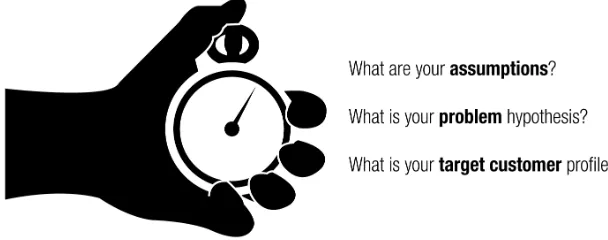
To get that foundation in place, I want you and your team to do three exer-cises that will take less than an hour total to complete (Figure 2-1):
• Identify your assumptions • Write your problem hypothesis • Map your target customer profile
I recommend these three exercises because it’s fairly easy to get your team members to participate regardless of whether they embrace customer devel-opment or are actively skeptical. It’s hard to argue with “Let’s make sure everyone understands what we’re trying to achieve and how.”
For some of you, these exercises may feel redundant. Surely everyone on the team already knows our working assumptions and what we’re trying to achieve, right? You’d be surprised at how often that isn’t true, even for highly collaborative teams.
These exercises are a fast and effective way to form initial hypotheses on how you’re going to provide value and make money and who you’re going to target. If you want more rigor (and are willing to invest more effort up front), you may want to complete a Business Model Canvas instead of or in addition to these exercises (see “The Business Model Canvas” later in this chapter for details).
Figure 2-1. All you need to start answering these ques-tions is some time and something to write with
Exercise 1: Identify Your Assumptions
You should spend some time identifying your assumptions whether you’re starting a brand-new company, launching a new product to existing cus-tomers, or adding a new feature to an existing product. If you are just starting, you may feel like these assumptions are wild guesses; if you are working in an existing enterprise, you may feel highly confident that your assumptions are correct. Either way, you must identify your assumptions explicitly in order to be able to rigorously validate them.
Ready? Set? Go!
Get some pens and sticky notes and set a timer for 10 minutes. Then start writing, as quickly as possible, your assumptions about your customers, product, and partners. If you’re doing this as a group exercise (and I hope you are), don’t stop and discuss during the 10 minutes. The point isn’t to write what you think is correct; it’s to unlock the mostly unspoken assump-tions in your head.
Here is a list of prompts to help you bring your assumptions to the surface:
• Customers have _______ problem
• Customers are willing to invest _______ to solve this problem • Stakeholders involved in using/buying this product are _______ • Partners involved in building/distributing this product are _______ • Resources required in building/servicing this product are _______ • If customers did not buy/use our product, they would buy/use _______ • Once customers are using our product, they will gain _______ • This problem affects our customers _______
• Customers are already using tools like _______
• Customer purchasing decisions are influenced by _______ • Customers have [job title] or [social identity]
• This product will be useful to our customers because _______ • Customers’ comfort level with technology is _______
This is a list of triggers to help you get started. Once you start identifying assumptions, it will become clearer what other beliefs you hold about how you plan to build, design, distribute, and create value with your product.
You may think that there’s no way you’re going to be right about your cost structure or key partners on day one, and that’s probably right. Steve Blank likes to quote boxer Mike Tyson on prefight strategies: “Everybody has a plan until they get punched in the mouth.”*
It’s not important that you’re right; it is important that you write down your assumptions. They serve as a critical reminder to you that you haven’t yet proven or disproven them.
After you’ve finished, if you’ve done this as a group, spend another 10 min-utes clustering similar sticky notes. For example, put all the sticky notes around “Customers have X problem” together. You’re likely to see assump-tions that contradict each other, even within a small group. Finding these internal misalignments will help your product even before you start talking to customers!
You will want to refer back to your assumptions throughout your custom-er development process—at first as a refcustom-erence for finding customcustom-ers and thinking of questions to ask, and later to annotate them as you collect evi-dence that validates or invalidates them.
Now that you’ve completed a brain dump of your assumptions, it’s time to come up with a simple, provable hypothesis.
* This is far more entertaining than Blank’s original version, “No business plan survives first contact with a customer” (http://bit.ly/1iXUUjB).
The Business Model Canvas
Another tool that can prompt you to identify your assumptions is the Business Model Canvas (Figure 2-2).*
Students who take one of Steve Blank’s entrepreneurship classes at Stanford, UC Berkeley, or online at Udacity begin by sketching out a business model canvas for their business idea and updating it each week based on what they’ve learned.
Most organizations i’ve talked with use the canvas more as an in-spiration than something to religiously update each week. if you’re new to customer development, the canvas is a helpful reminder that you’ve likely made assumptions about a number of areas be-yond just your product and primary customer.
* You can get poster-sized canvas images to print at http://www.businessmodel-generation.com/canvas.
There are alternate versions. Ash Maurya, entrepreneur and author of Running Lean, remixed Alex Osterwalder and Yves Pigneur’s work to produce his version, the Lean Canvas ( http://practicetrumpstheory.com/2012/02/why-lean-canvas/). You can find the Lean Canvas at http://leanstack.com/.
Exercise 2: Write Your Problem Hypothesis
Next, you’ll write your problem hypothesis. This is the hypothesis that you will either validate or (probably) come back and revise.
Write your hypothesis in this form:
I believe [type of people] experience [type of problem] when doing [type of task].
or:
I believe [type of people] experience [type of problem] because of [limit or constraint].
Let’s break it down. Your hypothesis needs to consider the five journalistic questions: who, what, how much, when, and why.
The type of person who experiences the problem—that’s who you need to talk to. The type of problem that they’re experiencing—that’s the what, how much, and when that you’ll need to find out. The type of task or con-straint—that’s the why that you’ll need to understand.
Turning Products into Hypotheses
Already got a product? You may need to work backward to come up with your hypothesis. Think about the value you’re providing, the audience who will potentially get that value, and why they need it. it might help to look at these hypotheses for existing prod-ucts (which, i will admit, i made up; i have no idea if this is how the owner of these products would have characterized them):
• I believe that [tech operations teams] experience [wasted time and budget] when [predicting network bandwidth usage for their growing companies]. (Amazon S3)
• I believe [small businesses] experience [inability to grow their businesses] because [traditional email marketing platforms are too expensive and complicated]. (MailChimp)
• I believe that [parents] experience [fear about infant health] when [putting infants to sleep]. (Halo SleepSack)
• I believe [professional men] worry about [potential embarrass
if you have a product and customers, the most direct approach is simply to observe your customers!
Travel site hotwire started with simple, scrappy listening labs— setting up in an on-site conference room and using Skype to communicate with friends of hotwire employees. That allowed the team to identify the biggest pain points with the existing site. hotwire uses what’s called “opaque booking”—the customer pays a lower rate, but the name of the hotel isn’t revealed up front. Be-cause the customer isn’t sure which hotel she’ll get, it’s especially important that she know where her prospective hotel is located.
Watching people struggle with the hotwire site made it clear that they were struggling with geographical orientation. “They didn’t know where these results would sit on a map,” explained interac-tion designer Karl Schultz. The more savvy customers opened up Google Maps in a separate browser window; the less savvy pro-spective customers simply abandoned the site.
it was easy for the hotwire team to form an initial hypothesis: [Travelers] are unable to [feel confident enough to complete a ho-tel booking] because [they can’t figure out where their prospec-tive hotels are located].
You want to make each learning cycle as rapid as possible. Each time you’re wrong, you’ll learn a little bit about why you were wrong, which helps you make a more educated guess the next time.
Write down your hypotheses and save them. You’ll be referring to them again later.
Go Narrow
One quick tip: All this talk about hypotheses being wrong might lead you to suppose that you should start with something broad and general. After all, if you don’t know much yet, why would you rule anything out?
i state this explicitly because it’s the opposite of what most people expect. You might wonder, “if i start with a very specific profile, isn’t it more likely i’ll guess wrong?”
Yes, but that’s OK.
if you start with a very broad scope, you’ll find a huge amount of variation between individuals. You may end up doing 20, 30, or more interviews and still not be sure if you’re on the right path.
Think about it this way: is it faster to disprove that cats like water or that animals like water?
Exercise 3: Map Your Target Customer Profile
What does your customer look like, and what about her abilities, needs, and environment make her more likely to buy your product?
Chances are, you don’t know exactly what your customer looks like. Even if the problem is one you’re experiencing personally, it’s hard to know who else is part of your target market.
Start by asking questions like:
• What is the problem?
• Who is experiencing this problem?
You probably identified a fairly broad audience, such as moms or working professionals. That may represent the audience that will eventually be in-terested in your product. But anyone familiar with the technology adoption lifecycle knows that not all of these people will be ready to buy or use your product on day one. You need to find and focus on those day one people, found on the left side of the innovation adoption lifecycle (Figure 2-3).
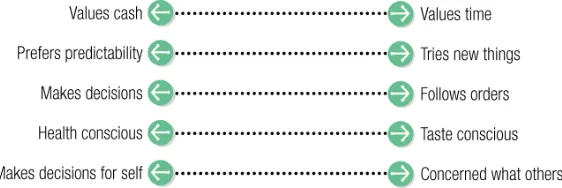
In working with a number of product teams, I’ve found that it’s usually difficult to know where to start. One exercise that works well is to draw opposing traits on a spectrum (Figure 2-4) and ask two questions: is this relevant? And if so, where do we think our customer sits on this spectrum?
Figure 2-3. The innovation adoption lifecycle: only inno-vators and early adopters are willing to try imperfect or incomplete solutions—those who wait for trusted solu-tions aren’t useful customer development interviewees*
Figure 2-4. The traits spectrum shows a sample of traits that may positively or negatively influence a customer’s
willingness to solve his problem with your solution
The advantage of the traits spectrum is that it’s visual. I recommend sketch-ing these out on a whiteboard with your entire team and solicitsketch-ing input as you go. In my experience, doing this helps bring a more diverse set of thinkers into the process. Engineers, designers, and salespeople who might not read a long document will participate in a short whiteboard exercise.
The following lists should get you started, and then you can add criteria specific to your industry or vertical.
If you’re targeting consumers, you might want to start with some of these traits as a jumping-off point:
• Cash versus time
• More control versus more convenient • Low-tech versus tech-savvy
• Replaces frequently versus long-term purchaser • Values adventure versus values predictability • Enjoys highs and lows versus prefers consistency
If you’re targeting business customers, you might want to start with some of these traits:
• Low-tech versus tech-savvy
• Low autonomy versus high autonomy
• Conservative corporate culture versus progressive corporate culture • Risk-averse versus risks are rewarded
• Values stability versus values recoverability
• Prefers turnkey solutions versus prefers best-of-breed pieces
You can create a surprisingly full target customer profile using only oppos-ing traits like this. To round it out, you may also wish to ask a few general questions:
• What does this person worry about the most?
• What successes or rewards does this person find the most motivating? • What is this person’s job title or function?
• What social identity (teenager, mom, frequent business traveler, retiree, athlete, etc.) would this person use to describe herself?
Some of you will wonder why you’ve done all this work up front before you start talking to people. Others will wonder why you need to talk to people when it was so easy to come up with very plausible customer profiles on your own!
Demographics Aren’t Customers
You’ll notice that nowhere in here have i mentioned traditional marketing demographic information such as age, gender, race, household income, or marital status.
That’s because such information is a poor substitute for what you really want to know: is someone going to buy this? Who are they? What are the factors in their life that will drive them to buy this product?
Duncan Watts, principal researcher at Microsoft, writes: “When marketers think about their demographic, they actually construct stories about [invented] individual people.… in reality you have this very diverse population of people who have all kinds of needs and incentives and who are also interacting with each other in ways that are hard to anticipate. [invented] stories … paper over all of that complexity, effectively replacing the whole system with a single ‘representative individual’ and then try to reason about that person’s behavior as if she were an actual person. it’s a big error.”
Once you have a product and you’re shipping thousands or mil-lions of units, demographic information may reveal some interest-ing patterns, but that’s a long way off at this point.
Resist the urge to look for large amounts of generic information, such as analyst reports, census data, or market surveys. What will help you build an amazing product starts with highly specific, de-tailed, and passionate information—in small amounts.
Next Step: Find Your Target Customers
Key Takeaways
• Spend time as a team writing down your assumptions so you can validate or invalidate them. Even if you think everyone is in align
-ment, they probably aren’t.
• Write your problem hypothesis: I believe [type of people] experi
-ence [type of problem] when doing [type of task].
• Make your hypothesis as specific as possible. The narrower your focus, the faster your progress in proving it right or wrong. • Create a target customer profile with your team using the traits
C H A P T E R 3
Who Should I Be Talking To?
We went to Sonoma, the center of highbrow culinary thinking, and went to the Wine Auction. We bought a booth and had a KRAVE jerky tent next to the high-end wineries. There was definite shock factor! But people were intrigued and came to talk to us.
—Jon Sebastiani, CEO of KRAVE
Everyone wants to feel connected. When people know that they’re actually helping to grow a product, that we want their personal
ex-perience to be as great as possible, it gets them really excited.
—Dan Levine, CTO of StyleSeat
There are probably two things concerning you right now: that you have no idea how to find the right customers to talk to, and that they wouldn’t spend their time talking to you even if you could find them. If you have a product and existing customers, you may still find it surprisingly hard to get in direct contact with them. If you don’t have a product yet, why would someone want to spend time talking to you about a product that doesn’t even exist yet?
places to find the people who will benefit from the product you’re trying to build. I’ll also discuss the factors that motivate people to share and col-laborate. By understanding some basic social psychology, you’ll be better able to convince people to help you and make them feel happier for having done so. We’ll cover:
• The importance of “earlyvangelists” • Details for finding people to talk to
• Methods for interviews and preparations that ensure interviews run smoothly
• What to do if you can’t find anyone who wants to talk
In effect, if you think of customer development interviews in terms of who, what, where, how, and when, this chapter helps you find out concretely who to talk to, decide how you will talk to them (in person, by telephone, or using video), where you’ll do the interview (whether a physical place or the environment from which you’ll conduct your phone or video interviews), and when (especially in terms of scheduling and spacing them). (Chapter 2 addressed the question of why you’re doing the interviews to begin with.)
This chapter doesn’t cover what questions you should ask interviewees. In fact, that’s the wrong way to think of the what in customer development. The real what is what you should be learning from your interviews. We’ll get there in Chapter 4.
By the end of this chapter, you’ll be equipped to start reaching out to pro-spective customers immediately. The sooner you start sending out requests, the closer you’ll be to validating your hypotheses.
How Can I Find Customers Before I’ve Even Built a
Product?
This is one of the first questions people ask, and my response is always: “How were you planning on finding them after you’ve built a product?”
This isn’t entirely meant as a snide answer—you’ll be using many of the same techniques that you’d use once you have a product. Imagine a world where you weren’t reading this book and you had just spent the past six months building your product. Now you’re ready to sell it. What would you do?
• You’d look for relevant places to advertise.
• You’d look for places where your likely customers already are and try to get your product in front of them.
• You’d partner with complementary products or services to cross-promote.
• You’d build a website and monitor the channels bringing people to your site.
Every one of these methods can be started before you write a single line of code or sketch a single wireframe.
And by doing so, you can prevent having to add sad bullet points like these:
• You’d wonder if Google Analytics were broken because it’s not show-ing any visitors to your site.
• You’d look at your garage filled with product and fear that you’ll be reduced to dropping it off at Goodwill.
Come On—Why Would They Talk to Me?
Before we go into the details of techniques for finding customers, let’s ad-dress the skepticism you’re probably feeling. You may think, “So you’re telling me that people are willing to spend time talking to someone they don’t know who has no product to show them?”
I’ve found that no one believes this at face value. People are busy. They hate telemarketers, advertising, and spam. How is this different?
To start believing that people—useful people—will want to talk to you, you need to understand the people you’re looking for.
The Importance of Earlyvangelists
In the beginning, you are looking for the most enthusiastic, passionate po-tential customers. These are the people who are the most motivated to solve their problem.
This doesn’t mean you want “early adopters,” those folks who always rush out to buy the latest device and pride themselves on tinkering with prod-ucts or exploring all of the advanced features. Early adopters are willing to try just about anything! That won’t help you validate or invalidate your hypotheses.