61
| Publisher: Humanistic Network for Science and Technology
RESEARCH ARTICLE
URL of this article: http://heanoti.com/index.php/hn/article/view/hn1201
Analysis of Factors Related to Visual Inspection with Acetic Acid Examination on Child
Bearing Women
Esti Yunitasari*, Eva Riantika*, Ah Yusuf*, Aria aulia*
*Faculty of Nursing, Airlangga University, Indonesia Email: [email protected]
ABSTRACT
Not only the health promotion about Visual Inspection with Acetic Acid (VIA) examination and servical cancer but also free for VIA examination have been held in Polindes Tanjunganom, but the scope of VIA examination is still in low grade. Health Belief Model (HBM) theory is used to evaluate and explain the differences of individual perception towards preventive behaviors. This study was aimed to analyze the factors correlating with VIA examination in women by HBM. Design used in this study was cross sectional. The population was all child bearing women in Tanjunganom Public Health Center. Total sample was 50 respondents, taken according to simple random technique. The independent variabels were perceived susceptibility, perceived seriousness, perceived benefits, perceived barriers, and cues to action. The dependent variabel was VIA examination. Data were collected by using structured questionnaire and analyzed by using chi square test with level of significance of ≤ 0,05. Results showed that perceived susceptibility had correlation with VIA examination (p=0,026), perceived seriousness had correlation with VIA examination (p=0,004), perceived benefits had correlation with VIA examination (p=0,016), perceived barriers had correlation with VIA examination (p=0,016), and cues to action (p=0,000) had correlation with VIA examination. It can be concluded that HBM has correlation with VIA examination and cues to action has the strongest variabel related to VIA examination. Further studies should involve larger respondents and better measurement tools to obtain more accurate results.
Keywords: VIA examination, Susceptibility, Seriousness, Benefits, Barriers, Cues to action
INTRODUCTION
Cervical cancer is one of the main causing deaths in women. It can be prevented if pre-cancerous lesions can be identified in early period (Ibrahim, et al., 2011). Pre-cancerous lesions can be detected through inspection (Visual Inspection with Acetic Acid / VIA) but unfortunately VIA examination in Indonesia is still poor (Kemenkes RI, 2013). Nganjuk District Health Office reported that childbearing women doing VIA examination in some health centers are still low, whereas the incidence of cervical cancer in this region is known 1: 100 found on VIA examination through a year (Dinkes Nganjuk, 2015).
Cancer is the second leading causing death in the world after cardiovascular problem. The highest types of cancer in women are breast cancer (38 per 100,000 women) and cervical cancer (16 per 100,000 female) (Agency for Research on Cancer, 2012).
VIA examination is a visual examination of the cervix using 3%-5% acetic acid by the naked eye to detect abnormalities (Depkes RI, 2008). VIA examination is recommended for reproductive women 30-50 years, due to pre cancerous lesions can be detected 10-20 years early before definitely diagnosed as cervical cancer (WHO, 2012). American Cancer Society (2009) recommends VIA examination ideally start from 3 years after vaginal intercourse.
62
| Publisher: Humanistic Network for Science and Technology
METHODS
Write here, the type of research, design, population, sample, sampling technique, data collection, data management, data analysis, and interpretation. Write here, the type of research, design, population, sample, sampling technique, data collection, data management, data analysis, and interpretation. This study was designed by cross sectional design, the type of research that emphasizes on dependent and independent measurement variables at one time (Nursalam, 2013). The population in this study was all child bearing women in Polindes Tanjunganom. Criteria: child bearing women in the age of 30-50 years old (Kemenkes RI, 2015), and has participated in health education program about cervical cancer and VIA examination held by Tanjunganom Public Health Center in 2015. Primary data was obtained by giving questionnaires to respondents directly. The questionnaire consisted of demographic data and HBM questionnaire (Frankenfield, 2009). It was include with 35 statement items. Airworthiness ethics derived from the Faculty of Nursing, Airlangga University.
The sample in this study were obtained from a sample size formula and using simple random sampling technique by lottery. Thus, the sample size in this study was 50 people. The independent variables were perceived susceptibility, perceived seriousness, perceived benefits, perceived barriers, and cues to action. The dependent variable was VIA examination in Polindes Tanjunganom. Referring to Nugroho (2014), the collected categorical data was analyzed descriptively in the form of frequency and percentage. Further testing hypothesis using Chi-square test.
RESULTS
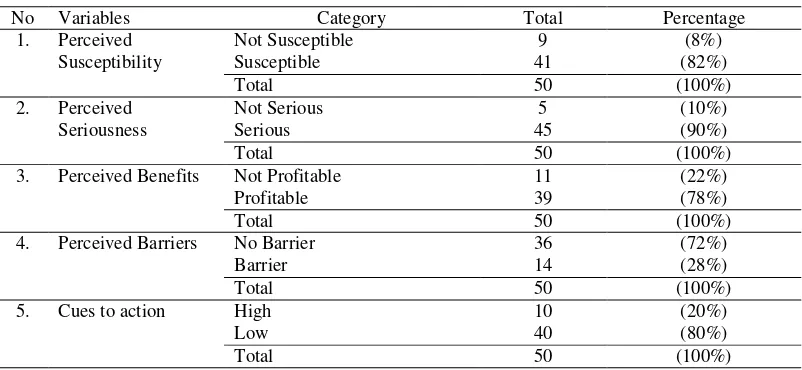
Table 1. Health belief model towards VIA examination
No Variables Category Total Percentage
1. Perceived susceptibility (p= 0.026), (2) perceived seriousness (p=0.004), (3) perceived benefits (p=0.016), (4) perceived barriers (p=0.016), and (5) cues to action (p= 0.000).
DISCUSSION
Becker (1974) developed a concept of HBM. Based on the idea that the individual must have a willingness to participate in health interventions, and belief that health is a result that considered highly. Therefore, it can be predict that a person uses positive health behavior to determine a person's perception of the disease, illness or an accident, identify factors modifiers, and the tendency of a person to act.
Correlation between perceived susceptibility with VIA examination towards child bearing women
63
| Publisher: Humanistic Network for Science and Technology
perceptions is good or positive, it will lead someone to prevent the risk from illness (Stretcher, Rosenstock, 1997). Perception of the increased susceptibility associated with health behaviors, but decreased susceptibility associated with unhealthy behaviors (Janz, et al., 2002). Another phenomenon was also demonstrated in this study. There were some respondents who have high perceived susceptibility toward cervical cancer but they don’t take on VIA examination. It caused by other types of work such as civil servants and self-employed, so it can be considered that mothers who work dependently have consumed much time for their job (Pertiwi, 2015). Then there is anomaly phenomenon in this study. The secondary school (Junior High School) didn’t pay attention on VIA examination. In fact, the higher education should increase the health behaviors (Rahma & Prabandari, 2012), but not for this study. There is also the other factor which make respondents were deny for VIA examination although their perceived susceptibility was high. That’s just because they are afraid feeling the pain during examination. Other anomalous events were identified in this study. The respondents with less perceived susceptibility accept for VIA examination. That’s because of the support of health workers. They serve free VIA examination in Polindes without having to come to Puskesmas Tanjunganom. Perceived susceptibility has 5 item statements. The statement make same perception among the respondents is "I am worried about all the things of cervical cancer".
Correlation between perceived seriousness with VIA examination towards child bearing women
Based on the results of the study there is a weak correlation between perceived seriousness with VIA examination in Polindes Tanjunganom. It’s conduct that people with high serious perception of cervical cancer will do VIA examination, but not all of them. Serious and individual perceptions about the severity of disease will encourage people to seek treatment and prevention measures (Champion & Skinner, 2008). The more serious and severity affect of a disease, the greater they seek preventive actions (Desi, 2016). Another thing is also shown by this study. There are respondents who didn’t take on VIA examination although the perception of seriousness was high. Based on the analysis of researchers, this is caused by the type of work (self-employed and civil servants) and the distance between home and VIA service center is far enough compared to other respondents. So that’s why the high serious perception of cervical cancer does not make the respondent moved for VIA examination. That phenomenon also supported by Lawrence Green that there is a supporting factor (enabling factors) to conduct one’s health behaviors, it is “accessibility of health resource”. Someone will make health behavior if there is an easy access to reach the health service (Green & Kreuter, 1991). Stimulating factors (cues to action) is also affects the perceived seriousness of cervical cancer. Another anomaly was found that respondents with a low perceived seriousness have tried VIA examination. The analysis showed that it has influenced by the presence of free VIA examination conducted after counseling. The items that stand out and make the respondents have the same perception in this variable is the statement number 1, "I think cervical cancer is make me scare". It’s mean that cervical cancer is still considered as frightening disease for the respondent
Correlation between Perceived Benefits with VIA Examination towards Child Bearing Women
Based on the results of the study there is a weak correlation between perceived benefits with VIA examination in Polindes Tanjunganom. It’s mean that if one's perceived benefits in VIA examination is high, not all of them will examine their cervical by VIA, but most people will likely to do it. The amount profits or benefits derived from a precaution, the greater chance of the individual to take the preventive action (Notoatmodjo, 2010). However, if the perceived benefit is less than the barrier, a preventive action will be smaller (Khosidah & Trisnawati, 2015). Another phenomenon is also found by this study. There are respondents with high perceived benefits but they don’t take VIA examination. This is because the respondent is constrained by the job (Self Employed), and then caused by high barriers perception that includes thinking of pain during the examination and feelings difficult to make a new habit after examination. This is in line with HBM that when the barriers perception of someone getting high to action, then someone would be deterred to take these actions (Rosenstock, et al., 1988). Lower support of people around and the information media also influence this study, although the benefits perception of VIA examination is high. Another anomaly was found that respondents with low perceived benefits take VIA examination. The results of analysis show that it is influenced by the presence of free VIA examination conducted after counseling. This variable has the most powerful statement that made respondents have same perception. This is "VIA examination can help me to find my cervix disorder".
Correlation between Perceived Barriers with VIA Examination towards Child Bearing Women
64
| Publisher: Humanistic Network for Science and Technology
preventive measures depends on the outcome of two beliefs (Becker, 1974), they are the perceived threat of pain and consideration between the advantages and the disadvantages (Machfoedz & Suryani, 2008). Another result of this study is that the respondents with low resistance, there are no checks in VIA examination. Respondents that did not examine by VIA are caused by their work (Pertiwi, 2015) and low of cues to action (stimulation), and then there was no support from the people around or from their family. According to Friedman, it’s analyzed that someone will find health service, when they are administered by their family or friends (Friedman, 1998). The other factors that affect the implementation of VIA examination are the low result of perceived susceptibility, perceived seriousness, and perceived benefits. The three factors strongly influence their perception. Respondents who felt susceptible were dominated by those who were married over the age of 20 years. This is in accordance with risk factors for cervical cancer causing by marriageable age less than 20 years (Baughman & Hackley, 2000), so they are not a part of the risk (Llewellyn, 2002; Morgan & Hemilton, 2009). Another anomaly was found that respondents with high barriers of perception in VIA examination take this examination. The analysis showed that it is influenced by the presence of free VIA examination conducted immediately after counseling. The inhibitors statement items of the respondents with high barriers of perception is the number 3, which is "I think VIA examination is painful". Based on these data it can be seen that the majority perception that impede to carry out VIA examination is the perception of fear of pain.
Correlation between cues to action with VIA examination towards child bearing women
Based on the results of the study, there is a strong correlation between cues to action with VIA examination in Polindes Tanjunganom. It’s conduct that people with high cues to action will do VIA examination. A person's behavior depends on the information received during social interactions continuously (Notoatmodjo, 2007). If the information received is correct, someone will apply it right. So stimulus of social environment administers a high role to change behavior (Glanz, et al., 2008). Another phenomenon of this study also showed that respondents with a high cues to action remains no checks in VIA examination. Based on the analysis, it is due to many inhibiting factors such as employment, access to health centers, and supported by a low susceptibility factors. So despite stimulus of respondents is high, it still not influence in VIA examination. The strongest statement that affects the same perception of the respondents in this variable is the statement "I obey an advice of health workers to carry out VIA examination, because it is beneficial for my health". It’s mean that the role of health workers was instrumental and successful in influencing the one’s perception to perform VIA examination.
The dominant factor correlating with VIA examination towards child bearing women by health belief model
Health Belief Model (HBM) is one of the theories used to examine the behavior (Jones & Bartlett, 2008). The results of this study stated that perceived susceptibility, perceived seriousness, perceived benefits, perceived barriers, and cues to action has a correlation with VIA examination in child bearing women. These five factors together determine the formation of VIA examination. Each factor studied has a value of correlation and contingency coefficient (C), so the most dominant variable found in VIA examination is cues to action. Based on analysis of this research, cues to action became a strong influence because of the stimulus of health workers who provide a counseling of VIA examination and cervical cancer. Thus health promotion from health workers contains a persuasive that can affect respondent’s perception indirectly (Ayers, et al., 2007). Knowledge of the respondents who are already good, make it easier to examine the perception of each individual in accordance with their same knowledge. The strong stimulus (cues to action) demonstrating the success of health workers in health promotion in this study, is expected to be maintained and improved to motivate health workers to be more active in disseminating the VIA examination and cervical cancer. The weak variable is expected to find a solution such as setting the suitable time for VIA examination service that can be done throughout Polindes by all the time, so the obstacles such as occupational factors, a far distance access can be minimized.
CONCLUSION
65
| Publisher: Humanistic Network for Science and Technology
REFERENCES
Agency for Research on Cancer. (2012). Latest world cancer statistics: extimated cancer incidence.
Ajenifuja, K.O., Gage, J. C., Adepiti, A.C., Wentzensen, N., Eklund, C., Reilly, M., Hutchinson, M., Burk, R.D., Schiffman, M. (2013). A population-based study of visual inspection with acetic acid (VIA) for cervical screening in rural Nigeria. International Journal Gynecoogical Cancer, 23(3), 507-512.
American Cancer Society. (2009). Cervical cancer.
Ayers, S., Baum, A., McManus, C., Newman, N., Wallston, K., Weinman. J., West, R. (2007). Cambridge handbook of psychology, health and medicine. West Cambridge University Press
Baughman, D. C., Hackley, J. C. (2000). Medical surgical nursing. Jakarta: EGC.
Becker, M. H. (1974). The Health Belief Model and Six Role Behaviour. Health e ducation monographs winte, 2(4), 409-419.
Champion, V. L. (1984). Instrument development for Health Belief Model constructs. Advances in nursing science, 6(3), 73-87.
Champion, V. L. & Skinner, C. S. (2008). The Health Belief Model. In: Health behavior and health education: theory, research, and practice. San Fransisco: Jossey-Bass.
Depkes RI. (2008), Skrining kanker leher rahim dengan metode inspeksi visual asam asetat (IVA). Jakarta: Departemen Kesehatan Republik Indonesia.
Desi, A. (2016). Health beliefs model (HBM) perilaku deteksi dini kanker leher rahim metode IVA pada wanita usia subur di Puskesmas Padang Pasir tahun 2016 (Doctoral dissertation, Universias Andalas)
Dinkes Nganjuk. (2015). Data KIA Kabupaten Nganjuk. Nganjuk: Dinas Kesehatan Kabupaten Nganjuk. Frankenfield, K.M. (2009), Health belief model of breast cancer screening for female college students. Master's
Theses and Doctoral Dissertations, Paper 258. Friedman. (1998). Keperawatan keluarga. Jakarta; EGC.
Glanz, K., Rimer, B.K., Viswanath, K. (2008). Health behavior and helath education: theory, research, and practice. United States of America: Jossey-Bass.
Green L.W., Kreuter M. W. (1991). Heath promotion planning, an educational and environmental approach. California: Mayfield Publishing Co.
Hall, K. S. (2011). The health belief model. J Midwifery Womens Health, 1(57), 74-81.
Ibrahim, A., Rasch, V., Pukkala, E., Aro, A. R. (2011). Cervical cancer risk factors and feasibility of visual inspection with acetic acid screening in Sudan. International Journal of Women’s Health, 1(3), 117-122. Janz, N. K., Champion, V. L., Strecher, V. J. (2002). The health belief model.In K. Glanz, B.K. Rimer, & F.M.
Lewis (Ed.). health behavior and health education: theory, research, and practice. 3rd Edition, 45-66. San Francisco: Jossey-Bass.
Jones and Bartlett. (2008). Health belief model. Jones and Bartlett Publisher
Kemenkes RI. (2013). Profil kesehatan Indonesia. Jakarta: Kementerian Kesehatan Republik Indonesia. Kemenkes RI. (2015). Panduan program nasional gerakan pencegahan dan deteksi dini kanker leher rahim dan
kanker payudara. Jakarta: Direktorat Pengendalian Penyakit Tidak Menular, Kementerian Kesehatan Republik Indonesia.
Khosidah, A., Trisnawati, Y. (2015). Determinan faktor yang mempengaruhi ibu rumah tangga dalam melakukan tes IVA sebagai upaya deteksi dini kanker serviks. Jurnal Bidan Prada, 6(2).
Llewellyn, D. (2002). Dasar dasar obstetri & ginekologi. Jakarta: Hipokrates.
Machfoedz, I., Suryani, E. (2008). Pendidikan kesehatan bagian dari promosi kesehatan. Yogyakarta: Fitramaya.
Morgan, G., Hemilton, C. (2009) Obstetri dan ginekologi panduan praktik jilid 2. Jakarta: ECG. Notoatmodjo, S. (2007) Promosi kesehatan dan ilmu perilaku. Jakarta: Rineka Cipta.
Notoatmodjo, S. (2010). Ilmu perilaku kesehatan. Jakarta: Rineka Cipta.
Nugroho, H. S. W. (2014). Analisis data secara deskriptif untuk data kategorik. Ponorogo: Forum Ilmiah Kesehatan (Forikes).
Nursalam. (2013). Metodologi penelitian ilmu keperawatan. Jakarta: Salemba Medika.
Pertiwi, N.D.E. (2015). Faktor-faktor yang berhubungan dengan kunjungan pemeriksaan IVA/pap smear pada ibu-ibu PKK di Dusun Tajem Depok Sleman. Doctoral dissertation. STIKes Aisyiyah Yogyakarta. Rahma, R.A., Prabandari, F. (2012). Beberapa faktor yang mempengaruhi minat wus (wanita usia subur) dalam
melakukan pemeriksaan IVA (inspeksi visual dengan pulasan asam asetat) di Desa Pangebatan Kecamatan Karanglewas Kabupaten Banyumas tahun 2011. Jurnal Bidan Prada, 3(01).
Rosenstock, I.M. (1974). Historical origins of the health belief model. Health Education Monographs, 2(4), 328-335.
66
| Publisher: Humanistic Network for Science and Technology
Stretcher, V. J., Rosenstock, I. M. (1997). The health belief model. In: Glanz K., Lewis F. M., Rimer B. K. (1997). Health behavior and health education: theory, research and practice, San Francisco: Jossey-Bass.