BUILDING GENDER SKILLS OF TEACHER CANDIDATES
FOR GENDER PERSPECTIVE EDUCATION
Oksiana Jatiningsih Faculty of Social Sciences, UNESA
Abstract
Education is still "constrained" by patriarchy gender values. This is contrary to education policies formalized in the form of a presidential decree and ministerial decisions on gender mainstreaming in education, which put gender equality values in education practices. Unfortunately, that this policy has not translated well operationally, so that the educational process to prepare teacher candidates still do not apply this rule well. What does educational sphere construct space to build perspective gender on education? What does the curriculum construct teacher candidates’ knowledge on gender? The study is descriptive and located at Civics Department UNESA. The subjects are 44 students who will graduate from the institution. The results can be described that UNESA’s sphere is dominated by unequal gender values, even patriarchy gender ideology. The institution does not fully translate the educational policies to prepare teacher candidates toward to implementating of a gender perspective education. The students do not have well gender knowledge yet. They do not understand the effect of gender patriarchy on the unjustice life. The subject as an individual can only become a place the patriarchy ideology as the episteme of dominant gender discourse works, and controlled and dictated by the true regime through the social context that shapes unconsiously them to continue socialilizing patriarchy gender values to their students. Repetition of these values through various aspects of the life and practices of education expresses the "acceptance" simply patriarchal gender values. Without anything, this becomes “the death knell” in building a gender perspective education.
Keywords: gender perspective education, teacher candidate, gender discourse
Introduction
Education has strategic roles in building society. What it’s work has large effects on the society’s life. Education becomes social engine to move on society. Education is a sphere to construct society. It is not only due to the subjects who have motivation to build and develop their potencies, but also society, included in parents, have their hope to keep and socialize their values to the members
Education is needed to develop the life quality of society. Education is a very important arena to prepare the future life, even the life itself. Therefore education should build educative experiences to live. Education functions to anticipate and participate on creating better future life. Dewey (1997:47) told that every experience would give a moving force toward better life in the future. Education gives strategic tools to battle injustice, included in gender discrepancy (Suryadi and Idris, 2004:29). For the purpose, education not only socializes children with certain values, but also stimulates changing to create equal and justice life. Here, create and build gender awareness and sensitivity through critical thought accordance with egalitarian life order.
Gender is social-cultural construct on men and women. As a social construction, gender may change and differ from time to time and place and place. Gender is social label consisted of attitude and behavior characteristics as the culture ascribes to each of man or woman (Brannon, 2005:15). That is why, gender construction is relative and its existence depends on the supporting or refusing of the society itself. Through social reproduction,
society force all individual wherein they obey the values. Individual, especially the young, is taught and socialized the society’s gender values. The values become standard to justify the true and false. Of course, the more those values are supported, the stronger they become social norms. Finally, all people place the values as the general norms and l knowledge that inform and teach people to execute them in everyday life. In other words, gender is constructed by society, and then constructs society the o internalize and keep them as individual value system.
Generally, gender construction is patriarchy. Gender consists of values that put in order how women and men behave and relate each other. The gender ideology places women and men in asymmetric relation. In patriarchy gender ideology, women and men are differently positioned, even unequally. Men as the first and the genuine subject, whereas women as the second and the other (Beauvoir, 1956:20; Bauer, 1960:44). Women are complement of men as the absolute. Men define what they think as the true and the false. Men define how the women should become ones. Women are constructed and defined by men (Beauvoir, 1956:15-16; Bauer, 2001:44). Women are subordinates, marginalized, and violence object. Men are the master. “He is the Subject, he is the Essential, he is the Absolute, but she is the Others” (Beauvior, 1956:16). As a result, men are powerful and women are powerless.
women are in the other side. Women are inferior and men are superior. Simone de Beauvoir in “the Second Sex” told that women were created inferior due to the social structure was held by men’s hand. Society formulates different characteristics for men and women. Men are to be masculine and women are feminine. Masculinity and feminity then become parameter to formulate kinds of each of their activity. Men works in a public sphere (culture sphere) and women works in a domestic sphere (nature sphere). In a family a woman is a housewife and a man is a breadwinner. Then, the stereotypes result in different, even unequal and injustice relation between the two sexes in social gendered schools. The values become standards that regulate and are obeyed by all people to think, speak, and behave. Foucault calls the values as episteme.
Episteme is a kind of ideology, paradigm, or magical power that moves all people to do its order. It dictates and controls them to think and behave unconsciously in the line of the invisible regulation. Episteme is a dominant ideology gives historically a set of regulation as a manual script on behave by most people of a society (Sweely, 1987:2). Through these social practices, the episteme is kept, obtained, obeyed, and continued existing. Consequence, the values become much stronger together with the power of the dominant group. The episteme guarantees the group to exist and hold the power. Because patriarchy as the dominant values have a social sphere regulated, the values become stronger to put in social order.
Episteme tells what the true or the false. The true is not the objectivity of an object like in a scientific procedure (Harland, 2010:141). The true is assurance quality built by the dominant group through the knowledge they have. Knowledge implies that “what is said or thought is true and that the individual has grounds for what he/she says or thinks” (Peters, 2005:58). The true is discourse cconstruction and knowledge regime to define the true and the false (Jorgensen and Phillips: 2007:24; Eriyanto, 2009:74). Of course, the dominant group has its power to control the true through the construction of knowledge. In patriarchy society, the episteme works to control the individuals on thought and behavior. Therefore, patriarchy not only works as limitation for women, but also to corrupt their consciousness to just receive and internalize themselves to the true of the ideology so that they lose their own conscious to leave it. The power of men as the truth regime has become stronger and stronger (Lie, 2005:71). Therefore for Foucault, knowledge is the effect and also instrument of power (in Latief, 2012:42).
Knowledge are means and products of the dominant power. Knowledge are closely connected with the power. The power works through the knowledge discourse which shares power to keep people in the line of the episteme. Discourse is complex relations and functions to definite game rules of social discursive practices (Foucault, 2012:137). Here, power is a strategy to force people to become what they want. Of course, patriarchy gender ideology is constructed in dominant relations and connected with the power (Hodder, 2005:76). Power comes from different vigor spreading in a certain space wherein there many strategic position are connected each other (Sarup, 2011:112; Eriyanto, 2009:65). Power is not about possession or capability, but it is a strategy (Mills, 2004:35). Power spreads through discourse working through many different social practices; it is not negative and repressive, but positive and productive. Power through the discourse forces people to think and obey according to the knowledge and the true they built. Based on the rule, it can be constructed the common and taboo objects of statement and practices in a society (Barker, 2004:144-145; Baxter, 2003:7). Discourse forces individual to follow and participate in social life as well as construct object in a certain way (Wooffitt, 2005:148). The disciplining machine runs based on controlling mechanism through defining discourse of knowledge/truth that influences society or other people to receive and implement voluntarily the knowledge/truth, not repressive. Therefore, discourse contains constraint to arrange and restrict as well as give possibility to people to know something.
Discourse is always in a struggle condition. The discourse winning the struggle will come as the exist and dominant discourse in a society, and others as marginalized discourses. It will define the knowledge as the true. And this will use to define, This needs awareness to reveal the injustice life that will drive toward to the better life. Here, education will be very important to develop critical thinking and capability to struggle to improve the quality of life. Of course for the purpose, the new discourse must battle the dominant one.
men as the first and women as the second; men as the dominant and women as the subordination. Gender bias in educational practices can lead social injustice (Subrahmanian, 2005:405). The condition causes to emerge consciousness on building new life order based on egalitarian values.
Gender Mainstreaming has designated that egalitarian gender should be run in education. Indonesian government has formulated regulation to run gender mainstreaming in development program. This is continued on education through National Education Ministry Regulation number 84/2008 about Gender Mainstreaming Manual on Education. Based on the regulation, education is executed based on gender equality and equity. In higher education, through the official letter of Direktur Jenderal Pendidikan Tinggi and Direktur Jenderal Peningkatan Mutu Pendidik and Tenaga Kependidikan Number 67684/A5.2/HK/2010 on August 30th, 2010 and Dirjen Dikti Number 1525/D/T/2010 on December 20th, 2010, it is commanded that all implementation of education in higher school run based on gender perspective. Of course, UNESA as a teacher training institution has important role to implement gender perspective on education.
At school, teacher has a very strategic role on struggling against patriarchy ideology in order to build egalitarian life order. Many previous researches have been reveal that teachers behave and interact in the line of gender bias. They do not understand well the gender concepts. They also tend to construct patriarchy gender ideology. These can create barrier to perform equal education. Therefore, preparing teacher who is capable to perform gender perspective education is very important. This specific matter is connected with the role of teacher training institution in preparing teacher candidates.
In Foucault construction, university has modality to build power. Power is not possessed, but it is shared through social practices. Nevertheless, every individual has his/her own capacity giving him/her recognition as power holders to make statements considered as the true. “There is no power without correlation constitutive from its field of knowledge …” (Foucault, 1979:27). Of course university or higher education as science central and scientific lighthouse has modality to become a central of knowledge or science. Roth (2005:184) tells that higher education producing teacher candidates is the most institution having responsibility to prepare quality and skill of teacher candidates. Their statement containing the true usually received as a discourse of the true. Due to the official and social legitimating adhered in the higher education, it has extraordinary power to change and create the better world.
For the purpose of changing toward to better life, education must be an important sphere to create the future life. The process can be started from growing critical thought and sensitivity of gender. Because they will be teachers taking the most important and central policy in education
(Datnow, 1998:9), therefore giving educational experiences to help teacher candidates to be ones with gender skill is important, of course. Educational practices are influenced by the gender discourse of people living in the society. What does educational sphere construct space to build perspective gender on education? What does the curriculum construct teacher candidates’ knowledge on gender?
Gender Sphere at UNESA
The changing of State Universiy of Surabaya (UNESA) from IKIP Surabaya (Teacher Ttraining Institution of Surabaya) does not eliminate its primer role as an institution of educational personnel. UNESA consists of seven faculties; those are Faculty of Education (FIP), Faculty of Mathematics and Natural Sciences (FMIPA), Faculty of Language and Literature (FBS), Faculty of Engineering (FT), Faculty of Social Sciences (FIS), Faculty of Sport Science (FIK), and Faculty of Economic Sciences (FE). Each faculty organizes educational and the non-educational programs. Currently UNESA has 66 study programs composed of 34 educational and 32 non-educational study programs.
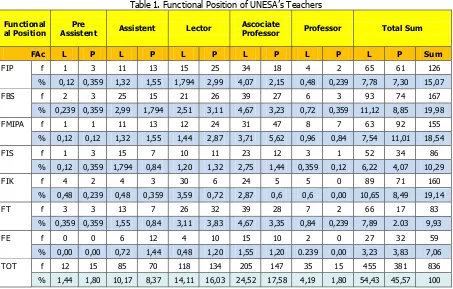
Composition of UNESA’s lecturer shows that there is gender inequality in UNESA. Some previous studies revealed that the number of female teachers is inversely related to levels of education; the higher the education level, the fewer number of female teachers. The higher the level of education, the stronger dominance of man teachers. Suryadi and Idris (2004:127) revealed that the female teachers still dominate the lower level education. In general, in every faculty of UNESA, the number of man lecturers greater than the number of woman lecturers, except in the Faculty of Mathematics and Natural Sciences (FMIPA). The fact that the number of men lecturers in UNESA is more than the number of female lecturers helped strengthens the inequality gender. There is an inverse relationship between the number of teachers by education level (Jatiningsih, 2009:265).
Table 1.Functional Position of UNESA’s Teachers
Functional al Position
Pre
Assistent Assistent Lector
Ascociate
Professor Professor Total Sum
FAc L P L P L P L P L P L P Sum
FIP f 1 3 11 13 15 25 34 18 4 2 65 61 126
% 0,12 0,359 1,32 1,55 1,794 2,99 4,07 2,15 0,48 0,239 7,78 7,30 15,07
FBS f 2 3 25 15 21 26 39 27 6 3 93 74 167
% 0,239 0,359 2,99 1,794 2,51 3,11 4,67 3,23 0,72 0,359 11,12 8,85 19,98
FMIPA f 1 1 11 13 12 24 31 47 8 7 63 92 155
% 0,12 0,12 1,32 1,55 1,44 2,87 3,71 5,62 0,96 0,84 7,54 11,01 18,54
FIS f 1 3 15 7 10 11 23 12 3 1 52 34 86
% 0,12 0,359 1,794 0,84 1,20 1,32 2,75 1,44 0,359 0,12 6,22 4,07 10,29
FIK f 4 2 4 3 30 6 24 5 5 0 89 71 160
% 0,48 0,239 0,48 0,359 3,59 0,72 2,87 0,6 0,6 0,00 10,65 8,49 19,14
FT f 3 3 13 7 26 32 39 28 7 2 66 17 83
% 0,359 0,359 1,55 0,84 3,11 3,83 4,67 3,35 0,84 0,239 7,89 2.03 9,93
FE f 0 0 6 12 4 10 15 10 2 0 27 32 59
% 0,00 0,00 0,72 1,44 0,48 1,20 1,55 1,20 0.239 0,00 3,23 3,83 7,06
TOT f 12 15 85 70 118 134 205 147 35 15 455 381 836
% 1,44 1,80 10,17 8,37 14,11 16,03 24,52 17,58 4,19 1,80 54,43 45,57 100
There is an inverse relationship between the level of functional position and the number of female lecturers who possess it. Based on table 1 it can be seen that the functional position of female lecturers left behind men. Consecutive number of female lecturers in functional pre assistant, assistant, and lector are 1.80%, 8.37%, 16.03%. This amount is not much different from the number of male faculty at each position; it is 1.44%, 10.17%, and 14.11%. Base on the data in table 1 it can be seen that the number of female lecturer in these positions a little more than male lecturers. The difference between the two is 0.36%. In the functional position of "expert assistant" that the difference of both is 1.8% and in the "lector" is 1.92%, with the advantages of the female lecturers. These conditions differ in functional "associate professor" and "professor." In the functional position of "associate professor" the difference is 7.94% (24.52% male and 17.58% female) and the office of "professor" difference is 2.39% (4.19% males and 1.80% of women), both with the man advantage. Based on these figures it can be argued that there is gender bias in the number of functional position of lecturer in UNESA. The higher functional position, the fewer the number of women lecturers are.
Not only functional position, gender unequally also occurs in the structural position and level of education lecturer. In a patriarchal gender ideology, leadership positions are often regarded as a status suitable for men. Women are considered unsuitable to be a leader because theirstereotypes. In general, people view that education is important for men than women, but the benefits of education are
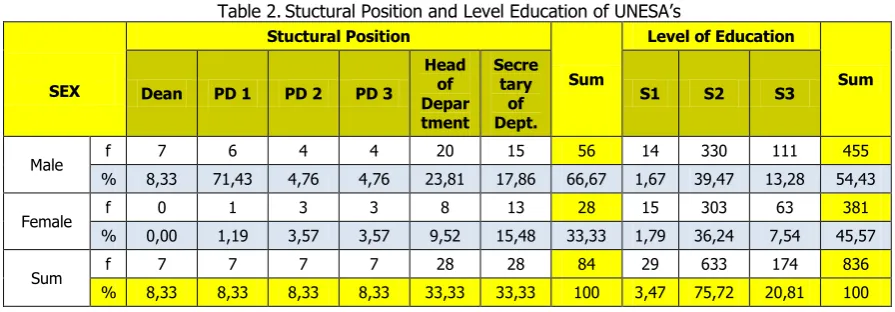
constructed differently in men and women. For men, education is seen as a ladder to the level of employment and income gains better to be a good head of the family, while not so for women. There is a glass ceiling faced by women when they climbed to the structural hierarchy. In contrast to men, there are many considerations that women do when they are promoted to officer. The same thing happens when they choose to continue their studies. Based on preliminary observations made, a young child or give him a chance to advance to advance further his studies into the reasons which often prevents woman lecturer’s motivation to continue their studies. Feeling quite at the level of S2 education is also one of the things that make them stop continuing their studies up to the S3 level. This bring the reality that woman lecturer’s lag behind the male lecturer in structural position and education. Of course the construction of patriarchy is not revealed in table 2 but it should be assumed that there are certain values that underlie gender inequality.
are three female lecturers who play as Dean Assistant 2 (PD 2). Similarly, it can be found at the third Dean Assistant (PD 3). In university level, since UNESA stands to date, there is only one woman who was in the position of rector's office (Vice Rector 1). Gender inequality deepened when last observed level of education pursued by the lecturer UNESA. Increasing levels of education, the less the number of women faculty who follow it.
At all levels of education, academic degree, level, functional, and structural position can be argued that male professors more than female professors. This gender bias phenomenon confirms that the university is a man's world (Bourdieu, 2010:136; Gunnarsson, 2001:247-248). The number of male professors more than female professors in almost every faculty, except in FE and Natural Sciences. Rank of lecturers and professors of education levels were more male than female professors. Therefore the chances of male professors to be a structural officer who was instrumental in the decision-making and policy were larger than female professors. Furthermore, as stated by Suryadi and Idris (2004: 141) that the decision-making positions held by men will lead to a decision taken from the point of view of men as the decision makers.
UNESA has 15.809 students on educational study program. According to the statement of the UNESA’s Rector, the mean of the number of the UNESA’s output who will be teachers is 80%. It means there are 12.647 future teachers. Gender inequality also occurs in UNESA students. Gender inequality occurs on students in terms of the number and distribution of students in various faculties. As noted earlier, the study of non-educational programs play a role in generating the candidates academics and professionals a variety of non-educational science, while educational courses
contributes to the prospective educational personnel, especially prospective teachers. Way of thinking which holds that women are constructed as educators, administrators domestic, and economic life support families make for interested and deemed fit to work in the scope of work that feminine. The teacher is seen as feminine and suitable jobs for women (Suryadi and Idris, 2004: 124). In the educational program, the number of female students is greater than the number of male students. Based on these data in 2014, there were 15 809 students educational program consisting of 9986 (63.17%) women and 5,823 (36.83%) males. The difference in the number of student teachers women and men do not necessarily reflect the gender bias conditions, but these conditions may be motivated by a social construction that considers the teaching profession as a suitable profession for women in accordance with her stereotypes. Such differences can also strengthen social construction that the teaching profession is a profession that is more suitable for women.
At all levels of education, academic degree, level, functional, and structural position can be argued that male professors more than female professors. This gender bias phenomenon confirms that the university is a man's world (Bourdieu, 2010:136; Gunnarsson, 2001:247-248). The number of male lecturers more than female lecturers in almost every faculty, except in FE and FMIPA. Functional position and education level of female lecturers left behind male lecturers. Therefore the chance of male lecturers to promote to structural position who is important in the decision-making and policy is larger than female professors. Furthermore, as stated by Suryadi and Idris (2004:141) that the decision-making positions held by men will lead to a decision taken from the point of view of men as the decision makers.
Table 2.Stuctural Position and Level Education of UNESA’s
SEX
Stuctural Position
Sum
Level of Education
Sum Dean PD 1 PD 2 PD 3
Head of Depar tment
Secre tary of Dept.
S1 S2 S3
Male f 7 6 4 4 20 15 56 14 330 111 455
% 8,33 71,43 4,76 4,76 23,81 17,86 66,67 1,67 39,47 13,28 54,43
Female f 0 1 3 3 8 13 28 15 303 63 381
% 0,00 1,19 3,57 3,57 9,52 15,48 33,33 1,79 36,24 7,54 45,57
Sum f 7 7 7 7 28 28 84 29 633 174 836
% 8,33 8,33 8,33 8,33 33,33 33,33 100 3,47 75,72 20,81 100
Stereotypes of men and women give birth to different perspectives on the fields of science that are considered suitable for men or women. In the social sciences there are seen as masculine and feminine characteristics; Sciences that are soft tend to be suitable for women, while the heavy field and technical studies tend to be suitable for men. Consistent with it, there is a faculty dominated by male students and faculty there are also dominated
business and management and technology majors suitable for men. UNESCO study at various universities world show that women are more interested in the fields of education, health and welfare, human and arts, and social sciences; he is less participate in the areas of engineering, manufacturing, and construction (Leathwood, 2009:34-35;161). Therefore, the gendered subject or gender bias in the sciences is seen as feminine or masculine will still occur. gender ideology. In this situation can be understood that the subject as an individual can only become a place the dominant ideology (patriarchy) works. They are controlled and dictated by the true regime through the social context that shapes unconsiously them to be an obedient individual, who will continue socialilzing patriarchy gender values to their students.
Gender Knowledge of Teacher Candidates Education is a force to change society and be a vehicle for reproducing existing social hierarchies. This reveals struggle condition between all powers. For Giroux, education is a part of the public sphere in which the struggles of cultural production occur. As a manual to implement education activity, curriculum is important. In connected educational discourse, as Apple said, curriculum is never neutral; Curriculum always places the groups’ knowledge legitimized as the core and marginalized other groups’ knowledge also considered as passive consumers. Education is not only about transferring knowledge, but “education is political, cultural, and social action” (Lean, 2006:1). Therefore, preparing students as future teachers is activity to transfer the knowledge (political, culture, and social values) of the dominant truth regime. Of course, as the standard and regulation, curriculum expressing what and how the dominant knowledge power of the regime becomes a document of the power. The content states the knowledge as the true.
One of the objectives of the education program as mentioned in the UNESA’s curriculum, produce excellent education humen who have characters of “honest, smart, creative, tough, caring, discipline, responsibility, and a steady personality.” No word which tells equallity or equity in order to build equal and equity relation in education. Moreover, no word telling gender equallity and equaity. Whereas, this becomes hot issue in development including education.
Moreover, the curriculum states that there two group of courses; they are Personality Development Courses (MPK) and Community Living Skill Couses (MBB). One of the Mission of MBB is building “democracy attitude civilized and uphold human values ...” The word democracy, of course,
connect to the values promoting equallity and equity as well as egalitarian relation between plural elements. One of the difference that should place in egalitarian relation is women and men in gender relation. But this is not a part of the knowledge in the curriculum. It seems that gender is not a part of the true knowledge that is important to hold by the students.
Secrutining the detail curriculum of each education program in UNESA, it can be found that no one a courses with lable of “Gender” and no one courses with content of gender, whereas gender education. Some students told that they know terminology of gender from internet or mass media, and a little material of a course like Sociology, Political Sociology, Anthropology, Human Rights, and Multicultural Education.
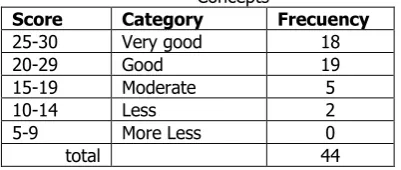
Students do not have good enough knowledge of gender. Some students can differ the concepts of gender, sex. They can describe that gender is social cultural construction of men and women; and sex is the biological construction of men and women. They also know characteristics natural that attaches to concept of sex and dynamics to gender. But they do not understand well the implication of the concept to role concepts in social context.
Table 3.Students’ Knowledge on Gender and Sex Concepts
Based on the table 3, many students have well understanding of gender and sex definition and characteristics. But this understanding come to false when talking about gender roles, especially gender roles in domestic area. Only 18 students ( 41%) who can understand that breadwinner and doing domestic roles are not natural maters.
The false understanding is caused by the litle information they have during the learning process. As mention before, the power regime define the true as mentioned in curriculum. No gender materials are considered important to be learnt by students. The curriculum does not accomodate the material as a subject matter or topics.
Students as future teachers do not have well gender skill. Their concept of gender is still limited on the definition. Students do not understand well the effect of gender patriarchy on the unjustice life for both men and especially women. Concepts of marginalization, the second sex, subordination, as well as gender sensitive, awareness, and marginalization, are not understood well, let alone the implementation of them in education and egalitarian relation.
2010. It has been almost 14 years ago, but the response of the teacher candidate education institution does not run obviously. The curricullum does not touch the gender issues. Gender is only a part of a little things to speak at class. There is no serious discussion about it.
Those practices indicates that gender is not an interesting issue. Gender is not an important issue. Gender education is also considered as unimportant issu to take in order to be apart of curricullum. The fact that gender knowledge and skill do not become a part students’ gender capacity reflects that educational practices when they were learning did not contact to gender issues. The practices are not sensitive to the condition that may open gender bias, as well as unequal and unjustice life.
The learning processes does not come into sight that building critical thinking skill. Learning process does not become hard effort to build students’ consciousness to unequal, unequaty, and unjustice conditions. Education is only sphere and place to run social reproduction.
Life is always a struggle area of discourses and education is always about political, social, and cultural discourse. As Foucault said, cosciousness was good means to discharge from the dominant power. But when the teacher education institution seems do nothing for building the teacher candidates’ cosciousness, it can be predicts that the power of the dominant ideology still develops the dominant discourse. Repetition of the dominant discourse is only a way to “help” the dominant discourse to strengthen its power. The dominant discourse becomes stronger and stronger.
Conclusion
It can be inferred that teacher candidate istitution does not fully translate gender policies as part of the educational policies that embody institutional commitment in preparing teacher candidates toward to implementating of a gender perspective education.
The social context as the space of learning process is still colored by unequal gender values. No policy (interruption) has been done to create equal gender condition. It shows gender neutral, even the domination of patriarchy gender ideology. In this situation can be understood that the subject as an individual can only become a place the dominant ideology (patriarchy) works, and controlled and dictated by the true regime through the social context that shapes unconsiously them to continue socialilzing patriarchy gender values to their students.
Students as future teachers do not have well gender knowledge. Their concept of gender is still limited on the definition. Students do not understand well the effect of gender patriarchy on the unjustice life for both men and especially women.
Educational practices in higher education producing teacher candidates is still gender neutral, even patriarchy gender values. Of course,
educational practices cannot be separated from the individual as an education actor, so that individual’s attachment to the values of a patriarchy gender will create the education practices characterized by patriarchal gender values. Repetition of these values through various aspects of the life and practices of education expresses the "acceptance" simply patriarchal gender values.
In Foucault’s language, patriarchy gender values as the episteme of dominant gender discourse get reinforcement through the enactment of the routine practices of education. Without anything, education (teacher training institution) becomes “the death knell” in building gender perspective education.
REFERENCES
Barker, Chris, 2004. Cultural Studies. Terjemahan oleh Nurhadi.Yogyakarta: Kreasi Wacana. Bauer, Nancy, 2001. Simode de Beauvoir.
Philosophy and Feminism. New York: Columbia University Press.
Baxter, Judith, 2003. Positioning Gender in Discourse. A Feminist Methodology. New York: Palgrave Mcmillan.
Beauvoir, Simond, 1956. The Second Sex. London: Jonathan Cape.
Brannon, Linda, 2005. Gender. Psychological Perspectives. Edisi IV. Boston: Pearson. Datnow, Amanda, 1998. The Gender Politics of
Educational Change. London: Falmer Press. Dewey, 1997.
Eriyanto, 2009. Analisis Wacana. Pengantar Analisis Teks Media. Yogyakarta: LKiS.
Foucault M., 2012. Arkeologi Pengetahuan. Terjemahan dari buku The Archeology of Knowledge. Penerjemah: Insyiak Ridwan Muzir. Yogyakarta: IRCiSoD.
Foucault, Michel, 1979. Power/Knowledge. Selected Interviews and Other Writings 1972-1977. Editor: Colin Gordon. New York: Pantheon Book.
Harland, Richard, 2006. Superstrukturalisme. Terjemahan dari Superstrukturalism: The Philosophy of Structuralsim and Pst-Strukturalism. Penerjemah: Iwan Hendarmawan. Yogyakarta: Jalasutra.
Hodder, Ian, 2005. Theory and Practice in Archaeology. London: Taylor & Francis e-Library.
Jorgensen, Marianne W. Dan Luise J. Phillips, 2007. Analisis Wacana. Teori dan Metode. Terjemahan oleh Imam Suyitno, Lilik Suyitno, dan Suwarna. Yogyakarta: Pustaka Pelajar. Latif, Yudi, 2012. Inteligensia Muslim dan Kuasa.
Genealogi Inteligensia Muslim Indonesia Abad Ke-20. Jakarta: Democracy Project.
Peters, R.S., 2005. Education and The Education of Teachers. London: Routledge and Kegan Paul. Roth, Robert A., 2005. “University as Context for
Teacher Development” in The Role of University in Preparation Teachers. Pages 175-190. London: Falmer Press.
Sarup, Madan, 2011. Panduan Pengantar untuk Memahami Postrukturalisme dan Pormodernisme. Terjemahan dari An Introductory Guide to Post-Structuralism and Postmodernism. Penerjemah: Medhy Aginta Hidayat. Cetakan kedua. Yogyakarta: Jalasutra.
Simone de Beauvoir, 1956. The Second Sex. London: Jonathan Cape Thirty Badford Square. Subrahmanian, Ramya, 2005. “Gender Equality in Education: Definitions and Measurements” dalam International Journal of Educational Development 25 (2005) 395–407.
Sunderland, Jane, 2005. Gendered Discourses. New York: Pallgrave macmillan.
Suryadi, Ace, dan Ecep Idris, 2004. Kesetaraan Gender dalam Bidang Pendidikan. Bandung: Genesindo.
Sweely, Tracy L., 1987. “Introduction” dalam Schanks dan Tilley, 1987. Manifesting Power Gender and the interpretation of power in Archaeology. Editor Tracy L.Sweely Halaman 1-14. New York: Routledge.