THE
A
C
ADEMIES
NATIONAL
IN BRIEF
REPORT
National Academy of Sciences • National Academy of Engineering • Institute of Medicine • National Research Council Outbreaks in the past decade of avian inluenza H5N1 (“bird lu”), severe acute respiratory
syndrome (SARS), and pandemic H1N1 2009 (so called “swine lu”) are examples of how zoonotic diseases—those caused by bacteria, viruses, parasites, or unconventional agents and are transmissible between humans and animals—can threaten health and economies around the world. Unfortunately, for several reasons, disease surveillance in the United States and abroad is not very effective in alerting oficials to emerging zoonotic diseases. This report calls for the United States to take the lead, working with global health organizations, to establish a global zoonotic disease surveillance system that better integrates the human and animal health sectors for improved early detection and response.
Sustaining Global Surveillance and
Response to Emerging Zoonotic Diseases
several infectious disease surveillance systems already in operation, identify effective systems, uncover gaps in efforts, and recommend improvements toward the goal of an effective global disease surveillance system. Experts in human and animal disease surveillance provided input to the committee at a workshop held in June 2008 in
Washington, D.C.
In addition to human and animal illness and potential loss of lives, the economic losses due to zoonotic disease outbreaks can be stagger-ing. Economic consequences can include trade sanctions, travel warnings or restrictions, animal disease control efforts such as animal culling (intentional slaughter), and declining public
conidence in animals products, as was the case with pork products and the inluenza A(H1N1) 2009 outbreak. The economic cost of HPAI H5N1
between 2003 and 2006 was estimated to equal nearly 2 percent of the regional gross domestic
product of China, Taiwan, Hong Kong, and
Singapore. In the United States, the beef industry
experienced a total loss of $11 billion over 3 years
after the detection of one Bovine Spongiform Encephalopathy-infected cow in December 2003.
Z
oonotic pathogens havecaused more than 65
percent of emerging infectious disease events in the past six decades. Zoonotic diseases are often novel and ones societies are medically unprepared to treat, as was the
case when HIV/AIDS and
variant Creutzfeldt-Jakob Disease (the human form of “mad cow disease”) emerged. Moreover, the severity of illness in different species is unpredict-able and widely variunpredict-able. For
example, the 1918 inluenza
pandemic (“Spanish lu”) was a particularly virulent strain of H1N1 that killed millions of people worldwide. Although mortality from recent human avian inluenza outbreaks has been
relatively low—notably just 257 reported deaths
worldwide from the ongoing highly pathogenic
avian inluenza H5N1(HPAI H5N1) outbreak—
there is still much cause for concern.
In response to this concern, the U.S. Agency for International Development (USAID)
approached the Institute of Medicine and the
National Research Council for advice about how to
achieve more sustainable global capacity for surveillance and response to emerging zoonotic
diseases. A committee was convened to examine
The occurrence of zoonotic disease outbreaks is increasing as the world becomes more interconnected.
Humans, animals, and animal products can now
circumnavigate the globe within 24 hours, making virtually all locations vulnerable to diseases they may
carry. In the irst half of 2003, the United States saw concurrent outbreaks of SARS and human monkey
-pox, as well as new geographical niches for West Nile
virus—zoonotic pathogens never before been found within U.S. borders. Several factors also lead to disease emergence and increase opportunities for exposure including increased food-animal production and the associated challenges in proper management to meet the growing global demand for meat, the expansion of housing into existing wildlife habitats, a rise in trade of exotic pets, and the effects of climate change on animal migration patterns.
Existing Surveillance and Response Capacity
Several global disease surveillance systems and networks have been established to detect human outbreaks of emerging zoonotic diseases or outbreaks of animal diseases. Some of these were described inthe committee’s Achieving Global Capacity for Surveillance and Response to Emerging Diseases of
Zoonotic Origin: Workshop Summary published in
2008. However, the efforts to conduct human and
animal disease surveillance in these populations have been limited. Such surveillance activities may not only be conducted by, but also inform several interna-tional players which have varying responsibilities for human and animal health or international trade (see
Box 1). The committee concluded that there is no
single example, in the United States or elsewhere, of a well-functioning zoonotic disease surveillance system
integrated across human and animal health sectors.
Non-integration increases the possibility that human health oficials might not be alerted to an animal
disease syndrome that could pose a threat in humans
or vice versa. Circumstances of the 1999 outbreak of West Nile virus in the United States demonstrate the
need to integrate human and animal surveillance: despite a common diagnosis of encephalitis in both humans and birds in the vicinity of the Bronx and
Queens, separate investigations by and ineficient
communication between the Centers for Disease
Control and Prevention and veterinary organizations
delayed linking the two. The delay in identifying the correct etiologic cause of outbreaks allowed time for the virus to establish and spread.
A critical element of robust disease surveillance
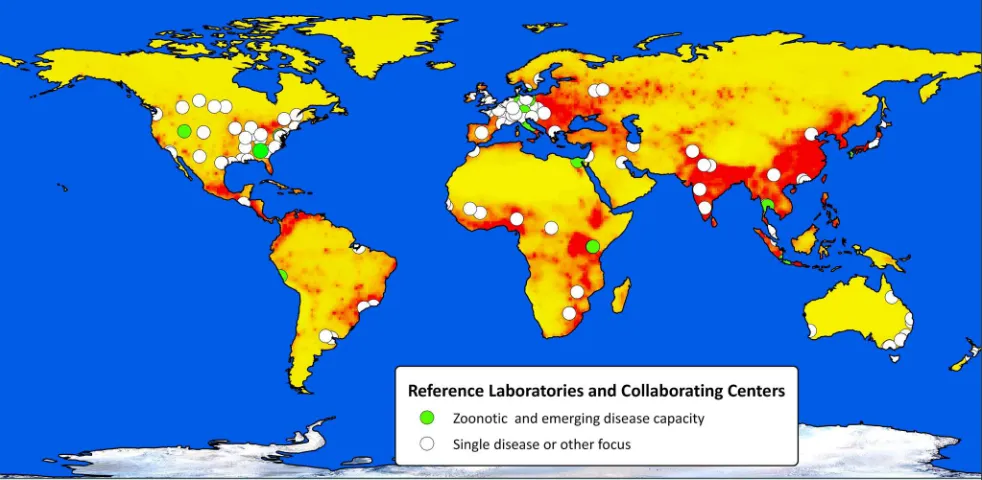
capability includes laboratory capacity and capability for zoonotic diseases. The committee concluded from available data that existing disease diagnostic labora-tory capacity (represented by green and white dots in
Figure 1) is poorly matched to areas where it may be
most needed—red and orange shaded areas on the map suspected to be ideal for pathogen emergence or adaptation. The committee further concluded that the industrialized world has the most robust surveillance systems for both humans and animals; however surveillance systems are weaker in the developing world where most recent zoonotic diseases have emerged.
Strengthening Surveillance and Response
The committee concluded that because the U.S. government is among the world leaders in disease surveillance and has a considerable stake in the emergence and spread of zoonotic diseases, it shouldlead efforts to coordi-rate with the private sector and
non-govern-Several international players regulate human and animal health, including the World Health Organization (WHO), which focuses on human health aspects, the World Organization for Animal Health (also known as the Ofice International des Epizooties or OIE), which sets standards for animal health, and the Food and Agriculture Organization of the United Nations (FAO), which implements these animal health standards and strategies to achieve
food security. The scope and mode of operations for these three agencies is quite different:
WHO has a signiicant presence in many different countries, which enables it to more directly affect national decision making, while FAO has a more limited presence at ield level, normally without any animal health expertise in its country ofices. Finally, OIE has a 40-person headquarters’ staff, a limited number of regional representatives, and no speciic
country representation. These organizations have proven their ability to work together,
forming the Codex Alimentarius Committee, which sets food safety standards. Private industry plays a signiicant role in global food safety and security through trade agreements among their afiliated countries, and in implementing disease surveillance to meet respec -tive goals and missions. The World Trade Organization provides a forum for negotiating agreements aimed at reducing obstacles to international trade and ensuring a level playing
emerging zoonotic diseases in the United States.
These agencies should also collaborate with USAID
and international organizations to spearhead efforts for achieving a more effective global surveillance and response system, learning from and informing the experiences of other nations.
Strategic approaches to strengthen surveillance and response should include:
1. Working with researchers to develop science-based criteria to determine the magnitude and distribution of disease drivers.
2. Immediately strengthening surveillance in human populations at high-risk for zoonotic diseases (for example, livestock and poultry workers) in countries where disease surveillance in animal populations is weak.
3. Developing and strengthening surveillance systems in animal populations so that outbreaks are detected early in animal populations rather than discovered later through secondary human outbreaks.
4. Synchronizing and sharing surveillance informa-tion from both human and animal populainforma-tions in an integrated system, in as close to real time as possible.
5. Engaging science-based nongovernmental organizations as valuable partners that provide
the wide geographic reach and ield-expertise
needed for more comprehensive surveillance and response activities.
Financing and Incentives
Funding needs for the development and sustain-ability of a global disease surveillance system for emerging and reemerging zoonotic diseases will be
signiicant. Existing international aid architecture is
fragmented and donor funding is unpredictable,
especially during a global economic crisis. USAID— in partnership with international inance institutions
and other bilateral assistance agencies—should lead
an effort to generate sustainable inancial resources to
adequately support the development, implementation, and operation of integrated zoonotic disease surveil-lance and response systems. Several options are
reviewed in the report, including one that speciically
considers a tax on traded meat and meat products as a potential source of revenue.
Governance of Global Efforts
Recent concerns about the potential for a highly-virulent avian inluenza pandemic in humans
resulted in coordinated international action to help countries improve their ability to detect disease
outbreaks. A streamlined architecture for global
health governance related to zoonotic diseases would
beneit from structured coordination of critical intergovernmental bodies. USAID, in cooperation with the United Nations (UN) and other stakeholders
from human and animal health sectors, should promote the establishment of a coordinating body to develop and implement harmonized, long-term
Figure 1: Zoonotic Disease Hotspots And Selected Reference Laboratories By Location. Hotspot locations, shaded in red and
Committee on Achieving Sustainable Global Capacity for Surveillance and Response to Emerging Diseases of
Zoonotic Origin: Gerald T. Keusch (Co-Chair), Boston University, MA; Marguerite Pappaioanou (Co-Chair),
Association of American Veterinary Medical Colleges, Washington, D.C.; Corrie Brown, University of Georgia, Athens;
John S. Brownstein, Harvard Medical School, Cambridge, MA; Peter Daszak, Wildlife Trust, New York, NY; Cornelis De
Haan, The World Bank (retired), Washington, D.C.; Christl A. Donnelly, Imperial College London, United Kingdom;
David P. Fidler, Indiana University, Bloomington; Kenneth H. Hill, Harvard University, Cambridge, MA; Ann Marie
Kimball, University of Washington, Seattle; Ramanan Laxminarayan, Resources for the Future, Washington, D.C.; Terry
F. McElwain, Washington State University, Pullman; Mark Nichter, University of Arizona, Tucson; Mo Salman, Colorado
State University, Fort Collins; Oyewale Tomori, Redeemer’s University, Ogun State, Nigeria; Kevin D. Walker, Michigan State University, East Lansing; Mark Woolhouse, University of Edinburgh, United Kingdom; Kimberly A. Scott (Study
Director), Institute of Medicine; Peggy Tsai (Program Oficer), National Research Council.
The National Academies appointed the above committee of experts to address the speciic task requested by the U.S. Agency for International Development. The members volunteered their time for this activity; their report is peer-reviewed and the inal product signed off by both the committee members and the National Academies. This report brief was prepared by the National Research Council based on the committee’s report.
For more information, contact the Board on Agriculture and Natural Resources at (202) 334-3062 or visit http:// nationalacademies.org/banr. Copies of Sustaining Global Surveillance and Response to Emerging Zoonotic Diseases
are available from the National Academies Press, 500 Fifth Street, NW, Washington, D.C. 20001;
(800) 624-6242; www.nap.edu.
Permission granted to reproduce this brief in its entirety with no additions or alterations.
Permission for images/igures must be obtained from their original source.
© 2009 The National Academy of Sciences Box 2: United Nations System Inluenza
Coordinator
Appointed by the UN Secretary General in September 2005, the UNSIC has developed strong partnerships between tech
-nical agencies such as WHO, FAO, OIE and UNICEF. As a
result, communication and cooperation among the various
agencies has signiicantly improved. Pointed examples
include cooperation to prepare strategy updates and joint preparation of integrated national action plans. While these are evidence of joint strategy development and planning, it is noted that little effort has been made on joint activities for implementing disease surveillance and control.
• Strengthen global laboratory network infrastruc-ture with integrated human and animal health components for zoonotic disease diagnosis and reporting.
• Develop new and improve existing interdisci-plinary educational and training programs to build human capacity to plan, conduct, and evaluate integrated zoonotic disease surveillance.
• Establish a technical multi-disciplinary panel to
review current scientiic information on drivers
of zoonotic disease emergence and propose modifying policy and governance strategies.
• Create an independent mechanism to audit and rate national surveillance capacities for detecting and responding to emerging zoonotic disease outbreaks in humans and animals.
• Reduce incentives for disease concealment at the
country and local levels and reduce the social and economic repercussions for early reporting.
• Convene representatives from the public, private, and civil sectors to help build trust towards useful information for effective evidence-based decision making and coordinated actions.
• Revise OIE governance strategies to better
protect animal health and international trade.
• Undertake steps to mitigate disease threats from the legal and illegal trade in wildlife and wildlife products.
strategies for integrated surveillance and response to zoonotic diseases. This body could be modeled after
the UN’s System Inluenza Coordinator (UNSIC) (see Box 2). Because of the success of the UNSIC in handling highly pathogenic avian inluenza, this role
could be broadened and made permanent to
encom-pass all zoonotic diseases, not just inluenza, but it is currently expected to end in December 2010 without
further action.
Additional Recommendations
The report makes the following additional recommendations towards the goal of achieving an effective zoonotic disease surveillance system.