INSECT DIVERSITY CONSERVATION
Arinafril
Department of Plant Protection, Faculty of Agriculture, Sriwijaya University, Indralaya Campus, Ogan Ilir, South Sumatra, Indonesia
ABSTRACT
Insects are part of complex agricultural ecosystems. Their existence should be kept and maintained to stabilize entire environmental ecosystem. Insects play important role in the world, though they feed on plants and act as pests, but they also provide advantages as beneficial organisms. Approximately 1,000,000 of insect species have been taxonomically described than any other group of animals or plants on ecosystem. Insects are receiving increased attention in conservation assessment and research because of a growing awareness of their importance as keystone species, as indicators of patterns of species richness, and as monitors of environmental changes. Indralaya Campus of Sriwijaya University covers an area of approximately 750 hectares. Of this study, most species found were from order Homoptera (859 species, 28 % of all species found), followed by Hymenoptera (780 species, 24 %).
Key words: Insect Biodiversity Conservation, Agricultural Ecosystem, Environmental Ecosystem, Beneficial Organisms, Food Webs,
INTRODUCTION
It is clear stated that, nobody knows about how many of species of organism are on earth. Scientists predict that it is estimated that the number of species vary from 5 to 80 million species or even more, but the figure is most probably in the range of 30 million. Of this number, it is assumed that 1.4 million of these living species have been briefly identified. Of these, about 750.000 are insects, 41.000 are vertebrates and 250.000 are plants. (Ragaei and Allam 1997, Brooks et al. 2002, Connor et al. 2002). Insects encompass more than 50% of all identified species and are important components for all terrestrial and freshwater aquatic environments. The reasons are species diversity, population size and biomass are very large, and taxonomy and faunal information are not enough for availability. Another reason is the need for taxonomic and biodiversity information gets up greatly, followed by the shortage of taxonomic experts. (Kim 1993, New et al. 1995, Fisher 1998, Condon et al. 2008).
2
The substantial benefits to mankind from insects generally receive less publicity than the economic losses that result from their roles as vectors of diseases and as pests of agriculture, fibers and stored goods. The present momentum began in the 1960's, legislative measures were taken in the 1970's and being strengthened in the 1980's and 1990's (Pyle et al. 1981, Hughes et al. 2000, Losey et al. 2006, Franzén et al. 2007, Leather et al. 2008). Invertebrates are suffering the greatest species loss in the current biodiversity crisis. These animals perform essential ecosystem functions upon which humanity depends, yet they are largely overlooked in mainstream conservation planning. This has potential to be achieved through ecotourism. Within the international tourism industry, ecotourism is the fastest growing subsector, its growth rate being three times that of tourism overall. (Connell, 1996, Schwartz, 1999, Huntly et al. 2005).
As a response to government spending cuts in higher education, universities have sought ways of generating alternative sources of income through diversification (Connell, 1996). . Sriwijaya University covers an area 750 hectares, most of areas are vegetation with a lot of varieties of plants. Some areas are aimed for experimental stations for student experiments. Campus-based tourism – focused on ecotourism – is being planned to develop as a significant market.
MATERIAL AND METHOD
Studies have been conducting at Indralaya Campus, Ogan Ilir, South Sumatra, in September 2010 and onward on fields with black inceptisol soils. Observations were carried out on rambutan, star fruit, banana, and orange. The field size in the area is 10 m in length and 25 m in width. Twenty 20 pitfall traps were placed to catch soil insects into the fields, 2.5 m from the field border and 2 m from each other. The traps had a diameter of 10 cm and a depth of 8 cm. They were filled (one third) with 0.1 % formaldehyde solution, some drops of detergent added, and emptied weekly. Additionally, the population density of the predators was measured, by flooding with water, 10 squares of 0.1 m² per field (Basedow et al. 1988). Some flying insects are caught by using insect net. All caught insects are killed in a jar filled Potassium Cyanide. For the identification the following sources were used. Most of insects could be identified with the book of Kalshoven, 1981.
RESULT AND DISCUSSION
Species Found
Figure 1. Order and number of species found
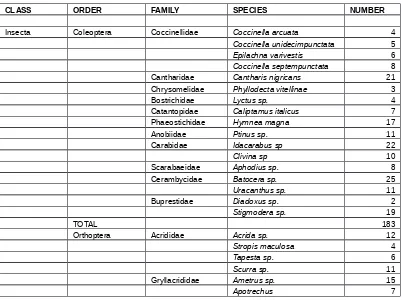
Species found could be grouped as insect pests and beneficial organisms. Most species could be identified completely, some are identified only until genera, and some could not be determined yet. Species found are listed in Table 1.
Table 1. Species found by names
CLASS ORDER FAMILY SPECIES NUMBER
Insecta Coleoptera Coccinellidae Coccinella arcuata 4
Coccinella unidecimpunctata 5
Epilachna varivestis 6
Coccinella septempunctata 8
Cantharidae Cantharis nigricans 21 Chrysomelidae Phyllodecta vitellinae 3
Bostrichidae Lyctus sp. 4
Catantopidae Caliptamus italicus 7 Phaeostichidae Hymnea magna 17
Anobiidae Ptinus sp. 11
Carabidae Idacarabus sp 22
Clivina sp 10
Scarabaeidae Aphodius sp. 8
Cerambycidae Batocera sp. 25
Uracanthus sp. 11
Buprestidae Diadoxus sp. 2
Stigmodera sp. 19
TOTAL 183
Orthoptera Acrididae Acrida sp. 12
Stropis maculosa 4
Tapesta sp. 6
Scurra sp. 11
Gryllacrididae Ametrus sp. 15
6
Plants as hosts of the insects were available on the experimental site. The insects were not controlled. It could be assumed that the number of insects found was related to the absence of insecticide application. Some insects were pests for other plants which are planted surrounding experimental site, and some were beneficial organisms, such as predators and parasitoids.
CONCLUSION
Eight orders of insects and three orders of arachnids were found, total number were 3000 species in area 250 m2. It could be concluded that experimental site of Indralaya Campus has a high
REFERENCES
Basedow, T., Y. Waruwu & Arinafril. 2005. The epigeal predatory arthropods in aubergine fields at South Sumatra (Indonesia) with regard to the plant cover and the use of insecticides. Journal of Plant Diseases and Protection 112 (6), 573–579.
Brooks, T.M., R.A. Mittermeier, C.G. Mittermeier, G.A.B. da Fonseca, A.B. Rylands, W.R. Konstant, P. Flick, J. Pilgrim, S. Oldfield, G. Magin & C. Hilton-Taylor. 2002. Habitat Loss and Extinction in the hotspots of biodiversity. Conservation Biology 16 (4), 909 – 923.
Connell, J. 1996. A study of tourism on university campus sites. Tourism Management 17 (7), 541 – 550.
Franzén, M. & M. Johannesson. 2007. Predicting extinction risk of butterflies and moths (Macrolepidoptera) from distribution patterns and species characteristics. Journal of Insect Conservation 11, 367–390.
Hughes, J.B., G.C. Daily & P.R.Ehrlich. 2000. Conservation of insect diversity: A habitat approach. Conservation Biology 14 (6), 1788 – 1797.
Kalshoven , L.G.E. 1981. The pests of crops in Indonesia. Revised and translated by P.A. van der Laan and G.H.L. Rothschild.. PT Ichtiar Baru – van Hoeve, Jakarta.
Leather, S.R., Y. Basset & B.A. Hawkins. 2008. Insect Conservation: finding the way forward.
Insect Conservation and Diversity 1 (1 ), 67 – 69.
Losey, J.E. & M. Aughan. 2006. Ecomic Value of eological Services Provided y Insects.
Bioscience 56 (4), 311 – 323.
Niemel, J., J. Kotze, A. Ashworth, P. Brandmayr, K. Desender, T. New, L. Penev, M. Samways & J. Spence. 2000. The search for common anthropogenic impacts on biodiversity: a global network. Journal of Insect Conservation 4, 3 – 9.
Pyle, R. M Bentzien & P. Opfer. 1981. Insect Conservation. Annual Review of Entomology 26, 233 – 258.
Ragaei, M. & M. Allam. 1997. Reviews and Views: Insect conservation and diversity. Journal of Islamic Academy of Sciences 10 (2), 43-48.