*Corresponding author/Dopisni autor: E-mail: [email protected]
UDk: 637.338.4
The effects spicing on quality of mozzarella cheese
Original scientific paper - Izvorni znanstveni rad
doi: 10.15567/mljekarstvo.2016.0203
G. Akarca, A. Çağlar and O. Tomar
Department of Food Engineering, Engineering Faculty, Afyon kocatepe University, 03100, Afyonkarahisar, Turkey Received - Prispjelo: 05.10.2015. Accepted - Prihvaćeno: 16.02.2016. Abstract
In this study, 3 different spice mixes were added just after blanching to mozzarel-la cheese produced by high moisture production method. The dough was kneaded and filled into to fibrous cases. After filling process, cheeses were stored for 28 days at 4 °C and 85 % of relative humidity. The following characteristics were measured: color parameters, milk acidity, to-tal dry matter, maturation index, toto-tal aerobic mesophilic bacteria, coliform bacteria, coagulase
posi-tive staphylococci, lactic acid bacteria, species of Lactococcus bacteria, proteolytic bacteria, lipolytic
bacteria and mold /yeast count were examined on 0, 5, 15,21 and 28 days after storage. Although L* (lightness) and a* (redness) values decreased during storage period, while moreover b* (yellowness) values increased. In addition acidity, dry matter and maturation index values increased during storage.
Total aerobic mesophilic bacteria, lactic acid bacteria, Lactococcus spp., lipolytic bacteria and mold/
yeast counts decreased, but proteolytic bacteria count increased. Key words:cheese, mozzarella, spices, ripening
Introduction
More than 4,000 cheese varieties are produced throughout the world. Most of these varieties do not have economic value due to their similarity to others (Demirci and Şimşek, 1997). Approximately193 cheese varieties are known to be produced in Turkey (Çetinkaya, 2008). One of these varieties is moz-zarella, which belongs to the pasta filata cheese fam-ily and is consumed without ripening. It has many different variations, from yellow blocks produced from cow milk to white balls produced from buf-falo milk. As a famous Italian cheese, mozzarella is produced around the world and is essential for pizza (Üçünçü, 2004; Harrbut, 2009).
Spices are defined as herbal products used as flavoring, coloring, and preserving agents in food and medication (Akgül, 1993). Although spices were
initially used only for the development and preserva-tion of food products, they were later used as agents for improving flavor and appearance. This shift oc-curred after the development of food additives in the food industry (Üner et al., 2000).
Using spice and plants to control microbial growth in processed dairy products has been a com-mon practice. Cumin, thyme, mint, fennel have been the center of focus as a natural antimicrobial. Most research noted that antimicrobial properties of spic-es such as thyme, mint, cumin, fennel are attribut-ed to their chemical contents as thymol, carvacrol, linalool, menthol, menthone, transanetole, estragol, p-cymene and the cumic aldehyde etc. (Rota et al. 2008; Singh et al., 2015; Senatore et al., 2013; Akrami et al., 2015; Prashanth et al.; 2001).
Enhancing cheese flavor, prtolonging the shelf life of the cheese by decreasing the microbial con-tent, achieving a healthier product, and preventing structural defects by reducing the salt content are some of the objectives for using spices and spice extracts (Ayar and Akyüz, 2003). Van otlu (herb) cheese is one of the most consumed traditional Turk-ish cheeses that produced with some natural plants. Van otlu cheese contains 0.1 % ingredients of plants, as Allium, Choerophyllum, Calamintha, Thymus and Ferula, which are added to the curd (Tekinşen and Özdemir, 2006). Zantar et al. (2014) added
Thymus vulgaris and Origanum compactum essential
oils in fresh goat cheese. Researcher reported that bacteria and mould counts decreased in fresh goat cheese produced with Thymus vulgaris and
Origa-num compactum. Surk is an another cheese produced
with herb and plant which contained peppermint, thyme, mint, cumin, black pepper, cinnamon, ginger and chili pepper in southern area of Turkey (Güler, 2014).
The aim of the present study was to increase the functional properties of mozzarella cheese by ad-dition of different spices. Cheese was filled into a fibrous materials, and ripened for 28 days. Physico-chemical, Physico-chemical, microbiological, and sensorial properties were determined.
Materials and methods
Production of mozzarella
Milk was heated for 4 minutes at 68 °C and cooled, and then a starter culture containing ly-ophilized thermophilic bacteria including
Strepto-coccus salivarus spp. thermophilus, Lactobacillus
delbrueckii spp. bulgaricus, and Lactobacillus
helve-ticus was added (1.5 %) as described by Özsunar
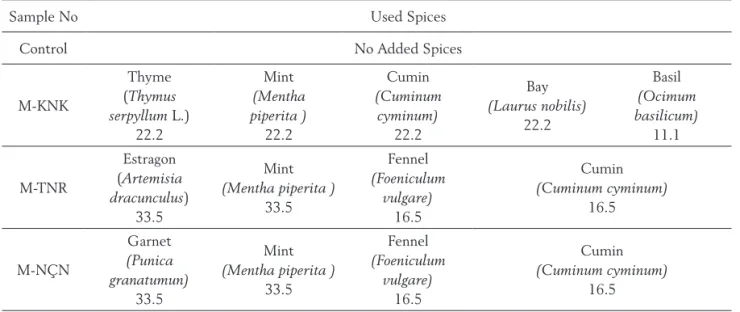
(2010). The starter culture was preactivated for 45 minutes, and rennet (1/18.000 MCU/mL, Mayasan A.Ş., Turkey), was diluted 10 times with water. The coagulate was cut into 1.5-2 cm cubes after coagula-tion for 60 minutes in order to reach the ripening acidity (pH 5.40). When the coagulate collapsed af-ter 5 minutes, 1/3 of the whey was separated and the curd was blanched at 42 °C for 15 minutes with the rest of the whey. After blanching, the whey was sep-arated from the tank, the coagulates were put into curd cloths, and the curd was incubated at 42 °C. The curds were cut into four equal pieces of 60 kg/ each when the pH reached 5.05, and they were then boiled in water for 1-2 minutes. While boiling, they were stirred with a wooden spoon. The dried spice mixes (Table 1) were added to the curds and knead-ed for 4-5 minutes. The spice mix was dispersknead-ed ho-mogeneously into the dough by kneading. The curds were cooled and filled into the fibrous case (30 Q, Oxygen permeability: 30-40 cm3/m2d bar, steam
permeability: 470-540 g/m2d bar) as 100 g/each.
Table 1. Quantities of spices used in production of mozzarella cheese (g/60 kg curd)
Control: No added spices; M-kNk: Mozzarella with thyme, mint, cumin, bay, basil; M-TNR: Mozzarella with estragon, mint, fennel, cumin; M-NÇN: Mozzarella with garnet, mint, fennel, cumin
Sample No Used Spices
Control No Added Spices
M-kNk Thyme (Thymus serpyllum L.) 22.2 Mint (Mentha piperita ) 22.2 Cumin (Cuminum cyminum) 22.2 bay (Laurus nobilis) 22.2 basil (Ocimum basilicum) 11.1 M-TNR Estragon (Artemisia dracunculus) 33.5 Mint (Mentha piperita ) 33.5 Fennel (Foeniculum vulgare) 16.5 Cumin (Cuminum cyminum) 16.5 M-NÇN Garnet (Punica granatumun) 33.5 Mint (Mentha piperita ) 33.5 Fennel (Foeniculum vulgare) 16.5 Cumin (Cuminum cyminum) 16.5
After being placed into its fibrous casing, the cheese was soaked in water at 0 °C for 10 minutes. The cheese was then drained and stored at 4 °C and 85 % relative humidity for 28 days. Physicochemi-cal, chemiPhysicochemi-cal, and microbiological analyses were con-ducted on days 0, 5, 10, 15, 21, and 28 of storage.
Color analysis
The color parameters of the mozzarella cheese were analyzed with a konica Minolta Chroma Me-ter CR-400 on the ripening days indicated above. L*(lightness), a*(redness), and b*(yellowness) val-ues were determined by the Hunter color system (Voss, 1992; Metzger et al., 2008).
Titratable acidity
Acidity in mozzarella cheese was determined by a titration method (Anonymous, 1990). The acid-ity was calculated as lactic acid (%).
Dry matter
Changes in the dry matter of the samples dur-ing the 28-day storage period were evaluated ac-cording to Association of Official Analytical Chem-ists AOAC (1990).
Ripening index
The ripening index in the mozzarella cheese was determined as described by Gripon et al. (1975) using the formula (WSN/TN) x 100.
Microbiological analysis
Samples of 10 g were taken aseptically from the mozzarella cheese. A sterilized ringer solution at a di-lution of 1:9 (w/v) was added, and the samples were homogenized for 3 minutes in a stomacher Lab-blen-der 400 (London, Uk). The serial decimal dilutions were plated for bacterial counts (Anonymous, 2001; Sekin and karagözlü, 2004).
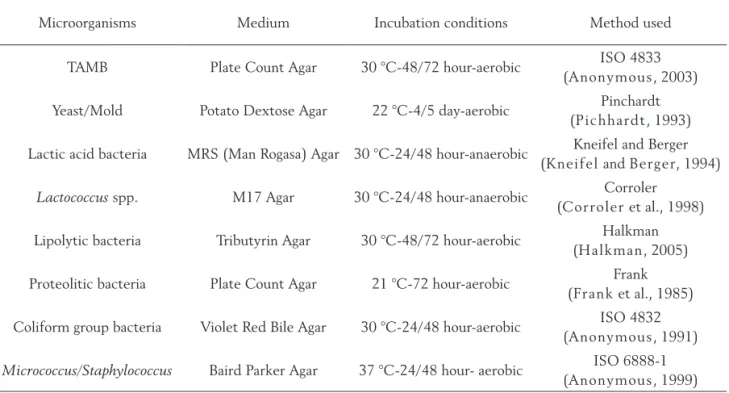
Total aerobic mesophilic bacteria (TAMb), yeast/mold, Lactobacillus spp., Lactococcus spp., lipolytic bacteria, proteolytic bacteria, and coliform were counted using a spread plate technique (Table 2) (Halkman, 2005).
Sensory analysis
Sensory evaluation of the mozzarella cheese was carried out on days 0, 15, and 28 of storage. Samples were scored by 20 trained panelists from the Food Engineering Department of Afyon kocatepe Univer-sity. The samples were served to panelists in daylight Table 2. Analysis of the microorganism groups and reproduction conditions
TAMb: Total Aerobic Mesophilic bacteria
Microorganisms Medium Incubation conditions Method used
TAMb Plate Count Agar 30 °C-48/72 hour-aerobic ISO 4833
(Anonymous, 2003)
Yeast/Mold Potato Dextose Agar 22 °C-4/5 day-aerobic Pinchardt
(Pichhardt, 1993)
Lactic acid bacteria MRS (Man Rogasa) Agar 30 °C-24/48 hour-anaerobic kneifel and berger
(kneifel and berger, 1994)
Lactococcus spp. M17 Agar 30 °C-24/48 hour-anaerobic Corroler
(Corroler et al., 1998)
Lipolytic bacteria Tributyrin Agar 30 °C-48/72 hour-aerobic Halkman
(Halkman, 2005)
Proteolitic bacteria Plate Count Agar 21 °C-72 hour-aerobic Frank
(Frank et al., 1985)
Coliform group bacteria Violet Red bile Agar 30 °C-24/48 hour-aerobic ISO 4832
(Anonymous, 1991) Micrococcus/Staphylococcus baird Parker Agar 37 °C-24/48 hour- aerobic ISO 6888-1
at room temperature in random order. The panelists were evaluated the samples for appearance, color, structure, taste, and odor and to express the general acceptability with a hedonic scale between 1 and 9 as follows: 1-3 (not acceptable), 4-5 (fairly acceptable), 6-7 (good, acceptable), 8-9 (very good) (bodyfelt et al., 1988).
Statistical analysis
The experimental design consisted of a com-pletely randomized design in a factorial arrange-ment: four treatments (Control, M-kNk, M-TNR, or M-TNR ), six storage periods (0, 5, 10, 15, 21, 28 days), and three replicates. Statistical analysis of the data was made by using the analysis of variance of the SPSS program, version 17.0.1 (Anonymous, 2008). Mean values with a significant difference were compared by Duncan’s multiple rangle tests.
Results and discussion
Color values
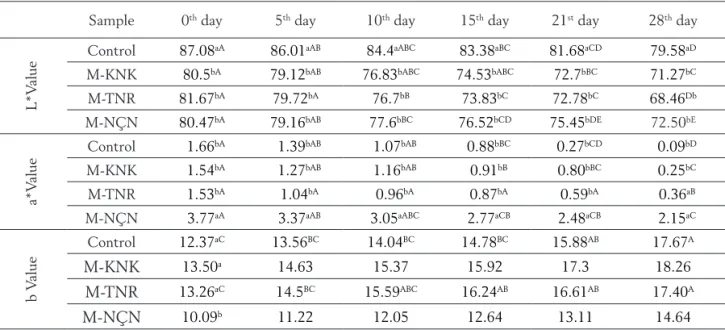
L* (lightness) values of the cheese with casing are shown in Table 3. L* values of all the samples decreased during storage (P<0.05). This decrease could be related to the decline of the moisture con-tent (Özsunar, 2010). Similarly, Metzger et al.
(2001) and Johnston and Darcy (2000) reported a decrease in L* values. The control sample had the highest L* value of 79.58 at the end of the stor-age period, while M-TNR had the lowest L* val-ue (P<0.05). This could be dval-ue to the spice mix that was added during production. The mozzarella cheese lost moisture during ripening, and thus the bright white color was lost and the color became dull yellow, which can be attributed to the decrease in L* values (Özsunar, 2010).
Changes in the a* values of the samples (red-ness) are shown in Table 3. The a* values of all sam-ples decreased during storage (P<0.05).The differ-ence in a* values could be caused by the spice mixes, production, and storage conditions (Akbulut, 2007; Özsunar, 2010). Although Akbulut (2007) re-ported a similar decrease in a* values, Johnston and Darcy (2000) did not report a significant decrease in a* values. At the end of the storage period, the M-NÇN sample had the highest a* value, while the control sample had the lowest a* value. A high a* value could be due to the spice mix containing a red-dish orange color. On the other hand, the spice mix was not added to the control sample during produc-tion, which could lead to difference in the a* value.
The b* (yellowness) values of the cheese sam-ples increased during the storage period (P>0.05). An increase in b* values could be explained by a Table 3. Changes in color values during storage period of mozzarella cheese
A - E: Values with the same capital letters in the same rows for each analysis differ significantly (P<0.05) a - d: Values with the same capital letters in the same column for each analysis differ significantly (P<0.05) L* (Lightness), a* (redness) and b* (yellowness)
Sample 0th day 5th day 10th day 15th day 21st day 28th day
L*V
alue
Control 87.08aA 86.01aAb 84.4aAbC 83.38abC 81.68aCD 79.58aD
M-kNk 80.5bA 79.12bAb 76.83bAbC 74.53bAbC 72.7bbC 71.27bC
M-TNR 81.67bA 79.72bA 76.7bb 73.83bC 72.78bC 68.46Db
M-NÇN 80.47bA 79.16bAb 77.6bbC 76.52bCD 75.45bDE 72.50bE
a*V
alue
Control 1.66bA 1.39bAb 1.07bAb 0.88bbC 0.27bCD 0.09bD
M-kNk 1.54bA 1.27bAb 1.16bAb 0.91bb 0.80bbC 0.25bC
M-TNR 1.53bA 1.04bA 0.96bA 0.87bA 0.59bA 0.36ab
M-NÇN 3.77aA 3.37aAb 3.05aAbC 2.77aCb 2.48aCb 2.15aC
b V alue Control 12.37aC 13.56bC 14.04bC 14.78bC 15.88Ab 17.67A M-kNk 13.50a 14.63 15.37 15.92 17.3 18.26 M-TNR 13.26aC 14.5bC 15.59AbC 16.24Ab 16.61Ab 17.40A M-NÇN 10.09b 11.22 12.05 12.64 13.11 14.64
A - E: Values with the same capital letters in the same rows for each analysis differ significantly (P<0.05) a - d: Values with the same capital letters in the same column for each analysis differ significantly (P<0.05)
Table 4. Changes in acidity, dry matter and maturation index ratio during the storage period of mozzarella cheese
loss of moisture during storage (Akbulut, 2007; Özsunar, 2010). Similarly, Johnston and Darcy (2000) reported an increase in the b* values of their mozzarella cheese samples. While the b* value of M-kNk was 18.26, the b* value of M-NÇN was 14.64. The reason for these changes could be due to the differences between the formulations of the spice mixes.
Acidity
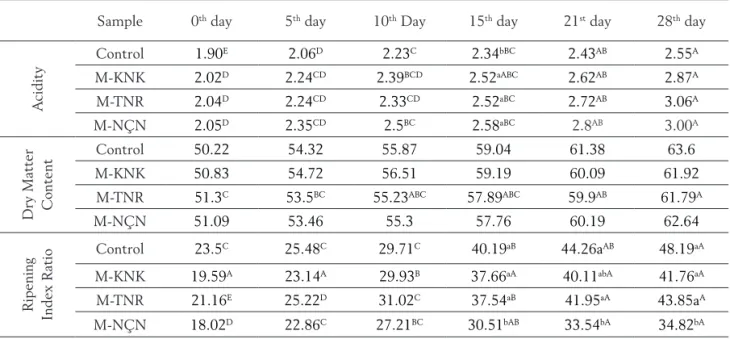
The acidity of the control and spice-mixed sam-ples increased during the storage period (P<0.05) (Table 4). The M-TNR sample had the highest acid-ity at 3.06, but this increase was not significant (P>0.05). Similarly, Metin and Öztürk (1996), Çağlar and Çakmakçı (1998), and Yaşar (2007) reported an increase in acidity in kaşar cheese stored for 90 days. Starter and non-starter bacteria in the cheese that can ferment lactose metabolize lactic acid, which could increase the acidity of cheese dur-ing the storage period.
Dry matter
The dry matter of the mozzarella cheese in-creased during the storage period (P<0.05). While the control sample had the highest increase, M-TNR had the lowest increase (Table 4). The increase of
dry matter in the mozzarella cheese could be attrib-uted to the loss of moisture due to the permeable properties of the fibrous case used during ripening.
Ripening index
The ripening index of the mozzarella cheese increased during the storage period (P>0.05). Al-though the control sample had the largest ripening index rate, M-kNk had the highest increase during ripening (53.09 %). Ripening is affected by rennin, starter and non-starter lactic acid bacteria, yeast/ mold, and proteolytic enzymes synthesized by psy-chrophilic bacteria (Dağdemir, 2006). Similarly, Yaşar (2007) reported an increase in the ripening index ratio for four different samples during stor-age for 90 days. At the end of the storstor-age period, the ripening index rate of the samples was between 33 % and 66 %, and the cheese was classified as rip-ened cheese (Table 4) (Griponet al., 1975).
Microbiological analysis
The TAMb count of the samples decreased dur-ing the storage period (P>0.05) (Table 5). Similarly, Çelebi (2011) reported a decrease of the TAMb count of örgü cheese (traditional cheese) produced with coagulation enzymes. A decrease in the TAMb count of mozzarella cheese during ripening could be
Sample 0th day 5th day 10th Day 15th day 21st day 28th day
A cidity Control 1.90E 2.06D 2.23C 2.34bbC 2.43Ab 2.55A M-kNk 2.02D 2.24CD 2.39bCD 2.52aAbC 2.62Ab 2.87A M-TNR 2.04D 2.24CD 2.33CD 2.52abC 2.72Ab 3.06A M-NÇN 2.05D 2.35CD 2.5bC 2.58abC 2.8Ab 3.00A
Dry Matter Content
Control 50.22 54.32 55.87 59.04 61.38 63.6
M-kNk 50.83 54.72 56.51 59.19 60.09 61.92
M-TNR 51.3C 53.5bC 55.23AbC 57.89AbC 59.9Ab 61.79A
M-NÇN 51.09 53.46 55.3 57.76 60.19 62.64
Ripening Index Ratio
Control 23.5C 25.48C 29.71C 40.19ab 44.26aAb 48.19aA
M-kNk 19.59A 23.14A 29.93b 37.66aA 40.11abA 41.76aA
M-TNR 21.16E 25.22D 31.02C 37.54ab 41.95aA 43.85aA
due to a decrease of aw and an increase of cheese acidity. The count of M-NÇN decreased from 6.45 log/g to 5.43 log/g constituting the highest de-crease. This decreased could be explained by antimi-crobial compound of garnet, mint, fennel and cumin (Prashanth, 2001; Singh, 2015; Diao, 2014; bisht et al., 2014). Protective effect of essential of cumin against food-borne and spoilage pathogenic bacteria was reported by bish et al. 2014. Essen-tial oil’s components such as -terpin-7-al, terpene, pinene and cumin aldehyde could be responsible for this activity. Similarly, the antibacterial activities mint oil were reported by Rasooli et al. (2008) and Singh et al. (2015).
The yeast/mold count of the mozzarella cheese decreased during the storage period (P<0.05).
Similarly, Şengül et al. (2010) and karaman and Akbulut (2006) reported a decrease in the yeast/ mould count during storage. A decrease in aw and an increase in cheese acidity during storage led to the decrease in yeast and mould. M-NÇN had the high-est decrease in yeast/mould count (Table 5). Simi-larly, a reduction in yeast and mold with addition herb and plant was reported in fresh goat cheese (Zantar et al., 2014).
The lactic acid bacteria count of the samples decreased by approximately 1 log, and M-kNk had the highest decrease (P<0.05) (Table 5). Similarly, Özsunar (2010) reported a decrease in the lactic acid bacteria of cheese produced with buffalo milk, cow milk, and a mix of buffalo and cow milk. During ripening index, the lactic acid bacteria of mozzarella Table 5. Changes in microbial composition of mozzarella cheese during storage time (cfu log/g)
A - D: Values with the same capital letters in the same rows for each analysis differ significantly (P<0.05)
Sample 0th day 5th day 10th day 15th day 21st day 28th day
TAM b Control 6.42 6.29 6.17 6.12 5.89 5.60 M-kNk 6.54 6.34 6.27 6.14 5.95 5.68 M-TNR 6.40 6.30 6.24 6.04 5.88 5.73 M-NÇN 6.45 6.22 6.09 6.01 5.81 5.43 Yeast/Mold count Control 5.54A 5.14Ab 5.09Ab 4.93b 4.85b 4.70b M-kNk 5.68A 5.26b 5.12bC 5.05bC 4.91CD 4.69D M-TNR 5.54 5.34 5.18 4.99 4.64 4.49 M-NÇN 5.66 5.37 5.22 4.97 4.72 4.44 L
actic acid bacteria count
Control 7.04A 6.71Ab 6.55AbC 6.44bC 6.35bC 6.13C
M-kNk 6.83 6.73 6.59 6.44 6.28 6.05
M-TNR 7.01A 6.75Ab 6.51bC 6.43bC 6.38bC 6.24C
M-NÇN 6.97A 6.89A 6.75Ab 6.56bC 6.36CD 6.13D
L
actococcus genus bacteria count
Control 7.16 6.95 6.78 6.65 6.48 6.17
M-kNk 7.18 6.89 6.83 6.72 6.42 6.04
M-TNR 7.17 6.93 6.83 6.55 6.45 6.35
M-NÇN 7.19 7.00 6.83 6.74 6.56 6.23
Lipolytic bacteria count
Control 6.19 6.12 5.98 5.85 5.73 5.52
M-TNR 6.33 6.20 6.07 5.86 5.71 5.51
M-TNR 6.14 6.01 5.88 5.87 5.73 5.38
M-NÇN 6.26 6.09 5.96 5.81 5.60 5.37
Proteolytic bacteria count
Control 5.81 5.87 5.95 5.98 6.02 6.05
M-TNR 5.69 5.81 5.86 5.88 5.90 6.01
M-TNR 5.66 5.77 5.89 5.96 5.99 6.04
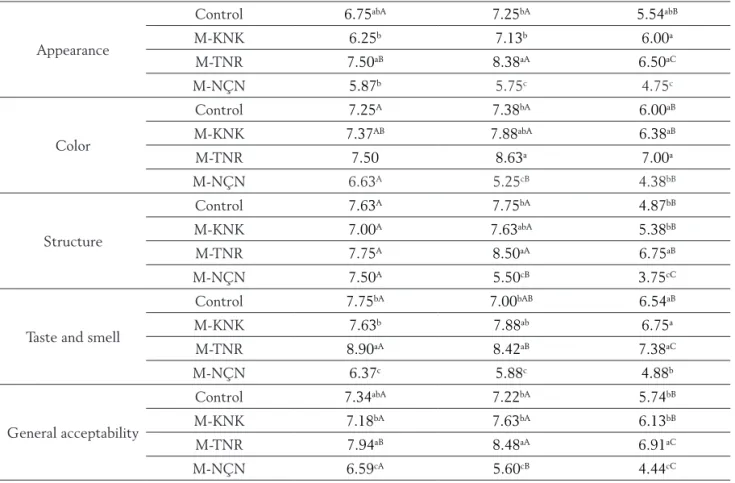
Table 6. The values of sensory analysis of mozzarella cheese
A - C: Values with the same capital letters in the same rows for each analysis differ significantly (P<0.05) a - c: Values with the same capital letters in the same column for each analysis differ significantly (P<0.05) cheese decreased. This decrease could be due to a
decrease in aw and an increase in cheese acidity.
The Lactococcus content of mozzarella
cheese samples decreased during the storage pe-riod (P>0.05). M-TNR had the highest decrease (Table 5). Similarly, Fenelon et al. (2000) report-ed a decrease in the Lactococcus content of low-fat cheddar cheese produced with different starter cultures.
The TAMb count is affected by the microbial quality of raw milk, heat treatment norms, and pro-cessing and ripening conditions (Fontecha et al., 1990).
The lipolytic bacteria count of the samples decreased during the storage period (P>0.05). M-NÇN sample had the highest decrease (Table5). Moreover, Ceylan (1998) reported an increase in the lipolytic bacteria count in Erzincan tulum cheese produced with a different spice mix. A decrease in the aw value during storage could lead to a decrease in the lipolytic bacteria count.
The proteolytic bacteria count of the mozzarella cheese increased during the storage period (P>0.05). While M-TNR had the highest increase, M-NÇN had the lowest increase (Table 5). Proteolytic bacteria that contain Clostridium genus bacteria with spores are resistant to unfavorable conditions and survive despite their surroundings. Their ability to grow un-der poor conditions led to the increase during the ripening of the mozzarella cheese.
Sensorial analysis
Sensorial analyses were performed during the ripening period at 0, 15, and 28 days. On day 0, M-TNR had the highest general acceptability scores (P<0.05). Higher general acceptability scores were reported on day 15 than day 0, except in M-NÇN. On the last day of ripening, the scores were lower. M-TNR had the highest scores on days 15 and 28 (P<0.05). According to the sensorial panel, the scores at 15 days were higher than at 0 days, except for M-NÇN. On day 28, the samples were generally less accepted (Table 6).
Appearance
Control 6.75abA 7.25bA 5.54abb
M-kNk 6.25b 7.13b 6.00a M-TNR 7.50ab 8.38aA 6.50aC M-NÇN 5.87b 5.75c 4.75c Color Control 7.25A 7.38bA 6.00ab M-kNk 7.37Ab 7.88abA 6.38ab M-TNR 7.50 8.63a 7.00a M-NÇN 6.63A 5.25cb 4.38bb Structure Control 7.63A 7.75bA 4.87bb M-kNk 7.00A 7.63abA 5.38bb M-TNR 7.75A 8.50aA 6.75ab M-NÇN 7.50A 5.50cb 3.75cC
Taste and smell
Control 7.75bA 7.00bAb 6.54ab M-kNk 7.63b 7.88ab 6.75a M-TNR 8.90aA 8.42ab 7.38aC M-NÇN 6.37c 5.88c 4.88b General acceptability Control 7.34abA 7.22bA 5.74bb M-kNk 7.18bA 7.63bA 6.13bb M-TNR 7.94ab 8.48aA 6.91aC M-NÇN 6.59cA 5.60cb 4.44cC
Conclusion
Different spices were used in the production of mozzarella cheese and functional properties of the cheese were improved. The spices used inhibit health problems, but are not well known neither frequently consumed. Some functional properties and overall acceptability properties were improved to the mozzarella cheese, that can be defined as the new type of mozzarella. Casing of mozzarella should be preferred by dairy producers if they would like to expand their offer in the cheese markets.
Acknowledgements
We wish to thank the Afyon kocatepe Uni-versity Scientific Research Projects Coordination Department for its support during the project.
Utjecaj dodataka začinskog bilja
na kvalitetu mozzarele
SažetakU ovom radu istražen je utjecaj 3 različite mješavine začinskog bilja u proizvodnji mozzarella sira. Sirno tijesto gnječeno je i punjeno u sirne marame, i uskladišteno 28 dana na 4 °C i relativnu vlagu 85 %. Istraženi su parametri boje, kiselosti mlijeka, ukupne suhe tvari i indeks zrenja. Također je istražen ukupan broj aerobno mezofilnih bakterija, te broj koliform-nih bakterija, koagulaza pozitivkoliform-nih stafilokoka, bak-terija mliječne kiseline, proteolitičkih i lipolitičkih bakterija, te kvasaca i plijesni. Mikrobiološke analize su provedene 0., 5.,15., 21., i 28. dana skladištenja. Intenzitet žute boje povećao se tijekom skladištenja sira, dok se intenzitet bijele i crvene boje sman-jivao. Parametri kiselosti, suhe tvari i indeksa zrenja povećani su tijekom zrenja. Utvđeno je smanjenje ukupnog broj aerobno mezofilnih bakterija, bakterija mliječne kiseline, Lactoccus spp., lipolitičkih bakteri-ja te brobakteri-ja kvasaca i plijesni tijekom skladištenbakteri-ja, dok je broj proteolitičih bakterija porastao.
Ključne riječi: sir, mozzarella, začini, zrenje
References
1. Akbulut, Ç. (2007): The Effect of Whey Draining ph on Some Physicochemical and Sensory Properties of Moz-zarella Cheese Made From buffalo Milk. Msc Thesis On dokuz Mayıs University Graduate School of Natural and Applied Science Samsun-Turkey.
2. Akgül, A. (1993): Spices Science and Technology. GTD Publications, Ankara-Turkey.
3. Akrami, F.,Rodríguez-Lafuente, A., bentayeb, k., Pezo, D., Ghalebi, S.R., Nerín, C. (2015) Antioxidant and an-timicrobial active paper based on Zataria (Zataria mul-tiflora) and two cumin cultivars (Cuminum cyminum),
LWT - Food Science and Technology 60, 929-933. 4. AOAC (1990): Official methods of analysis (15th ed.).
Washington, DC: Association of Analytical Chemists. 5. Anonymous (1991): ISO (International Standard
Orga-nization) 4832 General Guidance fort the Enumeration of Coliforms Colony Count Technique.
6. Anonymous (1994): TS 1018 Raw Cow Milk General Directorate of Turkish Standards. Ankara-Turkey. 7. Anonymous (1995): Turkish Standards Institute. TS
591 White Cheese General Directorate of Turkish Standards. Ankara-Turkey.
8. Anonymous (1999): ISO (International Standard Orga-nization) 6888-1 Horizontal Method for the Enumera-tion of Coagulase- positive Staphylococci Technique using baird Parker Agar Medium.
9. Anonymous (2001): Turkish Standards Institute. TS 6235 EN ISO 6887-1 Microbiology of Food and Ani-mal Feed General Rules of the Initial Suspension and Decimal Dilutions of Test Samples Preparation. 10. Anonymous (2003): ISO (International Standard
Orga-nization) 4833. Horizontal Method for the Enumeration of Microorganism Colony Count Technique at 30 °C. 11. Anonymous (2008): SPSS 17.00 for Windows SPSS Inc.
Chicago IL,USA.
12. Anonymous (2010): Sensory Testing Techniques. The Republic of Turkey Ministry of Education Ankara-Turkey. 13. Anonymous (2012): Food Technology Making Sensory
Controls. The Republic of Turkey Ministry of Education Ankara-Turkey.
14. Ayar, A., Akyüz, N. (2003): Effect of Some Herbs Ex-tract Added at During the Ripening of Lipolysis of Feta Cheese, GTD Journal 28 (3), 295-303.
15. bisht, D.S., Menon, k.R.k., Singhal, M.k. (2014): Com-parative Antimicrobial Activity of Essential oils of Cumi-num cymiCumi-num L. and Foeniculum vulgare Mill. seeds against Salmonella typhimurium and Escherichia coli, Journal of Essential Oil Bearing Plants4 (17), 617-622. doi: 10.1080/0972060X.2014.956675
16. bodyfelt, F.W., Tobias, J., Trout, G.M. (1988): The Sen-sory Evaluation of Dairy Products. Published by Van Nastr and Reinhold. New York.
17. Çağlar, A., Çakmakçı, S. (1998): Use of Protease and Li-pase Enzymes by Different Methods for Quick Ripening of the kashar Cheese, Gıda 23 (4), 291-301.
18. Çelebi, M. (2011): Effect of Ripening and Type of Coagu-lating Enzymes on the Mineral Content of Örgü Cheese. Msc Thesis Süleyman Demirel University Graduate School of Natural and Applied Science Isparta-Turkey. 19. Çetinkaya, A. (2008): Our Traditional Chesees. Abp
Press, İstanbul-Turkey.
20. Ceylan, Y.G. (1998): Studies on the Possibility of Us-ing Erzincan Tulum Chese to Produce Spicy. Ph Thesis Atatürk University Graduate School of Natural and Applied Science Erzurum-Turkey.
21. Corroler. D., Manguin, İ., Desmasures, N., Gueguen, M. (1998): An Ecological Study of Lactococci Isolated From Raw Milk in the Camembert Cheese Registered Designation of Origin Area, Applied and Environmental Microbiology 64, 4729-4735.
22. Dağdemir, E. (2006): Identification of Lactic Acid bac-teria Isolated from White Pickled Cheeses and Possibili-ties of Using Some Selected Isolats as Culture. Ph The-sis Atatürk University Graduate School of Natural and Applied Science Erzurum-Turkey
23. Demirci, M., Şimşek, O. (1997): Milk Processing Tech-nologies. Hasat Press, İstanbul-Turkey.
24. Diao, W.R., Hua, Q.P., Zhang, H., Xu, J.G. (2014): Chemical composition, antibacterial activity and me-chanism of action of essential oil from seeds of fennel (Foeniculum vulgare Mill.), Food control 35, 109-116. doi: 10.1016/j.foodcont.2013.06.056
25. Fenelon, M.A., beresford, T,P., Guinee, TP. (2000): Comparison Of Different bacterial Culture Sys-tems for The Production of Reduced-Fat Cheddar Cheese, International Dairy Journal 110, 151-158. doi: 10.1016/S0958-6946(00)00040-6
26. Fontecha, J., Pebez, M., Juarez, M., Reguen, T., Go-mez, C., Ramos, M. (1990): biochemical and Micro-biological Characteristics of Artisanal Hard Goat’s Cheese. Journal of Dairy Science 73, 1150-1157. doi: 10.3168/jds.S0022-0302(90)78776-0
27. Frank, J.F., Hankin, L., koburger, J.A., Marth, E.H. (1985): Test for Group of Microorganisms Standard Methods for The Examination of Dairy Products. In Richardson GH (Eds): 15th American Public Health Association Washington DC 189-201.
28. Güler, Z. (2014): Profiles of organic acid and vola-tile compounds in acid-type cheeses contain-ing herbs and spices (surk cheese), Internatio-nal JourInternatio-nal of Food Properties 17, 1379-1392. doi: 10.1080/10942912.2012.697957
29. Gripon, JC., Desmazeaud, MJ., baes, D. (1975): Role des microorganismes et des enzymes du cours de la maturation, Le Lait 548, 502-516. doi: 10.1051/lait:197554828
30. Halkman, k. (2005): Food Microbiology Applications. başak Printing and Promotional Services Ankara-Turkey. 31. Harrbut, J. (2009): World Cheese book. Dk Publishing
375 Hudson Street, New York-USA.
32. Johnston, D.E., Darcy, P.C. (2000): The Effects of High Pressure Treatment on Immature Mozzarella Cheese,
Milchwissenschaft 55 (11), 617-620.
33. karaman, A.D., Akbulut, N. (2006): A Study on the En-hancement of Shelf Life of kashar Cheese, 9th Turkey Food Congress24-26 May bolu-Turkey.
34. kneifel, W., berger, E. (1994): Microbiological Criteria of Random Samples of Spices and Herbs Retailed on the Austrian Market, J Food Protection 57 (10), 893-901. 35. Metin, M., Öztürk, G.F. (1996): Construction and
Thoughts of vacuum packaged Fresh kashar Cheese in Turkey Cheese. All Aspect II National Milk and Dairy Products Symposium12-13 June 1991 Trakya University Tekirdağ Agriculture Faculty Press No:125 Volume II Tekirdağ-Turkey.
36. Metzger, L.E., barbano, D.M., kindstedt, P.S., Gou, M.R. (2001): Effect of Milk Preacidification on Low Fat Moz-zarella Cheese: II Chemical and Functional Properties During Storage, Journal of Dairy Science 84, 1348-1356. doi: 10.3168/jds.S0022-0302(01)70165-8
37. Metzger, L.E., barbano, D.M., Rudan, M.A., kindstedt, P.S., Guo, M.R. (2008): Whiteness Change During Heating and Cooling of Mozza-rella Cheese, Journal of Dairy Science 83, 1-10. doi: 10.3168/jds.S0022-0302(00)74847-8
38. Önoğur, AT., Elmacı, Y. (2012): Sensory Evaluation of Foods. Sidaş Publication İzmir-Turkey.
39. Özsunar, A. (2010): The Effect of Mixture With Wa-ter buffalo and Cow Milk to Mozzarella Like Cheese in Physicochemical Properties and Aroma Profile. Ph The-sis Trakya University Graduate School of Natural and Applied Science Tekirdağ Turkey.
40. Pichhardt, k. (1993): Lebensmittel mikrobiologie. Auflage Sringer Verlag berlin.
41. Prashanth, D., Asha, M.k., Amit, A.(2001): Antibacteri-al activity of Punicagranatum, Fitoterapia72, 171-173. doi: 10.1016/S0367-326X(00)00270-7
42. Rasooli, I., Gachkar, L., Yadegarinia, D., Rezaei, M.b., Asta-neh, S.D.A. (2008): Antibacterial and antioxidant charac-terization of essential oils from Mentha piperita and Men-tha spicata grown in Iran, Acta Alimentaria37 (1), 41-52. doi: 10.1556/AAlim.2007.0019
43. Rota, M.C., Herrera, A., Martinez, R.M., Jose, A. Sotomayor, J.A., Jordan, M.J. (2008): Anti-microbial activity and chemical composition of
Thymus vulgaris, Thymus zygisand Thymus hy-emalis essential oils, Food Control 19, 681-687. doi: 10.1016/j.foodcont.2007.07.007
44. Sekin, Y., karagözlü, N. (2004): Food Microbiology ba-sic Principles and Applications for Food. Industry klaus Pichhardt (Translate at volume 4) Literature Publication İstanbul-Turkey.
45. Senatore, F., Oliviero, F., Scandolera, E., Taglialatela-Scafati, O., Roscigno, G., Zaccardelli, M., De Falco, E. (2013): Chemical composition, antimicrobial and antiox-idant activitiesof anethole-rich oil from leaves of selected varieties of fennel [Foeniculumvulgare Mill. ssp. vulgare
var. azoricum (Mill.) Thell], Fitoterapia 90, 214-219. doi: 10.1016/j.fitote.2013.07.021
46. Şengül, M., Erkaya, T., Fırat, N. (2010): The Com-parison of Some Microbiological Properties of kashar Cheeses Produced From Raw and Pasteurized Milks During The Ripening Period, Atatürk University Journal of Agricultures Faculty 41 (2), 149-156.
47. Singh, R., Shushni, A.M.F., belkheir, A. (2015): Anti-bacterial and antioxidant activities of Menthe piper-ita L., Arabian Journal of Chemistry 8, 322-328. doi: 10.1016/j.arabjc.2011.01.019
48. Tekinşen, k.k., Özdemir, Z. (2006): Preva-lence of foodborne pathogens in Turkish Van otlu (Herb) cheese, Food Control 17, 707. doi: 10.1016/j.foodcont.2005.04.007
49. Üçüncü, M. (2004): Cheese Technology From A to Z Volume I Meta. Printing Press, İzmir-Turkey.
50. Üner, Y., Aksu, H., Ergün, Ö.(2000): Effects of spices of the various microorganisms, İstanbul University Journal of Veterinary Faculty 26 (1),1-10.
51. Voss, D.H. (1992): Relating Colorimeter Measurement of Plant Color to the Royal Horticultural Society Color Chart, Hortscience 27 (12),1256-1260.
52. Yaşar, k. (2007): Effects of Different Coagulants Used and Ripening Period on Properties of kashar Cheese. Phd Thesis Çukurova University Graduate School of Natural and Applied Science Adana-Turkey.
53. Zantar, S., Yedri, F., Mrabet, R., Laglaoui, A., bakkali, M., Mounir, H.Z. (2014): Effect of Thymus vulgaris and Orig-anum compactumessential oils on the shelf life of fresh goat cheese, Journal of Essential Oil Research26 (2), 76-84. doi: 10.1080/10412905.2013.871673