Progress on Chemistry and Application of Chitin and its Derivatives, Volume XX, 2015 DOI: 10.15259/PCACD.20.21 213
S
YNTHESIS OF NANOCOMPOSITE CHITOSAN-TiO
2AND ITS APPLICATION AS PHOTODEGRADATION
AGENT OF METHILEN BLUE IN AQUEOUS
MEDIUM
Risfidian Mohadi, Christina Kurniawan, Nova Yuliasari,
Nurlisa Hidayati, Aldes Lesbani
Faculty of Mathematic and Natural Sciences, Sriwijaya University
Jl. Raya Palembang Prabumulih Km.32 Ogan Ilir 30662, Sumatera Selatan, Indonesia
e-mail: [email protected]
ABSTRACT
Synthesis of nanocomposite chitosan-TiO2 have been done. Nanocomposite made of chitosan was isolated from crab shell namely α-chitosan and squid pens as β-chitosan. Nanocomposite was synthesized by combining the function of chitosan as supporting material with TiO2 particle that have high photocatalytic activity. The nanocomposite characterized by FTIR and SEM/EDX analysis show the functional groups of chitosan and and also surface morphology of nanocomposite chitosan-TiO2. The FTIR spectra shows adsorption band of O-Ti-O at 677-695 cm-1, and characteristic adsorption band of chitosan at wavenumbers 1600 cm-1 for -NH2 and 3400 cm-1 for -OH. From SEM/EDX analysis can be seen that TiO2 has been distributed evenly on surface of chitosan. The nanocomposite was applied for photodegradation of methylene blue in aqueous medium on UV light radiation. The optimum percent photodegradation at wavelength 660 nm by the nanocomposite
α-chitosan-TiO2and β-chitosan-TiO2 are 59,48% and 59,82%, respectively.
Key words: chitosan, nanocomposite, methylene blue, photodegradation.
Received: 20.09.2014
214
Progress on Chemistry and Application of Chitin and its Derivatives, Volume XX, 2015 DOI: 10.15259/PCACD.20.21
1. Introduction
Chitosan is a natural biopolymer with abundant resource. Chitosan is derived from chitin, including compounds produced from deacetylation process by high concentrations of NaOH [1], where the majority of chitin and its derivatives produced by animals crustaceans [2]. The structure of chitin and chitosan have difference lies in the comparison of the amine group (-NH2) with an acetyl group (-CH3CO) is called the degree of deacetylation [3].
Muzzarelli and Jeuniaux [4] have reported that the chitin produced from crustacean shells of animals, such as shrimp or crab α-chitin structure, while the
structure of the -and -chitin chitin respectively generated by squid pens and fungi. Chandumpai et al. [5] for their studies have compared the content of chitosan produced from shrimp shells with squid pens, where the percentage of chitosan produced from squid pens and shrimp shell powder around 25-30% and 15-20% of the dry weight, respectively.
The non-biodegradable organic compounds in the environment as well as dye wastes generated from the textile industry is a major problem in aquatic environments One of the many examples of the dyes used in the textile industry is methylene blue. This compound is quite stable so it is difficult to degraded in nature and harmful to the environment especially in very large concentrations because it can increase the value of Chemical Oxygen Demand (COD) in surface water [6].
Various techniques or methods to reduce pollution from textile waste have been developed, including the method of adsorption. However, this method is not so effective because and when its accumulated in the adsorbent somehow will lead to new problems in the future [7]. As an alternative, in this research the use of photodegradation method by photocatalyst materials with irradiated by ultraviolet light able to decompose the dye waste. In this study the metal oxide TiO2 that has a high photocatalytic activity dispersed into chitosan which acts as a supporting material to form nanocomposite chitosan-TiO2 that has high photocatalytic activity and applied as photodegradation agent of methylene blue in aqueous medium.
2. Materials and Methods
2.1 Materials
of Methylene Blue in aqueous medium
Progress on Chemistry and Application of Chitin and its Derivatives, Volume XX, 2015 DOI: 10.15259/PCACD.20.21
215
2.2 Methods
2.2.1 Preparation of chitosan from crab shells and squid pens
The research studies in the laboratory indicate that the squid pens contain only small amounts of the mineral content of about 0.03%, so that the demineralization process can be eliminated, so preparation of chitosan from squid pens started by deproteinasi step while for crab shell started from demineralization according to Chandumpai et al. methods [5].
2.2.1.1 Demineralization
Amount of 50 g of 80 mesh crab shell put into a 500 mL beaker glass, then adding 1 M HCl solution with a ratio of 1:10 (w/v) between shell crab and HCl. The mixture is stirred with a magnetic stirrer at room temperature for 3 hours and then filtered with Whatman 41 µm filter paper while continously washed with purewater until no residual chloride ion remain in the samples. The washing process is stopped if no turbid solution formed when the filtrate drops with AgNO3 solution and the pH was neutral. The residue dried in an oven with a temperature max of 70°C until dry to constant weight.
2.2.1.2 Deproteinasi
After demineralization step the samples continue to the proteinasi process, where the residue from demineralization step was put into a 500 mL beaker glass and added with 1 M NaOH solution at a ratio of 1:10 (w/v) between the shells of crabs and NaOH solution. The mixture was heated and stirred at 60°C on a deproteinasi step was put into the glass beaker and added 50% NaOH solution at a ratio of 1:10 (w/v) between the crab shells and NaOH solution. The mixture is heated and stirred at a temperature above 90°C on hotplate for 2 hours. The mixture was filtered with Whatman 41 µm filter paper and the residue was washed with distilled water until the residue namely chitosan in neutral pH. Chitosan was dried in an oven at a temperature of 70°C until dry to constant weight. Chitosan has been obtained then characterized by FT-IR spectrophotometer to identify the functional groups of chitosan, and determine the degree of deacetylation product by base line method.
2.2.2 Synthesis of Chitosan-TiO2 nanonanocomposite from crab shells and squid pens
Amount of 10 g of chitosan from crab shell and squid pens was added into 100 mL of 0.1 M HCl solution in 250 mL beaker glass, while continously stirring until it dissolved evently and the TiO2 particle was added with a ratio of 1: 1 (w/w) between chitosan and TiO2. The mixture then filtered with Whatman
216
Progress on Chemistry and Application of Chitin and its Derivatives, Volume XX, 2015 DOI: 10.15259/PCACD.20.21
pH, then the residue dried in an oven at temperature of 70°C until dry to constant weight. The same procedure was also performed for chitosan from squid pens. After drying process, the nanocomposite chitosan-TiO2 is characterized by FT-IR spectrophotometer and SEM-EDX.
2.2.3. Determination of the activity of nanocomposite chitosan-TiO2 on photodegradation and adsorption of methylene blue in aqueous medium
Amount of 30 mL of methylene blue solution with a concentration of 5 mg/L was mixed with 0.1 g of nanocomposite chitosan-TiO2 with contact time at 60 minutes with two different conditions, i.e. with and without illuminated by UV light. After 60 minutes of interaction the mixture was separated using a centrifuge at 5000 rpm for 5 minutes to separate the nanocomposite chitosan-TiO2 with methylene blue solution. The methylene blue photodegraded or adsorbed by the nanocomposite chitosan-TiO2 measured using UV-Vis spectrophotometer Shimadzu UV-2600 at a working wavelength of 660 nm. The concentration of methylene blue solution is varied as well as 10, 20, 40, and 60 mg/L. From the absorbance values the percentage of photodegradation and adsorption of methylene blue can calculated. The same procedure was also performed for nanocomposite chitosan-TiO2 from squid pens, and TiO2.
3. Results and Discussion
3.1 Caracterization of Chitin, Chitosan and nanocomposite Chitosan-TiO2
from Crab shells and squid pens by FT-IR Spectrophotometer
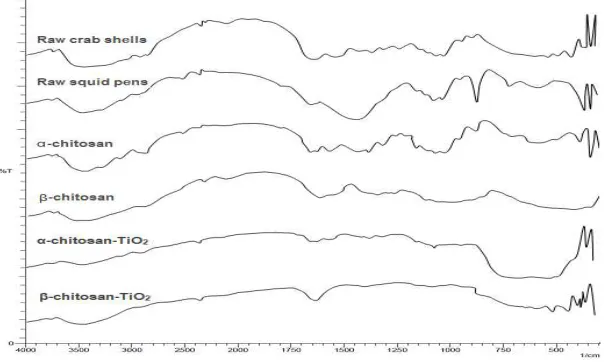
Crab shell powder and squid pens that have been prepared deproteinasi process, which is an early stage to obtain chitosan. Yield produced on stage deproteinasi reached 60.15% for shell crab, squid bone while the yield obtained approximately 65.04%. In the demineralization process, a process of removal of the primary minerals found in crab shells as calcium carbonate (CaCO3) which nanoparticle are show in Fig. 1. The crab shells and squid pens before treatment still has an acetyl group by the appearance of absorption at wave number 1070 cm-1 indicating the presence of -CO group stretching vibration and wave number 2900 cm-1 which indicates the stretching vibration -CH3. The typical absorption for chitosan from crab shells in the wavenumber of 3448.72 cm-1 which indicates the presence of hydrogen bonding of the-OH group that overlaps with the –NH region, while for raw squid pens, visible-OH group stretching vibration at 3410.15 cm-1 region [7].
of Methylene Blue in aqueous medium
Progress on Chemistry and Application of Chitin and its Derivatives, Volume XX, 2015 DOI: 10.15259/PCACD.20.21
217 cm-1 for the FT-IR spectra of chitosan from squid pens which indicates vibrations of the NH2 group of chitosan [8]. The results of the calculation method based on the degree of deacetylation by the base line method on FT-IR spectra, the degree of deacetylation of chitosan from crab shells was 76.6% and for chitosan from squid pens was 70.42%.
Figure 1. FT-IR spectra of crab shells,squid pens, chitosan and nanoparticle chitosan-TiO2.
Interpretation of the FT-IR spectra of nanocomposite chitosan-TiO2 from crab shell or squid pens indicated by the absorption at around 3000-3750 cm-1. This indicates that there is a primary -OH group and the NH2 group which is active in the chitosan. The adsorption of O-Ti-O for nanocomposite chitosan-TiO2 from crab shells appear on the 694.37 cm-1, whereas for nanocomposite chitosan-TiO2 from squid pens absorption of O-Ti-O appeared at 678.94 cm-1 region. The typical absorption in the wavenumber region below 1000 cm-1 shows the absorption for inorganic compounds, especially Cu metaloxide according to EDX data in Fig. 2.
3.2 Characterization of Nanocomposite of Chitosan-TiO2 by SEM/EDX
218
Progress on Chemistry and Application of Chitin and its Derivatives, Volume XX, 2015 DOI: 10.15259/PCACD.20.21
Figure 2. Data analysis of Energy Dispersive X-ray of (a) nanocomposite of α -chitosan-TiO2 from crab shells (b) nanocomposite of -chitosan-TiO2 from squid pens.
Figure 3. Scanning Electron Microscope (SEM) with magnification x10.000 for
(a) nanocomposite α-chitosan-TiO2 from crab shells (b) nanocomposite -chitosan-TiO2 from squid pens.
The SEM image also agree to the EDX data (Fig. 3) of nanocomposite TiO2 from crab shells and squid pens. The nanocomposite chitosan-TiO2 from crab shells and squid where most of the surface covered by white TiO2 nanoparticles.
3.3 Chitosan-TiO2 nanonanocomposite and TiO2 activity on
photodegradation and adsorption of Methylene Blue
of Methylene Blue in aqueous medium
Progress on Chemistry and Application of Chitin and its Derivatives, Volume XX, 2015 DOI: 10.15259/PCACD.20.21
219
Figure 4. The concentration vs percentage of photodegradation of methylene blue by nanocomposite chitosan-TiO2 and TiO2 with and without UV irradiation.
Nanocomposite of chitosan-TiO2 synthesized from crab shells and squid pens both have good activity to photodegrade of methylene blue. Chitosan nanocomposite-TiO2 from crab shells capable to photodegrade ofmethylene blue with irradiated of UV light were 59.48%; 28.26%; 32.73%; 58.31%; and 52.94% for each concentration of methylene blue 5, 10, 20, 40, and 60 mg/L. Chitosan nanocomposite-TiO2 from squid pen indicate percent photodegrade of methylene blue were 51.47%; 54.23%; 39.46%; 59.82%; and 55.29% for each concentration of methylene blue 5, 10, 20, 40, and 60 mg/L. The optimum conditions of nanocomposite chitosan-TiO2 from crab shells and squid pens was at concentration of 40 mg/L methylene blue with a percentage photodegradation of 59.48% and 59.82%, respectively. The metal oxide TiO2 also able to degrade of methylene blue, and the optimum conditions for it at a concentration of 20 mg/L with a percentage of 55.82% photodegradation.
220
Progress on Chemistry and Application of Chitin and its Derivatives, Volume XX, 2015 DOI: 10.15259/PCACD.20.21
The adsorption activities by nanocomposite chitosan-TiO2 of squid pen are also shown in Fig. 4. Where, nanocomposite chitosan-TiO2 of squid pen is able to adsorb methylene blue without UV light irradiation with the adsorption percentage of 14.19%; 11.52%; 6.17%; 7.28%; and 2.28%. The adsorption capacities of nanocomposite chitosan-TiO2 both from squid pen and crab shell are able to reduce concentration of methylene blue in the solution. The adsorption process occur effectively only at lower concentration and reduce gradually in higher initial concentration of methylene blue 20, 40 and 60 mg/L, this indicates that adsoption prosess occur as monolayer and all functional group of chitosan have bending of adsorbate molecule. While, the photodegradation process more dominant occurs at higher initial concentration of methylene blue. Nanocomposite chitosan-TiO2 of squid pen has a slightly higher percentage of photodegradation capacity than the nanocomposite chitosan-TiO2 from crab
shells. This is caused by the structure of -chitosan from squid pen which tend to be more open structure compare to the α-chitosan of crab shell, it causes TiO2
particles on the composite surface of -chitosan of squid pen has easily access to photodegrade of methylene blue than the α-chitosan of crab shell.
4. Conclusions
Based on the research that has been done, it can be concluded that
chitosan-α that have been isolated from crab shells produce yield of 70.71%, while the
chitosan- that have been isolated from squid pens generate yield of 85.73%. The degree of deacetylation of the chitosan-α to shell crab is 76.6%, while the degree of deacetylation of the chitosan- for squid pens is 70.42%. The photodegradation of methylene blue by nanocomposite chitosan- TiO2 from crab shells and squid pens produce optimum photodegradation activity at concentrations of 40 mg/L with a percentage of photodegradation of nanonanocomposite was 59.48% and 59.82%, respectively.
5. Acknowledgements
This work was supported by Ministry of Education and Culture, Republic of Indonesia through Directorate General Higher Education (DIKTI) with
“Decentralization Program, Sriwijaya University” Contract No. 129/UN9.3.1/LT/2014. We also thank to Department of Chemistry, Faculty of Mathematic and Natural Sciences, Sriwijaya University for laboratory equipment in this research.
6. References
1. Wiyarsi A. and Erfan P. (2008) Pengaruh Konsentrasi Kitosan dari Cangkang Udang Terhadap Efisiensi Penjerapan Logam Berat. Jurnal UNY 1-27. 2. Brine C. J. and Paul R. A. (1981) Chitin Variability with Species and Method
of Preparation. Com Biochem Physiol 69B, 283-286.
of Methylene Blue in aqueous medium
Progress on Chemistry and Application of Chitin and its Derivatives, Volume XX, 2015 DOI: 10.15259/PCACD.20.21
221 4. Muzzarelli R. A. A. and Jeuniaux C. (1976) In: R. A. A. Muzzarelli (Ed.),
Chitin. Pergamon Press, New York.
5. Chandumpai A., Narongsak S., Damrongsak F. and Prasart S. (2004) Preparation and Physico-chemical Characterization of Chitin and Chitosan from The Pens of The Squid Species, Loligo lessoniana and Loligo formosana. Carbohyd Polym 58, 467-474.
DOI: 10.1016/j.carbpol.2004.08.015
6. Palupi E. (2006) Degradasi Methylene Blue dengan Metode Fotokatalisis dan Fotoelektrokatalisis Menggunakan Film TiO2. Skripsi Sarjana Sains, FMIPA Fisika Institut Pertanian Bogor, Bogor.
7. Mohadi R., Nurlisa H., and Miranda R. (2009) Synthesis and Characterization of Composite Fe-chitosan and Its Application for Wastewater Treatment. Procceding of 1st International Conference on Advances in Wastewater Treatment and Reuse, Tehran.
8. Kumirska J., Czerwicka M., Kaczyński Z., Bychowska A., Brzozowski K.,