SEA-TB-352
manner, provided a strategic forum for exchange of information on existing and new, innovative approaches being applied in countries, for discussions on technical issues, and to follow up on actions taken on the recommendations of previous meetings, resulting in valuable advice for developing policies, strategies and plans for implementation of TB control interventions in Member countries
.
NTP managers from all 11 Member countries of the South-East Asia Region and representatives from donors, partners, as well as WHO regional and country staff, participated in the meeting and discussed extensively various issues including the importance of current priorities such as ensuring universal access to high-quality TB control services and scalingup programmatic management of drug-resistant TB
.
Report of a meeting of
national TB control programme managers and partners
Bangkok, Thailand, 23–27 September 2013
World Health House Indraprastha Estate, Mahatma Gandhi Marg, New Delhi-110002, India www.searo.who.int
Tuberculosis control
Report of a meeting of
national TB control programme managers and partners
Bangkok, Thailand, 23
–
27 September 2013
© World Health Organization 2014
All rights reserved.
Requests for publications, or for permission to reproduce or translate WHO publications – whether for sale or for noncommercial distribution – can be obtained from SEARO Library, World Health Organization, Regional Office for South-East Asia, Indraprastha Estate, Mahatma Gandhi Marg, New Delhi 110 002, India (fax: +91 11 23370197; e-mail: [email protected]).
The designations employed and the presentation of the material in this publication do not imply the expression of any opinion whatsoever on the part of the World Health Organization concerning the legal status of any country, territory, city or area or of its authorities, or concerning the delimitation of its frontiers or boundaries. Dotted lines on maps represent approximate border lines for which there may not yet be full agreement.
The mention of specific companies or of certain manufacturers’ products does not imply that they are
endorsed or recommended by the World Health Organization in preference to others of a similar nature that are not mentioned. Errors and omissions excepted, the names of proprietary products are distinguished by initial capital letters.
All reasonable precautions have been taken by the World Health Organization to verify the information contained in this publication. However, the published material is being distributed without warranty of any kind, either expressed or implied. The responsibility for the interpretation and use of the material lies with the reader. In no event shall the World Health Organization be liable for damages arising from its use.
This publication does not necessarily represent the decisions or policies of the World Health Organization.
Printed in India
Maps disclaimer
Contents
Page
Acronyms ... v
1. Introduction ... 1
2. Opening session ... 2
3. Progress and challenges of TB control ... 3
3.1 Global update ... 3
3.2 Regional update ... 5
4. Technical sessions ... 7
4.1. Review of recommendations of the meeting of NTP managers and partners, 2011 ... 7
4.2. Progress towards universal access ... 12
4.3. Scaling up programmatic management of drug-resistant TB (PMDT): review of activities ... 12
4.4. Technical support for TB planning and review ... 31
4.5 Strategic planning ... 37
4.6. TB TEAM... 47
5. Conclusions and recommendations ... 54
5.1 Conclusions ... 54
5.2 Recommendations ... 55
Annexes 1. Address by Dr Samlee Plianbangchang, Regional Director, WHO SEAR (Delivered by WR Thailand) ... 60
2. Agenda ... 62
3. List of participants... 63
4. Global overview of TB control ... 66
Acronyms
ACSM advocacy, communication and social mobilization
ART antiretroviral treatment
BOPM National Drug Regulatory Agency, Indonesia
BRAC Bangladesh Rural Advancement Committee
CAP-TB control and prevention of tuberculosis
CCM country coordinating mechanism
CHW community health workers
DOT directly-observed therapy
DOTS directly-observed treatment, short-course
DR-TB drug-resistant TB
DST drug susceptibility testing
EQA external quality assessment
FLD first line (anti-TB) drugs
GDF Global Drug Facility
GF Global Fund to Fight HIV/AIDS, TB and Malaria
rGLC regional Green Light Committee
HR human resources
JMM joint monitoring mission
LPA line probe assay
MDG Millennium Development Goals
MDR-TB multidrug-resistant tuberculosis
M&E monitoring and evaluation
NFM new funding model
NSP national strategic plan
NTP national tuberculosis control programme
NRL national research laboratory
PMDT programmatic management of drug-resistant tuberculosis
PPM public–private mix
QA quality assurance
SEAR WHO South-East Asia Region
SOP standard operating procedures
TA technical assistance
TB tuberculosis
TB–HIV tuberculosis and HIV
TRP technical review panel
TS technical support
TBTEAM TB Technical Assistance Mechanism
USAID United States Agency for International Development
WHA World Health Assembly
WHO World Health Organization
1.
Introduction
Tuberculosis remains one of the major public health concerns in the South-East Asia Region (SEAR) of the World Health Organization (WHO). With an estimated 5 million prevalent cases and 3.5 million incident cases in 2011, the Region continues to carry about 40% of the global burden of tuberculosis (TB). Five of the 11 Member States in the Region are among the
22 high-burden countries, with India alone accounting for 25% of the world’s incident cases.
Most cases continue to occur among young adults, particularly in the most productive age group of 25–34 years. Males are disproportionately affected: the male-to-female ratio was 2.0 among all new smear-positive TB cases detected for the year 2011 in the Region and 2.9 among cases older than 45 years. An estimated 450 000 people in the Region died from TB in 2012 illustrating that universal access to quality assured diagnosis and treatment for all persons with TB is not yet ensured.
The Millennium Development Goals (MDG) and Stop TB partnership goals and targets of reducing the prevalence and death rates by 50%, compared with their levels in 1990, are likely to be met by 2015 from a regional perspective, if progress to date is maintained and scaling up of implementation of prevention and control activities is ensured.
While progress continues to be made, national TB control programmes still face a number of challenges that relate to uncertainties regarding sustainable financial and operational resources, limited technical and management capacity, weak procurement and supply management mechanisms, and national laboratory networks. These uncertainties, in turn, are slowing the planned expansion of early and enhanced case detection and interventions for tuberculosis and HIV (TB–HIV) and drug-resistant TB (DR-TB). Though collaboration with other sectors is steadily increasing, the provision of care by all health-care providers is not sufficiently linked to national programmes to make an impact at the national level. Low community awareness and utilization of services hamper the uptake of services. It is increasingly becoming recognized that attention needs to be paid to addressing the social, economic and behavioural determinants that impact TB, if national efforts to combat TB are to succeed in the longer term.
The annual TB Technical Assistance Mechanism (TBTEAM) meeting includes participation of NTP managers and donors, partners, as well as regional and country staff, and has proven to be a valuable forum for planning and priority-setting. The Global Plan to Stop TB 2011–2015 highlights the important role of technical support (TS) to NTPs. Given the economic instability and the importance of current priorities such as ensuring universal access to high-quality TB control services including scaling up programmatic management of drug-resistant TB (PMDT), it is imperative that NTP managers are well informed on how to access as well as fund high-quality TS.
2.
Opening session
The meeting was opened by the WHO Representative to Thailand, Dr Yonas Tegegn who highlighted the importance of the TB control programmes in the Region and read out a message from Dr Samlee Plianbangchang, Regional Director, WHO South-East Asia Region. (See text of the message at Annex 1).
Dr PR Narayanan, Chair of the SEAR TB Technical Working Group, stressed that TB is still a major problem in the Region. He acknowledged the role of WHO in terms of policy development and noted the efforts made by Member States to reach all people with TB to ensure their successful treatment. Dr Narayanan stressed the importance of partnerships and the need to accelerate PMDT and address the suboptimal diagnostic capacity in the countries. He concluded by reiterating the importance of the leadership role of programme managers.
Welcoming the participants to Thailand, Dr Chawetsan Namwat, NTP Manager of Thailand, informed them about the successful organization of the TB joint monitoring mission (JMM) in August 2013. Dr Chanvit Thrathep, Deputy Permanent Secretary, Ministry of Public Health inaugurated the meeting and highlighted the challenges due to the magnitude of the TB disease burden in the Region, especially DR-TB. He also mentioned the problems of ensuring laboratory capacity, weak procurement systems and stressed the need for an extensive regional approach for cross-border issues. He noted that the uncertainty related to sustainability of financial resources is a particularly trying issue in view of the goal of universal access to high quality TB prevention, care and control services.
The general objective of the meeting was to strengthen the implementation of TB control interventions in the Region.
The specific objectives were:
(1) To review progress towards the achievements of TB-related MDG targets;
(2) To review progress on achieving universal access to high-quality care for all people
with TB;
(3) To share experiences in scaling up PMDT;
(5) To identify steps to strengthen country capacity to plan, implement and monitor TB control activities.
(See Annexes 2 and 3 respectively for the agenda of the meeting and the list of participants.)
3.
Progress and challenges of TB control
3.1
Global update
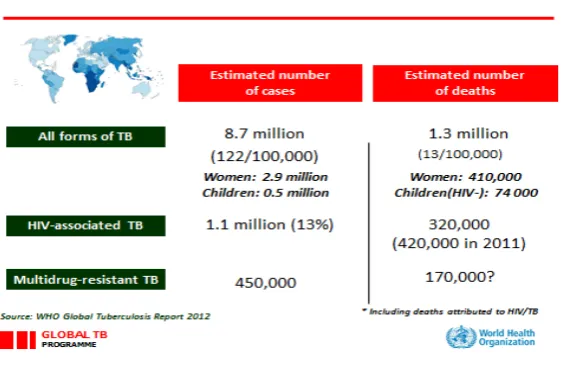
With the exception of data on mortality for people with HIV, provisional data describing the global burden of TB in 2012 do not show any major change compared to the situation in 2011. Due to rapid expansion of HIV screening and the provision of antiretroviral treatment (ART), TB-related deaths among people with HIV are clearly decreasing (Figure 1). The highest numbers of new cases of TB are found in China and India. The highest incidence rates (per 100 000 populations) are found in Saharan Africa. TB is driven by HIV in sub-Saharan Africa. In 2011, 3.7% of new cases were multidrug-resistant tuberculosis (MDR-TB). Case detection remains the main challenge (See Annex 4 for Global overview of TB control).
Figure 1: Provisional data for the global burden of TB in 2012
Source: Global TB Report 2012
Globally, incidence rates were relatively stable from 1990 up to around 2001, and then started to fall. Between 2010 and 2011, the rate of decline was 2.2%; if this trend is sustained, MDG Target 6.c will be achieved. The absolute number of incident cases is falling, albeit slowly (Figure 2), as the decline in the incidence rate (per 100 000 populations)
Figure 2: Slow decline in global TBburden
Source: Global TB Report 2012
Table 1: Global progress in TB control
2000 Year 2012
148 Incidence 122
263 Prevalence
(per 100 000)
169
22 Mortality
(per 100 000)
13
42 Case-detection rate (%) 66
69 Treatment success rate (%) 87
3 557 950 Total number of TB patients treated since 1995 22 199 020 Source: Global TB Control Report 2013
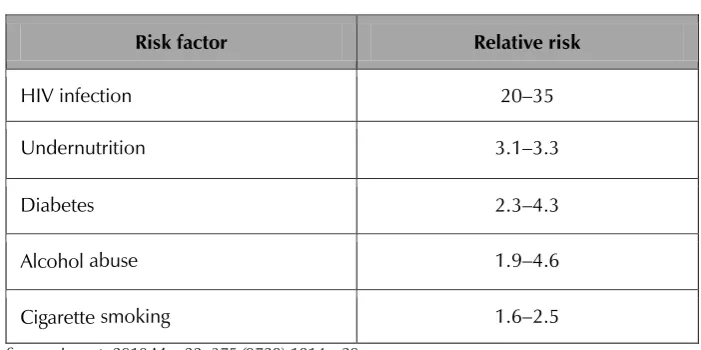
Table 2: Selected determinants for TB
Risk factor Relative risk
HIV infection 20–35
Undernutrition 3.1–3.3
Diabetes 2.3–4.3
Alcohol abuse 1.9–4.6
Cigarette smoking 1.6–2.5
Source: Lancet. 2010 May 22; 375 (9728):1814—29
The 2013 Global TB Control Report will be launched around the Union World Lung Conference in October 2013.
3.2
Regional update
SEAR had an estimated 5 million prevalent and about 3.5 million incident cases in 2011 and carried about 40% of the global burden of TB. Five of the 11 Member States in the Region are among the 22 high-burden countries, with India alone accounting for 25% of the world’s incident cases. Most cases continue to occur among young adults, particularly in the most productive age group of 25–34 years. While death rates due to TB are declining, an estimated 450 000 people in the Region died from TB in 2012 illustrating that universal access to quality-assured diagnosis and treatment for all persons with TB is not yet ensured. The estimated incidence of HIV-positive TB cases in 2011 is 140 000 (7.7 per 100 000 population) in the entire Region, but varies widely among countries.
The burden of TB in the Region includes an estimated 90 000 cases of MDR-TB. In 2012, about 16 000 patients with MDR-TB were registered for treatment in the Region, while 19 000 were diagnosed. Although very steady progress was observed, there is an urgent need for significant expansion in the scale and scope of TB control activities and to fully implement World Health Assembly Resolution WHA62.15 on “Prevention and control of multi-drug resistant tuberculosis and extensively drug-resistant tuberculosis”.
programmes in identifying and removing the more symptomatic and smear-positive cases out of the pool.
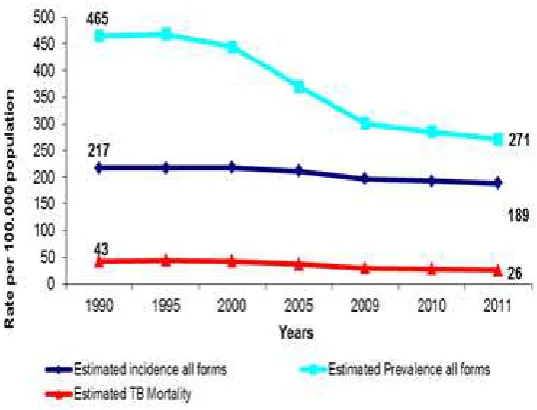
The MDG and Stop TB partnership goals and targets of reducing the prevalence and death rates by 50%, compared with their levels in 1990, are likely to be met from a regional perspective by 2015, if progress to date is maintained and implementation of prevention and control activities is scaled up. (Figure 3).
Figure 3: Incidence, prevalence and mortality 1990—2011
Source: SEAR TB Annual Report 2013
Major challenges for TB control in the Region include:
maintaining and improving the quality of basic TB control services: ensuring access
to high quality diagnosis and treatment services, including services for children;
slow progress in improving PMDT;
slow progress in increasing TB–HIV collaborative activities;
inadequate laboratory capacity;
overstretched health systems, including major challenges related to the quality and
quality of the health workforce;
insufficient resource mobilization;
involvement of big hospitals and private providers;
limited involvement of NTPs in decision-making related to the health sector reform
processes.
new anti-TB medicines are emerging. There is a need to urgently review and strengthen national strategic plans (NSPs); take advantage of opportunities provided by the Global Fund to Fight HIV/AIDS, TB and Malaria (GF), donors and expanded national investments in health systems; and, ensure sufficient funding and technical assistance (TA), both in the medium and long term.
4.
Technical sessions
4.1. Review of recommendations of the meeting of
NTP managers and partners, 2011
The progress in implementation of selected recommendations from the meeting of NTP managers and partners, 2011, was discussed in detail.
Earlier and higher case detection in the private sector: India
In 2011, India had an estimated 2.2 million incident cases with 1.3 million notified new and relapse cases, indicating that there are nearly a million missing incident cases. The main reasons for the missing cases include lack of access to the health system or delayed access and many people with signs and symptoms compatible with TB accessing private health-care providers who are not linked or engaged with NTP. Diagnosis is often ineffective and delayed in both the private and public sectors; there is a failure to notify and register people diagnosed with TB; and a failure of health service providers to link people diagnosed with TB to appropriate and effective treatment.
The private sector in India is huge and consists of more than 15 000 hospitals and institutions; approximately 5 000 000 physicians; approximately 18 000 stockists; 2 000 000 chemists; and more than 50 manufacturers. India consumes more TB drugs in the public sector than any other country (US$ 25 million in 2006). It also consumes more drugs in the private sector than any other country (nearly US$ 70 million in 2006).
The Government of India is attempting to address these challenges by implementing specific policies, systems and interventions:
(1) TB Notification Order 7 May 2012: Government of India made a major policy decision to make TB a mandatorily notifiable disease.
(2) reaching out to the unreached and vulnerable population:
– integration with general health system (rural and urban health missions);
– targeted case-finding activities with improving specimen transport and
feedback of results to patients.
(3) expanding efforts to engage all health care providers:
– standards for TB care in India have been formulated;
– diagnostic testing at private laboratories including DR-TB;
– flexible treatment options for private providers as per standards for TB care in
India.
(4) developing and deploying systems for notifying patients upon TB diagnosis from all
sources (case-based and web-based).
(5) creating public health system accountability for all diagnosed TB patients from all
sectors by:
– using the case-based web-based ICT intervention NIKSHAY;
– strengthening referral for treatment (transfer) mechanism, using electronic referral and feedback system.
The National Strategic Plan 2012–2017 – Universal Access to TB Care – is putting more emphasis on public–private mix approaches. This includes the establishment of a private provider interface agency to manage the many points of contact, monitor, and move micro-payments for services.
Challenges and lessons learnt include:
irrational use of anti-TB drugs
unorganized private sector
trust deficit
different objectives of stakeholders
specific partnership modalities not defined
costing of services not in line with the market
slower pace of notification from the private sector.
Establishment of systematic screening of high risk groups – prison inmates: Sri Lanka
There are 34 prisons and detention centres in the country. In 2011, there were approximately 109 000 inmates. The prison health facilities are limited and government health facilities are used for OPD and inpatient care. Up until 2011, there was no systematic screening for TB.
Since 2011, the following specific interventions have been implemented:
TB control in prisons included in the agenda of TB advisory committee meetings;
advocacy for prison authorities;
awareness for prison guards/welfare officers;
periodic mass screening in large prisons; and
prevalence survey among convicted persons.
In 2012, 50 128 inmates were screened; 7900 TB suspects identified and a total of 255 TB patients (204 S+) diagnosed. However, there is currently no screening of prison staff.
The main challenges are the poorly developed prison health system; scarce human resources; security issues related to the transportation of prisoners to chest clinics/treatment facilities; uncooperative inmates; forgery (faking or not taking medicine to remain in directly-observed therapy (DOT) clinic or selling SS+ results); DOT implementation; lost to follow-up following transfer or release.
Lessons learnt include the need for intersectoral collaboration and a change in attitude of caregivers; empowerment of prison inmates to make them responsible for their treatment; the need for ancillary care such as rehabilitation for drug addicts/alcoholics and the need to address social issues.
The next steps will be: continuation of periodic advocacy to prison officials and awareness for prison guards; efforts to improve human resource (HR) issues in the prison health services; improvements to the general prison environment; strengthening of rehabilitation work; utilization of mobile digital X-ray facility and implementation of Xpert MTB/Rif; and streamlining of screening (on admission, symptomatic and periodic mass screening).
Strengthening the laboratory network: Myanmar
Myanmar has taken major steps to strengthen the laboratory capacity in 2012—2013. Specific interventions include:
scaling up efforts to improve access to laboratory services (better identify people with presumptive TB, increase the number of smear laboratories and sputum collection centres, conducting mobile clinics, and organize sputum transportation to culture laboratory);
increasing the number of laboratories with external quality assessment (EQA);
introducing new laboratory tools (expanding iLED microscopy, developing SOP; rolling out Xpert MTB/RIF, and expanding solid culture);
improving management (additional human resources, developing TB diagnosis plan
2014–2018 with three additional BSL-3 laboratories, conducting integrated and/or
laboratory-specific supportive supervision, laboratory evaluation meetings at different levels, and introducing new recording and reporting tools);
TA (organize laboratory consultancy visits) with support from WHO and JICA.
Annual proficiency testing is done by the Bangkok Supranational Reference Laboratory (SRL). Sputum collection centres in hard-to-reach areas are contributing to case detection. Due to GF support, it has been possible to fill vacant positions. Training activities are being supported by The Union and WHO is providing support in the area of supervision and coordination.
Key challenges to strengthen the laboratory network include: insufficient number of staff; increased workload; cost of maintenance of equipment; data management (paper-based, many sub-registers for different tests; weaknesses in systematic recording and reporting, weak communication); risk of infections; accessibility (low coverage, weak sputum specimens transportation system is not well established; second-line DST has not started yet); basic amenities not always ensured (uninterrupted power supply, low voltage power supply, good quality water supply, Internet connectivity); requirement of TA on new tools.
Efforts will continue to implement the TB diagnosis plan to increase access to quality-assured smear microscopy, X-ray and rapid laboratory diagnosis; and, to establish laboratory and X-ray quality management systems.
Scaling up access to TB and HIV (TB–HIV) diagnosis and treatment services: Thailand
Thailand has a population of 70 million. The universal health coverage scheme is providing health coverage to about 75% of the population; adding other schemes, bringing the coverage up to almost 100%. In 1991, there were approximately 150 000 new HIV infections in the country; in 2010, the number was down to 10 800. TB is found in one third of symptomatic HIV/AIDS cases. In 2010, 90% of TB cases were tested for HIV coinfection, out of which 16% were found to be HIV-positive. Out of the coinfected cases, 71% are receiving CPT while 53% are on ARVs.
Bureau of TB and STIs work together through strategy management committee meetings
held four times a year. They are involved in the development of new HIV guidelines and TB–
HIV reporting form. There is an AIDS ZERO portal to share information for policy and programme advocacy – TB–HIV mortality; screening for HIV among TB cases and for TB among HIV-infected; antiretroviral therapy (ART) in TB–HIV cases. The outcomes noted in 2011 are shown in Table 3.
Table 3: Outcomes of TB–HIV collaborative activities
2011
TB patients with known HIV status 50 457
% of TB patients with known HIV status 90
TB patients that are HIV-positive 7 394
% of tested TB patients that are HIV-positive 15
% HIV-positive TB patients started on ART 59
HIV-positive people screened for TB 19 687
HIV-positive people provided with IPT NA
Source: Bureau of TB, Department of Disease Control, MoPH, Thailand.
Challenges and lessons learnt from the implementation of collaborative activities to date are:
a coordination body needed at all levels;
high mortality TB–HIV due to delayed diagnosis of HIV and start of treatment;
notification in private sector;
selection of indicators for policy and programme level (AIDS zero portal).
Next steps include the establishment of formal coordination bodies at different levels and TB expert committees at regional levels, as well as expansion of current interventions that will closely work with HIV expert committees.
Quality assured anti-TB drugs and supply chain management: Indonesia
The situation with regard to anti-TB drug supply chain management in 2011 included major challenges: collaboration between the National Drug Regulatory Agency (BPOM) and NTP was weak; institutional capacity on regulation implementation was limited; standard operating procedures for anti-TB drug quality assurance (QA) were not available; anti-TB drug sampling for testing was not conducted regularly; and there was limited availability of human resources.
The specific interventions to address these challenges included: involving TBCARE partners to strengthen QA at NTP and the BPOM; strengthening of DRA laboratory capacity at central level and provinces; establishment of a working group on QA; QA for second line (anti-TB) drugs (SLD); facilitation for local manufacturers to qualify for WHO pre-qualification; development of a policy on rational TB drug use and pharmacovigilance; and providing budget from GF for QA activities. These interventions have led to:
a SOP handbook for QA (Including rational use and pharmacovigilance);
good collaboration with DRA (Drug Regulatory Authority) such as integrated
supervision, development of regulations, providing reference material for TB testing and training and workshop on QA;
working group on QA: Pharmacy Directorate, CDC (United States Center for
Disease Control) Directorate, DRA, local manufactures, USP, and TBCARE;
QA test for SLD availability at DRA;
requests for WHO PQ submitted by two local manufacturers by the end of year 2013; and
While major progress has been made, the following key lessons and challenges have been learnt:
involvement of all stakeholders in QA implementation;
law enforcement for compliance of the regulation and policy;
importance of advocacy activities on QA system;
financial and time commitment needed for WHO PQ; and
key role of managerial policy.
4.2. Progress towards universal access
The session was organized as a poster session focusing on progress towards universal access to high quality diagnosis and treatment services for all people with TB; national strategic planning and financing and TBTEAM. A summary of the poster information as well as responses to a questionnaire on NSP and Technical Support (TS) circulated during the meeting is at Annex 5.
4.3. Scaling up programmatic management of drug-resistant
TB (PMDT): review of activities
Report from the regional meeting on combating DR-TB
A regional meeting on combating DR-TB was organized in Bangkok on 25–26 June 2013 with
high level participation from Member States and partners. The meeting participants made the following recommendations:
Recommendation for Member States:
(1) A re-invigorated high-level political commitment to prevent and combat
M/XDR−TB must be ensured.
(2) National TB programmes and the private sector should acknowledge and promote
TB prevention, care and control services based on evidence, public health approaches, ethical values and human rights principles and for the public good.
(3) It must be ensured that policies and strategies to address the underlying social determinants of TB are included in comprehensive country-specific NSPs.
(4) Efforts to achieve universal access to diagnosis and treatment of M/XDR TB should
be accelerated, in particular:
a)
strengthening collaboration and coordination between different components ofpublic health services, and between public and private health care providers;
b)
strengthening joint planning and coordination between NTP and key partners;d)
implementing mandatory TB case notification;e)
strengthening and expanding laboratory networks by introducing newdiagnostic tools, implementing QA systems, and by utilizing all existing and newly established laboratories;
f)
promoting the rational use of anti-TB drugs and pharmacovigilance in the public and private sectors;g)
ensuring uninterrupted availability of sufficient amounts of first and SLD free ofcharge to patients via NTPs and innovative public–private mix (PPM)
mechanisms;
h)
strengthening and implementing patient support mechanisms;i)
strengthening coordination and collaboration for cross-border TB prevention, care and control activities;j)
ensuring adequate TB infection control measures in health care facilities and congregate settings;k)
making available sufficient numbers of competent and motivated staff at all levels.(5) Comprehensive NSPs should be updated, based on an in-depth assessment of the
epidemic, including the full financial demand to ensure universal access and identification of funding gaps to secure sufficient domestic and external financing for TB prevention, care and control.
(6) Regional collaboration and coordination should be strengthened for TB
prevention, care and control activities targeted at migrant populations.
(7) Operational research should be encouraged for promoting new interventions in diagnostics and treatment such as shorter drug regimens for the treatment of
MDR−TB.
Recommendations for WHO, technical partners and donors:
(1) Technical support should be provided to countries in SEAR by WHO and technical
partners to develop and implement national strategic plans by which universal access to diagnosis and treatment of M/XDR in the public and private sectors is ensured.
(2) WHO should explore establishment of a SEA Regional PMDT Training Centre to provide support to strengthen managerial and technical capacities for the management of DR-TB within the Region.
(3) GF should ensure funding decisions are based on a comprehensive analysis of the
burden of disease as well as the GDP are need-based and realistic and allow for appropriate re-programming for combating DR-TB.
(4) WHO and technical partners should provide support to Member States and
(5) WHO, technical partners and GF should explore the possibility of a regional proposal to address cross-border issues and the treatment of migrants.
(6) WHO and technical partners should provide TA to countries, upon request, in designing appropriate protocols for the introduction of the shorter treatment
regimen for MDR−TB patients and in implementing the said regimen.
Report from the regional GLC (rGLC)
In 1998–1999, WHO and international partners observed that it was important to shift from
the existing individualized practitioner approach to the community-based programmatic approach in order to have an impact on the problem of drug resistance in the world. This led to newer terms such as the DOTS Plus Strategy (1999), the Green Light Committee (2000) and PMDT. The role of the Green Light Committee was to facilitate countries in developing their strategies for PMDT, the provision of quality assured SLD at concessional price and to monitor the implementation of the strategy.
The Global Framework was subsequently revised to facilitate faster expansion and
access to treatment of MDR−TB patients. Within this new framework, the role of the existing
GLC at the global level was revised and the concept of decentralization of activities to regional level mooted. Hence, six regional GLCs (rGLCs) were envisaged which would be supported by a secretariat housed within the respective WHO regional office. The rGLCs support the development of PMDT scale-up plans in Member States, assist in the procurement of the required SLD through the Global Drug Facility (GDF); help the countries in the implementation of DR-TB management; monitor and evaluate the function of the programme at the country level; and provide recommendations to the country for further scale−up. The rGLCs also assist in fundraising, capacity-building and advocacy at the country level.
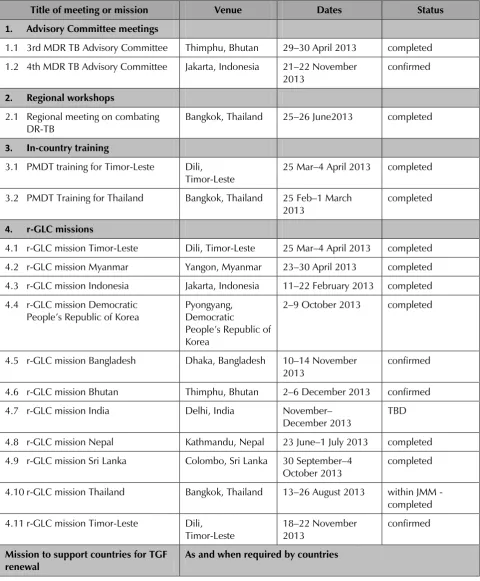
Table 4: rGLC activities in 2013
Title of meeting or mission Venue Dates Status
1. Advisory Committee meetings
1.1 3rd MDR TB Advisory Committee Thimphu, Bhutan 29–30 April 2013 completed 1.2 4th MDR TB Advisory Committee Jakarta, Indonesia 21–22 November
2013
confirmed
2. Regional workshops
2.1 Regional meeting on combating DR-TB
Bangkok, Thailand 25–26 June2013 completed
3. In-country training
3.1 PMDT training for Timor-Leste Dili, Timor-Leste
25 Mar–4 April 2013 completed
3.2 PMDT Training for Thailand Bangkok, Thailand 25 Feb–1 March 2013
completed
4. r-GLC missions
4.1 r-GLC mission Timor-Leste Dili, Timor-Leste 25 Mar–4 April 2013 completed 4.2 r-GLC mission Myanmar Yangon, Myanmar 23–30 April 2013 completed 4.3 r-GLC mission Indonesia Jakarta, Indonesia 11–22 February 2013 completed 4.4 r-GLC mission Democratic
People’s Republic of Korea
Pyongyang, Democratic
People’s Republic of
Korea
2–9 October 2013 completed
4.5 r-GLC mission Bangladesh Dhaka, Bangladesh 10–14 November 2013
confirmed
4.6 r-GLC mission Bhutan Thimphu, Bhutan 2–6 December 2013 confirmed 4.7 r-GLC mission India Delhi, India November–
December 2013
TBD
4.8 r-GLC mission Nepal Kathmandu, Nepal 23 June–1 July 2013 completed 4.9 r-GLC mission Sri Lanka Colombo, Sri Lanka 30 September–4
October 2013
completed
4.10 r-GLC mission Thailand Bangkok, Thailand 13–26 August 2013 within JMM - completed 4.11 r-GLC mission Timor-Leste Dili,
Timor-Leste
18–22 November 2013
confirmed
Mission to support countries for TGF renewal
Implementation of new diagnostic tools – regional overview
Beyond the current efforts to prevent, detect and cure TB, new tools and technologies are needed to radically transform the fight against TB, to contain the threat of drug-resistant
strains and to seriously target elimination by 2050. Today’s most commonly used diagnostic
tool, the light microscope, is more than 130 years old and is relatively insensitive, particularly in the presence of HIV coinfection, and gives no indication of drug susceptibility.
Molecular techniques have considerable advantages for scaling up programmatic management and surveillance of DR-TB, offering speed of diagnosis, standardized testing, potential for high through-put, and fewer requirements for laboratory biosafety. Molecular line probe assay (LPA) technology for rapid detection of MDR-TB was endorsed by the World Health Organization (WHO) in 2008. In 2009, Hain Lifescience introduced a new LPA, the
Genotype MTBDRsl® test, for the rapid determination of genetic mutations associated with
resistance to fluoroquinolone, aminoglycosides (kanamycin, amikacin), cyclic peptides (capreomycin), ethambutol, and streptomycin. The assay format is similar to the genotype
MTBDRplus assay for the detection of mutations conferring rifampicin and isoniazid
resistance, endorsed by WHO in 2008, and allows for testing and reporting results within 24 hours. In December 2010, Xpert MTB/RIF was introduced as the initial diagnostic test in individuals suspected of having MDRTB or HIV/TB and also as a primary diagnostic test for TB in people living with HIV.
The introduction of new tools for TB control and prevention should be regarded as a means of improving the quality of care by making available a wider choice of technologies to address unmet needs; it is also an opportunity to align the new tools with the capacity of laboratories and health systems to deliver care, address the changing nature of the epidemic and meet the needs of communities with or at risk of TB infection. The plans and investments to accelerate the development of new tools made thus far by the Global Partnership to Stop TB have led to high expectations that these technologies will provide national TB control programmes with better management tools. To achieve this, policy-makers need the information to make the right decisions about which new tools to implement and where in the diagnostic algorithm to apply them most effectively. These decisions are difficult, as the new tools are often expensive to implement and use, and the health system and patient impacts uncertain, particularly in developing countries where the burden of TB is high.
important lessons for the uptake of incrementally improved diagnostic services. New TB diagnostic tools offer fresh opportunities and challenges, but maintaining high-quality AFB smear microscopy remains essential, as it is still the fundamental method for TB control across all settings.
Community-level TB control: Bangladesh
The emergence of DR-TB has become a threat for TB control in Bangladesh and the country ranks 10th among the 27 high MDR-TB burden countries. Community PMDT has been implemented since May 2012.
The NTP treatment is 8 months’ intensive and 16 months’ continuation phase (24
months). Patients are hospitalized for up to eight weeks and discharged after two consecutive sputum examinations are negative. The treatment is then continued in the community using an ambulatory model of care. A community provider is an educated person who knows how to give injections. The community provider can also be a person from an NGO, who is trained and linked up to the district health care system. Anti-TB drugs are given to the community provider once a month and he is monitored on a monthly basis. Social support is provided to both patients and DOTS providers, e.g. nutritional support and travel allowance for patients and a cash incentive for the DOTS provider.
The system was piloted in four districts and one city corporation. It is now being scaled up in an additional 15 districts and two city corporations. Damien Foundation is providing treatment with a short regimen. Results are similar.
Table 5: Number of MDR and XDR TB detected and numbers of cases actually enrolled on treatment 2008—2012
Year GLC approved Damien Foundation Total
Diagnosed Enrolled Diagnosed Enrolled Total enrolled
May 2005– 2007
394 242 242
2008 274 107 174 124 231
2009 166 179 194 172 351
2010 291 183 189 173 356
2011 440 253 172 137 390
2012 544 376 157 132 508
January–June 2013
380 242 89 81 323
TOTAL 2095 1340 1369 1061 2401
Source: NTP, Bangladesh
to DST and culture; ensuring committed DR-TB DOTS provider in the community; channelling of nutritional and transport support costs to the patients; and implementing infection control measures at community level. While these challenges need to be addressed, the plans are to implement community PMDT countrywide.
Laboratory scale-up: India
The Revised National TB Control Programme (RNTCP) is planning to scale up the number of culture and DST laboratories nationwide. This includes: increasing the throughput per laboratory; strengthening the reference laboratories; engaging the private sector and medical college laboratory services; and establishing and scaling up training capacity. The expansion plans and the achievements in implementation are shown in Table 6.
Table 6 a: Laboratory expansion plan
Laboratories 2010–2011 2011–2012 2012–2013 Total
Enhance sputum processing capacity
12 +13 +18 43
Establish line probe assay (LPA) 12 +13 +18 43
Establish liquid culture systems 13 +9 +11 33
Source: RNTCP National Laboratory Scale-up Plan 2010, www.tbcindia.org
Table 6 b: Achievements versus plan
Laboratories Planned
(2010–2013)
Achieved (As on Aug 2013)
Enhance sputum processing capacity 43 27
Establish line probe assay (LPA) 43 35
Establish liquid culture systems 33 9
Source: RNTCP National Laboratory Scale-up Plan 2010, www.tbcindia.org
A case-based, Web-based (NIKSHAY) notification system has been established to provide universal access to DST for all TB cases.
Challenges to the implementation of such a massive scale-up plan include: establishment of Biosafety Level-III; ensuring competent staff for LPA/LC; difficulties in establishing well-performing sputum sample transport systems and ensuring capacity for follow-up cultures for patients diagnosed with DR-TB.
streamline systems and training to improve suspect identification, prompt sample collection and transport systems from PHIs/DMCs;
enhance coordination to fast-track processes for BSL III and HRD for LC
laboratories;
enhance follow-up capacity through one sample per follow-up culture policy, fast
track application of potential laboratories to reach proficiency stage with national research laboratories (NRLs) and budget for C-DST (Culture-Drug Susceptibility Test) schemes with private laboratories;
fast-track DR-TB centre establishments;
strengthen district capacity for ambulatory PTE, ADR management;
DR-TB Centre Scheme in 2013.
HRD for PMDT: Indonesia
Indonesia has an ambitious PMDT scale-up plan which put a major demand on human resource development for PMDT (See Table 7).
NTP has developed specific HRD strategies for PMDT to address the needs. These are being implemented within the overall framework for HRD for TB control:
(1) contribution to overall workforce planning, policy development and leadership:
a)
assessment of human resources (HR) needs; andb)
participation in HR policy revisions.(2) organization of ongoing in-service training (clinical, laboratory and managerial) for all health workers involved in the implementation of the Stop TB Strategy, that is, promoting and sustaining lifelong learning including:
a)
initial training on MDR-TB;b)
initial training on culture and DST;c)
on-the-job training (refresher: small performance problems that can beaddressed during a supervisory visit); and
d)
continuing education (to gain more skills and knowledge).(3) contribution to integrated personnel management system to foster adequate
workforce planning, recruitment, hiring, deployment and retention;
(4) monitoring and supervision of health worker performance:
a)
following up on training, provide support and mentoring;b)
detecting performance deficiencies;c)
identifying new staff in need of training; andTable 7: PMDT scale-up plan
Year TB MDR
suspect
Provincial coverage
TB MDR cases and treatment
No of health facilities involved
No of referral hospitals involved
2010 300 4 100 29 4
2011 2 000 14 700 479 14
2012 4 800 21 1 600 1 095 21
2013 10 200 27 3 900 2 328 27
2014 15 300 33 5 600 3 492 33
Source: NTP, Indonesia
Table 8 illustrates the results of case-finding activities in 2009–2012.
Table 8: MDR-TB case-finding in Indonesia
Year MDR-TB suspects MDR-TB patients diagnosed MDR-TB patients registered for
treatment
2009 137 34 19
2010 531 182 140
2011 1 245 326 251
2012 2 248 568 434
Source: NTP, Indonesia
Treatment success rate was 73.6% in 2011 and 71.4% in 2012.
To date, 1240 health staff from all levels of the health system have been trained in basic PMDT. Three international courses on clinical management of MDR-TB have been organized. A cascade system for training is being implemented. Establishment of a national training centre is planned. Sub-referral teams (consisting of at least one doctor, nurse and pharmacist each) have been established in 235 facilities; additional staff have been assigned at the provincial level; and professional organizations are being involved.
Since the availability of competent, motivated people is crucial to deliver high quality TB care and control services, the overall major challenge to HRD is to ensure that all suspects are identified, referred, diagnosed, treated and cure. More specifically, challenges include:
embedding HRD on PMDT in TB HRD (and not as a separate "programme);
addressing the major training needs (clinical and managerial) at all levels of the health system (including laboratories), based on defined roles, responsibilities and assigned tasks;
decentralizing training and meeting challenges to maintain quality;
ensuring that specialists in PMDT referral hospitals agree with/follow NTP
guidelines;
addressing the high turnover of staff, especially at the peripheral level;
improving the quality of supervision;
conducting regular monitoring and evaluation.
The next steps to address the challenges include further strengthening of the process for HRD for PMDT; strengthening collaboration with HRH bodies in the MoH to have HR-TB issues integrated in the HRH plan of MoH as well as in the local development plan; strengthening the management information system for human resources; introducing reward systems (financial and non-financial Incentive) for remote area assignments, and continuing supervision and monitoring on HR PMDT.
Case-finding and treatment: Myanmar
WHO estimates that in 2011, there were 5500 MDR-TB cases among the notified pulmonary TB cases. Among the total annual TB cases, 9000 are estimated to have MDR-TB. Two nationwide drug resistance surveys have been completed and a third survey is being finalized. A total of six extensively drug-resistant TB (XDR-TB) cases have been confirmed.
The standard operating procedures (SOP) for DR-TB management was finalized in 2009. The DOTS-Plus Pilot Project was started in July 2009 and concluded in November 2011. The catchment areas included 10 townships, five each in Yangon and Mandalay. The model of care for MDR-TB patients was based on an initial period of hospitalization followed by home-based treatment.
The scale-up on MDR management started in 2011 December. A five-year scale-up plan for MDR-TB management was developed; the SOP was revised and services expanded into 38 townships. An ambulatory model of care was started: DOTS was provided by basic health staff. Funding for patient support was provided by external donors. To improve case- finding, 19 GeneXpert machines have been installed in 11 regional and State TB centres. As a result, enrolment has increased significantly (See Figure 4).
Figure 4: Enrolment of MDR-TB patients by quarter in 38 sites (2009—2013)
Major challenges for MDR-TB case-finding and treatment include the need to:
strengthen HR (number and skills), including the willingness of physicians to follow
NTP guidelines;
strengthen the referral network for utilization of GeneXpert;
ensure geographical expansion;
ensure timely delivery of SLD;
ensure availability of ancillary drugs and support for infection control;
expand MDR-TB follow-up sites (decentralization);
ensure DOT;
ensure/sustain nutritional support for MDR-TB patients;
implement infection control measures for health-care settings;
implement paper-based recording, reporting;
meet TA needs for implementation of new diagnostics, monitoring and evaluation;
Planned activities for next steps include:
case detection and diagnosis of MDR-TB by GeneXpert; liquid culture and LPA for
all retreatment cases;
ensuring timely SLD procurement and delivery including a regular assessment of SLD needs;
providing MDR-TB support package for patients;
reinforcing infection control measures;
disseminating new guidelines;
capacity-building among health staff;
geographical expansion of 15 townships per year in 2013—2014;
introducing eR&R (Electronic Recording and Reporting).
In conclusion, since the introduction of new tools, the waiting list for enrolment on treatment for MDR-TB patients is increasing. The timely delivery of SLD and the establishment of diagnostic infrastructure, HR strengthening, and implementation of infection control measures are all crucial for PMDT scale-up.
Achieving nationwide coverage: Nepal
national referral laboratories in Kathmandu that can process sputum culture and DST for first line (anti-TB) drugs (FLD) and SLD by conventional method and LPA. However, Xpert is rapidly expanding from 9 to 34 centres, including some mobile status for outreach case-finding among vulnerable and remote populations.
NTP has also established eight hostels and one DR home to manage cases in need of intensive clinical care with no access to DR-TB centres. Psychosocial support is provided to patients and families, including nutrition and transport allowance for MDR-TB and cat.II patients:
training of health workers (75 every year) on PMDT
development of PMDT, infection control and Xpert guidelines
engagement of non-state partners
A case-based web-based surveillance system for DR-TB was established in 2012; however, it is still underutilized. The introduction of nutritional and transport allowances have
improved case-holding and the treatment success rate is around 73–78%.
One of the main challenges is that a significant proportion of patients seek care in the large, unregulated private sector. There is still insufficient access for patients to diagnostic facilities and DR-TB centres including a shortage of properly trained health personnel. Social stigma, job insecurity, loss of income all lead to long delays in seeking care. Job seekers who are migrating to India take treatment off on due to seasonal movements and lack of clear coordination between the two programmes. XDR-TB cases detected in a Nepalese man in the US raised the issue of X/MDR-TB in ethnic minorities (Tibetans and migrants from northern Nepal).
Next steps include:
securing a predictable financial flow through application to the New Funding
Mechanism of GF;
expansion of Xpert technology (total 25 additional devices in 2013—2014,
including some for outreach activities among vulnerable, hard-to-reach groups)
training of laboratory and clinical staff;
upgrading of regional laboratories to perform culture (and DST);
continued procurement of SLD from GDF and addition of new drugs to XDR-TB
protocol;
continued and expanded social protection for DR-TB patients and introduction of
incentives to increase case-finding and adherence;
construction of a chest hospital in NTC;
establishment of a DR Home in Bandipur;
establishment of five MDR clinical care centres inside regional hospitals;
Large metropolitan areas: Thailand
Since 2009, there are 100 MDR-TB centres located in capital districts and large urban areas countrywide. In this period, MDR-TB reports from these centres were not complete due to lack of laboratory data for M/XDR-TB detection among risk groups. The GLC monitoring visit in 2012 recommended the revision of the recording and reporting system with full participation of community hospitals on MDR-TB care.
Specific interventions were developed including improving the capacity of the laboratory system for culture. Funding was secured for DST for risk groups by the Universal Health Care (UC) Scheme and Department of Disease Control as well as funding for second line drugs by the UC Scheme for Thai persons and by the GF for non-Thai persons. In 2013, a National Expert Committee for DR-TB was appointed. PMDT items were added into the auditing system of the “Quality TB Clinic” and implementation of the revised TB register and PMDT recording and reporting forms (now including the results of culture and DST for risk groups for MDR-TB) was started.
Challenges and lessons learnt to date with the revised system include:
limited capacity of health care staff at community level to provide care for
M/XDR-TB patients;
inadequate living support for M/XDR-TB patients;
provision of DOTS for M/XDR-TB patients;
availability of a guideline for practice for staff such as psychosocial support for M/XDR-TB patients, side effect assessment/management;
low coverage of DST among risk groups due to lack of indicators for laboratory data in the old R&R system.
The next steps for the 2013—2014 period will focus on:
strengthening the laboratory capacity for culture and DST in 12 regions and culture
in provincial hospitals in collaboration with NHSO(National Health Security Office);
expansion of the PMDT module in the electronic recording and reporting system;
strengthening PMDT in all public hospitals through auditing “Quality TB Clinic”;
improving coverage and quality of PMDT reports to monitor the progress;
building capacity of staff at community level through training, practice guide;
integrating PMDT into regular health system such as indicators of health inspectors,
NHSO, health assistants in the Ministry of Public Health;
Resource constraints and limited number of donors: Democratic People’s Republic of Korea
The DOTS strategy was introduced in the Democratic People’s Republic of Korea over 10 years ago. Based on data in the Annual TB Report of Democratic People’s Republic of Korea
2012, the TB burden is approximately 34 000 new smear-positive TB cases and 52 000 new smear-negative TB cases. Case notification has gone up in the period 2008–2012 due to increased efforts in case detection (Table 9).
Table 9: Case notification (TB sensitive to FLD) 2008—2012
Year NSP NSN EP Relapse Incidence
2008 28 026 31 444 10 914 2157 72 541
2009 29 366 32 491 12 232 2247 76 336
2010 31 240 36 285 13 725 3408 84 648
2011 31 279 37 457 16 828 5869 91 433
2012 31 240 35 959 17 321 6701 91 885
Source: NTP, Democratic People’s Republic of Korea
For the burden of MDR-TB, representative data is not available and no DRS survey has been conducted. Thus the estimated annual burden of MDR-TB is 3900 of which 2000 are from incident, new and relapsed TB cases and 1900 are acquired. In 2012, 786 MDR-TB patients were registered for treatment, of which 50 patients were supported with funds from the GF and 736 patients by Eugene Bell Foundation. Laboratory confirmation of MDR-TB cases is done by NRL and supranational reference laboratories in Hong Kong.
In 2012, the reported NSP case-detection rate was 81% and the treatment success rate 90%. Other sectors have been oriented and involved in supporting TB control in terms of case-finding and treatment adherence. The laboratory network has been strengthened and there has been no stock-out of first line anti-TB drugs in the country.
However, the NTP is also facing the following challenges:
inadequate availability of resources to manage with PMDTs;
lack of diagnosis equipment for NSN and EPTB, such as X-ray machines;
good nutrition, if required, for good treatment;
Insufficient research capacity to conduct necessary operational research such as introducing traditional regimen and ambulatory treatment;
frequent turnover of TB staff requiring timely and necessary training to new staff.
pursue high quality DOTS expansion and enhancement
address MDR-TB management
health system strengthening
engagement of all providers
establishment of partnership
enabling and promoting research.
The number of donors supporting TB control in the Democratic People’s Republic of
Korea is limited. Currently, two donors are supporting the NTP: GF and Eugene Bell Foundation (for PMDT). GF has been supporting the country since Round 8. It is the first such grant for the country and is currently in Phase II. The upcoming new funding model (NFM) of GF will also be critical to cover the gap in NSP. NTP is planning to apply NFM as early as possible to ensure successfully implementation of TB control activities.
Country experiences on implementation
Bhutan
The prevalence of MDR-TB is 2.1% among new cases (1.8—2.5%) 16% among re-treatment
cases (12–19). In 2012, four cases notified among new cases and seven cases among re-treatment cases.
National guidelines have been developed on MDR-TB management. Liquid culture facility as well as first line DST has been established at the National TB Reference Laboratory (NTRL). Collaboration is established with the SNRL in Bangkok for second line DST. SLD are being procured through the GDF. NTP has also organized training of medical specialists and doctors on DR-TB management.
Challenges and lessons learnt include: delay in laboratory diagnosis of MDR-TB; DST for second line drugs; sample referral from districts to NTRL; technical capacity on PMDT; follow-up of cases during and after completion of treatment; long lead time for procurement of SLD; and fragile funding situation.
The way forward includes the establishment of LPA and other recent diagnostic tools to accelerate MDR-TB diagnosis; strengthen laboratory capacity for LPA and liquid culture; establish solid culture at two RRHs (Regional Referral Hospitals); improve capacity development in PMDT; improve contact tracing and case follow-up; strengthen ACSM on MDR-TB and infection control; promote operational research on MDR-TB and strengthen the involvement of medical colleges.
Maldives
Challenges and lessons learnt include financial constraints; lack of skilled manpower with adequate training; time needed for diagnosis of MDR and XDR-TB; capacity to manage, weak monitoring and supervision of the programme from the central level, ensuring adequate supervision and monitoring of DOTS centres in the regions and atolls; and the social stigma attached to the disease.
The next steps are to strengthen the diagnostic capacity for TB and MDR TB; scaling up prevention and management of MDR-TB; training staff at hospitals at the regional, atoll and health centre levels; and increasing community participation in case detection and management.
Sri Lanka
In 2012, a total of five MDR-TB patients were diagnosed. All diagnosed patients were enrolled on treatment. This is an improvement from 2008 when only 63% of diagnosed MDR-TB patients were enrolled. Since 2008, a total of 27 cases have been diagnosed. Treatment success is 75% (12/16) with 11 patients still on treatment.
Addressing MDR-TB, TB–HIV, TB contacts and the needs of poor and vulnerable people
is a strategic direction in the National Strategic Plan 2012—2016. Specific interventions have included:
procurement of GeneXpert MTB/Rif;
procurement of line probe assay;
development of DRS protocol;
establishment of two regional culture laboratories;
upgrading of NTRL to bio-safety level 3 (in progress);
development of draft PMDT Guidelines;
development of the draft PMDT expansion plan;
Challenges and lessons learnt include: decentralizing MDR-TB treatment facilities; transportation of sputum for culture; cost of new technologies; financial sustainability; human resources; migration from HBCs (for employment).
The NTP will finalize the PMDT guidelines and the development of PMDT expansion plan including the stepwise expansion of culture and DST for all diagnosed TB patients.
Timor-Leste
Major challenges to PMDT are as follows:
no culture and DST in country;
non-availability of expertise on PMDT in the country;
lack of knowledge of PMDT in health professionals;
low awareness of community on MDR-TB and its treatment;
transportation of sputum samples to SNRL.
Lessons learnt include: (i) good MDR case management is key to high cure rates; (ii) food support for MDR patients and family helped improved adherence to MDR treatment and (iii) collaboration with NGOs can be an added advantage in scaling up PMDT.
In the next phase, the NTP will continue to strengthen collaboration and coordination between public and private health care providers; ensure early and increased case detection; promote rational use of anti-TB drugs and pharmacovigilance in the public and private sectors; ensure uninterrupted availability of sufficient amounts of SLD free of cost; strengthen laboratory systems in the country with proper EQA and improve collaboration with the SRL; ensure adequate TB infection control measures in health care facilities and congregate settings and strengthen human resource at all levels.
Global Drug Facility (GDF)
GDF’s Grant Service combines the financing and procurement of quality-assured anti-TB drugs. GDF provides anti-TB drugs to countries that lack the resources required for purchasing them and are ineligible for funding from certain donor agencies, or financing mechanisms. It contracts procurement agents, manufacturers and service providers competitively and transparently. It helps countries access needed anti-TB drugs quickly because there is a single, simple application procedure rather than separate procedures for funding and drug procurement. It combines supply of anti-TB drugs with the TA necessary to manage those drugs effectively within countries. GDF can offer fast-track service -- for example, rapid support to countries that are waiting for disbursement of funds from donors to be able to order and receive drugs, or countries that are suffering from shortages due to civil strife or other humanitarian crises. GDF provides, exclusively, drugs that have either been prequalified by the WHO Prequalification Programme, approved by a stringent national drug regulatory authority or have passed a provisional evaluation by an independent expert committee
commissioned by WHO at GDF’s request. Across the years, a total of 128 different countries received the benefits from the procurement system and the multiple advantages offered by GDF.
GDF has developed its strategic directions and framework for the period 2013—2016.
The rationale for new directions is to:
aim at zero tolerance for stock-outs in countries to re-shape operations;
continue to further shape the market for more affordable prices with no
build on lessons learnt from the past and regular market dynamics research;
incorporate new TB drugs and diagnostics within GDF platform;
promote innovative tools for forecasting, monitoring and evaluation (M&E) to countries and leverage communication/collaborative actions with partners for improved planning;
mobilize and catalyse partners’ expertise, including in-country TA programmes to improve service delivery and data management;
foster countries’ shared responsibility, accountability and sustainability for supply chain systems strengthening, regulatory aspects and rational use;
work closer and focus on country needs and feedback to improve operations.
GDF is aiming at universal access for quality-assured TB medicines and diagnostics for GDF clients. GDF commits to three main quality objectives: product quality, service quality and the lowest prices.
Key lessons learnt to date to avoid stockouts:
Funding availability is the key, but technical support and close monitoring are crucial to implement a good management system at the country level.
Standardized methods for information collection, data management and close
monitoring + early information sharing with stakeholders / in country partners at all cycle steps are necessary.
GDF QA policy follows recommendations in the WHO Report: A Model Quality
Assurance System for Procurement Agencies, 2007 where it recommends that pharmaceutical procurement is restricted only to approved suppliers to ensure that drugs of acceptable quality are procured. This is reflected in the GDF QA policy implemented in June 2010, in full harmonization with GF QA policy.
An increase in the number of suppliers results in a proportional increase in the prices of medicines and competition between manufacturers, thus impacting the total manufacturing capacities for the entire TB community. GDF has significantly increased the number of suppliers and thereby, production capacity and access; especially in the fragile SLD market. The GDF product catalogue includes details of all the drugs that GDF procures, including price range and the highest available price (to be used for planning purposes).
For most products, GDF has multiple suppliers and cheaper prices may be available during quotation, in addition to consolidation of orders and staircase pricing. The catalogue is available online at http://stoptb.org/gdf/drugsupply/pc2.asp.