1 Martina Smrekar 1 Snježana Čukljek 1 Ana Marija Hošnjak 1 Boris Ilić
1 Sanja Ledinski Fičko
1 University of Applied Health Sciences, Department of Nursing, Zagreb
Article received: 25.01.2018. Article accepted: 28.05.2018. Author for correspondence: Martina Smrekar
University of Applied Health Sciences Mlinarska cesta 38, Zagreb, Croatia Tel: + 385 91 4595 711
Fax: + 385 1 5495 711 E-mail: [email protected] DOI: 10.24141/2/2/1/6
Keywords: alcoholism, treatment success, long term abstinence
Abstract
Introduction. Alcohol consumption represents a pub-lic health problem whose treatment is complex, multi-dimensional and long-term with possible recurrence. Treatment is aimed at achieving long-term abstinence. Aim. The purpose of this paper is to use a systematic review in order to determine which of the methods of alcoholism treatment has long-term effects on permanent and complete abstinence of an individual. The aim of the systematic review is an analysis of published data and achievements in this area.
Methods. A systematic review of literature that evaluates the success of long-term treatment of al-coholism was conducted using the Medline databas-es. The keywords used as search terms were: alcohol-ism, treatment success, long-term abstinence. Results. Six studies in total were taken into consid-eration due to the availability of a full text article and years of publication between 2000 and 2017. Treatment of alcoholism includes some of the follow-ing interventions: complete abstinence from alcohol, pharmacotherapy, cognitive-behavioral therapy, self-help group attendance, family therapy, individual in-terventions, combined behavioral interventions and telephone-based interventions. Results have shown that the following interventions had an impact on the increment of abstinence rates: aftercare telephone monitoring, regular medical checkups, participation in self-help groups, pharmacotherapy, attendance of the Outpatient Long-term Intensive Therapy for
Al-Alcoholism: Success of Long–Term
The causes of alcoholism can be numerous. Most often they are associated with disturbances in the biological, social and psychological functioning. Fac-tors that contribute to alcoholism may be age, gen-der, immediate and wider community, the easy avail-ability of alcohol, economic status, media advertising of drinking alcohol, society’s liberal attitude towards drinking alcohol, lack of social support from fam-ily and community. The Global Report of the World Health Organization 2014 on the status of alcohol and health states that Europe is the region with the highest consumption of alcohol per capita and that some of its countries have a very high consumption rate (2). The WHO Regional Committee for Europe had adopted The European Action Plan to reduce the harmful use of alcohol 2012-2020. The action plan reflects new evidence concerning public health poli-cies related to alcohol and includes a number of op-tions to reduce the harmful use of alcohol (6). Treatment of alcohol dependence remains one of the biggest challenges, since only about half of all pa-tients achieve long-term abstinence by the currently available therapies (7). There are many options for the treatment of alcohol use disorders. The treat-ment is a complex process and it requires a holistic treatment approach. It partly depends on the sever-ity of the patient’s drunkenness (4). The individual’s task is to make their own decision to stop drinking and to enter the treatment program. With long term treatment and support, some individuals are able to stop drinking and rebuild their lives (8).
Treatment programmes are conducted in hospitals and later rehabilitation through outpatient treat-ment. Treatment can be divided into three general categories: brief intervention; specialised treatment programmes, and mutual help groups (9). Brief inter-ventions are intended to provide prophylactic treat-ment before or soon after the onset of alcohol related problems. They are designed to motivate high-risk drinkers to moderate their alcohol consumption, rather than promote total abstinence. They are often simple enough to be delivered by primary care practitioners (9). Four medications are approved for the treatment of alcohol dependence in Europe, that is Naltrexone, Acamprosate, Disulfiram and the most recent Nalme-fene (10). Disulfiram which is in common use, inter-feres with the metabolism of alcohol by inhibiting al-dehyde dehydrogenase. It produces flushing, nausea, palpitations, and other severe reactions if drinking occurs (11). In the last years Nalmefene has been pre-coholics (OLITA) (OLITA program includes psychiatric
care, cognitive-behavioral therapy, patient-centered psychotherapy and classical addiction therapy). The research shows that people who abstain for 3 to 6 months are more likely to achieve and maintain long-term abstinence.
Conclusion. More long-term research is required in order to estimate the treatment success in the long term. The treatment success depends on the indi-vidual and his motivation to accept treatment, on the long-term and comprehensive treatment and self-help group attendance.
Introduction
Problems related to the abuse of alcohol vary wide-ly around the world. Alcohol is an easiwide-ly accessible, available and cheap substance that causes addiction. Alcoholism is a chronic, recurring condition involving multiple cycles of treatment, abstinence, and relapse (1). It represents a large health, social and economic burden (2). Abuse of alcohol is a risk factor for mor-bidity, disability and mortality (3). Alcohol abuse dis-orders include alcohol abuse (drinking problem) and alcohol dependence (alcoholism) (4). Consumption of alcohol and problems related to alcohol represent a public health problem whose treatment is complex and long-term with a possible recurrence causing cost on society. The main importance to public health is the development of successful approaches in treat-ment and their intense analysis (5). It is necessary to investigate which measures can be implemented in order to protect individuals from the attempt of al-cohol use and how to help individuals who were ad-dicted to alcohol to permanently abstain from alcohol use. The protection of the health of populations by preventing and reducing the harmful use of alcohol is a public health priority. One of the objectives of the World Health Organization is to reduce social burden caused by the harmful use of alcohol (3). Often alco-hol consumption is a part of the normative culture in certain countries. The significant problem occurs in young people starting with alcohol consumption at an earlier and earlier age. Most of them encounter alcohol for the first time in their family home.
Inclusion and exclusion criteria
We included the articles written in the English lan-guage, articles with full texts available online, focus-ing on the years of publication between 2000 and 2017.
The studies with a date of publication before 2000 were excluded.
Papers included in the final analysis
Upon the entry of the keywords into the database, the titles of potential articles were obtained. After analyzing the title of the paper, the second step was the analysis of the abstracts. Only full text articles were taken into account for further analysis. After applying the inclusion and exclusion criteria six pa-pers were included in the study.In total, six studies were included in this systemtic review. Overview of the studies finally included is displayed in Table 1.
Results
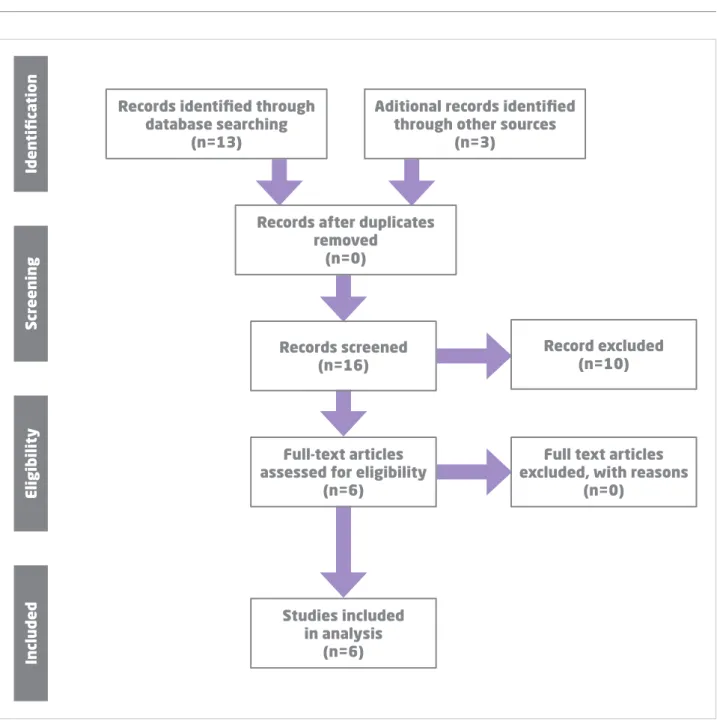
The search process yielded 16 articles in total. After applying the inclusion and exclusion criteria, 6 articles relating to long-term alcoholism treatment success were considered eligible for further analysis (as shown in Fig. 1). Overview of the studies finally included is presented as a Prisma 2009 Flow Diagram (15). Authors Rus-Makovec, Cebasek-Travnik (16) in 2008 tried to determine the factors that affect long-term abstinence. They studied the influence of the follow-ing on the abstinence of patients: intensive treat-ment (the treattreat-ment included the detoxification process, psychodynamically oriented group therapy combined with a behavioral-cognitive approach, the principles of motivational enhancement therapy and family therapy, individual interventions) and after-care telephone monitoring, the week of follow-up. The respondents were divided into two groups; the telephone contact group and no contact group. Re-spondents were checked after the intensive treat-ment by the aftercare telephone monitoring. The patients were asked questions about abstinence/ sented as a new medical means to reduce the desire
for alcohol but for now there is not enough experience of what will be its lasting effect (12).
Motivational interviewing helps to increase the pa-tient’s motivation and commitment to the treatment and the willingness to change behavior. This method of treatment is often used with patients with serious problems orwith patients with less serious alcohol problems (13).
Outpatient Long-term Intensive Therapy for Alcohol-ics (OLITA) is a long-term biopsychosocial outpatient therapeutic approach that is conducted in four steps. It is intended for patients who are heavily dependent on alcohol. The aim of OLITA is to stimulate imme-diate social reintegration of patients. This approach to treatment includes basic elements of psychiatric care, cognitive-behavioral care, patient-centered psy-chotherapy and classical addiction therapy (5). Alcoholics Anonymous is a large and effective organ-ization that deals with the treatment of alcoholics. They have done a lot for the world of alcoholics (14). The goal in the treatment of alcoholism is to achieve a permanent and total abstinence which can be com-plex and depends on the individual and his motiva-tion to accept treatment and support from family and community (5).
The purpose of this paper is to use a systematic re-view in order to determine which of the methods of alcoholism treatment has long-term effects on per-manent and complete abstinence of an individual. The aim of the systematic review is an analysis of published data and achievements in this area.
Methods
A systematic review of literature that evaluates the success of long-term treatment of alcoholism was conducted using Medline databases. The keywords used as search terms were: alcoholism, treatment success and long-term abstinence.
Greenfield, Burgdorf, Chen, Porowski, Roberts, Herrell (17) in 2004 examined the abstinence rate of wom-en involved in residwom-ential substance abuse treat-ment. The results showed that the abstinence rate was 76%–78% for three months and achieved their treatment goals in three to five months abstinence. The abstinence rate for patients who did not com-plete the treatment was 51%–52% (17).
Authors Weisner, Ray, Mertens, Satre, Moore (18) in 2003 aimed to determine the connection between a six-month treatment outcomes to abstinence 5 relapse, participation in after-care recovery,
partici-pation of significant others in after-care settings, quantity and quality of relapse, the type of help they received in coping with relapse, changes in marital status/partnership, employment status. The tele-phone contact group was checked three, six, twelve and twenty-four months after the intensive treat-ment. The no contact group was checked only at 24 months after the treatment. Results showed that the abstinence rate for telephone contact group was 27.7%, and for no contact group 24.4% (16).
Figure 1. Flow of information through the different phases of a systematic review
Iden tifica tion Scr eening Eligibility Included
Records after duplicates removed
(n=0)
Records screened (n=16)
Full-text articles assessed for eligibility
(n=6)
Full text articles excluded, with reasons
(n=0) Studies included in analysis (n=6) Record excluded (n=10) Records identified through
database searching (n=13)
Aditional records identified through other sources
Table 1. Overview of the studies finally included
DOCUMENT AIM STUDY DESIGN RESULTS
Rus-Makovec M, Cebasek-Travnik Z (16).
Slovenia
Determine the influence of intensive treatment and aftercare telephone contact
on abstinence of patients.
Prospective observational study conducted from April
2001 to June 2002. The number of the respondents;
telephone contact group (n = 249)
no contact group (n = 170)
The telephone contact group were checked three, six, twelve and twenty-four
months after the intensive treatment. The no contact group was checked only
at 24 months after the treatment. Abstinence rate for aftercare telephone monitoring patients; telephone contact group = 27.7%, and the abstinence rate for no contact group =
24.4%.
Greenfield L, Burgdorf K, Chen X, Porowski A, Roberts T, Herrell J (17)
USA
Determine the abstinence rate of women involved in residential substance
abuse treatment
Data from the following studies:
CSAT’s National Treatment Improvement Evaluation
Study (NTIES) National Institute on Drug
Abuse’s Drug Study Drug Abuse’s Drug Abuse Treatment Outcomes Study
(DATOS).
76%–78% was abstinence rate for clients who remained in treatment for
at least three months. Abstinence rate (51%–52%
abstinent) compared to those who who did not
complete treatment
Weisner C, Ray GT, Mertens JR, Satre DD, Moore C (18).
USA
Determine the relationship of 6-month treatment outcomes to abstinence 5 years post-treatment, and determine the predictors of
abstinence at 5 years
The number of the respondents: 784. Respondents were interviewed at baseline, 6
months, and 5 years
Abstinence at 6 months was an important predictor
of abstinence at 5 years
Gueorguieva R, Wu R, Fucito LM, O’Malley SS (19).
USA
Determine the abstinence rate of alcoholics involved in COMBINE
Study (Combined Pharmacotherapies and Behavioral Interventions
for Alcohol Dependence Study)
The number of the respondents: 1383 abstinent alcohol-dependent patients
End-of-treatment outcomes were the strongest predictors of long-term outcome in all analyses
Cho T, Negoro H, Saka Y, Morikawa M, Kishimoto T
(20). Japan
Determine the abstinence rate of alcoholics two years after discharge from
treatment
Prospective study conducted between November 2007 and
August 2008 The number of the
respondents: 98
The abstinence rates for patients who utilized 3CGS program were significantly
higher than those for patients who did not.
Krampe H, Stawicki S, Hoehe MR, Ehrenreich H. (5)
Germany
Determine the abstinence rate of patients with alcohol dependence using
Outpatient Long-term Intensive Therapy for
Alcoholics (OLITA)
The OLITA pilot study conducted from 1993 till
2003 The number of the
respondents: 180
The abstinence rate was over 50%
long-term abstinence. According to Muncie, Yasinian, Oge’ (2013) long-term success depends on facilitat-ing the patient’s entry into ongofacilitat-ing treatment (21). Authors Benyamina, Reynaud (2016) state that long-term medical surveillance is required in the treatment of alcohol dependence. The success of therapy de-pends on patient follow-up (phase of initiation with several consultations during 2-4 weeks) and psycho-social and motivational interventions. Patients need to be included in proactive disease management planning and ensure adherence to treatment, change in behavior and new way of life (22).
By analyzing the studies on the success of long-term treatment, the main predictors of treatment success that can be singled out are older age, participation at Alcoholics Anonymous meetings, the severity of addiction, motivation and socioeconomic status (23). This can be linked to greater emotional maturity and existential situation, which can be a significant mo-tive for the success of abstinence.
The environment in which the individual lives, the availability of alcohol, stress to which the individual is exposed, influence the enhanced risk of develop-ing alcoholism. The individual addicted to alcohol has a hard time deciding to start the treatment. Alcoholics cannot be forced into treatment, except in the case of violent behavior. Unfortunately, often only the consequences of alcohol abuse (violence, accidents and opportunistic diseases) force alcoholics into treatment, and by then they had already developed damage to the body and the success of treatment is significantly reduced. Involving the family of the alcoholics in the treatment is not always easy. The family often cannot understand that they need help as well. The circumstance that hinders successful treatment is the stigmatization of the society. This makes long-term treatment and at the same time the return to society more difficult. The final prospect of rehabilitation of individuals is associated with their positive attitude towards life, their history and the future towards which they look with realism but also with hope, which until recently did not even exist. The availability of hospital and outpatient treatment is very important but not sufficient to reduce the rate of alcohol dependence. The treatment includes complete abstinence from alcohol, management of acute medical and psychiatric conditions, attending self-help group programs. Alcoholics Anonymous is a widely used intervention for alcohol use disorders. Many patients find the social support provided by years post-treatment. Their resaults showed that
an important predictor of abstinence rate at 5 years was the abstinence rate at 6 months. Authors stated that these results strongly support the importance of recovery-oriented social networks for those with good short-term outcomes (18).
Authors Gueorguieva, Wu, Fucito, O’Malley (19) in 2015 showed the results from the Combined Phar-macotherapies and Behavioral Interventions for Al-cohol Dependence (COMBINE) Study. The authors aimed to determine which are the predictors of good patient outcome. According to their results the end of treatment outcomes were the strongest predic-tors of long-term outcome. Authors stated that the results from the study emphasize the importance of optimizing outcomes during treatment and identify potential subgroups of patients who require addi-tional or alternative interventions to achieve good long-term outcome (19).
Authors Cho, Negoro, Saka, Morikawa, Kishimoto in their study 2013 tried to determine the abstinence rate of alcoholics two years after discharge from the treatment. Authors presented the guidelines (3CGS) which are being carried out in Japan. The guidelines (3CGS) imply regular medical checkups, participation in self-help groups, pharmacotherapy with antidipso-tropics for patients with alcohol problems. The absti-nence rates for patients who followed the guidelines were significantly higher in comparison with patients who did not follow the guidelines (20).
Authors Krampe, Stawicki, Hoehe, Ehrenreich (5) pre-sented the OLITA outpatient therapy program which includes frequent contact with patients, therapist ro-tation, support of social reintegration and aggressive aftercare, application of alcohol deterrents and su-pervised intake of alcohol. The treatment procedure consists of a detoxification period followed by the outpatient period that is conducted in four phases. The estimated abstinence rate was over 50% (5).
Discussion
This research shows that people who abstain for 3 to 6 months are more likely to establish and maintain
means that it must respond in part to their expecta-tions and be emotionally and cognitively acceptable. Organizations and institutions that deal with issues of alcoholism have to work together.
Conclusion
More long-term research is required in order to es-timate the treatment success in the long-term. The treatment requires a multidisciplinary approach. It depends on the individual and their motivation to accept treatment, long term supervision, social sup-port, long-term and comprehensive treatment and self-help group participation. Family support is very important in all phases of treatment and abstinence process. With long-term treatment and support of family and community many individuals can achieve long term abstinence.
12-step self-help groups useful in maintenance of abstinence, especially if they have no other social support. Most Western experts for helping alcohol addicts agree that the best chance of recovery and healing are alcoholics who have attended Alcoholics Anonymous meetings long enough and frequently enough as well. From just under 60% of alcoholics who after the completion of treatment continued to attend Alcoholics Anonymous meetings, 41% of them continued stable abstaining (14).
Abuse of alcohol remains a serious public health con-cern. It takes long-term public health actions directed at the individual, their family and the entire commu-nity in order to act on reducing alcohol dependence and prevent possible recurrence. The aim is to pre-vent damage caused by alcohol, to reduce the risk of problems associated with alcohol, which can occur at various places such as home, workplace or at the premises where alcohol is consumed, and to provide affordable help to people who are at risk of alcoholism. The goal of public health efforts is to support intro-duction of effective strategies such as tax increases on alcoholic beverages, controlled access to alco-holic beverages and increasing the age for purchas-ing them. It is necessary to emphasize the role of primary care physicians in the early assessment of high-risk individuals. For this reason, additional edu-cation of health professionals is needed, especially physicians and nurses in primary health care. More long-term research needs to be implented in order to evaluate the effects of different types of treatment. Literature review revealed that there are not many papers that compare the performance of a treatment between men and women and papers on women and alcoholism in general. Alcoholism in women has re-cently become a growing problem. The reason for this is that women often due to condemnation from their environment enter treatment later than men, more often drink alone and hide their addiction. The reason for this may be a predisposition to the pro-cess of personal change and the possibility of identi-fying and removing the “cause” where a woman man-ages to outgrow the illness. In addition to behavioral changes, long-term abstinence demands personality changes as well. Maximum facilitated availability of therapies is extremely important in all phases of the treatment. The broad range of approaches confronts alcoholics with various institutional and professional components. With great motivation any intervention must be culturally acceptable for an individual, which
12. Paille F, Martini H. Nalmefene: a new approach to the treatment of alcohol dependence. Subst Abuse Reha-bil. 2014; 5: 87–94.
13. Manthou E, Georgakouli K, Fatouros IG, Gianoulakis C, Theodorakis Y, Jamurtas AZ.Role of exercise in the tre-atment of alcohol use disorders (Review). Biomed Rep 2016; 4(5): 535–545.
14. Torre R, Zoričić Z, Katanić K, Škifić B. Anonimni alkoho-ličari. Medica Jadertina 2010; 40: (1-2), 19-25. 15. Moher D, Liberati A, Tetzlaff J, Altman DG, The PRISMA
Group (2009). Preferred Reporting Items for Systema-tic Reviews and Meta-Analyses: The PRISMA State-ment. BMJ 2009;339:b2535, doi: 10.1136/bmj.b2535 16. Rus-Makovec M, Cebasek-Travnik Z. Long-term absti-nence and well-being of alcohol-dependent patients after intensive treatment and aftercare telephone contacts. Croat Med J. 2008;49(6):763-71.
17. Greenfield L, Burgdorf K, Chen X, Porowski A, Rober-ts T, Herrell J. Effectiveness of long-term residenti-al substance abuse treatment for women: findings from three national studies. Am J Drug Alcohol Abuse 2004;30(3):537-50.
18. Weisner C, Ray GT, Mertens JR, Satre DD, Moore C. Short-term alcohol and drug treatment outcomes predict long-term outcome. Drug Alcohol Depend 2003;71(3):281-94. 19. Gueorguieva R, Wu R, Fucito LM, O’Malley SS. Predictors of Abstinence From Heavy Drinking During Follow-Up in COMBINE. J Stud Alcohol Drugs 2015;76(6):935-41. 20. Cho T, Negoro H, Saka Y, Morikawa M, Kishimoto T. Two-year prognosis after residential treatment for patients with alcohol dependence: three chief guide-lines for sobriety in Japan. Neuropsychiatr Dis Treat 2016;12:1983-91.
21. Muncie HL Jr, Yasinian Y, Oge’ L. Outpatient manage-ment of alcohol withdrawal syndrome. Am Fam Physi-cian. 2013 Nov 1;88(9):589-95.
22. Benyamina A, Reynaud M. Management of alcohol use disorders in ambulatory care: Which follow-up and for how long? Encephale. 2016 Feb;42(1):67-73. 23. Krentzman AR et al. How Alcoholics Anonymous (AA)
and Narcotics Anonymous (NA) Work: Cross-Discipli-nary Perspectives. Alcohol Treat Q . 2010 December ; 29(1): 75–84. doi:10.1080/07347324.2011.538318.
References
1. McKay JR, Hiller-Sturmhöfel S. Treating alcoholism as a chronic disease: approaches to long-term continuing care. Alcohol Res Health 2011; 33(4): 356–370. PM-CID: PMC3625994
2. Meloni JN, Laranjeira R. The social and health burden of alcohol abuse. Rev Bras Psiquiatr. 2004 May;26 Suppl 1:S7-10. Epub 2005.
3. World Health Organization (WHO): Global status re-port on alcohol and health. WHO, Geneva, 2014. Ava-ilable at: http://apps.who.int/iris/bitstream/10665/ 112736/1/9789240692763_eng.pdf?ua=1
4. University of Maryland Medical Center — Alcohol and Drug Abuse. Available at: https://www.rehab.com/uni- versity-of-mary-land-medical-center-alcohol-and-drug-abuse/5564203-r
5. Krampe H, Stawicki S, Hoehe MR, Ehrenreich H. Outpa-tient Long-term Intensive Therapy forAlcoholics (OLI-TA): a successful biopsychosocial approach to the tre-atment of alcoholism. Dialogues Clin Neurosci 2007; 9(4): 399–412.
6. World Health Organization (WHO): European action plan to reduce the harmful use of alcohol 2012–2020. Copenhagen, WHO Regional Office for Europe, 2012-2020. Available at: http://www.euro.who.int/__data/ assets/pdf_file/0008/178163/E96726.pdf.
7. Müller UJ, Sturm V, Voges J, Heinze HJ, Galazky I, Hel-dmann M, Scheich H, Bogerts B. Successful Treatment of Chronic Resistant Alcoholism by Deep Brain Stimu-lation of Nucleus Accumbens: First Experience with Three Cases. Pharmacopsychiatry 2009; 42: 288 — 292 8. Alcoholism & Long Term Treatment. Long Term Rehab for Alcoholism. Available at: https://www.burningtree. com/alcoholism-long-term-treatment-2/
9. Room R, Babor T, Rehm J. Alcohol and public health. Lancet 2005; 365: 519–30.
10. Michalak A, Biała G. Alcohol dependence -neurobio-logy and treatment. Acta Pol Pharm 2016;73(1):3-12. 11. Miller PM, Book SW, Stewart SH. Medical Treatment of Alcohol Dependence: A Systematic Review. Int J Psychiatry Med 2011 ; 42(3): 227–266.
hoterapiju usmjerenu na pacijenta i klasičnu terapiju). Istraživanja pokazuju da je veća vjerojatnost postiza-nja dugoročne apstinencije kod osoba koje apstinira-ju tri do šest mjeseci.
Zaključak. Potrebno je provesti veći broj istraživanja kako bi se procijenila uspješnost dugoročnog liječenja. Uspješnost liječenja ovisi o pojedincu i njegovoj moti-vaciji da prihvati liječenje, dugoročnom i sveobuhvat-nom liječenju i sudjelovanju u grupama samopomoći.
Ključne riječi: alkoholizam, uspješnost liječenja, dugoročna apstinencija
Sažetak
Uvod. Konzumacija alkohola predstavlja javnozdrav-stveni problem čije je liječenje je kompleksno, mul-tidimenzionalno i dugotrajno, s mogućim recidivima. Liječenje ima za cilj postići dugoročnu apstinenciju. Svrha rada. Sistematičnim pregledom literature utvr-diti koja od metoda liječenja alkoholizma ima dugoroč-ne učinke na trajnu i potpunu apstidugoroč-nenciju pojedinca. Cilj je sistematičnog pregleda literature analiza objav-ljenih podataka i postignuća na tom području.
Metode. Sistematičan pregled literature koja procje-njuje uspješnost dugotrajnog liječenja alkoholizma proveden je s pomoću baze podataka Medline. Pojmovi koji su se upotrebljavali za pretraživanje bili su: alko-holizam, uspješnost liječenja, dugoročna apstinencija. Rezultati. Ukupno je šest studija uključeno u istra-živanje s obzirom na dostupnost cjelovitog teksta i godine objavljivanja između 2000. i 2017. Liječenje alkoholizma obuhvaća neke od sljedećih intervencija: potpunu apstinenciju od alkohola, farmakoterapiju, kognitivno-bihevioralnu terapiju, sudjelovanje u pro-gramu grupa samopomoći, obiteljsku terapija, pojedi-načne intervencije, kombinirane bihevioralne inter-vencije, telefonske intervencije. Rezultati su pokazali da sljedeće intervencije imaju utjecaj na povećanje stope apstinencije: kontinuirani nadzor pacijenata putem telefona; redoviti liječnički pregledi, sudjelo-vanje u programu grupa samopomoći, farmakoterapi-ja te uključenost u program OLITA (program uključuje psihijatrijsku skrb, kognitivno bihevioralnu skrb,