DEGRADED LANDS
1Irnayuli R. Sitepu2,3, Yasuyuki Hashidoko4, Aryanto2, Maman Turjaman2, Satoshi
Tahara3, Siti S. Miftahuliyah5, and Erdy Santoso2
ABSTRACT
Forest degradations have left vast amount of damaged and abandoned lands in Indonesia. In this paper, we present our approaches in rehabilitation of adverse soils using functional bacteria isolated from plant species of Indonesian tropical rain forests. For these purposes, we collected bacteria from various bio-geo-climatically different forests and conducted bioassays to test these bacterial abilities in improving plant growth. Repeated seedling-based studies on Shoreaspp.,Alstonia scholaris, Acacia crassicarpa, and Agathis lorantifolia have revealed that many bacteria were able to promote plant growth at early stage in the nursery. Various plant responses towards inoculations suggested that although forest soils maintain highly diverse and potent bacteria, it is necessary to select appropriate approaches to obtain optimum beneÞ ts from these plant-bacteria
interactions. Our ideas and futures studies for further management of these plant-bacteria interactions for biorehabilitation are also discussed.
Keywords : Plant-bacteria interaction, growth promotion, adverse soil
I. INTRODUCTION
Recurrence of massive forest Þ re, illegal logging, mining, and mismanaged activities conducted individually or institutionally have led to vast amounts of destroyed and converted forest areas worldwide. Indonesian forests have been exploited for more than 20 years now, resulting in more than 20 million hectares of deforested areas (Subiakto et al., 2005). Stressed/adverse soils are often associated with nutrient limitation, and extremely low pH condition is associated with high Al concentration in the soil solution. Tilak et al. (2005) reported only 1% of the total P present in the soil is available to plants due to
1 Paper presented in International Workshop on Rhizosphere Technology in Sustaining Plan
Growth in Adverse Soils and Prediction for Carbon Trade, Banjarmasin, Indonesia, 25-26 February 2008.
2 Forest Microbiology Laboratory, Forest and Nature Conservation Research and Development
Center, Jalan Gunung Batu No. 5, P.O. Box 165, Bogor 16610, Indonesia. 3 Corresponding author. E-mails: [email protected]; [email protected]
its chemical bonding and low solubility. These complex problems as well as a severe leaching on the forest ß oor, and/or presence of toxic elements have caused low survival rate of transplanted seedlings into these adverse areas. Thus, rehabilitation on such degraded, abandoned, and adverse lands remains a trivial effort.
Attempts to improve soil condition such as that applied in agricultural sectors by adding inorganic fertilizer and lime to increase the soil pH are inefÞ cient and can pollute the environments because forests usually cover considerably vast areas that include mountains, rivers, and villages. Albeit rehabilitation efforts have been recently intensiÞ ed and accelerated to encounter the global issue of the human impact towards the environment, these actions seem suffer draw back and become less effective without a proper identiÞ cation and solution to the real problems.
Rising reports on the beneÞ cial effects of functional bacteria on plant growth have inspired many researchers to understand this host-bacteria interaction. In subtropical regions, applications of plant growth-promoting rhizobacteria (PGPR) for improving seedling growth in the nursery for forest management have been increasing (Chanway, 1997; Garcia et al., 2004). However, investigations on functional bacteria from Indonesian forests have not been adequately studied. Bacteria play a pivotal role in maintaining nutrient cycle, preserving nutrient for plant growth, and improving soil structure and fertility (Lucy et al., 2004).
In this paper, we discuss our approach in utilizing rhizobacteria for plant growth promotion. Rhizobacteria were collected from various forest conditions and plant species in Indonesia and tested for growth promotion on Acacia
crassicarpa, Shorea selanica, Shorea leprosula, Agathis lorantifolia, and Alstonia
scholaris in the nursery.
II. MATERIALS AND METHODS A. Isolation and Screening Strategy
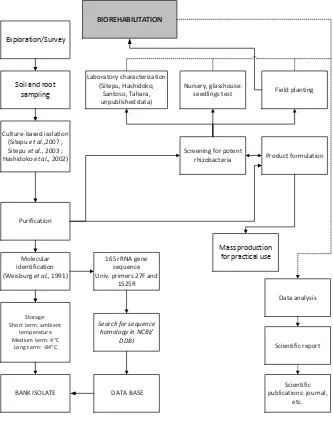
The orderly strategy for studying functional bacteria for plant growth promotion generally follows illustration in Figure 1. References therein describe the methods in detail.
B. Sampling Sites
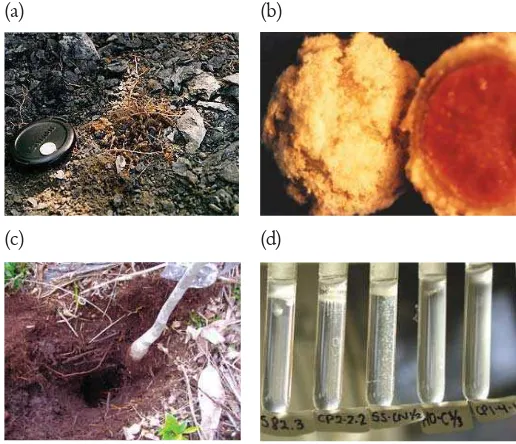
Exploration and isolation of functional bacteria have been done from biogeoclimatically different forest conditions ranging from abandoned/degraded to conserved ecosystems in Indonesia. The ecosystems ranged from adverse soils to conserved ecosystems: (1) former coal mining (Figure 2.a and b), cement mining, and degraded peat swamp forest (Figure 2.c and d) to represent degraded forest and adverse soils; (2) nursery to represent a controlled condition; (3) plantation forest of BKPH (Bagian Kesatuan Pemangkuan Hutan or forest management unit at regency level) Gunung Kencana to represent a monoculture/ oligoculture man-made system; (4) experimental forests of Carita, Haurbentes, and Cikole to represent maintained and diverse vegetation compositions; and (5) arboretum Nyaru Menteng to represent a conserved ecosystem.
(a) (b)
(c) (d)
Figure 2. Orderly strategy in investigating functional bacteria of Indonesian tropical forest plants for biorehabilitation of degraded lands.
III. RESULTS AND DISCUSSION
A. Isolation of Bacteria from Diverse Forest Conditions
forests types in Sumatra, Java, and Kalimantan, Indonesia. A study by Singh
et al. (2004) suggested that bacteria and plant are actually interdependent for
nutrient supply. Plants select their bacterial partners based on their functions rather than taxonomic (Wieland et al., 2001). This may rationalize our Þ ndings of diverse genera of associative bacteria isolated regardless of tree species.
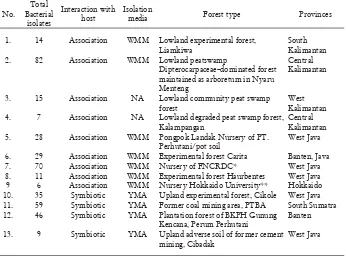
Bacterial identiÞ cation showed that gram-negative bacteria predominantly isolated from host plants indicate the common nature of the plant rhizosphere (Table 1) Predominance of gram-negative bacteria in the rhizosphere has been previously reported by Olsson and Persson (1999) and Donata-Correa et al.
(2004) who investigated rhizosphere bacteria of tagasaste and barley plants.
Table 1. Bacteria isolated from various forest types in Indonesia
No.
1. 14 Association WMM Lowland experimental forest,
Liamkiwa
South Kalimantan
2. 82 Association WMM Lowland peatswamp
Dipterocarpaceae–dominated forest maintained as arboretum in Nyaru Menteng
Central Kalimantan
3. 15 Association NA Lowland community peat swamp
forest
West Kalimantan
4. 7 Association NA Lowland degraded peat swamp forest,
Kalampangan
Central Kalimantan
5. 28 Association WMM Pongpok Landak Nursery of PT.
Perhutani/pot soil
West Java
6. 29 Association WMM Experimental forest Carita Banten, Java
7. 70 Association WMM Nursery of FNCRDC* West Java
8. 11 Association WMM Experimental forest Haurbentes West Java
9 6 Association WMM Nursery Hokkaido University** Hokkaido
10. 35 Symbiotic YMA Upland experimental forest, Cikole West Java
11. 59 Symbiotic YMA Former coal mining area, PTBA South Sumatra
12. 46 Symbiotic YMA Plantation forest of BKPH Gunung
Kencana, Perum Perhutani
Banten
13. 9 Symbiotic YMA Upland adverse soil of former cement
mining, Cibadak
West Java
Note : WMM: Winogradsky’s mineral mixture-based nitrogen-free medium solidiÞ ed
Isolated bacteria were maintained and stored in Forest Microbiology Laboratory, Forestry Research and Development Agency (FORDA), Indonesia and/or Ecological Chemistry Laboratory, Hokkaido University, Japan.
B. Screening of Growth Acceleration Capacity by Symbiotic Bacteria on Seedlings in Glasshouse Condition
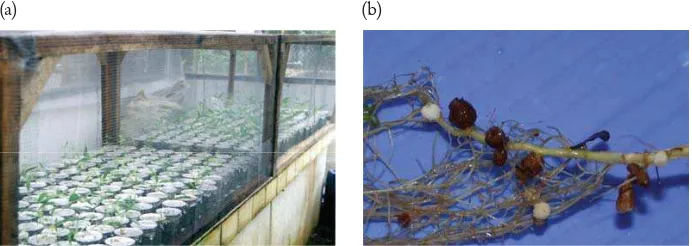
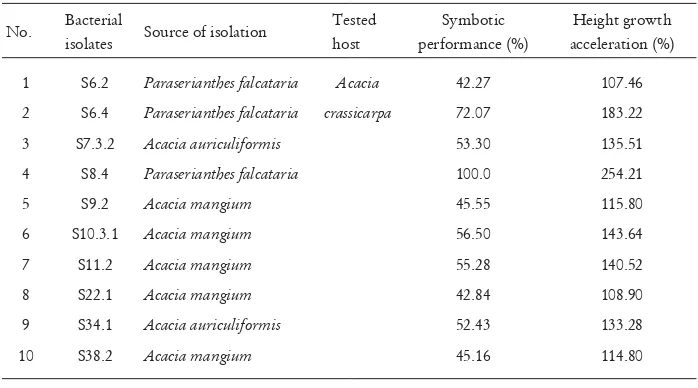
Most rhizobia inoculated improved growth of A. crassicarpa seedlings in controlled condition in glasshouse (Figure 3; Data not shown). Rhizobia that accelerated height growth more than 100% compared to non-inoculated seedlings are presented in Table 2. The most improved growth was achieved by seedlings inoculated with rhizobial strain S.8.4, as much as 254% (Sitepu
et al., 2003). Acacia crassicarpa is a legume species having better qualities and
adaptabilities towards more diverse conditions compared with other acacias, such as A. mangium, A. auriculiformis, A. leptocarpa, A. aulocarpa, A. cincinnata, A. uraria and A. hylonola (various sources in Kapisa et al., 2000).
Effectiveness of symbiosis led to a better nitrogen Þ xation by rhizobial inoculant. Dowling and Broughton (1986) said that eventual growth performance of inoculated plants was a resultant of many factors including rhizobial genomic, plant genomic and environment. This study by Sitepu et al.(2003) allowed selections of the most prominent rhizobia for accelerating A.
crassicarpa growth which is signiÞ cant for nursery management from economical
and ecological viewpoints.
(a) (b)
Figure 3. Screening of potent rhizobia for growth promotion of Acacia crassicarpa
Table 2. Symbiotic bacteria isolated from post coal mining areas and their efÞ ciency in improving growth of Acacia crassicarpa seedlings
No. Bacterial
isolates Source of isolation
Tested host
Symbotic performance (%)
Height growth acceleration (%)
1 S6.2 Paraserianthes falcataria Acacia 42.27 107.46
2 S6.4 Paraserianthes falcataria crassicarpa 72.07 183.22
3 S7.3.2 Acacia auriculiformis 53.30 135.51
4 S8.4 Paraserianthes falcataria 100.0 254.21
5 S9.2 Acacia mangium 45.55 115.80
6 S10.3.1 Acacia mangium 56.50 143.64
7 S11.2 Acacia mangium 55.28 140.52
8 S22.1 Acacia mangium 42.84 108.90
9 S34.1 Acacia auriculiformis 52.43 133.28
10 S38.2 Acacia mangium 45.16 114.80
C. Screening of Growth Acceleration Capacity by Rhizobacteria on Seedlings in Glasshouse Conditions
Bacteria have given immediate effect on seedling growth since the Þ rst month after inoculation. Dipterocarp seedlings responded variably to bacterial inoculation and most of the inoculated seedlings showed growth promotion. The growth promotion reached up to 41.4% and the most prominent PGPR strains from these studies are presented in Table 3. Only few of the tested bacteria gave negative effect on seedling growth. It has been pointed out that the negative effect is often resulted from phytotoxin produced by these bacteria (Brown and Rovira, 1999).
Table 3. Rhizobacteria and their efÞ ciency in improving growth of dipterocarp seedlings
No. Bacterial isolates Source of isolation Tested host Height growth
acceleration (%)
1 Erwiniasp. FL11.2.2 Shorea leprosula Shorea selanica 35.57 2 AlcaligenaceaeFL2.4.2 Hopea mengarawan Shorea selanica 33.56 3 Burkholderiasp. FL3.5.1 Hopea odorata Shorea selanica 19.46 4 Pseudomonassp. FL41 Shorea selanica Shorea leprosula 29.01 5 Burkholderia sp. FL44 Hopea mengarawan Shorea leprosula 27.48 6 Rhizobium sp. FL5.1 Hopea mengarawan Shorea leprosula 30.53
7 NI HM3 Hopea mengarawan Shorea selanica 28.71
8 Sphingomonas sp. R5b Shorea balangeran Shorea selanica 32.67 9 Sphingomonas sp. SB3 Shorea balangeran Shorea selanica 40.59 10 Burkholderiasp. FL37 Shorea selanica Shorea selanica 27.23 11 Enterobacter sp. FL13.2.1 Shorea leprosula Shorea leprosula 31.60 12 Burkholderia sp. CK32 Shorea balangeran Shorea leprosula 41.40 13 Burkholderia sp. JW6 Shorea selanica Shorea leprosula 23.50 14 Azospirillum sp. JW13 Shorea selanica Shorea leprosula 32.00
15 NI CK4 Shorea balangeran Shorea leprosula 30.70
D. Screening of Growth Acceleration Capacity by Double Inoculation of Rhizobacteria and Arbuscular Mycorrhizal Fungi in Glasshouse Conditions
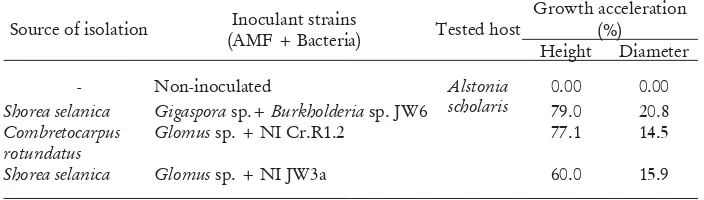
Double inoculations of arbuscular mycorrhizal fungi (AMF) accelerated height and diameter growth of Alstonia scholaris seedlings up to 79 and 20.8%, respectively compared to non-inoculated seedlings (Table 4). Our studies suggested that individual inoculation of either AMF or bacteria gave most signiÞ cant effect on height growth, whereas double inoculation gave most signiÞ cant effect on diameter growth (Data not shown).
Table 4. Double inoculation of bacteria and AMF and growth acceleration on
Alstonia scholaris
Shorea selanica Gigaspora sp.+ Burkholderiasp. JW6 79.0 20.8 Combretocarpus
rotundatus
Glomus sp. + NI Cr.R1.2 77.1 14.5
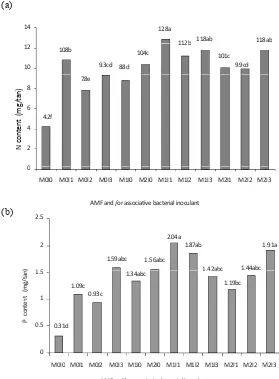
Double inoculation of AMF and rhizobacteria increased N and P content
of Agathis lorantifolia seedlings 6.5 months after inoculation (Figure 4;
11.8ab
M0I0 M0I1 M0I2 M0I3 M1I0 M2I0 M1I1 M1I2 M1I3 M2I1 M2I2 M2I3
AMFand/orassociativebacterialinoculant
(a)
M0I0 M0I1 M0I2 M0I3 M1I0 M2I0 M1I1 M1I2 M1I3 M2I1 M2I2 M2I3 M0I0 M0I1 M0I2 M0I3 M1I0 M2I0 M1I1 M1I2 M1I3 M2I1 M2I2 M2I3
AMFand/orassociativebacterialinoculant
(b)
Figure 4. N and P content of Agathis loranthifolia seedlings inoculated with AMF and rhizobacteria (Miftahuliyah et al., 2006 unpublished data). Note: M0I0 (non-inoculated); M0I1 (without AMF + bacteria strain Aa.R2.1); M0I2 (without AMF+ bacteria strain Gr.R2.1); M0I3 (without AMF+bacteria strain Nt.R2.2); M1I0 (Gigaspora sp+without bacteria); M2I0 (Glomus clarum+without bacteria); M1I1 (Gigaspora sp+bacteria strain Aa.R2.1); M1I2 (Gigaspora sp+ bacteria strain Gr.R2.1); M1I3 (Gigaspora sp+ bacteria strain Nt.R2.2); M2I1 (Glomus clarum+ bacteria strain Aa.R2.1); M2I2 (Glomus clarum+ bacteria strain Gr.R2.1); M2I3
E. What is necessary in bioreforestation using functional bacteria
Our screening works in laboratory and glasshouse/nursery provide preliminary, which is yet an important information on the effective PGPR. Most bacteria induced growth promotion effect on tested plants. We have found that growth performance of plants after inoculation is a resultant of bacteria-host-environment interaction. The consequence of this interaction is a rather speciÞ c case therefore screening work should not be overlooked for obtaining optimum growth promotion effect. In a relatively small pot condition, however, particularly at the initial stage, competition is likely so high for nutrition, water as well as niche. It is clear that much more complex mechanisms are on functioning in the bacteria-plant interaction than what we have already understood.
In the case of legume-rhizobia symbiosis, Kijne (1992) reported the rate of biologicalÞ xation from this symbiosis that reached 40% of the global Þ xation rate or approximately 70 tons of available nitrogen per year. The author further suggested that this type of symbiosis could provide exclusive nitrogen supply available for plant uptake and replace the use of urea fertilizer. Although these studies have been done extensively, particularly in the agriculture sector, Brockwellet al. (1995) and Thies et al. (1992) reported that an introduction of foreign rhizobial inoculant to a new soil environment often failed to conduct efÞ cient symbiosis due to a severe competition with the native rhizobia and other soil inhabitants. Therefore, searching for local biopotential of rhizobia from each of the targeted sites for biorehabilitation should be implicated.
Utilization of PGPR in agriculture is different from that in forestry because of the different practices in these two research disciplines. In agriculture, rhizobacteria are commonly applied as bacterial paste coated on annual crop seeds, and the seeds are directly planted in the Þ elds; but in the forestry, rhizobacteria are often applied to perennial seedlings Þ rstly grown in nursery before transplanting to the Þ elds (Lucy et al., 2004). Application of these functional bacteria isolated from various forest types in Indonesia for preparation of seedlings in the nursery is one alternative to obtain ecological and economical beneÞ ts. This approach would be more preferable than the excessive inputs of inorganic fertilizers, such as of NPK fertilizers. Nowadays, the urge to Þ nd alternative to reduce environmental loads due to chemicals utilization have widely drawn attentions. Kloepper (2003) raised the problem of nitrate contamination of ground water and phosphate run-off that has led to eutrophication of ponds and rivers.
into the Þ elds. A further study to test the preliminary nursery results will be implicated in our future works. In the adoption process of the seedlings to adverse environments in a complex and natural situation, more important and interesting nature of PGPR-plant interaction may be discovered.
From a practical viewpoint, biorehabilitation is dependent upon soil managements by providing sufÞ cient nutrient for plants to grow well. It is then necessary to focus on rhizosphere soil because PGPR have abilities to alter and regulate such micro-scale of soil environments. These studies would provide a better understanding in planning a practical biorehabilitation strategy.
Preparation of seedling inoculated with bacteria before the outplanting is relatively easy for nursery application, environmentally benign, and inexpensive. The use of indigenous plant species over introduction of exotic ones is another important consideration for bioreforestation. Local trees are more adaptable to site local condition and their timber and non-timber productions are highly saleable and priceless. In a global account, regenerated forest may contribute to responding to the current global issues of carbon sink destruction as well as greenhouse emission that accelerate global warming and exacerbate El Nino weather impact.
IV. CONCLUSIONS
1. Four hundreds and eleven bacteria isolates were trapped from diverse hosts of various forest conditions in Indonesia including degraded, nursery, man-made, experimental, and conserved forests.
2. Various responses of seedlings due to inoculations form our repeated studies which emphasized the importance of screenings stage of rhizobacteria for optimum growth improvement. Inoculations gave positive, no or negative effect on seedling growth.
3. Bacteria functioned immediately after inoculation, promoting various growth performances of the tested seedlings. This stage is very critical in screening effective rhizobacteria and understanding the ecological role of these bacteria in their interaction with trees.
4. Double inoculation of rhizobacteria and AMF increased N and P content
of Agathis lorantifolia seedlings 6.5 months after inoculation. The most
improved N and P contents (12.8 and 2.08 mg/plant) were achieved by the seedlings inoculated with a combination of bacteria strain Aa.R2.1 and
Gigasporasp.
micro-scale environment would assist us in formulating a practical strategy for biorehabilitation.
ACKNOWLEDGEMENT
The studies were Þ nancially supported by various funding sources including APBN, MOF from 2001-2007; 2003 RITE project to Y.H.; JSPS no. 16208032 grant-in-aid to Y.H.; Monbukagakusho and JSPS-LIPI Core University Program on Environmental Conservation and Land-use Management of Wetland Ecosystem in Southeast Asia. Najmullah, Sugeng Santosa and Ahmad Yani are appreciated for their sincere laboratory and glasshouse assistance.
REFERENCES
Brockwell J., P. J. Bottomley, and J. E. Thies. 1995. Manipulation of rhizobia microß ora for improving legume productivity and soil fertility: A critical assessment. Plant and Soil 174: 143-180.
Brown, G.D. and A.D. Rovira. 1999. The rhizosphere and its management to improve plant growth. Advances in Agronomy 66: 1-102.
Chanway, C.P. 1997. Inoculation of tree roots with plant growth promoting soil bacteria: an emerging technology for reforestation. Forest Science 43: 99–112.
Donate-Correa, J., M. Le´on-Barrios, and R.P´erez-Galdona. 2004. Screening for plant growth-promoting rhizobacteria in Chamaecytisus proliferus
(tagasaste), a forage tree-shrub legume endemic to the Canary Islands. Plant and Soil 266: 261–272.
Dowling D. N. and W. J. Broughton. 1986 Competition for nodulation of legumes. Annual Reviews of Microbiology 40: 131-157.
Frey-Klett, P., J.C. Pierrat, and J. Garbaye. 1999. Location and survival of Mycorrhiza helper Pseudomonas ß uorescens during establishment of ectomycorrhizal symbiosis between Laccaria bicolour and Douglas Þ r. Applied and Environmental Microbiology 63: 139-144.
Garbaye, J. 1994. Helper bacteria: a new dimension to the mycorrhizal symbiosis. New Phytolology 128: 197-210.
García, J.A., J. Domenech, C. Santamaria, M. Camacho, A. Daza, and F.J.G. Maėero, 2004. Growth of forest plants (pine and holm-oak) inoculated
Hashidoko, Y., M. Tada, M. Osaki, and S. Tahara. 2002. Soft gel medium solidiÞ ed with gellan gum form preliminary screening for root-associating free-living bacteria inhabiting the rhizoplane of plants. Bioscience Biotechnology Biochemistry 66: 2259-2263.
Kloepper, J.W. 2003. A review of mechanisms for plant growth promotion by PGPR. 6th International PGPR Workshop, 5-10 October 2003,
Calicut, India. WWW: http://www.ag.auburn.edu/~mlowens/india/ october2003/Contents.pdf
Kapisa, N., Jayusman and R. Harahap. 2000. Growth of bank clone Acacia
crassicarpa 1 year after planting. Buletin Penelitian Kehutanan 15:1-9.
Kijne, J.W. 1992. (G. Stacey, R.H. Burris and H.J. Evans, Eds). The Rhizobium infection process. In Biological Nitrogen Fixation. Chapman and Hall, New York. pp. 349-398.
Lucy, M., E. Reed, and B.R. Glick. 2004. Application of free living plant growth-promoting rhizobacteria. Anthony van Leuwenhoek 86:1-25.
Miftahuliyah, S.S. 2006. Double inoculation of arbuscular mycorrhizal fungi and free-living bacteria on the growth of Agathis loranthifolia Salibs. Undergraduate thesis. Winayamukti University, Bandung, Indonesia. Olsson, S. and P. Persson. 1999. The composition of bacterial populations in
soil fractions differing in their degree of adherence to barley roots. Applied Soil Ecology 12: 205-215.
Sitepu, I.R., E. Santoso, and U. Muß ih. 2003. Effectivity of rhizobia isolated from marginal acid land ex-coal mining in accelerating Acacia crassicarpa
seedling growth. Proceedings of Research and Development Discussion “Forest Resource Rehabilitation and Conservation”. Bogor, 23 December 2002. in Indonesian language.
Smith, A., S.E. Smith, B.J. John, and D.J.D. Nicholas. 1986. Inß ow of N and P Into roots of mycorrhizal and non-mycorrhizal onions. Physiological and Genetical Aspects of Mycorrhizae. Proceedings of 1St International
European Symposium on Myccorrhizae, Dijon, 1-5 July 1985. INRA: 371-376.
Singh, B.K., P. Millard, A.S. Whiteley, and J.C. Murrell. 2004. Unraveling rhizosphere-microbial interactions: opportunities and limitations. Trends in Microbiology 12: 386-393.
HCMC, Vietnam, 15-17 November, 2005. APAFRI. Ho Chi Minh City, Vietnam.
Thies J.E., B.B. Bohlool, and P.W. Singleton. 1992. Environmental effects on competition for nodule occupancy between introduced and indigenous rhizobia and among introduced strains. Canadian Journal of Microbiology 38: 493-500.
Tilak., K. V. B. R., N. Ranganayaki, K.K. Pal, R. De, A. K. Saxena, C.S. Nautiyal, S. Mittal, A.K. Tripathi, and B.N. Johri. 2005. Diversity of plant growth and soil health supporting bacteria. Current Science 89: 136-150. Wieland G., R. Neumann, and H. Backhaus. 2001. Variation of microbial