Enthusiasm Enhancement of Elementary School Teacher through
‘Training
and Development Personnel Model’
and Its Success
Determinant
Slameto
Primary School Teacher Education Program, Satya Wacana Christian University Salatiga
Abstract.
World Bank Research states that Indonesian teachers are mentioned to be the lowest quality as an agent of change regarding their low productivity, low teacher enthusiasm, and many more factors. For that reason, a set of teacher empowerment models are urgently needed. One of them is the Training and PersonnelDevelopment Model. This model is aimed to test the efficiency and effectiveness of teacher’s training model
and to find the determinant factor which concludes teacher enthusiasm. And it was developed through three stages of method; a preliminary study, the development model of teacher training, and continued validation of the model by examining its efficiency and effectiveness. The training is followed by 37 people, 17 of them are the alumni PJJ institution. A training was taken place in the studio of Working Group Teacher at Wonosobo regency, on the 2nd to 10th May 2013. From the training that was conducted, it was shown that most workshops for elementary school teachers were not efficient and effective and had not increased teachers’ enthusiasm. Yet, the developed training model is proven to be efficient and effective. There are 3 models of determinants; 1) positive habits, 2) clear and meaningful task and 3) the cooperative and anticipative activity which increases 81.60% of teachers' enthusiasm.
Keywords:
Elementary School Teacher Training, ‘Training and Development Personnel Model’, Efficiency and Effective Model, Teacher’s Enthusiasm Determinant.1.
Introduction
The students’ future is largely determined by the role of teachers in today's schools. The school serves students to prepare and develop future generations of the nation. Therefore, the school and the teachers are
expected to be able to adjust themselves to rapid changes in terms of students’ trends and the community needs. A teacher is regarded as an agent of change. Consequently, a teacher is expected to bring positive changes for the students and the school including the context of the curriculum, learning, and evaluation. A teacher is also viewed by the learners because of his personal habits. World Bank Research stated that Indonesian teachers are mentioned to be the lowest quality as an agent of change regarding their low productivity, low teacher enthusiasm, and many more factors.
The success and productivity of a teacher are closely associated with his enthusiasm. When his enthusiasm is high, the teacher will be creative and active and has a tendency to show the hard work so that he is able to achieve high performance. Enthusiasm is an important capital for teachers to be able to create high performance [4].
Within his high enthusiasm, a teacher will be able to become a good role model who motivates and inspires students, so that the students will be able to optimize their potentials that are useful for their future.
Teacher’s enthusiasm drives significant change. Ironically, there is a disparity from a World Bank study. Due
to the fact, an empowerment is needed for teachers. Yet, the suitable model of teacher training should also be designed to meet the goal. One of the suggested models is the teacher empowerment training 'Training and Personnel Development Model' of Otto and Glaser, which is considered quite effective. Further problems that influence the success of the model and how to apply the model to graduate program of Distance Education will be discussed in this article.
Corresponding author.
E-mail address: [email protected].
The problem in this research is (1) how 'Personnel Training and Development' model is able to enhance the enthusiasm of the teacher, (2) What factors that determine or become a determinant and (3) how the model contributes enthusiasm enhancement of trainee teachers. The aim of the research is to test the efficiency and effectiveness of the training model 'Training and Development Personnel' and find the determinant factors that decide the teachers’ enthusiasm through training.
2.
Theory
Enthusiasm is excitement, the surge of passion, great interest in something. The word enthusiasm originates from the Greek word Entheos which means "God within" or "inspired by God". Enthusiasm and confidence are a feeling, an awareness of a relationship between a person and a source of strength to reach the goal. Enthusiasm is a harmony and trust, an awareness of a relationship between a person and a source of strength to reach the goal. Therefore we need to speak using enthusiasm and a positive attitude and act with confidence. Energy can be transmitted or as a contagious enthusiasm by itself to the people around us. Enthusiasm will propel someone forward and win his fight [6].
Enthusiasm is the choice of the feelings that come up and is selected then continued and strengthened, because enthusiasm can be generated from and within ourselves or by circumstances beyond the self, the most powerful is the choice of yourself, because when you have decided to choose to be enthusiastic, then it will run the program in the minds directly generate energy.
Teachers need enthusiastic motivation and feeling so that they can continuously work and do their job with joy. Enthusiasm should be brought to the teachers themselves or anyone who has a goal to be able to work comfortably, happily and joyfully, to then earn success.
In his role as an agent of change agent, an enthusiastic teacher needs to have basic characteristics or abilities then he has to be persistent with it. Ability was illustrated beautifully by Fullan [7] with four basic capacities to be inherent in a teacher as an agent of change. The basic characters of the 4 capacities are: development of a personal vision, customs inquiry, the importance of mastery and collaboration.
The ability to learn together or to work together is needed. Moreover the ability to learn to overcome personal weaknesses which usually comes within the limitations of the self. Working in a group has been also a characteristic of modern developments lately. Effective collaboration is usually compensated by the inquired personal skills continuously. Yet it can be achieved in collaborative learning. For students, this model is more interesting and getting more real, because it brings real life into the complexity and variety of aspects. In a broader perspective, the teacher can apply the model together and with other stakeholders.
Many factors are able to generate enthusiasm, these are the following [6]:
Intention or Purpose Factor. Consciously or unconsciously someone will be very excited since he has clear objectives to be achieved. Consequently a person is able to choose the path and make the right strategies to evoke and reinforce enthusiasm.
Goal Setting or Target Planning. It is part of a clear intention above moreover if someone is having a target in the future in a few years or months of work or life. Goal setting greatly affects the enthusiasm in the work, directing the action and keep the spirit to remain high.
Potential and Barriers Recognition. To realize potential and barriers then someone has to have a big picture of his ability, expertise, strengths and whatever resources. Those are the things needed to be improved and learned, to boost confidence, strengthen the self-esteem and definitely thank to the Creator.
Positivity in thoughts, words and feelings, as much as possible can emit positive energy around and it will be responded by the universe then will be returned back to him as greater positivity. Positivity will lead to a positive attitude and perception to face and address the coming events, facilitate oneself to achieve the desired goals.
Group learning methods collectively is immediately needed. It is to overcome personal weaknesses which
usually creates one’s limitations. Working in a group will also stimulate mutual and radiate enthusiasm and
positive energy among the members. Effective collaboration continuously inquires personal skills.
Education and training as an integral system is a set of components or elements or sub-systems that
interact to improve teachers’ competence so that they could perform better in learning, education and training activities [9]. Approach in education and training system consists of a series of components such as ‘input’,
‘process’, ‘output’, and ‘come out’ element. ‘Input’ element can be in the form of education and training
taught by competent lecturers. Certainly, there are some factors that need to be concerned regarding to training management such as budget, time, facilities and infrastructure. A learning process is as a sub-system in education and training, evaluation of pre-and-post education training, class infrastructure structuring and so on. An output is the result of education and training after completion, among other papers of training materials, and mastery of specific capacity. An output is in accordance with the expected certificates, statements of work entered the world, or a license. An outcome relates to graduate productivity or contributions to the organization.
Based on the needs analysis, education and training targets have to be set. Goals should also be clearly stated. All good study principles should be applied to the learning process so that it can be done quickly and precisely. Basically there are some conditions to be applied in the learning process; participation, repetition, relevance, transfer and feedback. The appropriateness of the teaching technique has to meet the following factors; frugality in finance, program materials, the availability of certain amenities, preferences and abilities of participants, preferences and ability to coach and applied learning principles. By implementing education
and training, teachers’ knowledge and skill will be certainly improved. An education and training program can be successful if the participants are able to involve themselves in performing the task and behavioral changes that are reflected in their attitude, discipline and work ethic.
One of the efforts to improve teacher’s competence— besides enthusiasm—is an effective organization of education and training competency [9]. The structure of education and training programs of particular competencies needs to be designed in a comprehensive manner. Since a comprehensive education and training
is expected to effectively increase the teacher’s competence. Identification of information related to the real
competencies that a teacher should own in his battle field need to be concerned. Competency goals, education and training materials, the developed experience, learning resources, allocation of time to education and training have to be mapped when designing the training.
It is necessary to pay attention to the relevant strategies to participant characteristics. Education and training materials should facilitate active and fun learning, experience-based and competence-based development, designing effective training scenarios which are controlled, and accountable. Education and training should be relevant to the needs, to get a positive response from the participants. Therefore, a well-planned education and training through an assessment process is important.
The trainer should be able to deliver the material well. There are some factors to be concerned due to well delivery [10]; the application of andragogy approach which is based on experience and performance
development; development of the participants’ experience through active learning, and involving participants
as the subject of education and training activities during learning process. By experiencing and getting involved in particular activities, the education and training will be able to attract pleasant and carefully evaluation. The involvement of participants will also create a good mental, emotional, social, or physical atmosphere, besides the training environment will be more "live" and the participants will be more enthusiastic. Some self reflections are needed to see, then evaluate and secure the weakness. As a result, some integrated sides (like FGD), should be involved.
Based on the reasons above, some factors that influence the success of a good education and training will depend on the following aspects; clear & meaningful task, cooperative- anticipative activity, cooperative learning experience based methods, cooperative and correlative, participative, exhibittion result, elaboration of knowledge, critical thinking, reflection and anticipative thinking, good image result and positive habits.
3.
Model Development
There are many models of instructional system design. Those systems-oriented models are the Dick & Carey Model, ADDIE Model, and others. Meanwhile there are also models of instructional design-oriented products, which is aimed to produce products, such as the model of Hannaffin & Peck or rapid prototype models (rapid prototype models). Also, there is a model which focuses on teaching and learning activities in the classroom, like ASSURE or ICARE.
Generally, the design steps are as the following; stage of analysis, design, development, implementation and evaluation. The evaluation process can be done at each step from the stage of analysis to evaluate itself. This training system allows participants to absorb information or knowledge, perform skills, interact and study the knowledge and skills, then do a reflection toward materials taught. The things above are required to create a successful training design.
Otto and Glaser [5] proposed training strategy development model in terms of Model Training and Development Personnel. This model consists of five activities;
Analyzing problems exercise
Formulating and developing training purposes
Selecting, training materials, learning media, methods and training techniques
Developing curricula and units, eye exercises, and training topics
Assessing the results of the exercise.
An effective training model has to be based on curricula, approaches and strategies that fit the needs of the target learners and learning problems. Consequently, special requirements are needed to model an effective and efficient training. The requirements include the need and problem of the trainees. An analysis phase typically includes several steps. First, system analysis that generally depicts a client who asks for training design. The job analysis is not necessary anymore if he has had an adequate profile. The objectives and task formulation of participants attended the training need to be set then followed by reflection. Then materials and media should be selected followed by the quality of the training methods under the inspiration of trainee teachers. Once the particular things are set (curriculum and units, eye exercises, and training topics) an evaluation should be conducted. The evaluation has to be done to determine whether the training program objectives are achieved or not, and to determine if the content and training administration are satisfied or not, to determine the benefits and costs of the program and to compare the costs and benefit of various training programs then to choose the most excellent program.
Training and Personnel Development Model which consists of five steps is developed through three stages: a preliminary study, teacher training model development, validation model followed by efficiency and effectiveness evaluation in the form of self-assessment training participants. The training that had been conducted was for primary school teachers followed by 37 people and took place in the studio of the Working Group on Teacher Wonosobo regency from the 2nd to 10th of May 2013.
4.
Measurements and Results
The ‘Training and Development Personnel’ model has done the following five activities or methods:
Analyzing problems exercise
Formulating and developing training purposes
Selecting, training materials, learning media, methods and training techniques
Developing curricula and units, eye exercises, and training topics
Assessing the results of the exercise.
And those five steps are divided again into three main activities;
Preliminary studies that include analyzing problems exercise
Validation of models including further assessment of the results which will be used as the basis to develop models and learning strategies.
Based on the preliminary study found that during this time many teachers have problems related to teacher professional development. The problems are related to both low mastery of pedagogical competence that leads to the lower quality implementation of the duties and functions as a teacher. Most workshops attended by primary school teachers are not efficient and effective yet and have not inspired teachers to become the agents of change. For that reason, suitable and appropriate training (using Training and Development Personnel Model) needs to be designed.
Elementary teacher training was held by Working Group Teacher in Wonosobo Regency, at May the 2nd– to the10th, 2013 together with five facilitators from Elementary Teacher Education Department of Christian University of Satyawacana of Salatiga. There were 37 participants attended in the training and 17 of them are alumni of SWCU Blended Learning Program.
After the first and second step is done, the validation model is performed. Validation of Personnel
Training and Development Model is a measurement of the process of primary school teachers’ training, which includes measurement of training’s efficiency and effectiveness. It is by conducting participants’
self-assessment and training results using their overview. Participants' self-assessment at table 1 below shows the level of efficiency and effectiveness of the training given.
Table. 1: Variable description and results training process
Variable Mean Median Std. Deviation
Efficiency 3,33 3 0,63
Enthusiastic 3,21 3 0,58
Since the mean point is more than the median, it shows that Training and Development Personnel Model is efficient and effective. Thus it can develop enthusiasm of elementary school teachers. Meanwhile, there are 12
independent variables to be determinant factors that affect teachers’ enthusiasm in the development of training as the following;
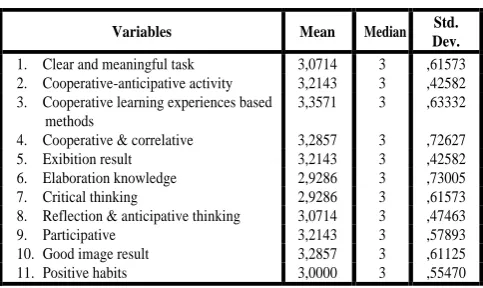
Table. 2: Description of the 11 independent variables
Variables Mean Median Std.
Dev. 1. Clear and meaningful task 3,0714 3 ,61573 2. Cooperative-anticipative activity 3,2143 3 ,42582 3. Cooperative learning experiences based
methods
3,3571 3 ,63332
4. Cooperative & correlative 3,2857 3 ,72627
5. Exibition result 3,2143 3 ,42582
6. Elaboration knowledge 2,9286 3 ,73005
7. Critical thinking 2,9286 3 ,61573
8. Reflection & anticipative thinking 3,0714 3 ,47463
9. Participative 3,2143 3 ,57893
10. Good image result 3,2857 3 ,61125
11. Positive habits 3,0000 3 ,55470
Based on the results as presented in the table above, there are 9 most significant independent variables out of 12 which are examined; 1) Clear and meaningful task, 2) Cooperative- anticipative activity, 3) Cooperative learning experience based methods, 4) Cooperative and correlative, 5) Exhibition result, 6) Reflection & anticipative thinking, 7) Participative, and 8) Good image result. There are only 3 variables are less well developed through this training, namely: 1), Elaboration knowledge, 2) Critical thinking and 3) Positive habits.
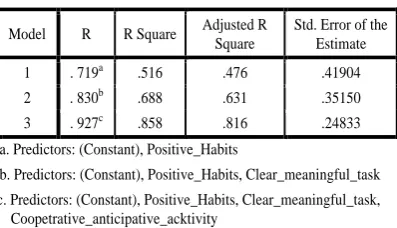
Then to find determinant factors of teachers’ enthusiasm, a Step Wise Model Regression is conducted as
shown in table 3 below.
Table. 3: Model summary
Model R R Square Adjusted R Square
Std. Error of the Estimate
1 . 719a .516 .476 .41904
2 . 830b .688 .631 .35150
3 . 927c .858 .816 .24833
a. Predictors: (Constant), Positive_Habits
b. Predictors: (Constant), Positive_Habits, Clear_meaningful_task
c. Predictors: (Constant), Positive_Habits, Clear_meaningful_task, Coopetrative_anticipative_acktivity
Regression analysis as above shows that there are only 3 independent variables (out of 11) which
influence teachers’ enthusiasm according to their respective standards of error. The effect of positive habits variable (model 1) toward teacher's enthusiasm is 47.60%. While positive habits variable and clear-and-meaningful task variable (model 2) creates 63.10%. Positive habits variable, clear-and- meaningful task variable, and cooperative-anticipative activity (model 3) makes 81.60%. Meanwhile, Table 4 shows the level of significance of each model.
Table. 4: Significance test results ANOVAE for effect 3 independent variables
Model Sum of
Squares df
Mean
Square F Sig.
1 Regression 2.250 1 2.250 12.814 .004a
Residual 2.107 12 .176
Total 4.357 13
2 Regression 2.998 2 1.499 12.133 .002b
Residual 1.359 11 .124
Total 4.357 13
3 Regression 3.740 3 1.247 20.219 .000c
Residual .617 10 .062
Total 4.357 13
a. Predictors: (Constant), Positive_Habits
b. Predictors: (Constant), Positive_Habits, Clear_meaningful_task c. Predictors: (Constant), Positive_Habits, Clear_meaningful_task, Coopetrative_anticipative_acktivity
e. Dependent Variable: enthusiastic
Based on the ANOVA results as presented in Table 4 above, there are only 3 models (out of 11
independent variables) which are concluded as a determinant variable of teachers’ enthusiasm, while 9 other
variables are excluded from the model because of its insignificant results. Model 1 says that F = 12.814 and its
significance level is 0.004; It means that the positive habits variable become determinant variable of teachers’
enthusiasm in Training and Development Personnel Model with 47.60% influence. Model 2 states that F = 12.133 with a significance level of 0.002; positive habits and a clear and meaningful task can be a significant determinant with 63.910% influence. While model 3 shows that F = 20.219 with a significance level of 0.000; positive habits, clear and meaningful task and anticipative cooperative activity can be a significant determinant of 81.60% influence.
5.
Discussion
A training model is considered effective when it is based on curriculum, the right approaches and strategies to meet the teachers' needs in their real world. Three determinant variables are proved to contribute almost 82% to the success of the training; they are positive habits, clear and meaningful task and anticipative cooperative activity. As a result, the success of Personnel Training and Development Model depends on how the curriculum, quality of materials and method of training allow the participants to set clear and meaningful goals and to apply cooperative learning, and how to anticipate problems in most elementary school levels. These findings strengthen the theory of positive psychology that is proven effective in training Personnel Training and Development Model.
The model consists of five steps which are then modified into 3 activities that allow the trainee teachers to not only absorb knowledge, interact in their knowledge and skills, and do self-reflect toward material taught, but also to build teamwork, foster a positive work habits since the beginning of the training, then participate in clear goal setting. Those things are needed to create a successful training design. So it is feasible if the training
successfully develops teachers’ enthusiasm supported by three significant independent variables; positive
habits, clear and meaningful task and anticipative cooperative activity.
A teacher—especially as the alumnus of SWCU PJJ has to have "strong vision" toward his profession. He must always ask and ask again and clarify his intention to become a teacher. A teacher must love changes and renew his enthusiasm. So that every training that he attends will be able to build his positive habits and develop his new enthusiasm as an agent of change.
6.
Conclusion
Training and Development Personnel Model for primary school teachers of PJJ alumni program at Wonosobo is proven to be the efficient and effective as shown by the supported data; based on the results of the analysis, there are 9 most influencing variable (out of 11) ; 1) Clear and meaningful task, 2) Cooperative-anticipative activity, 3) Cooperative learning experience based methods, 4) Cooperative and correlative, 5) Exhibition result, 6) Reflection & anticipative thinking, 7) Participative, and 8) Good image result. Yet there are only 3 variables are less well developed through this training, namely: 1), Elaboration knowledge, 2) Critical thinking and 3) Positive habits.
There are 3 determinant variables which influence teachers’ enthusiasm: positive habits (Model 1), clear and meaningful task (Model 2) and anticipative cooperative activity (Model 3) the magnitude of the effect can reach 81.60%. Therefore, this model can be replicated in other teachers working’s groups to improve the quality of teacher professionalism by increasing teacher enthusiasm for education, especially for the
elementary school teachers’ improvement.
7.
References
[1] Putu Sudira, 2012. Guru Sebagai Agen Modernisasi Pendidikan Dalam Dimensi Sosio-Kultural Untuk Peningkatan Kualitas Pendidikan. http://eprints. uny.ac.id/id/eprint/656
[2] Hidayat Jaya Giri. 2012. Pendidikan Usia Dini Masa Emas. www.hidayatjayagiri.net/2012/12/pendidikan -usia-dini-masa-emas.html
[3] World Bank. 2006. Mengefektifkan Pelayanan bagi Masyarakat Miskin di Indonesia: Titik Fokus untuk Mencapai Keberhasilan di Lapangan. http://ddp-ext. worldbank.org/ EdStats/IDNstu06a.pdf
[4] Andrew Ho. 2005. Dressed for Success. Jakarta: Elex Media Komputindo
[5] Mustafa Kamil, 2003. Model-Model Pelatihan. Bandung: UPI
[6] Ruly Mujahid, 2012. Bangkitkan antusiasme anda. http://reframepositive.com
[7] Fullan, M. G. 1993, Why Teachers Must Become Change Agent. Education Reform. Educational leadership Mar 1993, 50, 6
[8] Gokhale,A.A. 1995. Collaborative Learning Enhances Critical Thinking. ejournals JTE. Volume 7, Number 1 Fall 1995