ICM Action Planning
Lessons Learned from the Tanga Coastal Zone
Conservation and Development Programme
Proceedings of a Workshop held in Tanga, Tanzania
August 21-23, 2000
Prepared by Elin Torell, James Tobey and Trudy Van Ingen
University of Rhode Island’s Coastal Resources Center
Tanga Coastal Zone Conservation and Development Programme
Tanzania Coastal Management Partnership
World Conservation Union
Table of Contents
1. Introduction
2. What is Action Planning for Integrated Coastal Management?
3. The Coastal Management Project Cycle
4. The Evolution of Action Planning in Tanga
5. Key Dimensions of Action Planning in the Tanga Programme
A. Issue identification, problem analysis and action prioritisation B. Capacity building
C. Adoption and linking plans to existing legal and institutional frameworks D. Monitoring and evaluation
E. Sustaining support and participation over time
6. Contextual Barriers and Bridges to Action Planning
7. The Outcomes of Action Planning
8. Guidance for Future Action Planning
A. Issue identification and analysis B. Preparation of the action plan C. Formal adoption and funding
Workshop Participants
ICM Action Planning: Lessons Learned from the Tanga Coastal Zone Conservation
and Development Programme
Tanga, Tanzania
August 21-23, 2000
Facilitators
1. Elin Torell, University of Rhode Island, Coastal Resources Center 2. Jim Tobey, University of Rhode Island, Coastal Resources Center
3. Trudi Van Ingen, Tanga Coastal Zone Conservation and Development Programme
Tanga programme support staff
4. Solomon Makoloweka 5. Chris Horrill
6. Margreth Ndwela 7. Stella Salim
District Government Staff
8. Emanuel Mgongo, Pangani District Coordinator
9. Fatuma Bahunde, Tanga Municipality Agricultural Officer 10. Hosiana Kusiga, Tanga Community Development Officer
11. Claudia Kawau, Muheza District Community Development Officer 12. Frida C. Urio, Pangani District Agricultural Officer
13. Amin M. Abdallah, Pangani District Fisheries Officer 14. Hassan Kalombo, Muheza District Fisheries Officer 15. Enedy Mnzava, Tanga Municipality Education Officer 16. E.M. Kalolo, Tanga Municipality Fisheries Officer
17. Magreth Sabuni, Tanga Municipality Community Development Officer 18. John Kabamba, Muheza District Forestry and Beekeeping Officer 19. Lugazo Zuberi, Muheza District Fisheries Officer
20. Ally A. Mwemjudi, Pangani District Mangrove Officer
21. Agnes R. Mfuko, Pangani District Community Development Officer 22. S.A. Semtaga, Pangani District Community Development Officer 23. Michael Mfuko, Muheza District Community Development Officer 24. H. J. Kwallow, Mwambani Community Development Officer 25. M.R. Dengo, Tanga Municipality, Fisheries District Coordinator 26. Shehoza Mhina, Fangani District Forestry Officer
27. Mohamed Y. Abdallah, Muheza District Fisheries Officer
28. A.E. Sangawe, Tanga Municipality Community Development Officer 29. David Mdoe, Muheza District Fisheries Officer
30. George Uronu, Tanga Municipality Community Development Officer
Villagers
Tanga Coastal Management Partnership
32. J.M. Daffa
33. John Bosco Tindyebwa 34. Augustine Ntumbo 35. Lewis Mfuko
Mafia Island Marine Park
36. C.K. Rumisha 37. G.D. Msumi 38. Jason Rubens
39. Mambosha H. Hishuk
World Conservation Union (IUCN)
40. Abdulrahman S. Issa, IUCN East African Regional Office, Nairobi
1. Introduction
An intensive three-day workshop on the experience of the Tanga Coastal Zone Conservation and Development Programme in “action planning” was convened in Tanga, Tanzania in August 2000. The workshop is one of a series of activities to harvest the experience and lessons learned from the programme as it completes its second phase. Five areas for lessons learned have been identified for the harvest agenda: action planning; collaborative fisheries management; gender analysis; participatory rapid assessment; and monitoring.
Initiated in 1994, the Tanga Coastal Zone Conservation and Development Programme is a partnership between Tanga’s three coastal districts the Tanga regional secretariat, Irish Aid, and the World Conservation Union. The programme is designed to empower local people to meet their basic needs through restoring and protecting the coastal environment. The three coastal districts of the Tanga Region support a number of ecologically important and diverse habitats, including coral reefs, mangrove forests, sea grass beds, and coastal forests. Phase one, which was conducted from July 1994 to June 1997, had two objectives: to strengthen the capacity of local institutions to undertake integrated coastal management, and to work with local communities to implement effective management of coral reefs, mangroves, coastal forests, and wildlife. Phase two, which ends in December 2000, focused on improving the well being of coastal communities through the development and use of collaborative fisheries and related coastal resources
management plans.
The Tanga programme is recognised as one of the most successful models of community-based coastal management in East Africa. The core strategy of the programme has been action
planning—the use of issue-based plans, outlining specific actions targeted at either the causes or effects of problems, and providing detailed guidance on how they will be implemented,
monitored, and adapted over time.
The objectives of the lessons learned workshop were to:
• Document the key features of effective action planning • Transfer experience to other programmes
Learning from the experience of the Tanga Programme in action planning has special importance for Tanzania at the present time. The Tanzania Coastal Management
Partnership is initiating the implementation of a national coastal policy that has been
submitted for final adoption within national government. The TCMP is a national coastal management initiative supported by the United States Agency for International Development (USAID) in cooperation with the government of Tanzania through the National Environment Management Council (NEMC) and the Coastal Resources Center of the University of Rhode Island. The national coastal policy will be implemented through the Districts. One of the implementation mechanisms specified in the policy is the establishment of District integrated coastal management (ICM) action plans. To facilitate the development, approval, and
implementation of District action plans, the
TCMP Core Working Group is in the process of developing national guidelines for District action planning and plans for pilot testing them.
The workshop and this proceedings report were prepared under the leadership of the University of Rhode Island’s Coastal Resources Center in partnership with the Tanga Coastal Zone
Conservation and Development Programme, the Tanzania Coastal Management Partnership (TCMP) and the World Conservation Union (IUCN). Financial support for this work comes from the United States Agency for International Development (USAID) and Irish Aid.
District Action Planning in Tanzania’s National Coastal Management Policy Tanzania is in the final stages of approving a national coastal management policy. The National Integrated Coastal Management Policy is the result of a highly participatory process that extended over two years. It reflects the collective views and interests of a broad range of
stakeholders who live and work along the coast. It is also built on a solid foundation of scientific and technical knowledge. The Policy addresses a range of issues related to:
• Improvement of the well being and livelihoods of all beneficiaries of the coastal resources
• Planning and managing economic opportunities within the coastal area, including tourism, agriculture, mariculture, industry and oil and gas exploration • Managing geographical areas of concern
including critical habitats
• Supporting local initiatives, decision making for intersectoral developments, and balancing local with national interest • Information availability for decision
making
• The inadequacy of human and institutional awareness and capacity
2. What is Action Planning for Integrated Coastal Management?
An action plan is a strategic plan of action to address key issues and remedy specific problems identified in a previous assessment. It focuses on solvable issues and details specific actions targeted at either the causes or effects of problems and specific guidance on how actions will be implemented.
There is a distinction between an action plan and management plan. Action planning is characterised by its emphasis on:
• Empowering those involved to plan and implement actions themselves
• Implementation of a limited number of specific actions to address well defined local problems
• Monitoring impact of actions taken
• Continual review of progress and effectiveness, and adaptation
Management Plans Action Plans
Identifies and assesses priority coastal management issues and overall management goals
May or may not define detailed actions for solving specific issues
Is constructed from a broad discourse, getting input and consensus from all stakeholders, including higher levels of government
Describes specific issues in a well defined geographic location and clear, achievable objectives and actions to achieve them
Provides practical guidance for addressing specific issues, e.g. institutional
responsibilities, what activities, when, and inputs that are needed
The discourse involves stakeholders that will be directly involved in, or affected by, the actions taken. An intended outcome of discourse and participatory assessment of the issues is to empower the key groups to plan, implement, and monitor actions.
3. The Coastal Management Project Cycle
The coastal management project development cycle is the framework used in the Workshop to assess experience and capture lessons learned from the Tanga programme. This cycle has five distinctsteps:
• Step 1: Issue identification and assessment • Step 2: Preparation of the plan
• Step 3: Adoption and funding • Step 4: Implementation • Step 5: Review and evaluation
4. The Evolution of Action Planning in Tanga
The approach to action planning in the Tanga programme can be described by three sequential stages of development:
Stage 1. Pilot village action planning
Stage 2. Fisheries management plans with pilot village plus neighbouring villages
Stage 3. Collaborative fisheries management plans
1994 1995 1996 1997 1998 1999 2000
Stage two
Stage three
Stage one
A
The text box below describes the main characteristics of the three stages of action planning.
Stage 1. Pilot village action planning
Stage 2. Fisheries management plans with pilot
village plus neighbouring villages
Stage 3. Collaborative fisheries management plans
with nested village action plans
• Three pilotvillages in three Districts
• Villagers’ involvement, capacity building, and ownership
• Individual action plans and village Committees for each selected issue (3-4 per village)
• Quarterly feedback meetings in the village
• Two pilot villages plus surrounding villages • Neighbouring villages
involved in a passive way • Pilot village leads issue
identification, problem analysis and plan formulation
• Plan addresses shared marine and coastal management issues • Number of Committees
reduced to 2 per village • Feedback meetings
conducted in pilot village only
• Annual review of
management plan with pilot and neighbouring villages
• Five management areas and collaborative plans involving 28 villages
• All villages are equal partners in plan preparation and implementation • Collaborative area
management plans address issues of fisheries and related coastal resource use • Roles and responsibilities
among institutions clearly specified
• Only one Committee per village (Environmental Committee)
• Annual review of management plan with collaborating villages
Stage 1: Pilot village action planning. When the Tanga programme began in 1994, the Tanzania government was still very centralised in planning and operation. At this time a government sponsored coastal management plan would need to be adopted and implemented at the Regional level. As a rural development initiative, the Tanga programme made a strategic decision early on not to develop a Regional coastal management plan, but instead to go to villages first and work directly at the level of the people, places and local problems.
In Stage 1 three villages were selected in three coastal districts of the Tanga region, Pangani, Muheza, and Tanga Municipality. By selecting pilot villages in different coastal Districts, the programme began to experiment with and lay the groundwork for decentralised coastal management.
assessment and a participatory resource assessment of coral reefs and coastal forests. The results from these studies were fed back to the 9 participating villages in a workshop that reviewed and compared the issues that were found during the assessments. In July 1995, the Districts were asked to select one village each to become the first pilot villages to carry out action planning. As a pilot activity, villages were selected with a range of different situations and experience.
The villages of Kigombe, Kipumbwi, and Mwambani were selected and with assistance from extension workers, each began a process of prioritising the issues perceived as most urgent, analysing the causes and consequences of problems, and trying to develop actions that could improve the situation. The villages were asked to chose a limited number of issues to work on. Planning and implementation was conducted on a Committee basis. Committees were formed in the villages by villagers to deal with each of the 3-4 specific issues that they had selected. After receiving training in micro planning, i.e. how to formulate action plans
with clear, achievable objectives and actions to achieve them, the village Committees were ready to formulate action plans. The first action plans were one-year plans with evaluation and revision every six months. Later, they were structured with a three-month planning horizon. The first plans were adopted by the Village Committees, District Advisory Committee and Tanga programme in February 1996. The Committees engaged others outside the village as needed for each action area. A Regional and District Advisory Committee were also formed.
The issue-based action plans contributed to many positive tangible outcomes that will be explored in Section 7. But there were weaknesses that eventually led the programme to revise their strategy and initiate a second stage of action planning. The primary weakness was that the village action plans were inadequate for fully addressing marine ecosystem issues (such as reduced fish catch and dynamite fishing) shared across more than one village.
Detailed actions taken within each step of the project cycle in Stage 1
- Identification of key stakeholders
- Training of extension workers in participatory assessment
techniques, coastal ecology, coastal society and culture, facilitation skills, training of trainers, problem analysis, planning, monitoring and evaluation
- Awareness raising campaign on programme - Socio-economic assessment in nine coastal villages - Selection of three pilot villages (1 village in each district)
- Regional workshop with all key stakeholders to agree on priority issues
- Identification of two priority issues by villagers in each village - Problem analysis of priority issues on consequences, causes, and
possible solutions
- Formation of village Committees (one for each issue) by villagers - Village Committee training in micro planning
- Preparation and finalization of action plans for each issue (initially a 6-months planning horizon, later 3 months), including long term objectives
- Funding by programme - Formulation of by-laws
- Training and capacity building workshops with district and regional government staff in coastal ecology, problem analysis, planning, participatory approaches and collaborative management
March 1996 to May 1996
Step 4. Implementa-tion
- Implementation of action plans
- Implementation of action plan monitoring
- Study tours with villagers and government staff to Mtwara, Zanzibar, Pemba and Kenya coast
- Village patrols initiated - Militia training
- Quarterly reviews at village feedback meetings including some committee members and extension workers from other pilot villages
- Quarterly presentation at village assembly meetings
Quarterly, 1996-1997
Stage 2: Fisheries management plans with pilot village plus neighbouring villages. In the second stage of action planning, fisheries management plans involving more than one village were formulated and implemented. Thus, there was a greater focus on issues of shared resource use and marine resources. In 1996, collaborative fisheries management plans were formulated for two of the three pilot villages, Kigombe and Kipumbwi, whose village Committees agreed to try out the new type of action planning.
partners in the planning process until after the objectives were formulated and tension developed between the pilot villages and their neighbours because the pilot villages (particularly Kigombe) felt that they owned the plan and had the right to make changes to the plan (i.e. opening a closed reef) despite opposition from neighboring villages.
Detailed actions taken within each step of the project cycle in Stage 2
Step Action Timeline
Step 1. Issue identification and
assessment
- Six fisheries officers received additional training in swimming and snorkelling, first aid and life saving, and rapid reef assessment - Participatory coral reef and fisheries survey including
socio-economic aspects
- Feedback and analysis with two pilot villages of reef survey results (including reef status, fish population status, coral diversity, which villages use the reef, importance of reef for different fisheries, fishing gears and fish species)
- Identification and analysis of priority issues in fisheries management, it’s causes and solutions
August 1995
- Existing village Committee members delegated to develop management proposals and action plans
- Preparation of plans
- Consultation and agreement with neighbouring villages sharing fisheries area
- Approval by village governments, district councils and Director of Fisheries (because there were closed reefs involved)
- Legal closure of reefs - Funding by programme - Funding by Tanga Municipality
June 1997 to February 1999
Step 4. Implementa-tion
- Implementation of management plans
- Implementation of monitoring of management plans - Training of village reef monitoring team
- Half-yearly reef monitoring
January 1997
- Annual review to assess progress and effectiveness and re-negotiation of the plan if necessary
- Annual assembly
1997 to 1999
Stage 3. Collaborative fisheries management plans with nested village action plans. In this stage, which is ongoing, all villages that share a specific fishing area are equal partners in developing, implementing, monitoring, and evaluating the fisheries management plan. Twenty-eight of 42 coastal villages in the Tanga Region are
now involved in stage three collaborative fishery management plans. This includes all villages south of Tanga town and covers about 85 percent of the
coastline north of Tanga town and south of the Kenyan border.
Each participating village elects a Village
Environmental Committee responsible for developing a plan for fisheries management in their village. The village Committees feed into a Co-ordinating
Committee, comprised of representatives from all villages. The Co-ordinating Committee is responsible for formulating a management plan approved by all villages, including actions, and common rules and penalties. The Co-ordinating
Committee is also responsible for resolving inter-village disputes and proposing by-laws to
complement the implementation of the management plan. After the plan is approved by all villages and adopted by the Co-ordinating committee, the village
Environmental Committees are responsible for implementing village-based actions while the Co-ordinating Committee is responsible for overseeing overall plan implementation and monitoring.
Detailed actions taken within each step of the project cycle in Stage 3
Step Action Timeline
Step 1. Issue identification and
assessment
- Additional reef survey
- Awareness raising campaign in all participating villages about the objectives of the programme and formulation of fisheries
management plans
- Feedback with all villages on reef survey results (including reef status, fish population status, coral diversity, which villages use the reef, importance of reef for different fisheries, fishing gears and fish species)
- Identification and analysis with all villages on the main issues, consequences and causes, and solutions
July to August 1999
Step 2. Preparation of the plan
- Election of village Environmental Committees and Central Co-ordinating Committee (CCC) with representatives from all village Environmental Committees
- Formulation of village fisheries management plans - Finalisation of overall management plans with CCC - Formulation of monitoring plans
August to
- Feedback and consensus in all villages
- Approval by village governments, district councils and Director of Fisheries (because there were closed reefs involved)
- Funding by programme
- Partial funding of village patrols by Tanga and Muheza District
September to
- Implementation of management plans - Training of village reef monitoring team - Monitoring of management plan - Half-yearly reef monitoring
September to October 1999
Step 5. Review and Evaluation
- Annual review to assess progress and effectiveness and re-negotiation of the plan if necessary
- Annual assembly
October to November 1999 In Stage 3 Committees are appointed by government. This gives the Committee more formal standing to proceed with agreements.
A key factor for success of collaborative management plans is skilled facilitation of issue analysis across villages on shared resource problems. Avoiding
Similarities and differences across the phases. It is important to recognise that village action planning continued throughout the three stages of the Tanga programme with only modest changes in the micro-planning approach that proved successful in stage 1. The difference is that in stages 2 and 3, action planning became nested within a larger management framework.
Villages continue to develop a suite of specific plans of action in areas such as mangrove restoration, fisheries management, and seaweed farming. But these actions are now directly linked to the implementation of a more fully integrated,
collaborative management plan, increasing the likelihood of achieving ecosystem impacts. The number of village Committees has been reduced over time from several to just one, and this also facilitates better co-ordination with other village
Committees in the implementation of the collaborative management plan. Another characteristic that distinguishes current from earlier action planning is adoption and legal status. The present micro-plans have a stronger legal basis than the earlier ones because they are tied to collaborative management plans that are adopted by a Co-ordinating Committee and approved by District Councils and the Fisheries Division in the Ministry of Natural Resources.
5. Key Dimensions of Action Planning in the Tanga Programme
This section explores the experience of the Tanga programme in some major theme areas of coastal management:
• Issue identification, problem analysis and action prioritisation • Capacity building
• Use of studies, surveys, and local knowledge
• Adoption and linking plans to existing legal and institutional frameworks • Monitoring and evaluation
Stage 1. Pilot villages with several action plans dealing with single issues
Stage 3. Collaborative fisheries management plans
Actionplan
Village
Collaborative plan Action
plan
A. Issue identification, problem analysis, and action prioritisation
The techniques and use of participatory rapid assessment are a core feature of each of the three phases of action planning. The assessments were the vehicle for identifying and analysing priority issues that action plans addressed. The findings of
the assessments helped to identify seven priority issues at the outset of the programme:
1. Over fishing and destructive fishing methods 2. Poor government enforcement and management 3. Coastal erosion
4. Destruction of mangroves, lack of firewood and building materials 5. Poor agricultural production due to vermin
6. Beach pollution
7. Lack of basic sanitation in villages
The range of studies and surveys conducted decreased when the span of issues addressed by action planning became more concentrated in the later phases of the programme. For the
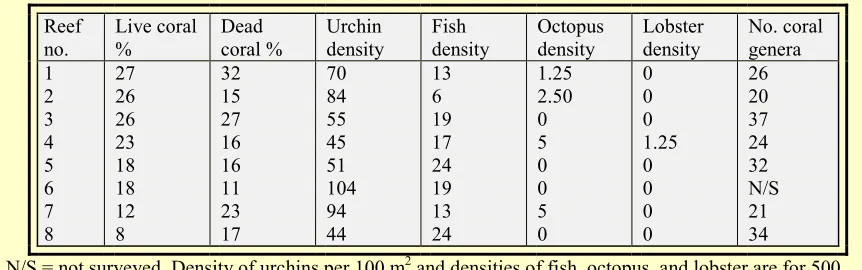
collaborative fisheries management plans, village monitoring teams and district fisheries officers are surveying health and importance of coral reef ecosystems, using line intercept transects to measure live coral cover, and belt transects to measure abundance of fish, urchins, octopus and lobster. The results from these surveys are used in discussions with villages when determining which reefs to close. The tables below illustrate the type of information collected and discussed with the villages. When deciding on a reef closure the programme considers not only ecological potential for recovery, but also the socio-economic consequences. If closure of the reef results in a severe economic impact on fishermen, it will be difficult to enforce compliance.
When problem analysis is not done well, everything goes askew!
Several lessons can be drawn from Tanga’s experience in issue identification, problem analysis and action prioritisation.
The first is that villagers will not likely take actions and change behaviour if they are not meaningfully involved in issue
identification and analysis. An example illustrates this point. In one village, fishermen did not seem serious about doing a deeper issue analysis to identify issues contributing to their low catch per. They held that the main problem was simply lack of fishing gear. This suggested to
programme support staff and extension workers that village fishermen were not truly interested in
There must be an interest among the concerned
communities to take part in the action planning process!
Example of Coral Reef Survey Results
Table 1. Summary of information of 8 reefs surveyed in the proposed Deep Sea-Boma management area.
Reef
N/S = not surveyed. Density of urchins per 100 m2 and densities of fish, octopus, and lobster are for 500 m2.
Table 2. Estimation of importance of each reef for resource use using the number of villages ranking different types of resource use as very important, important, and less important.
Reef Very important (3) Important (2) Less important (1) Total Rank
No villages Score No villages Score No villages Score
economic benefit in the form of fishing equipment. It was concluded that if the community members are not serious about issue identification and assessment, it might be better to cancel the management process in that community for the time being and revisit the site at a later stage when the interest is more genuine. With meaningful involvement of community participants, experience shows that the issue based planning approach enables successful action plans because the plans will reflect how villagers see their problems and what they see as potential solutions.
Moving from pilot village action planning to collaborating management plans, there was a greater emphasis on involving a broader group of stakeholders in issue identification and analysis. Efforts were made to increase the capacity of both government staff and villagers to take part in coral reef assessments, one of the methods used to address the issue of fish scarcity, which had become the main issue in the collaborative fisheries management plans.
A second related lesson is that both the process and product of issue assessment matters. A participatory assessment process is necessary to build the local capacity to understand and solve
problems, and the sense of ownership of the solution to motivate action. Villager participation should start even before the studies and assessments; it should start at the point of developing assessment design and objectives. If participants are not aware of the objectives of assessment and issue identification early on, their expectations of the process and its results may not be met. Being involved in all aspects of data collection and assessment increases villagers’ understanding of ecosystem processes and also increases trust in the information presented. This, in turn, enhances villagers’ ownership of the management process, as they are able to take decisions based on information that they collected themselves.
A final lesson is that one of the objectives of issue identification, assessment and prioritisation should be to enable correctly matching the number and complexity of issues with the human capacity and resources available to address them. Taking actions to address a broad range of issues is both costly and time consuming. If too many issues are selected, there is a risk that some of the issues will be improperly addressed, which in the long run may decrease the communities’ interest in participating in management.
“Get villagers in in as early as possible. It is participatory assessment!”
B. Capacity building
Building the capacity of regional staff, district staff, extension workers, and villagers for coastal management was seen as a way of empowering the groups to take action to solve coastal issues. The goal was to increase action planning skills and coastal management awareness and capacity, reduce the need for outside technical assistance
over time, and ensure the capability of communities and programme staff to sustain their efforts over time. Targeted training was provided to develop capacity within three core
areas: professional skills (conflict resolution, group process, facilitation skills), ICM practice (planning, public education, participation, evaluation), and technical background (coastal ecology, coral reef monitoring, etc).
The level of awareness and capacity building needs of each of the stakeholder groups was identified to improve the efficiency of capacity building efforts. It was found that most villagers are very knowledgeable about their own coastal environment. For example, communities are well aware of the detrimental effects of destructive fishing methods.
Consequently, more time and effort was devoted to raising confidence and capacity to do something about the situation, and less on understanding the causes and consequences of the problem. Study tours to Mombasa, Kenya, and to Zanzibar,
enabled villagers to see what other people in situations similar to them were doing. Villagers also perceived militia training as particularly helpful since it increased their practical capacity to protect their coral reefs.
Higher level government personnel and politicians were on the other hand less knowledgeable of the effects of, for example, destructive fishing gears, and a workshop on that topic for
government resource managers was organized. Skills related to problem analysis, general coastal management, and coastal ecology, were seen as particularly valuable by the regional and district staff.
Capacity building methods 1. Short courses 2. Study tours 3. Workshops 4. Learning by doing Villagers need to participate in the rapid assessments and detailed surveys. In order to participate, the facilitators need to build the capacityof villagers. This is what the Tanga programme did in 1995.
C. Adoption and linking plans to existing legal and institutional frameworks
For action plans to be sustained over time it is important that they are officially adopted and fit into legal and institutional frameworks. In the first stage of the programme, action plans were approved by the Village Committees, District Advisory Committee and Tanga programme. Although the action plans were created through a participatory process they had no legal authority. As the action planning process evolved to involve groups of villages it was increasingly recognised that the plans need to be
adopted through formal government channels at the village, District and national level. Decentralisation and Local Government Reform Programme provide Village and District
government greater decision-making power. Local government reform provides the legal standing for village government to form Environmental Committees, the mechanism that the programme has been using beginning in Stage 3.
The adoption process of action plans (in stage 3) still begins at the village level. But, after a plan is approved by the village Environmental Committee and the Central Co-ordinating Committee (CCC) it is advanced to the District Council and then to the Division of Fisheries for final approval. To avoid excessive delay of action, the programme has tried to design the approval process in a way that the action planning does not come to a halt while waiting for final approval. With the participatory process the programme tries to develop ownership for the action plans among the villagers, encouraging implementation before they are officially approved. In addition, the management plans are usually accompanied by a set of by-laws that are submitted to the District Council for approval together with the plan. If the District Council approves both the plan and the by-laws, the villages have a legal mandate to enforce their by-laws before the Division of Fisheries approves the management plan.
Stage 1
Stage 2 and 3
D. Monitoring and evaluation
Village action planning is a form of adaptive management in which monitoring provides feedback information to incrementally improve strategies and actions. Monitoring and evaluation therefore play a major role in the implementation of action plans.
Monitoring of village action plans Programme monitoring
• Village Committees formulate indicators and monitoring plans based on the specific objectives and anticipated results of action plans
• Village Committees meet every three months to report and discuss monitoring results, progress and specific issues/problems
• The District Technical Team visits villages for monitoring and other support upon request • Community-based coral reef monitoring
introduced stages 2 and 3
• Techniques of gender monitoring introduced in stages 2 and 3
• Programme support staff meet every two weeks to report and discuss progress and problems • Annual and quarterly programme progress
reports
• Annual evaluation of the participation and support of all interest groups in the participating villages (including village Committees) by programme and district staff • Regional annual workshop for all stakeholders
to discuss progress, problems and outcomes • Every two years, socio-economic indicators are
collected and compared with the baseline from the 1995 socio-economic study
• Regional Steering Committee meets every six months to monitor progress and discuss key issues
• Monthly financial reports • Yearly financial audits
• Mid term review and evaluation for each phase of the programme
The Tanga programme uses a nested system of monitoring in which monitoring data on village action plans, collected every three months, feeds into a yearly monitoring scheme developed for the programme as a whole. The village monitoring system has worked well and has been sustained because it was specifically designed to be practical and focus on relatively easy to measure indicators, such as mangrove area replanted or the number of dynamite blasts per month. Monitoring of action plans is conducted by villagers and is voluntary. The villagers feel it is important and take pride in their work. Most have been trained in ecosystem monitoring
techniques. Monitoring challenges of the Tanga programme are more particular to the difficulties of monitoring impacts in general, than to the inadequacies in the design and implementation of the monitoring plans. For example, data on fishing effort and catch can be unreliable because the fishermen do not report their entire catch.
developed countries such as the United States and Australia, but there are few examples of volunteer environmental monitoring in income-poor developing nations.
For monitoring and evaluation to be successful, it is essential that the action plans contain clear, achievable objectives and specify what inputs and activities are expected to produce what outputs and outcomes. This enables the identification of indicators that can be used to track progress towards the goals of the action plan. For monitoring to be relevant and useful there must be feedback loops to project management. Like good adaptive management, the Tanga programme has developed an array of regularly scheduled short-term and intermediate self-evaluation meetings at the village, District and programme level. These meetings are useful as a way for villages to share ideas and experiences of how to solve problems. The meetings also inform District and Regional staff on what is going on in the individual villages. Giving the villagers a chance to describe not only their negative experiences, but also to highlight their achievements, the regional assessments becomes a chance to celebrate the positive outcomes of the action plans and in that way they help in keeping the villagers enthusiastic and interested in the action planning activities. Visits by programme staff and “outsiders” from other areas to the villages during monitoring and assessment meetings may also contribute to keeping the villagers engaged in the process as it shows that what they are doing is viewed as important to others.
E. Participation in, and sustaining support for, action planning
Villagers were encouraged to become active participants in their own development from the outset. With the overall goal of increasing community awareness, empowerment and social change, the programme has emphasized individual knowledge and abilities, implementation of solutions with minimal outside help, and participation of all groups within a community.
In the development and implementation of action plans,
community and other stakeholders have been involved in setting objectives, identifying issues, and deciding on activities. Through this kind of active participation, lasting support and ownership for solving coastal problems has been created. The programme also emphasised underrepresented groups, such as women. The
private sector is still limited in Tanzania, especially in rural coastal communities and private
Volunteer, villager monitoring creates a sense of ownership of the issues and action planning process among participating villages
enterprise has been only a limited participant in the action planning process. The exception is the involvement of private companies in the marketing and operation of seaweed culture. As private enterprise becomes more developed in Tanzania, the programme recognises that it will play a larger role in action planning in the future.
Over time, some important practical lessons have been learned regarding participation and how to sustain support for action planning. First, it is important that transparency at all levels be made operational throughout the action planning process. Problems may, for example, arise if the procedures for distributing funds are not clear. Another problem (that arose in stage two) is that if not all participants have an equal stake in the planning process it is possible that decisions will be made that produce conflictual situations. Particularly when
dealing with controversial management measures such as reef closures, it is essential to ensure that decisions are taken by consensus and agreed on by all stakeholders.
Second, creating genuine partnerships between different levels of government and villages is
difficult but important for long-term success. A challenge of the programme, particularly in stages two and three, has been developing an effective dialogue and feedback loops between
government offices and the villages. Tanzania has a hierarchical decision making structure, and it is still difficult to find mechanisms and
space for all stakeholders to be genuine partners in the action planning process. For example, during the process of plan adoption feedback and dialogue has been
less than adequate between District and national government offices on the one hand, and Environmental Committees and the Central Co-ordinating Committee on the other hand. In another example of the tendency to hierarchy, some programme participants have indicated that the monthly visits to villages by the District Technical Team were little more than a government check-up on progress and were not real dialogues among partners about successes, failures, and needs for support. The monthly meetings were eventually cancelled and replaced with visits upon request.
All villages that are impacted by the action plan should be equal partners in the planning process.
Third, monitoring and evaluation help to sustain interest and support for coastal management. When properly designed and conducted, field monitoring and regular feedback meetings can provide a sense of continuity and maintain momentum for activities.
Fourth, active communication and exchange with other coastal management efforts in other
areas of Tanzania has helped to sustain enthusiasm for coastal resource protection over time. Study tours to other areas helped the villagers put their own situation into perspective and gave them ideas for how to solve their own problems. Another positive influence has been the Coastal Environmental Awards Scheme (CEAS) that the Tanzania Coastal Management Partnership helped execute. The Scheme rewards and offers visibility and positive reinforcement to individuals and organisations that are working to improve the coastal environment.
Fifth, combining coastal resource conservation with quality of life, alternative livelihood and
basic needs is critical to sustained support for action planning efforts. It is essential for action planning to consciously take into consideration the importance of raising the capacity of
communities and village participants to better their situation and opportunities for their children.
Participant roles in action planning
Participants STAGE 1 STAGE 2 STAGE 3
Villagers - Issue identification and analysis
- Plan preparation
- Formation of Committees
- Patrols
- Implementation of the plan
- Issue identification and analysis
- Monitor reefs and fisheries
- Patrols
- Review surveys and assessments
- Assist in formulation and review of
management plan
- Implementation of the plan
- Issue identification and analysis
- Monitor reefs and fisheries
- Patrols
- Assist in formulation and review of
collaborative management plan
- Election of committee members
- Review existing by-laws
- Draft new by-laws
Village Environmental Committees
- Plan preparation
- Presentation of plan to Village
Government
- Propose by-laws
- Review plan implementation
- Link to villagers
- Negotiate/consult with villagers in
preparing plans
- Plan preparation
- Presentation of plan to Village
Government
- Formulation of collaborative plan
- Election of Central Co-ordinating
Committee
- Representation on the Central
Co-ordination Committee
- Review plan implementation
- Link to villagers
Central Co-ordinating Committee
- Formulation and approval of
collaborative fisheries management plans
Village government (village assembly)
- Organise meetings
- Supervise the election of committee
members
- Organise meetings
- Approve plans and reports
- Link to villagers
- Approve by-laws and forward to Ward
Development Committee and District
- Financial support
- Organise meetings
- Approve plans and reports
- Link to villagers
- Approve by-laws and forward to Ward
Development Committee and District
- Financial support
- Review and approve collaborative
management plans
- Approval of closure of reefs
- Naval support (to control dynamite
fishing)
- Cost sharing
- Policy formulation
- Provide staff
- Review and approve collaborative
management plans
- Approval of closure of reefs
- Naval support (to control dynamite
fishing)
- Cost sharing
- Policy formulation
- Provide staff
IUCN - Technical support and programme
oversight
- Training to government staff and
villagers
- Coordination with other institutions
(e.g. Irish Aid, IMS, NEMC, TCMP)
- Technical support and programme
oversight
- Training to government staff and
villagers
- Coordination with other institutions (e.g.
Irish Aid, IMS, NEMC, TCMP)
- Technical support and programme
oversight
- Training to government staff and
villagers
- Coordination with other institutions (e.g.
Irish Aid, IMS, NEMC, TCMP)
Irish Aid - Programme guidelines
- Financial support
- Progamme review and evaluation
- Programme guidelines
- Financial support
- Progamme review and evaluation
- Programme guidelines
- Financial support
- Progamme review and evaluation
Regional government
- Technical assistance
- Review and approve action plans
- Financial support
- Technical assistance
- Link to national government
- Technical assistance
- Link to national government
Extension workers
- Village public education
- Facilitate issue identification and
assessment
- Listening to villagers
- Village public education
- Facilitate issue identification and
assessment
- Listening to villagers
- Village public education
- Facilitate issue identification and
assessment
- Listening to villagers
District Technical Team
- Technical support - Technical support
District Council - Review and approve plans and by-laws
- Financial support
- Co-ordination of village plans
- Review and approve plans and by-laws
- Financial support
- Co-ordination of village plans
University of Dar es Salaam
- Studies, expert advice - Studies, expert advice - Studies, expert advice
Private sector - Action plan stakeholder and participant
(seaweed farming)
- Participant in formulating and
implementing management plan
- Participant in formulating and
6. Contextual Barriers and Bridges to Action Planning
The process, substance and success of action planning efforts are shaped by the context in which they take place. There are a couple of aspects of context that are important to highlight in order to understand the Tanga programme experience and for future action planning.
One of the positive aspects of context for action planning is community experience in planning and organisation. This is a result of the socialist structure developed after independence. Because of this legacy, most villagers are experienced in working in and with collectives and other community-based organisations. When the Tanga programme started it was able to build on the existing “social capital” since most villagers
were familiar with how to hold meetings and prioritise issues. Of course, every village is unique, and the great skill in community-based coastal management—not only in Tanga, but anywhere in the world—is to understand local conflicts, stakeholders and leaders. A key factor of success is winning the support of village leaders, because if there is one or more powerful individuals that are working against the action planning process, it will be very difficult to make it succeed.
A contextual barrier to action planning has been the centralised government structure that impedes local governance of local coastal management initiatives. This is changing with the evolution to fiscal and administrative decentralisation, but the process will be incremental and it will take time for the institutional mechanism to be set up. Six years ago vertical deliberation between local and national level administrations was practically non-present. Realising this, the Tanga programme made a strategic decision to experiment with locally lead action planning in three pilot villages, knowing that the villages would need to “go it alone” because the programme chose not to put the only government pathway—through Regional government—in the lead.
As the number of villages involved in collaborative management plans increased, it became evident that District, regional and national government had to become more a more active participant. Fortunately, as the need for greater co-ordination and approval at higher levels
There are two kinds of village leadership, the visible leaders, and informal leaders. If you don’t take the second type of leaders into account, you will fail. (John Bosco Tindyebwa)
…This was the case in Kikambi and Mwambani. Informal leaders ended up convincing the whole community of a problem that otherwise noone believed in, and they had no formal leadership position. (Chris Horrill)
A key factor of success is winning the support of village leaders, because if there is one or more
powerful individuals that are working against the action planning process, it will be very difficult to make it succeed.
increased in stages two and three, so did the national trend toward local government reform, giving Districts and villages greater authority to govern their own resources. The Tanga
programme has been at the forefront of developing and testing relationships of local management and government and this experience benefits all of Tanzania.
7. The Outcomes of Action Planning
Despite having been in operation for only six years, there are meaningful and concrete outcomes to document from the experience. We can distinguish two kinds of outcomes: interim and end outcomes. Interim outcomes include changes in behaviour and meaningful but less tangible expressions of change like awareness and skills, leadership capacity and empowerment of people to take action, co-operation, and improved decision making. End outcomes are the final
objectives of the programme—protection and restoration of the coastal environment and standard of living.
Interim Outcomes
In terms of interim outcomes, the Tanga programme has increased understanding of the causes and consequences of coastal resource degradation, how negative environmental trends contribute to social problems and lower quality of live, and solutions to problems. Participating communities have become aware that they have the capacity to do something about their problems without major assistance from the outside, and how to do it. Evidence of increased awareness of the ability to act is seen in the fact that the community did take action. It is further evidenced by changed attitudes among both villagers and government staff regarding destructive practices— from discouragement to optimism.
It takes time for attitudes and behaviour to change. It took about two and a half years before dynamite fishing began to decrease. This may seem long, yet it is a remarkable
achievement since dynamite fishing is a well-established part of the fishing culture. Tanga has been known for it for 25 years or more. The village patrols were not effective in the beginning because information on patrol boat schedules was being leaked. There were also a reluctance to report on friends and relatives who use destructive fishing methods, partly because of social pressure and partly because the patrolling teams became targets for corruption. The attitudes
dynamite fishing is as much a result of shared awareness and commitment to address the problem as it is monitoring and enforcement.
Not only resource users in participating villages, but others in neighbouring villages and those not directly involved in resource use, such as government staff, have become more aware and
knowledgeable of the issues and of coastal management. For example, one neighbouring village has taken the initiative to begin its own action planning process after seeing the
progress being made in the pilot villages. Also, by raising the government’s awareness of the issues pertaining to coastal communities the relationship between villagers and government staff has slowly improved, particularly as the villagers feel that their issues and efforts have received greater recognition.
One of the objectives of action planning in the Tanga programme was to enable women to be more active participants in coastal
management and community
development. The high percentage of women representation on
Environmental Committees is an indication of programme success. One reason that the gender equality has
increased is that women’s opportunities to generate alternative livelihoods have been raised. Many women have received training in for example seaweed cultivation and/or organic vegetable farming. Being able to generate their own income, women have become more independent and able to provide for their family needs.
“When I came to Tongoni as a young primary school teacher, things were very different. Women were only allowed to go outside their houses with permission from their husbands and therefore they stayed inside the house most of the time. As you can see, Things have changed greatly, now even the chairman of the Environmental
Committee is a woman. The Tanga programme has made a big difference.” (Enedy Mnzava)
Seeing is believing—sometimes the only way to get people to change practice is for them to see themselves what works
End Outcomes
Fisheries and coral reefs. The first coral reef closures came into effect in 1997, during the second action planning stage, and at present three reefs are closed. The early closures had little impact because a coral bleaching event in March 1998 reduced the cover of live coral with around 50 percent on both open and closed reefs. Since then, both open and closed reefs have recovered, but importantly, closed reefs have almost three times the density of coral recruits compared to open reefs. For example, the coral reef cover in Pangani District has recovered to 50 percent cover on closed reefs and 20 percent on non-closed reefs.
Dynamite fishing decreased during the first action planning stage as a result of both patrolling and other measures to increase compliance with regulations against destructive fishing practices. The time between apprehending a dynamite fisher and prosecution has decreased from one year to three months. At the same time, the penalty has increased to 100,000 Tsh and one year in prison. It is estimated that about 70 percent of coral reef destruction and illegal fishing practices have ceased in the area where the programme is active. The density of commercially important benthic and schooling fish populations on both open and closed reefs has increased as a result. The increase in fish population densities is greater on closed compared to open reefs. Increased abundance of key species, e.g. orange-lined triggerfish, on closed reefs is also thought to have led
Outcomes of the Tanga programme from the villager’s perspective
✽ Increased ability to identify the real causes of coastal issues and their impact on village development
✽ Increased self-dependence and confidence in the ability to implement actions ✽ Increased capacity to influence decisions on resource use and solve coastal issues ✽ More equal resource ownership
✽ Reduced dynamite fishing leading to reduced reef destruction, recovery of effected
reefs and fish stocks, and other indirect positive impacts (e.g. controlling waves).
✽ Increased role of women in natural resource management with indirect benefits in
other social and political processes in the village
✽ Mangrove destruction has decreased as a result of increased knowledge about the
value of mangroves, replanting, and alternative sources of firewood and building materials.
✽ Increased village security as a result of militia training and equipment
Mangroves. Mangrove conservation actions have reduced or stopped cutting in several villages and areas that are of critical importance for preventing coastal erosion. Increased awareness of the direct and indirect benefits of mangroves, e.g. providing nursery grounds for fish and molluscs, have inspired villages in management areas to rehabilitate degraded areas. Despite initial difficulties, recent mangrove replanting efforts have been
successful, with a survival rate of between 80-90 percent. Almost 6 hectares have been replanted in the Kisa forest, which is managed through a collaborative mangrove management plan involving the Kipumbwi and Sange villages.
Replanted Mangroves, Tongoni Action Plan, Muheza District
Income and quality of life. Although the amount of fish caught has increased, fishers’ incomes have declined 29 percent in real terms between 1996 and 2000. The main reason for this decline is that the price for fish has decreased about 20 percent per kilo. Increased opportunities for alternative livelihoods, such as seaweed farming and organic farming, have nevertheless led to poverty reduction in participating villages. It is the perception among district staff that children
Environmental Outcomes
• Stabilised or increased fish catches per gear and per trip
• 30 percent increase in the number of reef fish on closed reefs
• Rapid recovery of corals after the 1998 bleaching event, particularly on closed reefs
• Reduced sea urchin densities on closed reefs
are less malnourished now than before the program began. Another positive perceived outcome is that the educational standard has
increased since more families are able to afford the school fees and because children that earlier were sent out to work on seine netting now are free to attend school.
8. Guidance for Future Action Planning
In the final session of the lessons learned workshop, participants were asked to put themselves in the role of a consultant asked to provide advice on planning. Their charge was to offer guidance on what actions to take, why they should be taken, what methods to use (how), and who to involve, in the initial steps of an action planning process: issue identification and analysis, plan preparation, and adoption. The exercise generated a good discussion around the essential actions and the potential difficulties that need to be taken into consideration. In this section, a synthesis of the group’s findings is presented along with ten practical criteria for action planning that is produced from a general analysis of Tanga’s experience in action planning.
Outcomes that matter to villagers: livelihood and security.
(anonymous participant)
What Actions did not work and Why?
A. Step 1: Issue identification and analysis
Issue identification and analysis serves as a foundation for the entire action planning process.
WHAT WHY HOW WHO
- Organise and prepare team of PRA facilitators - Area selected for action
planning
- Extension to communities about the action planning process
- Stakeholders and interest groups identified - Socio-economic
assessment - Coastal resource
assessments
- Issue identification and prioritisation
- Identify and analyse issues that are a concern
- Acquire baseline socio-economic and environmental information
- Shared awareness of issues and more
build trust among all involved
Participants felt that this should be led by a team of external facilitators or consultants with either prior experience or training. External facilitation is
preferred so that those steering the analysis are not among the interest groups for the issues being
considered. Before initiating any work facilitators should prepare participants. It is important that people in the
community and other participants in issue identification and analysis have a clear understanding of the objectives and of their expected role. W
hat the project can and can not do should be
clear to all participants.
It is essential to identify district and village leaders who have the capacity to lead and mobilize other participants to get involved in action planning. It may then be necessary to organise training in areas
such as facilitation, participatory rapid assessment (PRA), animation skills, planning, ICM, and coastal ecology.
Do not take villagers’ participation for granted, people do not generally have unlimited time to invest in action planning.
(anonymous participant)
“In Step 1 you need to find the district and village leaders who can play a leading role.”
Selecting priority issues is a difficult task and one that requires the inclusion of all interests. Hence, people should be brought together in workshops, focus groups and meetings to share perceptions on coastal issues, their root-causes and try to develop a consensus on those that are priority and potential solutions.
B. Preparation of the action plan
Agreeing on achievable objectives and actions to achieve them is the challenge of the second step of action planning.
WHAT WHY HOW WHO
- Identify staff and assess institutional capacity - Public education - Formation of village
committees/working groups - Negotiation and consensus
building to develop an integrated plan that accommodates all legitimate interests
- Formulation of village action plan
- Development of monitoring plan - Presentation and discussion of
proposed action plan
- Identify issues and actions to address
In this step the information from participatory rapid assessment and the results of stakeholder workshops and meetings are used to formulate an action plan. If the action plan encompasses more than one village, it may be desirable to form a co-ordinating committee to negotiate the
Criteria 1: The action plan addresses the key issues identified in an assessment or issue profile
Criteria 2: Action planning builds activities around an open, participatory process. The action plan has the full support of the community and is not being pushed by one interest group
Action plans are issue and action driven—it is essential to link short and long-term objectives with strategies and activities to reach the objectives. In order to gauge success in reaching the objectives and to continually improve performance, it is also essential to outline a monitoring system that will be implemented with the plan, including mechanisms for information feedback and plan adjustment.
Workshop participants constructed the outline of a “typical” action plan in plenary :
Outline of a Typical Action Plan Developed in Lessons Learned Workshop
1. Introduction – steps leading to the development of the action plan, who is sponsoring it 2. Area to be managed
3. Description of the priority issues and stakeholders 4. Objectives (short-term, long-term)
5. Strategies for addressing issues, link to national and other policies 6. Activities – what, who, when, and desired results (expected outcomes) 7. Institutional structures, roles and responsibilities
8. Principles to be used in guiding management decisions 9. Rules and regulations (including by-laws)
10. People, material, and financial inputs required
11. Monitoring and evaluation plan – indicators, methods of measurement, reporting and review mechanisms
12. How too sustain plans over time (financial, institutional, human resources/capacity)
Criteria 4: There is a likelihood that concrete, positive results can be generated in a short timeframe
Criteria 5: The actions to tackle the issues deal with causes of problems as well as effects
Criteria 6: The actions are manageable given the capacity, resources and experience available
Criteria 7: The individual actions work together and do not conflict with each other
C. Adoption and funding
A plan that organizes collective action on issues of resource conservation and use needs the formal backing and often the legal mandate for implementation.
WHAT WHY HOW WHO
- Prepare budget - Adoption of plan and
budget at village,
- Consultations to brief committees and
The process of adoption may be long if only because there is a sequence of levels of adoption (e.g. village assembly, Ward and District Committees, and national government) and each body only meets at certain points in time. The plan may be stuck in District government, for example, for months waiting for the next meeting to take place. Sometimes it may also be in the interest of particular influential persons to delay a plan, or other unforeseen events may hinder an otherwise rapid approval. To maintain the interest and momentum of action planning it is therefore
important that some activities begin to be implemented while it is still pending formal adoption, but after it has been approved by the village government and the co-ordinating committee. Because there are usually two aspects of implementing the action plan: those that need legal approval and those that do not, it
should be possible to proceed with some aspects prior to formal adoption, but to do this, you need to have your funding ready. To speed up the
implementation of those aspects that require legal approval it is important to submit plans with the by-laws needed, when the plan passes, the by-laws pass at the same time.
A characteristic of action plans is that they are realistic and do-able. This means that grand actions are not planned for which funds are realistically available in the immediate future.
Criteria 9: Commitments can be obtained for the help that villagers require and for the actions that need to be taken by people and organisations outside the community