1
Introduction
The MyCERT Quarterly Summary Report provides an overview of activities carried out by the Malaysian Computer Emergency Response Team (hereinafter referred to as MyCERT), a department within CyberSecurity Malaysia. These activities are related to computer security incidents and trends based on security incidents handled by MyCERT. The summary highlights statistics of incidents according to categories handled by MyCERT in Q3 2011, security advisories and other activities carried out by MyCERT professionals. The statistics provided in this report relect only the total number of incidents handled by MyCERT and not elements such as monetary value or repercussions of such incidents. Computer security incidents handled by MyCERT are those that occur or originate within the Malaysian domain or IP space. MyCERT works closely with other local and global entities to resolve computer security incidents.
Incidents Trends Q3 2011
Incidents were reported to MyCERT by various parties within the constituency as well as from foreign, which include home users from local as well from foreign, private sectors, government sectors, security teams from abroad, foreign CERTs, Special Interest Groups including MyCERT’s proactive monitoring on speciic incidents such as Intrusions. From July to September 2011, MyCERT, via its Cyber999 service, handled a total of 4526 incidents representing 17.83 percent increase compared to the previous quarter. In Q3 2011, incidents such as Intrusion, Malicious Code, Intrusion Attempt and Spam had increased compared to the previous quarter.
MyCERT 3
rd
Quarter 2011 Summary Report
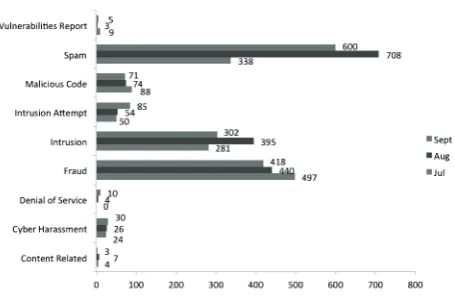
Figure 1 illustrates incidents received in Q3 2011 classiied according to the type of incidents handled by MyCERT.
Figure 1: Breakdown of Incidents by Classiication in Q2 2011
Figure 2 illustrates incidents received in Q2 2011 classiied according to the type of incidents handled by MyCERT and its comparison with the number of incidents received in the previous quarter.
Categories of Incidents
Quarter
Percentage Q3
2011
Q2 2011
Intrusion Attempt 189 155 21.93
Denial of Service 14 17 -17.65
Spam 1646 854 92.74
Fraud 1355 1547 -12.41
Vulnerability Report 17 63 -73.02
Cyber Harassment 80 128 -37.5
Content Related 14 19 -26.32
Malicious Codes 233 189 23.28
Intrusion 978 869 12.54
2
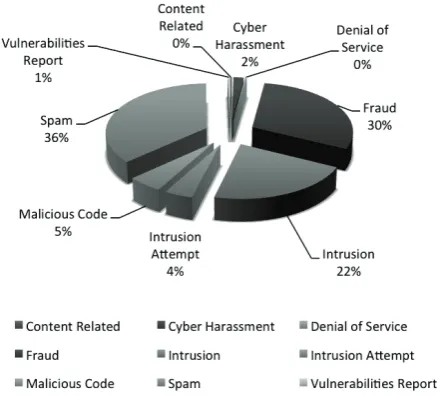
Figure 3: Shows the percentage of incidents handled according to categories in Q3 2011.
Figure 3: Percentage of Incidents in Q3 2011
In Q3 2011, a total of 978 incidents were received on Intrusion representing 21.60 percent out of total incidents received this quarter. Most of these Intrusion incidents wre web defacements, also known as web vandalism followed by account compromise. Web defacements are referred to as unauthorised modiications to a website with inappropriate messages or images with various motives by the defacer. This was made possible due to vulnerable web applications or unpatched servers involving mostly web servers running on IIS and Apache with a few others involving other platforms.
In this quarter, we received a total of 769 .MY domains defaced with the majority involving .COM.MY and .COM domains belonging to the private sector. The defaced domains were hosted on single servers that host single domains as well as on virtual hosting servers that host multiple domains, belonging to local web hosting companies. The web defacements were managed to be brought down under control and MyCERT had advised the System Administrators on
steps for rectifying and recovering from those defacements.
As was in the previous quarter, MyCERT observed that the majority of web defacements were done using the SQL injection attack technique. More information about SQL Injection technique and ixes are available at:
http://www.mycert.org.my/en/resources/ web_security/main/main/detail/573/index. html.
Figure 4 shows the breakdown of domains defaced in Q3 2011.
Figure 4: Percentage of Web Defacement by Domain in Q3 2011
3
we advise users to practice good password management to prevent their account from being compromised. Users may refer to the URL below on good password management practices:
h t t p : / / w w w. a u s c e r t . o r g . a u / r e n d e r. html?it=2260
http://www.us-cert.gov/cas/tips/ST04-002. html
Fraud incidents had decreased to about 12.41 percent in this quarter compared to the previous quarter. The majority of fraud incidents handled was on phishing attacks involving foreign and local brands with the rest of fraud incidents consisting of Nigerian scams, lottery scams, illegal investments, job scams and fraud purchases. A total of 1355 incidents were received on fraud activities in this quarter, from organisations and home users. A total of 241 phishing websites involving domestic and foreign brands were reported to us in this quarter with a majority of them belonging to local brands. In this quarter, we observed an increase in local Islamic banking activities becoming a target of phishing activities compared to previous quarters. MyCERT handled both the source of the phishing emails as well as the removal of the phishing sites by communicating with the respective Internet Service Providers (ISPs).
Based on our analysis, a majority of the phishing sites were hosted on compromised machines besides phishers hosting them on purchased or rented domains. The machines may have been compromised and used to host phishing websites and other malicious programmes on it.
As was in previous quarter, incidents on job scams and fraud purchases continue to increase with fraudsters using the same modus operandi. The majority of the job scams involves recruitment agencies of
well-known Oil & Gas companies to lure potential job seekers. Fraud purchases on the other hand, involved purchasing items at various websites in which victims never received the items after transferring money to the buyer. MyCERT had released an alert on the Job Scam and it is available at:
http://www.mycert.org.my/en/services/ advisories/mycert/2011/main/detail/815/ index.html
In this quarter we also received a total of 111 incidents on impersonation or spooing involving email and social network accounts. Normally spooing or impersonations uses compromised accounts belonging to victims and in several other incidents perpetrators will use victims’ personal details such as photos, names, addresses, telephone numbers to impersonate these victims for malicious motives.
We continued receiving incidents on cyber harassment in this quarter with a total of 80 incidents representing a 37.5 percent decrease compared to128 incidents in the previous quarter. Harassment reports mainly involved cyber stalking, cyber bullying and threats. Many of these cyber harassment victims are people known to the perpetrators such as their friends, relatives and colleagues. Threats via emails, blogs and social networking sites are prevalent in this quarter in which victims are threatened to pay money by person they just got know on the net otherwise their pictures will be exposed or uploaded on porn websites. MyCERT advise users to be very careful with whom they befriend with and never provide their personal details or photos to a third party on the net as the details can be used for malicious activities.
4 compared to the previous quarter. Some of
the malicious code incidents we handled are active botnet controller, hosting of malware or malware coniguration iles on compromised machines and malware infections on computers.
Advisories and Alerts
In Q3 2011, MyCERT had issued a total of six advisories and alerts for its constituency. Most of the advisories in Q3 involved popular end-user applications such as Adobe PDF Reader, Safari web browser and Multiple Microsoft Vulnerabilities. Attackers often compromise computers of end-users by exploiting vulnerabilities in their applications. Generally, these attackers trick a user in opening a specially crafted ile (i.e. a PDF document) or web page. Readers can visit the following URL below on advisories and alerts released by MyCERT.
http://www.mycert.org.my/en/services/ advisories/mycert/2011/main/index.html
Other Activities
In this quarter, MyCERT had conducted several trainings and presentations related to incident handling, malware analysis and Internet security awareness. Several of the trainings that we conducted recently were Incident Handling for Critical National Infrastructure and also for participants of Malaysian Cyber Drill. We also conducted presentations at the Hack in Taiwan Conference, the DEFCON Conference in the USA and at OWASP Day. DEFCON is the world’s longest running and largest underground hacking conference. OWASP stands for Open Web Application Security Project, a non-proit worldwide charitable organisation focused on improving the security of software applications.
Conclusion
Basically, in Q3 2011, the number of computer security incidents reported to us had increased compared to the previous quarter. In addition, most categories of incidents reported to us had also increased. The increase is also a relection that more Internet users are aware of the importance of reporting security incidents to the relevant parties. In addition, it must be noted that there are other factors contributing to the increase in security incidents, not only in Malaysia but worldwide. However, no severe incidents were reported to us this quarter and we did not observe any serious crisis or outbreak in our constituencies. Nevertheless, users and organisations must be constantly vigilant of the latest computer security threats and are advised to always take measures to protect their systems and networks from these threats.
Internet users and organisations may contact MyCERT for assistance at the below contact:
E-mail: [email protected]
Cyber999 Hotline: 1 300 88 2999
Phone: (603) 8992 6969
Fax: (603) 8945 3442
Phone: 019-266 5850
SMS: Type CYBER999 report <email> <report> & SMS to 15888
http://www.mycert.org.my/
5
Introduction
The CyberCSI Third Quarter Summary Report provides an overview of activities undertaken by the Digital Forensics Department (hereinafter referred to as DFD) of CyberSecurity Malaysia for the month of July, August and September in 2011. These activities are related to case analysis received from law enforcement agencies (hereinafter referred to as LEAs) and regulatory bodies (hereinafter referred to as RBs) such as Royal Malaysian Police (PDRM), Malaysian Anti-Corruption Commission (MACC), Malaysian Communications and Multimedia Commission (MCMC) and the Securities Commission Malaysia (SC). This summary will also highlight the training sessions and talks given to LEAs, RBs and public based organisations on modules encompassing digital forensics.
Digital Forensics and Data
Recovery Statistics
Digital Forensics Case Statistics
From July to September 2011, DFD handled 105 cases in digital forensics. Digital Forensics cases comprised cases concerning computer forensics, mobile forensics, audio forensics and video or image forensics submitted by LEAs and RBs.
Figure 1: Illustrates cases on Digital Forensics received from July to September 2011.
Figure 1: Cases Breakdown by Month 2011
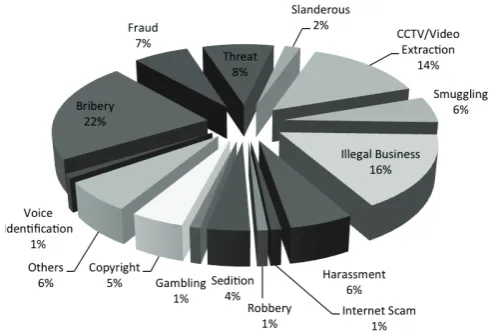
The chart in Figure 2 shows the category
breakdown of cases received by DFD in the period between July – September 2011. There are three (3) major categories that have been classiied as of ‘highest priority’ which is Bribery, Illegal Business and CCTV/ Video Extraction. Other minor cases which also contributed to the statistics were Threat, Fraud, Smuggling, Harassment and Others.
Figure 2: Breakdown by Categories of Digital Forensics Cases
Bribery cases were the highest contributor with 22 cases reported. When dealing with these types of cases, DFD provides support to LEAs by analysing emails, text messages, multimedia messages, calls via electronic gadgets such as mobile phones, notebooks, hard disks and thumb drives that were used as case evidences. DFD was also involved in the task force units consisting of various LEAs for Ops 3B. During this operation, the DFD teams focused solely on corruption and bribery elements within each case. This operation was led by BNM (Bank Negara Malaysia).
The Illegal Business category was at second place for this period with 16% share of the total cases recorded. This category showed an increase in its trend as compared to DFD’s half year statistic (Jan-Jun) which was only at 5%.
6
Based on the statistics, there was a 20% reduction in numbers compared to previous quarters. This is might due to the establishment of digital forensics laboratory by some LEAs, for example PDRM’s Forensic Cheras Facility and the MACC facility. When it involves high proile cases, these LEAs normally will be referred to by the DFD. In doing so, these LEAs can validate their indings by having a trusted second party to carry out the necessary analysis. This is also proof that the LEAs practises impartiality. Most of the LEAs and RBs were trained by DFD’s professionals. This would indirectly strengthen the cooperation between the two sides enable the sharing of expertise in their respective ields. The establishment of digitals forensics labs by LEAs showed that our aim to empower our LEAs has started to produce results. DFD can now focus more on cases which requires more technical and advance technology. This type of cases needs more in-depth research since the criminals are more IT savvy and more up-to-date tools are used.
Data Recovery Case Statistics
Data recovery is the process of salvaging data from damaged, failed, corrupted, or inaccessible secondary storage media mediums when it cannot be accessed normally. Often, data is salvaged from storage mediums such as internal or external hard disk drives, solid state drives (SSD), USB lash drives, storage tapes, CDs, DVDs, Redundant Array of Independent (or Inexpensive) Disks (RAID), and other electronics storage mediums. Recovery may be required due to physical damage to the storage device or logical damage to the ile system that prevents it from being mounted by the host operating system.
Another scenario involves a disk-level failure, such as a compromised ile system or disk partition or a hard disk failure. In any of these cases, the data cannot be easily read. Depending on the situation, solutions
involve repairing the ile system, partition table or master boot record, or utilising hard disk recovery techniques ranging from software-based recovery of corrupted data to hardware replacement on a physically damaged disk. If hard disk recovery is necessary, typically, the disk itself has failed permanently and the focus is rather on a one-time recovery, salvaging whatever data that can be read.
In a third scenario, iles have been “deleted” from a storage medium. Theoretically, deleted iles are not erased immediately; instead, references to them in the directory structure are removed, and the space they occupy is made available for overwriting. In the meantime, the original ile may be restored.
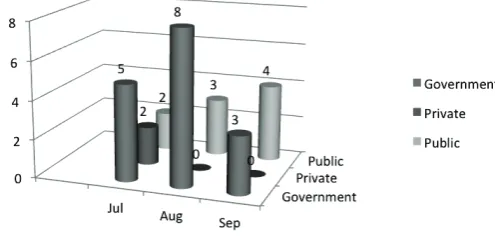
Figure 3 shows the breakdown of cases received under Data Recovery (Jul-September 2011) from Public, Private and Government Agencies in Quarter 3 of 2011.
Figure 3: Breakdown of cases received by Sector under Data Recovery (Jul-Sept 2011)
7
Malaysians with the following objectives: 1. To provide an avenue for consumers to
obtain assistance and to resolve issues in relation to cyber security, cyber safety and data privacy from a trusted service provider at a competitive price.
2. To serve as a citizen ‘touch-point’ and to demonstrate the government’s commitment to the people by meeting and satisfying their needs.
Others Activities
During this period, DFD has conducted several training sessions and lectures, which involved participants from government bodies and enforcement authorities as well as local universities. The objectives of the training programmes were to share knowledge between DFD experts and participants so that both parties can beneit and discuss latest issues and technologies. The summaries obtained will focus on DFD’s research and development and their collaboration with local higher institutions.
Talk
DFD has conducted several talks as requested by LEAs, RBs and other institutions such as Department of Pharmacy, Judicial and Legal Training Institute (ILKAP), Companies Commission of Malaysia (SSM), Royal Malaysian Customs Academy (AKMAL) and Universiti Teknologi Mara (UITM). Favourite topics requested were related to digital forensics and information security in Malaysia. The sessions aimed to create awareness on the importance of digital forensics to employees at these agencies and the need to practice it in their daily tasks. Besides training professionals at LEAs, stakeholders and other government agencies, these sessions also help to ensure sustainability and effective dissemination of information and resources.
Research and Development
Currently, the R&D Unit of DFD collaborates
with Universiti Kebangsaan Malaysia (UKM) in obtaining the Exploratory Research Grant Scheme (ERGS). The purpose of ERGS is to promote research and the early discovery of knowledge that can contribute to an increase in the level of intellectualism, the creation of new technologies and a dynamic cultural enrichment environment in line with Malaysia’s national aspirations.
One research was conducted in July 2011, named “A 2.5D Facial Identiication by Using Fuzzy Bees Algorithm for Video Forensics Analysis”. The Process Flow for this research is as below:
3. Equipment Purchasing 4. Assembly and Test 5. Data Collection
6. Researching methodology for 2D and 3D face recognition
7. Project expected to be completed by August 2012
Conclusion
8
Legal Restriction on Cryptography
BY | Liyana Chew Binti Nizam Chew, Abdul Alif Bin Zakaria
Introduction
Historically, a number of countries have attempted to restrict the export or import of cryptography tools. This article aims to give a general view on the existing restrictions on cryptography tools. Export restrictions are totally different from imports. Restrictions on exports are referring to restrictions on exporting cryptographic tools out of countries that produce them. Meanwhile restrictions on imports refer to a country that receives cryptography tools for their needs. This article will also discuss the reasons why certain countries do apply these restrictions while other doesn’t.
Restriction On Export
The export of cryptography is a transfer of devices and technology related to cryptography from one country to another country. In the early days of the Cold War, the U.S government developed an elaborate series of export control regulations designed to prevent a wide range of Western technology from falling into the hands of others. U.S non-military exports are controlled by Export Administration
Regulations (EAR). Encryption items
speciically designed, developed, conigured, adapted or modiied for military applications (including command, control and intelligence applications) are controlled by the Department of State on the United States Munitions List.
U.S government set a restriction on export of cryptography product with strict limit on the key size. In general, products and technologies with exportable cryptography provide much less security than the non-exportable version of the same products
and technologies. Non-exportable version of cryptography product use longer key length (128 bits) than exportable (40 bits or 56 bits) version. Communication between these two versions is limited to the longest key length supported by the exportable version. As reported in The New York Times on December 1998, U.S and European Union (EU) oficials have reached an agreement on export controls for cryptography software. Both blocs agreed to restrict the export of encryption software that uses keys of 64 bits or more. U.S law currently forbids companies from exporting software that uses that level of encryption. That’s why US versions of Web browsers contain 128-bit encryption to encode e-commerce transactions, but European versions use a much lower level of security (40 bits key). The agreement, reached by the 33 members of the Wassenaar Arrangement, will impose those export restrictions on European software suppliers. The more bits in the key, the harder it is to crack. The US government claims 64-bit keys are suficient for almost all uses. However, research proves that it is possible to break a 56-bit code, albeit using a network of hundreds of PCs operating in parallel. Much tougher keys, including the 128-bit keys commonplace in e-commerce applications, are thought to be virtually impossible to crack using today’s technology through the next few generations of processor.
9 Rationale to Export Control
Some countries have restrictions in the export of cryptography because of the government’s fear that their intelligence activities are hampered by the use of cryptography by scoundrel states. Governments in these countries tried to block the access of these foreign entities to cryptography systems or cryptography codes. It’s clear that these governments wanted to deny their enemies the potentials of cryptography technology. Monitoring diplomatic communications will be dificult if no restrictions are in place. The reasons for controlling cryptography exports are because governments are worried about the misuse of cryptography, where if it is misused it may be detrimental to the interests of a country.
The Controls That Are Contrary to Wassenaar Agreement
The Wassenaar Arrangement was established in order to contribute to regional and international security and stability, by promoting transparency and greater responsibility in transfers of conventional arms and dual-use goods and technologies, thus preventing destabilising accumulations. Participating states seek, through their national policies, to ensure that transfers of these items do not contribute to the development or enhancement of military capabilities which undermine these goals, and are not diverted to support such capabilities.
The Wassenaar Arrangement is an international agreement between 33 participating nations with the following being one of its main objectives (copied verbatim from the Initial Elements):
“It is stated that the arrangement will not be directed against any state or group of states and will not impede bona ide civil
transactions. Nor will it interfere with the rights of states to acquire legitimate means with which to defend them pursuant to Article 51 of the Charter of the United Nations.”
This aim stated that it is not prohibited if the purpose is for self-defence. However, immediate emphasis will happen if any development which threaten regional or international stability and security. This aim clearly stated that the Wassenar Agreement is not to be used legitimately to obstruct genuine civil transactions. This means that products that are designed for civil use should not be restricted by control.
There are several issues that relate to export controls on cryptography under the Wassenaar Agreement. The most important issue is even if cryptography is assessed as important in military terms; it is a purely defensive technology with no offensive uses. Cryptographic products are entirely passive products with a single purpose of defending and protecting information assets from an aggressor who, for their own reasons, seeks to gain access to them. Given its passive and entirely defensive nature, it is thus hard to see any case for the control of cryptographic products under the Wassenaar Arrangement – they simply are not capable of being used offensively in any manner.
10
Wassenaar Agreement “will not impede bona ide civil transactions”. In fact, this clause, when combined with the impact that cryptographic export controls are having on the civil market, might allow such controls to be legally challenged where the Wassenaar Arrangement is being used to justify them.
Restriction on Imports
Import of cryptography can be deined as good or services of cryptography brought into one country from another country. Cryptography is subject to import restrictions. Several governments place import restrictions on encryption technology. The availability of these encryption technologies depends on the actual strength of the encryption that you are allowed to use for security. This varies according to import restrictions for a speciic geographical area. Not all countries apply the restrictions on importing cryptography tools. It relects on what is the outcome that a particular government may face if they simply allow import activities of cryptography tools.
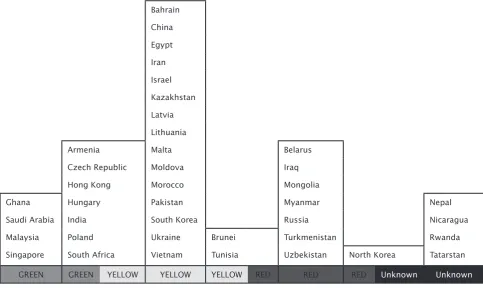
Table 1 shows countries with restrictions on importing cryptography tools (refer table below), the colour green represents some countries with no import restrictions at all. The ones in yellow shows that for countries to import cryptography tools, a license is required to import them. Countries that are totally banned from importing cryptography are in red. The “Unknown” column states that these countries are encouraged to seek further advice from their governments before importing any cryptography tools. Meanwhile, those with mixed colours, represent mixed restrictive policies.
Rationale to Import Control
There are reasons why certain governments are really concerned about importing cryptography tools from foreign countries. They are afraid that the public might misuse cryptography for negative purposes, for example, planning a rebellion against the government and the government will not have a chance to monitor the communications as it is encrypted. Governments prefer
Bahrain
China
Egypt
Iran
Israel
Kazakhstan
Latvia
Lithuania
Armenia Malta Belarus
Czech Republic Moldova Iraq
Hong Kong Morocco Mongolia
Ghana Hungary Pakistan Myanmar Nepal
Saudi Arabia India South Korea Russia Nicaragua
Malaysia Poland Ukraine Brunei Turkmenistan Rwanda
Singapore South Africa Vietnam Tunisia Uzbekistan North Korea Tatarstan
GREEN GREEN YELLOW YELLOW YELLOW RED RED RED Unknown Unknown
11
using locally developed cryptography tools because imported cryptography tools might have “trapdoors” or security holes. Trapdoors in this case concerns the use of foreign technology, where the producing country might have their own agenda to break into the national security of another because they know the weakness of the systems that they have developed and they can control the system at any time.
Cryptography Restrictions in
Malaysia
In Malaysia, there are no export or import restrictions on cryptography tools. Any transfer of devices and technology related to cryptography from Malaysia to another country or vice versa is allowed without any need for licenses. In terms of the use of crypto, no restrictions are in place and the public can use it freely.
Although Malaysia has no restrictions on cryptography but we are still bound by a few Acts that are related to implications of cryptography misuse. There were three Acts that are worth highlighting here. These three Acts contain powers to require authorities to decrypt during an investigation; such investigation is allowed when there is reasonable cause to believe that an offence under the Act at issue is being or has been committed. There is, therefore no general powers to order decryption.
i. Computer Crimes Act 1997
‘Art. 10 (1) (b) of the Computer Crimes Act 1997 requires (likely) users and people otherwise concerned with the operation of computers or material, during a search, to provide reasonable assistance for the purpose of accessing programs or data or material that is reasonably suspected to be used in connection with an offence under the Act, as well as to produce any information
contained in a computer and accessible from the premises to be produced in a form in which it can be taken away and in which it is visible and legible. Refusal to cooperate is punishable with at most RM25,000 and/ or three years’ imprisonment (art. 11).’
A police oficer conducting a search or an authorized oficer conducting a search shall be given access to computerized data whether stored in a computer. The access may include copies of any books, accounts or other documents, including computerized data, which contain or are reasonably suspected to contain information as to any offence so suspected to have been committed. The enactment of appropriate laws, with the aim of protecting victims of computer crimes and to provide legal means of prosecuting those who are found guilty of committing such crimes. In Malaysia, the punishment may take three years imprisonment and/or a monetary ine of RM25,000. Note that stiffer penalties will be meted out if it is found that the guilty party had the intention to cause injury when committing the crime.
ii. Digital Signature Act 1997
‘Art. 79 of the Digital Signature Act 1997 requires people, during a search, to give access to computerised data whether stored in a computer or otherwise, which includes providing the necessary password, encryption code, decryption code, software or hardware required to enable comprehension of computerised data. Refusal to cooperate is punishable with at most RM200,000 and/or four years’ imprisonment (art. 83).’
12
transactions, electronically through the use of digital signatures. This Act is an enabling law that allows for the development of, amongst others, e-commerce by providing an avenue for secure on-line transactions through the use of digital signatures. The Act provides a framework for the licensing and regulation of Certiication Authorities, and the recognition of digital signatures. The Controller of the Certiication Authority who has the authority to monitor and license recognized Certiication Authorities was appointed on 1st of October 1998.
iii. Communications and Multimedia
‘Art. 249 of the Communications and Multimedia Act requires people, during a search, to give access to computerised data whether stored in a computer or otherwise, which includes providing the necessary password, encryption code, decryption code, software or hardware required to enable comprehension of computerised data. Refusal to cooperate is punishable with at most RM100,000 and/or two years’ imprisonment (art. 242). This Act contains a provision (art. 256(2)) allowing people to refuse answering questions if they thereby would incriminate themselves; by contrast, the privilege against self-incrimination can be deemed not to hold for complying with a decryption order.’
An authorized oficer making an investigation under this Act may verbally examine a person who supposed to be acquainted with the facts and circumstances of the case. The person shall be legally bound to answer all questions relating to the case put to him by the authorized oficer, but the person may refuse to answer any questions where the answer to which would have a tendency to expose him to a criminal charge or penalty or forfeiture. A person making a statement under this section shall be legally bound to state the truth, whether or not the
statement is made wholly or partly in answer to questions.
Conclusion
Cryptography itself is a harmless system. It was built to defend the security systems of individuals or a nation. The nature of cryptography is defensive and not offensive. It depends on the user to use it wisely. Cryptography tools are not easily imported or exported because there may be issues that will arise at the end of the day if people were to use cryptography for negative purposes. Restrictions are not same in all countries and there are no standard restrictions. It depends on what is the government’s view on the impact of applying cryptography in their country. From my personal point of view, cryptography restrictions are not necessary because cryptography is not a harmful tool. Cryptography does protect communications and does not serve to take advantage on others. It is the people factor that still plays a role in determining the dangers associated with cryptography. ■
References
1. Whitield Difie and Susan Landau
(2005). The Export of Cryptography in the 20th Century and 21st. Palo Alto: Sun Microsystems.
2. Wassenar Arrangement on
Export Controls for Conventional and Dual-Use Goods and Technologies. http://www.wassenaar.org/index.html
3. Cryptography Export Laws.
http://www.freeswan.org/freeswan_trees/ freeswan-1.5/doc/exportlaws.html
4. Export or Import Restrictions.
http://www.citrix.com/lang/English/lp/ lp_1319021.asp
5. John Markoff. International Group
13
The argument that
assessing liability
for negligence in a
software products
context would expose
manufacturers and
sellers to “damages
of unknown and
unlimited scope” is
totally unconvincing.
Introduction
Information is an asset that and like other important business assets, it is essential for a business entity and consequently needs to be suitably protected. Information can exist in many forms. It can be printed or written on paper, stored electronically, transmitted by post or by using electronic means, shown on ilms, or spoken in conversations. Management systems, based on a legitimate business risk approaches, to establish, implement, operate, monitor, review, maintain and improve information security must be in place.
This paper will discuss software ownership and responsibility issues from an information security management perspective clearly deining every form of responsibility. The responsibility of an owner is described under one of the ISO/ IEC 27001 domains, the organisational aspects of information security and the control elements of dealing with external parties. In addition, perspectives from both Malaysia and the United States’ will also be discussed.
Malaysia vs. US Landscape
Software vendors are likely to face increasing exposure to lawsuits alleging that software products did not perform as was expected when the real issues is really about software ownership. Many companies in Malaysia and US have been alerted with these issues and had incorporated certain disclaimers in their products in order to protect themselves from any security or physical incidents related to the usage of their software. Malaysia’s premier online banking institution stated at their website [1] in particular that the bank shall not be liable for any loss or damage caused by any unavailability or improper functioning of the Mobile Banking-Service for any reason. This showed how serious they are in facing product liability issues. The same goes with a US based company, Microsoft [2] as stated at6 their website prohibiting software users from abusing their software in any manner that could damage, disable, overburden, or impair any of their servers, or the network(s) connected to any of their servers, or interfere with any other party’s use and enjoyment of any services. Users are also warned to not perform any illegal attempt to gain unauthorised access to any of their services, other accounts, computer systems or networks connected to any Microsoft server or to any of their services, through hacking, password mining or any other means.
Deinitions of Faulty Software
The ISO/IEC 27001 main objective is to ensure business continuity, minimise business risks and business interruptions, maximise return on investments and increase business opportunities. This can be achieved by increasing customer conidence in order to protect inancial and intellectual properties to gain a positive reputation. Both Malaysia and the US are discussing the same main issue in
Software Product Liability from an
Information Security Perspective
14
deciding if software is considered “goods” or a “service”. According to [6] Malaysia Consumer Protection Act 1999, the deinition of “product” means any goods and, subject to subsection (2), includes a product which is comprised in another product, whether by virtue of being a component part, raw material or otherwise. Under Section 3 of the [7] Malaysia Sale of Goods Act 1957 “goods” means every kind of movable property other than actionable claims and money; and includes stock and shares, growing crops, grass and things attached to or forming part of the land which are agreed to be severed before sale or under the contract of sale.
Whereas under the [6] Malaysia Consumer Protection Act 1999, “products” means products which are primarily purchased, used or consumed for personal, domestic or household purposes and includes products attached to or incorporated in, any real or personal property, animals, including ish, vessels and vehicles, utilities and trees, plants and crop whether on, under or attached to land or not, but does not include chooses in action, including negotiable instruments, shares, debentures and money.
In Section 6 under [8] Malaysia Civil Law Act 1956 “fault” means negligence, breach of statutory duty or other act or omission which gives rise to a liability in tort or would, apart from this Act, give rise to the defence of contributory negligence. The liability of a person under this Part to a person who has suffered damage caused wholly or partly by a defect in a product. Moreover, [7] Section 62 of the Sale of Goods Act 1957: Exclusion of implied terms and condition as to where any right, duty or liability would arise under a contract of sale by implication of law, it may be negatived or varied by express agreement or by the course of dealing between the parties, or by usage, if the usage is such as to bind both parties to the contract, it gives two conlicting views on the part of the liability of the software programmer.
Software can be deined as goods or services, whichever conforms to the user and the manufacturer. Software product liability can be deined as any liability, negligence, malfunction, warranty issues and subsequence negative effect that arise from the usage of the software, which can affect
the users’ environment such as incidents, losses, fraud and other negative impacts, and can be penalised under the respective country laws. The responsible parties are the owner of the software, the manufacturer, the programmer, the salesman and anyone who were directly involved in selling or providing the software to the user.
Manufacturer responsibility
To protect their products, software manufacturers use disclaimers and agreements between users and themselves. Users are forced to sign or click a button agreeing to the terms stated before proceeding to install and use the software. Many times, users are too lazy to read the ine print and continue the transaction by clicking the ‘Agree’ button without fully understanding the legal terms and conditions stated by the manufacturers. According to [3] Levy et al, in US, there are several case studies where manufacturers are facing legal action on faulty software related incidents. A construction company alleged that a bug in a spread sheet programme caused the company to underbid a $3 million contract. The company sued the manufacturer of the programme for $245,000, claiming it had lost that amount as a result of the incorrect bid. To date, in Malaysia, we do not have similar cases being brought into our courts, even though we legal grounds with regards to faulty software.
There are provisions under Consumer Protection Act, section 71 that states clearly about the responsibilities of manufacturers in Malaysia, where any damage caused wholly or partly by a defect in a product, the producer of the product whose using his name on the product or using a trade mark or other distinguishing mark in relation to the product, has held himself out to be the producer of the product persons and in the course of his business, imported the product into Malaysia in order to supply it to another person shall be liable for the damage.
15
is the main reason for this issue, the liability is placed upon the owner of the software manufacturer. Tort distinguishes between two general classes of duties. The irst is the duty not to injure ‘full stop’ and the other duty is not to injure negligently, recklessly, or intentionally. Software fault, is governed by fault liability where it louts a duty not to injure negligently, recklessly, or intentionally, but can still be governed by strict liability if the user is physically affected.
An example of strict liability reasoning is described by [3] Levy in the case of Brocklesby v. United State, where the court held a publisher of an instrument approach procedure for aircraft strictly liable for injuries incurred due to the faulty information contained in the procedure. Strict liability applied because the product was defective, even though the publisher had obtained the information from the government. Levy also described in his research of a second tort theory; that the vendor was negligent in developing the software. The plaintiff must show that the vendor had a duty to use a speciic standard of care and that the vendor breached that duty. This can be shown if there is malfunction of the software, which results in a negative impact. The screenshot or log of the software can be the evidence for logging the incident.
In 2003 at the [9] State Superior Court in Los Angeles there was an allegation that Microsoft engaged in unfair business practices and violated California consumer protection laws by selling software riddled with security laws. This allegation is really an opening statement that the software manufacturer can be held responsible for their products. More such legal actions are anticipated. The litigation, legal experts said, is an effort to use the courts to make software subject to product liability laws; a burden the industry has so far avoided and placed the blame on users.
Conclusion
It is clearly deined in both Malaysia and US laws that even though manufacturers provided their own disclaimers, users in both countries can still bring the manufacturer to court if they ind any defects in the product. It is important to identify the exact and appropriate policy recommendations for software liability laws
both in Malaysia and the United States. This is an important aspect from an information security perspective where the ownership and responsibility of the services are clearly deined. Users and manufacturers should make clear distinctions between safety-critical and normal software applications. The differences between regular and safety-critical applications such as exacting levels of care should be demanded from programmers, as their failure to do so may result in the injury or loss of life. The interest of the user and the manufacturer must be protected when dealing with software product liability issues so that it can be overcome and prevented from happening again in the future. ■
Reference
1. [1] Maybank2u Liability and Indemnity. Available online at http://www.maybank2u.com. my/mbb_info/m2u/public/personalDetail04. do?channelId=&cntTypeId=0&programId= FO-Footer&cntKey=TNC03&chCatId=/mbb/ Personal#liability. Retrieved on 23rd November 2011.
2. [2] Microsoft terms of service. Available online at http://www.microsoft.Com/about / legal/en/us/IntellectualProperty/Copyright/ Default.aspx#E6. Retrieved on 23rd November 2011
3. [3] Levy et al. Tech. L.J. 1 (1989-1990). Software Product Liability: Understanding and Minimising the Risks.
4. [3] Raysman & Brown, 1988 Strict Product Liability for Software and Data, N.Y.L.J., Sept. 15, 1at 3, 3; Gemignani.
5. [4] Zammit & Savio, Tort Liability for High Risk Computer Software, 23 PLI/PAT 373, 375 (1987).
6. [5] Blodgett, Suit Alleges Software Error, A.B.A. J., Dec. 1, 1986, at 22.
7. [6] Laws of Malaysia Act 599 Consumer Protection Act 1999.
8. [7] Laws of Malaysia Act 382 Sale of Goods Act 1957.
9. [8] Laws of Malaysia Act 67 Civil Law Act 1956.
16
Introduction
Spam has become a global issue faced by almost all Internet users. Though it is not as serious as malicious code, phishing, but is still considerably serious as spam has become a medium to transmit phishing sites, malwares, illicit contents and viruses.
Spam in general is deined as the use of electronic messaging systems to send unsolicited bulk messages to other Internet users. The most common type of spam is email spam. The other types of spam are instant messaging spam, spam in blogs and social networking spam. Spam is considered as an abuse of the Internet infrastructure to annoy, lood other users’ mailboxes and consume unnecessary bandwidth.
Email spam has steadily grown since the early 1990s. Botnets, networks of virus-infected computers, are used to send about 80 percent of spam. Email spam lists are often created by scanning Usenet postings, stealing Internet mailing lists, searching the web for addresses, from business cards, from conferences, seminars and exhibitions.
Techniques Used in Spamming
Generally, spammers use or jump to various techniques to bypass spam ilters. The more sophisticated spam ilters are the more sophisticated the spam techniques used. Direct sending spam emails to recipients is a very simple technique, in which spammers do not have to hide their identities. Spam ilters can easily block these techniques by blocking the email address or the IP address. Open relay is another technique used in which spammers utilises vulnerable open-relay mail servers to send spam emails to recipients. This
technique is also used to hide the spammers’ information, particularly originating IPs.
Using compromised computers is also another method of sending spam. This is carried out by installing malwares such as Trojan droppers and downloaders into compromised computers that allows remote access or by exploiting MS Windows vulnerabilities and other applications such as Microsoft Outlook or Outlook Express. Another contemporary sophisticated technique used in spamming is the use of spambot.
A spambot is an automated programme designed to automate the sending of spams which works by creating fake accounts. While other spambots, in addition, can crack passwords and send spam using third party accounts. E-mail spambots harvest e-mail addresses from materials found on the Internet in order to build mailing lists for sending unsolicited e-mails. Such spambots are web crawlers that can gather e-mail addresses from websites, newsgroups, special-interest group (SIG) postings and chat-room conversations. Because e-mail addresses have a distinctive format, spambots are easy to write. Spambots are effective in sending mass emails.
Spam Analysis
During the irst quarter of 2011, MyCERT received a total of 641 spam reported incidents. March recorded the highest number with 282 incidents reported. Meanwhile, Malaysia is the largest spam distribution centre; about 70 percent of spam come from Malaysia and 90 percent of that concerns fake lottery winnings and gambling related emails. In Q1, 2011 most of the gambling spam used were UK National Lottery, Exxon Mobil, Microsoft and Coca Cola as their fake
SPAM, the Annoying Culprit on the Net
17
representation to cheat people.
Back in 2010, many of this kind of spam used sporting events like the FIFA World Cup 2010 and AFF Suzuki Cup 2010 to cheat people. In addition, all reported spam still used the old format with no advanced techniques, such as ‘spam in PDF attachments’ or ‘using graphics as a background image’. Although there was an increase in the amount of spam reported from January to March 2011 in Malaysia, the number of reported damage or monetary loss was minimal.
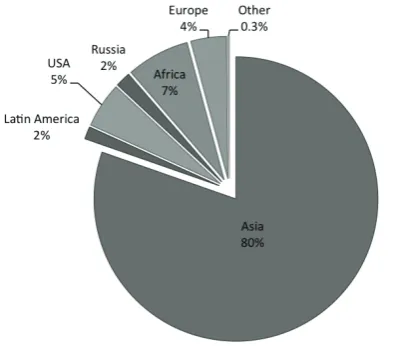
The distribution of spam sources by region in Malaysia
As shown in Figure 1, Asia continues to be the world’s foremost region for the distribution of spam in Malaysia for Q1, 2011. Overall, during the period of January to March 2011, Asian countries were responsible for distributing 80 percent of the total spam volume in Malaysia, with 70 percent of them originating from Malaysia itself.
Africa is among the many regions where the ight against cybercrime is virtually non-existent. In Q1, 2011 the volume of unsolicited messages coming from African countries accounted for 7 percent of the total spam in Malaysia, exceeding that of the USA or Europe. Poor anti-spam legislation and regulations as well as a lack of IT competence provided the ideal conditions for further increasing the volume of spam being distributed from this region.
Figure 1: The distribution of spam sources by region
As shown in Figure 2, MyCERT noted that if a comparison were to be drawn between the spam output of Asia, Africa, USA and Europe, then the Asian region’s output would be the highest. As a result, Asia continues to dominate as the leading source of spam, even when compared to the total spam output of Africa, USA and Europe as a whole (Asia 80 percent, Africa, USA and Europe 16 percent).
Figure 2 : The luctuations in spam going/directed to Malaysia
The distribution of spam sources in Malaysia by country of origin
During Q1, 2011, there were a total of 641 spam cases being reported in Malaysia to MYCERT. Figure 3 shows Malaysia went irmly into the lead this quarter with a total of 492 of all spam detected, while USA remains a steady second place with 24. Nigeria became the top African country with a contribution of 22 spam messages.
Figure 3: Countries that are sources of spam
Spam categories
18
Figure 4: The distribution of spam categories
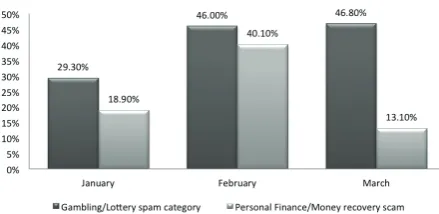
Gambling/Lottery was the most common spam category in the irst quarter of 2011. Almost 90 percent of gambling/lottery emails came from Malaysia. As shown in Figure 5, the percentage for these scams consistently increased from January to March. Personal Finance/Money recovery emails came in second place. In February, the percentage of emails in this category reached the highest number within 3 months at 40.1 percent.
Figure 5: The Gambling/Lottery spam and Personal Finance/ Money recovery scam categories in the irst quarter of 2011
According to Figures 3 and 4, the numbers of compromised hosts that are used to send Gambling/Lottery spam emails in Malaysia are increasing on a daily basis. From this data, we can also assume that there are many Malaysians who are still using Windows XP and the insecure Internet Explorer 6 web browser. This inevitably aids the distribution and infection rates for botnets that are used to send out spam such as Waledac, Kraken or TDL-4. It also shows that the majority of users in Malaysia lack awareness on how to securely protect their computers.
Spammers’ tricks and techniques
During the irst quarter of 2011, incidents involving gambling/lottery emails recorded a third of the total spam that was reported to MyCERT. The large numbers of spam recorded were on fake lottery winnings and compensation claim scams. Scammers will ask the victim to pay a certain amount to claim their winnings/compensation. Once the victim pays the fee, they will just invent a new fee that the victim has to continue paying. If the victim falls for that trick, they keep inventing a new fee, until the victim gives up or runs out of money.
If the victim becomes aware that the email that they received is a scam and stop sending money, the second stage of the fraud could occur. Scammers will introduce themselves as police oficers or other employees who have been arrested or who seek to arrest the criminals in the irst scam. They will promise to return the money stolen in the irst scam as shown in Figure 6.
Figure 6: Second stage of fraud for the fake lottery scam
Why Spam is prevalent
19
Another reason why spam is prevalent is because spamming is a cheap way in promoting services and products. This is in addition to the many tools available on the net for free that can be used for spamming. There are also many cheap software that can be used to spam on a large scale and also the availability of various database of emails that can be purchased on the net for a very cheap price.
Another reason is due to the lack of laws in many countries that can be used to punish and prosecute spammers. Only very few countries have spam legislations such as Australia with its Spam Act 2003, Singapore and its Spam Control Act 2007 and New Zealand with its Unsolicited Electronic Messages Act 2007. Unprotected and vulnerable computers also enable spam to be prevalent on the net. Computers without anti-virus protection can lead to malicious programme infections and enable the infected computers to become spam zombies.
Spam Mitigations
Though there is no special prescription to eradicate spam entirely, certain mitigation steps can be implemented to minimise spam to some extent. Some of the steps users can implement to protect themselves are to safeguard your email address from spammers. This includes being careful when signing up online using your email address and making sure the website you sign up with is reputable and not involved in unethical activities on the net. You must not reply to a spam email or unsubscribe to a spam email as this will further propagate the spam. If your email is exposed on the net, make sure it is in the form that a spambot cannot easily detect and grab. When choosing a new email address use one that is hard to crack - make it more than a few characters long with a few unusual characters like underscores if they are allowed. You can also consider using a secondary email address to avoid publicising your primary email address or use a disposable email address. Read email in plain text, switch off the preview pane, or disable the automatic downloading of graphics in HTML emails. Do not click links on spam emails as the links may contain an encoded version of your email address and indirectly informing spammers that your
email address is valid.
Using spam iltering is also an effective way of preventing spam. Spam iltering can be done at your computers, your organisation’s email gateway and at your ISP level. Spam iltering at your computer can be done either by using spam iltering software or spam iltering features available in your email client, which can be conigured based on keyword and routing or source of email information. The emails can be iltered to be sent to a spam-trash folder. System Administrators can install spam iltering software at their email gateways to prevent spam emails from reaching their users within the organisation. Users can also subscribe to their ISPs’ spam iltering services which help to prevent spam emails from reaching the end-users’ mailbox. Besides the iltering, make sure your computer is secured and running an updated version of an anti-virus software and is patched regularly. This can help to prevent your email address from being harvested from your PC or your PC being used as a spam zombie.
Conclusion
In conclusion, we can say that spam continues to grow and are still prevalent on the net. This is due to various factors such as lack of user awareness, availability of spamming tools on the net. There is no magic wand to eradicate spam. However, with safe email practices by users and proper spam iltering, spam can be minimised to a certain extent. This will eventually make spam less annoying and the Internet a comfortable place for all of us. ■
References
1. Cyber999 Help Centre
20
Introduction
Storage exhaustion and underutilisation
of IT peripherals has become a major
issue for companies to keep up
with in steering the growth of their
organisations. This will cost companies
millions of dollars in allocation for
IT operations especially when the IT
infrastructure works in silos. Thus, it
is imperative for growing organisations
to manage their data centres eficiently.
Most of the giant IT solution providers’
emphasise on uniied computing or
now popularly termed as Converged
Infrastructures. It is an exciting and
important part of IT management. But IT
analysts are sometimes tardy in getting
their heads around to understanding
it, and the fact that the current
implemented infrastructure is medieval.
It is time for a new technology to be in
place as preparation for modularity and
globalisation.
Many are confused with the basic
concept of converged technology and
the beneits of implementing converged
infrastructures in the long run. The
discussion on conceptualising converged
infrastructures and enjoying its beneits
will be presented throughout this article.
What Is Converged
Infrastructures?
Converged Infrastructures refers to
a technology where a new set of
enterprise products inclusive of servers,
storage, and networking architectures
are packaged together as a single unit. It
is a built-in service-oriented tool for the
purposes of driving eficiencies in time
for deployment and simplifying on-going
operations. It is an appliance equipped
with an intelligent engine that helps
to monitor and manage the delegation
of networks, storage, processors and
memory in pools.
Within the converged infrastructures,
all networks, storage, processors and
memory devices are aware of each other
and are tuned for higher performance
compared to products constructed
in purely modular architectures.
This approach allows IT operators to
rapidly re-purpose servers or entire
environments without undergoing
physical reconigurations.
From an architectural perspective, this
approach may also be referred to as a
Processing Area Network. This is due
to the physical state of the Computer
Processing Unit (CPU) being completely
abstracted away. It becomes stateless
and can be reassigned easily to create
a “fabric” of components, equivalent
to how Storage Area Networks (SANs)
assign logical storage for Logical Unit
Numbers (LUNs).
Converged infrastructures are
constructed of modular components
that can be swapped in and out as
required by scaling. The entire system
is integrated at both the hardware layer
and software layer. Both data and storage
transports can also be simpliied. The
physical network infrastructures can be
minimised to a single wire. As a result,
The Endless Possibility of IT
Infrastructure Sprawl
21
“wire-once” settings pool bare-metal
CPUs and network resources, allowing
for on demand assignments, deining
logical conigurations and network
connections instantly.
Converged Infrastructures
Maturity Model
As IT infrastructures are sprawled,
the migrations of data centres
through implementation of converged
technologies are essential. It is not an
overnight transformation and must be
done in phases. A profound analytical
study on the current infrastructures and
needs are crucial. A common practice
in monitoring the transformation is by
applying the Capability Maturity Model
(CMM). It comprises of ive maturity
levels, where the evolutionary area
of stability is well-deined towards
achieving a mature transformation
process. The ive maturity levels provide
the top-level structure of CMM.
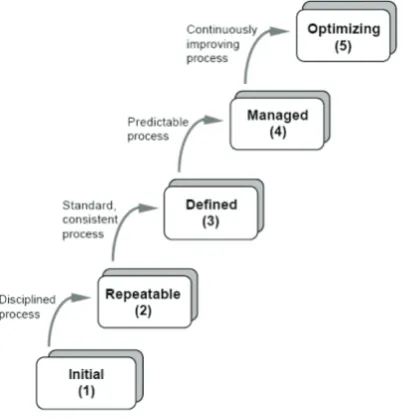
Figure 1 shows the deinition of each
level under CMM. This would help
an organisation to determine the
phases of each level while undergoing
transformation.
Figure 1: Capability Maturity Model
Level 1 – Initial (unstable)
at this level, the processes are disorganised, even chaotic. It is likely to depend on individual efforts for success. It is considered to be non-repeatable because processes would not be suficiently deined and documented to allow them to be replicated.
Level 2 – Repeatable
the basic project management techniques are established, and successes could be repeated, because the requisite processes would have been established, deined, and documented.
Level 3 – Deined
an organisation has developed or adapted a standard software process through greater attention to documentation, standardisation, and integration of the whole infrastructure.
Level 4 – Managed
an organisation is able to monitor and control processes through data collection and analysis for sustainment of their system and infrastructure.
Level 5 – Optimising
processes are constantly being improved through monitoring feedback from current processes and introducing innovative processes to better serve the organisation’s particular needs.
The intention in setting down the key practices is not to require or espouse a speciic model of converged infrastructure migration life-cycle, a speciic organisational structure, a speciic separation of responsibilities, or a speciic management and technical approach to development. The intention, rather, is to provide a description of the essential elements of an effective migration process.
Security Features
22
converged infrastructures work are mostly the same. The difference would be the additional features that are bundled with converged infrastructure packages such as log monitoring, archiving systems and various report generation.
The one that is mostly discussed among the giant providers is the HP Converged Infrastructure Solution. In general, converged infrastructures consist of multiple layers of security, often referred to as defence in depth. This approach provides better risk reduction by using multiple forms of mitigation techniques. For instance, the BladeSystem Matrix solution resembles a bank vault which possesses multiple levels of security.
This solution utilises modular components that are designed and integrated together to meet demanding business and security requirements. The main component of the BladeSystem Matrix solution is the BladeSystem enclosure. The enclosure supports the servers, storage blades and associated hardware. Numerous hardware and software components comprise the BladeSystem Matrix solution, but several key components provide the substantive security model for the BladeSystem Matrix solution.
Some converged infrastructures solutions do have Systems Insight Management (SIM) software as the foundation component that provides the security model and security services to many other BladeSystem Matrix components. Therefore, SIM is the focal point for security coverage in many sections.
The components that make up BladeSystem Matrix solutions are modular and it can be purchased as individual components for standalone applications outside of the BladeSystem Matrix solution. In addition, individual components can provide additional localised security mechanisms.
There are three administrative approaches that come together with BladeSystem Matrix.
Virtual Connect is one of the features meant for managing virtual conigurations within enclosures. The Onboard Administrator is for managing hardware such as blades, fans, power supplies and switches, and an iLO which is associated with each blade for direct administration of the physical server. Each component offers a full range of security mechanisms addressing authentication, authorisation, data conidentiality and integrity.
However, implementing virtualisation in computing environment will divulge it to potential risk as SIM can be a single point of failure. This has to be addressed and mitigated in order to maintain an acceptable level of risk standard.
Long Term Cost Effectiveness
Transition of current technologies to converged infrastructures will cost companies a bomb. However, it is noted to be a compelling opportunity to pursue. The important distinction is how it can simplify supporting IT infrastructure management and technology. This has become a demanding requirement for most companies seeking to expand their operations.
Implementing converged infrastructures will help to reduce operational complexities such as coordination of tool usage, procedures, interdependencies of each devices and fault-tracking. Thus, the operational and capital cost to maintain the data centre will be brought down by eliminating separate hardware components and their annual maintenance. The lesser on–the-loor maintenance, the lesser the electrical power consumed. With fewer physical components and more virtualised infrastructures, server conigurations can simply be created via single management tools.
23
San Francisco, CA. McKesson has doubled its development environment and saved millions. They managed to lessen their power consumption, lowered their network complications, storage and power costs as well as reduced data centre loor space. This has resulted in improved data growth and reduced deployment time.
As discussed earlier, converged infrastructures virtualises the software domain by mode of a virtual machine manager or better known as hypervisor. The same goes to the physical infrastructures by act of implementing converged networking and I/O virtualisation. Once the virtualised I/Os and networks are executed, they can be composed and decomposed on demand. This eliminates a large number of components needed for infrastructure provisioning, scaling and even failover or clustering.
I/O consolidation implies converged transport which means fewer cables and fewer switches to be installed onto the network. Furthermore, with fewer moving physical parts, fewer software tools and licenses are required. Roughly 80 percent of current physical components can be reduced consequently contributing to a decrease in operational complexities. Overall, converged infrastructures introduce physical simplicities which breeds operational eficiencies. This leads to reduced costs, efforts as well as simpliies complications in managing data centres.
What Is Converged
Infrastructures And What It Is
Not
Converged infrastructures have become a demanding solution in this new globalised era. IT infrastructures are now the ultimate platforms to serve the operations of an organisation. Different solution providers might have named it with different terms. For example, CISCO introduced this solution as Uniied Computing.
However, the way how vendors whitewash their products would also sound promising by labelling it as converged infrastructures. Several terms that one might come across while searching for these kind of solutions are Heterogeneous Automation, Product Bundle or Pre-Integrated solutions. These solutions could easily be scripted as run-book automations. This doesn’t reduce physical complexities, or it may simplify installations, but does not guarantee physical or operational simplicities.
Conclusion
All in all, converged infrastructures can re-create an entire environment to provide both High-Availability as well as Disaster Recovery in mixed physical and virtual environments. It also helps eliminate the need for complex clustering solutions and is an option for replacement of numerous point-products to simplify IT management. ■
Reference
1. HP Converged Infrastructure Solution Security For HP BladeSystem Matrix, 4AA2-8444ENW Rev. 1, November 2009
2. HP Converged Infrastructure Maturity Model, 4AA1-3980ENW Rev. 3, November 2009
3. Technical Report, CMU/SEI-93-TR-025, ESC-TR-93-178, Key Practices of the Capability Maturity ModelSM, Version 1.1, February 1993
4. Converge Infrastructure,
Ken Oestreich, 15 November 2010 h t t p : / / w w w. t h e c t o f o r u m . c o m / c o n t e n t / converged-infrastructure-0
5. 10 Best Practices for Managing a Converged Network, Leslie T. O’Neill, April 30, 2009 http://www.focus.com/briefs/10-best-practices-managing-converged-network/
6. IBM Business beneits of converged communications, IBM Global Technology Services, October 2006
24
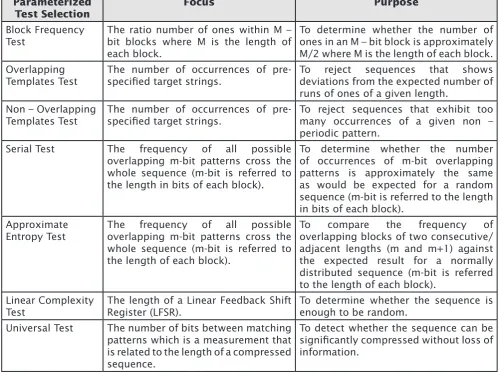
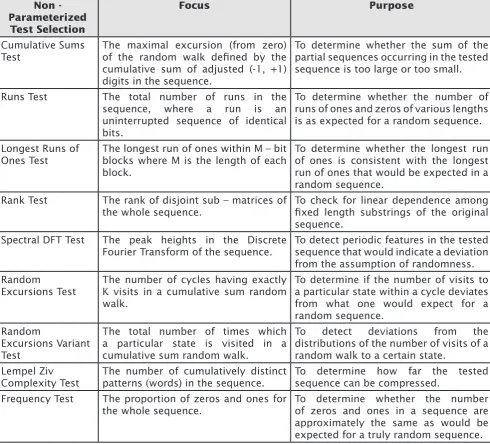
Introduction
Nowadays, random number generator (RNG) and pseudorandom number generator (PRNG) are needed for many purposes such as for cryptographic, modelling and simulation applications. For example, in the cryptographic ield, all cryptosystems use keys and other cryptographic algorithm parameters must be generated in a random pattern.
The RNG is a mechanism where it is used to generate a truly random binary sequence. It uses non – deterministic sources such as the noise in an electrical device, the timing of user processes (e.g. mouse movement) or the quantum effects in a semiconductor to produce randomness.
Meanwhile, the PRNG is a deterministic algorithm for generating a random binary sequence and this generator uses one or more inputs which are known as seeds. Both generators are very important in the construction of the encryption keys and also other cryptographic algorithm parameters such as keystream and outputs from component used in the algorithm. If the generated binary sequence is not random, then it can be easily predicted.
There are some statistical test suites used in order to prove the randomness of the generators. The irst statistical test suite was developed by Donald Knuth and was presented in his book entitle “The Art of Computer Programming Vol. 2 Seminumerical Algorithms”. Later, the DEIHARD suite
of statistical tests was introduced by George Marsaglia. Following that was the Crypt – XS suite of statistical tests and it was developed by researchers at the Information Security Research Centre. The most recent suite of statistical tests was developed through collaboration between the Computer Security Division and the Statistical Engineering Division at the National Institute of Standards and Technology (NIST) referred to as the NIST Statistical Test Suite. This topic will discuss on the NIST Statistical Test Suite for both random and pseudorandom number generators.
Random Number Generator
Tests
Before statistical tests are carried out, several assumptions must be made on the binary sequences.
1. Uniformity:
This means that for any point in the generation of a sequence of random or pseudorandom bits, the occurrence of zero or one is the same. For example, the probability of each zero and one is exactly ½. The expected number of occurrences of zeros or ones are equal to n/2, where n is the length of sequence.
2. Scalability:
This means that for any test which is applied to a sequence can also be applied to subsequence at random. If the sequence is random, then any subsequence should also be random. Therefore, any subsequence should pass any tests for randomness. By | Norul Hidayah binti Lot @ Ahmad Zawawi, Nik Azura binti Nik Abdullah