ii
Level 5, Sapura@Mines No. 7 Jalan Tasik The Mines Resort City 43300 Seri Kembangan Selangor Darul Ehsan Malaysia.
T: +603 8992 6888 F: +603 8992 6841 E: [email protected]
Customer Service Hotline:
1 300 88 2999
www.cybersecurity.my
Cyber999 Help Centre
|
Professional Development
(Training & Certification)
|
Product Evaluation &
Certification (MyCC)
|
Information Security Management
System Audit and Certification (CSM27001)
|
Malaysia
Trustmark
|
Security Assurance
|
Digital Forensic & Data
Recovery
|
Malaysia Computer Emergency Response Team
(MyCERT)
|
Security Management & Best Practices
|
Cyber
Security Research
|
Cyber Security Awareness For
Everyone (CyberSAFE)
CyberSecurity Malaysia,
an agency under
Malaysia’s Ministry of Science, Technology and
Innovation was set up to be the national cyber
security specialist centre. Its role is to achieve a
safe and secure cyberspace environment by
reducing the vulnerability of ICT systems and
networks while nurturing a culture of cyber
security. Feel secure in cyberspace with
A MESSAGE FROM CEO OF CYBERSECURITY MALAYSIA
Technology is an enabler and we are encouraging everyone to use it. At the same time, technology also introduces new risk and users need to know the risk associated with it, especially the internet. Criminals are also using technology to enable them to extend their reach to the whole connected world. Even security organisation like RSA, VeriSign, Lockheed Martin, NSA, FBI, and CIA were not spared.
This year rising trend in cyber incidents continues as the irst half of 2013 has recorded, on average, nearly 100 more incident per month as compared to 832 incidents per month in 2012. Content re
-lated incident for the irst six month has more than doubled and Spam recorded 16% higher from the whole of last year's total. Cyber Harassments, Malicious Codes, and Frauds in the irst six month of 2013 are already more that 60% (77.7%, 68.5%, and 62% respectively) of last year total incident.
Greetings to all!
It is with great pleasure that we bring you the eSecurity Bulletin 2013. As you are aware there are tons of information on the in
-ternet and sometime we are not sure about the accuracy or the integrity of these information, especially pictures which could fool our eyes. Well in this digital age the cliché of “seeing is believing” is not true anymore as our Digital Forensic expert share with us about image forensics techniques that would beneit you especially the “UFO in Putrajaya...” article.
Also in this issue the Bring-Your-Own-Device (BYOB) article which is currently a much discussed topic as it brings along it own sets of operational and legal issues.
And I take this opportunity to convey a big ‘Thank You’ to all the articles contributors for sharing their knowledge.
Be Smart! Be Safe!
Best regards,
Rosly Yahil, Editor
• MyCERT 2nd Quarter 2013 Summary Report
• The Council for Security Cooperation in the Asia Paciic (CSCAP) Study Group on Cyber Security -
Ensuring a Safer Regional Cyber Environment • The Story in Your Eyes – The Experiment
• UFO in Putrajaya…Really?
01
05
08
10
We have to equip ourselves with knowledge to enable us to protect ourselves better. Even for none techies, they should at least be aware of the current cyber threats like Spam, Love Scams, Parcel Scams, Identity Theft, and Cyber Stalking to name a few. Then there are the international standards like ISO 27001 that organisation can adopt into their operations in a structured manner to protect
their investment.
With the connected world, information or news travels very fast and not all information are true. All of us need to do our due diligence and verify the information especially before we shared it with our online friends.
This eSecurity Bulletin enables us to share, highlight, and discuss concepts, approaches, trends and best practises in the ield of cyber security and we hope you beneit from it.
See you at our Cyber Security Malaysia – Awards, Conference and Exhibition (CSM-ACE) 2013 in November.
Thank you and warmest regards,
Dr. Amirudin Abdul Wahab
Chief Executive Oficer, CyberSecurity Malaysia
• BYOD: Should It Be Allowed?
• Transaksi e-Dagang: Adakah ianya selamat? • A Glimpse of ISO 22301– Business Continuity
Management Systems
• The Need For Certiication and Its Beneits
13
17
20
1
while other incidents had decreased moderately.
Figure 1 illustrates the incidents received in Q2 2013 classified according to the type of incidents handled by MyCERT and its comparison with the number of incidents received in the previous quarter.
Categories of Incidents
Quarter
Percentage Q1
2013
Q2 2013
Content Related 16 26 62.5
Cyber Harassment 100 133 33
DoS 2 8 300
Fraud 1116 1374 23.12
Intrusion 862 864 0.23
Intrusion Attempts 16 8 50
Malicious Codes 49 393 72.04
Spam 331 283 14.50
Vulnerability Reports 7 4 42.86
Figure 1: Comparison of Incidents between Q1 2013 and Q2 2013
Figure 2 illustrates incidents received in Q2 2013 classified according to the type of incidents handled by MyCERT.
Figure 2: Breakdown of Incidents by Clas siication in Q2 2013
Introduction
The MyCERT Quarterly Summary Report provides an overview of activities carried out by the Malaysian Computer Emergency Response Team (hereinafter referred to as MyCERT), a department within CyberSecurity Malaysia. These activities are related to computer security incidents and trends based on security incidents handled by MyCERT. The summary highlights statistics of incidents according to categories handled by MyCERT in Q2 2013, security advisories and other activities carried out by MyCERT personnel. The statistics provided in this report reflect only the total number of incidents handled by MyCERT and not elements such as monetary value or repercussions of the incidents. Computer security incidents handled by MyCERT are those that occur or originate within the Malaysian constituency. MyCERT works closely with other local and global entities to resolve computer security incidents.
Incidents Trends Q2 2013
Incidents were reported to MyCERT by various parties within the constituency as well as from foreign, which include home users, private sectors, government sectors, security teams from abroad, foreign CERTs, Special Interest Groups including MyCERT.s proactive monitoring on several cyber incidents.
From April to June 2013, MyCERT, via its Cyber999 service, handled a total of 3093 incidents representing 23.77 percent increase compared to Q1 2013. In Q2 2013, incidents such as Fraud, Content Related, Malicious Codes, Intrusion, DOS and Cyber Harassment had increased
MyCERT 2
nd
Quarter 2013 Summary Report
2
Figure 3 : Shows the percentage of incidents handled according to categories in Q2 2013.
Figure 3: Percentage of Incidents in Q2 2013
In Q1 2013, a total of 864 incidents were received on Intrusion representing a 0.23 percent decrease compared to previous quarter. As was in the previous quarters, web defacements or web vandalism is still continuous. Based on our findings, majority of the web defacements were due to vulnerable web applications or unpatched servers involving web servers running on IIS and Apache. Majority of the defacements were using SQL Injection and Cross site scripting methods.
In this quarter, we received a total of 707 .MY domains defaced belonging to various sectors such as private, educational, government sectors compared to 750 .MY defaced domains in Q1 2013. MyCERT had responded to web defacement incidents by notifying respective Web Administrators to rectify the defaced websites by following our recommendations and the defaced websites were managed to be rectified accordingly by the respective Administrators.
Figure 4 shows the breakdown of domains defaced in Q2 2013.
Figure 4: Percentage of Web Defacement by Domain in Q2 2013
Account compromise incidents still prevails in this quarter as was in previous quarter. The same trend we observed in Q2 2013 as was in Q1 2013 in which perpetrators are taking advantage of various techniques to compromise accounts belonging to other Internet users. Majority of account compromise incidents involved free web based emails and social networking accounts such as Facebook. Account compromise incidents could be prevented if users practice good password management such as using strong passwords and safeguard their passwords.
Users may refer to the below URL on good password management practise:
h t t p : / / w w w. a u s c e r t . o r g . a u / r e n d e r. html?it=2260
http://www.us-cert.gov/cas/tips/ST04-002.html
A total of 1374 Fraud incidents were received in this quarter, from
biz - 0.8%
com - 40.9% com.my - 28.9% edu.my - 6.1%
gov.my - 5.6% biz - 0.8%
info - 0.1%
my - 9.6% net - 3.1% net.my - 0.3%
3
organizations and home users. Some of the fraud incidents that usually users report to us are phishing, job scams, fraud purchase and Nigerian scam. Phishing incidents involving foreign and local brands continues to increase in this quarter along with other types of frauds. A total of 720 phishing websites targeted local brands and 1085 phishing websites targeted foreign brands were handled by MyCERT in this quarter.
Incidents on job scams, Nigerian scams, fraud purchase continues to increase as was in previous quarter. We advise Internet users to be precautious and always adhere to best practices when they purchase goods online. They must make sure they are dealing with trusted parties and never simply transfer money to seller without prior checking on the status of the seller.
Some of the tips users can follow are as in the below links:
• h t t p : / / m s i s a c . c i s e c u r i t y. o r g / newsletters/2011-11.cfm
• http://www.actionfraud.police.uk/ fraud-az-online-shopping-fraud
Cyber harassment incidents had increased in this quarter with a total of 133 incidents representing 33% increase. Harassment incidents generally involved cyber stalking, cyber bullying and threatening. Social networking sites such as Facebook, emails and chat programs such as Yahoo Messenger, Skype have become popular avenues for cyber harassment as they are becoming popular communicating channels on the net. We advise users to be very precautious with whom they communicate on the net especially with unknown people and be ethical on the net.
In this quarter, we observed a trend in cyber harassment that targets Malaysian,
male victims. The Modus Operandi is the perpetrator, posing as a young, beautiful, single Japanese or Filipino female requesting to be friend with potential victim over the social networking site namely Facebook. After being friends with potential victims for some time, the perpetrator will invite the victim to video chat with her on skype. During video chat, perpetrator will lure victims and will take videos of victims in unpleasant position and situation using video cam. Victims will not realize that their video had been recorded and perpetrator will start to threaten victim to pay certain amount of money otherwise the video will be posted on the net such as on YouTube or on Facebook.
We advise Internet users to be very carfeul with whom they be friends with on the net as there maybe irresponsible users on the net with malicious purpose to threaten other Internet users into giving money to them. If victims are threaten by somebody, we advise them to lodge a police report immediately at a nearby police station together with evident to support the police report.
In Q2 2013, MyCERT had handled 393 incidents on malicious codes, which represents more than 100 percent increase compared to previous quarter. Some of the malicious code incidents we handled are active botnet controller, hosting of malware or malware configuration files on compromised machines and malware infections to computers.
4
More information on Nitol Botnet is available at: advisories and alerts for its constituency which involved Critical Vulnerability in Microsoft Internet Explorer 8, Oracle Java SE Critical Patch Update, Critical Vulnerability in Adobe ColdFusion, Multiple updates from Oracle for Java SE, Microsoft Security Bulletin Summary, alert on Redirection of Several .COM. MY and .MY Domains to Defacement Page. The Alert and Advisory comes with descriptions, recommendations and references.
Readers can visit the following URL on advisories and alerts released by MyCERT
• http://www.mycert.org.my/en/ s e r v i c e s / a d v i s o r i e s / m y c e r t / 2 0 1 3 / main/index.html
Other Activities
IIn Q2 2013, MyCERT personnel had conducted several talks, presentations and trainings in local and in overseas for example in April 2013, MyCERT personnel had conducted a presentation during the FIRST Technical Colloquim held in Amsterdam, Netherlands. The presentation was on In-house Developed Tools to Enhance Incident Response - Sharing MyCERT's Experience.
Besides International presentation,
MyCERT staff had also conducted several talks onSecurity Awareness, Cyber Trends, Social Media Security in various corporate organizations and Government Agencies.
Besides the talks/presentations, MyCERT personnel had also conducted several Incident Handling Training for System Administrators from corporate and Government organizations in this quarter.
Conclusion
In conclusion, overall the number of computer security incidents reported to us in this quarter had increased by 23.77% compared to the previous quarter. Spam, Vulnerabilities report and Intrusion attempts had decreased in this quarter however majority of categories of incidents had increased. No severe incidents were reported to us in this quarter and we did not observe any crisis or outbreak in our constituencies. Nevertheless, users and organizations must be constantly vigilant of the latest computer security threats and are advised to always take measures to protect their systems and networks from these threats.
Internet users and organizations may contact MyCERT for assistance at the below contact:
Malaysia Computer Emergency Response Team (MyCERT)
E-Mail: [email protected] Cyber999 Hotline: 1 300 88 2999 Fax: (603) 8945 3442 24x7 Mobile: 019-266 5850 SMS: Type CYBER999 report <email> <report> & SMS to 15888
http://www.mycert.org.my/
Online Version: http://www.mycert. org.my/en/services/advisories/
5
The Council for Security Cooperation in the
Asia Paciic (CSCAP) Study Group on Cyber
Security - Ensuring a Safer Regional Cyber
Environment
By | Lt Col Sazali Sukardi (Retired)
Background
The Council for Security Cooperation in the Asia Pacific (CSCAP) membership includes almost all the major countries in the Asia Pacific. It has 21 full members (Australia, Brunei, Cambodia, Canada, China, Europe, India, Indonesia, Japan, DPR Korea, Korea, Malaysia, Mongolia, New Zealand, Papua New Guinea, Philippines, Russia, Singapore, Thailand, United States of America and Vietnam) and one associate member (Pacific Islands Forum Secretariat). CSCAP is a non-governmental (second track) process for dialogue on security issues in the Asia Pacific that provides an informal mechanism for scholars, officials and other professionals in their private capacities to discuss political and security issues and challenges facing the region. It also provides policy recommendations to various inter-governmental bodies, convenes regional and international meetings and establishes linkages with institutions and organisations in other parts of the world to exchange information, insights and experiences in the area of regional political-security cooperation.
CSCAP Study Group on Cyber
Security
On June 2nd, 2010, the CSCAP Steering Committee approved the establishment of the CSCAP Study Group (CSCAP SG) Co-Chaired by CSCAP Australia, CSCAP India, CSCAP Malaysia and CSCAP Singapore. The CSCAP Study Group
is to examine the various cyber security issues and challenges that are relevant to the Asia Pacific region, and their likely security risks. Based on these findings, CSCAP Study Group proposed an effective strategy to accommodate cyber security challenges in the region. The CSCAP Study Group has convened two meetings to carry out the study:
• First Meeting on 21st – 23rd March 2011 in Kuala Lumpur, Malaysia; and
• Second Meeting on 10th – 12th October 2011 in Bengaluru, India.
The First Meeting of CSCAP
Study Group
The first meeting of CSCAP Study Group on Cyber Security was convened on 21st – 23rd March 2011 in Putrajaya, Malaysia. The meeting was attended by 20 delegates from 12 member committees (Australia, Brunei, Cambodia, China, India, Japan, Malaysia, Mongolia, New Zealand, Singapore, South Korea, USA, and Vietnam), and a non-member from Chinese Taipei. The meeting was aimed at providing an avenue for the delegates to share their ideas about various cyber security issues and challenges that are relevant to the Asia Pacific region, and potential security risks. The meeting discussed the various issues and challenges facing the Asia Pacific Region that covered the following areas:
• Cyber Security Issues and Challenges In The Asia Pacific
• Cyber Security Partnerships: the Roles and Responsibilities of the Government, the
6
Private Sector, and Civil Society
• Legal Policy and Framework: Territorial and Universal Jurisdictional Challenges in Cyber Security; and
• Multinational Cyber Security Cooperation: Possible Cooperative Measures in the Asia Pacific Region
Based on the discussions, the Study Group has identified several major considerations as follows:
• ICT in the Asia Paciic Region
The rapid development of ICT in the Asia Pacific region has resulted in enhanced prosperity amongst regional nations. Cyber security that ensures a secure, trusted and resilient ICT domain is a critical factor in underwriting that prosperity.
• Nations’ Roles and Responsibilities
The first priority for each regional nation is to implement an effective domestic cyber security strategy and policies, and to extend all possible support to other nations in their legitimate search for cyber security cooperation.
• Regional Cooperation – The Requirement
Concurrent with the development of national strategies and policies, it is vital that regional nations cooperate in establishing effective collective measures to ensure that cyber security across the whole region meets their mutual interests.
• Regional Cooperation – What Can Be
Done?
Regional nations are to identify areas of mutual concern that will enable collective cooperation, the setting and measuring of goals and actions within those areas, and related priorities.
• Terms and Deinitions
Regional nations should not define terms because of problems of reaching a collective agreement, and instead work on the basis of a general understanding of the meaning of the terms currently used.
• Legal Approaches
amongst regional nations should be considered using a soft law approach to address illegal activities that can be expanded over time. This treaty route can help in removing legal hurdles in cooperation among nations in the Asia Pacific region.
• Non-Legal Approaches
There is a vital need to adopt non-legal approaches as an immediate cyber security strategy. Regional cooperation may need to establish initially on a bilateral or multinational basis amongst a limited group of regional nations but with the opportunity for others to join at a later date. The activities include Cyber Security Awareness and Education, Sharing of Information and Experience, Technical Assistance, Capacity Building, Regional Cyber Crisis Management and Coordination through Asia Pacific Computer Emergency Response Teams (APCERTs), and references to other similar studies i.e. by APEC, ITU, EU, OECD, etc.
The CSCAP Study Group agreed to proceed with development of the Draft Memorandum to be submitted to the CSCAP Steering Committee and the ASEAN Regional Forum (ARF) for further consideration. The Draft Memorandum was discussed deliberately in the second meeting.
The Second Meeting of CSCAP
Study Group
The second meeting was convened on 10th – 12th October 2011 in Bengaluru, India. The meeting was attended by 15 delegates from 10 member committees (Australia, Brunei, China, India, Japan, Malaysia, New Zealand, Russia, Singapore and Vietnam), and a non-member from Chinese Taipei. This meeting was to deliberate the Draft Memorandum by the CSCAP Study Group that should lead to amenable proposals that have a potential to be accepted at the ARF Steering Committee. The Draft Memorandum will then be taken forward to the respective governments.
7
deliberated other similar studies conducted by other regional and global organisations. There are fifteen distinct study considerations which are grouped into Significance of Cyber Security, Cyber Security as a Domestic Security Issue, and Cyber Security as a Regional Security Issue. The meeting also had focused sessions on the other regional arrangements which are to be relected in the Draft Memorandum. These arrangements are namely Study of Shanghai Cooperation Organisation, Council of European Convention on Cyber Crime, and UN Global Cyber Security Agenda.
The Study Group also acknowledged the existence of hostile activities and aggression conducted by nation states, state-sponsored and non-state actors. The Study Group recommended these issues could be the subject for separate considerations and CSCAP should elaborate these issues further within an appropriate format. Based on the discussions, the recommendations of the CSCAP Study Group are grouped under National Responsibility and Regional Cooperation.
The Draft Memorandum recommends that a nation state to have in place a domestic cyber security strategy. The national role towards cyber security in the context of ARF regional cooperation was stated as responsibility of an ARF member country in ensuring cyber security, and its contributions to an ecosystem for cyber security in the Asia Pacific region. The members of the study group added the national responsibility element that relects on three dimensions namely Cyber Security as a National Responsibility, Enabling Legal Frameworks to Enhance Cyber Security, and Ensuring Participation in Multilateral Cooperation. The Draft Memorandum delves on a need in establishing a Computer Emergency Response Team (CERT), and the memorandum was amended with these suggestions.
The deliberations and outcome of the discussion on regional cooperation was summarised as follows:
• Cyber Security Awareness and Education;
• Sharing of Information and Experience;
• Capacity Building and Technical Assistance;
• Development and Expansion of Asia Pacific Computer Emergency Response Team (APCERT);
• Legal Approach and inclusion of Harmonization of Laws; and
• Creation of a Regional Cyber Security Action Task Force (CSATF) to develop recommended standards, mechanisms, and policies to assist in the harmonization of laws.
The Draft CSCAP Memorandum
to ARF
An effective regional cyber security strategy is an essential requirement for ensuring that all ARF nations are able to operate within and benefit from the advantages of a secure, resilient and trusted electronic operating environment. The CSCAP Memorandum is intended to recommend to ARF those measures required to implement such a strategy. The report by CSCAP Study Group serves as the basis for the preparation of CSCAP Memorandum and it is to be submitted as a separate document to ARF Steering Committee for further consideration
Conclusion
8
Introduction
Nowadays, technology improves the quality of photography. With variety of devices available in the market, thousands of photos can be captured in extremely high quality.
There is an interesting article written by Mr Hany Farid from Dartmouth College, New Hampshire, United States. He wrote about forensics on a photo based on the relection of the eyes. From the photo, we can see lights relecting from the eyes, and such lights contained information that can be extracted. However, reading is not enough. Some sort of experiment is needed to clear our doubts.
Therefore, we conducted a simple experiment to prove whether the stated claim is true. Thus, armed with a Nikon D3100 DSLR, Adobe Photoshop and a Super-Resolution coding (which we wrote from the library provided by the EPFL) we started our own Myth Buster Test. Finally yet importantly, Nazri managed to get his supportive eight-year old son to be the model for our experiment. We laid out four simple steps that we adhered strictly.
The Experiment
Step 1: Snap a picture
The setup was simple: Nazri asked his son to sit on a sofa right under the living room’s luorescent lights while Nazri snapped his smiley face.
The Story in Your Eyes – The Experiment
By | Nazri Ahmad Zamani, Mohamad Firham Efendy Md. SenanStep 2: Enhance the photo
The next step is setting up the photo for the analysis. The image is sized about 4608×3072 resolution. It is truly a concern if we try to enlarge the whole image to get a better zoom on the pupil as it will consume a lot of computing time and memory. Therefore, it is better to just crop out the right eye and use it for the analysis.
Here the size of the image is about 1240×920 resolution.
9
Here you can observe that several objects were clearly mirrored on the eye.
Step 3: Super-Resolution
We loaded up the image to the Super-Resolution coding that we have previously written. We set the zoom level at x3; with Vanderwall selection for estimating the rotation/shift and Robust Super-Resolution for the interpolation. The original code of the EPFL can only call TIFF images as to take advantage of the SamplePerPixel information from the image metadata for the SR algorithm (a structure-preserving algorithm for computing the spectrum of Hamiltonian matrices).
As we were using a JPEG format image, we had to make small changes in the coding to override the SamplePerPixel’s call. The result was a good quality enlarged image at 3720×2760 resolution. As you can see from the image below, the quality is very much similar to the previous photo. From this point on, we will only use the pupil to get the relection information.
Step 4: Second round of
enhancement
This is the final step – we cropped out the pupil and conducted the lens distortion correction. After that, we enhanced the image with another round of hue/saturation, brightness correction and de-blurring. Voila! The result are as follows:
Please note that this work was carried out using a DSLR image. Therefore, this is a very good quality source to begin with. We did not expect that it would work on lower quality sources such as webcams or surveillance cameras. However, this is a brilliant idea indeed! Thanks to FourAndSix for sharing their thoughts on this matter. ■
References:
1. Ecole Polytechnique Fédérale de Lausanne. “Super-Resolution” http://lcav.epl.ch/software/ superresolution
10
What’s the Story?
A recent picture of a UFO taken in Putrajaya has caught the attention of Malaysia’s local blogs and UFO enthusiasts. The photo was taken by an individual who claimed that he napped that photo of the UFO while he was in Putrajaya using his Samsung smart phone.
The following are pictures that were retrieved from emails together with other images on the same event. These emails were circulated among peers and then from there the photos were distributed to the public at large. The photos even managed to get the attention of a few independent news websites.
Could there really be a UFO in Putrajaya?
In debunking the UFO myth, we have conducted a few analysis on the retrieved photos. We will explain to you how the analysis was conducted, and at the end of this paper, we will summarise our findings on the authenticity of the said UFO sighting. algorithm and is closely modelled after that algorithm. When a message of any length less than 264 bits act as input, the SHA produces a 160-bit output (message digest). Signing the message digest rather than the message often improves the efficiency of the process because the message digest is usually much smaller in size than the message.
UFO in Putrajaya…Really?
By | Nazri Ahmad Zamani, MohdZaharudin Ahmad Darus11
Let’s Conduct A Few Analysis
The analyses were divided into three parts:
1. EXIF data analysis
2. Structural Similarity Index Measurement (SSIM) analysis
3. Blur & Light direction analysis
Phase 1: EXIF data analysis
The EXIF data analysis was used to check the metadata of a digital photo. That includes
the timestamp of the photo, the device used to capture the photo and the GPS coordinates of where the photo was captured.
The metadata pointed out that these photos were taken using an application called Camera360. Camera360 is an application that can be installed on Android devices to capture photos. This application offers thousands of special effects that can be used to modify an image and that includes aliens and UFOs.
Further analysis on Google (Yes, Google is a powerful analysis tool!) revealed that the photo of the flying saucer, was the same photo as in the claimed captured UFO photo!
From Google search, we discovered these images:
HaHa! busted!
We were not even in the second phase of the analysis yet and we have solved this mystery! However, let us make this more CSI-like, and continue to the next analysis.
Phase 2: The Structural Similarity Index Measurement (SSIM) analysis
The SSIM is traditionally used for assessing the quality of an image. It is usually used to assess the similarity between before and after processing of an image. This kind of assessment is popularly applied on image compression assessments. In this case, from the total numbers of photos supplied to us, one was very much similar to the picture of the UFO which we had previously Googled over the Internet.
Feel free to observe for yourself the following figure.
Size Item type
Date and time (original)
Camera
Make Software GPS latitude GPS longitude
253 KB JPEG image
2012:12:31 23:51:43
GT-N7100
12
The SSIM result is 99.7 percent similar. This indicates that the two images are highly similar to each other. The highest score of SSIM is at 100 percent while the lowest is at 0 percent.
The pixels surrounding the UFO are seen in contrast in term of brightness to the rest of the image. The pixels are also in a rectangular shape, which describes the manner of how the image was pasted on the original image.
Phase 3: Blur & Light Direction Analysis
This method was used to check the consistency in terms of blurring and light directions from the photo. Usually, a tampered photo contains object blurring and light direction that is not aligned to the overall photo blurring and light direction.
In this case study, the light direction is supposed to be positioned at the direction of the movement of the hands that snapped the photo.
Looking at the photo at hand, the building lights at the background were found to be in a sort of a direction (which is shown in the following figure). The UFO object, on the other hand, has no similar movements.
This indicates the UFO was never in the picture when the photo was taken.
Let Us Conclude Our Analysis,
Please!
From the three simple analyses shown here, we can conclude that the photos are fake, and someone has certainly doctored the photos. A UFO was never there at Putrajaya, at least at the date and time when the photos were taken.
Modifying or tampering with digital photos is fun but to prove it is another matter altogether. You need to present a scientific analysis before you can conclude your findings.
In the digital forensics field, photo authentication analysis can be a challenging task. Due to advance image processing and editing technology, it is getting more difficult from time to time to differentiate and to prove the originality of a photo. For example, Adobe Photoshop and other CGI applications can produce very realistic outcomes. A good knowledge and right techniques might help you to overcome this dilemma.■
References:
1. “UFO Spotted in Putrajaya, Malaysia”. http:// www.malaysia-kini.com/2013/01/ufo-spotted-in-putrajaya-malaysia/.
2. “Super-Resolution”. http://lcav.epl.ch/software/ superresolution.
3. Z. Wang, A. C. Bovik, H. R. Sheikh and E. P. Simoncelli, "Image quality assessment: From error visibility to structural similarity," IEEE Transactions on Image Processing, vol. 13, no. 4, pp. 600-612, Apr. 2004.
13
Introduction
The Information Security Forum (ISF) announced on 29th November 2012 the five most prevalent security threats that organisations will face in 20131 . One of them, is securing personal
devices in workplace2 . Personal devices in
workplace or bring-your-own-device (BYOD) refers to employees who bring their own computing devices (e.g. tablets, smartphones, laptops and PDAs) to the workplace for use and connectivity on the organisational network.
BYOD is a growing trend for many countries. According to a BYOD survey conducted by Ovum3 across 17 different countries (including
Malaysia), 57.1 percent of employees engage in some form of BYOD; and when broken down by market, it seems that 75 percent of employees in the emerging, high-growth markets (e.g. Brazil, Russia, India, UAE, and Malaysia) demonstrate a much higher tendency
BYOD: Should It Be Allowed?
By | Noor Aida IdrisCan the establishment of a foundation for a proactive and highly responsive mobility strategy be maximised with a simple solution?
to BYOD to work. This survey was conducted in Q4 of 2012 with the purpose to learn about behaviours and attitudes of employees who BYOD.
Employees usually are more satisfied at work if they are able to use their own or preferred devices. However, when employees bring their own mobile devices to work without any appropriate planning in BYOD implementation, security risks are introduced that can threaten the security posture of the organisation. The survey by Ovum4 revealed that 18 percent
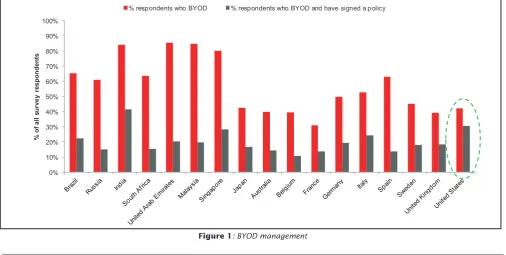
of organisations’ IT department is unaware of BYOD activity, while a further 28 percent of organisations’ IT department actively ignore it as it happens. Figure 1 shows that management of BYOD is an issue in many countries5 , at an
average of only 20.1 percent of BYOD being managed. However, some countries, e.g. United States, did demonstrate a higher level of management in comparison to the rest.
1Top 5 security threats for 2013 (source: http://www.net-security.org/secworld.php?id=14033)
2The securing mobile devices threat, however, is not mutually exclusive. This threat can be combined with other threats to create even greater threat profiles;
furthermore other threats will emerge in 2013.
3BYOD – Research findings released, (source: http://www.cxounplugged.com/2012/11/ovum_byod_research-findings-released/) 4BYOD – Research findings released, (source: http://www.cxounplugged.com/2012/11/ovum_byod_research-findings-released/)
5BYOD: an emerging market trend in more ways than one (source: www.logicalis.com/news-and-events/news/logicalis-white-paper-byod.aspx#.UVklGRdkP4W)
Figure 1: BYOD management
0% 10% 20% 30% 40% 50% 60% 70% 80% 90% 100%
%
of
a
ll
s
ur
vey
re
sp
ond
en
ts
14
In February 2013, Varonis conducted an online survey to examine the impact of BYOD on work habits and data security6 . Several key findings
of the survey are:
• 50 percent of employees reported that someone at their organisation has lost a device with important data in it
• 22 percent said the lost device had security implications for the organisation
Organisations should weigh the pros and cons of BYOD; and not just ignore employees who BYOD or simply disallow BYOD at workplace. BYOD can be an enabler for organisations, thus, organisations should take advantage of BYOD and allow for it. Nevertheless, they should develop a strategy to reduce security risks by planning and managing the BYOD implementation, through the implementation of ISO/IEC 27001:2005 Information Security Management System (ISMS) - Requirements.
ISO/IEC 27001:2005 ISMS – Requirements is an international standard published by International Organisation for Standardisation (ISO). The standard specifies requirements for an Information Security Management System (ISMS) that an organisation can develop and operate to protect its information assets and manage its information security risks. As a whole, ISMS can assist in the holistic and systematic management of information security within the organisation. Thus, ISMS is valuable in the planning and managing of the BYOD implementation to organisations in an effective manner.
This article describes the necessary requirements in ISMS that organisations can undertake in order to plan and manage their BYOD implementation.
Assessing BYOD risks
Risk assessment is a systematic process for identifying and evaluating events7 (i.e.
possible risks and opportunities) that could affect the achievement of objectives, positively or negatively. Risk assessment is one of the requirements in ISO/IEC 27001:2005 ISMS under clause 4.2.1 c). Risk assessment process
in ISMS usually includes other sub-processes such as identifying, analysing and evaluating the risks.
When conducting risk assessment, organisations should be able to identify security risks associated with BYOD. Some of the risks associated with BYOD are information disclosure due to stolen or lost personal device or confidential and sensitive business information stored in mobile devices without sufficient protection. Another type of security risk occurs when an employee leaves the organisation, for whatever reasons, and applications and confidential data may become unavailable to organisation as they still reside in the employee’s personal device. This possibility will occur when there is no procedure in place to safeguard the organisational confidential data.
Other risks introduced by BYOD are8:
• Introduction of Malware to the network through mobile devices that come pre-installed with malware;
• Trojanised applications that may be downloaded from third-party application stores that steal sensitive business information stored in mobile devices;
• Social engineering tactics that lead employees to click malicious URLs spammed by trusted sources via text messages, social media, emails;
• Virus infection of the network-connected jail-broken smartphones.
These risks need to be analysed and evaluated to determine whether security controls need to be implemented to reduce the risks to acceptable level. Organisations will need to design the security controls for the risks associated with BYOD. On the other hand, organisations may also decide to disallow BYOD if they realise the risks associated with BYOD are too high or the cost of security controls does not commensurate with the risks.
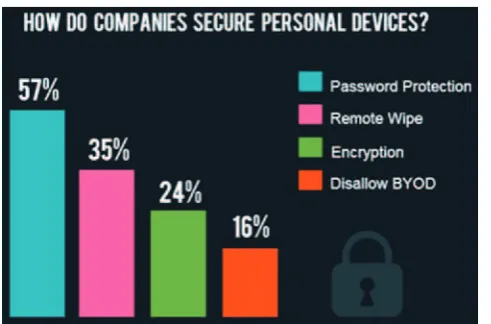
Figure 2 provides options on security controls that organisations may apply in BYOD implementation. They are; password protection, remote wipe, encryption and disallow BYOD. These options have been implemented by organisations in the Varonis online survey9.
6BYOD online survey (source:www.varonis.com)
7ISO/IEC 27005:2011 Information security risk management
15
Figure 2: Security controls for Securing Personal Devices
Developing BYOD policies and
procedures
Organisations should develop policies and procedures related to BYOD. Several controls in ISO/ IEC 27001:2005 ISMS are relevant to the development of BYOD policies and procedures. They are:
• A.5.1 Information security policy; Objective: To provide management direction and support for information security in accordance with business requirements and relevant laws and regulations;
• A.11.7 Mobile computing and teleworking; Objective: To ensure information security when using mobile computing and teleworking facilities.
BYOD policies and procedures should basically tell the employees the dos and don’ts of BYOD. The policies and procedures should have the following contents10 :
• Specify what devices are permitted
There are various types of devices available currently. Organisations should specify what devices are allowed and will be supported in the workplace; this includes brand, operating systems (OS) etc.
• Establish security controls for mobile devices
Employees tend to resist security controls (e.g. passwords or lock screens) on their personal mobile devices. However, organisations should establish security controls for personal mobile devices as there can be sensitive information in the devices, when the
devices connect to organisational network. Nevertheless, organisations may discuss with the employees to find appropriate security controls that will not burden them.
• Deine service/support level for
devices under BYOD criteria
Organisations should define what type and level of support that will be rendered to the personal mobile devices. Examples are in terms of broken devices, application (i.e. email, network issues), data loss etc.
• Clarify who owns data, applications, devices
While it seems logical that organisations owns information stored on the servers that the employees access with their devices, it becomes a problem when the issue of wiping the device (e.g. in the event the device is lost or the employee resigns). Wiping a device usually involve deleting all contents in the device, including personal pictures, music and applications that in many cases the employee, not the organisation, has paid for. Thus, organisations should clarify with employees the right to wipe devices brought onto the organisation’s premise. Organisations, should provide guidance on how employees can secure and back up their personal content and applications.
• Specify what applications will be
allowed or banned
Organisations should specify whether employees are allowed to download, install and use applications that present security or legal risks on mobile devices that have access to organisational network and resources. Major considerations typically include applications for social media browsing, replacement email applications and VPNs or other remote-access software.
• Integrate BYOD implementation plan
with organisational acceptable use policy
Organisations should ensure requirements in the existing acceptable use policy are covered in the BYOD implementation plan. This means the requirements for BYOD implementation should be aligned with the acceptable use policy. For example, is it a violation of acceptable use policy if the employees:
• Post on Facebook or other social media sites using their personal devices?
16
• Browse offensive websites via personal devices, which later inadvertently download malware and affect the organisational network?
• Transmit, unintentionally or not, inappropriate material over organisational network, using personal devices’ VPN?
• Indicate methods for employee exit strategy
Organisations should clearly spell out the employees exit strategy in the BYOD procedure. The detailed procedures of the removal of access rights, e-mail access, data and other proprietary applications on these personal mobile devices should be described. Disciplinary actions and/or enforcement should also be stated in the procedure as well.
The BYOD policies and procedures should be approved and communicated to all employees and relevant parties. Enforcement of the policies and procedures should also be in place. Lastly, the policies and procedures should be reviewed at planned intervals to ensure the validity and accuracy of the policies and procedures.
Monitoring security incidents
related to BYOD
Organisations should monitor any security incidents which may occur due to BYOD. ISO/ IEC 27001:2005 ISMS specifies few controls for managing security incident which are A.13.1 Reporting information security events and weaknesses and A.13.2 Management of information security incidents and improvements.
The objectives of these two controls is to ensure information security events and weaknesses associated with information systems are communicated in a manner that allows for timely corrective action to be taken and ensure a consistent and effective approach is applied to the management of information security. This will help organisations in managing security incidents related to BYOD effectively.
In addition, internal ISMS audit (clause 6 of ISO/IEC 27001:2005) is another requirement in ISMS that can assist organisations in managing and monitoring their BYOD security incidents. The internal ISMS audits will ensure organisations conduct audits periodically to find non-conformities in terms of violation of BYOD policies and procedures.
Conclusion
BYOD has created tremendous opportunity for organisations to allow their employees to work in new, innovative and productive ways. The old ways of prohibiting access to organisational network and data from personal devices, or insisting that employees use organisation-owned devices at workplace will not work in the consumerisation era. Thus, organisations should be lexible and allow BYOD in their organisations. However, they need to equip themselves with the knowledge and how-tos in managing the BYOD effectively. As described in this article, ISO/IEC 27001:2005 ISMS implementation will help organisations to understand BYOD risks, develop policies and procedures related to BYOD and monitor the security incidents related to BYOD. Other efforts should also be made to ensure the BYOD implementation is successful and managed effectively. ■
References:
1. ISO/IEC 27001:2005, Information technology - Security techniques - Information security management systems – Requirements.
2. ISO/IEC 27005:2011, Information technology – Security techniques – Information security risk management.
3. BYOD – Research indings released, 28 November 2012, http://www.cxounplugged.com/2012/11/ ovum_byod_research-indings-released/, accessed on 27 March 2013.
4. Adrian Drury, Richard Absalom, BYOD: an emerging market trend in more ways than one, http://www. logicalis.com/news-and-events/news/logicalis-white-paper-byod.aspx#.UVklGRdkP4W, accessed on 27 March 2013.
5. BYOD online survey by Varonis System, www.varonis. com, accessed on 27 March 2013.
6. Top 5 security threats for 2013, Information Security Forum, www.net-security.org/secworld.php?id=14033, accessed on 27 March 2013.
7. Jonathan Hassel, 7 Tips for Establishing a Successful BYOD Policy, May 17, 2012, http://www.cio.com/ article/706560/7_Tips_for_Establishing_a_Successful_ BYOD_Policy?page=3&taxonomyId=600013, accessed on 27 March 2013.
17
JOHOR BAHRU: Seorang kakitangan swasta yang membeli tiga telefon bimbit dengan harga RM3,250 secara dalam talian terkejut apabila hanya menerima lesung batu berharga RM14.50, sehari selepas melunaskan pembayaran.
Lebih menyakitkan hati, tulisan RM14.50 berkenaan masih ada pada lesung batu berkenaan dan mangsa tergamam ketika menerimanya.
“Saya membuat pembelian itu selepas melayari satu laman web dan tertarik dengan tawaran telefon bimbit Samsung Galaxy S bernilai RM1,100 seunit berbanding harga pasaran semasa iaitu RM1,900.
“Saya membeli tiga telefon bimbit berkenaan secara talian pada 6 Disember lalu dan membuat bayaran ke akaun seorang lelaki.” kata mangsa semalam.
Menurut mangsa, dia kemudian menerima SMS daripada kakitangan sebuah syarikat menjual peralatan komunikasi yang menawarkan barangan percuma atau diskaun RM50.
Mangsa memilih tawaran diskaun berkenaan dan sehari kemudian, dia menerima bungkusan barangan dibeli.
“Saya gembira kerana telefon bimbit berkenaan tiba tepat pada masanya, tetapi terkejut apabila mendapati kotak bungkusan berkenaan cuma mengandungi lesung batu.
“Saya menghubungi nombor telefon tertera seperti dalam SMS diterima sehari sebelum itu, tetapi individu terbabit enggan menjawab panggilan saya,” katanya.
Mangsa kemudian melakukan pemeriksaan di Suruhanjaya Syarikat Malaysia (SSM) dan mendapati syarikat terbabit tidak wujud.
Laporan diatas adalah antara kes penipuan perniagaan Internet yang pernah disiarkan oleh suratkhabar Harian Metro bertarikh 10 Januari 2012.
Dalam arus paskal pemodenan dunia tanpa sempadan hari ini, kita sememangnya tidak
Transaksi e-Dagang: Adakah ianya selamat?
By | Azrul Ehsan Ahmad & Norhazimah Abdul Malekdapat lari dari perubahan terhadap gaya hidup yang berorientasikan teknologi maklumat. Penggunaan Internet telah menjadi salah satu sumber utama dalam kehidupan harian kita semua. Istilah "dunia di hujung jari" sering digunakan bagi menggambarkan situasi tersebut. Menerusi penggunaan Internet, segala urusan harian boleh dilakukan secara dalam talian (online). Antaranya, urusan pembayaran bil dan cukai, kemudahan laman sosial bagi menghubungkan individu dengan dunia luar, dan tidak kurang hebatnya juga urusan jual-beli yang dijalankan secara dalam talian.
e-Dagang merupakan aktiviti yang kian mendapat tempat di kalangan para peniaga dan pembeli di negara ini. Antara produk-produk yang ditawarkan termasuklah peralatan komunikasi, produk kesihatan, kecantikan, pakaian, sukan, aksesori dan lain-lain lagi. Perniagaan e-Dagang mempunyai kebaikan di mana ianya dapat menjimatkan masa dan juga kos. Para peniaga juga dapat mempromosikan barangan mereka tanpa sempadan.
Walaubagaimanapun sejak akhir-akhir ini, kita sering membaca kes-kes penipuan berkenaan e-Dagang. Di antaranya, barangan yang diterima tidak menepati ciri sebenar barangan yang dilihat di laman e-Dagang dan paling malang, jika barang berkenaan bukan barang yang dipesan atau barangan yang dipesan tidak kunjung tiba walaupun bayaran telah dibuat sepenuhnya.
18
Lantaran itu, pihak kerajaan telah mengambil langkah proaktif dengan memperkenalkan Malaysia Trustmark bagi menangani kesulitan dan masalah-masalah yang berbangkit akibat kes penipuan perniagaan Internet ini.
Apa itu ?
Malaysia Trustmark merupakan hasil inisiatif Kerajaan Malaysia dalam usaha untuk merangsang perniagaan e-Dagang, meningkatkan keyakinan pengguna untuk melakukan transaksi e-Dagang dan seterusnya mengurangkan risiko penipuan Internet.
Malaysia Trustmark adalah perkhidmatan menilai dan mengesahkan sesebuah laman e-Dagang tempatan dari segi:
1. Pendedahan maklumat (Disclosure of Information), memerlukan setiap organisasi yang menjalankan perniagaan e-Dagang untuk memaparkan segala maklumat perniagaan dengan tepat dan terkini di laman sesawang e-Dagang mereka;
2. Amalan perniagaan (Practices) berdasarkan polisi serta prosedur yang diamalkan oleh sesebuah organisasi dalam menjalankan urusan jual beli dalam talian;
3. Keselamatan (Security), yang memerlukan sesebuah organisasi untuk memastikan tahap keselamatan laman sesawang e-Dagang mereka supaya data pelanggan serta sebarang transaksi elektronik yang terlibat di dalam urusan jual-beli dalam talian terjamin;
4. Privasi atau Perlindungan Data Peribadi (Personal Data Protection) yang memerlukan sesebuah organisasi itu mematuhi Akta Perlindungan Data Peribadi 2010 bagi memastikan data pelanggan mereka dilindungi;
5. Penyelesaian Pertikaian Alternatif (Alternative Dispute Resolution), setiap organisasi yang menjalankan perniagaan e-Dagang perlu mempunyai prosedur pengendalian aduan atau pertikaian pelanggan. Prosedur ini haruslah dipaparkan di laman sesawang e-Dagang mereka.
Sesebuah organisasi akan dapat menggunakan logo Malaysia Trustmark di laman sesawang e-Dagang mereka jika mereka mematuhi
keperluan di atas.
Antara faedah-faedah Malaysia Trustmark adalah:
1. Membina keyakinan para pengguna terhadap transaksi e-Dagang tempatan;
2. Menggalakkan amalan perniagaan e-Dagang yang teratur dan selamat;
3. Mengurangkan risiko dan kes penipuan Internet;
4. Organisasi yang mempunyai logo Malaysia Trustmark akan lebih dipercayai seterusnya akan meningkatkan jualan mereka;
5. Memperluaskan peluang-peluang perniagaan di peringkat tempatan dan antarabangsa.
Untuk merealisasikan inisiatif ini, Kerajaan Malaysia telah melantik CyberSecurity Malaysia sebagai agensi Pengendali (Operator) dan Pengesah (Certifier) Malaysia Trustmark bagi sektor swasta manakala Unit Pemodenan Tadbiran dan Perancangan Pengurusan Malaysia (MAMPU) pula dilantik sebagai agensi Pengendali (Operator) dan Pengesah (Certifier) Malaysia Trustmark bagi sektor awam.
Jika melihat kepada situasi di luar Malaysia, pendekatan yang sama juga dilaksanakan di negara-negara maju di mana terdapat badan atau organisasi yang diiktiraf untuk mengeluarkan logo Trustmark seperti VeriSign, TRUSTe dan TrustSg. Dengan adanya logo tersebut, jelas menggambarkan kesan positif di mana ianya membantu meningkatkan kepercayaan dan keyakinan para pembeli terhadap organisasi yang menjalankan perniagaan e-Dagang.
World Trustmark Alliance (WTA)
19
keyakinan para pengguna dalam e-Dagang di negara mereka seperti CyberSecurity Malaysia (Malaysia), Commerce Net Singapore (CNSG) dan Consumer Association Singapore (CASE) (Singapura), NIPA (Korea Selatan), TRUSTe (Amerika Syarikat), Trade Safe dan EC Network (Jepun), SOSA (Taiwan), Qartas Corporation (Filipina), Eropah, Thailand, Mexico, dan China. Objektif WTA adalah:
1. Memperluaskan peluang perniagaan melangkaui pasaran tempatan;
2. Menggalakkan amalan baik dalam transaksi-transaksi serantau;
3. Membina keyakinan dalam pasaran e-Dagang; dan
4. Menjadi model pertama bagi kerjasama serantau yang merupakan langkah pertama kearah perikatan global.
Ahli-ahli WTA menggunakan Garis Panduan Pengendali Trustmark (GTO) yang merangkumi keperluan pendedahan maklumat (Disclosure of Information), amalan perniagaan (Practices), keselamatan (Security), privasi atau perlindungan data peribadi (Personal Data Protection), Penyelesaian Pertikaian Alternatif (Alternative Dispute Resolution), dan pemantauan (Monitoring) untuk mengaudit organisasi yang menjalankan perniagaan e-Dagang.
Tips kepada Pengguna
Para pengguna atau pembeli di negara ini adalah dinasihatkan untuk melakukan transaksi hanya melalui laman e-Dagang yang selamat dan dipercayai sebelum meneruskan urusan jual beli secara dalam talian. Dengan adanya logo Malaysia Trustmark pada laman sesawang e-Dagang yang dilawati, ianya menunjukkan organisasi tersebut telah mengambil pendekatan program keselamatan.
Para pengguna juga boleh merujuk kepada garisan panduan yang ada berkenaan transaksi elektronik seperti yang disediakan oleh Kementerian Perdagangan Dalam Negeri, Koperasi dan Kepenggunaan (KPDNKK). Garis panduan tersebut boleh dimuat turun di laman sesawang KPDNKK.
Di bawah ini juga disediakan langkah-langkah yang perlu diikuti bagi mengenalpasti laman sesawang yang telah mendapat pengesahan Malaysia Trustmark. Sila pastikan:
1. Logo Malaysia Trustmark terletak di bahagian kanan atas sesebuah laman sesawang.
2. Sebelum melakukan sebarang transaksi jual beli, pembeli atau pengguna haruslah memeriksa kesahihan logo Malaysia Trustmark tersebut:
• Langkah 1: Gerakkan tetikus ke arah logo Malaysia Trustmark yang terletak di bahagian kanan atas.
• Langkah 2: Klik pada logo Malaysia Trustmark atau perkataan “Please Click Here” yang terdapat di bawah logo Malaysia Trustmark.
• Satu paparan sijil bagi Malaysia Trustmark akan muncul.
• Langkah 3: Periksa status yang terdapat di dalam paparan sijil Malaysia Trustmark tersebut.
• Jika status Malaysia Trustmark tersebut adalah ‘VALID’ (sahih), ini bermakna organisasi tersebut masih mematuhi keperluan Malaysia Trustmark. Jika tidak, ianya menunjukkan organisasi tersebut tidak lagi memberi komitmen terhadap pendekatan rancangan keselamatan Malaysia Trustmark.
Diharapkan dengan sedikit perkongsian mengenai Malaysia Trustmark ini dapat meningkatkan keyakinan pengguna untuk melakukan transaksi e-Dagang dan seterusnya merangsang perniagaan e-Dagang di Malaysia. Di samping itu, mengurangkan risiko dan kes penipuan internet yang kini kian menjadi-jadi.
20
Background
The new international standard for Business Continuity Management System (BCMS) “Societal security - Business continuity management systems – Requirements” i.e. ISO 22301 was officially launched in May 2012. This new global standard for business continuity management (BCM) specifies requirements to plan, establish, implement, operate, monitor, review, maintain and continually improve on a documented management system. The standard aims to protect against, reduce the likelihood of occurrence, prepare for, respond to and recover from disruptive incidents when they arise.
This is the first international standard for BCM using the British Standard BS 25999 - Business Continuity Management Part 2 as its primary input. Other standards referred to include the NFPA 1600:2010, ASIS SPC 1-2009, ISO 27031, ISO Guide 73, ISO PAS 22399 and other national BCM standards (e.g. Australia, New Zealand, Singapore, Japan, Singapore and Canada).
The new standard was developed according to the ISO Guide 83, with a new high-level structure which specifies the common headings and standardises text as agreed in ISO. The guide states several principles, definitions, standard words and a fixed format that ensure consistency with all future and revised management system standards. This will also allow easier integration and interface for organisations implementing various management systems like the ISO 27001, ISO 14001 and ISO 9001.
A Glimpse of ISO 22301– Business
Continuity Management Systems
By | Ida Rajemee Bt Ramlee
Why Implement BCM?
The birth of the global standard will eventually cater to the needs for a consistent approach to BCM implementation. This is especially important for multinational firms that operate in different countries and have to comply with each country’s BCM standards and statutory obligations. Similar to other management systems, the standard is also easily scalable so it can be adapted to organisations of almost all sizes. By adopting to this new standard, organisations are able to measure itself against good BCM practice.
For service oriented organisations, BCM practices should be embedded into their business operations and become part of corporate culture to ensure availability of their critical services. In Malaysia, the implementation of BCM at the organisation level is mainly due to regulatory and statutory obligations. For instance in the Financial and Banking sector, Bank Negara Malaysia has issued BCM Guidelines with the main objective “to outline and enforce minimum BCM requirements on the institution so as to ensure the continuity of critical business functions and essential services within a speciied timeframe in the event of a major disruption.”
21
the ISMS requirements at the same time.
Furthermore, the control is described in general and fulfills the basic requirements of BCM. The existence of the ISO 22301 provides the best methodology to support the implementation of this specific clause. By complying with the 27001 BCM controls, it will be easier for organisations to expand their BCM implementation to meet the requirements of ISO 22301.
Comparison with BS 25999
Considering BS 25999 has been the main reference most popular for business continuity standards ever since it was published in November 2007, some significance comparisons are highlighted in this sub-topic.
In general the ISO 22301 requirements are similar to the BS 25999-2 which includes the core components of BCM i.e. business continuity policy, business impact analysis, risk assessment, business continuity strategy and business continuity plans, exercising and testing, internal audit, management review and non-conformity and corrective action. Moreover, the new standard also includes improvement over 25999-2 in areas such as disaster response and crisis communications, and gives more emphasis on the planning of the BCMS and the engagement of the management throughout the phases.
Compared to BS 25999, major changes are observed in these following new areas - understanding the organisation, understanding the needs and expectations, management commitment, monitoring measurement, analysis and evaluation and communication and warning system. These requirements are new in ISO 22301 and were not covered in BS 25999.
Another new aspect introduced in this new standard is the Top Management Commitment. In ISO 22301, the top
management are given clearer BCM leadership responsibilities and ways to demonstrate their commitment to the establishment, implementation, operation, monitoring, review, maintenance and improvement of the BCMS.
BS 25999 only describes the management’s review in general and is based on Review Input and Output whereas management review requirements are also emphasised in greater detail in ISO 22301.
In the aspect of performance evaluation in terms of monitoring, measurement, analysis and evaluation, these areas are not covered significantly in BS 25999 compared to ISO 22301.
The former only described brief requirements in maintaining and reviewing BCM arrangements while the ISO 22301 requires organisations to determine what needs to be measured and monitored, methods to be used and when monitoring should be performed and when the analysis evaluation of measurement results should be performed. Procedures for monitoring performance are also clearly described.
Other new areas covered under the scope of BCMS are the interested parties’ needs and interests, such as customers, investors, shareholders, the supply chain, public and/or community input and needs, expectations and interests.
BCM practitioners are also exposed to new definitions introduced in this standard. Some of the new terms are listed in the table below:
Terms Deinition
Correction An action to eliminate a
detected non-conformity
Disruptive Incidents
An event that stops the business operations
Documented Information
22
Maximum Acceptable Outage (MAO)
Time it would take for adverse impacts, which may arise as a result of not providing a product/service or performing an activity, to become unacceptable
Maximum data loss
The point to which information used by an activity must be restored to enable the activity to operate upon resumption – also referred to as
Minimum level of services and/or products that is acceptable to the organisation to achieve its business objectives during a disruption
Application of the PDCA model
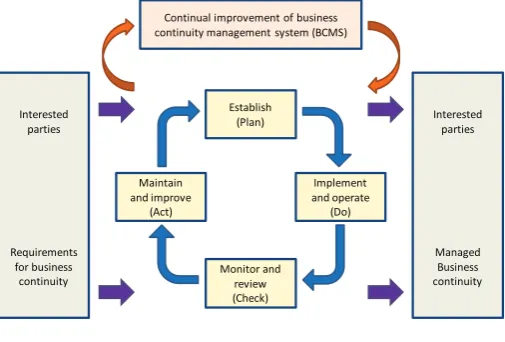
Organisations which have implemented other management systems standards such as ISO 9001, ISO 14001 or ISO/ IEC 27001 will be familiar with the Plan-Do-Check-Act (PDCA) model applied in the ISO 22301. The PDCA model is used in planning, establishing, implementing, operating, monitoring, reviewing, maintaining and improving the effectiveness of an organisation’s BCMS. At the same time, consistency with other management system standards that are already in place can also be obtained through integrated implementation and operation.
The ISO 22301 is designed to be compatible with other management system standards. For instance, ISO 27001 and ISO 22301 are highly compatible and are very easy to implement jointly. Similarities between the two standards are in the areas of Document and records management, Human resources management, Internal Audit, Management Review, Corrective and preventive actions, Setting objectives and measurement and the PDCA cycle. There
The Requirements & Clauses
This standard comprises of 10 main clauses initiated by the Scope, Normative Reference, Terms and Definitions, as followed by the standard’s requirements from Clause 4 to Clause 10.
a - Clause 4: Context of the organisation
This clause introduces the requirements necessary to establish the context and determine the scope of the BCMS. This is obtained by getting the internal and are also overlapping areas in Incident Management and Risk Management.
The diagram summarises the PDCA cycle in the BCMS context.
For the ISO 22301 requirements, the Planning activities include Clause 4: Context of the organisation, Clause 5: Leadership, Clause 6: Planning and Clause 7: Support. The DO phase covers Clause 8: Operation. Clause 9: Performance Evaluation represents the Check Phase and lastly Clause 10: Improvement is covered under the ACT phase. All these clauses are discussed in brief in the following section.
Figure 1: PDCA model applied to BCMS
Source: http://www.bsigroup.it/ Continual improvement of business
23 external needs of relevant interested
parties such as regulators, staff, customers and other related stakeholders. Other considerations are the organisation’s strategic objectives, key products and services, risk tolerance as well as the regulatory, contractual and stakeholders’ obligations and other interested parties (i.e. customers, investors, shareholders, the supply chain and public/community) needs and interests. The scope is also defined based on the size, nature and complexity of the organisation.
b - Clause 5: Leadership
It summarises the requirements specific to top management’s role in the BCMS and how leadership demonstrates its expectations to the organisation via a business continuity policy statement, providing sufficient resources to support, implement and maintain BCMS.
Top management are also responsible to ensure the BCMS achieves its expected outcome, BCMS objectives and plans are established as well as responsibilities and authorities for relevant roles are assigned accordingly.
c - Clause 6: Planning
Clause 6 describes requirements as it relates to establishing strategic objectives and guiding principles. This is achieved by identifying the risks to the BCMS implementation, treating the risks identified and complying with the organisational needs. Business continuity objectives must be established and communicated within the organisation and plans need to be developed to achieve these objectives.
d - Clause 7: Support
This clause addresses specific resources and staff competency for BCMS implementation. It also covers the need for both internal and external communications relevant to the BCMS. Additionally, all requirements for documented information
to support BCMS operations are explained during document creation, update and document control.
e - Clause 8: Operation
Clause 8 includes the requirements for Business Impact Analysis, Risk Assessment, the development of Business Continuity strategy, procedures, exercising and testing. It also stresses on the importance of a well-defined incident response structure to support timely response and escalation of incident.
f - Clause 9: Performance evaluation
Performance evaluation requirements are in terms of BCM performance measurement, BCMS compliance with International Standards and management’s expectation and feedback from management with regards to expectations. Evaluation of continuity procedures and capabilities shall be conducted along with management review to ensure the organisation’s BCMS continue with suitability, adequacy and effectiveness. Internal audit shall also be conducted at planned intervals to determine conformance to the standard and the organisation’s requirements for its BCMS.
g - Clause 10: Improvement
This clause identifies and acts on BCMS non-conformance through corrective action. Organisations complying to the standard shall evaluate the need for action to eliminate the causes of non-conformities and corrective actions appropriate to these non-conformities. The continual improvement for suitability, adequacy or effectiveness of the BCMS is also required.