Vol 40 - (1/2016)
“People often represent the weakest link in the security chain and are chronically responsible for the failure of security systems. ”
Bruce Schneier, Secrets and Lies
Understanding and Defending Against Mobile Botnets: A Case Study
ii
Level 5, Sapura@Mines No. 7 Jalan Tasik The Mines Resort City 43300 Seri Kembangan Selangor Darul Ehsan Malaysia.
T: +603 8992 6888 F: +603 8992 6841 E: [email protected] Customer Service Hotline:
1 300 88 2999 www.cybersecurity.my
Cyber999 Help Centre | My CyberSecurity Clinic |
Professional Development (Training & Certification) |
Product Evaluation & Certification (MyCC) |
Information Security Management System Audit and Certification (CSM27001) | Malaysia Trustmark | Security Assurance | Digital Forensic & Data Recovery | Malaysia Computer Emergency Response Team (MyCERT) | Security Management & Best Practices | Cyber Security Research |
CyberSAFE (Cyber Security Awareness for Everyone)
WELCOME MESSAGE FROM THE CEO OF CYBERSECURITY MALAYSIA
Dear Readers,
Thank you for your continuous patronage of CyberSecurity Malaysia’s e-Security Bulletin!
Because of you, we feel motivated to write more interesting articles.
For this 40th edition of e-Security Bulletin, we have compiled 20 articles for you — mostly technical articles that are eagerly sought after by researchers, practitioners and observers alike. Personally, I do make sure I read them all, in order to update and enhance my understanding of the current cyber security scenario in Malaysia. If you cannot read all of the articles, I highly recommend you to at least read the ‘Social Engineering Experiment via Social Media’, as well as ‘The Case Study for Understanding and Defending Against Mobile Botnets’.
Till we meet again in the next edition of e-Security Bulletin; be smart and be safe!
Dr. Amirudin Abdul Wahab
PUBLISHED AND DESIGNED BY
READERS’ ENQUIRY
CyberSecurity Malaysia,
Outreach and Corporate Communications, Level 5, Sapura@Mines, No.7 Jalan Tasik, The Mines Resort City, 43300 Seri Kembangan
EDITORIAL BOARD
Chief Editor
Dr. Zahri bin Yunos
Editor
Lt. Col Mustaffa bin Ahmad ( Retired )
Internal Reviewers
1. Mohd Shamil bin Mohd Yusoff 2. Ramona Susanty binti Ab Hamid 3. Nur Arafah binti Atan
4. Sandra binti Isnaji
Designer & Illustrator
1. Understanding and Defending Against Mobile Botnets: A Case Study ... 1
2. Addressing the Threat of Cyber Terrorism ... 4
3. WordPress vs Joomla: A Comparative Study... 7
4. Steganography Series: Peak Signal-to-Noise Ratio... 13
5. Rise of the DD4BC copycats ... 16
6. Successful Cybersecurity Capacity Building ... 19
7. Getting to Know The Knowledge Management Centre of CyberSecurity Malaysia ... 22
8. National Cryptographic Algorithm Projects ... 25
9. FIPS 140-2 Evaluation Laboratory Accreditation and Its Programs ... 30
10. Vulnerability Assessment & Penetration Testing (Vapt): Approach And Methodology ... 34
11. Comparing sampled Information Security Body of Knowledge with ISO/IEC 27001 ... 37
12. ICT Product Evaluated and Certified? Go for MyCC!... 40
13. Securing Your Online Gaming Experience ... 42
14. A Picture is Worth a Thousand Words – Investigating Images ... 45
15. Top Five Common Penetration Tools ... 48
16. Social Engineering Experiment – Social Media ... 52
17. Securing The Cyber Space Through International Collaboration of Computer Emergency Response Teams ... 56
18. Drafting Security Target 101 ... 59
19. Impersonation and Spoofing Fraud Q4 2015 ... 62
1
Understanding and Defending Against
Mobile Botnets: A Case Study
By | Sharifah Roziah Mohd Kassim
Introduction
It is no exaggeration to say that mobile devices have become part of daily life and have been emerging tremendously over the past years. They are now handy devices for multiple usage, such as communication, sending SMS messages, socializing, chatting, reading emails, online banking and catching up on early morning news. Mobile devices actually offer a better attack avenue than non-mobile devices because users almost always carry them around, providing greater probability for stealing confidential information, credentials or even pictures. As for non-mobile devices, the probability of attack is lower because they depend upon the device’s uptime and user’s availability with the device.
Overview of Mobile Botnets
So what is a mobile botnet? It is just like a computer botnet, which is a piece of malicious code that targets and infects mobile devices such as smartphones in order to gain complete ownership of them. Infection can happen by various means and regardless of the smartphone platform. Once infected, the device will establish communication with a Command & Control (C&C) server that is controlled remotely by an attacker known as a botmaster. The C&C servers are normally geographically dispersed around the world to ensure the longevity of activities and to evade tracing by Legal Enforcement Agencies.
Just like computer botnets, mobile botnets take advantage of vulnerable mobile devices to compromise and gain full control of them, enabling the botnets to make phone calls, send SMS messages, and access confidential data, contacts and pictures that may be stored in the mobile device. Besides, for the botnet to be more widespread and maximize its impact, it will propagate by sending a copy of itself to other vulnerable devices through SMS messages and emails.
Examples
Mobile botnet infections can be traced back to as early as 2011. Two such examples are DroidDream and Gemini botnets. They are
trojan game apps with bot-like capabilities that compromise Android devices. These were followed in November 2014 by the discovery of NotCompatible.C malware. This was considered the most advanced mobile botnet targeting Android-based devices including smartphones. Botnets are capable of gaining unauthorised access to secure enterprise networks.
In late 2014, WireLurker malware was discovered, which targeted Apple iPhones and iPads. Mobile botnets infect Apple devices through installing pirated versions of popular Mac applications. A botnet has the capabilities to download and install enterprise-signed apps to vulnerable devices without the user’s knowledge.
In March 2014, a variant of the Zorenium Bot was found targeting and infecting IOS device operating systems, which had previously included Windows and Linux. Upon infection, it can bypass anti-virus software detection and allows attackers to use the mobile phones as agents to conduct DDOS attacks and other notorious activities. Apart from the above examples are CommWarrior and Sexy Space.
Methods of Infection
There are several ways in which mobile botnets can infect smartphones and they are quite similar to the methods used to infect computers. 1. A popular and traditional method of how a
botnet can infect and spread is when a user clicks on an attachment or malicious URL that contains the botnet, normally bundled in emails.
2. Besides email, attachments or malicious URLs may attach to unsuspecting SMS messages.
3. A botnet also spreads through unsuspected illegitimate applications and when unknowingly browsing malicious websites.
Case Study
2
phone numbers stolen from the contact lists of infected smartphones. The botnets residing in the mobile devices seemed to have established communication with a remote C&C server and delivered the stolen data including the mobile phone numbers to the server. This information could be retrieved by the attackers who control the C&C server.
In this case study, it was found that mobile botnets spread through SMS messages that target Android smartphones only. Other platforms were not affected. Users who clicked on a link in an SMS message they received inadvertently installed a malicious Android Package (APK) that took control of their smartphones.
In this case study, we found the infected smartphones can be hijacked remotely and potentially used for various fraudulent activities, such as buying digital goods and services without the smartphone owners knowing it. The infected smartphones become launching pads to further propagate the malware to other smartphones by sending SMS messages with links to the malicious APK.
Implications of mobile botnets on smartphones can be huge and serious if immediate action is not taken to mitigate the infection. The impacts can be as follows:
a. Cybercriminals or botnet herders direct the infected smartphones to buy digital goods from micropayment providers in Malaysia. b. The botnet will send SMS messages to other
smartphone users, which were extracted from the infected smartphone’s address book, containing a malicious APK in order to propagate further.
c. Confidential information like contact numbers extracted from the infected smartphones’ address books are stolen and the perpetrators can use them for malicious activities.
d. The botnet will establish a connection and make call-backs to a Command & Control (C&C) server controlled by the attackers.
Below is a diagram illustrating how a mobile botnet works.
3
Defend Your Mobile Devices
As best practices to safeguard smartphones, users are advised to:
a. Set a password for your smart phone. All major smartphone operating systems allow you to set a password and automatically lock your phone after a period of inactivity. b. Verify an app's permission and the app's
author or publisher before installing it. c. Do not click on adware or suspicious URLs
sent through SMS/messaging services. Malicious programs could be attached to collect users’ information.
d. Always run a reputable anti-virus on your smartphone/mobile device, and keep it up to date regularly.
e. Switch off Bluetooth if it is not in use. This way, your phone will be less vulnerable to attacks.
Conclusion
Mobile devices, particularly smartphones, have become essential in our everyday life and the majority of us own at least one smartphone. However, it is the responsibility of each smartphone owner to ensure full protection is enabled for the device to prevent exploitation and botnet infections. Smartphones are now gaining popularity among attackers as a form of easy prey. As such, safeguarding devices must be given utmost priority to prevent unwanted incidents.
Reference:
1. http://www.bullguard.com/bullguard-security-center/mobile-security/mobile-threats/ mobile-botnets.aspx
2. http://www.webopedia.com/TERM/M/ mobile_botnet.html
3. https://www.mycert.org.my/en/services/ advisories/mycert/2014/main/detail/1011/ index.html
4. http://www.darkreading.com/cloud/ the-rise-of-the-resilient-mobile-botnet/d/d-id/1317593
4
What is Cyber Terrorism?
Cyber terrorism is the convergence of cyberspace and terrorism. It refers to unlawful attacks and threats of attacks against computers, networks and information stored therein done to intimidate or coerce a government or its people in furtherance of political or social objectives [1] [2]. Furthermore, to qualify as cyber terrorism, an attack should result in violence against persons or property, or at least cause enough harm to generate fear. Attacks that lead to death or bodily injury, explosions, or severe economic losses are such examples. Serious attacks against critical infrastructures may be acts of cyber terrorism, depending on their impact. Attacks that disrupt nonessential services or that are mainly a costly nuisance would not be considered cyber terrorism.
Cyber Terrorism Attacks in
Malaysia
Cyberspace is a virtual place that has become as important as physical space for social, economic, and political activities. Many countries around the world are increasingly dependent on cyberspace when using Information and Communication Technology (ICT) [3] [4]. This dependency renders these countries in an insecure position because cyberspace is borderless and vulnerable to cyberattacks. Individuals have the ability and capability to cause damage to a nation through cyberspace. Cyberattacks are also attractive because they are cheap in relation to the costs of developing, maintaining and using advanced and sophisticated tools. Many have declared that cyberspace is the fifth domain along with land, air, sea and space, and it is crucial to battlefield success.
In general, to understand cyber terrorism, it can be broken down into at least five elements that construe cyber terrorism [5] [6]:
i. Politically-motivated cyberattacks that lead to death or bodily injury;
ii. Cyberattacks that cause fear and/or physical harm through cyberattack techniques;
iii. Serious attacks against critical information infrastructures, such as finance, energy, transportation and government operations; iv. Attacks that disrupt non-essential services
are not considered cyber terrorism;
v. Attacks that are not primarily focused on monetary gain.
Malaysia has not experienced any serious cyberattacks, but several cyberattacks have affected the country including an attack in 2011 by a group calling themselves “Anonymous” [7].
Preventive Measures Taken by
the Government
In Malaysia, the Government has taken initiatives to mitigate and combat cyberattacks. One of the initiatives is the development of the National Cyber Security Policy (NCSP), which was endorsed by the Government in May 2006 [8] [9]. NCSP consists of eight (8) policy thrusts: Effective Governance, Legislative and Regulatory Framework, Cyber Security Technology Framework, Culture of Security and Capacity Building, Research and Development towards Self Reliance, Compliance and Enforcement, Cyber Security Emergency Readiness and International Cooperation.
The NCSP was formulated to address threats and risks to the Critical National Information Infrastructure (CNII) and to develop action plans to mitigate such risks. CNII consists of assets (real and virtual), systems and functions that are vital to the nation, and whose exploitation, damage or destruction would have a devastating impact on national economic strength, image, defence and security, government capabilities to function efficiently and public health and safety. The NCSP is particularly focusing on protecting CNII against cyber threats [10] [11]. Alongside clear and effective governance, NCSP provides mechanisms for improving trust and cooperation among the public and private sectors. NCSP also focuses on enhancing skills and capacity building as well as advancing research and development initiatives towards self-reliance. It also maps out emergency readiness initiatives and dictates a programme of compliance and assurance across the entire
Addressing the Threat of Cyber Terrorism
5 CNII. The NCSP also reaches out to Malaysia’s
international partners and allies. The policy describes ways in which Malaysia can share knowledge with the region and the world on cyber security-related matters. Malaysia developed NCSP as a proactive step in protecting critical sectors against cyber threats.
Other actions taken against cyberattacks are: i. A layered approach for defence mechanisms By having combinations of email filtering, installations of anti-virus software, pro-active malware protection, security policies and keeping protection software, operating systems and applications up to date can help tackle security-related concerns such as spam and malware attacks.
ii. Awareness
Internet users and organizations should constantly be offered cyber security awareness of current security threats and how to protect against threats via best practices and safeguarding their systems/networks from attacks.
How serious is Cyber Terrorism?
Cyber terrorism is real and extant. It is considered an attractive option for modern terrorists who value its anonymity, its potential to inlict massive damage, its psychological impact, and its media appeal. It includes warfare attacks against a nation’s state and forcing ICT infrastructure (including the critical national infrastructure) and assets to fail or get destroyed. Not only are cyber criminals not slowing down, but they keep upgrading and innovating ways of hacking into systems, stealing identities and data, hijacking computers and much more. Ways forward to mitigate cyberattacks and terrorism include:
i. Strengthening domestic cyber security through inter-agency cooperation and Public-Private Partnership;
ii. Global collaboration and strategic alliances to strengthen regional cyber security in addressing cross-border cyberattacks and cybercrimes;
iii. Adopting more innovative, aggressive and proactive approaches in order to stay ahead of cyber threats - with both defensive and offensive capabilities;
iv. Enhancing the People-Process-Technology triad.
The Roles of CyberSecurity
Malaysia in Combating Cyber
Terrorism
CyberSecurity Malaysia is structured to be able to mitigate cyberattacks and cyber threats. One of the major characteristics of such threats is their cross-border nature, whereby Internet crimes do not conform to a nation’s physical boundaries. On account of this, CyberSecurity Malaysia rigorously pursues international relations by establishing collaborative efforts with foreign government agencies and international organizations through bilateral and multilateral engagements. CyberSecurity Malaysia is also heavily involved in the establishment of cyber security multilateral engagement platforms, such as the Asia Pacific CERT (APCERT) and the Organization of Islamic Cooperation-CERT (OIC-CERT). These platforms see to the collaboration of similar organizations in mitigating international cyber threats.
In addition, other departments including Digital Forensics, the Malaysia Computer Emergency Response Team (MyCERT) and Security Assurance have specific arrangements with their counterparts overseas. Since 2001, CyberSecurity Malaysia has been actively participating in various cyber security events locally, regionally and internationally. All conferences, seminars and workshops have been of great benefit not only to the target audiences (who attended the event) but also to the country.
CyberSecurity Malaysia also organises its own yearly event in Kuala Lumpur, known as Cyber Security Malaysia – Awards, Conference and Exhibition (CSM-ACE). CSM-ACE stands out as the biggest and most talked-about public-private-community partnership event in Malaysia. We provide assistance in terms of detection, containment, analysis, eradication and recovery of incidents during a national cyber crisis. We also produce Security Advisory/Alerts during national cyber crises.
6
users, particularly the dangers of being online. CyberSAFE in Schools is a program in cooperation with Malaysia’s Ministry of Education (MOE) aimed to reach out to young generations in schools, which comprise the major portion of Internet users in the country and are the most vulnerable group.
References:
[1] R. Ahmad and Z. Yunos, “A Dynamic Cyber Terrorism Framework,” Int. J. Comput. Sci. Inf. Secur., vol. 10, no. 2, pp. 149–158, 2012.
[2] Z. Yunos, “Putting Cyber Terrorism into Context,” Published in the STAR In-Tech, p. IT11, 2009.
[3] Z. Yunos and R. Ahmad, “The Application of Qualitative Method in Developing a Cyber Terrorism Framework,” in Proceedings of the 2014 International Conference on Economics, Management and Development (EMD 2014), 2014, pp. 133–137.
[4] R. Ahmad, Z. Yunos, and S. Sahib, “Understanding Cyber Terrorism : The Grounded Theory Method Applied,” in IEEE International Conference on Cyber Security, Cyber Warfare and Digital Forensic, Malaysia, 26-28 June, 2012, pp. 334–339.
[5] Z. Yunos, R. Ahmad, and N. A. A. Abd Aziz, “Deinition and Framework of Cyber Terrorism,” Proceeding Southeast Asia Reg. Cent. Count. Terror. Sel. Artic., vol. 1/2013, pp. 67–79, 2013.
[6] R. Ahmad, Z. Yunos, S. Sahib, and M. Yusoff, “Perception on Cyber Terrorism: A Focus Group Discussion Approach,” J. Inf. Secur., vol. 03, no. 03, pp. 231–237, 2012.
[7] Z. Yunos, “The New Frontier for Terrorists,” Published in the STAR In-Tech Malaysia, 2008.
[8] Z. Yunos, “Illicit Activities and Terrorism in Cyberspace,” in Proceeding of CENS-GFF CyberSecurity Forum – The Geostrategic Implications of Cyberspace, 2011, pp. 12–13.
[9] Z. Yunos, R. Ahmad, S. M. Ali, and S. Shamsuddin, “Illicit Activities and Terrorism in Cyberspace : An Exploratory Study in the Southeast Asian Region,” in Paciic Asia Workshop on Intelligence and Security Informatics (PAISI 2012), Malaysia, 29 May, Springer Lecture Notes in Computer Science, Volume 7299/2012, 2012, pp. 27–35.
[10] Z. Yunos and S. H. Suid, “Protection of Critical National Information Infrastructure (CNII) Against Cyber Terrorism: Development
of Strategy and Policy Framework,” in IEEE International Intelligence and Security Informatics (ISI) Conference, Vancouver, Canada, 23-26 May, 2010, p. 169.
7
WordPress vs Joomla: A Comparative Study
By | Nur Fazila Selamat, Mohd Nor Akashah Mohd Kamal, Mohd Masri Abd Kamad
Abstract - At present, content management systems (CMS) are a well-known technology in the Web development industry, especially among website developers. CMS can ease the process of development and offers several useful features and beneits. WordPress, Drupal, Joomla, Blogspot and Moodle are several types of CMS applications. This article addresses only two open-source content management software, which are WordPress and Joomla. This article also provides an overview of these content management systems with their features and key vulnerabilities together with how to prevent them. A comparative study is done between the two abovementioned CMSs, namely WordPress and Joomla.
Keywords: Content management system, Joomla, WordPress, CMS
Introduction
In the current Information Technology era, there is great desire to automate and simplify processes. A content management system (CMS) serves as a tool to manage website content and information depositories. CMS is a software bundle that facilitates building a website that can be updated quickly and easily by non-technical staff members [1]. Such open source software is created and subsidized by a group or community of developers and can be downloaded at no cost. CMS is used to support creating, updating, publishing, translating, distributing, archiving, and retiring of digital information. It also includes standard features, such as tracking changes made to digital information [2]. Figure 1 represents statistics of websites that use CMS technologies. According to the statistics, WordPress (39%) has the highest usage of open source CMS, followed by Drupal (9%), Google Search Appliance (3%) and Adobe CQ (3%).
Fig. 1: Statistics for websites using CMS technology [3]
What is CMS?
A CMS is defined as an application (more likely web-based) that provides capabilities for multiple users with different permission levels to manage (all or a section of) content, data or information of a website project or internet/ intranet application [5].
Managing content refers to creating, editing, archiving, publishing, collaborating on, reporting, and distributing website content, data and information [5].
Fig. 2: Background of CMS [4]
Features of Content Management
Systems
8
Key Vulnerabilities of CMS
Web security is becoming more important as more enterprises outsource their business applications to software-as-a-service models [15]. As a web application, a CMS is an attractive target for attackers and a major source of security vulnerabilities [15]. Threats affect one or more security aspects. Some of the web application threats include the following.
• Data manipulation
This type of attack entails the process of changing data, which can violate data integrity. Common attack techniques include parameter manipulation and SQL injection [16].
• Accessing confidential data
Attackers access off-the-record data using techniques such as structured Query Language (SQL) injection and cross-site scripting (XSS).
• Code execution
Attackers can exploit CMS vulnerabilities to load files or programs containing defective codes onto a web server [16]. A consequence of this attack in 2015 was that most Joomla platform versions up to 3.4.5 were affected [17].
How to Prevent CMS Vulnerabilities?
Several processes need to be implemented on any CMS platform to prevent vulnerabilities, such as [9]:
• Ensure CMS is running in the latest version.
• Ensure the CMS systems are updated regularly.
• Use trusted sources for themes and plug-ins.
• Change the default settings and “ADMIN” name.
• Reduce credentials.
• Always use strong passwords. • Protect the .htaccess file.
• Ensure CMS installation is backed up regularly.
• Plan a disaster recovery plan.
WordPress
1. What is WordPress?
WordPress was released in 2003 by Matt Mullenwegg [10]. WordPress is the world’s most popular content management system [3]. It started out as a platform exclusively for blogging but has grown and advanced significantly over the years. Today, over 40% of sites using CMSs are using WordPress [3]. In addition, over 60 million websites are using WordPress, showing just how popular it is [12].
Figure 3 below illustrates a sample website that uses WordPress, while Figure 4 shows the back-end structure of WordPress to administrate the site.
Core Features Design Features Extra Features
• Integrated and online help • Modular and extensible • Easy user and group
management
• Group-based permission system
• Full template support for unlimited looks without changing a line of content • Easy install and upgrade
procedures
• Administration panel with multiple language support • Hierarchy content with
unlimited depth and size • Integrated file manager • Integrated audit log • Small footprint
• XHTML and CSS compliant • Auto-generated menu • Every page can have
different themes • Design protected from
content editors
• Multiple content areas on one page • Google Sitemap
9
Fig. 3: Sample website using WordPress
Fig. 4: Backend structure for WordPress
2. Features of WordPress
WordPress provides some features that can ease the development or editing process. Features offered by WordPress include [8]:
i. Simplicity ii. Flexibility iii. Ease of publishing iv. Publishing tools v. User management vi. Built-in comments
vii. Search Engine Optimization (SEO) viii. Multilingual
ix. Easy installation and upgrades x. Own your data
xi. Media management xii. Easy theme system xiii. Extended with plug-ins xiv. Freedom
xv. Community
Joomla
1. What is Joomla?
Joomla was released in 2005 forked by Mambo [10]. Joomla is a class of Open Source CMS written in PHP scripting language and uses a MySQL database for the backend [6]. Joomla is one of the best and most widely used CMS applications. It is suitable for creating corporate websites or intranets, online magazines, community-based portals and more. It has numerous built-in features as well as a large selection of extra modules and components to enhance the value of the website and enrich the visitors' experience [4]. Many aspects like extensibility and ease of use have made Joomla one of the most popular content management software. Best of all, Joomla is an open source software that is freely available to all.
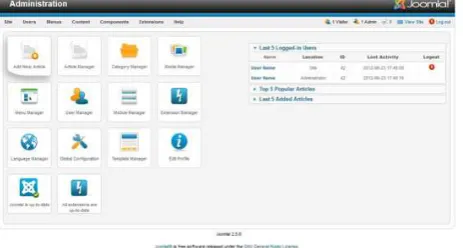
Figures 5 and 6 show a sample page in Joomla for front-end and back-end views respectively.
Fig. 5: Front-end of Joomla
Fig. 6: Back-end structure of Joomla
2. Core Features of Joomla
Joomla offers several core features, including the following:
Multilingual
Joomla offers more than 64 languages.
Well-Supported
10
can help build, maintain and market a Joomla project.
Easy Upgrades
There is a "One Click Version Update" feature to make this process super easy for users of any skill level.
Media Manager
A tool for easy uploading, organizing and managing media files and folders.
Better Search
The search ability of Joomla facilitates better and smarter searches for users.
Extensions
There are more than 8000 extensions to customize a website in Joomla.
Frontend Editing
Users can do content editing easy and fast by simply clicking and editing from the frontend.
Menu Manager
Allows creating as many menus and menu items as needed as well as structuring the menu hierarchy (and nested menu items) completely independent of the content structure.
WordPress vs Joomla: Comparative Analysis
i. Overview Comparison
For a quick overview, WordPress is the best pick for beginners as it works well for small to medium size websites, blogs and stores. Meanwhile, Joomla is great for e-commerce types of sites, but it requires at least some level of technical coding [10]. The table below shows a more in-depth comparison between WordPress and Joomla.
WordPress Joomla
Release Year 2003 by Matt Mullenwegg 2005, forked from Mambo
Popularity > 140 million downloads > 30 million downloads
Cost Free Free
Top Sites using
the Platform
Free Themes 2,000+ 900+
Free Plugins 27,000+ 7,000+
One Click Installation Availability
Available Available
Manual Installation Time
5 minutes 10 minutes
“Skill” Level Needed
Technical experience is not necessary; it is intuitive and easy to get a simple site set up quickly. It is easy to paste text from a Microsoft Word document
to a WordPress site, unlike Joomla.
More complex than WordPress. Relatively uncomplicated installation
and setup. With a relatively small investment of effort to understand Joomla’s structure and terminology, it is possible to create fairly complex
sites. Update
Frequency
42 days 36 days
Best Used for Blogs, corporate websites, small-medium size websites
11
ii. Comparison based on Popularity by
Google Trends
Referring to Figure 7, Google Trends indicates that starting in 2010, WordPress has been strongly increasing in popularity compared with Joomla [18]. The figure also shows that as of January 2016, people’s interest with WordPress is higher than with Joomla, and most of the time, people prefer using WordPress instead of Joomla.
Fig 7: Popularity comparison between WordPress and Joomla according to Google Trend [18]
In addition, as we can see in Figures 8 and 9, there are several regions that frequent the use of CMS, either WordPress or Joomla as their platform. Figure 8 indicates that Bangladesh is the top community that most frequently uses WordPress as their CMS. Meanwhile, Figure 9 shows that Kenya is the region or community that most frequently uses Joomla as the backbone of their website or system.
Fig. 8: Regional interest with WordPress [18]
Pros • User friendly
• SEO integration • Responsive sites • Great support
• Powerful • User friendly • E-commerce
• Developer community • Extensions
Cons • Security
WordPress is a target for hackers and prone to attacks. Although security has got better over the past 12 months, there are still vulnerabilities in the CMS, particularly around the 3rd party plugin used.
• Updates
WordPress (WP) releases system updates that are good for WP but may not be for the user. If the user needs are the same as those that WP tries to address, users are lucky. Otherwise, a user might get updates that harm rather than improve the website.
• Speed
WordPress sites contain lots of generic codes unnecessary for every specific website, so the webpage loading time becomes slower.
• Small Module Marketplace Joomla has a much more limited marketplace for additional modules and add-ons. If you are looking for additional modules to customize a site, they can be harder to find and maintain through Joomla.
• Plugin Compatibility
There may occur some frustrating compatibility issues between some of the plugins. It may turn out that it is impossible to get certain functionalities without some serious work on the PHP code.
12
Fig. 9: Regional interest with Joomla [18]
Conclusion
Cybercriminals are aware that there are large numbers of unpatched installations of popular content management systems (CMS), including WordPress and Joomla. Therefore, it is crucial to have a good understanding of the risks of content management systems and of how to prevent risks. Based on the results of a comparative study, both WordPress and Joomla have various strengths and weaknesses. WordPress is more well-known than Joomla in terms of popularity, whereby WordPress has over 140 million downloads compared to Joomla with only 30 million downloads. However, selecting a CMS all depends on the user’s requirements to support their web strategy both today and in the future. Users also recommend employing Google Trends [18] to get an idea of current CMS trends.
References
[1] Ghorecha, V., & Bhatt, C. (2013). A guide for Selecting Content Management System for Web Application Development. Computer Science Management Studies, 1(3), 13–17.
[2] Soediono, B. (2015). Open source content management software, Joomla & Drupal: A comparative study. Journal of Chemical Information and Modeling, 53(2394), 160. doi:10.1017/CBO9781107415324.004
[3] CMS technologies Web Usage Statistics. (n.d.). Retrieved February 12, 2016, from http:// trends.builtwith.com/cms
[4] Ghorecha, V., & Bhatt, C. (2013). A guide for Selecting Content Management System for Web Application Development. Computer Science Management Studies, 1(3), 13–17.
[5] What is a Content Management System (CMS)?. (n.d.). Retrieved February 12, 2016, from http://www.comentum.com/what-is-cms-content-management-system.html
[6] Wakode, B. V, & Chaudhari, D. N. (2013). Study of Content Management Systems Joomla and, 569–573.
[7] About Joomla. (n.d.). Retrieved from http:// www.joomla.org/about-joomla.html
[8] WordPress Features. (n.d.). Retrieved from https://WordPress.org/about/features/
[9] Alvarez, M. (2015). Pressing Your Luck With WordPress? A Look at CMS Security Risks. Retrieved February 17, 2016, from https:// securityintelligence.com/pressing-your-luck-with-wordpress-a-look-at-cms-security-risks/
[10] Robert Mening. (n.d.). WordPress vs Joomla vs Drupal + CMS “Comparison Chart.” Retrieved from http://websitesetup.org/cms-comparison-wordpress-vs-joomla-drupal/
[11] Hagen Graf. (n.d.). Joomla CMS. Retrieved from http://www.wilsonmar.com/joomla.htm
[12] Colao, J. J. (2012). With 60 Million Websites, WordPress Rules The Web. So Where’s The Money? Retrieved from http://www.forbes.com/ sites/jjcolao/2012/09/05/the-internets-mother-tongue/#7b00443955fe
[13] The 2015 WordPress vs Joomla vs Drupal Infographic. (n.d.). Retrieved from https:// cmsreport.com/articles/the-2015-wordpress-vs-joomla-vs-drupal-infographic-13720
[14] Joomla! Core Features. (n.d.). Retrieved from https://www.joomla.org/core-features. html
[15] Symantec Global Internet Security Threat Report Trends for July–December 07 Volume XIII. (2008). Retrieved from http://eval.symantec. com/mktginfo/enterprise/white_papers/b-whitepaper_internet_security_threat_report_ xiii_04-2008.en-us.pdf
[16] Sametinger, J., & Wiesauer, A. (2009). Security in Open Source Web Content Management Systems, (August).
[17] Marc-Alexandre Montpas. (2015). Vulnerability Details: Joomla! Remote Code Execution. Retrieved from https://blog.sucuri. net/2015/12/joomla-remote-code-execution-the-details.html
13
Introduction
Steganography is the art and science of hiding messages. The word steganography comes from the Greek words “Steganós” meaning covered and “Graptos” meaning writing [5]. Steganography and cryptography are similar in that both are used to protect important information. However, steganography differs from cryptography because it involves hiding information without noticing any alteration made to the cover object. Cover objects or carriers are files such as text, images, audio or video in which secret messages are hidden. The secret message can be in the same form as the cover object. A file containing a secret message hidden in the cover object is called a stego object. Cryptography entails changing a readable into an unreadable message, while steganography involves hiding messages into another medium.
Steganalysis
Steganalysis is the art and science of detecting secret communication in steganography. In general, steganalysis techniques can be categorized into six levels depending on how much information is required about the hidden messages. The techniques are (i) Differentiating between the cover and stego object, (ii) Identifying the steganographic method, (iii) Estimating the length of a hidden message, (iv) Identifying the stego-bearing pixels, (v) Retrieving the stego key, and (vi) Message extraction [6]. Changes in statistical properties of the cover may lead to a steganalyst attempting to detect the existence of the secret communication [5]. One of the most common steganalysis methods implemented is to measure the quality of the stego image using Peak Signal-to-Noise Ratio (PSNR).
Image Pixel
An image is an array of numbers that represent the intensity level of each pixel comprising the image. A colour image is represented by arrays of each of the three primary colours, red, green and blue. By superimposing these three arrays, each pixel is a sum of those three
colours that will produce a coloured image. Digital images are typically stored in either 24-bit (true colour) or 8-24-bit files (colour palette). 24-bit pictures have better resolution; thus, the file size would be larger and there would be more space available to hide information. 3 bytes are used to represent each pixel (1 byte for each colour) in 24-bit images. The 3 bytes can be represented as hexadecimal, decimal or binary values. A sequence FFFFFF represents a combination of 100% red, 100% green and 100% blue that will produce the colour white. Meanwhile, 00000 represents a combination of 0% red, 0% green and 0% blue that produce black. This combining method is applied to each pixel in order to compose an image. Information could be hidden by embedding secret messages into image pixels depending on the method implemented by the users.
Peak Signal-to-Noise Ratio
PSNR is a standard measurement method used in steganography in order to test the quality of stego images [2]. The higher the PSNR value, the higher the quality of the stego image is. If the cover image is C with size M × M and the stego image is S with size N × N, then each cover image C and stego image S will have a pixel value (x, y) from 0 to M-1and 0 to N-1 respectively. The PSNR is calculated as follows:
where
Note that MAX is the maximum possible pixel value of an image. For example, if the pixels are represented by 8 bits per sample, then the MAX value is 255. MSE, or Mean Square Error is an error metric used to compare image compression quality. It represents the cumulative squared error between the compressed and original image. If the stego image has a higher PSNR value, then the stego image is of better quality.
Steganography Series:
Peak Signal-to-Noise Ratio
14
Analysis
Figure 1 [4]: Jelly Bean Image
Table 1 [4]: Jelly Bean PSNR
Table 1 [4] shows a comparison of PSNR and MSE values of a "jelly bean" in Figure 1. The image was embedded with different data (secret message) capacities ranging from 0.1% - 1% of different image sizes (256 x 256, 306 x 468 and 512 x 512). It can be seen that with increasing embedded data capacity, the value of PSNR decreases and MSE increases. In other words, the more data that is embedded in the original image file, the more the picture quality will decrease. Depreciating picture quality happens because many bits of the original image have been changed or replaced by secret message bits.
The more bits that are modified in the original image, the more obvious the changes are to the naked eye. In steganography, if one can see a significant change in a cover object, the secrecy of data is exposed and it is contrary to the main objective of steganography, which is to hide the presence of messages [3].
Figure 2 [1]: Lena Image
Stego image performance decreases when more bits of cover image are modified. Figure 2 shows the differences in stego images that have been implemented with 1-bit to 7-bit data hiding using steganography. As the stego image gets more distorted, the PSNR value becomes lower and could increase the awareness of the existence of the hidden data.
Conclusion
It is hard to detect the presence of steganography because the existence of secret messages that are kept secret through steganography. One will never try to do steganalysis for all images, text, audio or video in communication to find secret or hidden message, as it would cost a lot of time and money. An efficient method implemented is by calculating the PSNR. Even though it is not the absolute solution to this problem, a steganalyst can at least narrow down the suspected stego object that contains a secret message, which could lead to finding the secret message. Previous steganography series can be viewed on the CyberSecurity Malaysia website:
Title :
Steganography Series: Colour Palettes
Publication :
CyberSecurity Malaysia e-Security Bulletin. Vol 38 – (1/2015)
Link :
15
References
[1] Gupta H., Kumar R. and Changlani S. 2013. Enhanced Data Hiding Capacity Using LSB-Based Image Steganography Method. International Journal of Emerging Technology and Advanced Engineering. Vol. 3, No. 6.
[2] Ibrahim R. and Kuan T.S. 2011. Steganography Algorithm to Hide Secret Message Inside an Image. Computer Technology and Application. Vol. 2: 102-108.
[3] Shamimunnisabi and Cauvery N.K. 2012. Empirical Computation Of Rs-Analysis for Building Robust Steganography Using Integer Wavelet Transform and Genetic Algorithm. International Journal of Engineering Trends and Technology. Vol. 3, No. 3.
[4] Usha B.A., Srinath N.K. and Cauvery N.K. 2013. Data Embedding Technique In Image Steganography Using Neural Network. International Journal of Advanced Research in Computer and Communication Engineering. Vol. 2, No. 5.
[5] Zakaria A.A., Yusof N.A.M., Omar W.Z., Abdullah N.A.N. and Rani H.A. 2015. Analysis of Steganography Substitution System Methods Using New Testing Techniques Proposed for Strict Avalanche Criterion. International Journal of Cryptology Research. Vol. 5, No. 1: 61-76
16
Rise of the DD4BC Copycats
By | Farah Ramlee
Introduction
From September 2014 through July 2015, cyber extortion was taken to another level and DD4BC emerged as the latest crime with a new modus operandi similar to Ransomware. DD4BC is an abbreviation of DDoS for Bit Coin. DD4BC is an extortionist group responsible for many bitcoin extortion campaigns involving DDoS attacks and ransom demands. This type of extortion is distributed through email. The email content is used to inform the target that if the ransom demand does not meet the deadline, a low-level DDoS attack would be launched against the victim's server [2]. To show the seriousness of such extortion, a mini demonstrative attack will be launched to prove their point. [3] Like Ransomware, the ransom goes through the dark web by charging in BitCoin and keeps increasing while the attack is in action.
Figure 1: DD4BC DDoS attack activity increased dramatically in April but began tapering off in July (by Akamai) [4]
The financial service sector was most targeted, including banks, credit unions, currency exchange and payment processing companies. [1]
Figure 2: DD4BC attack distribution by target industry (by Akamai)[4]
DD4BC recently threatened to expose targeted organizations via social media, adding to the damage caused by the DDoS attack itself. The goal apparently was to garner more attention to the group's ability to create service disruptions by publicly embarrassing the target and tarnishing the company's reputation through these wide-reaching channels. {2]
According to Akamai researchers, the group's methodology typically includes multi-vector DDoS attack campaigns, revisiting former targets and also incorporating Layer 7 DDoS in multi-vector attacks, specifically concentrating on the WordPress pingback vulnerability. This vulnerability is exploited to repeatedly send relected GET requests to the target to overload the website. This attack method is also incorporated into DDoS booter suite frameworks. The group used multi-vector DDoS attacks including NTP loods, SSDP loods, UDP loods, SYN loods, UDP fragment loods, ICMP loods, DNS loods, GET loods, SNMP loods and CHARGEN loods. 141 DDoS attacks confirmed as DD4BC were observed by Akamai and partners from September 30, 2014 to July 24, 2015. [1] The key cyber extortionist member was reportedly arrested in early January 2016. [3]
However, soon after, a new group called Armada Collective imitated the DD4BC tactics, techniques and procedures (TTP) hoping to gain billions of dollars. The possible drive for this act was probably that the price index of bitcoins keeps increasing and bitcoins are encrypted. The remaining cyber criminals took advantage and produced even more copycats, as companies were willing to pay the ransom to avoid being attacked. [6]
Analysis
17
Figure 3: Sample ransom email from Armada Collective reported to Cyber999
Figure 3 shows that the email consists of a template starting with an introduction of them, followed by a ransom that the victim would be DDoS-ed on the given date if the payment in bitcoins was not done. The extortionist also included their bitcoin wallet ID.
Figure 4: Email header from the Armada Collective Copycat
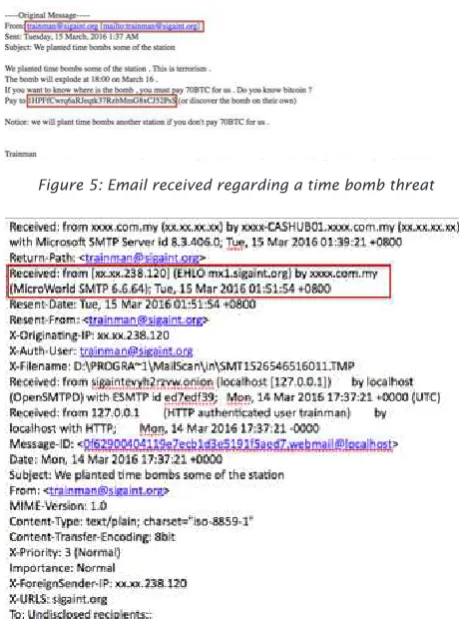
Figure 4 shows that the email header from the so-called Armada Collective with the email was originally sent using a free email web server called OpenMailbox. The sender’s IP address is internal, which means it belongs to the application, hence preventing the detection of the originating IP source. This is in fact a way that culprits are able to get away, as the application protects its users under their own privacy. However, we have reported regarding this email through their web-reporting channel. Another case that caught our eye was reported by an organization that received an extortion email with a different threat. The threat content was not to DDoS their servers, but the email mentioned that time bombs were physically placed at some unstated stations and would blow up on the said date if the ransom demand were not fulfilled.
Figure 5: Email received regarding a time bomb threat
Figure 6: Email header received regarding a time bomb threat
Figure 6 shows the email was sent using yet another public mail server called Sigiant. However, it was written in the website’s disclaimer that any incidents should be reported if any abuse was traced using the server. In this case, an email from [email protected] with the source IP address xx.xx.238.120 was detected. The incident was then escalated to the respective ISP for further action.
In both cases, none of the attacks were launched after the dates passed. We may conclude these were just other copycats following the TTP of the original DD4BC for money extortion through the net.
Conclusion
Different types of DDoS attacks can affect specific IT network elements and require various DDoS mitigation techniques. Attackers identify the weakest links that will cause the most damage. To help protect against extortionist groups and subsequent DDoS attacks, advice and recommendations are given as the follows for defensive measures [5]:
18
and avoid single points of failure due to an attack.
• Implement Layer 7 DDoS mitigation appliances on the network in strategic locations to reduce the threat to critical application servers.
The best practice to prevent your network from getting a DDoS attack is to develop a checklist or standard operating procedure (SOP) to follow in the event of a DDoS attack. [8] A proper DDoS mitigation plan also needs to be in place to help minimize damage and conduct “business as usual” during an attack.
If you need any assistance, do not hesitate to contact Cyber999 via the following channels: E-mail:
[email protected] Phone:
1-300-88-2999 (monitored during business hours)
Fax :
+603 89453442 Mobile:
+60 19 2665850 (24x7 call incident reporting) SMS:
CYBER999 REPORT EMAIL COMPLAINT to 15888 Business Hours:
Mon - Fri 08:30 - 17:30 MYT Web:
http://www.mycert.org.my
References
[1] https://www.stateoftheinternet.com/ resources-web-security-threat-advisories- 2015-dd4bc-case-study-ddos-attacks-bitcoin-extortion-ransom.html
[2] http://www.prnewswire.com/news-releases/ akamai-releases-indings-of-increased-attacks- and-more-aggressive-tactics-from-dd4bc-extortionist-group-300139405.html
[3] http://www.scmagazine.com/key-member-of-dd4bc-arrested-in-international-crackdown/ article/465097/
[4] http://pages.arbornetworks.com/rs/082-KNA-087/images/ATIB2015-04DD4BC.pdf
[5] https://blogs.akamai.com/2015/11/ operation-proile-armada-collective.html
[6] http://www.securityweek.com/dd4bc- armada-collective-inspire-cyber-extortion-copycats
[7] https://blogs.akamai.com/2015/09/case-study-operation-dd4bc.html
19
Long-term capacity building is the foundation for success in achieving cybersecurity goals. A capacity building plan should include a dynamic assessment and improvement process that aligns with a long-term strategy. This should be a lexible approach that is modified as technology and threats evolve. It is proposed in this article that the goal of a cybersecurity programme should achieve a level referred to as “Adaptive Defence.” Adaptive Defence is the ability to detect and respond to identified security needs by utilizing intelligence-based information and effective response planning. Adaptive defence entails more than achieving “Basic Cyber Hygiene.” This base level must be expanded to include advanced threats and unknown attacks. 70% of the time malware is used only once. Traditional means of ‘basic hygiene’ are no longer sufficient to protect against today’s cyber threats, which are unique, complex and no longer preventable by using traditional prevention methods.
The SANS Institute and the Council on Cybersecurity, a consortium of security experts from across public and private sectors, has published a list of ‘Top 20 Security Controls’ - a relatively short list of high-priority, highly effective actions that provides a useful and effective starting point for every enterprise seeking to improve their cyber defence. Two key controls in particular – 5 and CSC-13 – include recommended measures that go beyond traditional hygiene for malware and boundary defence. In the USA, the National Institute of Standards and Technology (NIST) Cybersecurity Framework best practices include NIST 800.53 SC-7 (Boundary Protection), SC-44 (Detonation Chambers) and SI-3 (Malicious Code Protection). These are elements of cybersecurity best practices that are particularly critical to any effective cyber hygiene program and they have been adopted and recommended by leading independent global security experts.
Each of the core Adaptive Defence domains are examined in detail below.
Detection: Detection includes utilizing intelligence from a range of sources and making decisions based on a lexible programmatic approach. Threat intelligence should include awareness of known threat groups, their known attack methodologies and anticipated attack vectors. Identifying who may be the source of an attack can support understanding the objectives of the attackers and why they may be targeting an organization. An adaptive defence security programme should evolve from passive monitoring to active “hunting” for evidence of threat actors within a network. This approach assumes the presence of an attacker that is using unknown intrusion techniques.
Prevention: Prevention includes basic activities to avert known threats. These activities comprise traditional security controls that are essential to a security programme. However, these basic controls must be supplemented by additional behavioural-based heuristic detection capabilities that can prevent attackers from exploiting an unknown vulnerability.
Response: Response should include both the capability to recover quickly from a cyberattack and a measurement of the time necessary to resume critical operations after an attack. Response should also include the following sub-domain controls:
• Incident Management
• Service Continuity Management • External Dependency Management
The Response Strategy must establish an incident response coordinator and precisely define protocols to inform key stakeholders. These protocols should govern privacy disclosure requirements and assignment of work streams for investigation, remediation, communication and response plan execution.
Analysis: Analysis consists of containment, forensics investigation and skill chain reconstruction. An effective strategy should emphasize on adaptation based on analysis of known attacks. Post-incident analysis forms the basis of an “adaptive” response by adjusting controls based upon actual known risks. Analysis of known attacks should promote the adoption of appropriate technical and organizational measures to safeguard data at a security level
Successful Cybersecurity Capacity Building
20
appropriate to actual risks. Understanding attack methodologies promotes informed decision-making, intelligence integration and timely response.
Long-Term Planning
The most important concept of a capacity building plan is that each organization has unique needs. An organization must identify critical areas that correlate with a desired security readiness posture. Within each area are maturity levels. Maturity levels are established by measuring progress along a continuum of risk-based preparedness from low readiness levels to advanced full capability. This risk and capability evaluation process allows decision makers to benchmark existing cybersecurity preparedness and evaluate core competencies, and it provides an operational framework for capacity building that also measures improvement dynamically.
Cybersecurity is not only a technical solution. The foundation for all technical solutions should be based on a clear understanding of policy requirements and strategy goals. Compliance is not “true security.” Many threats can evade basic compliance measures that tend to only promote “basic hygiene.” The overall objective of an Adaptive Defence capacity building programme is to create more than a mere compliance or basic hygiene capability as recommended above.
The capacity building structure should be designed so as to enable a comprehensive, long-term and holistic approach. Each activity domain within the suggested capacity building programme can be summarized as follows:
Framework Support:
• The assessment of operational needs and development of a strong sustainable framework that provides comprehensive operational security and procedures for operations.
Operational Standards:
• Comprehensive assessment of existing legislative policies covering criminalization, procedural law, electronic evidence, jurisdiction, private sector responsibilities and liabilities, and international cooperation, using good practice benchmarks and relevant regional and national standards
Operational Training:
• Delivery of training at the basic, intermediate, and advanced levels on advanced electronic evidence collection and handling
• For the government, the delivery of investigator and prosecution training at the basic, intermediate and advanced levels on the role and presentation of electronic evidence and applicable substantive and procedural law in the prosecution and adjudication of cybercrime cases
• Organization of public private partnership expert working groups to create protocols on the involvement of specialized procedures, use of investigative measures, guidelines for intelligence sharing operations, and the introduction and consideration of electronic evidence in legal forums.
Sustainability:
• Providing long-term coordination and support mechanisms to effectively transfer capabilities from global experts or security vendors to internal organizational staff and to maintain team readiness
Cooperation:
• Facilitating working relations between law enforcement and local offices of key global digital service providers, developing procedures and due legal process requirements, and facilitating the sharing of strategic threat information from key global cybersecurity providers with intelligence analysts
• Establishing advanced teams working with law enforcement and intelligence groups to apply legal, procedural and technical tools to monitor and respond effectively to threats A suggested phased implementation plan is outlined below:
Phase I: Operational Framework Assessment & Development
a. Assessment of Operational, Procedural, and Training Requirements
b. Development and Review of a Capacity Building Framework and Capacity Building Programme Recommendations
Phase II: Implementation
a. Establishing on-site cooperative partnership teams led by global experts to implement capacity building programmes from basic to advanced levels
21 international regulatory frameworks and
best practices
c. Evaluating implementation and adjustment to meet identified standard goals
Phase III: Sustainability and Maintenance
a. Additional support for staff on tools and techniques as determined necessary through monitoring and evaluation
b. Implementing long-term external cooperation and support mechanisms
Progress in programme implementation should be tracked through ongoing monitoring of the needs indicators established in an initial assessment. The purpose of ongoing monitoring is to ensure accountability through transparent and clearly-documented records with a view to enable clear oversight, decision-making and transparent operations. Information required for the indicators should be collected with a periodicity appropriate to each indicator, taking into account the time required for outputs and outcomes to have effect. Results from calculated available indicators can be used to ensure that activities, outputs and outcomes are in line with the expected results.
22
Introduction
Wikipedia defines 'Special Library' as a library that provides specialised information resources on particular subjects, serves a specialised and limited clientele and delivers specialised services to that clientele. In other words, Special Library is a term for a library that is neither an academy or school, nor a public or national library. Normally, special libraries are developed to support the vision and mission of an organisation. Special libraries are 'special' in their collections and services, which are more targeted and specific to the needs of the users. The Knowledge Management Centre (KMC) of CyberSecurity Malaysia falls under this category, whereby we specialize in subject matters related to information security and cyber security. The Knowledge Management Centre was established in 2008 as part of the CyberSecurity Malaysia initiative to realize the vision of a National Cyber Security Reference and Specialist Centre by the year 2020. Previously, it was known as the Knowledge Resource Centre (KRC). However, the name has been changed to the Knowledge Management Centre to relect its role and discipline in promoting a collaborative and integrated approach to the creation, capturing, access and use of knowledge assets. The centre acts as a platform for cyber security professionals and communities to seek a comprehensive collection of cyber security-related information materials. The Knowledge Management Centre also aims to provide a conducive learning and knowledge acquisition environment for cyber security professionals and practitioners across the nation.
KMC Key Objectives
• To complement the government's effort to produce 'K-Workers' particularly in the field of cyber security
• To contribute to CyberSecurity Malaysia's goal of becoming a Learning Organisation that empowers employees to be innovative and productive human capital, possess positive attitude and forge strong teamwork
• To gain national recognition as a national knowledge hub through the establishment of a place that provides a mind-stimulating knowledge acquiring environment in the field of cyber security.
Collection Development
The Knowledge Management Centre (KMC) envisions being a National Knowledge Reference Point in the area of cyber security. For this reason, our collections consist primarily of print and electronic resources focusing on cyber security-related information materials in order to meet the information needs of cyber security professionals and communities. The collections are basically divided into a few categories:
• Main Collections: Printed and online resources covering disciplines specified by CyberSecurity Malaysia and the information security community nationwide.
• Reference Collections: Dictionaries, encyclopaedias, directories, biographies, numerical data compilations, handbooks, manuals, bibliographies and yearbooks. • Control Access Collections: Materials
that are commonly used, such as theses, dissertations, research reports, seminar/ conference papers, official publications (e.g. annual reports) and small-size publications (e.g. statistics, surveys).
• Serial Collections: Cyber security-related journals, magazines, newspapers and bulletins.
• Multimedia Collections: Non-print materials in the form of audio, CDs and DVDs.
• Leisure Reading Collections: Light reading materials covering bestsellers, fiction, motivation, hobbies, crafts, etc.
• Cybersiana Collection: Articles and slide presentations written by CyberSecurity Malaysia professionals
Getting to Know The Knowledge
Management Centre of CyberSecurity
Malaysia
23
Services And Activities
The Knowledge Management Centre of CyberSecurity Malaysia supports and upholds the CyberSecurity Malaysia vision, i.e. 'To Be a Globally Recognised National Cyber Security Reference and Specialist Centre by 2020.' Therefore, we provide services and activities to cater and meet the information needs of staff. In addition to the basic operational services, such as cataloguing, classification, check-out and check-in of materials, we also provide information dissemination services, such as the Current Awareness Service [CAS] and Selective Dissemination of Information [SDI]. However, we re-brand the services by giving special names and disseminate information daily in order to keep our staff well-informed.
Monday:
Pick of the Week -- we choose several titles and display the books in the centre. Then we broadcast the titles via email to inform staff, especially newcomers, that we have those titles in the collection and they are most welcome to borrow them. However, if we purchase new titles, we change the broadcast to What's New.
Tuesday:
SDI K-Brief -- we choose a subject and select a few articles related to the subject. Then we email the abstracts of the selected articles to all staff. Those who are interested to read the full text of the articles are encouraged to request a copy from us.
Wednesday:
Current Awareness Service (CAS) -- we disseminate information extracted from new issues of technical journals and magazines received in a particular month. This way, our users will update their knowledge on the latest trends and technologies on cyber security matters.
Thursday:
Santai Jom Baca is targeted for those who want to take a break and relax by reading leisure materials such as Men's Health, Impiana; Harmoni; Reader's Digest; Pa & Ma; Umpan; Saji, etc.
Friday:
K-Share materials are extracted from several resources and those who are interested to read the full text over the weekend are most welcome to request a copy from us.
KMC also offers a service known as 'InfoQuest'
where CyberSecurity Malaysia staff can request Knowledge Management staff to assist with identifying and finding articles of interest. Today, knowledge matters. Therefore, more organisations are recognising knowledge as their most valuable and strategic resource to sustain their competitive advantage. The Knowledge Management Centre of CyberSecurity Malaysia aims to develop a knowledge-intensive culture by encouraging and aggregating behaviours, such as knowledge sharing and proactively seeking, acquiring and offering knowledge. Therefore, in addition to the information dissemination services, the Knowledge Management Centre also takes the initiative to organize several knowledge sharing activities, as we strongly believe these activities help CyberSecurity Malaysia with acquiring, capturing, storing and utilizing knowledge for problem solving, dynamic learning, strategic planning and decision making.
Cafe Ilmu @ KMC
Cafe Ilmu @ KMC was initiated to encourage CyberSecurity Malaysia staff to share and exchange their reading experiences and knowledge in an informal environment. Staff share and discuss what they have read and audiences are most welcome to add value based on their own knowledge and experiences as well. Since the centre's collection is very limited and focused on information security and cyber security matters, we encourage our Cafe Ilmu @ KMC participants to share their own reading materials regardless of subject interest. After the session, a summary is written and emailed to CyberSecurity Malaysia staff in order to benefit those who were not able to join and participate in the session. Later, those summaries are compiled and published as a KM Newsletter.
[Picture: Dr. Zahri Yunos sharing his reading entitled 'It Worked for me in Life and Leadership' by Colin Powell]
Jom Borak Ilmu
24
once they return from any training, seminar or conference. Again, it is done in an informal environment with the hope that knowledge will low freely and trigger informative discussions. This is also a good platform for staff to practice their communication skills and public speaking.
[Picture: Ahmad Dahari Jarno from the SA Department sharing his technical expertise on a Social Engineering Experiment]
Technical Colloquium
The Technical Colloquium serves as a platform for CyberSecurity staff to present their research papers in order to solicit feedback and comments before their papers are submitted for journal publications. In addition, Technical Colloquium is a knowledge sharing platform for researchers to enhance their communication and presentation skills.
[Picture - Khairul Akram from the Digital Forensics Department presenting his paper]
Occasionally, the Knowledge Management Centre also organizes activities, such as Infohunt, Merdeka Day Quizzes, ISMS Awareness Day, Thematic Exhibition and KM Appreciation Day.
Summary
Knowledge is an important asset to CyberSecurity Malaysia as it can enhance communication and collaboration among employees, create new knowledge and add value to the entire organisation. For these reasons, the Knowledge Management Centre plays its role effectively and efficiently to ensure that CyberSecurity Malaysia's vision and mission are met.
References
1. https://en.wikipedia.org/wiki/Special_ library
25
Introduction
Cryptography plays a crucial role in information security. Cryptography systems are used to protect valuable information resources for both data in transit and at rest. However, there have been a variety of cryptographic problems arise, involving cryptographic algorithms in communication to protect classified information. Therefore, many countries, such as Japan, the USA and European countries have shown initiatives to develop a mechanism to identify trusted algorithms. Trusted algorithms are used by standard bodies and governments. This article briely explains four national cryptographic algorithm projects that have been set up, namely NESSIE, CRYTREC, projects by NIST and eSTREAM.
NESSIE is a project within the Information Society Technologies (IST) Programme of the European Commission. It was founded from 2000 to 2003 to identify secure cryptographic primitives. The project was comparable to the NIST AES process and the Japanese government-sponsored CRYPTREC project, but with notable differences.
CRYPTREC is an abbreviation of Cryptography Research and Evaluation Committees and refers to a project to evaluate and monitor the security of e-Government recommended ciphers as well as to examine the establishment of evaluation criteria for cryptographic modules. The task of evaluating existing cryptographic techniques has been entrusted to the Information Technology Promotion Agency, Japan (IPA). AES, SHA-3and CAESAR are projects by National Institute of Standards and Technology (NIST), United States of America. AES is a competition ran by NIST to find a block cipher to replace the Data Encryption Standard (DES). The NIST hash function competition, which is SHA-3 competition, was set up to develop a new hash function called SHA-3 to complement the older SHA-1 and SHA-2. CAESAR is a competition for Authenticated Encryption: Security, Applicability and Robustness schedule from 2014 to 2017. eSTREAM is a stream cipher project by ECRYPT (European Network of Excellence in Cryptology).
This project was set up to identify new stream ciphers suitable for widespread adoption. The submissions to eSTREAM fall into either or both of two profiles, which are Profile 1: Stream ciphers for software applications with high throughput requirements and Profile 2: Stream ciphers for hardware applications with restricted resources.
The objectives and goals of each project are as follows:
![Fig. 1: Statistics for websites using CMS technology [3]](https://thumb-ap.123doks.com/thumbv2/123dok/3033990.1368015/12.595.330.515.476.652/fig-statistics-websites-using-cms-technology.webp)
![Table 1: Features of Content Management Systems [2]](https://thumb-ap.123doks.com/thumbv2/123dok/3033990.1368015/13.595.60.543.66.310/table-features-of-content-management-systems.webp)
![Table 2: Comparison Chart between WordPress and Joomla [7][8][10][13][14]](https://thumb-ap.123doks.com/thumbv2/123dok/3033990.1368015/16.595.56.290.623.760/table-comparison-chart-wordpress-joomla.webp)
![Table 1 [4]: Jelly Bean PSNR](https://thumb-ap.123doks.com/thumbv2/123dok/3033990.1368015/19.595.58.288.278.463/table-jelly-bean-psnr.webp)
![Figure 2: DD4BC attack distribution by target industry (by Akamai)[4]](https://thumb-ap.123doks.com/thumbv2/123dok/3033990.1368015/21.595.60.284.405.529/figure-dd-bc-attack-distribution-target-industry-akamai.webp)