ii
Level 5, Sapura@Mines No. 7 Jalan Tasik The Mines Resort City 43300 Seri Kembangan Selangor Darul Ehsan Malaysia.
T: +603 8992 6888 F: +603 8992 6841 E: [email protected] Customer Service Hotline: 1 300 88 2999 www.cybersecurity.my
Cyber999 Help Centre | My CyberSecurity Clinic | Professional Development (Training & Certification) | Product Evaluation & Certification (MyCC) |
Information Security Management System Audit and Certification (CSM27001) | Malaysia Trustmark | Security Assurance | Digital Forensic & Data Recovery | Malaysia Computer Emergency Response Team (MyCERT) | Security Management & Best Practices | Cyber Security Research | CyberSAFE (Cyber Security Awareness for Everyone)
CyberSecurity Malaysia,
an agency under Malaysia’s
Ministry of Science, Technology and Innovation was
set up to be the national cyber security specialist
centre. Its role is to achieve a safe and secure
cyberspace environment by reducing the vulnerability
of ICT systems and networks while nurturing a culture
of cyber security. Feel secure in cyberspace with
A MESSAGE FROM THE CEO OF CYBERSECURITY MALAYSIA
Welcome to the 37th Edition of the E-Security Bulletin!
We hope the knowledge imparted through our numerous articles would in some way help in raising the adoption of essential cyber security practices among Internet users.
It is very important for us to continuously preach and share valuable knowledge about positive and ethical ways of using the Internet, especially on social media platforms. This is vital as in the long run, we would like to ensure our Digital Citizens maintain an ethical and courteous culture that Malaysians are known for globally.
We believe positive societal culture like working together to imagine a better future and collaborating across traditional silos to design that future together through the power of story-telling and sharing should remain intact no matter how high we move up the rank in terms of socio-economy and digital sophistication. Thank you for your continuous support.
Dr. Amirudin Abdul Wahab
PUBLISHED AND DESIGNED BY
READERS’ ENQUIRY
CyberSecurity Malaysia, Level 5, Sapura@Mines,
Outreach and Corporate Communications, Level 5, Sapura@Mines, No.7 Jalan Tasik, The Mines Resort City, 43300 Seri Kembangan
EDITORIAL BOARD
Chief Editor Dr. Zahri bin Yunos
Editor
Lt. Col Mustaffa bin Ahmad ( Retired )
Internal Reviewers
1. Dr. Solahuddin bin Shamsuddin 2. Col. Sazali bin Sukardi (Retired) 3. Pn. Sabariah binti Ahmad 4. Pn. Zaleha binti Abd Rahim 5. En. Rosly bin Yahil
6. En. Ruhama bin Mohammed Zain 7. Pn. Ramona Susanty Ab Hamid 8. Pn. Azira Abd Rahim
1. Staying Away from Spam ... 1
2. ISO/IEC 27001 A Clause A Day: Clause 7.2 Competence ... 3
3. Capacity Building for the Development of National Cyber Security ... 4
4. Updated Personnel Records – Is It Necessary? ... 6
5. Cyber Drill Exercise among OIC Networks in Fight against Cyber-Attacks ... 8
6. Retinal Scanning VS Iris Recognition ... 11
7. Security Threats Overview in 4G LTE Mobile Networks ... 13
8. Why Social Networking Sites? ... 16
9. The History of Cryptography ... 19
10. INFOGRAPHIC: PKCS - Public Key Cryptography Standards ... 21
11. Email Account Compromise and Security Best Practices: A Case Study ... 25
12. Automated Incident Response Process ... 30
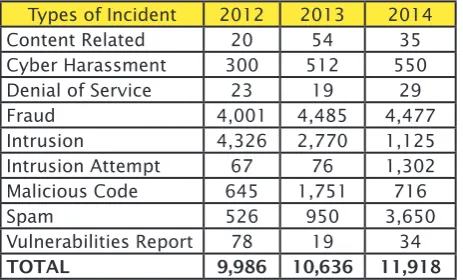
13. What we can learn from Online Fraud in 2014 ... 31
14. The Rise of Cyber Espionage In The Digital World ... 33
15. MH370 Cyber Crisis Management ... 36
1
it. While there are many solutions and tools introduced to end-users, the best is self-awareness and constant reminders to secure personal information. It is as simple as paying attention to details when changing passwords, giving out bank account numbers and transferring money online.
How to identify Scammers &
Spammers?
Before it was called ‘Spam’, businesses sent emails to businesses or individuals identified as potential clients, with intent to advertise their products or services. They were not malicious in their intent. A person can receive these emails through newsletter subscriptions. In some cases, the recipient might have agreed to receive updates on products or solutions advertised online. It is important to note that scam emails can appear as spam. The only difference is the mode of operation, the scammers intend to steal. Figure 2 explains the difference between spam and scam emails. Scam emails
usually provides recipients “too good to be true” deals and requires them to
Why Spam is still an issue?
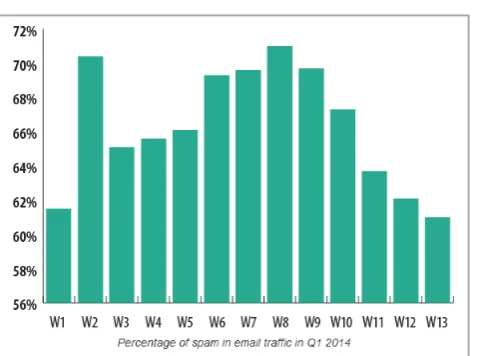
It might be 2015 but spam mails still exist and remain an issue. Research by SecureList (Figure 1) shows a high percentage of spam mails throughout Q1 of 2014.
Figure 1: Statistic for Quarter 1 2014 by SecureList.com
Spam can come from any sector or industry usually for advertising purposes. They can also disguise as scam, manipulating receivers for illegal profit-making. While
this issue has been discussed time and again, there is no one easy solution to completely and permanently prevent
Staying Away from Spam
By | Noraziah Anini Mohd RashidFigure 2: Scam mail vs Spam mail
2
respond immediately or click on the links provided.
Some scam cases require recipients to disclose their bank account and credit card details. Scam mails can also disguise as letters from troubled entities or individuals from Middle Eastern countries, asking for recipients’ help with their financial situation. This would require online money transaction between the recipient and scammer. These emails would induce recipients’ sympathy and ask for their kindness. Although email scams are widely known, there are people who are still cheated for their money.
Smart Tips to avoid Scammers
The best practice is not to reply to these emails or click any of the links as this may cause malware infection to receiver’s machine. Unsubscribing to the email may draw scammers’ attention further. They would know that the account is active and will continue sending scam emails. Instead, recipients can configure their spam setting to filter these emails. Recipients should avoid money transaction with unverified sources, especially providing them access to personal information. If unsure, recipients should call the company to verify the details of the transaction.
Awareness is important. Recipient can stay informed by keeping up with the latest online security news and developments. One of the simplest and easiest ways to identify spam is by using Google’s search engine. Searching for the sender’s email address online can help recipients to determine its validity. Sometimes paying close attention to the email address would do. For example, a Jusco promotion that came through from [email protected]. Legitimate organisations would only use email addresses with accurate company name or representation.
To avoid spams or scams, online users should avoid sharing their email addresses on public forums or websites. Online users should also change their setting to hide their email addresses when creating accounts on websites. Spammers may send an email asking the recipient if he or she is interested in the products or services they have just viewed. The best approach is to ignore these emails.
Malaysians who come across scams can lodge complaints to the Malaysian Communication and Multimedia
Commission (MCMC). ■
References
1. Malaysian Communications And Multimedia Commission (MCMC) | Suruhanjaya Komunikasi dan Multimedia Malaysia (SKMM) - Regulatory Approach to Spam. (n.d.). Retrieved November 11, 2013, from http://www.skmm.gov.my/FAQs/ SPAM/Regulatory-Approach-to-Spam.aspx.
3
ISO/IEC 27001 A Clause A Day: Clause 7.2
Competence
By | Razana Md Salleh
Summary
While employers understand the importance of staff competency building, they may not necessarily see the benefits of training right away. This unnecessary stress can be
4
Capacity Building for the Development of
National Cyber Security
By | Hafiz Ambar, Rahayu Azlina Ahmad, Siti Hazwah binti Abd Karim
The world is reliant on the Internet these days, especially with the many new and exciting digital offerings by governments, corporations, businesses and individuals. This rapid digital development also attracts cybercrimes. This has raised concerns among the governments, organisations, groups and individuals entrusted in the cyber security space. It also calls for capacity building and paradigm shifts in the legislations involving cyber security. There is a growing need for cyber security professionals with the right skills, knowledge and expertise; and establishment of specific authorities to oversee and steer cyber security initiatives and efforts.
The Importance of Capacity
Building
Governments, international organisations and the private sector have been placing importance in building their cyber security capacities. Cyber-attacks on Estonia, Georgia and Iran serves as a grim reminder to the rest of the world on the potential damages from cyber-threats and its impact to the economic, political and social state of nations.
Technology is transforming the way nations and societies work, interact and transact. Governance systems are keeping pace with the cyber space development that usually requires secure infrastructures. Building capacity in the cyber space is not only about the security, but also end-user demand for digital governance and delivery of services like e-Government facilities, e-Health provisions, online-based education systems, online banking services and more.
Capacity Building Measures
Strategic capacity building measures can only be effectively and properly implemented at the topmost of the governance hierarchy, i.e. the government. These are three crucial capacity building measures:
1. Legal Measures
Legislation plays a critical role in providing a harmonised framework accepted by all relevant parties. There is a need for adequate legislations in place – for example, the enactment of a dedicated act of law that caters to local cyber security issues and harmonises with other similar international legislations as well. This facilitates positive international efforts in cyber security and combating cybercrime.
2. Technical Measures
Entities without adequate capabilities to identify cyber-related issues will be vulnerable to cyber threats. Technology companies need to be at the forefront of cyber space – gluing the pieces together. Concerned nations need to adopting security measures and accreditation schemes for software applications and systems.
It is important to establish a national entity, governed by a national framework, dedicated to cyber-related issues on a nationwide level over the Critical National Information Infrastructures (CNIIs). For example, the national Computer Incident Response Team (CIRT), Computer Emergency Response Team (CERT) or the Computer Security Incident Response Team (CERT).
3. Organisational Measures
Organisational measures are essential for a successful implementation of a national strategy accompanied and an all-inclusive plan to govern the implementation, delivery and measurement aspects. A national strategy can match commitments and efforts by cyber security stakeholders and players. An underlying national strategy is required for the creation of related sub strategies, structures, institutions, roles and more, necessary for the development of national capabilities.
Capacity Building General
Framework
5
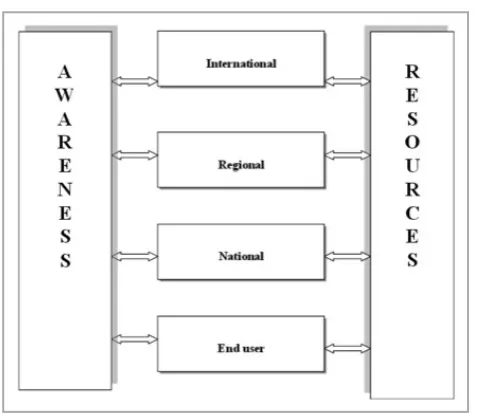
that capacity building to promote cyber security remains complex and considered a technical, specialised fields. The ITU has also proposed a capacity building framework to promote cyber security (see Figure 1).
Figure 1: Capacity Building General Framework
The framework was based upon the raising awareness levels and the availability of resources. Raising awareness is important to ensure a functioning and sustainable framework for international cooperation to safeguard the cyber space.
Cyber Skills Capacity Building
“Organisation doesn't really accomplish anything. Plans don't accomplish anything, either. Theories of management don't much matter. Endeavours succeed or fail because of the people involved. Only by attracting the best people will you accomplish great deeds” -- former US Secretary of State, Collin Powell
Cyber skills capacity building is the epitome of any established entity that can move with the evolving cyber security industry. This requires an adequate number of cyber security professionals to sustain the efforts and to meet the goals of their cyber security strategies.
A well-planned training roadmap can produce highly-skilled professionals and identify the right candidates for specialisation paths at an early stage. Stakeholders input must considered when formulating and deciding the training roadmap.
The CSIRT is a platform where professionals can hone their skills and enrich their experiences by dealing with real-life cyber security issues, incidents and escalations.
It is important to foster international collaborations with other CSIRTs and organisations all around the world. Discussions, exchange of information and ideas through forums, seminars, conferences and attachment programmes will benefit all.
The government can also begin incorporating cyber security lessons into school curricula to nurture cyber-awareness among the young generations way they choose, the nation will only end up with a society that are fully aware of the perils of the cyber space and ideally can also protect themselves, thanks to the cultivated good cyber security practices over the years prior.
The Internet Society’s anticipates three billion Internet users by early 2014. Malaysians require capacity building efforts properly in place to accommodate for such a heavily-connected world.
References
1. Cyber Capacity Building in Ten Points. European
Union Institute for Security Studies. Retrieved
from http://www.iss.europa.eu/uploads/media/ EUISS_Conference- Capacity_building_in_ten_ points-0414.pdf
2. Cybersecurity Readiness Study. Ponemon
Institute. Retrieved from h t t p : / / w w w 8 .
hp.com/h20195/v2/GetDocument.aspx?docname =4AA2-9963EEW
3. Global Cybersecurity Index: Conceptual
Framework. International Telecommunication
Union & ABI Research. Retrieved from h t t p s : / / www.itu.int/en/ITU- D / C y b e r s e c u r i t y / Documents/GCI_Conceptual_Framework.pdf
4. Internet Society Global Internet Report
2014: Open and Sustainable Access for All.
Internet Society. Retrieved from http://www.
internetsociety.org/sites/default/iles/Global_Intern et_Report_2014_0.pdf
5. ITU Global Cybersecurity Agenda (GCA) A
Framework for International Cooperation in
Cybersecurity. International Telecommunication Union. Retrieved from h t t p : / / i n t g o v f o r u m . o r g / Substantive_2nd_IGF/ITU_GCA_E.pdf
6. ITU Global Cybersecurity Agenda (GCA)
High-Level Experts Group (HLEG) Global Strategic
Report. International Telecommunication
Union. Retrieved from http://www.cybersecurity- gateway.org/pdf/global_strategic_report.pdf
7. Probert, David E. (2010). Cybersecurity
Capacity Building & International Collaboration.
International Telecommunication U n i o n .
6
Updated Personnel Records – Is It Necessary?
By | Norlela binti Mohamed Yunan
Employees are the biggest asset of any company. Proper management of personnel records is important to ensure updated information are available to make a right decision and to protect both rights of the state and individuals. The information held in personnel records is usually used to make decisions about suitability for promotion, transfer or in some cases disciplinary action and termination. The records also will be used to determine pay and other benefits for the employee and dependent family members.
What Belongs In A Personnel
Record?
Personnel records document stores the contractual relationship between employer and employee and the employee's career history in the organisation. Information that is sensitive and personal will be categorised as Secret or Private and Confidential and labelled accordingly. These type of information are accessible by authorised personnel only. Information kept in the Personnel Records includes the following:
• The job application and resume of the employee
• Letter of Appointment to the employee
• A job description for the position that the employee holds
• Academic Qualification or acquisition of new educational or professional qualifications
• Emergency contacts or next-of-kin contact number
• Beneficiary information
• Competency / Expertise Areas
• Professional Membership
• Publication / Presentation
• Career History or previous employment details
• Achievements
• Certifications
• Training History
• Medical report
• Background check
• Periodic performance evaluations
• Any forms relating to benefits that the employee enjoys
• Evidence records and notes of any
disciplinary proceedings taken against the employee
• Any employment contracts, written
agreements, or acknowledgments between
the employee and the employer (e.g. Non-Disclosure Agreement, Code of Conduct)
• Any documents that relate to employee
mobility (e.g. transfer, re-designation, promotion, resignation, termination etc.)
Where Are They Kept?
Personnel records can be maintained either in paper form, or electronically. Traditionally can be extremely time consuming especially when it comes to extracting data. With technology and globalisation, many organisations have moved from paper-based systems to computer-based systems. They deploy Human Resource Information Systems (HRIS) with various functions to simplify tasks. Computerised personnel record system allows easy analysis for reporting purpose.
Who Is Responsible?
The HR department is responsible to maintain records of each employee's work history in the organisation. However, some organisations allow the employees to key-in, review and update his/her personal profile electronically via Employee Self Service (ESS) system. HR will receive notification on the changes. Employees will have to submit supporting documents to HR for verification.
Why Is It Crucial To Update Data?
Any record keeping system is only useful if it fulfil certain principles. It must be:
• Up-to-date
• Accurate and reliable
• Confidential with regards to personal details
• Adaptable, so that it can cater for future developments and changes
• Economical in its introduction, use and maintenance
7
• Confidentiality: Assurance that information is shared only among authorised persons or organisations
• Integrity: Assurance that the information is authentic, complete and can be relied upon to be sufficiently accurate for its purpose
• Availability: Assurance that the systems responsible for delivering, storing and processing information are readily accessible when needed, and/or by those who need them
In addition, employers also need to address the following implications:
• business continuity
• minimisation of damages and losses
• competitive edge
• profitability and cash-low
• respected organisation image
• legal compliance
Business Continuity Management
(BCM)
Organisations may encounter the possibility of disruptive and unplanned events that have impacts on the business operations. Examples of these events are natural disaster, power outages, cyber-attacks, security breaches, pandemic illness, loss of key staff etc. Although it is impossible to predict crises, it is possible to prevent them from becoming a disaster or reduce the impact, so organisation can continue its operation with minimal disruptions.
HR plays a crucial role in the organisation’s preparations and responses to crisis. When a crisis occurs, HR will take the lead to resolve any human issues and protect the welfare and safety of the affected employees. Accurate and complete personnel records are invaluable source of information which will assists HR to respond readily before, during and after a crisis. For instance, if a building collapses from a fire and employees are trapped in the building, HR will need to refer to the employees’ personnel records to contact and notify the employees’ next-of-kin and the insurance agency, if necessary. The records are also useful for HR to identify employees who have First Aid skills that would benefit the situation.
Having accurate personnel records is crucial for complying with the legal requirements:
Section 61 of Employment Act 1955 (Part XIII: Registers, Returns and Notice Boards) mandates:
“(1) Every employer shall prepare and keep one or more registers containing such information regarding each employee employed by him as may be prescribed by regulations made under this Act.
(2) Every such register shall be preserved for such period that every particular recorded therein shall be available for inspection for not less than six years after the recording thereof”.
The particular points to note in the Personal Data Protection Act (PDPA) 2010 are:
Data Integrity Principle
11. A data user shall take reasonable steps to ensure that the personal data is accurate, complete, and not misleading and kept up-to-date by having the purpose, including any directly related purpose, for which the personal data was collected and further processed.
Access Principle
12. A data subject shall be given access to his personal data held by a data user and be able to correct that personal data where the personal data is inaccurate, incomplete, misleading or not up-date, except where compliance with a request to such access or correction is refused under this Act.
Periodic maintenance of the personnel records will ensure all important documents and information are complete, accurate, updated and easily accessible by an authorised personnel at any time. Employees must be reminded to review and update their particulars as and when there are changes to their profile. Updated information will help the organisation in making efficient decisions, as well as to protect the rights of the organisation and individual employees.
References
11. Malaysia Employment Act 195512. Personal Data Protection Act 2010 LAW OF MALAYSIA Act 709
13. PWC I Personal Data Protection Act (PDPA) 2010: “Data Protection: It’s getting personal”
8
OIC Networks Fight against
Cyber-attacks
The Organisation of The Islamic Cooperation-Computer Emergency Response Team (OIC-CERT) provides a platform for OIC member countries to explore and develop collaborative initiatives and partnerships in cyber security. It aims to strengthen their self-reliance in the cyber space.
The OIC-CERT comprises of 23 CERTs and cyber security-related agencies from 19 OIC member countries. The organisation has been working hard to forge partnership and build strategic alliances with OIC member countries and other CERTs to mitigate cyber threats which includes annual cyber drill exercises. The first OIC-CERT Cyber Drill began in February 2012, followed by its participation in the Asia Pacific Computer Emergency Response Team (APCERT) Drill in January 2013 and most recently, in February 2014.
Sophistication behind Cyber
Incidents
The increase in cloud and mobile computing has introduced more complex cyber-attacks. These attacks have been attempted on governments, businesses and individual users, more than ever before. Some experts even argue that it is no longer about whether an attack is going to happen, but rather when it is going to happen.
Nowadays, sophisticated attacks are taking place in the IT infrastructures. Attackers continuously refine their methods to beat any systems’ security improvements applied. They consolidate assets to create global networks that can support coordinated criminal activities. There has also been a rise in cyber spying and targeted attacks on organisations and individuals.
Cyber Drill Exercise among OIC Networks in
Fight against Cyber-Attacks
By | Hafiz Ambar, Rahayu Azlina Ahmad, Siti Hazwah binti Abd Karim
The other trend making headlines is the continuous mapping of targeted networks and probing for the systems’ weaknesses and vulnerabilities. Malware propagation through website intrusions and spam are on the rise, as well as large-scaled Structured Query Language (SQL) Injection attacks. Phishing cases are increasing, particularly through the fast lux method and domain phishing.
Preparing for the Worst: Cyber
Drill Exercises
The cyber drill exercises are important in enhancing capabilities, improving preparedness and communication, and encouraging collaboration of the participating CERTs and economies. These exercises help develop the capabilities of OIC member countries to protect their Critical National Information Infrastructures (CNIIs). They also help acquire and enhance the capacity to protect against cyber threats. Participation in the drills will enhance a country’s expertise and experiences in cyber security, reduce the skills gap and allow sharing of valuable knowledge and experience with participants from other member countries.
These exercises also improve the preparedness of OIC countries in the identification, prevention, response and resolution of cyber security incidents. The drills provide the opportunity to train professionals from participating economies on how to handle cyber-related incidents according to internationally accepted standards and best practices, and to effectively collaborate with others within the same ecosystem and area of interest.
9
aware of cross-border cooperation in cyber space, in their response to developing countries’ needs. Participants can test the existing communication capability to gauge the actual ability to communicate and relay information across physical borders and different time zones. These exercises enable effective decision-making and help coordinate swift response that can assist other economies to mitigate cyber-attacks.
How does it work?
During a cyber drill exercise, participating teams will be divided into two roles, the player and the observer. The player is tasked to execute the ‘incident handling’ process, analyse threats and mitigate simulated cyber-attacks, while the observer is required to perform communication roles that assists the player in mitigating the simulated attacks. The drill scenarios are created by cyber security experts and coordinated by the organiser.
The Issue with Cyber Drill
Exercises
Organising a cyber drill exercise is a huge challenge that requires meticulous planning. The organiser is required to outline the exercise objectives. They will need to decide the size of the drill (manpower, systems, networks etc.), the type and amount of technical hands-on required and the preparation/training required for the participants (and the organising committee) for a smooth-sailing drill.
It is also a challenge to get the support and participation of major organisations such as banks and government agencies – the biggest targets in cyber-attacks. While they understand the benefits of cyber drill exercises, it is complicated to plan and execute a hands-on simulated cyber-attacks because their operations are much larger and dispersed. They also find it difficult to conduct cyber drill exercises over concerns that they may affect their day-to-day operations.
Another challenge is to simulate what is considered as a typical cyber-attack. There are also concerns that drills will be more
focused on operational issues (e.g. business continuity, recovery of systems and services, media handling etc.) and not on the cause of attacks and how to stay protected. Even worse, there are also concerns of drill “data” accidentally getting out of hand. For example, the malware or virus intended for the drill is accidently leaked out of isolated network and into live systems.
Conclusion
Given the borderless nature and dangers of constantly evolving cyber-attacks, it is vital that every CERT and CIRT continues to share their knowledge, information and experience with one another to successfully mitigate cyber threats.
References
1. APCERT drill on countering cyber attacks.
Sunday Observer. Retrieved f r o m
http://www.sundayobserver.lk/2014/03/02/in10.asp
2. APCERT Embarks on Global Coordination to
Mitigate Large Scale Denial of Service Attack.
Asia Paciic Computer Emergency Response
Team. Retrieved from h t t p : / / w w w. a p c e r t . o r g / documents/pdf/APCERTDrill2013PressR e l e a s e _ AP.pdf
3. APCERT Stops Cyber Attacks During Drill
Exercise. Asia Paciic Computer Emergency
Response Team. Retrieved from http://www.
apcert.org/documents/pdf/APCERT-drill-2007.pdf
4. Coughlan, Sean (2014). Cyber-attacks increase
leads to jobs boom. BBC News Business. Retrieved
from http://www.bbc.com/news/business-26647795
5. Kumar, Avanti (2013). CyberSecurity
Malaysia appointed OIC-CERT p e r m a n e n t
secretariat. Computerworld Malaysia. Retrieved
from http://www.computerworld.com.my/resource/ security/cybersec urity-malaysia-appointed-oic-cert-permanent-secretariat/
6. OIC-CERT Cyber Drill Coordination
Successful In Addressing Targeted Cyber Crisis.
BERNAMA. Retrieved from http://www.
cybersecurity.my/bahasa/knowledge_bank/news/20 12/main/detail/2160/index.html
7. Phneah, Ellyne (2011). Cybersecurity drills useful
but risky. ZDNet Asia Edition. Retrieved from
http://www.zdnet.com/cybersecurity-drills-useful-but-risky- 2062302569/
8. Workshop Report: Value Cyber Security
Exercises. Asia-Paciic Economic Cooperation.
11
Introduction
Most people assume that Retinal Scanning and Iris Recognition are similar identification methods. They are both categorised as ‘eye biometrics’ that leaves people confused between the function of iris recognition and retinal scanning.
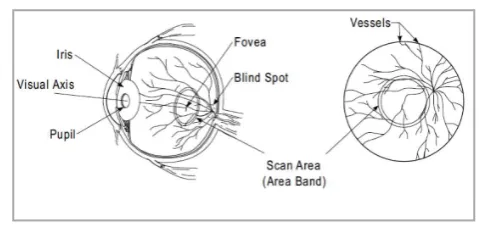
Retinal scanning involves the use of a scan that surveys the blood vessel patterns on the retina using infrared light. This biometric vein retinal technology looks at the back of the eye that has nerve tissue, and this includes blood vessels that come with a unique retinal pattern. Whereas, iris recognition involves scanning the iris specifically, focusing on the lat, coloured, ring-shaped membrane behind the cornea of the eye; whilst with an adjustable circular opening (pupil) in the centre. Figure 1 illustrates the difference between iris and retina.
Figure 1 1
Retinal Scanning
This technology was founded by Robert Hill in the 1970s. Hill was an electrical engineer discovered the idea of using retinal scans as a form of identification when he was helping his father, an ophthalmologist, to detect eye
disease through photographs.
The retina is the innermost coating of the eye, containing light-sensitive nerve cells and fibres connecting with the brain through the optic nerve1. Nerve cells are tissue that require blood to function properly and possess an intricate blood vessel system called ‘choroidal vasculature’. To scan the retina, a light beam needs to be exposed directly in the eyes for 10 to 15 seconds for the image to be converted to digital format.
Figure 2 Eyes structure 1
Figure 2 illustrates the image captured by a retinal scanner. The image on the left is a cross section of an eye with the retina. The ring can be seen on the right image is a cross section of the eye straight up and down.
Retinal scanning technology is the most accurate for biometric identification. In just 20 seconds, the retinal scanner scans about 400 reference points used for identification processes. The biggest disadvantage to this technology is certain diseases that can affect the choroidal vasculature and cannot be authenticated by the scanner.
A retinal scanner is considered more intrusive and slower. Users are required to be three inches from the scanner and focus on a red light point to clearly capture the retina. The red light is not good for the eyes as it can cause cataracts. Scan more than one time can cause dizziness to the user.
12
Iris Recognition
This technology was patented back in the 1980s. It was used by a Pennsylvania prison to help identify prisoners. Today, many airports are beginning to use this technology, including London’s Heathrow Airport and Germany’s Frankfurt Airport. In 1963, ophthalmologist Frank Burch proposed using iris patterns to recognise an individual. In 1985, Drs. Leonard Flom and Aran Safir, ophthalmologists, proposed discovered that no two irises are alike. In 1993, the Defense Nuclear Agency began testing a prototype unit, successfully completed by 1995.
Iris is a thin, circular structure of the eye, responsible for controlling the diameter and size of the pupils and the amount of light reaching the retina. Iris recognition is a particular type of biometric system that can be used to reliably identify a person by analysing the patterns found in the iris4.
Figure 3 Iris Pattern 5
Iris recognition uses high-quality camera technology with subtle infrared illumination to acquire images of the detail-rich, intricate structures of the iris. Most of the researchers classify the methodology in three steps: capture the pattern of the iris, calculate patterns by mathematical and statistical algorithms, and run a search through matcher engines in databases of enrolled iris
templates. Basically, before the recognition process, localisation of the iris must be performed to identify resultant noise like eyelashes, relections, pupils and eyelids in the captured image. The iris scanner can be utilised from a much farther distance of up to two feet and uses about 240 reference points.
The advantage of using iris recognition is its ability to search at speeds measured in millions of templates per second per (single-core) CPU, and with infinitesimally small False Match rates and extremely resistant to False Matches.
Conclusion
Although both technologies have different methods of identification, they are highly reliable because no two people have the same iris or retina. However, retinal scanning measurement accuracy can be affected by disease like diabetic and not suitable for pregnant women.
For those who interested with iris recognition can review the currents standards of iris recognition such as “ANSI/INCITS 379-2004 Iris Interchange Format” and “ISO/IEC 19794-6: 2005Biometric Data Interchange Format – Part 6: Iris image data”3.
References:
1. Carlos, Iris vs. Retina, http://scanmein. blogspot.com/2011/04/iris-vs-retina.html, accessed on 26 December 2013.
2. Pediatric Visual Diagnosis Fact Sheet, RETINAL_DISEASES_DEFINITION_DIAGNOSIS. Pdf
3. NSTC Subcommitee on Biometric, Iris Recognation.pdf
4. Iris Recognition.pdf by Michale Boyd
13
Introduction
In an era of mobile broadband communication at work and at home, mobile network security is more pivotal than ever. With the introduction of 4G LTE networks and the IEEE standardisation for mobile networks, the secure, “walled garden” days are over. Mobile networks are becoming very similar to common IP-based networks. The move to IP-lat architecture in 4G LTE networks means that networks are now susceptible to IP-based security attacks from the Internet and RAN, subsequently presenting a security challenge to MNOs that previously did not exist, and demanding new methods for network protection.
Key components of 4G LTE
mobile network
To realise the security concerns or threats in 4G LTE mobile network, one must first understand the key network elements involved in 4G LTE mobile network. 4G LTE mobile network still contains the same basic network elements as per the previous 2G GSM to3G WCDMA generation of mobile network.
User Equipment (UE)
The device used by a person or system to access external service networks (voice and data traffic) via the mobile network. User equipment can also be referred to mobile station. To gain benefit of LTE access, UE must be able to support LTE frequency bands such as 900 or 1800 or 2100 Mhz.
Radio Access Network (RAN)
The radio network which connects subscribers to their service provider. Each generation of mobile network consist of their own radio technology such 2G, 3G and LTE. They have been designed to be access-compatible to each other.
Backhaul
The physical network connections used to carry data between the Radio Access Network and the Mobile Core Network.
Core Network
The network which controls and authenticates users and devices, generates charging data records for billing purposes and provides agreed quality of services to subscribers. The LTE mobile core network is also referred to EPC or SAE.
External Service Networks
The services provided by the mobile operators and may include connection to PSTN, VoIP, VoLTE networks, Internet or Public Data Network (PDN), roaming partners, enterprise or corporate specific networks and many other services.
These five key network components could be the potential target by attackers or hackers to gain entry and subsequently abusing the mobile network.
Potential security threats and
their impacts in 4G LTE mobile
network
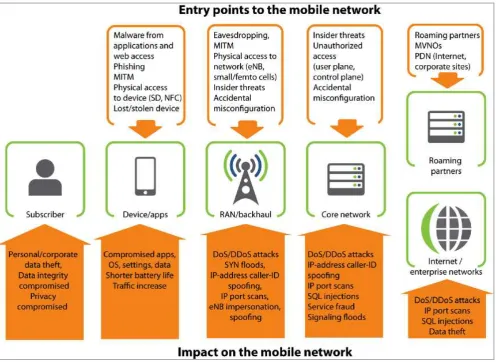
Among the five key network components, UE and core network remain the most potential targeted parts for security threats of the mobile network, while RAN and backhaul have attracted fewer security concerns (Figure 1). There is still potential increase of security threats on RAN and backhaul but they are likely to be more confined because of complex deployment configurations specifically tailored to operator based on location from specific vendor. Therefore, attacks would be difficult as they require complex preparation together with on-site access. However, security measures should
Security Threats Overview in 4G LTE Mobile
Networks
14
be considered from time to time, especially with the presence of small/femto cells and the integration of Wifi-hotspot with cellular network as these would allow attacks on mobile networks easier to plan and carry out.
Security threats associated with mobile network can be divided into two main categories:
Intrusion
Network is more open to intruders unless protective security measures are taken such as passwords, encryptions and granular authentication as these could lead to misuse of information, unauthorised modification or deletion of data and network capacity abuse.
Exploitation
Attackers gain access to mobile network and launch DoS attacks which could jeopardise the core network system.
UE such as smartphones can generate excessive signalling traffic in the mobile
core network during the busy hour periods if they are already compromised by malware. Nowadays, there are a number of mobile malwares can be found, especially Android malware and vulnerable for smartphone users. Examples of Android malwares are Andr/PJApps-C, Andr/BBridge-A, Andr/ BatteryD-A, Andr/Generic-S and Andr/ DrSheep-A.
The growing demands of OTT player such Facebook, Whatsapp and Twitter can also be a factor in excessive signalling traffic generated by UE, especially smartphones and could raise a potential of congestion in the core network. Therefore, protective measures should be adopted by MNOs to prevent their network from being jammed-up by signalling storm.
15
face many challenges to protect their 4G LTE mobile networks from any security threats and provide their best services to customers.
4G Fourth Generation Mobile Communication
DDoS Distributed denial of service
DoS Denial of service
eNB eNodeB
IEEE Institute of Electrical and Electronics Engineers
IP Internet Protocol
LTE Long term evolution
MITM Man in the middle
MNO Mobile network operator
MVNO Mobile virtual network operator
NFC Near field communication
OS Operating System
PDN Packet data network
PSTN Public System Telephone Network
RAN Radio access network
SD Secure Digital
SMS hort message service
SQL Structured query language
Syn Floods TCP syn attack
VoIP Voice over IP
VoLTE Voice over LTE
EPC Evolved Packet Core
SAE System Architecture Evolution
UE User Equipment
OTT Over the Top
References
1. Mobile Network Security – Availability Risks in Mobile Networks. ERT Lab Security Researcher. Retrieved from http://security.radware.com/uploadedFiles/Resources_and_Content/Attack_Tools/ Mobile_Networks_Security_Research_Paper.pdf
2. Wireless Security in LTE Networks. Senza Fili Consulting. Retrieved from http://www.gsma.com/ membership/wp-content/uploads/2012/11/SenzaFili_WirelessSecurity_121029_FINAL.pdf
16
Why Social Networking Sites?
By | Nor Radziah Jusoh and Yuzida Md Yazid
Social networking sites (SNS) have become the most popular mode of communication. A social networking site is usually a web-based service that allows individuals and businesses to create public profiles, share information and views with their connections. It is a media that we use to update our daily statuses, share photos and interesting places with family and friends, as well as promoting, selling and buying merchandises. Some people are even addicted to SNSs where they completely
emerge themselves. Days without SNSs would seem incomplete to them. What really motivate people to use SNSs?
Popular Social Networking Sites
Based on www.ebizmba.com, the top 15 sites globally was dominated by Facebook, Twitter, LinkedIn, Pinterest, Google and others, as of November 2014. User population on Facebook is larger than the population of some countries.
Rank : 1
900,000,000
A Social utility that connects people with friends and others who work, study and live around them.
Rank : 2
310,000,000
Connects with
friends and other fascinating people. Users can get live updates on their areas of interest.
Rank : 3
255,000,000
A tool to help users manage their professional identity. They can also build and engage their professional network.
Rank : 4
250,000,000
A visual discovery tool that users can use to find ideas for their projects and interests.
Rank : 5
120,000,000
Users can search the world’s information, including webpages, images, videos and more.
Rank : 6
110,000,000
Users can post anything (from a n y w h e r e ) ,
c u s t o m i s e everything, and find and follow what they love.
Rank : 7
100,000,000
17
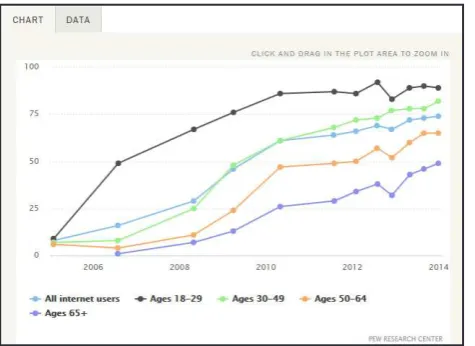
These SNSs are not only popular among youth but also all ages from all walks of life. According to Pew Research Centre, as of January 2014, 74% of online population use SNSs. Divided by age group, 89% of users were between the age of 18 and 29.
Diagram 1: Social Media Use by Age Group over Time
Why Social Networking Sites?
Many researchers are trying to understand why people use SNS. Research by Petter Bae Brandtzæg and Jan Heim shows that, the list of motivational factors includes to create new relations, maintain relationship with friends, socialise, access information, debate, get free SMS, kill time and others.
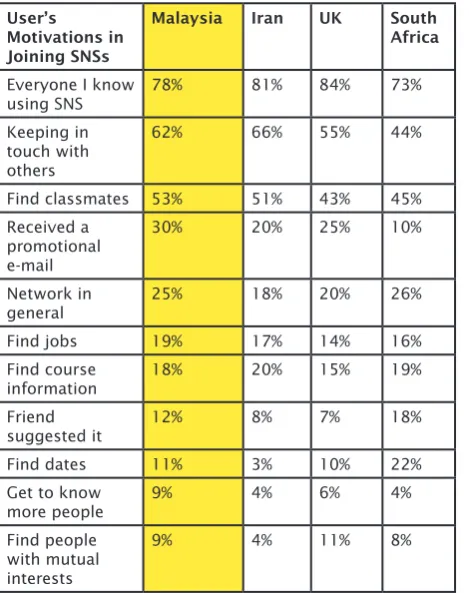
In China, Renren.com survey with college students listed ‘social interaction, ’self-image building’, information-seeking’ are the motivational factors in using SNS. Another study (table 2) shows students froms Malaysia, Iran, UK and South Africa choosing ‘peer pressure’, ‘keeping in touch’ and ‘finding classmates’ as top motivation in using SNS.
Rank : 9
65,000,000
Users can share and connect with the Flickr Community and place all their photos in one place.
Rank : 10
42,000,000
Vine is the best way to see and share life in motion through short, beautiful, looping videos created for friends and family.
Rank : 11
40,000,000
This tool helps groups of people with shared interests plan events and facilitates off line group meetings in various localities around the world.
Rank : 12
38,000,000
Tagged makes it easy to meet and socialise with new people through games, what people want to know about the users.
Rank : 14
15,500,000
A tool that helps users meet new people near them.
Rank : 15
15,000,000
This sites offers users access to nostalgic content, yearbooks and connect with people.
Table 1: User population in Social Networking Sites
18
User’s Motivations in Joining SNSs
Malaysia Iran UK South
Africa
Everyone I know using SNS
Find classmates 53% 51% 43% 45%
Received a
Table 2: User’s Motivations in Joining SNSs
Need to belong
Across all cultures of people, there is one major motivational factor that encourages people to join/use SNSs – the need to belong. It is the need to be accepted by others from the same group. Researchers believe that this need relates to self-esteem, attachment and self-presentation to impress others.
Marketing
SNSs are used as powerful marketing tools used by companies to sell products and services. Brand communities are a special form of consumer communities that bind brand and community together. Social interactions between community members profoundly inluence customers’ relationship with, and attitude towards, the brand. In such virtual environments, users often gather together in sub-groups with a specific brand in its centre, a brand-related community; consumers share their interest for a brand, exchange information and knowledge, or they simply express their affection for this specific brand.
Social Gap
Parents have extra motives to use SNS - bonding and bridging the social gap between them and their children. Children tend to be closer to their friends than their
parents. Parents use SNSs to communicate with their children, their children’s friends, and the parents of their children’s friends. Adolescents are more open and expressive in social networking sites. Hence, parents consider SNS as a good platform for them to know more about their children.
Campaign
Usage of SNSs among politicians, especially during election campaigns, is becoming a trend. Candidates running for presidential and parliament posts use micro-blogging and online social networks such as Twitter and Facebook to communicate and connect with the citizens. Traditional campaign involves only one-way communication. However, SNSs campaigns convey messages to people, that has an ‘amplifying’ effect. Politicians can create a mass connection and respond to more people.
References
1. Petter Bae Brandtzæg and Jan Heim, (2009),
Why People Use Social Networking Sites, pp. 143–152, © Springer-Verlag Berlin Heidelberg 2009
2. Population of Countries in the World.
Worldometers, 2014. (http://www.worldometers.info/ world-population/population-by-country/)
3. Manzoor Ali Mirani, (2011), Motives for Students
Using Social Networking Sites: Findings from Sukkur, Pakistan, IPEDR (22)
4. Social Media Use by Age Group Over Time,
Pew Research Internet Project, (2014) (http://www. pewinternet.org/data-trend/social-media/social-media-use-by-age-group/)
5. Schaefer, Cora. (2008). Motivations and Usage
Patterns on Social Network Sites.
6. Joan DiMicco, David R. Millen, Werner Geyer,
Casey Dugan, Beth Brownholtz, Michael Muller, (2008), Motivations for Social Networking at Work, CSCW’08 .
7. Leila Karimi, Rouhollah Khodabandelou,
Maryam Ehsani, Muhammad Ahmad, (2014), Applying the Uses and Gratiications Theory to Compare Higher Education Students’ Motivation for Using Social Networking Sites: Experiences from Iran, Malaysia, United Kingdom, and South Africa, Contemporary Educational Technology, 5(1), 53-72.
8. Zhang Wei Wei, Huang Pei Yi, (2011) How
Motivations of SNSs Use and Ofline Social Trust Affect College Students’ Self-disclosure on SNSs: An Investigation in China.
9. Jennifer Doty, Jodi Dworkin (2014). Parents’ of
adolescents use of social networking sites, Computers in Human Behaviour.
10. Maurice Vergeer, Liesbeth Hermans and Steven
Sams (2013), Online social networks and micro-blogging in political campaigning, The exploration of a new campaign tool and a new campaign style, Party Politics Journal
11. Mushera Frehat, Emad Abu-Shanab (2014).
The Role of Social Networking in the Social Reform on Young Society.
12. Melanie E. Zaglia (2013). Brand communities
19
Introduction
Cryptography is so advanced that people don’t even notice using them in their daily lives. Have you ever wondered how cryptography came about?
500 BC
ATBASH CIPHER
Atbash is a simple substitution cipher for the Hebrew alphabet. This cipher substitute the first letter of the alphabet for the last letter and the second letter for the second last letter and so on.
50 BC
CAESAR CIPHER
Caesar cipher is one of the oldest types of ciphers. It is the simplest and widely known encryption technique that is often incorporated as part of a more complex scheme, such as Vigenere Cipher. Caesar cipher is a type of substitution cipher in which each letter in the plaintext is rotated left or right by some fixed number of positions down the alphabet.
7 C SKYTALE
Skytale is one of the tools used to perform a transposition cipher, consisting of a wooden rod that acts as a key. Both sender and recipient need to own a wooden rod with the exact same diameter and length. A strip of parchment will be wound around the rod and message will be written on it. Then, the strip of parchment is sent as a cipher text. The recipient uses a similar rod, wraps the parchment to decrypt and reads the message. This cipher is said to be used by the Spartan military to communicate during battle times.
9 C
FREQUENCY ANALYSIS
Frequency analysis is the study of the frequency of letter or groups of letters in a ciphertext that is useful in cryptanalysis. The method is used as an aid to break classical ciphers such as Caesar Cipher and other substitution ciphers. In substitution ciphers, each plaintext letter is encoded to the same cipher letter or symbol. To start deciphering the encryption, it is useful to get a frequency count of all the letters in ciphertext. The most frequent letter may represent the most common letter in English which is E followed by T, A, O and I whereas the least frequent are Q, Z and X. This method was first documented by an Arabic mathematician, Abu al-Kindi.
1920s
ENIGMA MACHINE
Enigma machine was used by Britain’s code breakers for enciphering and deciphering secret messages during World War II. It was invented by Arthur Scherbius, the German engineer at the end of World War I. It has been claimed that as a result of the information gained through the device, hostilities between Germany and the Allied forces were curtailed by two years. Before and during World War II, Enigma has been the inspiration for many other designs of rotor cipher machines, such as the British Typex and the American Sigaba.
1977 DATA
ENCRYPTION STANDARD (DES)
Data Encryption Standard (DES) is a block cipher that uses shared secret encryption. It was selected by the National Bureau of Standards (now called NIST – National Institute of Standards and Technology) as an official Federal Information Processing Standard (FIPS) for the United States and which has subsequently enjoyed widespread used internationally. It is based on a symmetric-key algorithm that uses a 56-bit key to each 64-nit block of data.
2001 ADVANCED ENCRYPTION STANDARDS (AES)
Advanced Encryption Standard (AES) is a National Institute of Standards and Technology specification for the encryption of electronic data. The cryptographic algorithm used block encryption of 128 bits in size, supporting three variants of key sizes which are 128, 192, and 256 bits. It was developed by Joan Daemen and Vincent Rijmen. This algorithm is fast in both software and hardware due to the design principles known as substitution-permutation network.
21
INFOGRAPHIC: PKCS - Public Key
Cryptography Standards
By | Nik Azura Nik Abdullah & Norul Hidayah Ahmad Zawawi
What is Public Key Cryptography
Standards (PKCS)?
• A set of standards for implementation
of public-key cryptography developed by RSA Laboratories (a Division of RSA Data Security Inc.) starting in early 1990s in cooperation with Apple, Microsoft, DEC, Lotus, Sun, and MIT.
• PKCS#1, #3, #5, #6, #7, #8, #9, #10,
#11, #12 and #15 have been published.
PKCS#13 and #14 are currently being developed, whereas PKCS#2 and #4 are no longer active as of 2010.
• The purpose of these standards is to
accelerate the deployment of public-key cryptography when we work with public key cryptography and digital certificates.
• Some of these standards have become
22
Who uses PKCS and how it is
used?
1. International Organisation for Standardisation and International Electrotechnical Commission (ISO/IEC) developed standards for application independent cryptographic techniques and bank security standards.
• ISO/IEC 9798-3: Information
technology - Security techniques - Entity Authentication - Part 3: Mechanisms using digital signature techniques which defines seven protocols based on cryptographic signatures.
• ISO/IEC 7816-15: Identification cards - Integrated circuit cards with contacts.
• ISO/IEC 9796: Information technology
- Security techniques - Digital signature schemes giving message recovery. 2. American National Standards Institute
(ANSI) developed ANSI X9 standards for financial service specifically for personal identification number (PIN) management, check processing and electronic transfer of funds.
• ANSI X9.9 is a banking standard for
authentication of financial transactions which focuses on message formatting and the particular message authentication algorithm.
• ANSI X9.17 is the Financial Institution Key Management standard which defines the protocols to be used by financial institutions to transfer encryption keys.
3. National Institute of Standards and Technology (NIST) developed standards for use by US federal government department.
• FIPS PUB 186-3: Digital Signature
Standard (DSS) specifies a suite of algorithms that can be used to generate a digital signature.
• NIST Special Publication 800-3:
Establishing a computer security incident response capability.
• NIST Special Publication 800-18:
Guide to developing security plans for information technology systems.
• NIST Special Publication 800-26:
Security self-assessment guide for information technology security.
4. Internet Engineering Task Force (IETF) developed standards for use by Internet community.
• RFC 2048: Multipurpose Internet Mail
Extensions (MIME)
• RFC 2246: The TLS Protocol
• RFC 2376: XML Media Types
• RFC 2518: HTTP Extensions for
Distributed Authority
5. Institute of Electric and Electronic Engineers (IEEE) developed IEEE P1363: Standards Specifications For Public Key Cryptography
• IEEE P1363-2000 & 1363a-2004:
Traditional Public-Key Cryptography includes digital signature and key establishment schemes based on integer factorization (e.g RSA), discrete logarithm (e.g Diffie-Helman, DSA) and elliptic curve discrete logarithm (e.g MQV) problems.
• IEEE P1363.1: Lattice-Based Public-Key Cryptography includes encryption (e.g NTRUEncrypt) and digital signatures (e.g NTRUSign) schemes.
• IEEE P1363.2: Password-Based Public
Key Cryptography includes password-authenticated key agreement (e.g EKE, SPEKE, SRP) and password-authenticated key retrieval (e.g Ford & Kaliski) schemes.
• IEEE P1363.3: Identity-Based Public
23
Presents the recommendations for implementing the RSA algorithm for public-key cryptography which defines:
• The mathematical properties of RSA key pair (public key and private key).
• Data conversion primitive (Integer-to-Octet-String and Octet-String-to-Integer).
• Cryptographic primitives (encryption-decryption and signature-verification).
• OAEP-based encryption scheme and PSS-based signatures schemes.
• Describes a general syntax for data that may have cryptography applied to it, such as digital signatures and digital envelopes. The syntax admits recursion (one envelope can be nested inside another, or one party can sign some previously enveloped digital data) and allows arbitrary attributes (signing time to be authenticated along with the content of a message and countersignatures to be associated with a signature).
• Compatible with Privacy-Enhanced Mail (PEM); signed-data and signed-and-enveloped-data content constructed in PEM-compatible mode can be converted into PEM messages, and vice-versa, without any cryptographic operations.
• Describes syntax for private-key information (which includes a private key for some public-key algorithm and a set of attributes) and describes syntax for encrypted private keys. A password-based encryption algorithm could be used to encrypt the private-key information.
• Private-Key Information Syntax and Encrypted Private-Key Information Syntax shall have ASN.1 type PrivateKeyInfo and ASN.1 type EncryptedPrivateKeyInfo respectively. Encryption process for both involves the private-key information is BER encoded yielding an octet string as step one. To differentiate between these two syntax, the result of step one in the Encrypted Private-Key Information Syntax, is encrypted with the key to give an octet string, the result of the encryption process.
Presents the recommendations for implementing password-based cryptography which defines:
• Key derivation functions which produced a derived key from a base key (password) and other parameters (salt value and iteration count).
• Two symmetric encryption schemes; PBES1 with an underlying block cipher (DES or RC2) and PBES2 which is recommended for new applications.
• Message-authentication schemes which consist of MAC generation operation and MAC verification operation.
Covers RSA encryption of message digests, but was withdrawn in 2010 to be merged in PKCS #1.
Covers RSA key syntax, but was withdrawn in 2010 to be merged in PKCS #1. Describes a cryptographic protocol which enables two parties, who have no prior arrangements, to agree on a secret key only known by them, but will not be available to eavesdropper.
24
PKCS #12: Personal Information Exchange Syntax Standard
PKCS #13: Elliptic Curve Cryptography Standard PKCS #10: Certificate Request Standard
PKCS #15: Cryptographic Token
Information Format Standard PKCS #9:
Select Attribute Types
PKCS #14: Pseudo-random Number Generation PKCS #11: Cryptographic Token Interface
Describes a format for storing and transporting personal information including private keys, certificates, miscellaneous secrets, and extensions. Machines, applications and browsers that support this standard will allow users to import, and export a single set of personal identity information.
The elliptic curve cryptography standard is currently being developed. This standard will concentrate on the elliptic curve cryptography aspects which consist of parameter and key generation and validation, digital signature, public-key encryption, key agreement, and ASN.1 syntax.
Describes the syntax for certification request of a public key, a name and optionally a set of attributes. The process of certification request is defined as following below:
• A CertificationRequestInfo value which consist of a distinguishing name, a public key, and optionally a set of attributes which is constructed by an entity.
• The CertificationRequestInfo is then signed with the entity's private key.
• The CertificationRequestInfo value, a signature algorithm identifier, and the entity's signature are collected together into CertificationRequest value.
Describes a standard that users are able to use cryptographic tokens to identify themselves to applications, independent of the application's Cryptoki implementation (PKCS#11) or other API. The aim of this standard is to enable:
• Interoperability among components running on various platforms.
• Application to take advantage of products and components from multiple manufactures.
• Use of advances in technology without rewriting application level software
• Maintaining consistency with existing, related standards while expanding upon them only where necessary and practical.
Presents certain attribute types for use in PKCS#6 extended certificates, PKCS#7 digitally signed messages, PKCS#8 private-key information, and PKCS#10 certificate-signing request. This standard provides in more details about syntax (what is syntax, how it is to be used and where it is to be used).
25
Email Account Compromise and Security Best
Practices: A Case Study
By | Md Sahrom Bin Abu
Email Account Compromise
cases in Malaysia
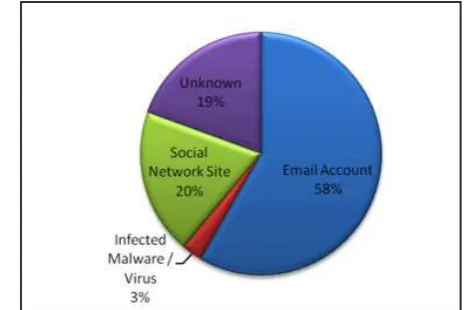
When an account is compromised, it is exposed to serious data loss, data theft or theft of services. Compromise at the end user access level can be contained, however the same can’t be said for a root-level (high administrative level) access. Account compromise can be classified into email account intrusion, malware/virus infection, social networking (social engineering), keylogging malware (Command and Control) and others.
‘Compromised account’ incidents usually comes from account owners and seldom from third parties, with the highest number of cases involving personal emails or social networking accounts. In the second quarter of 2014, 36 incidents on ‘account compromise’ were reported, as shown in table 1 and graphic 1.
Types of Account Compromise
April May June Total
Email account 11 2 8 21
Malware/virus
Table 1: Number of Account Compromise Incidents in Q2/2014
Graph 1: Number of Account Compromise Incidents in Q2/2014
Graph 2: Types of Account Compromise Incidents
What happens when your email
gets hacked?
“A Malaysian IP address hacked my account and sent emails to people all over the world as well as those in my address book. I have since changed the password but they have tried to hack into my personal account again. Please see log below.”
The IP address for 14th April is 60.49.70.46
The IP address for 31st March is 175.145.196.101
Date Event Location
Date? 12:42 PM
Signed in from Internet Explorer
April 15 Changed password
Carrick-On-Shannon, Leitrim, Ireland
April 16 Signed in from IE
(Windows)
Carrick-On-Shannon, Leitrim, Ireland
Table 3: Snippet of log activity for my email account
Analysis
26
Queried whois.apnic.net with "60.49.70.46"...
% Information related to '60.49.0.0 - 60.49.255.255'
inetnum: 60.49.0.0 - 60.49.255.255
netname: ADSL-STREAMYX
descr: TMNST
country: MY
admin-c: EAK2-AP
tech-c: EAK2-AP
status: ASSIGNED NON-PORTABLE
mnt-by: MAINT-AP-STREAMYX
mnt-lower: MAINT-AP-STREAMYX
mnt-routes: MAINT-AP-STREAMYX
mnt-irt: IRT-TMNST-MY
notify: [email protected]
changed: [email protected] 20130412
changed: [email protected] 20140515
source: APNIC
changed: [email protected] 20140211
source: APNIC
changed: [email protected] 20080918
mnt-by: TM-NET-AP
abuse-mailbox: [email protected]
source: APNIC
Queried whois.apnic.net with "175.145.196.101"...
% Information related to '175.145.0.0 - 175.145.255.255'
inetnum: 175.145.0.0 - 175.145.255.255
netname: ADSL-STREAMYX mnt-routes: MAINT-AP-STREAMYX
mnt-irt: IRT-TMNST-MY
Graph 3: Email notiication to the ISP
27
What to do when your email is
hacked?
Once the email account has been marked as ‘compromised’, the account can be recovered using the Password Recovery Tool (PRT). However, if there are insufficient information (e.g. forgotten security question) to use the PRT, the account can no longer be used.
The table below shows the recovery process for scenario 1 and scenario 2.
Scenario Recovery and Mitigation Process
Able to
• Try recovering the password using
PRT. Once you’ve successfully logged in to the account, change the current password to a long one with multiple cases, numbers and special characters.
• Send a message to all contacts
in the owner’s email account, to inform that the problem has been rectified.
Step 2: Reset all the passwords in related accounts
• Find all services registered using
this email account by searching the inbox for confirmation emails. Then, change the passwords accordingly.
Step 3: Reset all the accounts with the same password used in the hacked account
Step 4: Investigate how the account was hacked
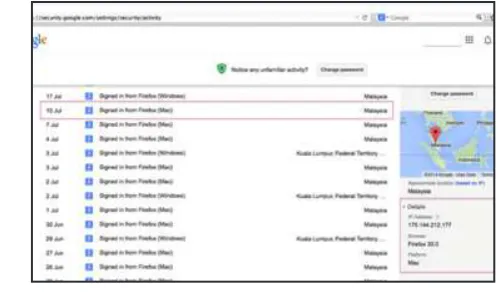
• Check the activity log for
unfamiliar activities and perform WHOIS to IPs used by hacker to find the location. Refer to Graph 4.
• Make a police report and liaise
with the Investigation Officer to get more information of the IP. Unable to
recover password using PRT
Send a letter or email to the relevant service provider such as Google, Yahoo or Microsoft to either request for account termination or recover the account.
Table 4: Email recovery and mitigation process
Graph 4: Gmail’s recent activity log
Best Practices in Password
Creation
Passwords can be cracked using of a word list or dictionary programme. Instead of manually keying in these combinations, hackers use bots to automatically compare lists of words or character combinations against the password until they find a match. Table 5 lists some common passwords used by end-users:
Common Passwords
123456, 234567, 789456258753951, yourname-computer, yourbirthday, yourphone, name1234, Gankster1234, sushi1111, hummerkller, youremail, abc123, password
Table 5: List of common passwords
Users can apply the following best practices to develop a secure, unique password:
• Do not use passwords that are based on
personal information easily accessed or guessed.
• Do not use words that can be found in
any dictionary of any language.
• Develop a mnemonic to remember
complex passwords.
• Use both lowercase and capital letters.
• Use a combination of letters, numbers
and special characters.
• Use passphrases when you can.
• Use different passwords on different
28
Double Protection with 2-factor
Authentication
In 2011, Google introduced the two-factor authentication to provide its users a more protection. The two-factor authentication is used in banks either for credit card usage or ATM machine access. This method requires users to enter a code number to verify the validity of the card before using it.
With this method, users now have another form of identification, usually a code generated by a key fob or a smartphone app. The code must be keyed in at the time of login as it changes after a certain period of time.
How it works on Gmail:
• Sign in to Google using the usual
username and password.
• You are required to key in a code that
will be sent to you via text, voice call or mobile app.
• If you are using a home computer,
you may come across a Google pop-up asking you if you’d like to unable this authentication feature. Even if you do unable, Google will still prompt for codes when you or anyone else tries to sign in from other computers.
Graph 5: Google two-factor authentication (credit: googleblog. blogspot.com)
Though the number of cases is not alarming, email or social network account owners should always be aware of the threats caused by account compromise. Information can be manipulated by irresponsible parties for malicious reasons. Account owners must change their passwords regularly and use only strong, secure passwords. They also must make sure that their machines and applications are regularly patched or updated to keep the computer from malware or viruses.
Reference:
1. http://www.mycert.org.my
2. http://www.sans.org
3. http://www.us-cert.gov/ncas/tips/ST04-002
4. http://googleblog.blogspot.com/2011/02/ advanced-sign-in-security-for-your.html