Volume 20 - (Q3/2009)
Email Header Analysis By Fauzi Mohd Darus [email protected] File Deletion in Linux By Nor Zarina Zainal Abidin [email protected]
Malicious Macromedia Flash File Analysis By Lee Ling Chuan &
Megat Muazzam Abdul Mutalib [email protected] [email protected]
Gmail Forensic (Memory Analysis) – Part 2 By Kamarul Baharin Khalid &
Razana Md Salleh [email protected] [email protected]
Kevin Mitnick
EnCase 101: How EnCase Looks at the Time of the Evidence File
By Lee Hui Jing [email protected]
Towards an Effective and Efficient Public and Private Cooperation within the Critical National Information Infrastructure By Ruzamri Ruwandi
The Curious Case of Service Packs Effects on Vulnerability Scanning for Windows 2003 By Ruhama Bin Mohammed Zain
Contributors
The methods that will most effectively minimize the ability of intruders to compromise information security
are comprehensive user training and education. Enacting policies and procedures simply won’t suffice. Even
with oversight the policies and procedures may not be effective:
my access to Motorola, Nokia, ATT, Sun
depended upon the willingness of people to bypass policies and procedures
that were in place for years
before I compromised them successfully.
MyCERT 3rd Quarter 2009 Summary Report CyberSecurity Malaysia
Business Continutiy Management: From Information Security Management System (ISMS) Perspective
By Ida Rajemee Ramlee [email protected]
Why ICT Product Developers and Consumers should Support the Certified ICT Products By Mohd Amin Mat Isa &
2.
Welcome to the third edition of eSecurity Bulletin for 2009 and a belated Eid-ul Fit al-Mubarak to all our Muslim readers.
In the past quarter, there were quite number of stories on social networking websites being attacked such as Facebook and Twitter, rather than conventional attacks through email. If previously, phishing attacks usually targeted financial websites, now phishers are expanding it, luring Internet users to accidentally expose their sensitive information through social networking sites. This latest development causes real threats to organizations as employees do access social networks at workplace. Thus, it is imperative for organizations to ensure proper measures including social network policy to be in place to avoid sensitive data being leaked out unnecessarily.
It is without a doubt, the weakest part of security lies within the organization itself. Disgruntled employees, terminated employees can be a source of enemy to exploit vulnerabilities within the system that can surprise the organization. Strong security policy with security awareness instilled amongst employees able to alarm possible danger by internal perpetrators.
Therefore, CyberSecurity Malaysia is trying various ways to inculcate security awareness be for organizations as well as for public. On 9 August 2009, His Honourable Tuan Haji Fadillah Yusof has officiated our new CyberSAFE portal. In general, CyberSAFE portal is our new commitment to propagate our cyber security messages with new updated information and outlook pertaining to the cyber security awareness to the public. This portal consists of CyberSAFE Website (www.cybersafe.my) and CyberSAFE Web Zine.
Again, I would like to stress educating people and organizations are fundamental in building a strong pillar to secure our cyberspace.
Finally, I would like to take this opportunity to thank our contributors who have given their time and support to make this bulletin a success. New contributors are always welcomed!
Thank you.
Best Regards
Lt Col (R) Husin Jazri (Retired)CISSP CEO
So, what do we have in this issue; product certification, BCM, email header analysis, memory analysis of gmail forensic and many more technical write-ups, but of course they are those the interesting ones!
Next quarter? Without we realize it, time passed so fast and next quarter will be the last quarter of the year. Please utilize your budget for the trainings offered by CyberSecurity Malaysia and get the best deal before the year ends!
For this last quarter, you will see more training on wireless security and security essentials. Do check our website for more details if you want to attend the training and sit for the CISSP and SSCP.
Our CEO highlighted the social networking abuse. While there are various ways to protect from social media hacker attacks, but still education and awareness remains the essential factor to curb it. Thus, please convey the significance of not disclosing personal details in the cyber world to your colleagues, friends and family. It is not only happening to adults, but our kids are at risk too. For all parents, please ensure you know what your kids are doing on the net.
I would like to thank our contributors for this publication and hope for security professionals and practitioners out there to share their experiences and know-how with us.
Do email us if you wish to contribute.
Happy reading!
Best Regards
Maslina binti Daud Editor
E-Security News Highlights for Q3, 2009 MyCERT 3rd Quarter 2009 Summary Report
Business Continuity Management: From Information Security Management System (ISMS) Perspective EnCase 101: How EnCase Looks at the Time of the Evidence File? [Part 1]
Why ICT Product Developers and Consumers Should Support the Certified ICT Products
Towards an Effective and Efficient Public and Private Cooperation Within The Critical National Information Infrastructure
PUBLISHED BY
PRODUCED BY
PRINTED BY
CyberSecurity Malaysia (726630-U)
Block A, Level 8, Mines Waterfront Business Park No 3, Jalan Tasik, The Mines Resort City 43300 Seri Kembangan
Selangor Darul Ehsan
Equal Media (1590095-D)
Block D-10-3, Plaza Kelana Jaya Jalan SS7/13A, 47301 Petaling Jaya Selangor Darul Ehsan, Malaysia Tel / Fax : +603 2274 0753
Percetakan Tujuh Lapan Enam Sdn Bhd (564108-K)
No18, Lengkungan Brunei
The Curious Case of Service Packs Effects on Vulnerability Scanning for Windows 2003
Email Header Analysis File Deletion in Linux
3.
e-Security News Highlights for Q3, 2009
Survey: Half of businesses don’t secure personal data (September 24, 2009)
“Around 55 percent of all businesses acknowledge that they secure credit card information but not Social Security numbers, bank account details, and other personal data, according to a survey of more than 500 companies released Wednesday by Imperva and Ponemon Institute..”
http://news.cnet.com/8301-1009_3-10360639-83.html
Three of Four Charges Dismissed In Terry Childs Case (August 24, 2009)
“Terry Childs, the San Francisco network administrator who kept some rather important passwords to himself last summer, is now facing a considerably shorter list of accusations. A judge has dismissed three of the four charges that were brought against him..”
http://www.securitypronews.com/news/securitynews/spn-45-200 90824ThreeOfFourChargesDismissedInTerryChildsCase.html
Cyber virus targets online banking log-ins (September 21, 2009)
“CYBER criminals have created a highly sophisticated Trojan virus that steals online banking log-in details from infected computers. The Clampi virus, which is spreading rapidly across hundreds of thousands of computers in Britain and the United States, infects computers when users visit websites that host a malicious code..”
http://www.theaustralian.news.com.au/business/ story/0,28124,26102544-5017997,00.html
Woman falls victim to identity thief (September 9, 2009)
“PETALING JAYA: Swashna (not her real name) wondered why strangers kept sending requests to add her as a friend on their profile at a popular social networking site. The 25-year-old company executive is normally careful about who she adds to her own profile, so she was surprised to find total strangers claiming to know her…”
http://star-techcentral.com/tech/story.asp?file=/2009/9/9/techn ology/20090909100203&sec=technology
Cyber-thief Sold Stolen Domain to NBA Player, Police Charge (August 4, 2009)
“A 25-year-old man is charged with stealing a company’s domain name and selling it to NBA player Mark Madsen for $111,000. New Jersey State Police say they believe the arrest marks the first time the state has charged someone with stealing a domain name…”
http://www.eweek.com/c/a/Security/CyberThief-Sold-Stolen-Domain-to-NBA-Player-Police-Charge-411195/
10 Ways to Protect Your Company from Social Media Hacker Attacks (September 24, 2009)
“News Analysis :Social networks can be scary places that cause many companies to debate whether to continue supporting social network access for employees at the office. But keeping a company safe from potential security issues isn’t as hard as it might appear. Here are 10 ways to make social network access safer..”
http://www.eweek.com/c/a/Security/10-Ways-to-Protect-Your-Company-from-Social-Media-Hacker-Attacks-595134/
Cyber criminals may target Olympics (July 8, 2009)
“International organised criminal networks are already preparing to target the London 2012 Olympics, one senior police officer has warned. Scotland Yard Deputy Assistant Commissioner Janet Williams said officers are probing a series of front companies that could be used in complex frauds..”
http://www.channel4.com/news/articles/science_technology/cybe r+criminals+may+target+olympics/3255757
Teenagers blamed for 40% of game crimes in Korea (September 26, 2009)
“About 40 percent of online game-related crimes were committed by teenagers last year, according to a report by the National Police Agency.A total of 76,141 game-related crimes occurred in 2006-2008 and 61,886 or 81.3 percent of the offenders were apprehended, showed the report unveiled by a ruling party lawmaker…”
http://www.asiaone.com/News/AsiaOne+News/Crime/Story/ A1Story20090926-170070.html
Researchers: Attacks on US, Korea sites came from UK (July 15, 2009)
New York Times website hit by malicious adverts for scareware (September 14, 2009)
“The website for the New York Times was hit by malicious adverts over the weekend. A note was posted to the home page on Sunday that warned of a pop-up message warning users that their computer had been infected, and urging them to install fake anti-virus software..”
http://www.scmagazineuk.com/New-York-Times-website-hit-by-malicious-adverts-for-scareware/article/148862/
Time for social networks to take security seriously (July 22, 2009)
“Last week, a hacker who gained access to a Twitter employee’s personal email account was able to infiltrate the company’s Google Apps account to steal confidential documents, which were then published by some websites..”
http://www.mxlogic.com/securitynews/web-security/time-for-social-networks-to-take-security-seriously694.cfm
Twitter warns of direct-messaging worm (September 24, 2009)
“Social-networking service Twitter warned users on Wednesday that a link sent by direct message redirects users to a malicious site that attempts to steal their account credentials…”
MyCERT 3
rd
Quarter 2009 Summary
Report
Introduction
Incidents Trends Q3 2009
This quarterly summary provides an overview of activities related to Cyber999 (computer security incident handling service) and trends observed from the research network. The summary provides users with high-level statistics of incidents handled by MyCERT in quarter three (Q3) of 2009, security advisories published, and events participated by MyCERT staff. Do take note that the statistics provided reflect only the total number of incidents handled by MyCERT. They do not represent nor reflect the financial value and impact of the incidents to the victims. Computer security incidents handled by MyCERT are those that occur or originate within the Malaysian domain or IP space. MyCERT works closely with other local and international organizations to resolve computer security incidents.
In Q3 2009, system intrusion and fraud recorded high number of incidents representing 50% and 29% of total incidents handled respectively. System intrusion incidents are generally attributed to web defacement. MyCERT observed that the main cause of defacements were due to unpatched and misconfigured web applications. There was a slight surge of web defacements in July and August due to political events where attackers target shared hosting servers in carrying out mass defacements.
From July to September 2009, MyCERT, via its Cyber999 service, handled a total of 1087 incidents. These incidents were referred to MyCERT by members in it’s constituency and security teams from abroad, in addition to MyCERT’s proactive monitoring efforts.
The following graph shows the total incidents handled by MyCERT in Q3 2009.
Incident Breakdown by Classification in Q3 2009
Fraud related incidents handled by MYCERT comprise of mostly phishing sites of local and foreign brands. In Q3 2009, MyCERT handled 165 phishing related incidents involving 125 unique phishing sites that target various brands. The majority of phishing sites were targeting local financial institutions. MyCERT handled both the source of the phishing emails as well as the removal of the phishing sites by communicating with the affected Internet Service Providers (ISPs). There were instances where MYCERT was able to recover the drop email accounts used by attackers and the database containing users credentials. Details of those information are normally escalated to responsible parties for their further action.
MyCERT has also observed that a targeted phishing attack is normally coupled with ‘money mule’ recruitment emails. Basically once users credentials has been obtained via the phishing sites, the criminals will need somebody who has an account at the same bank to assist them in transferringthe money out. The following is an example of money mule recruitment email. Take note of the requirement of “Only Maybank Account (Malaysia) ”
Hello,
Would you like to work from home and get paid every day?
HOW MUCH WILL YOU EARN?
At the beginning your fee will be 10% per each operation, though in future it will increase up to 18%!
MAIN REQUIREMENTS
#18 years or older #Legally capable #Responsible
#Ready to work 3-10 hours a week #E-mail and internet experience #Only MayBank Account ( MALAYSIA )
5.
Unique Foreign Brands Phishing Websites July to Sept 2009
Web Defacement By Domain Q3 2009
Percentage of Defacer Origin For Q3 2009
Percentage of Incident Q3 2009
Unique Local Brands Phishing Websites July to Sept 2009
The following graph gives an overview of phishing incidents handled by MyCERT in Q3 2009.
The following graph shows the breakdown of domains defaced in Q3 2009. Out of the 490 websites defaced in Q3 2009, 61% of them are those with com and com.my extensions. Defacers generally target web applications that are prone to SQL injection or sites that are not secured or patched with latest updates.
In Q3 2009, MyCERT has observed that the majority of defacers originate from Indonesia, representing 64% as shown in the below graph. The activities of defacers from this origin, mainly involves mass defacements of websites hosted on single virtual hosting server.
In Q3 2009, MyCERT had issued a total of 25 advisories and alerts for its constituency. Most of the advisories in Q3 are related to popular end user applications such as Adobe PDFReader, Adobe Flash, Microsoft Office Power Point, Mozilla Firefox and Microsoft Internet Explorer. Attacker often compromise end users computersby exploiting vulnerabilities in users’ application. Attacker uses various social engineering techniques to trick users to open a specially crafted file (i.e. a pdf document) or web page.
Readers can visit the following URL on advisories and alerts released by MyCERT in 2009.
http://www.mycert.org.my/en/services/advisories/ mycert/2009/main/index.html
Apart from the Cyber999 service, MyCERT also observed activities on its research network and conduct analysis on internet threats and trends. The overall objectives of this initiative are as follow: old and well known attack techniques.
• To compile and analyze sufficient relevant information
of which the results can be used to alert the community at large to the possibility of imminent cyber attacks on local networks.
Malware, a portmanteau from the words malicious and software, is software designed to infiltrate or damage a computer system without the owner’s informed consent. The expression is a general term used by computer professionals to mean a variety of forms of hostile, intrusive, or annoying software or program code. The term “computer virus” is sometimes used as a catch-all phrase to include all types of malware, including true viruses.
Software is considered malware based on the perceived intent of the creator rather than any particular features. Malware includes computer viruses, worms, trojan horses, most rootkits, spyware, dishonest adware, crimeware and other malicious and unwanted software. Malware is not the same as defective software, that is, software which has a legitimate purpose but contains harmful bugs.
MyCERT have seen that most vulnerabilities being exploited in Windows systems were through automatic methods, without direct involvement of the attacker. The known vulnerabilities are automatically being exploited by malware which updated with recent or famous exploit code.
Beside of exploiting common vulnerabilities, MyCERT has observed that cyber criminals also take advantage on some popular events such as H1N1 and the passing of Michael Jackson, the ‘King of Pop’. MyCERT spotted and learned a few malicious spam links, videos and emails about Michael Jackson’s death and H1N1. The modus operandi for this attack relies so much on social engineering technique. Out of total 16275 binaries collected in Q3 2009, 727 are unique (based on MD5 hash).
In the following plot, one can see the the global distribution of binaries downloaded by Nepenthes sensors in the third quarter of 2009.
Advisories and Alerts
CyberSecurity Malaysia Research Network
7.
Different antivirus products might reflect different name for one particular malware. As grouped by MD5 hash, here are the top 10 malwares collected in Q3 2009:Top 10 Binary Hash
Based on MD5 hash, among the top malware collected in Q3 2009:
• 524bc0f75c12683f73ce0ceed70faab8 • 7dc73bfa4d78284155dd5101991eeb34 Analysis from Threat Expert
From the above, two MD5 hashes, and some other samples, one could observe and might conclude that most malware that MyCERT has collected in Q3 2009 share the following summaries:
• Family of network-aware worm. Uses known exploit(s) in
order to replicate across vulnerable networks.
• Exploit MS04-012 vulnerability: DCOM RPC Overflow
exploit - replication across TCP 135/139/445/593.
• Exploit MS04-011 vulnerability: LSASS Overflow exploit
- replication across TCP 445.
• Communicate through a remote IRC server.
• Contains characteristics of an identified security risk.
MyCERT staff had been invited to conduct talks and training in various locations in Q3 2009.The following is a brief list of talks and trainings conducted by MyCERT in Q3 2009:
• September 2009 – Talk on Global Threats Updates at
F-Secure Lab.
• August2009 –Incident Response Training for Egypt CERT
in Cairo, Egypt.
• August 2009 – Cyberspace Security; Current Trends and
Threats, Client Side Security; MingguInovasi, Sarawak.
• August 2009 – Presentation on Hacking Anatomy at
• July 2009 – Presentation on Hacking Anatomy at CGSO
Internet Security Awareness.
• July 2009 – Hacking Demo at ILKAP DPP Prosecution
Course.
In Q3 2009, neither crisis nor outbreak was observed. Nevertheless, users and organizations are advised to always take measures to protect their systems and networks from threats. MyCERT encourages Malaysian Internet users to be constantly vigilant of the latest computer security threats.
MyCERT can be reached for assistance at:
Malaysia Computer Emergency Response Team (MyCERT)
E-mail: [email protected]
Cyber999 Hotline: 1 300 88 2999 (Office Hours) Phone: (603) 8992 6969 (Office Hours)
Fax: (603) 8945 3442 Phone: 019-266 5850 (24x7) SMS: 019-281 3801
http://www.mycert.org.my/
Please refer to MyCERT’s website for latest updates of this Quarterly Summary.
Other Activities
Business Continuity Management:
From Information Security Management
System (ISMS) Perspective
Background
Information security (IS) in its broader definition as described by the ISO/IEC 27001:2005 is, “The protection of information from a wide range of threats in order to ensure business continuity, minimize risk and maximize return on investments and business opportunities”. To ensure this, a suitable set of controls, policies, organizational structures, procedures and other related functions must be implemented along with other business management processes.
ISO 27001 is an information security management standard developed to help organizations establish, implement, operate and monitor an Information Security Management System (ISMS). In other words, ISO 27001 is also an ISMS development methodology which explains how to develop ISMS. However, this standard alone does not elaborate on the elements that construct ISMS, which is where ISO 27002 comes in.
The ISO 27002, previously known as ISO/IEC 17799:2005, lists the generally accepted information security management practices that make up ISMS. There are 15 controls covered and Business Continuity Management (BCM) is one of the main ones. Although, BCM is often considered to be a subject by its own, in terms of standards BCM is an integral part of it. Being an essential part of IS, this is obviously stated in section 14 of ISO 27002 where BCM is clearly emphasized. ISO 27002 includes useful advice and guidance on how to include IS controls within the business continuity process. As for organizations undergoing the ISMS certification, having to comply to ISMS requirements is an indirect requisition to have BCM in place all at the same time.
As stated in the ISO/IEC 27002:2005(E) Information Tech
- Security techniques – Code of Practice for Information
Security Management , the information security aspects of BCM is to counteract interruptions to business activities, protect critical business process from the effects of major failures of information systems or disasters and ensure their timely resumption. To ensure this, organizations should implement business continuity (BC) process to reduce the impact as well as to recover from loss of information assets at an acceptable level.
Overall there are 5 subsections within the BCM area. Subsection 14.1.1 stated that IS should be included in the BCM process. The control that should be implemented for this subsection is to develop and maintain a managed
process for BC to address organizations’ IS requirements. Similarly, this is to establish a business continuity process for information. In doing so, the implementation guidance that can be followed stated the process to have these BCM key elements ; understanding the risks in terms of likelihood and the impact caused by IS incidents and establishing the business objectives of information processing facilities; identifying all the assets in critical business processes; possibility to purchase suitable insurance as part of the overall BC process or part of operational risk management; identifying and considering the implementation of additional preventive and mitigating controls; identifying sufficient financial, organisation, technical and environmental resources to address the identified IS requirements; ensuring personnel safety and protection of information processing facilities and property; formulating and documenting BC Plans for IS requirements to be in line with the agreed business strategy; regular testing and updating of the plans and processes; and ensuring the management of BC is included in the organizations’ overall processes and structure.
9.
From Information Security Management
risk assessment comes into place. The control that should be implemented for this subsection is to identify events causing interruptions to business process along with the impact and probability of such interruptions and their consequences for IS. The implementation guidance for this are stated herein; IS aspects of BC should be based on events that may cause disruptions to the organization business processes; risk assessment to be carried out to determine probability and impact of interruptions to all business processes and include results specific to IS; Based on the result business continuity strategy is to be developed and endorsed by management and subsequently
plan created and again endorsed by management prior to implementation. IS aspects of BCM in Section 14.1.3 is to develop and implement continuity plans. For this subsection the control that should be in place is to develop and implement plans to restore operations and ensure availability of information at required level within required time after an interruption or failure of critical processes. The implementation guidance highlighted that the BC planning process should consider the following ; identification and agreement of all responsibilities and BC procedures; identification of the acceptable loss of information and services; implementation of the procedures to allow recovery and restoration of business operations and availability of information in required time-scales; operational procedures to follow pending completion of recovery and restoration; documentation of agreed procedures and processes; staff education in agreed procedures and processes including crisis management; testing and updating of the plans.
Section 14.1.4 is mainly on establishing a BC planning framework. The control emphasizes on maintaining a single framework of BC plans to ensure consistency in all plans, to attend to IS requirements and to identify priorities for
testing and maintenance. In general the implementation guidance stated on the approach for each BC plans to ensure information system availability, security, specification of the escalation plan and conditions for activation. Responsibilities to execute plans shall also be considered. All the plans shall be included within the organization change management programme and amended accordingly to cater for changes. Specific owner shall own the BC plans and be responsible for their respective plans.
References
1. ISO/IEC 27002:2005(E) Information Tech – Security techniques – Code of Practice for Information Security
Management
2. An Introduction To Information, Network and Internet Security - Aspects of BCM http://secutity.practitioner. com/introduction/infosec_7_13_3.htm
3. The Business value of ISO270K- A case Study by Gary Hinson, CEO of IsecT.Ltd.http://iso27001security. com/ISO27k_the_business_value_of_ISO27k_case_ study.pdf
4. ISO 27000 NEWSLETTER – ISSUE 14 & 19
Audit & Implementation
In the context of BCM implementation, while undergoing the ISO 27001 certification process, among the first items the auditors will look at the existence of a BC plan. In retrospect, during the BCM business impact analysis phase where critical business functions are identified, it is crucial to integrate the organizations’ operations, staffing, materials , transport and facilities with the IS requirements as well as other continuity requirements . In BIA exercise, the impact for consequences of disasters, loss of service and availability and security failures are also considered. The auditors will check on the consistency of the reports created and are updated accordingly.
The same goes for the risk assessment stage, where BCM practitioners’ should also include controls to identify and reduce the risks. This is to ensure that information required for business processes is readily available. Above all, the main thing that is vital to the auditors is consistency in the plans across the organization and the plans fit into a single high level framework as stated in clause 14.1.4. As for clause 14.1.5, the existing continuity plans need to be tested thoroughly to ensure the plans are working as expected and results of the test can be used to enhance the continuity plans. Isolated components testing can be done in the earlier phase but must be followed by an overall full test simulation that links all the components and ensuring interdependencies are also addressed and tested.
On a different note, although the implementation guidance is referred and followed, the basic thing that needs to be looked at is ensuring all the BCM related documents are reviewed, approved and recorded accordingly following the ISMS procedures and policies by the appropriate management level. It is also important to ensure consistent usage of terms and reference throughout all the related documents.
11.
EnCase 101:
How EnCase Looks at the
Time of the Evidence File? [Part 1]
Abstract
Experiment
Background
Some may wonder the reason we need to find out the suspect’s computer time zone setting before we start an analysis. Unlike in the US that observes various time zone setting because of the geographical area and size, Malaysia has only one time zone setting. Nevertheless, there is always a possibility that the suspect’s computer’s time zone setting may be changed accidentally or purposely. Apart from that, do you know that even the examiner’s machines can sometimes change the time zone of an evidence file? Time zone is important because it changes the Modified, Access, Create (MAC) of the evidence file. We know that Operating System, logs most of the user’s activities that includes the time when the activities are carried out. It is of great importance that the time of the evidence file is identified, as the suspect may claim he or she is innocent. In this article, what I would like to highlight how examiner’s machines can affect the time zone of an evidence file.
In order to solve the mystery, an experiment was carried out, which uses the concept of daylight saving time. The basic idea behind DST is to gain more light out of the day by advancing clocks by one hour during the summer. During DST, the sun appears to rise one hour later in the morning.
The only thing that can trigger that kind of setting is time zone setting. For experiment purposes, three machines containing three different time zone settings and the same version of the EnCase Forensic Software were set up. Each was labeled as:
•
Machine A: (GMT + 07:00) Bangkok, Hanoi, Jakarta•
Machine B: (GMT +8:00)Kuala Lumpur, Singapore•
Machine C: (GMT +8:00) Beijing, Chongqing, Hong Kong, UrumqiTarget Evidence: An image hard disk containing a windows based OS with a target evidence file named i_background[2]. html created under time zone GMT+8:00 Kuala Lumpur on 13 February 09 06:45:45PM
This research started based on the report generated from EnCase Forensic Software having an hour difference on the same evidence file, which triggered, the experiment on the software. The case started when a suspect posted a seditious or defamatory comment on a blog and a report was lodged to the police. The police investigated and through the IP address, they managed to locate the suspect, seized his computer and handed it over to me for analysis. The time and date posted on the comment was recorded at 13 February 09 06:45:45PM.
The objective of the case was simple: To find any trace of evidence in the suspect’s computer that matched the comment posted on the blog and at the same time matched the given time and date of the incident. During a keyword search, a html file (i_background[2].html ) that contained some part of the comment was found. However, the time did not match. It registered an hour earlier than the actual incident time. The BIOS time of the suspect machine was studied and found to have an offset of a few seconds compared to the current time. How do we justify an evidence file that content matches the original post but the MAC time was all offset by an hour? The mystery remained unsolved until two days later when the client called to request for some other evidence from the suspect’s hard disk. Another report was re-extracted from the software
In machine A, a write blocker was attached to prevent data from being written to the original evidence and ran EnCase Forensic Software. The following information was taken from the evidence:
Then machine A was replaced with machine B and all the steps were repeated. The following result was obtained:
And then with machine C:
SECTION i_background[2].html
File Type html
Full Path C:\Documents and Settings\user\Local Settings\Temporary Internet Files\Content. IE5\7MWYJWPL\i_background[2].html
File Created 02/13/09 05:45:45PM
Last Written 02/13/09 05:45:51PM
Last Accessed 02/13/09 05:46:40PM
Entry Modified 02/13/09 05:45:51PM
SECTION i_background[2].html
File Type html
Full Path C:\Documents and Settings\user\Local Settings\Temporary Internet Files\Content. IE5\7MWYJWPL\i_background[2].html
File Created 02/13/09 06:45:45PM
Last Written 02/13/09 06:45:51PM
Last Accessed 02/13/09 06:46:40PM Entry Modified 02/13/09 06:45:51PM
SECTION i_background[2].html
File Type html
Full Path C:\Documents and Settings\user\Local Settings\Temporary Internet Files\Content. IE5\7MWYJWPL\i_background[2].html
File Created 02/13/09 06:45:45PM
Last Written 02/13/09 06:45:51PM
Last Accessed 02/13/09 06:46:40PM
13.
Based on the experiment, we concluded that EnCase Forensic Software shows the time of the evidence based on the examiner’s machine time zone setting. Therefore, it is important before starting the investigation to know the time zone setting of the evidence examined before starting the analysis.
EnCase ®Computer Forensic II-v6.10pvi(03.16.2009) Copyright ©2009, Guidance Software,Inc. Of all the three machines, only machine A showed difference in results.
Conclusion
Reference
Original Sample Setting (GMT+8:00)
Kuala Lumpur, Singapore
A
(GMT +07:00) Bangkok, Hanoi, Jakarta
B
(GMT+8:00) Kuala Lumpur, Singapore
C
(GMT +8:00) Beijing, Chongqing, Hong Kong, Urumqi
Create 02/13/09 06:45:45PM 02/13/09 05:45:45PM 02/13/09 06:45:45PM 02/13/09 06:45:45PM
Accessed 02/13/09 06:46:40PM 02/13/09 05:46:40PM 02/13/09 06:46:40PM 02/13/09 06:46:40PM Modified 02/13/09 06:45:51PM 02/13/09 05:45:51PM 02/13/09 06:45:51PM 02/13/09 06:45:51PM
Why ICT Product Developers and
immuned from being announced in the next “The Breach of Information Security” headline. There is no assurance in the security protection that is blending within the ICT product. Indeed, without this assurance, there would be serious economic risks for information processing systems which are vitally essential in the day to day life such as payment cards for the banking activities, SIM card in the world of mobile telecommunications, health card, and protection of the networks. As of July 2009, according to the incidents reported to Malaysian Computer Emergency Report Team (MyCERT), there was 1971 number of cases reported based on the general incident classification like denial of service, fraud and forgery, vulnerability probing, malicious code, system intrusion, etc. From such scenario, it shows that no one can escape from these ‘virtual’ deceases.On the other hand, many ICT consumers lack of knowledge, expertise, or resources necessary to judge whether their confidence in the security of the IT products or systems is appropriate, and they might not wish to rely solely on the assertions of the developers. Therefore, consumers might choose to increase their confidence in the security measures of an ICT product or system by acquiring an analysis of its security. So how does one prevent data security breaches?
Reflecting from this situation, the government has made a wise and efficient step by commencing the Malaysian Common Criteria Evaluation and Certification (MyCC) Scheme as a way to enhance the National cyber security. Certified products provide grounds for confidence that they: will meet consumer security needs; function as specified; have adequate guidance; can be operated securely; have been built correctly; have been delivered as requested; has been thoroughly tested; and have reduced the potential for exploitable vulnerabilities in their implementation. However, it does not mean that the evaluated and certified product is totally free from exploitable vulnerabilities. There remains a residual level of risk that exploitable vulnerabilities remain undiscovered in the TOE’s claimed security functionality. This residual risk is reduced as the certified level of assurance increases for the ICT products and systems.
•
Malaysian Common Criteria Evaluation and Certification (MyCC) SchemeThe Malaysian Common Criteria Evaluation and Certification (MyCC) Scheme is a systematic process for evaluating and certifying the security functionality of ICT products and systems against ISO/IEC 15408 standard which is known as Common Criteria (CC). The usage of the recognise ISO standard ensures that MyCC Scheme certified products which can be found in MyCC Scheme Certified Products Register (MyCPR) at
15.
Security evaluation of ICT products and systems isconducted by the licensed and accredited evaluation facilities which are known as Malaysian Security Evaluation Facilities (MySEFs). MySEF can be a commercial or government entity that is independent from the product developers. MySEF shall be operated in an independently accredited environment based on MS ISO/IEC 17025 and within the MyCC Scheme rules. The
main role of MySEF is to conduct a specific and a well- mannered plan of the security evaluation on Target of Evaluation (TOE) which is the ICT product or a consumers’ specification which is call Protection Profile (PP).
In addition, MySEF may also provide consultancy services on how CC standard is to be applied in the development environment and how consumers’ requirements can be communicated to developers. This will ensure that all development documentation, and the evaluation scope are determined based on CC requirements. The evaluation process is completely independent and conforms to a methodology which is known as Common Evaluation Methodology (CEM) or ISO/IEC 18045. During the evaluation process, the evaluator team works on the product, and documentation to find whether it is
internally consistent, properly functioned and performed like what has been claimed by the developer. The results of the evaluation are recorded in the Evaluation Technical Report (ETR) and will be submitted to the MyCC Scheme Certification Body or what we call Malaysian Common Criteria Certification Body (MyCB) for the certification process before the evaluation process closed.
MyCB is an impartial body within the MyCC Scheme that is responsible for carrying out certification and for overseeing the day-to-day operation of MyCC Scheme. The certification process includes the acceptance of the products to be evaluated and certified under the MyCC Scheme, oversee the evaluation process, and certifying the evaluation results.
Benefits to the Consumers
The Common Criteria provides a mechanism for ICT consumers to express their security needs to developers for a type of ICT products such as firewall, operating system and others in an unambiguous manner. This is what we call a Protection Profile (PP). A PP develops by a consumer defines a minimum set of security functionality that must be implemented in a type of product. The PP needs to be evaluated and certified to ensure that it is complete, consistent, and technically sound and suitable for use as a template on which to build another PP or a type of an ICT product.
Benefits to the Developers
The main goal of an independent security evaluation to the developers is to validate the security claims of their ICT products or systems. CC allows the security evaluation of an ICT product or system to obtain a level of confidence that the security functionalities claim by the developer. The developers could fulfil their customers’ needs by producing the ICT product or system based on the PP. First, they need to develop a document that includes the security needs for a specific identified product or system. This document is called Security Target (ST). The Security Target contains a summary specification, which defines the specific measures taken in the product or system to meet the security requirements. Security Targets is actually designed to answers questions such that revolves around the developer capability to produce such product, the way product is tested and its evaluation processes. Furthermore, by constructing the ST, the developer has a guideline to produce a secure ICT product or system that meets the consumers’ needs.
The developers will also use the CC to determine the scale for measuring assurance level for their ICT product or system which is called the Evaluation Assurance Levels (EALs). EALs consist of an appropriate combination of the assurance components as describe in Part 3 of the CC. Basically, there are seven hierarchically ordered EALs defined in the CC, where higher EAL represents more assurance than the lower EALs. The complexity of evaluation process increased based on the EAL, evaluation scope and complexity of the product or system. Most of the developers have chosen to contribute until EAL4+ evaluation because there is no
standard and recognize methodology for EAL5 and above. Independent security evaluation and certification will help the developer to gain access to new markets and make their product different from other similar type of products. Moreover, the ICT products or systems produced are more robust because the security flaws discovered during the evaluation are rectified.
Conclusion
17.
References
1. Part 1: Introduction and General Model, Common Criteria for Information Technology Security Evaluation, version 3.1 Revision 3, July 2009, http://www.commoncriteriaportal.org/files/ccfiles/CCPART1V3.1R3.pdf
2. MyCC Scheme Policy (MyCC_P1), version 1, May 8, 2009, http://www.cybersecurity.my/mycc/document/MyCCP1.pdf
3. Reported Incidents based on General Incidents Classification Statistic 2009, MyCERT Statistic July 2009, http://www. mycert.org.my/en/services/statistic/mycert/2009/main/detail/625/index.html
4. Motoshi Saeki, Haruhiko Kaiya “Using Common Criteria as Reusable Knowledge in Security Requirements Elicitation”, 2008, http://ftp.informatik.rwth-aachen.de/Publications/CEUR-WS/Vol-413/paper09.pdf
5. Ariffuddin Aizuddin “The Common Criteria ISO/IEC 15408 The Insights, Thoughts, Questions, and Issues”, http://www. cybersecurity.my/data/content_files/13/68.pdf?.diff=1176418091
6. Common Criteria and Protection Profile: How to Evaluate Information, 2003, http://www.sans.org/reading_room/ whitepapers/standards/common_criteria_and_protection_profiles_how_to_evaluate_information_1078
7. Thuy D. Nguyen, Timothy E. Levin, and Cynthia E. Irvine, “High Robustness Requirements in a Common Criteria Protection Profile”, http://cisr.nps.edu/downloads/06paper_highrobust.pdf
8. Ross Anderson, “Why Information Security is Hard - An Economic Perspective”, 2001, http://www.acsac.org/2001papers/110. pdf
9. Richard E. Smith, “Trends in Government Endorsed Security Product Evaluations”, October 2000, http://www.cryptosmith. com/docs/evaltrends.pdf
Towards an Effective and Efficient
Public and Private Cooperation Within
The Critical National Information
Infrastructure
Introduction
The National Cyber Security Policy (NCSP), a policy endorsed by the government to protect the Critical National Information Infrastructures (CNII), defines the country’s CNII as real or virtual assets. These systems and functions are vital to the nation that their incapacity or destruction would have a devastating impact on the national economic strength, image, defense and security, government capabilities to function, and the public health and safety. The NCSP has identified ten critical sectors as the CNII, namely National Defense & Security, Banking & Finance, Information & Communication, Energy, Transportation, Water, Health Services, Government, Emergency Services, and Food and Agriculture.
The complexity and interdependency of the CNII is becoming more visible and unavoidable. It is observed that Malaysia’s critical information infrastructures are mainly operated by private stakeholders due to Malaysia’s privatization policy. As a result, the situation requires an effective Public Private Cooperation (PPC) among the CNII operators and the government to ensure that the CNII are adequately protected.
There are a number of issues with regards to the cooperation between the private and the public sector. These issues include the unwillingness of agencies and organizations to share sensitive information such as information on cyber security incidents and system vulnerabilities. This is due to the perception and belief that by exposing such information, it will have negative impacts on their organizations. Another relevant factor that can be considered as a restrictive factor in nurturing the cooperation between both sectors is the different level of understanding on information security itself.
To overcome these issues, five models of the PPC have been proposed by the NCSP as shown in the diagram below.
The formal PPCs are the Regulatory PPC Model, the Outsourced PPC Model, and also the Research & Development (R&D) Cluster PPC Model. While the Information Security Assistance PPC, and the Common Interest Group PPC Models are the informal PPCs. These PPC models are expected to foster the joint cooperation efforts in protecting the CNII, at the same time building trust in sharing information and resources between the public and the private sectors.
The Regulatory PPC Model
19.
The Information Security Assistance PPC Model
Reference The Outsourced PPC Model
The R&D Cluster PPC
This model is driven by the Not for Profit (NFP) organisations, where the Information Security Assistance PPC Model is mainly supported by the government. The services are widely open to the public, private and also the community. CyberSecurity Malaysia is the best example of this type of PPC Model. With ‘Securing Our Cyberspace’ as its tagline, the organisation has a number of services to offer. These services are open to be employed by the community.
Ministry of Science, Technology and Innovation (2006). A Study on the Development of the National Information Security Policy
This model proposes that government agencies to outsource certain services to the private sector service providers. These include consultancy services, security audits, or technical support both in hardware or software. These service providers are paid for the services rendered and there should be some guidelines in order to ensure the protection of secrecy and privacy.
This model refers to the cooperation between research institutions, universities and the public and private sectors. By utilising funding from various sources, it promotes collaborative research in information security. Some incentives from the government could foster an R&D culture among researchers. An example is MIMOS Bhd, the R&D organisation that functions as an advisor to the Malaysian Government on technologies, policies and strategies relating to technology development, is a good example of this model with the aim to nurture research and development in information security.
The Common Interest Group PPC Model
Infosec.my, a knowledge sharing session organised by CyberSecurity Malaysia, is a good example to illustrate this model, where parties (from the public and private sectors) or a community with a common interest gather in meet to discuss and share their knowledge and experience pertaining to information security matters. Another example is the SIRIM national technical committee on information security standards (TC5), which monitors and participates in the international (ISO) information security standards, setting process and recommends adoption or adaptation of such standards for Malaysia. Members of these committees, such as TC5, comprise of representatives from the public and private sectors, promoting a high level of consultative process in reviewing standards and guidelines.
These foregoing PPC Models were designed with the aim to foster joint cooperation efforts in protecting the CNIIs and building trust in sharing information and resources between
the public and private sectors. Since the majority of the nation’s critical infrastructure is operated and owned by the private sector, the public-private cooperation has been identified as one of the key initiatives in protecting the CNII. However, this can only be successfully accomplished and achieved if the government, which has the responsibility of protecting the national critical infrastructure, can offer a trusted, well-organized, efficient and reliable networking platform to the private sector, covering all relevant aspects from battling misdemeanors and early warnings, to standards development, knowledge sharing, technical expertise and support.
The Curious Case
of Service Packs
Effects on Vulnerability Scanning for
Windows 2003
Background What we tested
Objective
The Scenario
Despite the availability of newer Windows operating system, a lot of corporate environment is still running Windows 2003, serving web pages, hosting databases, running web applications and email services, not to mention DNS and other network infrastructure services. Although, it is not the latest Microsoft Windows server operating system, the number of corporations that still runs it and has not upgraded to Windows 2008, makes this version of Windows a very relevant target for vulnerability assessment study.
First, we used Nessus vulnerability scanner with the free home-feed type plugins and updated just prior to running the scan. All plugins were selected including the unsafe checks. The aim was to throw everything at the Windows 2003 target without worrying about bringing the machine down. Both Microsoft patches check scan and the default complete scan were used.
Subsequently, Service Pack 1 was applied to the target and Nessus vulnerability scanner was once again run against it.
Next, the same test was repeated after Service Pack 2 was applied to the target.
We entered the administrator password into Nessus vulnerability scanner configuration to enable local checks to be performed and each scan was run twice to enhance confidence and ensure repeatable results.
When we were done with the free home-feed plugins the whole scan was repeated again using the Professional
feed.
First, we set up a virtual machine running Windows 2003 SP0 with no installed applications as the target. A second virtual machine with BackTrack 3.0 and Nessus 3.2 installed serves as the penetration tester’s machine. BackTrack is a Linux distro with a collection of security assessment tools pre-installed. Unfortunately, Nessus did not come as a standard install.
When everything is ready we ran Nessus vulnerability scanner against the Windows 2003 virtual machine and the results were analyzed for high risk or critical vulnerabilities. We set out to find the vulnerabilities that are present on a newly installed Windows 2003 with no service packs, no extra applications installed, and no firewall running on the machine, which will be our baseline or reference installation in the future.
Our objective is to find out any decrease (or increase) in the number of detected vulnerabilities after applying Service Pack 1 and Service Pack 2 on the target Windows 2003 machine.
21.
The Result
Conclusion
Reference
The results came back with some expected findings and a few unexpected ones too. The table below contains our findings.
The scan results are consistent for high and medium vulnerabilities across all scan types (Microsoft patches and default scans) and across plugin feed types (home-feed and professional feed). The results also show, there was no direct relation between the scan results and the types of vulnerability scanner applied.
The effect of applying service packs on the number of high and medium vulnerabilities is not very noticeable going from SP0 to SP1. In fact, from our observation, the number of high vulnerabilities increases by two and medium vulnerabilities increases by 1 if you upgrade to SP1 from SP0. The scenario illustrates that not only will you not improve your security by applying SP1, you will actually be worse off than if you have chosen to remain with SP0.
The security improvements after applying SP2 is very noticeable if you look at the number of high and medium vulnerabilities discovered after the upgrade. The high and medium vulnerabilities have decreased sharply to 2 and 0, respectively.
The following chart shows these results.
Scan Type Windows 2003 SP0
Nessus Professional High: 111 High: 113 High: 2
Feed (Default scan) Medium: 20 Medium: 21 Medium: 0
There are minor variations in the number of low vulnerabilities discovered. To simplify the analysis and for the purpose of easy comparison, the number of low vulnerabilities has been averaged out across different scan types and plugin feed types in the chart below.
It can be concluded from this vulnerability scan results analysis that a significant reduction in the number of high and medium vulnerabilities can be achieved if an installation of Windows 2003 server is applied with service pack 2. In addition, the result also shows, it is not advisable to apply service pack 1 because the number of vulnerabilities will increase after the upgrade, which is indeed puzzling.
What is email header?
Header Analysis
Introduction
Nowadays, everyone has his or her own personal email address. Emails are used for personal and professional communication. Email can be sent through application based such as Mozilla Thunderbird, Microsoft Outlook, Lotus Notes or through web based email client like Gmail, Yahoo, Hotmail, and Operamail. Almost all web based email clients are free for registration and this leads to the increasing of the email users in the world, which can potentially translate to more illegal activities such as spamming, phishing, slanderous emails, etc. There are two components when a person sends out an email, email header and message body (the content of the email).
When you send an email, extra information will be included in the email itself. The information is stored in the upper section of the email, which we call an email header. The email header contains details of the sender, route or path the email took and the receiver. This information is useful especially when we want to trace the information about the sender such as the IP address and the time, which the e-mail was sent out.
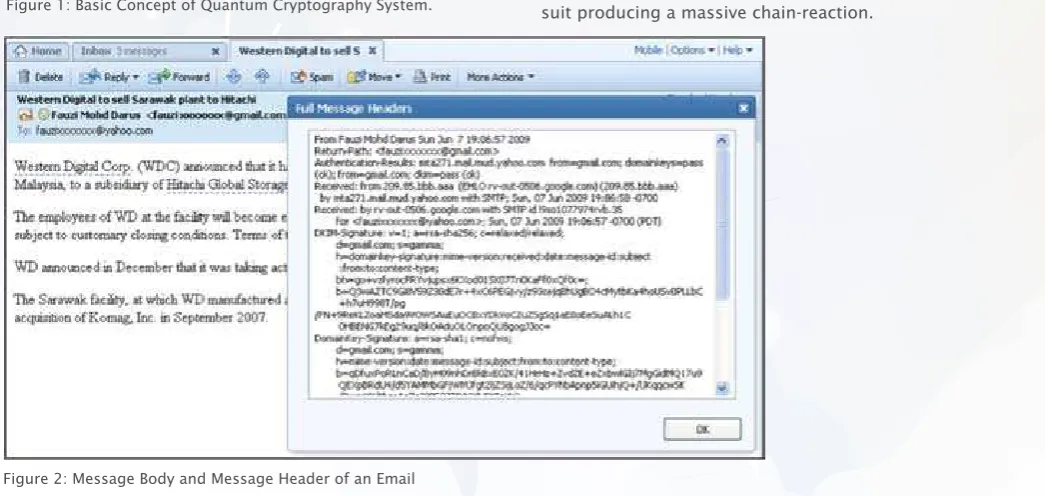
Figure 1 above shows a typical email header of Gmail. In an email header, it is mandatory to have these four fields:
•
FROM – the sender’s name and email address•
TO – the recipient’s name and email address•
DATE – the date when the email was sent•
SUBJECT – the subject of the emailAlthough these four fields are mandatory but they can easily be spoofed. In year 2003, a worm code name W32. Sobig.F@mm successfully altered the FROM field by using
[email protected] as the sender and sent emails to
all contacts found in the victim’s address book. Then the recipient of the infected email sent emails to all the contacts found in that computer and this process followed suit producing a massive chain-reaction.
Figure 1: Basic Concept of Quantum Cryptography System.
23.
The analysis
Other than these four fields, sending time stamps and receiving time stamps by the email agents that have received and sent the email are also included in the email header. This information is automatically inserted by the email agents.
The time stamp field also can be spoofed. However, the detection of timestamp spoofing is fairly easy.
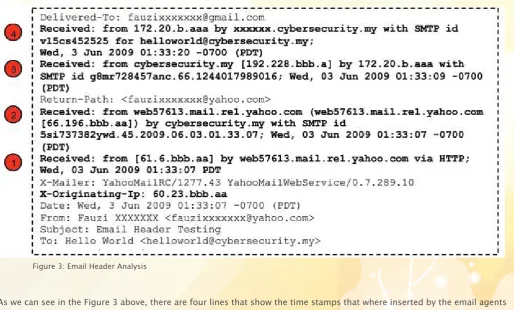
Let’s use the email header in Figure 3 as our example of analysis. The highlighted lines (lines begin with the “Received:” tag) will help us to trace the sender of the email. To read the email header, we start from bottom to top as the last time stamp was inserted at the top of the email before it is delivered to the receiver.
Figure 3: Email Header Analysis
As we can see in the Figure 3 above, there are four lines that show the time stamps that where inserted by the email agents when received and forwarded it to next email agent until it reached to the receiver.
The first time stamp shows the email was sent from IP address 61.6.bbb.aa, which is the IP of the ISP of the sender and received by Yahoo mail server, web57613.mail.re1.yahoo.com (66.196.bbb.aa). We believe that the email was sent from a web browser based on the “HTTP” at the end of the line.
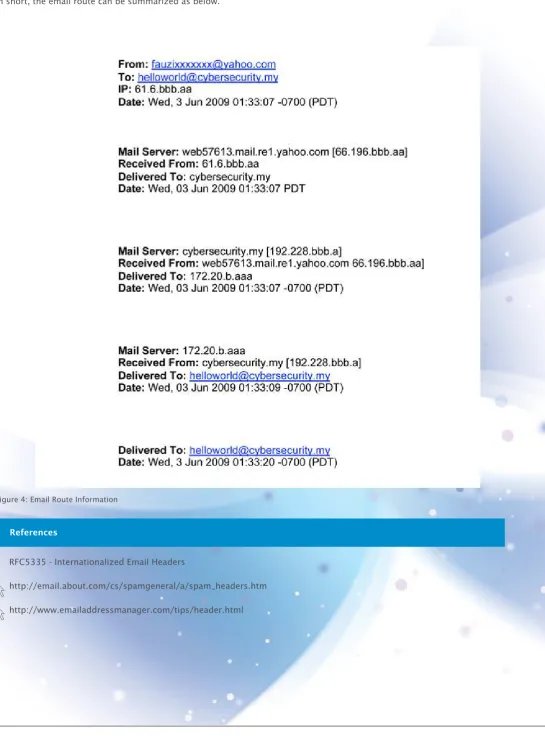
Then in the second line, Yahoo mail server forwarded the email to cybersecurity.my (192.228.bbb.a). From cybersecurity. my the email was then forwarded to another mail server, 172.20.b.aaa. Finally, the email was delivered to the recipient from mail server with IP 172.20.b.aaa.
RFC5335 - Internationalized Email Headers
http://email.about.com/cs/spamgeneral/a/spam_headers.htm
http://www.emailaddressmanager.com/tips/header.html References
Figure 4: Email Route Information
25.
File Deletion in
Linux
Introduction
Nowadays, Linux is becoming more popular as it is an operating system which is more reliable and secure compared to Windows. However, for new computer users, Windows is still much easier to use as users do not have to bother to know about the source code of the operating system when using Windows. On the other hand, those using Linux need to know some commands even to delete a file.
In this article, targeted for Linux beginners, the discussion will revolve around the process of deleting a file or directory and what happens to the file or directory after the deletion.
Files can be deleted from the Linux/ Unix console by using the ‘rm’ (short for remove) command. By default, this command deletes a file without confirmation from user.
$ rm filename
This command immediately deletes a file in the current directory without prompting.
$ rm filename1 filename2
This command allows user to delete more than one file at once.
$ rm -r directory
The –r flag is used to recursively remove directories and subdirectories in the argument list. The directory will be
emptied of files and removed. The user is normally prompted for removal of any write-protected files which resided in
the directory. This –r flag actually is a permission for rm to delete directories, their files and their subdirectories. $ rm -f filename
Another rm flag is -f, which will remove all files in a directory whether it is write-protected or not and it will remove all your files without prompting the user.
$ rm -i filename
The –i flag is used to ensure that rm prompts for confirmation before removing any file.
What happens after deletion?
•
File Deletion under EXT2/3What happened to the files after being deleted? In Windows, all the deleted files go straight into the Recycle Bin. However, in Linux only files that had been deleted from the GUI will go to the Trash folder. In actual fact, the files are not lost unless they are overwritten, which includes the rm command file. Before I the discussion goes any further, it’s better for you to understand the important data structures in Linux.
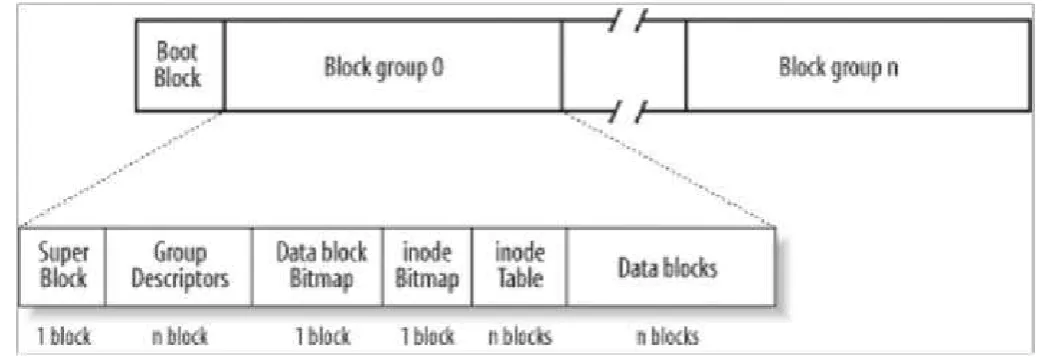
By default, Linux use EXT3 as its file system, but it also uses EXT2. EXT3 is the new version of EXT2 with journaling mechanism. Journaling keeps track of the major steps taken during the last sessions with a file and it also can be booted up to the last configuration and recover it to the point of crash.
The boot record in Linux is called Superblock. Linux divides the drive into block groups and a copy of the Superblock is frequently found at the beginning of these block groups.
Linux also distributes information fairly evenly across the drive (it does not use a first-come-first-serve file allocation method).
•
SuperblockThe first logical drive which stores information about the number of free blocks, inodes, block size and other information related to file system.
•
Group DescriptorsIncludes information of each group, located after the Superblock. Each group descriptor describes one group.
•
Blocks BitmapThe block bitmap keeps track whether each block is in use or not.
•
Inode BitmapThe inode stores all information about a file. A fixed number of blocks are usually allocated for storing the inode Table, which stores all the file inodes. The in odes also contain pointers to disk blocks where the actual files are stored. The inodes bitmap is provided to check for allocated blocks and free them when files are deleted from the system.
•
Inode TableInode Table contains Meta information about the file. This information includes the filename, the filesize, a pointer to the disk blocks containing the file, the file creation, access and modification times, the number of links to the file, as well as the user and group ids of the file.
27.
Figure 2
When you delete a file, the inode status is set to zero. If a process has a hold of the file, it does not displace the inode. It breaks the link between the directory entry and the inode. That file now can be called an orphan as it does not have a parent anymore. There is an inode orphan list in the Superblock. When you reboot the computer, the orphans will be unallocated.
There’s a difference between EXT2 and EXT3 in terms of unloading an inode. EXT3 will wipe the inodes, so block number will be lost while EXT2 doesn’t wipe the inodes (similar to FAT). EXT2 will adjust previous directory entry length to obscure deleted record. Refer figure 3.
“The inode contains 15 pointers to blocks where the first 12 are direct pointers to content blocks. Another pointers will have 1 indirect pointer to data and the next one points to `a block of pointers’ to `blocks of pointers’ to a double indirect. Indirect and double indirect block pointer will be used to support larger files. Refer figure 2.”
Figure 3
Conclusion
References
Unlike Windows, Linux operating system drivers clean the part of inode information after file is deleted and fills it with zero object size, object type information and object allocation information. This means after a file is deleted, the software knows nothing about it. But, recovery is still possible as there are a set of recovery methods that could help with file recovery, but none can give 100% assurance that the deleted files can be recovered.
http://thinkdifferent.typepad.com/edulog/computer_forensics_i/
http://lowfatlinux.com/linux-delete-files-rm.html
Macromedia Flash File Format (SWF) is designed to deliver vector graphics and animations over the internet through web browsers. Unfortunately, the availability of SWF files playing perfectly on any platform’s browser has brought the attention of the malware writers. In 2008, antivirus companies and security research centers including SecurityFocus [1], McAfee [2], and SANS [3] have reported in-the-wild exploitation of the SWF vulnerability. For details on this vulnerability could be witnessed in CVE-2007-0071 [4]. According to Mark Dowd, IBM Internet Security Systems researcher, Adobe Flash Player version 9.0.115.0 and earlier, are prone to memory corruption issue when processing a malicious Shockwave Flash (SWF) file. The successful attack will allow arbitrary code to run through an exploitable NULL-pointer dereference and compromise the infected computers. This document shows the in-depth process of analyzing malicious SWF files.
The malware writers uploaded and ran the malicious SWF
files in the vulnerable web server – so called malicious
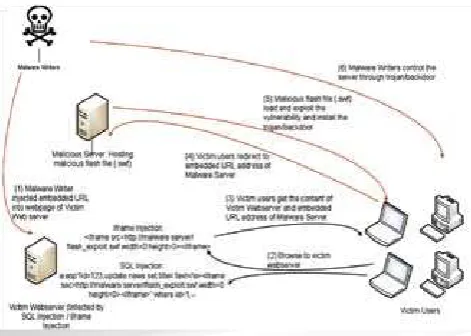
server. The attack started with injecting the embedded Uniform Resource Locator (URL) into third party domain’s web pages through SQL injection [7] or IFrame Injection [8]. The embedded link will automatically redirect victim to the malicious server, which hosts the malicious SWF files. Then the link will exploit the vulnerability and install the trojan or backdoor in victim’s computers if the victim is using vulnerable Adobe Flash Player.
Figure 1: Flash Exploit Generator
Figure 2: Flash Exploitation Attack through SQL Injection / IFrame Injection
A lot of malware writers from China abused the Adobe Flash Player vulnerability to develop their own exploit generators resources. These exploit generators can be kept by the writers for personal usage or sale in the underground black market forum. Figure 1 shows the example of a SWF File Exploit Generator for Adobe Flash Version Win9, 0,115,0ie.
In this section, the useful tools for conducting analysis process will be listed. The analysis machine installed with the tools is as below:
•
SWFTool [5] – Collection of utilities for working withAdobe Flash files (SWF files)
•
IDA Pro - Disassembler for static analysis•
OllyDbg - Debugger for dynamic analysis•
Hex Workshop for hex viewIn this section, the useful tools for conducting analysis process will be listed. The analysis machine installed with the tools is as below:
•
Malware writers launched an attack to the victim’s web servers and planted an embedded URL that is linked to malicious server through SQL injection or IFrame Injection attack.•
Once the users browsed the web server, the browser will redirect to the embedded URL hosting malicious SWF files.•
The malicious SWF files will be downloaded and exploit the vulnerable Adobe Flash Player application and install Trojan or Backdoor into the victim’s computer.•
Malware writers will able to connect and compromise victim’s computer through the installed backdoor or29.
The analysis is divided into two parts. The first part will explain the steps on extracting embedded SWF file and locating the decryption routine of the shellcode. The following steps will describe the decryption of obfuscated shellcode and its payload. Figure 3 shows the original screenshot of malicious SWF file in hex view.
Analysis of Malicious SWF File
Figure 3: Original Screenshot of Malicious SWF File
• Extracting Malicious Code from SWF File
The complete SWF binary structure [9] as shown below:
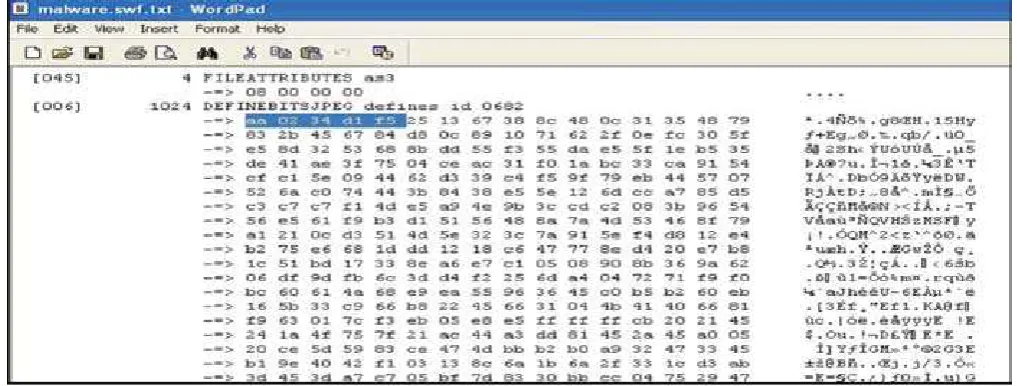
The SWF file starts with string FWS. An FWS signature indicates an uncompressed SWF file [10] but it is still unreadable. The software - swfdump.exe can be used to see the tag and DEFINEBITS section where the obfuscated shellcode is located [11].
Figure 4: Starting Opcode of the Obfuscated Shellcode
Figure 5: End Opcode of the Obfuscated Shellcode
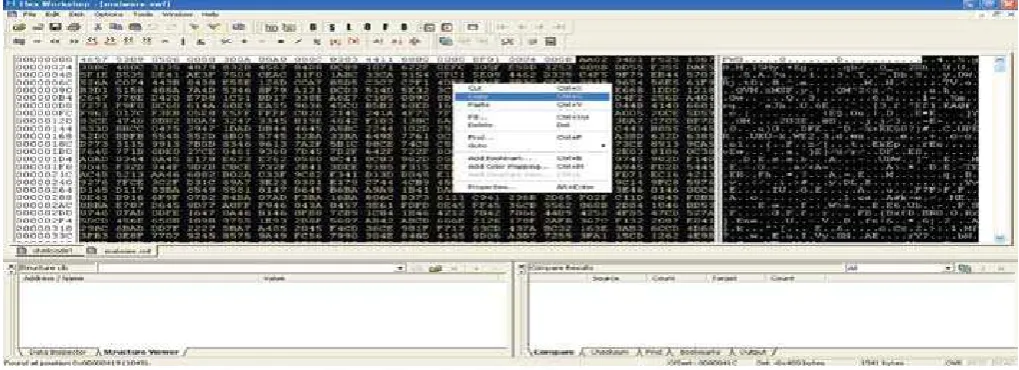
Obfuscated shellcode was copied starting from opcode AA02 34D1 (Highlighted in Figure 4) until opcode F067 FBA2
(Highlighted in Figure 5) by using Hex Workshop and saved it as different filename; in this case, we named it as
31.
Figure 6: Copy the Obfuscated Shellcode from Malicious SWF File
Figure 7: Conversion of the Selected Byte to Instruction
• Shellcode Analysis
The following step is looking at the decryption routine of obfuscated shellcode. First, load the shellcode.bin with IDA Pro and 32-bit disassemble mode is chosen. The full code analysis can be done by choosing force conversion of the selected byte to instruction option.
•
Select and highlight all the codes•
Press C and select option Force analysisFigure 8: Decryption Routine of the Shellcode
“The obfuscated shellcode will call the decryption routine before executing the payload. In this exercise, the starting of the decryption code located at offset 0000 00D8. The details of the coding can refer to the comments (Refer Figure 9).
Since the opcode for shellcode.bin part was found, the same steps can be applied to the original malware.swf file. As shown in Figure 10, the malware.swf file was loaded with Hex Workshop and the offset for opcode 6631 044B is 0000 00F4. Again this is the offset for the beginning decryption routine which was used to decrypt the rest of the obfuscated shellcode.