Vol 42 - (1/2017)
“Cybersecurity is a shared responsibility, and it boils down to this : In cybersecurity, the more systems we secure, the more secure we all are”
Jeh Johnson
Incident Trend Analysis for 2016
Cryptocurrencies 102 and the Dark side of the web
ii
Level 5, Sapura@Mines No. 7 Jalan Tasik The Mines Resort City 43300 Seri Kembangan Selangor Darul Ehsan Malaysia.
T: +603 8992 6888 F: +603 8992 6841 E: [email protected] Customer Service Hotline:
1 300 88 2999 www.cybersecurity.my
Cyber999 Help Centre | My CyberSecurity Clinic | | |
Information Security Management System Audit and
| Malaysia Trustmark | Security Assurance | Digital Forensic & Data Recovery | Malaysia Computer Emergency Response Team (MyCERT) | Security Management & Best Practices | Cyber Security Research |
CyberSAFE (Cyber Security Awareness for Everyone)
WELCOME MESSAGE FROM THE CEO OF CYBERSECURITY MALAYSIA
Dear Readers,
The opportunity of travelling from one continent to another, delivering speeches, participate in international conferences, and have the opportunities to meet people with relevant knowledge in the arena of cyber security landscape, one consistent theme I encounter, is that people are eager to hear the latest threats and case studies affecting that particular nation and how the organization counters those issues. People are interested to hear the “expert opinion” and what solutions may be offered and exchanged amongst the collaborating countries.
It gives me great pleasure to showcase 21 terriic articles in this irst publication
for e-Security Bulletin for 2017. You will be enlightened from the shared articles as well as will be kept abreast with the current and relevant issues on cyber and technologies landscape.
I believe that many of you are aware of the recent Ransomware Wannacry attack, whereby more than 200,000 machines in 150 countries worldwide have been infected. The threat has become the most severe and menacing cyber incident in the history of the Internet, after the DYN DDoS attack in October 2016. The article entitled “Ransomware WannaCry Attack! Are you at risk?” will provide you with a better grasp on the threat plus how to shield yourself from being a fallen victim. In addition, another article to be highlighted is the “Incident Trend Analysis for 2016” that could give you with more insights on the particular subject matter.
On that note, I would like to convey my utmost appreciation to all contributors for their nobility of sharing invaluable knowledge and also for their continuous support towards our goal of enhancing online safety.
We hope our readers will be more informed and equip with relevant knowledge on countering such threats.
Thank you and warmest regards.
Dato' Dr. Haji Amirudin Abdul Wahab
PUBLISHED AND DESIGNED BY READERS’ ENQUIRY
Outreach and Corporate Communications, Level 5, Sapura@Mines, No.7 Jalan Tasik, The Mines Resort City, 43300 Seri Kembangan
EDITORIAL BOARD
Chief Editor
Dr. Zahri bin Yunos
Editor
Lt. Col Mustaffa bin Ahmad ( Retired )
Internal Reviewers
1. Mohd Shamil bin Mohd Yusoff 2. Ramona Susanty binti Ab Hamid 3. Nur Arafah binti Atan
4. Jazannul Azriq bin Aripin
Designer & Illustrator
1. 5 Common Social Engineering Tactics ... 1
2. Embryonic Cyber Security Products ... 3
3. Malware Trend Report H2|2016 ... 6
4. Incident Trend Analysis for 2016 ... 17
5. Cryptocurrencies 102 and the Dark side of the web ... 20
6. Social Networking Security and Privacy ... 26
7. Blockchain Implementation (Proof-of-Concept) ... 30
8. Email Security Threats and Trends ... 34
9. Cyberbalkanization/Splinternet ... 37
10. Going for Digital Detox ... 40
11. CyberSAFE Tips for Parents ‘Educate your Child! Say No to Cyber-Bullying’ ... 43
12. Zooming In Cyber Security Market Development ... 45
13. Approved Cryptographic Algorithms in ISO/IEC Standards ... 49
14. Approved Cryptographic Algorithm in NCA1 Projects ... 55
15. Cryptography and Virus ... 60
16. Lightweight Cryptography in Internet of Things ... 63
17. Ransomware WannaCry Attack! Are you at risk? ... 68
18. Mobile Security: Android OS vs iOS ... 70
19. CyberSecurity Malaysia New Building at Cyberjaya ... 75
20. Certificate vs Certification ... 76
1
5 Common Social Engineering Tactics
By | Nur Sharifah Idayu binti Mat Roh & Noraziah Anini binti Mohd Rashid
A social engineer is someone who uses techniques of deception, persuasion, and influence to obtain information that would otherwise be unavailable. Social engineering is different from hacking in the aspect of obtaining information, whereby social engineers get access to confidential information with the victim’s consent. Basically, they are con artists who are good at convincing you to give your information outright by manipulating you into thinking they are a trusted party. In other words, it is not about being a good liar; it is about being an ordinary person who finds extraordinary ways to manipulate people to their advantage. By using a variety of media, including phone calls and social media, these hackers trick people into offering access to sensitive information. Social engineers use a variety of techniques to achieve their goals. However, this article will focus on five common types of attacks that social engineers normally use to target people:
1. Phishing
Phishing is a type of social engineering attack that is usually delivered in the form of e-mails, chats, web advertisements or sites designed to impersonate real systems or organizations. Phishing messages are designed to convey a sense of urgency or fear with the end goal of capturing sensitive end-user data. Phishing messages may come from banks, the government or major corporations. Phishing scams may be the most common type of social engineering attack used today. Most phishing scams exhibit the following characteristics:
1. Attempts to obtain personal information, such as name, address and social security number.
2. Use link shorteners or embedded links that direct users to suspicious URL websites that look legitimate.
3. Combine the threat with fear and a sense of urgency in order to manipulate a user into immediate action.
4. A phishing message may come from a bank, the government or a large corporation.
• Call for different actions. Some ask the person to "verify" their account login information, and include a login mock-up page complete with a logo and brand to appear legitimate.
• Some claim the person is the "winner" of a prize or lottery and request bank account details to deliver the prize.
5. Submit phishing e-mails to users after they installed the crack to a Google Play APK file that is pre-loaded with malware. This particular phishing campaign shows how malware attacks are usually paired with phishing attacks in an attempt to steal users' information.
#2. Baiting
Baiting is similar to phishing, in that it involves offering an item or good that hackers use to attract victims. The "bait" comes in many forms, either digital, such as peer-to-peer music or movie downloads, or physical. Baiting attacks are not limited only to the online scheme. Hackers can also focus on exploiting human curiosity through the use of physical media. For example:
1. Baiters can offer users a free music or movie download when they submit their login credentials to a specific website.
2. Hackers infect USBs with a Trojan virus and disperse them throughout an organization’s parking area. Out of curiosity, many workers will take the USB and plug it into their computers, thus automatically enabling a keylogger and providing hackers access to certain employee login credentials.
#3. Pretexting
2
oneself as another and creating good reasons or scenarios designed to obtain personal information. One of the most important aspects of social engineering is trust. A solid ground is an essential part of building trust. Examples of pretexting include:
1. An e-mail to employees from what appears to be the Head of IT support, or chat messages from an investigator claiming to conduct corporate audits.
2. Posing as external IT service staff auditors and manipulating the physical company security to allow them into the building.
#4. Quid Pro Quo
Much like baiting, quid pro quo attacks involve hackers asking for critical data or login credentials in exchange for services. For example:
1. Fraudsters posing as IT services, spam calling direct numbers of end users to offer free help or IT technology improvement in exchange for login details.
2. Posing as researchers, requesting access to the company network as part of an experiment in exchange for a certain amount of money. If an offer sounds too good to be true, it is probably a quid pro quo attack.
As real-world examples show, some office workers are more than willing to give their passwords for treats of a meal or chocolate bar.
#5. Tailgating/Piggybacking
Last but not least, another type of social engineering attack is tailgating, which is also known as piggybacking. The attack involves someone who does not have proper authentication but follows workers to access protected system areas. For example:
1. Someone asks to borrow an employee’s laptop for a few minutes, when the hacker is able to quickly install any malicious software on the laptop.
2. A hacker can strike up a conversation with an employee and use some sorts of presentation or persuasion skills to make it past the front desk.
3. Hackers request workers to hold the door open for them as they claim having forgotten their employee access cards.
Conclusion
All employees should be aware of the various forms of recent social engineering to ensure that corporate cyber security is preserved. Attending security awareness training is one way to reduce the risk of being hacked, which can simply equip employees with security knowledge and security best practices. Another method is for the organization to carry out breach exercises on the organization’s physical access using social engineering techniques. This can be very helpful for employees to understand how people can be easily manipulated and persuaded by others. Thus, it is more likely they can prevent attacks before sensitive information gets exposed and the organization can also identify which employees need further awareness.
3
Embryonic Cyber Security Products
By | Nazahan bin Nazri
Developing a secure ICT product obviously requires it is designed, built and operated by people who understand the threats, know the security requirements and also have general skills.
Most products fail due to problems relating to the development process. The inability to coordinate different teams, resolve personal conflicts, or respond effectively to unforeseen technical difficulties are all common problems. Without an adequate process in place to respond to any concern, products can get lost or side-tracked, and stall or fail to meet even basic requirements.
The Embryonic Process
Most organizations utilize a hybrid
iterative-waterfall methodology to facilitate quicker development cycles and the ability to adapt to changes through the process.
The waterfall model is a sequential product development process, whereby progress is considered to be flowing steadily downwards (like a waterfall) through the phases of requirement gathering, analysis, design, development, unit testing, integration testing, acceptance testing and release.
4
The waterfall development model originated in the manufacturing and construction industries for highly structured physical environments, where after-the-fact changes are prohibitively costly, if not impossible. Since no formal software development methodologies existed at the time, this hardware-oriented model was simply adapted for software development.
The main advantage of using the waterfall approach is that time spent early in the software lifecycle can lead to enhanced economy in later stages. For example, a bug found in the early stages (e.g. requirement specification or design) is cheaper in terms of money, effort, and time to fix than the same bug found later on, once development has started.
Requirement Analysis
To develop a successful product, a clear understanding of what the client needs and is planning to use the product for is necessary. The product must also be able meet all of the client’s expectations and do exactly what the client wants.
The very first step is to analyse the user requirements. The functional requirements of the product are analysed and ways to meet those requirements are examined.
Tensions may erupt between various departments within a firm. To alleviate any stress and avoid conflict it is possible to create an integrated product team with one point person to represent each interest. In this phase, frequent meetings are held to ensure everyone’s concerns and needs are met and considered.
Understanding the requirements and allocating resources efficiently can drastically reduce development time as well as potential errors, technical glitches and miscommunication. These are major reasons for attempting to lower cost and save time.
Design & Implementation
In the next phase, the product specs are put into action to develop and test each configuration
item. Each item is designed and built according to the specifications established in the initial phase. With a clear understanding of the end requirements, the design and development process flows more smoothly and easily.
Integration & Testing
After building and testing the configuration items, or discrete components, separately, they are integrated into a holistic system to ensure they work together harmoniously. Since there is already a requirement-based plan for integration and testing, this phase becomes cost and time-efficient.
Delivery
All the mentioned steps lead up to the final moment: product or system delivery, ready for use. However, delivery processes have different degrees of metrics that involve product deployment. Moreover, the value chain stream depends on client requirements.
5
Conclusion
The model is simple, and easy to understand and use in the product development phase. The model is also easy to manage due to its rigidity – each phase contains specific deliverables and a process review. With this model, phases are processed and completed one at a time, so the phases do not overlap. Ultimately, the waterfall model works well for projects if the requirements are very well-understood.
References
1. Product Methologies; https://www.
inflectra.com/Methodologies/Waterfall.aspx
2. Waterfall Model; http://
istqbexamcertification.com/what-is-waterfall- model-advantages-disadvantages-and-when-to-use-it/
3. Cybersecurity challenge; http://
w w w . m c k i n s e y . c o m / b u s i n e s s - f u n c t i o n s / digital-mckinsey/our-insights/meeting-the-cybersecurity-challenge
4. Cybersecurity product thru secure
6
Malware Trend Report H2|2016
By | OIC-CERT Permanent Secretariat
Disclaimer
This document is for informational purposes only. Every effort has been made to make this document as complete as possible, but no warranty or fitness is implied. The information provided is on an “as is” basis. CyberSecurity Malaysia, an agency under the Ministry of Science, Technology and Innovation Malaysia and the Permanent Secretariat of the Organisation of the Islamic Cooperation – Computer Emergency Response Team (OIC-CERT), shall have neither liability nor responsibility to any person or entity with respect to any loss or damages arising from the information contained in this document.
Information about the malware trend is made available by CyberSecurity Malaysia for the purposes of providing awareness and improving the preparedness and readiness in facing malware threats.
The logo and names of organisations and products mentioned herein are the trademarks of their respective owners. Use of the logo and name do not imply any affiliation with or endorsement by the respective organisations.
Executive Summary
Having information access and sharing over the Internet are much easier with the use of Information and Communications Technology (ICT) and the advancement accomplished in this area. The government, private sectors, and individuals are relying on the Internet for their daily operations in economic growth, e-governance, business, and social as well as human development.
However, the increase usage and dependability on the Internet has also seen the rise of malicious activities such as cyber-attacks involving computer malicious codes or malwares. The evolution of malwares combined with the inexperience of Internet users makes such attacks detrimental to the victims.
It is important for organisations to realise that cyber criminals have the capability and capacity to inflict harm across geographical borders. As we share common interests in the political
and economic activities, cooperation among the countries and organisations is necessary to better mitigate malware threats.
CyberSecurity Malaysia, an agency under the Ministry of Science, Technology and Innovation Malaysia and the Permanent Secretariat of the Organisation of the Islamic Cooperation – Computer Emergency Response Team (OIC-CERT) has embarked on the Malware Research and Coordination Facility project (hereinafter referred to as “the Project”) as an initiative to enhance the mitigation of malwares. It is a collaborative effort of participants from the OIC-CERT members and information security organizations of multiple countries. The background of the Project and the participating agencies / organisations is available in Appendix A.
This Malware Trend Report, first published for the second half of 2016, is one of the outcomes of the collaboration effort.
Introduction
In the early 2010, the world observed a decline in the sales of personal computers (PC) and a rise in the sale of mobile devices such as smartphones, tablets, and more recently, the wearables. In a recent prediction by Gartner, the global PC market is expected to drop by 8% and the mobile phone shipment to decline by 1.6% in 2016 [1], indicating that the overall trend of using mobile devices instead of PC remains intact.
7
Real-time protections for known threats are relatively effective; however, zero-day malwares are still prevalent.
Mobile devices are connected to 10 to 100 more networks than the traditional PCs [3]. Given the fast pace of mobile innovation and low barrier of entry for developing and publishing a mobile app, both apps and operating systems are usually full of vulnerabilities. According to Gartner, throughout 2015, more than 75 percent of the mobile apps failed the basic security tests [4] because the developers are more concerned with the functionality of the applications rather than its security.
Objectives
This Report aims to provide a better understanding of malware threats and analysis as well as related potential impacts. The ultimate objective is to educate and improve awareness, preparedness, and readiness in facing cyber threats.
Target Audience
The malware threat analysis presented in this Report is primarily for the consumption of the general Internet user
Malware Types
Malware, depending on the type and function, may be stealthy – intended to steal information or spy on computer users for an extended period of time without their knowledge, or it may be designed to cause harm – often as sabotage, or for financial gains – to extort payment from the users. Malware can infect any devices on any operating system (OS) platform ranging from PCs to servers to smartphones and even smart TVs [5].
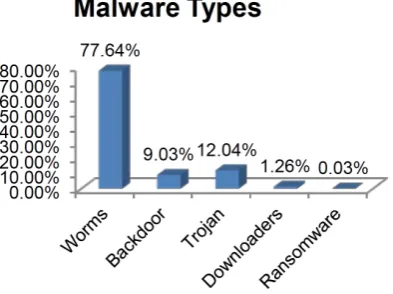
Figure 1 depicts the malware types infecting the computers during the implementation of this Project between July and December 2016. The malwares detected include Worms, Backdoor, Trojan, Downloaders, and Ransomware. The most common type of malware captured is Worms. As the anti-virus software evolved over time and nowadays become security suite, so does malwares which evolved from simple to complex, typically concealed in an application such as advertising-supported software (adware) that comes with spywares.
Figure 1 Captured malware types, H2 2016
In the first half of 2016, Microsoft released Volume 21 of its half-yearly Security Intelligence Report using malware data from January to June 2016. One of the analyses available in this report is the comparison of infection and encounter rates, patterns, and trends in different locations around the world.
This analysis is made possible by the malware data generated by Microsoft security products from computers whose administrators or users choose to opt-in to provide data to Microsoft which includes information about the location of the computer, as determined by the IP geolocation.
The worldwide malware threats analysis, as included in Table 1, serves as a comparison reference to the threats detected in this Project.
Table 1 Malware types comparison – Global vs Detected
Note: Figures do not include Brantall, Rotbrow, and Filcout. See “Brantall, Rotbrow, and Filcout”
8
detected through Worms is shockingly high at 77.64%, more than 20 times on those affecting the worldwide computers. Similarly, Trojan is the second common malware infection type at 12.04% and this figure is still relatively higher compared to the figures worldwide.
The Backdoors infection at 9.03% is alarmingly since the infection is more than 20 times the worldwide figure.
The Downloaders & Droppers are lower than the worldwide infection while the Ransomware, as a new comer, contributing 0.03% of the infection, is lower than the global figure of 0.3%.
By the first half of 2016, the global figures indicated that malware in the form of Worms have reduced in favour of Browser Modifiers. However, Browser Modifiers are presently not a common malware detected in this Project.
The analysis shows two major trends: 1) malware types infecting the computers and users can be significantly different from one part of the world to another, and 2) malware threats evolve over time.
For the general Internet users, the malware type analysis above provides good knowledge but would probably provide little significance. Since the objective of this Malware Trend Report is to help the typical users at better understanding the malware threats and analysis as well as related potential impacts, the malware analysis presented and discussed in the following sections of this report have been reclassified.
The malware threats classification details are provided in Appendix B.
C&C Callback Destination
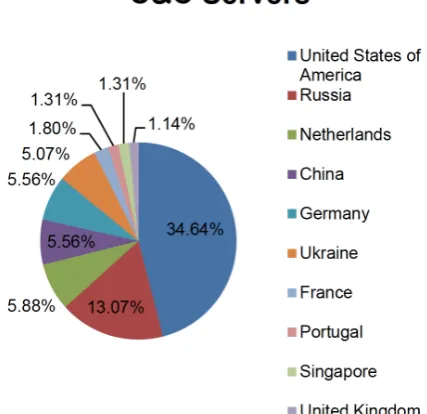
The callback destination of a malware to its servers, also known as the Command and Control (C&C), indicates that the computers and users involved in this Project have been exposed to infections. Malwares have successfully passed through the organisations’ security perimeters and reach its internal hosts as there were large numbers of attempts towards the C&C servers observed.
From July to December 2016, the majority malicious IP addresses serving C&C servers came from the United States of America, Russia and the Netherlands. Figure 2 shows the top ten C&C countries that were identified as callback destinations which contribute to 75.34% of all countries serving C&C servers.
9
PC Threats
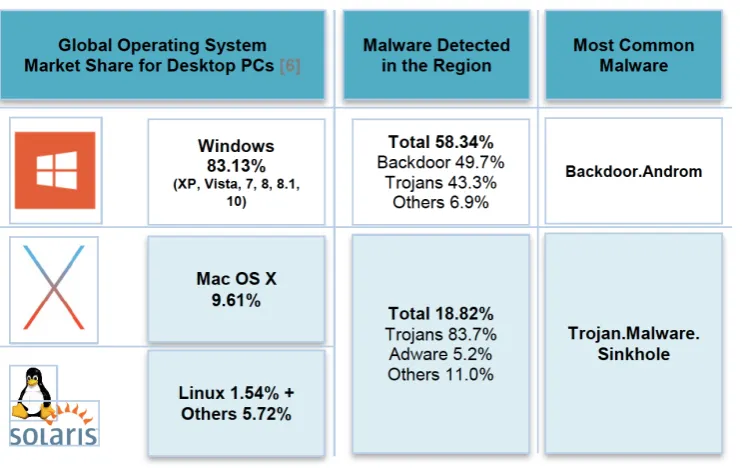
Table 2 Overview of PC malware threats
The malware is as old as the software itself and PC running the Windows operating systems (OS) have been around for more than 20 years. By now, avid PC and Windows users are very familiar with the main symptoms of a malware infected system such as unwanted advertisement pop-up windows, anti-virus solution that doesn’t seem to work properly or if the update module seems to be disabled, new browser homepage, and unwanted websites accessed without any input.
Table 2 shows the summary of global OS market share for desktop PCs for July 2016. The types of malware detected infecting the PC users in this Project and the most common malware between July and December 2016 are also highlighted. Compared to other operating
systems, Microsoft Windows is the widely used OS globally at 83.13%. Mac OS X is currently at second place with 9.61% of the market share and the remaining 7.26% consists of other OS such as Linux and Solaris [6].
Windows, being the most used OS for PCs, is no doubt the common target of further malware threats. This known fact is supported since 58.34% of the malware detected in this Project infects Windows with its most prominent malware being the Backdoor.Androm. Malware threats targeting other OS has a combined total of 18.82% with the Trojan, Malware, and Sinkhole being the top malware detected during the second half of 2016.
10
Malware threats detected targeting the PCs running Windows and other OS is totalling to 77.16%. As such, 22.84% of the malware detected in this Project targets the mobile OS. Table 3 provides comparison between the PC and mobile threats detected globally as reported by Nokia, and the malwares detected in this Project.
According to the Nokia’s Threat Intelligence Report, for the first half of 2016, malware activities observed on smartphones running Android and iOS was ahead of Windows based computers and laptops and now account for 78%. The remaining 22% of the malware activity is still attributable to Windows PCs and laptops connected via dongles or tethered through phones [7].
Mobile Threats
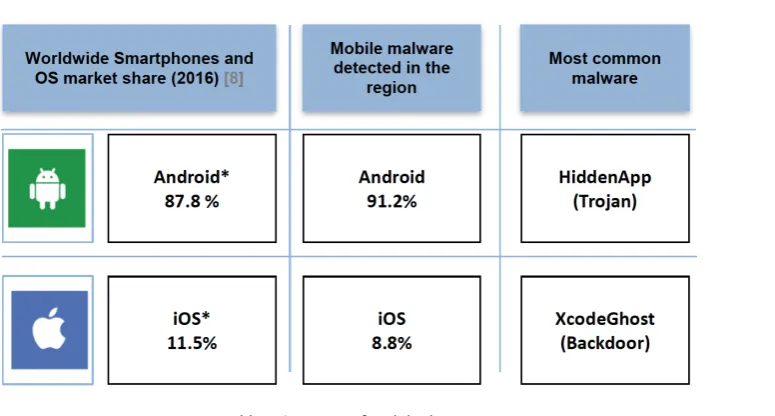
Table 4 Overview of mobile threats
Note: * Remaining 0.7% are Microsoft 0.4%, RIM 0.1%, and Others 0.2%.
According to IDC’s Worldwide Quarterly Mobile Phone Tracker (January 27, 2016), the world bought more than 1.4 billion smartphones in 2015, up by 10% from the 1.3 billion units sold in 2014. Ericsson predicts there could be as many as 6.4 billion smartphones subscriptions by the end of 2020, almost one smartphone per person [9].
Table 4 illustrates the key facts for mobile devices and its threats. Six (6) out of seven (7) or 86.2% new smartphones run on Android OS while one (1) in eight (8) runs Apple’s iOS [8]. Holding the worldwide smartphone market share, it is no surprise then that Android, similar to Windows, is the main mobile operating system worldwide.
Android Malwares
Table 5 Top 10 Android malware detected
Table 5 list the top 10 malware detected out of 31 infecting the Android mobile users in this Project. These malwares represent more than 93% of the total malware detected targeting Android smartphones.
11
Android, targets the ever-expanding market of Chinese-Android device owners [10]. Once HiddenApp successfully infects a smartphone, it begins downloading and attempts to install android application packages (APKs) to external storage, like a secure digital (SD) card, without your knowledge. Those APKs could include spam, more malwares, or all sorts of other unwanted apps that could benefit the hacker at the victim's expense.
iOS Malwares
Apple’s software repository, Apple Store, requires all submitted applications to pass a rigorous vetting process before they can be offered in the store, and has historically been admirably free of malware. Apple is well-known for its stringent screening processes, which is why the number of malicious iOS apps is so much smaller than for Android.
As Apple’s mobile devices such as iPhones and iPads gain more market share, cyber criminals will most likely target Apple devices which are partly driven by the supposedly higher disposable income of their owners. iOS malware threats detected in this Project represent 8.8% of the total mobile malware detected. This figure is 4 times more than the iOS malware that Nokia reported at 2.07% of the total infections on the mobile platform [7].
Table 6 iOS malware detected
Table 6 provides the iOS malware detected in this Project. Unlike earlier versions of the iOS threats, the XcodeGhost malware does not require any iOS vulnerabilities or the iPhone/ iPad to be jail-broken in order to compromise the iOS device [9].
According to the Internet Security Threat Report, Volume 21 by Symantec, in September 2015, malwares were discovered in a number of iOS applications that are legitimately available on Apple Store including WeChat, a popular cross-platform mobile instant messaging (IM) app. The worrying fact is that these apps are not intentionally designed to be malicious – their developers were compromised with malware that was embedded into the apps they develop [9].
Web Threat
Most users still surf the Internet from PCs but this behaviour is changing towards browsing from mobile devices. A joint study in the US in 2015 titled The Generational Content Gap, done by Fractl and BuzzStream, surveyed over 1,200 people across three generations about their digital content consumption. According to the survey, approximately 70% of the users browse the Internet using desktop and laptop. However, the Millennials, the generation born between 1977 and 1995, showed signs that this web browsing trend will change to browsing from mobile devices in the near future [11].
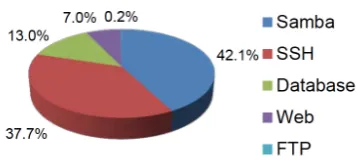
Figure 3 Overview of targeted services
Referring to Figure 3, apparently 7% of the malware is targeted specifically to the web services. However, it is common these days that web servers are connected to other related services including database and file sharing servers to provide users with more useful web applications and better browsing experience. In essence then, malware infection targeting the web is more than the obvious.
12
Figure 4 Overview of the targeted web application vulnerabilities
The ease of use and wide availability of web attack toolkits is feeding the number of web malware threats. In the middle of 2015, it was filled with accounts of malicious advertisement (malvertisement) affecting almost every segment of the ad-supported Internet.
On 19 March 2016, major news websites such as The New York Times, BBC, Newsweek and Aol.com began serving their visitors malware for the duration of the weekend. The malware did not come from these legitimate news pages; instead, the advertisements posted on these websites were remotely hijacked [12].
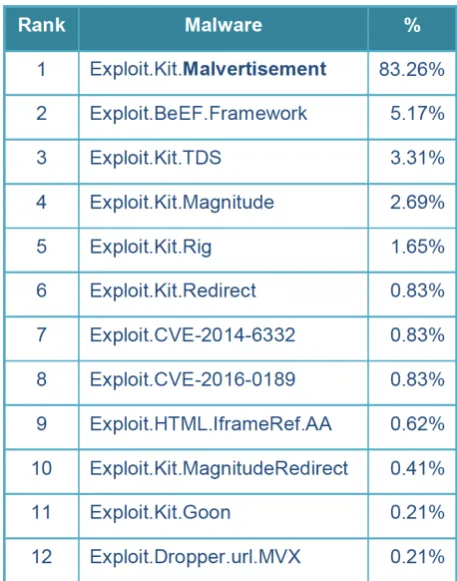
Table 4 lists the web threats detected within this Project. Malvertisement is the highest ranked web malware contributing to 83.26% of the web threats detected.
Table 7 Web threats captured – Exploit Kits
Malvertisements or adware are commonly placed on a website by one of these two ways:
• Pop-up ads: Pop-up ads typically deliver malicious payloads as soon as the ads appear on the user’s screen. Scareware, disguised as an anti-virus application, is often delivered through pop-up ads. In some cases, the malware will execute when the user clicks the “X” to close the pop-up window; and
• Legitimate ads: Cyber criminals place a series of malware-free ads on a trusted site that runs third-party ads.
In order to establish a good reputation, the legitimate ads are left alone for a certain period of time, i.e. several weeks or even months. The cyber criminals will then inject malicious payloads into the ads, infecting as many computers as possible in a short amount of time. To avoid tracking, the malicious codes are quickly removed or the ads discontinued. This type of attack runs on websites that run third-party ads.
Ransomware
Practicing safe web browsing should become a habit for all Internet users. Ransomware, despite being a relatively “newcomer”, is similar to any other malwares in the sense that it can infect a user’s PC or mobile device from practically any source including:
• Visiting unsafe, suspicious, or fake websites;
• Clicking on bad or malicious links in emails, Facebook, Twitter, and other social media posts, and instant messaging apps; and
• Opening emails and email attachments from
unsolicited or unexpected sources.
13
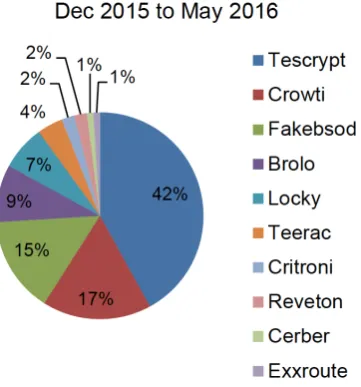
Figure 5 Prevalent ransomware – Global
Source: https://www.microsoft.com/en-us/ security/ portal/mmpc/shared/ransomware. aspx
So, why have Ransomware attacks become increasingly sophisticated, targeted, and lucrative?
One of the reasons is that the profit potential cyber criminals use to gain from exploiting stolen credit card details have reduced. This can be linked to the recent introduction of the more secure Europay, MasterCard and Visa (EMV) standard (chip-and-PIN) payment cards into the consumer market along with the abundant supply of stolen information on the black market.
Figure 6 shows the four ransomwares detected in this Project i.e. Petya, Cerber Downloader and Android.Congur. As stated earlier, malware types infecting the computers and users can be significantly different from one part of the world to another.
Figure 6 Regional ransomware
Petya is clearly the prominent ransomware making up 88.4% of the total ransomware detected during the second half of 2016. The ransom payments are at approximately 0.9 bitcoins (equivalent to US $657) and there is no way to decrypt hostage drives for free [14].
Figure 7 Petya ransomware screenshot
Figure 7 shows a snapshot of the Petya ransomware. Petya ransomware is delivered via scam emails themed as a job application. The e-mail comes with a Dropbox link, where the malicious ZIP is hosted. This initial ZIP contains two elements:
• a photo of a young man, purporting to be
an applicant (in fact it is a publicly available stock image); and
• an executable, pretending to be a curriculum vitae (CV) in a self-extracting archive or in Portable Document Format (PDF), which is a malicious dropper in the form of a 32bit Portable Executable (PE) file.
Conclusion
Malware threats target vulnerabilities and / or operating system configurations as well as applications (commercial off-the-shelf or customized) that are unequally distributed around the world. Some threats reflect the online services offered by the government and industry sectors that are local to a specific geographic region or country.
The spread of malware can also be highly dependent on the socio economic factors as well as on the methods used for distribution (for example the ever-expanding market of Chinese-Android device vendors and cross-platform instant messaging apps). As such, significant differences exist in the types of threats that affect users in different parts of the world.
14
related countries and organisations is crucial. It is learned, from McAfee’s (Intel Security) interview of nearly 500 security professionals to understand their views and expectations about the sharing of cyber threats, that 97% of those who share cyber threat intelligence see value in it to help them to improve their preparedness and readiness to face the evolving cyber threats [15].
Appendices
9.1 A : Project Background
The Malware Research and Coordination Facility project was initiated by CyberSecurity Malaysia, an agency under the Ministry of Science Malaysia and the Permanent Secretariat of the OIC-CERT. The participating agencies / organisations subscribing to this Project share malware data that allow collective malware threat analysis to
be done. Such analysis provides early detection of malware for the corresponding advisories to be provided. The analysis and recommendations allow government and organisations to react against the malware threats and protecting their assets against the detrimental effect of malware infection which typically leads to cyber-attacks.
At the moment, four countries that share their malware data include Malaysia, Brunei, and France. The services of the Malware Research and Coordination Facility are also offered to the Asia Pacific Computer Emergency Response Team (APCERT) through Memorandum of Understanding (MoU) between OIC-CERT and APCERT and APCERT Malware Mitigation Working Group.
The participating agencies/organisations in this Project are listed below:
Figure 8 Participants for the Project
9.2 B : Threat Catergories
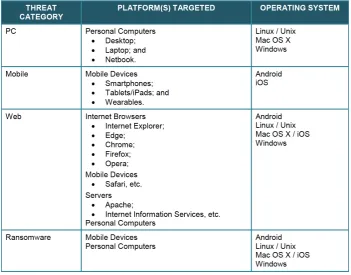
To simplify the presentation of the malware data and make the malware analysis easier to understand, this Malware Trend Report classifies the many types of malware threats into categories. Threat categorization is based
on a number of factors such as similarities in threat function and purpose, how the threat spreads and what it is designed to do.
15
Table 8 Deinition of the threat categories
9.3 C : Data Source
The data, information and analysis used to produce this Malware Trend Report H2 2016 are derived from the malware data generated by various sources within CyberSecurity Malaysia and the participating agencies / organisations in this Project such as:
• Network security devices (active and passive) installed regionally;
• Managed security services; and
• User reported cases
9.4 D : References
1. Gartner. (2016). Gartner Forecasts
Worldwide Device Shipments to Decline for Second Year in a Row [Online]. Available: http:// www.gartner.com/newsroom/id/3468817
2. Charlie Anthe et al., “Microsoft Security Intelligence Report January throughJune, 2016,” Microsoft Corp., Redmond, WA, December 2016, vol. 21.
3. Matt Louden. (2016, Jun. 1). Mobility
Menaces [Online]. Available: http://mobiwm. com/technology/mobile-security/
4. Gartner. (2014, Sep. 14). Gartner Says
More than 75 Percent of Mobile Applications will Fail Basic Security Tests Through 2015 [Online]
Available: http://www.gartner.com/newsroom/ id/2846017
5. Mary-Ann Russon. (2016, Jan. 12). It's
official, your smart TV can be hijacked: Malware is holding viewers to ransom [Online]. Available: http://www.ibtimes.co.uk/its-official-your- smart-tv-can-be-hijacked-malware-holding-viewers-ransom-1537533
6. StatCounter. (2016, July). Global operating systems market share for desktop PCs, from January 2012 to July 2016 [Online]. Available: https://www.statista.com/statistics/218089/ global-market-share-of-windows-7/
7. Nokia Threat Intelligence Laboratories,
“Nokia Threat Intelligence Report – H1 2016,” Nokia Security Center, Berlin, September 2016.
8. Gartner. (2016). Global mobile OS market share in sales to end users from 1st quarter 2009 to 3rd quarter 2016 [Online]. Available: https://www.statista.com/statistics/266136/ global-market-share-held-by-smartphone-operating-systems/
9. Paul Wood et al., “Internet Security Threat Report,” Symantec Corp., Mountain View, CA, April 2016, vol. 21.
16
11. Fractl and BuzzStream. (2015). The Generational Content Gap [Online]. Available: http://cdn2.hubspot.net/hubfs/495782/ Gated_Assets/Content_by_Generation/Content_ Engagement_by_Generation_Whitepaper. pdf?submissionGuid=8ec61b78-5a9d-4289-b4ed-e35ff4b77791
12. Carrie Mihalcik (2016, Mar. 16). New York Times, BBC and others inadvertently serve up dangerous ads [Online]. Available: https://www. cnet.com/news/new-york-times-bbc-dangerous-ads-ransomware-malvertising/
13. Malware Protection Center. (2016). Ransomware [Online]. Available: https://www. microsoft.com/en-us/security/portal/mmpc/ shared/ransomware.aspx
14. Alexander Gostev et al., “IT Threat Evolution in Q1 2016,” Kaspersky Lab, Moscow, May 2016.
15. Diwakar Dinkar et al., “McAfee Labs Threats Report,” McAfee Part of Intel Security, Santa Clara, CA, March 2016.
If you have any enquiries or comments about this Malware Trend Report or you would like to obtain additional copies of the document (including permission to quote or reuse this report), please contact by letter, phone or email:
The Permanent Secretariat of the
Organisation of the Islamic Cooperation – Computer Emergency Response Team (OIC-CERT)
Level 5, Sapura@Mines The Mines Resort City 43300 Seri Kembangan Selangor, Malaysia
+603 8992 6888
17
Incident Trend Analysis for 2016
By | Syarifah Roziah Mohd Kassim & Kilausuria Abdullah
Introduction
This 2016 trend analysis provides an overview and analysis of the year in terms of incidents. The report is based on data obtained from MyCERT’s incident reports. Data confidentiality is preserved throughout the report to ensure the public and organizations are well-protected. Emerging trends are identified and analysed in comparison with 2015. Some of the present analysis findings include:
• Whether the cyberattack trend is on the
increase or decline
• Common modes or techniques used in
cyberattacks
• Latest cyberattacks
• Social media continues to be an avenue for cyberattacks
• More attacks are becoming money-motivated
MyCERT currently operates the Cyber999 computer security incident handling and response help centre as well as the Cybersecurity Malaysia Malware Research Centre.
MyCERT works closely with law enforcement agencies, such as the Royal Malaysian Police, Securities Commission, and Bank Negara Malaysia. MyCERT also has close collaborations with Internet Service Providers (ISP), computer security incident response teams and various computer security initiatives worldwide.
MyCERT responds to nine categories of incidents:
a. Content-related
b. Cyber harassment
c. Denial-of-Service (DoS) attacks
d. Fraud
e. Intrusions
f. Intrusion attempts
g. Malware
h. Spam
i. Vulnerability reports
Incident reports were obtained through the following channels:
a. Hotline number
b. Email
c. Fax
d. SMS
e. Online report form
f. Mobile phone app – Cyber999 App
g. 24x7 on-call reporting
h. Walk-in
Total incidents for 2015 and 2016
Category 2015 2016
Content-Related 33 50
Cyber Harassment 442 529
DoS 38 66
Frauds 3257 3921
Intrusions 1714 2476
Intrusion Attempts 303 277
Malicious Codes 567 435
Spam 3539 545
Vulnerability Reports 22 35
Total 9915 8334
Incidents that Increased in 2016
Category 2015 2016 Percentage
Content-Related 33 50 51.52%
Cyber Harassment 442 529 19.68%
DoS 38 66 73.68%
Fraud 3257 3921 20.39%
Intrusions 1714 2476 44.46%
Vulnerability Reports
18
Incidents that Decreased in 2016
Category 2015 2016 Percentage
Intrusion Attempts 303 277 -8.6%
Malicious Codes 567 435 -23.3%
Spam 3539 545 -84.6%
Trend Analysis for 2016
Fraud
Fraud incidents continue to be one of the major threats in our constituency. As fraud incidents have increased to 20.39% in 2016 compared to 2015, Internet users are advised to be vigilant of fraud activities. Fraudsters are always up to date with new techniques and modus operandi to prey on potential victims. Common fraud activities reported are the Love Scam, Lottery Scam, Fraud Purchase, Phishing, and Impersonation.
A key finding regarding fraud activities is that fraudsters are targeting small-medium corporate companies more than individuals with scam activities to maximize impact and increase monetary gains. This move has actually contributed to the increasing number of commercial fraud incidents.
Type of Fraud 2016 2015
Love Scam 44 22
Purchase Fraud 110 155
Lottery Scam 35 78
Impersonation 79 60
Some of the fraud incidents we have handled that are worth highlighting for public awareness and precaution, should the public encounter such emails or websites, are:
• Impersonation of Portal Rasmi Jabatan
Imigresen Malaysia (JIM)
• Phishing emails impersonating Ketua
Akauntan Negara regarding unclaimed money.
• Loan frauds that use the name Koperasi
1Malaysia Berhad via WhatsApp.
• Phishing website of Kementerian Kewangan
Malaysia
Web Defacement Intrusion
Intrusion incidents reported in 2016 increased by 44.46% compared to 2015. Such incidents reported to Cyber999 consist of account compromises and web defacements. Account compromises, including email, social media and server accounts, continued to be reported in 2016. Web defacement means that the web content hosted on a web server has been modified or altered illegally, but it may not indicate a full system compromise. The majority of web defacements reported to Cyber999 involved the private sector as well as other sectors, with the majority of web defacements reported related to the private sector.
Most web defacements reported mainly exploited known vulnerabilities, for instance in the Content Management System or CMS that runs on web servers such as Joomla or Word Press. To keep attackers away, System Administrators need to apply security patches, keep their servers/applications up to date with current patches and follow best practices for web application.
Based on the present findings, the most popular hack modes used by attackers to deface websites are SQL injection and the exploitation of known vulnerabilities in a server.
The hack modes used in web defacement activities in 2016 are as follows:
• Brute force attacks
• Cross-site scripting
• Known vulnerabilities (e.g. unpatched
system)
• Other web application bugs
• SQL injection
• Web server intrusion
Based on observations over the past two years, most targeted domains are .com and .com.my corporate websites belonging to the private sector. Platforms like Apache and IIS web servers were targeted most, followed by nginx and LiteSpeed web servers.
Cyber Harassment and Content-Related
Incidents
19
foreign service providers and home users.
Hoax emails were also observed, which contained some elements of false content. Examples of such emails are:
• False notifications of a National Power
Electricity Interruption on 18 December 2016
• Hoax tsunami warning emails
Cyber harassment incidents increased in 2016 from 2015 by 19.68%. The trends observed are:
• Cyber bullying, such as creating fake profiles of victims, cyber-blackmailing victims with money, humiliation and making victims’ personal photos go viral on the net.
• Posting personal profiles belonging to
victims (naked/nude photos/videos) on websites without the victims’ knowledge
• Cyber stalking, such as threatening, and
sending unsolicited sexual photos and inappropriate texts.
• Religious incidents, such as websites posting defamatory and misleading information about Islam.
Distributed-Denial-of-Service (DDoS)
attacks
DDoS incidents increased by 73.68% in 2016 compared to 2015. Some of the DDoS incidents observed are:
• DDoS amplification attacks
• Log triggers from several DDoS mitigation
providers, as more companies are subscribing to DDoS mitigation services
The DYN cyberattack on October 21, 2016 that involved multiple distributed denial-of-service (DDoS) attacks targeting systems operated by Domain Name System (DNS) provider DYN contributed to the increase in DDoS incidents. Many source IPs or agents of this DDoS attack originated from Malaysian IP addresses.
Malicious Codes
Even though malicious code incidents were fewer in 2016 than in 2015, incidents related to botnets, bots, and malware hosting continued to be reported to Cyber999. Incidents related to ransomware also continued to be reported to Cyber999, with a total of 82 incident reports in 2016. Cyber 999 also received reports of Mirai
botnet infection incidents originating from Malaysian IP addresses that took part in the DYN DDoS attack in October 2016.
Conclusion
20
Cryptocurrencies 102 and the Dark side of
the web
By | Engku Azlan Engku Habib & Ikmal Halim Jahaya
Initially, Bitcoin and most other cryptocurrencies
were made with bona fide intention and as
the main reason. However, criminals are very creative but on the wrong side of the law and will use whatever means to get the upper hand.
Over 1010 cryptocurrencies exist in the Internet
ecosystem [1], as mentioned in a previous
article (Cryptocurrencies 101). Of these, only 94 types of cryptocurrencies have a market capital exceeding USD 1M in value. Meanwhile, cryptocurrencies ranking 186 to 1010 have market capital below USD 100k. These are huge sums of wealth being created that attracting people to wish for some slices of the cake.
History in Malaysia
It appears that the current de-facto cryptocurrency (Bitcoin) was first accepted and discussed in Malaysia around 2012, and possibly even earlier. Bitcoin was first accepted and used globally by the public in 2009.
Bitcoinmalaysia.com, a leading, claimed to be the first website to promote and discuss Bitcoin in Malaysia, has been hosted since 24 August 2012[2]. Any offline or informal discussions could have begun earlier still.
As of 28 May 2017[3], Bank Negara Malaysia, the controlling body for finances in Malaysia, declared the following about Bitcoin (and other Cryptocurrencies):
The Bitcoin is not recognised as legal tender in Malaysia. The Central Bank does not regulate the operations of Bitcoin. The public is therefore advised to be cautious of the risks associated with the usage of such digital currency.
Bank Negara Malaysia 2 January 2014
Whereas at the international level, cryptocurrencies are received with mixed
reactions. Thailand was the first country to officially ban the usage of Bitcoin in the Kingdom [4]. China was the second country to ban Bitcoin
[5].
In contrast, an international entrepot hub, Singapore views cryptocurrency from another perspective. It allowed the usage of Bitcoin in 2014[6] and has a nearly complete explanation of the definition of cryptocurrencies and the taxation of transactions using cryptocurrencies.
Meanwhile, Japan officially legalized the usage of Bitcoin as a legal method of payment on 1st April 2017[7]. Under this law, Bitcoin Exchange is under the anti-money laundering regulation, and at same time Bitcoin is categorized as a prepayment instrument.
To ensure that usage is controllable and to avoid uncertainties, Bitcoin Exchange is to strengthen their IT infrastructure (to avoid the Mt. Gox intrusion incident from recurring) and conduct operational stipulation. From the management side, the Exchange is needed to conduct employee training programs and to submit annual reports to legislators for audit purposes.
The unintended relation between cryptocurrencies and the Deep Web is discussed in the next subtopics as case studies. Under no circumstance is the usage of cryptocurrencies either promoted or prohibited.
What is the Deep Web?
The Dark web, a subset of the Deep Web, is a notorious meeting ground for hardcore criminals, from human traffickers to hired assassins. To cover their tracks, they will use any method that provides advantages against law enforcement agencies (LEA).
21
category. Some sites are purposely hidden, while others appear hidden because search engine crawlers cannot find/index and catalogue them. It is estimated that the Deep Web is an exorbitant 400-500 times bigger than the Surface Web. Data incompatibilities and technical problems can complicate indexing efforts. There are Web sites that require login passwords before users can access the content. Crawlers cannot penetrate data that requires keyword searches on a single specific Web site. There are also timed access sites that no longer allow public views after a certain time limit. These challenges and others thus make it much harder for search engines to find and index data.
The aforementioned technical descriptions of the Deep Web address both good and bad websites. For the sake of this article, only purposely built and hosted websites with mala fide intention are mentioned.
The characteristics for mala fide websites are generally as follows:
a. Can only be accessed on the TOR network
Intended users need to use the TOR browser bundle to access content. A normal browser cannot work even if the user employs TOR software or is behind a proxy. This is because the dedicated TOR browser has a built-in ‘interpreter’ that is able to open Deep Web content.
b. Employ a different URL naming convention (do not end with .com, .net and others, but mostly end with .onion).
(e.g. http://kpvz7ki2v5agw5.onion/wiki/ index.php/Main_Page)
Contrary to popular belief, the Dark Web is not the Deep Web, but is only part of it. The Dark Web relies on darknets or networks where connections are made between trusted peers. Examples of Dark Web systems include TOR, Freenet, and the Invisible Internet Project (I2P) [8].
Most services or products on the Dark Web only accept Bitcoin as payment method. This is done to hide money trails, as Bitcoin (and other cryptocurrencies) is not regulated by the government or any central entity or agency.
Examples of illegal services or products advertised on the Dark Web that accept cryptocurrencies for payment are listed below. The URLs are not shared for security reasons; besides, URLs do not usually last long, as
another means of evading identification.
i. Drug Trafficking
Figure 1: Peoples Drug Store sells heroin, cocaine, ecstasy, and more; gives Bitcoin a commission for promoting the website
and being the payment method
ii. Gun trade
22
iii. Ransomware
Figure 3: Ransomware demanding payment via Bitcoin in Italian language (auto detected based on the victim’s proile –
e.g. language used on the computer)
iv. Fake Documents (credit cards)
Figure 4: Fake credit cards with stolen details for sale on the Dark Web with Bitcoin as the payment method accepted
v. Fake Documents (US passport)
Figure 5: Fake USA passport up for sale for USD 5,900 @ BTC 25.624
vi. Money laundering.
Although Bitcoin is fairly anonymous, there exists aservice that is mostly used for money laundering to secure transactions by adding more anonymity. This is generally achieved by “mixing” the user’s Bitcoins—transferring them through a spidery network of microtransactions before returning them to the user. In the process, the user will end up with the same amount of money (minus a small handling fee), but the transactions become substantially harder to track.
Ultimately, Bitcoin users will wish to extract money from the system and turn it into cash or other types of traditional payment means. Several anonymous services exist in the Deep Web for this purpose. These allow users to exchange Bitcoins for money via PayPal, Automated Clearing House (ACH), Western Union, or even send cash directly via mail.
For security reasons, the websites and methodology of this service are not discussed in detail in this article.
23
vii. Online pharmacy for illegal/
prescription medicine on the Deep Web
Figure 7: Online pharmacy that accepts Bitcoins and other popular cryptocurrencies as payment and delivers to Malaysia.
Note the .onion URL.
viii. Hacker for hire
Figure 8: Hacker offering his services for Bitcoin prices
Based on research by scientists from Trend Micro, some statistics on products sold on the Deep Web were compiled [8].
Figure 9: Vendor breakdown [8].
Figure 10: Buyer breakdown [8].
Apart from typical WWW (http or https) used for the Deep Web, other methods of communication or data distribution are also used.
Figure 11: Protocols used on the Deep Web (excluding http/ https) [8]
Searching The Deep Web
24
For security reasons, the full URLs are not listed:
Search Engine
DuckDuckGo More focus on anonymous searches but not on Deep Web searches
Grams Search engine with focus on the drug trade
Not Evil Tor search engine that only indexes hidden services on Tor.
Torch Tor search engine claimed to have indexed around 1.1 million pages.
Wiki
Wiki
The
Uncensored Hidden Wiki
Wiki sites on materials that are illegal on the Surface Web
Harry71's Onion Spider -
A hybrid of a search engine and Wiki. It is a spider robot for finding known .onion sites. It does not list onions that are down.
Figure 12: Torch search engine. Note the illegal services advertised on the website
Figure 13: The Uncensored Hidden Wiki main page
Figure 14: Harry71 Onion Spider website. A simple website that lists various Deep Web services.
Challenges To Law Enforcement
Since TOR was designed for whistle-blowers to use and for anonymity in the first place, its creation has become a huge stumbling block for LEA in determining who uses the Deep Web for criminal purposes. Besides hurdles with Surface Web investigation, officials investigating the Deep Web face the following challenges as well:
i. Encryption: Contents in the Deep or Dark Web are encrypted in case of Lawful Interception. This would deter normal investigation from being carried out and investigators need to be inside the Deep Web itself to obtain data almost manually and possibly act as other forum members and try to buy products or obtain services.
ii. Categorization: It is very difficult to categorize sites on the Deep Web, since all sites end with .onion domains and are not categorized as usual Surface Web sites (.com, .gov, .org). Any .onion site can host anything from grey-area crime (e.g. porn or free speech, which may be legal in certain countries and not in others) to definite crime (e.g. assassins, paedophiles).
iii. High-pace activities: The Deep Web is a very dynamic place. A site can be at a specific URL one day and offline in just a day or two. The URL of the same site on the Deep Web also changes frequently.
Any information obtained by investigators 10 days ago may no longer be relevant today and can thus seriously affect prosecution.
Prospect Of The Deep Web
25
or other new currencies have new methods of obscuring transactions. The Federal Bureau of Investigation (FBI) forecasted that Bitcoin will only become more popular, as it will be used to fund illegal organizations, including hacker or terrorist group because money trails are very hard to trace [9].
With this highly lucrative and yet untapped illegal market, there are always prospective sellers entering the Deep Web to offer products and services. Hence, law enforcement will only have more cases to resolve.
A resolute and concise cyber law that can be implemented in all or most countries in the world is needed to combat crime, especially on the Deep Web. So far, criminals can move to countries that have no serious laws on cybercrime or the jurisdiction does not really understand the cyber situation since it is not the same as in the physical world.
Whilst convenient, cloud services can also be used by criminals hosting malware in reputable cloud service providers where the traffic is less likely to be blocked. An estimated 16% of malware and cyberattacks come from Amazon cloud services [10].
Conclusion
What was originally created as a tool for secret communication has evolved into a prominent underground domain: a display of human nature, improvisation and evolution. However, this domain is an obstacle for LEA and government investigators to identify lawbreakers, but it should not be so. To start, LEA and investigators may be taken aback by the Deep Web & Bitcoin aficionados, but with proper study and research they should be able to fully understand and be in a proper position to eradicate the nuisance caused by underground lawbreakers.
Moreover, proper laws and an understanding of current laws and judiciaries pertaining to the Deep Web ecosystem besides the normal Surface Web, are important to bring perpetrators to justice.
References
1. http://coinmarketcap.com/all/views/all/
2. http://bitcoinmalaysia.com/page/24/
3. h t t p : / / w w w . b n m . g o v . m y / i n d e x . p h p ? c h = e n _ a n n o u n c e m e n t & p g = e n _ announcement&ac=49&lang=en
4. http://www.cnbc.com/id/100923551
5. http s://www. b lo o mberg . c o m/news/
a r t i c l e s / 2 0 1 3 1 2 0 5 / c h i n a s p b o c b a n s -financial-companies-from-bitcoin-transactions
6.
http://coinrepublic.com/singapore-tax- authorities-iras-recognize-bitcoin-and-gives-guidance/
7.
http://www.coindesk.com/japan-bitcoin-law-effect-tomorrow/
8. Trend Micro’s Below the Surface: Exploring the Deep Web, Dr. Vincenzo Ciancaglini, Dr. Marco Balduzzi, Robert McArdle, and Martin Rösler, June 2015.
9. Bitcoin Virtual Currency: Unique Features Present Distinct Challenges for Deterring Illicit Activity.
26
Social Networking Security and Privacy
By | Nor Zarina binti Zamri
Abstract - Social networking sites have become very popular for communication and information sharing. As people are moving more towards social networking, personal security, privacy and data are at higher risk. This article examines risks and security measures to be adopted for more secure use of social networking.
Keywords— Security, Privacy, Facebook, Twitter, Website.
Introduction
Social networking has become very important, if not compulsory in daily life. By definition, the term ‘social networking’ comes from ‘social network,’ which represents relationships and flows between people, groups, organizations, computers or other information/knowledge processing entities. In general, social networking sites are platforms that provide virtual communities for people with the same interests or to simply socialize [1].
The history of existing social networking is illustrated below.
Figure 1 Timeline of the launch dates of many major SNSs and dates when community sites were re-launched with SNS
features [2]
As the importance and need for social networking websites rise, the risks involved in protecting and securing personal data and communication devices/systems also increase. This article mainly concentrates on various possible risks, and their impact and security mechanisms necessary for protecting ourselves and the devices involved in communication.
Some of the most widely accessed social networking websites will be emphasized (e.g. Facebook, Twitter) along with the security and privacy concerns involved, as well as security measures to follow/adopt to protect our personal data and communication devices.
Security And Privacy In Social
Networking
Failure to observe and ignoring security and privacy in social networks results in a number of problems, as discussed below [3].
Social applications offer easy access to
attackers.
Almost all social applications require access to private user data [3]. Attackers have started inventing applications to deceive users for attackers’ own benefit. Users do not realize they are exposed to attacks while adding friends to their lists without filtering friends’ profiles. This can lead to Trojans on phishing pages. A spambot can be added silently to the vulnerable user’s account, which will send the user informal messages followed by links.
Welfare hoaxes
27
all the money donated by the user will be credited to the scammer’s bank account. This type of scam is frequent these days, and it is also happening regularly on social networking sites.
Phishing attacks on user credentials
Phishing is a form of stealing user account data, such as usernames and passwords, by presenting users with a fake login page. In this case, after a user has logged in to the fake page, the information will be sent to the attacker, who may use the victim’s account wrongly. There are many effects of phishing, identity theft and stealing personal user information that prevent users from accessing their own accounts and allow power abuse at the corporate level, for example changing the system flow like bypassing the budget approval process. There are new and dangerous phishing threats that lead users to install unused plug-ins containing malware that will infect users’ computers. Moreover, this malware will spread to other machines that are connected to the affected computer. Pharming is a very dangerous form of phishing. Such attack will modify the domain name resolution system and redirect users to false web pages. Attackers will wait for the user to visit the target site rather than produce links, thus making the attack more effective. Nonetheless, there are various ways to evade phishing attacks. For example, be careful with all email received by checking the sender’s email domain name and check if the visited page is trusted before filling in any personal data. It is advisable not to open suspicious links, and if required, forward the email to the network administrator for further action.
Malware
Over the last five years, an abundance of spam has been dispersed through social networking sites. In an easy but effective way, attackers use phished social accounts to post inappropriate messages that will link the users to malware. All such messages get posted on the victim’s friends’ profiles or accounts. This technique is used to create confidence in the user to click, rather than posting by spambots. This threat is known as “Koobface,” which is one of the most popular malware that uses Facebook as a platform for spreading. Figure 2 presents the lifecycle of Koobface, which starts when the user’s account begins sending the malware link to friends, who directly open it without authenticating it first. As the link is opened, it will lead the victim to a similar looking page like a You Tube video and request them to download
some plug-in in order to watch the video. Once the user downloads the plug-in, the malware will affect them as it is being transferred from other infected machines. This newly infected machine will act as a host to store a copy of the malware.
Figure 2. Lifecycle of Koobface (a kind of malware) [3]
Social Networking Website:
Facebook was developed by Mark Zuckerberg and friends in 2003. Facebook is the most widely used social networking website that is accessed globally. Facebook offers various languages on the interface [4]. According to research, Facebook ranks as the second most widely accessed website after Google. This shows how addicted and dependent people are on this social networking website. It is a domain space where data is shared/exchanged/accessed by various people. Potential attackers concentrate on this website to obtain people’s personal data and any other information required for attacks. Additionally, Facebook has numerous applications and games that users are able to access. These applications are also a potential risk factor for malware infection.