ii
Level 5, Sapura@Mines No. 7 Jalan Tasik The Mines Resort City 43300 Seri Kembangan Selangor Darul Ehsan Malaysia.
T: +603 8992 6888 F: +603 8992 6841 E: [email protected]
Customer Service Hotline:
1 300 88 2999
www.cybersecurity.my
Cyber999 Help Centre
|
Professional Development
(Training & Certification)
|
Product Evaluation &
Certification (MyCC)
|
Information Security Management
System Audit and Certification (CSM27001)
|
Malaysia
Trustmark
|
Security Assurance
|
Digital Forensic & Data
Recovery
|
Malaysia Computer Emergency Response Team
(MyCERT)
|
Security Management & Best Practices
|
Cyber
Security Research
|
Cyber Security Awareness For
Everyone (CyberSAFE)
CyberSecurity Malaysia,
an agency under
Malaysia’s Ministry of Science, Technology and
Innovation was set up to be the national cyber
security specialist centre. Its role is to achieve a
safe and secure cyberspace environment by
reducing the vulnerability of ICT systems and
networks while nurturing a culture of cyber
security. Feel secure in cyberspace with
PUBLISHED AND DESIGNED BY
A MESSAGE FROM CEO OF CYBERSECURITY MALAYSIA
CyberSecurity Malaysia, Level 5, Sapura@Mines,
Welcome once again to our eSecurity Bulletin. We are pleased to present the inal issue for 2013. As in
previous eSecurity Bulletin publications, there are many interesting topics and issues that we want to
share in keeping abreast of the current cyber and technologies landscape.
As a government agency who is responsible to oversee the safety of Malaysia cyber space, we have the knowledge, information and expertise in internet security which enables us to provide relevant and es
-sential information pertaining cyber incidents particularly in Malaysia. We receive various cyber incidents report from the public and the numbers have keep on increasing year to year. These cyber incidents re
-ported from various parties include home users, private sectors, government sectors, security teams from abroad, foreign CERTs and Special Interest Groups (SIG). For the record, we have received various types of cyber incident reports related to Content, Cyber Harassment, DoS, Fraud, Intrusion, Intrusion Attempt, Malicious Codes, Spam and Vulnerabilities Report.
Greetings,
As we come to the end of 2013, we are glad to unfold the concluding issue of the eSecurity Bulletin for this year. We remain positive in providing you with interesting and informative articles that we believe will beneit everyone. Thus, in order to ensure you gain invaluable information, we have lined up some interesting articles
in this edition.
The articles published for you are not only limited to technical and semi technical issues pertaining to internet
security but the articles also emphasis on community base reading materials such as social media issue. We
hope this will encourage you to be more aware on any internet threats facing by you and your community today.
I would like to convey our utmost appreciation to all our contributors. Your articles are not only invaluable knowledge sharing but the articles also imparts useful tips on how to stay safe online. Safe suring everyone
and happy reading!
Be Smart! Be Safe!
Best regards,
Lt Col Mustaffa Ahmad (Retired), Editor
01
04
08
11
15
18
21
24
Although some of the incident types reported have shown a decrease in numbers as compared to last year, but the pattern in malicious code and intrusion attempt incidents has increased. In addition, no severe incidents were reported this quarter and CyberSecurity Malaysia did not observed any crisis or outbreak in our constituencies. Nevertheless, we believe users and organizations must be constantly vigilant of the latest computer security threats and are advised to always take measures to protect their systems and networks from these threats.
It is our concern to stay safe in our cyber space. Thus, we have to cooperate, collaborate, and combine our talents and ideas in order to formulate a viable and coherent cyber security approach. As such, we collectively, can earnestly begin confronting the cyber threats from a full security perspective.
I would like to thank and commend all contributors for their nobility of sharing invaluable knowledge with others and also for their continuous support towards our goal of enhancing online safety. Keep those keyboards clicking!
Thank you and warmest regards,
DR. AMIRUDIN ABDUL WAHAB
Chief Executive Oficer, CyberSecurity Malaysia
• Finding Hidden And Unknown Malware • Protect your USB Flash Drive – Encrypt it!! • What is SSD?
• 5 Key Steps For Securing SCADA Environments • Guideline to Determine Information Security Professionals Requirements for CNII Agencies/ Organisations
• Data gathering challenges in a Diskless environment • 5 Signs That Our Kids Are Facebook Addicts • Recommendations for the Maintenance of Digital Forensics Laboratory
27
30
33
37
40
46
48
50
• MyCERT 3rd Quarter 2013 Summary Report
• The Application Of Qualitative Method In Developing A Cyber Terrorism Framework
• Audio Steganography: An Alternative Method for Secure Information Transmission
• How Secure is E-Commerce? • Bring Your Own Device • Kuatkan Benteng!
1
had increased were Intrusion Attempt and Malicious Code while other incidents had decreased moderately.
Figure 1 illustrates the number of incidents that are classified according to the Categories of Incidents for Q2 and Q3 2013.
Categories of Incidents
Quarter
Percentage Q2
2013
Q3 2013
Content Related 26 3 88.46
Cyber Harassment 133 134 0.75
DoS 8 8 0.00
Fraud 1374 962 29.99
Intrusion 864 711 17.71
Intrusion Attempts 8 15 87.50
Malicious Codes 393 961 144.53
Spam 283 179 36.75
Vulnerability Reports 4 2 50.00
Figure 1: : Comparison of Incidents between Q2 2013 and Q3 2013
Figure 2 illustrates the number of incidents according to the Breakdown of Incidents by Classification for Q3 2013.
Figure 2: Breakdown of Incidents by Classiication in Q3 2013
Introduction
The MyCERT Quarterly Summary Report provides an overview of activities carried out by the Malaysia Computer Emergency Response Team (hereinafter referred to as MyCERT), a department within CyberSecurity Malaysia. These activities are related to computer security incidents and trends based on security incidents handled by MyCERT. This summary report highlights statistics of incidents handled by MyCERT in the 3rd quarter (Q3) 2013 according to categories, security advisories and other activities carried out by MyCERT personnel. The statistics provided in this report reflect only the total number of incidents handled by MyCERT and not elements such as monetary value or repercussions of the incidents.
Computer security incidents handled by MyCERT are those that occur or originate within Malaysia. MyCERT works closely with other local and global entities to resolve computer security incidents.
Incidents Trends Q3 2013
Reported incidents to MyCERT are from various parties within as well as outside of Malaysia. These parties include home users, private sectors, government sectors, security teams from abroad, foreign CERTs, Special Interest Groups (SIG) including MyCERT’s proactive monitoring on several cyber incidents.
From July to September 2013, MyCERT, via its Cyber999 service, handled a total of 2975 incidents. This represents 3.8 percent decrease of incidents compared to 3093 in the 2nd quarter (Q2) 2013. In the 3rd quarter (Q3) 2013, incidents that
MyCERT 3
rd
Quarter 2013 Summary Report
2
Figure 3 illustrates the percentage of incidents handled according to categories in Q3 2013.
Figure 3: Percentage of Incidents in Q2 2013
For Q3 2013, MyCERT received 961 reports in malicious codes incidents compared to 393 reports in Q2, a jump of 144 percent. This is due to a new feed to MyCERT from Nitol Botnet command and control. MyCERT analysed the feeds and sorted the IP according the ones from Malaysia. MyCERT notified the respective Internet Service Providers (ISP) and requested the ISPs to investigate the incidents as well as to clean up the infected machines.
More information on Nitol Botnet is available at:
• http://blogs.mcafee.com/mcafee-labs/
digging-into-the-nitol-ddos-botnet
• h t t p : / / w w w . c s o o n l i n e . c o m /
article/716188/microsoft-downs-botnet-that-infiltrated-chinese-pc-supply-chain
Other malicious code incidents handled during Q3 were active botnet controller, hosting of malware or malware configuration files on compromised machines and malware infections to computers.
In Q3 2013, a total of 711 incidents were received on intrusion, which represents 17.71 percent decrease compared to previous quarter. As was in the previous quarters, web defacements or web vandalism was still occurring continuously. Based on the findings, majority of web defacements were due to vulnerable web applications or unpatched
servers involving web servers running on IIS and Apache. Majority of the defacements attacks were using SQL Injection and cross-site scripting (XSS) methods.
MyCERT observed for Q3 a total of 299 .my domains being defaced compared to 707 .my domains in Q2 belonging to various sectors such as private, educational, and government sectors. MyCERT responded to web defacement incidents by notifying respective Web Administrators to rectify the defaced websites by following our recommendations, leading to the defaced websites being rectified by the respective Administrators.
One notable incident that involved defacement is the redirection to landing page of several .com.my and .my domains that contained views of a defacement page. The valid page of the domains actually contains no defacement. The reason behind this incident is poisonous DNS cache. All the domains involved had been restored to their correct information immediately after the problem had been notified and rectified.
For more information regarding this incident, readers can refer to
http://www.mycert.org.my/en/services/ advisories/mycert/2013/main/detail/927/ index.html
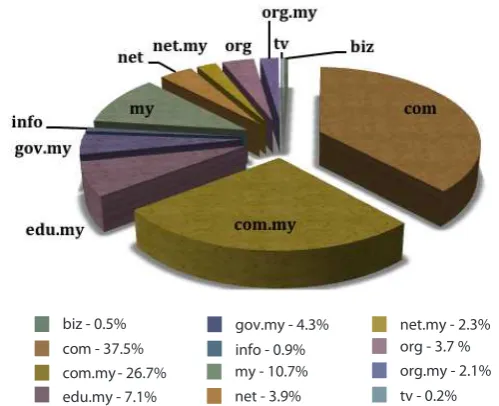
Figure 4 shows the breakdown of domains
defaced in Q3 2013.
Figure 4: : Percentage of Web Defacement by Domain in Q3 2013
biz - 0.5%
com - 37.5% com.my - 26.7% edu.my - 7.1%
gov.my - 4.3% info - 0.9% my - 10.7% net - 3.9%
net.my - 2.3% org - 3.7 % org.my - 2.1%
3
Although incidents involving fraud had decreased to almost 30 percent in this quarter compared to previous quarter, fraud cases are still the top incidents reported to Cyber999. A total of 962 fraud incidents were received in this quarter, from organisations and home users. A majority of fraud incidents reported involved phishing, job scams, fraud purchase and Nigerian scam. Fraud incidents involving phishing incidents from foreign and local brands saw a decrease for this quarter. A total of 78 unique phishing websites targeted local brands while 366 unique phishing websites targeted foreign brands were handled by MyCERT in this quarter.
Despite the decline of fraud incidents this quarter, MyCERT advised Internet users to be precautious and always adhere to best practices when they purchase goods online. Users must ensure that the dealing is made with trusted parties and never simply transfer money to seller without prior checking on the status of the seller.
Cyber harassment incidents meanwhile saw a slight increase of 1% for this quarter, representing a total of 134 incidents. Harassment incidents generally involved cyber stalking, cyber bullying and threatening. Social networking sites such as Facebook, emails and chat programs such as Yahoo Messenger and Skype have become popular avenues for cyber harassment as they are becoming popular communicating channels on the Internet. MyCERT advise users to be very precautious with whom they communicate on the net especially with unknown people and be ethical on the Internet.
Advisories and Alerts
In Q3 2013, MyCERT issued a total of 7 advisories and alerts which involved Critical Vulnerability in Microsoft Internet Explorer 8 and 9, security update for multiple critical vulnerability in Adobe products, critical Microsoft Security Bulletin Summary and alert on Redirection of several .com.my and .my Domains to Defacement Page. The Alert and Advisory comes with descriptions, recommendations and references.
Readers can visit the following URL on advisories and alerts released by MyCERT: http://www.mycert.org.my/en/services/ advisories/mycert/2013/main/index.html
Other Activities
In Q3 2013, MyCERT personnel had conducted several talks, presentations and trainings at several places. This includes presentations at Labuan and Pulau Langkawi regarding security awareness. MyCERT had also conducted several talks on Cyber Trends, Social Media Security in various corporate organisations and Government Agencies.
Besides the talks/presentations, MyCERT personnel had also conducted several Incident Handling trainings for System Administrators from corporate and Government organisations this quarter.
Conclusion
The number of computer security incidents reported to MyCERT this quarter had decreased by 3.8% compared to previous quarter. Only malicious code and intrusion attempt incidents had increased this quarter while other incidents had decreased. No severe incidents were reported in this quarter and MyCERT did not observe any crisis or outbreak within Malaysia. Nevertheless, users and organisations must be constantly vigilant of the latest computer security threats and are advised to always take measures to protect their systems and networks from these threats.
Internet users and organisations may contact MyCERT for assistance at the below contact:
Malaysia Computer Emergency Response Team (MyCERT)
E-Mail: [email protected]
Cyber999 Hotline: 1 300 88 2999
Fax: (603) 8945 3442
24x7 Mobile: 019-266 5850
SMS: Type CYBER999 report <email>
<report> & SMS to 15888 http://www.mycert.org.my/
4
The Application Of Qualitative Method In
Developing A Cyber Terrorism Framework
By | Zahri Yunos and Zaleha Abd Rahim
Zahri Bin Yunos
Chief Operating Officer CyberSecurity Malaysia
An Agency Under the Ministry of Science, Technology & Innovation (MOSTI)
Zaleha Abd Rahim
Head of Knowledge Management Research Division
CyberSecurity Malaysia
An Agency Under the Ministry of Science, Technology & Innovation (MOSTI)
Introduction
Methodology can be simplified as a plan of action where the method used results in the desired outcome. The context of methodology as described by Crotty [1] cited in Levy [2], defines methodology as "the strategy, plan of action, process or design lying behind choice of particular methods and linking the choice and use of methods to the desired outcome". It is a researcher's task to examine and make a decision about which research approach, or combination of approaches, should be used in a specific study [3]. The objective of this paper is to describe the application of qualitative method in developing a cyber-terrorism framework. The purpose is to discover a theory and then develop a conceptual framework that describes the phenomena by using qualitative method.
Literature Review
2.1 Cyber Terrorism
In this digital age, the use of cyberspace to carry out terrorist activities have emerged. As mentioned by Denning [4], the convergence of
physical terrorism and new advancement of ICT have spawned a new term called cyber terrorism. It can be summarised that cyber terrorism is the perpetration of attack through cyberspace and the virtual world. There is no universally accepted definition of cyber terrorism, which seems to be a fundamental issue and challenge in countering threats from cyber terrorism [5].
At the international front and among researchers, there is no common agreement on the concept of cyber terrorism. While there are many definitions of cyber terrorism [6] [7] [8], these suggest a trend that in-depth analysis of this concept can be conducted. This can also be evidence that the study of this concept has been the focus of many policy makers and scholarly studies, but their standpoints and views vary. Due to multidimensional structure (or components) of cyber terrorism, we can say that the concept of cyber terrorism is a contested concept whereby various parties interpret it differently [9][10]. Schmid [11] argues that, "there is no agreement among experts and there is not likely to be an agreement as long they cannot even agree on a common definition on terrorism [and cyber terrorism]."
The concept of cyber terrorism has several attributes (or components) such as motivation, impact and target [12] [13] [14]. Due to complexity of various interacting variables in the concept of cyber terrorism, to formulate a framework in describing its inluential components would be beneficial. As noted by Tafoya [15], wrong assumptions about concepts can lead to misunderstanding. Therefore, accurate knowledge on the context of cyber terrorism enhances clarity and helps to avoid obscuring intent. Thus, there is a need for a more structured approach in understanding the various components of cyber terrorism.
5
The outcome of this study serves as the basis for various strategic decisions for policy and decision makers as well as a useful foundation for academic research in understanding the context of cyber terrorism.
2.2 Qualitative Method Research
There are considerable literatures that discuss qualitative research methodologies [16]. Generally, the qualitative research can be explained from the following perspectives.
Firstly, qualitative research aims to achieve an in-depth understanding of a situation or a certain phenomenon [17]. The focus of the research is to explore (understand and interpret) a situation or a certain phenomenon. Qualitative research is labelled as interpretive research because it seeks to develop understanding through detailed description for theory building. Secondly, since qualitative research is interpretive, such research allow for the discovery of new ideas and unanticipated occurrences [18]. At the data collection stage, the array of techniques include focus groups, in-depth interviews and observations [19]. During analysis, the qualitative researcher uses content analysis of written or recorded materials drawn from participants' expressions and observations [17] or document reviews [2].
Thirdly, qualitative research is often related to small-scale studies. Qualitative data is usually collected through interviews, focus groups and participant observations. Fourthly, in qualitative research, a researcher may serve as a participant, whereby the researcher may observe and provide insights during the process [17].
Research Framework of this Study
This research is about exploring the cyber terrorism phenomenon, focusing on the attributes or components of cyber terrorism. Since this project is exploratory in nature, a qualitative research is proposed. The nature of this research is in-depth where an interview-based technique is used. In this study, the qualitative method is conducted with the
objectives to investigate the phenomena under study, to identify and construct attributes of the phenomena and to develop the empirical model that describes the phenomena.
The authors believe that a qualitative method approach is appropriate to be used in this study in order to accomplish theory discovery within a single research project. Theory discovery is achieved by using qualitative data to sharpen our theoretical ideas about the phenomena under investigation. Qualitative methods permit the researcher to record and understand people in their own terms, whereby depth and detail emerge through direct quotation and careful description. The framework of research methodology is described below (Figure 1).
Interview Questions
Usually, qualitative method involves interviewing a sample population about a topic, transcribing the interviews, coding parts of the transcripts, and relating these codes to one another [20]. In this project, the interview technique is a semi-structured interview, starting with a few specific questions and then following the individual's tangents of thought with interview probes. Interview questions were given to the respondents with minimal guidance, to allow the respondents to have some background on the phenomena being studied. According to Walsham [21], interview should be supplemented by other forms of field data in an interpretative study; and these may include press, media and other publications relevant to the context of the study.
Frankel and Devers [22] stress that another set
Results & Discussions
Objectives:
1. To investigate the phenomena 2. To identify and construct attributes of the
phenomena
3. To develop conceptual framework that describes the phenomena
Cyber Terrorism Conduct data analysis on the context of cyber terrorism by
using the grounded approach
6
of critical issues affecting the formulation of the interview questions is the primary audience for the research, the goal of the research and what role, if any, shape the interview questions. In this research, the questions are divided into 2 parts: broad and specific. The broad questions in the questionnaire are used for generic issues surrounding the area of cyber terrorism and the second part is to explore the importance of components in the cyber terrorism framework. The research questions are addressed in a developmental manner and rely on discussions of literature to help frame and refine the specific topic. The objectives of the initial questions are to probe and provide some insights on the issues under investigation. The questions are linked to the problem and significant to the issue of interest. The questions are theoretical, which provide a number of different samples and specific questions, which focus on a particular issue of interest. Table 1 presents samples of the interview questions.
Table 1. Sample of the interview questions
Result
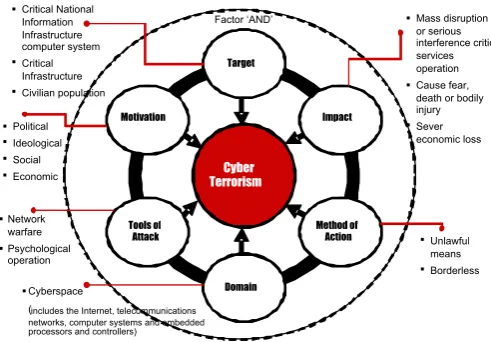
The findings indicated that the nature of cyber terrorism should have been formulated from six perspectives: motivation, target, method of attack, domain, action by perpetrator and impact [23][24][25]. Motivation is about inluencing human beings and the decisions they make.
Motivation forces behind cyber terrorism are social, political, ideological and economic. With the growing interconnectedness of critical infrastructures in ICT, the selection of a target that allows the maximum level of disruption would significantly inluence the perpetrator. The perpetrator can exploit vulnerabilities over a targeted system through a vast array of intrusive tools and techniques. The method of attack could be through network warfare and psychological operation. Cyberspace is the domain in which a terrorist-type attack is conducted. The perpetrator employs unlawful use of force or unlawful attacks to conduct the premeditated attack. The impact or consequence is high as the cyber-attacks are done to intimidate or coerce a government or people that lead to violence against persons or properties.
The illustration of core components of cyber terrorism is described in Figure 2. In other words, the framework suggests that all attributes (or components) contributed in the decision-making process in order to determine whether someone is involved in cyber terrorism or not. The authors suggest that the six components of cyber terrorism in this framework are bound together to form the concept of cyber terrorism. We need to combine the components with conjunction "AND", which means each of those components is necessary to constitute cyber terrorism. Otherwise, if one or more components are not provided, it would not constitute cyber terrorism.
What are the factors that make up the components (or elements) of cyber terrorism?
What are the factors that should not be considered as component (or element) of cyber terrorism?
From the various literatures, a conceptual framework describing the core components of cyber terrorism can be described as follows (but not limited to): Target, Motivation, Tools of Attack, Domain, Method of Action and Impact. What is your view?
The components of cyber terrorism are bound or linked to each other to form the concept of cyber terrorism. We need to combine the components with the conjunction "AND", which means, each of those components is necessary to constitute cyber terrorism. If one or more components are not provided, the statement would not constitute cyber terrorism. What do you think?
Q1
Civilian population
Political
( includes the Internet, telecommunications networks, computer systems and embedded processors and controllers)
Unlawful means
Borderless
Mass disruption or serious interference critical services
7
Conclusion
The study on the context of cyber terrorism is quite complex as it is about threat perception which makes the concept different from one to another. Understanding similarities and differences in perception of what constitutes cyber terrorism can provide insight on the concept of cyber terrorism. This paper explains on how this research is conducted and describes the framework of research methodology. This paper also establishes the conceptual framework that guides data collection and data analysis techniques. The outcome of this study serves as the basis for various strategic decisions for policy and decision makers as well as useful foundation for academic research in understanding the context of cyber terrorism. Detail and focused analysis can be conducted to investigate and
analyse the context of cyber terrorism. ■
References:
1. M. Crotty, The Foundation of Social Research: Meaning and Perspective in the Research Process. St Leonards, NSW: Allen and Unwin, 1998.
2. D. Levy, “Qualitative Methodology and Grounded Theory in Property Research,” Paciic Rim Property Research Journal, vol. 12, no. 4, pp. 369–388, 2006.
3. R. B. Johnson and A. J. Onwuegbuzie, “Mixed Methods Research: A Research Paradigm Whose Time Has Come,” Educational Research, vol. 33, no. 7, pp. 14–26, 2004. 4. D. E. Denning, “Activism, Hactivism and Cyberterorism:
The Internet as a Tool for Inluencing Foreign Policy,” in Conference on The Internet and International System: Information Technology and American Policy Decision Making, 1999.
5. J. J. Prichard and L. E. MacDonald, “Cyber Terrorism: A Study of the Extent of Coverage in Computer Security Textbooks,” Journal of Information Technology Education, vol. 3, 2004.
6. B. Mantel, “Terrorism and the Internet. Should Web Sites That Promote Terrorism Be Shut Down?,” CQ Researcher, pp. 129–152, 2009.
7. M. Conway, “Reality Bytes : Cyberterrorism and Terrorist ‘ Use ’ of the Internet,” FIRST MONDAY, Journal on the Internet, 2002. [Online]. Available: www.irstmonday. org/ISSUES/issue7_11/conway. [Accessed: 09-Jun-2008].
8. C. Wilson, “Computer Attack and Cyberterrorism: Vulnerabilities and Policy Issues for Congress,” 2005. 9. Z. Yunos and S. H. Suid, “Protection of Critical
National Information Infrastructure (CNII) Against
Cyber Terrorism: Development of Strategy and Policy Framework,” in IEEE International Intelligence and Security Informatics (ISI) Conference, Vancouver, Canada, 23-26 May, 2010, p. 169.
10. Z. Yunos, S. H. Suid, R. Ahmad, and Z. Ismail, “Safeguarding Malaysia’s Critical National Information Infrastructure (CNII) Against Cyber Terrorism: Towards Development of a Policy Framework,” in IEEE Sixth International Conference on Information Assurance & Security, Atlanta, GA, 23-25 Aug, 2010, pp. 21–27. 11. A. P. Schmid, “Root Causes of Terrorism: Methodological
and Theoretical Notes, Empirical Findings and Four Inventories of Assumed Causal Factors,” 2005.
12. N. Veerasamy, “A Conceptual High-level Framework of Cyberterrorism,” International Journal of Information Warfare, vol. Vol. 8, no. 1, pp. 1–14, 2009.
13. R. Heickero, “Terrorism Online and the Change of Modus Operandi,” Swedish Defence Research Agency, Stockholm, Sweden, pp. 1–13, 2007.
14. S. Gordon and R. Ford, “Cyberterrorism?,” 2002.
15. W. L. Tafoya, “Cyber Terror,” FBI Law Enforcement Bulletin. pp. 1–7, Jun-2011.
16. R. Ahmad and Z. Yunos, “The Application of Mixed Method in Developing a Cyber Terrorism Framework,” Journal of Information Security, vol. 03, no. 03, pp. 209–214, 2012. 17. D. R. Cooper and P. S. Schindler, Business Research
Method. NY: McGraw-Hill Companies, Inc, 2008.
18. J. K. Jacobs, T. Kawanaka, and J. W. Stigler, “Integrating Qualitative and Quantitative Approaches to the Analysis of Video Data on Classroom Teaching,” International Journal of Educational Research, vol. 31, pp. 717–724, 1999. 19. C. Yauch and H. Steudel, “Complementary Use of
Qualitative and Quantitative Cultural Assessment Methods,” Organizational Research Methods, vol. 6, no. 4, pp. 465–481, Oct. 2003.
20. D. Furniss, A. Blandford, and P. Curzon, “Confessions from a Grounded Theory PhD : Experiences and Lessons Learnt,” in The ACM CHI Conference on Human Factors in Computing Systems, Vancouver, BC, Canada, May 7-12, 2011.
21. G. Walsham, “Doing Interpretive Research,” European Journal of Information Systems, no. 15, pp. 320–330, 2006. 22. R. M. Frankel and K. J. Devers, “Study Design in Qualitative
Research: Developing Questions and Assessing Resource Needs,” Education for Health (Abingdon, England), vol. 13, no. 2, pp. 251–61, Jan. 2000.
23. R. Ahmad, Z. Yunos, S. Sahib, and M. Yusoff, “Perception on Cyber Terrorism: A Focus Group Discussion Approach,” Journal of Information Security, vol. 03, no. 03, pp. 231–237, 2012.
24. R. Ahmad, Z. Yunos, and S. Sahib, “Understanding Cyber Terrorism : The Grounded Theory Method Applied,” in IEEE International Conference on Cyber Security, Cyber Warfare and Digital Forensic, Malaysia, 26-28 June, 2012, pp. 334–339.
8
Abdul Alif Bin Zakaria
Analyst, Cyber Technology Research Department Research Division CyberSecurity Malaysia
An Agency Under the Ministry of Science, Technology & Innovation (MOSTI)
Liyana Chew Binti Nizam Chew
Analyst, Cyber Technology Research Department Research Division
CyberSecurity Malaysia
An Agency Under the Ministry of Science, Technology & Innovation (MOSTI)
Introduction
The increasing number of Internet users today has led to the increasing number of data being transferred online. Most of the data is transferred as clear text information, which is vulnerable to the unintended recipient. Therefore, a reliable secure information transmission method should be applied widely so that the threats of information leakage or data theft can be reduced. The secure information transmission method known as ‘Audio Steganography’ is one method deemed secure as it ensures that existence of data is unnoticed.
Audio Steganography
Overview
The word steganography is derived
from a Greek word “steganos”, which means covered or secret and “graphy” signifying writing or drawing. Therefore, steganography, literally means, “covered writing”. In other words, steganography is the hiding of a secretAudio Steganography: An Alternative
Method for Secure Information Transmission
By | Abdul Alif Bin Zakaria, Liyana Chew Binti Nizam Chew
message within an ordinary message and the extraction of it at its destination. A common steganography technique uses a picture or image as a cover object in which the message is hidden. In this article, the technique that will be highlighted is audio steganography or the hiding of information in sound.
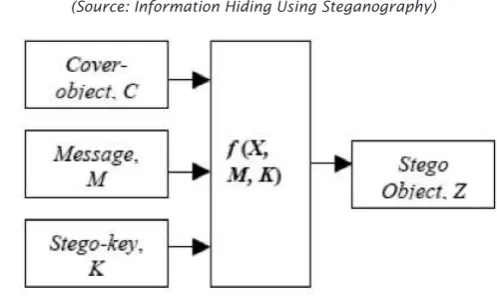
Figure 1: Basic Audio Steganography Model (Source: Information Hiding Using Steganography)
Information is hidden using a cover or host audio as a wrapper. The existence of the information is concealed during transmission so that the existence of the information remains unnoticed. Audio steganography relies on the imperfection of human auditory (hearing weakness) and visual system. It takes advantage of human auditory system (HAS), where weak tones cannot be heard because of the existence of a stronger tone in an environment. For example, speech may not be heard at a football stadium filled with spectators who are cheering for their favourite team.
Frequency masking occurs when people do not recognise frequencies at a lower level if frequencies in the surrounding areas are at a higher level. A weak, pure tone is masked by wide-band noise if the tone occurs within a critical band. Different ways for embedding
9
information can be applied due to the properties of inaudibility of a weaker sound.
Elements in Audio
Steganography
The basic model of audio steganography contains three elements namely cover object, message and stego-key. The cover object is also known as carrier, in which a message is embedded and it serves to hide the existence of the message. In this case, the sound itself is the cover object.
Message is the data which sender wishes to maintain its secrecy. It can be in the form of plaintext, ciphertext, image or anything that can be embedded in a bit stream such as copyright mark, a covert communication, or a serial number.
Stegokey works as password which will ensure that only a receiver who knows the key will be able to read the message from cover-object. Incorrect stegokey may lead to unreadable message by the recipient.
The cover-object with the secretly embedded message is then called the stego-object., Stego-object is the sound which the message is hidden or altered.
Following are examples of digital audio formats which react as a cover object in audio steganography:
-The process of hiding information can be applied in many ways but this article discusses only one technique; using an audio file. We have to identify the redundant bit in a cover-object. The redundant bit can be changed or modified without damaging the quality of the cover-object. The message bit will then be embedded into the redundant bit in
cover-object. In this example an audio file is used as the cover-object. Changes on embedded cover-object cannot be heard because the difference is too small. When the two audio files are compared, they almost sound alike without realising there is an embedded message in it.
Audio Steganography vs
Cryptography
Cryptography changes the structure of a message by encrypting it so that no one except the one who has its key can read its information. In the electronic environment, an attacker might attempt to steal or intercept the message while it is at rest, in use or in transit. By attacking the algorithm or keys, it might enable the attacker to decrypt the message, hence retrieving the hidden information.
Audio steganography is different from cryptography as it does not use algorithm to change the structure of message. The main goal of audio steganography is to prevent the attacker from realising the existence of the information by hiding the message. A key is needed to hide and reveal the message from the audio file.
Although the two concepts are different, they can be applied together to add multiple layers of security. First, a message is encrypted using the encryption key to become a ciphertext. The ciphertext is then embedded into an audio file and sent to the receiver. By doing this, an attacker may not have the chance to break the code or even if they have, it requires extra work to access information.
Technique of Hiding
Information
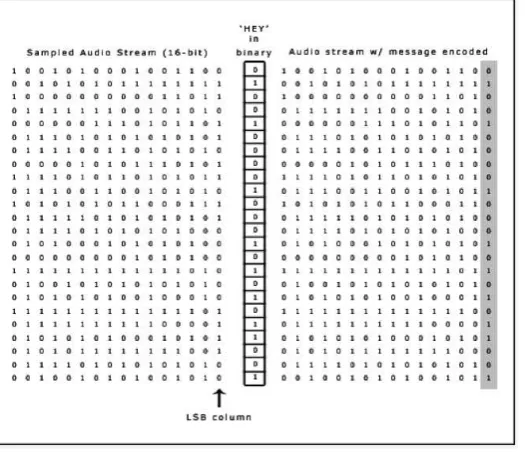
Least significant bit insertion is the easiest technique which embeds the message bit into the least significant bit in the cover-object.
• wav
• midi
• avi
• mpi
10
The audio file size and message size must be determined by the system to allow the audio file to hold- the embedded message. Changes to the sound are unnoticed so that no one realises the embedded message. The stego-object is sensitive to changes or manipulation. Addition of noise or compression to the stego- object will demolish the message.
Conclusion
Information hiding can increase confidentiality of the information and provide privacy in daily communications. Audio steganography technology is a very important part of the future of Internet security and privacy in the open system environment like the Internet. Audio steganography research is primarily driven by the lack of strength in cryptographic systems, hence both techniques need to be combined in order to achieve a better information security in an open-systems environment.
Several laws have been created by many governments to limit the exports of cryptosystems to other countries or even
prohibit the strong cryptographic solutions from being used. Such laws are to prevent cryptography from being used by criminals to hide their information and communications; hence hindering the law enforcement agencies with their investigation. However, such restriction has caused the majority of Internet community only using weak encryption algorithms that are often thought to be unbreakable.
Many parties and organisations are against this restriction on the use of cryptography as it violates users’ privacy which is protected under human rights. The protection of secret messages through the use of audio steganography has become increasingly important and widely used because it can hide important information in other files. To add multiple layers of security, it is best to apply both cryptography and audio steganography at one time. Neither cryptography nor audio steganography is thought to be the “turnkey solution” to providing an open system privacy, but by applying both technologies at a time, it may help users to achieve better privacy when
using Internet as a communication medium.■
Reference
1. Methods of Audio Steganography
http://www.snotmonkey.com/work/school/405/ methods.html
2. El-Shishtawy, M. (2012) Audio steganography – LSB
http://www.slideshare.net/mohabshishtawy/ audio-steganography-lsb
3. Mohammed, A.M. and Hussain, A.A. Information Hiding: Steganography and Watermarking http:// www.emirates.org/ieee/information_hiding.pdf 4. Muhalim, M.A., Subariah, I., Mazleena, S.,
Mohd, R.K. (2003). Information Hiding Using Steganography.
http://eprints.utm.my/4339/1/71847.pdf
5. Memon, N. Information Hiding, Digital Watermarking and Steganography
http://eeweb.poly.edu/~yao/EE4414/memon_ F05_v2.pdf
11
Nor Azeala binti Mohd Yusof
Analyst, Cyber Technology Research Research Division
CyberSecurity Malaysia
An Agency Under The Ministry of Science, Technology & Innovation (MOSTI)
Isma Norshahila Binti Mohammad Shah
Analyst, Cyber Technology Research Department
Research Division CyberSecurity Malaysia
An Agency Under the Ministry of Science, Technology & Innovation (MOSTI)
Introduction
The rapid growth of the Internet has become a global phenomenon reshaping the way we communicate, manage, access, use and commercialise information, to conduct business electronically. Electronic commerce, also known as e-commerce or EC, is a process of buying and selling goods, services, and information on the Internet. Today, e-commerce has become a powerful tool for business transformations, by allowing companies to enhance their supply-chain operations, reach new markets and improve services for customers as well as providers. In e-commerce transactions are carried out across the world using the Internet.
E-commerce can be divided into several categories such as B2C (Business to Consumer), B2B (Business to Business), B2B2C (Business to Business to Consumer), G2B (Government to Business) and G2C
(Government to Consumer). However, the most common and popular system used is B2C which allows businesses to sell goods or services to their customers from their e-mails or social networking websites.
Application of E-Commerce
Online shopping, online marketing and advertising
By using e-commerce, retailers need not worry about operating physical stores. They only need to advertise and place information about their products on their website, blog, or social networking sites. Customers can do online shopping from home on their electronic devices such as computers, laptops, and mobile phones.. Thus they no longer need to go to stores. Customers can choose from various online stores and place their orders by contacting the retailers using email or SMS. Payment can be made using debit cards, credit cards, or when the product is delivered to their homes.
Online Banking
Online banking, also called home banking, allows customers to operate, access and manage their accounts, including paying bills without going to the bank. They can use the bank’s services from any convenient location as long as they are connected to the Internet. Customers only need to open the bank’s website and login as authorised account owners. For the authentication process, customers will need to prove their identities by providing their passwords or they will be asked for answers to security questions. They will be permitted to access their accounts immediately after their
How Secure is E-Commerce?
By | Nor Azeala binti Mohd Yusof, Isma Norshahila binti Mohammad Shah
12
identities are proven. All the transactional data online is in encrypted form, so if a hacker tries to hack the information, he or she will not able to read the actual message.
Supply chain management
A supply chain is a collection of interdependent steps which will accomplish a certain objective. For example, a company may have several departments, such as Production, Marketing, Customer Service, Accounting and Finance, as well as Shipping and Distribution. If consideration is not given equally to all departments, it will not fulfil the purpose of company development. Since the low of information is required between all departments, the information can be made available online to each and every department. Therefore, the intersharing of information and integrity of these entire departments are assured, as it is one of the important features in supply chain management
Security Issues In E-Commerce
Many companies that offer products and services online face security risks that threaten their businesses. Many threats to e-commerce could potentially occur within the company or externally. There are several types of security issues in e-commerce applications which need to be addressed:
Client threats
a. Active contents – programmes that are embedded transparently in web pages and cause action to occur.
b. Malicious Software (Malware)
c. Server-side masquerading – Masquerading lures a victim into believing that the entity with which it is communicating is a different entity.
Communication channel threats
• Confidentiality threats – Confidentiality
is a prevention of unauthorised information disclosure. Confidentiality can be breached by recording the secret information the user has just entered.
• Integrity threats – exists when an
unauthorised party can alter a message stream of information. It can alter vital financial, medical or military information.
Server threats
• Web-server threats, commerce server threats,
database threats, and common gateway interface threats can have security holes and bugs. If someone obtains user authentication information, then he or she can masquerade as a legitimate database user and reveal private and costly information.
• Password hacking – The simplest attack
against a password-based system is to guess a password.
Unwanted Programmes
• Adware – Calls for unwanted pop-up ads
• Spyware – Can be used to obtain
information, such as a user’s keystrokes, e-mail, IMs, etc.
Phishing and Identity Theft
An attempt by a third party to obtain confidential information for financial gain. The most popular type is the e-mail scam letter. It is one of the fastest growing forms of e-commerce crime.
Hacking and Cyber Vandalism
• Hacker – an individual who intends to gain
unauthorised access to computer systems.
• Cracker – a hacker with criminal intent.
(two terms often used interchangeably)
• Cyber vandalism – the act of intentionally
disrupting, defacing or destroying a website.
• Viruses with the ability to replicate and
spread to other files and folders.
• Worms that are designed to spread from
computer to computer.
• A Trojan horse is used to perform
malicious and unexpected damage.
• Bot programmes can be covertly installed
13
Credit Card Fraud
Credit card information can be stolen, deterring online purchases. Hackers target credit card files and other customer information files on merchant servers and use the stolen data to establish credit under false identities.
Spooing (Pharming) and Spam (Junk) Websites
• Spoofing – Presenting oneself by using a
fake e-mail address or masquerading as someone else.
• Spam – Using domain names similar to
legitimate one, then redirecting traffic to spammer redirection domains.
DoS and DDoS Attacks
• Denial of Service (DoS) attack – Hackers
lood a website with useless traffic to inundate and overwhelm network.
• Distributed Denial of Services (DDoS)
attack – Hackers use numerous computers to attack the target network from numerous launch points.
Other Security Threats
• Sniffing – An eavesdropping programme
that monitors information shifting over a network. It enables hackers to steal proprietary information from anywhere on a network.
• Insider jobs – Single largest financial
threat.
• Poorly designed server and client
software –With increased complexity of software programmes, this has led to an increase in vulnerabilities which hackers can exploit.
Security Technologies
There are many relevant technologies, including cryptographic technologies that can mitigate vulnerabilities. However, none is comprehensive on its own. In the mass media, the most visible security technology
is the encrypted algorithms. E-commerce software packages should also work with Secure Electronic Transfer, Secure Socket Layer, Public Key Infrastructure (PKI) and Secure E-commerce protocol technologies for encryption of data transmissions.
Digital Signatures and Certiicates
Digital signatures provide the requirement for authentication and integrity. A sending message is run through a hash function and new value is generated as a message digest. The message digest and the plain text is encrypted with the recipient’s public key. The recipient then decrypts the message using his private key and verifies the message using the supplied hash algorithm. Digital certificates are also used for security purposes. Certificate Authority (CA) issues an encrypted digital certificate to an applicant that contains the applicant’s public key and other identification information. An algorithm provides the capability to generate and verify signatures. Signature generation makes use of private key to generate a digital signature.
Secure Socket Layer (SSL)
SSL was developed to provide secure communication between web servers and clients. SSL is widely used on the Internet especially in interactions that involve exchanging of confidential information such as credit card numbers. It also provides authentication to both parties to secure communication. SSL provides point to point security. The message is encrypted only during transmission over the network and other security mechanisms are required to handle security of the messages in an application or disk.
Pretty Good Privacy (PGP)
14
provides authentication and confidentiality, compression and segmentation services for email security.
• Authentication
SHA-1 is used to generate a 160 bits hash code of the sending message. Then, the hash code is encrypted using sender’s private key and the result is appended to the message. The receiver decrypts the hash code by sender’s public key. The receiver generates a new hash code for the message and compares it with the decrypted hash code. If both hash codes are same then the message is authentic.
• Confidentiality
A message is combined with 128 bits session key for the sending. The message is encrypted using 3DES with the session key which is encrypted using the recipient’s public key and appended to the sending message. The receiver uses its private key to decrypt and recover the session key which it is also used to decrypt the sending message.
• Public Key Infrastructure (PKI)
PKI is used to allow message distribution through the use of public keys and digital certificates to provide secure communication. Some of the popular public key encryption algorithms are RSA, El-Gamal, and ECC. Most of them are using algorithms based on discrete logarithms in finite groups or integer factorisation.
• Secure E-commerce Protocol
Secure E-commerce Protocol provides a certificate based security mechanism. Both customer and merchant request CIA for the issuance of certificates, so both can initiate their transactions. Both parties will authenticate each other by their ID’s. This approach is also used to handle replay threats. Secure E-commerce Protocol provides security against Authentication, Confidentiality,
Integrity, Non Repudiation, Replay attack and Man- in -the -middle attack.
Conclusion
Electronic commerce is growing rapidly and simultaneously giving rise to security issues in computer networks. There are many guidelines for securing systems and networks available for e-commerce systems. Training and orientation programmes are becoming more critical in order to increase the security awareness among e-commerce users. IT and financial groups using e-commerce sites should form an alliance to overcome the general resistance to the implementation of security practices at a business level. Therefore, consumers need to be educated further on security issues and become more concerned about protection of their personal information. Privacy is an important issue that needs to be addressed to
ensure the future growth of e-commerce. ■
References
4. Cryptography Based E-Commerce Security : A Review
http://ijcsi.org/papers/IJCSI-9-2-1-132-137.pdf 5. E-Commerce and Internet Security
http://www.acfe.cz/files/E_Commerce_and_ Internet_Security_Zachary_Rosen.pdf
6. Privacy and Security Issues in E-Commerce http://econ.ucsb.edu/~doug/245a/Papers/ ECommerce%20Privacy.pdf
7. E-Commerce Security-A life cycle approach http://www.ias.ac.in/sadhana/Pdf2005AprJun/ Pe1335.pdf
8. E-Commerce Security Issues
h t t p : / / w w w. h i c s s . h a w a i i . e d u / h i c s s _ 3 5 / hicsspapers/pdfdocuments/inisc01.pdf
9. E-Commerce security
h t t p : / / p a p e r . i j c s n s . o r g / 0 7 _ book/200805/20080550.pdf
10. Framework of e-Commerce
http://staff.fit.ac.cy/com.bd/MIS/Readings/ Framework%20of%20e-Commerce.pdf
11. 8. Transaction Security for E-Commerce
application
15
Introduction
These days it’s hard to find people who do not own a smart phone. In fact, some people use more than one smart phone. It is natural that people bring their own devices to their workplace and wanting to use it to access company resources (think web access) and corporate applications like email. Yes, you’ve guessed it right if you think that there may be some issues arising from this trend.
Let us start from the basics. Most people have heard of BYOD or ‘Bring Your Own Device’. Before that acronym gets turned around on its head and becomes ‘Bring Your Own Disaster’, we must make sure users are aware of the threats that come with the BYOD movement. Then we need to educate them on what to do in order to mitigate some of those threats.
This article will focus on Android security basics. The reason is easy enough, Android is the most popular smart phone operating system today. According to analyst firm Canalys, Android devices accounted for 67.7 percent of all smart phones shipped in 2012. It is projected that over 1 billion Android smart phones will ship in 2017.
Why is securing Android important? Well, it is logical that if many people use Android as their smart phone operating system then it becomes very attractive for the bad guys to attack Android and applications that run on the Android
Bring Your Own Device
Be smart. Ensure your devices are secure!
By | Ruhama bin Mohammed Zain
platform. Keeping that in mind, imagine what happens when unsecured Android devices are brought into your company under the BYOD movement which seems unstoppable. We are moving closer to the Bring Your Own Disaster meaning of BYOD!
Threats to BYOD in general:
#1 Lost or Stolen Mobile Device
This is an obvious one. When a device is lost and it contains company related or company-owned data then we may have a major disaster on our hands. This may not be caused by someone purposely trying to steal company secrets by stealing a mobile device but incidental to an employee losing the device due to carelessness or oversight.
#2 Untrustworthy Applications
By some estimates there has been more than 100 billion mobile applications downloaded since 2008.
16
Yes, trusted application marketplaces such as Google Play do provide some assurance that the applications downloaded from there are safe. But should we believe that every single application is fully tested and guaranteed to behave properly? If users choose to download applications from other places that are not official marketplace, then all bets are off. Incidentally, there are more than 500 third-party app stores containing malicious apps to choose from!
There is a real risk of one of your employees walking around with a mobile device containing a rogue application that is secretly doing its dirty deed from inside your organisation.
#3 Unpatched Mobile Devices
It is simply a fact of life that any software written by humans is not perfect. There will always be security flaws inside, just waiting for attackers to discover and take advantage of. Why do you think we keep getting software upgrades and new releases all the time? Not keeping the mobile device patched and updated to overcome security problems is another threat to mobile device security.
Some Android Speciic Threats
Now let us take a look at Android specific security threats.
The biggest thing that the Google operating system (Android) got going for it is its open nature. That means it is easy for anybody to learn how to develop applications for it. That would include malware authors as well. Remember we
said that Android is the most popular mobile operating system today? So it is not surprising that according to Juniper Networks Mobile Threat Centre (MTC) by March 2013, Android takes up more than 92 percent of all mobile malware threats that the MTC detected.
The second potential Android specific security threat comes from the so-called adware that displays advertisement on mobile devices from within the host application. The problem resides in third-party software called mobile ad libraries. Security researchers claim that these software can go beyond collecting private information such as device identifiers like IMEI, IMSI and location information. It will collect when instructed, sensitive information like call history, contacts, and even text messages. Not only that, it may also execute dynamically downloaded code. The reader is encouraged to read more about this finding at the FireEye website given in the link under References at the end of this article.
17
SMS message. Sadly, the majority of users are still without this latest update and therefore may still be victims of this type of Android malware.
Who does not like free apps, right? Unfortunately, the fourth security threat comes from the so-called free apps available for Android. Researchers have found that free apps are three times more likely to track location and 2.5 times more likely to access contact information than their paid equivalent. Moral of the story? When you pay nothing, be prepared to give something back in return even if you may not know what it is you are divulging to the outside world.
So What Can We Do?
The good news is there are some things that can be done to reduce or mitigate the risks associated with the threats described above. Having these measures in place will not guarantee fool-proof protection of course, but it will put the organisation on the right track towards improving the security posture of its BYOD movement.
The first thing to do is to protect against malware by using anti-virus solutions. While some may argue on the effectiveness of anti-virus solutions on mobile devices, they are still valuable as a first line of defence against malicious applications and malware.
Second, look into ways to remotely track, locate, lock or wipe lost or stolen devices. Deploy this technology on both corporate and BYOD devices. Have policies that require users to consent to deploying this technology onto their devices before they are allowed to use their own devices in the corporate
network. Remember to also encrypt any data stored on the devices especially corporate-owned data.
Third, make use of mobile device management (MDM) features that can blacklist known bad applications. Another way would be to use an application white-list that disallows any mobile device with non-approved mobile application from getting on the corporate network.
Fourth, control what corporate-owned device users can download. This helps to reduce the possibility of downloading unapproved apps or worse, malwares.
Conclusion
There is no denying the fact that threats to mobile security and Android security in particular will only increase in the future. The profits to be made from exploiting the mobile technology vulnerabilities and mobile users’ gullibility is simply too huge for cyber criminals to ignore. The best strategy to have is to reduce the chance of bad things happening to us by doing what we can to make it harder for the bad guys to win.■
References
1. h t t p : / / w w w. c s o o n l i n e . c o m / a r t i c l e / 7 4 1 0 7 2 / raising-awareness-quickly-explaining-byod-and-mitigating-mobile-risks?page=3
2. h t t p : / / w w w. t h e r e g i s t e r. c o . u k / 2 0 1 3 / 1 0 / 0 8 / android_ad_peril/
3. h t t p : / / w w w . f i r e e y e . c o m / b l o g / technical/2013/10/advulnaavulnaggressivev u l n e r a b l e a g g r e s s i technical/2013/10/advulnaavulnaggressivev e a d w a r e t h r e a t e n i n g -millions.html
18
Nur Sharifah Idayu binti Mat Roh
Analyst,
Security Assurance CyberSecurity Malaysia
Pelayan web anda yang bersambung ke Internet 24 jam sehari menghadapi ancaman penggodam sepanjang masa. Penggodam sentiasa mencari peluang dengan niat jenayah tertentu terhadap keselamatan di pelbagai sistem operasi pelayan web. Pelayan Web (Server Web) adalah merujuk kepada perkakasan (komputer) atau perisian (aplikasi komputer) yang membantu dalam menyampaikan kandungan yang diakses melalui Internet atau intranet. Program pelayan web akan sentiasa berfungsi di dalam komputer. Apabila mana-mana pengguna cuba untuk mengakses laman web yang dihoskan oleh pelayan web, program pelayan web akan menyediakan laman web berdasarkan permintaan pengguna.
Isu-isu keselamatan pelayan web adalah aspek penting dalam melindungi sistem maklumat. Malangnya ramai pemilik dan pengurus sistem maklumat yang kurang mengambil berat isu-isu keselamatan terhadap pelayan web mereka atas sebab kurangnya pendedahan mengenai kaedah dalam menghadapi serangan terhadap pelayan web. Oleh itu, artikel ini akan membincangkan tentang tips-tips yang boleh digunakan dalam menghadapi serangan ini.
Kuatkan Benteng!
Pastikan pelayan web anda bersedia menghadapi serangan
By | Nur Sharifah Idayu binti Mat Roh
Tips Pertama: ‘Patches’ Dan
‘Updates’
Langkah pertama yang perlu dilakukan adalah dengan membuat imbasan(scan) bagi mengenal pasti kelemahan yang sedia ada, ‘patch’ dan kemaskini perisian pelayan web dengan kerap bagi mengelakkan ia ditembusi penggodam. Pengimbas rangkaian boleh digunakan bagi memeriksa apa-apa juga kemungkinan yang mungkin berisiko kepada sistem. Kemaskini pengkalan data pengimbas rangkaian dengan kerap bagi memperoleh maklumat pepijat terbaru.
Sebelum menggunakan mana-mana perkhidmatan, hotfix atau patch keselamatan, semua dokumen yang berkenaan perlu diteliti terlebih dahulu. Lakukan ujian ke atas setiap pek perkhidmatan dan hotfix yang dikemaskini di dalam pelayan web sementara sebelum digunakan di dalam pelayan web yang sebenar.
Di samping itu, proses kemaskini pelayan web mesti mengikut jadual tertentu supaya dapat berjalan tanpa gangguan. Set pita backup serta cakera pembaikan kecemasan juga perlulah tersedia dan dapat digunakan pada bila-bila masa. Sediakan satu ‘rollback plan’ yang membolehkan sistem kembali kepada keadaan asal sekiranya pelayan web digodam. Jadual berkala perlu disediakan bagi menaikkan taraf pek perkhidmatan dengan menjadikannya sebahagian daripada operasi penyelenggaraan.
19
Tips Kedua: Protokol
Di dalam penggunaan protokol pula, elakkan penggunaan protokol yang sudah diketahui kurang selamat seperti ‘Telnet’, ‘POP3’, ‘SMTP’, dan ‘FTP’. Jika tidak dapat mengelak daripada menggunakan protokol ini, ambil langkah-langkah yang sesuai dengan menyediakan autentikasi dan komunikasi yang selamat, contohnya menggunakan polisi ‘IPSec’. Sekat semua port yang tidak perlu seperti ‘NetBIOS’ dan ‘SMB’, serta ‘Internet Control Message Protocol (ICMP) traffic’.
Terdapat pelbagai jenis aplikasi Remote Access yang membolehkan penggodam memasuki pelayan web secara remote seperti Telnet, SSH, RDP, GoToMyPC, LogMeIn, dan PCAnywhere. Tutup atau buang aplikasi ‘remote’ yang tidak perlu. Jika perlukan akses dari jarak jauh, pastikan sambungan itu selamat digunakan dengan menggunakan ‘tunneling’ dan ‘encryption’ protokol. SSL (Secure Socket Layer) adalah salah satu protokol keselamatan pelayan web yang menggunakan enkripsi pada penghantaran data ke pelayan web. Sentiasa gunakan patch perisian terkini dan kemas kini perisian sistem.
Selain itu, tutup atau matikan protokol WebDAV (Web-based Distributed Authoring and Versioning) jika tidak digunakan oleh aplikasi atau simpan dengan selamat jika ia masih diperlukan. WebDAV ialah protokol HTTP yang membolehkan pengguna untuk membuat, mengubah dan memindahkan dokumen pada pelayan, biasanya digunakan di pelayan web atau bahagian web. Ciri-ciri protokol HTTP termasuk penyelenggaraan mengenai pencipta atau tarikh pengubahsuaian, pengurusan ruang nama, koleksi, dan penambahan data baru dalam perlindungan.
Tips Ketiga: Akaun
Akaun berfungsi untuk membolehkan seseorang mengakses masuk ke dalam
komputer. Akaun-akaun ini perlu diaudit. Buang mana-mana akaun yang tidak perlu. Bagi menyukarkan serangan melalui ‘brute force’ dan ‘dictionary attack’, gunakan kata laluan yang kukuh berdasarkan polisi kata laluan. Kemudian, lakukan audit serta maklumkan jika terdapat kegagalan dalam log masuk. Pastikan rangkaian telah dikonfigurasikan dengan kata laluan yang kukuh untuk menghalang akses tanpa kebenaran ke dalam rangkaian.
Buang semua modul dan aplikasi tambahan yang tidak digunakan. Akaun pengguna yang tidak perlu yang wujud semasa pemasangan sistem perasi juga perlu ditutup. Apabila ingin membuat web direktori yang baru, sekurang-kurangnya beri kebenaran NTFS yang digunakan oleh pelayan web IIS kepada pengguna untuk mengakses kandungan web.
Di samping itu, hapuskan akaun pengguna yang tidak perlu di dalam pangkalan data dan ikut prinsip yang telah ditetapkan bagi aplikasi pangkalan data untuk mengelakkan ancaman “SQL query poisoning”. Gunakan “web permissions” dan “NTFS permissions” yang selamat dan juga .NET framework di seluruh mekanisme kawalan termasuk pengesahan URL. Jalankan operasi dengan menggunakan akaun tertentu di samping akses tertentu dan akaun pengguna.
Tips Keempat: Fail Dan
Direktori
Dalam menghadapi serangan ke atas pelayan web, terdapat beberapa perkara yang perlu diambil berat dalam aspek fail dan direktori, antaranya ialah memastikan semua fail dan direktori yang mempunyai kebenaran NTFS sahaja dibenarkan mengakses perkhidmatan MS Windows dan akaun pengguna. Gunakan MS Windows audit untuk membolehkan anda mengesan sebarang aktiviti yang mencurigakan atau tidak dibenarkan.
20
perlu di dalam fail .jar dan buang semua maklumat konfigurasi yang sensitif di dalam ‘byte code’. Elakkan dari memetakan direktori maya di antara dua pelayan yang berbeza atau di dalam rangkaian. Jangan lupa untuk melakukan pemantauan dan pemeriksaan dengan kerap ke atas semua jenis log seperti log perkhidmatan rangkaian, log masuk laman web dan log pelayan pangkalan data contohnya, ‘Microsoft SQL Server’, ‘MYSQL’, ‘Oracle’ dan Sistem Operasi. Di samping itu, hentikan perkhidmatan penyenaraian direktori dan beberapa jenis fail tertentu dengan mewujudkan satu sumber pemetaan.
Kenalpasti kehadiran aplikasi web atau fail laman web dan skrip di dalam partisyen yang berasingan, atau log sistem operasi dari mana-mana fail di dalam sistem lain. Hapuskan kewujudan fail yang bukan fail web seperti fail arkib, fail sandaran, fail ujian dan header.
Lain-lain Tips
‘PORT’: Audit port rangkaian pada pelayan dengan kerap bagi memastikan perkhidmatan yang tidak selamat atau tidak perlu adalah tidak aktif pada pelayan web. Pengimbas port adalah cara yang sangat cepat untuk menentukan jenis sistem yang sedang beroperasi pada rangkaian. Tentukan apa yang harus dicapai oleh rangkaian dari Internet, sahkan melalui pengimbas port, dan gunakan gabungan di antara ‘firewall rule cleanup’ dan pengukuh system.
SERVIS: Matikan semua perkhidmatan yang tidak perlu supaya apabila pelayan web beroperasi semula, pelayan web tidak akan mula secara automatik. Matikan servis FTP, SMTP dan NNTP jika tidak diperlukan. Setiap pelayan mesti menjalankan sesetengah servis supaya ianya mampu beroperasi dengan baik tetapi sesetengah servis yang berjalan secara sendirinya adalah tidak diperlukan. Gunakan pengimbas rangkaian untuk mencari semua
servis tersebut dan matikan servis yang tidak perlu.
REGISTRI: Banyak tetapan yang berkaitan dengan keselamatan disimpan dalam registri system dan keselamatan registry sistem itu perlu dijamin. Oleh itu bagi menjamin keselamatan registri, gunakan senarai kawalan akses MS Windows dengan menyekat pentadbiran ‘remote registry’.
Kesimpulan
Boleh dikatakan setiap hari, pelayan web menjadi sasaran gangguan dan serangan oleh penggodam di alam maya kerana adanya jalan masuk ke dalam pelayan web yang tidak diperkukuhkan. Diharap artikel ini serba sedikit dapat membantu dalam meningkatkan keselamatan pelayan web, sekali gus menjamin keselamatan maklumat-maklumat penting
yang terdapat di dalam setiap pelayan web.■
Rujukan:
1. Ancaman dan serangan internet (2004), boleh dilayari:
http://deris.unsri.ac.id/ materi/deris/ AncamanInternet.pdf
2. Web Server term, boleh dilayari:
http://www.webopedia.com/TERM/W/ Web_ server.html
3. Guidelines on Securing Public Web Servers, boleh dilayari:
http://csrc.nist.gov/ publications/ nistpubs/800-44-ver2/SP800-44v2.pdf
4. Sans.org, boleh didapati di: http://www.sans. org/security-resources/blogs,
http://www.sans.org/reading_room/ whitepapers/apple/
5. Us-cert.gov, boleh dilayari di:
http://www.us-cert.gov/related-resources 6. Shan Jiang, Sean Smith, Kazuhiro Minami,
Securing web servers against insider attack, boleh dilayari:

![Figure 13 – image source: [EMC, 2011]](https://thumb-ap.123doks.com/thumbv2/123dok/3034191.1368031/36.595.26.292.603.725/figure-image-source-emc.webp)
![Figure 14 – image source: [Sakac, et al, 2009]](https://thumb-ap.123doks.com/thumbv2/123dok/3034191.1368031/39.595.58.289.272.436/figure-image-source-sakac-et-al.webp)