Vol 39 - (2/2015)
“People often represent the weakest link in the security chain and are chronically responsible for the failure of security systems. ”
Bruce Schneier, Secrets and Lies
Islamic ethical values in banking system design
Computerised accounting information systems, perceived security threat and how to
reduce the threat?
Malaysia Trustmark: Beware of non-validated website
ii
Level 5, Sapura@Mines No. 7 Jalan Tasik The Mines Resort City 43300 Seri Kembangan Selangor Darul Ehsan Malaysia.
T: +603 8992 6888 F: +603 8992 6841 E: [email protected] Customer Service Hotline:
1 300 88 2999 www.cybersecurity.my
Cyber999 Help Centre | My CyberSecurity Clinic |
Professional Development (Training & Certification) |
Product Evaluation & Certification (MyCC) |
Information Security Management System Audit and Certification (CSM27001) | Malaysia Trustmark | Security Assurance | Digital Forensic & Data Recovery | Malaysia Computer Emergency Response Team (MyCERT) | Security Management & Best Practices | Cyber Security Research |
CyberSAFE (Cyber Security Awareness for Everyone)
WELCOME MESSAGE FROM THE CEO OF CYBERSECURITY MALAYSIA
Alhamdulillah (praise be to Allah) for allowing us to reach this far, about to
complete another year’s worth of deliverables without dificulty.
One of our commitments is to publish the e-Security Bulletin twice a year. I am now pleased to present to you the 2nd edition of e-Security for 2015.
For this edition, we selected 25 articles of various genres. If you are interested in technical papers, you will love this edition. About 80% of the articles are
technical in nature, such as ‘The Effectiveness of Cyber Exercise in Mitigating Cyber Threats’, ‘The Ransomware Attack’ and ‘How to repair and prevent
website defacement’.
Leisure readers would particularly enjoy ‘Safety Tips for Online Photo Sharing’
and ‘Risks of Online Shopping’ among others, while learning to be safe online.
Till we meet again, have a blessed new year 2016!
Thank you,
Dr. Amirudin Abdul Wahab
PUBLISHED AND DESIGNED BY READERS’ ENQUIRY
CyberSecurity Malaysia,
Outreach and Corporate Communications, Level 5, Sapura@Mines, No.7 Jalan Tasik, The Mines Resort City, 43300 Seri Kembangan
EDITORIAL BOARD
Chief Editor
Dr. Zahri bin Yunos
Editor
Lt. Col Mustaffa bin Ahmad ( Retired )
Internal Reviewers
1. Dr. Solahuddin bin Shamsuddin 2. Lt. Col Sazali bin Sukardi (Retired) 3. En. Rosly bin Yahil
4. En. Ruhama bin Mohammed Zain 5. Pn. Sandra binti Isnaji
6. Pn. Ramona Susanty Ab Hamid 7. En. Aaron Ikram Mokhtar 8. Pn. Azira Abd Rahim
Designer & Illustrator
1. The Effectiveness of Cyber Exercise on Mitigating Cyber Threats ... 1
2. Islamic Ethical Values in Banking System Design... 3
3. Technology Architecture: Focus on Server Infrastructure for The Operating System, Web Application and Database ... 10
4. The Impact of The Digital Signature on Organizational Integrity ... 17
5. The Ransomware Attack ... 20
6. Computerised Accounting Information Systems, Perceived Security Threats and Reducing the Threats ... 25
7. Cyber Security Education in Malaysia: What's The Future? ... 29
8. Mobile Communications Systems ... 33
9. How to Repair and Prevent Website Defacement Defacement ... 35
10. Common Hacking Techniques ... 38
11. Mobile Threats – MyCERT Case Study ... 41
12. Safety Tips For Online Photo Sharing ... 44
13. The Dos and Donts During Audit ... 46
14. Malaysia Trustmark: Beware of Non-Validated Websites ... 48
15. ISMS Internal Auditing: What Can Go Wrong? ... 49
16. Various Randomness Testing Tools ... 51
17. Cyber Parenting: How To Protect Your Children From Pedophiles ... 53
18. The Internet of Things (IoT) and Its Impact on Business and Society ... 56
19. Risk of Online Shopping ... 59
20. The Best Secure Messaging Apps ... 61
21. Identity Fraud on Social Networks. Are You at Risk? ... 64
22. Options for Redressing Customer Complaints ... 66
23. Success Factors of Information Security Measurement Program in Information Security Management System (ISMS) Implementation ... 68
24. The Social Impact of the Internet of the Things (IoT) ... 71
1
The Effectiveness of Cyber Exercise on
Mitigating Cyber Threats
By | Sharifah Roziah Mohd Kassim
Introduction
Cyber exercise is the foundation of any computer security Incident Response procedure that is under the Preparation Stage. It refers to the simulation of incidents or attacks on target machines and testing how the simulated incidents respond and get resolved according to the appropriate procedure. The exercise is structured around a scenario that includes several incidents involving the most common types of attacks. The participants need to investigate/analyse the incident and produce a mitigation solution. Teams are required to identify the origins of attacks, identify possible solutions and mitigation steps, and rectify the defacement and/or outbreak. All events and incidents are simulated, thus no live systems are attacked. A player executes the incident handling process, analyses the threats and mitigates the simulated attacks, while an observer executes the communication role and assists the player to mitigate the simulated attacks.
Cyber Exercise Objectives
A cyber exercise is conducted mainly with the objectives to ensure the feasibility of an existing Incident Response procedure, communication and coordination, and to identify loopholes for further enhancement. Besides, it is also meant to test the team’s level of readiness and identify future planning and process improvements. Apart from the above objectives, a cyber exercise is conducted to test incident response capabilities in mitigating and countering cyberattacks as well as enhancing organizations’ incident response capabilities.
The Importance of Cyber
Exercise
Cyber exercise is important in the sense of becoming prepared and knowing what to do during real cyber security incidents. Carrying out periodic cyber exercises within organizations or particular regions will ensure that cyber incidents are better addressed and remediated, whether locally or among regions.
Cyber exercise is also important as it establishes the requirement for proper contingency plans, thus improving familiarity with tools and other related software. It is important to have adequately trained personnel in place to handle cyber threats once a need for skilled personnel has been identified.
Expectations from the Cyber
Exercise
The cyber exercise can serve as a platform to develop cooperation between different organizations, especially when there is a Common Framework for Incident Response that is well accepted and understood by all parties. Besides, it is also expected to improve communication, technical capabilities and the quality of incident response in assuring Internet security and safety in terms of process and tool enhancement. Strategic communication plans should be developed that can be used by all teams. Other benefits include information sharing such as incident data and artifacts, as well as analysis and improving communication among players, team members and external parties during an emergency. With this information, low to relevant parties can be controlled appropriately.
Feedback from Participating
Teams on the Cyber Exercise
2
exercise exposed the participants to a realistic hands-on experience in handling and managing cyber incidents. Apart from that, participants also requested for training to solve the cyber exercise and suggested additional interaction and incident escalation as well as including forensic investigation.
Did the Cyber Exercise Work?
The cyber exercise was found to be an integral part of Incident Response in terms of detection, eradication, recovery and incidents. The Debriefing on the Cyber Exercise and Post Cyber Exercise provided a platform for discussion on the findings from the cyber exercise. This is similar to a real post-incident scenario where the aftermath of an incident is discussed, which serves to further improve the process.
The cyber exercise also helps a participating organization to assess its own performance and develop specific plans of action for strengthening its cyber security. The cyber exercise also exposes the organization to the correlation of multiple incidents between public and private sectors. The correlation of multiple incidents across several infrastructures and between the public and private sectors remains a major challenge. The cyber incident response community is generally effective in addressing single threats/attacks, and to some extent, multiple threats/attack. Players were challenged when attempting to develop an integrated situational awareness picture and cohesive impact assessment across sectors and attack vectors. Other aspects in which the cyber exercise works relate to process, tool and technology improvements. Improved processes, tools, and training—with focus on the analysis and prioritization of physical, economic, and national security impacts of cyberattack scenarios—would enhance the quality, speed, and coordination of response. This is particularly true in the case of integrated or cascading attacks or consequences.
Lessons Learnt from the Cyber
Exercise
Because the cyber exercise was done successfully, several lessons were learnt. Participants ought to look into these lessons learnt for future improvements in responding to security incidents and mitigating them. One of the lessons learnt is that communication is essential during incidents and for the rapid mitigation of incidents. Moreover, documenting
every step and action during an incident is very important, besides having the correct and updated contacts of persons from the respective teams. Another lesson learnt is to prioritize jobs especially during incidents, to ensure they are addressed appropriately and in order from critical to less critical incidents.
Conclusion
MyCERT leveraged our experience in organizing various cyber exercises regionally and locally, such as the X-MAYA Malaysia Cyber Exercise and Cyber Exercise for the Organisation of Islamic Cooperation - Computer Emergency Response Team (OIC-CERT), as well as participating in the Asia Pacific Computer Emergency Response Team (APCERT) and the Southeast Asia CERTs Cyber Exercise.
From a MyCERT perspective, the cyber exercise provided the participants an opportunity to face realistic incidents, test out internal procedures, exercise technical capabilities and analyse cyber threats. Areas for improvement remain for both cyber exercise organizers and participants to ensure future cyber exercise activities will be done successfully, meet all necessary objectives and most importantly, encourage and get the full participation of teams.
3
Islamic Ethical Values in Banking System
Design
By | I.D Safairis Bin Amat Noor
Abstract - Islamic laws, teachings and qualities overall, have been in some ways misrepresented and misunderstood by the western world from a bitter point of view. Like any other religion, the core values are to worship a Single Creator, and instil best practices, good ethics and moral values through the examples of the Messenger, Prophet Muhammad, which are not viewed well by many and none the more understood. The Islamic economic system proposes many different inancial and marketing principles that contrast conventional banking systems. Conventional banking system design, which projects to higher proit alone, has already started referring to Islamic banking system design. In some parts of the world, the framework of Islamic economics has already captured the interest of global communities. Is it probable and practical that instilling Islamic moral values into conventional banking will bring banking to a higher level? What great achievements have been accomplished by Islamic economics so far? And what are the impacts of infusing Islamic moral values into conventional banking? These are some of the questions and topics that we will be uncovered and discussed in detail.
Keywords – Islam, Islamic banking, moral values, ethics, conventional, traditional, marketing, finance, economic, Sharia
Introduction
When people hear about Islam, those who do not practice usually have many misconceptions about what Islam really is, the teachings it conveys and the laws it upholds. The only holistic way in which non-Muslims can see Islamic values is through example. Many Islamic countries that completely or partially uphold Islamic economics infuse the best practices of Sharia, which benefits all parties and prohibit certain unethical practices. Banks, as a constitutional centre of finance and marketing, have a major role in shaping the economic values of a country that own and manage it. Islamic banking is practiced in various Muslim countries, for example Egypt, Iran, Malaysia, Pakistan, Sudan, Yemen, Jordan, Saudi Arabia, Turkey and Dubai. Over 150 Islamic financial institutions worldwide and rising, show that Islamic banking is gaining popularity and importance even throughout the Western world.
Problem statement
Conventional, or traditional (non-Islamic), banking in its true nature entails gaining profit and interest by giving loans and services or engaging in trade (buying and selling). One related scenario is where a buyer might be on the losing side because the seller excessively marked up the price of an item or service. In a way, the charges do not cover the burden that the buyer is bearing. The system lacks when it does not profit both parties and does not create a healthy community if there is always a losing side. In the same manner, an online banking system that processes millions of transactions of loans, selling and buying or savings services, needs to be properly designed in such a way that it follows the nature of a traditional or Islamic banking system framework, so that it profits all parties by operating ethically. Only if there is a fair amount of extra charges is it properly informed and mutually accepted by stakeholders before execution. While Islamic Sharia law prohibits charging interest from its own point of view, then how can both parties profit? These are some of the issues that will be explored (Aggarwal and Yousef 2000).
What are the Islamic Banking
and Sharia concepts?
Islamic banking is based on the Islamic Sharia Law (Hanif 2010). One of the branches of Sharia law specifically guides Islamic banking and is called fiqh muamalat (Islamic rules on transactions). All these rules and practices originate from the content of the Quran and examples, or Sunnah, of the Messenger Prophet Muhammad. In pursuit of Islamic noble, ethical, morality of philosophy called akhlaq, following Sharia Law is the utmost responsibility (Syed and Metcalfe 2014). Most Islamic banks have Sharia committees to guide them on Sharia matters to ensure uniformity of views and practices. The committees consist of academia and Sharia experts of Islamic banking and finance.
There are a number of common Sharia concepts that must be understood before proceeding further:
4
for custody. The bank guarantees the safety of the items kept there, and the bank may charge a fee for looking after those items or may even pay hibah (gift) if it deems fit.
Figure 1: Wadiah (safekeeping)
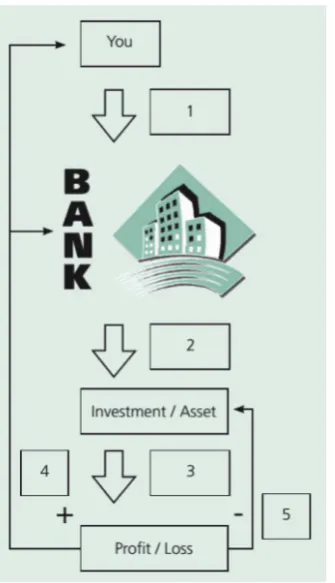
2. Mudharabah (profit sharing) – a profit sharing arrangement between two parties. An investor funds a business venture for an entrepreneur and gets a return on the funds put into the business. Any loss will be borne by the capital provider (Siddiqi 2006). The bank acts as the entrepreneur here.
Figure 2: Mudharabah (proit sharing)
3. Musyarakah (joint venture) –a partnership or a joint business venture to make profit. Based on an agreed ratio, profit made will be shared by the partners. Losses incurred will be shared based on the ratio of funds invested by each partner.
4. Qard (interest-free loan) – the borrower is only required to repay the borrowed amount over a fixed given period on goodwill basis.
The borrower may pay extra (not as an obligation) as a way to thank the lender.
5. Riba (usury) – the amount paid or received over and above the principal in a loan contract.
6. Gharar (uncertainty) – unknown fact or condition that is extremely avoided in Islamic banking.
Islamic Finance in the Global
Economy
Islamic finance is based on the religious roots of Islamic teachings. While not widely used in many financial institutions all over the world, the Islamic banking concept has become more reliable over the long run during economic difficulties with the global rise of oil prices. After seeing the greater benefits of infusing Islamic finance and trying to assimilate into the current banking concept, Islamic banks have taken pragmatic steps by starting to mimic conventional banks while at the same time maintaining sharia-compliant contracts. The rise of Islamic financial values came to light through problems with money laundering by Americans generally and the high demand for banks to be more regulated, transparent in their financial reporting, compliant to standardizations, and to be seen as good citizens in the international financial environment. Another concern was that conventional bankers were usually perceived as being dishonest and greedy, while Islamic banks were stressing out about their proven moral character and ethics. The core values of Islamic finance lie in the combined theory of risk sharing and the rationale for prohibiting the practice of Riba (usury) (Ahmad and Hassan 2007) and Gharar (uncertainty). One of the challenges in practicing Islamic finance includes the relationship between sharia and common and civil laws, where the litigation of financial contracts should be dealt with either by national law or the Sharia court.
5
(Tournois and Aoun 2012). Many Gulf countries such as Dubai, Yemen and Saudi Arabia, which originally applied the Islamic Sharia Law are operating Islamic banking frameworks. While countries like Turkey, which comprise multi-religious and Western ways of life, were historically inluenced by Saudi administration and laws. Not to leave out that over many years, the Islamic economic system has been introduced (Köni 2012). Among the significant differences from conventional banking are cost, revenue and profit efficiency (Kamarudin et al. 2014).
Co-evolution and reconcilability
between Islam and the West in
global banking
Many see the two systems as irreconcilable and the conlict between the two inevitable, as they have been inluenced by co-migration, economics and politics through imperialism and the discovery of resources such as oil. The question arising is whether Islamic banking can co-evolve with conventional banking without losing its original identity (Tlemsani 2010). Will there be a problem of compatibility between the two systems of conventional and Islamic banking? The emergence of the Islamic-based profit-and-loss sharing system was introduced for greater stability, precisely because the risk sharing concept produced more significant stability in the long run. The conventional banking system, or so called capitalist system, is based on the principle of laissez faire, in
which one is free to pursue profit with minimal intervention. A historical perspective shows that Muslim countries that uphold non-riba activities are not lagging behind those who apply riba activities. In fact, they are prospering in the same manner of profit gained by conventional systems. By using conventional bank technology and injecting Islamic banking core values, the efficiency of Islamic banking increases (Abdul-Majid, Saal, and Battisti 2009). Islamic banking views money more as a medium of exchange than a store of value and wealth. Islam prohibits reward without a share in the risk or a stake in the economic venture, which would be considered as riba. Capitalism encourages excessive concentration of wealth, which undermines moral and ethical values and in some ways tends to make the rich richer and the poor poorer. Islamic banking on the other hand underscores core social and ethical responsibilities that are indeed compatible with Western notions of ethical banking and social capital (Tlemsani, 2010).
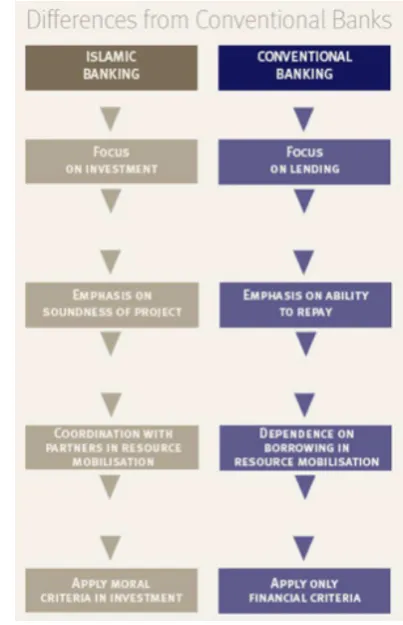
Figure 3: Differences between Islamic and Conventional Banking
Maximizing Profit from Islamic
Perspectives
6
religion, has its own prescriptions and business instructions. In Islam, participation in business and economic activities is always linked with spiritual dimensions. Prophet Muhammad said “Seeking earnings is a duty for every Muslim”, a strengthening factor indicating that engaging in business affairs is one of the obligations that must be performed. Capitalism introduced profit maximization to developing countries, which has become a necessary element for economic growth. So, what kind of profit is allowed from the perspective of Islam? Fardh underlines two key factors, Kifia and Ayen, which are essential for insuring normalcy and stability in the society of Islam. Fardh, guided by Ihsan, forbids any harm to a community and is a priority to maintain. The Quran (42:23) states “And if anyone earns any good, we shall give him an increase of good in respect thereof”.
Which is why in Islam profit maximization is neither sought nor is desirable for five main reasons:
1. By focusing on investment and operation, business operation can thrive even when profit is low. Commitment to operation with small profit will lead to business growth.
2. Prosperity is achievable by investing in capital growth and business transactions. 3. Quality and availability of an item are always
linked to profit earning level.
4. The amount of risk inluences the amount of profit. The greater risk, the greater the profit it will lead to.
5. To prevent manipulation, marketplace actors must be supported and protected by the government.
In a simpler way, by looking closely at the Islamic economic system, whether we realize it or not, Islamic teachings propose an unintentional way of having corporate social responsibility (CSR). Based on profit sharing, taking care of all parties’ interest, free from riba and gharar, Islamic economy means corporate social responsibility itself (Basah and Yusuf 2013).
Islamic teachings approve lawful earnings and profit levels that do not lead to exploitation, obstruction of market function and mischief. This is why harming communities and/or excessive pricing is not looked upon positively. In the Middle East, highly profitable Islamic countries’ banks highly leverage their income, high cost of capital, therefore less profitable in the short term. Introducing incentives to undertake more risks attracts more customers and shareholders, which is more profitable
in the long run. This proves that in Islam, enhancing society’s welfare with the positive outcome of fostering economic prosperity is indeed considered a profit despite not being achieved in the blink of an eye.
Challenges and Issues with
Applying Islamic values in
Conventional Banking Systems
About 23 percent of the world’s global population is Muslim, and it is expected to reach 33 percent by 2030. Islamic marketing with its ‘business philosophy’ is taking reference from business ethics frameworks as its core values. The question is, should existing frameworks of market orientation be designed based on Islamic marketing and branding? More and more countries, whether Muslim or not, are already seeking and starting to partially infuse Islamic banking systems of principle or set up a completely new brand of bank that can cater to the Muslim communities in those countries. Such countries include the United States of America, Australia, the United Kingdom and even China and East Asian countries. It is not clear when or where the first modern Islamic banking was initiated. According to Noor and Ahmad (2012), the first Islamic bank was set up in Egypt in 1963. Since then, the number has risen to over 300 institutions in more than 75 countries. Some of the challenges in applying Islamic ethical values to conventional banking include:
1. In non-Muslim countries, should the litigation of financial contracts be dealt with by national law or Sharia court? In such countries, Sharia court does not exist where authorization and weak implementation exist.
2. There is confusion and lack of understanding of the major terms in Islamic banking, such as gharar and riba. Interest is often considered riba, whereas in certain situations it is actually not.
3. The true nature of Islamic banking does not allow trading and dealing with non-Halal products such as alcoholic beverages, non-Halal food and gambling-related services or business.
7
Thailand, a multi-religious country where Islam is the second largest religion, is greatly inluenced by the Malaysian Islamic banking system. Many conventional banks that have been operating for many years and that are affected by Pattani Islamic Saving Cooperative, which is preferred by a large number of the Muslim community, are forcing conventional banks to take major steps by introducing Islamic banking modules into the current banking system (Haron and Yamirudeng 2003). Brunei, also an Islamic country that is recently enforcing a complete Sharia Law not only into its legal law but also its financial system as a whole, proves that not only is it ethical but also profitable in many ways (Ebrahim and Joo 2001). Other countries like India are still facing difficulties with integrating and applying an Islamic banking system into its Bank Rate system whose basis is that of interest (Khan 2002).
Proposed Model Framework – to
Instil Islamic Ethical Values in
Banking System Design
The main source of reference in designing a banking system with Islamic ethical values is the Quran and Sunnah. As indicted by the Sharia law, two main factors that must be avoided to ensure an Islamic-compliant banking system are to avoid riba and gharar. Dubai, as an example of a country that successfully instils Islamic values into its financial system, can be a role model for designing an Islamic banking system. Such framework can be followed and applies to the current system we are trying to design.
Transaction Processing System (TPS) in
Dubai Islamic Bank
The Dubai Islamic Bank functions effectively with a transaction processing system that helps enterprise systems rapidly process transactions, ensuring the smooth low of data and progress. The transaction processing system is used for: 1. Opening new accounts – Employees take
data from customers, such as name, passport, address and amount of money. These data are entered into the computer manually or by passport scanning. All personal data are stored in a transaction file and master file. The end result of the output is a new account.
2. ATM Machine and Online Bank Systems – ATM machines and online banking systems are commonly used for banking transactions, such as deposits, transfers, withdrawals and checking the balance.
3. Employee records – Not only are data of customers collected, but so are bank employees’ data. To maintain security practices, all employees are supposed to log in and log out for every process either manually using a password or thumb printing on a biometric device. This process logs all activities and helps the management to monitor the working efficiency of employees.
Management Information System (MIS)
of Dubai Islamic Bank
The management information system as a whole is for the management to manage the bank effectively through centralized information about customers and employees. The TPS and MIS systems are interconnected, so MIS is able to generate reports and summarize the organization’s basic operations that also come from TPS. These data will be reviewed and overseen by the management as to how the performance is at the moment.
Dubai Islamic Bank employs MIS for:
1. Giving loans to customers – this requires higher levels of intervention depending on whether funds and resources are available to give loans
2. Hire purchase – this also requires higher levels of intervention because hire purchases usually involve buying new cars or assets Customer applications go to the MIS system, which is connected with the TPS system. At the same time, MIS is connected to another decision-making system in order to approve or reject an application by evaluating the state of the customer through the MIS system.
Decision Support System (DSS) of Dubai
Islamic Bank
As a decision-making support system, DSS of the Dubai Islamic Bank assists in these fields: 1. Investment – choosing the right items to
invest in, making profit by meeting investors in prior and predicting risks and returns on investment
2. Insurance – setting the right price and managing the risks
3. Trading – helps making trading fast and fairly profitable
4. Preventing abnormal transactions or payments
8
banking system that matches the requirements and ethics underlined by the Sharia.
Discussion
By seeking means of escaping from capitalist modes of finance and by taking examples from Middle Eastern countries, Malaysia is looking into integrating Sharia Law into its Islamic banking (ElGindi, Said, and Salevurakis 2009). The first Islamic bank in Malaysia was established in 1983, that is, Bank Islam Malaysia Berhad (BIMB). For many years, challenges were encountered in its first establishments, not only within but for other major banks as well. By introducing a few Islamic terms such as Mudarabah, Musyarakah and others, it has slowly gained positive attention (Samad and Hassan 2000). It was clearly shown that the achievements in Islamic Banking rely largely on the level of expertise in the field and efficiency in management (Zainol, Shaari, and Ali 2008). Without proper establishment, structure and plans, the values of the Sharia Law would remain a philosophy. Malaysia, a hub and leader for Islamic banking, is taking a pragmatic approach by introducing a Sharia committee to advise Bank Negara on monitoring all Islamic banking that operates in the country. A positive indicator that Islamic banking is well-accepted in Malaysia is the rise in Islamic bank-based principles in conventional banks, including Alliance Islamic Bank, Hong Leong Islamic Bank, Public Islamic Bank, Standard Chartered Islamic Bank and other major players such as Maybank Islamic, CIMB Islamic and RHB Islamic Bank. Bank Islam is the first bank to completely practice the Sharia principle of equity in its operations and it leads the movement by showing profit year by year. Bank Islam customers also consist of many non-Muslims who have given positive feedback and whose numbers keep growing.
Moreover, as a leader of Halal products, Malaysia is catering to the needs of the Islamic community locally and on a broader level by attending international conferences and having standards that support Halal products. Importing and exporting halal products benefit Muslim communities all over the world who request halal foods. At the same time, non-Muslim communities can also share the various lavours and recipes of Muslim halal foods. Such products are halal, sharia compliant, good for health and prepared with good intentions.
As a remark, the current mobile industry of developing apps for Muslim communities, whether for financial purposes, games or other
means, is still low. There is too much negative inluence of unethical apps available on the market, which may in the long run destroy good moral values and ethics.
Conclusion
The Bankscope database provides evidence that Islamic and conventional banking exhibit different performance during a financial crisis, whereby Islamic banks actually profit more than conventional banks albeit not statistically significantly (Amba and Almukharreq 2013). In the long term, the differences may become more obvious. Whether Islamic Banking is practical and suitable to be applied to conventional banking system design remains a debatable question. Many countries, even Islamic countries like Malaysia are facing challenges in integrating Islamic finance principles. Since many are still seeking faster profit generation with higher margins, a complete package of Islamic finances cannot be achieved. An international body that deals with standards must exist to assist and maintain communities that require Islamic banking to prosper and grow so that Islamic banking can profit all, even the non-Muslim communities.
References
1. Abdul-Majid, Mariani, David S. Saal, and
Giuliana Battisti. 2009. “Eficiency in Islamic and Conventional Banking: An International Comparison.” Journal of Productivity Analysis 34 (1): 25–43. doi:10.1007/s11123-009-0165-3. http://link.springer.com/10.1007/s11123-009-0165-3.
2. Aggarwal, RK, and T Yousef. 2000. “Islamic Banks and Investment Financing.” Journal of Money, Credit and Banking 32 (1): 93–120. http://www.jstor.org/stable/2601094.
3. Ahmad, AUF, and MK Hassan. 2007.
“Riba and Islamic Banking.” Journal of Islamic Economics, Banking and …, 1–33. http://ibtra. com/pdf/journal/v3_n1_article1.pdf.
4. Ali, Abbas J., Abdulrahman Al-Aali,
and Abdullah Al-Owaihan. 2012. “Islamic Perspectives on Proit Maximization.” Journal of Business Ethics 117 (3): 467–75. doi:10.1007/ s10551-012-1530-0. http://link.springer. com/10.1007/s10551-012-1530-0.
5. Amba, Muni Sekhar, and Fayza
9 International Journal of Financial Research 4 (3).
doi:10.5430/ijfr.v4n3p83. http://www.sciedu. ca/journal/index.php/ijfr/article/view/2978.
6. Basah, MYA, and MM Yusuf. 2013. “Islamic Bank and Corporate Social Responsibility (CSR).” European Journal of Business and Management 5 (11): 194–209. http://iiste.org/Journals/ index.php/EJBM/article/view/5441.
7. Ebrahim, MS, and TK Joo. 2001. “Islamic
Banking in Brunei Darussalam.” International Journal of Social Economics 28 (4): 314–
37. doi:10.1108/03068290110357708. h t t p : / / w w w . e m e r a l d i n s i g h t .
com/10.1108/03068290110357708.
8. ElGindi, T., M. Said, and J. W.
Salevurakis. 2009. “Islamic Alternatives to Purely Capitalist Modes of Finance: A Study of Malaysian Banks from 1999 to 2006.” Review of Radical Political Economics 41 (4): 516–38. doi:10.1177/0486613409341453. h t t p : / / r r p . s a g e p u b . c o m / c g i / doi/10.1177/0486613409341453.
9. Hanif, Muhammad. 2010. “Differences
and Similarities in Islamic and Conventional Banking.” International Journal of Business and Social Sciences 2 (2): 166–75. http:// papers.ssrn.com/sol3/papers.cfm?abstract_ id=1712184.
10. Haron, Sudin, and Kumajdi Yamirudeng. 2003. “Islamic Banking in Thailand: Prospects and Challenges.” International Journal of Islamic … 5 (2). http://www.perpustakaan.depkeu. go.id/FOLDERJURNAL/vol5no2art1.pdf.
11. Kamarudin, F., B. a. a. Nordin, J. Muhammad, and M. a. a. Hamid. 2014. “Cost, Revenue and Proit Eficiency of Islamic and Conventional Banking Sector: Empirical Evidence from Gulf Cooperative Council Countries.” Global Business Review 15 (1): 1–24. doi:10.1177/0972150913515579. h t t p : / / g b r . s a g e p u b . c o m / c g i /
doi/10.1177/0972150913515579.
12. Khan, M. Y. 2002. “Status and Issues of Islamic Banks in India.” Management and Labour Studies 27 (2): 63–76. d o i : 1 0 . 1 1 7 7 / 0 2 5 8 0 4 2 X 0 2 0 2 7 0 0 2 0 1 . h t t p : / / m l s . s a g e p u b . c o m / l o o k u p / doi/10.1177/0258042X0202700201.
13. Köni, Hakan. 2012. “Saudi Inluence on Islamic Institutions in Turkey Beginning in the 1970s.” The Middle East Journal 66 (1): 96–109. doi:10.3751/66.1.15. http://openurl.ingenta. com/content/xref?genre=article&issn=0026-3141&volume=66&issue=1&spage=96.
14. Noor, M. a. N. M., and N. H. B. Ahmad. 2012. “The Determinants of Islamic Banks’ Eficiency
Changes: Empirical Evidence from the World Banking Sectors.” Global Business Review 13 (2): 179–200. doi:10.1177/097215091201300201. h t t p : / / g b r . s a g e p u b . c o m / c g i / doi/10.1177/097215091201300201.
15. Rammal, H. G., and L. D. Parker. 2012. “Islamic Banking in Pakistan: A History of Emergent Accountability and Regulation.” Accounting History 18 (1): 5–29. doi:10.1177/1032373212463269. h t t p : / / a c h . s a g e p u b . c o m / c g i /
doi/10.1177/1032373212463269.
16. Samad, Abdus, and MK Hassan. 2000. “The Performance of Malaysian Islamic Bank during 1984-1997: An Exploratory Study.” Thoughts on Economics 1 (3). http://www.ukm. my/hairun/kertas kerja assignment/malaysian islamic banks.pdf.
17. Siddiqi, MN. 2006. “Islamic Banking and Finance in Theory and Practice: A Survey of the State of the Art.” Islamic Economic Studies 13 (2). http://79.132.221.61/iles/takmili/ islamic_econ./islamic_banking/vol_13_2..m_n_ siddiqi.._isl_banking_and_inance...pdf.
18. Syed, Jawad, and Beverly Dawn Metcalfe. 2014. “Guest Editors’ Introduction: In Pursuit of Islamic Akhlaq of Business and Development.” Journal of Business Ethics, March. doi:10.1007/ s10551-014-2130-y. http://link.springer. com/10.1007/s10551-014-2130-y.
19. Tlemsani, Issam. 2010. “Co-Evolution and Reconcilability of Islam and the West: The Context of Global Banking.” Education, Business and Society: Contemporary Middle Eastern Issues 3 (4): 262–76. doi:10.1108/17537981011089569. h t t p : / / w w w . e m e r a l d i n s i g h t . com/10.1108/17537981011089569.
20. Tournois, Laurent, and Isabelle Aoun. 2012. “From Traditional to Islamic Marketing Strategies: Conceptual Issues and Implications for an Exploratory Study in Lebanon.” Education, Business and Society: Contemporary Middle Eastern Issues 5 (2): 134–40. doi:10.1108/17537981211251179. h t t p : / / w w w . e m e r a l d i n s i g h t . com/10.1108/17537981211251179.
21. Zainol, Zairani, R Shaari, and HM Ali. 2008. “A Comparative Analysis on Bankers’ Perceptions on Islamic Banking.” International Journal of Business and …, no. Note 5: 157–68. http://www.ccsenet.org/journal/index.php/ ijbm/article/view/1559.
22. http://www.dib.ae/en/home
10
Technology Architecture: Focus on Server
Infrastructure for The Operating System,
Web Application and Database
By | Nor Zarina Zamri, I.D Safairis Amat Noor, Adlil Ammal Mohd Kharul Apendi
Abstract – Web applications and systems are strongly related with the backend technology, which entails the technological architecture of the server infrastructure. This article generally discusses the components involved in realizing web technology and that may function in the cloud, local networks or legacy systems. The common systems, differences, advantages and disadvantages of the components, limitations and borders of server technology will be described. The components involved are server infrastructure for operating systems, web servers, web server applications and databases in general.
Introduction
Since Web technology was introduced by Tim Berners Lee, a British computer scientist and inventor of the World Wide Web, the accelerating evolution of the Web has been unstoppable and it inluences largely how we currently view the Web. Initially there was Web 1.0, which was only for viewing and linking, which matured into Web 2.0 that focused on participation, personal Web, user engagement and consolidating content, and then Web 3.0 was then called the next big thing. Web 3.0, or Sematic Web, is all about data integration, where the infrastructure of technologies such as cloud technology is organized into a future technology called Meta Web, or Web 4.0, which is where we are headed now. The simplest technology architecture in Web server applications, operating systems and databases is contributing to the direction in which we are moving. The interrelation and integration of these three main components plays a major role in serving information that is seen every day on computer monitors, tablets and mobile phones.
UNIX and Windows operating systems
By definition, an operating system is a low-level software that supports a computer’s basic functions, such as scheduling tasks and controlling peripherals (Oxford Dictionaries, 2014). In other words, the operating system is a program used to organize and control computer hardware and is an integral part of computers
and workstations (Polze and Probert 2006). The operating system also functions as an execution platform and resource manager for applications (Momeni, Kashefi, and Sharifi 2008). There are many types of operating system, such as UNIX, Microsoft Windows, Linux, GNU, OS X and others. In this project, UNIX is used as the operating system.
UNIX Operating System
UNIX was developed in 1969 as a timesharing system, a term used to describe a multitasking operating system that supports multiple users at each terminal. It was developed at Bell Laboratories by Ken Thompson and Dennis Ritchie. Until today, UNIX stands as one of the most inluential systems in computing history by supporting most hardware platforms, with nearly every major vendor supporting a product based on UNIX.
Unix OS architecture and structure
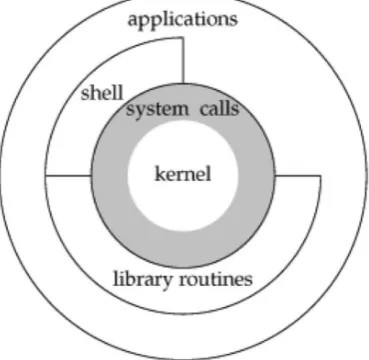
The architecture of UNIX is divided into three levels of functionality, as shown in Figure 1. 1. The lowest level is the kernel, which
schedules tasks, manages resources and controls security. It is also known as the heart of the operating system.
2. Most operating system services in UNIX are provided by the next software level that is the utilities, commands or tools. For example, cd (change directory) and cat (display content) are located in the file management command.
11
Figure 1: UNIX Architecture
The UNIX operating system is a multitasking and multiuser operating system. Moreover, with the help of terminals, several users may utilize a single computer simultaneously. Others capabilities and features supported by the UNIX operating system are kernels that are written in high-level languages, characters based on default UI and built-in networking. UNIX is also capable of providing the same services from small computers to the largest main frames with only speed and storage capacity differences.
Windows Operating System
In the late 1980s, Microsoft began designing a new operating system that could take advantage of software developments. The new operating system was called Windows NT (new technology). The Windows Server 2003 and Windows XP operating systems are based on Windows NT. Windows Server 2003 was the origin of Windows XP with further server feature and service improvements, such as IIS Web Server. Also, Windows Server 2003 included a 64-bit edition for computing (Polze and Probert 2006).
Windows Server 2003 OS architecture
and structure
The architecture of Windows Server 2003 basically includes two processor access modes: the user mode and kernel mode. The user mode includes application processes, which are typically Windows programs and a set of protected subsystems. A protected subsystem means that each subsystem is a separate process with its own protected visual address space. Meanwhile, the kernel mode is a highly privileged mode of operation in which the program code has direct access to the virtual memory. This includes the address spaces of all user mode processes and applications and their hardware. The kernel mode of Windows Server
2003 contains the Windows NT executive as well as the system kernel. The kernel controls how the operating system uses the processors. Operations include scheduling, multiprocessor synchronization, and providing objects that the executive can use or export to applications. Figure 2 shows the Windows Server 2003 architecture.
Figure 2: Windows Server 2003 architecture
The Windows operating system is a multitasking operating system with the lexibility to choose a programming interface. Besides, it provides a graphical user interface and a command line interface for users and administrators. Windows OS also has built-in networking (TCP/IP). Moreover, it provides persistent system service processes called Windows Services that are managed by Windows Service Control Manager.
Comparison between UNIX and
Windows
There are several differences between the UNIX and Windows architectures as follows:
i. Hardware Drivers
A hardware driver facilitates the interaction between the operating system and the hardware driver. In UNIX, there are several ways of managing drivers. Some of the ways allow dynamic loading and unloading of drivers, whereas other implementations do not. Meanwhile, in Windows the driver model provides a platform for developing drivers for industry-standard hardware devices attached to a Windows-based system. In addition, the hardware must be compatible with Windows Plug and Play technology in order to provide user-friendly hardware installation.
ii. Stability
12
UNIX machine seldom requires reboots while Windows constantly needs them. Furthermore, a server running on UNIX constantly has high availability and reliability in high uptime.
iii. Security (Authentication)
Authentication is a basic function in any security system. Authentication is a process that determines if a user’s login information is true or valid for accessing the system. Every operating system provides a technique of securing user authentication. Generally, the UNIX system employs user names and passwords as the authenticating method and the database passwords are kept in the system. Since it is common for users to utilize the same password for multiple accounts on multiple machines, it is not advisable to allow the system administrators access to user passwords. Accordingly, the database does not store actual passwords but rather cryptographic hashes of passwords. On the other hand, Windows also uses the same concept of password hashing algorithms but the hash storage approach is different. Windows employs two different types of hashes, of which LAN Manager Password is commonly used. Regrettably, this hash is relatively easy to break because the passwords are not case sensitive and the system will convert all the characters to uppercase before transforming them (Viega 2000).
iv. Compatibility
Websites that are designed and programmed with UNIX-based Web servers can easily be hosted on a Windows server, whereas it is quite difficult to implement the other way. This makes UNIX the better choice.
v. Price
Server hosting for websites requires licenses for any operating system. Windows Server 2003 and other related applications cost certain amounts of money, but UNIX is a free operating system to download, install and operate. As a result, Windows hosting is the more expensive platform.
Web Server Application
A Web Server Application brings two explanations in one simple mission, which is to serve Web content. A Web server handles the HTTP protocol. When the server receives an HTTP request, it responds with an HTTP response such as an HTML page. When a request comes to the web server, the web server simply passes the request to the program best able to handle it, such as CGI scripts, JSPs (Java Server Pages), servlets, ASPs (Active Server Pages), server-side Java Scripts or other server-side technology.
Figure 3: How a Web server works
As for the Application Server, according to definition, an application server exposes business logic to client applications through various protocols, possibly including HTTP. While a Web server mainly deals with sending HTML for display in a Web browser, an application server provides access to business logic for use by client application programs. The application program can use this logic as it would call the method on an object (or a function in the procedural world). Such application server clients can include a GUI (graphical user interface) running on a PC, a Web server, or other application servers.
Figure 4: How a Web Application server works
Apache Web Server versus IIS (Internet
Information Server)
13
Figure 5: Usage of Web Server types
In 2014, the overall market shares of IIS and Apache dropped to 71% of the overall website servers due to the emerging nginx and Google Web Server.
Apache is a key component in what is known as the “LAMP” stack (Ramana et al. 2005), which comprises the Linux operating system, Apache Web server, MySQL database and either PHP, Perl or Python programming language. While Apache is often perceived as a Linux Web server, it also runs on Windows, which is then known as a “WAMP” stack. If using IIS instead of Apache in the stack, it would change to “WIMP” that stands for Windows, IIS, MySQL and either PHP, Perl or Python programming language.
Apache Web Server and IIS Architecture
IIS architecture basically involves three multi-application tiers consist of Client, Web Server which is the IIS itself, and a database. In this case, the database could be MS SQL, MySQL, ldap, active directory or any database supported by IIS.
Figure 6: How an IIS Web Server works between the Client and Database
The Apache Web Server works in the same way as IIS, where there is a client or browser to serve the HTTP website, and a Database that can be MySQL or any other type of database supported by the Apache Web Server.
Figure 7: How the Apache Web Server works between the Client and Database
What is a database?
A database is a structured collection of records or data that are stored in a computer so they can be consulted by a program to answer queries (Berrington 2007). Essentially, a database is a place to keep and save records or data to be used in the future. The database is very important for keeping track of previous transactions or activities. Data or records from the database can also be used for decision-making processes.
A database contains multiple tables or a single table. Each table has a data value that comprises records (rows) and fields (columns). Figure 1 shows what a table looks like.
Product Vendor Apr-14 Percent May-14 Percent Change
Apache Apache 361,853,003 37.74% 366,262,346 37.56% -0.18% IIS Microsoft 316,843,695 33.04% 325,854,054 33.41% 0.37% nginx NGINX, Inc. 146,204,067 15.25% 142,426,538 14.60% -0.64%
GWS Google 20,983,310 2.19% 20,685,165 2.12% -0.07%
14
Figure 8: Database components
DBMS
A database management system (DBMS) is a software application used for a database to interact with end users or other databases. DBMS allows actions to be performed to data, such as adding, editing and deleting. The DBMS can be categorized in two parts: a desktop-based system and server-desktop-based system. The desktop-based system is used by a single-user application and stands on personal computers. The DBMS server is capable of managing and saving large amounts of data and can also be accessed through a network. Most DBMSs use a standard system called Structured Query Language (SQL) to query their tables. A sample query to add, edit and delete is shown below.
Add query.
INSERT INTO <<table_name>> (ield1, ield2, ield3,...)
VALUES (data_value1, data_value2, data_ value3,...);
Edit query
UPDATE <<table_name>>
SET ield1= data_value1, ield2= data_value2,...
WHERE some_ ield=some_data_value;
Delete query
DELETE FROM <<table_name>>
WHERE some_ield =some_data_value;
RDBMS
The relational database management system (RDBMS) was introduced by Edgar Codd in 1970 (Berrington 2007). Instead of a navigation model (used by DBMS), the RDBMS uses the relationship between tables using primary keys, foreign keys and indexes. A primary key is a unique value that cannot be duplicated or repeated in that particular table. The primary key acts as an identifier for the particular data recorded. A foreign key in one table refers to the primary key of another table.
Figure 9: Tables linked in a relational database
Data fetching with RDBMS is faster compared to DBMS. DBMS is slow if the data are complex and in large amounts. Different from RDMS, despite the complex and large data, the process is faster because it is in a relational model.
Well-known RDBMSs are Oracle, MySQL, Microsoft SQL Server, PostgreSQL and IBM DB2.
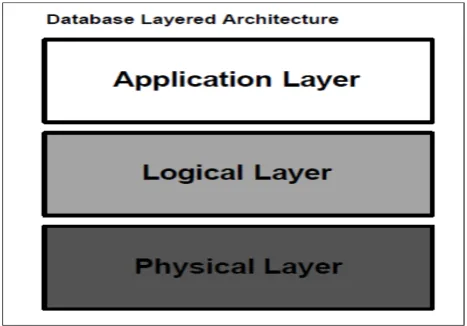
Figure 10: General RDBMS Architecture (Bannon et al. 2002)
Application Layer (Bannon et al. 2002)
The application layer represents an interface for all RDBMS users. Users can interact with the database server via the application layer. Four types of users are:
i. Sophisticated users – use query language to interact with the database server.
ii. Specialized users – application or system programmers
iii. Naive users – interact with the database server via existing written applications.
iv. Database Administrators - manage the entire database including grant access authorization to the database.
Logical Layer (Bannon et al. 2002)
15
Physical Layer (Bannon et al. 2002)
This layer is responsible for the storage of various types of information. The main types of information are:
i. Data files – store user data.
ii. Data dictionary – stores metadata (database structure).
iii. Indices – provide fast access to data items. iv. Statistical data– used by query processor to
find the best way to execute the query.
v. Log information – used to keep track of the executed query.
Before choosing the best database for our system, it is necessary to know what the system requirements are. Our system is the Enterprise System and requirements include being network-based, able to manage large amounts of data, fast data fetching, and each table is related. RDBMS satisfies all database requirements for enterprise systems.
RDBMS Database
To select a database, we have decided to study well-known databases and the most frequently used ones, which are MySQL, Microsoft SQL Server and Oracle.
I. Oracle
Oracle is a commercial database, meaning it is not free and needs to be bought. The owner of Oracle database is Oracle Corporation. Oracle was introduced around 1980.
Oracle is one of the most widely used database systems by corporations for transaction processing and storing critical information. The Oracle database is largely used as a database server for ERP systems. It is also broadly used as the backend database server for Internet-based applications (Mehta, Portability, and Act 2000).
The Oracle database is strongly related to many known security vulnerabilities. Oracle Corporation reported 15 vulnerabilities from January 2003 to November 2003 for example. Furthermore, numerous security vulnerabilities of the Oracle database have been posted by Securityfocus.com since 1999 (Mehta, Portability, and Act 2000).
Data in the Oracle database environment can be accessed (in authorized or unauthorized manner) in three ways, regardless of the specific database system used:
i. Through direct database connection (e.g., ODBC and SQL*Plus)
ii. Through a frontend application
iii. Through another database (i.e., database link)
User passwords are maintained in encrypted format within a table. However, Oracle can be configured to allow only encrypted passwords for client-to-server and server-to-server connections to highly protect the passwords during the authentication process.
Oracle can be installed on AIX, HP-UX, Linux, OSX, Solaris, Windows and z/OS. Oracle is supported by more programming languages, such as C, C#, C++, Java, JavaScript, Perl, PHP, Ruby and Visual Basic.
II. MySQL
MySQL is an open source relational database management system (RDBMS). It is free to setup the MySQL database and is available to download through the Internet. However, some features are only available with the paid version. Nowadays, the majority of large organizations use MySQL as a database, for instance Wikipedia, Twitter and Facebook. MySQL is owned by Oracle, since Oracle bought Sun in 2010. MySQL was developed in Sweden in the mid-90s and then Sun bought it in 2008. According to a survey of Oracle through a measure of traffic, nine out of ten websites are using MySQL as a database (Databases 2012).
The security of MySQL is managed by Access Control Lists in terms of accessing all objects and operations. Communications between client and server are encrypted by SSL and also cover encrypted data functions to store and retrieve data.
MySQL can be installed on Linux, Solaris, Free BSD, OS X and Windows. MySQL supports multiple programming languages such as PHP, Java, Ruby, C, C# and C++. To be able to connect to those languages, MySQL provides standard-based drivers for JDBC, ODBC and .Net. MySQL uses standard form for SQL data language.
MySQL can also be customized depending on the system or application needs and the operating system. For example, MySQL saves data into tables with up to 50 million rows and default size of 4 GB, but if the server’s operating system handles this, a table can reach 8 million terabytes. MySQL also allows programmers to modify the software to make it work with particular environments.
III. Microsoft SQL Server
16
SQL Server was introduced around 1989.
The Microsoft SQL Server runs on port 1433. This port has great potential of being unsecure, as a suspicious amount of connection attempts have been directed towards this port. A number of techniques have been used to resemble an average attack. An MSSQL handshake begins with the first communication effort and then a second packet is exchanged, which is an effort to log in to the MSSQL server with the account name “sa” and a blank password. This authentication process consists of MSSQL default installation (News and News).
The Microsoft SQL Server is only supported for running on Windows. It also supports only few programming languages, which are .Net, Java, PHP, Python, Ruby and Visual Basic. To be able to connect to these language, the SQL Server provides standard-based drivers for OLE DB, Tabular Data, Stream (TDS), ADO.NET, JDBC and ODBC.
4. 0 Conclusion
To summarize, a simple technology of Web server infrastructure that allows obtaining information anywhere and anytime, whether via cloud technology, local networks or direct connections to the source, consists of three main components: the Client, Web Server and Database. The client functions in a similar way to using a computer and clicking on the browser to go into a desired Web address or Web application. The Web server replies and serves the content requested at the backend. At the same time, the database passes the information requested by the client or application interface. All this happens faster than the blink of an eye.
Figure 11: How the Client, Web Server Application and Database work together
References
1. Abhari, Abdolreza, Adam Serbinski, and Victoria Street. 2005. “Improving the Performance of Apache Web Server”, no. April 1996.
2. Bannon, R, A Chin, F Kassam, A Roszko, and R Holt. 2002. “Mysql Conceptual Architecture.” Retrieved August, 1–14. http://infosecwriters. com/text_resources/pdf/Oracle_NAaron.pdf.
3. Berrington, James. 2007. “Databases.” Anaesthesia & Intensive Care Medicine 8 (12): 513–15. doi:10.1016/j.mpaic.2007.09.011. http://linkinghub.elsevier.com/retrieve/pii/ S147202990700241X.
4. Databases, Open Source. 2012. “Six Free Databases for the Enterprise.”
5. Gui-hong, Li, Zheng Hua, and Li Gui-zhi. 2010. “Building a Secure Web Server Based on OpenSSL and Apache.” 2010 International Conference on E-Business and E-Government, May. Ieee, 1307–10. doi:10.1109/ICEE.2010.334. h t t p : / / i e e e x p l o r e . i e e e . o r g / l p d o c s / e p i c 0 3 / wrapper.htm?arnumber=5591185.
6. Khalid, Saneeha, Haider Abbas, and Asad Raza. 2012. “Securing Internet Information Services ( lIS ) Coniguration Files”, 726–29.
7. Mehta, Raju, Health Insurance Portability, and Accountability Act. 2000. “Oracle Database Security”, 40–53.
8. Momeni, Hossein, Omid Kashei, and Hadi Sharii. 2008. “How to Realize Self-Healing Operating Systems?” 2008 3rd International Conference on Information and Communication Technologies: From Theory to Applications, April. Ieee, 1–4. doi:10.1109/ICTTA.2008.4530346. h t t p : / / i e e e x p l o r e . i e e e . o r g / l p d o c s / e p i c 0 3 / wrapper.htm?arnumber=4530346.
9. News, Fraud, and Biometrics News. “Where to Buy Stolen Credit Cards ! Sensors Discredited ? Biometrics Is a Technology SQL Server under Beware —.”
10. Polze, Andreas, and Dave Probert. 2006. “Teaching Operating Systems: The Windows Case.” ACM SIGCSE Bulletin, 298–302. http://dl.acm.org/ citation.cfm?id=1121434.
11. Ramana, U V, C D Murta, J M Almeida, and V A F Almeida. 2005. “Some Experiments with the Performance of LAMP Architecture”, 2–6.
12. Viega, J. and J. Voas. 2000. “The Pros and Cons of Unix and Windows BASIC OPERATING SYSTEM”, no. October.
17
The Impact of The Digital Signature on
Organizational Integrity
By | Nur Shazwani bt Mohd Zakaria
Introduction
Nowadays, securing documents against attackers or unauthorized persons is compulsory, especially for organizations. Rather than implementing good policies on protecting documentation in safe places, an organization can implement the digital signature as one of the methods to avoid obstacles that can affect daily processes.
What is a digital signature?
The digital signature basically follows the traditional concept of paper-based signing, except it is an electronic “fingerprint” that uses a unique coded message through the combination of a document and signer. Any changes made to the document after signing cannot be amended by others, thus protecting against signature forgery and information tampering. Therefore, digital signatures can often help organizations sustain signer authenticity, accountability, data integrity and the non-repudiation of signed electronic documents and forms.
Digital signatures actually rely on certain types of encryption in order to ensure their authentication is perfectly secured. Encryption is defined as a process that takes all the data sent through one medium to another and encodes the data into a form that only the latter medium will be able to decode.
Digital signatures began with their legal enforcement after the EU Directive for Electronic Signatures in 1999. On June 30, 2000, the Electronic Signatures in Global and National Commerce Act (eSign) was officially approved by President Clinton, which made signed electronic contracts and documents as legally binding as paper-based contracts. Now, digital signature (standard electronic signature) solutions carry recognized legal significance that enables organizations to comply with global regulations. As with other countries, the prospect of electronic commerce has driven the Government of Malaysia to amend existing legislation and enact new laws to deal with legal issues emerging from electronic commerce. The Digital Signatures Act was enacted in 1997 in
response to the societal need to replace paper-based signatures.
How does the digital signature
work?
When a user creates a document, he or she signs it with a unique digital signature and sends it to the recipient. If the publisher’s signature is managed by a certification authority (CA), the recipient will trust the CA in confirming the publisher’s identity. This process is to ensure that the message is authenticated and provides non-repudiation.
Any person, firm, company, agency, etc. can have digital signatures. Several companies are known as certification authorities (CA) in Malaysia that manage digital signatures, such as DigiCert Malaysia and MSC TrustGate.com Sdn Bhd.
Basically, a digital signature functions in three steps. This process is illustrated using Ali and Taufik, who are responsible for applying and verifying a digital certificate in an organization.
i. Step 1: Obtaining a Private and a
Public Key
Before signing a document, Ali needs to get a private and a public key, whereby the private key cannot be shared by others and must be used by the signer. The public key is openly available for use by those needing to validate the signer’s digital signature.
ii. Step 2: Signing an electronic
document
18
Create a digital signature – In Malaysia, many organizations use Certification Authorities (CAs) to ensure signer authenticity. In such situation, Ali must be certified by a trusted CA (as mentioned above) that knows him and can verify that he is indeed who he claims to be.
Basically, people do not know the process behind the wall of how digital certificates are processed, especially users from the business line. A unique digital fingerprint of the document (sometimes called a message digest or document hashing) is usually created using a mathematical algorithm such as SHA-1.
Append the signature to the document – The hash result and the user’s digital certificate that includes the user’s public key will be combined into a digital signature by using the user’s private key in order to encrypt the document hash. Both the document and the user’s signature will result in a unique signature. Finally, the digital signature is appended to the document. Ali will send the signed document to Taufik and Taufik will use Ali’s public key (which includes a digital certificate) to authenticate Ali’s signature and ensure that no changes have been made to the document after it was signed.
iii. Step 3: Verifying a Digital Signature
Initiate the validation process – Depending on the software used, Taufik must initiate the validation process by clicking the “Validate Signature” menu option in the software’s toolbar.
Decrypt the digital signature – By using Ali’s public key, Taufik decrypts his digital signature and receives the original document.
Compare the document fingerprint with the calculated one – Taufik’s software will calculate the hash of the received document and compare it with the original document hash. If they are similar, the signed document has not been altered.
How does the digital signature
benefit an organization?
In an organization, many processes require formal authorization or approval. Sometimes, the number of approvals within the organization or department is higher than expected and it becomes difficult if the authorizer or approval is outside the office and the document requires immediate approval. Thus, by implementing digital signatures, an organization is able to significantly shorten the processing time while
cutting cost and improving collaboration and efficiency. The table below highlights some necessary signature-dependent processes and documents.
Executive Management / Board Documents
Board Actions, Corporate Communications and Public Reports, Investor Relations, SEC Documents
HR Documents Employee Actions, Employee Benefit Changes, Employee On-boarding Documents, Employee Time Sheets, Employee Training, Insurance Claims
Legal Documents
Contracts, Agreements, Work Orders, Master Service Agreement Forms and Sub-contractor Agreements
Finance/ Accounting Documents
Lease Agreements, Loan Agreements, Expense Reports & Reimbursement Approval, Invoices, Tax Filings, Financial Spreadsheets (Data collection and Aggregation)
Customer Service Documents
Customer Service Change Orders
Procurement Documents
Purchase Orders, Contracts with subcontractors
Sales Documents
Sales Proposals, Point of Sale/ Service, Contracts with clients
Regulatory Affairs
Applications, Submissions, etc.
Quality Control QC Documents, Standard Operating Procedures, Policies, Work Instructions, Training Documents, Test Procedures, Field Service, Maintenance and Calibrations Reports
Other Industry Specific Documents
Designs, Drawings, Plans, Manufacturing Instructions and Reports, HIPAA Patient and Consent Forms, Medical Records, Clinical Documentation, Lab Reports and Certificates of Analysis
What is the impact of digital
signatures on organizations?
19
need to implement this technology include:
Low cost – Organizations do not need to send documents by post or courier service since employing digital signatures is much cheaper.
Secure – The use of digital signatures and electronic documents can reduce the risk of documents being altered, modified or read by unauthorized users.
Non-repudiation – Signing electronic documents can identify one as an official signatory and cannot be denied later.
Easy to find – A digitally signed document can easily be tracked and located in a short time. Avoid fake signatures – Nobody from within or outside the organization can forge a digital signature or submit electronic documents falsely claiming they were signed by someone else.
Fast operation – Businesses no longer have to wait for paper-based documents to be sent by courier. Contracts are easily written, completed and signed by all concerned parties within a short time no matter how far the parties are located.
Conclusion
Malaysia is among the first countries in Asia to formulate laws governing the use and application of digital signatures as a means to propel the country into a digital economy. Therefore, many organizations, particularly private, believe there is more money to be made once the Internet become increasingly secure with the implementation of digital signing. Moreover, the public trust of organizations is built in terms of security and confidence in performing daily activities that involve document delivery from an organization to the public or among organizations.
References
1. John, P. Drivers and Impediments to
E-Commerce in Malaysia. Malaysia Journal of Library & Information Science, Vol.6, No2. December 2001. http://umepublication.um.edu. my/ilebank/published_article/1849/173.pdf
2. Digital Signatures FAQ. http://www.arx.
com/learn/about-digital-signature/digital-signature-faq/
3. Digital Signature. http://www.skmm.gov.