Developing Instructional Model for the Vocational Competence in CNC Machining for Vocational High School Students
By Bernardus Sentot Wijanarka
Department of Mechanical Engineering Education Faculty of Engineering Yogyakarta State University
Email: [email protected]
Abstract
This study aimed to: (1) produce a model of learning for CNC machining subjects for Vocational Hight Schools (VHSs) in accordance with the standards of competence and basic competences, and (2) analyze the feasibility and effectiveness of Best CNC learning models for the formation of the vocational competence in CNC machining for VHS students.
This study employed the research and development approach. The research procedure was the design and development research by Richey and Klein consisting of two stages of development, i.e.: (1) a comprehensive model development, and (2) a process of developing model components. The model validation process consisted of two stages, i.e. the internal validation and the external validation. The internal validation was carried out on the model components through peer reviews and a focus group discussion and the external validation was conducted through a pilot test. The validation process involved 24 participants consisting of: experts in the CNC machining subject, vocational education experts, a workshop management expert, VHS teachers, and VHS students. The research method employed in the pilot test was the qualitative and quantitative descriptive methods.
The results of the study are as follows: (1) A learning model for CNC machining has been produced and the name of the model is Best CNC that has components: learning modules, utilities used, and evaluation instruments. (2) Best CNC learning model can be applied and effective in forming students’ competence including the settings of CNC machines, CNC machine programming and CNC machines operation. All students have mastered each competency standards after using this learning model. Best CNC learning model is more efficient and effective than those applied in VHSs at present.
Keywords: Learning Model, vocational, CNC, VHS
Introduction
Some new subjects in the vocational curriculum appears to follow the
development of the era. Advances in computer technology and the industry has a lot
to change the capabilities and skills in machining competency of job seekers
especially for former students of VHS. Conventional machine tools which were
originally used by most industries in the seventies, has now been replaced with a
machine tool controlled by a computer because of high productivity and accuracy.
The machine is the CNC (Computer Numerically Controlled ) machine tools, that are
current technology in manufacturing is growing very rapidly, so a lot of CNC
machines used in the machining industry to produce parts with a high level of
complexity and precision ( Subagio and Atmaja, 2011:105 ). According to Mike
Lynch ( http://www.cncci.com/resources articles/CNCmanual.htm) at this time more
than 80% of companies that make various kinds of products have at least one CNC
machine. In response to these conditions, the VHS was challenged to prepare
students to be competent enough to work, through learning to meet the needs of the
workforce and industry.
Training to operators of CNC machine tools include the settings, operate, and
monitor the process. Skills of planning, controlling, programming, and CNC
machine settings should be taught to trainees (http://www.siemens.com/cnc4you).
Thus the implementation of the learning process of CNC machining competence are
more likely in of the procedure knowledge skills than the manual skills. Berner
(2008:177) analyzes that have been ongoing changes of the learning process in terms
of knowledge, social, and emotional to be a machine tool operator. Matter and how
students learn will be part of their own self-understanding, identity work in the
future, and feelings about something he knows. Employment in manufacturing
companies that use CNC machines are handled by the engineers, programmers, and
operators (Bureau of Labor Statistics, 2010). Engineer in charge of the field of CNC
machinery to plan and create software. CNC programmers tasked to create a CNC
program is based on the working drawings designed by the designer. CNC machine
operator to set the machine and its peripherals, include the program on the machine,
the setting of cutting tool, workpiece set up, run the CNC program to create a
product, and do the machining process measurement products. CNC machine
operator is a person who needs to know how to run a CNC machine is not planning
or designing a CNC program ( http://www.amatrol.com/programs ).
Based on field observations, a model of learning for subjects to most of CNC
machining at vocational schools are refer to the CNC machine, teaching materials,
teaching methods, learning strategies and learning approaches made by EMCO,
companies from Austria, developed in the 90 's . This can be seen from the learning
module and electronics books which is used in vocational schools published by the
Directorate of SMK on the Internet (http://www.ditpsmk.org). Based on the above
vocational student competency in accordance with the standards of competence and
basic competence.
Literature Review
Many experts put forward a definition of a model of learning and developing
learning models. Models of Teaching is in fact also be regarded as models of
learning (Joyce et al, 2009: 7). Gunter in Santyasa (2007:7) defines learning model
as follows: "an instructional models is a step- by- step procedure that leads to
specific learning outcomes.” Joyce, et al (2009:30) said: " A model of teaching is the
idea of a learning environment that also includes our behavior as a teacher when the
model is applied. "A more detailed description set forth in the other website
(http://www.edtech.vt.edu/edtech/id/ models / ), which is " teaching models prescribe
tested steps and procedures to effectively generate desired outcomes. In general,
models can be classified along a continuum from instructor -directed, instructor to
student - negotiated, to student -directed. "
Joyce, et al (2009:31-45) classify learning model into four major groups,
namely: (1) the information processing model of learning, (2) the social learning
model, (3) the model of personal learning, and (4) group learning model of system
behavior. Each group consists of many models of teaching or learning model. The
models of information processing group consists of: inductive thinking, concept
discovery, inductive word-pictures, scientific research, research training, mnemonics,
sinektik, and advance organizers. The group consists of models of social learning
model: study partner - positive independence, organized research, investigation
groups, role playing, and jurisprudential research. Group personal learning model
consists of model: teaching without direction, and improve self-esteem. The group
consists of models of learning behavior model: learning to master, direct instruction,
simulation, social learning, and the planned schedule.
McIlrath and Huitt (1995) defined "A model is a visual aid or the picture
which highlights the main ideas and variables in a process or system". Models in
particular discusses the model as measured by standardized test scores for the basic
science subjects (basic skills) are: reading, language arts, mathematics, science, and
social studies. These models are: John Carroll, Proctor, Cruickshank, Gage and
Berliner, Huitt, and Laosa models. The models are used in the United States for the
Based on the above descriptions it is understood that the learning models
(models of teaching ) has a broader meaning than the methods, strategies/approaches,
and procedures. Learning model based on learning objectives to be achieved, the
skills students will be obtained, and the learning environment is used. Thus to
construct a model of learning for learning purposes (competency) must be specified
in advance the philosophy underlying the competencies to be taught, learning
theories that support, learning competencies to be achieved (cognitive, psychomotor,
or affective), and the theory of the subjects or teaching materials concerned.
CNC machining competencies for vocational students is the student's ability
to cover aspects of knowledge, skills and attitudes in the use of CNC machines to
make things work according to the standards of competence and basic competences
(SKKD= Standar Kompetensi dan Kompetensi Dasar). Competencies to be
possessed by vocational students are seting, programming, and operating the CNC
machine tool. Basic competency to be controlled in large part on the cognitive (ie
operational work: describe and recognize) and psychomotor domains (with the verb
operations: install, perform, instruct, change, write, implement, test, operate, and
monitor). Attitude formation is not implied in the competency standards, but is
written in Basic Vocational Competencies, namely to apply occupational safety and
health, with descriptions of basic competencies and implement health and safety
procedures.
According to Drake (2007: 2), the standard of competency -based learning
approach, teachers are expected to prepare students to meet the standards of
accountability within the framework of the learning process. The curriculum is
taught is the same for the same level throughout the country. Students must follow
the standardized competency exams to demonstrate that the student has achieved a
certain level of success. The results of the competency test is used as an indication
of the level of student learning. Further noted also that the competency -based
teaching approaches adopted the following principles: (1) the planning process with
the design -down curriculum, (2) focuses on what students will do, not what the
teacher will teach, (3) standards of competence, teaching strategy and assessment of
neatly arranged, (4) is very important to decide what should be known, worked and
served the students, (5) standards of competence can be observed and measured, (6)
understanding of complex ideas and serves as an umbrella of course content; (8) the
performance of complex skills always comes up every year and on all subjects; (9)
the content of lessons as a means to achieve competency standards, and (10) teachers
-free teach with all kinds of styles of teaching for competency standards are met.
Methodology
Stages of research using the stages of design and development research by
Richey and Klein. According to Richey and Klein (2007: 8) design and development
of research consists of two main categories: (1) product and research tool, and (2)
model research. Research on the category of product development stages are:
analysis, planning (design), development, and evaluation. While basically the same
development tools with product development but are also more emphasis on: (1)
development tool , and (2) tool use. The research phase of the model include: (1)
development model, (2) validation of the model, or (3) use of the model.
Model Development
The process used in this study is the modeling study by Richey and Klein
(2007: 65). Step -by-step development of such models in detail include: (1)
development model, (2) model validation, and or (3) try out the model. On the
development of this model there are two kinds of development are: (1) the
development of comprehensive models, and (2) the development of model
components.
Before carrying out the development is preceded by a preliminary study to
find a model that is currently applied by the study subjects as material to develop a
learning model of CNC machining. Model validation process is carried out two
kinds of internal validation and external validation. Internal validation performed on
the components of the model, while the external validation studies the impact of the
model. External validation of the model is done by a pilot test or try out on the
subject of the research. Try out conducted in small groups of students at one
location. A try out was made to the number of students in accordance with the
provisions of the model, which is eight students. Try out conducted in the CNC
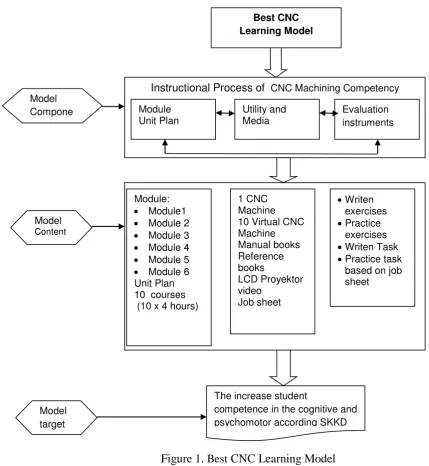
Figure 1. Best CNC Learning Model
Try out Result
Try out the use of learning models implemented at one school site which
already has a utilities of CNC machining course in accordance with the learning
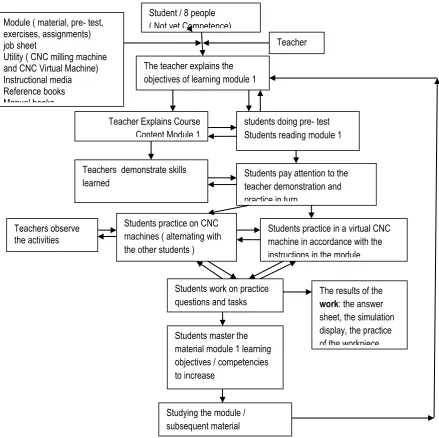
model developed. Try out is conducted in 10 meetings. Each class meeting held for
4 hours of lessons. The course process is in Figure 2.
Instructional Process of CNC Machining Competency Best CNC
Learning Model
Module Unit Plan
Utility and Media
Evaluation instruments
Module: Module1 Module 2 Module 3 Module 4 Module 5 Module 6 Unit Plan 10 courses (10 x 4 hours)
1 CNC Machine 10 Virtual CNC Machine Manual books Reference books
LCD Proyektor video
Job sheet
Writen exercises Practice
exercises Writen Task Practice task
based on job sheet Model
Compone ntst
Model
Content
s
Model target
The increase student
Figure 2. Course process of the try out
Improvement of students competency
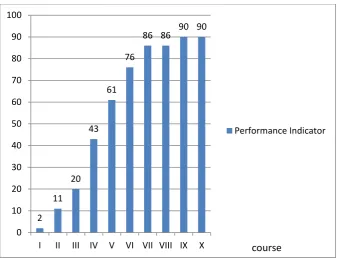
During pilot testing, the competencies achieved by students are observed by
teachers and researchers. Achievement of competency standards were observed
using performance indicators, amounting to 90 performance indicators. The increase
of student competence can be seen in Figure 3. Student / 8 people ( Not yet Competence)
The teacher explains the objectives of learning module 1
Teacher Module ( material, pre- test,
exercises, assignments) job sheet
Utility ( CNC milling machine and CNC Virtual Machine) Instructional media Reference books Manual books
Teacher Explains Course Content Module 1
students doing pre- test Students reading module 1
Teachers demonstrate skills learned
Students pay attention to the teacher demonstration and practice in turn
Students practice on CNC machines ( alternating with the other students )
Students practice in a virtual CNC machine in accordance with the instructions in the module Teachers observe
the activities
Students work on practice questions and tasks
Students master the material module 1 learning objectives / competencies to increase
The results of the work: the answer sheet, the simulation display, the practice of theworkpiece
Figure 3. The improvement of students competency
All students stated that the Best CNC learning model is an interesting model
of learning, the learning module can help the learning process, and students have
been convinced to operate the CNC milling machine and virtual CNC milling
machines. Best CNC learning models purpose are improving the competence of
students, so that in the opinion of students on the above description it can be said that
the purpose of these models has been achieved. Recap student opinion on the Best
[image:8.595.144.532.568.772.2]CNC learning model can be seen in Table 1.
Table 1.
Opinions from The Students Regarding Best CNC Learning Model
Student opinion Percentage
of Answers
1. Interesting learning model 100%
2. Understanding of learning material
a. Understand the learning material completely b. Understand the most of the learning material
50% 50% 3. Questions and tasks
a. Very adequate to establish the competence b. Adequate to establish the competence
75% 25% 4. Questions and tasks actually measure the knowledge and
skills
100%
5. Get direct feedback 100%
6. Been able to operate a CNC milling machine 100% 7. Been able to operate the virtual CNC milling machine 100%
2 11
20 43
61 76
86 86
90 90
0 10 20 30 40 50 60 70 80 90 100
I II III IV V VI VII VIII IX X
Performance Indicator
Competencies that students can independently operate CNC machines are the
demands of competency standards in accordance with SKKD. Competence is
essentially a student's ability to include competencies in the domain of affective,
cognitive and psychomotor skills. This model is in trials do not measure students'
affective competencies, but from the implementation of the trial shows that students
carry out the learning process seriously, maintaining workplace safety, maintain the
safety of the machine, maintain the safety of other students, and always tried to
follow the steps modules are written in earnest. Look in cognitive abilities of
students have been able to do practice questions and tasks that can improve cognitive
abilities. Skills of the students looked up, the ability to check the results of all
students claimed not to operate a CNC machine and after learning to use the model to
follow the Best CNC states are sure all students can operate the CNC machine. Thus
it can be said that the Best learning model CNC has proven effective in shaping
students' competency in CNC machining.
Teachers who implement the Best learning model CNC feel that the modules,
software, and learning steps suggested by CNC Best models was helpfully. In the
implementation of learning for the next semester the teacher will use this learning
model, it is because: a learning tool in the form of CNC machines and computers,
learning modules, practice materials, and teaching schedule allows for the
implementation.
Feedback from teachers is that teaching materials in the module coupled to
the material with other control systems are a valuable input. These suggestions will
be met by developing learning modules with GSK or Fanuc control system and still
use the concept of learning models and frameworks of the Best CNC. Changes will
be made on the content of the modules, especially regarding the description of the
control panel, programming code, setting the zero point, and operation of CNC
machines. Solved exercises and assignments, and job sheet is still being used.
Conclusions
Based on this research, the conclusions in this study are:
1) Best CNC learning model efficient in shaping students' competence in accordance
spent learning to use a learning model Best CNC less than the current model of
applied learning in the vocational high schools.
2) Best CNC learning models effective in shaping students' competence in
accordance with the demands of competency -based curriculum. Three standards
of competence can be achieved by the students after participating in learning by
using Best CNC models are more than the use of learning models currently used
by VHS.
Reference
Berner, B. (2009). Learning Control: Sense-Making, CNC Machines, and Changes
in Vocational Training for Industrial Work , Journal Vocations and Learning,
vol 2, number 3, 177-194
Bureau of Labor Statistic. (2010). Occupational Outlook Handbook 2010-11 Edition. Diambil pada tanggal 28 Juli 2010, dari http://www.bls.gov/oco/ocos286.htm
Depdiknas. (2004). Kurikulum SMK Edisi 2004.
Depdiknas. (2009). Standar Kompetensi dan Kompetensi Dasar (SKKD) SMK
Depdiknas. (2009). Permendiknas No. 28, Tahun 2009, tentang Standar Kompetensi Kejuruan Sekolah Menengah Kejuruan (SMK)/Madrasah Aliyah Kejuruan (MAK).
Drake, S.M. (2007). Creating Standards-Based Integrated Curriculum. California: Corwin Press.
Iron, I. (2008, October 16). CNC Machinist- CNC Operator. Diambil pada tanggal 27 Juli 2010, dari http://ezinearticles.com/?CNC-Machinist
---CNC-Operator&id=1589696
JobBank USA. (2010). Job Descriptions, Definitions Roles, Responsibility: Computer-Control Programmers and Operators. Diambil pada tanggal 28 Juli 2010, dari http://www.jobbankusa.com/career_employment/
computer/computer
Joyce, B., Weil, M., & Calhoun, E. (2009). Models of Teaching (8th ed.). (terjemahan oleh Achmad Fawaid dan Ateilla Mirza). New Jersey: Pearson Education Inc.(Buku asli diterbitkan tahun 2009).
MasterTask Training System. (2009). In-Plant Training for CNC Lathes: 3 Options. Diambil pada tanggal 1 Desember 2009, dari http://www.mastertask.com/ manufacturing/lathe .
Mc Ilrath, D.,& Huitt, W. (1995 December). The Teaching Learning Process: A Discussion of Models. Educational Psychology Interactive. Valdosta, GA: Valdosta State University. Diambil pada tanggal 10 Nopember 2011, dari
http://teach.valdosta.edu/whuitt/papers/modeltch.html.
Michigan Jobs & Career Portal . (2010). #211-Computer Controlled Machine programmer. Diambil pada tanggal 27 Juli 2010, dari