commit to user
INDONESIAN LOCAL GOVERNMENT COMPLIANCE OF
MANDATORY DISCLOSURE ON
GOVERNMENTAL ACCOUNTING STANDARD
THESIS
A thesis submitted in partial fulfillment of the requirement for the degree of Magister Sains
by:
UMI PUJIYANTI SRN: S4307106
MAGISTER OF ACCOUNTING
FACULTY OF ECONOMICS
SEBELAS MARET UNIVERSITY
commit to user
INDONESIAN LOCAL GOVERNMENT COMPLIANCE OF MANDATORY DISCLOSURE ON
GOVERNMENTAL ACCOUNTING STANDARD
By:
Umi Pujiyanti
SRN: S4307106
Has been approved by Supervisors:
Date:……….
Chairman : Drs. Djoko Suhardjanto, M.Com(Hons).,PhD., Ak. ………
Vice : Dra. Y Anni Aryani, M.Proff, Acc., Ph.D.,Ak ………
Member : Prof. Dr. Bambang Sutopo, M.Com., Ak. ………
: Drs.M. Agung Prabowo, M.Si., Ph.D. Ak. ………
Acknowledged by:
Director of PPs UNS Head of Master of Accounting Program
Prof. Drs. Suranto, M.Sc., Ph.D.
NIP. 195708201985031004
Dr. Bandi, M.Si. Ak
commit to user DEDICATION
commit to user PRONOUNCEMENT
Name : Umi Pujiyanti
NIM : S4307106
Study Program : Master of Accounting
Main Interest : Public Sector Accounting
I hereby sincerely state that the thesis titled “Indonesian Local Government
Compliance of Mandatory Disclosure on Governmental Accounting Standard” is my
real masterpiece. The things out of my masterpiece in this thesis are signed by
citation and referred in the bibliography.
If later proven that my thesis has discrepancies, I am willing to take the academic
sanctions in the form of repealing my thesis and academic degree.
Surakarta, Februari 2011
Stated by,
commit to user ACKNOWLEDGEMENT
Assalaamu’alaikum Wr. Wb.
Alhamdulillah, Researcher thanks to ALLAH SWT for the overflows of blesses,
grants, and guides so that Researcher able to finish this thesis well. This thesis is
compiled to equip the duties and fulfill the preconditions to get the Master of Science
degree in Faculty of Economics, University of Sebelas Maret Surakarta.
Researcher realizes that during the thesis process, there are many helps from
other parties, directly and indirectly. Herewith, Researcher says many thanks to
various the following parties:
1. Minister of National Education of Indonesian Republic, for the willingness to
give grants in the form of scholarship “Beasiswa Unggulan Diknas”, in order to
complete the study in Master of Accounting Study Program, Faculty of
Economic, University of Sebelas Maret Surakarta.
2. Prof. Dr. Bambang Sutopo, M.Com., Ak., as The Dean of Faculty of Economics,
commit to user
3. Dr. Bandi, M.Si.,Ak. as The Head of Master of Accounting Program, Faculty of
Economics, University of Sebelas Maret Surakarta. It is such a blessing to have
you Sir!!
4. Prof. Dr. Bambang Sutopo, M.Com., Ak., as the main supervisor, for all the
guidance you give.
5. Drs. Muhammad Agung Prabowo, M.Si.,Ph.D.,Ak., as the co-supervisor, for all
the guidance, help, motivation, critique, and suggestion that help the researcher to
attain the maximum result. You’re one in the million!
6. All of lecturers and staffs in Economics Faculty, University or Sebelas Maret
Surakarta, especially in MAKSI.
7. My Lovely Nufaysah “Upha-Upho” Annajiyah, My Remarkably Hanifah “Ipha”
Annajiyah and My Stunning Roko Patria Jati. It’s been such a wonderful life you
have shared with me. Too much love for y’all!
8. Ibu, Bapak, Mas Rudi and all family in Purwodadi. Even we rarely meet, I believe
you always remember and pray for me. I miss you all, really!
9. Papa, Mama, Malabar Family and Mbah Putri. So much support you’ve given to
me. Can’t stand without you!
10.My Best friend ever in fighting, Mbak Emi, for the place, the sugar and the tea
you gave me. I do not know where to hang in FE if it is not you! My thanks also
go to Manda for the helps, Mbak Uut for the suggestions, Chicko for the
companion during the classes we had. I also want to acknowledge my friends:
commit to user
Dewi, Mas Chalik, Mas Oki, Pak Ipul and Pak Dwiyono as well as Pak Andriono.
Believe it or not, WE ARE SIMPLY GORGEOUS!!
Researcher realizes that this is far from being perfect. Hence, researcher expects
all the constructive suggestions and criticisms regarding the content, grammar, or any
other.
Wassalamu’alaikum. Wr. Wb.
Surakarta, Februari 2011
commit to user
commit to user
CHAPTER II. LITERATURE REVIEW AND HYPOTHESIS DEVELOPMENT
A. Theoretical Background ...
B. Level of Government Agencies and Location of Indonesian Local Government ...
C. Hypothesis Development ...
CHAPTER III. RESEARCH METHODOLOGY
A. Type Research ...
B. Population and Sample ...
C. Data Source and Data Collection ...
D. The Measurement Issue of Compliance ...
E. Technique of Analysis ...
1. Descriptive statistic ...
2. Hypothesis testing ...
CHAPTER IV. DATA ANALYSIS AND DISCUSSION
A. Data Description...
1. Sample selection ...
2. Classical assumption ...
3. Items of mandatory accounting disclosure ...
commit to user
B. Hypothesis Testing ...
CHAPTER V. CONCLUSIONS, SUGGESTIONS, AND RESEARCH LIMITATION
A. Conclusion ...
B. Suggestion ...
C. Research Limitation ...
BIBLIOGRAPHY
APPENDICES
39
40
40
48
commit to user LIST OF TABLE
Page
Table 1 The Scoring System 23
Table 2 The Scoring System in Nangroe Aceh Darussalam’s Financial Statement
24
Table 3 Local Governments’ Financial Statements 2007 30
Table 4 Mandatory Accounting Disclosure Items in Balance Sheet
32
Table 5 Descriptive Statistics 38
Table 6 The t-Test Analysis (Independent Sample t-Test) – H1 40
commit to user
LIST OF APPENDIX
APPENDIX I THE NAME OF LOCAL GOVERNMENTS USED AS SAMPLE
APPENDIX II CLASSICAL ASSUMPTION TEST APPENDIX III THE COMPLIANCE LEVEL OF LOCAL
commit to user ABBREVIATION
BPK : Badan Pemeriksa Keuangan (Supreme Audit Committee) LKPD : Laporan Keuangan Pemerintah Daerah (Local Government
Financial Report)
NPM : New Public Management
PAD : Pendapatan Asli Daerah (Local Government Own Revenue) SAP : Standar Akuntansi Pemerintahan (Governmental Accounting
Standard)
SKPD : Satuan Kerja Perangkat Daerah UU : Undang –Undang(Law)
commit to user ABSTRACT
This research aims at figuring out the different level of compliance of Indonesian local governments’ financial reports with SAP. The differentiation is based on the different level of governmental agency (municipal/ city) and different geographical location (located in Java Island and Non Java Island).
The sample is 102 financial reports (balance sheet) that consists of 22 reports of provinces (4 are from Java and 18 are from Non Java Island) and 80 from municipalities/ cities (40 are from Java Island and 40 others are from Non Java Island) with qualified or unqualified opinion. The tests are normality and Independents sample t- test.
commit to user
rejected due to the fact that local governments from outside Java have the same ability to adapt to new regulation.
This research concludes that local governments in Indonesia have the same level of compliance for their financial reports.
This research has a drawback that is only uses balance sheets as the item of analysis.
Keywords: disclosure, compliance, governmental accounting standard (SAP), local governments, level of governmental agency and different geographical location
ABSTRAK
Penelitian ini bertujuan untuk mengetahui ada tidaknya perbedaan antara tingkat kepatuhan laporan keuangan pemerintah daerah di Indonesia terhadap Standar Akuntansi Pemerintahan (SAP) yang didasarkan pada perbedaan level agen pemerintah (provinsi dan kabupaten/ kota) dan letak geografis (berlokasi di Jawa dan Luar Jawa).
commit to user
dengan menggunakan metode PC unweighted. Data diuji kenormalannya dengan One Sample Kolmogorov-Smirnov dilanjutkan dengan uji-t.
Hasil penelitian menunjukkan bahwa tingkat kepatuhan (item Balance Sheet) laporan keuangan pemerintah daerah di Indonesia adalah 41, 71% (kepatuhan rendah). Tingkat kepatuhan pemerintah daerah di tingkat provinsi sama dengan tingkat kepatuhan di tingkat kabupaten/ kota; hipotesis 1 tertolak. Hal ini disebabkan oleh tidak adanya sanksi terhadap pelanggaran, kurangnya contoh dari agen pemerintah yang lebih tinggi dan adanya perasaan independen dari pemerintah daerah yang lebih rendah. Hipotesis 2 tertolak karena pemerintah daerah yang berlokasi di Luar Jawa memiliki kemampuan yang sama untuk beradaptasi dengan peraturan pemeintahan yang baru.
Penelitian ini menyimpulkan bahwa semua pemerintah daerah di Indonesia memiliki tingkat kepatuhan yang sama meskipun memiliki tingkat agensi dan lokasi geografis yang berbeda.
Keterbatasan penelitian ini terletak pada hanya diambilnya Neraca sebagai bahan penelitian.
commit to user CHAPTER I
INTRODUCTION
This research investigates the compliance of Indonesian local governments
with SAP where some comparisons are made. This chapter explains the background
of the research, the research problems, the purposes of the research and the benefit of
the research.
A. Research Background
During the last decade, accounting and government policy makers in the UK,
Australia, New Zealand and other countries have advocated the adoption of accrual
accounting system, commonly regarded as “commercial accounting”, for public
sector financial management (Hopwood and Tomkins, 1985; Guthrie, 1994;
Llewellyn, 1998; Lapsley, 1999; Lawrence, 1999; Llewellyn and Northcott, 2005 in
Mir and Rahaman, 2006), known as New Public Management (NPM). Mhina (2008)
argues that this movement is started in 1980s and based on public choice and
managerial schools of thought, new public management seeks to enhance the
efficiency of the public sector and the control that government has over it. The main
assumption in the NPM-reforms is that more market orientation in the public sector
will lead to greater cost-efficiency for governments, without having negative side
effects on other objectives and considerations.
commit to user
the changed role of the state and the growing demands for good governance
practices worldwide (Sharma, 2007: 4).
Good governance then is associated with accountability and transparency.
Accountability has become a major topic in the discussion among experts in regards
to public sector reform. This issue deals a lot with accountability and transparency on
the financial report made by the public sector entities. Accountability may be seen as
a channel for ascertaining the use of power by an individual or an organization that
has been entrusted with the task of performing prescribed tasks (Premchand in
Schiavo-Campo, 1999). Transparency, in the other hand, implies that the procedures
and methods of decision making and the disbursement of public funds are open to
visible to all (Jayawickrama in Schiavo-Campo, 1999).
The emergence of new public management has started since 1980s, but the
development in Indonesia is languished since it started in 1992 with the President
Suharto’s Decree 35 1992 (Robinson & Harun, 2004). This Presidential decree
assigned responsibility to a newly established Accounting Development Board Centre
within the Ministry of Finance with the task of modernizing the cash basis system of
accounting inherited from the Dutch (Robinson & Harun, 2004).
After a long process, Governmental Accounting Standard (SAP), as one of the
important elements of governmental accounting reform in Indonesia, has finally
stipulated by Governmental Decree Number 24 Year 2005 (Peraturan Pemerintah
commit to user
for the first time has Governmental Accounting Standard that is specifically
composed to be standardized guidance for the government to compose its financial
statement.
However, after a couple years the governmental accounting standard has been
implemented, the implementation by local governments is still weak (Nasution,
2008). This is evident by the fact that many local governments are still incapable of
devising financial statement in compliance with Generally Accepted Accounting
Principle (Misra, 2010), although some regions have managed to devise reliable
financial statement and obtained good audit opinion. According to the Supreme Audit
Committee (Badan Pemeriksa Keuangan/BPK) investigation among 459 local
government financial statements (Laporan Keuangan Pemerintah Daerah/LKPD) in
the year 2006, BPK gives unqualified opinion for 3 LKPD (1%), qualified for 326
LKPD (71.02%), adverse for 28 LKPD (6.10%), and disclaimer opinion for 102
LKPD (22.22%) (Nasution, 2008).
From accounting practices as a whole, the degree of accounting practices of
Indonesia shown in its compliance level is 72.11% on average (Misra, 2010). This is
higher compared to Belgium which is only 62% (Christiaens, 1999). However, in
particular, the Government Decree Number 24 about local autonomy may open
opportunity for local governments in producing wide-varied financial reports based
on their own financial resources. This leads to the opportunity for several local
governments to falsify the government deposits and to misuse local governments’
commit to user
This research investigates the compliance of local governments’ financial
statements with its established official standard, SAP. Particularly the study will
compare the level of compliance between different levels of agency and between
different levels of location of local governments. The different level of government
agency is taken into account as such agency in Indonesia is divided into provinces
and municipalities/ cities (Indonesian Constitution 1945, second amendment, Chapter
VI about Local Government, Article 18, Verse 1).
This different level of agency in Indonesia affects the fund distribution from
the central government, namely the intergovernmental revenue. The receipt of
intergovernmental revenue has been positively associated with organizational
innovativeness (Ingram and De Jong, 1987). State and federal governments provide
intergovernmental revenue to local governments; they also regulate the way in which
the funds can be used (Patrick in Mandasari, 2009). Recipients must meet the
financial statements and auditing standards of grantors (Ingram and De Jong 1987).
This means that the local governments who receive the intergovernmental revenue
will comply more to the established official standard because they have resources to
do so.
Further, this research also compares the compliance of Java local governments
with non Java local governments. Indonesia consists of thousand islands with wide
ranging geographical condition (www.wikipedia.com). The conditions above may
affect the presentation of financial statements of local governments. Java and
commit to user
Human resource quality growth of Java Island is higher than outside Java Island
(Bhinadi, 2003) and education and health facilities in Java are far different from those
in Non-Java Island. In Australia case of study, geographic location and isolation were
important determinants of variations in operating practices in local governments
including their annual reports (Kloot and Martin, 2001). Urban area with extensive
legislative changes and easy access to other region tends to quickly adapt to new rule
compared to rural and remote area. Kloot and Martin also identify that rural and
remote community tend to have a strong resource of economy which results in the
reluctant to change their annual reports to the new standard. Accountability is
continually being socially constructed (Parker and Gould in Kloot and Martin, 2001).
This means that the more modern and developed the society in a certain area, the
higher level of financial statement compliance they perform (Mandasari, 2009;
Retnoningsih, 2009).
This research focuses on the mandatory disclosure compliance of balance
sheet stated in SAP. Similar research is done by Mandasari (2009) and Retnoningsih
(2009). Mandasari (2009) examines the influence of local government characteristics
to the mandatory disclosure compliance with SAP. The results show that educational
background of regent is the only variable influencing the compliance level. Having
economics/accounting background is likely a benefit since the regent will have better
knowledge in economics/accounting, also better understanding of the importance of
accounting for accountability (Mandasari, 2009). This research also mentiones that
commit to user
municipalities in Indonesia is still low (52.57%). The research by Mandasari (2009)
focuses on items of Balance Sheet as the elements of analysis.
In the other hand, Retnoningsih (2009) tries to examine the relation between
the characteristics of parliament with the mandatory disclosure. The results show that
the compliance level of mandatory accounting diclosure elements in the municipal
level is still low (Retnoningsih, 2009). Again, the educational background of person
in parliament is the only item influencing the compliance level of mandatory
accounting diclosure of a certain municipal (Retnoningsih, 2009). In Retnoningsih
(2009), the elements of analysis are items of Budget Realization and Notes on
Financial Statement. In this research, Retnoningsih (2009) also discusses in brief the
different mandatory disclosure compliance level between Java and Non Java Island
where the result identifies that local governments located in Java comply more
compared to local government located in Non Java Island. This finding is supported
by Bhinadi (2003) which mentions that the quality of humand resourcces in Java
Island is higher than those Non Java Island.
Compared to the previous researches mentioned above, this research focuses
on the comparison of the mandatory disclosure compliance level between province
and municipal/ city and between local government located in Java Island and located
in Non Java Island.
The balance sheet is chosen since it describes financial position of asset,
liability and fund equity of local government in certain date (Mursyidi 2009). Balance
commit to user
and accountability level in managing assets and liabilities admitted in financial
statement (Bastian 2006). The preparation of a balance sheet will enable the
organization to manage its asset more effectively, increase the organizations ability to
evaluate debt/equity funding, and allocate accountability for specific asset and
liabilities (Churchill, 1992). Moreover, balance sheet is also made to increase the
comparability from period to period and local government to local government
(Bastian 2006). In order to attain the purpose of comparability, accounting standard
obligates financial statement to present in accrual bases.
B. Research Questions
As mentioned above, the main discussion of this research is the compliance
level of Indonesian’s Local Governments with SAP. The compliance level will
consider the local governments’ structure (province and city/ municipality) and local
governments’ geographical location (within Java Island or Non Java Island). The
different structure of local government will impact on the fund distribution/
intergovernmental revenue which come to the assumption that the local government
receiving bigger amount of fund distribution will comply more with the SAP
compared to others who receive smaller number of intergovernmental revenue (Pugh,
Hickson, Hinings, Turner, 1969; Ingram and De Jong, 1987). Further, local
commit to user
Non-Java Island due to the human resource and economic condition (Bhinadi, 2003;
Retoningsih, 2009).
The issuance of SAP in 2005 aims at reforming the Indonesian public sector
(NPM) by standardizing the form and the essence of the governmental agencies’
financial reports (Robinson & Harun 2004). However, the varied nature of Indonesian
local governments—whether it is in a form of different level of governmental
agencies or different geographical location—may impact on the SAP application in
field. Is the original purpose of SAP issuance reached by the Indonesian provinces
and Indonesian cities/ municipalities? How is the compliance level of local
government located in Java Island compared to those located in on Java Island? Are
they same or not? The questions above are the important discussion in this research.
C. Research Purposes
The purpose of this research is to figure out the local governments’ financial
report compliance level with SAP based on comparisons: (1) between provinces and
cities/ municipalities, and (2) between local governments located in Java Island and
local governments located in non-Java Island.
D. Significance of the Study
Several studies have been done in the Indonesian local governments. Mandasari
commit to user
disclosure compliance of financial statement with SAP. Retnoningsih (2009) studies
the influence of parliament characteristics towards mandatory accounting disclosure
compliance elements. In 2010, Misra examines in what extent local government
financial accounting practices based on compliance index contains of technical
accounting and the transparency issues, while Arifin (2010) investigates the impact of
governance mechanism on the informativeness of local government financial report
in Indonesia.
However, none of those researches investigates the comparison among different
level of local governments that Indonesia has. Mandasari and Retnoningsih
investigate only in the level of city/ municipalities (2009). Further, the researches
above also ignore the varied geographical locations of Indonesian local governments
that may affect the level of compliance on SAP. This research gives explanations on
the difference level of compliance of financial reports between provinces and cities/
municipalities and between local governments located in Java Island and non-Java
commit to user CHAPTER II
LITERATURE REVIEW AND HYPOTHESES DEVELOPMENT
This chapter is about literature review and the development of hypotheses the
research has. This chapter elaborate theories used in the previous researches in
discussing the subject, level of agency and location of Indonesian local governments
in relation to compliance, and the hypotheses development.
A. Theoretical Background
There are many theories used to discuss the compliance of financial
statements of agency with certain standards. A research by Arifin investigates the
impact of governance on the informativeness of local government financial reports in
Indonesian context. The research framework borrows from agency theory
hypothesizing that governance mechanism might mitigate the conflict between the
agent and principal resulting in more informative financial reports (2010).
Agency theory itself is focused on the relationship between the principals and
agents (for example, the relationship between shareholders and corporate managers),
a relationship which, due to various asymmetries, created much uncertainty (Deegan,
commit to user
A contract under which one or more (principles) engage another person (the
agent) to perform some service on their behalf which involves delegating
some decision making authority to the agent (1976, p.308).
It is assumed within agency theory that principals will assume that the agent
(like the principal) will be driven by self-interest which may lead to the asymmetries
information between the manager and the owner. Therefore, the principals will
anticipate that the manager, unless restricted from doing otherwise, will undertake
self-serving activities that could be detrimental to the economic welfare of the
principals (Deegan, 2000).
In the domain of public sector, ownership distribution and board of directors
might be argued as identical to voter’s distribution and local parliament respectively
while the standard provision is similar to local government regulation (Arifin, 2010).
The agency problem, then, possibly emerges between the voters as the principal that
trust the management decision to executive party as the agent (Arifin, 2010). The
logic comes from the fact that the issuance of UU no. 17 year 2003 which obligates
the government agencies in Indonesia to make a financial report that comply with the
mandatory disclosures set by Governmental Accounting Standard/ SAP.
Another practice of agency theory in the governmental sector is that in the
condition of absence of stock exchange market mechanism, legislative body serves as
a main instrument in monitoring the behaviour of bureaucrat (Fama, 1980; Miller and
Moe, 1983; Weingast, 1984; Spencer, 1982 in Misra, 2010). Legislative body is
commit to user
performing monitoring function towards the behaviour of governmental bureaucracy
(Misra, 2010).
In the context of agency theory, Misra support that legislative body represents
as principal while the executive plays as the agent. A research by Retnoningsih
(2009) broadens this assumption based on the legitimacy theory. She states that as the
principal, individuals in the legislative body should acquire knowledge, skills, and
competences to be legitimate before the society (Retnoningsih, 2009) as legitimacy
indicates that one is qualified for particular professions (Lawrence in Retnoningsih,
2009). This implies educational background and educational level become crucial
factors for legislators. The findings suggest that the higher educational level of
parliament members is, the higher expectation and awareness to the compliance of
mandatory accounting disclosure elements is. This means the financial report
produced will highly comply with the standard which give assess to the society to do
analysis based on the information provided in the reports.
As stated before, annual financial report is the main medium of accountability
(Mack et al. 2010) since it function is to give relevant information for the
decision-making (Naim dan Rakhman 2000). Using the stakeholder perspective, Kloot and
Martin (2001) argue that managers, in making annual reports, in local government
have to contend with multiple accountabilities to multiple stakeholders: ratepayers,
the wider community, councillors, and their state governments. They suggest that the
more varied the user of information is, the more complex and complete the financial
commit to user
statement as ratepayers & residents, other resources providers, councillors, other
recipients of services, oversight bodies, internal users and other councils (2010).
B. Level of Government Agencies and Location of Indonesian Local Governments
As mentioned before, this research investigates the compliance level of local
governments’ financial statements with its established official standard, SAP.
Particularly the study will compare the level of compliance between different levels
of agency and between different of location of local governments. The different level
of government agency is taken into account as such agency in Indonesia is divided
into provinces and municipalities/ cities (Indonesian Constitution 1945, second
amendment, Chapter VI about Local Government, Article 18, Verse 1). The different
location is also taken into account since geographically Indonesia consists of
thousand islands (www.wikipedia.com 2010).
This different level of agency in Indonesia affects the fund distribution from
the central government, namely the intergovernmental revenue. The receipt of
intergovernmental revenue has been positively associated with organizational
innovativeness (Ingram and De Jong, 1987). State and federal governments provide
intergovernmental revenue to local governments; they also regulate the way in which
the funds can be used (Patrick in Mandasari, 2009). To be accountable and
governance, recipients of funds must meet the financial statements and auditing
commit to user
governments who receive the intergovernmental revenue will comply more to the
established official standard because they have resources to do so (Pugh, Hickson,
Hinings, Turner, 1969; Ingram and De Jong, 1987).
Another motivation for Indonesian local government to be accountable and
transparent in managing their fund is that the fact that they may receive different
amount of intergovernmental revenue in different accounting period for some reasons
(Mandasari, 2009). One of them is the local government incapability of managing the
fund indicated by the some remaining amount of fund in the end of financial period.
This condition is regulated by the Law of Financial Minister no.59/ PMK.06/ 2005.
Under this law, if the local government still has some remaining amount of
intergovernmental revenue, the state government will assume that the local
government is incapable of managing the fund, so in the next financial period, the
state government will decrease the fund distribution.
Further, this research also compares the compliance of Java local governments
with non Java local governments. Indonesia consists of thousand islands with wide
ranging geographical condition (www.wikipedia.org, 2010). The conditions above
may affect the presentation of financial statements of local governments. Java and
non-Java differs in its human resources and economic condition (Retnoningsih,
2009). Human resource quality growth of Java Island is higher than outside Java
Island (Bhinadi, 2003) and education and health facilities in Java are far different
from those in Non-Java Island. In Australia case of study, geographic location and
commit to user
governments including their annual reports (Kloot and Martin, 2001). In Portugal,
local authorities and municipalities in particular aim to satisfy the interests of a
certain geographic territory through their annual reports (Carvalho et al., 2007).
Urban area with extensive legislative changes and easy access to other region tends to
quickly adapt to new rule compared to rural and remote area reports (Kloot and
Martin, 2001).
Kloot and Martin also identify that rural and remote community tend to have a
strong resource of economy which results in the reluctant to change their annual
reports to the new standard. Accountability is continually being socially constructed
(Parker and Gould in Kloot and Martin, 2001). This means that the more modern and
developed the society in a certain area, the higher level of financial statement
compliance they perform (Mandasari, 2009; Retnoningsih, 2009).
Local governments in Java Island can be assumed as the urban area since they
locate next to Jakarta, Indonesia’s capital city (www.wikipedia.com, 2010). This
results in the higher human resource quality compared to those from Non-Java Island
(Bhinadi 2003). Urban groups are likely to be more educated and mobile group who
will use information to change their consumption or living preferences (Zimmerman
1997). This implies that the urban local government will disclose more information
commit to user
C. Hypothesis Development
This research investigates the compliance of local governments’ financial
statements with its established official standard, SAP. Particularly the study will
compare the level of compliance between different levels of agency and between
different levels of location of local governments. The different level of government
agency is taken into account as such agency in Indonesia is divided into provinces
and municipalities/ cities (Indonesian Constitution 1945, second amendment, Chapter
VI about Local Government, Article 18, Verse 1). In term of location, Indonesia
geographically consists of thousand islands with wide ranging geographical condition
(www.wikipedia.com, 2010). Its five biggest islands are Jawa, Sumatera, Kalimantan,
Sulawesi and Papua. Java and non-Java differs in its human resources and economic
condition (Retnoningsih, 2009). Human resource quality growth of Java Island is
higher than outside Java Island (Bhinadi, 2003) and education and health facilities in
Java are far different from those in Non-Java Island.
1. Provinces’ financial report disclosure is different from cities’/ municipalities financial reports
According to Indonesia Constitution 1945 (Undang - Undang Dasar 1945),
local governments of Indonesia are regulated in Chapter VI, article 18, verse 1. This
rule mentions that Indonesia consists of provinces and every province consists of
municipalities and cities in which the provinces, municipalities, and cities are having
commit to user
Indonesia administratively consists of provinces, municipalities/ cities, district,
residence (kemukiman), village (kelurahan/ desa), and other lower level of place
(tingkat yang lebih rendah) (www.wikipedia.com, 2010).
As mentioned before, Indonesia consists of provinces that are headed by
governor. Each province consists of municipalities and cities. Municipality and city
are administrative regions after province in Indonesia (www.wikipedia.com 2010).
Those autonomous regions have authority to manage their own government.
According to UU Number 34/2004 about local government, there are structural
differences between city and municipality. The municipality is headed by regent,
while the city is headed by mayor (walikota). Both regent and mayor are not
responsible to governor. Moreover, the main source of city’s PAD is derived from
industry and tourism. Meanwhile, the main source of municipality’s PAD is derived
from agriculture.
Another thing differs province, municipality, and city is that they have a
different size (wide of region). Province is the largest area since it includes several
municipalities, while city is the smallest area. As an example, the area of municipality
contributes around 4% - 24% of the total area in West Sumatra, while the area of city
only contributes around 0.3% (www.wikipedia.com 2010).
Region with wider area (province) is assumed to have more functional
differentiation (Satuan Kerja Pemerintah Daerah/ SKPD) compared to the smaller
one (municipality/ city). It means that province shall comply more on SAP compared
commit to user
Damanpour (1987) argue that functional differentiation facilitates the sharing of ideas
and information because varies organizational members bring different ideas to the
organization for consideration. Therefore, the more different departments exist in a
local government, the more ideas, information, and innovations are available. With
more ideas, information and innovations, certain local government will comply more
on the mandatory accounting disclosure set by the government.
Different level of governmental agencies also impact on different level of
intergovernmental revenue. The amount of the fund distributed to province is for sure
different from the fund distributed for city/ municipal. As reflected in the budget
realization report, the fund distributed to province is bigger than the one distributed to
city/ municipal. Intergovernmental revenue is positively associated with the
innovativeness (Pugh, Hickson, Hinings, Turner, 1969; Ingram and De Jong, 1987);
this implies the more the fund is, the more innovative the local governments is. As
mentioned before that local government with higher level of innovativeness will
comply more on the mandatory accounting disclosure of SAP. Therefore, the second
hypothesis is:
H1: The compliance level of provinces’ financial report disclosure is different from
those of cities’/ municipalities’.
commit to user
Previous research done by Kloot & Martin (2001) suggests that perceptions of
local government managers regarding accountabilities varied depending on their
geographic location and isolation. In term of geographic location, managers of urban
area will have different level of accountability compared to managers from non-urban
area. Further, in terms of the isolation, the accountability level of large cities will be
different from small or remote areas.
This condition can also be found in Indonesia. Geographically, Indonesia
consists of 17. 508 islands with its 5 biggest islands: Sumatera (473.606 km2), Java
(132.107 km2), Kalimantan (539.460 km2), Sulawesi (189.216 km2) and Papua
(421.981 km2) (www.wikipedia.com, 2010). Indonesia’s capital city is Jakarta which
is located in Java Island. This condition causes other island outside Java may have
different level of human resources as well as economic condition.
Bhinadi (2003) investigated economic growth between Java and non-Java
Island. His finding suggests that human resource quality growth of Java Island is
higher than outside Java Island one. Suryadarma in Retnoningsih 2009) finds that
education and health facilities in Java are far different from outside Java. These
crucial infrastructures contribute to the different human quality growth between Java
and outside Java. These differences are assumed influencing the compliance level of
mandatory accounting disclosure elements between Java area and non-Java area
(Suryadarma in Retnoningsih, 2009). Then, the first hypotheses of this research is
H2: The compliance level of local government financial report disclosure in Java is
commit to user CHAPTER III
RESEARCH METODOLOGY
This chapter mainly discusses the method used in the research as well as the
hypotheses testing employed. It then consists of type of research, population and
sample, data source and data collection, and the techniques of analysis.
A. Type of Research
This research is quantitative research. Different from the qualitative research,
in this research a deductive form of logic is used wherein theories and hypotheses are
tested in a cause-and-effect order (Creswell, 1994; Sekaran, 2003; Sutopo, 2006).
Furthermore, concepts, variables, and hypotheses are chosen before the study begins
and remain fixed throughout the study. Creswell (1994) also argue that the intent of
this study is to develop generalizations that contribute to the theory and that enable
one to be better predict, explain and understand some phenomena. This means that
there is a hypothesis built and tested in this research.
commit to user
Population can be explained as collection or numbers of people or events that
are interesting to be analyzed (Sekaran, 2003). Population refers to the entire group of
people, events, or things of interest that the researcher wishes to investigate (Sekaran,
2003). The population in this research is the 33 provinces’ audited financial
statements.
Sample is part of population, which is consisted of elements having similar
characteristics with population (Sekaran, 2003). Furthermore, Sekaran explains that
sampling is the process of selecting a sufficient number of elements from population,
so that a study of the sample and an understanding of its properties or characteristics
would make it possible for us to generalize such properties or characteristics to the
population elements. The sampling method used is purposive-judgment-sampling.
(Sekaran, 2003). This means that the researcher gains information only from certain
data which meet these criteria:
1. the Indonesian provinces which issued financial statement in 2008 and
published the financial statement in BPK RI website (www.bpk.go.id)
2. The financial statement chosen will be those with qualified opinion and
unqualified opinion. Financial statements having adverse and disclaimer
opinion are not chosen since the information within that financial statement
may not be relevant. Further, this kind of information can not be used in
decision making of financial statement users.
Recall the criteria above and that this research talks about provinces and
commit to user
Indonesia, 80 municipalities/ cities are taken also (40 are from Java Island and 40
others are from Non-Java Island).
C. Data Source and Data Collection
Data used in this study is secondary data which is taken from internet.
Sekaran (2003) explains that secondary data refer to information gathered from
sources already existing. The data source of this research is the financial statement of
Indonesian provinces published in www.bpk.go.id in 2008. The data are gathered by
the researcher through softcopy data basis from the internet and the document.
D. The Measurement Issue of Compliance
As stated in the SAP, local governments’ financial statement consists of four
items namely, Balance Sheet, Budget Realization Reports, Cash Flow Statements and
Notes on Financial Statement (SAP 2005). Among those elements, this research
focuses on the balance sheet items. The items of balance sheet cover inventory
accounting (PSAP 5), investment accounting (PSAP 6), fixed- asset accounting
(PSAP 7), assets under reconstruction (PSAP 8), and lastly liability accounting
(PSAP 9) with total is 34 items. This means that every local government which
complies with all the balance sheet mandatory accounting disclosure will have total
score of 34.
In measuring the compliance, this research uses PC unweighted method
commit to user
compliance level uses dichotomous or unweighted method (Cooke, 1996). As the
alternative is the partial compliance (PC) unweighted method (Al-Shiab, 2008).
These two methods differ for unweighted gives equal weight to the individual items
required to be disclosed by all standards, meanwhile, the PC unweighted assumes that
each standard is of equal importance and consequently gives equal weight to each
standard (Tsalavoutas, Evans, and Smith 2008). The common approach for
determining compliance on SAP done by private companies or public sector entities
is that of unweighted disclosure index (Yeoh, 2005; Ali et al., 1994; Craig & Diga,
1998; Patton & Zelenka; 1997; Cooke, 1996; Ahmed & Nicholls, 1994; Wallace et
al., 1994; Spero, 1979 in Tsalavoutas, Evans, and Smith 2008). Under this method, if
a required item is disclosed, it is scored as 1 and if it is not, it is scored as 0. For
example, in PSAP 5 about inventory, the first items mentions about disclosing
accounting policy for inventory measurement. If certain local government clearly
mentions it uses certain method of measurement, it is scored ‘1’ otherwise is ‘0’. This
then is called as ‘dichotomous’ method. However, it is not strictly ‘dichotomous’
because some items may not be applicable to every company, and therefore scored as
‘not applicable’ (NA) (Tsalavoutas et al., 2008). The detail illustration is as follows:
Table 1 The Scoring System
Items of PSAP 05 (Inventory)
Disclosing accounting policy for inventory measurement
Score
Mentioning it uses certain method of measurement (Biaya perolehan apabila diperoleh dengan pembelian, etc.)
1
commit to user
If the local government does not have any inventory - (Not Applicable/ A)
The exact example below is taken from the Gorontalo’s financial statements.
Table 2
The scoring system in Nangroe Aceh Darussalam’s’s fianancial statement
Score Nangroe Aceh Darussalam’s FS
1 (1) Accounting policy for inventory measurement (PSAP 5: Inventory) NAD is scored 1 for this rule since it mentions the accounting policy for inventory measurement. The statement is as follow: “Persedian dicatat pada akhir periode akuntansi berdasarkan hasil inventarisasi fisik dan dinilai berdasarkan harga perolehan”.
0 (03) Inventory condition (ex: the detail amounts of each inventory, the price (value) of each inventory, and explanation of good/ broken condition) (PSAP 5: Inventory)
NAD gets 0 because it does not mention the detail amounts of each inventory and does not explain the condition of the inventory whether it is in a good/ broken condition. However, NAD mentions the price of the inventory. The statement is: “Persediaan, merupakan persediaan barang pakai habis dalam TA 2007 yangtersisa masing-masing untuk alat tulis kantor dan barang pakai habis lainnya sebesar Rp1.564.065.030,00 dan obat-obatan sebesar Rp7.068.762.059,00.”
- (NA)
If the fixed asset recorded as revaluation amount, these things need to be disclosed: The name of independent appraiser. (PSAP 7: Fixed Asset) This rule is not applicable (NA) for NAD because NAD does not revaluate its fixed asset. So, NAD is scored by “-“.
In fact, some standards require a large number of items to be disclosed while
some others require only a view. As a result,
commit to user
An alternative method, avoiding the problem, is the ‘Partial Compliance (PC)
unweighted approach’ employed by Street & Gray (2001) and Al-Shiab (2008). It
explains that
‘the degree of compliance for each company is measured by adding the degree of compliance for each standard and then dividing this sum by the number of standards applicable to each company. This implicitly gives equal weighting to each applicable standard and avoids the problem of unintentionally giving more weight to a standard with a larger number of items in the index’ (Al-Shiab, 2008: 223).
In other words, it is giving unequal weighting to the disclosure items in different
standards.
This research uses PC unweighted method instead of the unweighted since it
considers some standards that might be inapplicable for certain local government. PC
unweighted method formula is:
where PCj is the total compliance score for each company and 0 ≤ PCj ≤ 1. Xi is the
level of compliance with each standard’s mandatory disclosure requirements. This
means that, initially, using the ‘dichotomous’ approach, the researcher calculates the
compliance with each standard separately. Subsequently, the sum of these compliance
scores (X) is divided by the total number of relevant/applicable standards for each
commit to user
For example, the SAP requires local government to disclose amount of short
term and long term liability that are classified based on the creditor (PSAP 9:
Liability). If certain local government has liability both short term and long term then
it states the amount of the debts based on the creditor, the researcher scores it ‘1’. If
the local government has short term and long term liability but does not mention the
amount and/ or the creditor, that local government is scored with ‘0’. Lastly, if the
local government does not have any liability whether it is short term or long term, it
is given (-) since such mandatory disclosure is not applicable to the local government.
E. Technique of Analysis
1. Descriptive statistic
The purpose of descriptive statistics is to provide description of distribution
and behavior of the samples (Iriawan and Astuti 2006). Jogiyanto (2005) states that
descriptive statistic provides frequency value, measures of central tendency (mean,
median, mode), measures of spread (range, standard deviation, variances, and
interquartile range), and measures of shapes (skewness and kurtosis). The
computation of analysis technique is done with SPSS.
2. Hypotheses testing
a. Normality Test
Before having an advanced analysis on the data, the classical assumption
commit to user
multiple regression test (Gujarati, 2003). Even this research is only a comparative
one, one of classical assumption—normality test—is still employed in the
purpose of knowing whether or not the data is normally distributed. This test is
usually done to test data in a ordinal scale, interval or even ratio. The normality of
the data can be tested by Histogram Graph and One Sample
Kolmogorov-Smirnov. This research employs One Sample Kolmogorov-Smirnov as the tools
with the p-value 5% significant level which means that the data is normally
distributed if the significance is > 5% or 0.05 (Piyatno, 2008).
b. Independent-Sample t-test
The dependent variable of this research is the compliance level while the
independent variables are local governments’ structure (province and city/
municipality) and local governments’ geographical locations (located in Java
Island and in Non-Java Island).
Independent-Sample t-test is used to identify the significance of mean’s
difference between two groups (Supranto, 1996). This test is employed to
compare the compliance level of Indonesian local governments based on the local
governments’ structure (province and city/ municipality) and local governments’
geographical locations (located in Java Island and in Non-Java Island). If the
significance value is lower that the significance level (5%), the alternative
commit to user CHAPTER IV
DATA ANALYSIS AND DISCUSSION
This research examines the differences in compliance of financial reports to
SAP between Java’s local governments and Non-Java’s local governments. It also
analyzes the difference level of compliance between provinces and cities/
municipalities. As samples, this research employs 22 provinces of Indonesia and 80
municipalities/ cities (40 are from Java Island and 40 others are from Non-Java
Island). The financial reports are produced in 2007 and published through BPK site in
2008.
This chapter provides details about data description, hypotheses testing, analysis
and discussion.
A. Data Description
1. Sample selection
This study uses secondary data from local governments’ audited financial
reports issued by BPK in its official website (www.bpk.go.id 2008). This research is
cross sectional according to the time dimension (Sekaran, 2003), so the reports are
from the year 2007 which were published by BPK in 2008 both in the first and
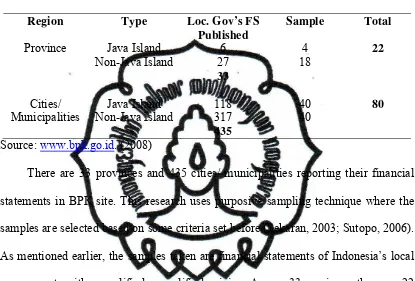
second semester of reporting. Table 3 below describes the population and sample in
commit to user Table 3
Local Governments’ Financial Statements 2007 (Reported in 1st and 2nd Semester of 2008)
Source: www.bpk.go.id. (2008)
There are 33 provinces and 435 cities/ municipalities reporting their financial
statements in BPK site. This research uses purposive sampling technique where the
samples are selected based on some criteria set before (Sekaran, 2003; Sutopo, 2006).
As mentioned earlier, the samples taken are financial statements of Indonesia’s local
governments with unqualified or qualified opinion. Among 33 provinces, there are 22
provinces which are grated unqualified or qualified opinion from BPK for their
annual reports. This research employs the 22 provinces as the samples. Of 435 cities/
municipalities across Indonesia, researcher only takes 80 cities/ municipalities as
samples. This is based on the analogy that “the minimal sample size in multiple
regression analysis should be at least 10 times of independent variables used in the
research” (Rosche 1975 in Sekaran 2003). The independent variable in this research
commit to user
statistical measurements (Jogiyanto 2005), so 80 cities/ municipalities taken as
sample are enough.
Among the 22 provinces, 4 are from Java Island, namely West Java, Central
Java, Yogyakarta, and Banten; 18 others are from Non-Java Island, namely NAD,
West Sumatra, Riau, Jambi, South Sumatra, Bengkulu, Lampung, Bangka Belitung,
Riau Island, Bali, NTT, South Kalimantan, North Sulawesi, Central Sulawesi,
South-East Sulawesi, Gorontalo, West Sulawesi and Papua. The 80 cities/ municipalities
taken as sample consist of 40 from Java Island and another 40 from Non-Java Island.
Appendix I is the name of provinces and cities/ municipalities used as samples.
2. Classical assumption
Gujarati (2003) states that classical assumption is needed as a precondition for
multiple regression tests to make sure that the research is valid, not bias, and
consistent. The classical assumption used in this research is normality test. This
research employs One Sample Kolmogorov-Smirnov as the tools with the p-value 5%
significant level which means that the data is normally distributed if the significance
is > 5% or 0.05 (Trihendradi, 2007).
The result shows that all of the data are normally distributed. The detail of the
classical assumption test can be seen in the Appendices II.
commit to user
This research again deals with the compliance practices of local government
financial statement toward SAP set by the government. SAP consists of 11
statements, one conceptual framework and some attachments. Among the 11
statements, there are four (4) main elements of local governments’ report, namely
budget realization report (PSAP 2), Cash Flow Statement (PSAP 3), Notes on
Financial Statement (PSAP 4), and balance sheet which consists of inventory
accounting (PSAP 5), investment accounting (PSAP 6), fixed- asset accounting
(PSAP 7), assets under reconstruction (PSAP 8), and lastly liability accounting
(PSAP 9). This research, then, pays attention on the item of balance sheet only since
it reflects the condition of an entity financially; how much its resources and how
much its debt. The items of balance sheet cover inventory accounting (PSAP 5),
investment accounting (PSAP 6), fixed- asset accounting (PSAP 7), assets under
reconstruction (PSAP 8), and lastly liability accounting (PSAP 9). The detail of every
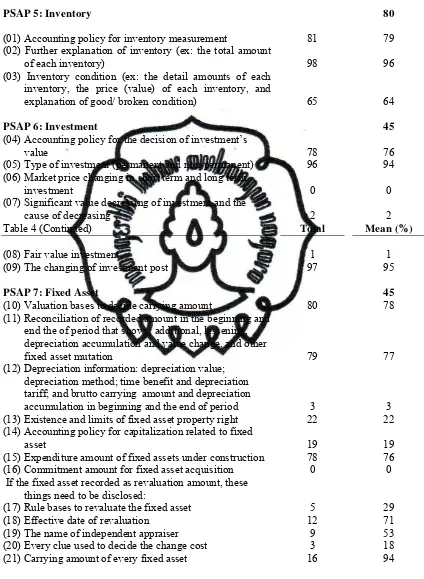
item in every PSAP is summarized in the Table 4 where there are 3 items under
inventory, 6 items under investment, 12 items under fixed asset, and 8 items under
liability.
Table 4
Mandatory Accounting Disclosure Items in Balance Sheet
commit to user
PSAP 5: Inventory
(01) Accounting policy for inventory measurement
(02) Further explanation of inventory (ex: the total amount of each inventory)
(03) Inventory condition (ex: the detail amounts of each inventory, the price (value) of each inventory, and explanation of good/ broken condition)
PSAP 6: Investment
(04) Accounting policy for the decision of investment’s value
(05) Type of investment (permanent and non-permanent) (06) Market price changing in short term and long term
investment
(07) Significant value decreasing of investment and the cause of decreasing
Table 4 (Continued)
(08) Fair value investment
(09) The changing of investment post
PSAP 7: Fixed Asset
(10) Valuation bases to decide carrying amount
(11) Reconciliation of recorded amount in the beginning and end the of period that shows: additional, lessening, depreciation accumulation and value change, and other fixed asset mutation
(12) Depreciation information: depreciation value; depreciation method; time benefit and depreciation tariff; and brutto carrying amount and depreciation accumulation in beginning and the end of period (13) Existence and limits of fixed asset property right (14) Accounting policy for capitalization related to fixed
asset
(15) Expenditure amount of fixed assets under construction (16) Commitment amount for fixed asset acquisition If the fixed asset recorded as revaluation amount, these
things need to be disclosed:
(17) Rule bases to revaluate the fixed asset (18) Effective date of revaluation
(19) The name of independent appraiser (20) Every clue used to decide the change cost (21) Carrying amount of every fixed asset
PSAP 8: Assets Under Construction
commit to user
(22) Contract details of assets under construction including finishing level and duration
(23) Amount of construction’s value and funding resource (24) Amount of expenditure
(25) Down payment (26) Retention
PSAP 9: Liability
(27) Details list of liability to give a better information to the users
(28) Amount of short term and long term liability that are classified based on the creditor
(29) Amount of liability that are classified by the type of security’s liability and due date
(30) Interest in the current period and the level of interest (31) Consequences of completing the liability before the due
date
(32) Agreement of liability’s restructuring: decreasing of liability; modification of liability’ conditions; decreasing of liability’s interest level; delay of liability’s due date; decreasing of liability’s due date Table 4 (Continued)
value; and decreasing of interest amount until the reporting period
(33) Amount of liability’s arrears that are presented in the list based on creditor
(34) Liability’s cost: treatment of liability’s cost; amount of liability’s cost that are capitalized in the current period; and capitalization level
8
Among 5 items in balance sheet, there are 80% of local governments comply on
inventory, 45% comply on investment, 45% comply on fixed assets, 27% comply on
liability and only 18% comply on the asset under reconstruction respectively.
The disclosure compliance on the inventory accounting is relatively high or the
highest among all disclosure compliance. Among 102 samples, there are 98 (96%)
local governments which comply with the item number 2 (Further explanation of
commit to user
1 (Accounting policy for inventory measurement) complied by 81 local governments
(79%). Meanwhile, item number 3 Inventory condition (ex: the detail amounts of
each inventory, the price (value) of each inventory, and explanation of good/ broken
condition). This finding is the same with the previous research by Mandasari (2009).
Local governments must disclose the condition of inventory in more detail, such as
the number of each item and the price (value). The detail amount of inventory’s item
is easy to be recorded and disclosed; however, the price (value) of inventory’s item is
not always disclosed. This requirement is not always fulfilled by the municipality due
to the complex condition. Some of the inventory can be in the form of drug and
livestock. Therefore, there will be difficulties due to the valuation of each item, also
deciding whether the drug and livestock are in a good condition or is broken.
In PSAP 6 about investment, the Indonesian local governments comply in
more-varied amount, ranging from 0%-95%. The highest compliance is on the
changing on the investment post (95%) then followed by the type of investment
whether it is permanent or non-permanent (94%). In other hand, there is no local
government disclosing the market price changing in short term and long term
investment. This is probably due to the complex process needed to calculate the value
of the investment with the new market price.
The compliance level for PSAP 7 (fixed assets) is also varied, ranging from 0
to 94%. The lowest level of compliance in this SAP is for the commitment amount
for fixed asset acquisition. In the reporting year of 2007, none of the local
commit to user
fixed assets acquisition. The highest compliance is for the changing of investment
post (94%).
For PSAP 8 (assets under construction), the highest level of compliance is for
item number 3 (amount of expenditure) which reaches 69%. In contrary, retention is
only in level 1%. Ideally, a construction contact has rules on retention, for example
maintenance term which is hold by the employer. The amount is disclosed in the
Notes on Financial Statement. Yet, none of Indonesian local government disclosed
retention amount in their financial reports in 2007.
In PSAP 09 or liability accounting, 100 local governments out of 102 samples
or 98% disclose the detail list of liability to give better information to the users. This
term is usually in term of dividing the liability into short term and long term, showing
the source of debt and giving the amount. Meanwhile, item number 5, 6 and 8 are
complied in the level of 0% by 102 local governments. No one of the sample disclose
any information about consequences of completing the liability before the due date.
Some of the local government mentions about the due date of their long term liability
but they do not mention anything about the consequences of completing the liability
before the due date. Agreement of liability’s restructuring: decreasing of liability;
modification of liability’ conditions; decreasing of liability’s interest level; delay of
liability’s due date; decreasing of liability’s due date value; and decreasing of interest
amount until the reporting period (item 6) and liability’s cost: treatment of liability’s
cost; amount of liability’s cost that are capitalized in the current period; and
commit to user
probably the complexity faced by the local government in disclosing the items or the
idea of the useless of disclosing those items in the financial reports. They probably
think that the most important information for their users of financial reports regarding
the liability is the type and the amount of the liability.
As mentioned in the Chapter III, this research employs PC unweighted
method in measuring the compliance level of local governments’ financial statement.
Refer to the Appendix III, the average level of compliance level under unweighted
method is 37. 94%. Meanwhile the average level under PC unweighted is slightly
higher; that is 41.71%.
The idea of Governmental Accounting Standard is issued is to give guidelines
for the creation of financial statement of local government across Indonesia. Ideally,
every local government in Indonesia (whether it is municipal/ city or province;
whether it is located in Java Island or in Non Java Island) must fully comply with the
SAP (Sinaga, 2011). Yet, the result above says differently where the average level of
mandatory disclosure compliance level is 41.71%. It means that the Governmental
Accounting Standard is partially complied by local government in Indonesia. This
result is supported by Mandasari (2009), Misra (2009) and Retnoningsih (2009).
The poor performance of Indonesian local governments’ compliance is critical
phenomenon to be considered. This is due to the needs of information required by the
users of FS in making the decision (Supriyanto, 2011). It has been argued throughout
commit to user
quality information to decision makers only when the issuing organizations comply
with accounting standards and when their respective external auditors provide ample
information concerning the extent of their clients’ compliance (Cohen and
Kaimenakis 2008). Applying total accrual accounting in Indonesian context seems
quite hard; that is why the government decides to have transition time in applying
accrual accounting (Robinson and Harun, 2004). SAP regulates the accounting bases
for revenue, expenditure, transfer and funding is cash bases, while accrual is for
assets, liability and equity. The transition is considered far from successful since the
quality of information provided by the new accounting systems is rather low.
Therefore its use for decision making purposes should be made with caution
(Mandasari, 2009).
As mentioned before, the results of PC unweighted is higher than the
unweighted method, the next computation uses PC unweighted as the base of
computation.
3. Descriptive statistic
This research aims at figuring out the local governments’ financial report
compliance level towards SAP with two comparisons: (1) between provinces and
cities/ municipalities, and (2) between local governments located in Java Island and
local governments located in non-Java Island.
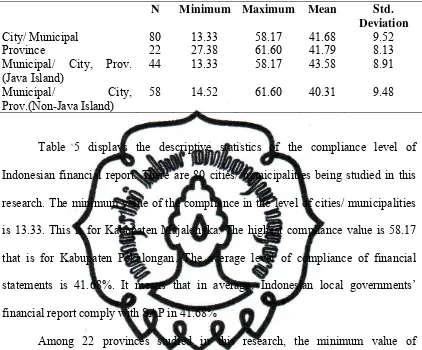
Table 5
commit to user
Table 5 displays the descriptive statistics of the compliance level of
Indonesian financial report. There are 80 cities/ municipalities being studied in this
research. The minimum value of the compliance in the level of cities/ municipalities
is 13.33. This is for Kabupaten Majalengka. The highest compliance value is 58.17
that is for Kabupaten Pekalongan. The average level of compliance of financial
statements is 41.68%. It means that in average, Indonesian local governments’
financial report comply with SAP in 41.68%
Among 22 provinces studied in this research, the minimum value of
compliance is 27.38, Sulawesi Barat; meanwhile, Riau has the highest level of
compliance that is 61.60. The average level of compliance in province is 41.79% with
8.13 deviations.
The total number of local governments’ financial reports studied in Java
Island is 44 local governments consisting of 40 municipalities/ cities and 4 provinces.
The lowest level of the compliance is 13.33, Kabupaten Majalengka. Meanwhile, the
highest level for compliance is 58.17, Kabupaten Pekalongan. The average level of
commit to user
The total number of local governments’ financial reports studied in Java
Island is 58 local governments consisting of 40 municipalities/ cities and 18
provinces.
C. Hypothesis Testing
The dependent variable of this research is the compliance level while the
independent variables are local governments’ structure (province and city/
municipality) and local governments’ geographical locations (located in Java Island
and in Non-Java Island).
Independent-Sample t-test is used to identify the significance of mean’s
difference between two groups (Trihendradi, 2007). This research investigates the
difference level of financial statements compliance with SAP between the province
and municipal/ city and between local government located in Java and local
government located in Non-Java.
This research has two hypotheses. Hypothesis 1 mentions ‘Provinces’
financial report disclosure is different from cities’/ municipalities’ financial report.’
Below is the group statistics of the hypotheses 1.
Recall table 5, the mean/ average level of compliance in province is 41.7905
while compliance for municipal/ city is 41.6828. In order to identify the significance
of mean’s difference between two groups (Thihendradi, 2007), the independent