Axis and Its Signature Tell Divergent Stories
Author(s): Brendan Delehanty and Rudy Boonstra
Source: Physiological and Biochemical Zoology, Vol. 84, No. 4 (July/August 2011), pp. 417-428
Published by: The University of Chicago Press
Stable URL: http://www.jstor.org/stable/10.1086/660809
.
Accessed: 14/08/2011 17:31
Your use of the JSTOR archive indicates your acceptance of the Terms & Conditions of Use, available at
.
http://www.jstor.org/page/info/about/policies/terms.jspJSTOR is a not-for-profit service that helps scholars, researchers, and students discover, use, and build upon a wide range of content in a trusted digital archive. We use information technology and tools to increase productivity and facilitate new forms of scholarship. For more information about JSTOR, please contact [email protected].
The University of Chicago Press is collaborating with JSTOR to digitize, preserve and extend access to Physiological and Biochemical Zoology.
Coping with Intense Reproductive Aggression in Male Arctic Ground
Squirrels: The Stress Axis and Its Signature Tell Divergent Stories
* Corresponding author; e-mail: [email protected].
Physiological and Biochemical Zoology84(4):417–428. 2011.䉷2011 by The
University of Chicago. All rights reserved. 1522-2152/2011/8404-0131$15.00. DOI: 10.1086/660809
Brendan Delehanty* Rudy Boonstra
Department of Biological Sciences, Centre for the Neurobiology of Stress, University of Toronto at Scarborough, Toronto, Ontario M1C 1A4, Canada
Accepted 4/25/2011; Electronically Published 6/9/2011
Online enhancement:appendix.
ABSTRACT
We tested the adaptive stress hypothesis that male arctic ground squirrels (Urocitellus parryii) exhibit a stress response over the course of the breeding season that is characterized by increasing free cortisol concentrations, increasing mobilization of stored energy, and decreasing physical condition. We assessed the functioning of the hypothalamic-pituitary-adrenal axis by mea-suring cortisol levels in response to the stress of capture and in response to a hormone challenge protocol (dexamethasone suppression and adrenocorticotropic hormone stimulation). We measured blood glucose levels, free fatty acids, white blood cells, and hematocrit to assess the downstream physiological responses to cortisol. Immediately after spring emergence, male arctic ground squirrels had ample free abdominal fat and few signs of wounding. By the end of the breeding season 3 wk later, visible fat reserves were almost entirely gone, and most males had extensive wounds. Total plasma cortisol concentra-tions increased over this period, but so did corticosteroid-bind-ing capacity, resultcorticosteroid-bind-ing in no change in the free cortisol response to capture. We found no significant changes in how the animals responded to our hormone challenges, contrary to our pre-diction that the stress axis should increase free cortisol pro-duction. Even though we found no change in the functioning of the stress axis, all of the downstream measures suggested that male arctic ground squirrels are chronically exposed to high cortisol concentrations. Over the breeding season, blood glucose increased, fat stores and circulating free fatty acids were depleted, and both hematocrit levels and white blood cell counts decreased significantly. Our data suggest that a more complex relationship between the stress axis and downstream measures of stress exists than that proposed by the adaptive
stress hypothesis. We propose several nonexclusive, testable mechanisms that could explain our observations.
Introduction
The hypothalamic-pituitary-adrenal axis (stress axis) has been of long-standing interest to physiological ecologists because of its central role in permitting vertebrates to respond to a wide range of stressors, from temperature extremes to social inter-actions and predation risk (Wingfield and Romero 2001). At the onset of an acute stressor that threatens an individual’s homeostasis, the sympathetic nervous system causes the release of catecholamines to generate immediate physiological effects (over a period of seconds to minutes), while the stress axis begins a neuroendocrine response that ultimately causes the releases of glucocorticoids (GCs; cortisol [CORT] and/or cor-ticosterone) over a period of several minutes to hours (Sapolsky et al. 2000). GCs are generally described as promoting the im-mediate survival of the individual (Boonstra et al. 1998; Wing-field et al. 1998; Sapolsky et al. 2000). They do this by redi-recting the body’s resources away from physiological processes that are not essential to immediate survival, including repro-duction and growth (Sapolsky et al. 2000; Charmandari et al. 2005), thereby freeing up energy to be devoted to overcoming or escaping the stressor.
The negative effects of chronic stress (by which we mean chronic activation of the stress axis) on reproduction have been well described (Sapolsky et al. 2000; Wingfield and Sapolsky 2003). In northern and arctic species, the interactions between the stress axis and the hypothalamic-pituitary-gonadal axis (re-productive axis) become critical because chronic stress during a narrow reproductive window could have a disproportionately large effect on the animal’s fitness. Nowhere is this truer than in those northern and arctic species in which males aggressively compete for mating opportunities. When the breeding season also coincides with limited food availability, it is likely that reproductive success will be highly influenced by the ability to maximize the energy they can devote to obtaining mates.
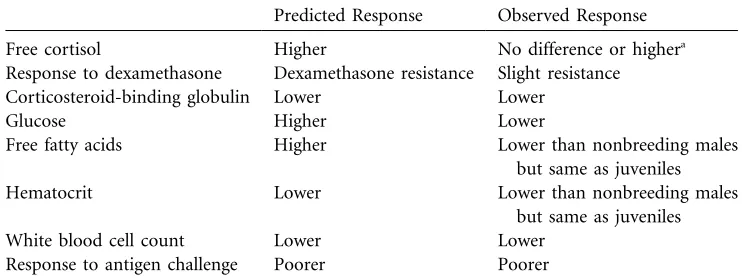
breed-Table 1: Physiological status of breeding male arctic ground squirrels as predicted by the adaptive stress hypothesis (Boonstra and Boag 1992) and observed by Boonstra et al. (2001b)
Predicted Response Observed Response
Free cortisol Higher No difference or highera
Response to dexamethasone Dexamethasone resistance Slight resistance Corticosteroid-binding globulin Lower Lower
Glucose Higher Lower
Free fatty acids Higher Lower than nonbreeding males
but same as juveniles
Hematocrit Lower Lower than nonbreeding males
but same as juveniles
White blood cell count Lower Lower
Response to antigen challenge Poorer Poorer
Note. The predicted response refers to the predicted status of breeding males in comparison with nonbreeding, prehibernating adult males and juvenile males.
aBoonstra et al. (2001a) used a hormone challenge protocol that involved collecting five blood samples over the course of two hormone treatments (the same protocol we used; see “Material and Methods” for details). The first blood sample was collected after the stress of capture and handling but before the administration of the hormones. The three classes of squirrels showed no difference in this baseline free cortisol level. However, in a repeated-measures ANOVA there was a significant effect of class (with breeding males having higher free cortisol levels than nonbreeding adult males and juveniles).
ing season can be an adaptive strategy in certain circumstances. By maintaining a robust—or even an enhanced—stress re-sponse during the breeding season, an individual could max-imize fitness by increasing the energy available for reproduction even if it reduces survival. This strategy has been called the “adaptive stress response” (Boonstra and Boag 1992) and is dependent on the ability to avoid or overcome the negative effects of stress on reproduction. The alternative strategy was called the “homeostasis stress response,” in which the normal feedback mechanisms of the stress axis remain intact over the breeding season; this was proposed to be characteristic of it-eroparous species. The adaptive stress response is best exem-plified by a group of semelparous marsupials in Australia. In at least 10 species of dasyurid marsupials, the entire male pop-ulation dies off at the end of their first breeding season (Lee and Cockburn 1985; Bradley 2003). The endocrine profiles of males have been studied in great detail in four of these species (Antechinus stuartii,Antechinus swainsonii,Antechinus flavipes, andPhascogale calura). Each one shares a common physiolog-ical progression. As the breeding season approaches, free GC levels increase in males. Free GC refers to GC not bound by corticosteroid-binding globulin (CBG), and it is widely believed that only free hormone can leave the circulatory system and exert a biological effect on tissues (see Rosner 1990; Ekins 1992; Mendel 1992; Malisch and Breuner 2010). The increase in free GC is the result of several factors: first, blood GC levels increase because adrenal GC production increases; second, testosterone drives down CBG production, which lowers the proportion of bound GC; and third, the negative feedback that normally shuts down GC production after the onset of the stress response fails (at least in P. calura and A. swainsonii; Bradley et al. 1980; McDonald et al. 1981; Lee and Cockburn 1985; Bradley 1987, 1990). The elevated GC levels lead to gastric ulcers, suppression of immune and inflammatory responses, increased parasitism,
and shifts in hematological parameters (Cheal et al. 1976; Barker et al. 1978; Bradley et al. 1980) that ultimately result in the male die-off. The adaptive stress hypothesis predicts that this type of response should evolve in species that have low survival between breeding seasons (Boonstra and Boag 1992). The arctic ground squirrel (Urocitellus parryii[Helgen et al. 2009], formerlySpermophilus parryii), is one such species that shows a life history broadly similar to that of the semelparous marsupials (Boonstra 2005). Although they are not semelpa-rous, males have low annual survival rates, with approximately 62% of males living through only one breeding season and !1% surviving beyond a second breeding season (estimated from figures in Gillis 2003). The once-a-year breeding oppor-tunity combined with a relatively low between-year survival rate for males led Boonstra et al. (2001b) to hypothesize that breeding male arctic ground squirrels would exhibit an adaptive stress response that promotes reproductive success at the ex-pense of survival, whereas nonbreeding males and juvenile males would exhibit a homeostatic stress response.
direct test of the adaptive stress hypothesis by comparing the stress response of male arctic ground squirrels immediately before the breeding season with that at the end of the breeding season (a span of 3 wk).
The biology of arctic ground squirrels makes them partic-ularly well suited to testing this hypothesis. Male arctic ground squirrels emerge from hibernation before females, at a time when snow still covers most of the ground (Buck and Barnes 1999). However, they have already been euthermic for the pre-vious 2–3 wk, during which time their testes grow and sper-matogenesis begins (Barnes and Ritter 1993). During this time they remain underground and consume cached food stores, regaining all their body mass lost over winter (Buck and Barnes 1999; Gillis et al. 2005). As a result, they have significant fat reserves when they emerge aboveground (Buck and Barnes 1999). We predicted that male arctic ground squirrels, being well fed and having been sequestered in their burrows away from any aggressive interactions, should be relatively unstressed when first emerging. However, approximately 1 wk after the first males emerge from hibernation, the females begin to emerge and rapidly enter estrus (Buck and Barnes 1999). Males defend territories encompassing the burrows of several females (Lacey and Wieczorek 2001), but aggressive encounters are fre-quent as males attempt to obtain matings with females not within their territory (Lacey et al. 1997). These encounters can result in severe wounding (e.g., gaping wounds, severed testes, and lost eyes) and even death (Carl 1971; Holmes 1977; Gillis 2003; this study). Given the intensity of the mating competition among males over 2–3 wk, we predicted that males would show signs of chronic stress and a breakdown of negative feedback in the stress axis by the end of the breeding season.
We made the following predictions about the change in male physiology from the prebreeding (the unstressed state) to the postbreeding (the chronically stressed state) sampling period. First, we predicted that, relative to prebreeding males, males at the end of the breeding season would show signs of chronic activation of the stress axis over the breeding season by having (1) higher free CORT levels (in accordance with the free hor-mone hypothesis, free horhor-mone levels determine the amount of hormone immediately available for uptake by tissues, so we made no specific predictions about how total CORT levels should change), (2) lower CBG levels as a result of high tes-tosterone levels (shown to suppress CBG in some semelparous marsupials; McDonald et al. 1981; Bradley 1987) or chronic stress (found to reduce CBG levels in other species; Dallman et al. 1987; Armario et al. 1994; Fleshner et al. 1995; Boonstra et al. 1998), and (3) attenuated negative feedback in response to adrenal production of CORT, as seen in semelparous mar-supials (McDonald et al. 1986; Bradley 1990).
Next, because one of the primary roles of GCs is to mobilize energy in times of need, we considered how the chronic acti-vation of the stress axis over the breeding season would alter the metabolic profiles of arctic ground squirrels. Because CORT reduces the peripheral uptake of glucose, promotes lipolysis and protein catabolism, and promotes hepatic gluconeogenesis so that the stores of glucose and glycogen in the liver are
in-creased under chronic stress (Boonstra et al. 1998; Sapolsky et al. 2000), we predicted that males at the end of the breeding season would show a different metabolic profile characterized by (1) higher stress-induced blood glucose levels and (2) de-pleted fat stores and lower stress-induced free fatty acid levels. Finally, we used two hematological measures to assess general health and immune function. We predicted that postbreeding males would show (1) lower hematocrit levels than prebreeding animals (because while hematocrit can change in response to a number of factors, a number of wildlife studies have found that higher hematocrit levels indicate better body condition; Franzmann and LeResche 1978; Lochmiller et al. 1986; Hellgren et al. 1993; Boonstra et al. 1998, 2001b; but see Dickens et al. 2009a) and (2) decreased white blood cell counts (due to the immunosuppressive effect of chronic stress; Sapolsky et al. 2000).
Material and Methods
Study Area
In 2007, we trapped ground squirrels 50 km west of Pelly Crossing, Yukon, at the Pelly River Ranch (62⬚50′
N, 137⬚18′ W) in pasture and oat fields. Snow still covered approximately 70% of the land on April 10 but had disappeared entirely by April 27. All procedures were conducted under University of Toronto animal use protocol 200006524, issued in accordance with the Canadian Council on Animal Care guidelines.
Trapping and Field Sampling
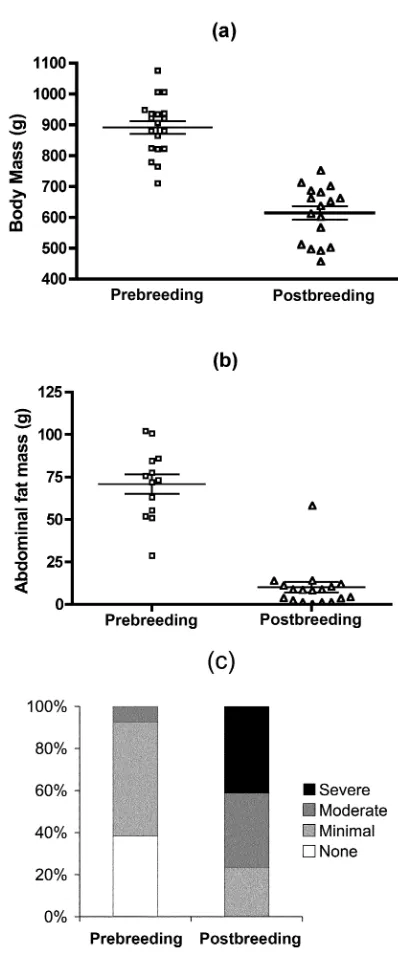
Figure 1. Changes in (a) body mass, (b) free abdominal fat, and (c) wounding in male arctic ground squirrels from the prebreeding (np19, 14, and 13, respectively) to the postbreeding (np17for all measures) trapping session. All changes were statistically significant (see “Results”). Error bars show standard errors. See “Material and Methods” for wound scoring.
traps if we were nearby; hence, there was no practical way to collect blood samples within the 3–5 min typically needed to obtain true baseline values (see Delehanty and Boonstra 2009). Approximately 0.3 mL of the first blood sample was collected in a lavender-tip tube and sent for a complete blood count (including a white blood cell count) at a commercial laboratory (Vita-Tech Veterinary Laboratory Services, Markham, Ontario). We also used this first blood sample to measure blood glucose
levels (mg/dL) with a FreeStyle glucose meter (Abbott Labo-ratories, Alameda, CA) and hematocrit levels, in duplicate, us-ing microhematocrit tubes and a microhematocrit centrifuge. The remaining blood collected in this sampling and all blood from subsequent samplings was centrifuged, and plasma was collected and frozen at⫺20⬚C until being returned to the lab-oratory, where it was stored at ⫺80⬚C.
After collecting the first blood sample, we started a hormone challenge protocol consisting of an injection of dexamethasone (DEX) followed 2 h later by an injection of adrenocorticotropic hormone (ACTH). DEX is an artificial GC that normally sup-presses endogenous CORT production by activating the GC receptors in the pituitary (De Kloet et al. 1998), inhibiting ACTH production and down-regulating GC production. Chronic stress can impair this negative feedback system, and animals whose GC levels do not fall as much or as rapidly in response to DEX treatment are described as DEX resistant (Bradley 1990; Sapolsky and Altmann 1991). We injected 0.1, 0.2, or 0.4 mg/kg DEX (Sabex, Montreal; dilutions with phys-iological saline) into the heart and then returned the animal to the covered trap and processed the next animal. Two hours after the DEX injection, we anesthetized the animal again and collected a 0.2–0.3-mL blood sample (hereafter, “DEX bleed”). Because previous studies used 0.4 mg/kg and found little evi-dence of DEX resistance, we tried the lower doses to test whether 0.4 mg/kg was too high to detect resistance. We found no correlation between dose and either total or free CORT in the DEX bleed (data not shown), indicating that a maximal response was achieved with the lowest dose. We therefore ig-nored dose as a factor in our analysis of DEX resistance.
After collecting the DEX blood sample, we injected 4 IU/kg ACTH (Synacthen Depot; Novartis Pharmaceuticals Canada, Dorval, Quebec) intramuscularly into the thigh. Post-ACTH blood samples of 0.2 mL each were collected at 30, 60, and 120 min (hereafter, “P30 bleed,” “P60 bleed,” and “P120 bleed”).
After the P120 bleed, the animal was euthanized by anesthetic overdose and decapitation. On necropsy, we determined paired adrenal gland mass to the nearest 1 mg (as another rough measure of adrenal capacity). As a gross measure of lipid energy stores, we weighed free abdominal fat to the nearest 0.1 g. Free abdominal fat was defined as fat that was readily extracted from the abdominal cavity and did not include mesenteric fat. To illustrate the intensity of the breeding season, we examined the skin internally and externally for evidence of wounding. We scored the degree of wounding according to the number of punc-tures (bite marks that penetrated the skin, usually only visible from the inside of the hide) and externally visible wounds (tears in the skin that were open to the muscle below or had scabbed over). Our scoring categories were “none” for no wounds, “min-imal” for!10 punctures and!2 cm2of externally visible wound-ing, “moderate” for ≥10 punctures and/or 12 but !7 cm2 of externally visible wounding, and “severe” for≥7 cm2
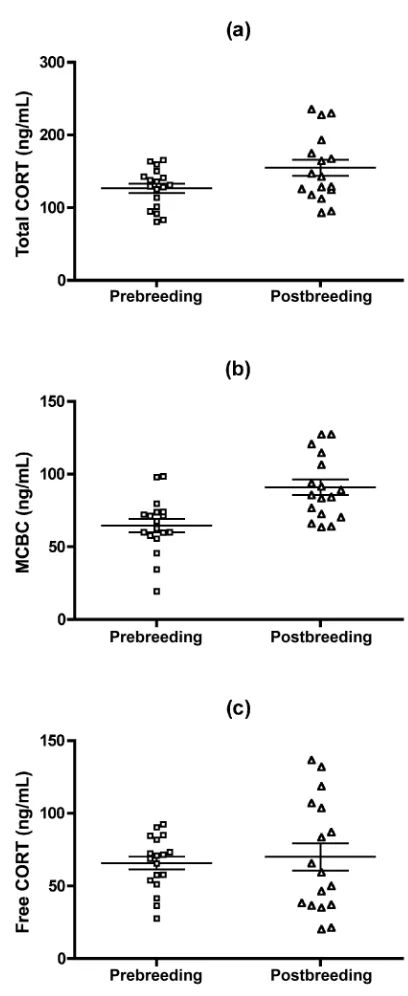
Figure 2. Plasma cortisol (CORT) and maximum corticosteroid-bind-ing capacity (MCBC) in male arctic ground squirrels in the prebreedcorticosteroid-bind-ing (np18) and postbreeding (np17) sessions measured at the baseline bleed (meanⳲSE). Total CORT and MCBC are significantly different in pre- and postbreeding sessions; free CORT is not.
Laboratory Procedures
We measured total CORT and estimated maximum cortico-steroid-binding capacity (MCBC; a measure of CBG level) using the radioimmunoassay methods described in Delehanty and Boonstra (2009). In this procedure, we used dextran-coated charcoal to separate bound from unbound hormone. The MCBC results are sensitive to the length of time to which the
hormone mixture is exposed to the charcoal because hormone-CBG complexes can dissociate during the incubation, thereby causing a loss of hormone bound to the charcoal. We used a 30-min incubation with charcoal, whereas Boonstra et al. (2001b) used a 10-min incubation. We calculated that samples lost 11% of bound hormone over the additional 20 min of incubation, and we therefore adjusted our MCBC values ac-cordingly to make our results directly comparable to previously published data. In addition to binding to CBG, CORT also binds to albumin, but with very low affinity. On the basis of a number of lines of evidence, some endocrinologists have concluded that albumin-bound hormone should be treated as free (Tait and Burstein 1964; Ekins 1992). The equation in Barsano and Baumann (1989) allows one to calculate non-CBG-bound hormone levels (i.e., free plus albumin-bound) given only the total CORT concentration, the MCBC, and the CBG/CORT equilibrium dissociation constant (Kd). Boonstra
et al. (2001b) calculated theKdfor arctic ground squirrel CBG
as 22.2 nM by means of a dialysis technique. However, because this study was part of a larger comparative study of five species of ground squirrels, we recalculated the Kd of arctic ground
squirrels by means of the same technique that we would be using for the other species. Using methods adapted from Ham-mond and La¨hteenma¨ki (1983), we calculated the Kd as
(meanⳲ SE) nM (see the appendix in the online 4.0Ⳳ0.42
edition ofPhysiological and Biochemical Zoologyfor details). Because testosterone has been shown to affect CBG levels (McDonald et al. 1981; Bradley 1987), we measured androgen levels to see whether they could explain any changes in MCBC we observed. We measured androgen levels in the stressed base-line plasma sample by radioimmunoassay, according to the procedures of Delehanty and Boonstra (2009). We refer to an-drogen levels because our antibody (P43/11; Croze and Etches 1980) had 62% cross-reactivity with dihydrotestosterone and 16% cross-reactivity with androstenedione.
Both GCs and ACTH can be lipolytic (Kiwaki and Levine 2003; Vegiopoulos and Herzig 2007), and because the hallmark of the adaptive stress response is maximizing the availability of energy even at the expense of longer-term survival, we expected these animals to deplete fat stores very rapidly and also to catabolize muscle as an energy source. Therefore, we predicted that prebreeding animals should be able to mobilize free fatty acids in response to capture stress, whereas postbreeding ani-mals should have virtually no fat reserves left and should, there-fore, show a reduced free fatty acid response to capture stress. We measured free fatty acids using a NEFA-C kit (Wako Chem-icals, Richmond, VA) modified to be used with a 96-well plate (Johnson and Peters 1993; Delehanty and Boonstra 2009).
Statistics
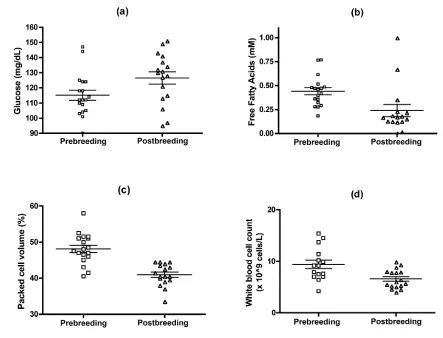
Figure 3. Changes in metabolic and blood parameters in male arctic ground squirrels over the breeding season (meanⳲSE). All data are from the stressed baseline bleed of the hormonal challenge, and all changes are significantly different (P!0.05). Sample sizes arenp18 prebreeding males andnp17 postbreeding males, except for free fatty acids (np16 postbreeding males) and white blood cell counts (np15prebreeding males).
the Satterthwaite test. Where nonnormal data could not be normalized with a transformation, we used the Wilcoxon-Mann-Whitney nonparametric two-sample test using the EXACT option to generate a Monte Carlo–based exact P
value. Other statistical tests are described in “Results.” All data are presented as meansⳲSE.
Results
A total of 18 males were captured in the prebreeding session, and 17 were captured in the postbreeding session. Because of limited plasma volumes, not all hormone assays could be per-formed for all individuals or for all blood samples from an individual, so sample sizes for each comparison vary.
The Toll of the Breeding Season
To put our main results in context, we first present our data on changes in mass and wounding to illustrate the intensity of the breeding season (Fig. 1). From the pre- to the postbreeding session, male arctic ground squirrels lost 31% of their body mass (tp9.15 df, p34,P!0.0001) and 88% of free
abdom-inal fat reserves (tp11.35, Satterthwaite-adjusted dfp14.2, ). Over the same period, males suffered an increasing
P!0.0001
number of wounds, with the percentage of severe wounds in-creasing from 0% to 23% (Fisher’s exact test, np30, P! ). None of the males we captured in the postbreeding 0.001
session were free of wounds.
Hormonal Changes
From the pre- to the postbreeding trapping session, total CORT levels in the stressed baseline sample increased by 22% (tp
, Satterthwaite-adjusted , ), but there
⫺2.20 dfp25.6 Pp0.037
was no net change in free CORT levels (tp⫺0.13, Satter-thwaite-adjusteddfp23.1,Pp0.90; Fig. 2), contrary to our predictions. Free CORT did not increase because there was a simultaneous 41% increase in MCBC (tp⫺3.83 df, p33, ), also contrary to our predictions. Individual
an-Pp0.0006
imals’ MCBC values did not change over the course of the hormone challenge protocol (repeated-measures ANOVA using SAS PROC MIXED,F4, 33p1.03, Pp0.40).
Figure 4. Total cortisol (CORT) response in male arctic ground squir-rels to adrenocorticotropic hormone (ACTH) injection in the pre-breeding (np13) and postbreeding (np15) sessions (meanⳲSE). Individual CORT concentrations were standardized by subtracting the animal’s total CORT level at the dexamethasone (DEX) bleed (obtained immediately before injecting ACTH) from each reading. The area un-der the curve did not differ between sessions.
was 0.31Ⳳ0.03 ng/mL in the prebreeding session and ng/mL in the postbreeding session. The difference 0.22Ⳳ0.02
was statistically significant (Wilcoxon-Mann-Whitney two-sample test, Sp192.0, Pp0.003). However, we think it is unlikely that the difference of 0.1 ng/mL has any biological significance given that the levels are only 2% and 1% of stressed baseline levels, respectively. If the difference is real, it is in the opposite direction of that predicted. However, because arctic ground squirrels in both sessions remained highly responsive to DEX relative to semelparous marsupials, in which DEX elicits only a 10%–27% drop in CORT levels in postbreeding males (McDonald et al. 1986; Bradley 1990), we conclude that there is no evidence of any meaningful change in DEX resistance from the pre- to the postbreeding state. This, too, is contrary to our prediction.
Downstream Measures of Stress
To measure the effects of CORT levels on target tissues, we measured blood glucose, free fatty acids, white blood cells, and hematocrit (Fig. 3). Postbreeding blood glucose levels were 10% higher than those measured in the prebreeding session (tp
, , ), and free fatty acid levels were 46%
⫺2.18 dfp33 Pp0.037
lower (Wilcoxon-Mann-Whitney two-sample test, Sp177.5, ). White blood cell counts were 30% lower (
Pp0.0002 tp
, Satterthwaite-adjusted , ), and
he-3.04 dfp21.7 Pp0.0061
matocrit levels (percent packed cell volume) were 15% lower (tp5.68 df, p33,P!0.0001). All of these results were con-sistent with our predictions.
Explanatory Data
Because our CORT and MCBC results were completely contrary to our predictions, we examined some of the other hormonal data we collected to better understand the causes of the CORT changes we observed. We looked at adrenal mass and the total CORT area under the curve (AUC) in response to ACTH stim-ulation. Measuring total CORT levels over time in response to ACTH injection (i.e., AUC measured from the DEX bleed through the P120 bleed, using the DEX bleed CORT concen-tration as a baseline) provides an integrated measure of the animals’ sensitivity and capacity to produce CORT. This in-formation helps us to understand why we may see an increase or decrease in CORT levels. For example, an increase in AUC suggests that the adrenal glands are either more sensitive to ACTH or have a greater capacity to produce CORT. However, we found no change in adrenal mass; paired adrenal gland weight was187Ⳳ9.9mg (np12) in the prebreeding session We also measured androgens to see whether they play a role in determining MCBCs. There was no change in stressed base-line androgen levels (pre- and postbreeding levels were
and ng/mL, respectively; ,
11.6Ⳳ0.6 10.2Ⳳ0.7 tp1.66
, ), but to examine the relationship between dfp33 Pp0.11
androgen levels and MCBC more closely we ran an ANCOVA (SAS PROC GLM). Controlling for session (pre- or postbreed-ing), there was a positive relationship between MCBC values and androgens (ANCOVA, F1, 32p4.32, Pp0.046), but an-drogens explained only an additional 8% of the variation in MCBC values after taking trapping session into account.
Discussion
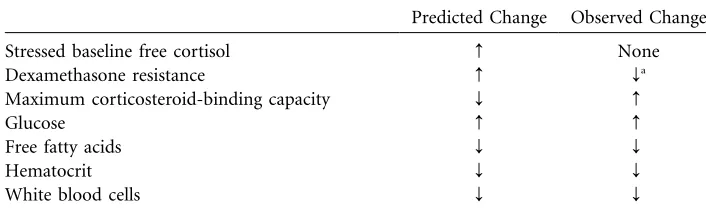
Table 2: Predictions of the adaptive stress hypothesis and observed changes in this study
Predicted Change Observed Change
Stressed baseline free cortisol F None
Dexamethasone resistance F fa
Maximum corticosteroid-binding capacity f F
Glucose F F
Free fatty acids f f
Hematocrit f f
White blood cells f f
Note. Arrows indicate increases or decreases from the pre- to the postbreeding session in the responsiveness of the stress axis, energy mobilization and condition, and the immune response of male arctic ground squirrels. Maximum corticosteroid-binding capacity is our measure of corticosteroid-binding globulin levels.
aAlthough there was a statistically significant change in dexamethasone free cortisol levels, the difference was so
small that there is likely no biological significance.
appear to have an adaptive stress response and be chronically stressed. We therefore reject the adaptive stress hypothesis; the stress axis of male arctic ground squirrels does not show the characteristic features of surging free GC levels and falling MCBC associated with the adaptive stress response character-istic of semelparous marsupials.
We are left with the task of trying to make sense of these results. To do this, we first examine the CORT data in more detail to try to understand how the stress axis changed over the breeding season. Then we propose new hypotheses that can help to reconcile the CORT and downstream results.
CORT Response
To interpret our results, it helps to think about the sequence of events leading up to the collection of our first blood sample. In the field, the animal starts from a basal unstressed CORT level. Upon capture, the stress axis is stimulated, and CORT production above resting levels begins. As free CORT levels increase, negative feedback at the level of the brain and pituitary act in opposition to the ongoing stimulation of the stress axis by the continued captivity. We assume that by the time we collect our stressed baseline blood sample, approximately 2–4 h later, an equilibrium exists between stimulation and negative feedback. That we see no change in stressed baseline free CORT suggests that from the pre- to the postbreeding period the stress axis is not changing its functioning in response to acute capture stress. So why do postbreeding animals have higher total CORT levels? It is not because the adrenal glands are producing more CORT in response to stimulation: adrenal mass did not change and total CORT AUC in response to ACTH did not differ between trapping sessions, both of which indicate that adrenal sensitivity and capacity remained stable. Nor is there evidence of impaired negative feedback: all pre- and postbreeding ani-mals responded strongly to DEX, indicating that negative feed-back continued to be robust. We therefore conclude that the most likely explanation is that free CORT levels determine the degree of negative feedback and, because MCBC is higher in postbreeding animals, more total CORT is required to reach
free CORT concentrations that provide the same degree of negative feedback as in the prebreeding session.
This consistency in the free CORT response is remarkable considering the dramatic changes that occur over the breeding season. The prebreeding animals had extensive fat reserves, and physical aggression in those first few days aboveground was relatively limited, as evidenced by the low wounding scores (Fig. 1). However, 3 wk later in the postbreeding session, mean body mass had decreased 31%, abdominal fat mass had de-creased 88%, and the vast majority of animals had moderate to severe wounding. That animals in such different conditions maintain an identical free CORT response suggests that they are adopting a homeostatic stress response. But if these animals are maintaining a homeostatic stress response, why does MCBC increase over the breeding season?
Two factors are usually cited as affecting CBG concentrations and, therefore, MCBC: testosterone and chronic stress. In sem-elparous marsupials, increasing testosterone over the breeding season causes CBG levels to decline (McDonald et al. 1981; Bradley 1987). In contrast, arctic ground squirrel CBG levels (measured indirectly as MCBC) increased over the breeding season (Fig. 2), despite unchanged androgen levels. Moreover, when we included androgen levels as a covariate in our com-parison of pre- and postbreeding MCBC values, we found a small positive (not negative) effect of androgens on MCBC. We therefore conclude, as Boonstra et al. (2001b) did, that CBG levels in arctic ground squirrels are not suppressed by testosterone.
when they had ample fat reserves and little wounding, actually had lower MCBC values than the postbreeding males at the end of 2 wk of intensive fighting and mating. CBG levels in male arctic ground squirrels appear to be determined by some factor other than androgen levels and chronic stress, and they change in a manner that is inconsistent with an adaptive stress response.
Thus, the stress axis of male arctic ground squirrels is in-compatible with both the adaptive stress and homeostasis mod-els proposed by Boonstra and Boag (1992), and alternative explanations need to be examined. In the appendix, we propose five nonexclusive alternative hypotheses that help to explain our observations, but here we focus on the two hypotheses that can explain our most significant observation, the increase in MCBC.
Alternative Hypotheses
We call the first explanation the “basal stress hypothesis.” Ac-cording to this hypothesis, male arctic ground squirrels main-tain a constant acute stress response over the active season but alter their basal physiology during the breeding season such that they have unusually high free CORT concentrations during both the pre- and the postbreeding period compared with non-breeding periods. We suggest that they do this by maintaining very low CBG levels in the breeding season so that a greater proportion of basal CORT (i.e., CORT levels in the absence of stressors activating the stress axis) is free. By maintaining elevated free CORT levels in the basal state, the animals could be constantly evoking responses from CORT-sensitive target tissues, thereby causing the symptoms of GC excess that we observed in our postbreeding downstream measures of stress (glucose, free fatty acids, white blood cell count, and hemat-ocrit). A phenomenon similar to this has been observed in rats. Fleshner et al. (1995) found that a single acute stress session caused basal CORT levels to be elevated for up to 96 h and that CBG levels were decreased for up to 48 h, thereby resulting in several days of increased free CORT exposure even in the absence of stressors. A similar effect over 24 h has been observed in Japanese quail (Malisch et al. 2010).
Our data and those of Boonstra et al. (2001a, 2001b) provide some support for the basal stress hypothesis. First, MCBC is at its lowest during the breeding season and then increases fourfold by midsummer (this study; Boonstra et al. 2001b). Second, male arctic ground squirrels have unusually high levels of free CORT in the breeding season. Boonstra et al. (2001a) collected basal blood samples from male arctic ground squirrels shot in late April and early May (a time equivalent to when the postbreeding samples were obtained in this study) and found that an astonishing 75% of total CORT was free. In contrast, free CORT in numerous other species is typically !10% of total CORT when animals are unstressed (e.g., ap-proximately 2% in male zebra finches, Taeniopygia guttata
[Breuner et al. 2006]; between 2% and 6% in male house spar-rows,Passer domesticus[Breuner and Orchinik 2001]; 8%–9% in stallions,Equus caballus[Alexander and Irvine 1998]; and
approximately 6% in humans [Lewis et al. 2005]). The high level of free CORT in male arctic ground squirrels during the breeding season is therefore noteworthy. Unfortunately, we have not been able to test a key prediction of the basal stress hypothesis: that male arctic ground squirrels in midsummer should have basal total CORT concentrations similar to those of breeding-season animals but a greatly reduced proportion of free CORT. Another key prediction is that negative feedback by hippocampal mineralocorticoid receptors (which regulate basal GC levels; De Kloet 1998) must be down-regulated during the period in which MCBC values are low, otherwise basal CORT levels would decline as a result of the negative feedback of the high free CORT levels.
though, is whether this energetic effect is a function of plasma CBG or tissue-based CBG.
This is an attractive hypothesis in our study because it is a much simpler explanation for the increased MCBC and the downstream indicators of stress than the basal stress hypothesis. However, there is one main hurdle to this hypothesis as it applies to male arctic ground squirrels: their MCBC values double between the breeding season and mid- to late summer (Boonstra et al. 2001b), yet summer is a time when males are focused on gaining weight and when there are abundant food resources. If higher MCBC values are a way to increase the net exposure of target tissues to CORT, it is difficult to understand why the animals would be increasing their exposure at a time of plentiful food and little evidence of aggression (R. Boonstra, personal observation). A longitudinal study that tracks the functioning of the stress axis and downstream measures of stress would be essential in testing this hypothesis.
Conclusion
Male arctic ground squirrels have a life history that is broadly similar to that of the semelparous marsupials, but they do not exhibit the marsupial adaptive stress response characterized by an unrestrained stress axis that leads to elevated free GC levels and classic symptoms of GC excess. Instead, symptoms of chronic stress develop in male arctic ground squirrels over the course of the breeding season despite the presence of constant free CORT levels. The mechanism by which symptoms of chronic stress develop despite a constant stress response re-mains unclear.
Our results also illustrate the importance of measuring more than just CORT levels when trying to understand the role played by the stress axis in an animal’s biology. Had we mea-sured only total CORT, we would have reported an increase in CORT production over the course of the breeding season and interpreted it as increased stress responsiveness. By including the MCBC assay, we were able to show that biologically active free CORT levels actually remained constant. Had we limited our measures of stress to CORT and MCBC, we would have concluded that stress responsiveness was constant and that the animals were unaffected by the breeding season. It is only by including some downstream measures of stress that the com-plex dynamics of the stress axis begin to be revealed. Finally, our results have also highlighted the potential importance of longitudinal studies that cover several different periods of an animal’s life. Our study examined the stress axis during the intense 3-wk period of emergence and mating. On its own, the slight increase in MCBC over the course of the breeding period is curious, but when we compared these levels to the much higher MCBC values that Boonstra et al. (2001b) found in midsummer we were able to recognize that both the pre- and postbreeding levels were extremely low.
Although our understanding of how the stress axis supports the reproductive life-history strategies of male arctic ground squirrels is still incomplete, we now have several testable
hy-potheses with which to explore the complex relationship be-tween the stress axis and animal ecology.
Acknowledgments
We thank Hugh and Dale Bradley for permission to trap on their farm and for their exceptional hospitality. We thank three anonymous reviewers for their helpful comments. This work was funded by a Natural Sciences and Engineering Research Council operating grant to R.B.
Literature Cited
Alexander S.L. and C.H.G. Irvine. 1998. The effect of social stress on adrenal axis activity in horses: the importance of monitoring corticosteroid-binding globulin capacity. J En-docrinol 157:425–432.
Armario A., M. Giralt, O. Marti, A. Gavalda, J. Hidalgo, B.R.S. Hsu, and R.W. Kuhn. 1994. The effect of acute and chronic ACTH administration on pituitary-adrenal response to acute immobilization stress: relationship to changes in corticosteroid-binding globulin. Endocr Res 20:139–149. Barker I.K., I. Beveridge, A.J. Bradley, and A.K. Lee. 1978.
Ob-servations on spontaneous stress-related mortality among males of dasyurid marsupialAntechinus stuartii macleay. Aust J Zool 26:435–447.
Barnes B.M. and D. Ritter. 1993. Patterns of body temperature change in hibernating arctic ground squirrels. Pp. 119–130 in C. Carey, G.L. Florant, B.A. Wunder, and B. Horwitz, eds. Life in the Cold: Ecological, Physiological, and Molecular Mechanisms. Westview, Boulder, CO.
Barsano C.P. and G. Baumann. 1989. Simple algebraic and graphic methods for the apportionment of hormone (and receptor) into bound and free fractions in binding equilibria; or how to calculate bound and free hormone? Endocrinology 124:1101–1106.
Boonstra R. 2005. Equipped for life: the adaptive role of the stress axis in male mammals. J Mammal 86:236–247. Boonstra R. and P.T. Boag. 1992. Spring declines inMicrotus
pennsylvanicusand the role of steroid hormones. J Anim Ecol 61:339–352.
Boonstra R., D. Hik, G.R. Singleton, and A. Tinnikov. 1998. The impact of predator-induced stress on the snowshoe hare cycle. Ecol Monogr 68:371–394.
Boonstra R., A.H. Hubbs, E.A. Lacey, and C.J. McColl. 2001a. Seasonal changes in glucocorticoid and testosterone concen-trations in free-living arctic ground squirrels from the boreal forest of the Yukon. Can J Zool 79:49–58.
Boonstra R., C.J. McColl, and T.J. Karels. 2001b. Reproduction at all costs: the adaptive stress response of male Arctic ground squirrels. Ecology 82:1930–1946.
Bradley A.J. 1987. Stress and mortality in the red-tailed phas-cogale, Phascogale calura (Marsupialia, Dasyuridae). Gen Comp Endocrinol 67:85–100.
breed-ing in the male red-tailed phascogalePhascogale calura (Mar-supialia, Dasyuridae). J Steroid Biochem Mol Biol 37:155– 163.
———. 2003. Stress, hormones and mortality in small carniv-orous marsupials. Pp. 250–263 in M. Jones, C. Dickman, and M. Archer, eds. Predators with Pouches: The Biology of Carnivorous Marsupials. CSIRO, Sydney.
Bradley A.J., I.R. McDonald, and A.K. Lee. 1980. Stress and mortality in a small marsupial (Antechinus stuartii, Macleay). Gen Comp Endocrinol 40:188–200.
Breuner C.W., S.E. Lynn, G.E. Julian, J.M. Cornelius, B.J. Heidinger, O.P. Love, R.S. Sprague, H. Wada, and B.A. Whit-man. 2006. Plasma-binding globulins and acute stress re-sponse. Horm Metab Res 38:260–268.
Breuner C.W. and M. Orchinik. 2001. Seasonal regulation of membrane and intracellular corticosteroid receptors in the house sparrow brain. J Neuroendocrinol 13:412–420. ———. 2002. Plasma binding proteins as mediators of
corti-costeroid action in vertebrates. J Endocrinol 175:99–112. Buck C.L. and B.M. Barnes. 1999. Annual cycle of body
com-position and hibernation in free-living arctic ground squir-rels. J Mammal 80:430–442.
Carl E.A. 1971. Population control in arctic ground squirrels. Ecology 52:395–413.
Charmandari E., C. Tsigos, and G. Chrousos. 2005. Endocri-nology of the stress response. Annu Rev Physiol 67:259–284. Cheal P.D., A.K. Lee, and J.L. Barnett. 1976. Changes in he-matology ofAntechinus stuartii(Marsupialia), and their as-sociation with male mortality. Aust J Zool 24:299–311. Croze F. and R.J. Etches. 1980. Physiological significance of
androgen-induced ovulation in the hen. J Endocrinol 84: 163–171.
Cyr N.E., K. Earle, C. Tam, and L.M. Romero. 2007. The effect of chronic psychological stress on corticosterone, plasma me-tabolites, and immune responsiveness in European starlings. Gen Comp Endocrinol 154:59–66.
Dallman M.F., S.F. Akana, C.S. Cascio, D.N. Darlington, L. Jacobson, and N. Levin. 1987. Regulation of ACTH secretion: variations on a theme of B. Recent Prog Horm Res 43:113– 173.
De Kloet E.R., E. Vreugdenhil, M.S. Oitzl, and M. Joels. 1998. Brain corticosteroid receptor balance in health and disease. Endocr Rev 19:269–301.
Delehanty B. and R. Boonstra. 2009. Impact of live trapping on stress profiles of Richardson’s ground squirrel ( Spermo-philus richardsonii). Gen Comp Endocrinol 160:176–182. Dickens M.J., K.A. Earle, and L.M. Romero. 2009a. Initial
trans-ference of wild birds to captivity alters stress physiology. Gen Comp Endocrinol 160:76–83.
Dickens M., L.M. Romero, N.E. Cyr, I.C. Dunn, and S.L. Med-dle. 2009b. Chronic stress alters glucocorticoid receptor and mineralocorticoid receptor mRNA expression in the Euro-pean starling (Sturnus vulgaris) brain. J Neuroendocrinol 21: 832–840.
Ekins R. 1992. The free hormone hypothesis and measurement of free hormones. Clin Chem 38:1289–1293.
Fleshner M., T. Deak, R.L. Spencer, M.L. Laudenslager, L.R. Watkins, and S.F. Maier. 1995. A long-term increase in basal levels of corticosterone and a decrease in corticosteroid-binding globulin after acute stressor exposure. Endocri-nology 136:5336–5342.
Franzmann A.W. and R.E. Leresche. 1978. Alaskan moose blood studies with emphasis on condition evaluation. J Wildl Manag 42:334–351.
Gillis E.A. 2003. Breeding, Dispersal, Male Mating Tactics, and Population Dynamics of Arctic Ground Squirrels. PhD diss. University of British Columbia, Vancouver.
Gillis E.A., S.F. Morrison, G.D. Zazula, and D.S. Hik. 2005. Evidence for selective caching by arctic ground squirrels liv-ing in alpine meadows in the Yukon. Arctic 58:354–360. Hammond G.L. 1995. Potential functions of plasma
steroid-binding proteins. Trends Endocrinol Metab 6:298–304. Hammond G.L. and P.L.A. La¨hteenma¨ki. 1983. A versatile
method for the determination of serum cortisol binding globulin and sex hormone binding globulin binding capac-ities. Clin Chim Acta 132:101–110.
Helgen K.M., F.R. Cole, L.E. Helgen, and D.E. Wilson. 2009. Generic revision in the holarctic ground squirrel genus
Spermophilus. J Mammal 90:270–305.
Hellgren E.C., L.L. Rogers, and U.S. Seal. 1993. Serum chem-istry and hematology of black bears: physiological indexes of habitat quality or seasonal patterns. J Mammal 74:304– 315.
Holmes W.G. 1977. Cannibalism in the arctic ground squirrel (Spermophilus parryii). J Mammal 58:437–438.
Johnson M.M. and J.P. Peters. 1993. An improved method to quantify nonesterified fatty acids in bovine plasma. J Anim Sci 71:753–756.
Kiwaki K. and J.A. Levine. 2003. Differential effects of adreno-corticotropic hormone on human and mouse adipose tissue. J Comp Physiol 173:675–678.
Lacey E.A. and J.R. Wieczorek. 2001. Territoriality and male reproductive success in arctic ground squirrels. Behav Ecol 12:626–632.
Lacey E.A., J.R. Wieczorek, and P.K. Tucker. 1997. Male mating behaviour and patterns of sperm precedence in arctic ground squirrels. Anim Behav 53:767–779.
Lee A.K. and A. Cockburn. 1985. Evolutionary Ecology of Mar-supials. Cambridge University Press, Cambridge.
Lewis J.G., C.J. Bagley, P.A. Elder, A.W. Bachmann, and D.J. Torpy. 2005. Plasma free cortisol fraction reflects levels of functioning corticosteroid-binding globulin. Clin Chim Acta 359:189–194.
Lochmiller R.L., E.C. Hellgren, L.W. Varner, and W.E. Grant. 1986. Serum and urine biochemical indicators of nutritional status in adult female collared peccaries, Tayassu tajacu
(Tayassuidae). Comp Biochem Physiol A 83:477–488. Malisch J.L. and C.W. Breuner. 2010. Steroid-binding proteins
and free steroids in birds. Mol Cell Endocrinol 316:42–52. Malisch J.L., D.G. Satterlee, J.F. Cockrem, H. Wada, and C.W.
change 24 h after an acute stressor in Japanese quail. Gen Comp Endocrinol 165:345–350.
McDonald I.R., A.K. Lee, A.J. Bradley, and K.A. Than. 1981. Endocrine changes in dasyurid marsupials with differing mortality patterns. Gen Comp Endocrinol 44:292–301. McDonald I.R., A.K. Lee, K.A. Than, and R.W. Martin. 1986.
Failure of glucocorticoid feedback in males of a population of small marsupials (Antechinus swainsonii) during the pe-riod of mating. J Endocrinol 108:63–68.
Mendel C.M. 1992. The free hormone hypothesis: distinction from the free hormone transport hypothesis. J Androl 13: 107–116.
Petersen H.H., T.K. Andreassen, T. Breiderhoff, J.H. Brasen, H. Schulz, V. Gross, H.J. Grone, A. Nykjaer, and T.E. Willnow. 2006. Hyporesponsiveness to glucocorticoids in mice genet-ically deficient for the corticosteroid binding globulin. Mol Cell Biol 26:7236–7245.
Rosner W. 1990. The functions of corticosteroid-binding glob-ulin and sex hormone-binding globglob-ulin: recent advances. Endocr Rev 11:80–91.
Sapolsky R.M. and J. Altmann. 1991. Incidence of hypercor-tisolism and dexamethasone resistance increases with age among wild baboons. Biol Psychiatry 30:1008–1016. Sapolsky R.M., L.M. Romero, and A.U. Munck. 2000. How do
glucocorticoids influence stress responses? integrating per-missive, suppressive, stimulatory, and preparative actions. Endocr Rev 21:55–89.
Tait J.F. and S. Burstein. 1964. In vivo studies of steroid
dy-namics in man. Pp. 441–557 in G. Pincus, K.V. Thinmann, and H. Astwood, eds. The Hormones. Academic Press, New York.
Torpy D.J., A.W. Bachmann, J.E. Grice, S.P. Fitzgerald, P.J. Phillips, J.A. Whitworth, and R.V. Jackson. 2001. Familial corticosteroid-binding globulin deficiency due to a novel null mutation: association with fatigue and relative hypo-tension. J Clin Endocrinol Metab 86:3692–3700.
Vegiopoulos A. and S. Herzig. 2007. Glucocorticoids, metab-olism and metabolic diseases. Mol Cell Endocrinol 275:43– 61.
Wingfield J.C., D.L. Maney, C.W. Breuner, J.D. Jacobs, S. Lynn, M. Ramenofsky, and R.D. Richardson. 1998. Ecological bases of hormone-behavior interactions: the “emergency life his-tory stage.” Am Zool 38:191–206.
Wingfield J.C. and L.M. Romero. 2001. Adrenocortical re-sponses to stress and their modulation in free-living verte-brates. Pp. 211–234 in B.S. McEwen and H.M. Goodman, eds. Handbook of Physiology. Sec. 7. The Endocrine System. Vol. 4. Coping with the Environment: Neural and Endocrine Mechanisms. Oxford University Press, New York.
Wingfield J.C. and R.M. Sapolsky. 2003. Reproduction and re-sistance to stress: when and how. J Neuroendocrinol 15:711– 724.
1
Appendix from B. Delehanty and R. Boonstra, “Coping with Intense
Reproductive Aggression in Male Arctic Ground Squirrels: The Stress
Axis and Its Signature Tell Divergent Stories”
(Physiol. Biochem. Zool., vol. 84, no. 4, p. 417)
Supplemental Methods and Discussion
In this appendix, we provide details of our method for calculating the equilibrium dissociation constant (Kd) of
corticosteroid-binding globulin (CBG), expand our discussion of the various alternative hypotheses that we believe could play a role in explaining our results, and discuss how the reservoir hormone hypothesis relates to the free hormone hypothesis.
Methods
Our method for calculating Kdwas adapted from the saturation binding of Hammond and La¨hteenma¨ki (1983).
Plasma was stripped of cortisol (CORT) with activated charcoal (70 mg/1 mL plasma) left for 4 h at 37⬚C. After centrifuging to obtain clean plasma, 50mL of diluted plasma (diluted 1 : 25 with 0.01 M phosphate-buffered saline containing 0.1% gelatin [pH 7.4]) was then incubated with 50mL of a series of eight concentrations of radioactive [1,2,6,7-3
H]CORT (Amersham Biosciences). Concentrations ranged from 0.5 to 30 nM either with (nonspecific binding tubes, in duplicate) or without (total binding tubes, in duplicate) 200 pmol of nontritiated CORT. A single set of eight tubes (total count tubes) received the tritiated CORT and 750mL of buffer. All tubes were allowed to equilibrate for13 h at 37⬚C on a shaker. After this incubation period, we placed the nonspecific binding tubes and total binding tubes in a saline ice bath (0⬚C) and added 700mL of ice-cold dextran-coated charcoal (1.25 g of charcoal with 0.125 g of T70 dextran dissolved in buffer) to the tubes within 1 min. These tubes were then vortexed briefly. All tubes were then placed in a centrifuge at 0⬚C. Ten minutes after the charcoal was added to the last tube, the centrifuge was started, and the tubes were spun at 2,000 g for 12 min. We pipetted 500mL of supernatant from each tube into 2.5 mL of scintillation fluid (Biosafe II; Research Products International). These were then counted in a scintillation counter (Tri-Carb 2900TR; Packard, Boston, MA). Specific binding at each hot CORT concentration was calculated by subtracting the counts per minute (cpm) for the nonspecific binding tubes from those for the total binding tubes. Specific binding was plotted against free hormone concentration in the total binding tubes. Free hormone (the concentration of hormone neither specifically nor nonspecifically bound at equilibrium) was calculated by multiplying the concentration of hot CORT added (i.e., from 0.5 to 30 nM) by [1⫺(cpm for the total binding tube) / (cpm for the total count tube)]. We calculated the equilibrium dissociation constant using nonlinear regression (SAS PROC NLIN) to fit the equationypBmax[x/(x⫹K )]d , where y is the activity of bound hormone (in cpm), x is the concentration of free hot CORT (in nM), Bmax is the maximum specific binding capacity of the CBG (in cpm), and Kdis the
equilibrium dissociation constant (in nM).
Proposed Alternative Hypotheses
We can conceive of five explanations for how male arctic ground squirrels can show downstream indications of chronic stress despite seeming to maintain a constant stress response.
1. Wrong metric hypothesis: our downstream measures of stress are, in fact, not indicative of chronic CORT exposure and instead reflect other physiological changes unrelated to stress.
2
3. Sensitivity hypothesis: target tissues are up-regulating their CORT sensitivity as the breeding season progresses by increasing glucocorticoid (GC) receptor density or increasing the degree to which receptor-CORT complexes affect gene expression.
4. Basal stress hypothesis: CBG is being down-regulated during the breeding season such that in the unstressed basal state (i.e., the male is not being challenged by another male or by livetrapping) a large proportion of the total CORT circulates as free CORT, thereby continually eliciting a stresslike response from CORT-sensitive target tissues.
5. Reservoir hormone hypothesis: the increase in CBG-bound CORT in the postbreeding session provides a reservoir of CORT that is released over time after the stress axis is no longer stimulated, effectively increasing the duration of the stress response and the net exposure of CORT-sensitive tissues to CORT.
We addressed the basal stress and reservoir hormone hypotheses in the main article, so we will address only the first three hypotheses here.
The first hypothesis, that our downstream measures are not actually indicative of stress, supposes that our metabolic and blood measurements have changed for reasons other than chronic CORT exposure. It is certainly true that each of our measures is influenced by factors other than CORT. However, these measures have been successfully used in other studies of chronic stress (e.g., Boonstra and Singleton 1993; Boonstra et al. 1998; Ackerman et al. 2000; Clinchy et al. 2004), and their use as indicators of chronic stress has a sound
underpinning in the basic physiology of the stress axis. Moreover, we cannot conceive of another physiological explanation for these outcomes; at a time when male arctic ground squirrels are losing so much mass and engaged in such severe aggressive competition for mates, it is difficult to imagine that another physiological response would be more prominent than the stress response. We believe that our results are true indications of chronic stress and that the remaining four hypotheses represent more probable, nonexclusive explanations for our observations.
The second hypothesis focuses on the frequency of activation of the acute stress response. Under this hypothesis, stressful interactions are frequent enough during the breeding season that CORT-sensitive tissues are chronically exposed to transient elevations in CORT, thereby producing the downstream indications of chronic stress. We have very little evidence either for or against this hypothesis. Typically, repeated acute stressors lead to changes in the acute response as well, either amplifying the free CORT response (e.g., in rats; Retana-Ma´rquez et al. 2003) or reducing it (e.g., in starlings, Sturnus vulgaris; Rich and Romero 2005). We saw no change in the free CORT response of male arctic ground squirrels, but this is not strong evidence against the frequency hypothesis. This hypothesis could be tested by observing individual male behavior through the breeding season and looking for correlations between the frequency of aggressive interactions and measures of chronic stress. Another test would be to compare the downstream measures of stress in animals that are exposed to “intruder” males in staged encounters with those that are not, as Buck and Barnes (2003) did (see also Scott 1987, who performed a similar experiment in Antechinus).
Under our third hypothesis, the sensitivity hypothesis, the stress axis responds to stressors in a consistent manner throughout the year, but certain CORT-responsive tissues increase their sensitivity over the course of the breeding season. The increased sensitivity of tissues, along with the increased frequency of acute stressors, could have the same effect as chronic exposure to high CORT concentrations. There are several levels at which tissue sensitivity could be enhanced. First, tissues could up- or down-regulate the expression of 11b-hydroxysteroid dehydrogenases (which interconvert CORT and biologically inactive forms, thereby either amplifying or reducing the CORT signal being received by the tissue). Second, GC receptor density could be altered. Third, the
efficiency of CORT signal transduction could be changed. Receptor density and 11b-hydroxysteroid
dehydrogenase activity can be measured (Jamieson et al. 1999; Cole et al. 2000; Mai et al. 2005) in key tissues such as adipose, muscle, and liver and would provide a good test of this hypothesis. One potential benefit of this strategy is that the animals could vary the sensitivity of specific tissues, thereby tailoring the stress response to particular seasonal or environmental circumstances. For example, during the breeding season an animal could increase the sensitivity of tissues that promote the mobilization of energy but keep reproductive tissues comparatively insensitive to CORT so as not to suppress reproductive activity.
Is the Reservoir Hormone Hypothesis Consistent with the Free Hormone Hypothesis?
3
effects of stress than free GC levels. Whether this contradicts the free hormone hypothesis depends on exactly what one means by it, and the literature is not always consistent on this point.
An excellent starting point for any discussion of the free hormone hypothesis is Mendel (1992). There, Mendel notes that the free hormone hypothesis had (at the time he was writing) often been worded along the lines of “intracellular hormone concentrations (and therefore biologic activity) are dependent on the concentration of free rather than protein-bound hormone in the plasma” (Table 2 in Mendel 1992). Mendel (1992) points out that this conflates two separate issues: what hormone fraction is able to leave the circulatory system to enter tissues, and what measure of circulating hormone best predicts downstream biological responses. He then defines the free hormone transport hypothesis as the simpler proposition that only free hormone can pass out of the circulatory system. Using several lines of evidence, Mendel (1992) argues persuasively that the free hormone “transport” hypothesis is generally valid, whereas the proposition that plasma free hormone levels determine biological effects is true only in certain instances (on the basis of such things as tissue-specific uptake rates and capillary flow rates).
Following this terminology, the reservoir hormone hypothesis is contrary to the free hormone hypothesis (because downstream effects reflect total rather than free hormone concentrations) but not to the free hormone transport hypothesis (because it is only as bound hormone gradually dissociates from CBG that it enters the tissues and exerts its effect). However, Mendel’s nomenclature is not widely used in the comparative literature; in fact, most of the recent literature uses the term “free hormone hypothesis” in its original sense to refer to what Mendel called the “free hormone transport hypothesis.” For example, Breuner and Orchinik (2002, p. 100) define the free hormone hypothesis as follows: “According to the free hormone hypothesis, steroid bound to plasma binding globulins is unavailable to tissues; the ‘free’ (unbound) hormone is the biologically active fraction, able to enter cells, activate intracellular or membrane receptors, and also be available for metabolism in the liver.”
Thus, when Breuner and Orchinik (2002, p. 100) discuss the potential role of CBG as a reservoir of hormone, they describe it as being “consistent with the free hormone hypothesis.” We have adhered to this definition of the free hormone hypothesis in this article, so we do not see our results as being contrary to the free hormone hypothesis (in the sense of Mendel’s free hormone transport hypothesis).
Of course, to focus only on what hormone leaves the capillaries is to miss the larger issue that most
physiological ecologists want to address: How do we get a meaningful measure of the state of an animal’s stress axis? Should we be focusing on free or total hormone levels? What is the significance of changes in CBG levels? Implicit in many studies that measure free hormone levels is the assumption that these are the
biologically relevant values and that the slow dissociation of bound hormone has a negligible effect on GC target tissues. If viewed through the lens of the reservoir hormone hypothesis, our results suggest that this is not true. However, additional evidence is needed before we can distinguish between the several alternative hypotheses that we have proposed.
Literature Cited Only in the Appendix
Ackerman P.A., R.B. Forsyth, C.F. Mazur, and G.K. Iwama. 2000. Stress hormones and the cellular stress response in salmonids. Fish Physiol Biochem 23:327–336.
Boonstra R. and G.R. Singleton. 1993. Population declines in the snowshoe hare and the role of stress. Gen Comp Endocrinol 91:126–143.
Buck C.L. and B.M. Barnes. 2003. Androgen in free-living arctic ground squirrels: seasonal changes and influence of staged male-male aggressive encounters. Horm Behav 43:318–326.
Clinchy M., L. Zanette, R. Boonstra, J.C. Wingfield, and J.N.M. Smith. 2004. Balancing food and predator pressure induces chronic stress in songbirds. Proc R Soc B 271:2473–2479.
Cole M.A., P.J. Kim, B.A. Kalman, and R.L. Spencer. 2000. Dexamethasone suppression of corticosteroid secretion: evaluation of the site of action by receptor measures and functional studies.
Psychoneuroendocrinology 25:151–167.
Jamieson P.M., K.E. Chapman, and J.R. Seckl. 1999. Tissue- and temporal-specific regulation of 11b -hydroxysteroid dehydrogenase type 1 by glucocorticoids in vivo. J Steroid Biochem Mol Biol 68:245–250. Mai K., V. Kullmann, T. Bobbert, C. Maser-Gluth, M. Mohlig, V. Bahr, A.F.H. Pfeiffer, J. Spranger, and S.
Diederich. 2005. In vivo activity of 11b-hydroxysteroid dehydrogenase type 1 and free fatty acid-induced insulin resistance. Clin Endocrinol 63:442–449.
4
2003. Changes in masculine sexual behavior, corticosterone and testosterone in response to acute and chronic stress in male rats. Horm Behav 44:327–337.
Rich E.L. and L.M. Romero. 2005. Exposure to chronic stress downregulates corticosterone responses to acute stressors. Am J Physiol 288:R1628–R1636.
Scott M.P. 1987. The effect of mating and agonistic experience on adrenal function and mortality of male Antechinus stuartii (Marsupialia). J Mammal 68:479–486.