Boarding the Aircraft: Trust Development Amongst
Negotiators of a Complex Merger
Michel W. Lander and Linda Kooning
HEC Paris; ConsultantABSTRACT We explore trust development in the context of an international merger
negotiation. Based on in-depth interviews with chief negotiators of the Air France–KLM merger, we contribute to existing theory by showing that trust develops in three interrelated domains: personal, process, and outcome. Progressively, trust develops in all domains on the basis of antecedents that differ between phases and domains. Distinguishing between different domains facilitates analysis of trust asymmetry and the coexistence of trust and distrust, as well as the influence of trust in interorganizational relationships.
Keywords: M&A, negotiations, process study, trust
INTRODUCTION
Intuitively, one would expect trust, mergers & acquisitions (M&As) and negotiation to be inextricably linked. Nevertheless, they have rarely been the conjoint focus of empirical study. While the influence of trust has been documented for various other types of interorganizational relationships, as has its importance to effective negotiation, the phenomenon has seldom been analysed in the context of M&A negotiations. This omission is curious as it is during negotiations that interorganizational relationships start to take shape. Stakes are often high, as is the intensity of interaction. As such, the development of a (dis)trusting relationship prior to deal implementation may provide a partial explanation for why M&A attempts succeed or fail.
One conclusion that can be drawn from literature on interorganizational collabora-tion – whether in an alliance (Argandoña, 1999; Inkpen and Currall, 2004), a long-lasting buyer–seller relationship (Dyer and Chu, 2000), or a stakeholder partnership (Leach and Sabatier, 2005) – is that trust is recognized as a critical feature (Currall and Judge, 1995). Among other effects, trust facilitates collaboration through its positive contribution to learning (Nielsen and Nielsen, 2009), and as it strengthens organizational ties (Fichman and Levinthal, 1991), facilitates dispute resolution (Ring and Van de Ven,
Address for reprints: Michel W. Lander, HEC Paris, 1 rue de la liberation, 78351 Jouy-en-Josas, France ([email protected]).
© 2012 The Authors
1994), and induces information sharing (Larson, 1992). One often cited consequence is that transaction costs decrease as trust increases (e.g. Gulati, 1995). In fact, the level of trust between parties may influence the interorganizational governance choice as trust functions as substitute for more formal governance modes (Gulati and Nickerson, 2008). Through these and other beneficial effects, trust works as a key enabler of effective negotiation (Leach and Sabatier, 2005). Negotiations are an integral part of the forma-tion of interorganizaforma-tional relaforma-tionships (Ring and Van de Ven, 1994). As such, under-standing this process that leads to M&As can provide valuable insights (Graebner, 2009; Jemison and Sitkin, 1986). Contentious negotiation can ‘strain and shatter’ (Fisher and Ury, 1981, p. 7) a relationship. It has significant bearing not only on the decision to engage into, but also on the ability and willingness of top management to succeed in an M&A endeavour (Walsh, 1989).
Although the benefits of trust are largely undisputed, the process of initial trust formation during the negotiation of a merger or acquisition remains elusive. We address this gap by studying trust development throughout the negotiations between Air France and KLM Royal Dutch Airlines, positioned by the Association of European Airlines (AEA) as third and fourth largest European airline, respectively. Testing for the effects of trust on interorganizational relationships requires analysing interorganizational trust (Reve, 1990). One way to measure interorganizational trust is through analysing the level of trust between Boundary Role Persons (BRPs; Currall and Judge, 1995). These individuals are essentially the linking mechanisms across organizational boundaries (Adams, 1976). Therefore their personal relationships shape and modify the structure of interorganizational relationships (Currall and Judge, 1995).
We draw on the models provided in the trust literature predicting initial trust forma-tion in new organizaforma-tional relaforma-tionships (McKnight et al., 1998) and its development beyond initial interactions (Mayer et al., 1995). As the negotiations at hand pose a tough environment for the development of interpersonal trust, it provides a ‘critical case’ setting. Through our account of a case where trust formation was especially vital but also especially complex, we contribute to the literature on trust and M&As.
As a first contribution, we document the cyclical nature of trust development (Butler, 1995; Cullen et al., 2000). Herein, we show the reciprocal linkage between manifestations of trust (i.e. trusting behaviours) of the one party and trusting beliefs of the other (Mayer et al., 1995). Additionally, we show how over the course of negotiations emphasis shifts to different core antecedents, a subject indicated by Schoorman et al. (2007) as requiring further research. This process in turn has an effect on the form trust takes as well as its robustness (McAllister, 1995; McKnight et al., 1998).
others’ behaviours (McAllister, 1995). This process positively impacted perceived risk levels and perceived benefits from interorganizational cooperation. In turn, this motivated the parties to demonstrate increasingly risky behaviours (i.e. risk-taking in relationships; Mayer et al., 1995), in the form of an escalating commitment to interorganizational collaboration.
As a second contribution to the trust literature, we demonstrate the existence of different relational domains. These domains can account for the coexistence of trust and distrust (Lewicki et al., 1998). Studying separate relational domains allows us to account for temporary trust asymmetry between parties, the relevance of which is documented by Graebner (2009). Similarly, domains facilitate trust repair (Tomlinson and Mayer, 2009) as we find that high levels of trust in certain domains motivate parties to resolve issues causing distrust in other domains.
The above finding is also important for the literature on interorganizational relation-ships. Das and Teng (1998) propose that different types of alliances require different levels of confidence, in a combination of trust and control. We argue that in M&A negotiations, similarly, contingencies jointly determine the required level of trust. Key characteristics of the case at hand included the relatively high risk of opportunistic behaviour, as a consequence of distinct environmental features, and the high level of interconnectedness sought after by the parties. These characteristics created a require-ment for high levels of trust in all three domains. We support the argurequire-ment that control mechanisms may substitute for trust (Ring and Van de Ven, 1994), but add two caveats: first, circumstances must allow for this substitution; and second, its effects must be separately reviewed for each relational domain. As such, we argue that both the level and scope of trust are contingent on negotiating conditions.
As a final contribution, we point to the negotiation phase as a key contributor to M&A success, whereas prior literature focuses on strategic and resource synergies (Trautwein, 1990) and soft factors such as culture (Cartwright and Cooper, 1993). Additionally, while negotiations will provide the BRPs involved with a context for trust development, remaining organization members will still have to go through a similar process as integration commences. Understanding these dynamics will help top management smoothen this process.
THEORETICAL ORIENTATION
Trust in Interorganizational Relationships
Given that BRPs conduct negotiations for interorganizational arrangements (Ring and Van de Ven, 1994), in this article we study trust at the individual level. This focus on ‘the simplest, most elemental unit of a relationship’ (McKnight and Chervany, 1996, p. 8)
allows us to extend our analysis from personaltrust(one person trusting another person,
persons or thing(s)) tointerpersonal trust(two or more individuals trusting each other).
negotiations. In contrast, while we recognize the role of expectations that parties hold of key institutions, such as the law and banks, institution-based trust will not be a focus of this study. Referred to as ‘minimal trust’ by Humphrey and Schmitz (1998), it is a facilitating form of trust (Rousseau et al., 1998) but insufficient for firms engaging in complex interdependencies.
We define personal trust as ‘a psychological state comprising the intention to accept vulnerability based upon positive expectations of the intentions or behaviour of another’ (Rousseau et al., 1998, p. 395). This definition incorporates two facets of trust: trust as an intention, or willingness, to be vulnerable (Mayer et al., 1995; i.e. trusting intention), and as a positive expectation (Cullen et al., 2000; Lewicki et al., 1998; i.e. trusting belief ). Scholars additionally point to two other aspects of the trust concept. Williams (2001) addresses the importance of an affective attitude towards the other (i.e. trusting attitude) as a factor influencing cognitive trust. Also, trust has been conceptualized as a risk-taking behaviour (i.e. trusting behaviour), a manifestation of the other facets (Das and Teng, 1998).
In their theory of reasoned action, Fishbein and Ajzen (1975) propose that beliefs about an object underlie the formation of an attitude towards the object, which will lead to a set of intentions corresponding to the nature of the attitude and, accordingly, a behavioural pattern of a similar nature. Although their theory is generic in nature and not proposed specifically for dyadic relationships, it has conceptually been applied to the development of trust (cf. Currall and Judge, 1995; McKnight and Chervany, 1996, 2001; McKnight et al., 1998). The logic applied by McKnight and Chervany (1996) is that when one has trusting beliefs about another, one will be willing to depend on that person, which will then lead one to behave in ways that manifest this intention. Trusting beliefs have been documented to take many forms, grouped by Mayer et al. (1995) in three factors representing perceived characteristics of the other (i.e. trustee): competence, integrity, and benevolence. Through cooperative interaction, trusting beliefs will set in motion self-sustaining within-person cycles of trust (McKnight et al., 1998). Also, as trusting behaviours are demonstrated by the trustee, its effects feed back into the cycle of the trustor, thereby strengthening his positive perceptions of the trustee (Mayer et al., 1995). Within-person cycles of trust (or distrust) and feedback loops between trustee and trustor create a circular, mutually-reinforcing process (Butler, 1991).
We deviate from extant literature on one account. We suggest that to capture the full scope of the trust concept as well as the temporal nature of its development (McEvily et al., 2003), it is best to use all four facets. We endeavour to separate all expressions of trusting attitudes from trusting beliefs, thereby introducing an intermittent step between trusting beliefs and trusting intentions.
The Process of Interpersonal Trust Development
thus expect negotiators to form primary (dis)trusting beliefs regarding the other on the basis of cognitive cues.
Second, initial assumptions are hypothesized to, in time, become replaced by behav-ioural experiences as direct interaction offers more reliable information which is more easily accessible (McKnight et al., 1998). The antecedents being at the basis of beliefs (Butler, 1991) change over time. For instance, Mayer et al. (1995) predict that integrity-and competence-beliefs will be more salient early on in the relationship whereas benevolence-beliefs will not become pronounced until later in the relationship. As argued by Lewicki et al. (2006), early relationships will likely be characterized by low trust (and low distrust) as information about the other is still limited. As trust develops through repeated interaction, on the basis of first-hand knowledge of the other’s trustworthiness, we refer to this as the formation of ‘extended trust’ (Humphrey and Schmitz, 1998). Depending on the changing character of key beliefs, trust may even develop on affective foundations (instead of rational decision processes), consisting of emotional bonds between individuals (McAllister, 1995; Rousseau et al., 1998).
Finally, Mayer et al. (1995) suggest that the display of risk-taking in relationships (RTR), as the proposed outcome of trust, is dependent on the perceived risk of a situation as well as on the relationship with the trustee. It follows that, as trust extends over time, it will not only increase the likelihood of trusting behaviours, it will also allow for the display of behaviours that are perceived as relatively risky.
The above description outlines the process of trust development within dyads. Yet in merger negotiations, while initial contact is located at the CEO level, progressively more people become actively involved. We suggest that the trust level among this broader group will be lagging behind, considering their shorter interaction history.
(Dis)trust in Different Domains
We argue that (dis)trust develops at a different pace and pattern in different relational domains. The concept ‘interaction domain’ is used to refer to the fact that relationships cover different situations, or contexts (Lewicki et al., 1998). Alternatively, we take domains to represent different facets of a relationship (i.e. ‘basic components of experi-ence’; Lewicki et al., 1998, p. 442). In line with earlier theorizing (Lewicki et al., 1998; Swift, 2001), we treat trust and distrust as two distinct and differentiable dimensions that may coexist. This means that, when different domains are at play, trust violations (the failure to act in line with expectations of the other; Janowicz-Panjaitan and Krishnan, 2009) bring distrust in one or two domains but do not necessarily result in an overall breach of trust. A parallel can be drawn with the literature on procedural justice and outcome fairness. Congruent with Eisenhardt (1989a), we expect individuals to take judgment of the (foreseen) outcome of a process separately from the process itself. We thus argue that trust in the process (the manner through which the parties arrive at an outcome) can be high even when faith in the outcome is low and vice versa. Therefore,
we separate theprocess domain from theoutcomedomain. Additionally, as evaluation of
personal characteristics is part of all human interaction, both formal and informal, we
distinguish a third domain: the personal domain. We expect emphasis to shift between
The objective of our analysis is to scrutinize patterns of trust development between BRPs, with an emphasis on: (1) the development of trust over time in different relational domains; (2) the interaction between domains; and (3) the influence of non-simultaneous entrance of BRPs into the negotiations.
METHODS
Case Selection and Research Setting
‘Within qualitative research choice of research participants is, invariably, constrained by what is practical’ (Saunders, 2012, p. 35). In our case, the opportunity to study the Air France–KLM merger negotiations presented itself and the case proved to be very suitable to a study of trust development. The first interviews with representatives of both airlines were arranged in light of the ambition to construct a factual report, to be used as material for a teaching case (described as output of the second stage of the data collec-tion). In these meetings, trust proved to be a highly relevant theme. Upon closer review, we found the preconditions for trust, namely interdependence and risk (Rousseau et al., 1998), to be prominently present.
First, the parties were part of a complex, dynamic, and increasingly vulnerable sector. The airline industry at the time was rife with changes due to the European economic environment and the creation of a single European market. The industry had become highly competitive due to the abandoning of the bilateral regime (in which national carriers had been organized on a country-by-country basis) and the related loss of protection for national carriers. This was exacerbated by the entry of low-cost carriers. The character of this environment induced collaboration (Van Boxtel and Huys, 2005) but also created conditions that made it difficult to trust. Every carrier was looking for a partner, so in any given interaction one might be used instrumentally in a broader strategic process. Also, it was the first time two airlines from different nations were heading for a merger. Weiss (1993) considers how international negotiation is of a complex character. In such a setting, risk and uncertainty are relatively high as a consequence of differences with regard to such factors as culture, law, and politics (Currall and Inkpen, 2002).
Personal stakes for the chief negotiators were high as well. The CEOs in particular had much to lose as initiators of the discussion regarding the merging of two national ‘jewels’, cherished by governments and the general public on both economical and emotional levels. Jean-Cyril Spinetta explained: ‘Until our announcement in 2003, there were no boards or CEOs prepared to take the risk of announcing and implementing a full merger, with all the other pitfalls we had in front of us: the reaction of public opinion, the reaction of employees, the traffic rights issues, etcetera.’
(Eisenhardt, 1989b). In comparison to the benefit of greater generalizability associated with multiple case studies, thick description of a single case study creates the option of distinguishing a wink from a twitch and a parody of a wink from an actual wink (Geertz, 1973). In essence, it allows for interpretation of human behaviour in light of its context.
Data Collection
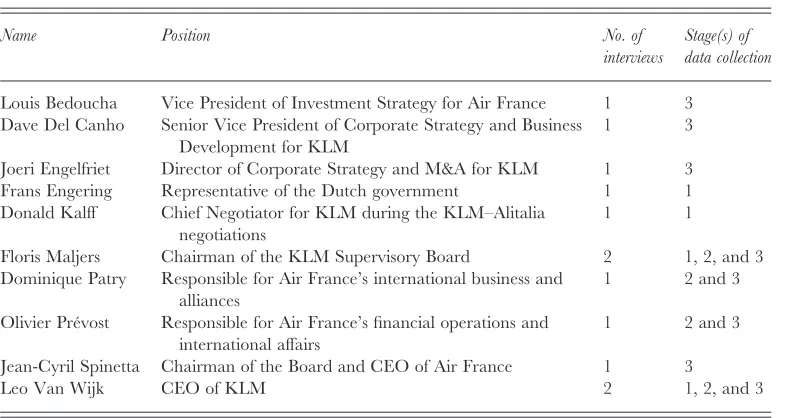
We used several data sources: (1) qualitative data obtained through 12 semi-structured interviews with 10 informants from Air France, KLM, and the Dutch government (details are presented in Table I); (2) communication via e-mail serving to clarify ambi-guities in the data; (3) archival data, including newspaper articles, speeches, business publications and regulatory filings, offering information on the background of the nego-tiations; and (4) internal company documents such as meeting notes presented by informants to support their recollections.
In the first stage of data collection, Leo Van Wijk, Floris Maljers, Frans Engering, and Donald Kalff were interviewed in order to establish the chronology of events that led to a formal agreement between the parties. These interviews served to complement the facts obtained from existing data sources (e.g. Lazard, 2004).
In the second stage, a subsequent interview with Van Wijk and Maljers was conducted to clarify any ambiguities and inconsistencies. On the bases of these accounts and of additional interviews with Dominique Patry and Olivier Prévost, a preliminary case study report was finalized and checked by the informants to assure its accuracy. This report offered a factual view on the process and was used to structure subsequent interviews.
The main goal of stage 3 (executed in part simultaneously with stage 2) was gathering data on trust development. In addition to the interviews conducted in stage 2, we
Table I. Informant information
Name Position No. of
interviews
Stage(s) of data collection
Louis Bedoucha Vice President of Investment Strategy for Air France 1 3
Dave Del Canho Senior Vice President of Corporate Strategy and Business
Development for KLM
1 3
Joeri Engelfriet Director of Corporate Strategy and M&A for KLM 1 3
Frans Engering Representative of the Dutch government 1 1
Donald Kalff Chief Negotiator for KLM during the KLM–Alitalia
negotiations
1 1
Floris Maljers Chairman of the KLM Supervisory Board 2 1, 2, and 3
Dominique Patry Responsible for Air France’s international business and
alliances
1 2 and 3
Olivier Prévost Responsible for Air France’s financial operations and
international affairs
1 2 and 3
Jean-Cyril Spinetta Chairman of the Board and CEO of Air France 1 3
interviewed Jean-Cyril Spinetta, Louis Bedoucha, Dave Del Canho, and Joeri Engelfriet. All informants were asked to describe their account of the negotiations. When appro-priate, specific questions were asked to enhance insight into the development of trust.
The interviews were semi-structured, conducted face-to-face, lasted between two and three hours, and were recorded and transcribed in the language in which they were held (interviews with Dutch informants were held in Dutch, interviews with French inform-ants were held in English). Quotes from interviews with Dutch informinform-ants have been translated to English in the data analysis phase. We obtained written permission for the use of direct quotations, which we presented to informants for an accuracy check.
Use of Cross-Sectional Data and the Mitigation of Cognitive and Retrospective Bias
Any form of process-related research demands, in principle, longitudinal data. This has led to a plethora of studies of trust in integration processes, which are less sensitive in nature as compared to M&A negotiations. These negotiations generally happen behind closed doors, making it problematic to obtain real-time data (Leonard-Barton, 1990). Like prior M&A process studies (e.g. Graebner, 2009), we therefore draw on retrospec-tive interview data. Although our approach to data collection allowed us to create an in-depth account of the negotiation process, it does present issues of retrospective and cognitive bias. In order to mitigate these issues and increase the level of data validity, we followed recommendations made by Miller et al. (1997). First, we asked each informant to describe his account of the negotiations, which provided us with more elaborate and reliable data (Schwenk, 1985). The use of open-ended questions served to reduce levels of retrospective bias and the substantiation of accounts through instructive examples. Second, to enhance the reliability of the data, perspectives were gathered from multiple actors, instead of relying on a single account. Third, during the interviews we were, where possible, shown archival data as well as meeting notes and correspondence between negotiators. These transcripts were used primarily to corroborate the process as described by informants.
The fact that the interview data are not anonymous and the Air France–KLM merger is still in place could elicit questions regarding the honesty of the informants’ accounts of the events. However, representatives from both parties displayed a critical attitude towards the negotiation process, as illustrated by the quotes below:
I considered warnings from several transactions that have been made cross-border and the influence of politics in France on a business such as Air France. You always know that situations can emerge that will change circumstances and manoeuvre people into a different position, or make them react differently than what you had seen up until then. (Van Wijk)
Evidently, we cannot rule out the possibility of some level of misrepresentation. However, that informants explicitly recognized the difficulties and risks of their relation-ship and included potentially threatening events in their accounts of the negotiation, leads us to conclude that the influence of retrospective bias is limited.
In all, we deem the use of retrospective accounts suitable for our objective given: (1) acknowledged problems with obtaining real-time data; (2) the steps taken to reduce retrospective and cognitive bias; and (3) the use of triangulation where possible.
Data Analysis
Complex process data are best analysed in an iterative fashion, shifting back and forth between data and theory. Conducted this way, the analysis allowed us to study key events on the basis of existing theory, apply concepts, and construct a process view (Langley, 1999) through constant comparison (Glaser and Strauss, 1967). We describe the data analysis stage by means of three distinct steps, though completed in a non-linear fashion.
Step 1. As a first step, relevant topics as addressed in the interviews were open-coded in high-level categories (Corbin and Strauss, 2008; instances of trust, main negotiating issues, and events) using NVivo. Next, all documents were revisited and coded in lower level concepts whereby specific (dis)trusting beliefs, (dis)trusting attitudes, (dis)trusting intentions, and (dis)trusting behaviours were identified. First, a passage was coded as a
trusting beliefwhen informants referred to an association between the other and specific attributes (e.g. ‘I think that this person is honest’). We coded for perceived attributes of the trustee such as competence, openness, and integrity (e.g. Butler, 1991; Mayer et al.,
1995). A paragraph was coded as a trusting attitude when an informant expressed his
feeling about the attribute associated with the individual. For example: ‘I feel that this person is trustworthy’. Also, we coded for instances where a willingness to make oneself
vulnerable to the actions of the other was expressed (trusting intention). Finally, a show of
trust by one party towards the other through an action or decision (i.e. a manifestation
of the willingness to trust; Mayer et al., 1995) was coded as atrusting behaviour.
Step 2. The next step of data analysis served to gain a deeper understanding of the
dynamics of trust development. Specifically, we attributed sections to thepersonal,outcome,
and process domain of the relationship. Also we took into account the level of the relationship at hand to illustrate the dynamics between the groups that entered the negotiations at different times: three layers were established, based on the moment negotiators were included in the negotiations.
Step 3. Finally, we integrated the findings of the previous steps. A thick description case study was written (Berg, 1989). In this narrative we identified adjacent periods in which the dynamics of trust development changed, based on discernible changes in the manner in which perceptions towards the other party were formed (McKnight et al., 1996).
FINDINGS
Developing Personal Trust Amongst Widespread Disbelief
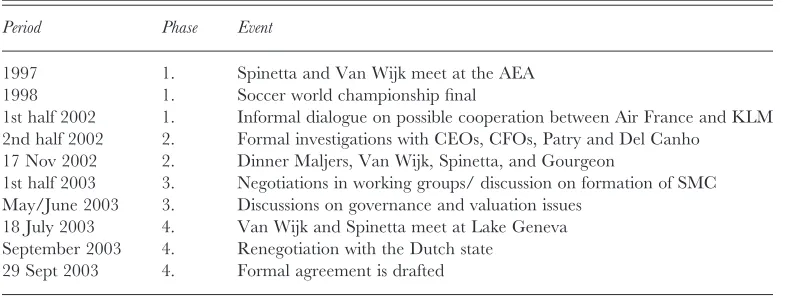
The CEOs of Air France and KLM first met during a meeting of the AEA in 1997. At their next encounter at the final of the 1998 world soccer championship, Jean-Cyril Spinetta and Leo Van Wijk discovered their shared passion for sports. Afterwards, they met several times and discussed the implications of industry developments for their airlines. As Kalff observed, a ‘very good relationship’ formed between Spinetta and Van Wijk.
The idea of a partnership between Air France and KLM and their US affiliates, Northwest Airlines and Continental Airlines, began to be discussed towards the end of the 1990s. Eventually, Air France decided to establish the SkyTeam alliance together with Delta Air Lines. As this ruled out an alliance between Air France and KLM because of US anti-trust law, it essentially meant a rejection of KLM as a partner. However:
The way he . . . explained and communicated to us, despite the disappointment, created a positive feeling. He said: ‘For this reason I make this choice, but that doesn’t mean that I lose interest in you as a future partner, so can’t we keep the communi-cation channels open?’, and that actually happened. (Van Wijk)
Instead of creating distrust, it created a basis for the development of a trusting attitude based on beliefs regarding Spinetta’s reliability (‘integrity-belief’; Mayer et al., 1995). This attitude was strengthened in successive meetings. Van Wijk had come to believe that Spinetta was someone who ‘handled relationships seriously and who tried to build trust, and was worth trusting’. This confirms the significance of consistency-beliefs, developed on the basis of behaviours of the other (Fishbein and Ajzen, 1975; Mayer et al., 1995).
When asked to describe their relationship at that time, Spinetta and Van Wijk expressed themselves in terms of beliefs of openness, consistency, reliability, integrity, Table II. Key events
Period Phase Event
1997 1. Spinetta and Van Wijk meet at the AEA
1998 1. Soccer world championship final
1st half 2002 1. Informal dialogue on possible cooperation between Air France and KLM
2nd half 2002 2. Formal investigations with CEOs, CFOs, Patry and Del Canho
17 Nov 2002 2. Dinner Maljers, Van Wijk, Spinetta, and Gourgeon
1st half 2003 3. Negotiations in working groups/ discussion on formation of SMC
May/June 2003 3. Discussions on governance and valuation issues
18 July 2003 4. Van Wijk and Spinetta meet at Lake Geneva
September 2003 4. Renegotiation with the Dutch state
and competence. Also, a sense of shared values, a shared world view, and a shared vision on the business grew strong in this period. The belief on which this attitude is based can be termed ‘value congruence’, following Mayer et al. (1995), who group this under the antecedent ‘integrity’.
In late 2001, representatives of Air France and KLM initiated an informal dialogue on the possibility of a ‘long-term strategic bilateral alliance’ (Lazard, 2004, p. 39). Their challenge was to create trust on more than one level.
There was a personal fit between Van Wijk and Spinetta. But after that you need to convince others, because many still felt Alitalia was a better match, others wanted a deal with British Airways. (Bedoucha)
The general view that representatives of both airlines had developed of each other was primarily based on what in literature is termed ‘categorization’. The idea that KLM employees were skilful and knowledgeable (‘competence-belief’; Mayer et al., 1995) was based on generalized beliefs developed during earlier dealings between both com-panies. However, within both Air France and KLM beliefs resided regarding the char-acter of ‘the Dutch’ and ‘the French’ respectively; cultural prejudice strongly impacted existing beliefs at an early stage of the negotiations. Patry recalled: ‘From a cultural point of view the inclination of a lot of KLMers was “it is better for us to go with British Airways”.’
These distrusting beliefs influenced general conceptions of the viability and desirability of a deal between both companies.
The challenge thus faced by Spinetta and Van Wijk was to envision an outcome in which they could place their trust and which would be accepted among the broader group. At the end of this period, the cooperation between Air France and KLM was envisaged as a process that would evolve gradually. Spinetta explained:
The first stage was one of quick wins, synergies . . . The second stage was an extended cooperation. The third stage was the end game, a full merger, but with no description [of its timing or conditions].
Additional evidence for the development of (dis)trust in this phase is presented in Table III.
Boosting Trust in the Outcome Domain
First, as illustrated by Del Canho, social interaction created a level of trust which was relatively personal in nature:
It rained after one of the first meetings and Spinetta offered Van Wijk his raincoat. Aside from trust based on the content, trust was also formed through small things that happened.
Second, trust in the process of negotiation developed over time. As Del Canho pointed out: ‘At the start it was absolutely no settled matter that we would come to a deal with Air France.’ However, in his description of the talks with Patry, Del Canho referred to a more defining feature of their relationship:
We had a first meeting and concluded ‘you seem to have a different interpretation than we do’, so we would just sit down together and then it would be clarified quickly.
Being classified as a trusting behaviour (Currall and Judge, 1995), close coordination contributed to trusting beliefs in the process domain. Similarly, Patry mentioned how he Table III. Indications of trust in Phase 1
Facet of (dis)trust
Quote
Belief ‘British Airways remained our preferred option, as its realization seemed least complicated, also from a cultural point of view and considering our history.’ (Van Wijk)
Belief ‘For both Spinetta and especially Van Wijk, it was a major challenge: the challenge of KLM
accepting to sell its company, an icon of the Dutch pride, to the “Frogs”. For the French chairman accepting to merge with the Dutch; impossible to believe. They needed therefore to trust each other.’ (Patry)
Belief ‘We [Spinetta and Van Wijk] reasoned from the same philosophy and approached matters
from the same values.’ (Van Wijk)
Belief ‘If you have spoken with someone several times and in those conversations over the years you
experience that someone is consistent in his behaviour, reliable in what he says and does, even if that does not result in what you hope for . . .’ (Van Wijk)
Belief ‘We had from the beginning a lot of respect for the KLMers. In spite of their relatively small size, we knew they were really good professionals.’ (Patry)
Attitude ‘Since 2000/1999 when we had these first contacts between Air France and KLM, Air
France’s people discovered the colleagues of KLM had skills, knowledge and they were positively impressed. . . . So when we decided to stop the relationship [with KLM and Alitalia], it was understood in Air France, but with the feeling that it was a pity not to continue discussions with KLM.’ (Spinetta)
Attitude ‘It [trust] is difficult to express, because sometimes you feel good with people, and sometimes not. From the beginning it was pleasant for me to meet with Leo [Van Wijk].’ (Spinetta) Attitude ‘I felt about him [Van Wijk] very positively. You met him, you know he his very open, a great
and Del Canho exchanged their meeting notes. Not only does such information exchange signal trust (Currall and Judge, 1995; McKnight and Chervany, 2001), this trusting behaviour also added to the level of trust. That the working language was English helped strengthen trust as well:
Both sides would often ask ‘what do you mean?’ or ‘could you explain that?’ You show vulnerability when you indicate you do not understand everything. (Del Canho)
Reports of all representatives involved at this stage point to the presence of vested beliefs regarding the competence, openness, and integrity of individuals, as well as feelings of affect. This helped the CEOs to further develop a sense of trust in each other and in the prospective outcome. Van Wijk mentioned how the cooperative stance of the parties and the absence of serious conflict brought the representatives ‘a sense of security, of trust, which was very motivating’.
New beliefs developed that strengthened trust in the process. Among the KLM representatives, soon the belief arose that the Air France representatives understood their concerns, mainly regarding stakeholders’ (e.g. the Dutch state and general public) needs. ‘ “L’interêt national”, as the French said, always had to be considered. They did it themselves, so it was reasonable that we did the same’, Maljers commented. In line with Mayer et al. (1995), beliefs that the French negotiators were willing to accommodate their interests (i.e. ‘benevolence-belief’) contributed to the KLM representatives’ trusting attitude. Van Wijk recalled: ‘The response to the important matters that we put on the table was such that it created a comfortable feeling.’
The first evaluation of potential synergies and possible terms of cooperation yielded a positive initial result; the networks were found to be highly complementary. Patry remarked: ‘We were absolutely certain that we had a match.’ From that moment on, the representatives’ belief that they had ‘a shared overall philosophy of a potential deal’ and ‘a sense of shared vision’ with regard to a range of relevant matters grew stronger. Positive beliefs grew among the negotiators regarding a positive outcome of negotiations, despite the scepticism which was widespread among the companies’ employees and the general public.
In this period of increasing enthusiasm, an obstacle to the further development of trust arose: Air France employed a one-tier board structure whereas KLM employed a two-tier board system. Spinetta recalled being confused about the fact that Van Wijk sometimes came back to issues that, in his mind, had been settled: ‘In France, when the CEO has decided, it is done. . . . Sometimes I thought “this guy is horrible. We have agreed and then he comes back to that”.’ These misunderstandings created a sense of doubt (i.e. distrusting attitude) regarding the process that he was involved in with Van Wijk.
Van Wijk and Maljers noted though that ‘it was more about the atmosphere than about what was being said’. Both men emphasized the significance of the fact that Maljers was able to address the Air France representatives in French and revealed his interest in French history and culture. Spinetta’s account of the event confirms that the parties shared a ‘common intention’ to develop a relationship in which they could trust each other. The dinner was a ‘watershed moment’, as Maljers phrased it, both in the personal and process domains. First, ‘the level of personal bonding greatly accelerated the process’ (Maljers). Second, distrusting beliefs with regard to Van Wijk’s predictability (McKnight et al., 1998) were removed as, Van Wijk recounted, ‘during this dinner, a level of comfort was created that made them believe we were indeed earnest’. Spinetta recalled: ‘It increased my confidence in the deal.’
Another issue concerned KLM’s active engagement in negotiations with British Airways. Its representatives were committed to continuing these talks until they would be able to weigh one offer against the other. KLM had engaged in talks with British Airways before and the personal relationship between both CEOs was very good. This fact produced a certain level of distrust among the Air France representatives with regard to the outcome of negotiations. Patry explained:
We, up to the very last minute, did not know too well whether they would ultimately go to British Airways or to us.
Although the KLM representatives sensed that their involvement with British Airways made the Air France representatives unsure about their commitment, an actual breach of trust was averted through open and honest communication on the matter (a trusting behaviour; Currall and Judge, 1995). This prevented the rise of distrusting beliefs regarding the other’s honesty (McKnight et al., 1998) and integrity (Mayer et al., 1995), and thus precluded feelings of deception (Kramer, 1998) among the Air France nego-tiators. Spinetta explained:
If he wouldn’t have told us and we would have discovered [the talks with British Airways], it would have created huge mistrust. But it was very open, transparent, so there was no problem.
In essence, trust in the process domain compensated for a lack of trust in the outcome domain; Air France chose to accept some uncertainty regarding the outcome.
To investigate its potential, working groups were established, extending again the range of individuals involved.
Additional evidence for the development of (dis)trust in this phase is presented in Table IV.
Extending Trust in the Process Domain
As those newly introduced to the process did not yet know their counterparts, most beliefs held among them were based upon assumptions, which for the main part pro-duced an attitude indicative of low trust in a positive outcome. Del Canho reported:
What I found interesting was that those who worked quite intensively with the people from Air France were overall much less sceptical than those who did not.
Table IV. Indications of trust in Phase 2
Facet of (dis)trust
Quote
Belief ‘Spinetta is someone who considers trust to be very important, he is a good listener and
takes his time to think things through. Then when he comes to a decision, he
communicates this clearly, either written or orally, and subsequently acts accordingly. He is very consistent and his messages are in line with prior stated principles. People notice such consistency and that brings trust.’ (Del Canho)
Belief/ attitude
‘The way he [Spinetta] handled matters was always such that it brought confirmation of the fact that he was trustworthy. That did not mean that we thus knew that we would come to an agreement. No, but that we seriously tried, in the interest of both organizations, to look into the possibility to come to a common deal.’ (Van Wijk) Belief/
attitude
‘I can remember the Executive Vice President for Network Management writing a note saying “consolidation in Europe, yes, with KLM, absolutely no way . . .”. There was nothing against KLM as such, except that we thought their business model had nothing to do with ours. . . . But when we started discussing seriously we realized we had the same sort of approach and we could get along quite easily.’ (Patry)
Attitude ‘We were, Dave [Del Canho] and myself, writing unofficial minutes of the meetings. It was
helpful and it created a second layer of trust.’ (Patry)
Attitude ‘We [Bedoucha and Del Canho] became friends first. We always openly discussed where
we stood.’ (Bedoucha)
Attitude ‘We really pushed through the cultural differences, the cultural mistrust.’ (Bedoucha)
Attitude ‘I had a difficult moment because during the process of negotiation we used to have
one-on-one meetings with Leo, to see: “we have agreed on that, that and that, and we still have to discuss on this, this and this.” . . . In the meetings coming after this one meeting, we were coming again to the points a, b, c, d, or one of them. I thought “this is stupid”. . . . So, at the beginning I felt that maybe Leo was a bit too tricky. I understood rapidly that it was because of the Dutch legal organization system.’ (Spinetta)
Intention ‘It was clear that our common intention was to create trust. So Maljers could trust me and
It was decided to bring the management teams together, with a clear aim to develop trust in the personal domain of the relationship. As Van Wijk recalled: ‘We had dinner together, just to develop a feel for each other, to see what kind of people we were dealing with.’
Informants reported trusting beliefs, such as regarding the other’s competence, and trusting attitudes vis-à-vis the negotiation process in the third layer of negotiations. Patry stated:
All of this started with three or four people. By the end it was probably more than 150 people in various working groups. We never had any negative reaction [such as]: ‘those people are totally impossible to work with’.
Prévost suggested the influence of shared vision: ‘The confidence that existed in the team was quite good, because we were speaking the same language.’ McKnight et al. (1998) talk of reputation effects: as interaction history develops between individuals, perceptions become transmitted beyond the one-on-one relationship at hand. In this case, the trusting beliefs that had developed between the CEOs impacted the development of beliefs within the other layers. Several informants addressed this fact, among them Bedoucha:
I think that Spinetta had a positive spirit, and Leo as well. It has trickled down to all: ‘We are dealing with a serious company, it is a serious deal and we must respect these guys.’
Nevertheless, several negotiators had not yet let go of their scepticism regarding the deal envisaged by their leaders and trust in the outcome remained low in the lowest layer of the negotiations. Spinetta recalled:
People did not really believe that it would go to the end. There were so many agreements which were supposed to be signed. . . . Always failures, failures and fail-ures. People were thinking that it would again be a failure.
In contrast, informants suggested that the dynamics in the team were excellent. Simi-larly, at a higher level, close cooperation and the open character of communication between the parties kept contributing to the strengthening of positive beliefs regarding the process of negotiation. This induced the Air France representatives to actively concede to KLM’s demands, which is identified as a trusting behaviour in prior literature (Cullen et al., 2000). On some occasions they proactively proposed arrangements advan-tageous to KLM. The KLM representatives developed a trusting attitude related to the position of the Air France representatives towards KLM’s wish to preserve its brand and the need to protect the position of Schiphol airport.
Herein the fact that the KLM representatives knew that it was also a matter of joint interest contributed to the expectation that their interests were dealt with in a fair manner and that their negotiating partner would act in the interest of the group (cf. Williams, 2001). Indeed, Patry explained how he and his colleagues had tried to convince their counterparts of this fact:
We constantly told them ‘but listen, if we acquire the company and we create a joint group, why the hell should we be willing to get rid of the assets of the group, whether they are Air France or KLM?
Consequently, Van Wijk made his trust in the Air France representatives explicit to the Dutch state when it articulated reservations regarding the intentions of Air France and the consequences of a merger for KLM and Schiphol. Van Wijk responded by explain-ing his positive vision on Air France as a partner. Conveyexplain-ing this attitude can be considered a trusting behaviour as a violation of his trust in Air France would have reflected negatively on Van Wijk.
At the same time, the KLM representatives experienced a lack of commitment on the part of British Airways in their merger talks. Del Canho explained:
With my French counterpart when things got difficult, I always got an answer quickly. The British would at times not respond for one or two weeks. That definitely did not help your trust.
During a meeting of the KLM supervisory board, Van Wijk communicated: ‘Air France is very keen to come to agreements on short notice. British Airways is also keen but seems to have a timing issue.’
For the KLM and Air France negotiators with a longer interaction history, the high level of trust in the outcome of discussions had a positive impact on the process.
When you see that the networks are compatible and when you really get enthusiastic about the prospects for both companies you think: ‘We should do this!’ Then when problems do come up you are much more willing to listen to each other’s arguments. (Engelfriet)
For instance, in the new structure a strategic management committee would facilitate harmony in strategic decision-making. Van Wijk wanted to include his four directors in the committee and placed Spinetta in a difficult position as Air France had only three directors. Spinetta accommodated KLM, which meant ‘he had to choose someone from the level below, which led to friction within Air France’, Van Wijk explained. As such, the concession strengthened Van Wijk’s trusting attitude with regard to the equal character of their relationship.
resulted in frustration. The parties, both independently and within the working groups, began to explore new options. In a private letter (written by hand) to Van Wijk, Spinetta eventually urged the parties to re-evaluate the current proposal.
Additional evidence for the development of (dis)trust in this phase is presented in Table V.
Culmination of Trust in Three Domains
In July 2003, the aforementioned concerns were explicitly addressed at the board level within both companies. It was suggested to reduce complexity and uncertainty by eliminating the phase in which the airlines would remain separate entities and progressing directly to a merger. Spinetta was on holiday and Van Wijk flew in to meet him in a restaurant near Lake Geneva. Van Wijk had already decided he would be willing to consider this important move. However, seeing that this change in governance Table V. Indications of trust in Phase 3
Facet of (dis)trust
Quote
Belief ‘I think it helped that the top 20 [managers] were involved throughout the process of strategic assessment. In the first session there were a lot of opposing opinions. Both in terms of “is it possible to work with the French” and in terms of content. There were a number of people that initially felt we should not cooperate with the French. . . . So there were a lot of preconceived opinions.’ (Engelfriet)
Belief ‘They did not say “then we invite you to dinner”. They took the initiative to come to
Amsterdam. These kinds of things contributed to the idea that they were really interested.’ (Van Wijk)
Attitude ‘There was real respect between Van Wijk and Spinetta and between the two management
teams as well.’ (Bedoucha)
Attitude ‘I think that Spinetta, as well as other people at Air France, through their consistency and the sincerity with which they raised issues, be them pleasant or unpleasant, helped to build trust.’ (Del Canho)
Attitude ‘The relationship was still very good, people working together . . . But at that time I think that people had the feeling in the two companies that it was from initial point of view something interesting, but that it would not succeed. In Air France, people were . . . working well, with pleasure, but there was a feeling that it was a dream of the CEOs and not a reality.’ (Spinetta)
Attitude “In a lot of negotiations you have oppositions and you have a climax and you yell at each other. I mean when we negotiated with Alitalia I lost my temper on three or four occasions and so did they, although I knew the guys for twenty years. Whereas with Henry Essenberg [executive vice president for KLM’s passenger division], we never had any bad feeling or..we never got heated up . . . I mean I found the KLMers to be very pragmatic indeed.” (Patry)
Attitude ‘In June 2003 there was a very important moment, things were not going well. At that point a
mode would entail a significant change in level of integration between both airlines, he told Spinetta: ‘You are going to have to help me and provide me with something for me to use to sell the story.’ Van Wijk’s openness about his needs was based on his trust in Spinetta, hence a trusting behaviour (Leach and Sabatier, 2005).
Van Wijk recalled: ‘For several hours we have been scribbling on the back of my cigar box, saying what a move would be. “But are we up to it and is it feasible?”’ Spinetta suggested creating a holding company with two separate operating companies as subsidiaries. The structure would maintain the autonomy of KLM, which was needed in light of traffic rights issues. Additionally, Spinetta suggested that the name of the holding company be Air France–KLM. For Van Wijk, this understanding of his needs signalled true commitment and strengthened his trusting attitude towards Spinetta:
He could also have said ‘we call the holding “Air France International”, or something like that . . . and that brought a level of comfort . . . if he offers that voluntarily, the intention to deal with it seriously must be profound to such a degree that you cannot doubt this anymore.
In Van Wijk’s words, the trusting relationship between him and Spinetta that had developed helped significantly in the process of revising their plans so drastically at such an advanced stage:
Agreement had already been reached regarding the cooperation and so much trust had been built that this [discussion on the immediate realization of the merger] went very smoothly.
Additionally, this process brought new experiences that confirmed existing beliefs regarding the approach chosen by Air France, thereby reinforcing trust (Lewicki et al., 1998, 2006). The KLM representatives recognized the senior position of Air France in the negotiations, as such they felt very strongly about the fact that, as emphasized by Van Wijk, ‘in every way it was demonstrated that this was unquestionably a cooperation’. To refrain from exercising relative power, even when circumstances would have allowed for such action, signals trust as well as trustworthiness (Cullen et al., 2000). Van Wijk told Spinetta:
If you give me this, if you are willing to do that [create a holding instead of an instant merger of the operating companies], then I see no reason to expect that this deal cannot be made.
significant and risky investments (Mayer et al., 1995). Spinetta expressed his vision of the importance of this moment for more than one domain of the relationship:
It was a decisive moment to create trust between us and to see that, when we were both saying ‘that is the end game’, it was not just empty words. It was true for me and for him.
In the subsequent months of negotiation, existing beliefs were confirmed, for example regarding the other’s ability and willingness to make compromises, and receptivity to what one has to say (‘benevolence-belief’; Mayer et al., 1995). For the negotiators this contributed to their trust in the process:
In all discussions, listening to each other’s arguments we were changing our positions to find compromise, as we understood that they were not fixed positions. (Spinetta)
Existing levels of trust in all layers contributed to the process of negotiating the details of the envisaged scheme, a fact repeatedly addressed by informants. Spinetta explained:
Of course we were taking advantage of all that had been done before, of the fact that people had created personal relationships between them. Myself with Leo, but also colleagues from Air France with colleagues from KLM.
Engelfriet attested to the level of trust in the outcome domain by exemplifying the negotiations on the terms for the exchange offer in which Air France would acquire the KLM shares as based on the intention to trust the motives of the counterpart (see Table VI).
Near the close of the negotiations, unexpectedly, the Dutch government expressed serious reservations with regard to the preliminary deal. The state assigned a special representative to renegotiate, which could potentially lead to a strain on the trusting relationship between the parties. ‘It was hard to go back to the French’, Van Wijk recalled. Despite the fact that Spinetta was somewhat surprised by this turn of events, he recognized the main issues. The event provided the parties with yet another hurdle to take, but proved no threat to the negotiations.
The negotiating teams formally agreed on the terms of the merger on 29 September 2003. In all, there was a culmination of trust in all domains for those directly involved in the negotiations. For those involved from that point onwards a similar path lay ahead, as illustrated by Del Canho:
I had a meeting with my corporate centre colleagues and some of them said ‘that SMC will not last three months. How can you trust these Frenchmen?’ At that time I considered that to be a very strange comment. . . . I noticed that the level of trust among those who had already cooperated with Air France was much higher than among those who had not yet had the opportunity to do so.
TRUST DEVELOPMENT IN COMPLEX NEGOTIATIONS
Table VII summarizes the development of trust between BRPs by phase: (1) instances of trusting beliefs, trusting attitudes, trusting intentions and/or trusting behaviours found; (2) the foundation of trusting beliefs; (3) the development of trust within the relational domains; and (4) the character of interaction between domains.
In phase 1, we see two processes unfolding simultaneously. First, categorization processes resulted in generally low levels of trust because of a general belief that coop-eration with the ‘Dutch’ and the ‘French’, respectively, was impossible. Second, trusting beliefs and attitudes developed between the CEOs as they built up a modest interaction history.
In phase 2, negotiators in the second layer went through a similar cycle to that which the CEOs had gone through. As individuals built up a modest history of interaction, first-hand knowledge replaced assumptions and second-hand knowledge, thus correcting most distrusting beliefs from categorization. Trust developed rapidly in the personal domain as early beliefs primarily related to the other’s integrity and competence. These Table VI. Indications of trust in Phase 4
Facet of (dis)trust
Quote
Belief ‘At the highest level of Air France, by Spinetta and his team, all agreements that were made
were adhered to and I think that a lot of people had not expected this.’ (Del Canho)
Belief ‘As KLM we obtained written assurances, but in addition we had been in discussions with
Air France for several years and meanwhile we had seen that these assurances really corresponded with their business vision: that they understood that it is important to keep the brand; that they saw the importance of satisfying stakeholders, also to assure KLM’s continuity. It showed Air France truly believed that these were important conditions for making this merger a success.’ (Del Canho)
Belief ‘So I think that these hundreds of hours we have shared together have been very fruitful for the future of the combination and the trust we have created. We learned to know each other, meaning we had a rough idea of our different ways of behaving.’ (Spinetta)
Attitude ‘On several issues he [Spinetta] has met my wishes to such an extent that it made me feel like “he understands what this is about and he means it”. It was not a matter of “I have to find some things I can use but they do not have any real substance”, thus it appeared credible.’ (Van Wijk)
Attitude ‘We have found compromise very easily. Sometimes Leo made an effort to join me and the
reverse – me the effort to join Leo on his position. But it was very pleasant and relatively easy. Preparation was very good, and with people who wanted to succeed, and to move forward positively.’ (Spinetta)
Attitude ‘At the moment we signed the deal I was sure of the relationship with Leo.’ (Spinetta) Attitude ‘After a moment of hesitation, people were, probably not unanimously, but very largely,
convinced that it had to be done.’ (Spinetta)
Table VII. Trust development between BRPs
Phase Trusting beliefs Basis of trusting beliefs
Trusting attitudes Trusting intentions
Trusting behaviours Status within domains Interaction between domains
Low confidence in cooperation with other party: no trust in process domain
Assumptions→low levels of trust in the
idea of intense cooperation between Air France and KLM (no trust in outcome domain)
Personal liking Trust develops rapidly in personal
domain
Trust in the personal domain→
increased willingness to consider the option of intense cooperation between Air France and KLM (trust in the outcome domain) contributes to increased trust in the personal and process domain, respectively. The result of early discussions brings heightened trust in the outcome domain. Trust in this domain remains limited due to several situational insecurities
Positive interaction between three domains. Trust in the personal and process domain mitigates the influence of trust asymmetry between Air France and KLM (BA issue) and distrust among stakeholders, in the outcome domain
Attention paid to the dispersion of increased trust in the personal domain through social interaction pays off. While trust develops rapidly in the personal and process domain, trust in the outcome remains low in the third layer of negotiators. Eventually, all conclude on the unfeasibility of the envisaged outcome
Trust in the outcome domain (first
and second layer)→extended trust
in the process domain. Interactive trust development in the personal and process domain (third layer)
Trust in the outcome domain strengthens significantly as the parties envisage a new scheme
Trust in the process domain→
increasing trust in the outcome domain and a deepening commitment to the negotiations. Trust developed in all domains works to smooth the last phase
of negotiations→extended trust in the
process and outcome domain
aIn this phase interaction between key BRPs from Air France and KLM is limited to a few individuals. Those individuals that would later become involved as negotiators here base their perceptions on second-hand knowledge. The foundation
for and character of trust in both groups is thereby different. For this reason, we separate these groups.
findings corroborate predictions of McKnight et al. (1998) and Mayer et al. (1995). The development of these basic beliefs regarding the trustworthiness of the other signifies cognition-based trust, as suggested by McAllister (1995).
Some newly developed beliefs in this phase relate to the other’s benevolence and contributed to trust in the process domain. Discussions brought a belief that cooperation would be an option, signifying extended trust in the outcome domain. Nevertheless, we find evidence of a temporary trust asymmetry in two domains. First, trust asymmetry built up in the outcome domain as a consequence of the continuing KLM–BA negotia-tions. The situation, though trust was disrupted, is reported by the Air France negotiators to have induced no distrust, in view of the openness and honesty displayed by the KLM representatives. Second, in the process domain, Van Wijk’s habit of desiring to discuss previously agreed upon points created a distrusting attitude with Spinetta. However, this insecurity was removed through conscious and open communication on the matter during a dinner in an informal atmosphere. Hence, we suggest that trust in one domain may prevent a general breach of trust following distrust in another domain. Both before and after the rise of a potential threat to the relationship, parties may stimulate trust in one domain and create what one may call slack in the other domain. This could be another mechanism making trust robust once it has developed, in addition to the factors addressed by McKnight et al. (1998).
In phase 3, again the cycle of trust development started anew for the next layer of negotiators. Yet the pace at which they moved through this cycle seems to have increased because of a conscious effort of leadership to develop trusting relationships and owing to a reputation effect of their positive views of the counterpart. The high intensity of informal and formal contact increased the level of trust in both the personal and process domains rapidly. However, outcome trust in this group remained low. Among the negotiators in the first two layers, trusting behaviours of a relatively risky nature are visible, such as proactive concessions by Air France. These acts increased trust in the outcome domain among the individuals on the other side of the negotiating table. Also, the behaviours fed back into their benevolence-beliefs, which meant a deepening of trust in the process domain. The significant influence of benevolence-related characteristics in later phases of the relationship is in line with previous literature (Mayer et al., 1995), who define benevolence as: ‘The extent to which a trustee is believed to want to do good to the trustor’ (p. 718). As such, we suggest benevolence-beliefs to be indicative of affect-based trust, the development of which is affect-based on negotiators explicitly attributing their counterparts’ behaviours to positive intentions in terms of ‘serving to meet legitimate needs’ or ‘demonstrating personal care and concern’ (McAllister, 1995, p. 29). As this happens, over time, trust becomes more robust, thereby decreasing the salience of its cognitive basis.
(Gulati and Nickerson, 2008). In fact, they have progressively upgraded their commit-ment to the relationship as they moved, in several steps, from a plan of low-intensity cooperation (alliance) to high-intensity cooperation (merger). They moved to a more integrated governance mode as the expected pay-off of cooperation increased (trust in the outcome domain) as well as trust in the other’s cooperative behaviour (trust in the process and personal domain).
DISCUSSION
The objective of this study was to provide a detailed reconstruction of how trust devel-oped during the merger negotiations between Air France and KLM. Documenting and elaborating this process allows us to offer insight into processes of trust development and the influence of trust on interorganizational cooperation. While rich in study in the conceptual realm, both subjects lack grounded examples. We contribute by validating existing literature and advancing insights in a number of ways as highlighted below.
Confirming Extant Propositions
Studying this case provided us with support for existing models on trust development (e.g. Mayer et al., 1995; McKnight et al., 1998). Building on Fishbein and Ajzen’s (1975) theory of reasoned action, we identified a pattern in the way trust develops in different domains of the interpersonal relationship: from trusting beliefs come trusting attitudes, which are subsequently manifested through trusting behaviours. It proved difficult to have informants, retrospectively, distinguish intended behaviour from actual behaviour. Nevertheless, the distribution of reported instances of trust over the different facets of trust provided us with sufficient insight to capture the temporal nature of trust develop-ment (McEvily et al., 2003). The different facets distinguished by Fishbein and Ajzen (1975) had yet to be researched in conjunction, which is surprising as previous literature proposes that trust development is a cyclical process (e.g. Butler, 1995; Cullen et al., 2000). Essentially, our case study demonstrates how trust develops following a virtuous cycle for each party, which interacts with the other party’s cycle as (trusting) behaviours of one party induce the development of trusting beliefs with its counterpart (Mayer et al., 1995).
consequently, different levels of robustness (e.g. McAllister, 1995; McKnight et al., 1998). In conjunction with this development, the parties, incrementally, changed their plans for a relatively low-risk non-equity alliance into an ambition to directly engage in a full merger.
Understanding the development of pre-deal trust, we argue, requires analysis of the negotiation phase of any interorganizational relationship. For future research it would be interesting to verify if M&As that have arisen out of an escalating commitment due to increased trust are indeed more durable as compared to those interorganizational rela-tionships that have not gone through a similar trust building process.
The Importance of Relational Domains for the Literature on Trust
We extend theory on trust by suggesting that different relational domains exist within a negotiation setting. Identifying these domains is important for the further development of our understanding of trust asymmetries and trust and distrust as separate concepts. We also find that the sets of antecedents that produce trust within different stages of the relationship can be ascribed to different relational domains. We distinguish three domains: personal, outcome, and process. In prior literature it is suggested that trust is context specific (Zand, 1972) and that interpersonal relationships are multi-faceted such that confidence can differ from situation to situation (Lewicki et al., 1998). Levels of trust may also differ between relational facets. Therefore, trust and distrust can exist simul-taneously within one context, in this case a merger negotiation. We show that trust, for instance, can be high in the process domain yet low in the outcome domain. Similarly, trust asymmetry may be present between parties within a specific domain (e.g. Air France experienced uncertainty in the outcome domain due to the KLM–British Airways talks). In general, trust violations occur frequently in interorganizational contexts (cf. Bies and Tripp, 1996; Sitkin and Roth, 1993). We show that these do not necessarily lead to a breach of trust. Even in a context where high trust is essential, distrust may well exist, as long as it is managed properly and of a temporary character. In our case it was the parties’ realization of the importance of clarity on the process and attention to informal interactions (i.e. trust in the process and personal domain) that contributed to the temporary acceptance of insecurity regarding the outcome of negotiations.
Tomlinson and Mayer, 2009). In addition to the compensational character of domains, the way they interact as high trust in one domain induces parties to solve trust issues in another domain, provides an alternative avenue for future research regarding trust repair.
The Importance of Relational Domains for the Literature on M&As
The presence of relational domains in negotiations has direct implication for the con-nection between deal characteristics and the significance of confidence in a partner’s cooperative behaviour. As Das and Teng (1998) argue, both trust and control are sources of confidence and different alliance types require different levels of confidence. The need for confidence among alliance partners increases with the level of alliance-specific invest-ments demanded, with the level of connectedness and interdependence among parties, and with the risk of opportunistic behaviour. The authors classify different alliance types based on this set of contingencies. We propose a similar breakdown of M&A types based on the level of risk and interdependence. Our case would be positioned to the far right of this continuum, whereas a hostile takeover, for instance, would be placed on the left side. Our case concerns negotiations of a merger deal which would imply ‘an extreme form of change’ (Searle and Ball, 2004, p. 1) and a highly integrated governance mode. Also, the high-risk setting at hand made both parties extremely susceptible to opportun-istic behaviour, especially as each had a say in the outcome. Considering these specific case characteristics, we argue that the high levels of trust observed in the outcome, process, and personal domain made possible the deal between Air France and KLM. The necessity of trust in the three domains, thus in its broadest scope, for a negotiation of this type, is further illustrated by the KLM–British Airways case. Considering the similarity in characteristics to the relationship between KLM and Air France, the limited scope of trust between both airlines meant a sure ultimate failure; high trust was limited to the personal domain. However, we believe that negotiations of a different type, defined by a different set of characteristics, could produce a positive outcome despite a lack of trust in one or several domains.