Chopinite, [(Mg,Fe)
3䊐](PO
4)
2, a new mineral isostructural with sarcopside,
from a fluorapatite segregation in granulite-facies paragneiss,
Larsemann Hills, Prydz Bay, East Antarctica
EDWARDS. GREW1,*, THOMASARMBRUSTER2, OLAFMEDENBACH3, MARTING. YATES1
and CHRISTOPHERJ. CARSON4
1Department of Earth Sciences, University of Maine, 5790 Bryand Research Center, Orono, Maine 04469-5790, USA
*Corresponding author, e-mail: [email protected]
2Laboratorium für chemische und mineralogische Kristallographie, Universität Bern, Freiestrasse 3,
3012 Bern, Switzerland
3Institut für Geowissenschaften/Mineralogie, Ruhr-Universität Bochum, 44780 Bochum, Germany
4Research School of Earth Sciences, Australian National University, Canberra, ACT 0200, Australia
Abstract:Chopinite, the Mg-dominant analogue of sarcopside, is a new mineral corresponding to synthetic Mg3(PO4)2-II, a
high-pressure polymorph of the meteoritic mineral farringtonite. A representative electron-microprobe analysis is SiO20.32, P2O547.32,
Al2O3 0.05, MgO 30.35, MnO 0.15, FeO 20.99, CaO 0.35, F 0.02, Cl 0.01, Sum 99.54 wt %, which gives
Ca0.02Mg2.20Fe0.86Mn0.01Si0.02P1.95O8. Single-crystal X-ray diffraction gives monoclinic symmetry, P21/c, a = 5.9305(7) Å, b =
4.7583(6) Å,c= 10.2566(10) Å, q = 90.663(9)°,V289.41(6) Å3, calculated density 3.34 g/cm3,Z= 2. Chopinite is of the olivine
structure type, but with ordered vacancies and strongly distorted octahedra due to the valence 5+ for P, which results in marked ordering of Mg at M2, whereas Fe2+concentrates at M1, most likely because of its axial symmetry. The strongest lines in the powder
pattern [din Å, (Icalc), (hkl)] are 5.92 (42) (100), 3.84(100) (102), 3.48(52) (111, 012, 111), 2.51(72) (113, 113), 2.44 (73) (211, 211). Chopinite is colorless and transparent, biaxial (–), [ 1.595(2), q 1.648(2), * 1.656(2) (589 nm). 2Vx(meas.) = 40(2)°, 2Vx(calc.) =
41°; X //b, Z ^a~55°. Chopinite is found as four inclusions isolated in a fluorapatite segregation in a quartz mass in a paragneiss from Brattnevet, Larsemann Hills, East Antarctica. Grains are mostly anhedral and range from 0.1 × 0.3 mm to 0.2 × 0.6 mm in size. Minerals present in the chopinite-bearing specimen include wagnerite-Ma5bc, xenotime-(Y), stornesite-(Y), P-bearing K-feldspar and plagioclase, Ti-rich biotite, sillimanite, orthopyroxene, sapphirine, hercynite, and corundum. It is inferred to have formed as a result of high melt P concentrations by reaction of biotite with an anatectic melt in which P/Ca ratio exceeded that buffered by apatite saturation due to the very slow diffusion of P relative to Ca in anatectic melt.
Key-words:phosphate, new mineral, Antarctica, Larsemann Hills, electron microprobe, crystal structure, granulite facies, anatexis.
Introduction
Sarcopside, (Fe, Mn, Mg)3(PO4)2, is an uncommon mineral
in granite pegmatites and in IIIAB meteorites; there are al-so possible occurrences in metamorphic environments and pallasites. Sarcopside is invariably dominated by Fe, with the maximum XMg = Mg/(Mg+Fe) = 0.37 and maximum XMn= Mn/(Mn+Fe) = 0.36. With rare exceptions terrestrial
sarcopside forms intergrowths with graftonite or triphylite. The Mg-analogue of sarcopside was first synthesized as a metastable phase by a solid-state exchange process at 660°C and 1 bar by Berthetet al.(1972), and subsequently at 600 °C and 30 kbar, by Annersten & Nord (1980). Bru-net & Vielzeuf (1996) and BruBru-netet al.(1998) showed that the Mg-analogue of sarcopside is a high-pressure poly-morph of the meteoritic mineral farringtonite and
deter-mined the equilibrium reaction to lie at 6.32–8.30 kbar for 566–824 °C.
Here we report Mg-dominant analogue of sarcopside as the new mineral chopinite from a terrestrial metamorphic environment: a fluorapatite segregation in granulite-facies (800–860 °C, 6–7 kbar) biotite-quartz-plagioclase para-gneiss at 69° 24.437’ S, 76° 15.057’ E on Brattnevet Penin-sula, Larsemann Hills, Prydz Bay, East Antarctica. The min-eral and name were approved by the Commission on New Minerals and Mineral Names, International Mineralogical Association (2006-004). The name is for Christian Chopin (born 1955) of the Ecole Normale Sup´erieure, Paris, France, for his major contributions to the mineralogy of phosphates. Holotype material (sample no. 121401E and thin section 121401E4) is deposited in the Mus´ee de Min´eralogie, Ecole des Mines de Paris as catalogue number M 73096.
Analytical methods
The optical properties of chopinite grain #3 were measured at the Ruhr-Universität Bochum by routine immersion pro-cedure using a microrefractometer spindle-stage (Meden-bach, 1985).
X-ray powder-diffraction data were obtained from chopi-nite grain #3 with a 57.3 mm diameter Gandolfi camera and CuK[ radiation at the Ruhr-Universität Bochum (Table 1).
Cell dimensions of chopinite grain #3 (Table 2) were re-fined from reflections at scattering angles 13 < ’ < 20° ob-tained with graphite-monochromated MoK [ radiation on an ENRAF NONIUS CAD4 diffractometer equipped with a point detector at the Universität Bern. CAD4 instrumenta-tion gives higher accuracy albeit similar precision as the CCD instrument.
Single-crystal X-ray intensity data were collected on chopinite grain #3 with a 3-circle SMART BRUKER CCD 1K, graphite-monochromated MoK[ radiation at the Uni-versität Bern. Like sarcopside, chopinite is pseudo-ortho-rhombic, but truly monoclinic. We chose the standard
set-Table 1. X-ray powder-diffraction data for chopinite (grain 3).
Iest dmeas(Å) Icalc dcalc(Å) hkl
Note: Intensities are visual estimates. Five strongest lines are given in bold. Calculated data from LAZY PULVERIX (Yvonet al., 1977) based on single-crystal refinement:a= 5.9305(7) Å,b= 4.7583(6) Å,c= 10.2566(10) Å, q = 90.663(9)°
tingP21/c. Twinning (imitating orthorhombic symmetry) is evident from optical inspection and structure refinement leaving the choice between (100) and (001) as twin planes. Due to q = 90.66° (close to 90°) the twin law was not obvi-ous from the single-crystal diffraction pattern. The half-widths ofhk0 and 0klreflections were checked and thehk0 reflections were systematically found to be more asymmet-ric and broadened compared to 0klreflections, which sug-gests that the twin plane is {100},i.e., identical to the twin plane {001} reported by Hurlbut (1965) for sarcopside in theP21/asetting. In order to deal with the extensive
poly-synthetic twinning, a large window for intensity integration for each reflection was chosen. It was then possible to col-lect the intensity of all twin domains. The structure was solved by direct methods and refined using the SHELXTL Version 6.12 program package (Sheldrick, 1997). All sites were refined with neutral atom scattering-factors (Mg, Fe, P, and O) and anisotropic displacement parameters. In addi-tion, variation of Mg and Fe on the octahedral sites M1 and M2 was allowed assuming complete occupancy. The octa-hedral site M1’ at 0,0,1/2, which is occupied in forsterite
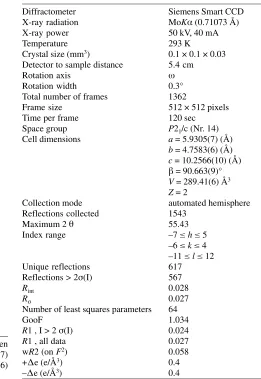
Table 2. Parameters for X-ray data collection and crystal-structure refinement of chopinite.
Diffractometer Siemens Smart CCD X-ray radiation MoK[ (0.71073 Å)
X-ray power 50 kV, 40 mA
Temperature 293 K
Crystal size (mm3) 0.1 × 0.1 × 0.03 Detector to sample distance 5.4 cm
Rotation axis K
Rotation width 0.3°
Total number of frames 1362
Frame size 512 × 512 pixels
Time per frame 120 sec
Space group P21/c (Nr. 14) Cell dimensions a= 5.9305(7) (Å)
b= 4.7583(6) (Å) Reflections > 2c(I) 567
Rint 0.028
Rc 0.027
Number of least squares parameters 64
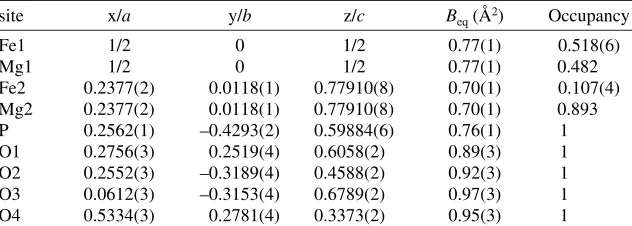
and fayalite, was found to be vacant, or very nearly so. The twin contribution was refined to 17.1(2) %. Anisotropic and isotropic displacement parameters, atomic coordinates and occupancies are given in Tables 3–5.
Chopinite and associated minerals in sections of sample 121401E were analyzed with a Cameca SX-100 electron microprobe at the University of Maine and with a Cameca SX-50 at the Centre de Microanalyse Camparis, Paris. Ana-lytical conditions for analysis of phosphates at the Universi-ty of Maine were 15 kV accelerating voltage, 10 nA beam current and 20 µm spot diameter, and data were processed using the X-Phi correction of Merlet (1994). The standards used for chopinite and wagnerite were fluorapatite (FK[), tugtupite (NaK[), synthetic Mg3(PO4)2 (MgK [), albite (AlK[), albite (SiK[), synthetic Mg3(PO4)2(PK[),
tugtupi-te (ClK [), fluorapatite (CaK[), rutile (TiK[), rhodonite (MnK[), almandine (FeK[); additionally for apatite, fluor-apatite (PK[), barite (SK[), celestine (SrL[), synthetic Y-Al garnet (YL[), synthetic rare-earth element phosphates (REE L[), and U metal (UMq). Three grains of chopinite were analyzed at twenty spots where each constituent was counted for 5 seconds, but 4 to 9 analyses were rejected be-cause of impurities and alteration. Fluorine in biotite was analyzed using the TAP crystal and a polylithionite stan-dard. Zr content of rutile was counted for a total of 1600 sec-onds using a zirconia standard (SPI-47) and 4 spectrometers simultaneously to improve the statistics.
Analytical conditions for analysis of silicates and oxides at the Centre de Microanalyse Camparis were 15 kV accel-erating voltage, 10 nA beam current and 5 µm spot diame-ter, and data were processed using PAP corrections. The standards and counting times used for chopinite, wagnerite
Table 3. Anisotropic displacement parametersUijwith standard deviations in parentheses for chopinite.
Site U11 U22 U33 U12 U13 U23
Fe1 0.0126(4) 0.0065(4) 0.0103(4) –0.0006(3) 0.0024(3) 0.0001(3) Mg2 0.0093(5) 0.0088(5) 0.0086(4) –0.0001(3) 0.0009(4) 0.0001(3) P 0.0112(3) 0.0078(3) 0.0099(3) 0.0000(3) 0.0005(3) –0.0002(3) O1 0.013(1) 0.009(1) 0.012(1) 0.0009(8) 0.0014(8) –0.0007(7) O2 0.014(1) 0.0115(9) 0.0101(9) –0.0010(8) –0.0003(9) –0.0002(7) O3 0.011(1) 0.011(1) 0.015(1) –0.0008(8) 0.0033(7) –0.0019(8) O4 0.013(1) 0.0096(9) 0.014(1) 0.0000(8) 0.0003(8) –0.0014(7)
Table 4. Atomic coordinates and isotropic displacement parameters, with standard devia-tions in parentheses, for chopinite.
site x/a y/b z/c Beq(Å2) Occupancy
Fe1 1/2 0 1/2 0.77(1) 0.518(6)
Mg1 1/2 0 1/2 0.77(1) 0.482
Fe2 0.2377(2) 0.0118(1) 0.77910(8) 0.70(1) 0.107(4) Mg2 0.2377(2) 0.0118(1) 0.77910(8) 0.70(1) 0.893 P 0.2562(1) –0.4293(2) 0.59884(6) 0.76(1) 1 O1 0.2756(3) 0.2519(4) 0.6058(2) 0.89(3) 1 O2 0.2552(3) –0.3189(4) 0.4588(2) 0.92(3) 1 O3 0.0612(3) –0.3153(4) 0.6789(2) 0.97(3) 1 O4 0.5334(3) 0.2781(4) 0.3373(2) 0.95(3) 1 Anisotropically refined atoms are given in the form of the isotropic equivalent displace-ment parameter defined asBeq= (8/3) ‘2 7i(7j(Uij ai* aj* ai.aj))
and biotite were Durango fluorapatite or topaz (15 s, FK[), albite (10 s, NaK[), synthetic Mg3(PO4)2, (10 s, MgK[),
or-thoclase (15 s, AlK[), diopside (15 s, SiK[), synthetic Mg3(PO4)2(10 s, PK[), scapolite (15 s, ClK[), orthoclase
(10 s, KK[), diopside (10 s, CaK[), MnTiO3(10 s, TiK[),
MnTiO3 (10 s, MnK[), hematite (10 s, FeK[), sphalerite (15 s, ZnK[), and barite (10 s, BaL[).
Identification of minerals not analyzed with WDS was confirmed by taking an element scan using energy-disper-sive spectroscopy at the University of Maine.
Crystal structure
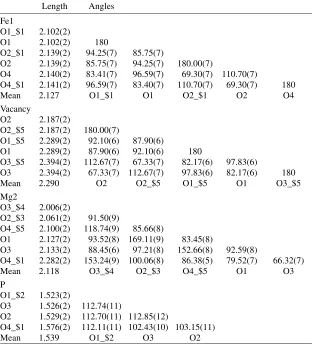
Chopinite and sarcopside are of the olivine structure type, but with ordered vacancies and strongly distorted octahe-dra due to the valence 5+ for P (Fig. 1). In olivine each oxy-gen atom is coordinated to 3 M and 1 Si yielding the “ide-al” bond strength of 2 for oxygen (3 x 2/6 + 4/4). In sarcop-side O1, O2, and O3 (our numbering) are bonded 2× to M and 1× to P yielding 2 × 2/6 + 5/4 = 1.917 indicating slight underbonding. However, O4 bonds 3 × to M and 1 × to P yielding 3 × 2/6 + 5/4 = 2.25 indicating significant over-bonding. For this reason all M-O4 and P-O4 bonds are rather long (Table 5), which results in strong distortions and a marked ordering of Mg at the M2 site (89 % Mg). Fe2+is ordered at M1 (52 % Fe), most likely because of
Table 5. Bond lengths (Å) and angles (°).
Length Angles
Fe1
O1_$1 2.102(2)
O1 2.102(2) 180
O2_$1 2.139(2) 94.25(7) 85.75(7)
O2 2.139(2) 85.75(7) 94.25(7) 180.00(7)
O4 2.140(2) 83.41(7) 96.59(7) 69.30(7) 110.70(7)
O4_$1 2.141(2) 96.59(7) 83.40(7) 110.70(7) 69.30(7) 180
Mean 2.127 O1_$1 O1 O2_$1 O2 O4
Vacancy
O2 2.187(2)
O2_$5 2.187(2) 180.00(7)
O1_$5 2.289(2) 92.10(6) 87.90(6)
O1 2.289(2) 87.90(6) 92.10(6) 180
O3_$5 2.394(2) 112.67(7) 67.33(7) 82.17(6) 97.83(6)
O3 2.394(2) 67.33(7) 112.67(7) 97.83(6) 82.17(6) 180
Mean 2.290 O2 O2_$5 O1_$5 O1 O3_$5
Mg2
O3_$4 2.006(2)
O2_$3 2.061(2) 91.50(9)
O4_$5 2.100(2) 118.74(9) 85.66(8)
O1 2.127(2) 93.52(8) 169.11(9) 83.45(8)
O3 2.133(2) 88.45(6) 97.21(8) 152.66(8) 92.59(8)
O4_$1 2.282(2) 153.24(9) 100.06(8) 86.38(5) 79.52(7) 66.32(7)
Mean 2.118 O3_$4 O2_$3 O4_$5 O1 O3
P
O1_$2 1.523(2)
O3 1.526(2) 112.74(11)
O2 1.529(2) 112.70(11) 112.85(12)
O4_$1 1.576(2) 112.11(11) 102.43(10) 103.15(11)
Mean 1.539 O1_$2 O3 O2
Symmetry codes. $1: –x+1,–y,–z+1. $2: x, y–1, z. $3: x, –y–1/2, z+1/2. $4: –x, y+1/2, –z+3/2. $5: x, –y+1/2, z+1/2.
is slightly larger (<M1-O> = 2.217 Å) than M2 (<M2-O> = 2.118 Å). In addition, M1 is more regular: the difference between the largest and shortest M-O bond is 0.038 Å for M1 but 0.274 Å for M2. Lastly, M1 is adjacent to the va-cant octahedral site, thus the M1 octahedron is freer to adopt a favorable coordination for Fe2+.
The largest octahedral site (<M-O> = 2.290 Å) in the structure is M1’, which is vacant in sarcopside and chopini-te. Local occupation of M1’ would increase the bond strength of O1, O2, and O3 by additional 2/6, which is ener-getically not favorable. Nevertheless, the highest positive peak in the final difference-Fourier map of 0.4 e/Å3 was
found at M1’. This residual density was not considered in the refinement because the highest negative peak close to the tetrahedral P sites was also –0.4 e/Å3. One may speculate
that the minor substitution of P5+by Si4+determined by
elec-tron microbe-analyses (Table 6) is charge balanced by very minor occupation of M1’ by additional Mg or Fe.
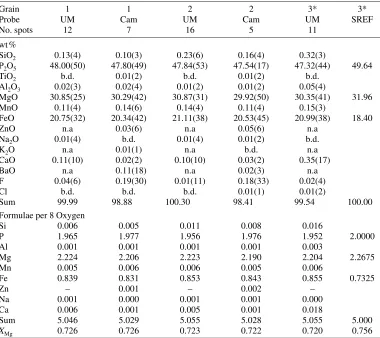
There is a minor difference between XMgobtained from the structure refinement (XMg= 0.756)vs.the corresponding value (XMg = 0.720) determined by electron microprobe analyses (Table 6). There are several possible explanations for this discrepancy. (1) X-ray single-crystal diffraction yields the 3-dimensional average bulk composition of the
entire crystal, whereas the electron-microprobe beam does not penetrate very far below the surface of the section,i.e., the different results could be due to compositional zoning. (2) Because Fe is the atom with the strongest scattering power in the structure, there is also a minor correlation in the structure refinement between Fe occupancy on one hand, scale factor and displacement parameters on the other. (3) The very minor (0.4 e/Å3) residual density at M1’ was not
considered. Furthermore, the twinning model with {100} as twin plane maps M1 on M1’ (Fig. 1). Thus there is some correlation between M1’ occupancy and the twinning con-tribution. Another possible explanation is the ionization lev-el of oxygen. However, Armbrusteret al.(1990) tested the effect of choosing neutralvs.ionic scattering factors on dis-placement parameters (Beq), which are even more sensitive than occupancies, and found no significant variation in Beq
of T sites in models with Si4+and Al+3compared to those
with neutral Si and Al in albite.
The synthetic analogue Mg3(PO4)2of chopinite was first synthesized by Berthetet al.(1972) as a metastable product of the following solid state reaction at 660°C: 2×LiMg (PO4) (olivine structure-type) + MgSO4→Mg3(PO4)2
(sar-copside structure-type) + Li2SO4. The above authors
Fig. 1. Projection of the chopinite structure alongb. M2 octahedra (Mg enriched) form unbroken edge-sharing chains parallel to a, whereas M1 octahedra (Fe enriched) alternate with vacant polyhedra (dark with line and cross pattern). PO4tetrahedra are marked with crosses.
their setting: a = 5.912(2),b = 10.21(3),c = 4.73(2), Å, * = 90°60’) and derived in analogy to olivine a correct struc-ture model with ordered octahedral vacancies. At 820°C this metastable chopinite analogue transformed to Mg3(PO4)2
having the farringtonite structure. Farringtonite is not based on a hexagonal closest-package of oxygen (as the olivine and sarcopside structure-type) and has for this reason also a larger unit-cell volume, 316.6 Å3 (Nord & Kierkegaard,
1968)vs.285.8 Å3. In farringtonite Mg occurs in fivefold
and octahedral coordination.
Recently Henryet al.(2003) refined the sarcopside-like structure of synthetic Fe2Ni(PO4)2by neutron powder
dif-fraction and found Fe enriched at M2 and Ni dominating at M1. This Fe order scheme is the opposite of that found in chopinite. However, in Fe2Ni(PO4)2 two transition metal
ions are competing with each other for the most favorable coordination. In this case Ni occupies the less distorted site. Previous crystallographic studies of solid solutions of Me3(PO4)2with Me = Co2+, Mg, Zn, Mn2+, Fe2+in
sarcopsi-de-like Ni3(PO4)2yielded the preference Ni > Co >Mg, Zn > Mn >> Fe for M1 over M2 (Nord, 1984). A neutron powder structure-refinement of synthetic sarcopside Fe3(PO4)2 at
59 K (Warner et al., 1992) yielded <M1-O> = 2.147 Å and <M2-O> = 2.159 Å, whereas a single-crystal X-ray structure refinement (Moore, 1972) of natural (Fe0.78 Mn0.21Mg0.01)3(PO4)2sarcopside gave <M1-O> = 2.130 Å and <M2-O> = 2.164 Å. Due to the similarity of Mn and Fe scattering factors for X-rays Moore (1972) did not deter-mine whether Fe and Mn order in sarcopside, but instead as-sumed equal distribution of both elements at M1 and M2. However, comparison of <M1-O> and <M2-O> bond lengths with those of Warneret al.(1992) suggests that the larger Mn2+will order at M2.
Physical and optical properties of chopinite
Most physical properties cannot be determined because of the small grain size and the very limited amount of available material. Two good cleavages are evident in photomicro-graphs and back scattered electron images (see below); these could {001} and {100}, the two good cleavages re-ported for sarcopside (Hurlbut, 1965). Density calculated with empirical formula is 3.34 g/cm3.
Chopinite is colorless and transparent, biaxial (–), [ 1.595(2), q 1.648(2), * 1.656(2) (589 nm). 2Vx(meas.) =
40(2)°, 2Vx(calc.) = 41°. Dispersion was not visible, but the
interference figure was poor due to inclusions of brownish material. Assuming that the twin plane is {100}, orientation of the principal vibration directions derived from stereo-graphic projection is X //b, Z /\a~55°. Larsen & Berman (1934) reported Z //b, X /\c= 45° for sarcopside, but they gave the cleavages as perfect in {010} and {100}. Hurlbut (1965) was unable to confirm the Larsen & Berman orienta-tion and reported an apparent optical orientaorienta-tion for sarcop-side characteristic of a triclinic crystal with Y closest tob. Hurlbut (1965) failed to resolve the obvious (to him) incon-sistency with Larsen & Berman (1934), and we have no ex-planation why the orientation for chopinite differs from both of those reported for sarcopside.
Chemical composition and compatibility index
of chopinite
Table 6. Analyses of chopinite in section 121401E4-1.
Grain 1 1 2 2 3* 3*
Probe UM Cam UM Cam UM SREF
No. spots 12 7 16 5 11
wt %
SiO2 0.13(4) 0.10(3) 0.23(6) 0.16(4) 0.32(3)
P2O5 48.00(50) 47.80(49) 47.84(53) 47.54(17) 47.32(44) 49.64
TiO2 b.d. 0.01(2) b.d. 0.01(2) b.d.
Al2O3 0.02(3) 0.02(4) 0.01(2) 0.01(2) 0.05(4)
MgO 30.85(25) 30.29(42) 30.87(31) 29.92(50) 30.35(41) 31.96
MnO 0.11(4) 0.14(6) 0.14(4) 0.11(4) 0.15(3)
FeO 20.75(32) 20.34(42) 21.11(38) 20.53(45) 20.99(38) 18.40
ZnO n.a 0.03(6) n.a 0.05(6) n.a
Na2O 0.01(4) b.d. 0.01(4) 0.01(2) b.d.
K2O n.a 0.01(1) n.a b.d. n.a
CaO 0.11(10) 0.02(2) 0.10(10) 0.03(2) 0.35(17)
BaO n.a 0.11(18) n.a 0.02(3) n.a
F 0.04(6) 0.19(30) 0.01(11) 0.18(33) 0.02(4)
Cl b.d. b.d. b.d. 0.01(1) 0.01(2)
Sum 99.99 98.88 100.30 98.41 99.54 100.00
Formulae per 8 Oxygen
Si 0.006 0.005 0.011 0.008 0.016
P 1.965 1.977 1.956 1.976 1.952 2.0000
Al 0.001 0.001 0.001 0.001 0.003
Mg 2.224 2.206 2.223 2.190 2.204 2.2675
Mn 0.005 0.006 0.006 0.005 0.006
Fe 0.839 0.831 0.853 0.843 0.855 0.7325
Zn – 0.001 – 0.002 –
Na 0.001 0.000 0.001 0.001 0.000
Ca 0.006 0.001 0.005 0.001 0.018
Sum 5.046 5.029 5.055 5.028 5.055 5.000
XMg 0.726 0.726 0.723 0.722 0.720 0.756
Notes: Probe: UM – University of Maine, Cam – Camparis, SREF – single-crystal structure refinement. n.a. – not analyzed; b.d. – below detection. All Fe as FeO. Numbers in parentheses are 1c standard deviations of last 1 or 2 digits in the averages. Totals does not include F, Cl. Formulae do not include Ba, F or Cl.XMg= atomic Mg/(Mg+Fe). * Grain used for optical and crystallographic studies.
whereas those obtained at the Centre de Microanalyse Cam-paris vary with the standard used, ranging from below detec-tion to 0.10 wt % with the topaz standard and from 0.62 to 0.76 wt % with the fluorapatite standard. Averages of individual grains in Table 6 include measurements with both F stan-dards, resulting in high standard deviations for F. Analyses at the two laboratories gave virtually identical formulae, except the Centre de Microanalyse Camparis analyses gave a closer approach to ideal stoichiometry in terms of (P+Si):(Mg+ Fe+Mn+Ca) ratio and lower Ca contents. Both sets of analy-ses gave a significantly lower Mg:(Fe+Mn) ratio than the crystal structure refinement (see above).
The Gladstone – Dale relation (Mandarino, 1981) gives a compatibility index 1 – (KP/KC) = 0.001 (superior) for grain no. 3.
Relationship of chopinite to other (Mg, Fe,
Mn)
3(PO
4)
2phases
Only two terrestrial minerals are composed almost exclu-sively of (Mg, Fe, Mn)3(PO4)2: the isostructural phases
cho-pinite and sarcopside (Fig. 2). Graftonite (Fe > Mn) and
beusite (Mn > Fe) are (Fe, Mn, Ca, Mg)3(PO4)2phosphates containing significant Ca. Graftonite has a higher Mn/Fe ra-tio and lower Mg/Fe rara-tio than associated sarcopside. The Brattnevet chopinite is far more magnesian than any known sarcopside or graftonite, and unlike most terrestrial sarcop-side, it is not intergrown with either graftonite or triphylite. Experiments suggest that there is no break in solid solution between synthetic end-member chopinite and sarcopside (e.g.Annersten & Nord, 1980; Charalampideset al., 1988). An Mg-dominant analogue of graftonite has not been re-ported in nature or experiment.
Meteoritic Mg-Fe-Mn phosphates include not only graf-tonite and sarcopside, but also farringgraf-tonite (Fig. 2). Syn-thetics with the farringtonite structure extend to 60 % Fe-end-member (Annerstenet al., 1980). Graftonite and sar-copside in IVA and IIIAB irons are Fe-Mn solid solutions containing negligible Mg; graftonite is richer in Mn than as-sociated sarcopside; identification by X-ray diffraction was possible in a few cases (Bild, 1974; Olsenet al., 1999). In contrast, phosphates in the Graves Nunatak (GRA) 95209 lodranite are Mn-poor (Mg, Fe)3(PO4)2 phases that range
0.0 0.2 0.4 0.6 0.8 1.0
0.0 0.2 0.4 0.6 0.8 1.0
Fe Fe3(PO4)2
Mn3(PO4)2
terrestrial sarcopside
terrestrial graftonite
chopinite
graftonite in IIIAB irons sarcopside in IIIAB irons
Farringtonite
GRA 95209
Brahin
Meteoritic phosphates
Mg3(PO4)2
Bt 1
Qz
Qz
Ap
1
2
3
4
Ap
Section 121401E4-1
Bt 2
(Floss, 1999; McCoyet al., 2006). A Fe-Mg phosphate in the Brahin pallasite also has the stoichiometry of sarcopside (Buseck & Holdsworth, 1977). Although information other than chemical was not obtained to identify these ferromag-nesian phosphates, there is reason to suspect that two or three phases are present in GRA 95209 (see below).
Fig. 2. Plot of natural farringtonite, graftonite, sarcopside, and chopinite compositions in terms of the divalent cations excluding Ca. The fields for terrestrial graftonite (dashed line) and sarcopside (solid line) are largely from intergrowths ( ˇCern´yet al.,1998; Corbella i Cordom´ı & Melgarejo i Draper, 1990; Fontan & Fransolet, 1986; Fransolet, 1977; Fransoletet al., 1986; Hurlbut, 1965; Huvelinet al. (1971); Lindberg (1950); Livingstone, 1980; Mall´oet al., 1995; Palacheet al. (1951); Povondraet al., 1987; Rodaet al., 2004; Smedset al.,1998; Stalder & Rozendaal, 2002; Zhang, 1995). Sources of other data: chopinite (this paper); farringtonite (Fuchset al., 1973; Bild, 1974; Buseck & Holds-worth, 1977); phosphates in meteorite GRA 95209 (Floss, 1999; McCoyet al., 2006); graftonite and sarcopside in IVA and IIIAB iron mete-orites (Bild, 1974; Olsenet al., 1999); phosphate (sarcopside?) in the Brahin pallasite (Buseck & Holdsworth, 1977).
Fig. 3. Photomicrograph of fluorapatite segregation (Ap) containing four grains of chopinite (numbered, Fig. 4) in section 121401E4. Matrix is quartz (Qz); Bt 1 and 2 – biotite grains closest to chopinite (Table 9); only a tip of the second grain is visible in this photograph. Plane polar-ized light.
Occurrence and associated minerals
200
Pm
200
P
m
Qz
Qz
Qz
Ap
Ap
Cpn
Cpn
(a)
(b)
(c)
(d)
Qz
Ap
Ap
100
P
m
Ap
Cpn
Qz
(f )
200
P
m
Qz
Ap
Cpn
(e)
Xnt
Fig. 4. Chopinite (Cpn) enclosed in fluorapatite (Ap) in section 121401E4. (a) Photomicrograph of grain 1. Plane polarized light. (b) Back scattered electron image of this grain. (c) Photomicrograph of grain 3. Plane polarized light. (d) Back scattered electron image of this grain. (e) Back scattered electron image of grain 2. (f) Back scattered electron image of grain 4. Qz – quartz, Xnt – xenotime-(Y). Darker areas in the photomicrographs are secondary minerals.
Brattnevet Peninsula. The segregation is 8 mm long, vari-able in thickness and highly irregular in outline (only a por-tion is shown in Fig. 3). Overall, 31 secpor-tions were cut from 22 different slices of sample 121401E, but only one section contained chopinite, four grains in all (section 121401E4). These grains are anhedral, or show some roughly planar sur-faces, and range from 0.1 × 0.3 mm to 0.2 × 0.6 mm (Fig. 4). The mineral is partially altered and its original form is ob-scured; the present grains could have been aggregates of two or three single crystals. Cores of unaltered material range from less than 0.1 × 0.1 mm to 0.2 × 0.4 mm and constitute single crystals, albeit one crystal appears to have been
bro-ken. Alteration of chopinite resulted in a mixture of phos-phates, including secondary fluorapatite, a phase similar to the isokite-like mineral reported by Grewet al. (2007), and xenotime-(Y), the last in specks (<10 µm) along grain boundaries (Fig. 4e). Other secondary phases appear green or brown in thin section, but could not be identified. No un-altered chopinite is in contact with quartz, but un-altered chopi-nite contacts quartz at one spot (Fig. 4f).
0.00 0.01 0.02 0.03 0.04
0.00 0.01 0.02 0.03 0.04 0.05 0.06 Na per 12.5 O
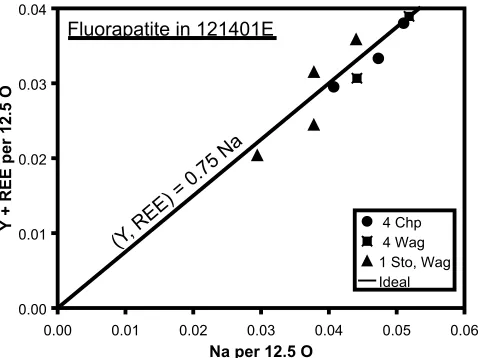
Fig. 5. Plot of fluorapatite Na, Y and total rare earth element (REE) contents in specimen 121401E, including data from Grew et al. (2006). Legend gives section number and identity of nearby ferro-magnesian phosphate mineral (abbreviations in Table 7). Line is for reference only.
Table 7. Minerals and their occurrence in specimen 121401E.
Mineral Ap seg* Qz matrix
Phosphates
Note: XX – very abundant; X – abundant throughout; x – present throughout; T – in trace amounts; R – rare,i.e., <5 grains total in 1 or 2 sections; 2nd– a secondary phase, generally sparse. *In the fluorap-atite segregations, with or without quartz, in contrast to minerals not found within the segregations. **Includes exsolved hematite and secondary “pseudorutile”.
(Table 7). The phosphates occur exclusively as inclusions in apatite, although contacts with quartz are common; in a few cases, wagnerite is found between apatite and silicates.
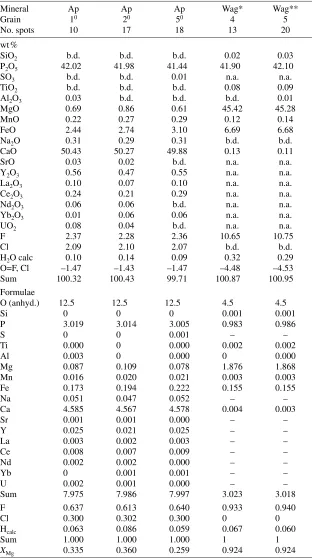
The coarse-grained fluorapatite hosting chopinite and wagnerite in section 121401E4 is relatively rich in Mg, Cl, Fe and Y (Table 8), features characteristic of fluorapatite in stornesite-(Y)-bearing sections of 121401E and of speci-mens from the type locality (Grewet al.,2006). Yttrium and total rare earth elements (REE) increase regularly with Na in sample 121401E, but not at the ratio predicted by the substi-tution (Y, REE) + Na = 2Ca (Fig. 5). Halogen contents of ap-atite vary little from spot to spot (Fig. 6a).
Next to fluorapatite, the most abundant phosphate is nerite. Two inclusions of partially altered pale-yellow wag-nerite, up to 1.5 mm long, in a second, larger apatite segre-gation in the chopinite-bearing thin section 121401E4 are 5bpolytype and contain little Ti (Table 8). Two other grains in this section average 0.33 wt % TiO2and XMg= 0.92. In other sections of 121401E wagnerite is commonly devel-oped around K-feldspar or biotite and its break down prod-ucts.
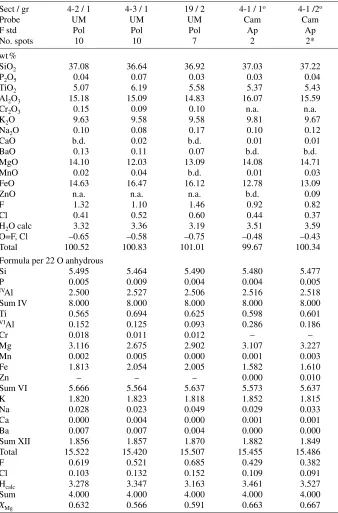
Brown flakes of Ti-rich biotite (Table 9) are commonly enclosed in fluorapatite or in quartz near fluorapatite (e.g. Fig. 3). Cl/(Cl+F) ratio (Fig. 6b) and Ti content vary inversely with XMg. Distributions of Cl, F and OH between biotite and apatite can be used as geothermometers (Zhu & Sverjensky, 1992), which we applied to the data obtained on the U Maine electron microprobe assuming a constant apatiteXClthroughout sample 121401E (Fig. 6a) and P = 6 kbar. Chlorine distribution [ln KD = 4.35 – 4.95, where
KD= (Cl/OH)Ap/(Cl/OH)Bt] gives less than 500 °C, where-as F distribution [ln KD= 3.32 – 4.02] gives 698–788 °C (cf. 800–860 °C for the metamorphic peak, Grew et al., 2006).
Perthitic K-feldspar occurs as selvages formed from breakdown of biotite (Grew et al., 2006) and as coarser grains enclosing oriented vermicules and rounded blebs of quartz (Fig. 7). P2O5contents of K-feldspar and plagioclase (An9-18) enclosed in fluorapatite or contiguous to fluorapa-tite range from 0.09 to 0.51 wt % (Grewet al., 2006; this pa-per, Table 10). Albite (An0.3) is a minor component of the quartz matrix in the chopinite-bearing section.
Orthopyroxene is largely altered to phyllosilicates; it is separated from apatite and from small grains of wagnerite enclosed in apatite by a quartz-K-feldspar-oligoclase coro-na (Fig. 8a; Table 11). Sapphirine is found in direct contact with quartz (Fig. 8b) or enclosed in sillimanite, which iso-lates it from fluorapatite and quartz. In most cases, silliman-ite appears to be a later-formed mineral, being found with the low-Ti skeletal biotite and as an overgrowth on corun-dum (Fig. 8c,d; Table 11); a prism is also enclosed in fluor-apatite.
Table 8. Selected analyses of fluorapatite (Ap) and wagnerite-Ma5bc(Wag) in the cho-pinite-bearing section 121401E4-1.
Mineral Ap Ap Ap Wag* Wag**
Grain 10 20 50 4 5
No. spots 10 17 18 13 20
wt %
SiO2 b.d. b.d. b.d. 0.02 0.03
P2O5 42.02 41.98 41.44 41.90 42.10
SO3 b.d. b.d. 0.01 n.a. n.a.
TiO2 b.d. b.d. b.d. 0.08 0.09
Al2O3 0.03 b.d. b.d. b.d. 0.01
MgO 0.69 0.86 0.61 45.42 45.28
MnO 0.22 0.27 0.29 0.12 0.14
FeO 2.44 2.74 3.10 6.69 6.68
Na2O 0.31 0.29 0.31 b.d. b.d.
CaO 50.43 50.27 49.88 0.13 0.11
SrO 0.03 0.02 b.d. n.a. n.a.
Y2O3 0.56 0.47 0.55 n.a. n.a.
La2O3 0.10 0.07 0.10 n.a. n.a.
Ce2O3 0.24 0.21 0.29 n.a. n.a.
Nd2O3 0.06 0.06 b.d. n.a. n.a.
Yb2O3 0.01 0.06 0.06 n.a. n.a.
UO2 0.08 0.04 b.d. n.a. n.a.
F 2.37 2.28 2.36 10.65 10.75
Cl 2.09 2.10 2.07 b.d. b.d.
H2O calc 0.10 0.14 0.09 0.32 0.29
O=F, Cl –1.47 –1.43 –1.47 –4.48 –4.53
Sum 100.32 100.43 99.71 100.87 100.95
Formulae
O (anhyd.) 12.5 12.5 12.5 4.5 4.5
Si 0 0 0 0.001 0.001
P 3.019 3.014 3.005 0.983 0.986
S 0 0 0.001 – –
Ti 0.000 0 0.000 0.002 0.002
Al 0.003 0 0.000 0 0.000
Mg 0.087 0.109 0.078 1.876 1.868
Mn 0.016 0.020 0.021 0.003 0.003
Fe 0.173 0.194 0.222 0.155 0.155
Na 0.051 0.047 0.052 – –
Ca 4.585 4.567 4.578 0.004 0.003
Sr 0.001 0.001 0.000 – –
Y 0.025 0.021 0.025 – –
La 0.003 0.002 0.003 – –
Ce 0.008 0.007 0.009 – –
Nd 0.002 0.002 0.000 – –
Yb 0 0.001 0.001 – –
U 0.002 0.001 0.000 – –
Sum 7.975 7.986 7.997 3.023 3.018
F 0.637 0.613 0.640 0.933 0.940
Cl 0.300 0.302 0.300 0 0
Hcalc 0.063 0.086 0.059 0.067 0.060
Sum 1.000 1.000 1.000 1 1
XMg 0.335 0.360 0.259 0.924 0.924
Notes: n.a. – not analyzed; b.d. – below detection. All Fe as FeO. H2O calculated from stoichiometry: F + Cl + H = 1.XMg= atomic Mg/(Mg+Fe).
Analyses done at the University of Maine.
0Near to chopinite grains 1 and 2, wagnerite grain 5, respectively
selvage of sillimanite (e.g. Fig. 8c,d, Table 11). A rutile grain (Table 12) occurs with zircon along the boundary of quartz with a sillimanite aggregate enclosing corundum. Temperatures calculated from the 386 ppm Zr measured in rutile are 751 °C (calibration of Zack et al., 2004) and 663 °C (calibration of Watsonet al., 2006).
Table 9. Selected analyses of biotite in sample 121401E.
Sect / gr 4-2 / 1 4-3 / 1 19 / 2 4-1 / 1o 4-1 /2o
Probe UM UM UM Cam Cam
F std Pol Pol Pol Ap Ap
No. spots 10 10 7 2 2*
wt %
SiO2 37.08 36.64 36.92 37.03 37.22
P2O5 0.04 0.07 0.03 0.03 0.04
TiO2 5.07 6.19 5.58 5.37 5.43
Al2O3 15.18 15.09 14.83 16.07 15.59
Cr2O3 0.15 0.09 0.10 n.a. n.a.
K2O 9.63 9.58 9.58 9.81 9.67
Na2O 0.10 0.08 0.17 0.10 0.12
CaO b.d. 0.02 b.d. 0.01 0.01
BaO 0.13 0.11 0.07 b.d. b.d.
MgO 14.10 12.03 13.09 14.08 14.71
MnO 0.02 0.04 b.d. 0.01 0.03
FeO 14.63 16.47 16.12 12.78 13.09
ZnO n.a. n.a. n.a. b.d. 0.09
F 1.32 1.10 1.46 0.92 0.82
Cl 0.41 0.52 0.60 0.44 0.37
H2O calc 3.32 3.36 3.19 3.51 3.59
O=F, Cl –0.65 –0.58 –0.75 –0.48 –0.43
Total 100.52 100.83 101.01 99.67 100.34
Formula per 22 O anhydrous
Si 5.495 5.464 5.490 5.480 5.477
P 0.005 0.009 0.004 0.004 0.005
IVAl 2.500 2.527 2.506 2.516 2.518
Sum IV 8.000 8.000 8.000 8.000 8.000
Ti 0.565 0.694 0.625 0.598 0.601
VIAl 0.152 0.125 0.093 0.286 0.186
Cr 0.018 0.011 0.012 – –
Mg 3.116 2.675 2.902 3.107 3.227
Mn 0.002 0.005 0.000 0.001 0.003
Fe 1.813 2.054 2.005 1.582 1.610
Zn – – – 0.000 0.010
Sum VI 5.666 5.564 5.637 5.573 5.637
K 1.820 1.823 1.818 1.852 1.815
Na 0.028 0.023 0.049 0.029 0.033
Ca 0.000 0.004 0.000 0.001 0.001
Ba 0.007 0.007 0.004 0.000 0.000
Sum XII 1.856 1.857 1.870 1.882 1.849
Total 15.522 15.420 15.507 15.455 15.486
F 0.619 0.521 0.685 0.429 0.382
Cl 0.103 0.132 0.152 0.109 0.091
Hcalc 3.278 3.347 3.163 3.461 3.527
Sum 4.000 4.000 4.000 4.000 4.000
XMg 0.632 0.566 0.591 0.663 0.667
Notes: Sect/gr – section/grain. Probe: UM – University of Maine, Cam – Camparis. n.a. – not analyzed; b.d. – below detection. F standards: Pol – polylithionite, Ap – fluorapatite. All Fe as FeO. H2O calculated from stoichiometry: F + Cl + H = 4.XMg= atomic Mg/(Mg+Fe).oGrains 1 and 2 are the closest biotite grains to chopinite (Fig. 3). *Only one spot for F.
Origin of chopinite
XCl = -1.1933XMg + 0.8753
Fig. 6. Plots of Cl/(Cl+F)vs.Mg/(Mg+Fe) for primary fluorapatite and biotite in sample 121401E, including data from Grewet al.(2006). (a) Fluorapatite. Numbers in legend refer to section; C indicates spots near chopinite, W indicates spots near wagnerite. (b) Numbers in legend re-fer to three sections of sample 121401E (sections 4 – 2 and 4 – 3 are from the same slice as the chopinite-bearing section, but do not contain chopinite).
Table 10. Analyses of feldspars in sample 121401E.
Sect / gr 19 / 1* 19 / 1a* 10 / 2** 10 / 6
Mineral Pl Kfs Pl Kfs
No. spots 11 3 10 10
Wt %
SiO2 63.92 64.74 65.82 64.73
Al2O3 22.77 18.69 21.71 18.46
Sum 100.54 99.96 100.66 99.65
Formulae per 8 O
Si 2.806 2.972 2.875 2.988
Al 1.178 1.011 1.118 1.004
P 0.012 0.013 0.013 0.008
Fe 0.010 0.008 0.000 0.007
Mn 0.000 0.001 0.000 0.000
Mg 0.000 0.000 0.000 0.002
Na 0.830 0.146 0.867 0.089
K 0.004 0.832 0.030 0.883
Ca 0.159 0.005 0.092 0.000
Ba 0.000 0.000 0.000 0.001
Sum 5.000 4.988 4.996 4.981
Notes: Sect / gr – section / grain. n.a. – not analyzed. All Fe as Fe2O3. Analyses done at the University of Maine. *In corona between or-thopyroxene and fluorapatite (Fig. 8a). **Adjacent to K-feldspar-quartz intergrowth (Fig. 7b).
Zhang, 1995), and only one other metamorphic occurrence if “mineral A” reported from Lake Quoich, Scotland (Liv-ingstone, 1980) is sarcopside, as suggested by its composi-tion ( ˇCern´yet al., 1998). Associations of fluorapatite and sarcopside are not common, and in some cases fluorapatite is later (e.g.Fransoletet al., 1986). The closest analogues to the Brattnevet assemblage of chopinite, wagnerite and stornesi-te-(Y) are assemblages of the Fe-dominant analogues, re-spectively, sarcopside, zwieselite, and johnsomervilleite, as well as the Mn-dominant phosphate graftonite, in granites and granitic pegmatites (e.g.Londonet al., 1999; Rodaet al., 2004). This analogy supports the suggestion that the origin of chopinite and associated ferromagnesian phosphates is closely tied to granitic melts resulting from anatexis (Grew et al. 2006), a scenario we would like to further develop here based on new information obtained on the Brattnevet sample and rethinking after constructive reviews.
Table 11. Selected analyses of sapphirine, corundum, sillimanite and orthopyroxene in sample 121401E.
Sect / gr 4-2 / 1 4-2 / 3 4-2 / 3 19 / 2
Mineral Spr Crn* Sil* Opx
No. spot 10 10 10 9
wt %
SiO2 11.65 n.a. 36.47 48.91
P2O5 b.d. n.a. 0.03 n.a.
MgO 13.17 b.d. 0.03 20.94
CaO b.d. n.a. 0.02 0.06
Na2O 0.01 n.a. b.d. 0.02
K2O b.d. n.a. b.d. 0.02
Sum 99.85 100.02 99.58 99.68
Formulae
O / cations 20 / 14 3 5 6
Si 1.420 – 0.992 1.841
P 0.000 – 0.001 –
Ti 0.003 0.000 0.001 0.006
Al 8.846 1.986 1.987 0.251
V 0.003 0.000 0.000 –
Cr 0.002 0.000 0.000 0.002
Fe3+ 0.304 0.014 0.020 –
Fe2+ 1.019 – – 0.743
Mn 0.006 0.000 0.000 0.006
Mg 2.394 0.000 0.001 1.175
Ca 0.000 – 0.000 0.002
Na 0.002 – 0.000 0.001
K 0.000 – 0.000 0.001
Sum 14.000 2.000 3.003 4.028
XMg 0.702 – – 0.613
Notes: Sect / gr – section / grain. n.a. – not analyzed; b.d. – below de-tection; dash – not calculated. All Fe as FeO or Fe2O3, except sapphi-rine, for which FeO and Fe2O3 were calculated by stoichiometry.
200
P
m
W
Ap
Q
(a)
Ap
Pl
Qtz
250
P
m
(b)
0.2 mm
Qz
Qz
Spr
Hc
Bt
Hc
Bt
(b)
200Pm
Crn
Qtz
Qtz
S S
S S
(d)
Qz
0.2 mm
(c)
100Pm
Opx
Fsp + Q
W
(a)
Ap
Fig. 7. Back scattered electron images of perthite-quartz intergrowths in section 121401E10. (a) K-feldspar host (light) with quartz blebs (Q, mostly vertical) and plagioclase lamellae (diagonal) surrounded by partially altered wagnerite (W). (b) Mesoperthite (light and dark) with quartz globules (Qtz) and plagioclase (Pl, Table 10). Ap – fluorapatite.
Fig. 8. (a) Back scattered electron image in section 121401E19 of orthopyroxene (Opx) partially altered to phyllosilicates, including biotite, and separated from fluorapatite (Ap) and wagnerite (W) by a corona consisting of K-feldspar (lighter), quartz and oligoclase (both darker). (b) Photomicrograph of sapphirine in direct contact with quartz in section 121401E8. Hercynite (Hc) in grain next to sapphirine is largely al-tered to a transparent material (diaspore?). Plane light. (c) Photomicrograph of corundum in quartz in section 121401E4 – 2 (2ndcut of slice yielding chopinite). Plane light (d) Back scattered electron image of (c) showing corundum (Crn) mantled by sillimanite (S) in quartz (Qtz). Analyses are given in Table 11. Sillimanite is partially altered to phyllosilicate, resulting in speckled material.
The scenario proposed by Grewet al. (2006) is based on the premise that the fluorapatite segregations and plagio-clase-bearing quartz masses could be restitic bodies remain-ing after melt had been extracted from P-bearremain-ing biotite-pla-gioclase paragneiss. Additional perspective on this scenario is provided by orthopyroxene, sapphirine and corundum, all three of which were discovered in the Brattnevet specimen after the Grewet al. (2006) manuscript was in press. Al-though the first two minerals have stabilities with quartz, none has been confirmed for corundum. One possible expla-nation that Harlov & Milke (2002) forwarded for the
juxta-position of corundum and quartz is that the two phases formed in separate locations and were forced together by de-formation; subsequent reaction between the two was suffi-ciently slowed by low water activities or difficulty of nucle-ation that only a narrow rim of sillimanite developed, armor-ing the corundum.
0.0
Table 12. Analyses of oxides in sample 121401E.
Sect / gr 19 / 1 4-2 / 2 10 / 4
Fe2+ 1.002 0.018 0.763
Ni – – 0.003 tection; dash – not calculated. All Fe is given either as FeO (rutile) or apportioned between FeO and Fe2O3 by assuming stoichiometry (Mgt, Hc).XMg= atomic Mg/(Mg+Fe2+). Analyses done at the Uni-versity of Maine. *Adjacent to quartz. **Except ZrO2(see text)
distinctive quartz-microperthite intergrowths (Fig. 7) are inferred to be remains of this melt. Under equilibrium con-ditions, P and Ca content of the melt would be buffered by apatite and melt P/Ca ratio would never be great enough for ferromagnesian (or manganese) phosphates to be stabilized in addition to apatite according to the model developed by Londonet al. (1999). However, Wolf & London (1994) re-ported experiments in which the low diffusivity of P in gra-nitic melts resulted in buildup of P adjacent apatite to sever-al times the saturation, whereas Ca diffused away more quickly. These experiments suggest the possibility of high P concentrations in small melt bodies surrounded by apatite. If Ca diffused away more rapidly than P, then P/Ca ratio might have been sufficiently high for ferromagnesian
phos-Fig. 9. Schematic relationships of phases in the (Mg,Fe)O-F-PO2.5 sys-tem coexisting with granitic melt for (a) experiments at 2 kbar and 650–750 °C (Londonet al. 1999) and (b) Brattenevet at 6–7 kbar and 800–860 °C (Fig. 10). Silicate phase at (Mg,Fe)O corner depends on availability of SiO2and Al2O3in the melt. The component KAlSi3O8is presumed to be in excess, either in the melt or in K-feldspar, so that bi-otite compositions can be projected into this system. The maximum and minimum F contents of biotite are plotted in both diagrams.
phates to appear. Thus, the experimental results of London et al. (1999) on Ca-absent compositions at 650–750 °C, 2 kbar could be applied to Brattnevet [whereXFis F/(F + OH + Cl)]:
Bt (XMg= 0.47–0.68,XF= 0.06–0.12) + Al2SiO5(melt) +
SiO2(melt) + P2O5(in melt) = Kfs + cordierite (XMg= 0.72–
0.82) + (Mg,Fe)3(PO4)2(XMg= 0.76–0.85) + H2O (1)
The corresponding reaction for sample 121401E from Bratt-nevet is:
Bt (XMg= 0.52–0.67;XF= 0.12–0.22) + P2O5(in melt) = Kfs + Hc + Mgt + Ilm ± Spr ± Crn ± Opx (XMg= 0.59–0.61) + Wag (XMg= 0.92–0.93) ± Sto (XMg= 0.68–0.71) ± Chp (XMg
= 0.72–0.73) + H2O (2)
XMgof initial biotite compositions in the experiments and nature overlap, but the natural biotite is much richer in Ti (5.0–6.6vs.0.9–1.0 wt % TiO2) and in halogens. The
associ-ation of highly magnesian wagnerite with Fe-dominant ox-ides might balance the less magnesian synthetic cordierite + (Mg,Fe)3(PO4)2assemblage in terms ofXMg, and Ti would account for ilmenite in the natural product assemblage. However, the natural product assemblage differs from the experimental because the most abundant phosphate is wag-nerite rather than (Mg,Fe)3(PO4)2, and cordierite is absent
from the Brattnevet sample (only a trace of what could be al-tered cordierite was found in the Stornes specimens, Grew et al., 2006).
0
500 600 700 800 900
Temperature (ºC)
most likely due to greater availability of F, which is evi-denced in the higher F contents in the Brattnevet biotite and is consistent with a reaction relating Chp + Bt and Wag + Opx assemblages based on simplified compositions from the Brattnevet specimen:
Bt + Chp + 2Qtz + 1.4F = 2Opx + 2Wag + KAlSi3O8 +
0.8H2O (3)
However, there is no evidence from fluorapatite and biotite halogen contents within the Brattnevet specimen (Fig. 6) for variation in F contents from one part of the specimen to an-other, and thus this reaction would not explain the appear-ance of chopinite in the Brattnevet specimen. Fluorapatite associated with chopinite has a higherXMgthan other fluor-apatite in the Brattnevet specimen (Fig. 6a), and nearby bio-tite is more magnesian than other biobio-tite in the sample (e.g. Table 9), suggesting that increasing Mg/Fe ratio could favor Bt + Chp. However, a local increase in P could be more im-portant than either F or Mg/Fe,i.e., a shift rightward of the bulk composition in the triangles in Fig. 9. If the presence of wagnerite is due to a non-equilibrium excess of P in the ana-tectic melt over that resulting from fluorapatite saturation, an even greater deviation from equilibrium would be needed to attain the higher P contents necessary for chopinite for-mation. Stornesite-(Y) presumably also results from a local-ized excess of P. It is not as rare as chopinite, implying that another condition necessary for chopinite formation is lo-calized depletion of Ca and Na.
Chopinite-farringtonite relations
Brunet & Vielzeuf (1996) and Brunetet al.(1998) showed that their Mg3(PO4)2-II (chopinite) is a high-pressure
poly-morph of the meteoritic mineral farringtonite and predicted that Fe2+ would stabilize chopinite-sarcopside solid
solu-tions to lower pressures. Calculation of isopleths (Fig. 10) requires data on Mg-Fe distribution between farringtonite and chopinite-sarcopside as well as the volume of reaction determined by Brunet & Vielzeuf (1996) and Brunetet al. (1998). Grewet al.(2006) calculated this distribution coef-ficient, KD= (Mg/Fe)Far/(Mg/Fe)Src= 2.30, from the
distri-bution coefficients between each of these two minerals and johnsomervilleite or chladniite calculated from composi-tions in terrestrial and meteoritic minerals (Fig. 11a). We as-sumed that the most magnesian compositions that McCoyet al. (2006) called farringtonite are indeed farringtonite. More ferroan compositions show different Fe-Mg distributions, i.e., the “Mg-graftonite” of Floss (1999) behaves like sar-copside-chopinite.
The isopleth for 70 % chopinite solid solution passes through the box indicating peak conditions in the Larse-mann Hills, but the isopleth for 40 % chopinite is 2 kbar higher than the synthesis of this composition by Charalam-pideset al.(1988) at 0.8 kbar, 500 °C (Fig. 10). This dis-crepancy implies the calculated KD is too low, that is, the isopleths are too closely spaced; variation of KDwith com-position could also play a role.
Londonet al.(1999) referred to their (Mg0.8Fe0.2)3(PO4)2
phase as “sarcopside” but cited no evidence other than
com-Fig. 10. Schematic pressure-temperature diagram showing isopleths calculated from the reaction and volume change in the Mg3(PO4)2 system (Chp 1-Far 1, Brunet & Vielzeuf 1996; Brunetet al.1998) for chopinite-sarcopside solid solution associated with farringtonite sol-id solution and assuming both solsol-id solutions are sol-ideal and a Kd= (Mg/Fe)Far/(Mg/Fe)Chp = 2.30 (Fig. 11a). Charalampides et al. (1988) synthesized sarcopside containing 40 % chopinite at 0.8 kbar, 500 °C (arrow Chp 0.4). Numbered gray-filled boxes indicate peak (I) and post peak (II, III) metamorphic conditions for the Larsemann Hills based onP-Testimates reported for the Larsemann Hills and nearby exposures (Thostet al., 1994; Fitzsimons, 1996; Carsonet al., 1997). Unnumbered gray-filled box indicates synthesis condi-tions for (Mg0.8Fe0.2)3(PO4)2(average composition) by Londonet al. (1999). Al2SiO5relations are from Pattison (1992). And – andalu-site, Chp – chopinite, Far – farringtonite, Ky – kyanite, Sil – silli-manite.
position to back this identification. Even allowing for dis-crepancy noted above, Fig. 10 shows that it is highly unlike-ly that their phase is chopinite; more likeunlike-ly, it is farringtoni-te. This identification is consistent with Mg-Fe distribu-tion between biotite and their synthetic phosphate (Mg,Fe)3(PO4)2: KD = (Mg/Fe)P/(Mg/Fe)Chp = 2.28
(Fig. 11b), virtually identical for KD for
farringtonite-sar-copside (Fig. 11a).
(Mg/Fe)Chp = 1.3231(Mg/Fe)Bt
(Mg/Fe)Src = 0.588(Mg/Fe)Fil
R2 = 0.93 (Mg/Fe)Far = 1.354(Mg/Fe)Fil
R2 = -1
Fig. 11. Distribution of Fe and Mg between (Mg, Fe)3(PO4)2phases, fillowite group minerals and biotite. (a) KD = (Mg/Fe)Far/ (Mg/ Fe)Scp. Sources of data: Livingstone (1980), ˇCern´yet al.(1998), and Corbella i Cordom´ı & Melgarejo i Draper (1990) for sarcopside and johnsomervilleite; Floss (1999) and McCoyet al.(2006) for farring-tonite, “Mg-graftonite”, graftonite/sarcopside and chladniite in lod-ranite GRA 95209. (b) KD= (Mg/Fe)P/ (Mg/Fe)Chp, where P is the (Mg, Fe)3(PO4)2phosphate reported by Londonet al.(1999) as sar-copside. Sources of data: Camparis analyses of chopinite (average from Table 6), Camparis analyses of biotite in grains 1 and 2 (Table 9), and analyses of synthetic (Mg, Fe)3(PO4)2and biotite from Lon-donet al.(1999).
References
Annersten, H. & Nord, A.G. (1980): A high pressure phase of mag-nesium orthophosphate.Acta Chem. Scand.,A34, 389–390. Annersten, H., Ericsson, T., Nord, A.G. (1980): The cation ordering
in iron-containing zinc and magnesium orthophosphates deter-mined from Mössbauer spectroscopy.J. Phys. Chem. Solids,41, 1235–1240.
Armbruster, T., Bürgi, H.B., Kunz, M., Gnos, E., Brönnimann, S., Lienert, C. (1990): Variation of displacement parameters in struc-ture refinements of low albite.Am. Mineral.,75, 135–140. Berthet, G., Joubert, J.C., Bertaut, E.F. (1972): Vacancies ordering in
new metastable orthophosphates [Co3䊐]P2O8 and [Mg3䊐]P2O8 with olivin-related structure.Z. Kristallogr.,136, 98–105.
Bild, R.W. (1974): New occurrences of phosphates in iron meteor-ites.Contrib. Mineral. Petrol,45, 91–98.
Brunet, F. & Vielzeuf, D. (1996): The farringtonite / Mg3(PO4)2-II transformation: A new curve for pressure calibration in piston-cylinder apparatus.Eur. J. Mineral.,8, 349–354.
Brunet, F., Chopin, C., Seifert, F. (1998): Phase relations in the MgO– P2O5–H2O system and the stability of phosphoellenbergerite: petro-logical implications.Contrib. Mineral. Petrol.,131, 54–70. Buseck, P.R. & Holdsworth, E. (1977): Phosphate minerals in
palla-site meteorites.Mineral. Mag.,41, 91–102.
Carson, C. J., Powell, R., Wilson, C.J.L., Dirks, P.H.G.M. (1997): Partial melting during tectonic exhumation of a granulite terrane: an example from the Larsemann Hills, East Antarctica.J. Meta-morphic Geol.,15, 105–126.
ˇ
Cern´y, P., Selway, J.P., Ercit, T.S., Breaks, F.W., Anderson, A.J., An-derson, S.D. (1998): Graftonite – beusite in granitic pegmatites of the Superior Province: A study in contrasts.Can. Mineral.,36, 367–376.
Charalampides, G., Ericsson, T., Nord, A.G., Khangi, F. (1988): Studies of hydrothermally prepared (Fe,M)3(PO4)2-sarcopsides.
N. Jahrb. Mineral. Mh., 1988, 324–336.
Corbella i Cordom´ı, M. & Melgarejo i Draper, J.-C. (1990): Carac-ter´ısticas y distribuci´on de los fosfatos de las pegmatitas gran´ıti-cas de la pen´ınsula del Cap de Creus (Pirineo oriental catal´an). Bol. Soc. Espa˜n. Mineral.,13, 169–182.
Fitzsimons, I.C.W. (1996): Metapelitic migmatites from Brattstrand Bluffs, East Antarctica–Metamorphism, melting and exhumation of the mid crust.J. Petrol.,37, 395–414.
Floss, C. (1999): Fe,Mg,Mn-bearing phosphates in the GRA 95209 meteorite: Occurrences and mineral chemistry.Am. Mineral.,84, 1354–1359.
Fontan, F. & Fransolet, A.-M. (1986): Les phosphates de Fe et Mn des pegmatites de Valmy, Massif des Alb`eres (Pyr´en´ees Orient-ales), France.Bol. Soc. Espa˜n. Mineral.,9, 391–396.
Fransolet, A.-M. (1977): Intercroissances et inclusions dans les as-sociations graftonite-sarcopside-triphylite. Bull. Soc. Fran¸c. Min´eral. Cristallogr.,100, 198–207.
Fransolet, A.-M., Keller, P., Fontan, F. (1986): The phosphate miner-al associations of the Tsaobismund Pegmatite, Namibia.Contrib. Mineral. Petrol.,92, 502–717.
Fuchs, L.H., Olsen, E., Gebert, E. (1973): New X-Ray and composi-tional data for farringtonite, Mg3(PO4)2.Am. Mineral.,58, 949– 951.
Grew, E.S., Armbruster, T., Medenbach, O., Yates, M.G., Carson, C.J. (2006): Stornesite-(Y), (Y, Ca)䊐2Na6(Ca,Na)8(Mg,Fe)43 (PO4)36, the first terrestrial Mg-dominant member of the fillowite group, from granulite-facies paragneiss in the Larsemann Hills, Prydz Bay, East Antarctica.Am. Mineral.,91, 1412–1424 Grew, E.S., Armbruster, T., Medenbach, O., Yates, M.G., Carson,
C.J. (2007): Tassieite, (Na,䊐)Ca2(Mg,Fe2+,Fe3+)2(Fe3+,Mg)2 (Fe2+,Mg)
2(PO4)6.2H2O, a new hydrothermal wicksite-group mineral in fluorapatite nodules from granulite-facies paragneiss in the Larsemann Hills, Prydz Bay, East Antarctica.Can. Miner-al.,45, in press
Harlov, D.E. & Milke, R. (2002): Stability of corundum + quartz rel-ative to kyanite and sillimanite at high temperature and pressure. Am. Mineral.,87, 424–432.
Henry, P.F., Weller, M.T., Wilson, C.C. (2003): Determination of the cation distribution in Fe2Ni(PO4)2using isotopic substitution and powder neutron diffraction.J. Appl. Crystallogr.,36, 1361–1367. Hurlbut, C.S. (1965): Detailed description of sarcopside from East
sarcop-side de Sidi-bou-Othmane (Jebilet, Maroc). Notes Serv. G´eol. Maroc,31, 277–284.
Larsen, E.S. & Berman, H. (1934): The microscopic determination of the nonopaque minerals.U.S. Geol. Surv. Bull.848, 266 p. Lindberg, M.L. (1950): Arrojadite, hühnerkobelite, and graftonite.
Am. Mineral.,35, 59–76.
Livingstone, A. (1980): Johnsomervilleite, a new transition-metal phosphate mineral from the Loch Quoich area, Scotland. Miner-al. Mag.,43, 833–836.
London, D., Wolf, M.B., Morgan, G.B., VI, Garrido, M.G. (1999): Experimental silicate – phosphate equilibria in peraluminous gra-nitic magmas, with a case study of the Alburquerque Batholith at Tres Arroyos, Badajoz, Spain.J. Petrol.,40, 215–240.
Mall´o, A., Fontan, F., Melgarejo, J.-C., Mata, J.M. (1995): The Al-bera zoned pegmatite field, Eastern Pyrenees, France.Mineral. Petrol.,55, 103–116.
Mandarino, J.A. (1981): The Gladstone – Dale relationship: Part IV. The compatibility concept and its application.Can. Mineral.,19, 441–450.
McCoy, T.J., Carson, W.D., Nittler, L.R. Stroud, R.M. Bogard, D.D., Garrison, D.H. (2006): Graves Nunataks 95209: A snapshot of metal segregation and core formation.Geochim. Cosmochim. Ac-ta,70, 516–531.
Medenbach, O. (1985): A new microrefractometer spindle-stage and its application.Fortschr. Mineral.63, 111–133.
Merlet, C. (1994): An accurate computer correction program for quantitative electron-probe microanalysis. Mikrochimica Acta, 114, 363–376.
Moore, P.B. (1972): Sarcopside: its atomic arrangement.Am. Miner-al.,57, 24–35.
Nord, A.G. (1984): Crystallographic studies of olivine-related sar-copside-type solid solutions.Z. Kristallogr.,166, 159–176. Nord, A.G., & Kierkegaard, P. (1968): The crystal structure of
Mg3(PO4)2.Acta Chem. Scand.,22,1466–1474.
Olsen, E.J., Kracher, A., Davis, A.M., Steele, I. M., Hutcheon, I.D., Bunch, T.E. (1999): The phosphates of IIIAB iron meteorites. Meteoritics & Planetary Science,34, 285–300.
Palache, C., Berman, H., Frondel, C. (1951): The System of Miner-alogy of James Dwight Dana and Edward Salisbury Dana, Yale University. 7th ed, v. II. Halides, Nitrates, Borates, Carbonates, Sulfates, Phosphates, Arsenates, Tungstates, Molybdates, etc. Wiley, New York, 1124 p.
Pattison, D.R.M. (1992): Stability of andalusite and sillimanite and the Al2SiO5triple point: Constraints from the Ballachulish aure-ole, Scotland.J. Geol.,100, 423–446.
Povondra, P., Pivec, E., ˇCech, F., Lang, M., Nov´ak, F., Prachaˇr, I., Ulrych, J. (1987): Pˇribyslavice peraluminous granite.Acta Univ. Carol., Geol.,3, 183–283.
Roda, E., Pesquera, A., Fontan, F., Keller, P. (2004): Phosphate min-eral associations in the Ca˜nada pegmatite (Salamanca, Spain): Paragenetic relationships, chemical compositions, and implica-tions for pegmatite evolution.Am. Mineral.,89, 110–125. Sheldrick, G.M. (1997) SHELXS97 and SHELXL97. University of
Göttingen, Germany..
Smeds, S.-A., Uher, P., ˇCern´y, P., Wise, M.A., Gustafsson, L., Pen-ner, P. (1998): Graftonite – beusite in Sweden: Primary phases, products of exsolution, and distribution in zoned populations of granitic pegmatites.Can. Mineral.,36, 377–394.
Stalder, M. & Rozendaal, A. (2002): Graftonite in phosphatic iron formations associated with the mid-Proterozoic Gamsberg Zn-Pb deposit, Namaqua Province, South Africa.Mineral. Mag.,66, 915–927.
Thost, D. E., Hensen, B. J., Motoyoshi, Y. (1994): The geology of a rapidly uplifted medium and low pressure granulite facies terrane of Pan-African age: the Bolingen Islands, Prydz Bay, Eastern An-tarctica.Petrology,2, 293–316.
Warner, J.K., Cheetham, A.K., Nord, A.G., von Dreele, R.B., Yethi-raj, M. (1992): Magnetic structure of iron (II) phosphate, sarcop-side, Fe3(PO4)2.J. Materials Chem.,2(2), 191–196.
Watson, E.B., Wark, D.A., Thomas, J.B. (2006): Crystallization thermometers for zircon and rutile.Contrib. Mineral. Petrol., 151, 413–433.
Wolf, M.B. & London, D. (1994): Apatite dissolution into peralumi-nous haplogranitic melts: An experimental study of solubilities and mechanisms.Geochim. Cosmochim. Acta,58, 4175–4145. Yvon, K., Jeitschko, W., Parthe, E. (1977): LAZY PULVERIX, a
computer-program, for calculating X-ray and neutron-diffraction powder patterns.J. Appl. Crystallogr.,10, 73–74.
Zack, T., Moraes, R., Kronz, A. (2004): Temperature dependence of Zr in rutile: empirical calibration of a rutile thermometer. Con-trib. Mineral. Petrol.,148, 471–488.
Zhang, R. (1995): Mg-sarcopside, a new variety of sarcopside group.Kuangwu Yanshi = J. Mineral. Petrol.,15, 6–10 (in Chi-nese with English abstract).
Zhu, C. & Sverjensky, D.A. (1992): F-Cl-OH partitioning between biotite and apatite.Geochim. Cosmochim. Acta,56, 3435–3467.
Received 22 July 2006