26
THE STRENGTHENING RELATIONSHIP OUTCOME STRATEGY IN
RETAIL BUSINESS IN INDONESIA
Chr. Whidya Utami
Economics Faculty at Widya Mandala Catholic University-Surabaya
Abstract: Retail Business covers an activity that involves the sale of goods to customers for their own use rather than to
shops. High competition and customers’ retention effort have motivated retailers in seeking a strategy to win the competition. The aims of this paper are: (1) how to implement relationship marketing in retail business in Indonesia, (2) how to implement strengthening relationship outcome strategy in retail business through communication, preferential treatment, personalization, and rewarding. Through communication, preferential treatment, personalization, and rewarding, it is expected to be able to create a long term and continuous relationship.
Keywords: relationship marketing, retail business, customer retention, customer loyalty, relationship effort, relationship
outcomes.
INTRODUCTION
Marketing Management Study identifies 5 philo-sophies in applying its marketing as follows: (1) producer, (2) production, (3) seller, (4) market, (5) social marketing (Kotler, 2002:12). This mass market orientation has been used by companies. However, the redefinition of marketing itself still goes on as a social demand in finding the appropriate definition. (Kotler, 2002:25).
The redefinition of marketing concept is triggered by the changes of market paradigm from transactional to relationship. Kotler (2002:34) states that a company needs to adjust the marketing systems from transactional marketing to relationship marketing. These changes are triggered by business atmosphere and information technology. A company does not only think to get profit from new customers but it also focuses on how to have a continuous sales to present customers in the future.
In the middle of 20th century, some management philosophers such as Peter Drucker believe that creating consumers satisfaction is the aim of a business (Shajahan, 2004:1). Profit is not an aim but a reward. It is assumed that if a consumer is satisfied, they will get “value” that gives profits for share-holders in a long term through “re-buying” activity for regular customers.
This opinion is inline with the changes of marketing paradigm from transactional paradigm to relationship marketing paradigm. Disney (1999) says, “as organization becomes more critical.” Under-standing the unfulfilled demands of customers and finding a strategy to make customers become loyal are crucial matters that needed to be considered by a company. In this case, paradigm change from
transactional to relationship is a must. This Relation-ship Marketing will give benefits for customers and put competitors in a harder situation in getting customers’ loyalty (Evan and Lasking, 1994). Kotler and Nevin (1995) stated that marketing has changed into a small scope transaction to marketing network.
Achrol (1997) states that the differences of Transactional Marketing and Relationship Marketing are based on company orientation which explains as follows: Transactional Marketing only focuses on sales, products characters, short-term, not emphasize on customers service, restricted commitment to customers, in-continuous relationship, and only focus to production. On the other hand, Relationship Marketing focuses on customers care and value, long-term, emphasize on giving service to customers, unrestricted commitment to customers, continuous relationship, and pay attention on overall quality.
Retail Business involves the sale of goods to customers for their own use and not for business (Berman, 2001:3). While according to Levy (2004:64), Retail Business can be categorized as service business, but very low service needs. A high service business is meant as giving service in the real context such as restaurants, banking, management consultant, and insurance. Berry (1986) in Mehta C.A., Ashok and Soon Li Han (2000) state that classifying retailers as “good” and “services” are very helpful as retailer business also belongs to the real service business like restaurants, beauty saloon or even management consultant. Therefore, in implementing Relationship Marketing Concept in retail business, the same approach is needed with a low service involvement.
This modern retail business is marked by the increasing demand toward information technology application system. For instance: the usage of computers for shops like Point of Sales (POS), Electronic Data Interchange (EDI), and Electronic Fund Transfer (EFT) where these systems are expected to support the progress (Maulana, 1999). However, the exchange on modern retail business has not applied by oriented customers. Beatty et al., (1996) says, “However, retailers generally have little knowledge on the types of value drivers that they should focus at. Bendapudi and Berry (1997) added that conceptualized what some of these drivers might be, but no systematic, empirical investigation has been reported. Especially research pertaining to relationship marketing in consumer market has advanced little. In other word, retailers’ attention on relationship marketing that focuses on customers is considered less systematic and less supported by Investigation Empirical Activity.
Some retail business have succeeded and the difficulty in identifying themselves are only based on merchandise selection (Berry and Gresham, 1986; Gosh, 1994). Retailers are hoped to work harder in improving customer value through processes, services and technology (Morgan and Hunt, 1994) in Wulf and Gaby (2003).
Based on these opinions, this paper tries to talk about the following matters:
1. How to implement Relationship Marketing in retail business in Indonesia.
2. How to implement Strengthening Relationship Outcomes Strategy in retail business through communication, preferential treatment, personalize-tion and rewarding.
BRIEF REVIEW
Relationship Marketing Concept
Relationship Marketing is a very interesting topic. In 1998, there was an international seminar about this topic. Journal of Strategic Marketing chose it as the main topic, so did Journal of Business Research in 1999 (Too, H.Y, Leanne, Anne and Peter, 2000). Researches about Relationship Marketing implementation were also done. Relationship Marketing Paradigm was known better after realizing that the mixed traditional marketing model (4Ps to 8Ps) was not good enough for industrial and service marketing. Abram (1995) summarized 2 reasons: (1) to focus more on short activities than continuous ones, and (2) to simplify decision making involving only small part of the whole organization. Payne (1995:30)
mentioned 3 main elements of Transactional Marketing to Relationship Marketing are: (1) the exchange of functional based marketing, (2) the exchange of customers’ interests orientation, and (3) six view points that are: customer market, internal marketing, supplier market, recruitment market, influencer market and referral market.
Sheth and Parvatiyar (2002) stated that there was proliferation in defining Relationship Marketing at present. Relationship Marketing is used to describe various context and perspective of marketing. It is an old idea which is often used as a topic in a discussion and a research especially in practice and service marketing (Berry, 1995). Relationship Marketing Paradigm is started from Economic Theory of Exchange as in Transactional Cost Analysis (TCA) where a company maximizes profit and ignores being dependable between the transaction maker and its own people by minimizing the transaction cost from its own side but not from the other side. Agency theory is a result of further development which is determined by the rules in the agreement. This theory does not care about personal relationship. Further development is suggested by understanding inter-personal relationship theory and customers behaviour approach.
The idea of having Relationship Marketing is as a way to identify, maintain and build network with individual customer, and reinforce the network for both sides through interactive contact, individual and additional points in a long-term (Peterson, 1995). There is an important change of value in Relationship Marketing definition and a new philosophy orientation of marketing theory where customer’s satisfaction is considered important but not as a marketing goal. The goal of relationship development is based on long-term and the boundary between sellers and buyers. This variable is marked by network relationship that covers trust, commitment and social value (Achrol, 1997).
Networking contribution, theory of relationship marketing, is applied differently from conventional exchange theory in Dyadic context. Hunt and Morgan in Sheth and Partivayar (1995) explained that all kinds of relational exchange did not only have networking with customers but also to distributors, branch office or salesmen, buyers and internal relationships. In other word, Relationship Marketing increases company efficiency while cooperation and customers’ response will decrease the fund resource and non-productive marketing resource (Sheth & Partivayar, 1995).
Relationship Marketing focuses on getting and maintaining customers, and also developing tradition-nal marketing view which emphasizes only on transaction, long-term customers’ loyalty and the effectively of organizational cost.
Some of marketing experts defines relationship marketing into 2 perspectives; they are broad and
limited perspectives. In limited perspective,
relation-ship marketing is used to describe various marketing tricks, to maintain or bound customer after sale, in order to create customer retention. In this perspective, Shani and Chalasani (1992) as quoted by Prvatiyar and Sheth (2002), define Relationship Marketing as an integrated effort to identify, maintain and build up a network with individual consumer and to continuously strengthen the network with mutual benefit of both sides, through interactive, indivi-dualized and value added contacts over a long period of time. This definition is inline with Relationship Marketing based on Metcalf & friends (1992), a guided marketing activity to find, understand, maintain customers and convince them that they will get what they hope as agreed.
Jackson (1985) used the term “account” for industrial company (business to business) in defining relationship marketing as marketing oriented toward strong, lasting relationship with individual account. While Parvatiyar and Sheth stated (2002) that other forms in narrow perspective are (1) one to one marketing which means date base customer marketing, (2) Account management in industrial market. These two marketing relationship will be applied widely as a support is given by information technology application.
On the other hand, in broad perspective, relationship marketing is used as a paradigm and marketing orientation which is the opposite of transactional marketing. Gronroos (1990) compared relationship marketing with service marketing as its definition “marketing is to establish, maintain, and enhanced relationships with customer and other partners, at a profits, so that the objectives of the
parties involved are met. This is achieved by a mutual exchange and fulfillment of promises. Parvatiyar and Sheth (1998) gave wider view about customer relationship concept where it is set formally by a company to build and strengthen customer relationship.
Whether it depends on the historical background of relationship marketing or even in broad and limited perspectives, the core of relationship marketing is an activity aimed to build and maintain long-term relationship with the main stakeholder, and based on beneficial principles. Payne (2003) gave more details explanation in finding the way of having beneficial mechanism in the form of relational relationship where it gives profit to the other part as it gave profit before and expect to get it in the future. In relationship changes, a part gives profit to another than gets balance profit. The point is those who get profit, they will have a right or profit in another form. In the application, relationship marketing can be used as a new strategy or business philosophy.
As a strategy, relationship marketing is formed as a formal planned strategy in doing business. The choice of relationship marketing as a strategy must be based on relationship marketing philosophy itself and supported by the appropriate strategy analysis of the organization’s cost and usage.
Relationship Marketing Component
Relationship Marketing is a structural dimen-sional that consists of 6 components: trust, bounding, communication, shared value, empathy and conti-nually (Callaghan & friends, 1995; Morgan and Hunt, 1999; Wilson, 1995). Each component is explained as follows:
1. Trust
According to Garbarino and Johnson (1999) in Prasasti, Herizon and Yudi (2003), the meaning of trust is service marketing emphasizes more on the individual behaviour that leads to customers’ faith toward the quality and given service. Gwinner (1998) thinks more on the philosophy profit than special privileges given to the customers or the social benefit or service given by the company to the customers. While Mowen and Minor (2001:312) think customer’s trust is all knowledge and conclusion own by customers about objects, attribute, and usage. Objects can be in the form of products, people, company and anything where someone has trust and character that might be owned by the objects. At the end, Morgan and Hunt (1994) define trust as a key of relationship marketing model where the higher the trust between sellers and buyers, the bigger the chance to have a long-term and continuous relationship. 2. Bonding
According to Callagham & friends (1995), bonding is a component that describes business relationship where buyers and sellers have same goal. Based on Gronroos (1989), to do relationship marketing, a company needs to have continuous bonding with customers. Shani and Chalasani (1992) in Callaghan and Shaw (2000) place bonding process as trust. In a maximum limit, the bonding process will give the feeling of friendship. It is stated that Relationship Marketing Orientation will be able to develop and increase the customers’ loyalty. This can cause the feeling of ownership in organization. Wilson and Mummalaneni (1986) in Sin & friends (2005) discovered that the power of bonding between buyers and sellers lead to a bigger commitment in maintaining relationship.
Gounaris and Ventis (2000) use customer bonding as customer’s trust in marketing study in industrial service in Greece. As stated by Payne (2003), trust is vulnerable. Therefore, bonding is needed to strengthen trust. This means a guarantee is needed in relationship parties to decrease the uncertainty of accepted usage.
3. Communication
Communication is defined as exchange, sharing, and punctuality between buyers and sellers. The research of relationship marketing emphasizes on the importance of information exchange in relationship business (Anderson and Narus, 1990). The importance part of communication in partnership is used to build trust and cooperative. Morgan and Hunt (1999) found out that communication has positive relationship and
effects between retailers-suppliers relationship in automotives industry. In conclusion, communication can be included as another component in Relationship Marketing.
4. Share Value
Share Value is defined as partners’ trust toward attitude, purpose, and important or unimportant policies, appropriate or inappropriate, and right or wrong (Morgan and Hunt, 1999). Share Value is believed as a component that build relationship between retailers and suppliers (Levy and Zaltman, 1975). In other word, when a partner has a goal or the same value, then it will build positive relationship from both parties.
5. Empathy
Empathy is a dimension of Relationship Mar-keting which is used to see a situation from different perspectives or view points. It means there should be an understanding about people demand and their goals. This also includes individual ability to judge a situation from different view points in a cognitive way. Based on the marketing literature service, empathy is one of components that is used for developing service quality (SERQUAL), an instrument that is used to evaluate service quality (Berry & friends, 1990). In Business Relationship, empathy is a component that makes both participants to be able to see their own perspectives. “Empathy is defined as seeking to understand the desires and goals of somebody else (Greenberg, 1983). This means that empathy is an important condition to build positive relationship from both parties.
6. Reciprocity
Reciprocity is that causes either party to provide favours or make allowances for the other in return for similar favours or allowances at a later date, (Sin et al., 2005). So Reciprocity is something that caused any parties to provide kindness or help for others as allowances (Callaghan & friends, 1995). The relationship of reciprocity with relationship marketing is indicated as the foundation that connects the transaction exchange with marketing activity.
Relationship Marketing Level
existence of these levels has shown that the higher the level, then the previous level will be needed. Each level gives different result to get potential benefit of opponents.
In Relationship Marketing context, its benefits are customers’ benefits in doing relationship. Ulaga and Eggert (2003) have summarized some researchers’ opinions about relationship value as seen in Table 1.
Table 1.
Writer Dimension
Anderson et al (1993) Anderson & Narus (1999)
Anderson et al.,(2000)
Fourth Benefit dimensions (as net profit,economic benefit, technical benefit, services benefit, social beneftit) Wilson Jantrania
(1995)
Three benefit dimensions ( as economic benefit, strategic benefit, behavior benefit)
Gwinner et al.,(1998) Three benefit dimensions (as
trust benefit, social benfit, preferential treatment benefit)
Lapierte (2000) Three benefit dimensions (as
product benefit, services benefit, relationship benefit Source: Ulaga and Eggert (2003)
In conclusion, all of Relationship benefits can be accumulated by some of marketing researchers’ opinion as economics profit, technical, service, social, strategy, behaviour, trust, preferential treatment, profitable products, and relationship benefit. These dimensional profits will be accepted in industrial business or even retail business.
DISCUSSION
The Relationship Marketing Implementation in Retail Business
According to Wulf and Gaby (2003), to improve retail business, relationship effort should be done. Having a relationship is an important foundation to build customer value with the following reasons: (1) The increasing customers’ expectation toward better quality products and service, (2) The increasing competition among retailers by using marketing strategy, for instance: offer similar merchandise, price promotion, do sharing activity toward distribution channel system, and give better service to customers (Berry Gresham, 1986; Davis, 1997). (3) Retailers are faced to new claim about the certainty and uncertainty of marketing condition in retail business between market and industry, and the increasing of market fragmentation or even products limitation (Juttner and
Wehrli, 1994 in Wulf and Oderkerken, 2003). Therefore, retail business needs relationship strategy as the strength to make relationship outcome real, where at the end, it will grow customers’ loyalty.
Strengthening Relationship Outcomes in Retail Business
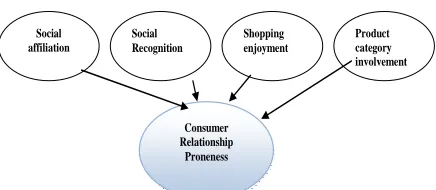
According to Oderkeken & friends (2003), relationship marketing research cannot be done without knowledge or understanding where the main concern of relationship is one or more exchanges between a consumer and a retailer that are perceived by the customer as being interrelated to potential past and future exchanges with the retailer. According to Callaghan & friends (1995), there are several things that need more attention in building relationship: (1) a consumer respects an exchange as an important condition and sufficient of relationship which is marked by a continuum relationship. (2) Postulat Banes (1997) stated that relationship will not exist without the existence of consumer relationship. This opinion focuses on consumers’ perspective. (3) Relationship existence happens when a buyer accepts a trade with a seller as potential interaction in the past or even in the future (Lacoubucci and Ostrom, 1996). Figure 1 talks about customers personality traits and its effects toward consumer relationship. it is described in Gwinner & friends (1998) in individual
buyer preferences which means how the efforts of
individual consumer to retailer in building relationship marketing.
Social affiliation
Social Recognition
Shopping enjoyment
Product category involvement
Consumer Relationship
Proneness
Source: Brady M., J Cronin, 2001, Journal of Marketing Vol 65 (3) p.34 – 49
Figure 1. Consumer Relationship Tendency
Relationship outcomes
Relationship Satisfaction
Trust Commitment Relationhip
Source: Brady M., J Cronin, 2001, Journal of Marketing Vol 65 (3) p. 34 – 49
Figure 2. Relationship Outcomes
As explained above, retail business is a hard business in doing differentiation that needs relation-ship effort as customer value and loyalty. Based on Wulf and Gaby (2003), a relationship effort as any effort that is actively made retailer towards a consumer that is intended to contribute to the consumer’s perceived customer value above and beyond the core product and or service efforts received, and that can only be perceived by the consumer after continued exchange with the retailer. According to Oderkerken, Gaby and Patric (2003), relationship efforts lead to: (1) an active effort by retailers. For example: convenient benefit is done where a consumer learns from his or her shopping experience by memorizing the display in the supermarket. This condition will come true because of the active role or retailers that inform consumer through signage or personal communication. (2) Based on Gwinner & friends’ opinion (1998, p.102), relationship effort is similar to relationship benefit which means a benefit that is earned by a consumer from a long-term relationship through core service given.
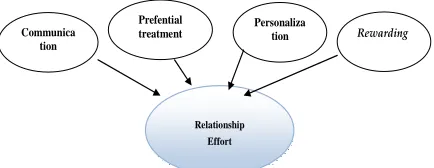
When retailers apply relationship marketing to get relationship outcomes as expected, it will give good impression to customers. By investing time, efforts and other sources, it can create a relationship with customers where psychology effect takes part and will make the customers maintain the relationship and give a feedback. (Smiths and Barclay, 1997) in Berry (1995). There are 4 relationship effort strategies in Figure 3. they are expected to be able to take care consumers’ retention to retailers through commu-nication, preferential treatment, personalization, and rewarding.
Communica tion
Prefential treatment
Personaliza
tion Rewarding
Relationship Effort
Source: Brady M., J Cronin, 2001, Journal of Marketing Vol 65 (3) p.34 – 49
Figure 3. Relationship Effort
Below are details explanations of relationship effort: 1. Communication as strengthen relationship
out-comes strategy
Communication means a consumer perception of the extent to which a retailer keeps its regular customer informed through direct communication media (Duncan and Moriarty, 1998). Communi-cation is the maid condition to create a relationship (Duncan and Moriarty, 1998). Through communi-cation, consumers can understand efforts done by retailers.
2. Preferential treatment as strengthen relationship outcomes strategy
Gwinner & friends (1998) explained that Prefe-rential Treatment is a consumer perception of the extent to which a retailer gives its regular customer better service and treatment than to its non-regular customer. However, in relationship not all customers like to have the same treatment. In fact, some customers hope to get preferential treatment (Peterson, 1995). It is urged that ordinary treatment is the important basic need of each customer to be fulfilled. Therefore, preferential treatment to customers must be done as an effort of retailers’ retention. Sheth and Parvatiyar (1995) stated that preferential treatment is service given to customers in a form of special shopping time or new products. They also explained that a customer does not expect to have the same treatment like other. Some marketers criticized retailers who give same treatment to customers, and cause a company not only lose its profit but also custom-mers’ loyalty. Peterson (1995) commented that preferential treatment value customers. By applying this treatment, it will improve the overall level of relationship outcomes.
3. Personalization as strengthening relationship outcomes strategy
4. Rewarding as strengthening relationship outcomes strategy
According to Peterson (1995), rewarding is a customer perception of the extent to which a retailer offers an incentive reward to regular customer in order to build loyalty. This rewarding can be in the form of presents, vouchers, coupons, point collection to stay in a hotel, movie tickets, and others. Rewarding identifies cooperation or relationship with other party. Many retailers focus on rewarding as investment and incentive price to keep customers’ loyalty (Berry, 1995; Peterson, 1995). So rewarding is stated as a real value of customers’ loyalty.
As a factor that decides relationship outcomes, Gwinner & friends (1998) claimed that relation-ship outcomes will be stronger, not only depends on retailers’ strategy but also on buyers’ personality.
CONCLUSION
Marketing redefining concept is triggered by the changes of market paradigm from transactional into relationship. Its aim is to create customers’ satisfaction. Profit is not the aim, instead the reward. This statement is based on the opinion that when a customer satisfies, they will give value to create profit for shareholders for a long-term through re-buying activity from satisfied customers. It means the change of paradigm from transactional into relationship is a must.
The understanding of relationship marketing, whether from the point of view of perspective background or broad and limited perspectives, is determined by its marketing activity to build and maintain its long-term relationship with the main stockholder that based on beneficial principles.
Relationship effort is done to improve retail business. Having a relationship is an important foundation to build customer value with the following reasons: (1) The increasing customers’ expectation toward better quality products and service, (2) The increasing competition among retailers by using marketing strategy, for instance: offer similar merchandise, price promotion, do sharing activity toward distribution channel system, and give better service to customers (Berry Gresham, 1986; Davis, 1997). (3) Retailers are faced to new claim about the certainty and uncertainty of marketing condition in retail business between market and industry, and the increasing of market fragmentation or even products limitation.
Strengthening relationship outcomes strategy through preferential treatment, communication, personalization and rewarding are expected to be able to create a long-term and continuous relationship.
REFERENCES
Abram, Hawkes, 1995, Relation Marketing in The
Financial Services Industry,
www.managing-chance.com /guestcon/retmktfs.htm.
Achrol, Ravi S.,1997, Change in The Theory of
Inter-organizational Relationship in Marketing Toward a Network Paradigm, Journal of The Academy of Marketing Science, Vol.15, No.1,
p 56-71.
Anderson, James C and James A. Narus, 1990, A
Model of Distributor Firm and Manufacturer Firm Working Relationship, Journal of Mar-keting, Vol 54 (1), p 42-58.
Beatty, Sharon E., James E. Coleman, 1996, Kristy
Ellis Reynold, and Jungki Lee, Customer-Sales Associate Retail Relationhip, Journal of Retailing, Vol 72 (3), p 223-47.
Berry, Leonard L., 1995, Relationship Marketing of
Services-Growing Interest, Emerging Perspec-tives, Journal of the Academy of Marketing Science, Vol 23 (4), 236-45.
………., 2002, Relationship Marketing of Services –
Perspectives from 1983 and 2000, Journal of Relationship Marketing, Vol.1 (1) p. 59-78.
Berry, L., Gresham, L.G., 1986, Relationship
Retailing: Transforming customer into Client, Business Horizon 29, 43-47.
Berman Barry, Joel R. Evan, 2001, Retail
Mana-gement : a Strategic Approach, eight edition,
Prentice Hall,Inc., New Jersey, USA.
Brady M., J. Cronin , 2001, Some New Thoughts on
Conceptualizing Perceived Service quality : a Hierarchical Approach, Journal of Marketing
Vol 65 (3), p 34-49.
Callaghan M, J. McPhail, Yau OHM, 1995,
Dimensions of s Relationship Marketing orientation: an Empirical exposition, Pro-ceeding of The Seventh Biannual World Marketing Congress, Melbourne, Australia,
July, Vol VII-II p.10-65.
Callaghan, Michael and Robin N. Shaw, 2002,
anzmac,2002/anzmacAUTHORS/pdfs/Callag-hanz, pdf
Davis, J.F, 1997, Maintining Customer Relationship
Through Effective Database Marketing:A perspective For Small Retailer, Journal of Marketing Theory and Practice Vol 5, p.31-42.
Disney, John, 1999, Customer Satisfaction and
Loyalty: The Critical Element of Service Quality, Journal of Total Quality Management,
Vol 10 No 4, p, 491-497.
Duncan T., Moriaty S.C., 1998, Communication
Based Marketing Model For Managing Relationship, Journal of Marketing, Vol. 62, p
1-13.
Evan, Joel R., Laskin, 1994, The Relationship
Marketing Process: A Conceptualization and Application, Journal of Industrial Marketing Management, Vol 23, p.439-452.
Ghosh,A., 1994, Retail Management, The Dryden press, Foth Worth.
Gouaris, Shiror P., and Karin Venetis, 2000, Trust in
Industrial Service Relationship: Behaviour Consequences, Antacedens and The Moderating Effect of The Duration of The Relationship, Working Paper, Department of Management and Science, A Rhesis University of Economics and Business, http//www.aueb.gr
Greenberg J, Hreenberg, 1983, The Personality of
Top Salesperson, Nation’s Business, December,
p 30-2.
Gronroos, C., 1991, The Marketing Strategy
Conti-nuum: A Marketing Concept for the 1990s, Journal of Management Decision, Vol.29, No,1, p.7-13.
Gwinner K.P., Gremler D.D., Bitner M.J., 1998,
Relational Benefit in Service Industries: The Customer Perspektif, Journal Academic Marketing Science, Vol 26, p 101-114.
Kotler, Philip, 2002, Marketing Management
Analy-sis, Planning, Implememtation and Controll,
11 th ed, Uppersadle River, New Jersey Prentice Hall.Inc.
Jackson B.B., 1998, Winning and Keeping Industrial
Costumers: The by name of Costumer Relationship, Lexington M.A : DC Health &
Company.
Lamb. C.W., 1994, Principles of Marketing, Second
Edition, Ohio, South Western Publishing Co,
p.34.
Levy M., Barton A. Weitz, 2004, Retailing
Management, Fifth Edition, Mc Graw Hill Inc.,
Irwin, New York, USA.
Levy S., Zaltman G., 1975, Marketing Society and
Conflict, Englewood Cliffs, Prentice Hall, New
York.
Maulana Agus, 1999, Perilaku Konsumen Di Masa Krisis, Implikasinya Terhadap Strategi Pema-saran, Usahawan, No1 Th. XXVIII, Januari 1999.
Mcllroy Andrea, Shierly Barnett, 2000, Building
Customer Relationships: Do Discount Cards Work ?, Journal Managing Service Quality,
Vol. 10, No.6, p 347-355.
Mehta, C. Subhash, Ashok K,Lalwani, Soon li Han, 2000, Service Quality in riteling: relative
Efficiency of Alternative Meaasurement Scales for Different Product-Service Environment, International Journal of Ritel & Distribution Management, Vol.28 No.2 P, 62-72.
Metcalf L.E., Frear C.R., Krishnan R.,1992, Buyer –
Seller Relationship an Aplication of The IMP Interaction Model, Europian Journal of Marketing, Vol. 26, pp 27-46.
Morgan, Robert M and Shelby D. Hunt, 1999, The
Commitment–Trust Theory of Relationship Marketing, Journal of Marketing, Vol 58(3), p
20-38.
Oderkerken Schroder Gaby, Kristof De Wulf, Patrick Schumacher, 2003, Strengthening Outcomes
Of Retailer-Consumer Relationships The dual Impact Of Relationship Marketing Tactics and Consumer Personality, Journal of Business Research, Vol 56, p 177-190.
Payne, Andrian, 1995, Advance in Relationship
Marketing, Grandfield Univercity school of management, London; British Library
Cataloging in Publication Data..
Peterson, Robert A.,1995, Relationship Marketing
and The Consumer, Journal of Academic of Marketing Science, Vol.23, N0.4, p,278-281.
Prasasti, R.D., Herizon Chaniago, Yudi Sutarso, 2003, Pengaruh Relationship Marketing terhadap Kepuasan Pelanggan Dalam Industri Jasa Asuransi Jiwa, Jurnal Ventura, Vol.6, No2, hal 127-143
Sheth, Jagdish N., & Atul Partivatiyar, 1995,
Relationship Marketing in Consumer Markets: Anticedents and Consequencies, Journal of The Academy of Marketing Science, Vol. 23,
No, 4, p 255-271.
Sheth, Jagdish M. & Atul Parvatigar, 2002, Evolving
Relationship marketing into a Dicipline, Journal of Relationship Marketing, Vol 1(1) pp
3-16.
Sin Leo Y.M, Alan C.B. Tse, Oliver H.M. Yau, Raymond P.M. Chow, Jenny S.Y.Lee, Lorett B.Y. Lau, 2005, Relationship Marketing
Orientation: Scale Development and Cross-cultural Validation, Journal Of Business Research, Vol 58 p 185-194.
Too H.Y., Leanne, Anne L.S., Peter C. Thirkell, 2000, Relationship Marketing And Customer
Loyalty in Retail Setting: A Dyadic Explo-
ration, Research Paper Aston Busineess School, No 15, June, Birmingham (ISBN No. I
85449 520.8).
Ulaga, Wolfgang and Andreas Eggert, 2003,
Relationship Value in Business Market: Development of a Measurement Scale, ISBM Report 2-2003, Institute for the Studu of Business Markets The Pensylvania State University, htpp/www.ebusiness.xerox.com/
isbm/desqi/ds.py/get/file-228/7-2003.pdf.
Wilson DT., 1995, An Integrated Model of Buyer –
Seller Relationship, Journal Academic of Marketing Science, Vol 23(4), p 335-45.
Wulf D. Kristof, Gaby Oderkerken-Schroder, 2003,