A Conceptual Framework
in the Formation of Young Entrepreneurs in Indonesia
Rahmatiah
1Dondick Wicaksono Wiroto
2Hapsawati Taan
3Abstract
This article is an initial step to reach a conceptual understanding on young entrepreneurs in sociological studies. Many studies pertaining to entrepreneurship have been found in various discipline of studies,
however, nothing of note has been found particularly in connection to the concept of youth. The current reality in Indonesia precisely exhibits multiple entrepreneurship activities targeting young people as organizers and participants. The identity of entrepreneur is constructed by tracing and researching the variety of important concepts observed in various literature (writen by economy, sociology, and entrepreneurship experts) concerning entrepreneur action. Entrepreneur identity has 4 dimensions: triggering event, innovation, action strategy of start-up arrangement (as stated in the
business plan/model), and entrepreneurship implementation. Entrepreneur identity will be discussed
by using multiple data obtained from YouTube in the form of speeches, lectures, and interviews of young entrepreneurs until an understanding is ultimately acquired regarding the identity of young entrepreneurs’ base of action by analyzing their emphasis on what they do as entrepreneurs. The discussion develops further as the identity touches on a more complex social context: social welfare, hence, young entrepreneurs also have the identity of young entrepreneurs’ social movement comprising of three phases: initiation, strategic, and control.
Keywords:
youth; entrepreneur; identity; start-up business; innovation.
1 Department of Sociology, Faculty of Social Science, Gorontalo State University.
Email: [email protected]
2 Department of Sociology, Faculty of Social Science, Gorontalo State University.
Email: [email protected]
3 Department of Management, Faculty of Economy, Gorontalo State University.
ISSN 1410-4946 (Print), 2502-7883 (Online)
doi: 10.22146/jsp.30435
Introduction
It is observed that numerous segments of entrepreneurial activities are being conducted by youngsters. SWA, an Indonesian business magazine, has been writing articles since 2003 not only on maters of business, but also concerning entrepreneurs and CEO’s. It even has a special column regarding youngster which is divided into four diferent news categories:
entrepreneur, start-up, self-employed, and
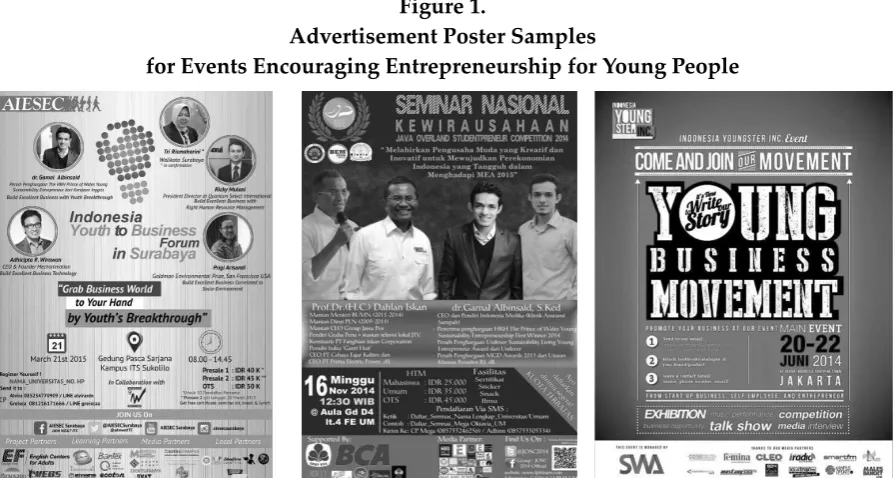
professional. The magazine, in 2014, held an event named Young Business Movement
2014 in Jakarta which showcased three
business categories of young entrepreneurs:
entrepreneurship, start-up, and self-employed
diiculties in clearly understanding the roles
and functions they should establish when
deciding to become an entrepreneur. There is also the possibility that these youngsters have
yet to clearly understand their presence in that situation as a symbol of the transitional process within the development of human life (Minza,
2014), as a generation symbol (a periodical context and condition of historical construct
in the relation of the social-economic-political situations) (Sutopo, 2014), and also unavoidably
as a part of the various other generations facing
the rapid, immense, and subtle mass cultural
penetration occurring through various legal speciications, which have instead symbolically caused transition and generation boundaries to become disorientating to the youngsters, particularly those living in cities and are difused in mass society, because of their acquiring new
status of membership within a subculture
(Hodkinson, 2007: 4) and their increasingly shedding of their youth status from their
cultural identity (Macionis, 2008: 71). Hence, the development of such entrepreneurship
trend makes it more diicult to understand the Indonesia Youth to Business Forum in
Surabaya held by the ITS campus in 2015, the National Seminar on Entrepreneurship: Java Overland Studentpreneur Competition
2014 held in Malang State University, and the
National Seminar on Entrepreneurship and
Independent Youth 2016: Efective Strategy to Success at a Young Age in the Era of the ASEAN Economic Community held at the Semarang National University. Young businesspeople, young entrepreneurs, young professionals, young motivators, and government figures were invited to present as key sources during
those events.
These entrepreneurship events are
merely following the popular trend prevalent
in the wider community, as well as a result
of their mutual concern in facing threats of
unemployment and labor competition to
youngsters who are currently pursuing their undergraduate degree. The concern over their employment status upon graduation and their apprehension as a generation expected
to mature and become independent may
surely lead these young people to experience
Figure 1.
Advertisement Poster Samples
for Events Encouraging Entrepreneurship for Young People
Source: http://wartaagro.com/foto_berita/92indonesia-youth.jpg, http://media.halomalang.com/
media/2014/Events/10/31/B08kLB3CMAA5Jzf.jpg,
the actual phenomenon of entrepreneurship
among young people. They are also confronted with unpredictable conditions as a job seeker or a future entrepreneur. Becoming an employee
seems to be the most rational choice, but
they should also anticipate on becoming an entrepreneur as the risk of not securing
employment increases and the opportunities in the informal sector become more available. Even
so, the choice of becoming an entrepreneur,
which may commonly be undertaken by
youngsters having business experiences and family background in trade and business,
remains to imbue a sense of unpredictability in the level of success that can be accomplished (Viinikainen et al. 2016).
In summary, the conditions faced by
youngsters today compel them to adjust their
intent and desire to very limited options
that are restricted by an existing situation which agrees to market interests organized
by dominant and collective actors (for more detailed elaboration on formulation of interests
see Swedberg, 2005). However, this article
does not discuss such particular condition,
it instead focuses on how young people respond to this situation. This study atempts to initiate a conceptual framework regarding how youngsters respond to this situation and make the decision of taking on the identity as entrepreneurs. Giddens (1991) in Jenkins (2008) explains that identity formation is undertaken by puting emphasis on one’s personal life, that is one’s action and inluence in forming their
self-identity which provides the possibility
of understanding themselves in terms of self-control and planning their future self, namely as a young entrepreneur.
Methods
This study is a literature research utilizing qualitative methodology. We examined that the
concepts of youth and entrepreneur identity have various interrelated definitions and that they are an initial part of the conceptual
framework which will be developed through
various qualitative studies (Neumann, 2013: 209-210). We consider various documents
such as journal articles that discuss concept
developments or research results, as well as
interviews coverage, speeches, and lectures
collected from YouTube, as required data which
were subsequently examined to contribute in establishing an initial framework for developing a conceptual deinition.
The respondents in the interviews
coverage, who also have their speeches and lectures on YouTube, are Sandiaga Uno, Nadiem Makariem, Kevin Mintaraga, Budi
Susilo Setiawan, and Haidhar Hibatullah
Wurjanto. Sandiaga Uno name is taken because he is the most successful and most recognized young entrepreneur in Indonesia. Total time frame of analysis of the Sandiaga Uno speeches
and lectures in Youtube is 2:50:23 hours.
Nadiem Makariem is the founder of Gojek,
a start-up unicorn in Indonesia. Total time frame of analysis of the Nadiem Makariem interview and lecture in Youtube is 1:34:11
hours. The name Kevin Mintaraga is found at YouTube when searching a successful young entrepreneur in building a start-up unicorn and selling it to other enterprise to get huge proit in order to start a new high innovation
start-up. Total time frame of analysis of the
Kevin Mintaraga interviews on Youtube is
48:30 minutes. Budi Susilo Setiawan and
Haidhar Hibatullah Wurjanto are an alumnus
of a university in Indonesia who have tried to
build business organization since they were in college and now come as successful young entrepreneurs. There were many examples of young entrepreneurs compare to Budi and Haidhar in business interview coverage on YouTube, but only both of them gave the
information which is adequate to our scope and focus of research. Total time frame of analysis of the Budi Susilo Setiawan interview on Youtube is 35:32 minutes and of the Haidhar Hibatullah
The data collected from YouTube is
meant to enhance available data pertaining to empirical conditions of young entrepreneurs
in Indonesia, in which it was acquired from
a number of seasoned young entrepreneurs (Sandiaga Uno) and start-up entrepreneurs.
These data are deemed necessary based on
several considerations. Firstly, upon analysis of
various literature, it is observed that researchers on entrepreneurship constantly develop and are very dynamic, which is similar to the personal character of entrepreneurs and the
complexities of entrepreneurship, whereas
the concept of youth is underdeveloped in
the subculture category, thereby requiring direct explanations from individuals who are competent and experienced in this concept. Secondly, the deinition of entrepreneur and matters pertaining to it differs throughout every social group as each depends on their own language (McKenzie, 2009) (for instance, the expectations and objectives of entrepreneurship, and the emphasis on speciic
values and attitudes to accomplish those
expectations and objectives; and the measure
of success and failure as an entrepreneur may
also difer). Lastly, the various data obtained from assorted groups of people become a consideration in developing a conceptual framework of youngsters and entrepreneur
identity into a dynamic conceptual framework
on the identity of young entrepreneur – wherein
literature on dynamic entrepreneurship conceptual framework remains very limited
(Nassif, Ghobril, da & Silva, 2010).
Results and Discussion
Conceptualizing Entrepreneur Identity
William B. Gartner, in his 1988 article titled “Who is an entrepreneur is the wrong question” concluded that there is no signiicant agreement on who an entrepreneur is (Ruef,
2010: 7). Whereas, in order understand identity, it is essential to question who’s who (for without
doing so it will be difficult to understand
what’s what) ( Jenkins, 2008). Hence, we
need to initially observe the extent of the scope concerning entrepreneurship based on limitations set by existing literature.
Gartner (1988), emphasized the
implication his research has for subsequent studies, wherein research on entrepreneurship should be oriented toward actions conducted by
entrepreneurs in establishing and developing organizations. He further elaborated that
the most important point of study concerns what skills entrepreneurs have and employ to accomplish these actions and where they can
acquire these skills (Ruef, 2010: 7).
Howard E. Aldrich (2001) in Saade (2013) is of the same opinion that the study on entrepreneurship pertains to the
formation of new organization, in which
he also provided several weaknesses on
the business growth approach, innovation
approach, and opportunity identification approach. Entrepreneurship concerns nascent
entrepreneur which is deined as individuals initiating signiicant activities with the intent of accomplishing a business start-up, wherein the activity conducted are gestation activity for
business development.
D u r i n g t h e g e s t a t i o n p e r i o d ,
entrepreneurs remain uncertain (Holm, Nee,
& Opper, 2011) in formulating opportunities and acquiring resources, and are, thereby,
in need of a business plan able to serve as a
complete strategy in establishing a new business organization (Samuelsson & Davidsson, 2009; Bygrave & Zacharakis, 2010: 56). The business
plan comprises of several parts which should be
fulilled by the entrepreneur, namely: analysis
on industry, consumers, and competitors;
company and product description; marketing
plan; operational plan; development plan; and
identiication of plausible risks; source of fund and its use; and financial report projection (Bygrave & Zacharakis, 2010: 242-256).
To this point, it can be understood that entrepreneurs are people who undertake a
set of strategic and organized actions through systematic business planning in order to develop a business organization, and they are
individuals able to properly formulate their
business opportunities and strategic actions for the sake of acquiring necessary resources. However, this deinition has yet to provide an understanding that entrepreneurship is an
identity. The entrepreneur’s identity developed here remains very narrow and has not touched
upon its sociological aspect.
In the distant past, Weber defined
entrepreneur’s identity as those possessing the spirit of capitalism formed through group loyalty of a Protestant religious sect in ascetic rationalism (a person’s integrity of not commiting moral violations is acknowledged through baptism (charisma and emphasis on
charisma) and he obtains unlimited trust from the entire community wherein the consequently
emerging ethic is that he would donate several
sums of his money back to the Church for the sake of his sect) and those driven to induce
changes in the conduct of entrepreneurs in
businesses, from a lenient traditional form into
a more modern one illed with logical reasoning of intense competition in order to generate
money/profit (Ghosh, 2014: 25-26, 351-354).
In short, entrepreneurs are those who have
been aforded with God’s blessings apparent through the proitability of their ventures and
their life prosperity.
The deinition speciied in the work of
Weber, when conceptualized as an identity by
using the identity concept strategic scope of Jenkins (2008: 46), produces an understanding
on entrepreneur identity, i.e. the result of constant dialectic between an individual and one’s interaction space with its collective domain
through an order consisting of a network of
people with positions and routine practices bounded by “repertoires of intentionality” to define an individual as an entrepreneur with certain criteria in order to acquire and
utilize resources and be identiied from the organization of said resources, to accomplish the business goals, and ultimately to generate classification of experiences in interactions
between entrepreneurs (as individual or
collective) and other agents in the population.
However, Weber’s formulation is limited to a collection of “moral-capitalism” considerations, wherein the modern order he aimed to achieve
did not receive proper atention, making the classiication of entrepreneur to be unfeasible
as the new entrepreneur identity is merely
constrained to internal deinition (observing similarities and diferences), and has yet to be established externally through individual practices that build relations with other agents. Swedberg (2009: 20-21) found a number
of substantial points in the work of Schumpeter,
in which capitalism do not indeed atempt to create a new social order (proit and ownership have insignificant impact and even create
unemployment), hence the abundance of entrepreneurs would lead the system of capitalism
to be in a transitional state. Swedberg provided
a collection of “competition-accumulation” considerations, wherein entrepreneurs would
due to business rivalry of accumulating capital.
There is more concept development observed
here as a classiication of capitalist entrepreneur has been given: capitalists with few innovations
(traditional entrepreneurs) in contrast to those with numerous innovations (dynamic entrepreneurs).
The lack of this classiication is that it is limited to interactions among entrepreneurs (it does
not elaborate on entrepreneur identity based
on their interaction with agents other than the
entrepreneurs themselves within the population).
Upon observation of the entrepreneur
behavior model presented by Carol Moore (1989),
it is understood that a new entrepreneur will grow by undergoing a social and personal character development process through a triggering event (Bygrave & Zacharakis, 2010: 50, Haten, 2011:
29). This triggering event occurs in relation
to one’s personal experience in their activities (experience in taking risks, dissatisfaction or loss of employment, formal education, age and gender identiication, and personal commitment) and collective domains (social networks, groups/
teams, parents, family, and role models) which will concurrently determine the focus of their
attention in implementing innovations and strategies for gestation activities. Entrepreneur
identity in this model is very much determined by
a collection of “triggering event-entrepreneurship
implementation” considerations, hence this
deinition is more developed and has broadened
the formulation of entrepreneur identity provided
by Swedberg (2009). Entrepreneur identity
becomes more distinct as entrepreneurship implementation is found to have three forms:
establishing and selling company/business (business founder), maintaining company/ business (manager), and developing company/ business (leadership entrepreneur) (Bygrave &
Zacharakis, 2010: 547).
Entrepreneurship implementation
to business founder entails: seeking new ideas; starting a venture; motivated by opportunities; developing and implementing a vision; establishing an organization around
the area of opportunity; preceding and inspiring others; creating changes within a
competitive environment. Entrepreneurship
implementation for manager involves: maintaining business operation; running
business; motivated by available resources;
planning, organizing, forming staff, and monitoring; increasing organization eiciency; monitoring of personnel; maintaining
consistency and predictability.
A business founder will decide whether
the business is to be sold for proit or not, and if
she were to sell it, the options available would
be for her to remain working in that company,
to establish a new company, or to seek another employment. A business founder will also consider whether she would continue to lead
the business or ind someone more experienced to maintain and organize the company which has become more complex and competitive,
so that she could focus on other matters of
importance such as product or technological
innovations. An entrepreneur may also have
the option of leading her company to grow exponentially or remain satisfied with the existing market share. This article, however,
merely focuses on the measures or actions
undertaken by entrepreneurs in maintaining
their businesses (ibid: 532-533).
To this point, it may be understood that the identity of entrepreneur is characterized by
four dimensions: triggering event, innovation, strategy of gestation activity (stipulated in
the business plan), and entrepreneurship implementation. Thereby, entrepreneurs are
individuals triggered by their experiences
in the collective and individual domain of activities who implement their focus of
entrepreneurship by utilizing their business planning and innovative capabilities.
Young Entrepreneurs in Indonesia within the Entrepreneur Identity Framework
using data obtained from empirical conditions
of youths and businesses in Indonesia that
are published via YouTube. Categorization of young age is taken from Republic of Indonesia
Law number 40 of 2009 about Youth, article 1, chapter 1 that describes youths are Indonesian citizen who enters an important period of
growth and development aged 16 (sixteen) to 30 (thirty) years. The young entrepreneurs examined as data sources were: Sandiaga Uno (PT Saratoga Investama Sedaya), Nadiem Kariem (founder of Go-Jek), Kevin Mintaraga
(CEO of Bridestory), Budi Susilo Setiawan
(founder of MT Farm), and Haidhar Hibatullah Wurjanto (Restaurant Momo Milk Barn).
Sandiaga Uno
At the age of 28, Sandiaga Uno had founded PT Saratoga Investama Sedaya, a limited liability company (PT). His triggering events among others were: loss of employment (he was terminated from his job and had diiculties in securing new employment), formal education (has a master degree from George Washington University with a GPA of 4.00), commitment (4
As mindset: kerja keras (work hard), cerdas (work smart), tuntas (work thoroughly), ikhlas (work
sincerely); working smart or intelligently means developing knowledge, utilizing technology and innovations; working thoroughly means all activities we undertake should have objectives and we must achieve those objectives; working
sincerely means that once we have truly put in
our maximum eforts, we should leave the rest in the hands of Allah the Gloriied and Exalted, and not forget to always give alms; expand
relations with people who are optimistic, positive
and successful because goals can be more easily achieved through collaborations; the more
optimistic, positive and successful people there
are to collaborate with, the higher the prestige and
reputation of the Indonesian nation will be), role
model (William Soeryadjaya owner of PT Astra
Honda Motor), team (collaborates with optimistic
individuals: Rosan Perkasa Roeslani and Edwin
Soeryadjaya (Grahadyarini, 2008). The signiicant innovation he implemented was changing the transactions of his inancial consultancy business,
in which he was paid in company shares instead of money. This innovation accelerated company
growth and altered the core of the business from inancial restructuring to company acquisition. There is no data available on the internet regarding his company’s business model, although he did
state that business plan is necessary for survival,
and the company should advance to experience scaling-up and subsequently create new business planning (Ayopreneur.com). Sandiaga Uno’s
entrepreneurship implementation is from that of an entrepreneur to an entrepreneur leader and he has even left several important positions of
companies under the Saratoga Group (Indrastisi, 2015), including the first company that he acquisitioned: PT Adaro Positive Energy Tbk.
Nadiem Makarim
Nadiem Makarim founded PT Go-Jek Indonesia at the age of 27. The triggering events were: experiences in taking risks (failed 3 times
in start-upbusinesses without giving up), work
experience (he was First Managing Director
at Zalora and obtained practical lessons about online business and was positioned as
Chief Innovation Officer at Kartuku where he gained experience regarding payments),
commitment (problems in Indonesia are seen
as opportunities, the goal of business is to provide welfare for others, and developing
business to create leaders in Indonesia), team
(along with a friend bearing the same vision
Alamanda Shantika Santosa who at the time
was the Vice President of Technology for
Go-Jek), parents (his father is Nono Anwar Makarim who used to be a member of the KPK
(Corruption Eradication Commission) ethics
commitee, and he is always reminded by his
parents that he should contribute to Indonesia).
public transport company, designing spinof applications for delivery services—Go-Ride, Car, Food, Mart, Send, Go-Box, Go-Pulsa, Go-Massage, and others—that
are in high demand by urban communities (this impacted on lowering selling prices and keeping consumer’s cost at a minimum in obtaining various provisions of services), changing conventional organization culture in terms of working hours and decision making (there is no strict regulation on working hours and leaves, and junior managers are even authorized to make decisions). Go-Jek’s model/ business plan: as a customer based technology start-up, its business traction (business progress and momentum for growth) is determined by
the number of users and transactions, and in
order to maintain this figure, Go-Jek has 5
work principles to ensure the company keeps
innovating: be fearless (courage), customer obsession, zero ego, number/data driven, and
inspire others. The current entrepreneurship implementation of Nadiem Makarim is to
continue being the CEO of Go-Jek due to his commitment of constantly creating young
Indonesian leaders impervious to failures.
Kevin Mintaraga
Kevin is known as the founder of the internet marketing agency called Magnivate at the young age of 24, and he is now the CEO of Bridestory. The triggering events for him becoming an entrepreneurs among others were: parents (his life spent playing video games while pursuing studies in Australia had to end
due to his parents illness and he was forced
to work hard since), work experience (his experience as an account executive at a graphic design studio had led him to meet many people
and broadened his relations), commitment (he
is commited to internet based business as it is a constantly developing venture, he listens to numerous experiences from people intending to open business opportunities, he has a high level of integrity in order to maintain trust of
clients and users), team (he runs the business
while some of his friends manage the projects, design the website, and are experts in internet technology), age identification (being at a young age and unmarried provides him with no sense of fear in failing since he is yet to bear any signiicant responsibility). The innovations launched by Kevin and his team continuously follow technological advancements which
provide added value to consumers and reduce costs, and to develop this they have recruited
talented individuals highly determined to apply their outstanding capabilities. As the
CEO of Bridestory, he conducted a market
research and found that the annual expenditure spent by Indonesians for weddings almost reached US$4 million. He uses the Lead Generation business model to develop a
website in the form of a marketplace for items
relating to wedding and its preparations. He gathered various service providers and collaborated with them through his website, wherein his proit is secured when vendors begin to subscribe with payment. He explained
that Bridestory is a start-up with a business
appeal in higher proitability, which sees the potential of growth and scaling-up, because the wedding business relates to honeymoon businesses and housing/property businesses. Kevin’s entrepreneurship implementation is
that he prefers to be a business founder, so that once the company has developed he prefers to
sell them to a company beter experienced at managing big companies, which was his exact decision for his former company, Magnivate,
that he had sold to WPP London.
Budi Susilo Setiawan
Budi Susilo Setiawan is the founder of
Mitra Tani Farm (MT Farm) in 2004 at the age of 22. His triggering events, among others, are: formal education (a graduate of the Department of Animal Husbandry, IPB (Bogor Institute of Agriculture), in which his venture was initiated
graduating), team (he worked along with his college friends Bahrudin, M. Afnan, Amrul L, Budi SS, Sucahyo, Faisal), and commitment (Islam, his religion, advised its followers to be productive and engage in business ventures, and Indonesia’s agrarian characteristics may lead Indonesians to follow the examples of religious messengers and prophets who had managed livestock, this may have encouraged him to be productive in managing livestock/
animal husbandry). His innovations are quite
simple, that is through motivational donations of providing assistance to breeders in Ciampea, Bogor who were in need of materials, not only by directly providing the needed materials, but also by encouraging them to engage in eforts of goat and sheep fatening in order to produce proit enabling them to procure those materials
monthly. His business model and plan is the
core-plasma scheme, wherein MT Farm serves as the core providing market regulation, market channels, and supporting systems— such as standard operating procedures—for
breeders who carry them out. Such core-plasma
business model is able to assist in fulilling the markets excessively high demand for goats
and sheep (for daily consumption and the
religious sacrifice of livestock called aqiqah
and qurban), and it also helps create eiciency
in systems relating to monitoring, investment, and land area needed for producing large
livestock supplies. Budi Susilo Setiawan’s entrepreneurship implementation is that he
continues to be involved in scaling-up this business venture as there remains a huge gap between demand and supply of goats and sheep. Hence, MT Farm initiated in developing
the sale of livestock plots to investors interested
in pursuing this business sector.
Haidhar Hibatullah Wurjanto
At the age of 25 in 2010, Haidhar Wurjanto
established his venture, that he had done so
multiple times since high school, in the form
of a restaurant called Momo Milk Barn with a
current number of 60 employees. His triggering events, among others, are: role model (Haidhar
considers his friend’s father as the person he
looks up to during high school, his role model was at the time an entrepreneur living in an elite housing compound in Bogor who owned a luxurious residence and was often seen at home spending ample quality time with his family.
This was a stark contrast to his life, wherein
his father, who has a doctoral degree, found
it difficult to provide quality time with the
family and their house was not as grand as his
friend’s. He subsequently learned and realized
that becoming an entrepreneur provides more
financial freedom and unrestricted time),
experiences in taking risks (encouraged by his role model, he started his irst business at the age of 17 by venturing to cater Japanese
cuisine, he has as of current failed 8 times in his business ventures), commitment (since
his initial business venture, he enjoyed being an entrepreneur and had found his great calling, he is committed not to work as an
employee and to create a business which can provide employment for many people instead, he also chose the hospitality sector
because enjoys making customers happy), formal education (as a graduate from the Department of Management, IPB, he continues to seek knowledge by reading books and he never stops finding innovations), and group (he constantly encourages the spirit of entrepreneurship through his relations in the
business community). Innovation is his most substantial factor as the location of his business
is in the city of Bogor which has a highly
competitive environment for the restaurant business. He must, therefore, continuously seek popular concepts of service provisions
as well as food and beverage products, as an example, he had created KitKat Matcha
Tea which was a top sales product for two months. Haidhar employs the canvas business
2014). His entrepreneurship implementation
is that he continues to manage his company and minimize existing business obstacles such
as incomplete business permit, recruitment
of quality employee, and also preparing
the development of dairy cattle and milk
processing businesses.
Base of Action Identity of Young Entrepreneurs
The ive young entrepreneurs described
above have four dimensions of entrepreneur
identity in their journey of establishing to developing their respective business. The description not only explained who these young entrepreneurs are, but also what
they have done to clearly portray who they are. The actions they have conducted can
be simpliied into three identities: 1) young
entrepreneurs are individuals who are aware
of the various life events they experienced
personally and collectively, and utilize them as a source to develop their self-potential as an entrepreneur and to initiate a commitment
of accomplishing their dreams; 2) young
entrepreneurs are individuals who are aware
that their commitment of accomplishing their dreams relates to change towards beter social
welfare, hence they continuously innovate and create business models and plans when they establish, maintain, and develop their
businesses; 3) young entrepreneurs are
individuals who are aware that their businesses
must have the potential to grow and develop,
and this consequently leads to them always
maintaining the trust of their users, clients, and investors, as well as constantly increasing their business appeal. The three speciications above are the identities that young entrepreneurs in
Indonesia base their actions on.
An interesting issue is observed in this discussion, namely the emphasis given by young entrepreneurs concerning their intent of changing the human condition to becoming more prosperous. This raises a significant question in sociology, how are entrepreneurs
while competing against each other able to
create a better condition of prosperity and welfare? Particularly, since competition is
aimed at achieving market domination for the sake of accumulating proit and other capital, leading to entrepreneurs being constantly illustrated as a very individualistic and egotistic group. Nevertheless, this assumption does not deny the possibility that nearly all the young
entrepreneurs above has an ideal condition of human welfare they intend to achieve (perhaps
the most irrelevant in this mater are Kevin and Haidhar). Sandiaga wants this nation to
be full of people who can easily collaborate in
accomplishing good objectives, Nadiem wants
this nation to bear leadership capacity, and Budi
wants people to always participate in managing agriculture and livestock potentialities available in rural areas as Indonesia is an agrarian
nation. In this aspect, the three identities
serving as the basis for their actions may be
seen as the entrepreneurs’ social movement
aimed at improving social welfare. Therefore, it is necessary to ind the synthesis of young entrepreneur social movement through a diferent means.
S o c i a l M o ve m e n t I d e n t i t y o f Yo u n g Entrepreneurs
The construct of conceptual framework
on the identities young entrepreneurs base their
actions on may even lead to various syntheses
of action with difering phases and situations.
The three identities mentioned in the previous section are interconnected. Identity 1 and 2 relate to the situation of initial social capital and
network utilization in establishing a business organization with an agreed vision of change
and is clear in the founders’ division of tasks,
as there may still be people who are resistant
and dislike business expansion which changes the strategic standing of other business groups, this may be considered as the strategic phase.
Identity 1 and 3 relate to the use of both new and initial social capital and networks so that
trust in the business organization aforded by existing social networks becomes stronger, and organizational performance in achieving the dream of improving human welfare can
be easily undertaken with proper control over
various prevailing obstacles, this phase may be regarded as the control phase.
Bjerke (2010: 104) has presented a concept regarding the type of entrepreneurship
situation found in the Indonesian community, namely the business situations (in markets), common situations (in institutions), and social situations (in public places). Business situations or market-based entrepreneurship contains
initial actions of entrepreneurs relating to knowledge on social capital and networks (Bjerke, 2010; Lippman, Davis & Aldrich, 2005 in Wiroto, 2016: 203). Network and networking
are substantial instruments of entrepreneurship
with significant roles in the establishment, development, and growth of small enterprises (Shaw & Conway, 2000 in Bjerke, 2010). The
initiation phase occurs in business situations wherein a new entrepreneur optimizes all her
network and networking potential to carry out a number of innovations aimed at surviving
market competition and business situations. What is referred to as common situations are a more collective form of entrepreneurship
focused on more extensive actions and outcomes as a response to changes exemplifying the global age. The strategic phase is included
in this situation, wherein entrepreneurs
prepare the foundation for building a strong, socially inclusive economy within the globally
interconnected world (De Bruin, 2003 in
Bjerke, 2010: 107). The strategic phase occurs
due to the formation of an entrepreneur collective based on their desire to help improve
entrepreneurship growth in their area of operation through several means, such as by identifying problems which can be turned into opportunities for gaining proit and creating business organization through private public
partnership and innovations that will be
used to change opportunities into businesses. Additionally, the strategic phase results in an
entrepreneurship community as the activities of both the public and private sectors have
raised and promoted their region to be more globally connected to other regions which also
enhance their economic activities worldwide
(Bjerke, 2010: 114-116).
There is a difference in the definition of social situations and common situations. Common situations are those in which public entrepreneurship seeks what has been lost in the local community, namely the quality of
social interaction or sociality that has begun to wane due to the marginalization of its
roles. Meanwhile, social situations are those in which entrepreneurship activities occur due to
people being aware of existing opportunities
to fulfill needs that remain unmet that the
welfare system may or will never fulill, and social situations collectively gather necessary resources (generally are the volunteers, money,
and land and property) then utilize them
to make changes (Thomson, 2000: 238 in Bjerke, 2010: 111). Bjerke, however, gave the impression of puting social entrepreneurship
after public entrepreneurship, as he is of the
opinion that social entrepreneurship is diicult
and can only be undertaken by individuals
having extraordinary capabilities. If we observe the deinition of the third phase or the control phase, then there are increasingly more entrepreneurs involved in the strategic phase
or public/commons entrepreneurship, which
changes for better welfare and prosperity.
Thus, they will have the capacity to control situations which may lead to the decrease of public entrepreneurship quality as well as control situations which may open and pave
the way to resolve prevailing social issues, such
as poverty.
In this section, it is concluded that
there are three identities relating to young
entrepreneurs’ social movement, namely:
initiation phase, strategic phase, and control phase. Out of the ive young entrepreneurs
discussed above, it may be understood that the identity of their movement had only reached
the initiation phase, wherein Sandiaga, Nadiem,
and Budi had only made initial commitment
for stepping into the strategic phase, and no concept is yet to be observed regarding their intent of reaching the control phase.
The social movement identity of these
young entrepreneurs provides a substantial
contribution to the concept of social movement
in general. Mario Diani in The Wiley-Blackwell Encyclopedia of Social and Political Movements
(Snow et al., 2013) notes that Charles Tilly,
in 1978, had provided an explanation that collective action can no longer be achieved by merely being dependent upon particular social character of a population pertaining to prevailing inequality and discrimination at
the macro structure level. Collective action is restricted because it does not take into
consideration existing social relations and social
representations found in the various social
categories (class, trade, gender, nationality, religion, and others), and thus, social category and social networks (category and networks
or catnet) become an important causal factor of collective action. Diani subsequently posed
a signiicant question, why is social character in certain categories more apparent than
others, is this caused by the dependence
on entrepreneurial dissimilarities (on ields of social category) in terms of adequate
resources, or unequal opportunity provided
by the government institutional management system in encouraging collaboration among organizations? Mario Diani’s elaboration is very clear that young entrepreneurs’ social movement identity will arrive at the strategic phase because the government does not truly desire to manage entrepreneurial resources and
create collective action of entrepreneurs which
provides beneits to the public, although it is obvious that the government greatly requires positive growth in the entrepreneurship sector. Regarding the social movement identity of young entrepreneurs at the control phase, a contextual explanation from the concept
of social movement entrepreneur has been provided by John McCharty and Mayer Zald
in 1977 (Suzzane Staggenborg in Snow et al., 2013). Staggenborg notes that McCharty and Zald explained that the modern social
movement has become more professional, as
characterized by full-time leadership, a large
amount of recorded membership, and reliance on constituents who are conscious and do not
intend to gain direct beneit from the success of accomplishing its goals. This movement becomes organized by issue entrepreneurs and furthermore, Gerhards and Rucht (1992) explain that movement entrepreneurs would frame the issue in a way that would atract followers and, they must link the atention of the
diverse participants present to form a coalition
which extends to various organizations and movements (Staggenborg in Snow et al., 2013). This signiies that the problems entrepreneurs encounter at the strategic phase will drive them to be involved in a bigger issue in order to create social changes and actualize social welfare, so that a coalition among them will
be established and will subsequently provide
proper conditions for entrepreneurship growth.
Conclusion
The attempt of finding a conceptual framework in forming the identity of young
answer that young entrepreneurs have four
dimensions of status identity, three identities
serving as basis of action, and three identities
of movement. Consequently, we would like to invite all social scholars, particularly those in
the sociology discipline, to utilize and improve this framework whilst conducting their research
on entrepreneurship in Indonesia.
Some sociological studies which need to
be carried out and may utilize the conceptual
framework of young entrepreneur identity, in our opinion, among others, are: how do young entrepreneurs select their team/group in establishing a business, distributing work and managing task coordination in their business organizations? What is the inluence
of social networks on the development and
growth of business organizations? What are the experiences of young entrepreneurs in implementing self commitment when they initially established their business organization, and when the business started to grow and develop? What is the inluence of innovations to the continuity of young entrepreneurs’ businesses? How do young entrepreneurs adapt to situations that may be disadvantageous to the company? How do young entrepreneurs
keep their focus and remain calm not to hastily
undertake business growth and expansion? What factors can instill in young entrepreneurs the conidence of engaging in collaboration with the public sector? How does the government perceive the potential of young entrepreneur’s
involvement in the development of their
respective region? How does the government actively participate in resolving several issues concerning young entrepreneurs’ activities rejected by the community? How does the government urge young entrepreneurs to develop a positive atitude of entrepreneurship
in their institution and the whole community? There are, undoubtedly, many more
research questions to ill the list in the previous passage, the issues above, however, cover basic problems that are as of current insuiciently
researched. We are certain that more sociological research on entrepreneurship will encourage more optimism and scientiic entrepreneurial
attitude in the community, particularly for
college students deciding to become young entrepreneurs or young employees.
Acknowledgement
This paper is based upon work supported
by HSBC Indonesia Research Award 2017 (HIRA 2017). Any opinions, indings, and conclusions or recommendations expressed in
this paper are those of the author(s) and do
not necessarily relect the views of PT Bank
HSBC Indonesia.
References
Aidin, S. (2015). New Venture Creation: Controversial Perspectives and Theories.
Economic Analysis, 48(3-4), 101-109.
Ayopreneur. (2014). Sandiaga Uno tentang Cara Beralih dari Fase Survival ke Scaling Up. Retreived from http://www.ayopreneur. com/sandiaga-s-uno/sandiaga-uno- tentang-cara-beralih-dari-fase-survival-ke-scaling-up.
Bygrave, W. & Zacharakis, A. (2010).
Entrepreneurship. USA: Wiley.
Bjerke, B. (2010). Entrepreneurship, Space and Place. In F. Bill, B. Bjerke, & A. W. Johansson
(Eds.), (De) Mobilizing Entrepreneurship Discourse: Exploring Entrepreneurial Thinking
and Action. Cheltenham: Edward Elgar.
Bygrave, W. & Zacharakis, A. (2010).
Entrepreneurship. USA: Wiley.
DailySocial TV. (2015). DScussion #13: Interview with CEO, Co-Founder Bridestory Kevin
Mintaraga [Video]. Retrieved from htps://
www.youtube.com/watch?v=nUum1-DxqSo.
DailySocial TV. (2015). DScussion #14: Interview with CEO, Co-Founder Bridestory Kevin
Mintaraga (Part II). [Video]. Retrieved
f r o m h t t p s : / / w w w . y o u t u b e . c o m /
DailySocial TV. (2015). DScussion #15: Interview with CEO, Co-Founder Bridestory Kevin
Mintaraga (Part III). [Video]. Retrieved
f r o m h t t p s : / / w w w . y o u t u b e . c o m /
watch?v=KpiuNXka-9M.
Diani, M. (2013). Catnets. In D. A. Snow, D. t.
Porta, B. Klandermans, & D. McAdam. The Wiley-Blackwell Encyclopedia of Social and
Political Movements. Malden, MA: Wiley.
doi: 10.1002/9780470674871.wbespm021
Ghaffari, M. A. (2014). Pengembangan Model Bisnis Momo Milk (Studi Kasus Kafe Momo
Milk Bogor) (Tesis Master). Bogor: Institut
Pertanian Bogor.
Ghosh, P. (2014). Max Weber and The Protestant
Ethic: Twin Histories. Oxford: Oxford
University Press.
Grahadyarini, L. (2008, September 4). Kebangkitan Hidup Sandiaga Uno. Kompas.
Retrieved from htp://megapolitan.kompas. com/read/2008/09/04/0124478/Kebangkitan. Hidup.Sandiaga.Uno
Haten, T. S. (2012). Small Business Management: E n t r e p r e n e u r s h i p a n d B e y o n d. USA:
Southwestern, Cengage Learning.
Hodkinson, P. (2007). Youth Cultures: A Critical
Outlines of Key Debates. In P. Hodkinson
& W. Deicke (Eds.), Youth Cultures: Scenes,
Subcultures, and Tribes. New York: Routledge.
Holm, H. J., Nee, V., & Opper, S. (2011).
Entrepreneurs Under Uncertainty: An
Economic Field Experiment (CSES Working
Paper No. 60). Retrieved from http:// www.economyandsociety.org/wp-content/
uploads/2013/08/wp60_HolmNeeOpper_
Uncertainty.pdf
Hubungan Alumni IPB. (2013). Budi Susilo
S. Pengusaha Sukses MT Farm. Retrieved
from http://hubunganalumni.ipb.ac.id/
budi-susilo-setiawan-pengusaha-sukses-mt-farm/
Indo Mixed. (2016). Nadiem Makarim –
CEO GO-JEK | Satu Indonesia. [Video].
Retrieved from htps://www.youtube.com/ watch?v=IcYjoxV6mvg.
Indrastisi, N. (2015, July 4). Sandiaga Uno Lepaskan 16 jabatan di Saratoga. Kompas.
Retrieved from http://bisniskeuangan.
kompas.com/read/2015/06/04/094317026/
Sandiaga.Uno.Lepaskan.16.jabatan. di.Saratoga
IPB Oicial. (2016). Haidhar Hibatullah Wurjanto.
[Video]. Retrieved from https://www.
youtube.com/watch?v=HBClsTBEliI.
Jenkins, R. (2008). Social Identity (Third Edition).
London: Routledge.
Kautonen, T., van Gelderen, M., & Fink, M. (2015). Robustness of Theory of Planned Behavior in Predicting Entrepreneurial
Intentions and Actions. Entrepreneurship
Theory and Practice, 39(3), 655-674. doi:
10.1111/etap.12056
Knudsen, T., & Swedberg, R. (2009). Capitalist entrepreneurship: Making proit through the unmaking of economic orders. Capitalism
and Society, 4(2). doi:10.2202/1932-0213.1057
Macionis, J. J. (2008). Sociology. New Jersey: Pearson Prentice Hall.
McKenzie, B. (2009). Investigation of the Dynamic of Entrepreneurial Change.
International Review of Business Research
Papers, 5(5), 365-372. Retrieved from htps://
www.bizresearchpapers.com/29.Brian.pdf
Minza, W. M. (2014). Masa Muda Sebagai Masa
Transisi. In M. N. Azca, D. S. Widhyarto
& O. R. Sutopo (Eds.), Buku Panduan Studi Kependudukan: Teori, Metodologi dan Isu-isu
Kontemporer (pp. 11-26). Yogyakarta: YouSure.
Nassif, V. M., Ghobril, A. N., & da Silva, N. S. (2010). Understanding the entrepreneurial
process: a dynamic approach. BAR-Brazilian
Administration Review, 7(2), 213-226.
doi:10.1590/s1807-76922010000200007 Neumann, W. L. (2014). Social Research Methods:
Qualitative and Quantitative Approaches.
Essex: Pearson Education Limited.
PKPU Human Initiative. (2014). Pintu Inspirasi
Episode 4 “Kisah Sukses Pengusaha Muda.
Rappler Indonesia. (2015). Sesi Inovasi Teknologi – Pertumbuhan Ekonomi, Nadiem Makarim CEO
Go-Jek. [Video]. Retrieved from htps://www.
youtube.com/watch?v=UNXXLKP9dkg. Ratomo, U. T.(Ed.). (2014, June 19). Semarak
Young Business Movement 2014.
Antaranews. Retrieved from htp://www.
antaranews.com/berita/439979/semarak-young-business-movement-2014.
Ruef, M. (2010). The Entrepreneurial Group: Social Identities, Relations, and Collective Action.
Princeton and Oxford: Princeton University
Press.
Rumah Jenggala. (2014). Membentuk Karakter
Juara oleh Sandiaga S. Uno. [Video].
Retrieved from htps://www.youtube.com/ watch?v=JX3si4H3sNg.
Saade, F. (2013). Towards Understanding Nascent Entrepreneurship: A Theory of Planned Behavior
Perspective (Master’s Thesis). Retrieved
from http://epub.lib.aalto.fi/en/ethesis/ pdf/13312/hse_ethesis_13312.pdf
Saefullah, A. (2016). Bincang Bisinis Nadiem Makarim CEO GOJEK Startup Unicorn Pertama
di Indonesia. [Video]. Retrieved from htps://
www.youtube.com/watch?v=pbStiaJUXZk.
Samuelsson, M., & Davidsson, P. (2008). Does venture opportunity variation matter?
Investigating systematic process diferences
between innovative and imitative new ventures. Small Business Economics, 33(2), 229-255. doi:10.1007/s11187-007-9093-7
Staggenborg, S. (2015). Entrepreneurs,
movement. In Snow, D., della Porta, D.,
Klandermans, B., & McAdam, D. The Wiley-
Blackwell Encyclopedia of Social and Political
Movements. doi: 10.1002/9781405198431.
wbespm083.
Sutopo, O. R. (2014). Perspektif Generasi dalam Kajian Kepemudaan. In M. N. Azca, D. S. Widhyarto & O. R. Sutopo (Eds.),
Buku Panduan Studi Kependudukan: Teori,
Metodologi dan Isu-isu Kontemporer (pp.
11-26). Yogyakarta: Yousure.
T h e C r a f t e r s . ( 2 0 1 7 ) . T h e C r a f t e r s 0 1
// Kevin Mintaraga. [Video]. Retrieved
f r o m h t t p s : / / w w w . y o u t u b e . c o m /
watch?v=LKK6HISHVng.
Vanguard Ace. (2011). Peluang Usaha Bagi
Wirausahawan Muda Sukses Indonesia.
[Video]. Retrieved from https://www. youtube.com/watch?v=pzEZK2bvjCs. Vanguard Ace. (2011). Sandiaga Salahuddin Uno -
Entrepreneurship Character Building. [Video].
Retrieved fromhtps://www.youtube.com/ watch?v=NnEK6nJy3Zw
Viinikainen, J., Heineck, G., Böckerman, P., Hintsanen, M., Raitakari, O., & Pehkonen,
J. (2016). Born Entrepreneur? Adolescents’ Personality Characteristics and Self-Employment
in Adulthood (IZA Discussion Paper No. 9805).
Retrieved from htp://ftp.iza.org/dp9805.pdf Wiroto, D. W. (2016). Kapital sosial dan
kepemimpinan dalam pengembangan
kompetensi usaha mikro dan kecil di era
MEA: Sebuah tinjauan konseptual ringkas. In M. Ilyas, R. Junaid, H. Asri (Eds.), Seminar Nasional 2016: Kesiapan Daerah Menghadapi
Masyarakat Ekonomi ASEAN (MEA) (pp.