The Study of Government’s Role for Welfaring Rubber Farmer
in The Globalization Vortex
Pahrudin HM
•1Abstract
Rubber is a type of plant that has been cultivated by the people of Indonesia for long a time. Until now, farmers have become the largest party to cultivate rubber in Indonesia (85.10%) and contribute greatly to the nation’s economy, but are still far from prosperous. Rubber products
produced by farmers are priced cheap so that they incomes are very small and create income
inequality. As an export commodity, rubber is highly dependent with overseas which determines the price. In this context, the government through the bureaucratic system serves to produce a series of innovative-solutive development program in order to keep the people from the negative impacts of globalization. This efort can be run by the government with adopting The New Public Service Paradigm as part of eforts to beter public services for the people. It is implementation in the form of domestic rubber needs priorities, bringing the industry to the center of rubber, training of rubber farmers, and improvement of transportation infrastructures.
Keywords:
rubber farmer; globalization; state role; New Public Service.
• Department of Political Science, Faculty of Social and Political Sciences, Jambi University.
Email: [email protected]
doi: 10.22146/jsp.30436
Introduction
The study of the existence of rubber becomes interesting topic because its
contribution to the Indonesian economy is quite
significant. Based on data from the Central
Bureau of Statistics (BPS) (2014), 2,623,425
million tons (83.20%) of total rubber production
(3.153.186 million tonnes) is destined for
exports and generated US$ 4,741,489 million used to finance development projects in
Indonesia. However, what is obtained by the
main manager, rubber farmers, is not directly
proportional to the contribution it provides.
This is because rubber farmers are still facing
a series of problems in the cultivation of this type of plant that has an impact on their life.
Historically, rubber is a type of plant that has been cultivated by the Indonesians since
a long time, i.e., in the time range of 1910-1911. Starting from an interest in the success
and profit of Dutch plantation companies,
although still a sideline business from the main
activities as a food crop farmer, such as rice and
vegetables (Padmo, 2004: 110).
Nationally, Indonesia has a total of 3,555,946 hectares of rubber plantations spread
throughout the country, mainly on the island of Sumatra and Kalimantan (BPS, 2014). A total of 3,026,020 Ha. (85.10%) of the total national
rubber are owned by the people/farmers, thus
certainly contributing greatly to the nation’s
economy as much as 2,623,425 million tons
Million tons) is earmarked for export and produces US$ 4,741,489 million. Rubber is also a type of plant that has long been cultivated by
people in Jambi Province.
Table 1.
Area of Rubber Plant in Indonesia (Ha.)
Year PR PBN PBS Amount Growth (%) 2013 3,026,020 247,068 282,858 3,555,946 1.42 2014 3,062,931 249,040 294,274 3,606,245 1.41 2015 3,098,861 251,033 306,163 3,656,057 1.38
Source: Statistics Indonesia Rubber BPS, 2014.
Note. :
PR : Smallholder
PBN : National Large Estates (PTPN) PBS : Big Private Plantation.
Table 2.
The Volume of Indonesian Rubber Export, 2012-2014
Year
Natural Rubber Growth
Volume (Ton)
Value
(000 US$) Volume(%) Value(%)
2012 2,444,438 7,861,378 - 4.35 - 33.16 2013 2,701,995 6,906,952 - 10.54 - 12.14 2014 2,623,425 4,741,489 - 2.91 - 31.35
Source: Statistics Indonesia Rubber BPS, 2014.
The amount of rubber contribution was not directly proportional to the condition of
rubber farmers as the main manager of national rubber production. Until now, rubber farmers
still face problems related to product quality
and low productivity, technology and simple marketing system.
The problem faced by rubber farmers
is the lack of government atention to rubber farmers in the cultivation of this plant. Although the government has given birth to various
policies, one of them is the Nucleus Estate
(PIR), but still has not been able to overcome the problems faced by farmers. According to Padmo (2004: 117), even though the PIR has been applied by the government, farmers still have problems with the inability to pay of
their credit, the sale of rubber materials out of the core, low quality and variety of bokar
and excessive rubber plantation exploitation. The oicial Plantation Revitalization Program
also fared the same. Implementation of this
program runs slowly, and this goal is diicult to achieve due to inhibiting factors that cannot be overcome (Rulyantie, 2011). The Rubber Rejuvenation Program issued by the Jambi Provincial Government in 2006 has not been
able to solve the problems faced by rubber farmers. This is because the policy does not
address the real problems facing rubber
farmers, namely: price issues.
The problems faced above have an
impact on the farming economy (Napitupulu,
2011; Sunarti, 2011; HM, 2014). As the main livelihoods, farmers rely heavily on the results obtained from rubber concessions. When the
results get beter, the farmers economy and their family will be beter, but when the sales
results are not satisfactory, the farmers life also
slumps. The economic downturn experienced
by farmers due to the unfavorable results of
rubber gains has had an impact on the welfare
of their lives. As a result, many of the necessities
of life, both clothing, shelves and food, that farmers cannot fulill, so that their lives farther
away from prosperity.
Various problems faced by rubber farmers above certainly does not appear without any cause. Especially faced with the
fact that farmers become the main manager of rubber in the country (85.10%) and produce division US$ 4,741,489 million for the country.
As one of Third World’s important resources
due to its signiicant role in the economy, rubber is of course inextricably linked to the impact of the global economic system, primarily because of its status as an export commodity. Thus, the existence of farmers as the main actors of rubber management is strongly inluenced by the existing policies at the global level. Based
on the perspective of the skeptical theory of
globalization, the problem faced by rubber
is because what happens in the local realm is
an implication of the workings of the global capital system. Thus, exploring the problems facing rubber farmers is a consequent impact
of capital penetration that controls natural
resources in the Third World through the role of its agents in the era of globalization. According
to the skeptical theorists (Petras and Veltmeyer,
2011, Gilpin and Gilpin, 2000, Amin, 2001), the
backwardness and powerlessness of the people
in the Third World is the impact of globalization which is nothing but a new manifestation of
imperialism.
Studies show the absence of government
policies that pro people make people’s lives in powerlessness and poverty amid the penetration
of global capitalism. This is as shown in Mitrović (2010) study about the conditions of post-socialist societies under the inluence of neoliberal development strategies and restoration of peripheral capitalism. Through
uncritical acceptance of the modernization
strategy of neoliberal dependence receive from the West, the compradore bourgeoisie
and political elite has contributed more to the process of destruction than creation. This
group brings a peripheral economic system in
Serbian society to the point that this country
and the Balkans generally enter into the circle of peripheral capitalism. Although their place
is separate from each other, they do the same
activity, which is exploiting the community. The study of Jati (2012) also highlights the economic imbalances in globalization.
Such inequality is particularly manifest in the phenomenon of poverty, income inequality, and increased debt for Third World countries. This implication indicates an unequal process of
globalization between an increasingly wealthy Forward Country and a poorer Third World
country. In another study, Jati (2013) said that
colonialism in the era of globalization itself is manifested in the control of large capital
that moves between nations and countries.
Under these circumstances, the Forward
Countries beneit from having a comparative advantage of technology and banking, while Third World countries rely only on extractive resource results. However, the exchange of
resources between the two actors is not in an
equal position. The Forward States themselves beneit from international trade regulations that allow them to have a veto in the low of trade.
The condition is in contrast to the Third World countries who are in a position to accept and have no Minimized State votes.
Still, in the same context, Napitupulu
(2011) states that smallholder rubber farmers
are identical with poverty for failing to improve their standard of living in Jambi. Rubber
farmers live in conditions that are far from
decent living standards, due to poor earnings
due to the result that its rubber business is not
qualiied and priced lower in the market. Same
condition as shown in Sunarti’s (2011) study
also stated that rubber is one of the main export
commodities in Jambi Province whose demand
is increasing. Amid the high volume of exports,
Jambi rubber farmers face various problems.
Rubber farming in is generally a conventional or traditional smallholder rubber farming
business because farmers have limited capital.
The income of farmers from rubber farming business ranges from IDR 320.000 - IDR 480,000
per month; the income is still below Minimum
Wage Standard (UMR) Bungo District (IDR. 716,000/month), although the area of land holding in this area is 3.82 Ha./family.
On the basis of it, this paper is intended
to analyze the existence of rubber farmers in the context of globalization and propose innovative solutions in an efort to overcome the problems faced by the main actors of rubber management so that life becomes beter. Tabir Ilir District Merangin Regency Jambi Province was chosen
as the location for this study because it is one of the main areas of rubber producers in Jambi
Province (HM, 2014). According to data from the Merangin District Plantation and Forestry
District is the largest in Merangin Regency, which is 15,787 hectares (12.01%) and is a
smallholder rubber (8,050 farmers). As with BPS (2014) data, Jambi Province has the third
largest rubber plantation area in Indonesia
(662,213 hectares), mostly of smallholder
rubber. Merangin Regency is the region with the largest rubber plantation area in Jambi Province, which is 130.948 Ha. (19.77%), or 131,413 Ha. according to the Merangin Regency Plantation and Forestry Oice.
Methods
T h i s a r t i c l e u s e d a q u a l i t a t i v e research method that provide opportunities for researchers to be able to do a detailed
description and interpretation in order to gain a holistic understanding (Marvasti, 2004: 7).
The type of this research is case study that an
approach to study, explain, or interpret a case in the context naturally without any intervention
from outside (Denzin and Lincoln, 2009:
300-301). Rubber farmers of Tabir Ilir, rubber businessmen, and Local Government of Jambi Province and Merangin Regency are subjects of this study. Data were collected through documents and archive footage, interviews,
direct observation, participant observation and other physical devices (Yin, 2004: 103-118). Data
analysis used reducing data, displaying data, and drawing conclusion (Miles and Huberman,
1992: 15-21).
Results and Discussion
Globalization DiscourseIn general, globalization is understood by Rizer (2006: 96) as a process of spreading global habits, the expansion of relationships across continents, the organization of social life on a global scale, and the growth of a common global consciousness. Meanwhile, according to Giddens (1990: 64), globalization
is the intensification of world relationships
that link the far-lung locality in such a way
that a number of social events are shaped by events that occur over miles and vice versa.
Thus it can be said that globalization is the integration of all aspects of human life, ranging
from economic, information, political systems to cultural aspects.
Globalization has been massively
enforced worldwide since 1980 and raises impact on the world community. On the one
hand, globalization has a positive impact on the efort to obtain a decent standard of living (Friedman, 2007; Bryan and Farrell, 1996). This is because globalization provides the
same competitive arena for each country to
take advantage of the opportunities provided
(Wolf, 2005).
On the contrary, globalization has also generated negative excesses around the world. According to Petras and Veltmeyer (2001), globalization is only enjoyed by the Developed
Countries, while the Third World countries only serve as spectators, even the victims
of the various negative excesses it causes. Globalization also marginalizes farmers in Third World countries because global trade rules make them increasingly marginalized,
even uprooted from the systems, professions, and way of life that has been done (Shiva, 2003).
According to Amin (2001), globalization is
a metamorphosis of the third Western occupation
of the Third World, having previously practiced
mercantilism and imperialism. Chakrabarty
(2000) says that globalization is nothing but
a manifestation of the European ambitions
of rebuilding its hegemony using a series of
historical imperialist practices in Third World
countries. In the same context, Murshed (2002) and Steger (2010) also state that globalization is an atempt by the West, especially the British,
in order to spread modernity and capitalism
throughout the world.
Globalization also raises the debate among experts about the role of the state or government in development. The integration
and information makes it easy for people to
interact and take advantage of opportunities without being constrained by state status
anywhere and anytime. As a result, the state’s
tertiary physical boundaries merge so that the government is considered to have litle role in
development (Winarno, 2005: 37).
The role issue played by the state has become one of the central themes in the debate
surrounding globalization (Winarno, 2005).
This is because as the party who handed over
the responsibility of state management, the government as the manifestation of the state should play an active role in overcoming the problems faced by the people. Globalization with all its impacts needs to get the atention of the government so that its positive excesses can be put to good use and the negative excesses
can be avoided by the people.
The debate over the role that the state or
government play in this development according to Giddens (2002: 7-8) led to two major groups, namely Radical groups on the one hand and Skeptical groups on the other. Generally, Radical groups are identiied as a collection
of social thinkers who support globalization because they regard it as a necessity and useful
in human life, while Skeptics are known as intellectuals who doubt the possibility, even
against its existence because of the various negative excesses it causes.
Ta b i r I l i r’ s R u b b e r F a r m e r s i n T h e Globalization Vortex
On the basis of a skeptical thesis that poses
it as a new form of colonization, globalization carries out its mission through its agents of
various actors spread across multiple levels,
ranging from global to local levels. Actors performing global mastering missions are played by rubber importing countries, while national actors are state/government and companies owning rubber processing factories, while locally-linked rubber-related agents are
played by local entrepreneurs, as illustrated in
the diagram below.
As mentioned earlier that rubber has
always had a signiicant role in human life and has a major impact on the economy. This is
understandable because the processed rubber
Diagram 1.
Tabir Ilir’s Rubber Farmer in the Globalization Vortex
products become one of the main raw materials of several industries, especially transportation equipment and household. On the basis of
such, some countries need rubber processing
products to meet the needs of industrial raw
materials that they try. Based on BPS data, USA,
Japan and China are the top three countries that need the supply of Indonesian rubber to meet the needs of the industry, then followed
by India, South Korea, Germany, and France (Rubber Statistics Indonesia, 2014).
According to BPS, 2,623,425 million tons (83.20%) of Indonesia’s total rubber production
in 2014 (3.153.186 million tonnes) is intended
for international markets or exported to the above countries (Rubber Statistics Indonesia,
2014). Based on a skeptical perspective of
globalization, rubber importing countries generated from Indonesia are globalizing agents of globalization. In an attempt to
control one of the main natural resources of
the Third World, these importing countries
do not directly do so. The penetration mission
carried out by the Indonesian rubber importing countries is done in the form of determining
the quality and price of the rubber market.
This method of concentration is run through
international commodity markets in the
Singapore Commodity Exchange (Sicom) and the Tokyo Commodity Exchange (Tocom).
Both of these commodity markets become the reference of quality and price of rubber at international level which then becomes a reference for rubber market price in the country
through Spot Market Palembang (Peppebti,
2015). Thus it can be seen that the price of rubber is determined by the price set in the international market which is then referred to
by the existing markets in the country. The high
price is of course intended for quality rubber
and good quality rubber products determined by the technology used to process it.
The globalization agent at the
international level then cooperates with the
Indonesian government and rubber factories.
The role of the Government of Indonesia is issuance of Standard Indonesia Rubber (SIR)
2000. It is the standard quality of Indonesian
rubber that has been dried and reined to sheets
with a predetermined size. On the one hand,
the government issued SIR 2000 that must be met by rubber producers (including farmers),
but on the other hand, the farmers are allowed
to perform simple rubber management. As a result, rubber farmers continue to struggle with
quality issues of production, productivity and
price over time. Rubber products that can be
produced by farmers only in the Bokar form
or also known as Latex. This type of rubber
product is the cheapest in the market because
it still contains high water content and high
levels of dirt. Quality Bokar like this is the
result of technology or precisely the ability
that is controlled by farmers related to the
management and processing of rubber that is still simple and obtained from generation to generation.
Another role of government is the ‘omnipotence’ of farmers managing their simple rubber. Despite being the largest
contributor to rubber concessions in Indonesia,
the government seems to be turning a blind eye to the conditions experienced by farmers in trying to rubber: Bokar quality, low productivity
and low prices and simple technology and marketing systems. Historically, there are actually several government policies related
to efforts to overcome the problems faced by farmers, namely: Plantation Core People
(PIR) and Plantation Revitalization Program at the national level and Rubber Rejuvenation Program issued by the Government of Jambi
Province. Another problem faced by rubber
farmers is the lack of government atention to
rubber farmers in the cultivation of this plant. In reality, however, these policies have failed to address the problems faced by farmers in
seeking rubber. Although the PIR has been implemented by the government, farmers still
loans, the sale of rubber materials (Bokar) out of the core, low quality of Bokar and variety
and excessive rubber plantation exploitation
(Padmo, 2004: 117). This is because PTP and
PIR, on the one hand, monopolize technology, management, political and financial legal support from the government, while on
the other hand, smallholder (and private) plantations are isolated from these facilities. Whereas the people’s plantations are located
in a place far from large plantations, cultivated with small capital, less extensive planting area and relatively simple technology.
The same is true with the next policy, namely the Plantation Revitalization Program that is oicially valid through Regulation of the Minister of Agriculture of the Republic of
Indonesia No. 33/Permentan/OT.140/7/2006 and
Regulation of the Minister of Finance No. RI. 117/PMK.06/2006 on Credit for Development of Plant-Based Energy and Plant Revitalization (KPEN-RP). This program is difficult to be expected as a solution to the problems faced by farmers. Implementation of this program runs slowly and this goal is diicult to achieve due to inhibiting factors that cannot be overcome (Rulyantie, 2011). The crucial problem faced in the implementation of this program is
the low coordination of related parties, both
government as executor and banking as a source of funding and quality of human
resources is still low.
The same thing happened with Rubber Rejuvenation Policy issued by Jambi Provincial Government which also failed to solve the
problems faced by rubber farmers, namely
quality, and price. This program also did not
touch the farmer of Tabir Ilir rubber in its implementation.
Another indication of ‘omission’ by the government is not to make an efective efort
to overcome the main problem faced by rubber
farmers, namely price issues. The low selling
price of rubber products that resulted in the
farmers geting a small and minimal advantage
of its activities to manage this commodity.
In an effort to overcome this problem, the
government only formed Badan Pengawas Perdagangan Berjangka Komoditi (Bappebti)/ Commodity Futures Trading Supervisory Agency under the Ministry of Trade of the Republic of Indonesia. As the name implies, Bappebti only serves as a traic controller of
various commodities, one of them rubber, without any authority to determine the price. The amount of price applied to one commodity, one of which is rubber, remains the domain of the international market, or in other words, the price of a commodity is left entirely to the
global market mechanism.
In this context, the amount of rubber price that should be used by all parties working on it is based on market decisions in Singapore Commodity Exchange (Sicom) and Tokyo Commodity Exchange (Tocom). The two
institutions that serve as the benchmark for world trade, mainly in Asia, are the
manifestations of global capitalism through the hands of the Forward Countries with a great interest in rubber. Bappebti publishes
commodity price information traded to trade services as well as plantation and forestry
services throughout Indonesia, including to the Merangin Regency Plantation and Forestry Oice.
Another role that the government, especially the local government, is not providing
facilities and infrastructure that are conducive
to supporting the management of rubber in Tabir Ilir. As it is known that the rubber gardens
cultivated by the farmers of Tabir Ilir are far from their settlements, even some of them
are located outside the Merangin Regency, in Bungo, Tebo and Sarolangun Regencies. Rubber products produced by Tabir Ilir farmers
which will be sold to Toke and must travel a long
distance on poor road conditions. Roads used
for transportation activities of these farmers’ rubber products are mostly in poor condition,
of the sections are already paved. Actually, the
local government is not paying any atention
to the condition of this road, but the quality of
the asphalt does not match with its designation.
As the main road used to transport rubber, the asphalt condition of the road is below standard because it is so thin that it is
easily damaged and resulted in the emergence of gaping holes. The condition of this road
makes rubber car transporters difficult to
operate and takes longer time. When it comes
to the rainy season, the streets become full of water and mud, while in the dry season, the main road to the rubber plantation is the main
source of air pollution due to the lying dust. Another globalization actor at the
national level is a corporation that owns a
rubber processing factory that houses or buys
the rubber produced by the farmers of Tabir
Ilir. It is this rubber processing factory that
buys and collects the rubber produced from
farmers known as Latex to be processed into rubber crumb type SIR 10, SIR 20 and SIR 20VK.
The types of rubber products produced by the factories are in accordance with the established
standard (SIR), i.e.,e the dirt content of no more than 0.10% (SIR 10) and 0.20% (SIR 20) and so forth according to the provisions set forth in SIR
2000 and the provisions of international rubber
trade held by processing plants (Napitupulu, 2011). After the rubber is processed according to the speciied speciications, then the processing
company sells it to meet the demand of the industry, especially tires, both national and international scale. Thus, it can be said that only the factory can process the rubber into a product
that can meet the required speciications, both in accordance with the SIR and the standards
traded on the international market.
These factories only process rubber
production of semi-inished farmers, which
produce and market the crumb rubber type
SIR 10, SIR 20 and SIR 20VK, to meet the
demand of the national and international tire
industry. Rubber-processed rubber factories
with various variants of this is a product that
is highly qualiied and needed by industries
that use rubber raw materials, such as tires and hoses. The quality of this product is produced because the factory has a variety of
equipment and processing machines are much beter and modern. In addition to catering to
domestic needs, manufactured rubber products
are mostly intended for export to various countries: USA, Japan, China, India, South Korea, Germany, and France (Rubber Statistics
Indonesia, 2014).
Like previous globalization agencies at
the national level, there is a similar indication
of ‘omission’ by the processing plant to the simple rubber farmers’ processing techniques.
This assumption arises because it turns out
the processing factory is still buying rubber
products produced by farmers, even at the
lowest level of quality though, of course with
a very low price too. This is done because
the processing plant has a special tool that
can sort the dirt in the rubber products of the farmers so that it becomes a product with
higher selling value. Thus, it can be said that the simple processing techniques of rubber farmers become the proit for the factory, or in a more critical expression that the condition is actually a proit for the factory, so it is worth
to continue to be preserved.
Based on data, there are some rubber
processing factories operating in Jambi Province and using rubber materials of Jambi, namely: PT Batanghari Tembesi, PT Jambi Waras I, PT Angkasa Raya, PT Hongtong, PT Remco, PTP
Nusantara VI, PT Aneka Bumi Pratama, PT
Jambi Waras II, PT Dasa Anugerah Sejati, PT Djambi Waras-Jujuhan, PT Anugerah Bungo Lestari, PT Lembah Karet (West Sumatra), PT Kirana Sapta (North Sumatra), PT Pantja Surya (North Sumatra), and PT Kirana Windu (South
Sumatra).
The local agen of globalization is local
entrepreneurs(toke) becomes a very signiicant
being mastered (rubber) as well as meeting
with the main producers (farmers). Positions like this make toke also share the sweet, biter
and biter experience experienced by farmers in
rubber cultivation, so it becomes a product that is needed many people. Based on data, there are ten toke that act as ‘globalization agent’ at
the local level in rubber management in Tabir Ilir. These ten local entrepreneurs are buying and collecting rubber produced by farmers in Tabir Ilir, in accordance with the management agreement they apply.
Although it consists of ten local
entrepreneurs, actually entrepreneurs who really affiliated directly with the rubber
processing plant consisting of only two Toke,
namely: A Sung and H. Yusuf. These two local
rubber entrepreneurs have direct access to
rubber processing factories, because they have suicient farmers’ equipment and processing
equipment. Other local entrepreneurs do not
deal directly with rubber processing factories, but their interactions are made through the
two Toke intermediaries above. These ten local entrepreneurs are directly related to the farmers
by buying and accommodating the rubber
of their products. Because different in the
relationship patern with the rubber processing plant, the proit earned each Toke in Tabir Ilir is also not the same. As a local entrepreneur
directly related to the rubber plant, the A Sung and H. Yusuf families certainly beneit more from the sale of rubber to the processing plant
than the other Toke associated with the factory
through these toke. As an illustration, if the rubber sold A Sung and H. Yusuf Family valued IDR. 10,000 per kilogram, the other rubber
Toke will be bought by both Toke at the highest
IDR. 7,000 per kilogram. The magnitude of this
price is then used as a reference by other toke
to buy rubbers produced by Ilir Tabir farmers. Therefore, the quality of rubber products
produced by farmers, in general, is below the standard as a reference, the farmers will get a price far below the prevailing prices in the
market.
Based on the data, Toke will divide the rubber products produced by farmers into two
categories: ‘dry rubber’ produced by farmers several weeks before weighing time (1 to 2 months) and ‘wet rubber’ produced several days before weighing time. With beter quality and relatively low water content under SIR conditions, ‘dry rubber’ will be priced at IDR. 4,000 per kilogram. Meanwhile, with lower quality due to the high water content based on the SIR quality standard, ‘wet rubber’ will be priced at the highest IDR. 2,500 per kilogram.
The amount of price applied by Toke to rubber products produced by farmers is based on the
assumption of rubber market price of IDR. 9,000 per kilogram.
Such is the mechanism that prevails in
the management and trade of rubber in Tabir
Ilir applied by Toke. In general, the farmers of
Tabir Ilir rubber produce more rubber products
that are categorized as wet (moisture content in excess of SIR provisions), so the income earned
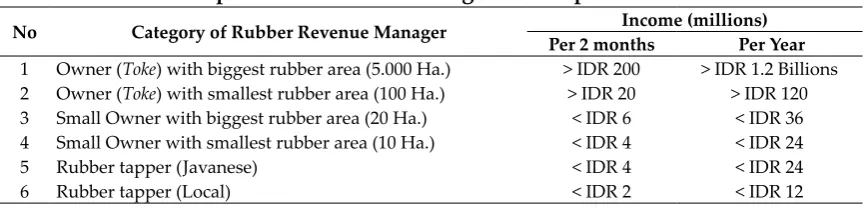
Table 3.
Revenue Comparison of Rubber Management Perpetrators in Tabir Ilir
No Category of Rubber Revenue Manager Income (millions)
Per 2 months Per Year
1 Owner (Toke) with biggest rubber area (5.000 Ha.) > IDR 200 > IDR 1.2 Billions
2 Owner (Toke) with smallest rubber area (100 Ha.) > IDR 20 > IDR 120 3 Small Owner with biggest rubber area (20 Ha.) < IDR 6 < IDR 36 4 Small Owner with smallest rubber area (10 Ha.) < IDR 4 < IDR 24 5 Rubber tapper (Javanese) < IDR 4 < IDR 24 6 Rubber tapper (Local) < IDR 2 < IDR 12
is not too large. Conversely, Toke who collect and buy rubber produced by farmers will dry the wet rubber before it is sold to the factory. In fact, some Toke process irst rubbers produced
farmers into sheets in accordance with the
provisions of the plant using special equipment so that the selling price becomes higher.
The Ofer of Innovative Policies on Rubber
Farmer
Based on the views of the skeptics above, it can be concluded that the role of the state
in development must be still existing and strengthened. Related to the discourse of the significant role of the state in overcoming
these public problems, the New Public Service
(NPM) paradigm is worth puting forward.
The concept promoted by Janet V. Dernhart
and Robert B. Dernhart (2003) is a criticism of the Reinventing Government proposed by David Osborne and Ted Gaebler. As a criticism of another form of New Public Management (NPM) which is the mainstream paradigm in
the role discourse of the State, NPS assumes
that running a government administration is not the same as managing a business organization; because it must be mobilized as it moves democratic government. The mission of a public organization is not just to satisfy the service user, but also to provide goods and services as the fulillment of public rights and obligations.
Based on the NPS concept, the government through its bureaucratic system along with other
stakeholders should be able to innovate to create
breakthrough solutions to problems faced by
rubber farmers. This is because previously the
government only acted as a regulator that only came to produce SIR and three policies (PIR, Plantation Revitalization, and Rubber Garden Rejuvenation) which proved to be not solutive.
Orientation to meet domestic needs is a vision
that must be focused by the government so that
rubber products produced by farmers are not
always dependent on exports. With the vision
of the fulillment of the domestic market, the government can play a more signiicant role in providing solutions for rubber farmers to address
the problems they face.
This efort as prominent with the plan of utilization of rubber products as a mixture
of asphalt, as already done in Thailand and Malaysia (http://ekbis.sindonews.com/read,
access dated February 1, 2016). Based on research conducted by Amal (2011), mixing rubber (Latex) with asphalt will make the
asphalt becomes thicker and denser because air
cavity will be smaller, so it becomes stronger and durable. In addition, the addition of Latex
on asphalt can also reduce the amount of
asphalt used in the mix for highway pavement
to save the use of natural resources. In addition, the use of rubber in asphalt will save road
maintenance costs by up to 40%, although on
the other hand the cost of production increases
to 20%(htp://industri.bisnis.com, access July 28, 2016). Mixing natural rubber, the quality of asphalt can be beter because the level of elasticity is higher, so the road is not easily damaged (htp://economy.okezone.com, access
July 28, 2016).
Based on the experience of Malaysia and Thailand that have long adopted this method, the use of rubber as a mixture of asphalt is inancially more expensive, but on the other
hand, will increase domestic rubber use up to
40% to 50%. Still, in the same context, Malaysia is more advanced by utilizing rubber not only
for asphalt raw materials, but also used for
Mass Rapid Transit (MRT) bearings. Based on the experience of Malaysia and Thailand, then by focusing the use of rubber for domestic
needs will increase the number of rubber products Indonesia. If in 2014, Indonesia’s total rubber production amounted to 3,153,186 tons, there will be 1,261,274.4 tons consumed
domestically, assuming a 40% increase after only 529,761 tons (18.8%).
Another innovative policy that can be
consumption is to encourage the national tire industry to expand to nearby rubber plantation and production centers (htp://ekbis. sindonews.com/read, access dated February 1, 2016). As it is known that as much as 55%
of rubber products consumed in Indonesia (291,368.6 tons) are utilized by the tire industry to be used as the main raw material. In an effort to obtain industrial raw materials,
national tire manufacturing plants work with rubber processing factories (BPS, 2014). With the establishment of tire manufacturing plants near rubber centers, the efort to obtain
raw materials can be made directly (shorter)
without going through other intermediaries as
it has been done.
Based on the policies mentioned above,
the government is expected to no longer repeat agricultural politics ever undertaken by the Dutch government irst. Initially, the Dutch did facilitate the people to grow rubber in their land area through the provision of rubber seeds in the demonstration gardens
(Lindayanty, 2013: 87). However, after the people’s rubber developed quite rapidly, the Dutch implemented a variety of policies that
would not beneit farmers. This efort is a Dutch strategy to double the economic and political beneits of rubber exploitation.
The Dutch policies relating to rubber are shaded by the Agrarian Law 1870 which gives
the private sector the widest possible space to
invest in Indonesia (Padmo, 2004: 111). Through this regulation, the private sector obtains land tenure concessions in the long term, establishes a plantation bank and legal and political
protection. The form of implementation of
this regulation is the emergence of cheap labor wage policy, the provision of facilities
and infrastructure for the interests of private companies, and suppress the production of
smallholder rubber to maintain the existence
of private companies (Padmo, 2004:
112-113). As a ruler, the Dutch government in
the past was very unconcerned with the fate
experienced by farmers and how they survived,
because farmers were only seen as a means
of producing something with as much as possible to provide beneits and beneits to the
authorities. This was as prominent as the Dutch
policy of raising taxes on rubber for farmers’ production, from 10 cents per kilogram in 1934 to 59 cents per kilogram in 1936
(Locher-Scholten, 2002: 173). In addition, the Dutch also
implements agricultural politics that make the government not directly in touch with farmers, but the relation is made through intermediaries (comprador) consisting of Chinese (Padmo,
2004: 112). Consequently, the policies adopted
by the Dutch government did not favor the peasants for not touching the real problems they experienced, but only on the needs of these
intermediaries.
Eforts to meet the needs of this country in line with the Deglobalization concept. According to Bello (2004), Deglobalization is an atempt to re-orient the domestic economy from the emphasis on production for export
to production needs for local markets. This
thinking is Bello’s response to the phenomenon of continuing food problems in this era of globalization. On the one hand, the neo-liberal
system of the last two decades has been able
to push globalization toward competition
that shows quite favorable levels of economic
progress and productivity, but on the other hand, there are problems, increasing the level of competition and reducing the profits of
companies and business actors.
The emergence of Deglobalization is not an atempt to oppose the economic linkage between one country and another, as globalization agencies have always expressed and no atempt to withdraw from the international community. Deglobalization, however, places more emphasis on making the fulfillment
of the domestic market’s needs a primary
community-owned cooperatives, local private companies, and state-owned enterprises. In a world like that, the wheels of the economy do not involve transnational corporations at all. Thus,
Bello’s (2004) paradigm holds a fundamental
characteristic of demands for the production of
goods and services that respond to the needs of
society, not a demand created by a consumer culture driven by corporations, capital, and
markets. This perspective of Deglobalization has become one of the strategic approaches to counteracting globalization which is claimed
to be a new imperialism with a set of actors.
For supporters of Deglobalization, the state is a very important fortress to stem global corporate power by not opposing the links between diferent countries and international exchanges.
In addition to eforts to meet domestic rubber needs, the government is also expected
to educate farmers to apply the principles
of rubber management more advanced. This can be done by providing training on rubber processing skills according to SIR
and equipment assistance needed for the
products produced by farmers selling high in the market. This efort is needed because
the farmers who are the main producers of rubber needs so far have never received any
skills training, as happened in Tabir Ilir. This
solution is a response to the low quality of rubber production produced by farmers so far
because they still apply simple management
methods.
Based on the government policy that
implements this New Public Service and
Deglobalization concept, the income inequality that has always been atached to farmers will be reduced. Reduced levels of income inequality
will occur because the chain of utilization of rubber products will be cut. The parties
involved in the marketing of rubber produced by farmers are no longer as numerous as reaching countries in other parts of the world (such as the United States), now the utilization
of the end is shorter because it is within the
country itself (government and businesses made from rubber raw materials). Advantages that have been enjoyed by many other parties because of the length of the chain of rubber
utilization will be able to move to the farmers
so that it has implications for improving the
welfare of their lives.
In addition, the orientation of domestic
rubber needs fulilled by the government can
also overcome the price problem which has been a problem faced by farmers because it is
no longer dependent on importing countries. Because the government itself is using rubber for various domestic purposes, the government can ix the price of rubber products produced by farmers without dependent on foreign countries. It is known that as much as 83.20 %
(2,623,425 million tons) of Indonesia’s rubber
products in 2014 is aimed at exports to various countries, namely: the United States, Japan, China, South Korea, India, Germany, and France (Rubber Statistics Indonesia, 2014). Thus, the prices imposed on rubber are strongly influenced by the terms set by importing
countries which are practiced in practice by
the Singapore Commodity Exchange (Sicom) and Tokyo Commodity Exchange (Tokom). With the orientation of the fulillment of the
domestic market to supply the needs of road
construction projects (for asphalt mixtures) and various other projects, the government can control its own price because the government
itself uses it.
In addition, the provision of good infrastructure for rubber management also needs serious atention by the local government.
As it is known that one of the obstacles faced
by farmers in managing the rubber they have
is infrastructure, especially roads, are not adequate. This unfavorable road condition,
addition to the proits from the sales of rubber
products to be shared equally with other
management actors, rubber farmers also have
to spend more on transportation. Conversely,
if the roads used by farmers are in good
condition, then some funds for transportation can be diverted to other aspects they need to
improve their standard of living.
Conclusion
As the main stakeholder of rubber
management (85.10%), farmers should live in welfare because the eforts they generate produce 4,741,489 million U$D. But in reality
peasant life remains in a state of limitations
because the results they get are not as expected. This condition occurs because the management
of rubber by farmers still leaves some problems, namely: low product quality, low productivity,
as well as technology and a simple marketing system. As a result, the selling price of rubber
production of farmers is very far from the
prevailing prices in the market so that it has
implications on the income it earns.
Based on the perspective of globalization skeptics, it is necessary to have a signiicant government role in overcoming the problems faced by rubber farmers above. In this context, the government through its bureaucratic system has a role in producing a series of
innovative-solutive development policies and
programs in order to prevent people from the negative impacts of globalization. This efort can be run by the government by adopting NPS paradigm as part of a good public service efort for the people as citizens guaranteed
by the Constitution. Implementation is done
following the concept of Deglobalization by prioritizing the fulfillment of domestic needs as the main interest. In this context,
the need for a policy of transfer of rubber orientation from what has been destined for
export purposes (84.10%) is in the domestic interest. Large domestic rubber production
can be used for the purpose of raw materials
for road construction by mixing asphalt with
rubber that proved successful in Malaysia and
Thailand. Financially it is expensive, but on the
other hand, it will increase domestic rubber
usage from 40% to 50%. If in 2014, Indonesia’s
total rubber production amounted to 3,153,186 tons, there will be 1,261,274.4 tons consumed
domestically, assuming a 40% increase after only 529,761 tons (18.8%).
Another policy is to bring rubber industry
closer to rubber centers as well as to educate farmers to improve the quality of their products and improve road facilities and infrastructure.
Given these policies, the dependence on exports
that have implications on rubber prices can be overcome because the domestic people
themselves, especially the government, who use
rubber for various purposes.
References
Amal, A. S. (2011). Pemanfaatan getah karet
pada aspal Ac 60/70 terhadap stabilitas Marshall pada Asphalt Treated Base (ATB).
Media Teknik Sipil, 9(1), 8 – 16.
Amin, S. (2001). Imperialism and globalization.
Journal Monthly Review, 5(11), 157-168. Badan Pusat Statistik (2014). Indonesia dalam
angka. Jakarta: BPS.
Badan Pusat Statistik. (2014). Statistik karet Indonesia. Jakarta: BPS.
Bappebti. (2015). Daftar harga komoditas di Indonesia. Jakarta: Kementerian Perdagangan
RI.
Bello, W. (2004). Deglobalization: Ideas for a new world economy. New York: Zed Books.
Bryan, L. & Farrell, D. (1996). Market unbound: Unleasing global capitalism. New York: John Wiley.
Chakrabarty, D. (2000). Provincializing Europe.
London: Routledge.
Denzin, N. K. & Lincoln, Y. S. (2009). Introduction: entering the ield of qualitative research. In N. K. Denzin & Y. S. Lincoln.
Thousand Oaks, CA: SAGE.
Dernhart, J. V. & Dernhart, R. B. (2003). The New Public Service: Serving, Not Steering. New York: M.E Sharpe.
Fajriah, L., R. (2016). Penggunaan karet lewat instruksi Presiden. Retrieved from htp://
ekbis.sindonews.com/read/1066625/34/
kemendag-dorong-penggunaan-karet-lewat-instruksi-presiden-1449150438.
Friedman, T. (2007). The world is lat: A brief history of the twenty-irst century. New York: Picador.
Giddens, A. (1990). The consequences of modernity.
California: Stanford University Press. Giddens, A. (2002). Runaway world: How
globalization is re-shaping our lives. London:
Proile Books.
Glienmourinsie, D. (2016). Menperin Dorong Industri Ban Ekspansi ke Hulu. Retrieved from http://ekbis.sindonews.
com/read/1056636/34/menperin-dorong-industri-ban-ekspansi-ke-hulu-1445942850. HM, Pahrudin. (2014). Relasi patronase dalam perkebunan karet rakyat. Jurnal Sosiologi
“Relektif”, 8(2), 195-215.
Jati, W. R. (2012). Ketimpangan utara-selatan dalam globalisasi. Jurnal Studi Hubungan Internasional, 2(2),83-101.
Jati, W. R. (2013). Memahami globalisasi sebagai evolusi kapitalisme. Jurnal Global dan Strategis, 7(2), 241-258.
Lindayanty. (2013). Jambi dalam sejarah 1500-1942. Jambi: Dinas Kebudayaan dan
Pariwisata Provinsi Jambi.
Loadman, J. (2005). Tears of the tree: the story of rubber – a modern marvel. New York: Oxford
University Press.
Locher-Scholten, E. B. (2002). Berdirinya kekuasaan kolonial di Jambi: partai
ganda politik & ekonomi. Fondasi Historis Ekonomi Indonesia. In J. Thomas Lindblad
(Ed.). Yogyakarta: Pusat Studi Sosial Asia Tenggara UGM-Pustaka Pelajar.
Marvasti, A. B. (2004). Qualitative Research in Sociology. London: SAGE Publications.
Mitrović, L. (2010). The new bourgeoisie
and its pseudo-elite in the societies of peripheral capitalism (a sketch for a
sociological portrait). Facta Universitatis Series: Philosophy, Sociology, Psychology and History, 9(1),1-13.
Murshed, S., M. (2002). Globalization, marginalization, and development. London:
Routledge.
Napitupulu, D. (2011). Kajian tata niaga karet alam: Upaya peningkatan kesejahteraan
petani. Jurnal Penelitian Karet, 29(1), 79-92. Padmo, S. (2004). Perusahaan tanaman karet
di Sumatera Timur, bunga rampai sejarah sosial-ekonomi Indonesia. Yogyakarta: Aditya
Media-Fakultas Ilmu Budaya Universitas Gadjah Mada.
Petras, J. & Veltmeyer, H. (2001). Globalization unmasked: Imperialism in 21st century. London: Fernwood Publishing and Zed Books.
Pratiwi, D., A. (2016, July 28). Aspal dicampur karet kualitasnya lebih tahan lama.
Retrieved from http://economy.okezone. com/read/2015/04/09/320/1131761/aspal- dicampur-karet-kualitasnya-lebih-tahan-lama.
Rizer, G. (2006). The globalization of nothing: Mengkonsumsi kehampaan di era globalisasi.
Yogyakarta: Universitas Atma Jaya.
Rulyantie, S. (2011). Studi implementasi kebijakan program revitalisasi perkebunan di Provinsi Kepulauan Bangka Belitung. (Unpublished
master’s thesis). Magister Administrasi Publik Universitas Terbuka.
Shiva, V. (2004). Peraturan pertanian WTO: ancaman bagi para petani dunia ketiga. Globalisasi, kemiskinan dan ketimpangan. International
Forum on Globalization (IFG). Yogyakarta: Cindelaras Pustaka Rakyat Cerdas.
Steger, M. B. (2002). Globalism: The market ideology. Boston: Rowman and Litleield.
Sunarti. (2011). Tingkat Kesesuaian Lahan di DAS Batang Bungo Untuk Tanaman Karet.
Jurnal Hidrolitan, 2(2), 16-25.
pembangunan. Yogyakarta: Tajidu Press.
Wolf, M. (2005). Why globalization works. New
Haven: Yale Notabene.
Wolf, M. (2016). Will the nation-state survive globalization? Retrieved from htps://www.
foreignafairs.com/articles/2001-01-01.
Wulandari, D. (2016). Aspal karet: tahun depan mulai diterapkan. Retrieved from htp://industri.