ACCOUNTING PERFORMANCE AS AN ANTECEDENT FACTOR OF
CHIEF EXECUTIVE OFFICER
TURNOVER IN INDONESIA
Lindrianasari1
University of Lampung ([email protected])
Nurdiono
University of Lampung
(
[email protected])
Einde Ivana
University of Lampung ([email protected])
ABSTRACT
This study is aimed to provide empirical evidence about the usefulness of accounting information in the issue of CEO turnover. Previous research shows the results that CEO turnover is inconclusive with respect to its antecedent factors and consequences. It is also very rarely observed in Indonesia, and therefore strongly encourages the author to conduct this study. The samples of this study is all the companies performing turnover (either routine or non-routine) at the level of the company's top leaders in office as President Director. The sample included 81 CEOs which experienced turnover from 1998 to 2006 period, and compared with a control group referring to companies that does not perform CEO turnover during the observation period (nine years). The final sample that we used for testing the accounting data is as much as 140 companies, consisting of 81 companies that performed turnover and 59 companies that did not. The results of study show that accounting data (i.e. total assets, total sales, ROA, ROE and earnings), indicates a significant negative effect on turnover decisions, while current ratio does not. In additional tests, we find that the accounting performance on non-routine turnover compares favourably with CEO turnover on the type of routine. This result indicates a bargaining position of CEOs at a company that does change regularly. Meanwhile, worse accounting performance will have the potential for CEOs to be replaced (down position or enter into a council of commissioners) and even be laid off from the company.
Keywords: CEO turnover, accounting performance, antecedent factors
INTRODUCTION
The goal of changing the key directors of a firm is to improve the firm’s performance. This is proven by one of the public banks in Indonesia who performed CEO turnover in 2004. Three years preceding the turnover (2002-2004), the company experienced a 34,67%, income decline, with a total debt to asset ratio of 34,56%. Positive change had followed the turnover. Company income had increased to 17,5% in 2008, while the debt to asset was 45,37% (increased almost 11%). One of the major achievements reported was that in the midst of the global banking crisis, banks were able to increase their net profits when compared to previous earnings. Such stories prove the success of a company after performing CEO turnover.
The current study is aimed to describe the content of financial reports related with the issue of company CEO turnover (see Smith, Wright and Huo (2008). It is expected to produce a finding that supports previous studies (for example Engel, Hayes and Wang 2003) by creating the significance of accounting variables as an antecedent and consequence towards CEO turnover. It is expected that the consistent findings in the study will endorse stakeholders to take reference of the figures in financial reports when making important decisions for their company.
Studies of this field have been scarce in Indonesia. This is due to the limited informa-tion that is published in this country. Nevertheless, study in CEO turnover topic is extremely important especially regarding its contribution in policy making concerning company management. Furthermore, this study is also expected to provide information to stakeholders when deciding a particular action towards the company CEO, with respect to their poor or positive behaviours, by utilizing accounting information. In order to achieve this goal, this study will strive to seek the answers of whether accounting
information will influence the decision of CEO turnover in Indonesia.
The finding in this study provides information that accounting information plays a significant role in the decision of CEO turnover in Indonesia. The antecedent factors which consider accounting performance towards turnover analyzed in this study serves as the main contribution of this study. By using a sample from CEO turnover for the period 1998-2005, based on numerous consid-erations, we investigated some accounting and market data that have chosen to represent the sample of the study. The results of the study indicate six consistent and unbiased account-ing variables as antecedents of CEO, namely Total Asset, Total Sales, ROA, ROE and Earnings. The findings explain the content of accounting information and its benefits for deliberating important company decisions.
ROA Warner et al. (1988), Weisbach (1988), Virany et al. (1992), serta Shen (2000). Sementara itu, Laba ditemukan negatif dan signifikan pada penelitian Engle et al.
(2003), dan DeFond and Hung (2003), serta Harga Saham ditemukan negatif dan signifi-kan pada penelitian Warner et al. (1988), Beatty and Zajac (1987), Engle et al. (2003), DeFond and Hung (2003), dan Fee and Hadlock (2004).
THEORETICAL FRAMEWORK AND HYPOTHESIS
Studies on the field of accounting which investigates CEO turnover was introduced by Coughlan and Schmidt (1985) followed by Warner, Watts, and Wruck (1988) and Weisbach (1988). All of these researchers found a relationship between CEO turnover with accounting performance (ROA found negatively of CEO turnover in Warner et al.,
until 2009 remain inconclusive. Moreover, previous studies have only given limited attention towards variation of findings between companies with regard to accounting and market based performance measures towards sustainability of executive perform-ance. A study from Engel, Hayes and Wang (2003), placed large hopes towards normative accounting information towards managerial performance. When accounting information was proven to be more sensitive in explaining issues of CEO turnover, the executive board should reconsider the contribution of accounting information when making decisions of performance sustainability.
Accounting Performance as an Antecedent of CEO turnover
A study performed by Kesner and Sebora (1994: 356) concluded that turnover is frequently treated as a dependent variable. The findings indicate a consistent pattern with high levels of turnover prevalent among poor performing companies. Nevertheless, Finkelstein and Hambrick (1996) suggested that performance preceding turnover poorly explains the variance accounting for the turnover. This indicates the weak relationship between the variable that precedes turnover. The weakness found in earlier studies is due to the different measures on performance and the presence of other factors that tend to moderate the relationship between performance and turnover (Miller, 1991; Cannella & Lubatkin, 1993; Zajac & Westphal, 1996; Finkelstein & Hambrick, 1996).
Smith, Wright and Huo (2008) followed up on their previous study using a variable which was found to be significant in previous studies. The variable that they used included Total Assets, Total Debt, Book value of equity, Debt to Equity, Retained Earnings; Current Ratio, and Interest Coverage Ratio, and found significance for all samples companies with a p-value smaller than 0,05.
Total Assets. The findings from Smith et al.,
(2008) succeeded in finding the significance of Total Assets variable. The result of the study was indeed inconsistent with Puffer and Weintrop (1991) that indicated the insignifi-cance of Total Assets variable. Smith et al.,
(2008) supported the findings of earlier studies conducted by Murphy and Zimmerman (1993) that found the contribution of accounting information in making important decisions by the companies. The growth of sale levels and declining assets were significant before the CEO was laid off and remained on a relatively low level for some years following the CEO turnover. Although level of assets is contin-gent upon managerial policies (for example application of depreciation methods that can be made for some exceptional reasons), however this policy remained to lack any influence to net income compared to costs with high discretion, such as R&D, advertise-ment, capital costs, accrual and earnings.
Current Ra tio. Previous studies found the influence of current ratio towards turnover. Smith et al., (2008) elaborated that current ratio is used for indicating whether there are limitations of the company’s financial condition in the short term which would eventually lead to CEO turnover. The result of this study indicated that coefficient estima-tions on current ratio were statistically negatively significant; a finding that supports those of Altman et al. (1977) and Hill et al. (1996), and indicated that a company with a lower current ratio has higher probabilities of going bankrupt. Other studies also demon-strate a negative relationship towards probabil-ity of bankruptcy (Flagg & Giroux, 1991; Zmijewski, 1984).
between functionality of turnover and sales (as a proxy of organizational performance) that indicates a statistically significant relationship. This finding was deemed strong since it used meta-analysis and confirmed previous studies which also used using meta-analysis, conducted by Hunter and Schmidt (1990) and Lausten (2002).
Murphy and Zimmarmen (1993) discovered a significant decline of sales preceding CEO turnover from the organization and then stable (constant) sales a number of years following the CEO turnover, however the on a relatively low level. This finding somewhat indicates that sales constitute one of the factors that leads to CEO turnover. Sales which become one of the discretion variables is considered to strongly influence management intervention, particularly when the CEO is about to leave the company. Although the level of sales depend on a number of managerial policies (for example realization of sales income can be accelerated from one period ahead). However, Murphy and Zimmerman (1993) also explained that this policy is assumed to lack the influence compared to costs of R&D, advertisement, capital costs, accrual and earnings with large discretion.
Return on Assets (ROA). This variable is very common in previous studies that analyzed accounting ratio (for example Virany, Tushman, and Romanelli, 1985; Harrison, Torres, and Kukalis, 1988, Shen 2000). ROA was found to be negatively associated with turnover and with external replacement. The rationale for using the variable ROA is not explicitly mentioned however the negative relationship that was found in previous studies indicate that poor company performance reflects the poor value of company return on assets which will eventually encourage CEO turnover.
Return on Equity. Puffer and Weintrop (1991) was one of the researchers that used accounting performance in their study of CEO turnover. The success in performing return on
equity becomes one of the measures of managerial performance. Previous studies investigated the relationship between account-ing ratio and CEO turnover. Return on equity became one of the focus of investigation in studies from James and Soref (1981), Allen and Panian (1982), Lubatkin and Chung (1985), Robinson and Brief (1985), and Harrison, Torres, and Kukalis (1988) – cited in Puffer and Weintrop (1991). Accounting performance (ROA, ROE, Earnings, Total Sales, and Assets) became one of the studies that investigated the antecedents and conse-quences of turnover, although accounting ratio was less used by researchers of CEO turnover compared to market ratio.
Earnings. Engel, Hayes and Wang (2003) and DeFond and Hung (2004) used the variable earnings in their study in relation with CEO turnover. The findings from both studies strengthen the position of earnings as an antecedent factor of turnover. The goal of the article authored by Engel et al. (2003) was to investigate the relationship between measure-ment of performance and CEO turnover which are influenced by the characteristics of accounting systems. Engel et al. specifically tested the cross-sectional variation from essential accounting information for CEO decisions, and subsequently related these characteristic to performance measures.
turnover. Both Engle et al. (2003) and DeFond & Hung (2003) found a negative relationship between earnings and turnover.
We are going to further make a hypothe-sis of this study that: “accounting performance influences CEO turnover.”
RESEARCH METHOD 1. Research Data and Sample
The data used in this study includes all data of CEO turnover from the period 1998-2006. Turnover which occurred in 2001-2003 and later for the next four consecutive years did not engage in turnover constitute the sample of the study. This is due to the assumption that CEO will bring change towards the company until 2005. Data was obtained by directly investigating the financial reports from companies registered in the Indonesian Stock Exchange for 8 years of observation. Consistent with previous studies, we use the position of the President Director in the company as the CEO (cited in DeFond and Hung 2004) when the company does not officially use the term CEO. Data on CEO turnover is obtained by exploring data from the company by comparing the name of the President Director during the years of observation. Using this method, we can gain information the changes of the CEO. This change of the CEO refers to the CEO turnover in a particular company in a particular year.
Data selection from the change of the Indonesian CEO’s name for 3 years, occurring
in 2001 to 2003, this which will be symbolized as t0 and this will determine the accounting
data for 3 years before the year of the turnover. Meanwhile, for the market data we used the data of 3 years before and 3 years after the year of the turnover. Previous studies used the period 5 or 3 years after the turnover. However, because our sample will be smaller if we broaden our observation period, therefore we used 3 years before and after the turnover. During 1998-2005 there were 246 CEO turnovers in the public companies of Indonesia. However those which fulfilled the criteria of the sample of our study (namely they have financial data 3 years and 3 years after the turnover and do not indicate confounding effects, for example restructuring and stock management). The final sample for turnover using accounting data totalled 81 companies.
2. Variable Tests
Tests on the antecedent variables use LOGIT (test on first hypothesis) as in equation
(1) which is generally used in studies using binary variables as the dependent variable (symbolized as 1 for turnover and 0 for anything else) as well as cross sectional data.
relationships between the independent variable and the dependent variable. From various studies, in the last few years the LOGIT analysis has become one of the important research analysis tools to maintain methodological strength for the purposes of publication in prestigious journals. The Logit
Table 1. Sample Selection
Description Total Companies investigated in 1998-2006
Total turnover identified in 1998-2006
Turnover without change for 4 consecutive years in 2001-2003 Final sample for analysis on accounting data
3200 264
97 140*
* 81 research sample and 59 controlled sample ***
model used in this study testing the first hypothesis is presented below:
TURNOVER (1,0) = α0 + α1ln-TAssetsit
+ α2CurRattit + α3ln-TSalesit
+ α4 ROAit + α5ROEit + α6Earningsit
+ εit
3. Research Variable
3.1. Accounting Performance as an Antece-dent of CEO Turnover
The variables used in this study are include the following:
a) Total assets (ln-TAsset), as a proxy for the size of the company, and the natural log are used to control high levels of non-linear data. This variable is suggested to have a negative relationship with turnover because increasing total assets reflect positive company growth.
b) Current ratio (CurRat), formulation of
current assets /current liabilities, and presented as a proxy towards short term financial limitations. Previous studies of bankruptcy demonstrate a negative rela-tionship towards the probability of turn-over (Flagg and Giroux, 1991, Zmijewski,
1984, and Altman, 1977) cited in Smith et al (2008).
c) Total sales (ln-TSales), becomes a
meas-ure of operational management perform-ance by applying the natural log to control non-linear data. ln-TSales is suspected to have a negative relationship with turnover, meaning that high ln-Tsales will not push CEO turnover CEO.
d) Return on Assets (ROA). Refers to a
per-formance measure obtained by a compari-son of earnings with total asset. The better the ROA, the less likely for turnover to occur.
e) Return on Equity (ROE), as an alternative
consideration of management success towards company return on equity. The value of ROE is obtained by the earnings equation divided by total equity. This variable is suspected to have a negative relationship with turnover; therefore failure in capital return becomes a reason for turnover in the company.
f) Earnings. This measure was used by Engle et al. (2003); DeFond and Hung (2004) and gave a negative relationship between earn-ings and turnover. This measure is very common and is largely used as a
CEO Turnover;
1 = turnover 0 = others
Accounting Performance:
Total Assets
Current Ratio
Total Sales
ROA
ROE
consideration in management performance. We use net income to represent earnings.
RESULTS AND ANALYSIS 1. Classical Assumption Test
Prior to conducting the Logit analysis towards the accounting data, we performed classical tests towards both of the data. The classical tests were performed to test multicollinearity and heterosdasticity. For the multicollinearity tests, we obtained an R-squared of 0.31 < from 0.66 which represents the R-squared of the variable model tests. This value signifies that multicollinearity is not evident within the data (between variables). Furthermore we also conducted heterodasticity using the test white and found a probability of 0,998. A probability value larger than 0,05 indicates that the data fulfils the assumption of homodasticity. From the results of the classical assumption on our data we can conclude that the data is adequate and consistent and therefore further tests can be performed using the necessary statistical tests.
2. Results of LOGIT Regression on Accounting Performance
Our study conducted tests towards accounting data as a factor that we considered to influence CEO turnover in Indonesia. Overall, the results of the LOGIT tests for accounting data used in the study (Total Asset,
Current Ratio, Total Sales, ROA, ROE and
Earnings) indicate a prediction value with a
percentage correct of 91,4%. This value indicates that the variable used in this model is correct. Based on each variable, 5 from 6 accounting variables indicate a significance of
p ≤ 0,05. This value is supported by the
omnibus test from the chi-square tests that
indicates that the accounting and market antecedent model is strongly significant, each with a p= 0,000. The value of the chi-square
omnibus test of model coefficients less than p=
0,05 indicates that null hypothesis that states that there are no influences of the independent variable towards the dependent variable is rejected. Furthermore, Nagelkerke’s R square
which is a modification of the coefficient cox
and snell R square is used as a consideration
to ascertain a relationship variation for each independent variable towards the dependent variable. The influence of the independent variable is simultaneously displayed by the value of the Nagelkerke’s R square of 0.66, and the value of the Nagelkerke’s R square is partially explained by the Wald together with its significance.
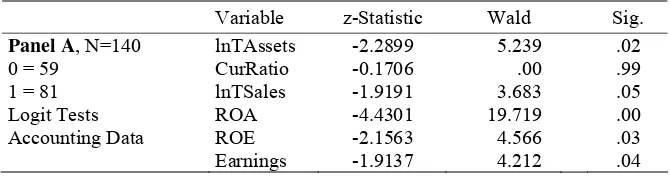
We present the overall analysis of the study in Table 2. The characteristics and results of the tests performed along with the sample are explained accordingly. In Table 2 Panel A, the test on the influence of turnover towards CEO turnover from 140 sample companies consist of 59 companies who did not engage in turnover on the observed periods added with 81 companies that engaged in turnover. The result of the analysis indicates that from six accounting variables that we used in the model of turnover antecedents, five
Table 2. Characteristic and Results of Group Tests
variables significantly influenced turnover. Total Sales was significant at 0,05, while Total Asset, ROE and Earnings was significant at p
≤ 0.05, while for ROA,this variable indicated the strongest level of significance as large as p
≤ 0.000. In this study we found significance for the variable Current Ratio towards turnover. Using the results of the statistical tests, our study confirms the first hypothesis that accounting performance significantly influences CEO turnover.
The current study is also consistent with Smith et al. (2008) and other studies for example Engel et al. (2003). By having sup-port for this hypothesis, we allow the claim that this study confirms the expectations of previous studies (Engel, Hayes, and Wang, 2003), who expected that accounting informa-tion can be considered when making important corporate decisions. Tests on the ROA vari-able indicate a significant relationship towards turnover and are also consistent with Shen (2000) who found significance of ROA towards turnover. The results indicate that accounting performance serves as a factor that must be considered by the company when making important decisions.
3. Additional Tests: Difference Tests on Accounting Performance for Routine and Non-Routine Turnover
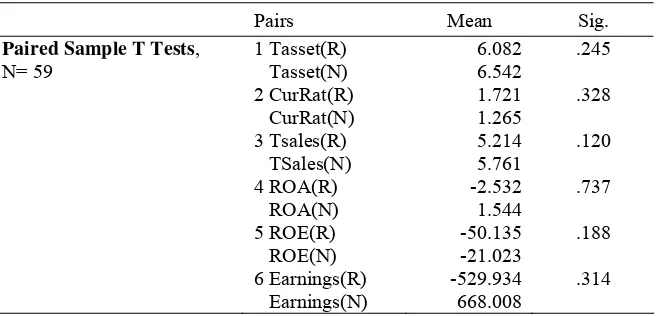
We performed tests on companies that performed routine and non-routine turnover as an additional test with the goal to provide detailed explanations on the issue of turnover. We used Paired Sample T Test for both types of turnover and found a difference of mean that was inconsistent with previous studies on the five accounting variables that were used for routine and non routine turnover, namely
Total Assets, Total Sales, ROA, ROE, and
Earnings however the results were consistent
for the variable Current Ratio. Table 3 gives a detail description of the difference tests that were conducted on routine and non-routine turnover. The non-routine type of turnover indicated a better accounting performance (except for Current Ratio) compared to routine turnover. This indicates that non-routine turnover occurs when company performance is actually better compared to routine turnover. This finding also indicates scapegoating in the decisions of CEO turnover in Indonesia. CEO with poor performance, but remain in the company, appear to hold a bargaining position towards the executive members in the
com-Table 3. Results of Difference Tests based on Routine and Non-Routine Turnover
Pairs Mean Sig.
Paired Sample T Tests, N= 59
1 Tasset(R) Tasset(N) 2 CurRat(R) CurRat(N) 3 Tsales(R) TSales(N) 4 ROA(R) ROA(N) 5 ROE(R) ROE(N) 6 Earnings(R) Earnings(N)
6.082 6.542 1.721 1.265 5.214 5.761 -2.532 1.544 -50.135 -21.023 -529.934 668.008
.245
.328
.120
.737
.188
.314
pany, while CEOs with average performance who do not have a bargaining position are laid off from the company. Ritual Scapegoating Theory (Gamson and Scotch, 1964 – cited in Beatty and Zajac, 1987) postulates that there is no significant relationship between turnover and performance. With regard to the issue in this study, for companies who perform routine CEO turnover, they demonstrate poorer ac-counting performance compared to companies performing non-routine turnover.
The researcher cautiously defines turn-over. Non-routine turnover which causes the previous CEO not to hold any key positions (as board of commissioners or member of the executive management team) in the initial company and or in a company with the same owner. Setiawan (2008) was in agreement with Kang and Shivdasani (1996) in identify-ing the process of routine and non-routine turnover. When a laid off CEO becomes a member of the board of commissioners there-fore the turnover process becomes routine, and vice versa. Apart from being a member of the commissioner, the current study also considers CEO turnover for companies with the same ownership and also considers becoming a member of the executive management team.
CONCLUSIONS, IMPLICATIONS AND LIMITATIONS
The current study highlights the contribu-tion of accounting informacontribu-tion towards CEO turnover in Indonesia. The antecedent factors towards turnover that have been analyzed in our study constitute the major findings of this study. The sample used in this study includes companies who have performed CEO turnover in a particular time period as well as the investigation of accounting and market data. From the six accounting variables used as turnover antecedents, the variables of Total Asset, Total Sales, ROA, ROE and Earnings were found to be consistent and not bias. The findings serve as important information confirming the importance of accounting
information for all accounting communities, because to this day accounting functions as information that is considered important in making important corporate decisions.
It is not fair to view CEO turnover as an easy decision for the organization because change in the executive management implies change of the organization’s model and causes the organization to become vulnerable and requiring management reorganization (Baron, Hanan and Burton 2001), primarily for compa-nies that are dependent towards particular leading figures and are not based on informa-tion systems. CEO turnover which considers accounting information have indicated the significance of accounting information, and this certainly cannot be separated from the quality of the information.
Although in our study we have performed our analysis with great caution, for example when selecting the sample and data used in this study, nevertheless numerous limitations cannot be hindered which will serve as moti-vation for further refined studies. A number of the limitations in this study include the researcher’s decision not to include broader factors of turnover for example pension, mortality, or forced or voluntarily turnover, of which previous studies have shown to indicate a considerable effect. In addition, as explained by previous studies, further studies need to consider the personal characteristics of the CEO that was laid off and the new CEO entering the company. By considering these factors, this would refine the results of investigating the issue of CEO turnover and would sever as a comprehensive explanation towards the phenomenon of turnover in Indonesia.
REFERENCES
Allen, P. A. and Panian, S. K. 1982. “Power, Performance, and Succession In The Large Corporation”. Administrative
Baron, James N., Hannan, Michael T., and Burton, M. Diane. 2001. “Labor Pains: Change in Organizational Models and Employee Turnover in Young, High-Tech
Firms”. The American Journal of
Sociology 106(4): 960-1012.
Beadles II, N. A., Lowery, Christopher M., Petty, M. M., and Ezell, H. 2000. “An Examination of the Relationships between Turnover Functionality, Turnover Fre-quency, and Organizational Performance”.
Journal of Business and Psychology
15(2): 331-337
Beatty, Randolph P. and Zajac, Edward J. 1987. “CEO Change and Firm Performance in Large Corporations: Succession Effects and Manager Effects”.
Strategic Management Journal 8(4):
305-317.
Boeker, W. 1992. “Power and Managerial Dismissal: Scapegoating at the Top”.
Administrative Science Quarterly 37:
400-421.
Cannella, JR., Albert, and Lubatkin, Michael. 1993. Succession as a sociopolitical process: Internal impediments to outsider selection. Academy of Management Jour-nal 36(4): 763-793.
Carroll, G. R. 1984. Organizational Ecology.
Annual Review of Sociology 10; 71-93.
Chow C. 1960. Test of equality between subsets of coefficients in two linear
regressions,Economnetrica 28: 591-609.
Coughlan, A. T. and R. M. Schmidt. 1985. Executive compensation, managerial turnover, and firm performance: An empirical investigation. Journal of
Accounting and Economics 7: 43-66.
Davidson, W. N., D. Worrell, and D. Dutia. 1993. The stock market effects of CEO succession in bankrupt? Journal of
Management 19(3): 517-533.
Defond, Mark L. and Hung, Mingyi. 2004. Investor Protection and Corporate Governance: Evidence from Worldwide
CEO Turnover. Journal of Accounting
Research 42(2): 269-312.
Denis, David J. and Denis, Diane K. 1995. “Performance Changes Following Top Management Dismissals”. The Journal of
Finance 50(4): 1029-1057.
Engel, Ellen, Hayes, Rachel M., and Wang, Xue. 2003. “CEO Turnover and Properties of Accounting Information”. Journal of
Accounting and Economics 36: 197–226.
Finkelstein, S., and Hambrick, D. C. 1996.
Strategic leadership. New York: West.
Gamson, W., and Scotch, N. 1964. “Scape-goating in Baseball”. American Journal of
Sociology 70:69-76.
Grusky, O. 1964. “Reply to Scapegoating in Baseball”. American Journal of Sociology
70: 72-76.
Harrison, J. R., D. L. Torres, S. Kukalis., 1988. “The Changing of the Guard: Turnover and Structural Change In Top-Management Positions”. Administration
Science Quarterly 33: 211-232.
Harrison, J. R., D. L. Torres, S. Kukalis. 1988. “The Changing of the Guard: Turnover And Structural Change In Top-Management Positions”. Administration
Science Quarterly 33: 211-232.
Haveman, Heater. 1993. “Organizational Size and Change”. Administrative Science Quarterly 38: 20- 50.
Helmich, D. L., 1974. “Organizational Growth and Succession Patterns”, Academy of
Management Journal 17: 771-775.
Hunter, J. E. and Schmidt, F. L.,
1990. Methods of Meta-Analysis:
Correcting Error and Bias in Research
Findings. Newbury Park, CA: Sage.
Kato, Takao and Cheryl Long, 2006. “Executive Turnover and Firm Perform-ance in China”. The American Economic
Review, Vol. 96(2); 363-367.
Future”. Journal of Management 20: 327-372.
Lausten, M., 1998. CEO Turnover, Firm
Performance and Corporate Governance.
Papers 98-10, Aarhus School of Business - Department of Economics.
Miller, D. 1991. “Stale in The Saddle: CEO Tenure and The Match Between Organiza-tion and Environment”. Management Science 37: 34-52.
Murphy K., and J. L. Zimmerman, 1993. “Financial Performance Surrounding CEO Turnover”. Journal of Accounting and
Economics 16:27 3-315.
Puffer, Sheila M., and Weintrop, Joseph B., 1991. “Corporate Performance and CEO Turnover: The Role of Performance Expectations”. Administrative Science
Quarterly 36; 1-19.
Shen, Wei, 2000. “Political Dynamics Within Corporate Upper Echelons and Their Impacts on Contender and Outsider CEO Succession”. Academy of Management Proceedings BPS: H1.
Shen, Wei, 2000. “Political Dynamics Within Corporate Upper Echelons and Their Impacts on Contender and Outsider CEO Succession”. Academy of Management Proceedings BPS: H1.
Smith, Frank, Wright, Alan, and Huo, Y. Paul, 2008. “Scapegoating Only Works If The Herd is Big: Downsizing, Management Turnover, and Company Turnaround”.
International Journal Of Business Strategy 8(3): 72-83.
Virany, Beverly, Michael L. Tushman, and Elaine Romanelli, 1992. “Executive Succession and Organization Outcomes in Turbulent Environments: An Organization
Learning Approach”. Organization
Science 3: 72-91.
Virany, Tushman, M. and E. Romanelli, 1985, “Organizational Evolution: A Meta-morphosis Model of Convergence and Reorientation” in: L.L. Cummings and B.M. Staw (Eds.), Research in
Organiza-tional Behavior, Vol 7, 171-222,
Green-wich, CT: JAI Press.
Warner, Jeroid B. Watts, Ross L., and Wruck, Karen H, 1988. “Stock Prices and Top Management Changes”. Journal of
Finan-cial Economics 20: 461-492.
Weisbach, Michael S, 1988. “Outside directors and CEO Turnover”. Journal of Financial
Economics 20: 431-460.
Zajac, E. J. and J. D. Westphal. 1996. “Who Shall Succeed? How CEO/Board Prefer-ences and Power Affect the Choice Of
New CEOs”. Academy of Management
Journal 39: 64-90.
Zmijewski, M, 1984. “Methodological Issues Related to the Estimation of Financial Distress Prediction Models”. Journal of