DEVELOPING STUDENTS’ WORKSHEET OF DERIVATIVE BASED ON
APOS THEORY
Yunika Lestaria Ningsih1, Darmawijoyo2, Yusuf Hartono3 PGRI Palembang University1, Sriwijaya University 2,3
1) [email protected], 2) [email protected] , 3) [email protected]
Abstract
This study aims to develop valid and practical students’ worksheet of derivative based on
APOS theory in higher education, and to know the potential effect of the product that
developed to the students’ ability of understanding the mathematics concepts. This study used design research method type development study. The development stages are preliminary study and formative evaluation (self evaluation, expert reviews, one-to-one, small group, and field test). The subjects were 38 students of class 1C Faculty of Mathematics Teacher Educations, University of PGRI Palembang. Data were collected through walkthrough (expert reviews), documentation, and interviews. Data were analyzed with
qualitative descriptive. The results show that the research’s product is valid, practical, and
have a potential effect to the students’ ability of understanding mathematics concepts.
Keywords: derivative, APOS Theory, design research type development study, students’ worksheet.
INTRODUCTION
Derivative is an advance mathematics concept, beside function and limit, which is the crucial in calculus. This concept has many applications in daily life such as in physics, and economics (Purcell, Varberg, & Rigdon, 2010). Because of that, it becomes an important topic for students to study in higher education (Orhun, 2012).
According to the curriculum for higher education in Indonesia, one of the learning goals of derivative is students have to understand the concept of derivative and able to apply it in solving the real life problems. However, understanding the concept of derivative is not easy for many students (Uygur & Ozdas, 2005; Maharaj, 2013). Tall (1992) suggested that students may learn the concept of derivative by drawing a graphic to see the changing of the slope in a curve.
Ed Dubinsky and his colleagues introduced APOS theory in 1991. It explained how students used their cognitive structure in construct mathematical knowledge from the action, process, object and schema stage (Brijlall & Ndlovu, 2013). Meagher, Cooley, Martin, Vidakovuc, & Loch (2006) also mentioned that this theory forces students to explore their ways of thinking, so that the abstract concept assimilated and learned.
This study aims to develop valid and practical students’ worksheet of derivative based on APOS theory in higher education, to know the potential effect of using the students’ worksheet to improve students’ ability in understanding the mathematics concepts specially the concept of derivative.
THEORETICAL FRAMEWORK
APOS theory begins with hypothesis that an individual’s mathematics concept, including
derivative, understood by constructing and reconstructing mathematical action, process, object and organizing these in schema. An action is transformation of mathematical object to get another object based on external stimuli. When an individual repeat an action and reflects on it internally, it may be interiorized to a process. Process can be encapsulated as an object, when an individual reflects on operations in a process and realize can make a transformation on it. A schema constructed by coherent collections of processes and objects (Asiala, Brown, DeVries, Dubinsky, Mathews, & Thomas, 1997; Dubinsky & Mc. Donald, 2001).
According to Dubinsky and Mc. Donald (2001), APOS theory is very useful to support students in understanding the undergraduate mathematics concepts. Asiala, Cotrill, Dubinsky, & Schwingendorf (2001) stated that APOS theory help students to get better understanding in derivative. Besides that, APOS theory improved the students’ ability to proof in abstract algebra (Arnawa, Sumarno, Kartasasmita, & Baskoro, 2007).
)n order to develop students’ worksheet of derivative based on APOS theory in this study, students assumed to have prior understanding about the basic concepts in constructing derivative. Such as the concept of function, graphic function, slope of a line, limit, and so on. Students can construct theirs understanding of derivative by understanding those concepts (Firouzian, 2010). Those concepts used as a guideline to arrange the APOS theory framework.
The notion genetic decomposition introduced to refer to the framework of APOS theory. It is a model that used by the researchers to explain how the mathematics concepts taught (Dubinsky & Mc. Donald, 2001). With this model, students could explore how to construct the concept of derivative.
Asiala, Cotrill, Dubinsky, & Schwingendorf (2001) mentioned there are two related path in constructing a schema for the concept of derivative, a graphical path and an analytic path. They also gave the genetic decomposition for derivative concept as follow:
2a. Graphical: Interiozation of the action in point 1a to a process as the two points get closer and closer together.
2b. Analytical: Interiozation of the action in point 1b to a process as the time intervals get smaller and smaller.
3a. Graphical: Encapsulation of the process in point 2a to produce the slope tangent line as the limiting of the slope of secant lines.
3b. Analytical: Encapsulation of the process in point 2b to produce the instantaneous rate of change.
4. Interiozation of the process in point 2a and 2b in general to produce the definition of derivative of a function.
According to Skemp (1976), there are two levels of mathematics understanding, which are instrumental and relational understandings. Students approved to have instrumental understanding if they are able to remember things that told to them. Whereas, relational understanding means that students are able to apply a mathematics idea to a new situation.
Kilpatrick et al. mentioned five dimensions of understanding the mathematics (as cited in Long, 2005; Khairani & Nordin, 2011) they are conceptual understanding, procedural fluency, strategic competence, adaptive reasoning, and productive disposition. Conceptual understanding is the ability to understand the objects of mathematics including its operation and relation. Procedural fluency is the ability to apply the procedures correctly, efficiently and accurately. Meanwhile the ability to represented, formulate and problem solving are the part of strategic competence. Adaptive reasoning is the ability to think logically, reflection, explanation, and justification, and productive disposition involve the ability to see the mathematics object as useful things.
From the explanation above, this study was focus on understanding mathematics concepts and relational understanding. The indicators of understanding mathematics concepts used in this study are the ability to interpretation, explanation, formulation, and counting. For the relational understanding is the ability to apply the mathematics concepts in or out of mathematics context.
METHOD
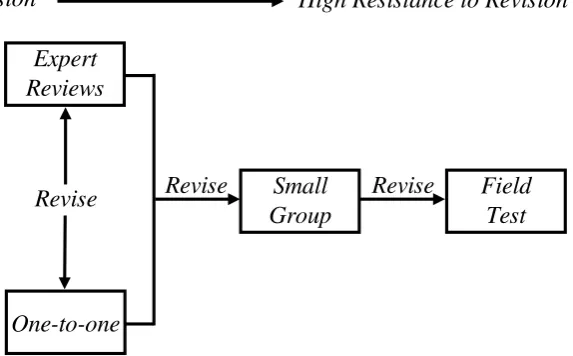
The subjects were 38 students in class 1C Mathematics Teacher Education, PGRI Palembang University academic year 2014/2015. This study used design research type development studies, which progress in several stages. They are preliminary research and the prototyping stage, including design the product, formative evaluation and revision (Nieveen, McKenney, & van den Akker, 2006). The formative evaluation flowchart can be seen in figure 1.
product are linked to each other consistently (construct validity). Practicality refers to that the product is appealing and usable in normal conditions. Effectiveness refers to that the outcomes are consistent with the intended aims.
Data collection techniques are walkthrough (expert review) which is used to find out the qualitative validity (content, construct and language) of the product, documentations which is used to determine the practicality, and interviews which is used to determine suggestions and comments from the students. Data were analyzed with qualitative descriptive to determine the validity, practicality and effectiveness of the product.
Figure 1: Formative evaluation flowchart (Tessmer, 1993)
RESULT AND DISCUSSION Preliminary Study
At this stage, researchers did things for preparation, like arranged the schedule with the university, analyzed the mathematical ability of the subjects, and analyzed the curriculum by identifying the learning goals of derivative.
Prototyping Stage Design the product
At this stage, researchers designed the students’ worksheet of derivative based on APOS
theory. The guideline of designing the worksheet is the genetic decomposition that mentioned by Asiala, Cotrill, Dubinsky, & Schwingendorf (2001). For the first result, the worksheet consists of three activities and exercise. Activity 1, students determine the slope of tangent line by counting the limit for two points, which get closer and closer. Activity 2, students determine the instant velocity by counting the average velocity for interval of time which smaller and smaller. Activity 3, students determine the formulation of derivative as the slope of tangent line and the instantaneous velocity.
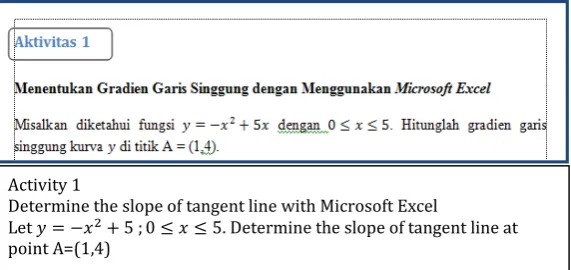
In order to help students drawing the graphical function, this worksheet complemented with the Microsoft Excel program. This is one of example of students’ activity in the worksheet before the validation.
Low Resistance to Revision High Resistance to Revision
Expert Reviews
One-to-one
Small Group
Field Test
Activity 1
Determine the slope of tangent line with Microsoft Excel
Let = − + 5 ; 0 ≤ ≤ 5. Determine the slope of tangent line at point A=(1,4)
Figure 2: Activity 1, before validation
Formative Evaluation Self Evaluation
At this stage, researchers evaluated the designed worksheet. Researchers examined the product from the content, construct, and language. Content means that the topic in worksheet is suitable with the learning goals, construct means that the topic in worksheet is suitable with the APOS theory framework, and language means that the language in worksheet is easy to read and clarity to understand. The worksheet in this stage called the prototype 1.
Expert Review
At this stage, the qualitative validity of the prototype 1 consulted and examined based on the content, construct and language to the mathematics education experts. The experts are Dr. Abdul Qohar, M.T. from Malang State University, Dr. Kms. Amin Fauzi, M.Pd. from Medan State University and Samsuryadi, M.Komp, Ph. D. from Sriwijaya University. They reviewed the topic in worksheet that developed in accordance with the characteristic of APOS theory, and the using of sentences in worksheet to improve the clarity.
One-to-One
At one-to-one, prototype 1 tested to five students with different mathematical abilities, namely high, medium, and low. The students solved the worksheet individually. The researcher involved with them in an informal conversation. Evaluation of one-to-one was focusing on clarity, easy to use and effectiveness of the product.
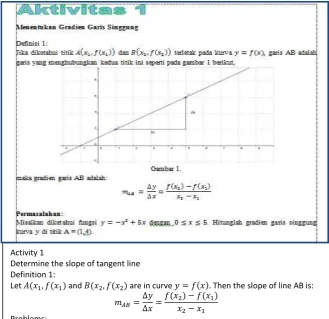
The result of one-to-one evaluation showed that students with low mathematical ability difficult to solve limit function problems, draw a graphic function and difficult to explain the definition of derivative as the slope of tangent line and the instantaneous velocity. After did the worksheet students were filled suggestions and comments. Suggestions and comments from students and from experts are very important information for researcher to make a revise in order to get the prototype 2. After the revision, prototype 2 was valid, and tested in small group.
Activity 1
Determine the slope of tangent line Definition 1:
Let , � and , � are in curve = � . Then the slope of line AB is:
� =∆∆ =� − �−
Problems:
Let = − + 5 ; 0 ≤ ≤ 5. Determine the slope of tangent line at point A=(1,4)
Figure 3: Activity 1, after the validation
Small Group
At this stage, prototype 2 which is stated valid from the expert review and one to one tested to nine students, which divided in 3 small groups. They solved the worksheet, and same on the one-to-one evaluation students are required to provide the suggestions and comments about prototype 2. Researchers analyzed the worksheets, for knowing
students’ difficulties and to determine how far is students understand about the topic.
The interviews result showed that at this stage, students difficult to give explanation about the definition of derivative in activity 3. This is a Schema stages, which is the highest level in APOS theory framework (Dubinsky & Mc. Donald, 2001). Students should understand the action and process stage in activity 1 and 2 to obtain the Object and Schema understanding in activity 3.
Field Test
Field test purposed to determine the potential effect of the product to the student’s ability of understanding mathematics concept. It is conducted on October 18, 2014 with 38 students of class 1C Mathematics Teacher Educations, PGRI Palembang University academic year 2014/2015. Students divided in 8 groups with different mathematical ability. The groups is consist of 4-5 persons.
Based on learning goal of derivative, the learning process is to determine the definition of derivative as a slope of tangent line and the instantaneous velocity based on APOS theory.
APOS Theory Framework
Action. At activity 1, action stage students draw the line that connected two points in a curve. The curve made by the Microsoft Excel program. At the activity 2, action stage students count the average velocity from moving object in interval of time.
Process. Activity 1, process stage students were did the same with action stage, but the two points in this stage become closer and closer. With the computer program students could see the line that through these two points and the changing value of the slope of the line, until they found the slope of tangent line from a very closer range of two points. It was determined by filling the provided table.
Activity 2 process stages, students counted the average velocity to a very little interval of time. Until the interval gets closer to zero, they found that the average value of velocity changing in to an instantaneous velocity.
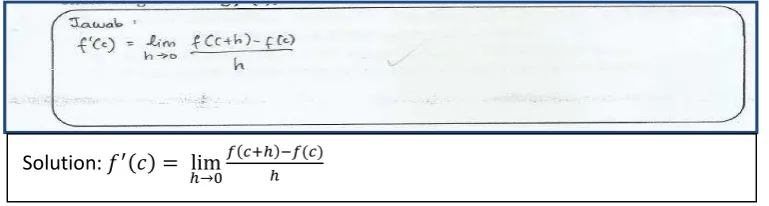
Object. The object stage is in activity 3. At this stage, students determined the definition of derivative function � at a point = �. Figure 4, shows one of the students’ answers for this activity.
Figure 4: The students answer for activity 3
Schema. The Schema stage is in the last step of activity 3. Students give an explanation about how to define derivative function at a point, as slope of tangent line and instantaneous velocity. In order to reach this schema understanding of derivative, students should connected the information from stage action-process-object.
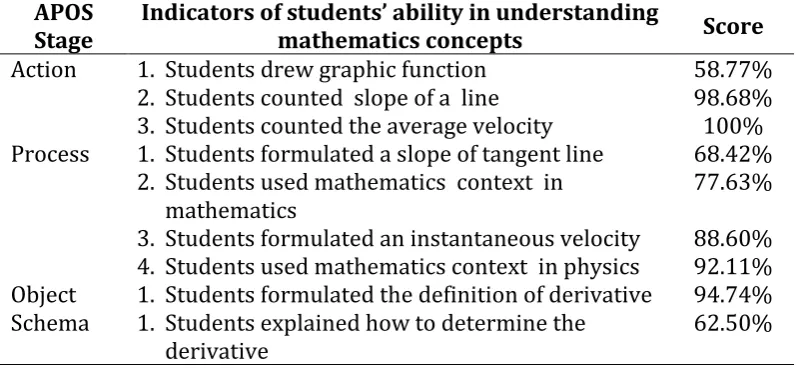
Next, to know the potential effect of the students’ worksheet, researchers analyzed it. The result of analysis is shown in Table 1.
Solution: �′ � = lim ℎ→
Table 1: The score of students’ ability of understanding mathematics concepts
APOS Stage
Indicators of students’ ability in understanding
mathematics concepts Score
Action 1. Students drew graphic function 58.77% 2. Students counted slope of a line 98.68% 3. Students counted the average velocity 100% Process 1. Students formulated a slope of tangent line 68.42%
2. Students used mathematics context in mathematics
77.63%
3. Students formulated an instantaneous velocity 88.60% 4. Students used mathematics context in physics 92.11% Object 1. Students formulated the definition of derivative 94.74% Schema 1. Students explained how to determine the
derivative
62.50%
Students’ ability of understanding the mathematics concepts
Understanding the mathematics concepts
Interpretation: Students drew a graphic function
In this part students drew a graphic function that plotted by the computer program in the worksheet. This activity was easy to students because the topic of function and graphic function learned from junior high school. However, the result showed that many students made mistake, they did not put the value of x and y correctly to obtain the correct graph. The score for this indicator is only 58, 77 %.
Students that could not draw graphic function correctly indicated that they did not understand the concept of function and graphic function very well. This is become the problem to them in understanding the derivative concept. Because in order to understand it, they have to understand, function and graphic function (Maharaj, 2013).
Counting: Students counted the slope of line, and the average of velocity
Counting is students’ ability to count or apply some formulates. According to Skemp (1976), counting is part of procedural understanding. Students did not difficult in solving this indicator; the score for this indicator is the highest, 98, 68 % for counting the slope of a line, and 100% for counting the average velocity. The highest score is show that students prefer procedural understanding than conceptual understand in learning mathematics (Tall, 1992; Orhun 2012).
Formulation: Students formulated a slope of tangent line, an instantaneous velocity and derivative of a function at a point
Meanwhile, the score increasing for formulating the instantaneous velocity, 88.60% and the derivative function at a point 94.74%. This means students have learned how to determine a formula form the situation stated.
Explanation: Students explained the definition of derivative function at a point According to Kilpatrick et al. (as cited in Long, 2005; Khairani & Nordin, 2011), explanation is a part of adaptive reasoning, beside the ability to think logically, reflection and justification. At this part, students explained that derivative of a function at a point as a slope of tangent line and instantaneous velocity. However, many of them only wrote the formula of derivative. Score for this indicator is only 62.50 %. This score indicated that students were difficult to make a connection between the mathematics topics, as mentioned by Khairani & Nordin (2011).
Relational understanding
Students used mathematical context in mathematics
At this part, students used the concepts of function, graphic function, limit, and the slope of a line to found the formula about the slope a tangent line. Students who did not understand about function and graphic function could not determine it. The score for this indicator was 77. 63 %.
Students used mathematical context in physics
At this part, students used the concept of function, limit, and the average velocity of moving object to determine the instantaneous velocity. The score for this indicator was 92.11 %.
From the description about, we can say that the students’ worksheet of derivative based on APOS theory in class 1C students of Mathematics Teacher Education had a potential
effect to the students’ ability of understanding the mathematics concepts, especially in
derivative concept.
CONCLUSION
The product of this research is students’ worksheet of derivative based on APOS theory, which is valid and practical. The validity stated from the result of the expert review and one-to-one stages. From the data analysis in expert review and one-to-one stages, the product stated valid. The practicality stated from the small group test’s result. Based on data analysis in this stage, almost students could solve the problems to construct the derivative concept in the worksheet. This means that the product was practice, easy to read and easy to understand.
The product in this study stated valid, practice, and effectiveness. So that, the students’ worksheet of derivative based on APOS theory in this study can be used in general conditions.
REFERENCES
Arnawa, I.M., Sumarno, U., Kartasasmita, B., & Baskoro, E.T. (2007). Applying the APOS theory to improve the students ability to proof in elementary algebra. Journal of the Indonesian Mathematical Society, 13(1), 133-148.
Asiala, M., Brown, A., DeVries, D.J., Dubinsky, E., Mathews, D., & Thomas, K. (1997). A Framework for Research and Curriculum Development in Undergraduate Mathematics Education. Retrieved from http://www.math.wisc.edu/~wilson/Courses/Math903/APOS-Overview.pdf. Asiala, M., Cotrill, J., Dubinsky, E., & Schwingendorf, K.E. (2001). The Development of
students’ graphical understanding of the derivative graphical. Retrieved from http://homepages.ohiodominican.edu/~cottrilj/graph-deriv.pdf.
Brijlall, D., & Ndlovu, Z. . (igh school learners’ mental construction during solving
optimisation problems in calculus: a South African case study. South African Journal of Education, 33(2), 1-18.
Dubinsky, E., & Mc. Donald, M.A. (2001). APOS: A Constructivist Theory of Learning in Undergraduate Mathematics Education Research. Retrieved from http://www.math.kent.edu/~edd/ICMIPaper.pdf.
Firouzian, S.S. (2010). Correlations between students’ multiple ways of thinking about the derivative and their abilities to solve applied derivative problems Master’s thesis,
University of Missouri, Columbia). Retrieved from http://umaine.edu/center/files/2011/10/FirouzianThesis.pdf.
Khairani, A.Z., & Nordin, S.M. (2011). The development and construct validation of the mathematics proficiency test for 14-year-old students. Asia Pacific Journal of Educators and Education, 26(1), 33–50.
Long, C. (2005). Math’s concepts in teaching: procedural and conceptual knowledge.
Phytagoras, 62, 59-65.
Maharaj, A. . An APOS analysis of natural science students’ understanding of derivatives. South African Journal of Education, 33(1), 1-16.
Makonye, J.P. (2011). Learners Mathematical Errors in Introductory Differential Calculus Tasks: A study of misconception in the senior school certificate examinations ( Master’s thesis, University of Johannersburg, Johannersburg . Retrieved from https://ujdigispace.uj.ac.za/bitstream/handle/10210/6788/Makonye.pdf?seque nce=1.
Meagher, M., Cooley, L., Martin, B., Vidakovuc, D., & Loch, S. (2006). The Learning of Liner Algebra from an APOS Perspective. Retrieved from http://www.pmena.org/pastconferences/2006/cd/ADVANCED%20MATHEMAT ICAL%20THINKING/ADVANCED%20MATHEMATICAL%20THINKING-0019.pdf Nieveen, N., McKenney, S., & van den Akker, J. (2006). Educational design research: the
value of variety. In Van den Akker, J., Gravemeijer, K., McKenney, S., & Nieveen, N. (Eds.). Educational design research (pp. 229-240). London: Routledge.
Skemp, R.R. (1976). Relational Understanding and Instrumental Understanding.
Retrieved from
http://www.alearningplace.com.au/wp-content/uploads/2014/01/attachments/pdf/Skemp%20paper.pdf.
Tall, D. (1992). Students’ Difficulties in Calculus. Retrieved from http://homepages.warwick.ac.uk/staff/David.Tall/pdf5/dot1993k-calculus-wg3-icme.pdf.
Tessmer, M. (1993). Planning and Conducting Formative Evaluations. Philadelphia: Kogan Page.
Uygur, T., & Ozdas, A. (2005). Misconceptions and difficulties with the chain rule. Retrieved from http://math.unipa.it/~grim/21_project/21_malasya_Uygur209-213_05.pdf