1Department of Physics, Faculty of Mathematics and Natural Sciences, University of Sriwijaya
Jl. Palembang – Prabumulih Km. 32, Inderalaya, Ogan Ilir, Sumatera Selatan, 30662, Indonesia
2Also at Center for Geohazard and Climate Change Study, Faculty of Mathematics and Natural Sciences, University of Sriwijaya 3Badan Pengkajian dan Penerapan Teknologi (BPPT), Jakarta, Indonesia
19
TREND IN PRECIPITATION OVER SUMATERA UNDER THE WARMING EARTH
Iskhaq Iskandar1,2, Muhammad Irfan1, Fadli Syamsuddin3, Akmal Johan1, and Pradanto Poerwono1
Abstract. A long-term climate variations in the western Indonesian region (e.g. Sumatera) were evaluated using precipitation data as a proxy. The result showed that there was a long-term climate variation over Sumatera region indicated by a decreasing trend in precipitation (drying trend). Moreover, the long-term precipitation trend has a strong seasonality. Remarkable decreasing trend at a rate of 3.9 cm/year (the largest trend) was observed during the northwest monsoon (DJF) season, while the smallest decreasing trend of 1.5 cm/year occurred during the southeast monsoon (JJA) season. This result suggested that the Sumatera Island experienced a drying trend during the northwest monsoon season, and a dryer condition will be more frequently observed during the southeast monsoon season. The long-term precipitation over the Sumatera Island was linked to coupled air-sea interactions in the Indian and Pacific oceans. The connection between the seasonal climate trends and sea surface temperature (SST) in the Indian and Pacific oceans was demonstrated by the simultaneous correlations between the climate indices (e.g. Dipole Mode Index (DMI) and the Niño3.4 index) and the precipitation over the Sumatera Island. The results suggested that both the Indian Ocean Dipole (IOD) and the El Niño-Southern Oscillation Index (ENSO) have significant correlation with precipitation. However, remarkable correlations were observed during the fall transition of the IOD event.
Keywords:Climate variations, Dry season, Precipitation, Sumatera and Kalimantan, Wet season.
1. Introduction
Seasonal variation of the Asian-Australian monsoon system is the main driver of variation in precipitation over Sumatera region (Hendon, 2003). In addition, coupled ocean-atmosphere modes in the tropical Indian Ocean (e.g. Indian Ocean Dipole – IOD) and Pacific Ocean (e.g. El
Niño-Southern Oscillation – ENSO) are
responsible for the interannual variation (Aldrian and Susanto, 2003; Hendon, 2003; Chang et al., 2004; Kubota et al., 2011; Saji et al., 1999; Ashok et al., 2003; Saji and Yamagata, 2003). Typical characteristic of this seasonal variation indicates that the anomalies are much more coherent and predictable during the dry season (May–October) than during the wet season (January–March) (Hendon, 2003; Haylock and McBride, 2011).
On interannual time-scale, the swing between cold and warm sea surface temperature (SST) in the tropical Pacific Ocean results in deficit and enhanced precipitation over most part of the Indonesian regions, respectively (Hendon, 2003). Moreover, the occurrence of a positive (negative) IOD event in the tropical Indian Ocean causes a decrease (increase) precipitation over the maritime continent (Ashok et al., 2003). However, it is still unclear to what extent the IOD event influences the precipitation over the Sumatera region since the recent IOD event co-occurred with El Niño (Schott et al., 2009).
In this study, we evaluate the trend in
precipitation over the Sumatera under a scenario of intense extreme climate events. The increase of the number of IOD as well as ENSO years is considered to have a great impact on the precipitation over the Sumatera region, causing extreme drought and flood events. These droughts and floods have often been considered among the most severe natural disasters for the country. Thus, the long-term climate variations in Indonesia and their possible connection to the increase in greenhouse gas concentrations are a subject of considerable scientific and practical interest.
The rest of the paper is organized as follow. Section 2 describes the datasets used in the present study. Section 3 presents the precipitation trend over the Sumatera and its relation to IOD and ENSO. The last section is reserved for a summary and discussion of major results.
2. Data and Methodology 2.1. Data Description
The primary data used in this study is monthly precipitation obtained from the Center for Climatic Research, Department of Geography, University of Delaware, Newark, DE, USA. The data cover a period of January 1900 to December 2008 with spatial resolution of 0.5 0.5. The data are based on monthly total precipitation observed at rain gauge station under the Global Historical Climatology Network (GHCN).
20 International Journal of Remote Sensing and Earth Sciences Vol. 8, 2011
precipitation and climate modes in the tropical Indo-Pacific region, we used monthly SST data from Extended Reconstructed Sea Surface Temperature (ERSST) from NOAA's Historical
Merged Land-Ocean Surface Temperature
Analysis (Smith et al., 2008). The data are available from January 1854 to present with horizontal resolution of 2 2.
In this study, we focus our analysis for a period of January 1900 to December 2000. Mean climatologies of precipitation and SST were calculated from time series over the period January 1900 – December 2000. Anomaly fields for all variables were then constructed on the
basis of deviations from their mean
climatologies.
2.2.Correlation Analysis
In order to evaluate respective influences of the IOD or ENSO on the precipitation variability over Sumatera region, a partial correlation analysis will be used here. It is defined by
r13,2 (r13r12r23) (1r122)(1r232)
, (1)
where r13,2 is the partial correlation between variable 1 and variable 3 without influences from variable 2. r12, r13 and r23 are correlation coefficients between the two variable indicated in the subscript, and it is defined as
3.1. Long-term trend in precipitation
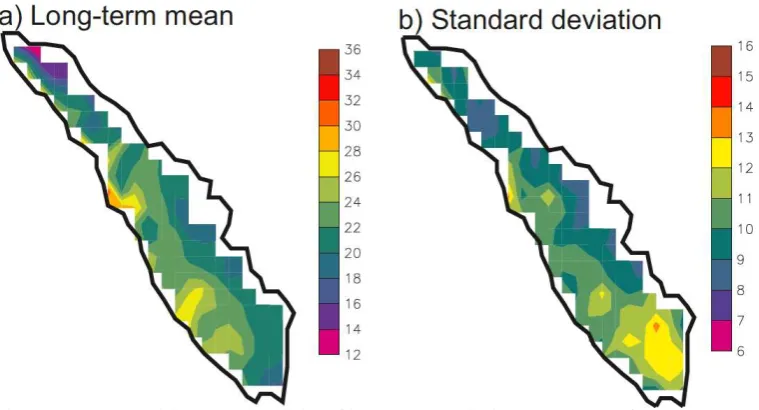
We first show the time mean (1900–2010) and standard deviation of the precipitation over the Sumatera. In Figure 1a, it can be seen that the precipitation amount declines from southwestern coast (> 24 cm) toward the southeastern coast (< 18 cm) of Sumatera. In addition, the northern part of Sumatera shows lower amount of precipitation compared to southern part, with the lowest during all seasons. The standard deviation of the precipitation indicates that large variation occurred in the southern Sumatera and in the precipitation over Sumatera. Precipitation has decreasing trend over the period of study at a rate of 0.81 cm/year. Note that the major decrease in precipitation occurred during the last ten year of the study period in 1991 – 2000.
International Journal of Remote Sensing and Earth Sciences Vol. 8, 2011 21 The spatial-averaged of long-term precipitation
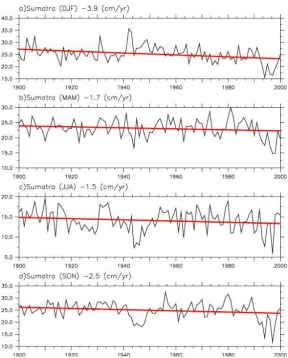
has indicated a decreasing trend over Sumatera Island. Next, we analyze long-term trend and variations in four seasons, namely the December– February (DJF) season, March–May (MAM) season, June–August (JJA) season and September– November (SON) season. The division of the season is following the Asia-Australia monsoon season where the DJF, MAM, JJA and SON seasons are associated with the northwest monsoon, spring transition of the monsoon, southeast monsoon and the fall transition of the monsoon, respectively It is shown that the
precipitation has decreasing trend during all seasons. Remarkable decreasing trend at a rate of 3.9 cm/year (the largest trend) was observed during DJF season (Figure 3a), while the smallest decreasing trend of 1.5 cm/year occurred during JJA season (Figure 3c). The results suggest that the Sumatera Island experienced a drying trend during the northwest monsoon season. In addition, it is likely that Sumatera Island will experience a dryer condition during southeast monsoon.
Figure 2.Time series of spatial averaged of precipitation over Sumatera. The straight line is obtained by a linear regression over a period of 1900 – 2000.
22 International Journal of Remote Sensing and Earth Sciences Vol. 8, 2011 3.2. Influence of Indian Ocean Dipole and El
Niño-Southern Oscillation
In order to evaluate the influence of IOD and ENSO on precipitation over Sumatera, we then apply normal and partial correlation analysis between precipitation and Dipole Mode Index (DMI) and Niño3.4 index. The DMI was calculated as an anomalous SST gradient between the western equatorial Indian Ocean (50°E-70°E and 10°S-10°N) and the southeastern equatorial Indian Ocean (90°E-110°E and 10°S-0°N). When the DMI is positive then, the phenomenon is refereed as the positive IOD and when it is negative, it is refereed as negative IOD. On the other hand, the Niño3.4 index is defined as the SST anomaly averaged over a region of (5°N-5°S and 120°W-170°W) in the equatorial Pacific Ocean.
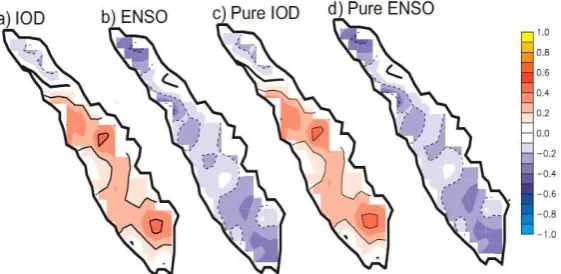
Figures 4 shows the normal and partial correlations between the precipitation over Sumatera and DMI/Niño3.4 index during the northwest monsoon (DJF) season. The normal correlation during the northwest monsoon season indicates that the precipitation over the most part
of Sumatera has positive correlation with IOD with the highest correlation observed in the southern part of Sumatera (Figure 4a). In contrast, the precipitation over the whole Sumatera region shows negative correlation with the ENSO (Figure 4b). After excluding the influence from ENSO, the correlation between precipitation and IOD remains positive but slightly weaker (Figure 4c). On the other hand, the correlation between precipitation and ENSO does not change after removing the influence from IOD (Figure 4d).
The results for the normal and partial correlations between precipitation and IOD/ ENSO during the spring transition of the monsoon (MAM) season are shown in Figure 5. The precipitation shows positive correlation with IOD, and the largest correlation is observed in the central Sumatera (Figure 5a). We obtained similar result after excluding the influence from ENSO (Figure 5c). On the other hand, negative correlation is observed between precipitation and ENSO (Figure 5b). Similar result was obtained after removing the influence from IOD (Figure 5d).
Figure 4. Distribution of normal correlation coefficients between precipitation and DMI (a) and Niño3.4 index (b) during the northwest monsoon (DJF) season. (c) and (d) same as in (a) and (b) except for the partial correlation coefficients. Correlations above 90% significant level are contoured. The zero contour is indicated by the thick-solid contour.
Figure 5. Same as in Figure 4, except during the spring transition of the monsoon (MAM) season.
The correlation between precipitation and IOD/ENSO show interesting results during the southeast monsoon (JJA) season (Figure 6). The
International Journal of Remote Sensing and Earth Sciences Vol. 8, 2011 23 (Figure 6a). The correlation is stronger if we
removed the influence from ENSO (Figure 6c). On the other hand, the precipitation over southern (northern) parts of Sumatera shows negative
(positive) correlation with the ENSO (Figure 6b). The correlation does not significantly change after removing the influence from the IOD (Figure 6d).
Figure 6. Same as in Figure 4, except during the southeast monsoon (JJA) season.
Remarkable different between the normal and partial correlation for both the IOD and ENSO influences were observed during the fall transition of monsoon (SON) season (Figure 7). The northern and central parts of Sumatera have negative correlation with the IOD, while the rest shows positive correlation (Figure 7a). The precipitation has negative correlation with ENSO over Sumatera, except the northern part that has
positive correlation (Figure 7b). After excluding the influence from ENSO, the correlation between precipitation over the southern part of Sumatera and IOD significantly increased (Figure 7c). Similarly, the removal of IOD influence results an increase in correlation between precipitation over the southern part of Sumatera and ENSO (Figure 7d).
Figure 7. Same as in Figure 4, except during the fall transition of the monsoon (SON) season. 4. Conclusion
Long-term precipitation record has been used to evaluate the long-term climate variation over Sumatera. The results show that there is a long-term climate variation over Sumatera region indicated by a decreasing trend in precipitation (drying trend). The long-term precipitation trend has a strong seasonality. Remarkable decreasing trend at a rate of 3.9 cm/year (the largest trend) was observed during the northwest monsoon (DJF) season, while the smallest decreasing trend of 1.5 cm/year occurred during the southeast monsoon (JJA) season. This suggests that the
Sumatera Island experienced a drying trend during the northwest monsoon season. In addition, it is likely that Sumatera Island will experience a dryer condition during southeast monsoon.
24 International Journal of Remote Sensing and Earth Sciences Vol. 8, 2011
IOD and ENSO are remarkably seen during the fall transition of the monsoon from September – November, in particular in the southern part of Sumatera region. The precipitation has positive (negative) correlation with IOD (ENSO).
However, the mechanism underlying the
influences of IOD and ENSO on precipitation trend over Sumatera is required further analysis and will be the topic of our future study.
5. Acknowledgements
This study was supported by the University of
Sriwijaya through a “Penelitian Unggulan
Perguruan Tinggi 2012” and “Penelitian Fundamental 2012”. The authors would like to
thank the member of Center for Geohazard and Climate Change Study for helpful discussion. This is CGCCS contribution number 1203.
6. References
Aldrian, E., and R. D. Susanto, 2003, Identification of three dominant rainfall regions within Indonesia and their relationship to sea surface temperature, Int. J. Climatol., 23, 1435−1452.
Ashok, K., Z. Guan, and T. Yamagata, 2003, Influence of the Indian Ocean Dipole on the Australian winter rainfall, Geophys. Res. Lett., 30, 1821, doi:10.1029/2003GL017926. Chang, C.P., Z. Wang, J. Ju, and T. Li (2004), On
the relationship between western maritime continent monsoon rainfall and ENSO during northern winter, J. Climate, 17, 665−672.
Hamada, J.-I, S. Mori, H. Kubota, M. D. Yamanaka, U. Haryoko, S. Lestari, R.
Sulistiyowati and F. Syamsuddin, 2012, Interannual Rainfall Variability over Northwestern Jawa and its Relation to the Indian Ocean Dipole and El Niño-Southern Oscillation Events, SOLA, 8, 069−072, doi:10.2151/sola.2012-018.
Haylock, M., and J. McBride, 2001, Spatial coherence and predictability of Indonesian wet season rainfall, J. Climate, 14, 3882−3887.
Hendon, H.H., 2003, Indonesian rainfall variability: Impacts of ENSO and local air-sea interaction, J. Climate, 16, 1775−1790. Kubota, H., R. Shirooka, J.-I. Hamada, and F.
Syamsudin, 2011, Interannual rainfall variability over the eastern maritime continent, J. Meteor. Soc. Japan, 89A,
Vinayachandran, and T. Yamagata (1999), A dipole mode in the tropical Indian Ocean,
Nature, 401, 360−363.
Schott, F.A., S.-P. Xie, and J.P. McCreary, 2009, Indian Ocean circulation and climate variability, Rev. Geophys., 47, RG1002, doi:10.1029/2007RG000245.