• Tidak ada hasil yang ditemukan

The role of the Islamic religious organizations, some issues and considerations | Basri | Proceedings of AICS - Social Sciences 6008 12428 1 SM

N/A
N/A
Protected

Academic year: 2017

Membagikan "The role of the Islamic religious organizations, some issues and considerations | Basri | Proceedings of AICS - Social Sciences 6008 12428 1 SM"

Copied!
6
0
0

Teks penuh

(1)

100

THE ROLE OF THE ISLAMIC RELIGIOUS ORGANIZATIONS, SOME

ISSUES AND CONSIDERATIONS

HASAN BASRI

Faculty of Economics, Syiah Kuala University, Aceh, Indonesia

ABSTRACT

In the country with the largest Muslim population, such as Indonesia, Islamic based religious organizations, such as pesantrens, have played a very significant role in providing services for society. However, there are only a few studies that have examined the role of these kind of organizations in providing services for the community. As such, this article discusses some issues and role played by religious based organization, specifically, Islamic religious organization. The paper starts by looking at the nature of religious organizations, and then followed by the brief of pesantrens. The roles of Islamic religious organizations in Indonesia are also discussed.

Keywords : Religious Organization, Islam, Pesantren

Introduction

In Indonesia, the country with the largest Muslim population, Islamic religious organizations have become important providers of social services across the country. One of the most important institutions is the pesantren, an Islamic boarding school that provides education services at minimal cost to students. However, only a limited number of researchers have examined the role of this kind organizations in society. Therefore a study is needed to understand the role of religious organization in providing education for the society. As such the aim of this paper is to discuss the role of Islamic religious organizations in providing services for community. The paper include information gathered through literature sources and semi structure interviews with a few informants The paper is structure as follows: Section 2 discusses the nature of religious based organizations, It then proceeds with the brief of

pesantren. Section 4 discusses the role of Islamic religious organizations in Indonesia and section 5 provides a conlusion.

The Nature of Religious Based Organizations

Literature on religious studies indicates that religious organizations are among the oldest of human institutions. These kinds of organizations or communities have been providing assistance to those afflicted by natural disaster, persecution, uprooting and war long before international humanitarian law was formalized in treaty law (Ellizabeth, 2005). However, there is no single accepted definition of what constitutes a religious-faith based organization.

Martens 2002, as quoted by Berger (2003, p.1), defined religious organizations as:“formal

organizations whose entity and mission are self-consciously derived from the teachings of one or more religious or spiritual traditions and which operates on a non-profit, independent, voluntary basis to promote and realize collectively articulated ideas about the public good at the national or international level”.

Kramer et al. (2002, p.2) define a religious based organization as “an organization that

(2)

101

worship”. They claim that these organizations include congregations or houses of worship, and non-profit organizations affiliated with religion.

Although, there is no generally accepted definition of religious based organizations,

they are characterized by having one or more of the following:“affiliation with religious body; a mission statement with explicit reference to religious values; financial support from religious sources; and/or a governance structure where selection of board members or staff is based on religious beliefs or affiliation and/or decision-making processes based on religious values” (Ellizabeth, 2005, p. 312).

The World Conference on Religion and Peace (2001) claimed that religious organizations are the largest and best organized civil institutions in the world today, due to the allegiance of billions of believers and bridging the divides of race, class and nationality (Berger, 2003). Furthermore, religious based organizations have a long history of transforming individual lives and helping to raise people out of poverty and despair. They provide services to tackle issues ranging from hunger to education with or without support from government.

Religion has been a primary motivator and shaper of many efforts to improve the life

of humankind. Islam, for example, contributes to the welfare of one’s community through the giving of alms and doing works of mercy, which is essential to the practice of Islam. Buddhism teaches that acts of compassion are steps along the path to enlightenment, and Christianity promotes providing charity to the poor, medical care to the sick, and education for children. Since a society will be judged by the way it treats its weakest members, it is argued that the most important contribution of a religious organization is the commitment to act in the interest of others (see Ellizabeth, 2005; Jeavons, 2003). This means that religious organizations exist for the benefit of others, not for the management or stockholders.

However, there are two characteristics that set religious organizations apart from secular non-profit organizations: “they are motivated by their faith and they have a constituency which is broader than humanitarian concerns. For believers, to be a Jew or a Muslim or a

Christian implies a duty to respond to the needs of the poor and marginalized” (Ellizabeth,

2005, p.316). This means that religious-faith based organizations are more focussed on social services, volunteer management and fund raising. Thus, religious-faith based organizations are not simply another type of organization; they are a link to God, moral, faith, and have the absence of ownership. The following section will provide explanations concerning one of the most important religious institutions in Indonesia called pesantren, an Islamic boarding school that provides education services for society.

The Brief of Pesantren

Very limited historical evidence has been found that could explain the origin of

pesantren in Indonesia. Majid (1997), as quoted by Haedari and Hanif (2004, p.3), states that

“the origin of pesantren has very strong relationship with the pre-Islamic educational institutions that existed in the Hindu-Buddhist-Kingdom”. This is also supported by Lombard who indicates some similarities between pesantren and the educational institutions that existed during the Hindu-Buddhist time (Haedari and Hanif, 2004, p. 3). This means that Islam continues the Hindu-Buddhist educational system through the process of adjustment and change.

Pesantren’s other name is called pondok, often the words are also put together: Pondok Pesantren (Subandi, 1998). Pesantrens have had a significant influence on all aspects of society. According to Abdullah, as quoted by Lukens (2000, p. 34), “prior to the 20th Century,

pesantren was the only form of education found in Indonesia”.

(3)

102 traditional (salafi) pesantren and modern (khalafi)pesantren. Both types of pesantrens share some basic elements such as a dormitory, mosque, students (santri) and kitab kuning (See Luken, 2000; Subandi, 1998, Pohl, 2006). However, there are also some differences between these two types of pesantren. In traditional pesantrens, for example, there is no set curriculum, The lesson consist only of religious subject and Arabic language taken from kitab kuning9. The

method of teaching is typically “traditional”, relying on the individualized instruction and the

collective learning methods. The graduates of traditional (salafi) pesantren are not regarded as being equally qualified as graduates of public school. Whereas in the modern pesantren, in addition to kitab kuning, they usually adopt the recommended curriculum from the government. Such an adopted curriculum contains subjects common for national examination. Today, all

pesantrens considered as modern pesantrens have madrasah (schools) within their complex. The madrasahs built in the pesantren are equivalent to the public junior secondary school (madrasah tsanawiyah) and the senior secondary education (madarasah a’liyah). The management of both these schools is under the Ministry of Religious Affairs. The madrasah

certificates are regarded as being equivalent to those of a public school. It thus qualifies its graduates to continue their education in the public sector at the post secondary level (See Country Report, 2004).

Although the terms of salafi and khalafi are used widely in the community, there is no official definition or criterion to determine a pesantren as salafi or khalafi. The translation of

salafi into traditional and khalafi into modern or moderen in Indonesian is based on the common use in the society.

In the the province of Aceh, in which this study was conducted, the local government,

represented by Badan Pembinaan dan Pendidikan Dayah (Dayah Supervisory and

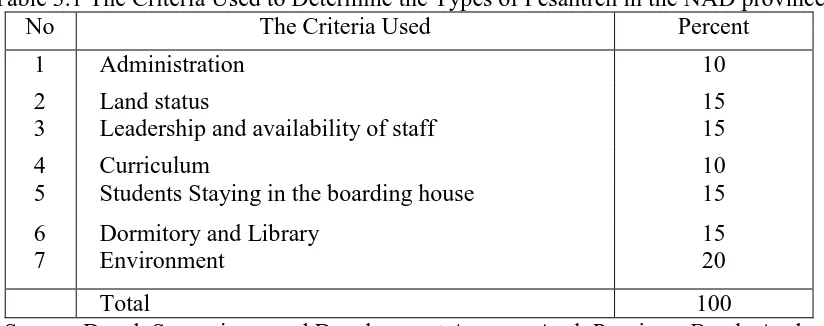
Development Agency), one of the government agencies established in 2008 by the Aceh government and which is primarily responsible for pesantren development, officially divides the type of pesantren into Type A, Type B, Type C, and type D. The criteria used are as follows:

Table 3.1 The Criteria Used to Determine the Types of Pesantren in the NAD province

No The Criteria Used Percent

1 Administration 10

2 Land status 15

3 Leadership and availability of staff 15

4 Curriculum 10

5 Students Staying in the boarding house 15

6 Dormitory and Library 15

7 Environment 20

Total 100

Source: Dayah Supervisory and Development Agency, Aceh Province, Banda Aceh.

The highest score is classified as pesantren type A, and than followed by types B, C and D. Recent figures show that there are 852 Islamic educational institutions registered in the Department of Religious Affair in Banda Aceh as pesantrens. However, the Dayah Supervisory

9 Called Kuning, yellow, after the tint paper of books brought from Middle East in the early twentieth

(4)

103 and Development Agency has only recognized 588 institutions as pesantrens, which consist of 72 pesantrens as type A, 123 pesantrens as type B, 195 pesantrens as type C and finally, 198 pesantren are classified as type D, the rest being classified as a hall to study religion (balai pengajian) because they cannot fulfil the basic requirements of pesantren. It appears that in the past, many Islamic educational organizations in Aceh that did not meet the criteria of

pesantren were also considered as pesantren because there were no official indicators to determine whether an organization was a pesantren or not.

Furthermore, it is important to note that pesantrens (referred to as Dayah in Aceh) have existed for over a Century. Dayahs have the same function as pesantrens but these two educational institutions have a different historical background. According to Purbakawaca (1979), as quoted by Amiruddin (2003, p.34), pesantren resemble the Hindu educational institutions that existed before Islam arrived in Indonesia. The term pesantren is derived from

the words “santri”. The word santri is from shastri (castri-India), which referred to individuals who understand the Hindu holy book. When Islam arrived, the purpose of this institution was adjusted to the Islamic domain. The name of Dayahcomes from the Arabic word “Zawiyah”

which literally means a corner, which was believed by the Acehnese to have been first used for the corner of the mosque of Madina where Prophet Muhammad taught the people. The word

zawiyah is pronounced as Dayah by the Acehnese (Amiruddin, 2003, p. 33). However, the term of pesantren is more popular and commonly used in Aceh. Seen from this point of view, the origin of pesantrens in Aceh have a different historical background to that of pesantrens

elsewhere in Indonesia.

Hasyimi (1975), the prominent local historian, as quoted by Amiruddin (2003, p. 38), says that the original objective of dayahs was to produce people who had the skill to be the

sultan’s minister, qadhi, or some other kind of officer. This means that dayahs during the early period not only trained their students in religious matters in the narrow sense, but also provided instruction in other subjects to ensure that they were able to produce people to administer the state. However, some dayahs have come under criticism for producing students that are only equipped with religious knowledge and that lack other skills (Amiruddin, 2003). They argue that the dayahs should produce graduates who have certain skills in addition to religious learning. This can be understood as most dayahsin Aceh are classified as “traditional”, i.e.,

focusing on the exclusive teaching of the religious curriculum. Only a few dayahs have established and use the full-national curriculum (at junior and senior secondary levels), and are regarded as modern or integrated dayahs(and may be explicitly designated as “modern” within

their titles or simply referred to as such).

In terms of financial matters, historically, almost all pesantrens have sustained their development independently through fund raising activities, without any major financial assistance from the government. However, nowadays there have been moves by the government to optimize their social function as an educational institution that also serves as a centre for community development. Every year, the government provides a reasonable amount of funds to support the activities of the pesantrens. Even, the local government “the Province of Aceh” has established a special government agency to enhance the management of

traditional and modern dayah to undertake more effective management, either in teaching, learning or in financial management.

The Role of Islamic Religious Organizations in Indonesia

(5)

104

bound by a legal order or set of shared rules. It is distinct from “society” in general in that it

involves citizens acting collectively in a public sphere to express their interests, passions, preferences, and ideas to exchange information, to achieve collective goals, to make demands of the state, to improve the structure and functioning of the state, and to hold state official

accountable” (Epley, 2004, p. 40).

Religious organizations can involve the individual, community and the state simultaneously, and overlap the private and public spheres. Charitable, poverty, and educational programmes, such as pesantren (Islamic boarding schools), demonstrate a case of public goods provided by a religious group, which can at times involve the state. The official religions of Indonesia are Islam, Christianity, Buddhism, and Hinduism. Islam makes up the overwhelming majority of the country. All of the religious groups have a long history of providing public goods to their followers and the larger community. Charity and education are very much a daily part of their religious tradition (Epley, 2004).

The former Indonesian minister for Religious affairs, Tarmizi Taher also notes that, “in

the past ten years Indonesia’s religious institutions have shown great concern over the

economic development of their members. He believe that two examples – banks utilizing

shari’ah and the pesantren – were indications that religious institutions do encourage economic

development” (Epley, 2004, p.46). He also argues that nearly all religious institutions in the

country are committed and highly motivated to raise the level of welfare of their members. Furthermore, religious organizations in Indonesia are also powerful in influencing government policy. Epley (2004) shows two cases as evidence of the role of religious organization in influencing the economic and social development policies. They are debates on family planning and education policy.

Regarding family planning, the Indonesian government has struggled to control population growth and improve family health, and the formal approaches used by government officials for introducing family planning during the early 70s largely failed. Government researchers concluded that policy makers had neglected the role of religious community leaders. Many Muslim scholars informed Muslims that family planning devices like IUDs and birth control pills are contradictory to Islamic teachings. It was, therefore haram (prohibited) for Muslims to cooperate with government programmes to practice family planning. Hence, the state essentially required the backing of Ulama (religious scholars), otherwise, people would not respond positively to any government policy, rule or regulation that involved religious issues. After a series of discussions, workshops and meetings, the government and key Muslim leaders came to an agreement on the need and benefits of family planning. As a result, the people can easily accept the government programme of family planning.

Concerning education policy, the religious organizations had a comparative advantage over the secular groups. The Islamic religious organizations showed that they had a powerful influence on the state, one example being the controversy that arose in the mid-1980s over the rights of Muslim schoolgirls to wear hijab10. The state law prohibited the use of any clothing or accessories that were not officially part of the school uniform. Some Muslims girls faced strong reaction from their teachers and principals. Some were forced to move to private schools, while others were banned from taking the school exams. Consequently, many Muslim leaders and Islamic religious organizations criticized the government policy, saying that it was an example of the state developing secular education policies and that it deprived Muslim

10 Hijab is the Arabic term, frequently used in Malaysia, it refers to the head dress worn by Muslim

(6)

105 children of their right.

Conclusions

This paper concern the role of religious organizations, particularly, Islamic religious organizations in Indonesia. There are two characteristics that set religious organizations apart from secular non-profit organizations: they are motivated by their faith and they have a constituency which is broader than humanitarian concerns. These kinds of organizations have played very significant roles in providing various assistances for Indonesian society. They aim to provide social services, and empower people as well as to engage in advocacy in influencing government policy.

References

Amiruddin, H., M. (2003) Ulama Dayah, Pengawal Agama Masyarakat Aceh, Nadya Foundation, Lhoksemawe, Aceh, Indonesia.

Berger, J. (2003) Religious Non-Governmental Organizations” An Exploratory Analysis,

International Society for Third-Sector Research and the Johns Hopkins University, pp. 1-23.

Bremer, J. (2004) Islamic Philanthropy: Receiving Traditional Forms for Building Social Justice, CSID Fifth Annual Conference, Washington.

Country Report (2004) Quality Education for All Young People, Paper Presented to the 47 International Conference on Education, Genewa Switzerland.

Directorate of Religious Education and Pondok Pesantren, Department of Religious Affair(2005) The Dynamics of Pondok Pesantren in Indonesia.

Ellizabeth, F. (2005) Faith-Based and Secular Humanitarian Organizations, International Review of The Red Cross, 87(858), pp. 312-325.

Epley, J., L. ( 2004)Development Issues and The Role of Religious Organizations in Indonesia, Studies on Asia, series II, 1 (1), pp. 39-52.

Haedari, A., and Hanif A. (2004) Masa Depan Pesantren,Dalam Tantangan Modernitas dan Tantangan Komplesitas Global, IRD Press, Jakarta.

Kramer, F., D., Nightingale, D., Trutko, J., Spaulding, S., and Bamow, B. S. (2002) Faith-Based Organizations Providing Employment and Training Services: A Preliminary Exploration, Discussion Paper, The Urban Institute, 2100 M Street, NW, Washington, DC 20037.

Lukens-B., Ronald, A. (2000) Teaching Morality: Javanese Islamic Education In A Globalizing Era,Journal of Arabic and Islamic Studies,(3) pp. 27-47.

Pohl, Florian (2006) Islamic Education and Civil Society: Reflections on the Pesantren Tradition in Contemporary Indonesia, Comparative Education Review, 50 (3), pp 389-409.

Gambar

Table 3.1 The Criteria Used to Determine the Types of Pesantren in the NAD province  No The Criteria Used Percent

Referensi

Dokumen terkait

Result of the study conducted by several institutions which concerned with street children, such as Center of Study and Child Protection (PKPA) of Aceh, Social Department