ISSN
: 1411-5735
V o l u m e
1 0 N o m o r
2
J u r n a l IL M U
D A S A R V o l . 1 0
N o . 2
Hlm. 109-244
J e m b e r
J u l i 2 0 0 9
Atas
Bawah
lssN 1411-
57:5
,
Jurnal ILMU DASAR
V o l u m e
1 0 N o m o r
2 J u l i 2 0 0 9
P i m p i n a n
E d i t o r
I Made Tirta
Sekretaris
Kartika
Senjarini
Editor Pelaksana
Eva Tyas Utami
Edy Supriyanto
Dewan Editor
Moh. Hasan
Sujito
Wuryanti
Handayani
Sattya
Arimurti
Editor Teknik
Kusbudiono
Adminisffi:'g,,ilfffansan
Nur Syamsiyah
Harpanti
Jurnal
llmu Dasar
diterbitkan
oleh :
Fakultas
Matematika
dan llmu Pengetahuan
Alam, Universitas
Jember.
Terbit
sejak
Janqpri
2000 dengan
frekuensi
penerbitan
dua kali setahun.
Terakreditasi
berdasarkan
SK Dirjen Dikti NOMOR:
65a/DlKTl/Kep/2008
tanggal
15 Desember
2008
Alamat Editor/Penerbit:
Jl. Kajimantan
37 Kampus
Tegalboto,
Jember
68'12'l
Telp. (0331) 334293;
Fax. (0331) 330225
atau
http://www.unej.ac.id/fakultaslmipa/
atau http:l/r,vww.mipa.unei.ac.id
Keterangan
sampul
:
: Cormel
explants
with shoot intiation
of three gladiolus
cultivars;
(a) Nabila,
(b) Clara
and (c) Kaifa
in 18 days"
after
planting
on MS free hormone
media.
: Plantlet
performance
of gladiolus
cultivars:
(a) cv. Nabila
on 2 mgil BAr
UCAPAN
TERIMA
KASIH
Diucapkan
terima kasih kepada MITRA BESTARI
atas kontribusinya
pada penerbitan
Jurnal
ILMU
DASAR
Volume
10 tahun
2009
:
1.
Prof. Agus
Subekti,
M.Sc.,
Ph.D.
2.
Prof.
Prof.
Dra.
Susanti
Linuwih,
M.Stats.,
ph.D.
3.
Prof.
Dr.rer.nat.
Karna
Wijaya,
M.Eng.
4.
Prof.
Dr. Wiwik
TriWahyuni,
M.Sc.
5.
Triyanta,
Ph.D.
6.
Prof.
Dr. Tejasari,
M.Sc.
7.
Slamin.
Ph.D.
B.
Drs.
Moh.
Hasan,
M.Sc.,
Ph.D.
L
Prof.
Kusno,
DEA.,
Ph.D.
10. Prof.
Endang
Semiarti,
M.Sc.,
Ph.D.
11. Prof.
Dr. Mammed
Sagi,
M.S.
12. Prof.
Endang
Soetarto,
M.Sc.,
ph.D.
13. Pepen
Arifin,
Ph.D.
14. Prof.
Dr. Bambang
Sugiharto,
M.Sc.Agr.
15. Prof.
Dr. I Nyoman
Budiantara,
M.Si.
16. Drs.
Siswoyo,
M.Sc.,
Ph.D.
17. Drs.
Achmad
Sjaifullah,
M.Sc.,
ph.D
18. Drs.
Zulfikar,
Ph.D.
19. Drs.
Bambang
Kuswandi,
M.sc.,
ph.D.
20. TriAtmojo
Kusmayadi,
M.Sc.,
ph.D.
21. Dr. Sekartedjo
22. Dr. Hidayat
Teguh
Wiyono,
M.pd.
23. Drs. Budi Lestari,
M.Si.
24. Dr. dr. Supangat,
M.Kes.
25. Dra. HariSulistyowati,
M.Sc.
26. Dr. Wiwik
SriWahyuni,
M.Kes.
27. Dr. M. lsa lrawan,
M.T.
Volume
10 Nomor
2 Juli 2009
lssN 1411-5735
Jurnal ILMU DASAR
DAFTAR ISI
ln Vitro Regeneration
of Three Gladiolus
Cultivars
Using Cormel Explants by Kurniawan Budiarto
( 1 0 9 - 1
1 3 ) .
Solusi Analitik
Persamaan
Schrddinger
Sistem Osilator
Harmonik
1 Dimensi
dengan Massa Bergantung
Posisi menggunakan
Metode
Transformasi
(Anatyticat
Sotution
ol Schrodinger
Eq-uation
oi tne Uarmonic
Oscillator
System
with Position
Dependent
Mass Using
Transformation
Method")ofefr'suiisna
(114-120).
Peningkatan
Kualitas
Minyak
Jelantah
Menggunakan
Adsorben
Hs-NZA
dalam Reaktor
sistem Fluid fixed
bed [he lmprovement
of_Waste
Cooking
Oil Quatity using H5-NZA Adsorbent
in Ftuid Fixed Bed Reactor)
oleh Donatus
setyawan p. Handoko,
Triyono, Narsito,
tutlr owi (121-1g2).
Konsistensi
dan Asimtotik
Normalitas
Model Multivariale
Adaptive
Regression
Spline
(Mars) Respon
Biner
(Consistency
and Asymptotic
Normatity
of Maximum
Liketihood
Estimior in MniS ainiry iisponse Model
oleh
Bambang
Widjanarko
Otok (133-140).
Analisis
Reservoar
Daerah
Potensi
Panasbumi
Gunung
Rajabasa
Kalianda
dengan
Metode
Tahanan
Jenis
dan Geotermometer
(Geothermat
Reservoir Anatysis-
of ilount Rajabasa
Kaianda pitency Area using
Resistivity
Method and Geothermometer)
oleh Nandi Haerudin, Vina Jaya parOeOe,'
Syamsurijai
R a s i m e n g
( 1 4 1 - 1 4 6 ) .
Aplikasi
Sistem Informasi
Geografi
(SlG) untuk-Mempelajari-Keragaman
Struktur
Habitat
Laba-laba
pada
Lansekap
Pertanian
di Daerah
Aliran Sungai (DI\q). cialJul (AppticZtion
of Geographical
tnfomation
System
(!-tp) to S_tudy
Diyersity of Habitat Structure of Spider i; Ag'ri;itturat Landscape
in Cianjur Watershed)
oteh
I Wayan
Suana
dan Yaherwandi
(147-152).
Modified
Newton
Kantorovich
Methods
for Solving
Microwave
Inverse
Scattering
problems
by Agung Tjahjo
Nugroho
(153,159).
ldentifikasi
The Bactericide
Fraksi
Aktif Bakterisida
pada Rimpang
Lempuyang
(Zingiber ramineumBlume)
(tdentification
of
Active Fraction
on Zinqiber
qiamineum'8iumd
earxio'leh
I Made oira Swairtara (160-170).
Embe.dding
Grat Kz,s,n
pada Torus (Embedding
K23,, Graphs on Torus) oleh Liliek Susilowati, Nency
Rosyida
Y, Yayuk
Wahyuni
(171-180).
Uji Sitotoksisitas
Ekstrak
Metanol
Buah Buni (An.tidesma
bunius
(L) Spreng)
terhadap
Set Hela (Cytotoxicity
Effect
of Methanolic
Extract.of.
Buni-'s
Fruits
(Anldcsmg
bunius
1Ly'sjreng)'against
Hiti ceirg oten Endah
Puspitasari
& Evi Umayah
Utfa
(181-185).
Laser
Induced
Thin Film
Production
(LITFP)
Using
Nitrogen
(N2)
Laser
Deposition
by Syamsir
Dewang
(186-1 8 9 ) .
Constructing
Fuzzy Time Series Model Using Combination
of Table Lookup and Singutar value
Decomposition
Methods
gnd lts Application
to Foiecasting
Inflation
Rate by Agus Maman Abadi, Subanar,
Widodo,Samsubar
Sateh (190-i9S).
Simulasi
Model Jaringan
Selular
melalui
Pemrograman-
Inte-ger
(Simutation
of Ceilular Network
Modet by
I nteg
e r Prog
ram
m i ng) oteh Agustina pradjanin
gsih (1 99-206j.
Jurnal ILMU DASAR
DAFTAR ISI
Efek Protektif
Propolis
Dalam Mencegah
stres oksidatif Akibat Aktifitas Fisik Berat (swrm
ming stress)
(Propotis Protective Effect to Prevent-oxidarive^
stress cai;;J-oy' itrenous pnyiiiit \iiii,ty (swimming
Sfress))
ofeh Hairrudin
dan Dina Hetianti
(207-211).
Pusat
dari Beberapa
Gelanggang
Polinom
Miring
(rhe centre of some skew potynomial
Rings)
oleh Amir
Kamaf Amir (212-2181.
Efek Kondisi
Hiperglikemik
terhadap
struktur
ovarium
dan siklus Estrus
Mencit
(Mus musculusL)
(Effect
of
Hyperglikemic
conditions
on ovarian structure.and
estpui)icte i'ui"r(Mus musculus
L)) oteh Eva Tyas
Utami,
Rizka Fitrianti, Mahriani,
Susantin
Fajariyah
tZtg-iiil.
- '
Generalized
Reduced
Gradient
Untuk optimasi Amunisi Kaliber 57 mm c-60 Het (Generalized
Reduced
Gradient
optimization
for Ammunition
caiiber 57 mm c-oo ieo-olii Muhammad sjahid Akbar, Bambang
Widjanarko
Otok, dan Lesti Anggraini (225-23s)
ev vre"rv
^^vr
Beberapa
senyawa Hasil lsolasi dari Kulit Batang Tumbuhan
Kedoya
(Dysoxylum
gaudichaudianum
(A.
Juss.) Miq.) (Metiaceae)
.(p9v9r7t compoundi tsotated rroi-'dtem Bark of Kedoya erqvlur
oaudichaudianum
(A. JussJ.Miq
) (Meliaceie))
oleh ruliran, i"yutr"
Hamdani,
1 9 0
I
i
:
I
l
C onstructing F uzzy Time... (A gus M aman Abadi dkk)
ConstructingFazzy Time Series Model Using Combination of Table Lookup
and Singular Value Decomposition Methods and
Its Application to Forecasting Inflation Rate
Agus Maman Abadir), Subanar2), widodo2), Samsubar Saleh3)
1)Department of Mathematics Education, Faculty of Mathematics and Natural Sciences,
Yo gyakarta Stat e Univ e rsity
t)Ph.D Student, Department of Mathematics, Faculty of Mathematics and Natural Sciences, Gadjah Mada University
2)Department of Mathematics, Faculty of Mathematics and Natural Sciences, Gadjah Mada University
3)Department
of Economics, Faculty of Economics and Business, Gadjah Mada University
ABSTRACT
Fuzry time series is a dynamic process with linguistic values as its observations. Modelling fuzzy time sedes
data develo@ by some researchers used discrete membership functions and table lookup method furm taining
data. This paper presents a new mettrod to modelling fuzzy time series data combining table lookup and singular
value decomposition methods using continuous membership functions. Table lookup method is used to
constuct fuzzy relations from fraining data. Singular value decomposition of fuing strength mahix and QR
factorization are used to rcduce fuzz] relations. Furthermore, this method is applied to forecast inflation rate in Indonesia based on six-factors one-order fuz4r time series. This result is compared with neural nefivork rnethod and the proposed method gets a higherforecasting accuracy rate than the neural network method.
Keywords: Fuzry time series, tablelookup, singularvaluedecompositioq inflation rate.
INTRODUCTION some researchers (Sah & Degtiarev 2004, Chen
& Hsu 2004).
Fuzzy time series is a dynamic process with Forecasting inflation rate in Indonesia by
linguistic values as its observations. Many fuzzy model resulted more accuracy than that
researchers have developed fizzy time series by regression method (Abadi et al. 2006).
model. Song & Chissom (1993a) developed Following the above paper, Abadi et al. (2007)
fuzzy time series model based on fuzzy also constructed flzzy time series model using
relational equation using Mamdani's method. table lookup method to forecast interest rate of
In their paper, determination of the fuzzy Bank Indonesia certificate and the result gave
relation needs large computation. Meanwhile, high accuracy. Abadi et al. (2OO8a, 2008b)
Song & Chissom (1993b, 1994) also showed that forecasting inflation rate using
constructed first order fuzzy time series for singular value method had a higher accuracy
time invariant and time variant cases. This thanthatusingWang'smethod.
model needs complex computation for fuzzy Abadi et al. (2008c) constructed a
relational equation. Furthermore, to overcome generalization of table lookup method using
the weakness of the model, Chen (1996) firing strength of rules and applied it in
designed fuzzy time series model by clustering financial problems. Fuzzy time series model
of fuzzy relations. based on a generalized Wang's method was
Hwang et al. (1998) constructed fuzzy time designed and it was applied to forecast interest
series model to forecast the enrollment in rate of Bank Indonesia certificate that gave a
Alabama University. Fuzzy time series modei higher prediction accuracy than using Wang's
based on heuristic model gives more accuracy method (Abadi et al. 2009a). Furthermore, than its model designed by some previous forecasting interest rate of Bank Indonesia
researchers (Huamg 2001). Forecasting for certificate based on multivariate fuzzy time
enrollment in Alabama University based on series data was done by Abadi et al. (2O09b).
high order fuzzy time series resulted high Kustono et aI. (2O06) applied neural network
prediction accuracy (Chen 2002). First order method to forecast interest rate of Bank
[image:6.612.123.535.38.478.2]Jurnal ILMU DASAR. Vol. I0 No. 2. Juli 2009 : j,90-198
In this paper, we will design fuzzy time series model combining table lookup method and singular value decomposition using continuous membership functions to improve
the prediction accuracy. This method is used to
forecast inflation rate in Indonesia.
METHODS
QR factorization and singular value decomposition
In this section, we will introduce QR factoizatiot and singular value decomposition of matrix and its properties referred from Scheick (1997). l,et B be m x n matrix and suppose mSn. The QR factorization of B is given by B =QR, where Q is m x m orthogonal matrix and R = [R,, R,r) is m x n matrix with m x m uppet triangular matrix R,, . The QR factorization of matrix B always exists and can be computed by Gram-Schmidt orthogonalization. Any m x n matrix A can be expressed as
A = U S V , , ( l )
where U and V are orthogonal matrices of dimensions m x tn, n x /r respectively, and S is n x n matrix whose entries are 0 except s,; = o,
i = 1 , 2 , . . . , r w i t h 6 , 2 o , 2 . . . > o . > 0 , r <min(m,n). Equation (l) is called a singular value decomposition (SVD.1 of A and the numbers q are called singular values of A. If U , V are columns of U and V respectively, then equation (l) c a n b e w r i t t e n 6 I = 2 o J J V ' .
I-et ff a ll', =7rt; be the Frobenius norm of A. Since U and V are orthogonal matrices, then
llu, ll=1
and
llv,
ll=t.
Hence
i l , 1 2 ,
l l e l l . = l l l o l l v ' l l = 2 o ' . L e t A = U S V ' b e
l l , r l l F
SVD of A. For given p < r , the optimal rank p approximation ofA is given by A,, =io,IJ,V,' . Thus
l t , , i l r
llA
-A"
ll, =ll>.o,u
v; -1o,u
,v;ll,
.
= l l z " ' , ' 1 l l =
t o'
i l ' - P , l l
this means that Ao is the best rank p approximation of A and the approximation error depend only on the summation of the square of the rest singular values.
Designing fuzzy time series model using table lookup method
Let Y (t) cR, r = ..., -1, 0, l,2, ..., be rhe universe of discourse in which fuzzy sets "f, (l ) (i = 1, 2, 3,...)
are defined. If F(r) is the collection of/, (r), i = l, 2, 3,..., then F(t)is called fuzzy time series on I (t) . Based on this definition, fuzzy time series
F(t) can be considered as a linguistic variable and /, (r) as the possible linguistic values of f. (r) . The value of F(r) can be different depending on time t. Therefore F(r) is function of time r. Let{(r) be fizzy tme series on f (r). If {(/) is caused by
(F,(t -r),F,(t -1)), (4 Q -Z),r"Q -z)),
(F,(t -n),F,(t -n)), then a fuzzy logical
relationship is presented by
(F,(t -n),F,(t -n)),... ,(F,(t -2),F,(t -2)), (F,(t -1), F,(t - l)) -+ 4 (t ) . The fuzzy logical relationship is called two-factors n-order fuzzy time series forecasting model, where {(r),{(r) are called the main factor and the secondary factor fuzzy time series respectively. If a fuzzy logical
relationship is presented as ( F , ( r - n ) , F , ( t - n ) , . . . , F . ( t - n ) ) , . . . , (F,(t -2),F,(t -2),...,F^(t -2)),
(F,(t -L),F,(t -r),...,F_(t -l)) + 4(r) , (2) then the fuzzy logical relationship is called m-factors n-order fuzzy time series forecasting model, where {(t) is called the main factor fuzzy time series and F,(t),...,F,,(t)are called the secondary factor fuzzy time series. The application of multivariate high order fuzzy time series can be found in l*e et al. (2006) and Jilani et aI. (2007).
Like in modeling traditional time series data, training data are used to set up the relationship among data values at different times. In fuzzy time series, the relationship is different from that in traditional time series. In fuzzy time series, we exploit the past exp€rience knowledge into the model. The experience knowledge has form "IF ... THEN ...". This form is called fuzzy rules. So fuzzy rules is the heart of fuzzy time series model. Furthermore, main step to modeling fitzzy time series data is to identify the training data using fuzzy rules.
LetA,,(t -i),...,An,.,(l -i)be Ni fuzzy sets in f u z z y t i m e s e r i e s { ( t - i ) , i = 0 , 1 , 2 , 3 , . . . , n , k = 1 , 2, . .., m and the membership functions of the fuzzy sets are continuous, normal and complete. The rule:
R ' i I F ( x ,(, - n) is A:.,(t - n) md ... and r_ (t - n ) is A,' _ (r - n)) and ... and (x, (r - l) is Ai , ( - t) and ...
and .r,, (r - l) is Ai . (r - t)) and ... and (x, (r - l) is Af., (r - l) and ... and x
", (r - l) is A,:,, (r - t)), THEN.r, (r ) is A,1, (r ) (3)
r92
is equivalent to the fuzzy logical relationship (2) and vice versa. So (3) can be viewed as fuzzy relation in U x V w h e r e U = U , x . . . x U , " , c R ' ' ' , V c R with A (rr(r -n),...,x,(t -l),...,.r,(r - n),...,x,,(/ -l))=
pA,,(x t(t - n))...lrA
,,Q '(t - l))...|to,. .(x ,,(t - n)...pA _.,,,(t -'t) ,
where
A = A i r t ( t - r ) x . . . x A - , . , ( r - l)x...xA-..,n (t - n)x...xA-,,,.. (r - l).
Let F,(t -I),F,(t -1),...,4,(r -l) -+ 4(r) be m-factors one-order fuzzy time series forecasting model. so{(r -1),{(t -r),...,F,(r -l) -+ 4(t) can be viewed as fuzzy time series forecasting model with m inputs and one output. In this paper, we will design m-factors one-order time invariant fuzzy time series model using table lookup and singular value decomposition methods. This method can be generalized to m-factors n-order fuzzy lime series model. Table lookup method is used to construct fuzzy logical relationships and the singular value decomposition method is used to reduce unimportant fuzzy logical relationships.
Suppose we are given the following N training data: (x,,, (/ - l), x,,, (r - l),..., x,, (t - l);x,, (r )),
p =1,2,3,...,N . Constructing fuzzy logical relationships from training data using the table lookup method is presented as follows:
Step 1. Define the universes of discourse for main
factor and secondary factor. Let
U =[a,, f ,]. n be universe of discourse for main factor, xtpt -l),xto(t1ela,, Bl and V =
I a , , f , l c R , i = 2 , 3 , . . . , m , b e u n i v e r s e o f
discourse for secondary factors.
x v G - 1 ) e [ q , ,F,| .
Step 2. Define fuzzy sets on the universes of discourse. LetA,.oQ -i),...,A*,.n(r -i )be Ni fuzzy sets in fuzzy time series { (t - I ) . The fuzzy sets are continuous, normal and complete in [ar, p, ] c R, i = 0 , 1 , k =1,2,3,...,m .
Step 3. Set up fuzzy relationships using training
data. For each input-output pair
(x ,,(t -l),x ,o(t -l),...,x , ,(t - 1);,r,, (/ )) , determine the membership values of x,,(t -1) in
4,,.r(t -l) and membership values of x,,,(t) in 4,,., (/). Then, for eachx*,,(r -i), determine
A...0 (t -i) such that
F o . , r , , r ( r o.r(t -r) > po,,(,-,.,(x 0 . , , ( t - t ) , i = I , 2, ..., N*. Finally, for each input-output pair, obtain a
fuzzy logical relationship as
( A
j . .,(t - l ) , A j . .,(t - l ) , . . . , 4 . . , " ( r - l)) + A,;,, (r ) . If there are some fuzzy logical relationships having
the same antecedent part but different consequent part, then the fuzzy logical relationships are called conflicting fuzzy relations. So we must choose one fuzzy logical relationship of conflicting group that has the maximum degree.
For a fuzzy logical relationship generated by the
input-output pair
(x,,, (t - l), x .,, (t - 1),..., x,,,, (t - l); x,,, (r )), we define its degree as
(p o .,,, _,,(*,, (t - 1)) lt
^ ..,,, _,,(x,,,(t - l)... po,.
.^r,r(x ,,,,(t -71)p^ ..,,,,(x ,,(t)).
From this step we have the following M collections of fuzzy logical relationships designed from training data:
R ' : ( A ' . ( r - l ) , A ' . ( t - t ) , . . . , A ' . ( / -l)) -+A' (r),
t i , t i '
l = 1 , 2 , 3 , . . . , M .
t ; . "
' i . '
(4) Step 4. Determine the membership function for each fuzzy logical relationship resulted in rhe Step 3. If each fuzzy logical relationship is viewed as a fuzzy r e l a t i o n i n U x V w i t h U =U,x...xU,, cR'', V c R , then the membership function for the fuzzy logical relationship (4) is defined by
/-t ^,
(x, o (t - l), x,, (t - l),..., x,,"(r - l); x,, (r )) =. p^ ..,r.,(x ,,(t -l))/t^,r,u,, ("r,,, (t - l))...
po . .^,,_,(* _,(t -l))lt^,,.,,,,(x ,,(t))
Step 5. For given fuzzy set input A'(t -l)in input space U, establish the fuzzy set output A:(t)it output space V for each flzzy logical relationship (4)
defined as
F
^; (x, (t )) = sup(p ^. (x (t - l)) p ^,
(x ( - 1); x, (r )))),
where x (t - l) = (x ,(t -l),...,x ,,,(r - 1)) .
Step 6. Find out fuzzy set A'(t) as the combination of M flzzy sets e,161,e',6ye',Q),...,A: ()
defined as
1t
^,,,, (x, (t )) = max (po-,,, (x, (t ),..., p ^.,,,(x, (t ))) = max(sup(l^ Q ( - l ) ) p " ( x ( r - l ) : x , ( r ) ) )
= n,i,ax
tsun(a.
G Q - D)fr !^,,,
u,,(x,
(r - 1))4,,,
(x,
(r
)))).
Step 7. Calculate the forecasting outputs. Based on the Step 6, if fuzzy set input A'(t -l) is given, then the membership function of the forecasting output
A ' ( r ) i s p ^ . , , , ( x , ( t ) ) =
Jurnal ILMU DASAR, Vol. I0 No. 2, JuIi 2009 : 190-198
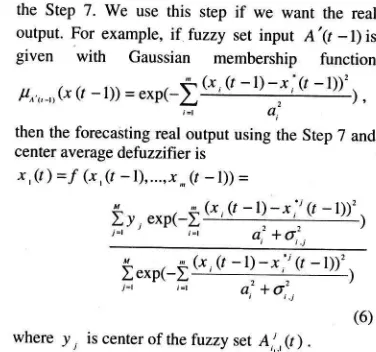
the Step 7. We use this step if we want the real output. For example, if ftzzy set input A'(r -l)is given with Gaussian membership function
.q (x, (r _ I) _x, (r _ l))' . It^ ,,_,,(x (t - I)) = exp(-):---r--- 1 , then the forecaiting ."d Ju,pu, urinjrn" Step 7 and center average defuzzifier is
x , ( t ) = f (x,(t -l),...,x _(r - l)) =
Step 6. Apply QR-factorization to V-' and find M x
M permutation matrix E such that f, E =eR ,
where Q is t x k orthogonal matrix, R = [Rrr Rrz],
R1 I is /< x /< upper triangular matrix.
Step 7. Assign the position of entries one's in the
first k columns of matrix E that indicate the position of the k most important fuzzy logical relationihips.
Step 8. Construct fuzzy time series forecaiting
model (5) or (6) using the k mosr important fuzz!
logical relationships.
[image:9.612.103.291.151.327.2]RESULTS AND DISCUSSION
Figure 2 shows the procedure to design fuzzy time series model using combination of tablb lookup and SVD methods. The method is applied to forecast the inflation rate in Indonesia based on six-factors one-order fuzzv time series model. The main factor is inflation
rate and the secondary factors are the interest
rate of Bank Indonesia certificate, interest rate of deposit, money supply, total of deposit and
exchange rate. The data ofthe factors are taken
from January 1999 to February 2003. The data from January 1999 to January 20O2 are used to training and the data from February 2002 to
February 2003 are used to testins.
In this paper, we will preOi-ct the inflation
rate of f'month using data of inflation rate, interest rate of Bank Indonesia certificate.
interest rate of deposit, money supply, total of
deposit and exchange rate of (k-l)'h month. The
universes of discourse of interest rate of Bank
Indonesia certificate, interest rate of deposit,
exchange rate, total of deposit, money supply,
inflation rate are defined as [10,40], tl0;401, [6000, 12000], t360000, 4600001, 40000,
900001, [-2, 4] respectively.
We define fuzzy sets that are continuous. complete and normal on the universe of
discourse such that thefuzzy sets can cover the
input spaces. We define sixteen fuzzv
sets B, , B,,..,, B,u , sixteen fuzzy sets
C,,Cr,...,C,u, twenty five fuzzy
sets Dr , 4,..., 4s , twenty one fuzzy
sets E,,Er,...,Er,, twenty one fuzzy
sets 4 , 4,..., 4, , thirteen fuzzy sets
4,4,...,4ron the universes of discourse of
the interest rate of Bank Indonesia certificate. interest rate of deposit, exchange rate, total of deposit, money supply, inflation rate respectively. All fuzzy sets are defined by Gaussian membership function. Then, we set
r93
$ . . ^--, E(x,(r - l ) - x ; ' ( r - l ) ) ' , Z), exP(-.1---: . -)
!=t t-' a; +O;.,
Iexp( s (x, (r - l) --r ,' (r - l))'
ai +oi,
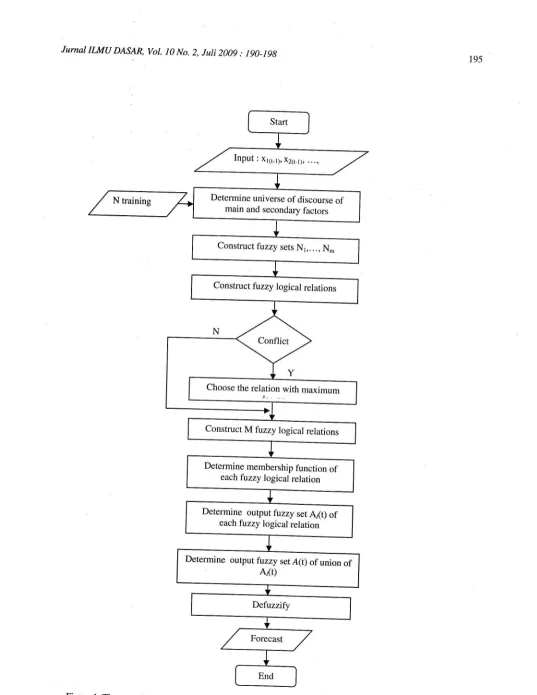
(6) where y is center of the fuzzy set Ai., (r ) . The procedure to design fuzzy time series model using table lookup method is shown in Figure l.
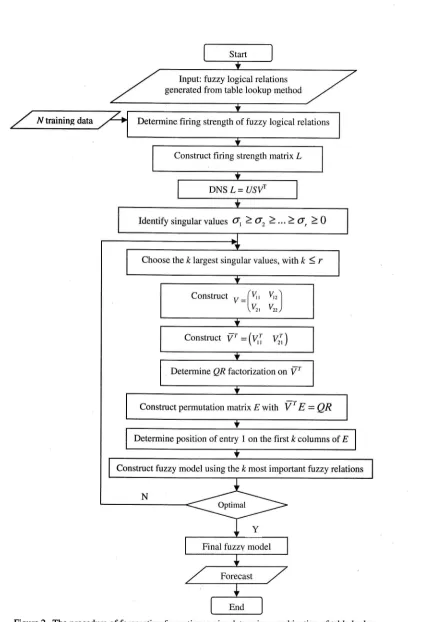
Reducing unimportant fuzzy logical relationships using SVD-QR factorization method
If the number of training data is large, then the number of flzzy logical relationships may be large too. So increasing the number of fuzzy logical relationships will add the complexity of computation. To overcome the complexity of computation, we will apply singular value decomposition method to reduce the fuzzy logical relationships using the following steps.
Step l. Set up the firing strength ofthe fuzzy logical relationship (4) for each training datum (x;y) = (x,(t -l),x,(t -l),...,.r,,, (t -t);x, (r)) asfollows
Lt @;y) =
l[l /t^, , ,,-,,{, , (t -t))p ^, (x ,(t ))
t = t l = l
Step 2. Construct Nx M matrix
( L , 0 L , ( t ) L r , ( l ) )
L = l L , ( 2 ) L , ( 2 ) L L , ( 2 ) |
l M
M M M l
\ r , ( l r ) L , ( N ) L L , ( N ) ) Step 3. Compute singular value decomposition of L a s L = U S V ' , w h e r e IJandVare NxNandMxM onhogonal matrices respectively, S is N x M matrix w h o s e e n t r i e s s a = 0 , i * j , s i i = 6 i = 1 , 2 , . . . , r w i t h q ) o,>...>6,>_0, r <min(N,M). Step 4. Determine the number of fuzzy logical relationships that will be taken as k with
k < rank(L\ .
step 5. Partitio n u u, , =('," Y'' I , *h.r. v,, i.
V,, V,,
)
t x t matrix, V,,is (M-k) x ft matrix, and construct
v ' = ( v , i v : , ) .
194
up fnzzy logical
relationships
based
on training
data
resulting
36 fuzzy relations
in the form:
( B ' , r , Q
- D , C " ( t - r ) , D " , ( t -r),E'r,Q
- D ,
F,l"(t
-l),A',,(r
- l)) -+ A'. (r )
Tabfe l. Six-factors one-order fuzzy logical relationship groups for inflation rate using table lookup method.
((r.(, - l), r,(, - l), {(, - l), r,(, - l), r"(r - l),x (r - l)) + r , ( t )
C onstructing F uzzy Time... ( A gus M aman Abadi dkk)
2 3 4 5 6 1 8 I t 0 t l t 2 t 4 t 5 t 6 t'l IE I 9 20 2 l 22 23 21 2 8 29 30 3 l 32 33 l 5 l6
( 8 r 4 . ( 8 r 5 , ( 8 1 5 , ( B t 4 . ( B t o . ( B ? , ( 8 4 , ( B l . ( B l . ( 8 3 , (ts3, ( 8 2 , ( 8 2 , ( 8 2 , (82, ( B l . (82, (82,
( 8 3 . C r , D l 3 . E 3 . n , A 8 ) (Bl, c2, Dl0, E2, n. A6) Dr2. 83, F8, 44)
There are thirty four nonzero singular values of
Z. The distribution of the singular values of L
can be seen in Figure 3. The singular values of
L decrease strictly after the first twenty nine
singular values (Figure 3). Based on properties
of SVD, the error of training data can be
decreased by taking more singular values of l,
but this may cause increasing error of testing data.
The error of training data depends on the summation of the square of the rest singular values. So we must choose the appropriate ft singular values. In this paper, we choose the first eight, twenty, and twenty nine singular
values. To get permutation matrix E, we apply
the QR factorization and then assign the position of entries one's in the first ft columns of matrix E that indicate the position of the ft most important fvzzy logical relationship. The mean square error (MSE) of training and testing data from the different number of reduced fuzzy logical relationships are shown in Table 2.
The mean square error (MSE) of training and testing data from the different number of reduced fuzzy logical relationships are shown in Table 2.
Table2. Comparison of MSE of training and testing data using the different methods.
Method Number of relations MSE of training data MSE of testing data Proposed method
8 0 . 4 8 5 2 1 0 0.66290
zo
0.3 12380 0.3017329 0. l9 1000 o.zlL62
Table lookup method
36 0.063906 0.30645
Neural network
0.757744 0.42400
Based on Table 2, fuzzy time series model (5)
or (6) designed by table lookup method gives
the smallest error of training data. If we use 29
fuzzy logical relationships, then we have the
smallest error of testine data.
c t 4 , D t 3 . E r 2 , c t 4 , D t 2 . E r 3 , c r 4 , D t z , E t 3 , c r 3 , D l O . E r 5 , c l I , D 9 , E t 6 , c8, D4. EB, c 5 . D 5 , E r 3 , c 3 . D 7 , E l l, c 2 . D r r . E l O , c2_ D5. U. c2. D7. E9, c2, D5, E6, c2. D7. E7. c2, D1, E7. c f , D 7 , E 1 , c l , D 9 . E 1 , c l , D r I , 8 8 , C I , D I 2 . B .
n , A i l )
n, A8)
F3, A5)
E. A4)
P. 44)
P. A4)
P, A3)
Fr. A3)
F4, 45)
F4, 45)
F8, A8)
F5. A8)
F5, A5)
F5, A4)
F5, A6)
F6, A7)
-) es - ) p
J r r J m J * - ) r u J e t J u
J e r
J a s -t
--)
--)
+--)
--)
J-)
- . .
(83, C2, Dr5. 86. F8, A1j (83, C2. Dt5. E1, m, A8) (81, c2, Dr5, 87, Fl4. AC) (Bt, c2, Dr5, E9, B, A6) ( B 3 . C 3 , D t 6 , E l r , B , A 1 ' (84. Cl, DtS, EB. B, 47)
cl, D24, El5. FtO. A6)
[image:10.612.316.458.64.112.2](84, Cl, Dzt, Et4. Fro, A7) (84. Cl, D23, EI4. Ft r. A8) ( B 5 , C 3 , D t 5 , E r 0 , F r 2 , A 9 ) ( 8 5 . C l , D l 2 , E t 0 , F l 3 . 4 5 ) ( 8 5 , C 5 . D r 6 . E t 2 , F l 3 , 4 6 ) ( 8 5 , C 5 . D l 9 . E l 6 . F r 2 , A 6 ) ( 8 5 , C 5 , D r 9 , E r 7 , F r 4 , A 8 )
Table I presents allfuzzy logical relationships.
To know the ft most important fuzzy logical
relationships, we apply the singular value
decomposition method to matrix L of firing strength of the fuzzy logical relationships in Table I for each training datum,
L , ( t ) L L , ( 2 ) L
I n p u t : x111-1;, x 2 ( t _ t , t t . . . t
Determine universe of discourse of
main and secondary factors
Construct fuzzy sets Nr,..., N.
Construct fuzzy logical relations
Construct M fuzzy logical relations
Determine membership function of
each fuzzy logical relation
Determine output fuzzy set Ar(t) of each fuzzy logical relation
Determine output fuzzy set A(t) of union of A(t)
Jurnal ILMU DASAR, Vol. I0 No. 2, Juli 2009 : 190_I9g
[image:11.612.47.584.37.732.2]1 9 5
Figure 2.
C onstructin g F uzzy Time.. ... (A gus M aman Abadi dkk)
The procedure of forecasting fuzzy time series data using combination of table lookup
and SVD- QRfactorj^zation methods.
Input: fuzzy logical relations
generated from table lookup method
Determine firing strength of fuzzy logical relations
Construct firing strength matrix L
DNS t = USf
Identify singular values d, 2 or 2... ) q t 0
Choose the k largest singular values, with k ( r
Construct
f'=(r,I
V{,)
Determine QR factorization on V'
Construct permutation matrix E w'th Vr E = QR
Determine position of entry I on the first ft columns of E
Jumal ILIUIU DASAR, Vol. 10 No.2, Juli 2009 : 190-198 t97
Figure 3. Distribution of singular values of matrix L.
(a)
3 r
jii : --iIi-,-1.-.
,{i r
ir'r- it i l r
i Y ft*
ft
(c)
Figure 4. Prediction and true values of inflation rate using proposed method: (a) eight fuzzy logical relationships, (b). twenty fuzzy logical relationships, (c) twenty nine fuzzy
logical relationships, (d) thirty six fuzzy logical relationships.
So to forecasting inflation rate, fuzzy time series model (5) or (6) designed by 29 fuzzy logical relationships gives a better accuracy than that designed by 8 and 2O fuzzy logical
relationships. Furthermore, Table 2 shows that
in predicting inflation rate, the proposed
method results a better accuracy than the neural
network method.
Figure 4(c) illustrates that prediction accuracy is improved by choosing 29 fuzzy
logical relationships. The plotting of prediction
and true values of inflation rate using different
number of fuzzy logical relationships is shown
in Figure 4.
CONCLUSION
In this paper, we have presented a new method
to design fuzzy time series model. The method combines the table lookup and SVD-QR factorization methods. Based on the training data, the table lookup method is used to construct fuzzy logical relationships and we apply the singular value decomposition and QR-factorization methods to the firing strength matrix of the fuzzy logical relationships to remove the less important fuzzy logical
relationships. The proposed method is applied
to forecast the inflation rate. Furthermore.
(b)
I
\l
r i i ; i l i - i i f i . ! i f i i l i r i 1
,ii iiAil
,*i i, Ji i
Ii llli,l ti ii;Ji
l
r ! . i l i ' i i l i * i
i i $ ' i i { r .
\ i : I
ii+
, t ,"]
[image:13.612.150.375.115.252.2] [image:13.612.103.492.175.527.2]1 9 8
predicting inflation rate using the proposed
method gives more accuracy than that using the
table lookup and neural network methods. The precision of forecasting depends also to taking factors as input variables and the number of defined fuzzy sets. In the next work, we will design how to select the important input
variables to improve prediction accuracy.
Acknowledgements
The authors would like to thank to Dp2M DIKTI, Department of Mathematics Education Yogyakarta State University, Department of
Mathematics Gadjah Mada University,
Department of Economics and Business Gadjah
Mada University. This work is the par-t of our
works supported by DP2M-DIKTI Indonesia
under Grant No: 0 I 8/SP2FVPP /DP2Ir41IJ12}OB.
REFERENCES
Abadi AM, Subanar, Widodo & Saleh S. 2006.
Fuzzy Model for Estimating Inflation Rate. Procceedings of The International Conference on Mathematics and Natural Sciences. Institut Teknologi Bandung: 7 36-7 39.
Abadi AM, Subanar, Widodo & Saleh S. 2007. Forecasting Interest Rate of Bank Indonesia Certificate Based on Univariate Fuzzt Time Series. International Conference on Mathematics and Its applications SEAMS. Gadjah Mada University.
Abadi AM, Subanar, Widodo & Saleh S. 2008a. Constructing Complete Fuzzy Rules of Fuzzy Model Using Singular Value Decomposition. Proceedings of The International Conference on Mathematics, Statistics and Applications (ICMSA). Syiah Kuala University. 1: 6l-66. Abadi AM, Subanar, Widodo & Saleh S. 2008b.
Designing Fuzzy Time Series Model and lts Application to Forecasting Inflation Rate. 7rh World Congress in Probability and Statistics. National University of Singapore.
Abadi AM, Subanar, Widodo & Saleh S. 2008c. A New Method for Generating Fuzzy Rule from Training Data and Its Application in Finacial Problems. The Proceedings of The 3'd International Conference on Mathematics and Statistics (ICoMS-3). Institut Pertanian Bogor: 655-66 l.
Abadi AM, Subanar, Widodo & Saleh S. 2009a. Designing Fuzzy Time Series Model Using Generalized Wang's Method and Its Application to Forecasting Interest Rate of Bank Indonesia Certificate. Proceedings of The International Seminar on Science and Technology. Islamic University oflndonesia.: I l-16.
C onstructing F uuy Time... ( A gus M aman Abadi dkk)
Abadi AM, Subanar, Widodo & Saleh S. 2009b. Peramalan Tingkat Suku Bunga Sertifikat Bank Indonesia Berdasarkan Data Fuzzy Time Series Multivariat. Proceeding Seminar Nasional Matematika. FMIPA Universitas Jember. pp: 462-4',74.
Chen SM. 1996. Forecasting Enrollments Based on Fuzzy Time Series. Fasy Sets and Systems. 81.. 3 l l - 3 t 9 .
Chen SM. 2002. Forecasting Enrollments Based on High-order Fuzzy Time Series. Cybernetics and Systems Journal. 33: l-16.
Chen SM & Hsu CC. 2004. A New Method to Forecasting Enrollments Using Fuzzy Time Seies. International Journal of Applied Sciences and En g ine e r in g. 2(3) : 234 -244.
Huamg K. 2001. Heuristic Models of Fuzzy Time Series for Forecasting. Fuzzy Sets and Systems. 123 369-386.
Hwang JR, Chen SM & Lee CH. 1998. Handling Forecasting Problems Using Fuzzy Time Series. Fuzzy Sets arul Systems. L00 217-228.
Jilani TA, Burney SMA & Ardil C. 2007. Multivariate High Order Fuzzy Time Series Forecasting for Car Road Accidents. International Journal of Computational Int e ll i g e nc e. 4(l): | 5-20.
Kustono, Supriyadi & Sukisno T.2006. Peramalan Suku Bunga Sertifikat Bank Indonesia dengan Menggunakan Jaringan Syaraf Tiruan. [Laporan penelitian dosen muda, Universitas Negeri Yogyakarta, Yogyakartal.
Lee LW, Wang LH, Chen SM & Leu YH. 2006. Handling Forecasting Problems Based on Zwo-factors High Order Fu72y Time Series. IEEE Transactions on Fuzzy Systems. l4(3): 468 -477.
Sah M & Degtiarev KY. 2004. Forecasting Enrollments Model Based on First-order Fuzzy Time Series. Transaction on Engineering, Computing and Technology VI. Enformatika. Yl:375-378.
Scheick JT. 1997 . Linear algebra with applications. Singapore : McGraw-Hill.
Song Q & Chissom BS. 1993a. Forecasting Enrollments with Fuzzy Time Series, Part I. Fuzzy Sets and Systems. 54: 1-9.
Song Q & Chissom BS. 1993b. Fuzzy Time Series and Its Models. Fuzzy Sets and Systems.54.269-277.
1 .
2-5 .
JURNAL ILMU DASAR GUIDLINES FOR AUTHORS
The scientific journal "Jurnal ILMU DASAR- is puHished twice a year, every January and July'
The submitted manuscripi must neither had been published nor to be published in other scientific journals. The scopes of the topics are basics sciences including Mathematics, Physics, Chemistry, and Biology. The.manuscripts, originated from research dissemination, are preferable'
The manuscripts must be written in good scientific English'
The manuscripts. must be submitted in the form of 3 exemplars of print out (on 44 paper, 1 lzline spacing, 12 pt new times roman) using Microsoft Word or compatible , not more than 15 pages), and f ile on CD, to:
Dewan Redaksi Jurnal ILMU DASAR Fakultas MIPA Universitas Jember
Jl. Kalimantan 37 Jember 6812't E-mail : [email protected] at least two months before the schedule of
publication-7. Authors must attach lheir brief c.v.s (auto biography).
B. The manuscripts will be examined bytwo reuiewers (expert on the corresponding fields), with criteria including: originality, quality' validity, clearness, and benefit for academic society'
g. Authors must revise their manuscripts according to reviewers' comments, no later than specified interval time' 10. Rejected manuscripts will be returned to the authors together with reasons for rejections'
11. Manuscript must be written according to the following JID structure: Title: English title consists of around 10 words.
AuthorsaThe name and the complete postal address of authors' institution must be clearly written.
Abstract: lt must be wrilten clea;ly and concisely, consists of objectives and scope of research, methods, results and conclusion' must not be more than 300 words. References, iigures, table are nol allowed in abstract'
Keywords: It consists of terms in English that can be used to search the article.
Intioduction: Background, theoreticil review, and objectives of research, must be included implicitly in the introduclion' Methods: All importlnt methods, including important materials, applied the research should be described here.
Results and Discussion: This part describes results, illuslrations, interpretation, generalisation of the results and its relatignship with orevious related research.
Conclusion: lt briefly describes the important finding of the research and must be based on the fact' Reterences: References must be written as follows'
a. Cross-referencing in the text must be consistent with references, both for authors name and year of publications.
b. Cross-referencing in the text are as follows: "(Author-Name Year)", or "Author-Name (Year)"' Notation "&" is used instead ot ,,and', to separate two authors of the same publication. For author more than 2, must be written as "Author-Namel et a/' Year)' c. References
i. Reference items must be ordered alphabetically (A-Z) based on Authorl-Name and year of publications. ii. Similar authors must be written completely (not using ---)
iii. All authors must be written completely in the form " Family-Name lnitial-Name.Year of publication. '''." iv. Ref erence from books: "Author_name. Year. Book Title (italics\. city:Publisher".
v. Reference from journals: "Author_name. Year. Article litle. Journal Title (italics\. Vol./No (bold): pages.
vi. Reference from unpublished works (thesis, report, dissertations): "Author-name. Year. Work Title (italics\- [unpublished type of work, name of institutionsl
vii. Reference from Internets: Author name' Year' Paper Title (italics)
Examples: Cross-references:
(Stoker & Gustafson 2003, Linsey 2007); (Hoppe efal' 1998)
References:
Web_address lDate of accessi
Heather AF. 2000. The Magnetic and Electrical Properties of Permalloy-Carbon Thin Film Multilayer. [unpublished Thesis, Collage of William and Mary, Virginial.
Heather if . zOOZ. The Magneiic anl Etectrical eroperties .-. Virginia.Hoppe HG, Giesenhagen HC & Gocke K. 1998. Changing patterns of Bacterial S;bstrate Decomposition in a Eutrophication Gradient. Aquatic Microbial Ecology 15:1-13.
Hoppe HG, Giesenhagen HC & Gocke x. tgge. Changing Patterns of Bacterial Substrate Decomposition in a Eutrophication Gradient. Aquatic Microbial Ecology. 1 5:1 - 1 3.
Lindsey J.K. On h-tiketihood, random6ff ect and penatised likelihood. http://luc.be/-jlindsey/hglm.ps [25 Oktober 2007]