Ma Manda Phonology
MA MANDA PHONOLOGY
By
Ryan Pennington
Presented to the Faculty of
the Graduate Institute of Applied Linguistics in partial fulfillment of the requirements
for the degree of
Master of Arts with major in Applied Linguistics
SIL e-Books 64
2014 SIL International®
ISBN: 978-1-55671-381-1 ISSN: 1934-2470
Fair-Use Policy:
Books published in the SIL e-Books (SILEB) series are intended for scholarly research and educational use. You may make copies of these publications for research or instructional purposes free of charge (within fair-use guidelines) and without further permission. Republication or commercial use of SILEB or the documents contained therein is expressly prohibited without the written consent of the copyright holder(s).
Editor-in-Chief
Mike Cahill
Managing Editor Bonnie Brown
CERTIFICATE
I acknowledge that use of copyrighted material in my thesis may place me under an obligation to the copyright owner, especially when use of such material exceeds usual fair use provisions. I hereby certify that I have obtained the written permission of the copyright owner for any and all such occurrences and that no portion of my thesis has been copyrighted previously unless properly referenced. I hereby agree to indemnify and hold harmless the Graduate Institute of Applied Linguistics from any and all claims that may be asserted or that may arise from any copyright violation.
____________________________ Signature
THESIS DUPLICATION RELEASE
I hereby authorize the Graduate Institute of Applied Linguistics Library to duplicate this thesis when needed for research and/or scholarship.
Agreed: _______________________________________________
ABSTRACT
Ma Manda Phonology Ryan Pennington
Master of Arts with major in Applied Linguistics
The Graduate Institute of Applied Linguistics, June 2013
Supervising Professor: Steve Parker
This thesis presents a phonological description of Ma Manda (ISO 639-3: skc), a Finisterre-Huon language of the Trans-New Guinea family. This is accomplished through
a sketch of the segmental phonology, syllable structure and phonotactics, suprasegmental features, and morphophonemic alternations.
In addition to documenting the phonological domains listed above, particular
emphasis is given to several unique and interesting processes. First, /i/ and /u/ tend to be reduced to the high central [ɨ] in unstressed environments. Related to this is a rule of
epenthesis whereby the same segment ([ɨ]) is inserted between disallowed consonant clusters. These two processes are discussed from both a synchronic and a diachronic perspective. Next is a process of long distance nasal agreement, also known in the
literature as nasal consonant harmony (Hansson 2010, Walker 2011). In Ma Manda, NV (nasal+vowel) sequences initiate the prenasalization of a following tautomorphemic
alternation: /mo-qə/ → [moɴqə] ‘go down and...’ and /mo-be/ → [mombe] ‘go down!’. Ma Manda is the only language known to exhibit this pattern. Finally, a number of
complex and phonetically unmotivated alternations are triggered when consonants concatenate across morpheme boundaries. For example, the lateral /l/ is realized as a
voiceless alveolar stop ([t]) when adjacent to any nasal (e.g., /l+m/→[tm] and /m+l/→
[mt]). Mappings such as /lm/→[tm] are quite unexpected from the perspective of
sonority-based constraints like the Syllable Contact Law (Hooper 1976, Seo 2011). Nevertheless, in Ma Manda these processes are robust, productive, and regular.
Consequently, several aspects of the sound patterns of this understudied language of Papua New Guinea are noteworthy for the contribution they make to linguistic typology
vii
Dedicated to Crystal, my bride,
viii
ACKNOWLEDGMENTS
No work of value is accomplished alone. I have been the beneficiary of numerous
encouragements, prayers, financial gifts, and other acts of kindness. God has blessed me with a team of family, friends, and colleagues who loyally support my endeavors, ask me the tough questions, and provide me with comfort and strength in times of distress. These
people keep pushing me toward greater heights and new challenges, and I aspire to continue to meet their expectations through the perseverance and peace that only come
from Jesus Christ.
I would like to thank a few people in particular. First, I am grateful to my friends and colleagues in SIL PNG who have stood by my side during the foundational years of
my academic research. I am especially grateful for the academic mentorship and friendly encouragement of René van den Berg.
I thank SIL PNG, GIAL, and CanIL for scholarships and grants that have enabled me to pursue my Master’s degree.
I am forever indebted to the hospitality and graciousness of the Ma Manda people,
who have accepted my family into their homes, babysat my children so that my wife and I could do language lessons, taken me on hikes through mountain rainforests, and who
ix
enormous amounts of time helping me to fill out paradigms, record stories, and ask questions. Yeñguloñ kaalin shnhk!
I would like to thank my wife Crystal, as well as our two children, Chloe and Caedmon. I have spent many late nights in front of the computer instead of with them,
and I am grateful for their patience and love. Crystal always believes in me, which has sometimes been the only reason I have kept moving forward. She has also made corrections on my thesis along the way. I could not have done any of this without her.
Finally, I would like to thank the advisors on my committee. Michael Boutin and Mike Cahill offered their time and energy to improve my thesis. I am grateful that they
were willing to share their expertise in order to help me become a better linguist. Steve Parker, the chair of my committee, has spent many hours with me over the course of this process. I am grateful for the time he spent mentoring me, connecting me with resources,
listening to recordings with me, and correcting my mistakes. All of my committee members have made me more confident and competent, and therefore they share in any
future successes I have in the field of linguistics.
x
TABLE OF CONTENTS
ABSTRACT ... V
ACKNOWLEDGMENTS ... VIII
LIST OF MAPS ... XIII
2 THE MA MANDA LANGUAGE ...12
2.1 LOCATION ... 12
2.2 GENETIC CLASSIFICATION ... 14
2.3 LANGUAGE VITALITY ... 16
2.4 MORPHOSYNTAX OVERVIEW ... 17
3 LITERATURE REVIEW ...22
3.2 EPENTHESIS AND NASAL AGREEMENT ... 30
3.2.1 Barred-i epenthesis ...30
3.2.2 Long distance nasal agreement ...31
3.3 SONORITY AND PERCEPTIBILITY ... 32
3.3.1 Sonority and the Syllable Contact Law ...32
3.3.2 Perception-based phonology ...36
4 SEGMENTAL PHONOLOGY ...40
4.1 CONSONANT PHONEMES ... 40
xi
5 THE SYLLABLE AND PHONOTACTICS ...63
5.1 SYLLABLE TEMPLATE ... 63
5.2 CONSONANT SEQUENCES ... 68
5.3 VOWEL SEQUENCES ... 70
7 HIGH VOWEL REDUCTION AND EPENTHESIS...91
7.1 HIGH VOWEL REDUCTION ... 93
7.2 EPENTHESIS ... 98
7.3 SUMMARY ... 107
8 LONG DISTANCE NASAL AGREEMENT ...108
8.1 OVERVIEW AND DEFINITIONS ... 108
8.2 NASALIZATION IN RELATED LANGUAGES ... 111
8.3 TAUTOMORPHEMIC NASAL AGREEMENT ... 112
8.4 HETEROMORPHEMIC NASAL AGREEMENT ... 116
8.4.1 Triggers, targets, and transparent segments ...117
8.4.2 Directionality and domain ...120
8.5 FURTHER CHARACTERISTICS OF NASAL AGREEMENT ... 123
8.5.1 Blocking of nasal agreement ...123
8.5.2 Blocking of /b/-lenition ...123
8.5.3 Interaction of nasal agreement with epenthesis...124
8.6 SUMMARY ... 125
9 MORPHOPHONEMIC ALTERNATIONS ...126
9.1 HETEROMORPHEMIC CONSONANT INTERACTIONS ... 126
9.1.1 Voiceless plosive interactions ...129
9.1.2 Voiced plosive interactions ...131
9.1.3 Fricative interactions ...132
9.1.4 Nasal interactions ...133
9.1.5 Approximant interactions...137
9.1.6 Summary of heteromorphemic consonant interactions...145
9.2 HETEROMORPHEMIC INTERACTIONS INVOLVING VOWELS ... 146
xii
9.3.1 Reduplication ...148
9.3.2 Compounds ...153
9.4 SUMMARY ... 156
10 CONCLUSION ...158
APPENDIX 1:ALPHABETIZED WORDLIST ... 162
APPENDIX 2:PHONEME FREQUENCY COUNTS... 172
APPENDIX 3:NOMINAL POSSESSION PARADIGMS ... 175
APPENDIX 4:VERBAL TAM PARADIGMS ... 177
APPENDIX 5:INTERLINEARIZED STORY ... 183
APPENDIX 6:HETEROMORPHEMIC CONSONANT INTERACTIONS ... 187
xiii
LIST OF MAPS
xiv
LIST OF FIGURES
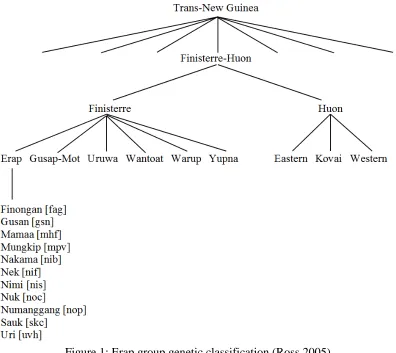
Figure 1: Erap group genetic classification (Ross 2005) ... 15
Figure 2: Proposed revision of Erap family ... 16
Figure 3: Spectrogram and waveform of /jəŋen/ ... 54
Figure 4: Spectrogram and waveform of /ijəŋen/ ... 54
Figure 5: Falling pitch contour of a statement ... 86
Figure 6: Spectrogram and waveform of [nan.du:.la.lət] ... 105
xv
LIST OF TABLES
Table 1: Summary of important sources ... 28
Table 2: Summary of Erap sources ... 28
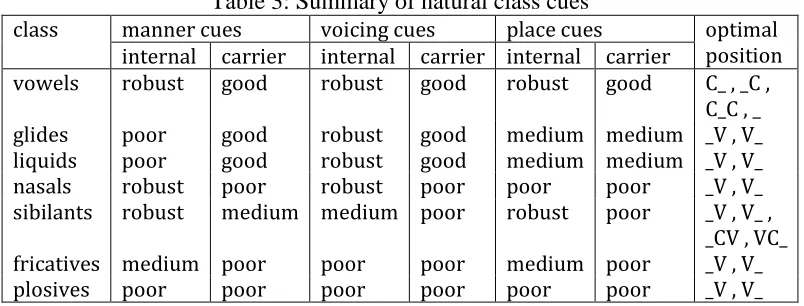
Table 3: Summary of natural class cues ... 39
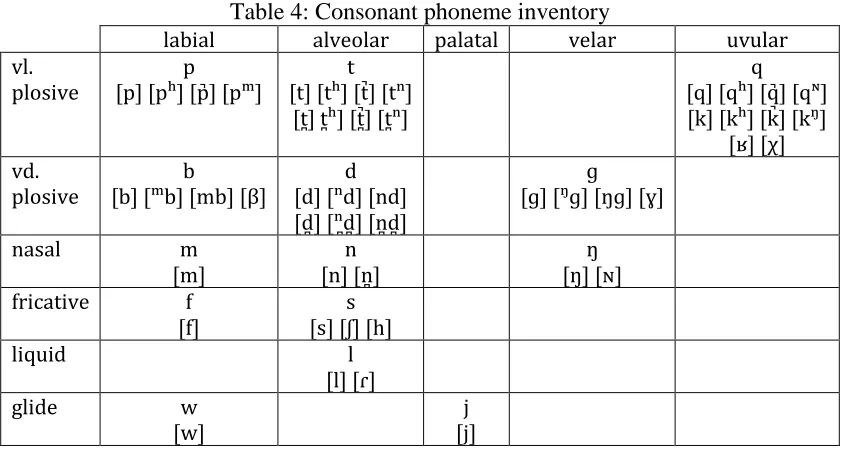
Table 4: Consonant phoneme inventory ... 41
Table 5: Allophones of /p/ ... 42
Table 6: Allophones of /t/ ... 43
Table 7: Allophones of /q/ ... 43
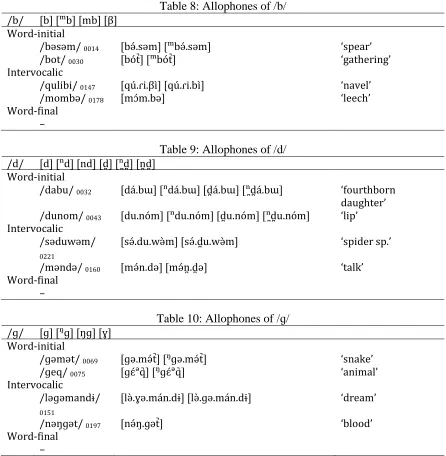
Table 8: Allophones of /b/ ... 45
Table 9: Allophones of /d/ ... 45
Table 10: Allophones of /ɡ/ ... 45
Table 11: Allophones of /m/ ... 47
Table 12: Allophones of /n/ ... 47
Table 13: Allophones of /ŋ/ ... 47
Table 14: Allophones of /f/ ... 50
Table 15: Allophones of /s/ ... 50
Table 16: Allophones of /l/ ... 51
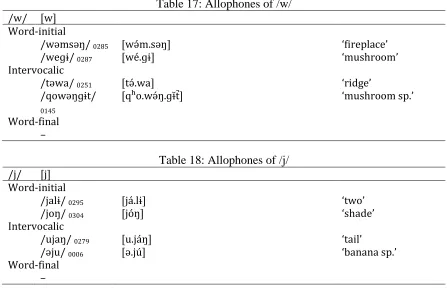
Table 17: Allophones of /w/ ... 52
Table 18: Allophones of /j/ ... 52
Table 19: Vowel phoneme inventory ... 56
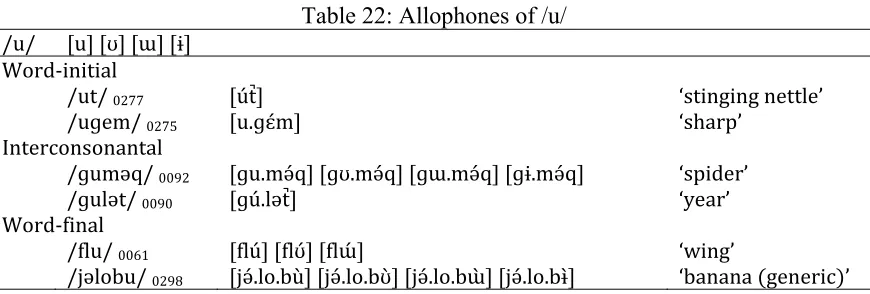
Table 20: Allophones of /i/ ... 57
Table 21: Allophones of /ɨ/ ... 57
Table 22: Allophones of /u/ ... 58
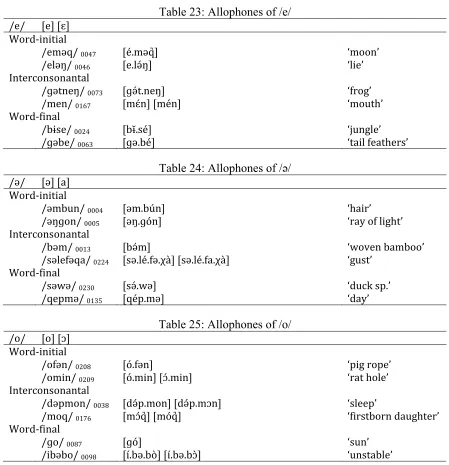
Table 23: Allophones of /e/... 59
Table 24: Allophones of /ə/... 59
Table 25: Allophones of /o/ ... 59
Table 26: Allophones of /a/... 60
Table 27: CV syllables ... 65
Table 28: CVV syllables ... 65
Table 29: CVC syllables ... 66
Table 30: CVVC syllables ... 66
Table 31: CLV syllables ... 66
Table 32: CLVV syllables ... 67
Table 33: CLVC syllables ... 67
Table 34: V syllables ... 67
Table 35: VC syllables ... 68
Table 36: Tautomorphemic consonant phoneme sequences ... 68
Table 37: Tautomorphemic consonant phoneme sequence examples ... 69
xvi
Table 39: Tautomorphemic vowel phoneme sequences ... 71
Table 40: Tautomorphemic vowel phoneme sequence examples ... 71
Table 41: Tautomorphemic V.GV sequence examples ... 71
Table 42: Heteromorphemic vowel phoneme sequences ... 72
Table 43: Noun/verb models for use in examples sets ... 128
Table 44: Suffix/enclitic models for use in example sets ... 128
Table 45: Heteromorphemic consonant interactions ... 145
Table 46: Reduplicated nouns (pluralization) ... 149
Table 47: Reduplicated nouns (diminution) ... 150
Table 48: Reduplicated nouns ungrammatical base forms ... 151
Table 49: Adjectival reduplication... 151
Table 50: Adverbial reduplication ... 152
Table 51: Verbal reduplication (nominalization) ... 152
Table 52: Nominal compounds ... 154
Table 53: Verbal compounds ... 155
Table 54: Alphabetized wordlist ... 163
Table 55: Consonant phoneme frequency chart ... 174
Table 56: Vowel phoneme frequency chart ... 174
Table 57: Nominal possession paradigms... 175
Table 58: Frames for TAM paradigms ... 177
Table 59: /lo/ ‘go up’ ... 178
Table 68: /fepm/ ‘cut bush’ ... 182
Table 69: Obstruent/ obstruent sequences ... 188
Table 70: Obstruent/ nasal sequences ... 189
Table 71: Obstruent/ liquid sequences ... 189
Table 72: Obstruent/ glide sequences ... 190
Table 73: Nasal/ nasal sequences ... 190
Table 74: Nasal/ liquid sequences ... 190
Table 75: Nasal/ glide sequences ... 191
Table 76: Liquid/ liquid sequences ... 191
xvii
ABBREVIATIONS
- affix boundary LW loanword
* ungrammatical med medial verb
/ / phonemic representation ms milliseconds
[ ] phonetic representation MSC morpheme structure constraint
~ free variation n noun
+ join morphemes nom nominative case
: fused morpheme nfut near future tense
= clitic boundary npst near past tense
→ becomes, surfaces as NV nasal + vowel sequence
Ø null morpheme o bound object pronoun
1 1st person OPD Organised Phonology Data
2 2nd person part participle
3 3rd person pfv perfective aspect
adj adjective pl plural
adv adverb PNG Papua New Guinea
cat cataphoric pronoun poss possessive
caus causative pres present tense
compl completive aspect rpst remote past tense
dat dative pronoun sbjv subjunctive mood
ds different subject medial
verb
SCL Syllable Contact Law
du dual sg singular
emph H
emphatic pronoun heavy syllable
sim same subject simultaneous medial
verb
hab habitual aspect ss same subject medial verb
HZ Hertz SSP Sonority Sequencing Principle
imp imperative mood TAM tense, aspect, modality
iter iterative aspect v verb
L light syllable VOT voice onset time
LLG Local Level Government ynq polar question
1
1 INTRODUCTION
This thesis is a phonological description of Ma Manda (ISO 639-3: skc), a Finisterre-Huon language of the Trans-New Guinea family. It is one of eleven languages
that form the Erap subgroup, a subdivision of the broader Finisterre-Huon family that is spread across the Huon peninsula of northeastern Papua New Guinea (PNG).
The phonology of Ma Manda is particularly interesting in several ways. First of
all, the high peripheral vowels /i u/ are prone to reduction to the high central [ɨ] in unstressed environments, as well as in words of three syllables or longer. This can be
seen when the first person possessive suffix is attached to /nimin/ ‘cousin’.
(1) a. /nimin/ [ní.min]1 ‘cousin’
b. /nimin-nə/ [n�̀.mɨ.nə́] ‘cousin-1sg.poss’
Related to this process of vowel reduction is the process of barred-i epenthesis, whereby [ɨ] is inserted between disallowed consonant clusters, as well as word-finally after voiced plosives /b d g/, the liquid /l/, and fricatives /f s/. Diachronically, epenthesis
has arisen from the reanalysis of [ɨ] as an epenthetic segment rather than a reduction of the full high vowels. Ma Manda is in a state of transition with regard to this vowel: Often
the full high peripheral vowels are recoverable in careful speech and thus reanalysis is shown not to have occurred, while in many other cases morphological evidence reveals
1
2 that this vowel is not underlyingly present. As an example, the following pair of forms
shows /nol/ ‘brother’ both in isolation and with the first person possessive suffix /-nə/:
(2) a. /nol/ [nó.lu] ‘brother’
b. /nol-nə/ [nót.nə] ‘brother-1sg.poss’
Word-finally in (2a), the epenthetic vowel is realized as [u] after /l/ (harmonized in roundness and backness with the [o] earlier in the word). When attached to the
nasal-initial suffix, however, /l/ undergoes a predictable alternation: /l+n/→[tn]. This alternation shows that the high vowel is not phonemically present here.
A second unique characteristic of Ma Manda phonology is the phenomenon of
long distance nasal agreement, whereby nasal+vowel sequences initiate the prenasalization of a following tautomorphemic voiced plosive. Interestingly,
heteromorphemically both voiced and voiceless plosives are prenasalized in this environment. Ma Manda is the only language in the world known to exhibit such a pattern. Nasal agreement among both voiced and voiceless plosives is seen in the
following verbal paradigm (where (3) shows a regular verb root and (4) shows a verb root composed of an NV sequence).
(3) a. /lo/ ‘go.up’ + /-ɡot/ ‘1sg:rpst’ → [ló.ɡot] ‘I went up’
b. /lo/ ‘go.up’ + /-de/ ‘2du:imp’ → [ló.de] ‘go up (2du)!’
c. /lo/ ‘go.up’ + /-qə/ ‘ss’ → [ló.qə] ‘go up and ...’
(4) a. /mo/ ‘go.down’ + /-ɡot/ ‘1sg:rpst’ → [móŋ.ɡot] ‘I went down’
b. /mo/ ‘go.down’ + /-de/ ‘2du:imp’ → [món.de] ‘go down (2du)!’
c. /mo/ ‘go.down’ + /-qə/ ‘ss’ → [móɴ.qə] ‘go down and ...’
brought into contact with other consonants across morpheme boundaries. For example,
the liquid changes to a voiceless stop when adjacent to any nasal (e.g., /l+m/→[tm] and
/m+l/→[mt]/[mp]), and the liquid and labiovelar glide coalesce to form [ɡ]. These
alternations can be seen in (5).
(5) a. /lo/ ‘go.up’ + /-lət/ ‘1sg:pres’ → [lo.lə́t] ‘I am going up’
b. /blam/ ‘carry’ + /-lət/ ‘1sg:pres’ → [blám.tət] ‘I am carrying it’
c. /monə/ ‘secondborn.son’ + /=lɨ/ ‘nom’ → [mó.nə.l�̀] ‘Secondborn son did...’
d. /qaqon/ ‘uncle’ + /=lɨ/ ‘nom’ → [qá.qon.t�̀] ‘Uncle did ...’
e. /nam/ ‘brother-in-law’ + /=lɨ/ ‘nom’ → [nam.pɨ] ‘Brother-in-law did ...’
f. /ul/ ‘hit’ + /-neŋ/ ‘2pl:imp’ → [út.neŋ] ‘hit him (2pl)!’
g. /ul/ ‘hit’+/-wam/ ‘1pl:pres’ → [u.ɡam] ‘we are hitting him’
The remaining portions of this chapter are structured as follows: First, in §1.1 I
discuss the objective and structure of this thesis; in §1.2 I lay out my four primary motivations for this study; §1.3 addresses the scope of the thesis, including the limitations I am aware of; §1.4 provides a description of the methodology that has been undertaken;
and §1.5 provides an overview of the informed consent protocol that was followed during the data collection phase of the research.
1.1 Objective
The objective of this thesis is to describe the phonology of the Ma Manda language. This is accomplished through analyses of the segmental phonology (Chapter 4),
syllable structure and phonotactics (Chapter 5), suprasegmental features (Chapter 6), and morphophonemic alternations (Chapter 9). Particular focus is given to three phenomena:
4 and long distance nasal agreement (Chapter 8). I describe the behavior of these processes
in detail and discuss their possible historical origins. Finally, the appendices provide lists of the words upon which the analysis in this thesis is based (including numbers that
cross-reference the audio files on the attached disc). Appendix 1 is a general wordlist, composed primarily of monomorphemic nouns and adjectives. Appendix 2 provides frequency counts of all Ma Manda phonemes based on 1448 morphemes. Appendix 3
provides a list of ten nouns, each inflected in six separate possessive forms. These illustrate the variety of morphophonemic alternations that are seen in nominal suffixation.
Appendix 4 provides a group of ten separate verbs in morphological paradigms. These are simple paradigms that fully illustrate the variety of morphophonemic behaviors that can occur when TAM (tense, aspect, mood) suffixes are attached to verb stems. Appendix
5 provides an interlinearization of a short story about planting yams. Finally, Appendix 6 is a supplement to §9.1 that provides a structured list of all interactions that occur when
heteromorphemic consonants concatenate.
1.2 Motivations
The present study has four primary motivations. First, it serves as a building block
upon which future analyses can take place. Out of necessity, a basic understanding of the phonology of a given language is required before an attempt can be made at wrestling
three particular phonological phenomena—reduction of high vowels, epenthesis of the
high central vowel, and prenasalization of voiced plosives—which have been analyzed in various ways within the Erap subgroup and across the Trans-New Guinea family of
languages as well. A thorough treatment of these processes in Ma Manda should shed light on identical or similar processes attested in several related languages. Third, a deeper analysis of these processes will be helpful for linguistic theorists and typologists.
For example, to my knowledge, no other language is known to exhibit long distance nasal agreement among both voiced and voiceless plosives across morpheme boundaries, while
only among voiced plosives tautomorphemically. Finally, a thorough phonological analysis is paramount in the development of an effective writing system. Without, at the very least, a basic grasp of the various phonological phenomena at work in a language,
many of the decisions in the development of an orthography would be made blindly and might lead to unnecessary revisions and frustration.
1.3 Scope
The analysis throughout a majority of this thesis is presented in a purely descriptive light. This means that the description is divorced from theory wherever
possible. It is my goal that this thesis be accessible to a variety of people doing basic linguistic research among PNG languages, many of whom may not be familiar with the
6 Phonology (Chomsky & Halle 1968), Optimality Theory (Prince & Smolensky 2004),
Metrical Phonology (Hayes 1995), Autosegmental Phonology (Goldsmith 1976), Evolutionary Phonology (Blevins 2004), and Phonetically Based Phonology (Hayes et al.
2004). It is important that the data be presented with clarity, in order that fieldworkers, typologists, and theorists can use it to substantiate, modify, and/or disqualify their own hypotheses.
Generally speaking, the syntax of Ma Manda is not addressed in this paper. That would lead to a much longer thesis, and would detract from the limited and focused scope
of the present phonological study. Syntactic information is provided insofar as it may aid in the understanding of the processes described herein. Though morphology, likewise, is not a primary focus of this work, it is handled more than syntax due to its relevance in the
various complex morphophonemic alternations. An overview of the morphological paradigms is necessary, though they are not dwelled upon, as their grammatical analysis
is not germane to the present study (although two sets of paradigms are presented as appendices). For a brief overview of the morphosyntax, however, see §2.4.
Finally, it is important to note that, for the purpose of consistency, only one
dialect is in focus throughout this thesis. The Erap family2 is part of a complex dialect chain, where the language of each successive village gradually morphs into different
dialects and, subsequently, different languages. The boundaries that are drawn are often
2 This group is often referred to as a “family” in Papuan literature, even though it is a small group within
rather arbitrary. This means that the border villages within any particular “language” are
fuzzy and often incorporate linguistic patterns and phenomena from neighboring languages. Ma Manda is no exception in this regard. The dialect under study is that which
is spoken in and around the two Ma Manda villages of Saut and Lemang. This dialect was chosen because it is more distant from a main road, and therefore it is less affected by pidginization. Additionally, due to the increased isolation of Saut and Lemang, fewer
outsiders are present, and therefore the effects of code-switching are reduced. Dialectical differences are observed, however, especially when they are relevant for potential
differences of opinion regarding a particular analysis.
1.4 Methodology
This thesis is based upon research primarily conducted during six months of
living in the village of Saut. This time was spread out over a period of three years, from 2009–2012. In addition, at several points speakers from Saut have joined me at
Ukarumpa, SIL’s main center in Papua New Guinea. This has probably encompassed two additional months.
The data has been gathered from a number of sources. The primary method of
collecting language data has been simply living and interacting with the Ma Manda people while carrying around a simple data notebook. Upon hearing something new, I
8 confirmed at a later date with multiple people, and when deviations were discovered,
these were noted alongside the originals. Finally, each finished data notebook has been scanned, electronically catalogued, and backed-up on the internal server of SIL PNG in
Ukarumpa.3
In addition, many oral discourses of various genres have been recorded, including narratives, procedural discourses, expository discourses, prayers, and dialogues. A
majority of these were recorded by audio recorder, while several were captured by video camera as well. A good portion of these have been re-collected in careful speech, and
many of those have been orally translated.4 These “careful speech” and “oral translation” recordings were recorded with the original speaker when possible. These stories have been elicited from both males and females, from twelve to seventy years old, from many
education levels. The analysis undertaken in this thesis, however, is based on the wordlists and stories as spoken by only two men: Garambon Magu and Tuboin Bangam.
Finally, various paradigms and wordlists have been collected over the years. Most often these elicitation sessions have simply been confirmations of data that had previously presented itself in informal speech or in recorded stories. These were
generally written into data notebooks as well. Recently, I undertook the project of recording a collection of wordlists and paradigms, both for posterity and to substantiate
3 SIL PNG’s internal server is not accessible to the public; it is used solely as a backup.
4 Utilizing the BOLD (Basic Oral Language Documentation) method first espoused by Gary Simons
my own analyses. This has resulted in a collection of over 300 monomorphemic words
spoken both in isolation and in a carefully selected frame. These words were selected to illustrate every possible phonetic variant and phonotactic combination that I know to
exist.5 Additionally I previously collected approximately 850 words, all spoken in isolation and from a combination of speakers. I have also collected recordings of verb paradigm in frames, as well as nouns in possessive paradigms.
The recorded data upon which these descriptions are based are provided (in wav format) in a disc at the front of the thesis. The numbers alongside the examples
throughout the paper cross-reference the media files (the absence of a number means that there is no recording for that word). An alphabetized wordlist is also provided in Appendix 1. This list contains every word used within this thesis, transcribed both
phonemically and phonetically.
1.5 Informed consent
A few comments are in order regarding the informed consent protocol that has been followed. First of all, the collection of written and recorded data was discussed with the various village leaders of Saut. No one expressed any aversion to this process at any
time. Unfortunately, no official record of that consent was made with these leaders. Instead, signatures have been obtained for all the people who have allowed themselves to
5 These recordings are 16-bit/48 KHz PCM files recorded on an Olympus LS-20M recorder with a Shure
10 be recorded. Each form contains a statement of full disclosure about the ways that their
language data may be used. This statement was written in Tok Pisin, the national language of Papua New Guinea.6 This brief statement is provided below, followed by an
English translation.
Mi laik harim tokples bilong yu. Mi bai putim toktok bilong yu long rikoda na bihain bai mi putim em i go insait long komputa. Mi bai no inap kisim moni bilong dispela. Mi bai givim em i go long wanpela ples we ol i save lukautim dispela kain samting long en (olsem universiti). Dispela toktok bai stap long ples klia (Internet) na husait lain laik harim nau o bihain taim, em ol i ken harim. Bihain, sapos ol tumbuna pikinini bilong yu o ol arapela manmeri i gat laik long kisim sampela save bilong tokples na kalsa bilong yu o pasin tumbuna bilong yu, orait ol i ken harim dispela toktok bilong yu. Em bai yu tok orait long dispela o nogat? Sapos yu tok orait, orait raitim nem bilong yu long dispela lain.7
I want to hear your language. I will put your speech on a recorder and later I will put it into a computer. I will not be able to get money for this. I will give it to a place where they look after this kind of thing (like a university). This speech will be freely accessible (Internet) and whatever group wants to hear it now or later can listen. Later, if your descendants or other people want to get some knowledge about your language and culture or your ancestral customs, they can hear your speech. Will you say “okay” to this or not? If you say “okay”, write your name on the line.
I took great care to provide my informants with as much information as possible. For many Ma Manda people, however, the concepts of recorders, computers, the Internet,
and archives are foreign. I searched to find the balance between overloading people with too much unhelpful information, and providing insufficient background for them to make
6 Tok Pisin, or Melanesian Pidgin, is one of three national languages of PNG (the other two being English
and Hiri Motu). It is the lingua franca for most people of Morobe Province. A vast majority of Ma Manda speakers are fluent in this language.
7 I owe thanks to John Hatton and Malinda Ginmaule for their help in writing this statement in Tok Pisin. I
an informed decision. It is an important ethical consideration to find an appropriate
method of helping people to be adequately informed, and I feel that I have been faithful to the Ma Manda people in this endeavor.
It was never the case that the people were forced to read the form and sign without any discussion. Rather, I would spend a fair amount of time in discussion with the informants, helping them to understand the various issues involved. Generally, I
would bring along someone who I had already informed, and they would help to translate into Ma Manda. This was often done not with a sole informant, but with a group of
12
2 THE MA MANDA LANGUAGE
The Ma Manda language group is composed of four primary villages—Kesengen, Lemang, Maulak, and Saut—along with two hamlets—Gisapin and Mosa.8 In addition,
there are two outlying villages—Sawana and Yangaran—which blend characteristics of Ma Manda with the neighboring languages of Numanggang and Sama, respectively. Based on the 2000 census count (National Statistical Office 2002)—and accounting for
population growth, as well as emigration to population centers for employment—I estimate the current population of Ma Manda to be approximately 1800 people. Several
hundred are living elsewhere around the country, especially in squatter settlements around the city of Lae. The location and geography are addressed in §2.1, the genetic classification is provided in §2.2, Ma Manda’s vitality is assessed in §2.3, and a brief
overview of the morphosyntax is provided in §2.4
2.1 Location
The Erap family is located between the Irumu and Busu Rivers in the Finisterre Mountains and on the southern slopes of the Saruwaged Range, within Morobe Province. Map 1 shows the Erap family in reference to Lae, the capital of Morobe Province. The
8 In this area a typical village has a population of approximately 200 people in approximately 35
Ma Manda language group is a part of the Wain-Erap Rural LLG (Local Level
Government), which is in the Nawae District of Morobe Province. The Ma Manda language area is located in the north central portion of the Erap family along the
headwaters of the Erap River. Specifically, the village of Saut is located at S06.320650 E146.709350, while the village of Kesengen is located at S06.359117 E146.702333.
Map 2 shows the relative locations of each Erap language. Kesengen, the
southernmost Ma Manda village, is often accessible by road. This accessibility depends on many factors, most notably landslides and the height of rivers due to heavy rains.
Kesengen is approximately 50 km (31 mi) northwest of the major city of Lae. The Ma Manda language area ranges in altitude from approximately 1077 meters (3500 feet) to 1587 meters (5200 feet).
14
2.2 Genetic classification
Ma Manda is classified as Trans-New Guinea, Finisterre-Huon, Finisterre, Erap
(Ross 2005, Lewis et al. 2013). Though higher-level groupings have seen a few insignificant changes over the years, cohesion of the Erap subfamily has not seen any
counter-arguments since its establishment in 1970 (McElhanon & Voorhoeve 1970, Hooley & McElhanon 1970, Claassen & McElhanon 1970). Figure 1 below illustrates the current accepted classification of the Finisterre-Huon family and Erap group.
There are a few important notes to be made here. First, it is only recently that the name “Ma Manda” has been changed from “Sauk” in the Ethnologue (Lewis et al. 2013).
During a sociolinguistic study in 2006, Hiley et al. (2008) discovered that the previously-established name was unknown to the speakers. It should be pointed out that names of
language groups are not a strong value in this area, and therefore the names do not necessarily hold any particular significance to the people. After thoroughly discussing the issue, however, the community proferred “Ma Manda” as the new name. Ma Manda
16 learned to hear, see, and speak. Second, Mamaa (also referred to as Mama) has been all
but absorbed by the Finongan language, and now operates as a single-village dialect (Claassen & McElhanon 1970:56, Rice 2010), and Mungkip has been declared to be on
the verge of extinction, having been absorbed by Uri (Retsema et al. 2009). Finally, the four eastern Erap languages surrounding the Boana government station are grouped together as a tighter unit (Claassen & McElhanon 1970:56, Hooley & McElhanon
1970)—“the Wain subfamily” (Hynum 1980:1). Based on these facts, I propose the revised organization shown in Figure 2.
2.3 Language vitality
Ma Manda is spoken fluently by all people of the language group who are
participants in village life. Those who have attained higher levels of education often leave the area in search for work, and these people sometimes do not teach Ma Manda to their children. Generally though, Ma Manda children are fluent in Ma Manda alone, and only
learn outside languages once they begin attending school. A vast majority of the people are bilingual in Tok Pisin. The only demographic that is not typically bilingual is elderly
women, who have never spent much time outside of the language area. I am unaware of
the patterns of language use in squatter settlements in and around the city of Lae.
Pidginization has been a pervasive feature of many languages of Morobe
Province. In these situations, Tok Pisin has been adopted in increasingly greater degrees until the original language becomes extinct. Due to the relative isolation of the Ma Manda language area, however, people are still choosing to use Ma Manda in their
homes, in community meetings, in village-level preschools, and in church. In gatherings that include other language groups, Tok Pisin is used instead.
These factors establish Ma Manda as a Level 6 on the GIDS scale (Fishman 1991:92–95). This means that the language is being used orally by all generations, and is being used by children as their first language. More precisely, Ma Manda is at Level 6a
on the expanded (EGIDS) scale: “This is the level of ongoing oral use that constitutes sustainable orality. Intergenerational transmission of the language is intact and
widespread in the community. The language use and transmission situation is stable or gaining strength” (Lewis & Simons 2010:112). A tentative orthography was only developed for the language group in 2011, and therefore literacy is not widespread. This
is the criterion that separates Levels 5 and 6.
2.4 Morphosyntax overview
18 properly understood within the broader linguistic situation. The only features which are
addressed here are clause-chaining, switch-reference, bound portmanteau affixes for person/number of the subject and tense, and bound pronominal object affixes.
Ma Manda is a clause-chaining language with a basic word order of SOV. A clause-chaining language is one in which distinctive verbal morphology differentiates various dependent (“medial”) clauses from the independent (“final”) clause (Roberts
1997:104). A sentence, therefore, has one final, fully-inflected verb, along with a potentially large number of minimally-inflected medial verbs. Each medial verb is the
head of a co-subordinate clause, and these clauses string together into a “chain”. This structural makeup can be thought of as a train, where the independent verb is the engine at the end, and this is preceded by several cars (dependent verbs) hooked on and
preceding it (Longacre 1972:2). In Ma Manda only the final verb is fully inflected for tense, aspect, and mood categories. In contrast, medial verbs can only be inflected with a
same-subject or different-subject suffix. This is the essence of what is known as a switch-reference system. Each medial verb is inflected for whether the following clause has the same subject or a different subject. Switch-reference can be defined as follows:
“Canonical switch reference is an inflectional category of the verb, which indicates whether or not its subject is identical with the subject of some other verb” (Haiman &
Munro 1983:ix).
(6) a. /tamɨŋ bə-qə gebɨŋ mo-qə sɨbət se-ŋəq/
woman come-ss inside go.down-ss food cook-3sg:npst
‘The woman came and went inside and cooked the food.’
b. /nə bə-qə gebɨŋ mo-ŋɨlɨ tamɨŋ sɨbət se-ŋəq/
man come-ss inside go.down-23.ds woman food cook-3sg:npst
‘The man came and went inside and the woman cooked the food.’
c. /nəq bə-qə gebɨŋ mo-ŋələ tamɨŋ sɨbət se-ŋəq/
1sg come-ss inside go.down-1sg.ds woman food cook-3sg:npst
‘I came and went inside and the woman cooked the food.’
The sentence in (6a) is composed of two medial verbs, each inflected for same subject
(SS), followed by a final verb that is inflected for person/number, and tense. When a verb is marked with the suffix /-qə/ ‘SS’, this means that the subject of the following clause is
the same as the current subject. Since the subject remains the same throughout the sentence, the only place where subject agreement morphology takes place is on the final verb. Finally, note that the successive clauses in (6a) are interpreted in a simple
sequential order. Example (6b) is quite similar: the same three verbs are used, the first two verbs are marked as medial verbs, and the last verb is fully inflected for
person/number and tense. In this example, however, a man comes and goes inside, and then a woman cooks the food. Since the subject of the second clause (i.e., man) is different from the subject of the final clause (i.e., woman), the different subject medial
suffix (DS) is used. This suffix indicates (i) that the subject of the following clause is not coreferential with the current clause, and (ii) that the subject of the current clause is not
20 the first two clauses is ‘1SG’, indicated by the pronoun /nəq/. In this case, the second verb
(i.e., /mo/ ‘go.down’) is given a first person singular different subject suffix.
Like most Trans-New Guinea languages, Ma Manda is characterized by extensive
pro-drop of both subject and object. Once an argument has been introduced, successive clauses and sentences typically utilize only the bound agreement morphemes on the verb, rather than overt noun phrases. Independent verbs in Ma Manda are minimally composed
of a stem, followed by a portmanteau suffix indicating person and number of the subject, along with tense (seen with se-ŋəq ‘cook-3SG:NPST’ in (6) above). The person/number
and tense categories can be distinguished in certain instances, but the overall pattern suggests that they are best treated as fused morphemes (Edgar Suter, p.c.). Foley (1986:137) points out the prevalence of this pattern in New Guinea: “Very common in
Papuan languages are series of portmanteau suffixes expressing the person and number of the actor as well as tense.” Additionally, a small closed class of approximately 25
transitive verbs take bound pronominal object prefixes. This is a feature of many Finisterre-Huon languages (Suter 2012:23).9 This is exemplified in (7).
(7) a. /qep nə bən=tɨ nimin Ø-u-goq/
yesterday man a=nom cousin 3sg.o-hit-3sg:rpst
‘Yesterday a man hit his cousin.’
b. /qep nə bən=tɨ (nəq) n-u-goq/
yesterday man a=nom 1sg 1sg.o-hit-3sg:rpst
‘Yesterday a man hit me.’
c. /qep nə bən=tɨ (gəq) g-u-goq/
yesterday man a=nom 2sg 2sg.o-hit-3sg:rpst
‘A man hit you.’
9 The object prefixes of Ma Manda and other Finisterre-Huon languages have been reconstructed and found
The verb in (7a) does not have an overt object agreement prefix. Many, though not all,
verbs have a null prefix for the third person. In (7b–c), however, there are prefixes for 1SG and 2SG, respectively. Along with the bound pronominal affixes, separate free
22
3 LITERATURE REVIEW
3.1 Related languages
This thesis is the first thorough description of Ma Manda phonology. Three
previous manuscripts are as follows. Pennington (2012a) provides a brief overview of the segmental phonology, stress placement, and syllable structure. Pennington (2012b) describes two phonological processes—epenthesis of the high central vowel and “nasal
spreading”—and relates them to similar processes in various Papua New Guinean languages and recent literature. This article also addresses how the two processes of
epenthesis and nasal spreading have affected the development of the Ma Manda orthography. Pennington (2012c) discusses the numerous alternations that occur among consonants at morpheme boundaries in light of the Syllable Contact Law and various
perceptual factors.
In the following subsections I summarize the contributions that are most
significant to the present study of Ma Manda phonology. In §3.1.1 I present a brief history concerning the Erap and wider Finisterre-Huon families, focusing on phonological patterns and phenomena. In §3.1.2 I discuss the relevant information
gleaned from William Foley’s important 1986 survey, The Papuan languages of New
Guinea. In §3.1.3 I provide a summation of the phonological data available for the Erap
Finisterre-Huon and greater Trans-New Guinea families. I also provide a table showing
all manuscripts and publications available on the individual Erap languages.
3.1.1 Finisterre-Huon family
As stated in §2.2, Ma Manda belongs to the Finisterre-Huon family, a group of approximately 70 languages within the broader Trans-New Guinea phylum (Pawley 2005:94; McElhanon 1975, 1977). More specifically, Ma Manda is one of eleven
languages of the Erap group. It appears that the Erap area languages were first noted to exist by Wurm (1964). The cohesion of the Erap languages as a family within the broader
Finisterre-Huon family, however, was established through a series of publications in 1970. McElhanon & Voorhoeve (1970) reported on a wordlist survey conducted across the Finisterre-Huon family, including every Erap language. Hooley & McElhanon (1970)
added to this knowledge base with a summary of census information regarding the various villages known to exist in the Erap area, and even grouped the eastern four Erap
languages together as a tighter-knit linguistic group within the Erap group. Claassen & McElhanon (1970) is the first publication to provide a synthesis of the phonological patterns being described by fieldworkers throughout the Finisterre-Huon family. Some of
the more relevant and notable phonological patterns that were said to characterize Finisterre-Huon languages are as follows:
• widespread occurrence of voiced prenasalized stops, especially intervocalically (and occasionally in word-initial position as well);
24
• velar nasals in word-initial position in a few languages;
• lack of contrast between laterals and alveolar flaps;
• variation in dialects and/or languages between the s and h phonemes;
• voiceless stops often have unaspirated and aspirated allophones depending on word or syllable position;
• voiceless stops are often unreleased word-finally;
• backed location of velar stops, especially the k;
• phonemic vowel length in a few languages, though usually with a restricted set of vowels;
• f exists in some languages, though sometimes claimed to alternate with p; • word-final glottal stops in many languages, which correspond with k in many
others;
• many languages have labiovelar stops kp and ɡb, or labialized stops kw and ɡw;
• many 5- and 6-vowel systems, all with i, u, e, o, and a; the extra vowel tends to be ɔ or ə;
• generally simple syllable structure, with consonant clusters being disallowed within the syllable;
• most languages only allow p, t, k, m, n, and ŋ to occur syllable-finally, and a few languages allow laterals in this position;
• generally simple syllable nuclei.
Throughout the years since then, the picture has continued to be refined. McElhanon (1973, 1975) provided a table of phonemes of ten representative languages
across the Finisterre-Huon family, including Uri, an Erap language to the southwest of Ma Manda. McElhanon noted several additional patterns for Finisterre-Huon
phonologies:
• when a language allows vowel clusters, there are usually restrictions on their sequence;
• each language has peculiarities regarding which consonants may occur contiguously at syllable boundaries;
He also provided a large amount of data regarding morphological and syntactic patterns
and phenomena, although these are largely outside the scope of this thesis.
An assortment of Finisterre-Huon languages are valuable in supporting the
present study, including Awara (Quigley 2003, Quigley & Quigley 2011), Nankina (Spaulding & Spaulding 1992, 1994), Tuma-Irumu (Webb & Webb 1992, Webb 1997), Wantoat (Davis 1964a, 1964b, 1969), and Nabak (Fabian et al. 1971, McElhanon 1979,
Fabian et al. 1998).
3.1.2 Papuan languages
In his seminal work on Papuan languages, Foley (1986) discussed the most salient patterns of phonology, morphology, and syntax throughout the non-Austronesian languages of Papua New Guinea. The following are the aspects of his summary that are
most relevant to this discussion of Ma Manda:
• the typical Papuan vowel system contains five vowels i, e, a, o, u; this is extended to form a six-vowel system in two primary ways: either with the addition of a low back rounded vowel ɔ (common on the Huon peninsula) or, more commonly, with the addition of a second (higher) central vowel—which can vary from ɨ to ʌ, with ə being the most common;
• seven-vowel systems are not uncommon, and are formed by the addition of an extra front and back vowel—either ɪ/ʊ or ɛ/ɔ—or, more commonly, by the addition of two central vowels ə and ɨ (common in the Sepik);
• consonantal systems typically contain three places of articulation—labial, dental/alveolar and velar—but often include a palatal as well;
• many phonemes have a wide array of allophonic variation, especially stops, which have a tendency for weakening and voicing intervocalically;
26
• all Papuan languages have the semivowels w and j, though their phonemic status varies according to phonetic features of the language and the analyst’s preference; j usually occurs in languages that lack a palatal distinction for other manners of articulation, and therefore is typically best analyzed as an apical semivowel in the same basic series as t;
• many languages are analyzed as having prenasalized voiced stops, while many other languages are analyzed in which nasalized stops are considered separate segments (N + C);
• typically characterized by complex morphologies—especially in the verb—in an agglutinative pattern.
3.1.3 Erap languages
Linguistic description and analysis of the Erap group of languages has thus far
only been carried out by members of SIL, at least with regard to published and known works. There are phonological descriptions available for Nek, Numanggang, and Uri,
although they are all unpublished manuscripts. In addition, there are Organised Phonology Data (OPD) descriptions available for each of these languages and for Finongan as well. OPDs are normally created by SIL for each New Guinea language in
which fieldwork is carried out. They are brief overviews of the segmental phonology, stress placement, syllable structure, and miscellaneous pertinent facts regarding the
phonology and orthography. Finally, SIL-internal surveys have been conducted on all the Erap languages. These surveys provide prospective fieldworkers with relevant data regarding language vitality, linguistic relatedness, and much more. These surveys are the
only information that I am aware of for Nema, Mungkip, Nakame, Sama, and Nuk. The following list provides my extraction of the most recurrent and relevant phonological
• every Erap language has sets of voiceless, voiced, and nasal stops which contrast at the labial, alveolar, and velar points of articulation;
• sometimes voiceless plosives have nasal releases in utterance-final position;
• often voiceless plosives are aspirated in onset position and unreleased word-finally;
• velar plosives are prone to spirantization intervocalically;
• the velar nasal is very rare word-initially;
• the glottal stop occasionally occurs word-finally as an allophone of t or k;
• phonemic kʷ and ɡʷ in some languages;
• prenasalization of plosives is predominant, especially intervocalically;
• two or three (voiceless) fricative phonemes exist in each language: f, s, h; voiced fricatives are common allophones of plosives and w;
• an alveolar flap ɾ alternates with the liquid phoneme l in every language;
• w and j are analyzed to be phonemic in all of these languages;
• vowel length is observed in several languages, though analyzed in various ways: phonemic length, sequences of vowel nuclei, or reduced versions of full vowels;
• a short unstressed central vowel is noted for several of the languages; it is claimed to be epenthetic in certain instances;
• vowels are sometimes nasalized when adjacent to nasal stops;
• a CVC maximal syllable template is common, while a couple of languages allow the liquid to occur as a second onset consonant;
• often the voiced plosives, fricatives, and liquids are barred from coda position;
• stress is analyzed in various ways in various languages: quantity-sensitive, quality-sensitive, word-initial, contrastive, and unpredictable.
3.1.4 Summary of sources
Table 1 and Table 2 provide an overview of the works which are most important
for the study of Ma Manda. Table 1 provides a summary of the works that are especially relevant to the Erap group, the Finisterre-Huon family, and the greater Trans-New Guinea family. A majority of these sources are broad surveys that help to form the foundation of
28 Table 1: Summary of important sources
Reference Title
Claassen & McElhanon 1970 Languages of the Finisterre Range—New Guinea
Foley 1986 The Papuan languages of New Guinea
Hooley & McElhanon 1970 Languages of the Morobe District—New Guinea
McElhanon 1973 Towards a typology of the Finisterre-Huon languages, New
Guinea
McElhanon 197510 New Guinea area languages and language study
McElhanon 1977 The north-eastern Trans-New Guinea Phylum languages
McElhanon 1984 A linguistic field guide to the Morobe Province, Papua New
Guinea
McElhanon & Voorhoeve 1970 The Trans-New Guinea Phylum: Explorations in deep-level genetic relationships
Pawley 2005 The chequered career of the Trans New Guinea hypothesis:
Recent research and its implications
Ross 2005 Pronouns as a preliminary diagnostic for grouping Papuan
languages
Wurm 1964 Recent developments in linguistic studies on the Australian
New Guinea mainland
Wurm & Dutton 1981 Morobe Province [map]
Table 2 lists all the works that deal specifically with the Erap languages, including wordlists, sociolinguistic surveys, dialect surveys, anthropological papers, and
grammatical and phonological descriptions.
Table 2: Summary of Erap sources
Language Reference Description
Finongan Troolin & VanderWal 1998a sociolinguistic survey report Troolin & VanderWal 1998b wordlist of 170 words
Rice & Rice 2006 sociolinguistics and literacy study
Rice 2010 dialect study
Rice & Rice 2010 informal overview of phonology and orthography
Rice et al. 2010 social organization study
10
Language Reference Description
Ma Manda Hiley et al. 200811 sociolinguistic survey report & wordlist
Pennington 2012a informal overview of phonology and orthography
Pennington 2012b paper on barred-i epenthesis and “nasal
spreading”
Pennington 2012c paper on alternations arising from
heteromorphemic consonant clusters
Pennington 2012d preliminary observations on grammatical aspect
Mungkip Retsema et al. 2009 sociolinguistic survey report (includes wordlist of
170 words)
Nakame Hynum & Hynum 1988 mainly a Numanggang dialect survey but
includes a wordlist from a Nakame village Potter et al. 2006 sociolinguistic survey report (includes wordlist of
170 words for each of 7 villages)
Nek Linnasalo 1991 phonology paper
Linnasalo 1993 grammar paper
Linnasalo 1995 social organization paper
Linnasalo 1997 dialect study
Linnasalo 2003a informal overview of phonology and orthography
Linnasalo 2003b phonological description
Linnasalo 2008 worldview paper
Nema Hiley et al. 2008 sociolinguistic survey report & wordlist
Nuk Potter et al. 2007 sociolinguistic survey report (includes wordlist of
170 words for 2 separate villages)
Numanggang Hynum 1980 phonological description
Hynum & Hynum 1988 dialect survey and wordlists from 3 villages (2 Numanggang & 1 Nakame)
Hynum 1995 grammar description
B. Hynum 2001 marriage paper
Hynum 2001 informal overview of phonology and orthography
Hynum 2010 paper describing an ergative marker
Sama Hiley et al. 2008 sociolinguistic survey report & wordlist
11 Hiley et al. (2008) is a large sociolinguistic survey report of three languages: Ma Manda, Nema, and
30
Language Reference Description
Uri McElhanon 1968a wordlist recordings corresponding with
McElhanon (1968b)
McElhanon 1968b wordlist of 180 words for each of 7 villages
Webb 1974a phonological description
Webb 1974b translation of 4 Uri legends
Webb 1980 grammar description
Webb 1981 supplement to Webb (1974a), dialect survey, &
wordlist of 180 words for each of 3 dialects
Webb 1995 informal overview of phonology and orthography
3.2 Epenthesis and nasal agreement
A significant amount of research has been undertaken regarding both epenthesis of the barred-i vowel and nasal agreement. These two phonological phenomena merit special attention. This section provides an overview of the descriptive, theoretical, and
typological works which are relevant to my study of “barred-i” epenthesis (§3.2.1)— along with the related process of high vowel reduction—and long distance nasal
agreement (§3.2.2).
3.2.1 Barred-i epenthesis
Foley (1986) discusses at length the status of the high central (“barred-i”) vowel
in various Papuan languages, particularly in the Sepik. These comments, and the languages upon which he based his hypotheses, are discussed in Chapter 7. These special
vowels are discussed from a diachronic perspective in Blevins & Pawley (2010), which is a response to the typology of vowel intrusion presented in Hall (2006). Some other languages which provide additional examples of the special status of the barred-i vowel
others in the Sepik; Menya (Whitehead 2004), Nankina (Spaulding & Spaulding 1992,
1994), Haruai (Comrie 1991) and several Erap languages; and Selau (Blust 2003) from the Austronesian family.
3.2.2 Long distance nasal agreement
Several works are particularly helpful in my analysis of long distance nasal agreement in Ma Manda. Outside of the Erap group, some other Trans-New Guinea
languages exhibit similar patterns. Particularly relevant are some Binanderean languages, especially Korafe (Farr & Farr 1974) and Binandere (Wilson 1992). Smallhorn
(2009/2011) discusses these languages in her historical reconstruction of the Binanderean languages.
The prenasalization patterns exhibited in Ma Manda are an example of what has
been called in recent literature “long distance consonant agreement.” The following works, among a vast literature, are particularly important for developing and refining this
concept over the years: Piggott (1996), Gafos (1996/1999), Gafos (1998), Walker (2000a), Hansson (2001/2010), Piggott (2003), Rose & Walker (2004), and Walker (2011). Hansson (2001/2010), Rose & Walker (2004), and Walker (2011) have begun to
draw a more defined boundary between, on the one hand, general patterns of nasal spreading and harmony, and on the other, long distance agreement (which is evidenced
32 3.3 Sonority and perceptibility
Ma Manda exhibits a complex system of morphophonemic alternations, which is the topic of Chapter 9. Many of these alternations can be explained by an appeal to one of
two contrasting phonological theories: (i) sonority and (ii) perception-based phonology. In order to understand some of the complexities involved, it is beneficial to be somewhat acquainted with the overarching themes involved in these different enterprises. This is an
admittedly lengthy section, but its inclusion is necessary for a full understanding of the forces at work behind the morphophonemic alternations in Ma Manda.
3.3.1 Sonority and the Syllable Contact Law
The notion of sonority has been notoriously difficult to define and measure. As for a formal definition, Parker (2011:1160) describes it as “a unique type of n-ary
(non-binary) feature-like phonological element that potentially categorizes all speech sounds into a hierarchical scale.” As for measurement, this “sonority scale” or “sonority
hierarchy” has proven more elusive until recently. Many varieties have been suggested in the literature (see Parker (2002, 2008, 2011) for discussion). The following reflects a noteworthy justification:
Nonetheless, Parker (2008:61) poses the question: “What is the articulatory,
acoustic, and/or perceptual source of sonority in the speech signal?” In answer, it is determined that “phonological sonority, as derived from cross-linguistic syllable
phonotactics, does indeed have a reliable physical basis” (2008:82). It turns out that, with minor exceptions, acoustic intensity values are a strong physical correlate of sonority. This is a valuable step forward in the affirmation of sonority in current phonological
theory.
The most commonly cited version of the sonority hierarchy, which organizes
sounds into five natural classes in order of decreasing sonority, is as follows: vowels > glides > liquids > nasals > obstruents (Clements 1990, Kenstowicz 1994). Due to cross-linguistic variation, it is exceedingly difficult to make many definitive statements
regarding further delimitations within the sonority scale, especially due to the various conceptions of the feature in the first place. See Parker (2008, 2011), however, for an
expansion of the sonority scale to include seventeen relative sonority indices correlated with acoustic intensity values.
The basic hierarchy shown above is motivated by extensive cross-linguistic
evidence, and its simplicity allows it to be a practical tool in phonotactic descriptions and theoretical observations. It is especially useful with regard to the Sonority Sequencing
34 nucleus and fall in sonority thereafter. In other words, every syllable has only one peak of
sonority, which is coextensive with the nucleus.
Of the several weaknesses of the SSP commonly mentioned in the literature,
perhaps the most damaging is its typological over- and under-generation (Henke et al. 2012). As for under-generation, a typical complaint is that it does not account for the commonly-occurring sibilant + stop sequence. Of course, one might say that the SSP
does address this fact, since this cluster type reverses the SSP minimally. As for over-generation, a typical complaint is that it fails to prohibit commonly attested sequences
like [tl] and [dl] clusters. In other words, it has nothing to say about place of articulation.
Another important sonority-based generalization is that of the Syllable Contact Law (SCL) (Hooper 1976, Murray & Vennemann 1983, Vennemann 1988, Clements
1990). This principle restricts the sonority of segments from rising across a syllable boundary. Hooper’s (1976) original proposition for Spanish was categorical in nature,
whereby the sonority of syllable-final consonants must exceed the sonority of a following syllable-initial consonant. Subsequent variations and extensions of the SCL (Murray & Vennemann 1983, Vennemann 1988, Clements 1990) have been more gradient in nature,
whereby heterosyllabic segments are preferred when the first segment is higher in sonority than the second (Seo 2011). This is in line with Optimality Theoretic accounts of
There are two primary weaknesses of the SCL (Seo 2003:12ff.). First, it simply
cannot explain why certain types of clusters are often repressed across syllable boundaries as well as tautosyllabically. In other words, phonological processes often
target certain sequences no matter where they occur. For example, in Leti (Seo 2003:12– 14) the /nl/ cluster surfaces as [ll] whether it occurs word-initially or intervocalically. In
intervocalic position, it can be assumed that the /nl/→[ll] alternation arises to cure the
syllable boundary from having rising sonority. However, in word-initial position no such explanation presents itself. Since the SCL crucially refers to the syllable boundary, it can
have nothing to say about other locations in the syllable. This is unfortunate, because such alternations deserve a unified account.
Second, the SCL cannot provide a unified account of identical alternations found
in both liquid + nasal sequences as well as nasal + liquid sequences, like those in Korean (Seo 2003:15–16, Henke et al. 2012:82–88). Long assumed to be evidence for the SCL,
the Korean liquid/nasal alternation has turned out to be evidence against it. The process
in Korean targets both nasal + liquid and liquid + nasal sequences equally (i.e., /nl/→[ll];
/ln/→[ll]). Even though the denasalization in nasal + liquid sequences does seem to show
support for the SCL, the denasalization in liquid + nasal sequences shows a sonority
36 modifications can be better treated by appealing to the notion of speech perception, an
area to which I now turn.
3.3.2 Perception-based phonology
Many works in the literature thoroughly describe such concepts as cues, recoverability, robustness, precision, and modulation (Ohala 1990; Wright 1996, 2001, 2004; Benkí 2003; Henke et al. 2012). The following summary simply defines the most
relevant and salient notions of the perception-based enterprise.
Following Wright (2001, 2004), a cue can be defined as “information in the
acoustic signal that allows the listener to comprehend the existence of a phonological contrast” (2004:36). The acoustic signal is supplied by continuous and overlapping articulations that vary in their perceptibility. The degree to which these articulations (and
thus the presence of segments) are likely to be comprehended is the notion of cue robustness (Henke et al. 2012:72). The greater the robustness of a cue, the greater the
likelihood that a listener will perceive it in a normal speaking environment. Similarly, cue precision is the degree to which a particular cue narrows down the field of segmental contenders (Benkí 2003, Henke et al. 2012). So, for instance, the presence of an
anti-formant restricts the choices to that of liquids and nasals only.
The robustness of a cue is affected by several factors, including audibility,
distribution refers to the fact that some cues occur rapidly (e.g., a tongue flap), while
others are distributed over a longer portion of the speech signal (e.g., frication noise). The longer the duration, the more robust the cue is. Modulation refers to the amplitude and
spectral change between a pair of successive segments. Ohala (1990:325) emphasizes the differences in the intrinsic parameters of successive segments as well: “Rather than focus on some alleged intrinsic value that individual speech sounds or sound types are
supposed to have we should concentrate on the modulations in the relevant parameters created by concatenating one speech sound with another.” Basically, the greater the
degree of change between two segments, the greater the modulation, and thus the greater the robustness of each segment involved.
The concepts of cue robustness, cue precision, and modulation come together to
explain why certain sounds are better suited in particular positions, while others are less so. In other words, these factors contribute to cue recoverability. One final factor
involved in the robustness of a cue is its redundancy. When articulatory gestures are caused to overlap in natural speech, this often results in a superfluity of information regarding a particular contrast. For instance, in an /fl/ cluster the cues to the presence of
the liquid are not only found in the following formant transition of the vowel, but also in the formant structure overlapping with the fricative. “Even though increased overlap may
38 contrast in spite of background noise or significant overlap. When there is a paucity of
cues it is less likely for a segment to be recoverable, and more likely that over time it will be assimilated, dissimilated, metathesized, or handled in some other manner in order to
force lexical contrast to remain.
There has been a significant amount of phonetic research done on the various cues for manner of articulation, voicing, place of articulation, etc. These cues are found in the
following areas, among others: formant transition frequencies, release burst spectrums, closure silence, pitch perturbations in vowel onsets, durations of closures, durations of
VOTs, the presence of periodicity, etc. Table 3, reproduced in its entirety from Henke et
al. (2012:78), provides a helpful summary “about the internal cues of various speech
sounds, about their best position in a string of segments, and about their suitability as
carriers of cues to the identity of their neighboring segments, in terms of manner, of place, and of voicing” (Henke et al. 2012:78).12
12