AI3 Indonesia Activity Report
September 1998
AI3 Indonesia [email protected]
Abstract
In this paper, we will report on our experience in building / in implementing Information Technology (IT) in the Indonesian higher education institutions. Some of these technologies have been proven to be a challenge for the Indonesian policy / regulatory makers, such as, WaveLAN 2Mbps links, Packet Radio Technology, Internet Technology in general. Institute of Technology Bandung (ITB) operates the Indonesian major gateway for Indonesian Education Internet at an aggregate speed of 3.5Mbps. Additional bandwidth will be added. Satellite technology is used as our major regional network technology as it is more reliable than current Telecom terrestrial services. A glimpse of our experience in building / implementing IT in education will be reported, which include distance learning program, largest server for Indonesian mailing lists, video broadcasting & conferencing. Strategies in implementing an Academic Information Infrastructure (AII) in Indonesia will be reviewed, which include the vision, architecture, as well as some tactical aspects.
A glimpse on our experience in implementing IT in education & building the Indonesian information society.
In this section, we will briefly describe our experience in implementing Information Technology (IT) & Internet in education. These experiences can be summarized as follows:
A test bed for distance course over Internet.
Information based university.
A continuing effort in building an Academic Information Infrastructure (AII). This approach is currently involving many research activities.
A continuing effort in building information society in Indonesia.
References:
http://ai3.itb.ac.id/
http://xxx.itb.ac.id/~adnan/
Short philosophy behind the effort.
The aim is fairly simple. We would like to have ITB & other major Indonesian universities as the information hub between Global & Asia Pacific Communities, Industries / Commercial sectors & Remote Learning. The whole system should be able to run on self-financing & self-sustaining basis. It is shown in the above figure the approach. Directions of arrows indicate the direction of flow of information.
The physical configuration to aim for such objective has been implemented at ITB. In the next figure is shown the current network topology, which aim directly towards such objectives. A 1.5 Mbps connection to Internet has been installed to reach global community, with additional 2 Mbps to Indonesia Internet Exchange (IIX) to reach Indonesian commercial & industries. Many Indonesian education networks has been connected into our hub to reach the other networks.
A continuing effort to build the Indonesian Information Society
There is a strong need to build the Indonesian Information Society; two major activities have been performed to aim for these objectives, namely:
Connecting Indonesian Academic Institutions to Internet.
Facilitate virtual meeting platform for Indonesian Information Society.
Connecting Indonesian Academic Institutions to Internet.
All of the Internet activities of ITB is not at all possible if we are not involve in the major movement in building a Asia-Pacific Education & Research Network part of Asia Internet Interconnection Initiatives (AI3) (http://www.ai3.net/) activities to test a Asia Pacific Information Infrastructure (APII) (http://hite.etri.re.kr/~apii/apii.html) at a speed of 2 Mbps. Ku-Band ground station is installed at ITB in September 1996 to catch the JCSat-3 to reach WIDE Network in Japan. The topology of most Indonesian University connected to Internet is shown in the figure below.
ITB Main
Internet Hub Ground StationKu-Band
Internet
IPTEK-NET
C-Band Ground Station
VSAT Ground Station
ITB Campus-Net
University Network
PTS A Network
PTS B Network
PTS B Network
JCSat-3 (128E) Palapa C1
2Mbps
256Kbps
64-128Kbps
Bandung-Net 2Mbps WaveLAN
Topology to integrate all Indonesian Universities to Internet
AI3 Network Topology
http://hayate.sist-nara.ac.jp/research/ai3/inet96/inet96.html
The AI3 Indonesia activities are currently concentrated at:
http://www2.unpar.ac.id/sql/n21/index.html
Shown on the http://netmon.itb.ac.id map, a total of more than 25+ Indonesian universities are connected to Internet via our AI3/ITB gateway. It clearly shows strong commitment of ITB community in building the Academic Information Infrastructure. A complete list of educational institutions connected to Internet is listed in Appendix II or an update of it can be downloaded from http://ai3.itb.ac.id/
Bandung is also of interest in terms of Telecommunication and IT Research communities as the head office of PT. Telekomunikasi Indonesia & several telecommunication industries, such as, PT. Compact Microwave Indonesia, PT. LEN Industries, PT. INTI, PT. Telnic Industries, are located in Bandung.
Mailing Lists to support Indonesian Information Society.
To increase ITB’s outbound traffic, we are setting up the major Indonesian Internet mailing list server. Using this mailing list service, we hope to be able to build the Indonesian information community in the cyberspace. Starting with one Pentium 32Mbyte in around February 1997, we are now running the system using two Pentium 64Mbyte in parallel to serve the community. The setup of the system is as follows:
mx1.itb.ac.id mx2.itb.ac.id
Ethernet
Ethernet
202.249.47.36 202.249.47.37
167.205.23.6 167.205.23.13
client server
Both mx1.itb.ac.id and mx2.itb.ac.id are Pentium 166 running FreeBSD. NFS is used to link the majordomo on both machines. DNS round robin is used to select these two machines in serving the mailing lists.
The current total mailing lists is 150+ mailing lists hosted at ITB with a total of 12.000+ subscribers. It serves more than 75% of all Indonesian mailing lists in Internet. The complete list of the Indonesian mailing list is listed in Appendix II. However, it seems the large number of mailing lists hosted at ITB only consume approximately 10% of our Outbound traffic.
List of the ITB’s mailing list subscribers in Appendix IV. It shows several significant mailing lists at ITB, such as, mailing list in medical ([email protected]), mailing lists in electronics / computer ([email protected] & [email protected]).
Domain of most users can be seen in Appendix V. It shows that the mailing lists is dominated by the users from Academic Institutions especially ITB and users from Indonesian ISP (*.net.id).
A test bed for distance course over Internet
Acknowledgment:
We would like to thank Prof. Paul Beam (University of Waterloo – [email protected]) and Ms. Tin Sudrajat (Institute of Technology Bandung) for their continuing supports to the project. My colleagues at Computer Network Research Group(CNRG), Dr. Intan Ahmad, Dr. Soegiardjo Soegijoko, Prof.Dr. Widiadnyana Merati as well as colleagues at Asia Internet Interconnection Initiatives (AI3), such as, Prof. Jun Murray ([email protected]), Prof. Suguru Yamaguchi ([email protected]), Prof. T. Baba.
Engl210e: Technical Writing Course
Engl210e: Technical Writing Course is a good example of English course over Internet. Prof. Paul Beam currently offers it at University of Waterloo, Canada via Internet for distance learners at (http://itrc.uwaterloo.ca/engl210e/). A collaboration between Prof. Paul Beam and us (Language Center and AI3 Team) at ITB is currently underway to see the possibility in providing the course for Indonesian students in Indonesia over Internet. A mirror of the Web is shown in the figure is actually accessible via Internet at:
http://distance-courses.itb.ac.id/
A typical overview of the course is shown in the above figure. A Window based PC equipped with mouse and Internet access is suitable to perform the operation. Shown in the above figure is the main component of the course supporting system, such as:
Information Desk: Information on the course.
Help Desk: Student can easily reach the teaching assistance over this facility.
Assignment: Detailed of the assignment for the course.
Assignment Submission Room: Student can submit their work on-line & update the Web on the fly.
Instructor’s Comments: Comment on student’s work.
Bulletin Board: Announcement related to the course.
Conference Room: Webchat and newsgroup are used as the main vehicle to perform the on-line conference. Organizing invited speakers in regular bases would be the task of the course leader.
Book Case: Unlike other conventional courses - some of the references needed for the course is actually on-line.
Unlike other conventional course, Engl210e Technical Writting Course is providing their references on line over Internet. Shown in the figure is the entry point to the on-line reference on the Web. All the students have to do is “clicking” a particular “book” their are interested in reading. Some of the materials actually a database server on Internet. Thus, the technology will make the life of cyber students a bit easier and make learning process a bit fun to do.
Some of the benefits in doing the on-line English learning are:
Indonesian students can interact directly with other students at a distance from Indonesia who usually a “native writers”.
Indonesian teachers could do the same.
There should be no more difficulties in finding references / books.
The needed equipment is fairly simple & based on Window-based PC and widely available Internet accesses.
Information Based University
Several efforts have been performed to move Institute of Technology Bandung (ITB) towards information based university. Some of the efforts are:
ITB’s Web site.
Online Library.
Mailing Lists as listed in Appendix II.
ITB’s Campus Backbone is being build over thick Ethernet & fiber optics.
ITB’s Web site.
Web site of ITB has been build for the last one year. It is located at:
http://www.itb.ac.id/
As shown in the figure is the front page of the ITB’s web site. It contains many information related to ITB as science & engineering education & research institute in Indonesia. We are welcome those who wish to browse ITB’s web site. Some of the major information provided on the Web, such as:
Profile of various research centers, research activities as well as researchers.
Many educational resources.
On-line Library.
On-line Library.
ITB’s main library has been progressively developed into information based library. ITB’s library has been moved from the conventional into information technology based library. Some of the key features implemented in the library are:
Public computer / Internet access for students & staff of ITB.
Online Catalog & search facilities via Web.
As shown in the figure on the right, online catalog & search facility is provided over the Web. User should be able to obtain the required information by providing the appropriate keyword into the search engine. A simple conversion from conventional CDS/ISIS database into the Web which can be search through mSQL database is developed by the [email protected] who are mainly the students at Electrical Engineering Department.
In this section, we will describe:
Indonesia Internet Topology & development.
Indonesia Education Network & the role of AI3 in helping this networks to grow & move towards its maturity.
Brief results in the research activities in physical layer.
Brief results in the research activities in network layer.
Brief results in the research activities in application layer.
Indonesia Internet
In the right figure, we show the current Internet network topology
The total Indonesian speed to Internet is expected to be more than 20Mbps.
A total of 40 ISP has received their licensed from the ministry of post & telecommunication.
Most of the ISPs are connected to three major Internet Exchange (IX) run by the three major Indonesian telecommunication carrier, namely, PT. Indosat, PT. Satelindo & PT. Telekomunikasi Indonesia. Unfortunately, no AS number assigned & BGP capability is used among these IX. Thus, a transfer of knowledge on how to do IX properly is currently being transferred to these IX / ISP.
ITB is currently the major Indonesian gateway & ISP for education & research institutions - those Indonesian educational institutions that have Internet connection more than half of it are connected via ITB as their Internet gateway. It shown in the Appendix II.
ITB has been leading the major effort in building cyber community in Indonesia. The largest mailing lists server has been installed at ITB. It is currently has been severed by a dual server running in parallel to give a better performance in serving the community.
The Institute of Technology Bandung (ITB)
Network Operation Center (NOC
)The Network Operating Center (NOC) at Institute of Technology Bandung (ITB) has evolved from a simple NOC consisted of a link to AI3 Gateway at Nara and a Router to Campus Network at ITB is now evolved into a complex NOC which summarized as follows:
Ku-Band connection via JCSat-3 to Japan at 1.455Mbps.
2 Mbps CDMA Connection at 2.4GHz to Telkom IIX
4 Mbps microwave link to Jakarta is under testing.
256 Kbps terrestrial link to Surabaya & continue to Bali & Malang from Surabaya.
2 Mbps CDMA Metropolitan Area Network (MAN) to connect major Indonesian universities in Bandung Area.
1200bps packet radio MAN for low cost access to Internet.
Several research activities has been developed to support such network as it is for the first time for an Indonesian to deploy an Internet that covers a Wide Area Network and using a very diverse telecommunication infrastructure. The research results on various networking layers will be reported in the following sections.
Research Results in Physical Layer
In physical layer, we do several research activities, namely:
Homebrew 2Mbps CDMA network.
Wireless Data Network.
Experiment / comparison between VSAT TDMA & SCPC Network.
Low cost Internet accesses for schools.
Fast Ethernet test-bed.
As part of our effort to do high speed networking at low cost, we purchase some of the WaveLAN produced by Lucent Technologies (check out -Lucent Technologies, “WaveLAN ISA Card User’s Guide” Lucent Technologies Bell Labs innovations). In the figure, we show the typical WaveLAN equipment. Some of WaveLAN manufacturers are:
Aironet “http://www.teleport.com/~nts/aironet/airotop.html” Cylink Corporation “http://www.cylink.com/radio.html" Karlnet, Inc “http://www.karlnet.com/wireless.html" Lucent Technologies “http://wavelan.netland.nl/" Solectek Corporation "http://www.solectek.com/"
It is basically a Code Division Multiple Access (CDMA) board running at 2Mbps in 915 MHz ISM-band.
In our homebrew WaveLAN experiment, the ISA WaveLAN Card is put into a 486 motherboard, an additional Ethernet card is used on the board to set the board as a router in the network. A homebrew loop yagi antenna at 915 Mhz is connected directly to the output of the WaveLAN card. We managed to link sites at approx. 15 km apart using the plain WaveLAN card at 250 mW @ 915 Mhz. Those who wish to connect longer distances could add a power amplifier to it.
A Metropolitan Area Network (MAN) 2Mbps has been established at our city using this technology. Both UNIX (Linux & FreeBSD) as well as KA9Q NOS variant has been used as the software to drive the router. We found UNIX will perform better in most cases, however, it requires more computing resources, e.g., memory & disk, than NOS.
Some of the consequences of having CDMA 2Mbps Metropolitan Area Network (MAN) within our cities observed in the last couple of month are we promote an alternative to build high speed MAN within Indonesian cities needed to inject the necessary traffic into our Internet gateway. Our Telecom company in Indonesia is currently having a limited number of N-ISDN lines throughout Indonesia (in the range of 300 lines). Thus, a wireless high speed MAN would be an attractive solution to the need of deployment of high speed MAN.
Wireless Data Network in Indonesia
(ITB) in getting such technology to work in Indonesia. The technology would enable the
Interface to Short Message Services (SMS)
The test bed of feasibility of the network has only been performed by PT. Elektrindo Nusantara. Typical specification of the current network is based on:
Radio Specification:
Network: DataTAC network.
Interface protocol: Native Control Language 2.1 (NCL) & RIM's Radio Access Protocol (RAP).
Power management protocol: PowerSave.
Air protocol: Dual RF Air Protocol (MDC 4800 & RD LAP 19.2), including nationwide fully automatic roaming.
GMSK 64Kbps packet radio systems.
To support our aim to develop low cost computer networking infrastructure, especially in rural area, we are currently developing a very low cost medium speed networking packet radio system. This system is basically the same as G3RUH 9.6 Kbps packet radio. However, instead of creating modulator & demodulator from scratch, we use a single chip modem GMSK MX 589 from MX-COM http://www.mxcom.com and put our effort in developing a simple & low cost , wideband FM radio.
Lead by Adnan Basalamah ([email protected]) We design this modem based on a fact that many indonesian institution have a problem with telecommunication infrastructure when they are try to connect their site to internet. the problem are vary from lack of cable (or their location is remote) to monthly bill from phone company they can't afford. There is no other way instead of connect to ISP via wireless modem operated in a Citizen Band frequency. Wireless modem is a simple and effective solution for connecting many indonesian school and other non profit organization to internet
Since 64 kbps data is too fast for PC serial port to handle without high interrupt load, we design small and simple Serial to Paralel & paralel to serial interface card to handle the data transfer between PC & modem. This interface card use DMA mechanism to speed up data transfer without excessive interrupt load.
We use PC running LINUX OS as router, driving our DMA interface card. The device driver for this card is modified from Linux Soundmodem device driver, which also used DMA for their data transfer.
To date, the whole system still not yet completed. we still building the interface card and testing our transmitter & receiver
Tranmitter & Receiver board prototipe. The amplifier is not shown.
Low Cost Internet Access for Schools
Low cost access for schools to Internet would be of interest to open the information access for Indonesian future generation. A conventional Telecom leased lines would be out of questions for most of Indonesian schools as it would cost a fortune for most of them.
We are currently building a model for low cost Internet access for Indonesian schools. The typical setup of such system is shown in the above figure. Some of the main features of the model can be described as follows:
Low speed (1200bps) & low cost packet access (can be less then US$300 / gateway) is used for transmitting the Internet E-mail. Most of the software required for it can be obtained from Internet, such as, ftp://ftp.ucsd.edu/ or http://xxx.itb.ac.id/~yc1dav/.
Having a 24 hours packet radio access enable us to off load the need of costly leased line into the schools.
Proxy & dial-on-demand router is used to accommodate the need for browsing the Internet if needed & if local phone lines dial up access are available. Proxy server software can be downloaded from Internet.
For those who wish to build their own 1200bps modem, it will cost approx. US$10 / modem. The major component used in the 1200bps packet radio modem are
One chip modem Texas Instrument TCM3105, CMOS Inverter 4049, x'tal 4.4336MHz (PAL colour burst). A detailed circuit diagram can be downloaded from http://xxx.itb.ac.id/~yc1dav/
Comparison between VSAT TDMA vs. SCPC
We have been using VSAT TDMA 128Kbps outbound / 64Kbps inbound shared for linking several Indonesian universities to Internet. We found TDMA 30% link efficiency is very limited for Web access from various universities. We have tried to tune inbound packet length from 256byte to 40byte doesn’t help in increasing the throughput of our satellite link for Web traffic.
We are now migrating our setup from VSAT TDMA to VSAT SCPC starting from 19.2Kbps to higher speed, such as, 64Kbps.
IntraNet
LAN
Proxy & Dial on Demand
Radio AX.25
Packet Radio Gateway
AX.25 Network
Research Results in Network Layer
Major portion of research results on network management was performed by
[email protected] and can be seen on http://netmon.itb.ac.id/ , which consists of:
Network Map
Sample of traffic by protocol, port, etc.
Graph of Total Traffic
We use Scotty http://wwwsnmp.cs.utwente.nl/~schoenw/scotty/, which uses high level and string-based API based on Tool
Command Language
http://www.sunlabs.com:80/research/tcl/. Scotty consists of two major component, namely,
Tnm Tcl Extension to access network information.
Tkined - frame work for network management.
Most of the needed information can be downloaded from:
ftp://ftp.ibr.cs.tu-bs.de/pub/local/ ; Scotty/ Tkined
ftp://netmon.itb.ac.id/pub/netmanag/scotty-tcl/; Tcl script for Scotty management tool.
ftp://netmon.itb.ac.id/pub/paper/ ; Network management paper.
http://wwwsnmp.cs.utwente.nl/software/, list of software on network management
http://wwwsnmp.cs.utwente.nl/~schoenw/scotty/, main page of Scotty.
http://netmon.itb.ac.id/map.html. Thus all network operator can easily access & seen the network condition.
Based on tcpdump software available in Internet we have developed an simple processing software to see the dominant traffic on our network. It appears that web cache is the dominant traffic within the Indonesian AI3 network.
Logging our traffic weekly shows that Wednesday is the highest traffic, while for E-mail the peak traffic occurs normally in the morning and in the afternoon after 4 o’clock & Web peak occurs around lunch time.
Multi RouterTrafficGrapher (MRTG) is a program for Internet traffic visualization written by Tobias Oetiker <[email protected]>. It logs the Internet traffic and converted into HTML format. It has been used & modified for our purposes by CNRG people such as [email protected], [email protected], [email protected]. Shown above is the traffic of our mail gateway to Internet called gerbang.itb.ac.id dated 4 September 1997. AI3 Indonesia seems to generate enough outbound traffic as well. Our MRTG Web is located at:
http://netmon.itb.ac.id/ http://netmon.itb.ac.id/mrtg/
http://www.ee.itb.ac.id/~waskita/network/
Max In:1222.8 kb/s (12.2%) Average In:736.6 kb/s (7.4%) Current In:975.9 kb/s (9.8%) Max Out:1079.3 kb/s (10.8%) Average Out:566.4 kb/s (5.7%) Current Out:650.3 kb/s (6.5%)
Date 4 September 1998
To do this, we need to get some of the software from:
PERL version 5.002 or above, check http://www.perl.com/perl/info/software.html
Some UNIX version such as FreeBSD has included Perl in their distribution.
MRTG 2.0 can be downloaded from http://www.ee.ethz.ch/~oetiker/webtools/mrtg/
Exotick: A Single-User Network Operating System Based on Exokernel Prototype Design
Joko Yuliantoro [email protected] from Computer Network Research Group ITB is leading the work for small OS for our routers. Today’s operating systems are usually derived from traditional kernel design, which abstract hardware resources. The cost of providing such abstractions is high. This make operating system becomes large, complex, unreliable, and inflexible. Beside that, such cost has a large impact on applications. The applications that built on top of the operating systems are inefficient and complex. These are mainly caused by general abstractions. General abstractions are intended to abstract resources in a way that useful to all of the applications. The abstractions are planned to accommodate all interfaces from application to hardware resource. Unfortunately, the coverage of abstraction is so large that make it larger in size and more complex. The abstractions are also trapped in vast small details that make the abstractions composed of inefficient codes and routines. On the other hand, we can not greatly improve the efficiency of applications since many details have been hidden away by kernel from application’s side.
At first, such technique is sufficient for average requirement. As entreaty for speed is increasing, the lack of efficiencies in codes and routines are becoming more essential. The implementation of such kernel design is not suitable anymore. As an example, Gigabit network issues have been kicked off by top-level hardware vendors as the answer to the need of wider bandwidth. Old kernel design will not able to keep pace with the growth. We need a new breakthrough in kernel designing for anticipating such necessity in the future.
Exokernel
Exokernel is a new approach to kernel design. Exokernel prototype design is firstly created and introduced by Dawson R. Engler and M. Frans Kaashoek from MIT in January 1995. The most important principle of Exokernel is applications should manage all physical resources and exokernel should only manage resources to the extent required by protection. All other principles are derived from it. Therefore, exokernel use distributed resource management for managing all resources it has. Exokernel concentrate on multiplexing the raw hardware in order to guide resources usage. All hardware operations in exokernel should be exported so application can manage the resources straight to the hardware. As the result, operating system can be made as a system which is more efficient and flexible.
Exotick
Exotick’s Feature
Exotick’s kernel design are composed of features below:
32-bit operating system on Intel’s architecture
Preemptive multitasking
Flat memory model
Small kernel size
Fast response (Real Time)
Plain text User Interface
TCP/IP support
Project Status
The project has been started for about 1 month since August 1998. It has no exact time schedule but I predict the project will be completed by the end of 1998. Initial task (e.g. bootstrap code and OS loader including memory management scheme) for Exotick has been completed. Right now, I am looking for good multitasking and hardware multiplexing scheme.
Below are tasks which have to be done (including testing procedure for each section):
Designing Preemptive Multitasking Scheme
Designing Hardware Multiplexing Scheme
Designing Debugging Process
Avoiding Reentrance Problem
Reducing Interrupt Latency
Designing Device Driver
Designing TCP/IP Stack
Designing Simple TCP/IP Routing Daemon
IP v6 Test Bed
Lead by [email protected], an Ipv6 test bed is being deployedat AI3 Indonesia. IPv6 Implementation using INRIA Rocquencourt’s IPv6 Implementation which based on FreeBSD (2.2.2-RELEASE and 2.2.5-RELEASE). The participants are ITB, (Institut Teknologi Bandung), UNPAR (Universitas Parahyangan), and UNILA (Universitas Lampung) as shown on the map.
IPv6 # ping6 5f12:bc00:a7cd:3000:2c0:26ff:feb0:49e5
trying to get source for 5f12:bc00:a7cd:3000:2c0:26ff:feb0:49e5 source should be 5f12:bc00:a7cd:1600:0:ffff:0:1
PING 5f12:bc00:a7cd:3000:2c0:26ff:feb0:49e5 (5f12:bc00:a7cd:3000:2c0:26ff:feb0:49e5): 56 data bytes 64 bytes from 5f12:bc00:a7cd:3000:2c0:26ff:feb0:49e5: icmp6_seq=0 ttl=255 time=4.973 ms
64 bytes from 5f12:bc00:a7cd:3000:2c0:26ff:feb0:49e5: icmp6_seq=1 ttl=255 time=5.359 ms 64 bytes from 5f12:bc00:a7cd:3000:2c0:26ff:feb0:49e5: icmp6_seq=2 ttl=255 time=4.557 ms ò^C
5f12:bc00:a7cd:3000:2c0:26ff:feb0:49e5 ping statistics ---3 packets transmitted, ---3 packets received, 0% packet loss round-trip min/avg/max = 4.557/4.963/5.359 ms
Our next step are:
Expand IPv6 Network in AI3-Indonesia Network
Connect to 6Bone
Develop IPv6 Applications
Research Results in Application Layer
Some of the activities in the application layer can be listed as follows:
Homepage for network beginners (http://xxx.itb.ac.id/~yc1dav/ )
cache & cache monitoring.
MPEG-3 test bed.
Java test bed.
Video Broadcasting over Internet.
Low Cost Broadcast Experiment
An AI3 Indonesia member atYayasan Widya
Caraka Nusantara YWCN
http://www.ywcn.or.id has been doing a low cost broadcast relay to Internet. A typical setup is shown in the figure during Dec. 1997 experiment.
It was connecting YWCN, STIE MCE Malang & FM 102 Radio Station in Malang. Archive of the discussion can be downloaded from http://www.ywcn.or.id/diskusi.html
Video Broadcasting over Internet
Progressive Network (Real Publisher)
Microsoft (NetShow)
The Computer Network Research Group (CNRG) at Institute of Technology Bandung has been transmitting video broadcasting via Internet since December 1997. Both technology is being used & tested. URL to reach the real publisher can be found at: http//www.itb.ac.id/ Shown in the figure is a captured during the Institute of Technology Bandung Alumni Congress in Bandung (2-7 December 1997) – shown in the picture is Dr. Syahrir one of the Indonesian Economics Expert giving his talk during the occasion. Internet Relay Chat (IRC) is being used to reach the presenter on the stage live from Internet.
Java Test Bed
A test bed to write an interactive platform based on Java is currently being performed by [email protected]. They are consisted of:
Asfira Sagitri
Cokorda Raka A.J.
Aditya San A.
Lucky Ginanjar A.
Their report can be seen at http://students.ee.itb.ac.id/~team4/laporan/
Homepage for Network Beginner
To support technical / engineering information on Internet technology, we have developed a preliminary resource homepage on Internet technology at:
http://xxx.itb.ac.id/~yc1dav/beginner/
Materials deposited on this homepage are mainly on:
Satellite Technology.
Tools to integrate Novell to Internet.
We have also deposited some materials on our majordomo server so that users with no full Internet access can download the information via E-mail.
Cache
We cache most of our Web traffic to Internet. Several parents are being used, such as, cache in Nara, cache in nlanr. Squid is used as our cache software and can be downloaded from:
ftp://squid.nlanr.net/pub/squid-1/
or latest version. ITB has set up several parents, namely,
ns1.itb.ac.id
cache-ien.itb.ac.id
ns2.itb.ac.id
cache.lib.itb.ac.id
The person in charge on our cache is [email protected] or [email protected] . most of our cache consists of:
Pentium 133 (or better)
RAM 32Mbyte (or higher)
SCSI disk 1.7Gbyte (cache needs lot of disk space).
Collaboration with local Indonesian ISP is currently being pursued to set a sibling to their cache server.
In the next figures, we show the result of our monitoring of the cache system. It can be seen at:
http://netmon.itb.ac.id/cache/
Shown in the figure, the total request on one of our main cache is approx. 700.000 hit / day. Most of the hit occurs during mid day.
Typical Cache Summary (dated 4 September 1998) as follows:
Hit requests Percent 53.90%
Hit bytes Percent 38.79%
Total number of successfull requests 406.473 Total number of hit requests 45.332 Average number of requests per day 695.980 Number of distinct sites accessed 12.971
Total bytes 582.499.684
Total number of hit bytes 202.711.204
Average bytes transferred per day 997.383.525 Number of distinct hosts served 38
Total requests 84.108
Total UDP requests 319.352
Total bytes 522.583.590
Total UDP bytes 22.337.238
Average size of objects (KB) 6
Some Reports from AI3 Indonesia Member
Internet Activity in Parahyangan Catholic University
Since connected to the Internet through AI3-network started September 1996 and effectively operated since January 1997 until now August 1998, UNPAR-net already used by 524 users from:
176 student users (http://student.unpar.ac.id/cgi-bin/userlist)
348 university staff users (http://home.unpar.ac.id/cgi-bin/userlist)
From our statistics with SNMP in our router (maingtw) showing number of data go out greater than data go in (http://www2.unpar.ac.id/traffic/).
Activities have been done using Internet:
Establishing network for Internet services by developing software from public sources (free software).
Training for users using the Internet facility.
Searching information for research: 1. Searching literature.
2. Making questionnaire
3. Searching secondary data for Research Methodology. 4. Searching references for writing papers, journals, etc.
Discussions among civitas academica of UNPAR live in Indonesia and overseas using internal mailing list.
Discussion among civitas academica and public using external mailing list.
Information about UNPAR through homepage (http://www.unpar.ac.id/)
Collect and publish alumni data.
Next plan
Academic information system using intranet available for students and public.
Access for all of students (11000 students) and university staff (1000 persons).Internet Activities at University of Lampung (UNILA)
UNILA http://www.unila.ac.id/ is the southern most university in Sumatra Island. They are preparing their system to become the major Internet gateway in the island for Indonesian universities / educational institutions in Sumatra island.
UNILA has been very keen in publishing their research activities in the form of OnLine Journal. Some of their journals are:
Journal of Agrotropika contains analysis and research in agronomy at http://www.unila.ac.id/journal/agro_fs.html
Journal Social and Agriculture Economics at
http://www.unila.ac.id/journal/jse_fs.html
Journal of Komunitas at http://www.unila.ac.id/journal/kom_fs.html
Journal of Tropical Soils at http://www.unila.ac.id/journal/jts.fs.html
Other activities are in Wetlands International Indonesia program to sustain & to restore wetland resources and bio-diversity for future generations through research, information exchange and conservation activities.
To do so, UNILA (Ir. Anshori [email protected]) has to develop Kite Aerial Photographic Techniques which can be seen from their web pages.
Proposed Strategies
In this section, we will briefly describe the proposed strategies to aim for our mission and objectives. However, before we describe the proposed strategies, the model used in aiming the objectives will be briefly reviewed to make it easier in explaining the strategies used.
To give some ideas on the contribution of the Academic Information Infrastructure (AII) could be made. It would be better to make a short overview of the brief architecture of a National Information Infrastructure (NII). It can be shown clearly the area where AII could contribute. Further, we can then define / propose the strategies that could be used to perform the AII.
An NII conceptually can be divided into several layers, namely,
Telecommunication Infrastructure that we can guess related to the services provided by telecommunication operators. We as educational institutions should rent these facilities from the existing telecommunication operators. The operators will professionally perform the services.
Technical Core / Expertise is related to various core technologies, standard in IT that is being used in NII. Research in this area would be needed for distance learning to set standards / efficient way in delivering the materials to the students. Technical core / expertise would be of interest for those institutions which involve in the process to collaborate among each other & build a common expertise / standard.
Regulatory Framework is the most difficult part of all. There are many regulations / consensus to be changed if we need to perform full fledge distance learning program. However, to start with mutual collaboration like exchange of expert etc. would be feasible while retaining the current regulatory framework as it is. Funding Agencies, such as, JICA, World Bank & CIDA, would be of interest to get strong involvement in the regulatory framework.
Computer Network is something that Internet Technology being heavily used. Collaboration among many Internet experts as well as operators has been done for a long time since the beginning of its operation. The key to it is to enable the students at the education centers to be involve in the operation of the network to produce more people with technical knowledge of Internet technology needed to sustain the rapid expansion of Internet in many countries including Indonesia. Thus the decisions / involvement in the computer network / Internet activities is entirely up to the particular universities / institutions.
IT Application is the application layer of the NII which interact directly with the end users. In our case, higher engineering education network is one of the main objective to be supported by the application layer. It would be of interest of funding agencies, such as, JICA, CIDA, World Bank, to get strong involvement in this area.
Proposed Strategic Planning
The strategies can be categorized as follows:
Strategies in the telecommunication infrastructure, core IT & Internet technology.
Strategies in AII application layer.
Strategies in legal Framework to support AII.
Strategies in the telecommunication infrastructure, core IT & Internet
technology.
Since universities / educational institutions are normally not a telecommunication operators, it is customary to use the services provided by local telecommunication operators as our highway to Internet. Unfortunately, in many cases (especially in Indonesia), the telecom operators lack the knowledge in computer networking as the technology is developed mostly within the universities. Thus, the scenario in most cases, educational institutions will rely on telecom services for its telecommunication infrastructure but run its own Internet operation on top of telecom highway.
Major issues in telecommunication infrastructure are:
It should be low cost.
It should be robust.
It would be beneficial if we could use the existing technology in Indonesia.
Our experience in building the Indonesian education network, we find two major wireless technology that can be used to build the Indonesian education network in a positive way, namely,
Low cost packet radio network.
2 Mbps CDMA Metropolitan Area Network.
It should be noted that our 2 Mbps Wireless Metropolitan Area Network in Bandung for linking several universities is operated & owned by the universities themselves. Other universities are currently adopting this model as Indonesian PT. Telkom is currently unable to provide 2 Mbps MAN in most Indonesian cities. Thus, it shows clearly that research & development and various innovation done at universities most often creates low cost alternatives but sometimes higher in performance.
Another alternative that being pursue in linking Indonesian high schools to Internet is using the network topology in the figure. Low cost & locally made packet radio technology is used for sending / transferring Email traffics while ordinary phone dial-on-demand technology is used for supporting the need for Web browsing. This technology will significantly reduce the need for telecommunication costs while supporting Indonesia local industries. However, frequency allocation would be the major issue as, currently,
there is no frequency allocation for educational purposes.
SMU /
SMP
Proxy &Dial on Demand
Radio AX.25 Packet Radio Gateway
AX.25 Network
Information Technology & various aspects related to the use of it to support educational activities are still an open research topics. Thus, the aim of activities in IT / Telecommunication sector would be:
Mutual research & development collaboration in IT / telecommunication through various existing media would be a strong contribution that could be made by any regional network.
Common IT infrastructure to enable any applications to run within the region.
We understand the importance to have collaborations and networks with partners in Asia Pacific. To aim for these objectives, for example:
ITB is in the process of becoming a member of Asia Multimedia Forum (AMF). Note that ITB is the first university to become a member of the AMF.
ITB has been an active member as well as the member of board of director at Asia Internet Interconnection Initiatives (AI3).
This shows our commitment in the multimedia field.
Strategies in legal Framework to support AII.
The current regulation in Indonesia would prevent some activities to be performed, such as, transfer of credits - and some difficulties to get some activities going, such as, multimedia class over the network. However, current regulation is still allow us to do most of the activities going and very helpful to get the AII run.
It would be a strong AII contribution to reduce the barrier in legal framework to enable all of the activities to run smoothly. Being not a university administrator as well as a legal experts has prevent me to write thoroughly on this matter. Several major issues that might arise from the activities are:
Transfer of Credit.
Taking courses from universities from outside Indonesia.
Licensed for invited Prof. / guest lecturer.
University acting as Internet Service Provider (ISP) for the students & its surrounding educational institutions. In Indonesia, we need special licensed from the government for acting as an ISP. It would be nice if we could remove such regulation for educational purposes.
Free licensed to use frequency for building low cost Internet access for educational institutions. Thus, allocation of educational purposed frequencies would be necessary.
Special telecommunication rate for educational institutions.
Knowing that all Indonesian Telecommunication KSO should use 3% of their revenue for human resource development -it would be nice if part of it can be used to support education & research activities.
As new paradigm emerge, it would be beneficial if we can reduce the requirement to become a content provider for a university.
Those are some of the major issues related to legal framework that has to be solved.
Strategies in AII application layer.
Distance Learning.
Academic institutions can contribute directly in Distance Learning activities with the focus on:
training for trainers. We do not deal directly with undergraduate (students), but train the lecturers, teachers, or graduate students. The lecturers will use the experience to propagate the method to their students. It is also practical and scaleable. (Under current condition, we cannot deal with millions of students directly.)
non-degree program. In our opinion, it is wise to start from non-degree distance learning programs. They can be done right away, without worrying about regulations (e.g. credit transfer, accreditation, etc.) This non-degree program can also be implemented in collaboration with the industry. For example an automotive industry can train their workers with a multimedia program designed by experts from universities and industries in a (intelligent / smart) networked multimedia facility.
Focus on prototyping. We are not focusing on end products, rather on the mechanism. Thus the system should be replicateable. There are issues to be resolved such as choosing the right components so that they are easily replicateable.
Access Centers. Academic institutions in distance areas become access centers. In Indonesia, multimedia-capable centers can be build within universities. Why universities? They produce the most impact to the local community and government.
Network of excellence. Network of excellence is a network, which consists of access centers described earlier. It is the virtual equivalent of center of excellence, since in the networked world the physical location is not that important. There will be several “network of excellence,” one for each field. The purpose of this network of excellence is digest new information or technologies and distribute them through the network.
Appendix I.
List of Some Indonesian Universities on Internet
University Domain Link Type ISP
Inst. of Tech. Bandung itb.ac.id VSAT SCPC
1.5Mbps
Univ. Parahyangan, Bdg. unpar.ac.id 2Mbps ITB
ITENAS, Bandung itenas.ac.id 2Mbps ITB
IKIP, Bandung ikip-bdg.ac.id 2Mbps ITB
UNISBA, Bandung unisba.ac.id 2Mbps ITB
UKDW, Jogya ukdw.ac.id VSAT TDMA
128Kbps
ITB
UMM, Malang umm.ac.id VSAT TDMA
128Kbps ITB
UNSOED, Purwokerto unsoed.ac.id VSAT TDMA
128Kbps
ITB
UNTAN, Pontianak untan.ac.id VSAT TDMA
128Kbps
ITB
UNILA, Lampung unila.ac.id VSAT TDMA
128Kbps ITB
UNSYIAH, Aceh unsyiah.ac.id VSAT TDMA
128Kbps
ITB
IKIP, Manado
ikip-manado.ac.id VSAT19.2Kbps SCPC ITB
YWCN, Malang ywcn.or.id 128Kbps Leased
Line
ITB
YWCN, Surabaya ywcn.or.id 128Kbps Leased
Line
ITB
WCPP, Jakarta wcpp.or.id 4Mbps Microwave
Link ITB
STIKI, Malang stiki.ac.id 2Mbps YWCN - ITB
Dempo, Malang dempo.ac.id 2Mbps YWCN - ITB
UNIBRAW, Malang unibraw.ac.id 2Mbps YWCN - ITB
STIE MCE stie-mce.ac.id 2Mbps YWCN - ITB
UKM, Bandung ukm.ac.id 1200bps ITB
ITA, Bandung ita.ac.id 1200bps ITB
LPKIG, Bandung lpkig.ac.id 1200bps ITB
P3GT, Bandung p3gt.ac.id 1200bps ITB
University of Indonesia ui.ac.id 64Kbps IPTEK-NET
Univ. Gunadharma gdarma.ac.id 128Kbps IDOLA
Univ. Bina Nusantara binus.ac.id 1Mbps Indosat.Net
UGM ugm.ac.id 64Kbps RadNet
Univ. Trisakti trisakti.ac.id 19.2Kbps IPTEK-NET
STIKOM, Surabaya stikom-sby.ac.id
STTS, Surabaya stts.ac.id. 64Kbps RadNet
STT-Telkom, Bandung sttt.ac.id 1200bps ITB
ITS, Surabaya its.ac.id 14.4Kbps (UUCP) UI
UNAIR, Surabaya unair.ac.id 14.4Kbps IndoNet
UNHAS, Ujung Pandang unhas.ac.id 14.4Kbps IPTEK-NET
UPH uph.ac.id ? INDOSAT-Net
PHI-BETA phi-beta.ac.id ? MegaNet
UNTAR, Jakarta untar.ac.id ? IndoNet
Petra, Surabaya petra.ac.id 64 Kbps SingTel
STIE YKPN, Yogyakarta stie_ykpn.ac.i d
64Kbps RadNet
IKIP, Yogyakarta ikipyk.ac.id ? RadNet-UGM
Mercubuana, Jakarta mercubuana.a c.id
? Vision-Net
USU, Medan usu.ac.id ? Wasantara-Net
UPN, Yogyakarta upnyk.ac.id ? UGM
UNMER, Surabaya unmer.ac.id ? IndoNet
IPWI ipwi.ac.id ? IndoNet
IKIP, Jakarta ikip-jkt.ac.id ? IPTEK-Net
UBAYA, Surabaya ubaya.ac.id ? IndoNet
STIE Perbanas stieperbanas.a
c.id ? IDOLA-Net
UAJY, Bandung uajy.ac.id ? UNPAR
Atmajaya, Jakarta atmajaya.ac.id ? IndoNet
Jayabaya, Jakarta jayabaya.ac.id ? UB-Net
UKI, Jakarta uki.ac.id ? SingNet
UNTAG, Surabaya
untag-sby.ac.id
? IndoNet
YPTK, Padang yptk.ac.id ? IndoNet
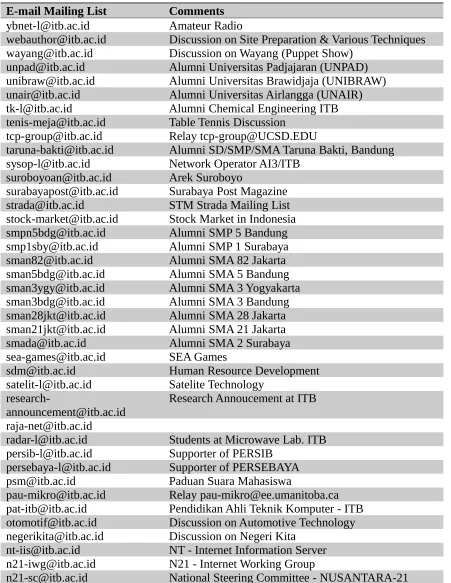
Appendix II
List of Major Indonesian Mailing Lists.
E-mail Mailing List Comments
[email protected] Amateur Radio
[email protected] Discussion on Site Preparation & Various Techniques [email protected] Discussion on Wayang (Puppet Show)
[email protected] Alumni Universitas Padjajaran (UNPAD) [email protected] Alumni Universitas Brawidjaja (UNIBRAW) [email protected] Alumni Universitas Airlangga (UNAIR) [email protected] Alumni Chemical Engineering ITB [email protected] Table Tennis Discussion
[email protected] Relay [email protected]
[email protected] Alumni SD/SMP/SMA Taruna Bakti, Bandung [email protected] Network Operator AI3/ITB
[email protected] Arek Suroboyo
[email protected] Surabaya Post Magazine [email protected] STM Strada Mailing List [email protected] Stock Market in Indonesia [email protected] Alumni SMP 5 Bandung [email protected] Alumni SMP 1 Surabaya [email protected] Alumni SMA 82 Jakarta [email protected] Alumni SMA 5 Bandung [email protected] Alumni SMA 3 Yogyakarta [email protected] Alumni SMA 3 Bandung [email protected] Alumni SMA 28 Jakarta [email protected] Alumni SMA 21 Jakarta
[email protected] Alumni SMA 2 Surabaya
[email protected] SEA Games
[email protected] Human Resource Development
[email protected] Satelite Technology
[email protected] Research Annoucement at ITB [email protected]
[email protected] Students at Microwave Lab. ITB [email protected] Supporter of PERSIB
[email protected] Supporter of PERSEBAYA
[email protected] Paduan Suara Mahasiswa
[email protected] Relay [email protected] [email protected] Pendidikan Ahli Teknik Komputer - ITB [email protected] Discussion on Automotive Technology [email protected] Discussion on Negeri Kita
[email protected] NT - Internet Information Server [email protected] N21 - Internet Working Group
[email protected] Public Discussion on - NUSANTARA-21
[email protected] MIDI Music
[email protected] ITS Mechanical Engineering
[email protected] User of merdeka.itb.ac.id (free UNIX).
[email protected] Alumni Mesin ‘88 ITB.
[email protected] Alumni Mesin ‘75 ITB
[email protected] Loedroek ITB. [email protected]
[email protected] Chemistry
[email protected] Kajian ISLAM
[email protected] Job Announcement / Opening
[email protected] Alumni ITS
[email protected] Alumni ITB Angkatan 75
[email protected] ITB big family.
[email protected] ISDN Technology
[email protected] Indonesia Press / Journalists [email protected] Indonesia-Japan Collaboration [email protected] Indonesia Internet Exchange (IX) [email protected] Indonesia-Canada Collaboraton
[email protected] Informatics ITB
[email protected] Ikatan Ahli Perencana Wilayah [email protected] Ikatan Ahli Geologi Indonesia
[email protected] Discussion on various aspect of law & legal framework [email protected] Higher Engineering Education - Network
[email protected] Relay [email protected] [email protected] Graphics Design
[email protected] Indonesian GPS Community
[email protected] Geodesi ITB
[email protected] Discussion of Fuel Cell
[email protected] Engineering Physics ITB
[email protected] FreeBSD [email protected] FreeBSD [email protected] FreeBSD [email protected] FreeBSD
[email protected] Fakultas Kesehatan Masyarakat UNAIR [email protected] Fakultas Kedokteran (?)
[email protected] Alumni Physics ‘88 ITB [email protected] Alumni Physics ‘90 ITB
[email protected] Physics ITB
[email protected] English Course Distance Learning [email protected] Electrical Engineering ITS
[email protected] Electrical Engineering Universitas Indonesia (UI) [email protected] Ecoscience
dosen @itb.ac.id Mailing List of ITB’s Lecturers [email protected] Physician Mailing List
[email protected] Delphi Programmer
[email protected] User Group CA-Clipper Programmer [email protected] Open Mailing List on Earth / Kebumian. [email protected] Open Mailing List on Buddhism
[email protected] Open Mailing List on Borneo (Kalimantan) [email protected] Mailing List on UFO
[email protected] ATM Technology [email protected]
[email protected] Keluara Besar Taruna Bakti, Bandung, News
[email protected] Arek Malang
[email protected] Amateur Radio Club ITB
[email protected] Architecture ITB
[email protected] Alumni Architecture ‘91 ITB [email protected]
[email protected] Relay [email protected]
[email protected] Relay [email protected] [email protected] Staff AI3 di ITB
[email protected] Administrator Library Network ITB
[email protected] Aceh
[email protected] Alumni Civil Engineering ITB [email protected] Electrical Engineering ITB ‘81 [email protected] Electrical Engineering ITB ‘84 [email protected] Electrical Engineering ITB ‘86 [email protected] Electrical Engineering ITB ‘87 [email protected] Electrical Engineering ITB ‘88 [email protected] Electrical Engineering ITB ‘89 [email protected] Electrical Engineering ITB ‘90 [email protected] Electrical Engineering ITB ‘91 [email protected] Electrical Engineering ITB ‘92 [email protected] Electrical Engineering ITB ‘93 [email protected] Electrical Engineering ITB ‘94 [email protected].
edu Aceh
[email protected] Dosen Universitas Ahmad Dahlan, Yogyakarta [email protected] Mahasiswa Indonesia di Thailand
[email protected] Mahasiswa Indonesia di Austria [email protected] Alumni Bunda Hati Kudus, Jakarta. [email protected]
y.edu
BISA=Berkeley Indonesian Student Association
[email protected] Kebumian & Geodesi.
[email protected] Keluarga Besar PT. Caltex Pacific Indonesia (CPI) [email protected] Keluarga Besar SMA Kanisius, Jakarta
[email protected] Ekonomi, bisnis & sekitarnya.
[email protected] Staf EIUDP (Eastern IndonesiaUniversity Development Project) in Vancouver and Jakarta
[email protected] Fellowship of Indonesian Christians in America (FICA)
[email protected] Fishery.
Forestry.
[email protected] Forum Komunikasi Mahasiswa Indonesia di Kanada.
Keluarga Besar Universitas Gajah Mada, Jogyakarta.
[email protected] Gereja Mahasiswa Bandung
[email protected]. Indonesian Christian Computer Network [email protected] Indonesia Japan
[email protected] Jaringan Kajian Pembangunan Indonesia [email protected] Teknik Industri (Industrial Engineering) - ITS [email protected] Alumni Fakultas Teknik, Universitas Indonesia. [email protected] Mahasiswa Indonesia di Eropa
[email protected] Forum Indonesia-Amerika [email protected] Mailing List Indonesia
[email protected] Berita & Pandangan “Lain” Tentang Indonesia (moderator John “apakabar” MacDougall)
[email protected] Mahasiswa Indonesia di British Columbia, Canada [email protected] Forum for ICS (Indonesian Club at Stanford)
[email protected] Indonesia di George Washington University in Washington DC
[email protected] Indonesian in Australia [email protected] Alumni IPB
[email protected] Indonesian Students in Oregon State University, Corvallis, Oregon, US.
[email protected] Indonesian Student's Group (in Winnipeg, Canada) [email protected] Diskusi Tentang Islam.
[email protected] Diskusi Tentang Muslim - NonMuslim
[email protected] Pertanyaan & Jawaban Ttg. Kristen Oleh ISNET [email protected]
u The first Indonesian mailing list
[email protected] Alumni Keluarga Eks forum for SMA Ketapang alumni Kolese Loyola, Semarang.
[email protected] Keluarga Mahasiswa Katolik Indonesia
[email protected] Maluku
[email protected] Sulawesi Utara
[email protected] Catholicism or issues in the Catholic religion [email protected]
wa-u.ac.jp
Indonesian Catholic Community in Asia Pasific regions.
[email protected] Anything on IT & Microelectronics. [email protected] Pengajian Staid III net
[email protected] Indonesian Students in Colorado State University, CO. [email protected] SMAK Petra II Surabaya Alumnae Mailing List.
[email protected] Indonesians who reside in the city of Philadelphia, its surroundings.
[email protected] Alumni of SMA Pangudi Luhur, Jakarta.
[email protected]@papilio.tutics.tut.ac.jp Indonesians studying in Central Japan and the alumni [email protected] PPI Kyoto
[email protected] PPI-Net
[email protected] math, physics, ece, etc, problems
[email protected] Minangkabaus (West Sumatran) in foreign soil. [email protected] Regina Pacis Alumni mailing list
[email protected] Alumni SMA Katolik Ricci, Jakarta
Discussion on SARA (Suku, Agama, Ras, dan Antar golongan) in Indonesia
[email protected] Lembaga Seni Pernafasan SATRIA NUSANTARA PUSAT
[email protected] Indonesian Science and Technology (IPTEK).
[email protected] all about semi-conductor
[email protected] Regina Pacis Bogor Alumni mailing list
[email protected] Alumni SMAK-1 (Yayasan BPK Penabur KPS) Jakarta. [email protected] Alumni SMAK-3 (Yayasan BPK Penabur KPS) Jakarta.
Guru, staf, pelajar dan alumni SMA Negeri 8 Jakarta
[email protected] Tenaga Dalam Satria Nusantara
[email protected] Petroleum and Geoscience within the alumny and faculties of Petroleum Engineering, ITB
Affiliates of St. Aloysius - Bandung
[email protected] Alumni/staff of Usakti Jakarta
[email protected] Alumni + staff of Universitas Indonesia, Jakarta
alumni dan staff Universitas Kristen Satya Wacana
Appendix III
List Indonesian Universities / Educational Related Web Sites
Universities
10 November Institute of Technology, Surabaya http://www.telimek.lipi.go.id/its/its.htm
Christian University Petra, Surabaya http://www.petra.ac.id/
Inter University Center on Microelectronics, Bandung
http://www.ee.itb.ac.id/ITB/iuc-me/iuc-me.html
Institute of Technology Bandung ITB, Bandung http://www.itb.ac.id/
Computer Network Research Group ITB http://www.ee.itb.ac.id/ITB/cnrg/
Department of Mechanical Engineering ITB http://engine.me.itb.ac.id/ Department of Electrical Engineering ITB http://www.ee.itb.ac.id/
Magister Management Program ITB http://www.zantara.com/mmitb/index.htm
Java Mirror at ITB http://java.ITB.ac.id/
Sun Mirror at ITB http://sun.ITB.ac.id/
HP Mirror at ITB http://hp.ITB.ac.id/
Apache Mirror at ITB http://apache.ITB.ac.id/
Cisco Mirror at ITB http://cisco.ITB.ac.id/
Sony Mirror at ITB http://sony.ITB.ac.id/
Sony Music Mirror at ITB http://sony-music.ITB.ac.id/
Sony Mirror at ITB http://sony-spe.ITB.ac.id/
IWI Mirror at ITB http://iwi.ITB.ac.id/
DigiCash Mirror at ITB http://digicash.ITB.ac.id/
GNN Mirror at ITB http://gnn.ITB.ac.id/
Magister Management Program ITB http://www.zantara.com/mmitb/index.htm
Institute of Technology National, Bandung http://www.iii.net/users/prasetyo/itenas.htm
Parahyangan Catholic University (UNPAR), Bandung http://kappa.iis.u-tokyo.ac.jp/~fujimori/unpar/unpar.html
Christian University Maranatha, Bandung http://www.strx.com/ukm
University of Gajahmada, Jogjakarta http://budi.ee.umanitoba.ca/gama/info.html
University of Hasanuddin, Ujung Pandang http://www.mis.bppt.go.id/~arisoni/unhas/unhas.html
SunSITE University of Indonesia http://sunsite.ui.ac.id
University of Indonesia, Jakarta http://www.ui.ac.id
University of Padjadjaran, Bandung http://www.cs.unb.ca/grads/r6uy/www/unpad/unpad.html
University Sam Ratulangi, Manado http://www.carleton.ca/~hmantiri/UNSRAT-MANADO.html
STMIK Gunadarma, Jakarta http://www.cyberspace.org/~derrys/gundar.html
Calvin College & Seminary. http://www.calvin.edu/~rsetia67/indonesian/indonesian.html
Lembaga Pendidikan Memajukan Bangsa http://www.go-indonesia.com/lpmb/ Indonesian Studies at The University of
Pangudi Luhur High School, Jakarta http://web.mit.edu/afs/athena.mit.edu/user/r/h/rh andojo/www/PL/PL.html
SMA Frateran - Frateran High School http://www.engr.csulb.edu/~lsoewito/frateran/
SMAK I - Christian Senior High School No. 1
http://elektra.res.cmu.edu/~smak1/
Jakarta International School (JIS) http://garnet.berkeley.edu/~kaykunng/html/main.html
SMA Tarakanita 1 Puloraya http://www.geocities.com/Paris/5975/
SMAK III - Indonesian Private High School http://www.calvin.edu/~rsetia67/smak3/
Academic Databases
Indonesian Science & Technology Information Base http://www.chem.utas.edu.au/students/yos/SI3/IT/index.html
Indonesian Science & Technology Information Base gopher://gopher.fedu.uec.ac.jp/11/.FEDUWIS/.Indonesia/ISTIB
Science Database Koblenz Search Engine
http://heym.uni-koblenz.de:2121/~lim/db_seach.html Science Database Koblenz
http://heym.uni-koblenz.de:2121/~lim/sci_db.html Indonesian Development Studies http://web.syr.edu/~idserr/
PPIA and INDOZ-NET http://info.utas.edu.au/docs/yos/ Macsonic Indonesia - Aerial color
infra-red mapping of Indonesian forest http://www.deltanet.com/users/macsonic/ Indonesian Serials Database http://coombs.anu.edu.au/SpecialProj/AJC/I
ND/Indonesia-jrnls.html
Center for International Forestry Research (CIFOR) Bogor http://www.cifor.or.id/
Center for International Forestry Research (CIFOR) Bogor http://www.cgiar.org/cifor/index.html
Multilingual Machine Translation System http://nataya.aia.bppt.go.id/immts/immts.html
Indonesia related academic internet
resources http://www.auckland.ac.nz/asi/indo/links.html
Indonesia related academic internet resources
PERMIAS Oklahoma State University http://www.okstate.edu/osu_orgs/iosa/ PERMIAS New York City http://www.columbia.edu/~fh38/permias/ PERMIAS University of Oklahoma http://www.ecn.uoknor.edu/~dpnugrah/permias.html
University of Tennessee at Knoxville http://funnelweb.utcc.utk.edu/~auxherm7/ University of Wisconsin at Madison http://www.engr.wisc.edu/~rufinus/permias.
html
Permias Indonesian Student Association http://www.umn.edu/nlhome/g187/permias/permias.html
Appendix IV
A Glimpse on The Number of Subscriber (As of 4 September 1998)
Mailing List at ITB Subscriber
ekonomi-indonesia 655
itb 532
pau-mikro 425
jobs 373
dokter 359
iagi-net 258
borneo 244
sysop-l 208
graphic-design 185
tk-l 167
sman3bdg 146
english-courses 143
itb75 132
Appendix V
A Glimpse on The Mailing List User Origin (as of 4 September 1998)
Subscriber Domain
1291 id.ac.itb
1171 id.net
562 com.hotmail
477 id.co
374 id.net.wasantara
292 id.net.centrin
227 id.ac
209 id.ac.itb.che
191 com.ptcpi
167 net.usa
157 id.net.mega
137 id.ac.unsyiah
132 com.fmi