Basic Policy on Promoting Green Purchasing
Table of Contents
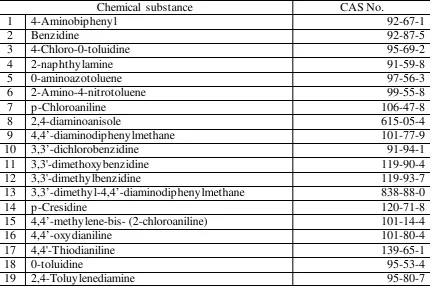
1. Bas ic D irect ion for Green Purchas ing by the G overnment and Indep endent
Administrative Institutions ………..1
2. Designated Procurement Items, Evaluation Criteria, and Basic M atters Relating to the Procurement of their Purchase………...……...………..……….4
3. Other Important M atters Regarding Green Purchasing…....………….……..……6
Appendix………8
1. Terminology………...8
2. Paper………8
3. Stationery………..………18
4. Office Furniture, etc……….…31
5. Office Automation M achines……….……….35
5-1 Copiers, etc………35
5-2 Computers………45
5-3 Printers, etc………...……….49
5-4 Fax M achines……….55
5-5 Scanners……….59
5-6 M agnetic Disc Drive Units……….62
5-7 M onitors……….64
5-8 Paper Shredders………68
5-9 Digital Duplicators.………..…………70
5-10 Recording M edias………..………73
5-11 Batteries.………..………75
5-12 Electronic Table Calculators………..…………77
5-13 Cartridges, etc………..…………78
5-14 Clocks………..………83
5-15 Projectors………..………84
6. M obile Telephones………87
7. Home Electronic Appliances………91
7-1 Electric Refrigerators, etc……….91
7-2 Television Receivers……….94
7-3 Electric Toilet Seats……….100
7-4 M icrowave Ovens………..102
8. Air Conditioners, etc……….104
8-1 Air Conditioners………..104
8-2 Gas Heat Pump Air Conditioners……….108
8-3 Space Heaters………...…………110
9. Water Heaters, etc………112
9-1 Electric Hot Water Supply Systems………112
9-2 Gas Water Heaters………115
9-3 Oil Water Heaters……….118
9-4 Gas Cooking Appliances……….120
10.Light ing……….123
10-1 Lighting Equipments………123
10-2 Lamps………128
11-1 Vehicles……….132
11-2 ITS Adaptable Car Accessories………142
11-3 Tires………..143
11-4 Engine Oil……….144
12.Fire Extinguishers………145
13.Uniforms and Work Clothes……….147
14.Interior Fixtures and Bedding………150
14-1 Curtains,etc………150
14-2 Carpets………152
14-3 Blankets, etc………154
14-4 Beds………156
15.Work Gloves………..159
16.Other Fiber Products………....160
16-1 Tents and Sheets………160
16-2 Safety Nets……….162
16-3 Flags, Advertisement Flags, and Banners, etc………164
16-4 M ops………166
17.Facilities ………..168
18.Stockpiles for Disaster………..176
18-1 Stockpiles for disaster (Potable Water)………176
18-2 Stockpiles for disaster (Food)………..………177
18-3 Stockpiles for disaster (Household items and materials, etc.)…………179
19.Public-Works Projects……….185
20.Services……….216
20-1 Energy Conservation Diagnosis……….216
20-2 Printing………217
20-3 Cafeteria……….229
20-4 Recapped Automobile Tires……….. ………230
20-5 Automobile M aintenance……….………..231
20-6 M anagement of Government Office Buildings, etc.……….233
20-7 Transportation and Delivery.………..………..……….253
20-8 Passenger Transportation .….………..………..………258
20-9 Illumination Services .….…..………..………..…….262
20-10 Retail Bus inesses……….……….…263
20-11 Laundry and Dry Cleaning……….……….…264
1
Basic Policy on Promoting Green Purchasing (Provisional Translation)
This document defines the basic policies for promoting comprehensive and planned procurement of materials, components, products and services with low environmental impact (hereinafter referred to as “eco-friendly goods”). This is the basic policy of the national government (e.g. the Diet, government ministries and agencies, and courts) and corporations defined by the government ordinance 556 of the year 2000 specifying corporations (hereinafter referred to as “Independent Administrative Institutions”) in Article 2, Paragraph 2 of the Law Concerning the Promotion of Procurement of Eco-friendly Goods and Services by the State and Other Entities (generally known as the Law on Promoting Green Purchasing). It is hoped that local governments, enterprises, and citizens will also make a commitment to the procurement of eco-friendly goods by taking this basic policy into consideration.
The national government shall continue to work in existing dealings to promote environmental conservation in coordination with this basic policy:
1.Basic Direction for Green Purchasing by the Government and Independent Administrative Institutions
1.1Background and S ignificance of the Promotion of Green Purchasing
Current concerns for global warming and waste management, among other environmental issues, are rooted in the system of production and consumption, which has promoted mass production, mass consumption, and mass waste. In order to address these issues, it is essential that we transform our economy and our societies into sustainable ones. This will require a commitment by all sectors to reduce environmental impact. We must immediately reduce the environmental impact of the goods and services that support our lifestyles and economic activities, and promote a shift in demand toward eco-friendly goods.
In order to shift demand toward eco-friendly goods, it is important to not only promote the supply of eco-friendly goods, but also to prioritize the purchase of eco-friendly goods. The prioritization for purchasing eco-friendly goods will help form markets for these goods and services, which in turn will promote their development and, as a result, increased purchase of eco-friendly goods. The resulting continuous improvement will create a ripple effect in the market. It is necessary for all persons to make a strong commitment to prioritize the purchase of eco-friendly goods as an integral part of their lives. This is the first step toward wider environmental conservation activities by the procurement entities.
2
the Use of Goods and Services which Help Reduce Environmental Impact,” of the Basic Environment Law (Law No.91, 19 November of 1992), and Article 19, “Promoting the Use of Recycled Goods,” of The Basic Law for Establishing the Recycling-based Society (Law No. 110, 2000).
In consideration of the recent measures against global warming, the government and others needs to take the leadership in green purchasing more than the equal in the past, based on “Immediate-Term Policy on the Countermeasures against Global Warming” (Global Warming Prevention Headquarters decision, M arch 15, 2013).
1.2Basic Approach toward the Promotion of Green Purchasing
Each fiscal year, each institution of the government (hereinafter referred to as “each institution”) shall formulate and publish a green purchasing policy in conformance with this basic policy and based on the Law Concerning the Promotion of Procurement of Eco-friendly Goods and Services by the State and Other Entities (Law No. 100, 2000; hereinafter referred to as “Law on Promoting Green Purchasing”) taking into consideration its budget and planned projects and activities for the fiscal year, and shall purchase goods and services during the fiscal year based on this green purchasing policy.
Specifically, each institution shall purchase and utilize goods and services based on the following philosophy:
(1)In addition to conventional considerations such as price and quality, environmental conservation must be considered when making purchasing decisions. This will make the reduction of the environmental impact of goods and services an element for a successful procurement contract, along with price and quality. The resulting competition between enterprises will lead to the popularization of eco-friendly goods. In awareness of this, each institution shall consider the possibility to reduce environmental impact in its procurement for as wide a range of goods and services as possible, considering the business’s promotion for reduction of the environment impact not to mention the observance of regulations related to environment.
(2)The viewpoint for the maximum reduction of environmental impact must incorporate a wide range of environmental factors, including global warming, air pollution, waste, and the decrease of biodiversity, in as holistic a manner as possible. At the same time, goods and services must be selected in consideration of their ability to reduce environmental impact throughout the product lifecycle from resource acquisition to disposal. With regards to areas with specific environmental issues such as local air pollution, such local environmental issues must be considered with priority in making purchasing decisions.
3
4
2.Designated Procurement Items, Evaluation Criteria, and Basic Matters Relating to the Procurement of their Purchase
2.1Basic Approach
2.1.a S etting Procurement Targets for Goods Meeting the Criteria
Each fiscal year, each institution shall establish procurement targets meeting the evaluation criteria for each designated procurement item (hereinafter referred to as “specified procurement goods”).
2.1.b Character of Evaluation Criteria
It is preferable to take into account the reduction of environmental impact over the entire product lifecycle when making green purchasing decisions. So as to ensure clarity, including the use of quantitative measures, objective guideline for the actual purchase of eco-friendly goods and evaluation criteria for each designated procurement item shall be established.
Additionally, while each eco-friendly good makes a corresponding contribution toward reducing environmental impact, the evaluation criteria are established to clarify which of these goods are to be included in the procurement targets set by each institution each fiscal year in its procurement policy, and function as a guideline for the promotion of green purchasing. Consequently, goods and services meeting the evaluation criteria are not the only ones that will help protect the environment, nor are they the only ones recommended for purchase. It is preferable for each institution to strive to purchase goods and services contributing to the reduction of environmental impact to the greatest extent possible, taking into account a variety of environmental factors over the entire product lifecycle, and not merely purchase the goods meeting the evaluation criteria in accordance with the basic philosophy of green purchasing.
Furthermore, there are factors, which are important for reducing environmental impact but are not appropriate to apply as uniform evaluation criteria at the present time. These factors are specified as “factors for consideration,” along side the evaluation criteria to be taken into consideration when making purchasing decisions. Note that when each institution applies the factors for consideration to procurement, it shall be made clear beforehand with explicit specifications for each procurement, in order to impart transparency and fairness to the procurement process.
Note that these evaluation criteria are created primarily for the reduction of environmental impact. It will naturally be necessary to ensure that the general criteria expected of purchased goods and services are satisfied as well, such as quality, functionality, and appropriate price.
2.1.c Revising and Adding Designated Procurement Items and Evaluation Criteria The designated procurement items and evaluation criteria shall be revised as appropriate, in response to the development and popularization of the goods and/or our scientific understanding of goods and materials.
5 2.1.d Approach toward Public Works
Public works account for a large share of each institution’s procurement, and have a large impact on the national economy. Additionally, it is believed that if the government takes the initiative in promoting the reduction of environmental impact in practicing the public works, it will be very effective at encouraging local governments and private enterprise to make a commitment as well. Therefore, public works that help to reduce environmental impact are included in designated procurement items relating to services, and this type of procurement shall be actively promoted in accordance with the following points.
As construction (including architectural structures), which is the aim of public works, is directly linked to the lives of the people, its long term safety and functionality must be ensured. Therefore, special consideration must be given to the strength, durability, and functionality of materials, based on the specific characteristics of the project concerned. There must also be a firm commitment to minimize the costs of public works projects, which have been considered from the point of the appropriate use of the institution’s budget. Future consideration shall be made to establish more appropriate procurement targets respecting that the usage of materials and so on is different due to the objective of each project, the purpose of each structure, the difficulty of construction and so on, and there are materials and so on which are available in limited areas and/or quantities.
There are many possible ways to reduce the environmental impact of public works in addition to material utilization, such as the construction methods with low environmental impact. The issue shall be studied from a holistic viewpoint spanning the entire lifecycle of the public works project.
2.2Designated Procurement Items and Evaluation Criteria See Appendix.
2.3Eco-friendly Goods Other than Designated Procurement Items
The purchase of eco-friendly goods other than the designated procurement items shall also be promoted in accordance with the status of the administrative task or project in question, by setting targets as concretely as possible for as wide a range of items as possible, in the procurement policy.
In particular under the services category, each organization shall actively take up what is provided with some of Designated Procurement Items in their own procurement policy even when it is not listed in this basic policy because it is thought to have a big potential to reduce environmental load. It is also important for each institution to extend its efforts to reduce environmental impact beyond ordinary commercially available products and services, to those custom built or ordered, and so on. It is therefore preferable to incorporate these special goods into the procurement policy, by studying the possibility of reducing environmental impact at as early a stage as possible, including the planning stages.
6
3.Other Important Matters Regarding Green Purchasing
3.1Desiderata for a Procurement Promotion S ystem
Each institution shall establish a system for promoting green procurement. As a rule, this system shall be managed by a person with the ability to exercise control over all of the institution’s internal green purchasing. (In the case of government ministries and agencies, the system shall be managed by the equivalent of a Director (Director-General), or higher). All organizations belonging to an institution shall participate in the system. Note that environmental departments and accounting/procurement departments must independently contribute to this process. Each institution shall clearly describe a concrete green purchasing promotion system in its purchasing policy.
3.2S cope of Procurement Policy Application
As a rule, the procurement policy shall be applied to all organizations belonging to the institution. However, in the case of specific departments where it is not feasible to uniformly promote green purchasing, a separate procurement policy shall be created for the department in question, after clearly noting the reasons in the procurement policy. Each institution shall clearly note the scope of its application in the procurement policy.
3.3Publication of Procurement Policy, S ummery of Procurement Track Record, and Methods Therein
Procurement targets for environmental goods each fiscal year will be included in each institution’s publication of its procurement policy, and will prompt enterprises to promote the supply of eco-friendly goods from the demand side. Additionally, in order to successfully promote green purchasing, it is necessary to give an objective and clear picture of the state of progress of green purchasing, by accurately grasping the procurement track record and creating a procurement policy that reflects the record, and by publishing the summery of record in an easy-to-understand format.
3.4Establishment of Committee of Related Government Ministries and Agencies, etc.
A committee of government ministries and agencies, etc. shall be formed to enhance communication between organizations and to study policies for the promotion of green purchasing so as to facilitate green purchasing effectively.
3.5Employee Training and Other Educational Activities for the Promotion of Green Purchasing
Training, seminars, and other educational activities shall be actively implemented to give employees, especially those in charge of procurement, a greater awareness and practical knowledge concerning the promotion of green purchasing.
3.6Utilization and Provision of Information about Eco-friendly Goods
7
8 Appendix
1. Terminology
In this Appendix, the terms “evaluation criteria” and “factors for consideration” are used with the following meanings:
Evaluation Criteria
The requirement as “specified procurement goods” stipulated in Article 2, Paragraph 2 of the Law Concerning the Promotion of Procurement of Eco-friendly Goods and Services by the State and Other Entities.
Factors for Consideration
While not criteria required for specified procurement goods, theses factors should preferably be taken into account when purchasing eco-friendly goods.
2. Paper
(1)Items and Evaluation Criteria
Information Paper
Copier paper Evaluation Criteria
(1) The composite rating obtained by using the following numbers in the formula in note 5 must be 80 or higher: content of recycled pulp, pulp certified by forest certification system, pulp manufactured with lumber obtained from thinning and others, proportion of pulp content that is used in accordance with method of material procurement with sustainable goals, degree of bleaching, and weight per unit to be used for material.
(2) If virgin pulp is used as the raw material, the pulpwood used is to be in compliance with the regulations concerning forestry in its country or geographical area of origin. This does not apply to virgin pulp manufactured with lumber obtained from thinning, or virgin pulp manufactured by using recycled wood pieces obtained from plywood or lumber factories, material left over from forestry, or lumber with small diameter.
(3) The composite rating and its breakdown (index or additional rating, as well as rating for each index item) must be listed on the product. When it is not possible to list the rating and its breakdown on the product, the information must be readily available on website, etc., which should be clearly noted.
Factors for Consideration
(1) The recycled pulp content is as high as possible.
9
methods. The content of pulp certified by forest certification system and pulp manufactured with lumber obtained from thinning and others is to be as high as possible.
(3) Packaging and stowage is to be as simple as possible and take into account ease of recycling and reduced environmental impact upon disposal.
Note:
1. Pulp used in accordance with method of procurement of materials with sustainable goals, denotes one of the following:
a. Pulp used in accordance with policies for procuring pulpwood only from those forests which are operated in accordance with the viewpoint to use forest material both cyclically and sustainably by maintaining the diverse functions of the forests, while not contributing to the deterioration of the forest or the reduction of forest area, and which maintain environmental excellence, including preservation of biodiversity, and social excellence, including consideration for health and safety of workers.
b. Pulp used in accordance with policies for procuring recycled and unused pulpwood that would contribute to the effective application of resources (scrap wood, pulpwood derived from construction, lower standard pulpwood (leftover pulpwood from forestry, shrubbery, tree root, pulpwood obtained from logs affected by vermin and natural disasters, bent material, material with small diameter, etc.) and fiber from waste plants).
2. Lumber obtained from thinning and others denoteslumber obtained from thinning and bamboo.
3. Index item denotes content of recycled pulp, pulp certified by forest certification system, pulp manufactured with lumber obtained from thinning and others proportion of pulp content that is used in accordance with method of material procurement with sustainable goals, degree of bleaching, and weight per unit to be used for material. Proportion of pulp content that is used in accordance with material procurement with sustainable goalsdenotes pulp to be used in
accordance with material procurement with sustainable goals, with the exception of pulp certified by forest certification system and pulp manufactured with lumber obtained from thinning and others.
4. Composite rating stands for the amount Y listed in note 5.
Index stands for amount per index item for x1, x2, x3, x4 as listed in note 5; Additional ratingstands for amount per index item for x5, x6 as listed in note 5. Rating stands for the amount calculated in accordance with formulas for y1, y2, y3, y4, y5 as listed in note 5.
10
Y and y1, y2, y3, y4, y5, x1, x2, x3, x4, x5, x6 stand for the following amount. Y (composite rating): the sum of y1, y2, y3, y4, y5 with the amount below decimal point eliminated.
y1: calculated rating for recycled pulp content, rounded to one decimal place. y2: calculated rating for the content of pulp certified by forest certification
system and pulp manufactured with lumber obtained from thinning and others, rounded to one decimal place.
y3: calculated rating for proportion of pulp content that is used in accordance with method of material procurement with sustainable goals, rounded to one decimal place.
y4: calculated sum of degree of bleaching, rounded to one decimal place. y5: calculated sum of weight per unit, rounded to one decimal place. x1: content ratio of recycled pulp satisfying minimal guarantee (%) x2: content ratio of pulp certified by forest certification system (%)
x2 = (pulp certified by forest certification system/ virgin pulp) x (100-x1) x3: content ratio of pulp manufactured with lumber obtained from thinning and
others (%)
x3 = (pulp manufactured with lumber obtained from thinning and others/ virgin pulp) x (100-x1)
x4: content ratio of pulp that satisfy other sustainable goals (%)
x4 = (pulp that satisfy other sustainable goals / virgin pulp) x (100-x1) x5: degree of bleaching (%)
degree of bleaching is to be determined as management standard per each product lot at the time of production. Amounts within 3% of management standard are to be allowed. When coloring occurs with purposes other than to match the lot color (when bleaching is done intentionally) does not count towards additional points.
x6: weight per unit (g/m2)
weight per unit is to be determined as management standard per each product lot at the time of production. Amounts within 5% of management standard are to be allowed.
6. As copy paper with low weight per unit has a relatively high risk of curling, jamming, and tearing at the time of copying, it is necessary to pay attention when procuring paper with low weight per unit.
7. When using copier paper for the copiers and the printers, each procurement organization must confirm the printability and print quality based on information offered by the paper manufacturer making public on the product or website. 8. Confirmation of the legality and the sustainability of the forest where pulpwood
producing paper originates from is to be conducted in accordance with the Forest Agency’s “Guideline for Verification on Legality and Sustainability of Wood and Wood Products (February 15, 2006)”.
In cases where the contract between the lumber company and the processing and marketing companies has been made prior to April 1, 2006, the proof that the lumber is legal in accordance to the guideline above is not necessary, as long as the party that is maintaining the lumber and the products documents on a certificate by April 1, 2006 that the said contract has been completed before April 1, 2006.
11
accordance with the Forest Agency’s “Guidelines for confirming thinning wood chips (February 13, 2009).”
10.As paper is produced from a mixture of multiple wood chips, it is permissible to take into consideration the difficulty of securing the actual proportion for each product during the manufacturing process, and use the credit method that is in accordance with “Operation guidelines for credit method for pulp certified by forest certification system, and pulp manufactured with lumber obtained from thinning (February 13, 2009)”, stipulated by M inistry of Environment.
Credit methodrefers to a method whereby the appropriate use of pulp certified by forest certification system and pulp manufactured with lumber obtained from thinning and others are determined for each product, in accordance to the amount of usage for the two types of pulp in relation to other types of material used in a given time, without consideration for whether or not it is actually used in individual product.
11.Copier paper manufactured until M arch 31, 2014, whose composite rating is over 80 will be considered as specified procurement goods in the fiscal year 2014.
Forms Evaluation Criteria
(1) 70% recycled pulp content and no more than approximately 70% bleaching.
(2) If virgin pulp is used as the raw material, the pulpwood used is to be in compliance with the regulations concerning forestry in its country or geographical area of origin. This does not apply to virgin pulp manufactured with lumber obtained from thinning, or virgin pulp manufactured by using recycled wood pieces obtained from plywood or lumber factories, material left over from forestry, or lumber with small diameter.
(3) If coated, coating on both sides totaling no more than 12 g/m2.
Factors for Consideration
(1) If virgin pulp is used as the raw material, the pulpwood used is to be obtained from a forest that is conducting a sustainable operation. This does not apply to virgin pulp manufactured with lumber obtained from thinning, or virgin pulp manufactured by using recycled wood pieces obtained from plywood or lumber factories, material left over from forestry, or lumber with small diameter.
(2) Packaging and stowage is to be as simple as possible and take into account ease of recycling and reduced environmental impact upon disposal.
Coated inkjet color printer paper
Evaluation Criteria
(1) At least 70% recycled pulp content.
12
is to be in compliance with the regulations concerning forestry in its country or geographical area of origin. This does not apply to virgin pulp manufactured with lumber obtained from thinning, or virgin pulp manufactured by using recycled wood pieces obtained from plywood or lumber factories, material left over from forestry, or lumber with small diameter.
(3) Coating on both sides totaling no more than 20 g/m2, coating on one side no more than 12 g/m2.
Factors for Consideration
(1) If virgin pulp is used as the raw material, the pulpwood used is to be obtained from a forest that is conducting a sustainable operation. This does not apply to virgin pulp manufactured with lumber obtained from thinning, or virgin pulp manufactured by using recycled wood pieces obtained from plywood or lumber factories, material left over from forestry, or lumber with small diameter.
(2) Packaging and stowage is to be as simple as possible and take into account ease of recycling and reduced environmental impact upon disposal.
Note:
Confirmation of the legality and the sustainability of the forest where pulpwood producing paper originates from is to be conducted in accordance with the Forest Agency’s “Guideline for Verification on Legality and Sustainability of Wood and Wood Products (February 15, 2006)”
In cases where the contract between the lumber company and the processing and marketing companies has been made prior to April 1, 2006, the proof that the lumber is legal in accordance to the guideline above is not necessary, as long as the party that is maintaining the lumber and the products documents on a certificate by April 1, 2006 that the said contract has been completed before April 1, 2006.
Printing Paper
Non coated printing paper
Coated printing paper
Evaluation Criteria
(1) M ust fulfill one of the following.
a. For non coated printing paper, the composite rating obtained by using the following numbers in the formula in note 5 must be 80 or higher: content of recycled pulp, pulp certified by forest certification system, pulp manufactured with lumber obtained from thinning and others, proportion of pulp content that is used in accordance with method of material procurement with sustainable goals, and degree of bleaching to be used for material.
13
be 80 or higher: content of recycled pulp, pulp certified by forest certification system, pulp manufactured with lumber obtained from thinning and others, proportion of pulp content that is used in accordance with method of material procurement with sustainable goals, and amount of coating to be used for material.
(2) If virgin pulp is used as the raw material, the pulpwood used is to be in compliance with the regulations concerning forestry in its country or geographical area of origin. This does not apply to virgin pulp manufactured with lumber obtained from thinning, or virgin pulp manufactured by using recycled wood pieces obtained from plywood or lumber factories, material left over from forestry, or lumber with small diameter.
(3) The composite rating and its breakdown (index or additional rating, as well as rating for each index item) must be readily available on website etc.
(4) Not processed in a way that makes difficult to recycle.
Factors for Consideration
(1) The recycled pulp content is as high as possible.
(2) When virgin pulp is used as material, the pulpwood must be produced from forests that are operated using sustainable methods. The content of pulp certified by forest certification system and pulp manufactured with lumber obtained from thinning and others is to be as high as possible.
(3) Packaging and stowage is to be as simple as possible and take into account ease of recycling and reduced environmental impact upon disposal.
Note:
1. Pulp used in accordance with method of procurement of materials with sustainable goals, denotes one of the following:
a. Pulp used in accordance with policies for procuring pulpwood only from those forests which are operated in accordance with the viewpoint to use forest material both cyclically and sustainably by maintaining the diverse functions of the forests, while not contributing to the deterioration of the forest or the reduction of forest area, and which maintain environmental excellence, including preservation of biodiversity, and social excellence, including consideration for health and safety of workers.
b.Pulp used in accordance with policies for procuring recycled and unused pulpwood that would contribute to the effective application of resources (scrap wood, pulpwood derived from construction, lower standard pulpwood
(leftover pulpwood from forestry, shrubbery, tree root, pulpwood obtained from logs affected by vermin and natural disasters, bent material, material with small diameter, etc.) and fiber from waste plants).
14
3. Index item denotes content of recycled pulp, pulp certified by forest certification system, pulp manufactured with lumber obtained from thinning and others, proportion of pulp content that is used in accordance with method of material
procurement with sustainable goals, degree of bleaching, and amount of coating to be used for material. Proportion of pulp content that is used in accordance with material procurement with sustainable goalsdenotes pulp to be used in accordance with material procurement with sustainable goals, with the exception of pulp certified by forest certification system and pulp manufactured with lumber obtained from thinning and others.
4. Composite rating stands for the amount Y1 or Y2 listed in note 5.
Index stands for amount per index item for x1, x2, x3, x4 as listed in note 5; Additional ratingstands for amount per index item for x5, x6 as listed in note 5. Rating stands for the amount calculated in accordance with formulas for y1, y2, y3, y4, y5 as listed in note 5.
5. Composite rating, rating, index, and additional rating are to be derived from the following:
y4=-x5+75 (60 x5 75, x5<60 x5=60, x5>75 x5=75)
y5=-0.5x6+20 (0 x6 10 x6=10, 10 x6 20 x6=20,20 x6 30 x6=30, x6>30 x6=40)
Y1, Y2 and y1, y2, y3, y4, y5, x1, x2, x3, x4, x5, x6 stand for the following amount. Y1 (composite rating of non coated printing paper): the sum of y1, y2, y3, y4
with the amount below decimal point eliminated.
Y2 (composite rating of coated printing paper): the sum of y1, y2, y3, y5 with the amount below decimal point eliminated.
y1: calculated rating for recycled pulp content, rounded to one decimal place. y2: calculated rating for the content of pulp certified by forest certification
system and pulp manufactured with lumber obtained from thinning, rounded to one decimal place.
y3: calculated rating for proportion of pulp content that is used in accordance with method of material procurement with sustainable goals, rounded to one decimal place.
y4: calculated sum of degree of bleaching, rounded to one decimal place (not applied for colored printing paper or fancy paper (including fine quality of colored paper and general colored paper used colorant)).
5 point adding in case of colored printing paper and fancy paper of Rank A (the one not obstructed in recycling to printing paper) that meet the criteria of “printing” (refer to printingsection), there is no adding point for other paper. y5: calculated sum of amount of coating, rounded to one decimal place.
x1: content ratio of recycled pulp satisfying minimal guarantee (%) x2: content ratio of pulp certified by forest certification system (%)
x2 = (pulp certified by forest certification system / virgin pulp) x (100-x1) x3: content ratio of pulp manufactured with lumber obtained from thinning and
15
x3= (pulp manufactured with lumber obtained from thinning and others / virgin pulp) x (100-x1)
x4: content ratio of pulp that satisfy other sustainable goals (%)
x4= (pulp that satisfy other sustainable goals / virgin pulp) x (100-x1) x5: degree of bleaching (%)
degree of bleaching is to be determined as management standard per each product lot at the time of production. Amounts within 3% of management standard are to be allowed. When coloring occurs with purposes other than to match the lot color (when bleaching is done intentionally) does not count towards additional points.
x6: amount of coating (g/m2)
amount of coating (coating on both sides) is to be determined as management standard per each product lot at the time of production.
6. When using printing paper for the copiers and the printers, each procurement organization must confirm the printability and print quality based on information offered by the paper manufacturer making public on the product or websites. 7. Confirmation of the legality and the sustainability of the forest where pulpwood
producing paper originates from is to be conducted in accordance with the Forest Agency’s “Guideline for Verification on Legality and Sustainability of Wood and Wood Products (February 15, 2006)”. In cases where the contract between the lumber company and the processing and marketing companies has been made prior to April 1, 2006, the proof that the lumber is legal in accordance to the guideline above is not necessary, as long as the party that is maintaining the lumber and the products documents on a certificate by April 1, 2006 that the said contract has been completed before April 1, 2006.
8. Confirmation of lumber obtained from thinning to be used for pulp is to be done in accordance with “Guidelines for confirming thinning wood chips (February 13, 2009).”
9. As paper is produced from a mixture of multiple wood chips, it is permissible to take into consideration the difficulty of securing the actual proportion for each product during the manufacturing process, and use the credit method that is in accordance with “Operation guidelines for credit method for pulp certified by forest certification system and pulp manufactured with lumber obtained from thinning (February 13, 2009)”, stipulated by M inistry of Environment.
Credit methodrefers to a method whereby the appropriate use of pulp certified by forest certification system and pulp manufactured with lumber obtained from thinning and others are determined for each product, in accordance to the amount of usage for the two types of pulp in relation to other types of material used in a given time, without consideration for whether or not it is actually used in individual product.
16 Hygienic Paper
Toilet paper Evaluation Criteria 100% recycled pulp content
Factors for Consideration
Packaging and stowage is to be as simple as possible and take into account ease of recycling and reduced environmental impact upon disposal.
Tissue paper
(2)Recycled paper and the percentage of recycled paper pulp content
The definition of recycled paper and relating terms, and the percentage of recycled pulp content defining as Evaluation Criteria in each article is as follows.
<The definition of recycled paper and relating terms>
Recycled paper Post-consumer recycled paper and pre-consumer recycled paper.
Post-consumer recycled paper
Used paper generated in shops, offices, or homes utilized as a raw material for papermaking by paper manufacturers (Papers shipped as a product to marketing channel once and returned again are included.).
Pre-consumer recycled paper
Paper generated from converting process after the papermaking process utilized as a raw material for papermaking by paper manufacturer.
However, paper used by the paper manufacturers as paper material without being shipped as good prescribed hereinafter is excluded: the one generated from such as a paper converting factory, paper product factory, printing factory and binding factory of paper manufacturer, etc. (include those affiliates such as subsidiary companies and related companies) and the one when converting at the mills or operational sites that uses paper as raw material and also those of generated from in case of converting by other business operators commissioned by paper manufacturers before shipping products (If the ownership of the paper material has transferred to the third party from the proper paper manufacturers, it will be treated as recycled paper, except intentionally attempted to handle mill broke as recycled paper.).
M ill broke The one that corresponds as follows.
Paper generated during the paper making process, and directly returned to the papermaking process to use as a papermaking material (so called Flowing Mill Broke. Wet broke and Dry broke). Paper kept in at the paper mills or operational sites and used as raw material (so-called Stored Mill Broke).
17 Paper
manufacture
Paper industry (142) specified in a middle classification by a classification of Japan Standard Industry Classification (No.175 of the M inistry of Internal Affairs and Communications Notification on M arch 23, 2009), classified Paper manufactu ring (1421), Corrugated board manufactu ring (1422), Machine-made Japanese style paper (1423) and Hand-made Japanese paper manufacturing (1424) in the small classification.
Subsidiary companies, related
companies, and affiliates
The one stipulated in each paragraph of Article 8 of Regulations Concerning Terminology, Forms, and Preparation Methods of Consolidated Financial Statements based on the regulations Article 193 of Financial Instruments and Exchange Act (Law No.25, 1948).
<The definition of the percentage of recycled paper pulp content>
18 3. Stationery
(1) Items and Evaluation Criteria Common to all
stationery
Evaluation Criteria
With the exception of metals, the primary material must meet, of the criteria below, (1) for plastic, (2) for wood, and (3) for paper. In addition, items whose secondary material includes wood must meet (2). Items whose secondary material include paper (with the exception of virgin pulp manufactured with lumber obtained from thinning, or with recycled wood pieces obtained from plywood or lumber factories) must meet (3)b. This does not apply to virgin pulp manufactured with lumber obtained from thinning, or virgin pulp manufactured by using recycled wood pieces obtained from plywood or lumber factories, material left over from forestry, or lumber with small diameter.
(1) Recycled plastic makes up no less than 40% in weight of the total plastic used.
(2) Lumber obtained from thinning, recycled wood pieces obtained from plywood or lumber factories, or lumber used as raw material that is in compliance with the regulations concerning forestry in its country of origin. The pulpwood used is to be in compliance with the regulations concerning forestry in its country or geographical area of origin.
(3) M ust fulfill the following.
a. At least 50% recycled pulp content.
b. If virgin pulp is used as the raw material for paper, the pulpwood used is to be in compliance with the regulations concerning forestry in its country or geographical area of origin. This does not apply to virgin pulp manufactured with lumber obtained from thinning, or virgin pulp manufactured by using recycled wood pieces obtained from plywood or lumber factories material left over from forestry, or lumber with small diameter.
Factors for Consideration
(1)The recycled pulp content and recycled plastic content is as high as possible.
(2)Organic solvent, or paint with as low odor as possible is used as coating.
(3)If the primary material is wood, lumber that is used as the raw material is to be obtained from a forest that is conducting a sustainable operation. Lumber obtained from thinning, or recycled wood pieces obtained from plywood or lumber factories are to be excluded.
19
pulp is used, pulpwood that is used as the raw material is to be obtained from a forest that is conducting a sustainable operation. This does not apply to virgin pulp manufactured with lumber obtained from thinning, or virgin pulp manufactured by using recycled wood pieces obtained from plywood or lumber factories, material left over from forestry, or lumber with small diameter.(5)Packaging and stowage is to be as simple as possible and take into account ease of recycling and reduced environmental impact upon disposal.
20
inkpad Refillable ink
Stamp case Official seal Rubber stamp Date stamp Rulers Trays
Erasers Evaluation Criteria apply to sleeve or case only
Staplers(general-purp ose type)
22
item. In other cases, the item must satisfy the Evaluation Criteria common to all stationery.
Pen stands Clip cases
Scissors Factors for Consideration
The items are designed so that it can be easily dismantled and its materials separated to facilitate refurbishment, reuse and, recycling, or the appropriate disposal of its separated parts. M agnets (ball)
M agnets (bar) Tape cutters Hole punchers (manual)
M alt cases (sponge case)
Paper turning cream Evaluation Criteria apply to the container only
Pencil sharpeners (manual)
Factors for Consideration
The items are designed so that it can be easily dismantled and its materials separated to facilitate refurbishment, reuse and recycling, or the appropriate disposal of its separated parts. Office machine
cleaner (wet paper type)
Evaluation Criteria
23
(1) If the primary material is plastic, recycled plastic must make up no less than 70% by weight of the entire item. Recycled plastic that utilizes post-consumer material must make up no less than 60% by weight of the entire item. In other cases, the item must satisfy the Evaluation Criteria common to all stationery.
(2) Cases for CD, DVD and BD should be a slim-type case that is 5mm or less in thickness.
(3) Uses vegetable based plastics whose reductional effect of environmental load has been confirmed.
M ouse pads
Office machine filters (with frame)
24 Glue (paste)
(including Refills)
Refillable contents
Glue (solid) (including refills)
Evaluation Criteria apply to the container or case only
Factors for Consideration Consumable parts can be replaced Glue (tape)
25
is to be obtained from a forest that is conducting a sustainable operation. This does not apply to virgin pulp manufactured with lumber obtained from thinning, or virgin pulp manufactured by using recycled wood pieces obtained from plywood or lumber factories, material left over from forestry, or lumber with small diameter.
Filing supplies Albums
26
Factors for Consideration
If virgin pulp is used as the raw material, the pulpwood used is to be obtained from a forest that is conducting a sustainable operation. If virgin pulp is used as the raw material, the pulpwood used is to be in compliance with the regulations concerning forestry in its country or geographical area of origin. This does not apply to virgin pulp manufactured with lumber obtained from thinning, or virgin pulp manufactured by using recycled wood pieces obtained from plywood or lumber factories, material left over from forestry, or lumber with small diameter.
Envelopes with windows (paper product)
28 Self-stick removable
notes
adhesive portion). If virgin pulp is used as the raw material, the pulpwood used is to be in compliance with the regulations concerning forestry in its country or geographical area of origin. This does not apply to virgin pulp manufactured with lumber obtained from thinning, or virgin pulp manufactured by using recycled wood pieces obtained from plywood or lumber factories, material left over from forestry, or lumber with small diameter. Otherwise, item must meet the Evaluation Criteria common to all stationery.
Factors for Consideration
(1) If virgin pulp is used as the raw material, the pulpwood used is to be obtained from a forest that is conducting a sustainable operation. This does not apply to virgin pulp manufactured with lumber obtained from thinning, or virgin pulp manufactured by using recycled wood pieces obtained from plywood or lumber factories, material left over from forestry, or lumber with small diameter.
(2) Use of soluble and dispersible adhesive in water or in the weak alkaline water solution, and no resin laminate processing.
Self-stick removable film
Factors for Consideration
Use of soluble and dispersible adhesive in water or in the weak alkaline water solution.
Blackboard erasers Whiteboard erasers Picture frames
29 Name tags (pin or
string) Key hooks
30
parts (i.e. cartridges), the entire replaceable portion is to be excluded from the total product weight. For non-replaceable consumable parts (one-way), only the appropriate portion (i.e. ink) it to be excluded from the total product weight.
11.Adhesive part denotes the surface of labels, etc., that are treated with a pressure sensitive adhesive. The adhesive and the backing paper or material is to be excluded from the total product weight.
12.As for Dust blower, Material whose global warming potential is less than 140 concerning Evaluation Criteria (2), denotes Carbon dioxide, Hydrocarbon and Hydro-fluoro-olefin(HFO-1234ze), etc.
13.Media cases under consideration denotes dose for use with CD, DVD and BD. 14.Confirmation of the legality and the sustainability of the forest where pulpwood
producing wood and paper originates from is to be conducted in accordance with the Forest Agency’s “Guideline for Verification on Legality and Sustainability of Wood and Wood Products (February 15, 2006)”.
In cases where the contract between the lumber company and the processing and marketing companies has been made prior to April 1, 2006, the proof that the lumber is legal in accordance to the guideline above is not necessary, as long as the party that is maintaining the lumber and the products documents on a certificate by April 1, 2006 that the said contract has been completed before April 1, 2006.
(2) Target Setting Guideline
31 4. Office Furniture, etc.
(1) Items and Evaluation Criteria Chairs
Shelves and storage furniture comprised primarily of metal should fulfill requirements outlined in (1) and (5). For all other products, one of the following should be met. Products whose primary material aside from metal is plastic, wood and paper should fulfill the requirements outlined in (2) and (5), (3) and (5), and (4) and (5), respectively. For products that include wood as a non-primary material should fulfill (3) a; products that include paper as a non-primary material should fulfill (4) b.
(1) Products included in Table 1 must fulfill both a. b. and c listed below. Other products must fulfill both b. and c. listed below.
a. Does not exceed criteria listed in Table 1 for each category.
b. Ratio of dismantle-possibility into single material must be 85% or higher.
c. Takes into account environmentally conscious design noted in Table 2 for each evaluation criteria.
(2) Recycled plastic makes up at least 10% by weight; otherwise, vegetable based plastics whose reductive effect of environmental load has been confirmed makes up at least 25% by weight of total plastic used.
(3) M ust fulfill the following:
a. Lumber obtained from thinning, recycled wood pieces obtained from plywood or lumber factories, or virgin pulp used as the raw material must be in compliance with the regulations concerning forestry in its country or geographical area of origin.
b. Discharge rate of formaldehyde from materials is no greater than 0.02 mg/m²h, or the equivalent. (4) M ust fulfill the following:
a. At least 50% recycled pulp content.
b. If virgin pulp is used as the raw material, the pulpwood used is to be in compliance with the regulations concerning forestry in its country or geographical area of origin. This does not apply to virgin pulp manufactured with lumber obtained from thinning, or virgin pulp manufactured by using recycled wood pieces obtained from plywood or lumber factories, material left over from forestry, or lumber with small diameter.
32
for 5 years or more after the termination of product manufacturing.
Factors for Consideration
(1) Designed for long-term use, taking into account maintenance, repair and the replaceability of parts that wear. Designed to enable component reuse and easy disassembly for refurbishment and recycling, or the appropriate disposal of the separated parts after the item’s useful life. Special care taken in the design of item’s metal components to enable long-term use, conservation of resources, and reuse of materials, based on the evaluation criteria of the Law to Promote Effective Use of Resources (Law No. 48 of 1991). (2) Organic solvent, or paint with as low odor as possible such
as powder paint and water-based paint is used as coating. (3) A system for collection and reuse/recycling of used
products, and a system for the proper disposal of components which cannot be reused or recycled is considered.
(4) If wood is one of the materials used in the product, lumber that is used as the raw material is to be obtained from a forest that is conducting a sustainable operation. This does not apply to virgin pulp manufactured with lumber obtained from thinning, or virgin pulp manufactured by using recycled wood pieces obtained from plywood or lumber factories.
(5) If paper is one of the material used in the product, and furthermore, if virgin pulp is used, pulpwood that is used as the raw material is to be obtained from a forest that is conducting a sustainable operation. This does not apply to virgin pulp manufactured with lumber obtained from thinning, or virgin pulp manufactured by lumber using recycled wood pieces obtained from plywood or lumber factories.
(6) Packaging and stowage is made as simple as possible, and takes into account ease of recycling and reduced environmental impact upon disposal.
(7) A system for the collection and reuse/recycling of packaging, etc. is considered.
Note:
1. White boardunder consideration in the evaluation criteria in this section includes all types of writing boards excluding chalk boards.
2. Comprised primarily of metal indicates that metal used for the product comprises 95% or more of the total product by weight.
33
Ratio of dismantle-possibility into single material = number of parts that can be dismantled into a single material / number of parts in the product x 100
Parts to which one of the following is applicable will not be included when calculating ratio of dismantle-possibility into single material.
a. Parts used to prevent overturning due to theft, earthquakes or as a part of the operating process (includes locks, overturning prevention parts, drawer guide-rails, etc.).
b. Parts that maintain sections that project from the main product (hinges, drawer guide-rails, etc.).
c. Accessory bolts used to secure or connect a part that meet the Japan Industrial Standards or its equivalent.
4. The definition of Recycled paper and The percentage of recycled paper pulp content is according to “2. Paper (2) Recycled paper and the percentage of recycled paper pulp content” in this Basic Policy.
5. Recycled plasticdenotes part or all of plastic once used as a part of a useful product that has been discarded, remnants discarded during the manufacturing process, or the recycle/reuse of defective articles (This excludes, however, plastic that has been recycled in the process of manufacturing the product.)
6. Vegetable based plastics whose reductive effect of environmental load has been confirmed denotes material whose reductive effect of environmental load has been confirmed by a third party such as an LCA expert through a quantitative, objective and scientific analysis and evaluation, including effects of trade off, of the environmental load of the product throughout its lifecycle.
7. Discharge rate of no greater than 0.02 mg/m²h, or the equivalent, denotes the following. Office furniture-Desks and Tables that fills standard of JIS S 1031, Office furniture-Chairs that fills standard of JIS S1032, Shelves and Racks that fills standard of JIS S 1039 and Office furniture-Storage cabinets that fills standard of JIS S 1033 meet this criteria.
34
Table 1: Function weight criteria for bookcase shelves and office storage furniture shelves comprised primarily of metal
Categories Criteria
Shelves of storage furniture (excluding those for special purposes such as medical chart storage)
0.1
Shelves of bookcases, lightweight shelving systems, and mid-weight shelving systems
0.1
Note: the formula for calculating the function weight criteria to use for shelves is as follows:
Function weight criteria = shelf weight (kg) / shelf resistance load (kg)
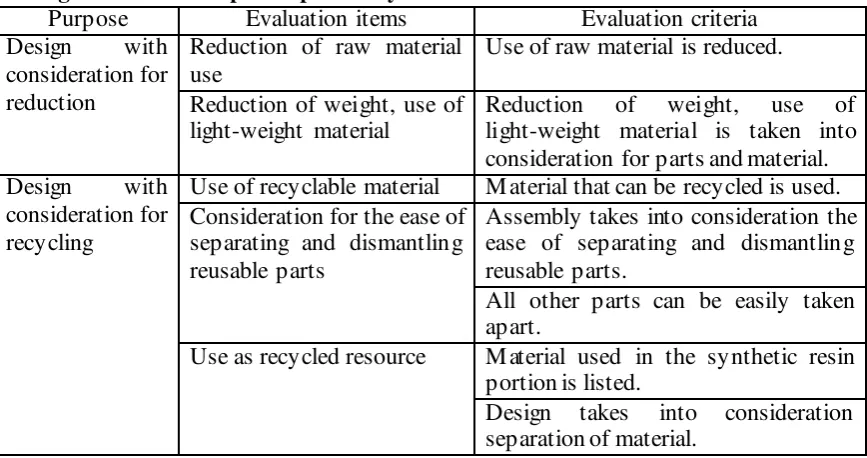
Table 2: Items for environmentally conscious design concerning bookcases and storage furniture comprised primarily of metal
Purpose Evaluation items Evaluation criteria
Design with consideration for reduction
Reduction of raw material use
Use of raw material is reduced.
Reduction of weight, use of light-weight material
Reduction of weight, use of light-weight material is taken into consideration for parts and material. Design with
consideration for recycling
Use of recyclable material M aterial that can be recycled is used. Consideration for the ease of
separating and dismantling reusable parts
Assembly takes into consideration the ease of separating and dismantling reusable parts.
All other parts can be easily taken apart.
Use as recycled resource M aterial used in the synthetic resin portion is listed.
Design takes into consideration separation of material.
(2) Target Setting Guideline
35 5. Office Automation Machines
5-1.Copiers, etc.
(1) Items and Evaluation Criteria Copiers
M ultifunction devices
Upgradeable digital copiers
Evaluation Criteria <Common Criteria>
(1) When the paper used meets the criteria for specified procurement, product must be capable of using the specified procurement material.
(2) Fulfills one of the following.
a. Copiers, multifunction devices, and upgradeable digital copiers with consideration for reuse (hereinafter referred to as copiers, etc.).
b. Copiers, etc. has a restricted use of specific chemical material.
<Individual Criteria>
(1)Copiers and Upgradeable digital copiers
a. Copiers and upgradeable digital copiers (excluding color copiers and large format products) will satisfy the standards of the applicable category in Table 1-1. b. Color copiers and upgradeable digital copiers
(excluding large format products) shall meet the standards of the applicable category in Table 1-2. c. Large format copiers or upgradeable large format digital
copiers shall meet the standards of the applicable category in Table 3.
(2)M ultifunction devices(excluding inkjet type)
a. M ultifunction devices (excluding devices capable of color copying and large format multifunction devices) shall meet standards of the applicable category in Table 2-1.
b. M ultifunction devices capable of color copying (excluding large format multifunction devices) shall meet standards of the applicable category in Table 2-2. c. Large format multifunction devices shall meet standards
of the applicable category in Table 3. (3) Inkjet type multifunction devices
a. Inkjet type multifunction devices (excluding large format multifunction devices) shall meet standards of the applicable category in Table 4-1.
b. Large format inkjet type multifunction devices shall meet standards of the applicable category in Table 4-2.
Factors for Consideration
(1)Batteries do not include cadmium alloys, zinc alloys, or mercury alloys. This requirement does not have to be met, if batteries including these substances are collected, reused, or recycled without failure, and/or properly processed.
36
based on the evaluation criteria of the Law to Promote Effective Use of Resources. Especially, if the components include rare metals, reusing them should be taken into consideration when designing the products.
(3)The item is designed so that it can be easily dismantled and its materials separated to facilitate refurbishment and reuse. (4)The item uses as large amount of recycled plastic as possible
if plastic components are used.
(5)Packaging and stowage is to be as simple as possible and take into account ease of recycling and reduced environmental impact upon disposal.
37
product supply, due to the fact that their production involves recovery of used material, which is supplied to its production only after a strict quality inspection. For the purposes of procurement in the case where each organization requires bidding conditions other than the fact that it is a specified procurement, it is necessary to make a note of (2) a and b in the Common Criteria.
8. For the procurement of copiers, etc. that involves consumables that is comprised of an independent toner container, and when it fulfills Evaluation Criteria (5) of “toner cartridge” titled “Chemical safety of toner is confirmed,” they will be handled in the same way as specified procurements.
9. As for Evaluation Criteria <Common Criteria> (1), as a precondition, papers are required not to have negative effect on the machine, and are able to be used for the print quality without trouble.
10.Due to the considerable amount of time necessary until the recovery of used products, individual criteria for copiers, etc. with consideration for reuse will be considered specified procurements if they fulfill appropriate criteria outlined in Tables 6-1 to 6-6. This is until products that fulfill criteria outlines in Tables 1-1, 1-2, 2-1, 2-2, 3, 4-1 and 4-2 is supplied in the market. The time period will be determined based on the observation of the market trends.
11.As for Copiers, M ultifunction Devices and Upgradable Digital Copiers, one year transition period will be applied in the fiscal year 2014, the products may considered as a specified procurement goods when they meet the Evaluation Criteria of Copiers, M ultifunction Devices and Upgradable Digital Copiers stated in Basic Policy on Promoting Green Purchasing (Cabinet Decision February 5, 2013).
Table 1-1 : Standards for Energy Consumption for Copiers and Upgradeable Digital Copiers (excluding Copiers with Color Copy Function and Large Format Products)
Product speed (ipm) Standards(kWh) Factor of automatic duplex printing function
ipm 5 0.3
38
2.Products for A3-capable (Standard format products with a paper path width equal to or greater than 275 mm.) are a 0.3 kWh/wk allowance standards of the applicable category in the Tables. Same applies for Tables 1-2, 2-1, and 2-2 below. 3.M easuring method for standard energy consumption shall be measured in accordance with “International ENERGY STAR Program Requirements, Product Specification for Imaging Equipment, Eligibility Criteria Version 2.0.” Same applies for Tables 1-2, 2-1 and 2-2 below.
Table 1-2 : Standards for Energy Consumption for Copiers and Upgradeable Digital Copiers with Color Copy Function (excluding Large Format Products)
Product speed (ipm) Standards(kWh) Factor of automatic duplex printing function
ipm 10 1.3
39
Table 2-2 : Standards for Energy Consumption for Multifunction Devices with Color Copy Function (excluding Large Format Products)
Product speed (ipm) Standards(kWh) Factor of automatic duplex printing function
ipm 10 1.5
Not applied
10 <ipm 15 0.1×ipm+0.5
15 <ipm 19
0.13×ipm+0.05
19 <ipm 30 Integral to the base
product or optional accessory
30 <ipm <35
40
Table 4-2 : Standards for Time Required to S witch into Sleep, Energy Consumption of Base Marking Engine at Sleep and Energy Consumption at Standby for Large Format Inkjet Type Multifunction Devices
Product speed
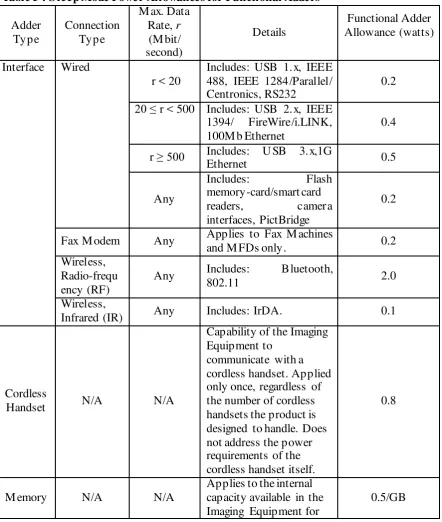
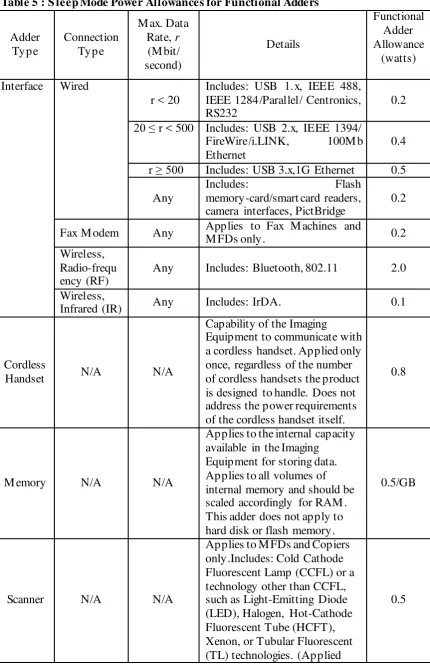
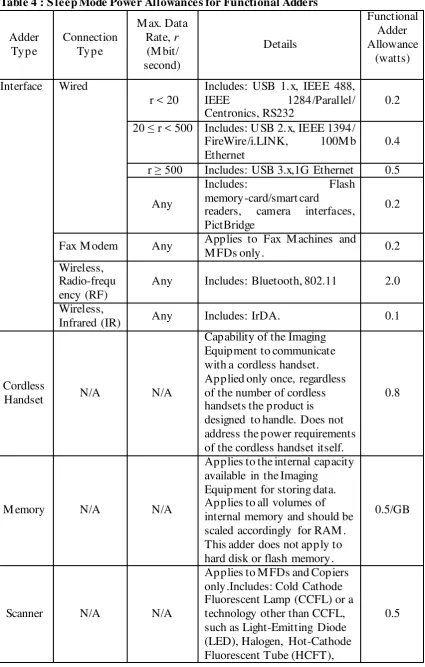
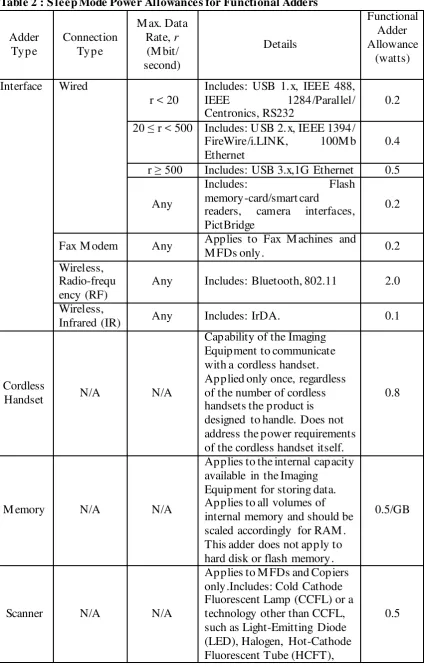
Table 5 : S leep Mode Power Allowances for Functional Adders
Adder 488, IEEE 1284/Parallel/ Centronics, RS232
Capability of the Imaging Equipment to
communicate with a cordless handset. Applied only once, regardless of the number of cordless handsets the product is designed to handle. Does not address the power requirements of the cordless handset itself.
0.8
M emory N/A N/A
Applies to the internal capacity available in the Imaging Equipment for
41
storing data. Applies to all volumes of internal
memory and should be scaled accordingly for RAM . This adder does not apply to hard disk or flash memory. Tube (HCFT), Xenon, or Tubular Fluorescent (TL) technologies. (Applied only once, regardless of the lamp size or the
Applies to both internal and external power supplies of M ailing M achines and Standard Format products using Inkjet and Impact marking technologies with
nameplate output power (POUT) greater than 10 watts. touch panel displays.
0.2 drives. Does not cover interfaces to external drives.
0.15
42
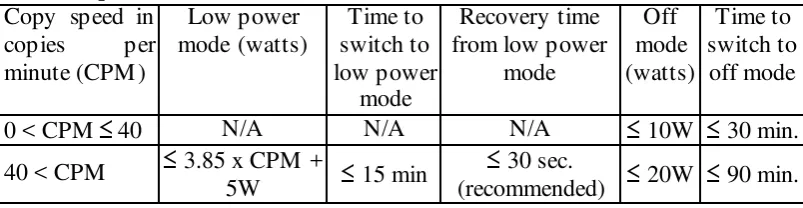
Table 6-1 : Standards for Energy Consumption at Low power mode, etc. for Copiers with consideration for reuse
Copy speed in
1. Copy speed is measured as CPM , the number of copies produced per minute (The same definition applies for Table 6-2 below.).
Each duplex output counts as two copies.
For copiers other than large-format copiers, measure CPM using A4-size paper. For large-format copiers, measure CPM with the largest size paper the machine can process, and convert into the number of A4-size paper using the following automatically. The same definition applies for Table 6-3 and Table 6-5 below.
3. Recommended denotes that it is desirable for a copier to have duplex mode function, or can be supplemented with duplex mode function. The same definition applies for Table 6-3 and Table 6-5 below.
4. Mandatory denotes that it is required for a copier to have duplex mode function, or can be supplemented with duplex mode function. The same definition applies for Table 6-3 and Table 6-5 below.
5. Low-power mode. This is the low power consumption state that the copier automatically enters after a specified period of inactivity. Same applies for Tables 6-2 to 6-6 below.
6. Off mode. This is the feature that the copier automatically turns off completely, after a specified period of inactivity. Same applies for Tables 6-2, 6-5 and 6-6 below.
7. M easuring method for energy consumption shall be measured in accordance with “International Energy Star Program Operating Specification (conducted January 1, 2006), Appendix Table 2”. Same applies for Tables 6-2 to 6-6 below.
43
Table 6-2 : Standards for Energy Consumption at Low power mode, etc. in Large Format Copiers, etc. with consideration for reuse
Copy speed in Multifunctional Devices with consideration for reuse (includes devices that have color copy function)
1. Sleep mode. This is the secondary low power state the copier automatically enters after a specified period of inactivity in the low power mode. Same applies for Table 6-4 below.
2. If power consumption meets sleep mode standards at all times during low power mode, a sleep mode is not necessary. Same applies for Table 6-4 below.
3. Time to switch to low power mode shall be set at 15 minutes when shipped. Same applies for Tables 6-4 to 6-6 below.
Table 6-4 : Standards for Energy Consumption at Low power mode, etc. in Large Format Multifunctional Device with consideration for reuse
44
Table 6-5 : Standards for Energy Consumption at Low power mode, etc. in Upgradeable Digital Copiers with consideration for reuse
Image Format Upgradeable Digital Copiers with consideration for reuse
Image
(2) Target Setting Guideline