THE EFFECT OF TEACHER PROFESSION PERCEPTION AND FAMILY ENVIRONMENT TOWARD
ACCOUNTING TEACHER INTEREST
UNDERGRADUATE THESIS
This undergraduate thesis is submitted in partial fulfillment of the requirement to obtain the degree of Bachelor of Education in Faculty of Economics
Yogyakarta State University
By:
RIMA YUNIARTI 13803244008
ACCOUNTING EDUCATION DEPARTMENT FACULTY OF ECONOMICS
v
MOTTO AND DEDICATIONS
MOTTO
“Dan janganlah kamu berputus asa daripada rahmat Allah. Sesungguhnya tiada berputus asa daripada rahmat Allah melainkan orang-orang yang kufur.”
(Q.S. Yusuf: 87)
Life isn't about getting and having, it's about giving and being. (Kevin Kruse)
Your hardest times often lead to the greatest moments of your life. Keep going. Tough situations build strong people in the end.”
(Roy T. Bennett)
DEDICATIONS
This undergraduate thesis is dedicated to beloved people in my life: 1. My parents, Sugiyono and Mami Sutarmi, who always pray for me and give support me during this undergraduate thesis writting
2. My young brother, Arif Rahmat Fadhilah and all my big family who always give motivation to me
3. My the best Excellent Accounting Education 2013 class 4. My beloved Almamater, Accounting Education Study
vi
THE EFFECT OF TEACHER PROFESSION PERCEPTION AND FAMILY ENVIRONMENT TOWARD
ACCOUNTING TEACHER INTEREST Environment toward Accounting Teacher interest; (3) The effect of Teacher Profession Perception and Family Environment toward Accounting Teacher Interest
This research was ex-post facto research. The method was a quantitative description. The population was 250 students of accounting education department year 2014-2016 and sample were 132 students. The data collecting technique was questionnaire. The data analysis technique were simple regression analysis and multiple regression analysis.
The result of the research were (1) There was a positive and significant effect of Teacher Profession Perception toward Accounting Teacher Interest with a correlation coefficient rx1y was 0,386; determination coefficient r2x1y was 0,149; Y
= 0,386X1 + 28,466 and tcount was 4,770 > ttable was 1,978. (2) There was a positive
and significant effect of Family Environment toward Accounting teacher Interest, with a correlation coefficient rx2y was 0,305; determination coefficient r2x2y was
0,093; Y = 0,305X2 + 38,060; and tcount was 3,657 > ttable was1,978. (3) There was
a positive and significant effect of Teacher Profession Perception and Family Environment toward Accounting Teacher Interest with a correlation coefficient Ry(1,2) was 0,403; determination coefficient R2y(1,2) was 0,162; Y = 0,305X1 + 0,140
X2 + 26,201; and Fcount was 12,487 > Ftable was 3,07. The relative contribution of
Teacher Profession Perception was 71,62% and the relative contribution of Family Environment was 28,38%. The effective contribution of Teacher Profession Perception was 11,6% and the effective contribution of Family Environment was 4,6%.
vii
PENGARUH PERSEPSI MAHASISWA TENTANG PROFESI GURU DAN LINGKUNGAN KELUARGA TERHADAP
MINAT MENJADI GURU AKUNTANSI
Oleh:
RIMA YUNIARTI 13803244008
ABSTRAK
Penelitian ini bertujuan untuk mengetahui (1) Pengaruh Persepsi Mahasiswa Tentang Profesi Guru terhadap Minat Menjadi Guru Akuntansi; (2) Pengaruh Lingkungan Keluarga terhadap Minat Menjadi Guru Akuntansi; (3) Pengaruh Persepsi Mahasiswa Tentang Profesi Guru dan Lingkungan Keluarga secara bersama-sama terhadap Minat Menjadi Guru Akuntansi.
Penelitian ini merupakan jenis penelitian ex-post facto. Metode dalam penelitian ini adalah deskriptif kuantitatif. Populasi penelitian adalah mahasiswa prodi pendidikan akuntansi angkatan 2014 – 2016 sejumlah 250 mahasiswa dan sampel penelitian sejumlah 132 mahasiswa. Teknik pengumpulan data yang digunakan adalah kuisioner. Teknik analisis data yang digunakan yaitu analisis regresi sederhana dan analisis regresi ganda.
Hasil penelitian ini adalah (1) Terdapat Pengaruh Positif dan Signifikan Persepsi Mahasiswa tentang Profesi Guru terhadap Minat Menjadi Guru Akuntansi dengan koefisien korelasi rx1y sebesar 0,386; koefisien determinasi r2x1y sebesar 0,149; Y = 0,386X1 + 28,466 dan thitung sebesar 4,770 > ttabel sebesar 1,978. (2) Terdapat Pengaruh Positif dan Signifikan Lingkungan Keluarga terhadap Minat Menjadi Guru Akuntansi dengan koefisien korelasi rx2y sebesar 0,305; koefisien determinasi r2x2y sebesar 0,093; Y = 0,305X2 + 38,060; dan thitung sebesar 3,657 > ttabel sebesar 1,978. (3) Terdapat Pengaruh Positif dan Signifikan Persepsi Mahasiswa Tentang Profesi Guru Akuntansi dan Lingkungan keluarga secara bersama-sama terhadap Minat Menjadi Guru Akuntansi dengan koefisien korelasi Ry(1,2) sebesar 0,403; koefisien determinasi R2y(1,2) sebesar 0,162; Y = 0,305X1 + 0,140 X2 + 26,201; dan Fhitung sebesar 12,487 > Ftabel sebesar 3,07. Sumbangan Relatif (SR) Persepsi Mahasiswa Tentang Profesi Guru sebesar 71,62% dan Sumbangan Relatif (SR) Lingkungan Keluarga sebesar 28,38%. Sumbangan Efektif (SE) Persepsi Mahasiswa Tentang Profesi Guru sebesar 11,6% dan Sumbangan Efektif (SE) Lingkungan Keluarga sebesar 4,6%.
viii
ACKNOWLEDGEMENTS
Alhamdulillahirobbil’alaamiin, all praise be to Allah SWT, the Almighty,
the Merciful and the Owner of the universe who has blessed me with beautiful things in my life, so can finish this undergraduate thesis entitled The Effect of Students Perception Towards Teacher Profession and Family Environment to Accounting Teacher Interest Students of Accounting Education Department Faculty of Economics Yogyakarta State University. This undergraduate thesis is written as partial fulfillment of the requirement to obtain the degree of bachelor of education.
In this thesis writting, I got supports from many people. Therefore, in this opportunity I would like to thanks:
1. Prof. Dr. Rochmat Wahab, M.Pd, M.A., the Rector of Yogyakarta State University.
2. Dr. Sugiharsono, M.Si., the Dean of Faculty of Economics Yogyakarta State University.
3. RR. Indah Mustikawati, SE.Akt, M.Si, the Head Department of Accounting Education Faculty of Economics Yogyakarta State University.
4. Dhyah Setyorini, S.E, M.Si, Ak, my supervisor who always guided me and gave sugestions to me during the thesis writting.
5. Diana Rahmawati, M.Si, my coordinator lecture in excellent accounting education 2013 class, who gave support to me during the thesis writting.
x
LIST OF CONTENTS
Page
COVER ... i
PENGESAHAN ... Error! Bookmark not defined. VALIDATION ... Error! Bookmark not defined. DECLARATION OF AUTHENTICITY ... iii
MOTTO AND DEDICATIONS... v
ABSTRAK ... vii
CHAPTER I INTRODUCTION ... 1
A. Background ... 1
B. Problem Identification ... 6
C. Problem Limitation ... 6
D. Problem Formulation ... 7
E. Research Objective... 7
F. Contributions ... 8
CHAPTER II LITERATURE REVIEW ... 9
A. Theoritical Review ... 9
1. Accounting Teacher Interest ... 9
a. The Meaning of Accounting Teacher Interest ... 9
b. The Functions of Interests... 11
c. Interest Aspects ... 12
d. Factors That Affecting Interests ... 13
2. Student Perceptions of Accounting Teacher Profession ... 15
xi
b. The kinds of Perception ... 15
c. Process of Perception on Teacher Proffesion ... 16
d. Factors That Affect Perception ... 16
3. Teachers Proffesion ... 17
a. Definition of Accounting Teacher Profession ... 17
b. Teacher Criteria As Profession ... 17
4. Family Environment ... 18
a. Definition of Family Environment ... 18
b. Function, Role and Environmental Factors that Affecting the Family ... 19
B. Relevant Research ... 20
C. Framework ... 22
D. Research Paradigm ... 25
E. Hyphothesis ... 25
CHAPTER III RESEARCH METHODS ... 26
A. Research Design ... 26
B. Place and Time Research ... 26
C. Subject and Object Research ... 26
D. Operational Definition of Variables ... 26
1. Accounting Teacher Interest ... 26
2. Teacher Profession Perception ... 27
3. Family Environment ... 27
E. Population and Sample Research ... 27
F. Data Collection Technique ... 28
G. Research Instruments ... 29
1. Make Grid Research Instruments ... 29
2. Calculation of Scores ... 30
H. Test Instruments ... 31
1. Test Validity Questionnaire ... 31
2. Test Reliability Questionnaire ... 34
I. Data Analysis Techniques ... 35
xii
2. Prerequisite Test Analysis ... 37
3. Hypothesis Test... 40
CHAPTER IV RESEARCH RESULT AND DISCUSSION ... 46
A. Data Description... 46
1. Description of General Data ... 46
2. Description of Special Data ... 47
1. Variable of Accounting Teacher Interest ... 47
2. Variable of Students Perception of Teacher Profession ... 49
3. Variable of Family Environment ... 52
B. Analysis Prerequisites Test ... 54
1. Normality Test ... 54
2. Linearity Test ... 54
3. Multicollinearity Test ... 55
4. Heterokedasticity Test ... 56
C. Research Hypothesis Test ... 57
1. The First Hypothesis Test ... 57
2. The Second Hypothesis Test ... 58
3. The Third Hypothesis Test ... 60
4. Relative Contribution (RC) and Effective Contribution (EC)... 62
D. Discussion ... 63
1. The Effect of Teacher Profession Perception toward Accounting Teacher Interest ... 63
2. The Effect of Family Environment toward Accounting Teacher Interest . 65 3. The Effect of Teacher Profession Perception and Family Environment toward Accounting Teacher Interest ... 68
E. Limitation Research ... 70
CHAPTER V CONCLUSIONS AND SUGGESTIONS ... 71
A. Conclusions ... 71
B. Suggestions ... 72
REFERENCES ... 73
xiii
LIST OF TABLE
Table Page
1. Data Observations Interests Students Become Teachers Department
Accounting Education Year 2013 - 2015...
2. Data Population of Accounting Education Department Students... 28
3. Each Forces Research Sample Data... 28
4. Grating Instruments of Accounting Teachers Interest... 29
5. Grating Instrument of Teacher Profession Perception... 30
6. Grating Instrument Family Environment... 30
7. Score Every Item of Statement... 31
8. The Result of Validity Test Instrument Accounting Teacher Interest... 32
9. The Result of Validity Test Instrument Teacher Profession Perception.... 33
10.The Result of Validity Test Instrument Family Environment... 34
11.Guidlines for Providing Interpretation with Correlation Coeffisient... 35
12.The Result of Reliability Test Instrument... 35
13.The Categories of Tendency Variables... 37
14.Frequency Distribution of Accounting Teacher Interest... 48
15.Category of Tendency Variable Accounting Teacher Interest... 49
16.Frequency Distribution of Teacher Profession Perception... 50
17.Category of Tendency Variable of Teacher Profession Perception... 51
18.Frequency Distribution of Family Environment... 52
19.Category of Tendency Variable Family Environment... 53
20.The Result of Normality Test... 54
21.The Result of Linearity Test... 55
22.The Result of Multicollinearitas Test... 56
23.The Result of Heteroskedastisticity Test... 56
24.Results of Analysis The First Hypothesis (X1-Y)... 57
25.Results of Analysis The Second Hypothesis (X2-Y)... 59
26.Results of Analysis The Third Hypothesis (X1 dan X2 - Y)... 60
xiv
LIST OF IMAGES
Image Page
1. Research Paradigm... 25
2. Histogram of Accounting Teacher Interest Variable... 48
3. Pie Chart of Tendency Categories Variable Accounting Teacher Interest.... 49
4. Histogram of Teacher Profession Perception Variable... 50
5. Pie Chart of Tendency Categories Variable of Teacher Profession Perception... 51
6. Histogram of Family Environment Variable... 52
7. Pie Chart of Tendency Categories Variable Family Environment... 53
xv
LIST OF APPENDIX
Appendix Page
1. Questionaire of Test Instrument... 78
2. Results of Test Instrument... 84
3. Questionaire of Research... 94
4. Data of Research... 99
5. Data of Description... 117
6. Analysis Prerequistest... 124
7. Hypothesis Test... 129
1 CHAPTER I INTRODUCTION A. Background
Human Development Index (HDI) is a tool used to determine the
indicators of human welfare. Based on HDI, a country can be categorized
as developed or developing countries. Indicators used in HDI shows the
quality of human resources in some of the main dimensions, such as the
economic, health and education. Indonesia ranks 108 with 0.684 HDI value
of all countries in the world (Bastian, 2016: 54). The rating is low compare
the ASEAN countries such as Singapore, Brunei Darussalam, Malaysia and
Thailand. It shows that the quality of human resources in Indonesia,
particularly in the world of education is still very low.
Education is the basic of the civilization of the whole nation.
Through education everyone can recognize their potention. They can
determine the direction and purpose in life. Every one has the right to get
proper education in view of the role of education is very large in a life. In
Undang-Undang No. 20 Tahun 2003 Pasal 3, say that:
“Pendidikan nasional berfungsi mengembangkan kemampuan dan membentuk watak serta peradaban bangsa yang bermartabat dalam rangka mencerdaskan kehidupan bangsa, bertujuan untuk berkembangnya potensi peserta didik agar menjadi manusia yang beriman dan bertakwa kepada Tuhan Yang Maha Esa, berakhlak mulia, sehat, berilmu, cakap, kreatif, mandiri, dan menjadi warga negara yang demokratis serta bertanggung
jawab.”
Based on the section above, the national education goals covering
various aspects of human life that must be achieved in order to establish an
2
education will continue to advance and develop according to the needs of
the times. Diverse demands of various aspects of life will affect the mindset
and behavior of person. This suggest that there is a necessity to reorganize
the education system.
The quality education system has components and devices are
well-organized education. One of the most important components in education is
the teacher. Teacher is one key to success in achieving the national goals of
education. Teacher plays an important role in educating the nation. Without
the teachers, an educational process will not go steadly. The teacher
profession is a noble profession because of its contribution in providing
services in the field of education. Based on Undang- Undang No. 14 Tahun
2005 Pasal 1 about teacher and lecture, say that:
“Guru adalah pendidik profesional dengan tugas utama, mendidik, mengajar, membimbing, mengarahkan, melatih, menilai, dan mengevaluasi peserta didik pada pendidikan anak usia dini jalur pendidikan formal, pendidikan dasar dan pendidikan menengah.”
In carrying out the duties and profession, teachers must be well
prepared in order to support the success of the educational process. A
teacher should also have an interest in living profession. Interests become
an important factor in running an activity or a person's job. Having the high
interest, all the job can be done with pleasure and seriously. If a teacher does
not have a high interest in their profession, it will be adversely affect
3
Accounting Education Department Faculty of Economics
Yogyakarta State University produce accounting teachers qualified in the
field of accounting. The subject of teacher training is Praktik Pengalaman
Lapangan (PPL), it is an internship program for students to become an
accounting teacher professional by applying the theory and practice in the
field.
Having accounting teacher profesional is generated. Since the role
of the teacher is very important for education, so it is needs a qualified
teacher who aware will their duties. But this awareness cannot be achieved
without a high interest and a good perception of the profession. This is
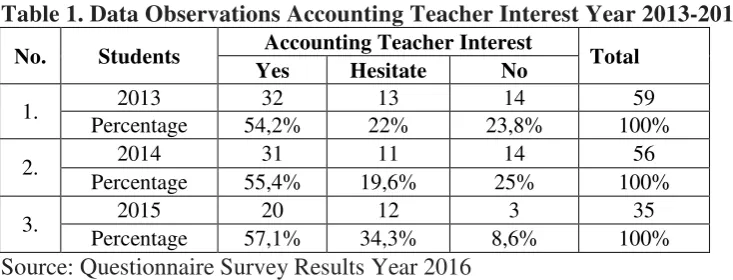
reinforced by the observation with questionnaire on student interest in
accounting education to become an accounting teacher.
Table 1. Data Observations Accounting Teacher Interest Year 2013-2015
No. Students Accounting Teacher Interest Total
Yes Hesitate No
1. 2013 32 13 14 59
Percentage 54,2% 22% 23,8% 100%
2. 2014 31 11 14 56
Percentage 55,4% 19,6% 25% 100%
3. 2015 20 12 3 35
Percentage 57,1% 34,3% 8,6% 100%
Source: Questionnaire Survey Results Year 2016
Based on the data above, it can be concluded that there were still
many students who hesitant and were not interested to be an accounting
teacher. While they were study in the department of accounting education.
The reasons were, mostly student viewed that teacher profession now is not
a priority. Narrow job opportunities, low wages and the terms were too
4
If the interest is low, so the job performance is not maximal. The low
interest and feeling hesitant in carrying the job will effect a concentration of
performance. These things happened because of factors that effect the
person interest.
According Abror (1993: 158) indicated the factors which affect the interests consisting of internal and external factors. Internal factors include
inner urgens factors and emotional factors. Internal factors include age,
gender, personality, experiences and perceptions. Diverse experience got by
the students will form a person's perception, mindset, behaving and argued.
This perception will affect accounting teacher interest. Rachmat (2004: 51)
stated that "perception is the experience of objects, events, or relationships
obtained by concluding information and interpret the message". With
perceptions, everyone can determine the choice and decision. Therefore, the
perception is very important for students in influencing their interest to be
an accounting teacher.
External factors include social environment, family and community
culture. In this case the family environment is an important factor in
influencing to person interests. With a family background which dominated
teacher profession, it will affect to accounting teacher interest. Students
entered the faculty of education because their parents wishes or want to have
a profession like them. The family environment can be one of important
5
Based on the explanation of the factors described above, family
environment will effect the student interests to become accounting teacher.
In accordance with the results of questionnaires known that 51.25% of
parents supported their children to become an accounting teacher. While
48.75% did not supported. Having family support is not enough, if the
students not have interest from their self to become an accounting teacher.
They should have motivation and pleasure to support their interest.
Family environment has a great effect to persons interest. How do
parents educate, parents concern and habits of the parents will effect to
children interest (Slameto, 2013: 60). The higher support given from family
environment so the accounting teacher interest will be higher. Conversely,
The lower support given from family environment so the accounting teacher
interest will be lower. Its mean the family environment can be effect to
accounting teacher interest.
Although many students still have low interest to become an
accounting teacher, but there are also some students have high interest to
become an accounting teacher. They wrote in their questionnaire that being
a teacher was their ideals, had the support of parents and the teacher
profession was considered as a noble profession where they could apply the
knowledge they have learned during the course. In this case it can be said
that they have interest to become an accounting teacher. They assume that
6
Based on the above problems, the researchers will conduct research
with the title “The Effect of Teacher Profession Perception and Family Environment toward Accounting Teacher Interest”.
B. Problem Identification
The identification of problems of this study are as follows:
1. Human Development Index of Indonesia country, particularly in the
field of education is still very low (Indra Bastian, 2016: 54).
2. Indonesia is still a shortage of qualified teachers in the role advancing
education.
3. Based on the observations, there were still doubts on the element of
compulsion and most students of accounting education to become
accounting teacher.
4. Various positive and negative perceptions that come from the family
environment can affect student interest in accounting education
department to become accounting teacher.
5. Based on the observations the interest to become accounting teacher on
students of accounting education department were still low.
C. Problem Limitation
Based on the problem background, the researchers need to limit the
problems in order to clarify the issues to be studied. This research will only
examine The Effect of Teacher Profession Perception and Family
7
Accounting Education Department Faculty of Economic, Yogyakarta State University force 2014 – 2016.
D. Problem Formulation
The problems of this study are as follows:
1. Is the effect of teacher profession perception toward accounting teacher interest?
2. Is the effect of family environment toward accounting teacher interest? 3. Is the effect of teacher profession perception and family environment
toward accounting teacher interest?
E. Research Objective
Here is an objective that will be achieved in this research are:
1. Knowing the effect of teacher profession perception toward accounting
teacher interest on students of Accounting Education Department
Faculty of Economics, Yogyakarta State University.
2. Knowing the effect of family environment toward accounting teacher
interest on students of Accounting Education Department Faculty of
Economics, Yogyakarta State University.
3. Knowing the effect of teacher profession perception and family
environment toward accounting teacher interest on students of
Accounting Education Department Faculty of Economics, Yogyakarta
8 F. Contributions
1. Theoretical
The results of this study are expected to be material literature review
were used as a source of reference and comparative material for further
research.
2. Practical
a. For Researchers
The results of this study are expected to provide benefits and add
insight and knowledge of researchers in understanding interest in
becoming a teacher of accounting.
b. For Readers
The results of this study can provide additional knowledge and
experience for the reader of career choices especially acconting
teacher.
c. For Department
This research is expected to provide information about the interest
of accounting student. So as to be consider in managing the learning
proces and academic supervices. Those students who graduated
from this department can be professional accounting teacher and
9 CHAPTER II LITERATURE REVIEW
A. Theoritical Review
1. Accounting Teacher Interest
a. The Meaning of Accounting Teacher Interest
Definition of interest according to Djaali (2007: 122) is high elevated heart tendency towards something. Meanwhile, according to Muhibbin Syah (2004: 136), the interest (interest) means the tendency and high excitement or great desire to something. Another interests definition is argued by Slameto (2013: 180) that "interest is a taste prefers and a sense of interest in a matter or activity without the sent. Interest is basically the reception about relationship between the self and something outside of itself ".
According to Anastasia and Urbina (1997: 127), interest is one of the important aspects of personality. Interests affect is including human behavior in interpersonal relationships, achievement education and employment, electoral activity in leisure time and daily activities. Interest as an affective response studied the object or activity.
How to measure the interest of student to become accounting teacher can use two ways, Handoko (2003: 62) said the interest or motivation of a person can be measured by:
10
2) Measuring aspects of certain behaviors that may occur from the phrase that caused a certain motivation.
In this research, researchers used a measuring tool aspects of certain behaviors that may occur from the phrase that caused a definite motivation with indicator elements of interest by Abror (1993: 112), the interest contains elements of cognition (introduction), emotions (feelings) and konasi (desire or motivation). Therefore, the interest is considered as a conscious response because if it did not do then the interest will not have any meaning.
Interest contain cognition, it means that interest is preceded by a sense of excitement and attracted to the teaching profession. Interests contain elements of emotion because the participation or experience was accompanied by a certain feeling (usually feelings of pleasure). While konasi elements is a continuation of cognition elements and emotions that embodied in the will and the desire for an area or interesting object. Volition is then realized so as to have insight into an area or object of interest.
Thus the interest in becoming a teacher of accounting can be measured through three kinds of indicators as follows:
1) Cognition include: knowledge of the teaching profession of accounting.
11
3) Konasi include: Desire, belief and effort to become an accounting teacher.
b. The Functions of Interests
Hendra Surya (2003: 6) said, regarding the function of interest, as follows:
1) As a reason, namely the driving force that stimulates someone pay attention to certain objects more than other objects.
2) As a result, like the pleasant experience feelings as a result of the presence of a person or object or as a result of a person's participation in some form of activity.
While the function of interest that Whitherington (1999: 136) expressed is as follows: "The interest is very functional for humans because it can lead someone to reach the goal of his life, so it can bring people on things that are not necessary to be something useful for him because of the emergence of awareness to meet their needed without burdening others. Besides interest can also provide a view of someone's life or someone's entire repertory ".
12
It can be concluded that the interest can drive humans goal. Indirectly impetus that generated by the interest can be encouraging and decisive decisions in life.
c. Interest Aspects
According to Mc. Clelland (in Slameto, 2013: 41) stated that some aspects of interest to the individual, such as:
1) The confidence, that individual positive attitude about himself that he truly understands what should be done.
2) Resistance to pressure, is the ability of individuals to overcome the difficulties faced, in order to function as it should to continue the activities or work.
3) Having the responsibility to resolve the problem, namely the individual's willingness to endure everything to be the consequences. 4) The lack of desperation, is the positive attitude that always
holds good in the face of all things about himself and abilities. 5) Liked the destination according to ability, the ability of individuals
to achieve personal goals with realistic and active, effective, and efficient.
According to Hurlock (2000: 116), the aspects of interest are as follows:
13
2) Affective aspect, Emotional weight concepts that build the cognitive aspects of interest that expressed in attitudes towards activities posed by interest.
d. Factors That Affecting Interests
According Dalyono (2005: 56) "The interest can arise because the power appeal from the outside and also from hearts, a great interest against something". Sunaryo (2004: 22) suggests that factors that affects a person's interest towards a particular object, namely: 1) Social factors, economic, parents, and community.
2) Environmental factors both environmental public life, home life environment or peers.
3) Factors worldview formed part of one's environment includes the establishment and ideals.
According to Crow and Crow in Abror (1993: 158) described the factors that affect interest are as follows:
1. Internal factors, such as: a. The Factor of Inner Urgers
14 b. Emotional Factor
This factor is a measure of the intensity of someone when pay attention to an activity or certain object.
2. External factors, This Is The Factor of Social Motive.
This factor is the motive in the environment of social relationships. The environment which the individual lives with his friends. A person's interest can also arise because of the interaction, if the social environment has same desire and interest in one thing, then this factor will strengthen their interest. While according to Dalyono (2005: 133) argues that the social environment is everyone else that affects us. Social environment includes family environment, school environment, and the community. Johanes cited by Walgito (2003: 35), states that "Interest can be classified into two, namely interest intrinsic and extrinsic. Intrinsic interest is interest the emergence of the individual itself without outside influence ".
15
2. Student Perceptions of Accounting Teacher Profession a. The Definition of Perceptions
Leavitt (Sobur, 2003: 445) distinguishes perception into two view, the narrow view and the broad view. The narrow view interpreted as visual perception, how someone saw something, while the broad view interpreted how someone sees or mean something. Furthermore, Rachmat (2004: 51) states that "perception is the experience of objects, events, or relationships obtained by concluding information and interpret the message".
Of the various terms of the perception of the above, it can be conclude that perception is a process where someone give an impression, views, opinions, judgments, and selecting, arranging and interpreting the information and experiences that exist or are provided by an object.
b. The kinds of Perception
Sunaryo (2004: 94) states that the perception is divided into two kinds, such as:
1) External perception, the perception that occurs because of the stimulation that comes from the outside of individual.
16
c. Process of Perception on Teacher Proffesion
Perception that occurs in a person is not created overnight, but there are processes and because of the relationship between the existing capabilities of individual itself with the influencing factor. Toha (2003, 145) suggests there is a three-step process of perception of an object at the individual, such as:
1) The stimulus or stimuli, the stimulation is the first step that must be passed for the creation of perception. Stimuli were present from about individuals will be responded by the human senses.
2) Registration, the registration process is catching stimulation by human senses, which will be forwarded and registered to the information center or the human brain.
3) Interpretation, after stumuli arrested and registration in the brain, the next process is the interpretation or meaning of the stimulus received. The process of meaning depending on the individual characteristics while recepting. The next step is the manifestation of perception in behavior that can be read by the brain.
d. Factors That Affect Perception
17
factors that affect the perception of the individual views or people who observe into four categories:
1) Knowladge, insight or someones experience 2) The need of somebody
3) Someones pleasure or hobby 4) The habit or pattern of daily living
3. Teachers Proffesion
a. Definition of Accounting Teacher Profession
Arifin (1995: 105) argues that the profession has a similar meaning to the word occupation or a job that requires skills that acquired through education or specialized training. Kunandar (2007: 45) writes, the proffesion can also be interpreted as a profession a specific position or a job that requires specific knowledge and skills gained from intensive academic education. Thus, the profession is an occupation or position that requires a certain expertise. And accounting teaching profession is defined as specialized expertise and authority in the field of education, teaching and training in the field of accounting to become a livelihood.
b. Teacher Criteria As Profession
18 4. Family Environment
a. Definition of Family Environment
According to Sartain (in Ngalim Purwanto, 2002: 25) said that what is meant by the environment (Environment) is covering all the conditions in this world which in a certain way influence our behavior, growth, development or life processes except the genes, can also be seen as preparing the environment (to provide environment) for other genes.
According to Abu Ahmadi (2007: 167) can be formulated that the definition of family by some definitions, such as:
1) The family is a small social group, usually consisting of father, mother, and child.
2) The relationship between family members inspired by the atmosphere of affection and sense of responsibility.
3) The social relationships among family members are relatively fixed and based on ties of blood, marriage or adoption.
4) The function of the family is to keep, treat and protect children in the context of socialization so they able to control themselves and socially minded.
According to Hasbullah (2012: 38) the family environment is the first environmental education for child in the family because this is the first time children get an education and guidance. Family environment is also said to be the main environment, because most of the child's life is families so the most education is widely accepted by children is family.
19
parental education will have a great influence on the spiritual development of children, especially personality and educational progress.
b. Function, Role and Environmental Factors that Affecting the Family According Hasbullah (2006: 39) the function and role of family education are as follows:
1) The first experience of childhood
Family education institutions provide the first experience is an important factor in children's personal development, family education atmosphere is very important because this is where the balance of life in the subsequent development of the individual.
2) Ensure the child's social life
Emotional life is the most important factor in shaping the individual. Abnormalities in the personal development of individuals due to underdevelopment of the emotional life is reasonable.
3) Inculcate moral education
The family is the main planting moral foundations for children that usually reflected in the attitudes and behavior of parents as role models to be emulated child.
4) Provide basic social education
20 5) Laying religious grounds
Family life should provide the conditions for children to experience a religious atmosphere.
According Slameto (2013: 60), family influence on children include:
1) How parents is educate
2) The relation between family members 3) Home atmosphere
4) The family economic situation 5) Understanding the elderly 6) Background culture
Based on the description above can be concluded that the family is a small social group consisting of father, mother, and children who have social relationships because of their ties of blood, marriage, or adoption by all the conditions that exist in the room were occupied. Family environment for the purpose of this research is the main family that consisting of: father, mother, and child. The family environment is the first and main environment for the growth and development of every child so its has a considerable influence.
B.Relevant Research
1. Research conducted by Sairoh (2016) entitled “Pengaruh pengalaman PPL, IPK, Lingkungan Keluarga dan Informasi Dunia Kerja Terhadap Minat Menjadi Guru Pada Mahasiswa Pendidikan Ekonomi Angkatan 2011 FE
21
of determination (R2) PPL experience, GPA, family environment and job
market information on the interest of a teacher at the Economics Education student class of 2011 FE UNY of 0.607 or 60.7%. The similarity this research was the dependent variable used interest to become a teacher. While the differences in this research was the used of independent variables, subject and object of research.
2. Research conducted by Agus Mulyana (2014) entitled “Pengaruh Persepsi Tentang Profesi Guru dan Informasi Dunia Kerja Terhadap Minat Menjadi Guru Akuntansi Mahasiswa Prodi Pendidikan Akuntansi Angkatan 2011 FE
UNY”. The results of this study were: 1) Those were all independent variables had positive and significant effect to accounting teacher intererst. 2) There was a positive effect perception of the teacher profession and the world's information work together towards an interest to become a teacher of accounting with correlation coefficient 0.603 and the value Fhitung 26.268>
Ftable 3.092 at a significance level of 5% and determination coefficient of
36.32%. The similarity this research are the dependent variable is interest in becoming a teacher of accounting and research subjects are students of department of accounting education FE UNY. The differences was the independent variable used is about the job market information and data samples are taken.
3. Research conducted by Agung Ibrahim (2014) entitled “Pengaruh Fasilitas Belajar dan Persepsi Profesi Guru Terhadap Minat dan Kesiapan Menjadi
22
indicated that: 1) There was a positive and significant impact on the interest of learning facilities to be a teacher with a value of coefficient of standard track critical ratio of 0.206 and 3.695 (p > 0.05). 2) There was a positive and significant impact on the interest of the perception of the teaching profession as a teacher with the standard path coefficient value of 0.393 and 7.036 critical ratio (p <0.05). The similarity this research was the dependent variable used is interest in becoming a teacher. While the differences were independent variables used and in research.
C.Framework
1. The Effect of Teacher Profession Perception toward Accounting Teacher Interest
Teacher is a noble profession because of his contribution in providing services in the field of education. The teacher's role is very important in achieving the national goals of education. It is as stated in Undang- Undang No. 14 Tahun 2005 Pasal 1 about teacher and lecture, say that:
23
Interest is a persons pleasure in doing an activity. If a person has a high interest in his work, the results will be as expected. It is the same with a teacher who has a passion for his job, the output obtained will be maximal output particularly in realizing the national goals of education.
Interest in a person affected by two factors were inside and outside factors. Factors inside are all factors that come from within the individual itself, such as age, gender, life experiences, and perceptions. While External factors are factors that come from outside the individual, the family environment, social and cultural environment.
Perception is one of the internal factors of the individual that affected patterns of thinking, acting and make opinion. During studying, accounting education student must have a lot of information, knowledge and experience about the sciences of education and teacher training. A variety of information and experience will established student perceptions in assessing the accounting teacher profession and the end the accounting teacher interest can be found out. Therefore, a perception can affect student interest to become accounting teacher which directly affect is the view and its assessment of the accounting teacher profession.
24
embeded family value in the children will affect to person interest in deciding their profession.
The family environment affect the children following their parents habbits, including their professions. The higher support given from family environment so the accounting teacher interest will be higher. Conversely,
The lower support given from family environment so the accounting teacher
interest will be lower. Its mean the family environment can be effect to
accounting teacher interest.
3. The Effect of Teacher Profession Perception and Family Environment toward Accounting Teacher Interest
Persons interest are affected by two factors, they are internal factors and
external factors. Internal factors come from inside individual such as age,
weight, sex, mindset, perception and perspective of a person, while external
factors come from outside individuals such as the social environment, family
environment and culture. These two factors are stimulus factor for persons
interest.
Teacher Profession Perception and family environment are one of the
factors affecting persons interest. Both of them effect toward accounting
teacher interest. When they are higher, so the accounting teacher interest will
25 D.Research Paradigm
Image 1. Research Paradigm Description:
X1 : Teacher Profession Perception (Independent Variable)
X2 : Family Environment (Independent Variable)
Y : Accounting Teacher Interest (Dependent Variable)
: The effect of variable independent X1 and X2 to dependent variable Y
: The effect of variable X1 and X2 together to dependent variable Y
E.Hyphothesis
The formulation of the hypothesis in this research are as follows:
1. There is a positive effect of Teacher Profession Perception toward Accounting Teacher Interest (H1).
2. There is a positive effect of Family Environment toward Accounting Teacher Interest (H2).
3. There are positive effect of Teacher Profession Perception and Family Environment toward Accounting Teacher Interest (H3).
X
1X
226 CHAPTER III RESEARCH METHODS A.Research Design
This research was ex-post facto research. This study aimed to determine the
events that have occurred and investigated the factors that cause such events
occur. This research used quantitative data approach where the data obtained
formed of numerical and analysis used descriptive method.
B.Place and Time Research
This research was conducted at the Accounting Education Department
Faculty of Economics, Yogyakarta State University. It was held on November
to December 2016.
C.Subject and Object Research
The subjects were students on Accounting Education Department Faculty
of Economics, Yogyakarta State University year 2014 - 2016. The object of this
research was Accounting Teacher Interest.
D.Operational Definition of Variables
Variables in the research should have a clear meaning to avoid
misunderstandings on variables. The meaning of each variables were as follow:
1. Accounting Teacher Interest
The dependent variable in this research is Accounting Teacher Interest
27
individu to become an accounting teacher. Having a high interest in their
profession will produce a good job performanced.
2. Teacher Profession Perception
The independent variable in this research is Teacher Profession Perception
(X1). Perception is a viewed, opinions, assesment and judgments about
something. This perception is formed an experience, knowledge, information
and lessons which learned from each individual. Teacher profession
perception is the perception about viewed, assesment and mindset to
accounting teacher. Many information and experiences is gotten by students
from their study, especially teacher training programs.
3. Family Environment
The independent variable in this research is Family environment (X2).
Family environment is the first environmental education for child while get an education and guidance. The family is become considerable influence on the growth and development of children especially how do parents educate, understanding parents, family economic situation, relationships between family members, cultural background and home situation.
E.Population and Sample Research
According Sugiyono (2013: 117), "the population is the region consisting
of the objects or subjects that have certain qualities and characteristics defined
by the researcher to learn and then drawn conclusions". The population in this
28
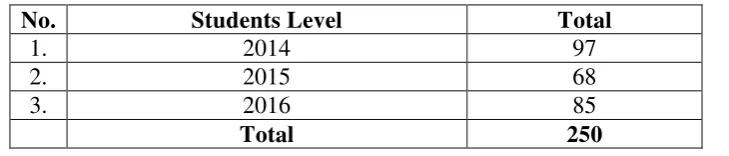
Economics, Yogyakarta State University year 2014 - 2016 with the following
details:
Table 2. Data Population of Accounting Education Department Students
Source: Administrative Staff Accounting Education Department FE UNY
The sampling technique in this research used the Proportionate Stratified
random sampling technique. Proportionate Stratified random sampling was used
when a population had members or elements that were not homogeneous and
stratified proportional (Sugiyono, 2015: 120).
Samples by used standard error of 10% , it was could made the population
can be distributed normally. If the total population of 250 with a standard error
of 10%, so the sample size of 130 (Sugiyono, 2015: 126). Below was the
calculation of sample from each population, were as follows:
Table 3. Each Forces Research Sample Data
No. Level Calculating Total
1. 2014 97/ 250 x 130 = 50,44 51
2. 2015 68/ 250 x 130 = 35,36 36
3. 2016 85/ 250 x 130 = 44,2 45
Total Sample 132
Source: Sugiyono, (2015: 128)
F. Data Collection Technique
The data collection technique used a questionnaire. According Arikunto
(2010: 194) "Questionnaires are a number of written questions that are used to
obtain information from respondents in terms of his personal report, or the things
No. Students Level Total
1. 2014 97
2. 2015 68
3. 2016 85
29
known”. The questionnaire used closed questionnaire where respondents only
choose the provided answer. Questionnaires in this research are used to collect
data from respondents about teacher profession perceptions, family environment
and accounting teacher interest.
G.Research Instruments
Measurement scale is necessary to accertain whether the quistionaire can be
used to measure the variables.
1. Make Grid Research Instruments
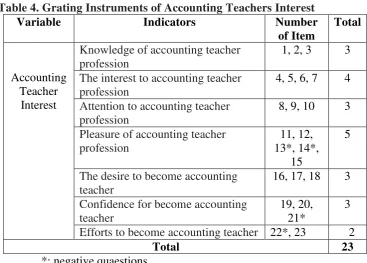
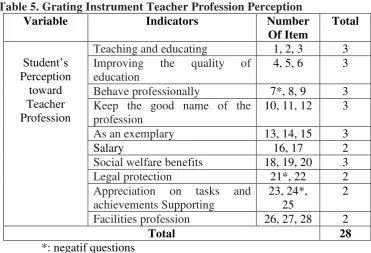
The following tables are an indicators of each study variables:
Table 4. Grating Instruments of Accounting Teachers Interest
Variable Indicators Number
of Item
Total
Accounting Teacher
Interest
Knowledge of accounting teacher profession
1, 2, 3 3 The interest to accounting teacher
profession
4, 5, 6, 7 4 Attention to accounting teacher
profession
8, 9, 10 3 Pleasure of accounting teacher
profession
11, 12, 13*, 14*,
15
5
The desire to become accounting teacher
16, 17, 18 3 Confidence for become accounting
teacher
30
Table 5. Grating Instrument Teacher Profession Perception
Variable Indicators Number
Of Item Facilities profession 26, 27, 28 2
Total 28
*: negatif questions
Source: Duties and Right of Teacher in Undang- Undang Nomor 14 Tahun 2015 about Teacher and Lecture
Table 6. Grating Instrument Family Environment
Variable Indicators Number
Of Item Family economic situation 8, 9, 10,
11
4 Relationships between family
members
12, 13, 14 3 Cultural background 15*, 16,
17
Source: Modified from theoritical review in Slameto (2013: 60)
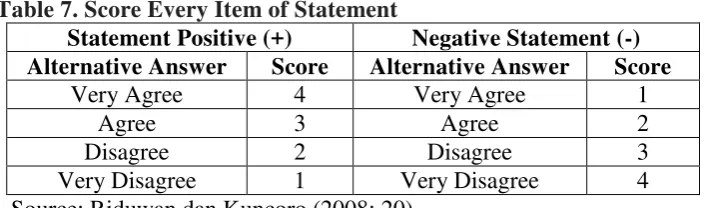
2. Calculation of Scores
The scale of measurement variables is the Likert scale because of the
31
scale that describes the indicator variables. Item subject is made from very
positive to very negative. In this research, the score is modified into four
alternative answers. It aimes to avoid respondents misleading, so the data will
be more valid. The table below is the table for score in the four alternative
answers, were follows:
Table 7. Score Every Item of Statement
Statement Positive (+) Negative Statement (-) Alternative Answer Score Alternative Answer Score
Very Agree 4 Very Agree 1
Agree 3 Agree 2
Disagree 2 Disagree 3
Very Disagree 1 Very Disagree 4
Source: Riduwan dan Kuncoro (2008: 20)
H.Test Instruments
The test instrument intended to obtain valid and reliable data. The test
instruments will be calculation used helped the statistic program.
1. Test Validity Questionnaire
Test validity questionnaire used statistic test of Product Moment
Correlation. Product moment correlation aimed to illustrate how strong the
relationship between two variables. In this test the instrument variables to be
tested, such as the validity instrument of the accounting teacher interest, the
validity instrument of teacher profession perception and family environment.
Product moment correlation formula:
rxy = � ∑ − ∑ ∑
{� ∑ − ∑ } { � ∑ − ∑ }
Description:
32
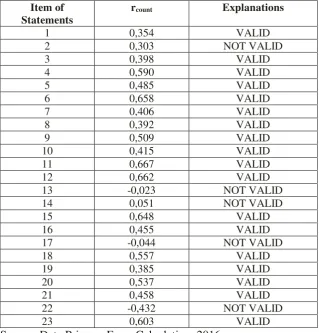
a. Validity Test Instrument of Accounting Teacher Interest
Instruments of accounting teacher interest consist of 23 statement,
which there were 5 items did not valid. The validity test was carried out
by 30 respondents from accounting education students year 2013. The
validity of each item statement can be obtained if rcount > rtable. The results
of showed as below:
Tabel 8. The Results of Validity Test Instrument Accounting Teacher Interest
33
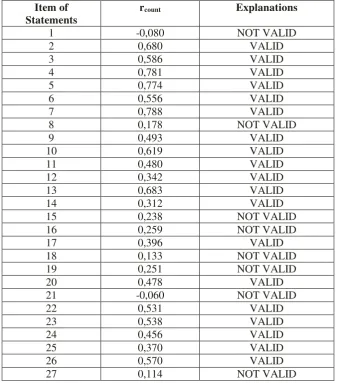
b. Validity Test Instruments of Teacher Profession Perception
Instruments of teacher profession perceptionconsist of 27 statement.
Based on the validity test results, there were 8 items did not valid. The
validity test was carried out by 30 respondents from accounting education
students level 2013. The formula used the product moment correlation
with an error rate of 10% and rtabel 0.306. The validity of each item
statement can be obtained if rcount > rtable. The results of showed as below:
Tabel 9. The Results of Validity Test Instruments of Teacher
34
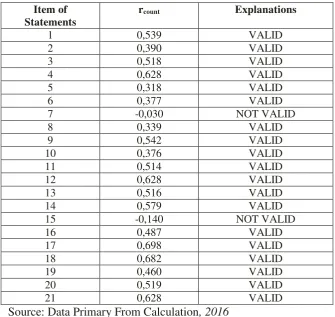
c. Validity Test Instruments Family Environment
Instruments of teacher profession perceptionconsist of 27 statement.
Based on the validity test results, there were 8 items did not valid. The
validity test was carried out by 30 respondents from accounting education
students level 2013. The formula used the product moment correlation
with an error rate of 10% and rtabel 0.306. The validity of each item
statement can be obtained if rcount > rtable. The results of showed as below:
Tabel 10. The Results of Validity Test Instrument of Family Environment
Source: Data Primary From Calculation, 2016
2. Test Reliability Questionnaire
The instrument is reliable if such instrument when the result are the same
althought its used in different time. (Arikunto, 2013: 101). The reliability test
35
The Cronbach alpha formula is as follows:
r11 = �
(Source: Arikunto, 2010: 239) The correlation coefficient use categories according Sugiyono (2015: 257)
follows:
Table 11. Guidlines for Providing Interpretation with Correlation Coeffisient
No Interval Coeficient Interpretation
1. Between 0,00 – 0,199 Very Low
2. Between 0,20 – 0,399 Low
3. Between 0,40 – 0,599 Enough
4. Between 0,60 – 0,799 Strong
5. Between 0,80 – 0,1000 Very Strong
Source: Sugiyono (2015: 257)
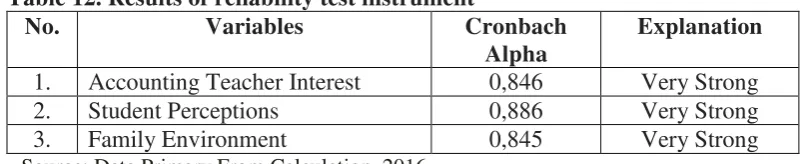
From the table above, the instrument is reliable if it has a Cronbach Alpha
coefficients more than 0.600. If the coefficient Cronbach Alpha is less than 0,600
the instrument is not reliable. Reliability tests performed used statistic program.
The table below is a reliability test results of research instruments.
Table 12. Results of reliability test instrument
No. Variables Cronbach
Alpha
Explanation
1. Accounting Teacher Interest 0,846 Very Strong 2. Student Perceptions 0,886 Very Strong 3. Family Environment 0,845 Very Strong Source: Data Primary From Calculation, 2016
I. Data Analysis Techniques 1. Data Description
The data obtained will be presented in the form of data description for
36
median, mode, standard deviation, maximum value, minimum value, the
frequency distribution table, histograms, tables of tendency variables and pie
charts.
a. Mean, Median, Mode, Standard Deviation, Maximum Value, Minimum
Value.
Mean is the average of the group. Mean is calculated from the sum
of all values divided by the number of data. The median is a central value
data. The mode is the value of the data most frequently occurring. Standard
deviation is a measure of the spread of data. The maximum value is
obtained from the biggest score data and the minimum value is the smallest
score data.
b. Tables of Frequency Distribution
1) Determine the number of Class Intervals
For the calculated class intervals used Sturges Rule formula, follows:
k = 1 + 3,3 log n Description:
k = Total of data class n = Total of observation data log = Logarithm
(Sugiyono, 2012: 35) 2) Determine a range
For the calcutating a range of clas, used the formula: Range = (maximum score – minimum score) + 1 3) Determine a long class
37
class length = total of interval classrange
4) Histogram
Histograms are made from the frequency of data has been seen in the tables of frequency distribution. This histograms used to easier of described and read of the data.
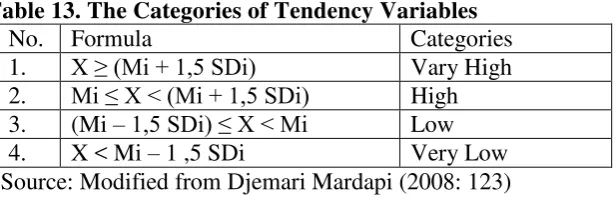
5) Variables Tendency Tables
The tendency score there are made to be four categories which modified from Mardapi (2008:123), can be seen in the table such as follows:
Table 13. The Categories of Tendency Variables
No. Formula Categories
1. X ≥ (Mi + 1,5 SDi) Vary High
2. Mi ≤ X < (Mi + 1,5 SDi) High
3. (Mi –1,5 SDi) ≤ X < Mi Low
4. X < Mi – 1 ,5 SDi Very Low Source: Modified from Djemari Mardapi (2008: 123) Description:
Mi = Average from score the total students in class = ½ (X max + X min)
SDi = Standar deviation total score = 1/6 (X max – X min)
6) Pie Chart
Pie chart is made depending on tendency data that have showed on variable tendency table.
2. Prerequisite Test Analysis
38 a. Normality Test
Normality test is performed to determine the data was distribution
of normal or not. Normality test used the komogorov- Smirnov formula
were processed by statistic program. Data is said to be normally
distributed if the coefficient Asym. Sign more than predetermined of 5%
(0,05). Below is the formula of data normality test, as follows:
KD = , 6 √� +� � �
Description:
KD = Value Kolmogorof Smirnov was found
n1 = Total sample was observated
n2 = Total sample was found
(Sugiyono, 2012: 389)
b. Linearity Test
Linearity test is performed to determine the dependent variable and
independent variables had a linear relationship. This test is performed
used F test in which the provisions of Fcount must be less than or equal to
Ftable. The F-test used significance level of 5% (0.05). Below is the
formula of data linearity test, as follows:
Freg=� ��� �
Descriptions:
Freg = F price for regresi line
Rkreg = squre average of regresi line
Rkres = squre average of residu
39 c. Multocollinearity Test
Multicolinearity test used to determine whether it occurs between independent variables to each other or not. A statistical technique used is the Product Moment. The formula is as follows:
n XY (X )(Y )
rxy=
{nX2 (X ) 2 }{nY2 (Y ) 2 }
Descriptions
rxy = the correalation coefficient between the variables X
and Y
N = the number of respondents
∑X = the number of items
∑X2 = the number of squares score items ∑Y = total score items
∑Y2 = total squares score items ∑XY = total multiple X and Y
(Suharsimi Arikunto, 2010: 213) Terms of the multicollinearity that the value of Tolerance is less
than 0.10 and VIF (Variance Inflation Factor) is more than 10.00.
Conversely, when the value of Tolerance is more than 0.10 and VIF
(Variance Inflation Factor) is smaller than 10.00, so there is no
multicollinearity between independent variables. Terms between the
independent variables can accepted or passed this test must does not
happen multicollinearity.
d. Heterokedasticity Test
Heterokedasticity test aims to test the regression model occurred
inequality residual variance from one observation to another observation.
40
criterion not happen heterokedasticity if the significance value > 0,05.
Conversely, if the significance value < 0,05 was happen
heterokedasticity between independent variables. (Ghazali, 2011: 142).
3. Hypothesis Test
a. Simple Regression Analysis
The analysis technique is to test the effect of the independent variables with the dependent variable, which is to determine the effect of Teacher Profession Perception toward Accounting Teacher Interest (hypothesis 1), the effect of Family Environment toward Accounting Teacher Interest (hypothesis 2). The Steps must be taken in a simple regression analysis as follows:
1. Finding correlation coefficient between XI and Y, X2 and Y. The formula is:
� = ∑
√∑ ∑
Descriptions:
rxy = coefficient correlation between X1 and X2 with Y
x = Teacher Profession Perception/ Family Environment y = Accounting Teacher Interest
∑xy = Total between X and Y
∑x2 = Square total of X score ∑y2 = Square total of Y score
41 2. Finding a determination coefficient
The coefficient of determination is the level of the effect of independent variables (X1 and X2) on the dependent variable (Y). The formula used as follows:
r2 = (r)2 Description:
r2 = determination coefficient r = correlation coefficient
The effects of independent variables (X1 and X2) are on the dependent variable (Y) by the square of the correlation coefficient. Furthermore, the coefficient of determination multiplied by 100% to determine the level of the effect of independent variables on the dependent variable in terms of percentage.
3. Make a simply line regression Y = aX + K Formula:
Descriptions :
Y = Accounting Teacher Interest a = Coefficient number
X = Student’s Perception of Teacher Profession/Family
Environment K = Constant number
(Sutrisno Hadi, 2004: 1) 4. Examine coefficient correlation with t test
42
� = �√ −
√ − �² Descriptions:
t = t count
r = correlation coefficient n = total of respondents
r2 = square of correlation coefficient
(Sugiyono, 2012: 230) The conclusion is to compare tcount with ttable. If tcount greater than or equal to the level ttable significant 5% than these variables significantly affect the independent variable. Conversely, if tcount smaller than ttable the effect of the variable is not significant.
b. Multiple Regression Analysis
This analysis is used to test the third hypothesis that the effect of Teacher Profession Perception and Family Environment toward Accounting Teacher Interest (hypothesis 3). These Steps in the multiple regression analysis are:
1) Finding coefficient double correlation between variables (X1 and X2) and dependent variable (Y), using the formula:
Ry(1,2)=√a Σ +a Σ Σ
Descriptions :
Ry(1,2) = Correlation Coefficient between Teacher Profession
43
Directions correlation will be positive if the result of the correlation calculation sign (=). If the minus sign (-), then the direction of the correlation is negative.
2) Finding determination coefficient (R2) between independent (X1, X2) and dependent variables (Y). Using Formula:
R2 = (R)2 Descriptions :
R2 = determination coefficient R = multiple correlation coeffiecient
Therefore the effect of independent variables (X1and X2) together with the dependent variable (Y) by the square of the multiple correlation coefficient. Furthermore, the coefficient of determination multiplied by 100% to determine the level of effect of two independent variables on the dependent variable in terms of percentage.
3) Make a multiple line regression
Y = a1X1 + a2X2 + K
Description:
Y = Accounting Teacher Interest
X1, X2 = Students Perception of Teacher Profession, Famil Environment a1a2 = number of coeffient 1, number of coefficient 2
K = number of constant
44
4) Examine multiple regresi significant with F test, the formula is:
���� =�² � − −
− �² Descriptions :
Freg = F price of regression N = Number of cases m = Number of predictor
R = Correlations of coefficient between predictor criteria (Sutrisno Hadi, 2004: 26)
The conclusion taken by comparing Fvalue with significant
Ftable at the level of 5%. If Fvalue is equal to or greater than Ftable the
independent variables on the dependent ones significantly. Conversely, when Fvalue is smaller than Ftable, then the effect of the
independent variables on the dependent variable is not significant. 5) Finding Relative Contributions dan Effective Contribution each
predictor on kriterium with formula: a. Relative Contribution
The formula using:
SR% = Σ
���x 100% Description:
SR = relative contribution from predictor a = coefficient predictor
∑XY = total product X with Y JKreg = total regression quadrant
(Sutrisno Hadi, 2004 :37) Relative contribution from a predictor showed the amount of relative contribution from independent variable toward
45 b. Effective Contribution
The formula using:
SE% = SR% x R2 Description:
SE% = Effective contribution from predictor SR% = Relative contribution
R2 = determination coefficient
46 CHAPTER IV
RESEARCH RESULT AND DISCUSSION
A. Data Description
1. Description of General Data
Accounting Education is one of Departments Education in the Faculty
of Economics, University of Yogyakarta. The campus is addressed at Jalan
Colombo No. 1, Caturtunggal, Depok, Sleman, Yogyakarta with the postal
code 55281. Accounting Education Program had a vision which the
formation of human resources devoted to God Almighty, superior and
accounting professionals in the field of education, has a high flexibility,
self-contained, competitive, national personality, noble, spirited
entrepreneurship, democratic and responsive to social change and global
demand. As one of the higher education institutions in Indonesia,
Accounting Education Department in Faculty of Economics YSU had
mission were as follows:
a. To organize of education, research, and service community in order to establish a reliable profession in the field of accounting education.
b. To develop an education system that can equip graduates with expertise in the field of accounting education adaptive to change and advancement
of knowledge and technology, as well as responsive in responding to the
challenges and problems that occur in the environment by their expertise.