Influence of the arrival of Anoplolepis
gracilipes (Hymenoptera: Formicidae) on
the composition of an ant community in
a...
Article in Asian Myrmecology · January 2011
CITATIONS
4
READS
77
2 authors:
Some of the authors of this publication are also working on these related projects:
The IWRM MoMo projectView project
Project manager and photographer of Antbase.netView project Dirk Mezger
22 PUBLICATIONS 134 CITATIONS
SEE PROFILE
Martin Pfeiffer
University of Bayreuth
76 PUBLICATIONS 917 CITATIONS
SEE PROFILE
All content following this page was uploaded by Martin Pfeiffer on 01 January 2015.
Influence of the arrival of
Anoplolepis gracilipes
(Hymenoptera: Formicidae) on the composition
of an ant community in a clearing in Gunung
Mulu National Park, Sarawak, Malaysia
Dirk Mezger anD Martin Pfeiffer
Institute of Experimental Ecology, University of Ulm, Germany
Corresponding author’s email address: [email protected]
ABSTRACT. The yellow crazy ant Anoplolepis gracilipes is a common and important invasive ant species in all parts of tropical Asia, including Borneo. We studied the impact of this ant species on the chronological development of an ant community in an artificial clearing at the edge of the alluvial forest in the Gunung Mulu National Park in Sarawak, Malaysia, in the years 2006 to 2009. We used 20 pitfall traps each year to monitor the ant community, in which we found 42 species altogether and 19–23 species in a given year. After the arrival of A. gracilipes in 2007 ant community structure changed and diversity (effective number of species and Simpson-diversity) declined, even before species richness itself went down. Ecologically-similar species to A. gracilipes, like Dolichoderus affinis, were the first species that disappeared. Abiotic factors like the occurrence of irregular flooding events may also have influenced community composition in this clearing. This factor may impact invasive species more heavily than native species, which may be better adapted to these conditions.
Keywords: Anoplolepis gracilipes, invasive species, community structure, edge habitat, inundation, Borneo
INTRODUCTION
In the changing world of today, invasive species are of ever-growing importance. Among the one hundred worst invasive species (Lowe et al. 2004), with the highest impact on natural ecosystems, five species of ants are listed. These ants are characterised by establishing polygynous super-colonies with the lack of clear colony boundaries (Giraud et al. 2002), numerous queens, and low aggression between individuals from physically separated nests (Drescher et al. 2007). But against other ant species, they tend to be very aggressive and competitive. These invasive ants can become major agricultural pests by supporting non-native hemipteran vermin (Lester et al. 2003) and may cause serious impacts on natural ecosystems by
displacing native species (Human & Gordon 1996) or disrupting mutualisms, for example, seed dispersal by myrmecochory (Ness et al. 2004). The most important invasive ant species to date are Linepithema humile, Pheidole megacephala, Solenopsis invicta, Wasmannia auropunctata and
Anoplolepis gracilipes (McGlynn 1999).
The yellow crazy ant A. gracilipes is widespread in many tropical countries (Wetterer 2005), but its origins are unknown. This species was first described from India (Jerdon 1851), but as other species of the genus Anoplolepis are exclusively distributed in Africa, an Afrotropical origin is possible. Anoplolepis gracilipes can cause severe impacts on ecosystems as evidenced on oceanic islands like the Seychelles (Gerlach 2004) and Christmas Island (Abbott 2005). On
Christmas Island, A. gracilipes caused heavy impact on the island’s forest ecosystem by killing large numbers of a keystone species, the endemic land crab Gecarcoidea natalis (O’Dowd et al.
2003); these crustaceans consumed large amounts of leaf litter, seeds and seedlings which resulted in the creation of an open understorey in the island’s forests. The crabs’ demise changed the forest structure drastically, since litter accumulated and a dense understorey developed. Native trees were weakened by invasive trophobionts which were attended by A. gracilipes (Abbott & Green 2007).
A. gracilipes is widespread in many areas of Southeast Asia (e.g., Bickel & Watanasit 2005; Bos et al. 2008). On Borneo it is a very common
species, which is mainly distributed in modified habitats (Drescher et al. 2007) like oil palm plantations (Pfeiffer et al. 2008), forest edges and
secondary or disturbed forests, where it interacts with native ants. Several studies in Southeast Asia have been conducted to assess the impact of A. gracilipes, by comparing invaded habitats with unoccupied ones, and most of these studies used different areas to compare ant communities (Bos et al. 2008).
In the present study, we used the rare opportunity to examine the effect of invasive ants by noting changes in ant community structure Borneo. The climate in this 528 km² area is wet-tropical, with mean temperatures in the lowlands of about 26°C and yearly rainfall of 4,000–5,000 mm (Sarawak Weather Service, pers. comm., 2003–2006) In this area, we conducted our study in a 5 to 10 ha large clearing at the Park headquarters (4°03′33″ N, 114°48′49″ E), at the edge of the protected area. Our study site was covered with a species-poor lawn-like vegetation of grass and herbs, kept short by frequent mowing. The site was surrounded by native alluvial forest and adjoined the river bank. Like this forest, the
clearing is irregularly flooded a few times per year. During the study period, the year 2006 had a moderate intensity of flooding events; 2007 had only a few flooding events with low intensity; in 2008, the area was flooded several times very intensively; while 2009 was quite a dry year with no notable flooding events (E. McArthur, research officer Gunung Mulu NP, pers. comm.).
Sampling
We collected samples once a year for a period of four years from 2006 to 2009 (on 11–13 October 2006, 11–13 October 2007, 24–26 November 2008 and 8–10 November 2009). Each time, we placed a transect line of 20 Barber traps in the clearing. The distance between each trap was about 20 m. Each trap was filled with a saturated saltwater solution and detergent. We covered each trap with a plastic cup as rain protection. After 48 hours, we emptied the traps and the content was preserved in 70% ethanol for later identification.
Ant species identification
Identification of ant genera was performed using Bolton (1994) and with a Leica stereo microscope MZ 16. From all species found in this study, we kept voucher specimens that are deposited at the “Antbase.net collection” of the University of Ulm (ABNC), with Automontage© photographs of most species being available via http://www. antbase.net. We classified non-native ant species as invasive, tramp or alien species according to the literature (Passera 1994; McGlynn 1999; Holway 2002).
Statistical analyses
91
Influence of the arrival of Anoplolepis gracilipes (Hymenoptera: Formicidae)
We optimised the estimation of species richness by choosing the optimal estimator with a method suggested by Brose & Martinez (2004); therefore, we: (1) estimated species richness based on all samples by a range of estimators (ACE, ICE, Chao1, Chao2, Jackknife 1, Jackknife 2, Bootstrap, MMMean); (2) calculated the estimated mean of sample coverage; (3) chose the most accurate estimator for sample coverage according to the tables provided by Brose & Martinez (2004) and (4) estimated species richness with this estimator and with the maximum number of SOCs per forest type.
As a measure of “true diversity” (Jost 2006), we used the effective number of species (D), which was calculated from Shannon entropy as given by the Shannon diversity index (H), according to the formula of Jost (2006): D = exp (H). The effective species number equals species richness for the case that all species of a sample have the same frequency. Basic calculation of diversity indices was performed with EstimateS at a common sample size of 80 SOCs for all four years. As a commonly used index, we further calculated Simpson diversity. For the calculation of beta diversity between the four years, we used the abundance-based Chao-Jaccard index which calculates the probability that two randomly chosen SOCs, one from each of two years, both belong to species found in both years (but not necessarily to the same shared species). As this index is quite robust to incomplete sampling, it is especially suitable for such a community with only moderate sampling coverage. This beta-diversity index was also part of EstimateS 8.2 package (Colwell 2009).
To demonstrate the changes within the community between years, we calculated an unconstrained ordination, a non-metric multidimensional scaling (NMDS) which takes most of the variance inherent in the species matrix into account. For this calculation, we used the following settings: distance measurement = Sorensen; maximum number of axes = 6; stability criterion = 0.0100; step length = 0.1; number of runs with real data = 50 and number of runs with randomised data = 249. This calculation was done with the program PCORD Version 5 (McCune & Grace 2002). ANOVAs were calculated with Statistica 6.0 (StatSoft 2003).
RESULTS
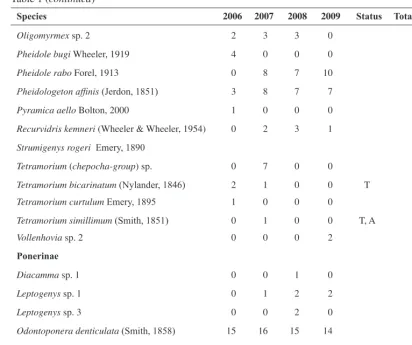
In a single year, we found between 19 (2009) and 23 (2006 to 2008) species. During the course of the four years, we altogether recorded 42 species, from seven subfamilies, in the clearing (Table 1);
Tetramorium and Monomorium were the most speciose genera, each with four species. The most common species were Odontoponera denticulata,
Monomorium sp. 6 and Cardiocondyla tjibodana, respectively present in 75 percent, 43 percent, and 39 percent of all samples. Of all 42 species, at least four were endemic to Borneo. On the percent of all traps, while in 2008 and 2009 we found A. gracilipes in only 10 percent and 15 percent of our samples respectively. The two non-native species Paratrechina longicornis
and Tapinoma melanocephalum were found in all four years, while Tetramorium simillimum, Tetramorium bicarinatum, Strumigenys rogeri
and Monomorium floricola were all recorded in only a single year, with one or two occurrences. As the mean over the four years we collected five species per trap, but species density differed significantly between years; in 2006 and 2009 four species were collected per trap, in 2007 six species, and in 2008 five species (ANOVA; F3,76=
5.46; P < 0.0019).
Species accumulation curves showed a medium level of species saturation, as they were still rising (Fig. 1); however, according to the species estimators Jackknife 1 and ICE, we found from 76 percent to 86 percent of all species (Table 2).
The effective number of species declined each year from 2006 (D=16.3) to 2009 (D=13.3) and Simpson-index ranged from 15.81 in 2007 to 12.25 in 2009 (Table 2).
. . . .
Table 1: Abundance of all species found in the clearing. We give information on the number of occurrences in the four years. Under status, we note whether a non-native species is classified as tramp (T), alien (A) or invasive (I)
species according to the definitions of Passera (1994), McGlynn (1999) and Holway (2002).
Species 2006 2007 2008 2009 Status Total SOCs
Aenictinae
Aenictus sp. 0 0 4 0 4
Cerapachyinae
Cerapachys sp. 12 1 0 1 0 2
Dolichoderinae
Dolichoderus affinis Emery, 1889 12 5 0 0 17
Iridomyrmex anceps (Roger, 1863) 0 0 0 1 1
Tapinoma melanocephalum (Fabricius, 1793) 3 11 3 6 I, T, A 23
Technomyrmex lisae Forel, 1913 0 1 0 0 1
Ectatomminae
Gnamptogenys sp. 0 0 0 1 1
Formicinae
Anoplolepis gracilipes (Smith, 1857) 0 14 2 3 I, T, A 19
C. arrogans (Smith, 1858) 0 0 1 2 3
C. gigas (Latreille, 1802) 0 0 2 1 3
Oecophylla smaragdina (Fabricius, 1775) 3 5 0 7 15
Paratrechina longicornis (Latreille, 1802) 3 10 7 3 I, T, A 23
Nylanderia sp. 8 2 0 0 0 2
Polyrhachis abdominalis Smith, 1858 0 1 0 0 1
Myrmicinae
Cardiocondyla tjibodana Karavaiev, 1935 5 11 10 5 31
Crematogaster rogenhoferi Mayr, 1879 0 1 3 1 5
Crematogaster sp. 12 6 3 0 0 9
Lophomyrmex bedoti Emery, 1893 2 0 0 0 2
Lophomyrmex longicornis Rigato, 1994 1 4 2 0 7
Monomorium floricola (Jerdon, 1851) 2 0 0 0 T 2
Monomorium sp. 1 0 0 1 1 2
Monomorium sp. 5 4 3 4 4 15
Monomorium sp. 6 4 8 13 10 35
Myrmicaria brunnea Saunders, 1842 2 0 1 0 3
93
Influence of the arrival of Anoplolepis gracilipes (Hymenoptera: Formicidae)
Table 1 (continued)
Species 2006 2007 2008 2009 Status Total SOCs
Oligomyrmex sp. 2 2 3 3 0 8
Pheidole bugi Wheeler, 1919 4 0 0 0 4
Pheidole rabo Forel, 1913 0 8 7 10 25
Pheidologeton affinis (Jerdon, 1851) 3 8 7 7 25
Pyramica aello Bolton, 2000 1 0 0 0 1
Recurvidris kemneri (Wheeler & Wheeler, 1954) 0 2 3 1 6
Strumigenys rogeri Emery, 1890
Tetramorium (chepocha-group) sp. 0 7 0 0 7
Tetramorium bicarinatum (Nylander, 1846) 2 1 0 0 T 3
Tetramorium curtulum Emery, 1895 1 0 0 0 1
Tetramorium simillimum (Smith, 1851) 0 1 0 0 T, A 1
Vollenhovia sp. 2 0 0 0 2 2
Ponerinae
Diacamma sp. 1 0 0 1 0 1
Leptogenys sp. 1 0 1 2 2 5
Leptogenys sp. 3 0 0 2 0 2
Odontoponera denticulata (Smith, 1858) 15 16 15 14 60
Platythyrea sp. 1 1 0 0 0 1
Community structure was analysed by NMDS. The final configuration of the NMDS (final stress 19.65 for a three-dimensional solution) was obtained after 96 tries. Plot scores of the first two axes differed significantly between the four years (Fig. 2), but not the scores of the third axis (ANOVA, axis 1: F3,74 = 16.4, p < 0.0001, axis 2: F3,74 = 4.2, p < 0.007, axis 3: F3,74 = 0.5, p = 0.7). Posthoc tests of the first axis in different years showed that scores of all years after the arrival of
A. gracilipes differed significantly from scores in
the year 2006 when A. gracilipes was still absent (HSD, for all three years: p<0.001).
DISCUSSION
With our study, we demonstrate the impact of the arrival of the invasive species A. gracilipes on the ant community on a clearing covered by herbs and grass in Gunung Mulu NP. Our results show that the presence of this invasive species leads to a declining Simpson-diversity, even in years when the number of species was still the same. The effective number of species showed the same pattern, declining in each successive survey after the arrival of A. gracilipes. The impact of these invasive ants could be underlined by the comparison of the NMDS scores of the community, which revealed a temporal shift in community patterns after the species’ invasion, and by the change in
Table 2: Estimated species number and diversity in the four observation years. Given are the species estimator chosen after the method of Brose & Martinez (2004), the estimated species number and the species coverage.
Optimal species estimators may change according to sample coverage (e.g., in 2008). We further report two diversity measures, the effective number of species according to the framework of Jost (2006) and the Simpson-index.
Year 2006 2007 2008 2009
Estimator used for calculation
Jackknife 1 Jackknife 1 ICE Jackknife 1
Collected species number
23 23 23 19
Estimated species number
29 30 27 25
Percentage of species collected
85.67 76.84 86.37 81.61
D (effective number of species)
16.28 15.49 15.49 13.33
Simpson-index 13.62 15.81 13.88 12.35
Table 3: Beta-diversity between the four years. We present Chao-Jaccard index as an inverse diversity measure
which calculates the probability that two randomly chosen SOCs, one from each of two years, both belong to species found in both years (but not necessarily to the same shared species). Highest beta diversity measurements (lowest indices) for consecutive years were obtained for the years before and after the species invasion, and highest measures overall for the longest period between samples.
2006 2007 2008
2007 0.604
2008 0.469 0.744
95
Influence of the arrival of Anoplolepis gracilipes (Hymenoptera: Formicidae)
Fig. 2. NMDS Plots of the samples of the four years and the NMDS scores of all 42 species. The scores of
Anoplolepis gracilipes and Dolichoderus affinis are marked by an X. The ant community in 2006 differed
significantly from all other years in scores of x- and y- axes.
beta diversity which was especially high in the year of the species invasion.
The impact of A. gracilipes on particular ant species can be demonstrated by the example of Dolichoderus affinis, a medium-sized dolichoderine ant with opportunistic foraging and trophobiont-tending habits, which is most common in disturbed habitats (Tanaka et al.
2007). With these characteristics, D. affinis is ecologically similar to A. gracilipes. When A. gracilipes arrived, D. affinis became rarer than the year before, and another year later it seems to have disappeared from this area; D. affinis had not recovered when A. gracilipes abundance was lower again in the year 2009.
Other non-native ant species seemed to be of lower importance in structuring the community. Two of them, Paratrechina longicornis and Tapinoma melanocephalum, show a similar distribution to A. gracilipes, but they were present before the arrival of A. gracilipes in the clearing, so it is difficult to evaluate their impact on community structure. In other areas
of Borneo, A. gracilipes seemed to be dominant over P. longicornis, for example, around the lab building of the Danum Valley Field Centre about 340 km away, P. longicornis almost disappeared after the arrival of A. gracilipes (Drescher et al.
2007), and similar observations have been made around buildings in rural Hong Kong (John R. Fellowes, pers. comm., 2011). In our study area, we did not observe that A. gracilipes outcompeted
P. longicornis. Four further non-native species,
Tetramorium simillimum, T. bicarinatum,
Strumigenys rogeri and Monomorium floricola were present in only a single year, in low numbers; therefore, these species seemed to have negligible impact on the community.
It is unclear whether A. gracilipes entered the area of Mulu by anthropogenic dispersal or by self-dispersal. The species is still spreading in the whole of Borneo; only recently, in 2004, it arrived in the area of the Danum Valley Research Centre by anthropogenic dispersal (Drescher et al.
connection from other parts of Borneo to Gunung Mulu NP. But the forested area of this national park adjoins an almost continuous expanse of anthropogenic modified habitats (e.g., secondary forest, scrub vegetation and plantation) that offer suitable conditions for A. gracilipes to reach Gunung Mulu NP by self-dispersal. In 2006, before its arrival in the clearing, A. gracilipes was already present on the other bank of the Melinau River, which separates the Gunung Mulu NP headquarters from the surrounding scrubland. However, we regularly surveyed the clearing area for ants and other arthropods, and did not observe
A. gracilipes during our field stays in 2006, or in
March/April 2007. The first time we observed this species in the study area was at the beginning of our field stay in August 2007. So we can be sure that the absence of A. gracilipes in the clearing in 2006 was no sampling bias.
When we look at the influence of
A.gracilipes, we must consider that the studied habitat is an anthropogenic modified habitat and heavily disturbed (e.g., by regular mowing). The ant species present there are adapted to disturbance, and some of the species can be found in oil palm plantations (Pfeiffer et al. 2008). This
already-disturbed ant community was heavily affected by the arrival of the invasive A. gracilipes. However, to elucidate the complex changes in ant abundance in detail, we must consider further abiotic effects that affect the ant community on this site. Irregular flooding events one or two times per year were a major abiotic impact to this area and might be expected to impact A. gracilipes more than native species, which are adapted to such an environment (Mezger & Pfeiffer 2008).The intensity of these floods might have influenced the abundance of A. gracilipes and its potential for further spread; 2007, the year of the arrival of A. gracilipes, was a year with only moderately flooding, while the following year, 2008, with a reduced abundance of A. gracilipes, showed very heavy flooding events. Although 2009 was again a year with only moderate inundations,
A. gracilipes could not recover to the frequency of 2007. On the other hand, this species is known to have cyclical variations in abundance even under stable conditions (Wielgoss et al. 2010), or drop in numbers after invasion (Haines et al. 1994), so there is the potential for further spread in future.
All the non-native species in the clearing seemed to be poorly adapted to flooding events, which are reported to be major forces in structuring ant communities in neotropical alluvial forests (Vasconcelos et al. 2010). Frequent inundation may therefore act as a strong environmental filter that supports native species, especially in undisturbed alluvial forest. Regular flooding events may constrain A. gracilipes from settling in this forested area; additional constraints include the high diversity of native ants that may prevent species invasions (see Beisner et al. 2006), and the complex habitat that might be less suitable for A. gracilipes, which prefers disturbed habitat with high insolation. However, a large number of tree-fall gaps caused by recent heavy gales might allow A. gracilipes further spread into this forest in the near future.
ACKNOWLEDGEMENTS
97
Influence of the arrival of Anoplolepis gracilipes (Hymenoptera: Formicidae)
REFERENCES
Abbott KL, 2005. Supercolonies of the invasive yellow crazy ant, Anoplolepis gracilipes, on an oceanic island: forager activity patterns, density and biomass. Insectes Sociaux 52:266–273. Abbott KL and Green PT, 2007. Collapse of an
ant-scale mutualism in a rainforest on Christmas Island. OIKOS 116:1238–1246.
Beisner BE, Hovius J, Hayward A, Kolasa J
and Romanuk TN, 2006. Environmental productivity and biodiversity effects on invertebrate community invasibility. Biological Invasions 8(4): 655–664.
Bickel T and Watanasit S, 2005. Diversity of leaf litter ant communities in Ton Nga Chang Wildlife Sanctuary and nearby rubber plantations, Songkhla, Southern Thailand.
Songklanakarin Journal of Science and Technology 27:943–956.
Bolton B, 1994. Identification guide to the ant genera
of the world. Harvard University Press, Cambridge, p222.
Bos MM, Tylianakis JM, Steffan-Dewenter I and Tscharntke T, 2008. The invasive Yellow Crazy
Ant and the decline of forest ant diversity in Indonesian cacao agroforests. Biological Invasions 10:1399–1409.
Brose U and Martinez ND, 2004. Estimating the richness of species with variable mobility.
OIKOS 105:292–300.
Colwell RK, 2009. EstimateS: Statistical estimation of species richness and shared species from samples. Version 8.2. User’s Guide and
application downloaded from http://purl.oclc. org/estimates. on 1February 2010.
Drescher J, Blüthgen N and Feldhaar H, 2007. Population
structure and intraspecific aggression in the
invasive ant species Anoplolepis gracilipes
in Malaysian Borneo. Molecular Ecology
16:1453–1465.
Gerlach J, 2004. Impact of the invasive crazy ant
Anoplolepis gracilipes on Bird Island, Seychelles. Journal of Insect Conservation
8:15–25.
Giraud T, Pedersen JS and Keller L, 2002. Evolution of
supercolonies: the Argentine ants of southern Europe. Proceedings of the National Academy of Sciences 99:6075–6079.
Gotelli JN and Colwell RK, 2001. Quantifying
biodiversity: procedures and pitfalls in the measurement and comparison of species richness. Ecology Letters 4:379–391.
Haines IH, Haines JB and Cherrett JM 1994.
The impact and control of the crazy ant,
Anoplolepis longipes (Jerd.) in the Seychelles,
pp 206–218. In: Exotic Ants: Biology, Impact, and Control of Introduced Species (Williams DF, ed), Westview Studies in Insect Biology, USA, p332.
Holway DA, 2002. The causes and consequences of ant invasions. Annual Review of Ecology and Systematics 33:181–233.
Human KG and Gordon DM, 1996. Exploitation and interference competition between the invasive Argentine ant, Linepithema humile, and native ant species. Oecologia 105:405–412.
Jerdon TC, 1851. A catalogue of the species of ants
2003. Argentine and other ants (Hymenoptera: Formicidae) in New Zealand horticultural ecosystems: distribution, hemipteran hosts, and review. New Zealand Entomologist 26:79–89.
Lowe S., Browne M., Boudjelas S., De Poorter M., 2000. 100 of the World’s Worst Invasive Alien Species A selection from the Global Invasive Species Database. Published by The Invasive Species Specialist Group (ISSG), a specialist group of the Species Survival Commission (SSC) of the World Conservation Union (IUCN), p12. First published as special lift-out in Aliens 12, December 2000. Updated and reprinted version: November 2004.
McCune B and Grace JB, 2002. Analysis of ecological communities. MjM Software Design, Gleneden Beach, Oregon, USA.
McGlynn TP, 1999. The worldwide transfer of ants: geographical contributions and ecological invasions. Journal of Biogeography
26:535–548.
Mezger D and Pfeiffer M, 2008. Record of a mixed
colony of two dacetine species: Strumigenys rotogenys and Pyramica mitis (Myrmicinae) from Gunung Mulu National Park, Sarawak, Malaysia. Asian Myrmecology 2:125–127.
Ness JH, Bronstein AN, Andersen A and Holland JN,
2004. Ant body size predicts dispersal distance of ant-adapted seeds: implications of small-ant invasions. Ecology 85:1244–1250.
O’Dowd DJ, Green PT and Lake PS, 2003. Invasional
meltdown on an oceanic island. Ecology
Elaeis guineensis in Borneo and Peninsular Malaysia. Ecography 31(1): 21–32.
StatSoft I, 2003. STATISTICA for Windows (software-system for data-analyses) Version 6.
Tanaka H, Yamane S, Nakashizuka T, Komose K and
Itioka T, 2007. Effects of deforestation on mutualistic interactions of ants with plants and hemipterans in tropical rainforest of Borneo.
Asian Myrmecology 1:31–50.
Vasconcelos HL, Vilhena JMS, Facure KG and Albernaz
ALKM, 2010. Patterns of ant species diversity and turnover across 2000 km of Amazonian
floodplain forest. Journal of Biogeography
37:432–440.
Wetterer JK, 2005. Worldwide Distribution and
Potential Spread of the Long-Legged Ant,
Anoplolepis gracilipes (Hymenoptera: Formicidae). Sociobiology 45:77–97.
Wielgoss A, Tscharntke T, Buchori D, Fiala B and
Clough Y, 2010. Temperature and a dominant
dolichoderine ant species affect ant diversity in Indonesian cacao plantations. Agriculture, Ecosystems and Environment 135:253–259.
ASIAN MYRMECOLOGY