Ecology of Ephemeroptera, Plecoptera and Trichoptera (Insecta) in Rivers of the Gunung Jerai Forest Reserve: Diversity and Distribution of Functional Feeding Groups
Suhaila Ab Hamid∗ and Che Salmah Md Rawi
School of Biological Sciences, Universiti Sains Malaysia, 11800 USM, Pulau Pinang, Malaysia
Abstrak: Satu kajian lapangan telah dijalankan ke atas kumpulan pemakanan (FFG) bagi order Ephemeroptera, Plecoptera dan Trichoptera (EPT) di Sungai Tupah, Sungai Batu Hampar dan Sungai Teroi, di Hutan Simpan Gunung Jerai (GJFR), Kedah, Malaysia. Dua puluh sembilan genera daripada 19 famili telah dikenal pasti. EPT telah diklasifikasikan kepada lima FFG; pemungut-kumpul (CG), pemungut-turas (CF), pengoyak (SH), penyagat (SC) dan pemangsa (P). Daripada kajian ini, CG dan CF merupakan kumpulan dominan yang dijumpai di kesemua sungai. Ephemeroptera mendominasi sungai-sungai kerana ia mencatatkan bilangan tertinggi dan merupakan CG (90.6%). SC mencatatkan bilangan terendah di kalangan semua kumpulan. Sungai Teroi sangat sesuai untuk CG sahaja manakala Sungai Tupah dan Sungai Batu Hampar sesuai untuk CG dan CF.
Perkadaran FFG adalah berbeza antara sungai-sungai (CG, χ2 = 23.6, p = 0.00; SH, χ2
= 10.02, p = 0.007; P, χ2 = 25.54, p = 0.00; CF, χ2 = 21.95, p = 0.00; SC, χ2 = 9.31,
p = 0.01). Penemuan ini menunjukkan FFG yang dijumpai di sungai-sungai daripada GJFR mewakili sungai kelas tinggi.
Kata kunci: Ephemeroptera, Plecoptera, Trichoptera, Hutan Simpan, Tropikal, Kumpulan Pemakanan
Abstract: A field study was performed to describe the functional feeding groups (FFGs) of Ephemeroptera, Plecoptera and Trichoptera (EPT) in the Tupah, Batu Hampar and Teroi Rivers in the Gunung Jerai Forest Reserve (GJFR), Kedah, Malaysia. Twenty-nine genera belonging to 19 families were identified. The EPTs were classified into five FFGs: collector-gatherers (CG), collector-filterers (CF), shredders (SH), scrapers (SC) and predators (P). In this study, CG and CF were the dominant groups inhabiting all three rivers. Ephemeroptera dominated these rivers due to their high abundance, and they were also the CG (90.6%). SC were the lowest in abundance among all groups. Based on the FFGs, the Teroi River was suitable for CG, whereas the Tupah and Batu Hampar Rivers
were suitable for CG and CF. The distribution of FFGs differed among the rivers (CG, χ2
= 23.6, p = 0.00; SH, χ2 = 10.02, p = 0.007; P, χ2 = 25.54, p = 0.00; CF, χ2 = 21.95,
p = 0.00; SC, χ2 = 9.31, p = 0.01). These findings indicated that the FFGs found in rivers of the GJFR represent high river quality.
Keywords: Ephemeroptera, Plecoptera, Trichoptera, Forest Reserve, Tropical, Functional Feeding Groups
INTRODUCTION
The composition of life in headwater streams contributes to the biodiversity of a river system and its riparian network. Small streams differ widely in their physical, chemical and biotic attributes, thus providing habitats for a range of aquatic species. Several factors, such as substrates (Rae 1985), allochthonous matter (Tiziano et al. 2007), water temperature (Ward & Standford 1982), water flow (Dudgeon 1993), habitat disturbance (Death & Winterbourn 1995) and biotic interactions (Kohler 1992), determine the structure of resident macroinvertebrate assemblages.
In stream ecosystems, various groups of aquatic organisms respond to habitat changes differently (Clarke et al. 2008). Among aquatic insects, some insect orders are generally more tolerant or more sensitive to an array of environmental disturbances (Orr 2005; Yule & Yong 2004; Dudgeon 1999; Merritt & Cummins 1996). Similar responses to environmental disturbances are observed among organisms within a similar feeding or functional group due to a similar mechanism of food acquisition (Boyero 2005). Many recent studies on invertebrates’ responses to habitat disturbance have focused on the composition of functional feeding groups (FFGs) rather than examining the effect on all organisms living in particular habitats (Al-Shami et al. 2013a; Che Salmah et al.
2013a, b; Gullan & Cranston 2005; Blasius & Merritt 2002). Moreover, Gullan and Cranston (2005) suggested subsuming taxa into FFGs to address the problem of species-level identification of many organisms, which requires high levels of expertise.
The adaptation of species to environmental conditions is known as ecosystem function (Townsend & Hildrew 1994), and feeding strategy plays an important role in this process. FFGs are a classification approach based on morphobehavioural mechanisms of food acquisition rather than taxonomic groups (Merritt et al. 2008) that use information on feeding habits of benthic taxa (Rawer-Jost et al. 2000). The categorisation of stream macroinvertebrates by FFGs has shown considerable success as a tool for assessing spatial changes in lotic communities based on environmental conditions (Blasius & Merritt 2002). FFGs are useful to describe the function of benthic communities, such as when comparing river sites of different sizes, variation of riparian vegetation and physicochemical characteristics (Boyero 2005). Furthermore, the use of FFGs could increase the knowledge about lotic ecosystems during the assessment of ecological integrity (Rawer-Jost et al. 2000).
habitats. Human activities at these undisturbed water bodies interfere with the aquatic organisms inhabiting the streams (Suhaila 2011; Suhaila & Che Salmah 2011; Suhaila et al. 2011). Therefore, this study was undertaken to investigate the diversity of the EPT community and its ecosystem function in upstream rivers of the Gunung Jerai Forest Reserve (GJFR) in Kedah, Malaysia. The distribution patterns of EPT FFGs in this forest would indirectly indicate the degree of habitat disturbance in the streams (rivers) that had been designated as popular recreational areas at this hill resort. The findings of this study will contribute to the planning of future recreational areas in forest reserves.
MATERIALS AND METHODS
Description of the Study Area
This study was conducted on rivers of the GJFR in Kedah, Northern Peninsular Malaysia, which lies at 5°47.44'N and 100°26.4'E. Three rivers were selected: the Tupah, Batu Hampar and Teroi Rivers. The Tupah River flows through low land dipterocarp forest at 200 m above sea level (a.s.l). The river substrates are predominantly cobble and gravel (55%) and boulders (45%). The Batu Hampar River flows through a populated village and fruit orchards in a low land dipterocarp forest 300 m a.s.l. In the Batu Hampar River, cobble and gravel substrates were highly embedded (approximately 60%). The Teroi River is located high on the Gunung Jerai at 1214 m a.s.l. The substrate in this river mainly consists of bedrock. The Teroi River flows through a hill dipterocarp forest with the water surface partly shaded by tree canopies. The water of this river is brownish in colour due to the resin from the Agathis alba trees that grow in high numbers along its banks.
Sampling of EPT
Aquatic forms of immature EPT were sampled from the Tupah, Batu Hampar and Teroi Rivers monthly from September 2007 to August 2008. Twenty samples were collected at each river using the kick sampling technique, a modified method of Merritt et al. (2008). This technique uses a D-pond net with a frame 40 cm wide and 30 cm high and fitted with a 60 cm long cone shaped net of 300 µm mesh. The frame was attached to a 100 cm long handle. A detailed description of the sampling procedure can be found elsewhere (Suhaila & Che Salmah 2011). Insects on pebbles, cobble and woody debris were scraped up and collected inside the net. The EPTs detached from the substrates were flushed into the net. The content of each sample was transferred into a labelled plastic bag, fastened with a rubber band and transported to the Aquatic Entomology Laboratory, Universiti Sains Malaysia (USM) in a Coolman® ice chest.
to the genus level when possible. The identification of Plecoptera was confirmed by Dr. Ignec Sivec (Slovenian Museum of Natural History, Ljubljana) and Prof. Yeon Jae Bae (Korea University, Seoul) verified the identification of Ephemeroptera and Trichoptera. Due to limited taxonomic keys of Malaysian taxa, it was not possible to identify the EPTs to the species level. Furthermore, many previous studies have shown that identification to the species level is not necessary for studies by FFG (Tomanova et al. 2006; Gayraud et al. 2003; Dolédec et al. 2000). Identification at the genus level has satisfied realistic functional descriptions of lotic communities (Heino & Soininen 2007; Boyero 2005; Gayraud et al. 2003; Dolédec et al. 2000).
Functional Feeding Groups (FFGs)
EPTs were categorised according to their FFG as scrapers (SC), collectors, shredders (SH) or predators (P). The generic identification of the EPTs was mainly based on Yule and Yong (2004) and Yule et al. (2009). Identified genera were assigned to FFGs according to Yule et al. (2009) and Merritt et al. (2008).
Physical Characteristics and Chemical Parameters of the Rivers
The physical features of the rivers, such as their width, depth, pH, water temperature and water velocity, were recorded in situ at each river. Concurrent with the EPT samplings, measurements of physicochemical parameters were performed at three randomly selected sites at each river. Measurements of width and depth were obtained using a Stanley measuring tape (3.2 m) and a stainless steel ruler (1 m), respectively. Dissolved oxygen (DO) and temperature values were measured in situ using an oxygen meter (YSI Model 550A, YSI Inc., Ohio, USA), whereas the pH of the water was measured with an electronic pH meter (HACH CO., Loveland, USA). The water velocity of the river was determined using a portable Velocity Autoflow Watch (JDC Instrument, Arizona, USA) and categorised following Carter et al. (1996) as fast flowing (>0.1 m/s), slow flowing (0.05–0.1 m/s) or non-moving (<0.05 m/s). To analyse selected chemical parameters [biochemical oxygen demand (BOD), chemical oxygen demand (COD), ammonia-nitrogen (NH3-N) and total suspended solids (TSS)], three water samples (500 ml each) were collected from the three rivers using polyethylene bottles during each sampling. The labelled bottles were transported to the laboratory in an ice chest and stored at 4ºC until analysis. The BOD, COD, TSS and NH3-N in the water were estimated in the laboratory using a DR/890 HACH calorimeter following the manufacturer’s instructions (HACH CO., Loveland, USA).
Data Analysis
biological dissimilarities in the diversity of EPTs in the rivers (Tuomisto 2010; Costa & Melo 2008). A biological index, such as the EPT taxa Richness Index (Lenat & Penrose 1996), was calculated for each river.
RESULTS
Diversity of EPT in Rivers of the GJFR
Within the study period, 17315 specimens representing 29 genera from 19 families of EPTs were collected from the Tupah, Batu Hampar and Teroi Rivers. The EPTs from the Tupah, Batu Hampar and Teroi Rivers were highly variable in composition and abundance. The taxa richness index was the highest at the Tupah River (28 taxa), followed by the Batu Hampar River (25 taxa) and the Teroi River (22 taxa) (Table 1). Many EPT taxa recorded from the Tupah River were also collected from the Batu Hampar River, but there were fewer common taxa shared with the Teroi River. From the biological perspective, the EPT taxa richness index indicated that the water quality in all three rivers was not impacted by the activities of visitors.
The scores of both diversity indices (Shannon-Weiner and Simpson’s) showed that the diversity of EPT communities was much higher in the Batu
Hampar River (H’ = 2.29, 1-D = 0.85), followed by the Tupah River (H’ = 2.15, 1-D = 0.81) and the Teroi River (H’ = 0.77, 1-D = 0.32). Because the abundance
of EPTs was low, the species richness Menhinick Index was low in all rivers, ranging from 0.43 to 0.19. Nevertheless, these values implied that the Tupah River provided the most suitable habitats for EPTs compared to the other two rivers. The EPT distribution (Pielou’s Evenness Index) was more uniform in the Batu Hampar (E = 0.71) and Tupah Rivers (E = 0.65), but it was least evenly distributed in the Teroi River (E = 0.26). Whittaker’s beta diversity, which measures biological dissimilarities between rivers, showed that the Batu Hampar
River (βW = 0.526) and Tupah River (βW= 0.562) were fairly low in dissimilarity
(high similarity) of species composition, with the highest dissimilarity (lowest similarity) observed in the Teroi River (βW= 0.882).
Table 1: Abundance and number of taxa of EPT in different rivers of the GJFR.
Indices River
Tupah Batu Hampar Teroi
Individuals 4298 3350 9667
EPT taxa richness index 28 25 22
Shannon-Wiener Index (H’) 2.153 2.294 0.765
Simpson’s Index (1-D) 0.811 0.853 0.323
Menhinick Index (R) 0.427 0.432 0.193
Pielou Index (E) 0.646 0.713 0.260
Functional Diversity of EPT
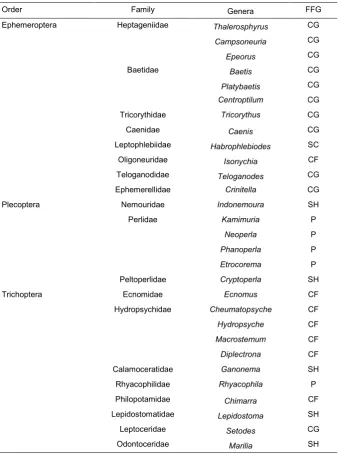
Table 2 shows the list of FFGs of EPTs in rivers of the GJFR. The composition of collector-gatherers (CG) was the highest in the Teroi River (90.6% of total FFGs; Fig. 1), moderate in the Tupah River (50.9%) and fairly low in the Batu Hampar River (33.2%). Meanwhile, EPT SC were markedly few, contributing only 1.2% in the Tupah River and 2% in the Batu Hampar River. SC were almost absent in the Teroi River. In the Batu Hampar River, P comprised 28.6% of the EPTs collected. Other guilds, collector-filterers (CF) (34.5%) and SH (1.7%), were more abundant in the Batu Hampar River compared to the other rivers. The range of FFG proportions differed between rivers (CG, χ2 = 23.6, p = 0.00; SH, χ2 = 10.02,
p = 0.007; P, χ2=25.54 p = 0.00; CF, χ2 =21.95, p = 0.00; and SC, χ2 = 9.31, p = 0.01).
Figure 1: Composition of the FFGs of EPT in rivers of the GJFR, Kedah.
Physicochemical Parameters of the Rivers
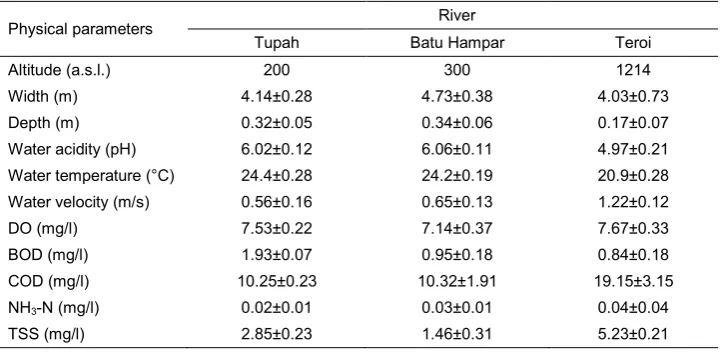
The physicochemical parameters of the water in the three rivers are summarised in Table 3. All parameters varied within fairly small ranges. Among the three rivers, the water in the Teroi River was more acidic (4.97±0.21) than that in the Tupah (6.02±0.12) and Batu Hampar (6.06±0.11) rivers. At 1200 m a.s.l., the water temperature in the Teroi River was the coolest (20.9±0.28°C) and had the fastest flow of the shallowest water compared to the other rivers. The mean BOD content was the highest in the Tupah River (1.93±0.07 mg/l) and the lowest in the Teroi River (0.84±0.18 mg/l). However, the mean COD (19.15±3.15 mg/l) and TSS (5.23±0.21 mg/l) contents were highest in the Teroi River. Meanwhile, the mean DO and NH3-N content did not vary between the rivers.
DISCUSSION
Penrose 1996). Between the three rivers, the Batu Hampar River had the most diverse EPT assemblage, as indicated by higher values of alpha diversity indices. Therefore, it was presumed that the Batu Hampar River was unpolluted and provided a high abundance of suitable habitats for EPTs.
Table 2: List of taxa and their FFGs in the study area.
Order Family Genera FFG
Ephemeroptera Heptageniidae Thalerosphyrus CG
Campsoneuria CG
Epeorus CG
Baetidae Baetis CG
Platybaetis CG
Centroptilum CG
Tricorythidae Tricorythus CG
Caenidae Caenis CG
Leptophlebiidae Habrophlebiodes SC
Oligoneuridae Isonychia CF
Teloganodidae Teloganodes CG
Ephemerellidae Crinitella CG
Plecoptera Nemouridae Indonemoura SH
Perlidae Kamimuria P
Neoperla P
Phanoperla P
Etrocorema P
Peltoperlidae Cryptoperla SH
Trichoptera Ecnomidae Ecnomus CF
Hydropsychidae Cheumatopsyche CF
Hydropsyche CF
Macrostemum CF
Diplectrona CF
Calamoceratidae Ganonema SH
Rhyacophilidae Rhyacophila P
Philopotamidae Chimarra CF
Lepidostomatidae Lepidostoma SH
Leptoceridae Setodes CG
Table 3: Mean (±SE) values of physical parameters of the rivers in the GJFR, Kedah.
In this study, the diversity of EPTs in all rivers was calculated based on the number of EPT genera recorded in each river at a coarse taxonomic resolution. As suggested by Bouchard et al. (2005), using a coarser taxonomic resolution (e.g., the identification of the family rather than the genus or species) makes the identification process less resource demanding. Higher number of taxa (species) collected from a habitat implies a richer community that usually lives in a healthier environment. Based on the scores, all rivers in the GJFR supported relatively rich EPT fauna, but their composition and abundance were significantly different between rivers. The range of scores of other calculated biological indices also pointed towards a rich EPT community inhabiting all rivers. However, a high preference of certain genera was observed, such as dominance of the mayfly Baetis in the Teroi River.
Comparing the generic compositions in the three rivers, the Batu Hampar River shared more common genera with the Tupah River, while the Teroi River was very different from the other rivers (as indicated by a high value of beta diversity). The Teroi River is located at a much higher altitude (1214 m a.s.l) compared to the Tupah and the Batu Hampar Rivers, which pass through altitudes of 200 m to 300 m a.s.l. Vegetation around the fast flowing Teroi River was also different when compared with the two other rivers, and it had a high abundance of A. alba that contributed to the higher acidity of its water. Such differences in the river’s physical habitat and hydrological conditions could contribute to the observed dissimilarities in the EPT compositions. This may be due to the multiplicity of microhabitats, along with a combination of several other environmental factors that varied between rivers (Costa & Melo 2008). Usually, similar richness of invertebrates is recorded from rivers with similar habitat structures, river geomorphologies and hydrological conditions (Novelo-Gutierrez & Gomez-Anaya 2009).
According to Bij de Vaate and Pavluk (2004), all FFGs (SC, SH, CG, CF and P) are usually found in undisturbed low-order rivers. Five groups of FFGs
Physical parameters River
Tupah Batu Hampar Teroi
Altitude (a.s.l.) 200 300 1214
Width (m) 4.14±0.28 4.73±0.38 4.03±0.73
Depth (m) 0.32±0.05 0.34±0.06 0.17±0.07
Water acidity (pH) 6.02±0.12 6.06±0.11 4.97±0.21
Water temperature (°C) 24.4±0.28 24.2±0.19 20.9±0.28
Water velocity (m/s) 0.56±0.16 0.65±0.13 1.22±0.12
DO (mg/l) 7.53±0.22 7.14±0.37 7.67±0.33
BOD (mg/l) 1.93±0.07 0.95±0.18 0.84±0.18
COD (mg/l) 10.25±0.23 10.32±1.91 19.15±3.15
NH3-N (mg/l) 0.02±0.01 0.03±0.01 0.04±0.04
were identified in the rivers of the GJFR. Except in the Teroi River, where SC were not found, these FFGs inhabited both the Tupah and the Batu Hampar Rivers. The absence of SC in the Teroi River was presumably related to the unavailability of macrophytes, which are its food source (Rosenberg & Resh 1993). In the Teroi River, most substrates of the sampling sites consisted of bedrock underneath very shallow water. The lack of macrophyte growth on such a substrate led to the absence of this FFG group in the river. Furthermore, the water in the Teroi River was slightly acidic and most likely not suitable for macrophytes (Suhaila 2011).
In this study, CG and CF were the dominant FFGs in all three rivers. Based on Rosenberg and Resh (1993), the dominance of these two FFGs reflected organic enrichment of the water. Vannote et al. (1980) reported that CG and CF were more dominant in larger streams. However, functional composition can vary between segments, riffles and within riffles in low-order streams (Boyero 2005). Moreover, the CG and CF considered in this study were a fraction of the two FFGs in the rivers because they only represented three insect orders.
In the GJFR, CG were the most dominant FFG guild, especially in the Teroi River because most of the CG identified were ephemeropterans that were abundant in the river. Baetis, which preferred fast water current, a characteristic of the Teroi River, represented a large component of CG. In this river, the ephemeropteran CG feed on a variety of detritus (Merritt & Cummins 1996) found on rocky surfaces. The high abundance of CG in the Teroi River was also influenced by food availability; according to Suren and McMurtrie (2005), there is a high occurrence of CG in urban streams that have abundant food resources. As reported by Bispo and Oliveira (2007), the importance of collectors increases as the allochthonous energy inputs increase in the form of fine particulate organic matter (FPOM). In the Teroi River, many A. alba trees grew along its banks. The leaves from these trees were a source of organic matter in the river (Bretschko & Moser 1993). Similarly, Gregory et al. (1991) found that the riparian zone also contributed organic matter to the stream and altered the nutrient flow. Riparian allochthonous organic matter eventually changed the food quality in the river that was available to the aquatic ecosystem (Elliott et al. 2004).
Variations of FFG components in rivers of the GJFR implied that the energy input in each river was dissimilarly distributed. In addition, the distribution of FFG components was also influenced by characteristics of physical habitats. The higher elevation and acidic water of the Teroi River was assumed to be less preferred by the CF and SH. The CF in this study were mainly Trichopterans, which were dominant in the Tupah River. Trichoptera Hydropsychidae were the most important contributors to the CF. Larvae of the Hydropsychidae construct tent-like nets among the cobble and gravel and need a strong current to prevent the nets from collapsing (Voshell & Reese 2002). To capture food particles, such as pieces of leaves or drifting organisms, the net opening faces upstream while the insect secretly stays within its retreat.
(1996) in Hong Kong and New Guinea, respectively. Accordingly, in the GJFR, a higher abundance of SC and SH were observed in shaded habitats, especially in the Batu Hampar River, a second-order river. The higher percentage of SC and SH in the Batu Hampar River is an indicator of large amounts of algal growth on rocks and leaf litter (food sources) that were available in the river. It also reflected that the river’s riparian forest was well preserved and that recreational activities had caused little perturbation to its aquatic habitat. Although SH were primarily represented by perlids (Plecoptera), taxa such as Ganonema (Trichoptera: Calamoceratidae), Lepidostoma (Trichoptera: Lepidostomatidae) and Marilia
(Trichoptera: Odontoceridae) were equally important. Moreover, the Batu Hampar River was surrounded by dense vegetation such as Shorea macroptera,
Shorealepidota and Shorea leprosula trees. These trees not only provided shade but also provided leaf litter and substrates to support growth of periphytic algae (Delong & Brusven 1998). Previous studies by Hynes (1970) and Vannote et al.
(1980) showed that the differences between food availability and habitat structure in river ecosystems could strongly influence both the structure and function of river communities such as EPT.
In conclusion, rivers of the GJFR supported relatively rich EPT communities. The FFG compositions in the three selected rivers were determined by the abundance of a guild (FFG) and the number of taxa within a guild. CG were more dominant because most of the CG were ephemeropterans that occurred in high abundance in all rivers. All FFG guilds inhabited rivers of the GJFR, and the distribution of guild taxa was restricted to the availability of food in high-gradient rivers. The assessment of FFGs in this study was based on available reference sources; therefore, its feeding ecology with associated food sources and food size are in need of further investigation.
ACKNOWLEDGEMENT
We would like to thank the School of Biological Sciences, USM for providing the facilities to carry out this study. This study was supported by the Fundamental Research Grant Scheme (203/PBIOL/671060), Ministry of Science, Technology and Innovation (MOSTI), Malaysia.
REFERENCES
Al‐Shami S A, Heino J, Che Salmah M R, Abu Hassan A, Suhaila A H and Madziatul R M. (2013a). Drivers of beta diversity of macroinvertebrate communities in tropical forest streams. Freshwater Biology 58(6): 1126–1137.
Al‐Shami S A, Che Salmah R, Abu Hassan A and Madziatul R M. (2013b). Biodiversity of stream insects in the Malaysian Peninsula: Spatial patterns and environmental constraints. Ecological Entomology 38(3): 238–249.
Bispo P C and Oliveira L G. (2007). Diversity and structure of Ephemeroptera, Plecoptera and Trichoptera (Insecta) assemblages from riffles in mountain streams of Central Brazil. Revista Brasileira de Zoologia 24(2): 283–293.
Bispo P C, Oliveira L G, Bini L M and Sausa K G. (2006). Ephemeroptera, Plecoptera and Trichoptera assemblages from riffles in mountain streams of central Brazil: Environmental factors influencing the distribution and abundance of immatures.
Brazilian Journal of Biology 66(2B): 611–622.
Blasius B J and Merritt R W. (2002). Field and laboratory investigations on the effects of road salt (NaCl) on stream macroinvertebrate communities. Environmental Pollution 120(2): 219–231.
Bouchard R W, Huggins D and Kriz J. (2005). A review of the issues related to taxonomic resolution in biological monitoring of aquatic ecosystems with an emphasis on macroinvertebrates. Report Grant USEPA X7-99790401. Open-file Report No. 133. Lawrence, KS, USA: Kansas Biological Survey, 38.
Bretschko G and Moser H. (1993). Transport and retention of matter in riparian ecotones.
Hydrobiologia 251(1–3): 95–101.
Boyero L. (2005). Multiscale variation in the functional composition of stream macroinvertebrate communities in low-order mountain streams. Limnetica 24(3– 4): 245–250.
Carter J L, Fend S V and Kenelly S S. (1996). The relationships among three habitats scales and stream benthic invertebrate community structure. Freshwater Biology
35(1): 109–124.
Che Salmah M R, Salman A A, Madziatul R M and Abu Hassan A. (2013a). Local effects of forest fragmentation on diversity of aquatic insects in tropical forest streams: Implications for biological conservation. Aquatic Ecology 47(1): 75–85.
———. (2013b). Biological and ecological diversity of aquatic macroinvertebrates in response to hydrological and physicochemical parameters in tropical forest streams of Gunung Tebu, Malaysia: Implications for ecohydrological assessment.
Ecohydrology 7(2): 496–507.
Clarke A, Mac Nally R, Bond N and Lake P S. (2008). Macroinvertebrate diversity in headwater streams: A review. Freshwater Biology 53(9): 1707–1721.
Costa S S and Melo A S. (2008). Beta diversity in stream macroinvertebrate assemblages among-site and among-microhabitat components. Hydrobiologia 598(1): 131– 138.
Death R G and Winterbourn M J. (1995). Diversity patterns in stream benthic invertebrate communities: The influence of habitat stability. Ecology 76(5): 1446–1460. Dolédec S, Olivier J M and Statzner B. (2000). Accurate description of the abundance of
taxa and their biological traits in stream invertebrate communities: Effects of taxonomic and spatial resolution. Archiv fur Hydrobiologie 148(1): 25–43.
Delong M D and Brusven M A. (1998). Macroinvertebrate community structure along the longitudinal gradient of an agriculturally impacted stream. Environmental Management 22(3): 445–457.
Dudgeon D. (1999). Tropical Asian streams: Zoobenthos, ecology and conservation. Hong Kong: Hong Kong University Press.
———. (1994). The influence of riparian vegetation on macroinvertebrate community structure and functional organization in six New Guinea streams. Hydrobiologia
294(1): 65–85.
Dudgeon D and Bretschko G. (1996). Allocthonous inputs and land-water interactions in seasonal streams: Tropical Asia and temperate Europe. In F Schiemer and K T Boland (eds.). Perspectives in tropical limnology. Amsterdam: PSB Academy. Elliott S R, Naiman R J and Bisson P A. (2004). Riparian influences on the biophysical
characteristics of seston in headwater streams. Northwest Science 78(2): 150– 157.
Gayraud S, Statzner B, Bady P, Hadybachp A, Scholl F, Usseglio-Polatera P and Bacchi M. (2003). Invertebrate traits for the biomonitoring of large European rivers: An initial assessment of alternative metrics. Freshwater Biology 48(11): 2045–2064. Gregory S V, Swanson F J, Mckee W A and Cummins K W. (1991). An ecosystem
perspective of riparian zones: Focus on links between land and water. Bioscience
41(8): 540–551.
Gullan P J and Cranston P. (2005). The insects: An outline of entomology, 3rd ed. Oxford, UK: Blackwell Publishing Ltd.
Heino J and Soininen J. (2007). Are higher taxa adequate surrogates for species-level assemblage patterns and species richness in stream organisms? Biological Conservation 137(1): 78–89.
Hynes H B N. (1970). The ecology of running waters. Liverpool: Liverpool University Press.
Kohler S L. (1992). Competition and the structure of a benthic stream community.
Ecological Monograph 62(2): 165–188.
Lenat D R and Penrose D L. (1996). History of the EPT taxa richness metric. Bulletin North American Benthological Society 12(13): 279–290.
Ludwig J A and Reynolds J F. (1988). Statistical ecology: A primer on methods and computing. New York: John Wiley and Sons.
Merritt R W and Cummins K W. (1996). An introduction to the aquatic insects of North America, 3rd ed. Iowa, USA: Kendall/Hunt Publishing Company.
Merritt R W, Cummins K W and Berg M B. (2008). An introduction to the aquatic insects of North America, 4th ed. Iowa, USA: Kendall/Hunt Publishing Company.
Morse J C, Yang L and Tian L. (1994). Aquatic insects of China useful for monitoring water quality. Nanjing, China: Hehai University Press.
Novelo-Gutierrez R and Gomez-Anaya J A. (2009). A comparative study of Odonata (Insecta) assemblages along an altitudinal gradient in the sierra de Coalcoman Mountains, Michoacan, Mexico. Biodiversity and Conservation 18(3): 679–698. Orr A G. (2005). A pocket guide dragonflies of Peninsular Malaysia and Singapore.
Sabah, Malaysia: Natural History Publications (Borneo) Sdn. Bhd.
Rae J G. (1985). A multivariate study of resource partitioning in soft bottom lotic Chironomidae. Hydrobiologia 126(3): 275–285.
Rawer-Jost C, Bohmer J, Blank J and Rahmann H. (2000). Macroinvertebrate functional feeding group methods in ecological assessment. Hydrobiologia 422/423: 225– 232.
Rosenberg D and Resh V H (eds.). (1993). Freshwater biomonitoring and benthic macroinvertebrates. New York: Chapman and Hall.
Salman A A, Che Salmah M R, Abu Hassan A, Suhaila A H and Siti Azizah M N. (2011). Influence of agriculture, industrial and anthropogenic stresses on the distribution and diversity of macroinvertebrates in Juru River basin, Penang, Malaysia.
Ecotoxicology and Environmental Safety 74(5): 1195–1202.
Stewart K W and Stark B P. (1993). Nymphs of North America Stonefly genera
(Plecoptera). Denton, Texas: University of North Texas Press.
Suhaila A H and Che Salmah M R. (2011). Influence of substrate-embeddedness and canopy cover on the abundance and diversity of Ephemeroptera, Plecoptera and Trichoptera (EPT) in recreational rivers. Aquatic Insects 33(4): 281–292.
Suhaila A H, Che Salmah M R, Hamady D, Abu Hassan A, Tomomitsu S, Fumio M and Michael B. (2011). Seasonal changes in mayfly communities and abundance in relation to water physico-chemistry in two rivers at different elevations in northern Malaysia. Wetland Science 9(3): 240–250.
Suren A M and McMurtrie S. (2005). Assessing the effectiveness of enhancement activities in urban streams: Responses of invertebrate communities. River Research and Applications 21(4): 439–453.
Tiziano B, Stefano F, Giorgio M, Massimo P and Francesca S. (2007). Effects of clogging on stream macroinvertebrates: An experimental approach. Limnologica-Ecology and Management of Inland Waters 37(2): 186–192.
Tomanova S, Goitia E and Helesic J. (2006). Trophic levels and functional feeding groups of macroinvertebrates in neotropical streams. Hydrobiologia 556(1): 251–264. Townsend C R and Hildrew A G. (1994). Species traits in relation to habitat templet for
river systems. Freshwater Biology 31(3): 265–275.
Tuomisto H. (2010). A diversity of beta diversities: Straightening up a concept gone awry. Part 1. Defining beta diversity as a function of alpha and gamma diversity.
Ecography 33(1): 2–22.
Vannote R L, Minshall G W, Cummins K W, Sedell J R and Cushing C E. (1980). The river continuum concept. Canadian Journal of Fisheries and Aquatic Sciences 37(1): 130–137.
Voshell J R and Reese J. (2002). A guide to freshwater invertebrates of North America. Blacksburg, Virginia, USA: McDonald and Woodward Publishing Co.
Ward J V and Stanford J A. (1982). Thermal responses in the evolutionary ecology of aquatic insects. Annual Review of Entomology 27: 97–117.
Wiggins G B. (1996). Larvae of the North American caddisfly genera (Trichoptera), 2nd ed.
Toronto: University of Toronto Press.
Yule C M and Yong H S. (2004). Freshwater invertebrates of the Malaysian region. Kuala Lumpur: Academy of Science Malaysia.
Yule C M, Leong M Y, Liew K C, Ratnarajah L, Schmidt K, Wong H M, Pearson R G and Boyero L. (2009). Shredders in Malaysia: Abundance and richness are higher in cool upland tropical streams. Journal of North American Benthological Society