This work provides an overview of the publications related to each of the species of the. The current status of the KwaZulu-Natal Ephemeroidea is discussed and a new key to the KwaZulu-Natal species is presented.
1 INTRODUCTION;
WATER SUPPLY IN KWAZULU-NATAL, PROJECT AIMS AND THE ORDER
EPHEMEROPTERA
WATER SUPPLY AND RARE INSECTS IN KWAZULU-NATAL
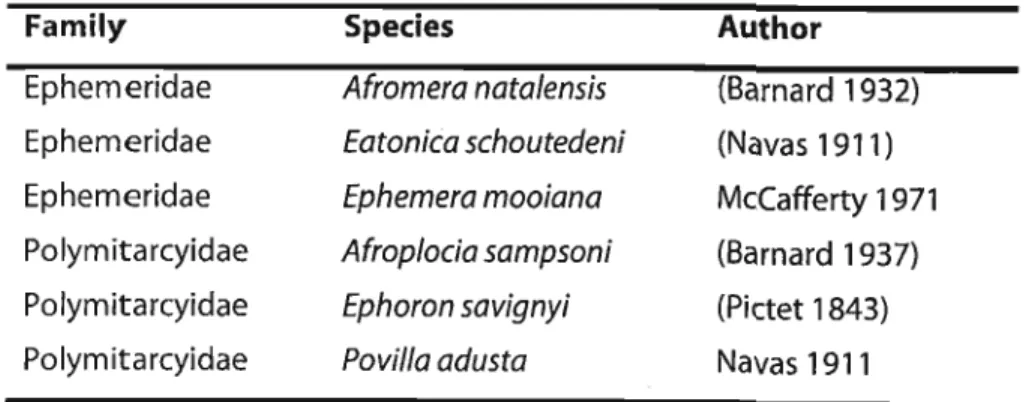
Literature research carried out in 1995 as part of these EIAs showed that a large diversity of aquatic invertebrates had been reported from the Mooi River. Surveys of the Mooirivier conducted since 1990 have only found the polymitarcyid Ephoron savignyi (PICTET 1843) and the ephemerid Afromera natalensis (BARNARD 1932) (DE MOOR 1995).
THE AIMS OF THIS PROJECT This project had three primary aims
This research project was established in 1998 to investigate topics related to the mayflies of the Mooi River prior to its closure. The proposal was to characterize the ecology of flies buried in situ in the river during field studies.
THE MAYFLIES
- Mayflies and man
However, filter feeding is particularly well documented for members of the Ephemeroidea (WALLACE&MERRITT 1980). If it is released from the top of the reservoir, the water again tends to be heated water, as in the case of a small collection.
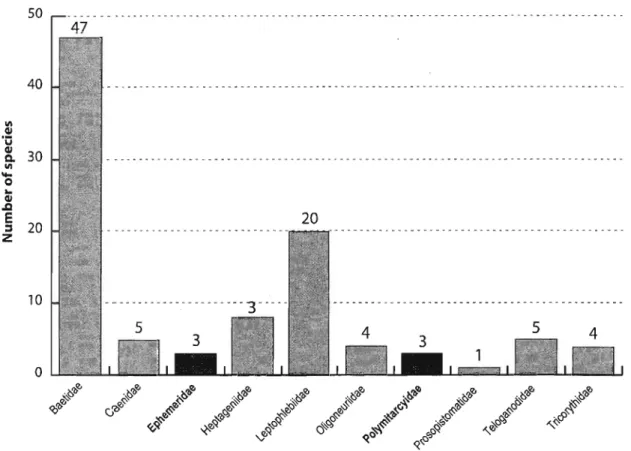
THE SUPERFAMILY EPHEMEROIDEA-THE BURROWING MAYFLIES
- Nymphs
- Adults
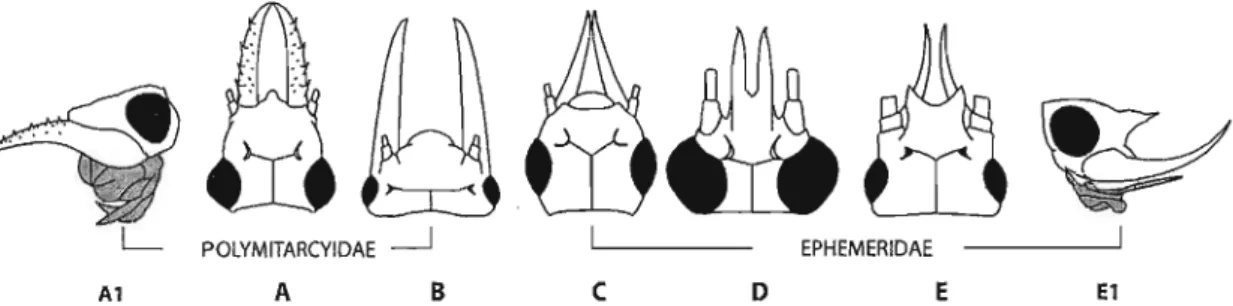
Such mayflies (for example members of the . Acanthametropodidae - not found in South Africa) are called 'psammophilic mayflies'. The tips of the tusks of the Polymitarcyidae curve downward and toward each other, but upward and away from each other in the Ephemeridae.
2 THE BURROWING MAYFLIES OF KWAZULU-NATAL;
A SYNOPSIS AND ASSESSMENT OF 19TH
INTRODUCTION
It is only relatively recently that greater stability has been introduced with the comprehensive reclassification of the group to a worldwide one. To date, no such association has been made for any of the South African representatives of this superfamily.
EPHEM EROIDEA RECORDED FROM THE MOOI AND KARKLOOF RIVERS
- Investigation of South African Ephemeroidea; methods & materials Between July 1998 and August 2000 all holdings of Afrotropical Ephemeroidea held
The data collected in this chapter have been used in the preparation of a new key to the Ephemeroidea of the Kwazulu-Natal Province presented here v . The use of Upton's stain greatly aided in tracing the wing patterns, especially on the wing perimeter.

GENERAL MORPHOLOGICAL FEATURES OF ADULT EPHEMERIDAE In the Ephemeridae the first Anal (1 sI A) vein is simple (unforked) and attached to the
FAMILY: EPHEMERIDAE-SUBFAMILY: HEXAGENIINAEj EATONICA SCHOUTEDENI (NAVAS 1911)j
The body markings are in most cases badly faded, but in the case of one of the Chad specimens a trace of the pattern indicated by MCCAFFERTY (1971) for Eatonica crassiis is visible (illustrated here in Figure 10). If MCCAFFERTY (1971) is correct in his assertion that the body pattern of Eatonica crassis differs from Eatonica schoutedeni in the W-shaped markings on the eighth and ninth tergites (Figure 10), then the majority of adults in the BMNH are in fact rather Eatonica crassi. thanEatonica schoutedeni. Only two specimens from the Republic of South Africa were cataloged (or found in the collections) in any of the museums visited.
These specimens have not been cataloged or located in any of the museums surveyed. female) from the Tahopo-Lindi basin, Belgian Congo, 1921; BEatonicasp. female) from Johannesburg, South Africa 1907; CEatonica schoutedeni (female) from Stanleyville, Belgian Congo1939; DEatonica crassi (male) from GhibeR., Ethiopia 1961. The pattern of tergite in the abdomen8 is fundamental in identifying specimens of Eatonicasp.
FAMILY: EPHEMERIDAE-SUBFAMILY: EPHEMERINAE;
In June 2000, four nymphs labeled as Eatonica schoutedeni in the BMNH collection were relabeled Ephemera mooiana at my suggestion. It is possible that the water downstream of the town of Mooi River, due to the lower elevation, is sufficiently warm enough to support a population of Afromera natalensis. It is not unreasonable to assume that Demoulin himself labeled these specimens in REI and suggested them to be representatives of the same species as envisioned by CRASS (1947).
These samples were taken in Guinea, in the region of the Fouta Djallon plateau according to the catalog.
FAMILY: EPHEMERIDAE-SUBFAMILY: EPHEMERINAE;
As part of an extensive revision of the genus Ephemera, MCCAFFERTY & EOMUNOS (1973) established a number of new subgenera. They felt that this was justified since the characters proposed as diagnostic of the genus Afromera by DEMOULIN (1955)—the male foreleg tarsi, the posterior margin of the subgenital plate, and the wing venation—were variable. The genus Afromerawas was first erected by DEMOULIN (l955) on the basis of a male raised from Elisabethville (now Lubumbashi, Democratic Republic of the Congo).
The biology of the nymph is unknown; Afromera evae is the only species of Afromer from Africa for which a nymph has been described (MCCAFFERTY& GILLIES 1979).
FAMILY EPHEMERIDAE: THE HABITAT REQUIREMENTS OF AFRICAN EPHEMERINAE
The description is based on 3 exuviae and a single nymph caught in drift nets, so the authors made no attempt to describe the biology of the species. This suggestion made some sense in light of the fact that most species of Afromera were found near the Equator. However, the Mooi River drops significantly in elevation downstream of the town of Mooi River, and this may allow enough climate change for the river to reach an average temperature high enough to support a population of Afromera natalensis.
EASTHAM (1939) suggested that this may be due to the sensitivity of the gills of this species.
GENERAL MORPHOLOGICAL FEATURES OF ADULT POLYMITARCYIDAE
He found that the gills were easily entangled by small amounts of debris and that the nymph combed the gills with the last few legs with great precision. If Ephemera mooiananimph requires a large proportion of coarse sand to find a suitable digging site, then the lack of success in finding specimens of Ephemera mooiana (or Afroplocia sampsoni) during this work is not particularly surprising - substrates with a high proportion of sand was only found on two occasions. Both sandy substrates were in the form of sand bars in the middle of the river and were almost certainly of a shifting nature and not what would be considered suitable to support a population of a large mayfly.
FAMILY: POLYMITARCYIDAE-SUBFAMILY: EXEUTHYPLOCIINAE;
Afrolocia sampsoni shares many of the morphological characteristics of the other Polymitarcyidae, especially members of the genus Exeuthyplocia. It is unknown what became of this exuvium, and no preserved specimens of the nymphs are recorded in the museums visited (although GILUES [1980) mentions having examined the exuvium at the BMNH). However, unlike Ephoron savignyi, there is no sexual dimorphism exhibited in the forelimbs of the adults.
He may also be referring to adults patterned on the wings or exuvia of nymphs floating on the surface of the water.

FAMI LV: POLYMITARCVIDAE-SUBFAMILV: POLYMITARCVINAE;
The 1871 publication presents figures of the male genitalia and transfers the species from Palingeniato Polymitarcys. None of the 13 species of Ephoronde described to date can be identified on the basis of wing plumage. Regarding Ephoron savignyiis, ULMER (1916) was the first researcher to publish a note on the high level of variation in the wing venation of the species.
As discussed in the paragraphs on Ephoron savignyia above, the current system used to identify members of the species (i.e. wing suffocation alone) is unsatisfactory.
CONCLUSIONS
Future workers should be aware that Eatonica crassi may be much more widespread than indicated in most of the available literature and its presence in South Africa should not be ruled out. The discovery of any new specimens would be of great value in understanding the taxonomy of the species and its ecological requirements. Particular attention should be paid to the morphology of the nymphs and eggs as it is these attributes that have proved most useful in characterizing other Ephoronin species in other parts of the world (in particular the USA and Japan, but also India).
A complete redescription of all life stages of the species based on specimens from Egypt would be very useful in this regard.
NGANYIKA LAKE
LAKE
KEY TO THE EPHEMEROIDEA (ADULTS) OF SOUTH AFRICA
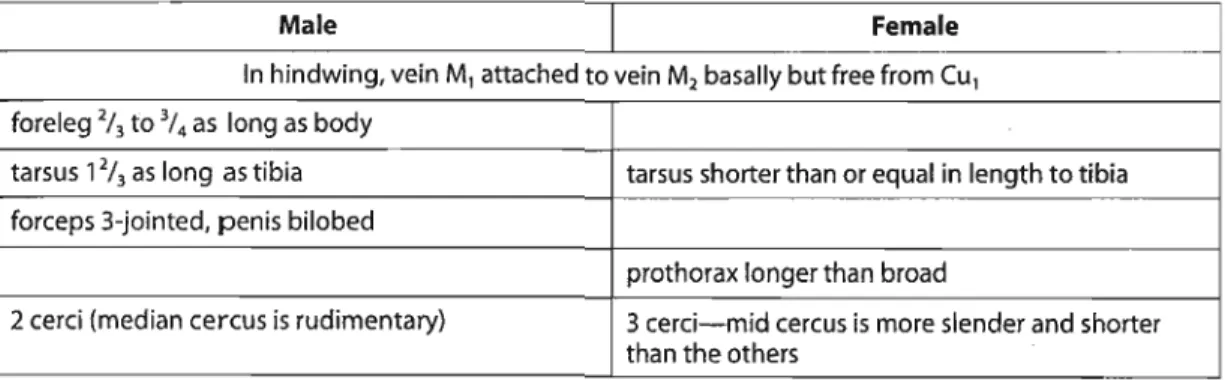
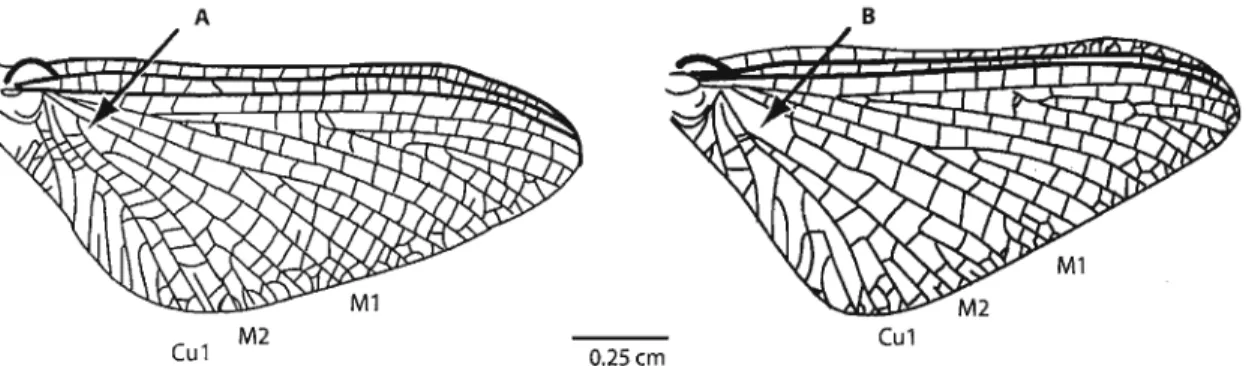
Males with long forelimbs, 4-jointed pincers; in both sexes: fork of R4+Sdistal to fork of R2+3 in the forewing; anal region of the forewing without sigmoid parallel transverse veins (Figure 14). Males with poorly developed forelimbs, pincers with I-joint; in both sexes forks of R4 + 5 and R2 + 3 at approximately the same level in the forewing; anal region of forewing with 9 sigmoid parallel cross veins (Figure 14). Males with rudimentary median caudal filament and 3-segmented genital forceps (Figure 10); females and males with vein M2or hindwings attached to vein Mr basal and free from vein CUr.
Females and males with vein M2 of hind wings not basally attached to MI and either basally free or basally attached to CUI.
3 FIELD INVESTIGATION;
CURRENT STATUS OF EPHEMEROIDEA IN THE MOOI AND KARKLOOF
CATCHMENTS
THE MODI, LITTLE MODI AND KARKLOOF RIVERS
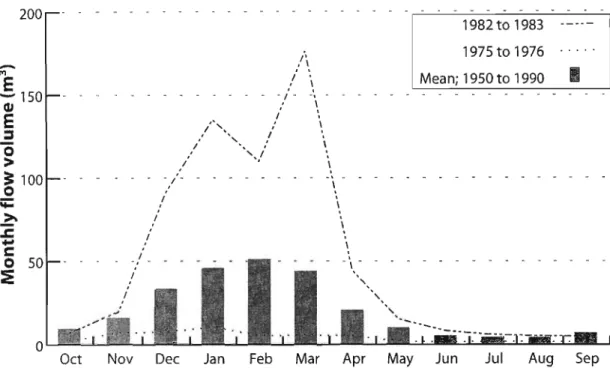
- Geology, precipitation, flow and abstraction
At this point, the river flows west through the Kamberg nature reserve and is about three meters wide. The construction of the small Mearns Weir at Edgehill Farm (EDG) affected much of the river's course from Rosetta to Mooi River. The slope of the river gradually decreases and the river flows over many smaller diabase thresholds.
Four kilometers downstream of the confluence with the Mgeni River Albert Falls Darn intercepts the river.
SELECTION OF FIELD SITES
- TYP ES OF SITES
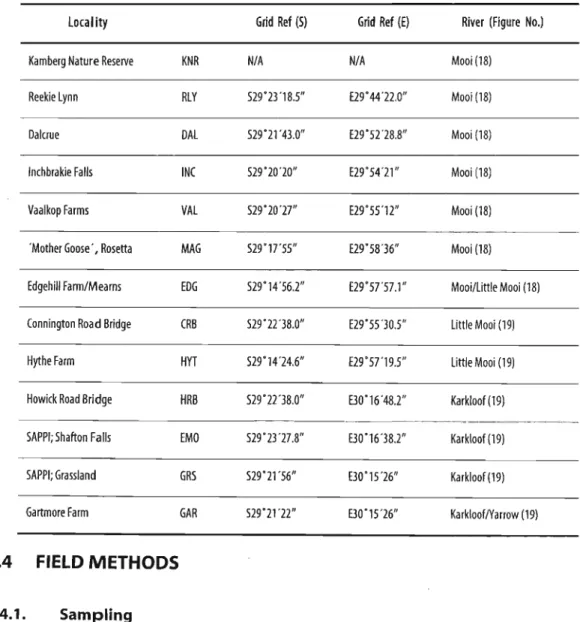
After the Yarrow confluence, the river (now known as the Karkloof River) flows along a much flatter gradient and spreads out to form. The river continues through the three sites described below (GAR, GRS, EMO) before spilling over the Karkloof Falls and on to the confluence with the Mgeni River east of Howick. This generally meant that the sites were no longer than 20 to 40 meters long, but where the river had a large number of deep pools which made surveying treacherous (for example the SAPPI grassland, [GRS Section 3.3.4.3]), the sites were longer.
The list of locations is expected to narrow as data is collected; eventually, assessments would only be conducted at sites where roaches were found.
Sites with a previous record for burrowing mayflies
Sites with anecdotal evidence of burrowing mayflies
Other sites
- FIELD METHODS
- Sampling
- RESULTS-NYMPH MATERIAL
- RESULTS-ADULT MATERIAL
- DISCUSSION
- Results of adult survey
- Conclusions
The river resumes its meandering nature and the banks of the river are mostly tree-lined. At the bottom of the hill is a small wetland (the hill is called Vaalkop; there is a second farm called 'Vaalkop' nearby). This shop in Rosetta has access to a one km stretch (approx) of the Mooi River.
The river bottom is mostly clay, although there is a section of rocky gullies west of the embankment.
A revised key to the adults of British Ephemeroptera with notes on their ecology. The importance of the egg stage for taxonomic and phylogenetic studies of ephemeroptera. ed.). Effect of water temperature on the mass occurrence of the dayworm, Ephoron shigae, in a Japanese river.
Effect of temperature and gender on growth patterns of nymphs of the mayfly Hexagenia bilineatain the laboratory.
SUPRASPECIFIC CLASSIFICATION OF RECENT EPHEMEROPTERA
MCCAFFERTY 1991A)
The following list describes the most up-to-date supraspecific classification of Recent Ephemeroidea (as proposed by MCCAFFERTY 1991a). The world distribution of subfamilies is indicated by the following attachment. Abbreviations: AF, Afrotropical; HO, Holarctic; MA, Madagascar; NA, Nearctic; NT, Neotropical; NZ, New Zealand; OR, Oriental; PA, Palaearctic; PT, Pantropical.
PERSONAL COMMUNICATIONS
Such a wide range of species is very typical of the hexageneous group of the Ephemeridae. In the sample I collected in January 1996 from the sample of graves examined, we noted that there were 400 female Ephoron savignyi and one female Afromera natalensis. De Moor was aware of the recorded location of type specimens of Ephoron savignyi from the collections of Barnard or Crass.
Newton is one of the few manufacturers that still uses the natural pigment, but it must be tinted to maintain consistent color.