Synthesis and Characterization of
Activated Sludge/Zeolite Adsorbent
for Lampung Textile Industry Wastewater Treatment
Darmansyah
1,a), Simparmin br. Ginting
1), Andri Sanjaya
1), Fadilla Soraya
1)and
Didik Supriyadi
2)1Department of Chemical Engineering, University of Lampung, Bandar Lampung, Indonesia. 2Department of Chemical Engineering, Institut Teknologi Sumatera (ITERA), South Lampung, Indonesia.
a)Corresponding author: [email protected]
Abstract.The present study reports a green synthesis method for ordered adsorbent material for Lampung Ethnic Textile Industry (LETI) wastewater treatment from activated sludge rubber industry and clipnotilolite (natural zeolite). LETI wastewater is containing about 70 mg/L of Chromium; 63,600 mg/L of COD and 36,500 mg/L of BOD. It has also high colour intensity and complex pollutants. Adsorbent can reduce Chromium heavy metal significantly. Activated sludge/zeolite adsorbent was calcined by furnace at 600oC for 15 min. It was activated by 10% wt/wt of NaOH and 1
molar of HCl. The material properties of calcined activated sludge/zeolite adsorbent was characterized by FT-IR, BET and SEM. Results showed that structure interaction processes occured between activated sludge and zeolite clipnotilolite. The BET analysis results showed that surface area, pore volume and average pore size respectively are 932 m2/gram; 0.6
cc/gram; and 258.87 Å.
Keywords: adsorbent; clipnotilolite; sludge; wastewater; zeolite
INTRODUCTION
Wastewater from industrial process especially textile industries contain many inorganic and organic contaminants such as acidic or caustic dissolve solids, toxic compounds, dyes, heavy metals [1]. Wastewater can cause serious environmental problems if it is not treated well by industries [2]. One of effective methods for minimizing the hazardous effect of wastewater effectively is adsorption method. This method is more lucrative than other conventional methods because of lower initial cost, simplicity in design, ease of operation, and no toxic [3]. The material its used for adsorption is activated carbon. Activated carbon is very useful for removing various pollutants because it has large specific surface area and pores. However, activated carbon is expensive because it must be added by other components to increase adsorptive capacity[4].
The alternative material that can be used as a resources as a resources for adsorbent is sludge from rubber industry. A large volume of sludge is generated by rubber industries every year. Sludge is a carbon-rich, renewable, low cost and vast resources [5]. Activated sludge has been proven to reduce BOD [6], heavy metal [7] and polyacrylate [8] in wastewater. The macromolecules (protein, polysaccharides, nucleic acids, humic-like substance, uronic acids and lipids) in activated sludge play important role for adsorption of heavy metal [9]. However, activated sludge has a small adsorptive capacity when it is not modified with additives because of its of low surface area. One of the solution to increase surface area of activated sludge is to mix activated sludge with zeolites. Zeolites are porous aluminosilicate minerals made from interlinked tetrahedral of alumina (AlO4) and silica (SiO4). Framework structure of zeolite is negatively charged consequently zeolites can adsorb cations such as Pb2+, Cd2+ and Cu2+[10].
MATERIALS AND METHODS
Materials
Sludge used in this study was collected from PT. Perkebunan Nusantara VII (South Lampung, Lampung). Zeolite was purchased from CV. Minatama (Bandar Lampung, Lampung) and batik dye wastewater was obtained from Lampung ethnic textile industry.
Preparation of activated solid waste
The sludge obtained was dried at 110oC for 24 h in oven. The dried sludge then sieved to particle size range 100 mesh. Activated sludge was prepared via two steps: calcination and soaking step. The calcination step did by drying dried sludge at 600oC for 15 minutes in the absence of air using a Thermolyne muffle furnace 6000. The soaking step did by soaking the calcined sample with certain volume of NaOH (100 g of calcined sample with 500 ml of NaOH (10%)) for 24 h at room temperature. After soaking step, sample was separated using Whatman filter paper. Prepared sludge was washed with distilled water till neutral filtrate and then dried at 100oC then for 6 h and finally stored in desiccator.
Preparation of Lampung Natural Zeolite
Initially, natural zeolite was grinded and separated in particle size ±100 mesh. The separated zeolite was washed and soaked with distilled water for 24 h in order to remove residue, and then dried in an oven at 100oC for 24 h. One hundred grams of natural zeolites soaked in 500 ml HCl 1 M under magnetic stirring for 3 h. The solution of activated zeolite was filtered with Whatman filter paper. The activated zeolite was then washed with distilled water in order to remove activating agent, and then placed in oven at 105oC for 3 h and kept in desiccator.
Preparation of adsorbent molding
The adsorbent was shaped in the cylindrical mold with a size 0.5 x 0.7 cm by mixing activated sludge and activated zeolite with a mass ratio (gram) 3:2, 4:1 and 5:0. Tapioca flour, clay, and sodium silica were used as a binder, each ratio used 5 gr of binder. After molding step, the adsorbent was dried in oven at 150oC for 1 h.
Characterization of adsorbent
The characterization of adsorbent was performed using different technique. The surface morphology and area of materials were performed using SEM and BET. Functional group of the materials were investigated by FT-IR.
Adsorption experiment
Where q
equilibrium Cr concentration, V(L) is the volume of dye solution, and m(g) is the adsorbent mass.
activated zeolite summarized in Table 1. The BET surface area and average pore size of activated sludge for ration of (5:0) was 768.454 m
area and average pore size was increased from 768.454 to 832.2 m
(3:2) increased more surface area and average pore size from 832.2 to 923 m
result shows that adding activated zeolite increased specific pore size of the adsorbent average size of pores, the activated sludge
are very important to adsorb ions and macromolecules
shown in F
These type of the surface are good for absorbing heavy metal ions many porous
turbidity, TSS, color and pH. Where q
equilibrium Cr concentration, V(L) is the volume of dye solution, and m(g) is the adsorbent mass.
The BET surface area, pore volume and pore size of adsorbent
activated zeolite summarized in Table 1. The BET surface area and average pore size of activated sludge for ration of (5:0) was 768.454 m
area and average pore size was increased from 768.454 to 832.2 m
(3:2) increased more surface area and average pore size from 832.2 to 923 m
sult shows that adding activated zeolite increased specific pore size of the adsorbent average size of pores, the activated sludge
are very important to adsorb ions and macromolecules
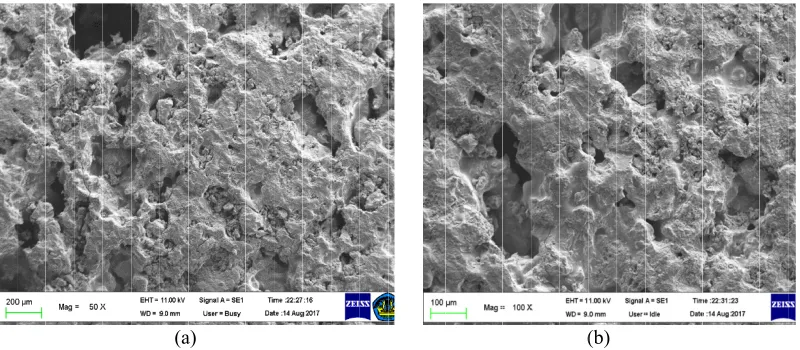
The surface morphology of the best adsorbent with ratio 3:2 was investigated by SEM. The shown in F
These type of the surface are good for absorbing heavy metal ions many porous
turbidity, TSS, color and pH. Where qe
equilibrium Cr concentration, V(L) is the volume of dye solution, and m(g) is the adsorbent mass.
The BET surface area, pore volume and pore size of adsorbent
activated zeolite summarized in Table 1. The BET surface area and average pore size of activated sludge for ration of (5:0) was 768.454 m
area and average pore size was increased from 768.454 to 832.2 m
(3:2) increased more surface area and average pore size from 832.2 to 923 m
sult shows that adding activated zeolite increased specific pore size of the adsorbent average size of pores, the activated sludge
are very important to adsorb ions and macromolecules
The surface morphology of the best adsorbent with ratio 3:2 was investigated by SEM. The shown in F
These type of the surface are good for absorbing heavy metal ions many porous
turbidity, TSS, color and pH.
e is the amount of Cr adsorbed per unit mass
equilibrium Cr concentration, V(L) is the volume of dye solution, and m(g) is the adsorbent mass.
The BET surface area, pore volume and pore size of adsorbent
activated zeolite summarized in Table 1. The BET surface area and average pore size of activated sludge for ration of (5:0) was 768.454 m
area and average pore size was increased from 768.454 to 832.2 m
(3:2) increased more surface area and average pore size from 832.2 to 923 m
sult shows that adding activated zeolite increased specific pore size of the adsorbent average size of pores, the activated sludge
are very important to adsorb ions and macromolecules
The surface morphology of the best adsorbent with ratio 3:2 was investigated by SEM. The shown in Figure
These type of the surface are good for absorbing heavy metal ions many porous
turbidity, TSS, color and pH.
is the amount of Cr adsorbed per unit mass
equilibrium Cr concentration, V(L) is the volume of dye solution, and m(g) is the adsorbent mass.
The BET surface area, pore volume and pore size of adsorbent
activated zeolite summarized in Table 1. The BET surface area and average pore size of activated sludge for ration of (5:0) was 768.454 m
area and average pore size was increased from 768.454 to 832.2 m
(3:2) increased more surface area and average pore size from 832.2 to 923 m
sult shows that adding activated zeolite increased specific pore size of the adsorbent average size of pores, the activated sludge
are very important to adsorb ions and macromolecules
The surface morphology of the best adsorbent with ratio 3:2 was investigated by SEM. The
ure 1. Images result for the SEM revealed the surface of the adsorbent is very irregular and porous. These type of the surface are good for absorbing heavy metal ions
sites provides abundant active sites for adsorbing not only Cr but also for reducing COD, BOD, turbidity, TSS, color and pH.
is the amount of Cr adsorbed per unit mass
equilibrium Cr concentration, V(L) is the volume of dye solution, and m(g) is the adsorbent mass.
The BET surface area, pore volume and pore size of adsorbent
activated zeolite summarized in Table 1. The BET surface area and average pore size of activated sludge for ration of (5:0) was 768.454 m
area and average pore size was increased from 768.454 to 832.2 m
(3:2) increased more surface area and average pore size from 832.2 to 923 m
sult shows that adding activated zeolite increased specific pore size of the adsorbent average size of pores, the activated sludge
are very important to adsorb ions and macromolecules
The surface morphology of the best adsorbent with ratio 3:2 was investigated by SEM. The
1. Images result for the SEM revealed the surface of the adsorbent is very irregular and porous. These type of the surface are good for absorbing heavy metal ions
sites provides abundant active sites for adsorbing not only Cr but also for reducing COD, BOD, turbidity, TSS, color and pH.
is the amount of Cr adsorbed per unit mass
equilibrium Cr concentration, V(L) is the volume of dye solution, and m(g) is the adsorbent mass.
The BET surface area, pore volume and pore size of adsorbent
activated zeolite summarized in Table 1. The BET surface area and average pore size of activated sludge for ration of (5:0) was 768.454 m2/g, 18.825 Å respectively. After modification with activated zeoli
area and average pore size was increased from 768.454 to 832.2 m
(3:2) increased more surface area and average pore size from 832.2 to 923 m
sult shows that adding activated zeolite increased specific pore size of the adsorbent average size of pores, the activated sludge
are very important to adsorb ions and macromolecules
Ratio
3:2 4:1 5:0
The surface morphology of the best adsorbent with ratio 3:2 was investigated by SEM. The
1. Images result for the SEM revealed the surface of the adsorbent is very irregular and porous. These type of the surface are good for absorbing heavy metal ions
sites provides abundant active sites for adsorbing not only Cr but also for reducing COD, BOD, turbidity, TSS, color and pH.
is the amount of Cr adsorbed per unit mass
equilibrium Cr concentration, V(L) is the volume of dye solution, and m(g) is the adsorbent mass.
The BET surface area, pore volume and pore size of adsorbent
activated zeolite summarized in Table 1. The BET surface area and average pore size of activated sludge for ration /g, 18.825 Å respectively. After modification with activated zeoli
area and average pore size was increased from 768.454 to 832.2 m
(3:2) increased more surface area and average pore size from 832.2 to 923 m
sult shows that adding activated zeolite increased specific pore size of the adsorbent average size of pores, the activated sludge
are very important to adsorb ions and macromolecules
Ratio
The surface morphology of the best adsorbent with ratio 3:2 was investigated by SEM. The
1. Images result for the SEM revealed the surface of the adsorbent is very irregular and porous. These type of the surface are good for absorbing heavy metal ions
sites provides abundant active sites for adsorbing not only Cr but also for reducing COD, BOD, turbidity, TSS, color and pH.
FIGURE 1.
is the amount of Cr adsorbed per unit mass
equilibrium Cr concentration, V(L) is the volume of dye solution, and m(g) is the adsorbent mass.
The BET surface area, pore volume and pore size of adsorbent
activated zeolite summarized in Table 1. The BET surface area and average pore size of activated sludge for ration /g, 18.825 Å respectively. After modification with activated zeoli
area and average pore size was increased from 768.454 to 832.2 m
(3:2) increased more surface area and average pore size from 832.2 to 923 m
sult shows that adding activated zeolite increased specific pore size of the adsorbent average size of pores, the activated sludge
are very important to adsorb ions and macromolecules
TABLE 1
The surface morphology of the best adsorbent with ratio 3:2 was investigated by SEM. The
1. Images result for the SEM revealed the surface of the adsorbent is very irregular and porous. These type of the surface are good for absorbing heavy metal ions
sites provides abundant active sites for adsorbing not only Cr but also for reducing COD, BOD, turbidity, TSS, color and pH.
FIGURE 1.
qe
is the amount of Cr adsorbed per unit mass
equilibrium Cr concentration, V(L) is the volume of dye solution, and m(g) is the adsorbent mass.
The BET surface area, pore volume and pore size of adsorbent
activated zeolite summarized in Table 1. The BET surface area and average pore size of activated sludge for ration /g, 18.825 Å respectively. After modification with activated zeoli
area and average pore size was increased from 768.454 to 832.2 m
(3:2) increased more surface area and average pore size from 832.2 to 923 m
sult shows that adding activated zeolite increased specific pore size of the adsorbent average size of pores, the activated sludge
are very important to adsorb ions and macromolecules
TABLE 1
The surface morphology of the best adsorbent with ratio 3:2 was investigated by SEM. The
1. Images result for the SEM revealed the surface of the adsorbent is very irregular and porous. These type of the surface are good for absorbing heavy metal ions
sites provides abundant active sites for adsorbing not only Cr but also for reducing COD, BOD,
(a)
FIGURE 1.
qe
is the amount of Cr adsorbed per unit mass
equilibrium Cr concentration, V(L) is the volume of dye solution, and m(g) is the adsorbent mass.
The BET surface area, pore volume and pore size of adsorbent
activated zeolite summarized in Table 1. The BET surface area and average pore size of activated sludge for ration /g, 18.825 Å respectively. After modification with activated zeoli
area and average pore size was increased from 768.454 to 832.2 m
(3:2) increased more surface area and average pore size from 832.2 to 923 m
sult shows that adding activated zeolite increased specific pore size of the adsorbent average size of pores, the activated sludge
are very important to adsorb ions and macromolecules
TABLE 1. Textural properties of activated sludge
BET specific surface area
768,454
The surface morphology of the best adsorbent with ratio 3:2 was investigated by SEM. The
1. Images result for the SEM revealed the surface of the adsorbent is very irregular and porous. These type of the surface are good for absorbing heavy metal ions
sites provides abundant active sites for adsorbing not only Cr but also for reducing COD, BOD,
(a)
FIGURE 1.
C
ois the amount of Cr adsorbed per unit mass
equilibrium Cr concentration, V(L) is the volume of dye solution, and m(g) is the adsorbent mass.
RESULT AND DISCUSSIO
The BET surface area, pore volume and pore size of adsorbent
activated zeolite summarized in Table 1. The BET surface area and average pore size of activated sludge for ration /g, 18.825 Å respectively. After modification with activated zeoli
area and average pore size was increased from 768.454 to 832.2 m
(3:2) increased more surface area and average pore size from 832.2 to 923 m
sult shows that adding activated zeolite increased specific pore size of the adsorbent average size of pores, the activated
sludge-are very important to adsorb ions and macromolecules
. Textural properties of activated sludge
BET specific surface area
The surface morphology of the best adsorbent with ratio 3:2 was investigated by SEM. The
1. Images result for the SEM revealed the surface of the adsorbent is very irregular and porous. These type of the surface are good for absorbing heavy metal ions
sites provides abundant active sites for adsorbing not only Cr but also for reducing COD, BOD,
SEM images of adsorbent with ratio 3:2 (a) 50 X (b) 100 X
m
o
is the amount of Cr adsorbed per unit mass
equilibrium Cr concentration, V(L) is the volume of dye solution, and m(g) is the adsorbent mass.
RESULT AND DISCUSSIO
The BET surface area, pore volume and pore size of adsorbent
activated zeolite summarized in Table 1. The BET surface area and average pore size of activated sludge for ration /g, 18.825 Å respectively. After modification with activated zeoli
area and average pore size was increased from 768.454 to 832.2 m
(3:2) increased more surface area and average pore size from 832.2 to 923 m
sult shows that adding activated zeolite increased specific pore size of the adsorbent
-zeolite adsorbent consists of many mesoporous sites. These type of pores are very important to adsorb ions and macromolecules
. Textural properties of activated sludge
BET specific surface area
The surface morphology of the best adsorbent with ratio 3:2 was investigated by SEM. The
1. Images result for the SEM revealed the surface of the adsorbent is very irregular and porous. These type of the surface are good for absorbing heavy metal ions
sites provides abundant active sites for adsorbing not only Cr but also for reducing COD, BOD,
SEM images of adsorbent with ratio 3:2 (a) 50 X (b) 100 X
m
C
eis the amount of Cr adsorbed per unit mass
equilibrium Cr concentration, V(L) is the volume of dye solution, and m(g) is the adsorbent mass.
RESULT AND DISCUSSIO
BET surface area
The BET surface area, pore volume and pore size of adsorbent
activated zeolite summarized in Table 1. The BET surface area and average pore size of activated sludge for ration /g, 18.825 Å respectively. After modification with activated zeoli
area and average pore size was increased from 768.454 to 832.2 m
(3:2) increased more surface area and average pore size from 832.2 to 923 m
sult shows that adding activated zeolite increased specific pore size of the adsorbent
zeolite adsorbent consists of many mesoporous sites. These type of pores are very important to adsorb ions and macromolecules
. Textural properties of activated sludge
BET specific surface area
The surface morphology of the best adsorbent with ratio 3:2 was investigated by SEM. The
1. Images result for the SEM revealed the surface of the adsorbent is very irregular and porous. These type of the surface are good for absorbing heavy metal ions
sites provides abundant active sites for adsorbing not only Cr but also for reducing COD, BOD,
SEM images of adsorbent with ratio 3:2 (a) 50 X (b) 100 X
V
is the amount of Cr adsorbed per unit mass
equilibrium Cr concentration, V(L) is the volume of dye solution, and m(g) is the adsorbent mass.
RESULT AND DISCUSSIO
BET surface area
The BET surface area, pore volume and pore size of adsorbent
activated zeolite summarized in Table 1. The BET surface area and average pore size of activated sludge for ration /g, 18.825 Å respectively. After modification with activated zeoli
area and average pore size was increased from 768.454 to 832.2 m
(3:2) increased more surface area and average pore size from 832.2 to 923 m
sult shows that adding activated zeolite increased specific pore size of the adsorbent
zeolite adsorbent consists of many mesoporous sites. These type of pores are very important to adsorb ions and macromolecules
. Textural properties of activated sludge
BET specific surface area
Morphology
The surface morphology of the best adsorbent with ratio 3:2 was investigated by SEM. The
1. Images result for the SEM revealed the surface of the adsorbent is very irregular and porous. These type of the surface are good for absorbing heavy metal ions
sites provides abundant active sites for adsorbing not only Cr but also for reducing COD, BOD,
SEM images of adsorbent with ratio 3:2 (a) 50 X (b) 100 X
V
is the amount of Cr adsorbed per unit mass
equilibrium Cr concentration, V(L) is the volume of dye solution, and m(g) is the adsorbent mass.
RESULT AND DISCUSSIO
BET surface area
The BET surface area, pore volume and pore size of adsorbent
activated zeolite summarized in Table 1. The BET surface area and average pore size of activated sludge for ration /g, 18.825 Å respectively. After modification with activated zeoli
area and average pore size was increased from 768.454 to 832.2 m
(3:2) increased more surface area and average pore size from 832.2 to 923 m
sult shows that adding activated zeolite increased specific pore size of the adsorbent
zeolite adsorbent consists of many mesoporous sites. These type of pores are very important to adsorb ions and macromolecules [1
. Textural properties of activated sludge
BET specific surface area
Morphology
The surface morphology of the best adsorbent with ratio 3:2 was investigated by SEM. The
1. Images result for the SEM revealed the surface of the adsorbent is very irregular and porous. These type of the surface are good for absorbing heavy metal ions
sites provides abundant active sites for adsorbing not only Cr but also for reducing COD, BOD,
SEM images of adsorbent with ratio 3:2 (a) 50 X (b) 100 X
is the amount of Cr adsorbed per unit mass of adsorbent (mg/g), Co and Ce (mg/l) are initial and equilibrium Cr concentration, V(L) is the volume of dye solution, and m(g) is the adsorbent mass.
RESULT AND DISCUSSIO
BET surface area
The BET surface area, pore volume and pore size of adsorbent
activated zeolite summarized in Table 1. The BET surface area and average pore size of activated sludge for ration /g, 18.825 Å respectively. After modification with activated zeoli
area and average pore size was increased from 768.454 to 832.2 m
(3:2) increased more surface area and average pore size from 832.2 to 923 m
sult shows that adding activated zeolite increased specific pore size of the adsorbent
zeolite adsorbent consists of many mesoporous sites. These type of pores [12].
. Textural properties of activated sludge
BET specific surface area Pore size (Å)
258,872 128,32 18,825
Morphology
The surface morphology of the best adsorbent with ratio 3:2 was investigated by SEM. The
1. Images result for the SEM revealed the surface of the adsorbent is very irregular and porous. These type of the surface are good for absorbing heavy metal ions
sites provides abundant active sites for adsorbing not only Cr but also for reducing COD, BOD,
SEM images of adsorbent with ratio 3:2 (a) 50 X (b) 100 X
of adsorbent (mg/g), Co and Ce (mg/l) are initial and equilibrium Cr concentration, V(L) is the volume of dye solution, and m(g) is the adsorbent mass.
RESULT AND DISCUSSIO
BET surface area
The BET surface area, pore volume and pore size of adsorbent
activated zeolite summarized in Table 1. The BET surface area and average pore size of activated sludge for ration /g, 18.825 Å respectively. After modification with activated zeoli
area and average pore size was increased from 768.454 to 832.2 m
(3:2) increased more surface area and average pore size from 832.2 to 923 m
sult shows that adding activated zeolite increased specific pore size of the adsorbent
zeolite adsorbent consists of many mesoporous sites. These type of pores
. Textural properties of activated sludge
Pore size (Å)
258,872 128,32 18,825
Morphology
The surface morphology of the best adsorbent with ratio 3:2 was investigated by SEM. The
1. Images result for the SEM revealed the surface of the adsorbent is very irregular and porous. These type of the surface are good for absorbing heavy metal ions
sites provides abundant active sites for adsorbing not only Cr but also for reducing COD, BOD,
SEM images of adsorbent with ratio 3:2 (a) 50 X (b) 100 X
of adsorbent (mg/g), Co and Ce (mg/l) are initial and equilibrium Cr concentration, V(L) is the volume of dye solution, and m(g) is the adsorbent mass.
RESULT AND DISCUSSIO
BET surface area
The BET surface area, pore volume and pore size of adsorbent with different ratio between activated sludge and activated zeolite summarized in Table 1. The BET surface area and average pore size of activated sludge for ration
/g, 18.825 Å respectively. After modification with activated zeoli area and average pore size was increased from 768.454 to 832.2 m2
(3:2) increased more surface area and average pore size from 832.2 to 923 m
sult shows that adding activated zeolite increased specific pore size of the adsorbent
zeolite adsorbent consists of many mesoporous sites. These type of pores
. Textural properties of activated sludge
Pore size (Å)
258,872 128,32 18,825
Morphology
The surface morphology of the best adsorbent with ratio 3:2 was investigated by SEM. The
1. Images result for the SEM revealed the surface of the adsorbent is very irregular and porous. These type of the surface are good for absorbing heavy metal ions
sites provides abundant active sites for adsorbing not only Cr but also for reducing COD, BOD,
SEM images of adsorbent with ratio 3:2 (a) 50 X (b) 100 X
of adsorbent (mg/g), Co and Ce (mg/l) are initial and equilibrium Cr concentration, V(L) is the volume of dye solution, and m(g) is the adsorbent mass.
RESULT AND DISCUSSIO
BET surface area
with different ratio between activated sludge and activated zeolite summarized in Table 1. The BET surface area and average pore size of activated sludge for ration
/g, 18.825 Å respectively. After modification with activated zeoli
2/g and 18.825 to 128.32 Å. Adding more zeolite (3:2) increased more surface area and average pore size from 832.2 to 923 m
sult shows that adding activated zeolite increased specific pore size of the adsorbent
zeolite adsorbent consists of many mesoporous sites. These type of pores
. Textural properties of activated sludge
Pore size (Å)
258,872
The surface morphology of the best adsorbent with ratio 3:2 was investigated by SEM. The
1. Images result for the SEM revealed the surface of the adsorbent is very irregular and porous. These type of the surface are good for absorbing heavy metal ions [4][
sites provides abundant active sites for adsorbing not only Cr but also for reducing COD, BOD,
SEM images of adsorbent with ratio 3:2 (a) 50 X (b) 100 X
of adsorbent (mg/g), Co and Ce (mg/l) are initial and equilibrium Cr concentration, V(L) is the volume of dye solution, and m(g) is the adsorbent mass.
RESULT AND DISCUSSIO
with different ratio between activated sludge and activated zeolite summarized in Table 1. The BET surface area and average pore size of activated sludge for ration
/g, 18.825 Å respectively. After modification with activated zeoli
/g and 18.825 to 128.32 Å. Adding more zeolite (3:2) increased more surface area and average pore size from 832.2 to 923 m
sult shows that adding activated zeolite increased specific pore size of the adsorbent
zeolite adsorbent consists of many mesoporous sites. These type of pores
. Textural properties of activated sludge
Pore size (Å)
The surface morphology of the best adsorbent with ratio 3:2 was investigated by SEM. The
1. Images result for the SEM revealed the surface of the adsorbent is very irregular and porous. [10]
sites provides abundant active sites for adsorbing not only Cr but also for reducing COD, BOD,
SEM images of adsorbent with ratio 3:2 (a) 50 X (b) 100 X
of adsorbent (mg/g), Co and Ce (mg/l) are initial and equilibrium Cr concentration, V(L) is the volume of dye solution, and m(g) is the adsorbent mass.
RESULT AND DISCUSSION
with different ratio between activated sludge and activated zeolite summarized in Table 1. The BET surface area and average pore size of activated sludge for ration
/g, 18.825 Å respectively. After modification with activated zeoli
/g and 18.825 to 128.32 Å. Adding more zeolite (3:2) increased more surface area and average pore size from 832.2 to 923 m2/g and 128.32 to 258.872 Å. From this
sult shows that adding activated zeolite increased specific pore size of the adsorbent
zeolite adsorbent consists of many mesoporous sites. These type of pores
. Textural properties of activated sludge-zeolite adsorbent.
(cm
The surface morphology of the best adsorbent with ratio 3:2 was investigated by SEM. The
1. Images result for the SEM revealed the surface of the adsorbent is very irregular and porous. ]. These images also can be deduced that sites provides abundant active sites for adsorbing not only Cr but also for reducing COD, BOD,
SEM images of adsorbent with ratio 3:2 (a) 50 X (b) 100 X
of adsorbent (mg/g), Co and Ce (mg/l) are initial and equilibrium Cr concentration, V(L) is the volume of dye solution, and m(g) is the adsorbent mass.
with different ratio between activated sludge and activated zeolite summarized in Table 1. The BET surface area and average pore size of activated sludge for ration
/g, 18.825 Å respectively. After modification with activated zeoli
/g and 18.825 to 128.32 Å. Adding more zeolite /g and 128.32 to 258.872 Å. From this sult shows that adding activated zeolite increased specific pore size of the adsorbent
zeolite adsorbent consists of many mesoporous sites. These type of pores
zeolite adsorbent.
The surface morphology of the best adsorbent with ratio 3:2 was investigated by SEM. The
1. Images result for the SEM revealed the surface of the adsorbent is very irregular and porous. . These images also can be deduced that sites provides abundant active sites for adsorbing not only Cr but also for reducing COD, BOD,
SEM images of adsorbent with ratio 3:2 (a) 50 X (b) 100 X
of adsorbent (mg/g), Co and Ce (mg/l) are initial and equilibrium Cr concentration, V(L) is the volume of dye solution, and m(g) is the adsorbent mass.
with different ratio between activated sludge and activated zeolite summarized in Table 1. The BET surface area and average pore size of activated sludge for ration
/g, 18.825 Å respectively. After modification with activated zeoli
/g and 18.825 to 128.32 Å. Adding more zeolite /g and 128.32 to 258.872 Å. From this sult shows that adding activated zeolite increased specific pore size of the adsorbent
zeolite adsorbent consists of many mesoporous sites. These type of pores
zeolite adsorbent.
The surface morphology of the best adsorbent with ratio 3:2 was investigated by SEM. The
1. Images result for the SEM revealed the surface of the adsorbent is very irregular and porous. . These images also can be deduced that sites provides abundant active sites for adsorbing not only Cr but also for reducing COD, BOD,
(b)
SEM images of adsorbent with ratio 3:2 (a) 50 X (b) 100 X
of adsorbent (mg/g), Co and Ce (mg/l) are initial and equilibrium Cr concentration, V(L) is the volume of dye solution, and m(g) is the adsorbent mass.
with different ratio between activated sludge and activated zeolite summarized in Table 1. The BET surface area and average pore size of activated sludge for ration
/g, 18.825 Å respectively. After modification with activated zeoli
/g and 18.825 to 128.32 Å. Adding more zeolite /g and 128.32 to 258.872 Å. From this sult shows that adding activated zeolite increased specific pore size of the adsorbent
zeolite adsorbent consists of many mesoporous sites. These type of pores
zeolite adsorbent.
Pore volume
The surface morphology of the best adsorbent with ratio 3:2 was investigated by SEM. The
1. Images result for the SEM revealed the surface of the adsorbent is very irregular and porous. . These images also can be deduced that sites provides abundant active sites for adsorbing not only Cr but also for reducing COD, BOD,
(b)
SEM images of adsorbent with ratio 3:2 (a) 50 X (b) 100 X
of adsorbent (mg/g), Co and Ce (mg/l) are initial and equilibrium Cr concentration, V(L) is the volume of dye solution, and m(g) is the adsorbent mass.
with different ratio between activated sludge and activated zeolite summarized in Table 1. The BET surface area and average pore size of activated sludge for ration /g, 18.825 Å respectively. After modification with activated zeolite (4:1), the BET surface /g and 18.825 to 128.32 Å. Adding more zeolite /g and 128.32 to 258.872 Å. From this sult shows that adding activated zeolite increased specific pore size of the adsorbent [1
zeolite adsorbent consists of many mesoporous sites. These type of pores
zeolite adsorbent.
Pore volume
The surface morphology of the best adsorbent with ratio 3:2 was investigated by SEM. The
1. Images result for the SEM revealed the surface of the adsorbent is very irregular and porous. . These images also can be deduced that sites provides abundant active sites for adsorbing not only Cr but also for reducing COD, BOD,
SEM images of adsorbent with ratio 3:2 (a) 50 X (b) 100 X
of adsorbent (mg/g), Co and Ce (mg/l) are initial and equilibrium Cr concentration, V(L) is the volume of dye solution, and m(g) is the adsorbent mass.
with different ratio between activated sludge and activated zeolite summarized in Table 1. The BET surface area and average pore size of activated sludge for ration te (4:1), the BET surface /g and 18.825 to 128.32 Å. Adding more zeolite /g and 128.32 to 258.872 Å. From this
[11]
zeolite adsorbent consists of many mesoporous sites. These type of pores
Pore volume
The surface morphology of the best adsorbent with ratio 3:2 was investigated by SEM. The
1. Images result for the SEM revealed the surface of the adsorbent is very irregular and porous. . These images also can be deduced that sites provides abundant active sites for adsorbing not only Cr but also for reducing COD, BOD,
SEM images of adsorbent with ratio 3:2 (a) 50 X (b) 100 X
of adsorbent (mg/g), Co and Ce (mg/l) are initial and equilibrium Cr concentration, V(L) is the volume of dye solution, and m(g) is the adsorbent mass.
with different ratio between activated sludge and activated zeolite summarized in Table 1. The BET surface area and average pore size of activated sludge for ration te (4:1), the BET surface /g and 18.825 to 128.32 Å. Adding more zeolite /g and 128.32 to 258.872 Å. From this
]. Acc
zeolite adsorbent consists of many mesoporous sites. These type of pores
Pore volume
The surface morphology of the best adsorbent with ratio 3:2 was investigated by SEM. The images of SEM is 1. Images result for the SEM revealed the surface of the adsorbent is very irregular and porous.
. These images also can be deduced that sites provides abundant active sites for adsorbing not only Cr but also for reducing COD, BOD, of adsorbent (mg/g), Co and Ce (mg/l) are initial and
with different ratio between activated sludge and activated zeolite summarized in Table 1. The BET surface area and average pore size of activated sludge for ration te (4:1), the BET surface /g and 18.825 to 128.32 Å. Adding more zeolite /g and 128.32 to 258.872 Å. From this . According to the zeolite adsorbent consists of many mesoporous sites. These type of pores
images of SEM is 1. Images result for the SEM revealed the surface of the adsorbent is very irregular and porous.
. These images also can be deduced that sites provides abundant active sites for adsorbing not only Cr but also for reducing COD, BOD, of adsorbent (mg/g), Co and Ce (mg/l) are initial and
with different ratio between activated sludge and activated zeolite summarized in Table 1. The BET surface area and average pore size of activated sludge for ration te (4:1), the BET surface /g and 18.825 to 128.32 Å. Adding more zeolite /g and 128.32 to 258.872 Å. From this ording to the zeolite adsorbent consists of many mesoporous sites. These type of pores
images of SEM is 1. Images result for the SEM revealed the surface of the adsorbent is very irregular and porous.
. These images also can be deduced that sites provides abundant active sites for adsorbing not only Cr but also for reducing COD, BOD, of adsorbent (mg/g), Co and Ce (mg/l) are initial and
with different ratio between activated sludge and activated zeolite summarized in Table 1. The BET surface area and average pore size of activated sludge for ration te (4:1), the BET surface /g and 18.825 to 128.32 Å. Adding more zeolite /g and 128.32 to 258.872 Å. From this ording to the zeolite adsorbent consists of many mesoporous sites. These type of pores
images of SEM is 1. Images result for the SEM revealed the surface of the adsorbent is very irregular and porous.
. These images also can be deduced that sites provides abundant active sites for adsorbing not only Cr but also for reducing COD, BOD,
(1)
of adsorbent (mg/g), Co and Ce (mg/l) are initial and
with different ratio between activated sludge and activated zeolite summarized in Table 1. The BET surface area and average pore size of activated sludge for ration te (4:1), the BET surface /g and 18.825 to 128.32 Å. Adding more zeolite /g and 128.32 to 258.872 Å. From this ording to the zeolite adsorbent consists of many mesoporous sites. These type of pores
images of SEM is 1. Images result for the SEM revealed the surface of the adsorbent is very irregular and porous.
. These images also can be deduced that sites provides abundant active sites for adsorbing not only Cr but also for reducing COD, BOD,
(1)
of adsorbent (mg/g), Co and Ce (mg/l) are initial and
with different ratio between activated sludge and activated zeolite summarized in Table 1. The BET surface area and average pore size of activated sludge for ration te (4:1), the BET surface /g and 18.825 to 128.32 Å. Adding more zeolite /g and 128.32 to 258.872 Å. From this ording to the zeolite adsorbent consists of many mesoporous sites. These type of pores
images of SEM is 1. Images result for the SEM revealed the surface of the adsorbent is very irregular and porous.
Chemical surface characterization
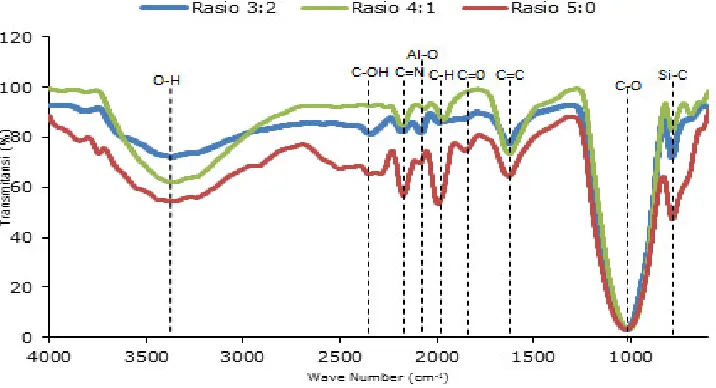
The FT-IR spectra (4000-600 cm-1) of activated sludge-zeolite adsorbents with varied ratio were shown in Fig. 2. According to the result, activated sludge-zeolite adsorbent at ratio 5:0 has lower peak compared to adsorbent at ratio 4:1 and 3:2 for the peak around 3360-3370 cm-1. The band at 3000 to 3500 cm-1 indicates the presence O-H group [4]. Ratio 4:1 showed the small peak at absorption band between 2900 and 2800 cm-1 however at ratio 3:2 and 5:0, it did not show the peak. The band at 2922 and 2850 cm-1 are stretch of alkyl C-H [13], which indicates waxes [14]. Additionally, another peaks appeared at ratio 3:2 and 5:0 at the band between 1670 to 1740 cm-1 but it did not appear at ratio 4:1. The peak’s band at 1680 to 1740 cm-1 is assigned to C=O carbonyl groups and band at 1670 cm -1 indicates carboxylic groups. All the ratio of the adsorbents have a small peaks at the broadband at around 1500 to 1600 cm-1 which is indicated the absence of carboxylic group and NH. The presence of carboxyl group indicated that adsorbents have the highest capacity to adsorb heavy metal [3]. C-O-C group stretches from 1070 to 1010 cm-1 and it indicates polysaccharide [15] while C-O stretches at 1029 cm-1[14]. These bands appeared at all the ratio of adsorbent. The band from 700 – 800 cm-1 can be assigned as Si-C group [10]. Adsorbent at ratio 3:2 has more Si-C group than the other ratio, which can be shown from the band at 786.47 cm-1. For ratio 4:1 and 5:0 the bands are at 783.74 and 783.92 cm-1. The height of the peak at ratio 3:2 is linear with adding more zeolite in the mixture of adsorbent.
FIGURE 2. FT-IR spectra of activated sludge-zeolite adsorbent
Effect of adsorbent dose and contact time
To determine adsorption capacity and the contact time of activated sludge-zeolite adsorbent to adsorb heavy metal, experiment was conducted by putting the adsorbent with ratio 3:2 in dye solution with initial concentration of Cr at 70 mg/l. The removal efficiency was calculated by increasing the mass of adsorbent during the experiment. The result is shown in Figure 3 (a). The removal efficiency of Cr were 99.1, 85.1, and 56.5% in the adsorbent amount by 20, 15 and 10 g. The increasing of adsorption percentage is equivalent with the increasing the mass of activated sludge–zeolite adsorbent because the increase of specific surface area and functional group of adsorbents is increased too.
[16]. The difference between this result and previous result can be caused by the characteristic of the adsorbent and specific surface area of the adsorbent.
FIGURE 3. Effect of (a) adsorbent dose and (b) contact time
Adsorption of dye solution
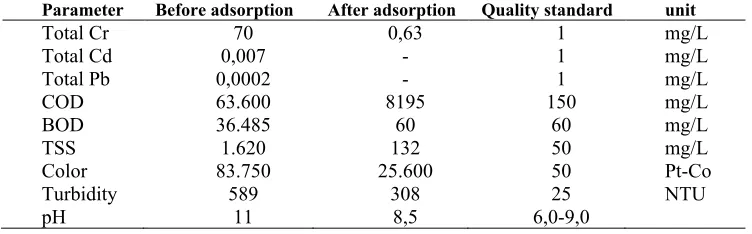
Adsorption experiment was conducted by contacting activated sludge-zeolite adsorbent at ratio 3:2 with dye solution from Lampung ethnic textile industry. The results of adsorption of dye solution is shown in Table 2. Based on the result, activated sludge-zeolite adsorbent was able to reduce waste parameters form dye solution below the quality standard but some parameters (COD, BOD, turbidity, color, pH and TSS) was still above the quality standard. One of parameter which successfully decreased was Cr concentration. Activated sludge-zeolite adsorbent reduced Cr concentration from 70 to 0.63 mg/L. Equilibrium adsorption of adsorbent was 0.346 mg/g. Despite the maximum adsorption capacity of heavy metal by activated sludge-zeolite was still lower than with modified Peganum harmala seed (53.48 mg/g) [16] and activated sludge for removing polyacrylate (399, 434 and 454 mg/g) [8], the result of reduction the concentration of heavy metal after adsorption was below the environmental quality standard (1 mg/L). Activated sludge-zeolite adsorbent also could reduce the other parameters of dye solution such as COD, BOD, turbidity, color, pH and TSS, however, the result of reduction were still above the environmental quality standard.
TABLE 2. Adsorption of dye solution with activated sludge-zeolite ratio 3:2
Parameter Before adsorption After adsorption Quality standard unit
Total Cr 70 0,63 1 mg/L
Total Cd 0,007 - 1 mg/L
Total Pb 0,0002 - 1 mg/L
COD 63.600 8195 150 mg/L
BOD 36.485 60 60 mg/L
TSS 1.620 132 50 mg/L
Color 83.750 25.600 50 Pt-Co
Turbidity 589 308 25 NTU
pH 11 8,5 6,0-9,0
0.0 10.0 20.0 30.0 40.0 50.0 60.0 70.0 80.0 90.0 100.0
0 5 10 15 20
Ad
so
rpti
on
(%)
Adsorbent dose (g) (a)
0 0.05 0.1 0.15 0.2 0.25 0.3 0.35 0.4
0 30 60 90 120 150 180
Cr
ads
or
bed (m
g/
g)
Adsorption kinetics
Kinetic models of pseudo–first order and pseudo-second order were applied to investigate kinetic of Cr onto activated sludge-zeolite adsorbent.
Pseudo-first order model is
kt
e
t
q
e
q
1
1 (2)Pseudo-second order model is
t
q
k
t
q
k
q
e e t
2 2 2
1
(3)Where qe (mg/g) is the equilibrium adsorption amount of Cr, qt (mg/g) is the adsorption amount of Cr at time t, k1 (1/min) and k2 (g/(mg.min)) are the constants of pseudo-first order and pseudo-second order.
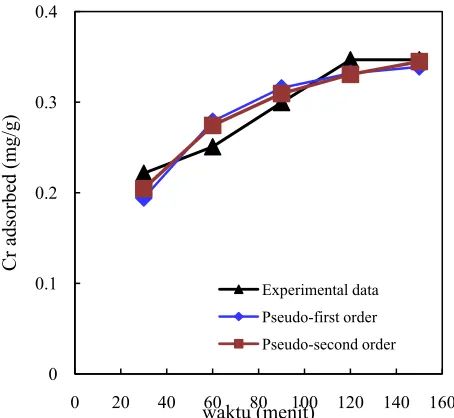
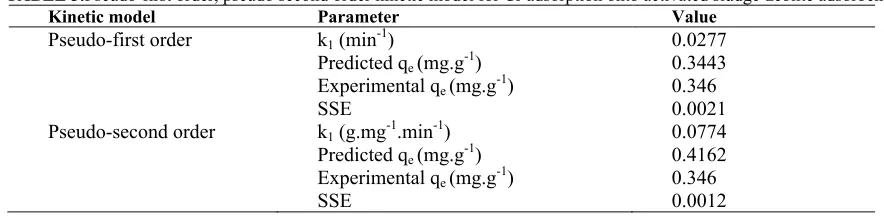
These models were used to fit experimental data and the results are shown in Figure 4 and Table 3. From the results, the pseudo-first order sum square error (SSE) was 0.0021, whereas the pseudo-second order SSE was 0.0012. For this calculation shows that experimental data is compliance with the pseudo-second model in terms of lower SSE. However predicted qe from the pseudo-first model were more consistent with qe from experiment than qe calculation from the pseudo-second order. The pseudo-first order model describes a physical adsorption of Cr in dye solution onto activated sludge-zeolite adsorbent. The previous research shows that adsorption of textile dye kinetic model onto coconut shell activated carbon was consistent with pseudo-first order model in terms of consistency between calculated qe and experimental qe[1]. The other research found that adsorption of chromium was better to modeled with the pseudo-first order [17].
FIGURE 4. Pseudo-first order and pseudo-second order kinetic model 0
0.1 0.2 0.3 0.4
0 20 40 60 80 100 120 140 160
Cr ads
orb
ed
(mg
/g
)
waktu (menit)
TABLE 3.Pseudo-first order, pseudo second order kinetic model for Cr adsorption onto activated sludge-zeolite adsorbent.
Kinetic model Parameter Value
Pseudo-first order k1 (min-1) 0.0277
Predicted qe (mg.g-1) 0.3443 Experimental qe (mg.g-1) 0.346
SSE 0.0021
Pseudo-second order k1 (g.mg-1.min-1) 0.0774
Predicted qe (mg.g-1) 0.4162 Experimental qe (mg.g-1) 0.346
SSE 0.0012
Adsorption isotherms
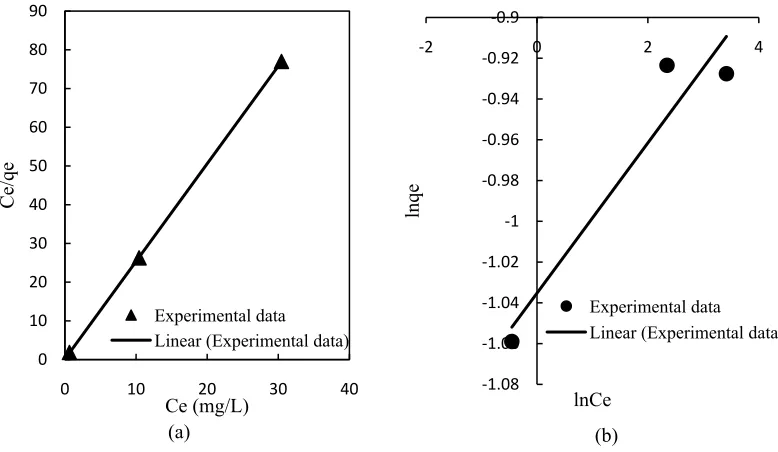
The adsorption isotherm shows how the adsorbate interact with the adsorbent [18]. The interaction can be modeled using Langmuir and Freundlich. The linier form of these equations are as follow:
Langmuir
max max
1
q
C
K
q
q
C
eL e
e
(4)Freundlich
e
F
C
en
K
q
ln
1
ln
ln
(5)Where qe is the amount of Cr adsorbed on the adsorbent (mg/g) at equilibrium, Ce the equilibrium of Cr in solution (mg/L), qmax the maximum adsorption amount for the adsorbent (mg/g), KL Langmuir adsorption constant (L/mg), while KF and n are Freundlich adsorption constants.
The Langmuir isotherm model has the essential characteristic to expresses adsorption process. It is called as the Langmuir equilibrium parameter RL, RL equation is as follow:
1
0
1
C
K
R
L
L
(6)
Where RL indicates the isotherms to be unfavorable (RL>1), linier (RL=1), favorable (0<RL<1) or irreversible (RL=0) [18].
(a) (b)
FIGURE 5. The Langmuir (a) and The Freundlich (b) adsorption isotherm
TABLE 4. Isotherm parameter coefficient for adsorption of Cr in dye solution onto activated sludge-zeolite adsorbent.
Isotherm parameters value
Langmuir
qmax (mg/g) 0.3964
KL (L/mg) 21.5256
R2 1
RL 0.000663
Freundlich
KF (L/g) 0.3553
n 27.1
R2 0.9137
CONCLUSIONS
Adsorbent from mixing activated sludge from rubber industry and activated zeolite has been successfully in removing Cr in dye solution waste from Lampung ethnic textile industry. Another waste parameters was also reduced but still above the environmental quality standard. The highest value of BET surface area and pore diameter are obtained from ratio 3:2 (activated sludge and zeolite). The value of BET surface area, pore diameter and pore volume from adsorbent with ratio 3:2 are 923 m2/g, 258.872 Å and 0.6 cm3/g respectively. FT-IR results show that adsorbent with ratio 3:2 contains carboxyl group which has capacity to absorb heavy metal. The result of adsorption experiment showed that activated sludge-zeolite adsorbent could remove Cr contained in dye solution in about 99.1% within 120 min. Kinetic data followed the pseudo-first order kinetic model with k1 is 0.0277 min-1. The Langmuir adsorption isotherm model is fitted well to the experimental data with predicted qmax is 0.3964 mg/g.
0 10 20 30 40 50 60 70 80 90
0 10 20 30 40
Ce/q
e
Ce (mg/L)
Experimental data Linear (Experimental data)
-1.08 -1.06 -1.04 -1.02 -1 -0.98 -0.96 -0.94 -0.92 -0.9
-2 0 2 4
ln
qe
lnCe
REFERENCES
1. A. M. Aljeboree, A. N. Alshirifi, and A. F. Alkaim, “Kinetics and equilibrium study for the adsorption of textile dyes on coconut shell activated carbon,” Arab. J. Chem., vol. 10, pp. S3381–S3393, 2017.
2. Darmansyah, Hens Saputra, Simparmin br. G., Lisa Ardiana, “Synthesis and characterization of MCM-41 from coal fly ash for tapioca wastewater teratment, ” ARPN J. Eng. and App. Sci., vol. 11, pp. 4772-4777, 2016. 3. Y. Kismir and A. Z. Aroguz, “Adsorption characteristics of the hazardous dye Brilliant Green on Saklıkent
mud,” vol. 172, pp. 199–206, 2011.
4. S. Y. Lee and H. J. Choi, “Persimmon leaf bio-waste for adsorptive removal of heavy metals from aqueous solution,” J. Environ. Manage., vol. 209, pp. 382–392, 2018.
5. K. Björklund and L. Y. Li, “Adsorption of organic stormwater pollutants onto activated carbon from sewage sludge,” J. Environ. Manage., vol. 197, pp. 490–497, 2017.
6. M. I. Hossain, A. Paparini, and R. Cord-Ruwisch, “Rapid adaptation of activated sludge bacteria into a glycogen accumulating biofilm enabling anaerobic BOD uptake,” Bioresour. Technol., vol. 228, pp. 1–8, 2017. 7. Y. Zhou, Z. Zhang, J. Zhang, and S. Xia, “Understanding key constituents and feature of the biopolymer in
activated sludge responsible for binding heavy metals,” Chem. Eng. J., vol. 304, pp. 527–532, 2016.
8. X. Zhao, J. Ma, H. Ma, D. Gao, Y. Sun, and C. Guo, “Removal of polyacrylate in aqueous solution by activated sludge: Characteristics and mechanisms,” J. Clean. Prod., vol. 178, pp. 59–66, 2018.
9. G. P. Sheng, H. Q. Yu, and X. Y. Li, “Extracellular polymeric substances (EPS) of microbial aggregates in biological wastewater treatment systems: A review,” Biotechnol. Adv., vol. 28, no. 6, pp. 882–894, 2010. 10. H. J. Choi, S. W. Yu, and K. H. Kim, “Efficient use of Mg-modified zeolite in the treatment of aqueous
solution contaminated with heavy metal toxic ions,” J. Taiwan Inst. Chem. Eng., vol. 63, pp. 482–489, 2016. 11. J. Liu, X. Cheng, Y. Zhang, X. Wang, Q. Zou, and L. Fu, “Zeolite modification for adsorptive removal of
nitrite from aqueous solutions,” Microporous Mesoporous Mater., vol. 252, pp. 179–187, 2017.
12. N. Y. Zhonghua Hu, Huimin Guo, M.P.Srinivasan, “A simple method for developing mesoporosity in activated carbon,” Seperation Purif. Technol., vol. 31, no. 1, pp. 47–52, 2003.
13. M. N. Pons, S. Le Bonté, and O. Potier, “Spectral analysis and fingerprinting for biomedia characterisation,” J. Biotechnol., vol. 113, no. 1–3, pp. 211–230, 2004.
14. T. L. Silva, A. L. Cazetta, P. S. C. Souza, T. Zhang, T. Asefa, and V. C. Almeida, “Mesoporous activated carbon fibers synthesized from denim fabric waste: Efficient adsorbents for removal of textile dye from aqueous solutions,” J. Clean. Prod., vol. 171, pp. 482–490, 2018.
15. L. Kong et al., “Removal of brilliant green from aqueous solutions based on polyurethane foam adsorbent modified with coal,” J. Clean. Prod., vol. 137, pp. 51–59, 2016.
16. R. Khosravi et al., “Chromium adsorption from aqueous solution using novel green nanocomposite: Adsorbent characterization, isotherm, kinetic and thermodynamic investigation,” J. Mol. Liq., vol. 256, pp. 163–174, 2018.
17. E. Zanin et al., “Adsorption of heavy metals from wastewater graphic industry using clinoptilolite zeolite as adsorbent,” Process Saf. Environ. Prot., vol. 105, pp. 194–200, 2017.