Proceeding
2nd International Conference on Current Issues
in
Education(ICCIE)
Publishing
Institute
Yogyakarta State
University
Director
ofPublication
Dr. Dwi
SiswoyoChief
Editor
Dr. Siti
lreneAstuti Dwiningrum
Board of
ReviewersProf.
Dr. AchmadDardiri
Dr.
SuwarjoProf. Madya Dato
Abdul
Razaq Ahmad, Ph.D.Dr.
Mohd. MahzanAwang
Prof. Dr.
Yoyon
Suryono, M.S.Prof.
Dr. Farida Hanum,M.Si.
Dr.
Ali
Mustadi, M.Pd.Dr. Udik Budi Wibowo,
M.Pd.Dr.
Sugeng Bayu Wahyono,M.Si
Prof.
Dr.
Suparno, M.Pd.Yulia Ayriza,
Ph.D.,M.Si.
Editors
Suhaini
M.
Saleh,M.A.
Sudiyono,
M.A.
Titik
Sudarrinah,M.A.
Lay Out
Rohmat Purwoko Syarief Fajaruddin
Administrator
Pramusinta
Putri
DewantiGraduate School, Yogyakarta State
iJniversity
ISSN:2460-7185
@ 2015 Yogyakarta State
University
A11
right
reserved.No
part of thispublication
may be reproducedwithout
theprior written
permissionof
Yogyakarta State UniversityAll
articesin
the proceedingof
lnternational Conference on Current Issuesin
Education(ICCIE)
2012 areTable
of
Contents
Foreword
of
the RectorForervord of the
Director
Table of Contents
Invited
SpeakersEducation for
A
Globalising World: From Australia to Indonesia and BeyondBen lVadham
Quality of Education in Malaysia:
A
Sociological Perspective Mohd Mahzun AwangTeacher Preparation for Better Multicultural and Inclusive Classrooms Ratchaneekorn Tongsoo kdee
The Role of non Formal Education: Expectation and Challenge Sagito
Paralel Session Speakers
I.
Sub Themes:-
Strategic Poticyfor Quality
andEquity
of Education-
Politics of Educationtoward quality
and equityin
SchoolMulticultural Education in the Perspective of Teachers and Students in High School in
Yogyakarta,
25 IndonesiaAchmad
Dardiri,
Siti Irene Astuti Dwiningrum,Zamroni
Identifying
Level of Historical Consciousness of College Students of History Educationin
Terms
30 of Ethnicity, Especially Javanese and MinangkabauAisiah, Sumarno
Strategies to Prevent Students Violence in Education Service of Yogyarta
City
38Ariefa
EJianingrum
.:Developing Academic Culture of The Students of Junior High School 3 Jetis
Bantul
43Arif
Rohman, Farida Hanum, Dwi SiswoyoQuality and Quantity of Preparing Students Dignified Lesson Study
Approach
50Arina
RestiaEducational Languages
for
Foreign Learners: Equal Classroom Integrationfor
Equal Qualityof
56 EducationD o minique S avio N sengiy umv a
Political Education Role in Primary School in Improving Social Knowledge and Human
Resources
62Emy Yunita Rahma
Prutiwi
Thinking Skills Framework for Constructivist Instruction
in
Literature Class to Meet the Needsof
68 Inclusive and Differentiated ClassroomE unice W. Setltaninglysg
-\ddressing
the
DelinquencyProblem among
Teenagers: Psychologicaland Educationional
14 PerspecritesFaidah
Saleh,Zurina
Ahmad Saidiiii
t0
t6
Effect of The
whole
Language Approach on the Learning Achievementin
IndonesianLanguage
296 n.uOlng Comprehension of Elementary School StudentsN oor
Alfulaila,
IY ashrullah P ettaloloThe use
of
English Languagein
Teaching and Leamingat
Institutionsof
Higher Learning:a
302Challenged Position for Malay Language?
-
-
.l,{oor Aiam Abdul Ruhmon,lVo,oiioh Mohd
Amin'
Mohd Mahzan Awang Development of Economy Token Model in Early ChildhoodLearning
309 Nar Hayati, Muthmuinnah, Raiika Ruhmawati
Impact of Drama Education on The Self-Confidence of Students of Primary School Education
and
215 the Relation Betweenft.i,
p.ott"*-
Solving Skills and Self-Confidence LevelsPALAVAN, 0zcan, QIQEK' Volkan
The Effect of Family well-Being towards children Behavior : Issue and challenges Rahmatul Sutbiah
Binti
GhazaliThe Effectiveness
oflearning
through Play Approaches for Pre SchoolEducation
326
Sn*"i
Bin Saruii,
Abdul RazaqAhmsd'
Mohd Mshzun AwangImpact
of
Drama Educationon the
Problem-SolvingSkills
of
Studentsof
Primary
School
330 EducationQIQE
K,
Volkan, PALAVAN, dzcanExploring Teachers' Perspectives on Effective Teaching Strategies in History Education
Win Mahirah
lAanKhalid,
Anuqt AhmadIV.
Sub Themes:-
Sociocultural and Religious Capitalin
EducationDrama Appreciation Learning Based Multicultural Perspective Abdul Aziz HunaiJi
Educating The Public on Religious Tolerance; Political Reflections
in
Addressing Apostate Issues in MalaYsiaAbdullih
suni Bin Mohd Zin, Zaid Ahmad, samsu Adubi MamatSocialization of Multi-Ethnic Students in Malaysian Venercular Schools: Issues and Challenges Andrew Huang Dung Kui, Mohd Mahzun Awung
The Welfare of Women Through Multicultural Counseling
Ari
khusumudewi, Najlatun NaqiYahOrganizational Culture: a
Stud!
on Frictions between Invisible Bureaucratic Rulesin
Schooland
361 Professional Demands bY Teachers321
337
342
341
355
360
Bakure Kazeem KaYode
Sociocultural Reciprocal Learning Approach
for
the MalaysiaCelinea
Lasan,
Zamri MahamodSasi Culture: an Effort to Maintenance Preserving Mother
n"tigiorrt
Education to Preserve Mother Earth in Maluku Flavius Floris AndtiesFreedom, Independence
and
Responsibility (MulticaseStuiy In
DeBritto
College High High School)Indigenous
Bidayuh
Pupilsin
Sarawak'
373Earth a Cultural Approach on
Christian
3'18of
StudentsIn
DemocraticCulture
in
Schools
384 School YogyakartaAnd
YogyakartaI
State SeniorHerly Janet Lesilolo
TheParadigmofReligiousEducationlnEmpoweringCommunityQuality .Iu'subaidi
v1
Intemational Confbrence on
Current Issues in Education
2015
-
30gDEVELOPMENT
oljgoNoMy
roKEN
MODEL rN
EARLY
CHILDHOO'
iNANXTUC
Nur
Hayatir,y.*TTrrrnah2,
Rafika Rahmawati3
, r.rpc_pa
u
o,pr,a,.uNT
Abstract
frl"r-
#ffit;:,i:Xli'd:fi
:
-J:::iT::l"r{
roken moder ror youngch,dren rhis
research was rhe phase
of
the productby an expert. The data
rnat
tncluded preliminary stuay, s"tageof
;;;p-"nt
and testinsthe developm"",
"i'rr,il
"..orJ.ny
,"i."r"-"Jis
analyzed using
quaniitu,i""
"nJ'quu]i,"ir,""nr,nues. Througi
positive bihaviors
anar"au""
n'e;;;i;;
;#''
rt was expected that the.e.arry.n'id,,""i"*lre
abre
to
deverooi:i!!fi
:#"nff
ff
:ff
J:?i;:;T;l,,rili.:.f
"-ff
h.T#JiJiil'#ir-:Ti,'j,":ffi
:'.fu
:f
l;J,f,:Tili?fJ:l,JJ"l::*,*f
i*i,l;l,tr"1k1**:,T:;3i1fi
r:**:J**l#::'H;
be enforced in rhe
orovisi",
"rp*iri".'r;l;"d;.r."t
incruded:.orr,rrllo
orrr,.
p.i= ;;
il"
rures thatn."o
,o of administration' and thetype of reinforcem.ni
*rri.n
wasgiven.
:ency of rules, trr"i",.rriry
and frequency Keywords: economy token,positive habituation, earry childhood
l.
Introduction
, o*.
*?ll
T
iil
?U,:
j;.T,
[:
#,.
il,
Io:[:l:ils
and adulthood. The g9lg"1
"s"
;i-rii;'ul"
in "u.ry:l:lLi,r_"^.
is
1
spelal
rrnZ-r".",i"'.#1d..,
in recelvlng a varietvof
knowledg"urA-opforruniti.,
to
stimulate variou,crr,anooJ'ie":,"Hff
il'J:r:',:1.Jitff
:l":"li
the attcntion and educ.ation
to optimize the potenriat
of
the chitd. Child
develoo;;;;
.Jntinu"
in:::i.9*.^..wirh
ageurd
"rp"ri"n.".
O"r"
"r
rfr.aspects of.development
that
,".a
,"
i"lriroduced
rn early childhood is theemotionJ
,"i,
"rr..".
In
accordancew^ir!
,n.
,,rnA..ar'Ti
.rr,,
childhood education
_of the
Minister
Regulationof
National Education No. ssv"u;'iro,
iir"J.rr,"rr,
social
aspectsthat must be
mastered
ai
children aged 5-6 years; cooDeratingwith
[l"lrao ,f,"*irg
tolerance, showingempathy and respecting
for
rhe excellence of others. TIru.,ii,"
"iii"r.a
."?"r"
,n.
emotional and social
aspects needs to be introduced as early as possible in order to
helf
.rrij."rl""_
.
coexist
with
others urAar"i.
"rui'.*_]ni.^rr".rrry
with
the provisionof.life
skills
,fr",'ir"lra"
,".i.f
and inrerpersonal
skills,
."grii.",*ii,'.lrl"
_,.,.
emotions skills, they muy
b!
u",*
f..p"."Jto
faceall the challenges.
The
problems frequently
encountered by
teachers
of
kindersarren
in
DIy
durinq
rheinrerview
of pLpc
i.,irii",'in
Ioi,
,ll'llii,,
,n.
number
of
children agecl 5_6,."^^vrfr",tuu.
no,had
a
cooperativeauitud"
"r;
-;;p;;;,
,,n
n,,
friend. The
behaviorsseizing
rh.
1;;,'
;'i
;1:: 'l?;:,:r,,tu',H,li
shouting, often hining
rh.
fii"n;l;;;y
O?ffi
r",
wJra,t
thel
wanted, and being selfish. This conditionffi::"j""":"^.fr:uig.d
special attenrion
so
tharchildren are abie to
tru,
"t-"'qr
otLc,trolt
so
thalmake
themi;;;#;#"
a pro_social aftitudes rhalstages.
rnce in the next developmentDevelopment
of
children as their
pro_social attitudes
is
infl uenceduv
*.i"rri"#..ran,,o..n
will
develop
into
inaividuats--;;;r.
high rntelleoua-l and power
ctraracter
wi.r';h.;
grow in supnnrr of the famiry, schoot.rd ;;;l';;;racter
of
society. Oneeffectivl
*ry
to
deveiopthe
socialskitls
of
young childr.n
;o; ;;' ,:ilji,
and
in krndergarten is bv implem.n,ing..o*ri]'tot
.n
in1le-
lelnine.
proi.u..
e.orori
i"i.r"oi"**.
,,
one
of
implementat:that*i;#...;"',;l:'"1";',J;,:"1'."T:T;..::1""7
II:C*T
is a
behavjoralmodifica,lon"'pio..Ou."
usrng the conditioned..infor....ii^.",,10,"0.r,
that are usedin
reinforcing rhe desired behavioron
the
client
(Miltenberger,
2004).Epstein,
er
al(Bernard, cohen
*.
win
n,
ztiodl n#"orJren
rhar economytoken was effeciive
i,
-'i.ipi"i,rg
,rr" compliancein
children and provide children
ausetul
.option exerciscs. Thi:
";;;y"';i;.
ar:;
J : l,"jj:',;
#:
::,T
or
". ; ;;,
;'
lli.,
i',1 .u.,,
,k,
r,
w;;
;;il"";#rr;*:
:hT,f
:?
::;H1
token program,it
canL"
,r"a
"r-
" ,r,J"
iii .*,,
childhood
educatorsin
applying the
conceptsof
l:li:"1.:
appropri atetf'*i,ffi
,,''u#"ll!u,,
u.
rmpacts in long time.
2.
Formulation
of the problemsTl"
formulation
of
the
problem
of
this research
js:
..Howto
Inrernational confbrence on Current Issues in Education 2or5 _ 30g
Df
ITLOP}IENT
OF
ECONTOMY
TOKEN MODEL
IN
E.{RL
T-
CHILDHOOD
LEARNII\G
\
ur
Hay ati'r rlluthmainnah2, Rafika Rahmawati3 ,,2,,PG-PAUD,FIP,LINY
Abstract
::;e"rrch aimed at developing a guide
of
econcmy token modelfor
young children. This researchwas the ::",
i-iri
:'_
::"
i-iri
:.:-::r-3:.:
such as a token was important to be given to the chiildren to strengthen or reinforce the ernlrsence;.':I:',j:j11?T:"':"0*"i::"0:'.:11'l::3_d.g
product by an expert. The data wasanalyzed,i.irg
p."ri*r,u.v
qr"rllr"ii
,tic:u;';f
;";.r;;ffi;:#;
:::';'T:I-:,",11.:^::_:-I
]"I*
Tld.l:
it
was expect.a*,ut
the earty early childhood childhood were able were ableto
to
develoodevelopI;:l:3
fi
,':"':::,,::.e::'^'-"0:.Y',o"^,
rh'.
J:,,.,i,i:l
"i
'r*
J'jv^;;;r;
r."#;
ff;:
-.;,,:;i;l;;::l::;,:",Ti,y:,,':-"::::'.*::o
,,.,:.;"liil""-;",".'""1f**..::T-1"i11,::":-"11
*,,:rop
ther,"L,t',"i
liiia;;;;
il^ffi'";t'il;,i;;';;;
t"1.,
1'"q.t
,i
il;-ffi-';;H:;
**;T::ffi:
:_".1:::
:1":-'l::i..'::idministration
was^that the chitdd;"';";J;;;;
;;;;;;
;j
il"
*H,fi|#lil
l;:-1;:::-j:j:'lj:li'lr-"^'::"::::::1r::::T:':incruded:
coniii.".v
"i*ril;il
["^,ffi#ffi::J;
:
i;;n:nisirarion.
and the type of reinforcement whichwas given. Ker n ords: economy token, positive habituation, early childhood
, - !3:i!', IOrS
:: e
ner.i
suchI.
Introduction
Optimization
of
educationin
early childhood education is the key to one's success in adolescence and adulthood. The golden age of which are in earlychildhood
is a
specialtime
for
the children
in receiving a varietyof
knowledge and opporrunitiesto
stimulate various aspectsof
development. Early childhood development needsto
be
iupported by the attention and education to optimize the potentialof
the child. Child
developmentwill
continue in accordancewith
age and experience. Oneof
the aspectsof
development that needto
be introduced in early childhood is the emotional social aspects.In
accordancewith
the
standardsof
early childhood educationof
theMinister
Regulationof
National Education No. 58 year 2009 foremotionalsocial
aspectsthat must be
masteredas
children aged 5-6 years: cooperatingwith
friends, showing tolerance, showing empathy and respectingfor
the excellence of others. Thus, the abitity to manage the emotional and social aspects needs to be introduced as early as possible in order to help children learn tocoexist wirh others and their environment. Starring
with
the provisionof
life skills
that include social and interpersonalskills,
cognitive skills and mimic emotions skills, they may be better prepared to faceall the challenges.
The
problems frequently
encountered byteachers
of
kindergarten
in DIy
during
theinterview
of
PLPG activitiesin
2013is, still,
thenumber
of
children aged5-6
yearswho
have nothad
a
cooperative attitude and empathywith
hisfriend. The
behaviorswere
shownby
frequentlyseizing
the toys
of
other
friends,
talking
by shouting, often hitting the friendif
they did not metwhat they wanted, and being selfish. This condition
needs
to
be
provided special attention
so
that children are ableto
have a pro-social attitudes that make them have endurance in the next development stages.Development
of
children as their
pro_social attitudesis
influencedby
various factors. Childrenwill
develop
inro
individuals
whose
high intellectual and power character when they grow in supnort of thefamily,
school and good characterof
society. One
effective way
to
dwelop the
socialskills
of
young children both
at
school and
in kindergarten is by implementing economy token inthe
learning program. Economy token program isone
of
implementationof
positive
reinforcementthat
reinforces
the
behavior. Economy
tokenprogram
is a
behavioralmodification
procedureusing the conditioned reinforcement
call;d
tokens that are used in reinforcing the desired behavior onthe
client
(Miltenbergel 2004). Epstein,
et
al (Bernard, Cohen&
Moffett,
2009) had proven thateconomy
token was effective
in
improving
the compliancein
children and provide childien
a
useful
option
exerciscs.
This
study aims
atdeve-loping
a
programof
economy tokenin
early childhood learning,in
particularto
develop social skills.With
the developmentof
modelof
economy token program,it
can be used as a guidefor
early childhood educatorsin
applying the
conceptsof
behaviorism appropriatelywithout any
negativeimpacts in long time.
2.
Formulation
of the problemsThe
formulation
of
the
problem
of
this researchis: "How to
develop the Economy Token3 10 - iniernationai Conference on Current Issues in Educatron 2015
3.
Objectives of the ResearchThe objective
of
this research isto
produce aprototype model of the economy token economy in
early
childhood learningin
particularto
develop emotional social aspects4.
Literature
Review4.1
Behaviorism TheoryBehaviorism theory
of
developmentis
atheory that was developed based on the philosophy espoused
by
JohnLock (Martini
Jamaris, 2006:104). Based
on
the
conceptsof
behaviorism, aperson
is
consideredto
have learned somethingif
he
shows changesin
behavior. Accordingto
thistheory,
the most-important thing
in
learning
is inputs which is in the form of stimulus and outputswhich
is in
the form
of
a
response. Stimulus is every.,thing the teacher givesto the
student, whilethe
responseor
reaction canbe
in
the form
of
student responsesto
the stimulus providedby
theteacher.
The
stimulus
and
response
can
be observed, thereforewhat
is
given
by
the
teacher(stimulus)
and what
is
receivedby
the
students (response) must be observed and measured. Other factor that is considered important by behaviorist isa
reinforcementfactor. When the
reinforcementgetting
biggcr
(positive
reinforcement),
the responsewill
be stronger.4.2
Economy TokenOne
form
of
positive reinforcement that canbe
usedin
forming and reinforcing the
desired behavior is the economy token. Economy Token isa
behavior modification procedure
using
the conditioned reinforcement called token (sign) thatis
usedin
reinforcing the desired behavioron
theclient (Miltenberger, 2004). Epstein, et al (Bernard,
Cohen
&
Moffett, 2009) has
provren EconomyToken effective
in
improving the
'adherence in children andproviding
childrena
useful exercise choice.Soekadji (1983) said that the economy token is a program that uses chips or marks given as soon
as possible whenever
the
behaviorof
the
target appears, then chipor
mark that has been collected can be exchangedwith
support (reward)which
ispreferred
by
the
subject.Rezky
Sahyani (2014) concludedthat the
economytoken can
improve eating behaviorsfor
childrenwho
have trouble in eating manner.The
statementwas
reinforced byresearch conducted
by
Rafikain
2013who
stated that early childhoodwho is
getting token program at some stagewill
try to
get the reward, which is dedicated to someone else. In other words,it
can be concluded that the token program which rsinitially
considered
more controlled
teachers,the
nextprocess
is
determined
more
by
the
students themselves. The main purposeof
a token economyprogram
is to
increase desirable behaviors andreducing undesirable behaviors.
4.3
Early
Childhood EducationLearning
in
early
childhood,in
principle,
ismuch
influenced
by
learning
theories
of
behaviorism and constructivism. The dominance
of
both theoriesin
early childhood education happens becauseofthe
characteristicsofchildren in
the age rangeof
0-6 yearsin
the fufure which isstill
beingegocentric. Teacher planned learning
through conditioning the environmentwill
foster children'slearning
responseand
in
certain
circumstances,children can
build
their own
conclusions about what they are doing and observe the current study.Learning can
be
ciefinedas a
grocess
of
behavioral changes
in
a person, as an indicator that someone hasan activity that
is
reflectedin
the changeof
behavior. For early childhood, behavior that appears is an incredible experience as a result of interaction with the environment. The acquisitionof
new
experiencesnot
merely
of
growth
andmaturity of the child, but they gain
it with
effort or exercise.According
to
the
constructivist theory, both Piaget and Vygotsky, learning is a process thatis
done by thechild
actively tobuild
ideas or newconcepts
which are
based
on
knowledge
or experienceboth
old or
new. Thus
to
favor
the occurrenceof
these conditions, thechild
must begiven
the
freedom and opportunify
to
explore themselvesand
their
surroundingsin
order
to acquire the knowledge itself.B.
F.Skinnerin
theory
Behaviorism wrote"Learning
is
the
acquisiticn
of
new
behavior through conditioning". (Suparno, 2001). Accordingto
Skinner, learningis
acquiringa new
behavior through conditioning where thechild is
controlled by a system of reward and punishment. Learning inthe behavior theory is a process ofshaping behavior
and
improve
children's desired behavior
byproviding
assistance,reward and
punishment toform the desired behavior and educators no longer need to give a reward to the child. (Slameto: 2003).
Globally,
in
the opinion
of
Muhibbin
Shah(2007), the factors that influence student learning can be divided into three kinds:
(l)
internal factorsor from within the
students, namely physical andspiritual condition
of
thechild;
(2) external factorsor
factors outside the sfudent, that the conditionof
the environment around the child; and (3) approach learning factors that is the lypesofstudents'efforts
that
includeleaming
strategies and methods thatstudents
use
to
conduct
leaming activities
in understandingthe
material being taught. Someof
the
factorsthat affect
children's learning process!
3 10 - Iniernational Conference onCurrent Issues in Education 2015
3.
Objectives of the ResearchThe objective
of
this research is to produce aproto[pe
model of the economy token economy inearly
childhood learningin
pamcufa.io
develop emotional social aspects.
4.
Literature
Review4.1
Behaviorism TheoryBehaviorism theory
of
developmentis
atheory that was developei
tu".a
oniil
pr,itoropty
espousedby
JohnLock (Martini
lami.ls,
ZOOO:104).
Basedon
the
conceprsof
irnul,io.ir_,
u personis
consideredto
have learned somethingif
he
shows changes.in behavior.A;;.d*g
to
thistheory, the most-important tfring
inl"arning
is inputs which is in the form of ,tlrn'rfusuid
oupr,,
which
is in
the form
of
a
respons".-Siimutu,
i,
everything the teacher gives
to
the student, whilethe
responseor
reaction canbe
ir'*l'mr*
of
student responses
to the
stimuf*
p."riO"a by
theteacher.
The
sdmulus
and
."r'porr"--'"un
t"
observed, therefore
what
is glu"n'by"th"
teacher(stimulus)
and what
is
receired
Uy'tt.
,tra.nts
(response) must be observed
"rd
;'"";;;"d.
orher factor that is consideredl*po.tu,rt fV
l"iurio.ir, i,
a
reinforcementfactor. When the
reinforcement
gettins
biiq".
(positive
."ini;r.;;";,
theresponse
will
be stronger.4.2
Economy Token,
01.
.form of
positive reinforcementthat
canoe
usedrn
lbrmins and reinforcing the
desired behavior is the econ'omy
token. Economy Token is
a
behavior modification
p.o..aur"..''u.*g
the conditioned reinforcement called token (sign)
that
is
usedin
reinforcing the desiredL.fr""i"i"on
,,,"
client (Miltenberger,'?9OCl Epstein,
et al lBernard,
9*.,
&- Moffett,
zoolj
has
p;;;;;
eluno*y
Token effective
in
improving
ifr.
,Jfr."r.r.. l"
children and
providing .t itarJn u
u#fri^Jr...ir"
choice.:-
Soekadji (1983) said that rhe economy token ls a program that uses chips or marks givenu, ,oo,
as possible whenever
the
behaviorIf
it"'rurg",
appe,ars, then chip or mark that
has
U""n".oU".t"a
can^be exchanged
with
supporrfr..r.al
,irri.r,
i,
lTf:o:d.
by
the
subject.-Rezky
srrry""i'
fior+l
concludedthat the
economytoken can
imDroveeating behaviors
lor
children*h; h";;';r;;ili;;;
eating manner.The
statement*u,
."irfo.."a
Uy research conductedby Rafika
l,
ZOf:
ivfro
.tut.a
that early childhood who
is
*.nir*
at.r;;"_
1t gome stage
will
try to
get theriward,
J".n
i.
dedicated to someoneetr.."fn
ott.. *o.ai
,i
..,
O" concluded that the token program which is
initially
consideredmore controllej
teacherq -it "^^'n.*,
process
is
determined
more
by
the
studentsthemselves. The main purpose
of
a token economyprogram
is to
increase desirable behaviorsand reducing undesirable behaviors.
4.3
Early
Chitdhood Education, Learning
in
early
childhood,in
principle,
ismuch
influenced
by
leaming
tireories of
behaviorism and constructivism.Tie
dominanceof
both theoriesin
early childhood"a*u,io,
happens becauseofthe
characteristicsofchildren in
the age rangeof
0_6 yearsin
the furure which isstill beiig
egocentric.
Teacher.planned learning
through conditioning the environment
will
foster children,s
,:13,n*
responseand
in
certain
"ir.u.r,un..r,
children can
build
their own
.*"].rior.
uUort what they are doing and observetfr"
.uo.rt
,ruay..
Learning
can.
be
ciefinedu,
u-p.o.".,
of
behavioral changes
in
a person, as an indicator that someone hasan activity that
is
reflected
in
the changeof
behavior. For early.hild;;;;,
behavior
th_at appears
is
anincre,Jibl";^p;;i;;ls
a result of interaction with the"rulror*iri. itiJ
u"quiritionof
new
experiencesnot
merely
of
growth
and
maturity of the chitd, but they gain
it
*lit
.ifon
o.
exercise.According
to
the cJnskuctivirt
tt eory, both piaget and
Vy[otsky.
l.u*G-;;'process
rhat is done by rhechild
actively tobuild
ideasor new
concepts
which
?r."
based
on
knowledge
orexperience
both
old
or
new.
flrr"-io
Aror
the occurrenceof
these conditions,the child
must begiven
rhe
freedom.una oppo.r,rrity'^ii ."pto."
themselvesand
therr
surroundingsin
order
to acquire the knowledge itself.B.
F.Skinnerin
theory Behaviorism
wrote"Leaming
is
the
acquisition
of
new
behavior through conditioning,,.jsupu_o,
)ooil.'
e..oroirg
to
Skinner, Iearningis
acquiringu
n"*
behavior through conditioning where the
child is
controlred by a system of rewaid ana pl.rnirhm"nr.i.u*irg i,
the behavior theory isa process
;il;;l;l"havior
and
improve
children,s desired
'U"f,?ri".
by
providing
assistance,reward
ara
p.rrri.lr*ent
toform the desired behavior una
"ar.itorr"no
long..
need to give a reward to the child.
fSf"rn.t",
ZOO:1._-
,
Globally,
in
the opinion
of r,arfriiii,
siruf,(2007), the factors that
lnfluenc"
*a"n,"i.u.nlng
can be divided into three kinds:
(l)
lrrt"rnui
a.to..
or from within the
students,nurn.tf
pivri.uf
una spiritual conditionof
the child;(2);;;;i'factors
or factors outside the student,thaithe .oniiUon
of
the environment around-the child;
urJ
11'[prou.f,
learning factors that is therye.,
or.n
jJrit]i.no.t,
that
include learning strategiesand methods that
sruoents
use
to
conduct Iearning activities
in understandingthe
material being;rght.-
So..
of
the
factorsthat affect
children,Jt.uiring*iro...,
becomevery meaningful input
r"r'.jr?"I"^ i,
orderto
packa
learningpro..r, ,o
,t.-rnui..iut,
5.
Research Method5.1
Type of ResearchThis
researchis
R & D
study
with
the development modelby
Borg andGall
(1983). The researchmodel
development because researchershave been seeking
to
developan
economy tokenprogram
in
early
childhood learning.The
modeldeveloped
is
the
concept
of
economy
tokenprogram
adaptedto
the
social
and
emotional characteristics of a child in TPA Darma Yoga Santi,State
University
of
Yogyakarta, especiallyto
apositive habit.
Broadly outline,
researchand
developmentactivities consist
of
two main
stages, namely: 1)feasibility
study and literature reviewto
map the social and emotional problems that exist in the field and support resources in the location (TPA), and 2) draw up modelsof
appropriate economy token for early childhoodin
TPA
DarmaYoga
Santi, StateUniversity of Yogyakarta, which is validated by the relevant experts and practitioners.
5.2
Data Collection TechniqueThis
research datacollection
techniquesare
obseration, interviews
and
documentation. Observation technique was chosen to determine the descriptionof
the social and emotional abilitiesof
children
of
kindergarten age. Observation of
activities carried out
in
the classroom and outsidethe
classroomby
observing
the
behavior of
children.
Interviewswere
addressedto
the
data sourcesinvolved
in
the
developmentof
social-emotionalskills of
kindergartnerwith
a structuredinterview
technique.
The
documentation
was intendedto
determine the successof
the economicprogram
of
the work
token/
performanceof
the students during the learning process in schools.5.3
Data Analysis TechniqueData obtained through assessment instruments
during
the
validation
test
were
analyzed using qualitative descriptive statistics. Experl test analysis results are used as a basis for revising the economytoken
models
that are
appropriate
for
young children. Quantitative datawas
obtained throughthe
scoring
of
economytoken models
by
the experts. The quantitative data was then converted toa
qualitative data using
percentageformula
to determinethe quality
of
the
product. Conversion performed on the data was referringto
the opinion of Suharsimi Arikunto (1998:244), namely:5.4
AssessmentCriteria
of
Economy
Token ModelNo.
Criteria
PercentI Verv Good 86%-100%
Sood t%-85%
A.verage s6%-10%
\ot
Good 40%International Conference on Current Issues in Education 20 I 5 - 3 1 1
6.
Research Result and Discussion6.1
Research ResultResearchers conducted
a
studyof
literature,identification
of
economytoken
implementation necessityfor
the development of positive habitsof
early childhood. This activity is done
by
exploringthrough
literature
and
interviews
with administrative coordinatorof
TPA
Dharma Yoga SantiUNY.
Literature explorationwas
made by reviewing the various theoriesof
token and social-emotional development of children, especially thoseof 2-4 years. The selection
of
2-4 years old was on the basis of observations that children who are often deposited in TPA Dharma Santi YogaUNY
are 0-4 years.But
thefact
showed that thosewho
can beactive
in
learning activities are children
of
2-4 years. Children of 4-5 years are no longer entrustedto
TPA because they had followed the educational programin
kindergarten which there was not beenin TPA Dharma Yoga Santi.
Instruments testing
by
validatorof
materialsexperts showed
that
18
indicators
assessed byvalidator 1 using the draft
guidelines,it
can be concluded that3
indicators (16.6%) were declaredgood,
15 indicators (83.3%) were expressed very well. The results of expert assessment of material 2can
be
concludedthat
one indicator (5.5%) wasstated
quite
good,
4
indicators
(22.2Yo) were declaredgood
and
13 indicators
(72.2o/o) were expressed very well. Based on the assessment of the validator, the guidebook that has been made by theresearchers
was
declared
eligible
tested
withrevisions.
6.2
DiscussionPositive habits are positive things that often done
by
peoplein
everydaylife
relatedto
social interaction. Basedon
behaviorism theory, that to establish individual behavior needs habituationof
some positive habits that can be developed
in
earlychildhood, among others: social
responsibility, manners and independence.Through
the
developmentof
the
economytoken model the children
who
studiedin
the TPA DharmaYoga Santi may
develop those positive habits.All
children
of
2-4
years havea
higher motivationin following
the studyin TPA
DharmaYoga Santi. Giving token
in
this study did not use the giftsof
objects, but the prizes were awarded in theform
of
a
sticker remembering the ageof
thechild was very young. Thus changes in the behavior
of
children appeared arenot
considered asa
gift,but because of changes in motivation.
7.
Implementationof
Economy Token Model in Learning Process7.1
Preparation Phase312 - Intemational conference on current Issues in Education 2015
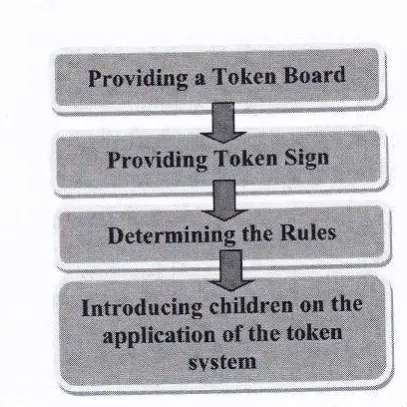
Figure
1.
The preparation stage of implementatron economy token model7.1.1
1. Providing a Token BoardToken board is the boards or media
to
attach starsor
marks obtainedby
childrenon
any pointsthat
have been definedin
the rule
madeby
theteacher. Token board
is
madeof
white boardwith
the size is adjusted to the number
of
children' The child's name is writtenwith
declining or downwardposition coupled
with the
implementation
or effective teaching written horizontally'Table 1. An ExamPle of Token Board
:
7.1.2
Providing Token SignStar sign
or
other token markers are pins starimage that
*ltt
U.
affixed by the
teacheron
the boaid based on the nameof
eachchild'
Star or pin is a sign that the child has been able to implement arule
oi
rule set. Tokens can also be stickers, bottle caps and other objects that can be affixed on board the token.*ffiw
7.1.3
Determining the RulesRules
to
be
set, generally, refers
to
the developmentof
positive habits setby
the teacher' [image:10.595.106.568.76.794.2]Determination
of
the type
or
target
of
positive habits should referto
the conditionof
the child's behaviorin
school that needs to be improved' Here are examplesof
some rules thatwill
be applied in the token model.Table2. ExamPle of Rule
1.
lnviting
friends
to
PlaYtogether.
2.
Responding friendlY
to
the peoplewho
greethim.
3.
Performing
the
game according to the rules.4.
Willing to
disPoseof
wastein
proper place.5.
Not scribbling in
anY Place.6.
Being
ontime to
school.7.
Saying thank
to
anY PeoPlewho
helphim.
7.1.4
lntroducing children
on the applicationof
the token sYstemEducators mention a few
of
rules thatwill
be applied in the token system, including:u.
^
typ"
of positive habits thatwill
be observed intoGn
modets such asbeing
good attitudeof
Time of Token Giving
Token
or a
sign
is
given every day
by
the teacherto
the child, when the childis
carrying out one rule that has been set. For every 1 (one) rule that can be implemented by a child then theFigrr."
3.
Picture of Board RulesFigure
2.
ExamPles of Token [image:10.595.115.327.441.592.2]AS:
l.
child gets one (1) star.
If
in a day there are some rule that a child is able to do then the childwill
get also some stars
in
that day. Acquisition of astar or token
will
be evaluated or reported every teacherin
early next week whenthe
learning begins.It
is
intended that the child's progress last week may spur children to do better and do more in this week's rule.7.2
ImplementationPhaseImplementation phase includes activities such
The actor
of
token program that is educators or parents should carefully observe the emergenceof
positive habitsin
accordancewith
the rules that has been set.2.
Educators give signs (markers) on token board in accordance with emergent behavior.3.
Educators save the data collectedby
the child every day.4.
Educators accumulatethe number
of
tokensearned each
child
during
a
predeterminedperiod,
for
example,
Monday-Thursday (4 days).Table 3. Token Board containing token accumulation
5.
Educators manage stocks (gifts) to be given as atoken
that
mustbe paid
to
the child.
Gift
ortoken should
be
objects that are interesting tochildren so as
to
motivate childrento
developpositive habits.
If
the
reinforcementor
tokenassessed children less attractive, there is a
wory
that
the
children
will be
reluctant
and unenthusiastic.b.
Educators present the resultsof
a child
tokenacquisition
and give
appreciationto
children qhtr received the token at most,for
example bygivine token
in
the form
of
stickers objectsprettned bv
childrenor
othergifts
that appeal to children.7.
Educatorsmotivate children
to
keep
them develop positir c habit.8.
Educators anticipate
possible
contingency punishmentfor
children. u.ho received
theInternational Conference on Current Issues in Education 2015 - 313
token, but the positive habits
or
good behavtor does not reappear. In this case the educator can provide contingency penalty by pulling back the token has been given in the past,in
the hopeof
positive habits children can
reappearwith
apromise ofreturn token that has been obtained.
9.
Educators supervise the implementationof
thetoken program and deal with potential problems,
for
example, children are forced and crying tobe
given token thoughthe child
is
not
doing positive habits.l0.Educators evaluate
the
implementationof
the system so that the next token system can ntn better.8.
ConclusionDevelopment
activity is
a development guideprototype
of
the
economytoken model
in
early childhood learning, especially children of 2-4 yearscontaining
an
introduction, literature review of
social-emotional development
and the theory of
economy token, implementation
of
economy tokenmodels
in
the
learning
and
conclusion.
Thisprototype
guide
results
in a
two-stepimplementation
of
economytoken
consistingof
procurement token boards, providing a token sign,
the
determination
of
rules,
introduction of
application systems such as the
tlpe
of
token in children positive habits thatwill
be
applied. Theresults
of
prototypes
formulation
were
then validatedby
experts and users that the results state that the prototype models deserve to be tested.The
implementation
of
giving
positive reinforcement such as tokenwhich is to
establish and develop habitsof
children needsto
carry out the rules of administration so that the child does not depend on the prize. Economy token modifications appliedin
the behaviorof
childrenof
2-4 years is not usinggift
items, but in the formof
sticker as an encouragementprize
for
children
in
developing positive habits. Rules that needto
be enforced inthe provision
of
positive
reinforcement include: consistency of rules, the intensity and frequencyof
administration, and the type of reinforcement which is given.
REFERENCES
[]
BemardR.
S.,
CohenL.
L.,
and MoffettK.2009.
A
Token
Economy
for
ExerciseAdherence
in
Pediatric
Cystic
Fibrosis:A Single-Subject Analysis.Journal of
Pediatric Psychology.Vol. 34 Issue4,
p354-365,l2p,
1Chart, 4 Graphs.
[2]
Martin,
G.
And
Pear,
J.
1992.
Behavior314 - International Conference on Current Issues in Education 2015
Miltenberger,
R. G.
2004.
Behavior Modification: Principle and Procedures FourthE dition. California: Wadsworth.
Muhibbin Syah.
(2002).
Psikologi Pendidikan dengan PendekatanBaru. Bandtng:
Remaja RosdakaryaRobert
M
Gagne.(1989).
The conditionsof
Le arning, Terj emahan Munandir. Jakarta: PAU Robert
R. Reilly
and Ernest L.Lewis. (1985).Educational Psychologt.
New
York: Macmillan Publishing Co. IncSlameto.
(2003). Belajar dan
Faktor-Faktor yang Mempengaruhinya. Jakarta: Rineka Cipta[8]
Soekadji,
S.
1983. Modifikasi
Perilaku:Penerapan
Sehari-hari
dan
Penerapan Profe s ional. Yo gyakarta: LYbertY[9]
Soha
Hartati. (2005).
Belajar
danPembelaiaran
Anak Usia
Dini.
Jakarta: Universitas Negeri Jakarta[10]Susanto,
E.
2008.
Ekonomi Token,
TipsMendidik
Anak Kreatif.http:iieko I 3.wordpress.conl/2008/05/1 S/ekono
mi-token-tips-mendidik-anak-kreatif/.
28 Oktober 201l.
t3l
l4l
tsl
t6l